EP1967497A2 - Diamant granulaire et électrode en diamant l'utilisant - Google Patents
Diamant granulaire et électrode en diamant l'utilisant Download PDFInfo
- Publication number
- EP1967497A2 EP1967497A2 EP08250618A EP08250618A EP1967497A2 EP 1967497 A2 EP1967497 A2 EP 1967497A2 EP 08250618 A EP08250618 A EP 08250618A EP 08250618 A EP08250618 A EP 08250618A EP 1967497 A2 EP1967497 A2 EP 1967497A2
- Authority
- EP
- European Patent Office
- Prior art keywords
- diamond
- base
- granular
- electrode
- conductive
- Prior art date
- Legal status (The legal status is an assumption and is not a legal conclusion. Google has not performed a legal analysis and makes no representation as to the accuracy of the status listed.)
- Pending
Links
Images


Classifications
-
- C—CHEMISTRY; METALLURGY
- C02—TREATMENT OF WATER, WASTE WATER, SEWAGE, OR SLUDGE
- C02F—TREATMENT OF WATER, WASTE WATER, SEWAGE, OR SLUDGE
- C02F1/00—Treatment of water, waste water, or sewage
- C02F1/46—Treatment of water, waste water, or sewage by electrochemical methods
- C02F1/461—Treatment of water, waste water, or sewage by electrochemical methods by electrolysis
- C02F1/46104—Devices therefor; Their operating or servicing
- C02F1/46109—Electrodes
- C02F1/46114—Electrodes in particulate form or with conductive and/or non conductive particles between them
-
- C—CHEMISTRY; METALLURGY
- C02—TREATMENT OF WATER, WASTE WATER, SEWAGE, OR SLUDGE
- C02F—TREATMENT OF WATER, WASTE WATER, SEWAGE, OR SLUDGE
- C02F1/00—Treatment of water, waste water, or sewage
- C02F1/46—Treatment of water, waste water, or sewage by electrochemical methods
- C02F1/461—Treatment of water, waste water, or sewage by electrochemical methods by electrolysis
- C02F1/467—Treatment of water, waste water, or sewage by electrochemical methods by electrolysis by electrochemical disinfection; by electrooxydation or by electroreduction
- C02F1/4672—Treatment of water, waste water, or sewage by electrochemical methods by electrolysis by electrochemical disinfection; by electrooxydation or by electroreduction by electrooxydation
-
- C—CHEMISTRY; METALLURGY
- C23—COATING METALLIC MATERIAL; COATING MATERIAL WITH METALLIC MATERIAL; CHEMICAL SURFACE TREATMENT; DIFFUSION TREATMENT OF METALLIC MATERIAL; COATING BY VACUUM EVAPORATION, BY SPUTTERING, BY ION IMPLANTATION OR BY CHEMICAL VAPOUR DEPOSITION, IN GENERAL; INHIBITING CORROSION OF METALLIC MATERIAL OR INCRUSTATION IN GENERAL
- C23C—COATING METALLIC MATERIAL; COATING MATERIAL WITH METALLIC MATERIAL; SURFACE TREATMENT OF METALLIC MATERIAL BY DIFFUSION INTO THE SURFACE, BY CHEMICAL CONVERSION OR SUBSTITUTION; COATING BY VACUUM EVAPORATION, BY SPUTTERING, BY ION IMPLANTATION OR BY CHEMICAL VAPOUR DEPOSITION, IN GENERAL
- C23C16/00—Chemical coating by decomposition of gaseous compounds, without leaving reaction products of surface material in the coating, i.e. chemical vapour deposition [CVD] processes
- C23C16/22—Chemical coating by decomposition of gaseous compounds, without leaving reaction products of surface material in the coating, i.e. chemical vapour deposition [CVD] processes characterised by the deposition of inorganic material, other than metallic material
- C23C16/26—Deposition of carbon only
- C23C16/27—Diamond only
-
- C—CHEMISTRY; METALLURGY
- C23—COATING METALLIC MATERIAL; COATING MATERIAL WITH METALLIC MATERIAL; CHEMICAL SURFACE TREATMENT; DIFFUSION TREATMENT OF METALLIC MATERIAL; COATING BY VACUUM EVAPORATION, BY SPUTTERING, BY ION IMPLANTATION OR BY CHEMICAL VAPOUR DEPOSITION, IN GENERAL; INHIBITING CORROSION OF METALLIC MATERIAL OR INCRUSTATION IN GENERAL
- C23C—COATING METALLIC MATERIAL; COATING MATERIAL WITH METALLIC MATERIAL; SURFACE TREATMENT OF METALLIC MATERIAL BY DIFFUSION INTO THE SURFACE, BY CHEMICAL CONVERSION OR SUBSTITUTION; COATING BY VACUUM EVAPORATION, BY SPUTTERING, BY ION IMPLANTATION OR BY CHEMICAL VAPOUR DEPOSITION, IN GENERAL
- C23C16/00—Chemical coating by decomposition of gaseous compounds, without leaving reaction products of surface material in the coating, i.e. chemical vapour deposition [CVD] processes
- C23C16/22—Chemical coating by decomposition of gaseous compounds, without leaving reaction products of surface material in the coating, i.e. chemical vapour deposition [CVD] processes characterised by the deposition of inorganic material, other than metallic material
- C23C16/26—Deposition of carbon only
- C23C16/27—Diamond only
- C23C16/278—Diamond only doping or introduction of a secondary phase in the diamond
-
- C—CHEMISTRY; METALLURGY
- C23—COATING METALLIC MATERIAL; COATING MATERIAL WITH METALLIC MATERIAL; CHEMICAL SURFACE TREATMENT; DIFFUSION TREATMENT OF METALLIC MATERIAL; COATING BY VACUUM EVAPORATION, BY SPUTTERING, BY ION IMPLANTATION OR BY CHEMICAL VAPOUR DEPOSITION, IN GENERAL; INHIBITING CORROSION OF METALLIC MATERIAL OR INCRUSTATION IN GENERAL
- C23C—COATING METALLIC MATERIAL; COATING MATERIAL WITH METALLIC MATERIAL; SURFACE TREATMENT OF METALLIC MATERIAL BY DIFFUSION INTO THE SURFACE, BY CHEMICAL CONVERSION OR SUBSTITUTION; COATING BY VACUUM EVAPORATION, BY SPUTTERING, BY ION IMPLANTATION OR BY CHEMICAL VAPOUR DEPOSITION, IN GENERAL
- C23C16/00—Chemical coating by decomposition of gaseous compounds, without leaving reaction products of surface material in the coating, i.e. chemical vapour deposition [CVD] processes
- C23C16/44—Chemical coating by decomposition of gaseous compounds, without leaving reaction products of surface material in the coating, i.e. chemical vapour deposition [CVD] processes characterised by the method of coating
- C23C16/4417—Methods specially adapted for coating powder
-
- C—CHEMISTRY; METALLURGY
- C25—ELECTROLYTIC OR ELECTROPHORETIC PROCESSES; APPARATUS THEREFOR
- C25B—ELECTROLYTIC OR ELECTROPHORETIC PROCESSES FOR THE PRODUCTION OF COMPOUNDS OR NON-METALS; APPARATUS THEREFOR
- C25B9/00—Cells or assemblies of cells; Constructional parts of cells; Assemblies of constructional parts, e.g. electrode-diaphragm assemblies; Process-related cell features
- C25B9/40—Cells or assemblies of cells comprising electrodes made of particles; Assemblies of constructional parts thereof
-
- C—CHEMISTRY; METALLURGY
- C02—TREATMENT OF WATER, WASTE WATER, SEWAGE, OR SLUDGE
- C02F—TREATMENT OF WATER, WASTE WATER, SEWAGE, OR SLUDGE
- C02F1/00—Treatment of water, waste water, or sewage
- C02F1/46—Treatment of water, waste water, or sewage by electrochemical methods
- C02F1/461—Treatment of water, waste water, or sewage by electrochemical methods by electrolysis
- C02F1/46104—Devices therefor; Their operating or servicing
- C02F1/46109—Electrodes
- C02F2001/46133—Electrodes characterised by the material
-
- Y—GENERAL TAGGING OF NEW TECHNOLOGICAL DEVELOPMENTS; GENERAL TAGGING OF CROSS-SECTIONAL TECHNOLOGIES SPANNING OVER SEVERAL SECTIONS OF THE IPC; TECHNICAL SUBJECTS COVERED BY FORMER USPC CROSS-REFERENCE ART COLLECTIONS [XRACs] AND DIGESTS
- Y10—TECHNICAL SUBJECTS COVERED BY FORMER USPC
- Y10T—TECHNICAL SUBJECTS COVERED BY FORMER US CLASSIFICATION
- Y10T428/00—Stock material or miscellaneous articles
- Y10T428/29—Coated or structually defined flake, particle, cell, strand, strand portion, rod, filament, macroscopic fiber or mass thereof
- Y10T428/2982—Particulate matter [e.g., sphere, flake, etc.]
- Y10T428/2991—Coated
Definitions
- the present invention relates to a granular diamond and a diamond electrode using the same.
- a diamond electrode is manufactured by coating the surface of a base with conductive diamond, by CVD (Chemical Vapor Deposition) using carbon-containing gas such as methane as a main material.
- CVD Chemical Vapor Deposition
- metal such as Nb (niobium), Ti (Titan) and the like as the base.
- Nb niobium
- Ti Ti
- a diamond electrode may also be possible to manufacture a diamond electrode by employing a base of silicon or SiC of which difference in coefficient of thermal expansion between diamond is small relative to the above-described metal, and coating the base with conductive diamond by CVD. In this case, however, though the above-described crack or peeling of the conductive diamond does not easily occur, there is a disadvantage that a high conductivity is not obtained.
- Patent Document 1 discloses an electrolytic treatment apparatus using an electrode obtained by coating a base made of a lattice-shaped round bar with conductive diamond.
- Patent Document 1 discloses that, by exposing the edge faces of the base made of the lattice-shaped round bar to the outside of the electrolytic cell without coating the edge faces with the conductive diamond, the aforementioned peeling of conductive diamond by residual stress attributed to a difference in coefficient of thermal expansion during CVD can be suppressed.
- the electrode disclosed in Patent Document 1 the length of the round bar by which peeling of diamond is prevented is actually limited. Accordingly, the size of an electrode that can be implemented is limited, and therefore it is not applicable to electrochemically process a large amount of solution at a time.
- Patent Document 2 discloses electrodes in which a plurality of conductive diamond pieces are fixed on a large substrate (base) in parallel by a conductive paste.
- the conductive paste may be dissolved into the solution from the gap between the electrodes fixed in parallel.
- Patent Document 3 discloses an electrolysis method. Accordingly to the method, a polycrystal of conductive diamond manufactured by CVD, or conductive diamond particles obtained by breaking the polycrystal is/are immersed into an electrolytic solution so as to be interposed between electrodes arranged to face each other. Then, a voltage is applied to the conductive diamond via the electrodes.
- the method disclosed in Patent Document 3 uses solely the conductive diamond, it is not possible to attain a high conductivity.
- the present invention has been made to solve the above-described problems, and an object thereof is to provide a granular diamond having a great surface area and a high conductivity, and a diamond electrode using the same.
- the present invention provides a granular diamond (hereinafter referred to as "the first granular diamond”), including: a columnar base formed by Nb, Ti or W and having a length in a longitudinal direction of not more than 30 mm and a maximum length in a direction perpendicular to the longitudinal direction of not more than 15 mm; and conductive diamond coating not less than 30% of a surface of the base.
- the first granular diamond including: a columnar base formed by Nb, Ti or W and having a length in a longitudinal direction of not more than 30 mm and a maximum length in a direction perpendicular to the longitudinal direction of not more than 15 mm; and conductive diamond coating not less than 30% of a surface of the base.
- the columnar base has the length in the longitudinal direction of not less than 2 mm and the maximum length in the direction perpendicular to the longitudinal direction of not less than 1 mm.
- the present invention also provides a granular diamond (hereinafter referred to as "the second granular diamond”), including: a spherical base formed by Nb, Ti or W and having a diameter of not more than 15 mm; and conductive diamond coating not less than 50% of a surface of the base.
- the second granular diamond including: a spherical base formed by Nb, Ti or W and having a diameter of not more than 15 mm; and conductive diamond coating not less than 50% of a surface of the base.
- the diameter of the spherical base is not less than 2 mm.
- the present invention also provides a diamond electrode using the above-described granular diamond of the present invention (the first granular diamond and/or second granular diamond).
- the granular diamond of the present invention even when conductive diamond is formed by CVD so as to coat the surface of the base formed by Nb, Ti or W, crack or peeling of the conductive diamond, which is invited by residual stress attributed to a difference in coefficient of thermal expansion between the diamond and the base during CVD, does not easily occur. Thus, a granular diamond having a great surface area and a high conductivity can be implemented. By using such a granular diamond of the present invention, a diamond electrode having a life drastically longer than that of a conventional electrode can be implemented.
- a base formed by Nb (niobium), Ti (titanium) or W (Tungsten) is used. Accordingly, the granular diamond having a high conductivity (specifically, about 5.0 ⁇ 10 4 - 2 ⁇ 10 5 / m ⁇ ) is realized, as compared to a case where a base formed by silicon, SiC or the like is used.
- the present invention is also advantageous in that, since Nb, Ti or W being valve metal is used as a material for forming the base, even when the surface of the base is not entirely coated by conductive diamond and the surface of the base is partially exposed, the exposed base surface does not contribute to electrolysis.
- the granular diamond of the present invention is characterized in use of a base of particular shape and size as the above-described base, and can generally be classified into two types depending on the shape and size of the base.
- Fig. 1 schematically shows one preferable example of a first granular diamond, which is one type of the granular diamond of the present invention.
- Fig. 1(a) is a perspective view and Fig. 1(b) is a cross-sectional view along a cross-section line IB-IB in Fig. 1(a) .
- First granular diamond 1 of the present invention basically includes a columnar base 2 having a particular size, and conductive diamond 3 coating the surface of base 2.
- columnar refers to a shape elongated in one direction (the direction being referred to as "the longitudinal direction"), every cross section of which perpendicular to the longitudinal direction has substantially the same cross-sectional area.
- the shape may be solid or hollow.
- columnar base is advantageous in that, as compared to use of a base of other shape, granular diamonds as packed in a column shown in Fig. 3 form great spaces that facilitate flow of electrolytic solution.
- a columnar shape may specifically include a solid or hollow cylindrical or prismatic (triangular prism, quadrangular prism, polygonal prism and the like) shape.
- a solid cylindrical shape as shown in Fig. 1 is preferable, since there are fewer edge portions where conductive diamond tends to peel off or brake.
- First granular diamond 1 of the present invention is characterized in that above-described columnar base 2 has a length in the longitudinal direction (length L in the example of Fig. 1 ) of not more than 30 mm and a maximum length (diameter R in the example of Fig. 1 ) in the direction perpendicular to the longitudinal direction of not more than 15 mm.
- the first granular diamond of the present invention has base 2 of such a size, even when conductive diamond is formed so as to coat the surface of the base by CVD, the conductive diamond is less likely to crack or peel off by residual stress attributed to a difference in coefficient of thermal expansion between the diamond and the base during CVD, in spite of use of the base formed by Nb, Ti or W.
- the first granular diamond of the present invention also has an advantage of an increased surface area realized by use of a base having a length in the longitudinal direction of not more than 30 mm and a maximum length in the direction perpendicular to the longitudinal direction of not more than 15 mm, as compared to a case where a plate-like base is used.
- a granular diamond having a great surface area and a high conductivity is realized.
- the columnar base in the first granular diamond of the present invention has a length in the longitudinal direction of not less than 2 mm and a maximum length in the direction perpendicular to the longitudinal direction of not less than 1 mm, for the following reasons. If the length in the longitudinal direction is less than 2 mm, the granular diamonds are packed in the column shown in Fig. 3 densely. Thus, bubbles generated by electrolysis are not released and the following electrolysis tends to be hindered (the electrolysis efficiency may be reduced). Also, if the maximum length in the direction perpendicular to the longitudinal direction is less than 1 mm, damages such as braking or bending may be incurred.
- One major feature of the first granular diamond of the present invention is that not less than 30% of the surface of the above-described columnar base is coated with conductive diamond. This is because a practical electrolysis performance is hardly obtained if the conductive diamond only coats less than 30% of the surface of the base. Considering the realization of a granular diamond having high electrolysis performance, preferably a greater proportion of the surface of the base is coated with the conductive diamond. Ideally, 100% of the surface of the base is coated with the conductive diamond.
- Such conductive diamond can be obtained by adding a dopant (impurity) to diamond to render the diamond conductive.
- the dopant added to the diamond may include, for example, phosphorus, nitride, boron or the like, while being not limited thereto.
- conductive diamond having boron added as a dopant is preferable, since a high conductivity is realized by addition of a small amount of boron.
- Boron oxide, diphosphorous pentaoxide, trimethyl borate, nitride gas and the like may suitably be used as a material of such a dopant, since they are less toxic.
- an addition amount of the aforementioned dopant is not specifically limited, it is preferably in a range of 1 - 10000 ppm and more preferably in a range of 100 - 10000 ppm, for the following reasons. If the addition amount is less than 1 ppm, the conductivity is too low and may not be used in electrolysis. Also, if the addition amount of the dopant is more than 10000 ppm, the crystallinity of the conductive diamond is reduced and the electrochemical feature specific to the conductive diamond may be lost. It is to be noted that the addition amount of the dopant in the conductive diamond refers to a value measured using an SIMS (Secondary Ion Mass Spectrometry), for example.
- SIMS Secondary Ion Mass Spectrometry
- the conductive diamond is formed in a manner of a film over the surface of the base to coat the surface. While the thickness of the conductive diamond is not specifically limited, preferably it is in a range of 3 - 50 ⁇ m, and more preferably in a range of 5 - 20 ⁇ m, for the following reasons. If the thickness of the conductive diamond is less than 3 ⁇ m, pinholes may occur in the conductive diamond and the conductive diamond may peel off from the base during electrolysis. Also, if the thickness of the conductive diamond is more than 50 ⁇ m, the conductive diamond may be damaged by internal stress in the conductive diamond and the conductive diamond may peel off from the base. It is to be noted that the thickness of the conductive diamond refers to a value measured by observing the cross section of the granular diamond using an SEM (Scanning Electron microscope), for example.
- SEM Sccanning Electron microscope
- Fig. 2 schematically shows one preferable example of a second granular diamond, which is one type of the granular diamond of the present invention.
- Fig. 2(a) is a perspective view and
- Fig. 2(b) is a cross-sectional view along a cross-section line IIB-IIB in Fig. 2(a) .
- Second granular diamond 6 of the present invention basically includes a spherical base 7 having a particular size, and conductive diamond 8 coating the surface of base 7.
- Use of a spherical base is advantageous in that, as compared to use of a base of other shape, granular diamonds packed in a column shown in Fig. 3 are allowed to be arranged uniformly as a whole.
- Spherical base 7 for use in second granular diamond 6 of the present invention may be solid or hollow ( Fig. 2 shows a hollow spherical example).
- base 7 is spherical as in the example of Fig. 2 , a base having diameter D of not more than 15 mm is used, for the following reasons. If a spherical base having diameter D of more than 15 mm is used, when the conductive diamond is formed on the surface, the conductive diamond may crack or peel off. Thus, a granular diamond having a great surface area and a high conductivity cannot be realized. Use of spherical base 7 having diameter D of not more than 15 mm is also advantageous in that uniform conductive diamond is formed.
- diameter D of above-described spherical base 7 is not less than 2 mm, for the following reason. If the diameter of the spherical base is less than 2 mm, the granular diamonds are packed in the column shown in Fig. 3 densely. Thus, bubbles generated by electrolysis are not released and the following electrolysis tends be hindered (the electrolysis efficiency may be reduced).
- One major feature of the second granular diamond of the present invention is that not less than 50% of the surface of the above-described spherical base is coated with conductive diamond. This is because a practical electrolysis performance is hardly obtained if the conductive diamond only coats less than 50% of the surface of the base.
- a greater proportion of the surface of the base is coated with the conductive diamond.
- 100% of the surface of the base is coated with the conductive diamond.
- the type, addition amount, thickness and the like of the dopant of the used conductive diamond in the second granular diamond of the present invention are the same as described above as to the first granular diamond.
- a manufacturing method of the above-described granular diamond of the present invention is not specifically limited, it may preferably be manufactured by preparing a base formed by Nb, Ti or W in the above-described shape and size (for example, by using an appropriate commercially available product), and by forming the conductive diamond in a manner of a film by CVD on the surface of the base, for example.
- coating of the conductive diamond by CVD can be performed for a plurality of times while changing the direction of the base, in accordance with the shape of the base (for example, in case of a spherical base, coating of the conductive diamond is performed by CVD on one hemisphere, and thereafter, turning over the base, coating of the conductive diamond is performed by CVD on the other hemisphere).
- Formation of the conductive diamond by CVD can be performed by using an appropriate, conventionally known CVD apparatus.
- hot-filament CVD, microwave plasma CVD or the like can suitably be employed. While the conditions of CVD are not specifically limited, hot-filament CVD can suitably be performed under conditions of, for example, for each single CVD: filament temperature of about 1800 - 2400°C; base temperature of about 750 - 950°C; pressure of about 2000 - 100000 Pa (hydrogen gas atmosphere); gas concentration of organic compound (such as methane, alcohol) relative to hydrogen gas of about 0.1 - 10 volume %; dopant gas concentration relative to the organic compound of about 0.001 - 1 volume %; and gas feeding rate of about 0.01 - 10 liter/min.
- organic compound such as methane, alcohol
- Microwave plasma CVD can suitably be performed under conditions of, for example, for each single CVD: plasma output of about 1 - 5 kW; pressure inside chamber of about 4000 - 15000 Pa; introduction flow rate of a mixture gas of hydrogen, carbon source and dopant of about 10 - 100 ml/min (with the same gas composition ratio as in the hot-filament CVD).
- the first granular diamond of the present invention may be manufactured by forming conductive diamond by CVD on a columnar object having a length corresponding to the total length of a plurality of the bases in the longitudinal direction, and cutting it into a desired size.
- the advantage of manufacturing the first granular diamond in such a manner is a highly improved manufacturing efficiency.
- dicing, wire electrical discharge machining, laser, waterjet and the like may suitably employed, for example.
- Fig. 3 schematically shows a diamond electrode 11 using first granular diamonds 1 of the present invention of the example shown in Fig. 1 .
- Fig. 4 schematically shows a diamond electrode 16 using second granular diamonds 6 of the present invention of the example shown in Fig. 2 .
- both the first and second granular diamonds have the great surface area and high conductivity, which can suitably be used for a diamond electrode for performing electrochemical processing of various solutions, for example, electrolysis of water for obtaining electrolyzed water used in the fields of medical and food or for cleaning electronic components, electrolysis of water for wastewater treatment and the like.
- the present invention also provides a diamond electrode using the granular diamonds of the present invention.
- the diamond electrode of the present invention is advantageous in that it is excellent in durability by use of the granular diamonds of the present invention, as compared to a conventional diamond electrode.
- the excellent durability of the diamond electrode of the present invention can be checked by evaluating the life of the electrode by, for example, a test (accelerated test) of performing electrolysis while passing current that is some times to 10 times greater (5 - 30 A/cm 2 ) than current usually used (0.5 - 3 A/cm 2 ), and measuring the time until the conductive diamond peels off.
- Each diamond electrode 11, 16 of the present invention is implemented by, for example as respectively shown in Figs. 3 and 4 , packing a multiple of granular diamonds 1, 6 in mesh-like metal column 12 and electrically connecting a feeding line 13 to column 12. Multiple of granular diamonds 1, 6 packed in column 12 are electrically continuous to each other by contacting each other, and can be regarded as one porous electrode in the packed state. That is, each diamond electrode 11, 16 having a great surface area and a high conductivity is realized.
- column 12 formed by titanium is preferable for its extremely high corrosion resistance.
- Figs. 3 and 4 show merely examples of the diamond electrode of the present invention, and the diamond electrode of the present invention is not limited to the configurations shown in Figs. 3 and 4 .
- the diamond electrode of the present invention only requires that at least one of above-described first granular diamond 1 and second granular diamond 6 of the present invention is used.
- First granular diamond 1 and second granular diamond 6 may be used in combination.
- first granular diamonds 1 and/or second granular diamonds 6 of different sizes may be used in combination.
- the diamond electrode of the present invention is preferably realized using granular diamonds 1, 6 of the same shape and size, as shown in Figs. 3 and 4 .
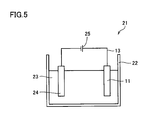
- FIG. 5 schematically shows an electrolysis apparatus 21 using diamond electrode 11 of the present invention of the example shown in Fig. 3 .
- Electrolysis apparatus 21 of the example shown in Fig. 5 is configured as follows, for example.
- An electrolytic solution 23 is stored in an electrolytic cell 22.
- above-described diamond electrode 11 (used as an anode electrode) of the present invention and a cathode electrode 24 are immersed, and diamond electrode 11 and cathode electrode 24 are electrically connected to each other.
- a power supply 25 is electrically connected between cathode electrode 24 and diamond electrode 11.
- Fig. 5 shows merely an example, and it goes without saying that the electrolysis apparatus using the diamond electrode of the present invention is not limited to the configuration shown in Fig. 5 . While Fig. 5 shows the case where diamond electrode 11 in the example shown in Fig. 3 is used, it goes without saying that diamond electrode 16 in the example shown in Fig. 4 may alternatively be used.
- Samples (1-12) of 12 types of spherical or cylindrical base samples in the shape and size shown in Table 1 were prepared.
- a film-like conductive diamond having boron concentration of 1000 ppm was formed by hot filament CVD, whereby the surface was coated and a granular diamond was produced.
- Coating of the conductive diamond by hot-filament CVD was performed twice. After the first coating, examination was performed by observing the appearance of the conductive diamond by a stereoscopic microscope, and when there is no irregularity such as crack or peeling of the conductive diamond, the base was turned over and the second coating was performed. Also after the second coating, examination for irregularity was performed by observing the appearance of the conductive diamond by the stereoscopic microscope. Each of the samples was formed so that the conductive diamond had average thickness of 10 ⁇ m.
- diameter D must be not more than 15 mm when the base is spherical, and that length L in the longitudinal direction must be not more than 30 mm and diameter R in the direction perpendicular to the longitudinal direction must be not more than 15 mm when the base is cylindrical.
- the granular diamonds using samples 1-4 and 6-10 where the conductive diamond did not crack or peel off in Experimental Example 1 were packed in columns each having a feeding line electrically connected, to produce diamond electrodes as shown in Figs. 3 and 4 .
- the employed column was a mesh-like Ti-made column (16 mm ⁇ 32 mm ⁇ 110 mm; wire diameter 0.3 mm; and opening size 1.29 mm).
- the granular diamonds were packed in the number that provided the same total surface area (about 7050 mm 2 ) irrespective of the size of the granular diamonds.
- the electrolysis apparatus as shown in Fig. 5 was produced and electrolysis tests were performed.
- a plate-like platinum electrode of 50 mm ⁇ 50 mm ⁇ 2 mm was used as the cathode, and cutting fluid of 1L of which COD (Chemical Oxygen Demand) was 830 mg/l was used as the electrolytic solution.
- the electrolysis was performed for four hours at a constant voltage of 5V, and COD concentration after the electrolysis was measured for each diamond electrode (the COD concentration was measured by COD (Cr) method).
- Table 2 shows the result that when the granular diamonds using samples 1, 6 and 7 are used, the reduction amount of COD concentration is relatively small. The reason thereof was considered as follows. These granular diamonds were smaller in size than the others and therefore produced smaller gaps between them when packed in the column. In the gaps, the bubbles generated by the electrolysis were trapped and the following electrolysis was hindered. From the result of Experimental Example 2, it was considered that, diameter D is preferably not less than 2 mm when the base is spherical, and that length L in the longitudinal direction is preferably not less than 2 mm and diameter R in the direction perpendicular to the longitudinal direction is preferably not less than 1 mm when the base is cylindrical.
Landscapes
- Chemical & Material Sciences (AREA)
- Organic Chemistry (AREA)
- Chemical Kinetics & Catalysis (AREA)
- Engineering & Computer Science (AREA)
- General Chemical & Material Sciences (AREA)
- Metallurgy (AREA)
- Materials Engineering (AREA)
- Mechanical Engineering (AREA)
- Electrochemistry (AREA)
- Life Sciences & Earth Sciences (AREA)
- Inorganic Chemistry (AREA)
- Water Supply & Treatment (AREA)
- Environmental & Geological Engineering (AREA)
- Hydrology & Water Resources (AREA)
- Electrodes For Compound Or Non-Metal Manufacture (AREA)
- Water Treatment By Electricity Or Magnetism (AREA)
- Chemical Vapour Deposition (AREA)
Applications Claiming Priority (1)
| Application Number | Priority Date | Filing Date | Title |
|---|---|---|---|
| JP2007046981A JP2008208429A (ja) | 2007-02-27 | 2007-02-27 | 粒状ダイヤモンドおよびそれを用いたダイヤモンド電極 |
Publications (2)
| Publication Number | Publication Date |
|---|---|
| EP1967497A2 true EP1967497A2 (fr) | 2008-09-10 |
| EP1967497A3 EP1967497A3 (fr) | 2008-10-15 |
Family
ID=39312912
Family Applications (1)
| Application Number | Title | Priority Date | Filing Date |
|---|---|---|---|
| EP08250618A Pending EP1967497A3 (fr) | 2007-02-27 | 2008-02-22 | Diamant granulaire et électrode en diamant l'utilisant |
Country Status (3)
| Country | Link |
|---|---|
| US (1) | US20080206564A1 (fr) |
| EP (1) | EP1967497A3 (fr) |
| JP (1) | JP2008208429A (fr) |
Families Citing this family (4)
| Publication number | Priority date | Publication date | Assignee | Title |
|---|---|---|---|---|
| SG193885A1 (en) * | 2008-09-24 | 2013-10-30 | Kurita Water Ind Ltd | Diamond electrode and method for manufacturing diamond electrode |
| JP7280650B2 (ja) * | 2020-03-02 | 2023-05-24 | 学校法人東京理科大学 | 固定床電解処理装置及び電解処理方法 |
| JP7725876B2 (ja) * | 2021-06-01 | 2025-08-20 | 富士電機株式会社 | 水質アルカリ化装置 |
| CN119977082B (zh) * | 2025-02-06 | 2025-09-16 | 北京寰宇晶科科技有限公司 | 一种金刚石电极及其制备方法 |
Citations (3)
| Publication number | Priority date | Publication date | Assignee | Title |
|---|---|---|---|---|
| JP2004321962A (ja) | 2003-04-25 | 2004-11-18 | Kurita Water Ind Ltd | 電解用電極および排水用電解処理装置 |
| JP2004358452A (ja) | 2003-06-04 | 2004-12-24 | Ebara Corp | 電解処理装置 |
| JP2005290403A (ja) | 2004-03-31 | 2005-10-20 | Kurita Water Ind Ltd | 導電性ダイヤモンド粒子による電解方法及び導電性ダイヤモンド粒子の製造方法 |
Family Cites Families (5)
| Publication number | Priority date | Publication date | Assignee | Title |
|---|---|---|---|---|
| US5399247A (en) * | 1993-12-22 | 1995-03-21 | Eastman Kodak Company | Method of electrolysis employing a doped diamond anode to oxidize solutes in wastewater |
| JP3501552B2 (ja) * | 1995-06-29 | 2004-03-02 | 株式会社神戸製鋼所 | ダイヤモンド電極 |
| FR2790268B1 (fr) * | 1999-02-25 | 2001-05-11 | Suisse Electronique Microtech | Cellule d'electrolyse a electrode bipolaire comportant du diamant |
| JP2004039372A (ja) * | 2002-07-02 | 2004-02-05 | Toyo Tanso Kk | 窒素とホウ素を含有し導電性を有するダイヤモンド粒状体及びこれを用いた流動床電極 |
| KR20060009811A (ko) * | 2003-05-26 | 2006-02-01 | 스미토모덴키고교가부시키가이샤 | 다이아몬드 피복 전극 및 그의 제조 방법 |
-
2007
- 2007-02-27 JP JP2007046981A patent/JP2008208429A/ja active Pending
-
2008
- 2008-02-20 US US12/034,342 patent/US20080206564A1/en not_active Abandoned
- 2008-02-22 EP EP08250618A patent/EP1967497A3/fr active Pending
Patent Citations (3)
| Publication number | Priority date | Publication date | Assignee | Title |
|---|---|---|---|---|
| JP2004321962A (ja) | 2003-04-25 | 2004-11-18 | Kurita Water Ind Ltd | 電解用電極および排水用電解処理装置 |
| JP2004358452A (ja) | 2003-06-04 | 2004-12-24 | Ebara Corp | 電解処理装置 |
| JP2005290403A (ja) | 2004-03-31 | 2005-10-20 | Kurita Water Ind Ltd | 導電性ダイヤモンド粒子による電解方法及び導電性ダイヤモンド粒子の製造方法 |
Also Published As
| Publication number | Publication date |
|---|---|
| US20080206564A1 (en) | 2008-08-28 |
| JP2008208429A (ja) | 2008-09-11 |
| EP1967497A3 (fr) | 2008-10-15 |
Similar Documents
| Publication | Publication Date | Title |
|---|---|---|
| JP7313577B2 (ja) | 炭素被覆された水素燃料電池用双極板 | |
| EP2333136A1 (fr) | Électrode de diamant et procédé de fabrication d'une électrode de diamant | |
| Dong et al. | Study on conductivity and corrosion resistance of N-doped and Cr/N co-doped DLC films on bipolar plates for PEMFC | |
| Feng et al. | C/CrN multilayer coating for polymer electrolyte membrane fuel cell metallic bipolar plates | |
| US20150037710A1 (en) | Coating with conductive and corrosion resistance characteristics | |
| EP2784024A2 (fr) | Séparateur de pile à combustible et son procédé de fabrication | |
| JP4746629B2 (ja) | ダイヤモンド電極および電解槽 | |
| Hu et al. | The effect of duty cycle and bias voltage for graphite-like carbon film coated 304 stainless steel as metallic bipolar plate | |
| EP1630257A1 (fr) | Electrode a diamant et procede de production | |
| EP1477585B1 (fr) | Electrode pour électrolyse et son procédé de fabrication | |
| US7468121B2 (en) | Conductive diamond electrode and process for producing the same | |
| EP1967497A2 (fr) | Diamant granulaire et électrode en diamant l'utilisant | |
| CN114447354B (zh) | 一种用于金属极板的类金刚石复合涂层及其制备方法 | |
| Cheng et al. | Plasma electrolytic oxidation behavior and corrosion resistance of brass in aluminate electrolyte containing NaH2PO4 or Na2SiO3 | |
| US12545990B1 (en) | Doped DLC for bipolar plate (BPP) | |
| EP1779101A1 (fr) | Électrodes en diamant | |
| JP2018104808A (ja) | チタン材、セパレータ、セル、および固体高分子形燃料電池 | |
| KR101372645B1 (ko) | 연료전지용 금속 분리판 제조 방법 | |
| EP4516973A1 (fr) | Substrat avec film de diamant déposé et procédé de production de substrat avec film de diamant déposé | |
| JP2019169296A (ja) | 燃料電池用セパレータ | |
| KR20240049291A (ko) | 탄소 기반 층으로 코팅된 부품 | |
| JP2007154262A (ja) | 複合基板及びその製造方法、並びに電極及び電解装置 | |
| JP2007100135A (ja) | 耐食性部材 | |
| JP2024135599A (ja) | ダイヤモンド電極、およびダイヤモンド電極の製造方法 | |
| CN121161221A (zh) | 一种多孔传输层及其制备方法和应用 |
Legal Events
| Date | Code | Title | Description |
|---|---|---|---|
| PUAI | Public reference made under article 153(3) epc to a published international application that has entered the european phase |
Free format text: ORIGINAL CODE: 0009012 |
|
| STAA | Information on the status of an ep patent application or granted ep patent |
Free format text: STATUS: REQUEST FOR EXAMINATION WAS MADE |
|
| 17P | Request for examination filed |
Effective date: 20080305 |
|
| AK | Designated contracting states |
Kind code of ref document: A2 Designated state(s): AT BE BG CH CY CZ DE DK EE ES FI FR GB GR HR HU IE IS IT LI LT LU LV MC MT NL NO PL PT RO SE SI SK TR |
|
| AX | Request for extension of the european patent |
Extension state: AL BA MK RS |
|
| PUAL | Search report despatched |
Free format text: ORIGINAL CODE: 0009013 |
|
| AK | Designated contracting states |
Kind code of ref document: A3 Designated state(s): AT BE BG CH CY CZ DE DK EE ES FI FR GB GR HR HU IE IS IT LI LT LU LV MC MT NL NO PL PT RO SE SI SK TR |
|
| AX | Request for extension of the european patent |
Extension state: AL BA MK RS |
|
| AKX | Designation fees paid |
Designated state(s): CH DE GB LI |