EP1968039A1 - Organische lichtemittierende Anzeige - Google Patents
Organische lichtemittierende Anzeige Download PDFInfo
- Publication number
- EP1968039A1 EP1968039A1 EP08250708A EP08250708A EP1968039A1 EP 1968039 A1 EP1968039 A1 EP 1968039A1 EP 08250708 A EP08250708 A EP 08250708A EP 08250708 A EP08250708 A EP 08250708A EP 1968039 A1 EP1968039 A1 EP 1968039A1
- Authority
- EP
- European Patent Office
- Prior art keywords
- switch
- electrically coupled
- light emitting
- organic light
- capacitor
- Prior art date
- Legal status (The legal status is an assumption and is not a legal conclusion. Google has not performed a legal analysis and makes no representation as to the accuracy of the status listed.)
- Ceased
Links
Images

Classifications
-
- G—PHYSICS
- G09—EDUCATION; CRYPTOGRAPHY; DISPLAY; ADVERTISING; SEALS
- G09G—ARRANGEMENTS OR CIRCUITS FOR CONTROL OF INDICATING DEVICES USING STATIC MEANS TO PRESENT VARIABLE INFORMATION
- G09G3/00—Control arrangements or circuits, of interest only in connection with visual indicators other than cathode-ray tubes
- G09G3/20—Control arrangements or circuits, of interest only in connection with visual indicators other than cathode-ray tubes for presentation of an assembly of a number of characters, e.g. a page, by composing the assembly by combination of individual elements arranged in a matrix no fixed position being assigned to or needed to be assigned to the individual characters or partial characters
- G09G3/22—Control arrangements or circuits, of interest only in connection with visual indicators other than cathode-ray tubes for presentation of an assembly of a number of characters, e.g. a page, by composing the assembly by combination of individual elements arranged in a matrix no fixed position being assigned to or needed to be assigned to the individual characters or partial characters using controlled light sources
- G09G3/30—Control arrangements or circuits, of interest only in connection with visual indicators other than cathode-ray tubes for presentation of an assembly of a number of characters, e.g. a page, by composing the assembly by combination of individual elements arranged in a matrix no fixed position being assigned to or needed to be assigned to the individual characters or partial characters using controlled light sources using electroluminescent panels
-
- G—PHYSICS
- G09—EDUCATION; CRYPTOGRAPHY; DISPLAY; ADVERTISING; SEALS
- G09G—ARRANGEMENTS OR CIRCUITS FOR CONTROL OF INDICATING DEVICES USING STATIC MEANS TO PRESENT VARIABLE INFORMATION
- G09G3/00—Control arrangements or circuits, of interest only in connection with visual indicators other than cathode-ray tubes
- G09G3/20—Control arrangements or circuits, of interest only in connection with visual indicators other than cathode-ray tubes for presentation of an assembly of a number of characters, e.g. a page, by composing the assembly by combination of individual elements arranged in a matrix no fixed position being assigned to or needed to be assigned to the individual characters or partial characters
- G09G3/22—Control arrangements or circuits, of interest only in connection with visual indicators other than cathode-ray tubes for presentation of an assembly of a number of characters, e.g. a page, by composing the assembly by combination of individual elements arranged in a matrix no fixed position being assigned to or needed to be assigned to the individual characters or partial characters using controlled light sources
- G09G3/30—Control arrangements or circuits, of interest only in connection with visual indicators other than cathode-ray tubes for presentation of an assembly of a number of characters, e.g. a page, by composing the assembly by combination of individual elements arranged in a matrix no fixed position being assigned to or needed to be assigned to the individual characters or partial characters using controlled light sources using electroluminescent panels
- G09G3/32—Control arrangements or circuits, of interest only in connection with visual indicators other than cathode-ray tubes for presentation of an assembly of a number of characters, e.g. a page, by composing the assembly by combination of individual elements arranged in a matrix no fixed position being assigned to or needed to be assigned to the individual characters or partial characters using controlled light sources using electroluminescent panels semiconductive, e.g. using light-emitting diodes [LED]
- G09G3/3208—Control arrangements or circuits, of interest only in connection with visual indicators other than cathode-ray tubes for presentation of an assembly of a number of characters, e.g. a page, by composing the assembly by combination of individual elements arranged in a matrix no fixed position being assigned to or needed to be assigned to the individual characters or partial characters using controlled light sources using electroluminescent panels semiconductive, e.g. using light-emitting diodes [LED] organic, e.g. using organic light-emitting diodes [OLED]
- G09G3/3225—Control arrangements or circuits, of interest only in connection with visual indicators other than cathode-ray tubes for presentation of an assembly of a number of characters, e.g. a page, by composing the assembly by combination of individual elements arranged in a matrix no fixed position being assigned to or needed to be assigned to the individual characters or partial characters using controlled light sources using electroluminescent panels semiconductive, e.g. using light-emitting diodes [LED] organic, e.g. using organic light-emitting diodes [OLED] using an active matrix
- G09G3/3233—Control arrangements or circuits, of interest only in connection with visual indicators other than cathode-ray tubes for presentation of an assembly of a number of characters, e.g. a page, by composing the assembly by combination of individual elements arranged in a matrix no fixed position being assigned to or needed to be assigned to the individual characters or partial characters using controlled light sources using electroluminescent panels semiconductive, e.g. using light-emitting diodes [LED] organic, e.g. using organic light-emitting diodes [OLED] using an active matrix with pixel circuitry controlling the current through the light-emitting element
-
- G—PHYSICS
- G09—EDUCATION; CRYPTOGRAPHY; DISPLAY; ADVERTISING; SEALS
- G09G—ARRANGEMENTS OR CIRCUITS FOR CONTROL OF INDICATING DEVICES USING STATIC MEANS TO PRESENT VARIABLE INFORMATION
- G09G3/00—Control arrangements or circuits, of interest only in connection with visual indicators other than cathode-ray tubes
- G09G3/20—Control arrangements or circuits, of interest only in connection with visual indicators other than cathode-ray tubes for presentation of an assembly of a number of characters, e.g. a page, by composing the assembly by combination of individual elements arranged in a matrix no fixed position being assigned to or needed to be assigned to the individual characters or partial characters
-
- G—PHYSICS
- G09—EDUCATION; CRYPTOGRAPHY; DISPLAY; ADVERTISING; SEALS
- G09G—ARRANGEMENTS OR CIRCUITS FOR CONTROL OF INDICATING DEVICES USING STATIC MEANS TO PRESENT VARIABLE INFORMATION
- G09G3/00—Control arrangements or circuits, of interest only in connection with visual indicators other than cathode-ray tubes
- G09G3/20—Control arrangements or circuits, of interest only in connection with visual indicators other than cathode-ray tubes for presentation of an assembly of a number of characters, e.g. a page, by composing the assembly by combination of individual elements arranged in a matrix no fixed position being assigned to or needed to be assigned to the individual characters or partial characters
- G09G3/22—Control arrangements or circuits, of interest only in connection with visual indicators other than cathode-ray tubes for presentation of an assembly of a number of characters, e.g. a page, by composing the assembly by combination of individual elements arranged in a matrix no fixed position being assigned to or needed to be assigned to the individual characters or partial characters using controlled light sources
- G09G3/30—Control arrangements or circuits, of interest only in connection with visual indicators other than cathode-ray tubes for presentation of an assembly of a number of characters, e.g. a page, by composing the assembly by combination of individual elements arranged in a matrix no fixed position being assigned to or needed to be assigned to the individual characters or partial characters using controlled light sources using electroluminescent panels
- G09G3/32—Control arrangements or circuits, of interest only in connection with visual indicators other than cathode-ray tubes for presentation of an assembly of a number of characters, e.g. a page, by composing the assembly by combination of individual elements arranged in a matrix no fixed position being assigned to or needed to be assigned to the individual characters or partial characters using controlled light sources using electroluminescent panels semiconductive, e.g. using light-emitting diodes [LED]
-
- H—ELECTRICITY
- H05—ELECTRIC TECHNIQUES NOT OTHERWISE PROVIDED FOR
- H05B—ELECTRIC HEATING; ELECTRIC LIGHT SOURCES NOT OTHERWISE PROVIDED FOR; CIRCUIT ARRANGEMENTS FOR ELECTRIC LIGHT SOURCES, IN GENERAL
- H05B33/00—Electroluminescent light sources
- H05B33/12—Light sources with substantially two-dimensional [2D] radiating surfaces
-
- G—PHYSICS
- G09—EDUCATION; CRYPTOGRAPHY; DISPLAY; ADVERTISING; SEALS
- G09G—ARRANGEMENTS OR CIRCUITS FOR CONTROL OF INDICATING DEVICES USING STATIC MEANS TO PRESENT VARIABLE INFORMATION
- G09G2300/00—Aspects of the constitution of display devices
- G09G2300/08—Active matrix structure, i.e. with use of active elements, inclusive of non-linear two terminal elements, in the pixels together with light emitting or modulating elements
- G09G2300/0809—Several active elements per pixel in active matrix panels
- G09G2300/0819—Several active elements per pixel in active matrix panels used for counteracting undesired variations, e.g. feedback or autozeroing
-
- G—PHYSICS
- G09—EDUCATION; CRYPTOGRAPHY; DISPLAY; ADVERTISING; SEALS
- G09G—ARRANGEMENTS OR CIRCUITS FOR CONTROL OF INDICATING DEVICES USING STATIC MEANS TO PRESENT VARIABLE INFORMATION
- G09G2300/00—Aspects of the constitution of display devices
- G09G2300/08—Active matrix structure, i.e. with use of active elements, inclusive of non-linear two terminal elements, in the pixels together with light emitting or modulating elements
- G09G2300/0809—Several active elements per pixel in active matrix panels
- G09G2300/0842—Several active elements per pixel in active matrix panels forming a memory circuit, e.g. a dynamic memory with one capacitor
- G09G2300/0852—Several active elements per pixel in active matrix panels forming a memory circuit, e.g. a dynamic memory with one capacitor being a dynamic memory with more than one capacitor
-
- G—PHYSICS
- G09—EDUCATION; CRYPTOGRAPHY; DISPLAY; ADVERTISING; SEALS
- G09G—ARRANGEMENTS OR CIRCUITS FOR CONTROL OF INDICATING DEVICES USING STATIC MEANS TO PRESENT VARIABLE INFORMATION
- G09G2300/00—Aspects of the constitution of display devices
- G09G2300/08—Active matrix structure, i.e. with use of active elements, inclusive of non-linear two terminal elements, in the pixels together with light emitting or modulating elements
- G09G2300/0809—Several active elements per pixel in active matrix panels
- G09G2300/0842—Several active elements per pixel in active matrix panels forming a memory circuit, e.g. a dynamic memory with one capacitor
- G09G2300/0861—Several active elements per pixel in active matrix panels forming a memory circuit, e.g. a dynamic memory with one capacitor with additional control of the display period without amending the charge stored in a pixel memory, e.g. by means of additional select electrodes
-
- G—PHYSICS
- G09—EDUCATION; CRYPTOGRAPHY; DISPLAY; ADVERTISING; SEALS
- G09G—ARRANGEMENTS OR CIRCUITS FOR CONTROL OF INDICATING DEVICES USING STATIC MEANS TO PRESENT VARIABLE INFORMATION
- G09G2320/00—Control of display operating conditions
- G09G2320/04—Maintaining the quality of display appearance
- G09G2320/043—Preventing or counteracting the effects of ageing
-
- G—PHYSICS
- G09—EDUCATION; CRYPTOGRAPHY; DISPLAY; ADVERTISING; SEALS
- G09G—ARRANGEMENTS OR CIRCUITS FOR CONTROL OF INDICATING DEVICES USING STATIC MEANS TO PRESENT VARIABLE INFORMATION
- G09G2320/00—Control of display operating conditions
- G09G2320/04—Maintaining the quality of display appearance
- G09G2320/043—Preventing or counteracting the effects of ageing
- G09G2320/045—Compensation of drifts in the characteristics of light emitting or modulating elements
Definitions
- the present invention relates to an organic light emitting display. More particularly, the invention relates to an organic light emitting display that can suppress image sticking due to a decrease in efficiency of an organic light emitting diode and can compensate for a threshold voltage of a drive transistor.
- an organic light emitting display is a display that emits light by electrically exciting a fluorescent or phosphorescent compound.
- the organic light emitting display may display an image by driving N ⁇ M organic light emitting diodes (OLEDs).
- OLEDs organic light emitting diodes
- Each OLED may include an anode electrode (indium tin oxide (ITO)), an organic thin-film layer, and a cathode electrode (metal).
- ITO indium tin oxide
- the organic thin-film layer may have a multi-layer structure including an emitting layer (EML), an electron transport layer (ETL) and a hole transport layer (HTL).
- EML emitting layer
- ETL electron transport layer
- HTL hole transport layer
- the organic thin-film may include a separate electron injecting layer (EIL) and a hole injecting layer (HIL).
- the anode electrode is coupled to a first power supply to supply holes to the EML, and the cathode electrode is coupled with a second power supply to supply electrons to the EML.
- the second power supply has a lower voltage than the first power supply.
- the anode electrode has a positive (+) electric potential and, relative to the anode electrode, the cathode has a (-) electrode potential.
- the HTL accelerates hole(s) supplied from the anode electrode and supplies the hole(s) to the EML.
- the ETL accelerates electron(s) supplied from the cathode electrode and supplies the electron(s) to the EML.
- the electron(s) supplied from the ETL and the hole(s) supplied from the HTL may recombine with each other, thereby generating a predetermined amount of light.
- the EML may include organic material that may generate one of red light (R), green light (G) and blue light (B) when the electron(s) and hole(s) recombine therein.
- the invention sets out to provide an organic light emitting display that substantially overcomes one or more of the problems due to the limitations and disadvantages of the related art.
- an organic light emitting display including a driving transistor electrically coupled to a first power line, a first switch electrically coupled to the driving transistor and an emission line, a second switch electrically coupled to the driving transistor and a previous scan line, a third switch electrically coupled to the first switch and a data line, a fourth switch electrically coupled to the data line and the third switch, a fifth switch electrically coupled to the driving transistor and a scan line, a first capacitor electrically coupled to the second switch and the third switch, a second capacitor electrically coupled to the third switch and the fifth switch, and an organic light emitting diode electrically coupled to the driving transistor and a second power line.
- the driving transistor may include a control electrode electrically coupled to the second switch, a first electrode electrically coupled to the first switch and the third switch, and a second electrode electrically coupled to the fifth switch and the organic light emitting diode.
- the first switch may include a control electrode electrically coupled to the emission line, a first electrode electrically coupled to the first power line, and a second electrode electrically coupled to the driving transistor.
- the second switch includes a control electrode electrically coupled to the previous scan line, a first electrode electrically coupled to a third power line, and a second electrode electrically coupled to the driving transistor.
- the fourth switch may include a control electrode electrically coupled to the scan line, a first electrode electrically coupled to the data line, and a second electrode electrically coupled to the first capacitor, the second capacitor, and the third switch.
- the fifth switch may include a control electrode electrically coupled to the scan line, a first electrode electrically coupled to a node between the driving transistor and the organic light emitting diode.
- the sixth switch may be further electrically coupled to the fifth switch.
- the sixth switch may include a control electrode electrically coupled to the scan line, a first electrode electrically coupled to a third power line, and a second electrode electrically coupled to the fifth switch.
- the first switch, the second switch, the third switch, the fourth switch and the fifth switch may be P-channel field effect thin-film transistors and the sixth switch is a N-channel field effect thin-film transistor.
- the first capacitor may include a first electrode electrically coupled to the second capacitor, the third switch, and the fourth switch, and a second electrode electrically coupled to the driving transistor and the second switch.
- the second capacitor may include a first electrode electrically coupled to the first capacitor, the third switch, and the fourth switch, and a second electrode electrically coupled to the fifth switch.
- the organic light emitting diode may include an anode electrode electrically coupled to the driving transistor and the fifth switch, and a cathode electrode electrically coupled to the second power line.
- a third capacitor may be further electrically coupled to a node between the first power line and the first capacitor.
- the third capacitor may include a first electrode electrically coupled to the first power line and a second electrode electrically coupled to a node between the first capacitor, the second capacitor, the third switch, and the fourth switch.
- a voltage of the first power line may be higher than a voltage of the second power line.
- the third switch may include a control electrode electrically coupled to the previous scan line, a first electrode electrically coupled to a data line, the first capacitor, and the second capacitor, and a second electrode electrically coupled to a node between the first switch and the driving transistor.
- the fifth switch may be electrically coupled to the sixth switch, and the second switch and the sixth switch are electrically coupled to the third power line.
- the scan line has a high level
- the emission line has a low level
- a first electrode of the first capacitor, a first electrode of the second capacitor and a control electrode of the driving transistor are electrically coupled to a third power line, such that the first electrode of the first capacitor, the first electrode of the second capacitor and the control electrode of the driving transistor are initialized to a voltage level of the third power line.
- a threshold voltage of the driving transistor may be reflected in the first and second capacitor, such that a voltage of the control electrode of the driving transistor has the voltage the level of the third power line, and the threshold voltage of the driving transistor is compensated.
- a data voltage of the data line may be stored in the first and second capacitors and simultaneously, a threshold voltage of the organic light emitting diode is reflected.
- the current provided to the organic light emitting diode may increase in proportion to the threshold voltage of the organic light emitting diode.
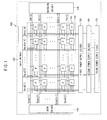
- FIG. 1 is a block diagram of organic light emitting display according to an embodiment of the invention.
- FIG. 2 is a circuit diagram of an pixel circuit employable by an organic light emitting display according to an embodiment of the present invention
- FIG. 3 is a timing diagram of signals employable to drive the pixel circuit of FIG. 2 ;
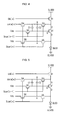
- FIG. 4 illustrates an operating state of the pixel circuit of FIG. 2 during an initialization period
- FIG. 5 illustrates an operating state of the pixel circuit of FIG. 2 during a threshold voltage compensating period
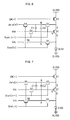
- FIG. 6 illustrates an operating state of the pixel circuit of FIG. 2 during a date write period and a voltage sensing period
- FIG. 7 illustrates an operating state of the pixel circuit of FIG. 2 during an emitting period
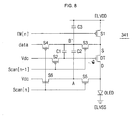
- FIG. 8 is a circuit diagram of another pixel circuit employable by an organic light emitting display according to another embodiment of the invention.
- FIG. 1 is a block diagram of an organic light emitting display 100, in the form of a flat panel display, according to the invention.
- the illustrated organic light emitting display 100 includes a scan driver 110, a data driver 120, an emission driver 130, an organic light emitting display panel 140 (hereinafter, a "panel"), a first power supply 150, a second power supply 160 and a third power supply 170.
- the scan driver 110 can sequentially apply a scan signal(s) to the panel 140 via a plurality of scan lines (Scan[1], Scan[2],....,Scan[n]).
- the data driver 120 can apply a data signal(s) to the panel 140 via a plurality of data lines (Data[1], Data[2],...., Data[m]).
- the emission driver 130 can sequentially apply emission signal(s) to the panel 140 via a plurality of emission lines (Em[1], Em[2], etc,Em[n]).
- the panel 140 includes a plurality of scan lines (Scan[1], Scan[2],....,Scan[n]) arranged in a column direction, a plurality of emission lines (Em[1], Em[2],...,Em[n]) arranged in a column direction, a plurality of data lines (Data[1], Data[2],....,Data[m]) arranged in a row direction, and a plurality of pixel circuits 141.
- the pixel circuits 141 are partially defined by respective portions of the plurality of scan lines (Scan[1], Scan[2], ..., and Scan [n]), the plurality of data lines (Data[1], Data[2], ..., and Data[m]) and the plurality of emission lines (Em[1], Em[2], ..., and Em[n]).
- each of the pixel circuits 141 is formed in a region defined by respective portions of two neighboring ones of the plurality of scan lines (Scan[1], Scan[2], ..., and Scan [n]) (or two neighboring ones of the plurality of emission lines (Em[1], Em[2], ..., and Em[n])) and two neighboring ones of the plurality of data lines (Data[1], Data[2], ..., and Data[m]).
- the pixel circuits 141 can be driven by respective ones of the plurality of scan lines (Scan[1], Scan[2],...,Scan[n]), the plurality of data lines (Data[1], Data[2],....,Data[m]), and the plurality of emission lines (Em[1], Em[2],...,Em[n]).
- a scan signal(s) output from the scan driver 110 can be applied to the respective one of the scan lines (Scan[1], Scan[2],....,Scan[n])
- a data signal(s) output from the data driver 120 can be applied to the respective one of the data lines (Data[1], Data[2],...., Data[m])
- an emission signal(s) output from the emission driver 130 can be applied to the respective one of the emission lines (Em[1], Em[2],....,Em[n]).
- the first power supply 150, the second power supply 160, and the third power supply 170 can respectively provide a first voltage ELVDD, a second voltage ELVSS, and a third voltage V dc to each of the pixel circuits 141 of the panel 140.
- FIG. 2 illustrates a circuit diagram of a pixel circuit 241 employable by an organic light emitting display according to the present invention.
- the pixel circuits 141 of the organic light emitting display of FIG. 1 may correspond to the pixel circuit 241 illustrated in FIG. 2 .
- the pixel circuit 241 is illustrated as being coupled to the nth scan line (Scan[n]), the mth data line (Data[m]) and the nth emission line (Em[n]) of the organic light emitting display 100 of FIG. 1 .
- the pixel circuit 241 is coupled to the nth emission line (EM[n]), a previous scan line (Scan[n-1]), the nth scan line (Scan[n]), the mth data line (Data[m]), the first power supply (ELVDD), the second power supply (ELVSS) and the third power supply (V dc ) of the display 100.
- the pixel circuit 241 includes a first switch S1, a second switch S2, a third switch S3, a fourth switch S4, a fifth switch S5, a sixth switch S6, a first capacitor C1, a second capacitor C2, a driving transistor DT, and an organic light emitting diode (OLED).
- the emission signal(s) supplied via the nth emission line (EM[n]) initialize the first and second capacitors C1, C2 and/or substantially and/or completely compensate for a threshold voltage of the driving transistor DT of the pixel circuit 241. Additionally, referring to FIG. 2 , in some embodiments with the emission line (EM[n]) electrically coupled to a control electrode of the first switch S1, the emission signal(s) supplied via the emission line (EM[n]) also controls an emission time of the OLED.
- the emission line (EM[n]) is at a low level
- the previous scan line (Scan[n-1]) is at a low level
- the scan line (Scan[n]) is at a high level
- the first and second capacitor C1, C2 are initialized to a value between the level of the first power supply (ELVDD) and the level of the third power supply (V dc ).
- the emission line (EM[n]) is electrically coupled to the emission driver 130 (see FIG. 1 ) for generating an emission signal(s) supplied thereto.
- the previous scan line (Scan[n-1]) can apply a previous scan signal, for selecting the previous scan line (Scan[n-1]) to the pixel 241 of the nth scan line (Scan[n]) during a previous (n-1)th scanning period.
- the previous scan line (Scan[n-1]) can apply the previous scan signal to a control electrode of the second switch S2 and a control electrode of the third switch S3 during the previous (n-1)th scanning period.
- a threshold voltage of the driving transistor DT is stored in the first and second capacitors C1, C2.
- the nth scan line (Scan[n]) can apply a respective scan signal(s) from the scan driver 110 (see FIG. 1 ) to select respective ones of the pixel circuits coupled to the nth scan line (Scan[n]) which are to emit light during an nth driving period. That is, during the nth driving period, OLEDs of the selected ones of the pixels circuits coupled to the nth scan line (Scan[n]) can emit light. More particularly, e.g., the pixel circuit 241 can be selected to emit light during a driving period by supplying the scan signal thereto. Referring to FIG.
- the nth scan line can apply a respective scan signal(s) to a control electrode of the fourth switch S4, a control electrode of the fifth switch S5, and a control electrode of the sixth switch S6.
- the nth scan signal can be described as 'supplied' when the scan signal has a low voltage level.
- the OLED thereof emits light during the respective driving period.
- nth scan signal when the nth scan signal is supplied to the nth scan line (Scan[n]), a data voltage from the mth data line (Data[m]) is stored in the first and second capacitors C1,C2, and simultaneously, a voltage (V EL ) of the OLED can be sensed and reflected.
- the nth scan line (Scan[n]) is electrically coupled to the scan driver 110, which may produce the respective scan signal(s).
- the mth data line (Data[m]) can apply a data signal (voltage), from the data driver 120 (see FIG. 1 ) to the first and second capacitors C1, C2 and the driving transistor DT.
- the voltage of the data signal is proportional or inversely proportional to a light emission brightness of the OLED of the pixel circuit 241.
- the mth data line (Data[m]) can be electrically coupled to the data driver 120 (see FIG. 1 ), which may produce the respective data signal(s).
- a first power line can enable the first voltage (ELVDD) to be applied to the OLED of the pixel circuit 241.
- the first power line can be coupled to the first power supply 150 (see FIG. 1 ), for supplying the first voltage (ELVDD).
- a second power line can enable the second voltage (ELVSS) to be applied to the OLED of the pixel circuit 241.
- the second power line can be coupled to the second power supply 160 (see FIG. 1 ), for supplying the second voltage (ELVSS).
- the first voltage (ELVDD) can be higher than the second voltage (ELVSS).
- a third power line can enable the third voltage (V dc ) to be applied to the first and second capacitors C1, C2 and a control electrode of the driving transistor DT.
- the third power line can be coupled to the third power supply 170 (see FIG. 1 ), for supplying the third voltage.
- the third voltage (V dc ) can be lower than the first voltage (ELVDD).
- the first switch S1 includes a control electrode (gate electrode) electrically coupled to the nth emission line (EM[n]), a first electrode (source electrode or drain electrode) electrically coupled to the first power line for receiving the first voltage (ELVDD), and a second electrode (the other of drain electrode or source electrode) electrically coupled to the driving transistor DT.
- EM[n] nth emission line
- first electrode source electrode or drain electrode
- second electrode the other of drain electrode or source electrode
- the second switch S2 includes a control electrode electrically coupled to the previous scan line (Scan[n-1]), a first electrode electrically coupled to the third power line for receiving the third voltage (V dc ), and a second electrode electrically coupled to the driving transistor DT.
- the third switch S3 includes a control electrode electrically coupled to the previous scan line (Scan[n-1]), a first electrode electrically coupled to the fourth switch S4, the first capacitor C1, and the second capacitor C2, and a second electrode electrically coupled to a node between the first switch S 1 and the driving transistor DT.
- the fourth switch S4 includes a control electrode electrically coupled to the nth scan line (Scan[n]), a first electrode electrically coupled to the data line (Data[m]), and a second electrode electrically coupled to the first capacitor C1, the second capacitor C2, and the third switch S3.
- the fifth switch S5 includes a control electrode electrically coupled to the nth scan line (Scan[n]), a first electrode electrically coupled to a node between the driving transistor DT and the OLED, and a second electrode electrically coupled to the sixth switch S6.
- the sixth switch S6 includes a control electrode electrically coupled to the scan line (Scan[n]), a first electrode electrically coupled to the third power line for supplying the third voltage (V dc ), and a second electrode electrically coupled to the fifth switch S5.
- the first capacitor C1 includes a first electrode electrically coupled to a node (B) between the second capacitor C2, the third switch S3, and the fourth switch S4, and a second electrode electrically coupled to the driving transistor DT and the second switch S2.
- the second capacitor C2 includes a first electrode electrically coupled to the node (B) between the first capacitor C1, the third switch S3, and the fourth switch S4, and a second electrode electrically coupled to a node (A) between the fifth switch S5 and the sixth switch S6.
- a first electrode of the driving transistor DT is electrically coupled to the first switch S 1 and the third switch S3 and a second electrode thereof is electrically coupled to the fifth switch S5 and the OLED.
- the control electrode of the driving transistor DT is electrically coupled to the first capacitor C1 and the second switch S2.
- the first, second, third, fourth, and fifth switches S1, S2, S3, S4, S5 and the driving transistor DT are illustrated as p-type transistors, e.g., p-channel field effect transistors, and the sixth switch S6 is illustrated as a n-type transistor, e.g., a n-channel field effect transistor.
- p-type transistors e.g., p-channel field effect transistors
- n-type transistor e.g., a n-channel field effect transistor.
- embodiments of the invention are not limited thereto.
- the driving transistor DT and/or the first, second, third, fourth and fifth switches S1, S2, S3, S4, S5, S6 may be any one selected from an amorphous silicon thin film transistor, a poly silicon thin film transistor, an organic thin film transistor, a micro thin film transistor, and equivalents thereof. However, embodiments of the invention are not limited thereto.
- the driving transistor DT and/or the switches S 1, S2, S3, S4, S5, S6 are poly silicon thin film transistors, they may be formed using, e.g., a laser crystallization method, a metal induction crystallization method, and equivalent methods thereof. However, embodiments of the invention are not limited thereto.
- the OLED includes an anode electrode electrically coupled to the driving transistor DT and the fifth switch S5, and a cathode electrode electrically coupled to the second power line for supplying the second voltage (ELVSS).
- the OLED emits lights of a predetermined brightness based on an amount of current controllably supplied thereto via the driving transistor DT.
- the OLED includes an emitting layer.
- the emitting layer may include, e.g., a low-polymer or a high-polymer.
- a low-polymer or a high-polymer.
- embodiments of the invention are not limited thereto. Because characteristics of a low-polymer material are widely known, it can be easily developed, and mass production is possible at an early stage.
- a high-polymer material may have excellent thermal stability, superior mechanical hardness, and a more-natural color as compared with a low-polymer material.
- FIG. 3 is a drive signal timing diagram illustrating signals employable to drive the pixel circuit 241 of FIG. 2 .
- a driving period for driving the pixel circuit 241 may include an initializing period (1), a threshold voltage compensating period (2), a data writing and OLED voltage sensing period (3), and an emitting period (4).
- FIG. 4 illustrates an operating state of the pixel circuit 241 of FIG. 2 during an initializing period (1).
- an emission signal at a low level is applied to the control electrode of the first switch S 1 via the nth emission line (EM[n]).
- a previous scan signal at a low level is applied to the control electrode of the second switch S2 and the control electrode of the third switch S3 via the previous scan line (Scan[n-1]).
- a scan signal at a high level is applied to the fourth switch S4, the fifth switch S5, and the sixth switch S6 via the scan line (Scan[n]).
- the first switch S1, the second switch S2, the third switch S3, and the sixth switch S6 are turned on while the fourth switch S4 and the fifth switch S5 are turned off.
- the first electrode of the first capacitor C1 is electrically coupled to the first power line for supplying the first voltage (ELVDD).
- the first electrode of the second capacitor C2 is also electrically coupled to the first power line for supplying the first voltage (ELVDD).
- the second electrode of the first capacitor C1 and the second electrode of the second capacitor C2 are electrically coupled to the third power line (V dc ).
- the control electrode of the driving transistor DT is also electrically coupled to the third power line (V dc ).
- a voltage of the control electrode of the driving transistor DT and a voltage of the first electrode of the driving transistor DT are determined by the following Equation Set 1.
- V G is a voltage of the control electrode of the driving transistor DT.
- V A is a voltage of node (A) between the second capacitor C2, the sixth switch S6 and the fifth switch S5.
- V dc is the third voltage supplied via the third power line.
- V S is a voltage of the first electrode of the driving transistor DT.
- V B is a voltage of node (B) between the third switch S3, the first capacitor C1, the second capacitor C2 and the fourth switch S4.
- ELVDD is the first voltage supplied via the first power line.
- FIG. 5 illustrates an operating state of the pixel circuit 241 of FIG. 2 during a threshold voltage compensating period (2).
- An emission signal at a high level is applied to the control electrode of the first switch S 1 via the nth emission line (EM[n]).
- a previous scan signal at a low level is applied to the control electrode of the second switch S2 and the control electrode of the third switch S3 via the previous scan line (Scan[n-1]).
- a scan signal at a high level is applied to the control electrodes of the fourth switch S4, the fifth switch S5 and the sixth switch S6 via the scan line (Scan[n]).
- the second switch S2, the third switch S3, and the sixth switch S6 are turned on while the first switch S1, the fourth switch S4, and the fifth switch S5 are turned off.
- the first electrode of the first capacitor C1 and the first electrode of the second capacitor C2 are electrically separated from the first power line for supplying the first voltage (ELVDD).
- the first electrode of the first capacitor C1 and the first electrode of the second capacitor C2 remain electrically coupled to the first electrode of the driving transistor DT via the third switch S3.
- the second electrode of the first capacitor C1 and the second electrode of the second capacitor C2 remain electrically coupled to the third power line (V dc ) via the second and sixth switches S2, S6, respectively.
- a voltage of the control electrode of the driving transistor DT and a voltage of the first electrode of the driving transistor are determined by the following Equation Set 2.
- a threshold voltage V th of the driving transistor DT is stored in the first capacitor C1 and the second capacitor C2.
- FIG. 6 illustrates an operating state of the pixel circuit 241 of FIG. 2 during a data writing and OLED voltage sensing period (3).
- an emission signal at a low level is applied to the control electrode of the first switch S1 via nth the emission line (EM[n]).
- a previous scan signal at a high level is applied to the control electrode of the second switch S2 and the control electrode of the third switch S3 via the previous scan line (Scan[n-1]).
- a scan signal at a low level is applied to the fourth switch S4, the fifth switch S5, and the sixth switch S6 via the nth scan line (Scan[n]).
- the first switch S1, the fourth switch S4, and the fifth switch S5 are turned on, and the second switch S2, the third switch S3, and the sixth switch S6 are turned off.
- the first electrode of the first capacitor C1 and the first electrode of the second capacitor C2 are electrically coupled to the mth data line (Data[m]).
- the second electrode of the first capacitor C1 is electrically coupled to the control electrode of the driving transistor DT, and the second electrode of the second capacitor C2 is electrically coupled to a node between the second electrode of the driving transistor DT and the anode electrode of the OLED via the fifth switch S5.
- V A V EL
- V B V data
- V EL is a voltage that may applied to the anode electrode of the OLED.
- V EL increases as a degradation level of the OLED increases.
- a voltage of the control electrode of the driving transistor DT are determined by the following Equation Set 4.
- V G V data -
- FIG. 7 illustrates an operating state of the pixel circuit 241 of FIG. 2 during an emitting period (4).
- an emission signal at a low level is applied to the control electrode of the first switch S1 via the nth emission line (EM[n]).
- a previous scan signal at a high level is applied to the control electrode of the second switch S2 and the control electrode of the third switch S3 via the previous scan line (Scan[n-1]).
- a scan signal at a high level is applied to the fourth switch S4, the fifth switch S5, and the sixth switch S6 via the nth scan line (Scan[n]).
- the first switch S1 and the sixth switch S6 are turned on, and the second switch S2, the third switch S3, the fourth switch S4, and the fifth switch S5 are turned off.
- the second electrode of the first capacitor C1 is electrically coupled to the control electrode of the driving transistor DT,
- the first electrode of the first capacitor C1 is electrically coupled to the first electrode of the second capacitor C2. That is, the first capacitor C1 is coupled to the second capacitor C2 in series.
- the second electrode of the second capacitor C2 is electrically coupled to the third power line for supplying the third voltage (V dc ).
- a voltage of node (A) changes and is determined by the following Equation 5.
- V A V dc
- a voltage of the control electrode of the driving transistor DT is determined by the following Equation Set 6.
- V G V data -
- + ⁇ V G ⁇ 2 ⁇ V G ⁇ 2 V dc - V EL
- V G V data -
- a current I OLED that may be supplied to the OLED in accordance with Equation Set 6 is determined by the following Equation 7.
- - V dc + V EL - Vth 2 ⁇ 2 ⁇ ELVDD - V data - V dc + V EL 2
- the more the voltage V EL of the OLED increases the more the current I OLED flowing through the OLED may increase. That is, in some embodiments, the current I OLED flowing through the OLED increases proportionally to the voltage V EL of the OLED.
- by increasing the voltage V EL of the OLED as the efficiency of the OLED decreases it is possible to substantially and/or completely suppress image sticking by increasing an amount of the current I OLED supplied to the OLED.
- some embodiments of the invention enable the lifetime of an organic light emitting display to be increased by controllably increasing the current I OLED supplied to the OLED as efficiency thereof decreases.
- a threshold voltage of the driving transistor DT is effectively stored effectively and substantially and/or completely compensated.
- FIG. 8 illustrates a circuit diagram of another pixel circuit 341 employable by an organic light emitting display according to another embodiment of the invention.
- One, some, or all of the pixel circuits 141 of the organic light emitting display of FIG. 1 may correspond to the pixel circuit 341 illustrated in FIG. 7 .
- the pixel circuit 341 is illustrated as being coupled to the nth scan line (Scan[n]), the mth data line (Data[m]) and the nth light emission control line (Em[n]) of the organic light emitting display 100 of FIG. 1 .
- the pixel circuit 341 has generally the same structure as the exemplary pixel circuit 241 of FIG. 2 . Only differences between the pixel circuit 341 of FIG. 8 and the pixel circuit 241 of FIG. 2 will be described below.
- the pixel circuit 341 includes a third capacitor C3 electrically coupled between the first power line for supplying the first voltage (ELVDD) and the second capacitor C2.
- a first electrode of the third capacitor C3 is electrically coupled to the first power line for supplying the first voltage (ELVDD).
- a second electrode of the third capacitor C3 is electrically coupled to a node (B') between the third switch S3, the fourth switch S4, the first capacitor C1, and the second capacitor C2.
- the third capacitor C3 serves to adjust a value of a voltage change due to a voltage V EL of the OLED and is employed in a feedback function. That is, in the pixel circuit 241 illustrated in FIG. 2 , because the voltage V EL of the OLED is fed back to the control electrode of the driving transistor DT, the current I OLED of the organic light emitting diode can increase excessively.
- a value of voltage change due to the voltage V EL of the OLED can controllably adjusted by the third capacitor C3 and feedback can be controllably executed. More particularly, in the pixel circuit 341 illustrated in FIG. 8 , the current provided to the OLED is determined by the following Equation 8. As may be seen from Equation 8, the voltage V EL of the OLED, for which a feedback operation is executed by the third capacitor C3, can be adjusted.
- Some embodiments may provide an organic light emitting display in which an increasing anode voltage of an OLED, which may be proportional to an amount of degradation of the OLED, may be sensed during a data writing period, and thus, an amount of current supplied to the OLED may be increased in proportion to the sensed voltage, such that image sticking and/or a reduction in a lifetime of the display due to degradation of the OLED may be substantially and/or completely suppressed.
- a storage capacitor may be electrically coupled to a node between a control electrode of a driving transistor and a first electrode of the driving transistor, and thus, a power source voltage provided to the first electrode thereof may be blocked, and a threshold voltage of the driving transistor may be stored naturally in the storage capacitor. That is, some embodiments of the present invention may compensate for a threshold voltage of the driving transistor without employing a diode-coupled structure.
Landscapes
- Engineering & Computer Science (AREA)
- Physics & Mathematics (AREA)
- Computer Hardware Design (AREA)
- General Physics & Mathematics (AREA)
- Theoretical Computer Science (AREA)
- Control Of Indicators Other Than Cathode Ray Tubes (AREA)
- Electroluminescent Light Sources (AREA)
- Control Of El Displays (AREA)
Applications Claiming Priority (1)
| Application Number | Priority Date | Filing Date | Title |
|---|---|---|---|
| KR1020070020802A KR100865396B1 (ko) | 2007-03-02 | 2007-03-02 | 유기 전계 발광 표시 장치 |
Publications (1)
| Publication Number | Publication Date |
|---|---|
| EP1968039A1 true EP1968039A1 (de) | 2008-09-10 |
Family
ID=39319619
Family Applications (1)
| Application Number | Title | Priority Date | Filing Date |
|---|---|---|---|
| EP08250708A Ceased EP1968039A1 (de) | 2007-03-02 | 2008-02-29 | Organische lichtemittierende Anzeige |
Country Status (5)
| Country | Link |
|---|---|
| US (1) | US8120556B2 (de) |
| EP (1) | EP1968039A1 (de) |
| JP (1) | JP5038167B2 (de) |
| KR (1) | KR100865396B1 (de) |
| CN (1) | CN101256737B (de) |
Cited By (3)
| Publication number | Priority date | Publication date | Assignee | Title |
|---|---|---|---|---|
| US8149186B2 (en) | 2007-04-10 | 2012-04-03 | Samsung Mobile Display Co., Ltd. | Pixel, organic light emitting display using the same, and associated methods |
| US8194012B2 (en) | 2008-03-10 | 2012-06-05 | Samsung Mobile Display Co.,Ltd. | Pixel and organic light emitting display using the same |
| CN106782323A (zh) * | 2017-02-15 | 2017-05-31 | 京东方科技集团股份有限公司 | 像素驱动电路及其驱动方法、显示装置 |
Families Citing this family (42)
| Publication number | Priority date | Publication date | Assignee | Title |
|---|---|---|---|---|
| KR100986896B1 (ko) * | 2008-12-05 | 2010-10-08 | 삼성모바일디스플레이주식회사 | 유기전계발광 표시장치 및 그의 구동방법 |
| US9740341B1 (en) | 2009-02-26 | 2017-08-22 | Amazon Technologies, Inc. | Capacitive sensing with interpolating force-sensitive resistor array |
| US10180746B1 (en) * | 2009-02-26 | 2019-01-15 | Amazon Technologies, Inc. | Hardware enabled interpolating sensor and display |
| US9785272B1 (en) | 2009-07-31 | 2017-10-10 | Amazon Technologies, Inc. | Touch distinction |
| US9740340B1 (en) | 2009-07-31 | 2017-08-22 | Amazon Technologies, Inc. | Visually consistent arrays including conductive mesh |
| KR101056308B1 (ko) * | 2009-10-19 | 2011-08-11 | 삼성모바일디스플레이주식회사 | 유기전계발광 표시장치 및 그의 구동방법 |
| KR101113430B1 (ko) * | 2009-12-10 | 2012-03-02 | 삼성모바일디스플레이주식회사 | 화소 및 그를 이용한 유기전계발광표시장치 |
| KR101142729B1 (ko) * | 2010-03-17 | 2012-05-03 | 삼성모바일디스플레이주식회사 | 화소 및 이를 이용한 유기전계발광 표시장치 |
| KR101155897B1 (ko) | 2010-05-11 | 2012-06-20 | 삼성모바일디스플레이주식회사 | 표시 장치 |
| KR101223488B1 (ko) * | 2010-05-11 | 2013-01-17 | 삼성디스플레이 주식회사 | 유기 발광 표시 장치 및 그의 구동방법 |
| CN102270425B (zh) * | 2010-06-01 | 2013-07-03 | 北京大学深圳研究生院 | 一种像素电路及显示设备 |
| KR101682691B1 (ko) * | 2010-07-20 | 2016-12-07 | 삼성디스플레이 주식회사 | 화소 및 이를 이용한 유기전계발광 표시장치 |
| KR101710656B1 (ko) | 2010-08-02 | 2017-02-28 | 삼성디스플레이 주식회사 | 화소 및 이를 이용한 유기전계발광 표시장치 |
| KR101739526B1 (ko) * | 2010-10-28 | 2017-05-25 | 삼성디스플레이 주식회사 | 유기 발광 표시 장치 |
| KR101950819B1 (ko) * | 2011-07-15 | 2019-04-26 | 엘지디스플레이 주식회사 | 발광표시장치 |
| JP6050054B2 (ja) * | 2011-09-09 | 2016-12-21 | 株式会社半導体エネルギー研究所 | 半導体装置 |
| KR101517035B1 (ko) | 2011-12-05 | 2015-05-06 | 엘지디스플레이 주식회사 | 유기발광 다이오드 표시장치 및 그 구동방법 |
| CN102654976B (zh) * | 2012-01-12 | 2014-12-24 | 京东方科技集团股份有限公司 | 一种像素电路及其驱动方法、显示装置 |
| US10043794B2 (en) | 2012-03-22 | 2018-08-07 | Semiconductor Energy Laboratory Co., Ltd. | Semiconductor device and electronic device |
| CN102708802B (zh) * | 2012-06-15 | 2014-12-10 | 开源集成电路(苏州)有限公司 | Led显示系统 |
| US9633599B2 (en) * | 2012-07-31 | 2017-04-25 | Sharp Kabushiki Kaisha | Pixel circuit, display device including the same and driving method of the display device |
| US9576535B2 (en) | 2013-01-17 | 2017-02-21 | Samsung Display Co., Ltd. | Pixel and organic light emitting display using the same |
| KR102033755B1 (ko) * | 2013-03-18 | 2019-10-18 | 엘지디스플레이 주식회사 | 유기전계발광표시장치와 이의 구동방법 |
| KR102033756B1 (ko) * | 2013-03-18 | 2019-10-17 | 엘지디스플레이 주식회사 | 유기전계발광표시장치와 이의 구동방법 |
| KR102053410B1 (ko) * | 2013-04-24 | 2019-12-09 | 삼성디스플레이 주식회사 | 박막 트랜지스터 및 유기 발광 표시 장치 |
| KR102046446B1 (ko) | 2013-08-22 | 2019-11-20 | 삼성디스플레이 주식회사 | 화소, 화소의 구동 방법 및 화소를 포함하는 표시 장치 |
| CN105096817B (zh) * | 2014-05-27 | 2017-07-28 | 北京大学深圳研究生院 | 像素电路及其驱动方法和一种显示装置 |
| KR102309843B1 (ko) * | 2014-12-04 | 2021-10-08 | 엘지디스플레이 주식회사 | 유기발광 표시장치 |
| CN104537983B (zh) * | 2014-12-30 | 2017-03-15 | 合肥鑫晟光电科技有限公司 | 像素电路及其驱动方法、显示装置 |
| TWI596595B (zh) | 2016-06-02 | 2017-08-21 | 凌巨科技股份有限公司 | 顯示裝置及其顯示面板的驅動方法 |
| US20190295469A1 (en) * | 2017-08-01 | 2019-09-26 | Sharp Kabushiki Kaisha | Display device |
| CN108538248A (zh) | 2018-04-24 | 2018-09-14 | 京东方科技集团股份有限公司 | 一种像素电路、驱动方法、显示面板及显示装置 |
| CN109348150B (zh) * | 2018-10-18 | 2021-01-29 | 天津大学 | 基于有机薄膜光电晶体管实现cmos有源像素柔性图像传感器的像素电路 |
| CN110070831B (zh) * | 2019-04-19 | 2021-08-06 | 深圳市华星光电半导体显示技术有限公司 | 像素驱动电路及显示面板 |
| CN110942743B (zh) | 2019-12-26 | 2021-04-13 | 云谷(固安)科技有限公司 | 像素电路的驱动方法、显示面板和显示装置 |
| CN111754939B (zh) * | 2020-07-28 | 2021-11-09 | 京东方科技集团股份有限公司 | 一种像素电路及其驱动方法、显示装置 |
| CN111739471B (zh) * | 2020-08-06 | 2022-02-22 | 武汉天马微电子有限公司 | 一种显示面板、驱动方法及显示装置 |
| WO2022162941A1 (ja) * | 2021-02-01 | 2022-08-04 | シャープ株式会社 | 画素回路および表示装置 |
| TWI780844B (zh) * | 2021-07-29 | 2022-10-11 | 友達光電股份有限公司 | 驅動電路 |
| CN114093299B (zh) * | 2022-01-24 | 2022-04-19 | 北京京东方技术开发有限公司 | 显示面板和显示装置 |
| CN114898701B (zh) * | 2022-04-20 | 2024-04-09 | 京东方科技集团股份有限公司 | 像素电路、其驱动方法及显示装置 |
| WO2025233765A1 (ja) * | 2024-05-10 | 2025-11-13 | 株式会社半導体エネルギー研究所 | 半導体装置 |
Citations (6)
| Publication number | Priority date | Publication date | Assignee | Title |
|---|---|---|---|---|
| US6356029B1 (en) * | 1999-10-02 | 2002-03-12 | U.S. Philips Corporation | Active matrix electroluminescent display device |
| US20060055336A1 (en) * | 2004-08-30 | 2006-03-16 | Jeong Jin T | Organic light emitting display |
| US20060253755A1 (en) | 2005-04-21 | 2006-11-09 | Au Optronics Corp. | Display units |
| US20060256058A1 (en) | 2005-05-12 | 2006-11-16 | Sony Corporation | Pixel circuit, display device method for controlling pixel circuit |
| US20070040769A1 (en) * | 2005-08-19 | 2007-02-22 | Toppoly Optoelectronics Corp. | Active matrix organic light emitting diodes pixel circuit |
| EP1758084A2 (de) * | 2005-08-01 | 2007-02-28 | Samsung SDI Co., Ltd. | Datentreiberschaltung und Verfahren zur Ansteuerung der lichtemittierenden Anzeige |
Family Cites Families (13)
| Publication number | Priority date | Publication date | Assignee | Title |
|---|---|---|---|---|
| KR100452114B1 (ko) * | 2002-04-15 | 2004-10-12 | 한국과학기술원 | 화소 회로 및 이를 이용한 유기 발광 다이오드 표시장치 |
| CN1662946A (zh) * | 2002-04-26 | 2005-08-31 | 东芝松下显示技术有限公司 | El显示设备的驱动方法 |
| JP3901105B2 (ja) * | 2003-02-14 | 2007-04-04 | ソニー株式会社 | 画素回路、表示装置、および画素回路の駆動方法 |
| KR101080350B1 (ko) * | 2004-04-07 | 2011-11-04 | 삼성전자주식회사 | 표시 장치 및 그 구동 방법 |
| KR100583137B1 (ko) * | 2004-06-28 | 2006-05-23 | 삼성에스디아이 주식회사 | 유기 발광 표시장치 |
| JP4747528B2 (ja) * | 2004-07-23 | 2011-08-17 | ソニー株式会社 | 画素回路及び表示装置 |
| KR100688802B1 (ko) * | 2004-11-22 | 2007-03-02 | 삼성에스디아이 주식회사 | 화소 및 발광 표시장치 |
| JP2006284916A (ja) * | 2005-03-31 | 2006-10-19 | Toshiba Matsushita Display Technology Co Ltd | 表示装置、アレイ基板、及び表示装置の駆動方法 |
| KR100670333B1 (ko) * | 2005-05-02 | 2007-01-16 | 삼성에스디아이 주식회사 | 유기 전계발광 표시장치 |
| KR100627417B1 (ko) * | 2005-08-26 | 2006-09-22 | 삼성에스디아이 주식회사 | 유기 발광 표시 장치 및 그 구동 방법 |
| JP4887203B2 (ja) * | 2006-11-14 | 2012-02-29 | 三星モバイルディスプレイ株式會社 | 画素、有機電界発光表示装置、および有機電界発光表示装置の駆動方法 |
| JP2008191450A (ja) * | 2007-02-06 | 2008-08-21 | Seiko Epson Corp | 画素回路、画素回路の駆動方法、電気光学装置および電子機器 |
| KR100865394B1 (ko) * | 2007-03-02 | 2008-10-24 | 삼성에스디아이 주식회사 | 유기 전계 발광 표시 장치 |
-
2007
- 2007-03-02 KR KR1020070020802A patent/KR100865396B1/ko active Active
-
2008
- 2008-01-16 JP JP2008007109A patent/JP5038167B2/ja not_active Expired - Fee Related
- 2008-02-27 US US12/071,852 patent/US8120556B2/en active Active
- 2008-02-29 CN CN2008100064811A patent/CN101256737B/zh not_active Expired - Fee Related
- 2008-02-29 EP EP08250708A patent/EP1968039A1/de not_active Ceased
Patent Citations (6)
| Publication number | Priority date | Publication date | Assignee | Title |
|---|---|---|---|---|
| US6356029B1 (en) * | 1999-10-02 | 2002-03-12 | U.S. Philips Corporation | Active matrix electroluminescent display device |
| US20060055336A1 (en) * | 2004-08-30 | 2006-03-16 | Jeong Jin T | Organic light emitting display |
| US20060253755A1 (en) | 2005-04-21 | 2006-11-09 | Au Optronics Corp. | Display units |
| US20060256058A1 (en) | 2005-05-12 | 2006-11-16 | Sony Corporation | Pixel circuit, display device method for controlling pixel circuit |
| EP1758084A2 (de) * | 2005-08-01 | 2007-02-28 | Samsung SDI Co., Ltd. | Datentreiberschaltung und Verfahren zur Ansteuerung der lichtemittierenden Anzeige |
| US20070040769A1 (en) * | 2005-08-19 | 2007-02-22 | Toppoly Optoelectronics Corp. | Active matrix organic light emitting diodes pixel circuit |
Cited By (3)
| Publication number | Priority date | Publication date | Assignee | Title |
|---|---|---|---|---|
| US8149186B2 (en) | 2007-04-10 | 2012-04-03 | Samsung Mobile Display Co., Ltd. | Pixel, organic light emitting display using the same, and associated methods |
| US8194012B2 (en) | 2008-03-10 | 2012-06-05 | Samsung Mobile Display Co.,Ltd. | Pixel and organic light emitting display using the same |
| CN106782323A (zh) * | 2017-02-15 | 2017-05-31 | 京东方科技集团股份有限公司 | 像素驱动电路及其驱动方法、显示装置 |
Also Published As
| Publication number | Publication date |
|---|---|
| KR100865396B1 (ko) | 2008-10-24 |
| JP5038167B2 (ja) | 2012-10-03 |
| CN101256737B (zh) | 2011-03-23 |
| KR20080080734A (ko) | 2008-09-05 |
| US20080211796A1 (en) | 2008-09-04 |
| US8120556B2 (en) | 2012-02-21 |
| JP2008216983A (ja) | 2008-09-18 |
| CN101256737A (zh) | 2008-09-03 |
Similar Documents
| Publication | Publication Date | Title |
|---|---|---|
| EP1968039A1 (de) | Organische lichtemittierende Anzeige | |
| US8334825B2 (en) | Organic light emitting display for suppressing images sticking and compensating a threshold voltage | |
| JP4396848B2 (ja) | 発光表示装置 | |
| JP4070696B2 (ja) | 発光表示装置,発光表示装置の駆動方法,および発光表示装置の表示パネル | |
| US8564512B2 (en) | Pixel circuit for driving transistor threshold voltage compensation and organic electroluminescent display apparatus using the same | |
| US8552943B2 (en) | Pixel circuit including N-type transistors and organic electroluminescent display apparatus using the same | |
| US7443366B2 (en) | Organic electroluminescent display and driving method thereof | |
| JP4113164B2 (ja) | 画像表示装置及びその駆動方法 | |
| CN102063861B (zh) | 像素电路、有机发光二极管显示器及其驱动方法 | |
| JP4197476B2 (ja) | 発光表示装置及びその駆動方法並びに画素回路 | |
| US8823609B2 (en) | Pixel circuit, organic electro-luminescent display apparatus using the pixel circuit and method of driving the apparatus | |
| EP1646032B1 (de) | Pixelschaltung für ein OLED Display mit automatischer Kompensation der Schwellenspannung | |
| JP5324543B2 (ja) | 発光表示装置、発光表示装置の表示パネル、及び表示パネルの駆動方法 | |
| US7557784B2 (en) | OLED pixel circuit and light emitting display using the same | |
| JP4195337B2 (ja) | 発光表示装置及びその表示パネルと駆動方法 | |
| US8063852B2 (en) | Light emitting display and light emitting display panel | |
| US8624806B2 (en) | Pixel circuit with NMOS transistors and large sized organic light-emitting diode display using the same and including separate initialization and threshold voltage compensation periods to improve contrast ratio and reduce cross-talk | |
| US20100201673A1 (en) | Light emitting display device and method of driving the same | |
| US20050110725A1 (en) | Flat panel display device with triodic rectifier switch | |
| KR20090073688A (ko) | 발광 표시 장치 및 그 구동 방법 | |
| JP2006276097A (ja) | アクティブマトリクス型発光表示パネルの駆動装置および駆動方法 |
Legal Events
| Date | Code | Title | Description |
|---|---|---|---|
| PUAI | Public reference made under article 153(3) epc to a published international application that has entered the european phase |
Free format text: ORIGINAL CODE: 0009012 |
|
| 17P | Request for examination filed |
Effective date: 20080311 |
|
| AK | Designated contracting states |
Kind code of ref document: A1 Designated state(s): AT BE BG CH CY CZ DE DK EE ES FI FR GB GR HR HU IE IS IT LI LT LU LV MC MT NL NO PL PT RO SE SI SK TR |
|
| AX | Request for extension of the european patent |
Extension state: AL BA MK RS |
|
| RAP1 | Party data changed (applicant data changed or rights of an application transferred) |
Owner name: SAMSUNG MOBILE DISPLAY CO., LTD. |
|
| AKX | Designation fees paid |
Designated state(s): DE FR GB |
|
| 17Q | First examination report despatched |
Effective date: 20090907 |
|
| STAA | Information on the status of an ep patent application or granted ep patent |
Free format text: STATUS: THE APPLICATION HAS BEEN REFUSED |
|
| 18R | Application refused |
Effective date: 20110329 |