EP1968268A2 - Kanaleinschätzung und ICI-Abbruch von OFDM - Google Patents
Kanaleinschätzung und ICI-Abbruch von OFDM Download PDFInfo
- Publication number
- EP1968268A2 EP1968268A2 EP08250807A EP08250807A EP1968268A2 EP 1968268 A2 EP1968268 A2 EP 1968268A2 EP 08250807 A EP08250807 A EP 08250807A EP 08250807 A EP08250807 A EP 08250807A EP 1968268 A2 EP1968268 A2 EP 1968268A2
- Authority
- EP
- European Patent Office
- Prior art keywords
- spectrum
- channel
- filtering
- decision
- subcarrier
- Prior art date
- Legal status (The legal status is an assumption and is not a legal conclusion. Google has not performed a legal analysis and makes no representation as to the accuracy of the status listed.)
- Withdrawn
Links
Images









Classifications
-
- H—ELECTRICITY
- H04—ELECTRIC COMMUNICATION TECHNIQUE
- H04L—TRANSMISSION OF DIGITAL INFORMATION, e.g. TELEGRAPHIC COMMUNICATION
- H04L25/00—Baseband systems
- H04L25/02—Details ; arrangements for supplying electrical power along data transmission lines
- H04L25/03—Shaping networks in transmitter or receiver, e.g. adaptive shaping networks
- H04L25/03006—Arrangements for removing intersymbol interference
- H04L25/03821—Inter-carrier interference cancellation [ICI]
-
- H—ELECTRICITY
- H04—ELECTRIC COMMUNICATION TECHNIQUE
- H04L—TRANSMISSION OF DIGITAL INFORMATION, e.g. TELEGRAPHIC COMMUNICATION
- H04L25/00—Baseband systems
- H04L25/02—Details ; arrangements for supplying electrical power along data transmission lines
- H04L25/0202—Channel estimation
- H04L25/022—Channel estimation of frequency response
-
- H—ELECTRICITY
- H04—ELECTRIC COMMUNICATION TECHNIQUE
- H04L—TRANSMISSION OF DIGITAL INFORMATION, e.g. TELEGRAPHIC COMMUNICATION
- H04L25/00—Baseband systems
- H04L25/02—Details ; arrangements for supplying electrical power along data transmission lines
- H04L25/03—Shaping networks in transmitter or receiver, e.g. adaptive shaping networks
- H04L25/03006—Arrangements for removing intersymbol interference
- H04L2025/0335—Arrangements for removing intersymbol interference characterised by the type of transmission
- H04L2025/03375—Passband transmission
- H04L2025/03414—Multicarrier
-
- H—ELECTRICITY
- H04—ELECTRIC COMMUNICATION TECHNIQUE
- H04L—TRANSMISSION OF DIGITAL INFORMATION, e.g. TELEGRAPHIC COMMUNICATION
- H04L25/00—Baseband systems
- H04L25/02—Details ; arrangements for supplying electrical power along data transmission lines
- H04L25/03—Shaping networks in transmitter or receiver, e.g. adaptive shaping networks
- H04L25/03006—Arrangements for removing intersymbol interference
- H04L2025/03433—Arrangements for removing intersymbol interference characterised by equaliser structure
- H04L2025/03439—Fixed structures
- H04L2025/03445—Time domain
- H04L2025/03471—Tapped delay lines
- H04L2025/03484—Tapped delay lines time-recursive
- H04L2025/0349—Tapped delay lines time-recursive as a feedback filter
-
- H—ELECTRICITY
- H04—ELECTRIC COMMUNICATION TECHNIQUE
- H04L—TRANSMISSION OF DIGITAL INFORMATION, e.g. TELEGRAPHIC COMMUNICATION
- H04L25/00—Baseband systems
- H04L25/02—Details ; arrangements for supplying electrical power along data transmission lines
- H04L25/0202—Channel estimation
- H04L25/0224—Channel estimation using sounding signals
- H04L25/0228—Channel estimation using sounding signals with direct estimation from sounding signals
- H04L25/023—Channel estimation using sounding signals with direct estimation from sounding signals with extension to other symbols
- H04L25/0236—Channel estimation using sounding signals with direct estimation from sounding signals with extension to other symbols using estimation of the other symbols
-
- H—ELECTRICITY
- H04—ELECTRIC COMMUNICATION TECHNIQUE
- H04L—TRANSMISSION OF DIGITAL INFORMATION, e.g. TELEGRAPHIC COMMUNICATION
- H04L25/00—Baseband systems
- H04L25/02—Details ; arrangements for supplying electrical power along data transmission lines
- H04L25/0202—Channel estimation
- H04L25/024—Channel estimation channel estimation algorithms
- H04L25/025—Channel estimation channel estimation algorithms using least-mean-square [LMS] method
-
- H—ELECTRICITY
- H04—ELECTRIC COMMUNICATION TECHNIQUE
- H04L—TRANSMISSION OF DIGITAL INFORMATION, e.g. TELEGRAPHIC COMMUNICATION
- H04L25/00—Baseband systems
- H04L25/02—Details ; arrangements for supplying electrical power along data transmission lines
- H04L25/03—Shaping networks in transmitter or receiver, e.g. adaptive shaping networks
- H04L25/03006—Arrangements for removing intersymbol interference
- H04L25/03178—Arrangements involving sequence estimation techniques
- H04L25/03312—Arrangements specific to the provision of output signals
- H04L25/03324—Provision of tentative decisions
-
- H—ELECTRICITY
- H04—ELECTRIC COMMUNICATION TECHNIQUE
- H04L—TRANSMISSION OF DIGITAL INFORMATION, e.g. TELEGRAPHIC COMMUNICATION
- H04L25/00—Baseband systems
- H04L25/02—Details ; arrangements for supplying electrical power along data transmission lines
- H04L25/03—Shaping networks in transmitter or receiver, e.g. adaptive shaping networks
- H04L25/03828—Arrangements for spectral shaping; Arrangements for providing signals with specified spectral properties
-
- H—ELECTRICITY
- H04—ELECTRIC COMMUNICATION TECHNIQUE
- H04L—TRANSMISSION OF DIGITAL INFORMATION, e.g. TELEGRAPHIC COMMUNICATION
- H04L27/00—Modulated-carrier systems
- H04L27/26—Systems using multi-frequency codes
- H04L27/2601—Multicarrier modulation systems
- H04L27/2647—Arrangements specific to the receiver only
Definitions
- the invention relates to wireless receivers, and more particularly to equalization of channel carriers and reduction of inter-carrier interference for OFDM receivers.
- wireless and RF technology have dramatically changed our perceptions, use, and reliance upon portable electronic devices.
- the uses of wireless technology are widespread, increasing, and include but are not limited to telephony, Internet e-mail, Internet web browsers, global positioning, photography, diary, address book, and in-store navigation.
- devices incorporating wireless technology have expanded to include not only cellular telephones, but Personal Data Analyzers (PDAs), laptop computers, palmtop computers, gaming consoles, printers, telephone headsets, portable music players, point of sale terminals, global positioning systems, inventory control systems, and even vending machines.
- PDAs Personal Data Analyzers
- laptop computers palmtop computers
- gaming consoles printers
- telephone headsets portable music players
- point of sale terminals global positioning systems
- inventory control systems and even vending machines.
- Orthogonal Frequency-Division Multiplexing (OFDM) has reached commercial deployment and success through its use within many applications including, but not limited to:
- OFDM portable electronic devices are mobile, as they are associated with users performing tasks as they move, and in many instances the users will be highly mobile as they use these electronic devices in their personal vehicles, or in public transportation such as buses, taxis and trains.
- these high mobility environments provide significant challenges to the system designers in two different aspects.
- ICI Doppler induced Inter-Carrier Interference
- CFR Channel Frequency Response
- ICI likely causes severe degradation of the system performance.
- pilot symbols with shorter duration than the OFDM symbol have been used.
- frequency-domain pilot-aided channel estimation is the only choice.
- time-varying channels also provide time diversity that has been exploited to improve the error performance.
- channel gain which is defined as the channel frequency response at the k th sub-carrier
- ICI gains which represent the multiplicative gains applied to the neighbor sub-carriers.
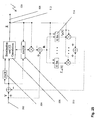
- Fig. 1 illustrates schematically the functioning blocks of the iterative channel estimation and ICI cancellation process according to an embodiment of the invention
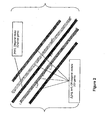
- Fig. 2 illustrates a channel frequency response matrix
- Fig. 3A illustrates a prior art channel frequency response estimation employing IDFT filtering
- Fig. 3B illustrates channel frequency response estimation employing DFT filtering which is an equivalent representation of IDFT filtering
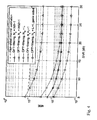
- Fig. 4 illustrates the effect of window size in DFT / IDFT filtering on channel gain estimation according to an embodiment of the invention
- Fig. 5A illustrates a snapshot of the ICI gain vector estimation for the first tap ICI gain vector corresponding to the 1 st off-diagonal vector according to an embodiment of the invention
- Fig. 5B illustrates a snapshot of the ICI gain vector estimation for the second tap ICI gain vector corresponding to the 2nd off-diagonal vector according to an embodiment of the invention
- Fig. 5C illustrates a snapshot of the ICI gain vector estimation for the third tap ICI gain vector corresponding to the 3rd off-diagonal vector according to an embodiment of the invention
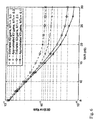
- Fig. 6 illustrates exemplary an error performance comparison between estimated ICI gains and approximated ICI gains according to an embodiment of the invention
- Fig. 7 illustrates exemplary performance of the proposed ICI cancellation approach with variations in the number of iterations
- Fig. 8 illustrates exemplary performance of the proposed ICI cancellation approach with different number of taps
- Fig. 9 illustrates an OFDM time frequency signal structure
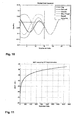
- Fig. 10 illustrate the extended frequency spectrum according to an embodiment of the invention
- Fig. 11 illustrates the large the large channel (or ICI) gain estimation MSE obtained from performing FFT directly in DFT-interpolation-based channel estimation method, when the pilot spacing is not divisible by the OFDM block size;
- Fig. 12 illustrates a linear interpolation to be combined with an FFT in order to replace the DFT operation in DFT-interpolation according to an embodiment of the invention
- Figs. 13 - 24 illustrate simulation results for different embodiments according to the invention for mitigating the edge affect caused by null subcarriers
- Fig. 25 is a simplified block diagram of a receiver according to an embodiment of the invention.
- Fig. 26 illustrates schematically functioning blocks of the iterative channel estimation and ICI cancellation process according to an embodiment of the invention where Forward Error Control (FEC) decoder and deinterleaver are included to counteract the effect of FEC encoder and interleaver at the transmitter.
- FEC Forward Error Control
- CFR Channel Frequency Response
- F reduces to a diagonal matrix. In this case, there are various existing channel estimation techniques applicable to estimate the channel gain.
- channel estimation will refer to an estimation of both the channel gain and the ICI gains.
- C k in Eq. 2 is the total ICI noise at the k th sub-carrier.
- C k is modeled as a Gaussian random process from the central limit theorem according to Russell et al. Since the process estimates the individual ICI gain as I m-k:k such that its corresponding ICI contribution in C k is canceled out by the receiver to improve the receiver error performance, it is relevant to look at the statistical property of I m-k;k instead of C k .
- the ICI generating mechanism is well known in the art and, therefore, not presented herein for brevity.
- the derivation of the autocorrelation of the ICI gain is outlined hereinbelow.
- J 0 ( ⁇ ) is the zero-order Bessel function of the first kind
- ⁇ 2 1 is the variance of the /th tap
- ⁇ q is the Kronecker delta function.
- Eq. 9 shows that A is constant with respect to r. Further, we observe that the summation part in Eq. 8 is the r th coefficient of the Fourier transform of the multi-path power delay profile. Normally, L « N, so that that p(r) varies slowly with respect to r. In fact, as shown below for d « N, we have the following approximation I p , k + d ⁇ I p , k
- the OFDM receiver when the linear approximation is made, the OFDM receiver to estimates only one vector of the ICI coefficients, H 1 (k).
- the other ICI coefficient vectors for different d values can be derived based on the linear relationship shown in Eq. (13).
- FIG. 1 A schematic diagram of the iterative decision-aided channel estimation and ICI cancellation for mobile OFDM systems according to an embodiment of the invention is illustrated in Fig. 1 .
- pilot-aided channel estimation 110 is applied to the received signal in order to obtain a first estimate of the channel gain H k at each sub-carrier.
- the frequency domain channel gains at the pilot sub-carriers are transformed into a spectrum domain, which is then filtered with a filtering function, to provide a filtered spectrum.
- the filtered spectrum is then interpolated and transformed back into the frequency domain to obtain channel gain estimates of each sub-carrier.
- a tentative decision of the transmitted symbol X k is thus obtained from process 120.
- the decisions from at least a previous iteration are used to obtain a better estimate in process 140 for both channel gain and ICI gains at each sub-carrier.
- the frequency domain channel gains at each sub-carrier are estimated.
- the estimated channel gains are then transformed into spectrum domain, which is then filtered with a filtering function to provide a filtered spectrum.
- the filtered spectrum is then transformed back into frequency domain to obtain the channel gain estimates of each sub-carrier.
- the frequency domain ICI gains from the d th neighbor sub-carrier at each sub-carrier are estimated.
- the resulting ICI gain estimates are transformed into spectrum domain, which is then filtered with a filtering function to provide a filtered spectrum
- the filtered spectrum is then transformed back to frequency domain to obtain channel gain estimates of each sub-carrier.
- the frequency domain ICI gains from the d th neighbor sub-carrier at each sub-carrier are estimated from the total ICI components, which is the received signals subtracted by the channel gain attenuated transmitted signals and the decision from the previous iteration.
- the frequency domain ICI gains from the dth neighbor sub-carrier at each sub-carrier are estimated from the residual ICI components, which is the received signals subtracted by the sum of the channel gain attenuated transmitted signals and the other ICI component calculated from the ICI gain estimates and the decisions from the previous iterations.
- ICI gains from the 1 st neighbor sub-carrier at each sub-carrier are estimated according to an embodiment of the invention.
- the remaining ICI gains are obtained by scaling the estimated ICI gains with a predetermined scaling factor.
- the receiver performs equalization and ICI cancellation in an iterative fashion to improve the error performance.
- LS Least Square
- the estimate of the length of the multi-path delay spread L ⁇ is used as the window size with a resulting tradeoff in complexity of calculations.
- Fig. 3B illustrates an equivalent process to IDFT-filtering, where the order of IDFT/DFT is swapped and the windowing function is modified accordingly. This method is referred to as DFT-filtering.
- the cutoff frequency N v of the low-pass filter V 270 is dynamically calculated, such that the ratio of the power in the pass band to the total power exceeds a predefined threshold.
- the low-pass filter V 270 is then realized, simply by setting to zero the components at frequencies higher than the cutoff frequency of the low-pass filter V 270 in the transform domain.
- the cutoff frequency N v in the DFT-filtering is determined by the channel multi-path spread.
- S' m denote the DFT 260 of the sequence H ⁇ k i .
- the channel gain estimation process 2200 provides several advantages including, robustness and low complexity. With respect to robustness, in the process 2200 no assumptions are made regarding the channel statistics during the estimation process. Reduced complexity is achieved as the DFT 260 and IFDT 270 processes are implemented with simpler FFT /IFFT processes respectfully.
- each individual ICI component is concealed within a relatively higher level of noise, which is a composite of Additive White Gaussian Noise (AWGN) and residual ICI. It is therefore a step in the process to extract the ICI gain.
- AWGN Additive White Gaussian Noise
- the first iteration provides only the channel gain estimates at the receiver, such that a simple one-tap equalizer is optionally used to estimate the tentative decisions.
- other methods such as Minimum Mean-Square Error (MMSE) with more taps is applied to obtain more accurate tentative decisions with a tradeoff in complexity.
- MMSE Minimum Mean-Square Error
- the channel matrix F has nonzero elements in the 2 K + 1 diagonals, the lower triangle of the K x K matrix in the bottom-left corner, and the upper triangle of the K x K matrix in the top-right corner.
- (2 K + 1) received signals are used to jointly perform (2 K + 1)-tap equalization and ICI cancellation in the data detection. Therefore, we call such a receiver a (2 K + 1)-tap equalizer with ICI cancellation.
- the iteration is stopped, for example, after a predetermined number of iterations or the number of iterations is dynamically adjusted according to the environment of the receiver with respect to SNR, mobility of receivers, number of channels, BER, and cost of processing on battery lifetime, but not limited thereto.
- the power of the multi-path channel taps is [0;-2;-6;-8;-10] (dB), and the delays are [0; 1; 3; 5; 10] (OFDM samples).
- Each channel tap is generated with Jakes' Doppler spectrum. Equal space pilots are used, and the spacing between two adjacent pilots is 16 subcarriers.
- Fig. 4 the Mean Square Error (MSE) of the estimated channel gain is plotted illustrating the effectiveness of the iterative decision-aided channel gain estimation process according to embodiments of the invention.
- MSE Mean Square Error
- FIG. 5 A snapshot of the ICI gains estimation is illustrated in Fig. 5 , where the amplitude of 3 different taps (/ 1; :, l 2 ,: and l 3 ;:) of estimated and approximated ICI gains are plotted with comparison to the actual ICI gains.
- the bit-error rate comparison between estimated ICI gain and approximated ICI gain is plotted in Fig. 6 .
- the approximated ICI gains using the estimated first tap ICI gain are closer to the actual ICI gains than the estimated ICI gains. This is due to the fact that, for taps p > 1, the LS estimates of the ICI gain are substantially noisier and, therefore, less accurate than the first tap ICI gain.
- BER Bit-Error Rate
- Fig. 7 the BER performance improvement is shown, plotted against the number of iterations of the channel estimation, and ICI cancellation process according to an embodiment of the invention.
- approximated ICI gains were used in the simulations for simplicity. From Fig. 6 it is evident that as the number of iterations increases, the extra performance gains diminish. In obtaining a good tradeoff between complexity of the process and the performance improvements, Fig. 6 indicates that establishing the process to perform 4 or 5 iterations provides a good balance.
- the process is established to operate with a fixed number of iterations or the number of iterations is dynamically adjusted according to the environment of the receiver with respect to SNR, mobility of receivers, number of channels, BER, and cost of processing on battery lifetime, but not limited thereto.
- the invention allows for a second degree of tradeoff between complexity and performance by varying the number of approximated ICI gain taps as well as the number of equalization taps.
- the performance improvements in BER for a receiver with varying ICI gain taps and equalization taps is plotted in Fig. 8 as a function of SNR. According to the simulation environment employed in determining the improvements plotted in Fig. 8 , implementing the process with a 5-tap equalization and 5-tap ICI cancellation provides a good tradeoff between performance and complexity. While the process is optionally implemented with a predetermined number of taps, such as the 5 identified above, it is also possible to implement the process with different predetermined numbers according to the environment and tradeoff of complexity / performance acceptable for the receiver. Also, optionally, the number of taps is varied according to the environment and received signal in a dynamic manner.
- embodiments of the invention provide a novel iterative channel estimation and ICI cancellation for OFDM systems, particularly mobile ones.
- the process approximates the ICI gains I p ,;: at taps p > 1 using the estimated first tap ICI gain.
- the approach reduces the computation complexity and provides significant improvement in error performance.
- the channel estimation process according to embodiments of the invention does not rely on the channel statistics, and thus, provides robust performance in a wide range of fading conditions.
- the iterative decision-aided channel estimation process provides an effective solution to OFDM systems with only frequency-domain pilots. For OFDM systems with time-domain pilot symbols, the iterative decision-aided channel estimation process is also applicable to track the channel variation between the pilots, allowing relaxing the requirements for pilot repetition.
- the OFDM modulation is performed with an IFFT assuming the number of subcarriers being a power of 2
- the existence of the null sub-carriers introduces the so called "edge effect" when channel estimation is performed using DFT/IDFT interpolation with filtering in case of pilot-aided solution or using DFT/IDFT filtering in case of decision-aided solution, where the channel estimation on the subcarriers close to the active spectrum edges suffers higher estimation error.
- the active frequency spectrum is divided into a group of K narrowband subchannels with equal bandwidth.
- each subchannel is modeled as a flat-fading channel.
- the information data sequence is also divided into K low-rate data sequences, each being carried in one subchannel.
- N-K null subcarriers
- the OFDM modulation is performed efficiently with an N- point IFFT.
- a Cyclic Prefix (CP) is added to the time-domain OFDM symbol in order to remove the ISI and the ICI caused by multipath fading channels.
- the wideband OFDM signal transmitted over a frequency-selective fading channel is equivalent to K narrowband subcarriers each transmitted of over a flat fading channel.
- the frequency domain signal of a DVB-T/H/SH system is plotted in Fig. 9 , where the filled circles are pilot symbols and the hollow circles are data symbols.
- the pilots are inserted evenly into the frequency-domain every 12 subcarriers.
- the pilot positions are shifted by 3 subcarriers from one OFDM symbol to the next.
- In the 2k mode of the DVT-T/H/SH system there are a total of 1705 active subcarriers, which carry either data symbols or pilot symbols.
- the OFDM modulation is performed with a 2048-point IFFT, after the insertion of 343 null subcarriers next to the 1705 active subcarriers.
- the pilot symbols are used for both synchronization and channel estimation.
- the pilot symbols are transmitted with a boosted power level in the DVB-T/H/SH system, so that the interference leaked from adjacent data subcarriers into the pilot subcarriers has less impact.
- DFT/IDFT -interpolation with filtering is an efficient technique to perform the channel estimation for OFDM systems with in-band pilot symbols.
- DFT-interpolation is based on the fact that the number of time-domain parameters - number of delay taps - necessary to characterize the channel is much less than the number of frequency-domain parameters, i.e., the number of subcarriers in an OFDM system. Therefore, the receiver estimates the time-domain parameters and derives the frequency domain parameters from the time-domain parameter estimations.
- the delay spread of the channel response is substantially smaller than the number of pilots.
- LPF Low-Pass Filter
- a vector of K symbols is mapped onto K subcarriers.
- M symbols are pilots known at the receiver, with which the frequency channel estimations of all the subcarriers are derived.
- the channel responses of other subcarriers are estimated via interpolation from the LS channel estimates. For simplicity, only one-dimensional (1D) interpolation over the frequency-domain is considered.
- the channel delay spread is substantially smaller than the number of pilot carriers. Therefore, the energy of the cepstrum representation of H ⁇ P (k) concentrates in the lower band. On the other hand, the transform of the noise and interference components is flat in the cepstrum domain. A LPF can therefore be applied to G ⁇ P (m) to remove part of the interference while keeping most of the useful information. In cases where the channel impulse response is much shorter than M , the performance improvement could be significant since the majority of the interference is removed.
- K and M are usually not a power of 2.
- the OFDM modulation is performed by padding N-K null subcarriers in addition to the K active subcarriers, to be able to apply the more efficient N -point IFFT/FFT.
- the DFT-based interpolation solution provides accurate results only when the channel frequency response is periodical and when it is continuous between the period boundaries. However, this is not the case in practice, where most OFDM systems have null subcarriers on the side of the useful spectrum. There are no pilots among the null subcarriers.
- the channel estimation is performed over the entire spectrum - including both active and null subcarriers - to apply an FFT instead of a DFT, this results in large estimation errors on the subcarriers close to the boundaries between the active and the null subcarriers because of the Gibbs's phenomenon, which is referred to as the "edge effect" hereinbelow.
- DFT interpolation is optimal when the number of total subcarriers is divisible by the pilot spacing. Performance degradation occurs for the FFT-interpolation-based channel estimation when the pilots are not strictly evenly-distributed in the whole spectrum.
- the pilot spacing is 12 subcarriers, which is not a power of 2. Therefore, it is impossible to have strictly evenly-distributed pilots. Simulation results show that this causes higher channel estimation MSE compared to a DFT-based interpolation. Therefore, an alternative solution is needed which has both a performance close to the DFT-based interpolation and an implementation complexity close to the FFT-based solution.
- the edge effect of the DFT-interpolation-based channel estimation is caused mainly by the discontinuities on the two boundaries.
- a Wiener filter is used to add more virtual pilots in the null area of the spectrum.
- applying the Wiener filter requires the knowledge of the channel characteristics. This issue is addressed by performing channel estimation which optimizes the MSE of the active subchannels only. This is achieved by applying a matrix multiplication, which requires more complexity.
- the edge effect is mitigated by transmitting extra pilot symbols near the edges of the active spectrum in addition to the regularly spaced pilots, thereby increasing pilot density at the edges.
- an efficient MMSE channel estimator is applied to achieve better channel estimation performance. This technique, however, requires the transmission of additional pilots and requires also additional complexity in both the MMSE channel estimation and in estimating the second-order channel characteristics which are required by the MMSE channel estimator.
- Virtual Pilots (VPs) - and corresponding virtual channel gain estimates - are added in the null spectrum to reduce the discontinuity on the two boundaries between the active and the null spectrum.
- the VPs are added in such a manner that the channel frequency response over the expanded spectrum is smooth on the two boundaries between the active spectrum and the null spectrum.
- the spectrum is circularly continuous after the VPs are added.
- a less optimal but simpler method is implemented in order to minimize the complexity.
- the receiver first obtains the LS channel estimates on the pilot carriers with Eq. (27), resulting in the LS CEV H P .
- the PCEV is thereafter used for DFT-interpolation-based channel estimation.
- the Zero-padding is the conventional method, which is listed here as a reference for comparison. As shown in Fig. 10 , the N -point sequence generated by Zero-padding introduces significant discontinuity on both sides of the active spectrum, which causes the so-called "edge effect".
- H ⁇ P e k ⁇ 2 ⁇ H ⁇ P 0 - H ⁇ P ⁇ k 1 - k 0 ⁇ k ⁇ k 1 H ⁇ P ⁇ k - k 1 k 1 ⁇ k ⁇ k 2 2 ⁇ H ⁇ P k 2 - H ⁇ P ⁇ 2 ⁇ k 2 - k k 2 ⁇ k ⁇ M
- the Symmetric-padding method comprises appending the mirror image of a sub-vector on both sides of the LS CEV.
- the curve is most likely not smooth when looking at the small local area around the edges. However, it does provide a "smoother" transition if these small local areas are ignored. It will be shown hereinbelow that, in flat-fading channels, this method actually provides better performance than the Smooth-padding method.
- the Repeat-padding method the first L 1 entries of H ⁇ P are copied in a 1 and the last entries of H ⁇ P are copied in a 2 .
- this method adds VPs in the null spectrum, it keeps a significant amount of the discontinuity between the active and null spectrum, which results in inferior performance compared to the Smooth and Symmetric padding methods.
- the Pseudo channel unlikely keeps the "band-limiting" property of the actual channel in the cepstrum domain.
- Performing windowing introduces additional MSE due to the discarding of the high frequency component of the Pseudo channel.
- the noise contained in the padding data, i.e., LS channel estimates, on both sides introduces more estimation error.
- the target is to find a solution which significantly reduces the edge effect while keeping most of the "band-limiting" property.
- spectrum shaping is applied to the extended channel estimation vector H ⁇ P e .
- the first shaping window considered is the Hanning window.
- the FFT block size is 2048, while the closest block size which is divisible by 12 is 2052.
- Performing a DFT-interpolation with a 2052-point IDFT is an optimal solution, assuming that the channel under consideration meets the Nyquist theorem in frequency with the specific pilot structure.
- performing a 2048-point IFFT instead of the 2052-point IDFT will cause performance degradation.
- the channel delay spread is limited to ⁇ samples, which is smaller than the cyclic prefix length G .
- H D (k) H P (m).
- h(n) are i.i.d. Gaussian random variables with zero mean and variance 1/ ⁇ - to guarantee a total path gain of 1
- the MSE is calculated for a DFT size of 2052 and an FFT size of 2048 and is plotted in Fig. 11 . It is shown that there is an obvious estimation error caused by the application of an FFT instead of a DFT.
- embodiments according to the invention comprise two methods to replace the DFT operation with an FFT followed by linear interpolation (FFT-Intp).
- the first method is based on the fact that performing a DFT with different number of points over the same time-domain sequence is equivalent to sampling the frequency-domain spectrum of this sequence with a different resolution.
- the 2052-point frequency response sampled with a resolution of F s /2052 is obtained directly by linear interpolation from the 2048-point frequency response sampled at F s /2048, where F s is the sample frequency.
- F s is the sample frequency.
- 28 VPs are added on the two sides of the active spectrum of 143 pilots so that a total of 171 pilots cover the extended spectrum which is divided into 2048 subchannels.
- a second solution is to add 113 VPs to the 143 active pilots so that the total number of pilots is now 256.
- a 256-point FFT is then performed to convert the extended channel frequency response into the cepstrum domain.
- the 256-point cepstrum is then expanded into a 4096-point vector by padding zeros.
- a 4096-point IFFT is then applied to perform the interpolation and obtain a 4096-point frequency response for the extended channel.
- each subcarrier becomes a "pilot" assuming all feedback decisions are correct.
- LS channel estimation is calculated for each subcarrier and K LS estimates are obtained.
- DFT/IDFT-filtering is applied to this LS vector to improve the channel estimation accuracy by discarding a significant part of the wideband channel estimation noise, caused by both additive noise (AWGN and ICI) and incorrect decision feedbacks. Since this operation is no longer an interpolation, we refer to it as DFT/IDFT-filtering.
- the DFT/IDFT-filtering process follows the operations for DFT/IDFT -interpolation described above, except that the LS channel estimation vector contains all active subcarriers.
- the edge effect still exists causes performance degradation.
- This "edge effect” is mitigated by extending the LS channel estimation vector on both sides so as to obtain smooth curve transmissions on the boundaries of the active spectrum.
- the discontinuity of the extended channel frequency response vector - i.e., including the null spectrum - is reduced by applying the spectrum shaping as described above.
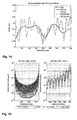
- Fig. 13 illustrates the channel estimation MSE when the conventional zero-padding-based DFT/IDFT -interpolation and FFT-interpolation is used, with and without windowing, assuming no additive noise. It is observed that, at high SNR, for the given channel, all methods result in channel estimation very close to the original channel at the center part of the spectrum. However, the "edge effect" is very obvious at the subcarriers near the edges of the active spectrum, as shown in the second diagram in Fig. 13 . Since there is no additive noise, the windowing does not provide performance improvement. On the other hand, it likely introduces performance degradation to the subcarriers on the boundaries due to the fact that the padded channel frequency response is no longer "bandlimited" in the cepstrum domain. Filtering out the higher frequency component removes part of the signal component together with the wideband noise component. Since the high frequency component is mainly introduced by the discontinuities on the boundaries, removing these components will cause damage to the subcarriers close to boundaries.
- Fig. 14 the same curves are presented for the same frequency selective fading channel for a low SNR scenario, with an E b / N 0 of 10 dB.
- the channel estimates are not as accurate comparing to the high SNR case. Significant performance improvement is observed when filtering is applied.
- Fig. 15 illustrates the subcarrier MSEs obtained from different channel estimation methods. With a high E b lN 0 of 40 dB, this figure reveals the inherent weakness of the channel estimation methods. It is obvious that all methods still suffer the "edge effect", which is plotted in detail in the second subplot. The "edge effect" is significant for Repeat-padding and Zero-padding methods. In case of Smooth-padding, the “edge effect” is significantly reduced, where the MSE of the edge subcarriers is more than 10 times lower than that for Repeat-padding. The Symmetric-padding method provides a different trade-off on the "edge effect".
- the MSE of the Symmetric-padding method becomes better than the Smooth-padding method for subcarriers with index lower than 1675. It can also be shown that at the center of the spectrum, the Repeat-padding and Smooth-padding suffers slightly higher MSE than the Symmetric and Zero-padding methods. This small difference on the MSE obtained from different methods for the center subcarriers is insignificant and is unlikely to cause any difference in detection performance. The system performance is most likely degraded by the high MSE on the edge subcarriers.
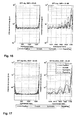
- Fig. 16 illustrates the MSE performance of the channel estimation with different data-padding methods at a more practical E b / N 0 value of 20 dB. It is observed that the MSEs on the edge subcarriers for different methods are closer compared to those shown in Fig. 15 . This is due to the fact that the additive noise becomes one of the major contributors to the MSE which is common to all methods. For Zero-padding and Repeat-padding methods, the MSE on the edge subcarriers increases only slightly since the "edge effect" is still the major contributor. However, for Symmetric-padding and Smooth-padding, the MSE on these subcarriers increases significantly, indicating that the major contributor is the additive noise.
- Fig. 17 illustrates the MSE performance of the different channel estimation methods with cepstrum-domain windowing.
- the window size is chosen to be as large as the channel delay spread to achieve the optimal performance. It is observed in this figure that the channel estimation MSE is significantly improved for subcarriers inside the spectrum. On the other hand, the "edge effect" becomes worse with the windowing. It is also observed that the MSE of the Smooth-padding method does not suffer degradation as significant as other methods.
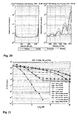
- the Hanning window is applied to shape the channel frequency response.
- the channel estimation MSE results obtained by simulation with this spectrum shaping are shown in Fig. 18 . Applying spectrum shaping significantly improves the MSE performance when the Smooth-padding is used. For the other data padding methods, the MSE improvement is not as significant. Furthermore, the MSE becomes more uniform with the shaping applied.
- Fig. 19 illustrates the performance degradation caused by applying FFT-interpolation instead of DFT interpolation. It is clearly shown that at this E b lN 0 , the FFT-interpolation provides significant MSE performance degradation due to the unevenly distributed pilots at the end of the spectrum. Performance obtained with the second FFTIntp method is also plotted in this figure, which shows a performance close to that of DFT-based interpolation, as well as a better "edge effect".
- Fig. 20 illustrates the MSE performance of the decision-directed DFT-interpolation-based channel estimation methods. Since there is no interpolation, performing FFT instead of DFT does not result in the performance degradation as shown in Fig. 19 . It is observed that the MSE on the inner subcarriers is much better than the interpolation-based solution. However, the "edge effect" is more or less on the same level. Therefore, applying Smooth data padding is still an effective way to reduce the "edge effect".
- the mobile channel model used in the simulation is a scaled Typical Urban (TU) wireless channel profile. It has the similar power delay profile shape as the TU channel but is linearly scaled to the specified multipath delay spread. Furthermore, the Doppler spectrum of all the incoming waves follows the Jake's model.
- TU Typical Urban
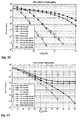
- Fig. 21 illustrates the BER performances of the COFDM system with channel estimation based on Zero-padding in AWGN channel, which is the extreme case of frequency-flat fading channels. From Fig. 21 follows
- Fig. 22 illustrates performance curves when applying Smooth-padding with spectrum shaping. Significant performance improvement is achieved and no error floor is observed.
- Fig. 23 illustrates performance curves of the channel estimation based on Zero-padding in frequency-selective fading channels, where the following observations are made
- Fig. 24 illustrates performance curves when applying Smooth-padding with spectrum shaping. Performance improvement is not obvious for low to medium SNR values. On the other hand, the error floor occurs at around 10 -5 , which is substantially lower than that obtained with the Zero-padding method.
- the above embodiments of the invention for mitigating the edge effect are not limited to the DVB OFDM systems, but also to other OFDM systems with Null spectrum, where DFT/IDFT interpolation with filtering is applied in case of pilot-aided channel estimation, or/and DFT/IDFT filtering is applied in case of decision-aided channel estimation and ICI gain estimation.
- the receiver 500 comprises an input port 502 for receiving a signal comprising a plurality of subcarriers.
- a pilot-aided channel estimator 504 is connected to the input port 502.
- the pilot- aided channel estimator 504 processes the signal by performing pilot-aided channel estimation for determining a first estimate of channel gain at each subcarrier.
- a decision block 506 is connected to the pilot-aided channel estimator 504 and to the input port 502.
- the decision block 506 determines a decision signal in dependence upon an estimate of channel gain at each subcarrier and an estimate of inter carrier interference gains at each subcarrier.
- Output port 508 is connected to the decision block 506 for providing the decision signal.
- Decision aided channel gain estimation block 510 is connected to the input port 502, the decision block 506 and to a node 512 interposed between the decision block 506 and the output port 508.
- the decision aided channel gain estimation block 510 determines an estimate of channel gain at each subcarrier corresponding to a principal diagonal vector of a channel frequency response matrix and for providing the estimate of channel gain at each subcarrier to the decision block 506.
- the block 514 determines an estimate of inter carrier interference gains at each subcarrier corresponding to off-diagonal vectors of the channel frequency response matrix in dependence upon the received signal and the decision signal.
- ICI coefficient estimation is performed in ICI coefficient block 514 - k parallel blocks, i.e.
- the decision block 506 and/or the decision aided channel gain estimation block 510; inter carrier interference gain estimation block 514 comprises a filter circuit.
- the decision block 506 and/or the decision aided channel gain estimation block 510; inter carrier interference gain estimation block 514 comprises a filter circuit.
Landscapes
- Engineering & Computer Science (AREA)
- Power Engineering (AREA)
- Computer Networks & Wireless Communication (AREA)
- Signal Processing (AREA)
- Cable Transmission Systems, Equalization Of Radio And Reduction Of Echo (AREA)
Applications Claiming Priority (1)
| Application Number | Priority Date | Filing Date | Title |
|---|---|---|---|
| US90560307P | 2007-03-08 | 2007-03-08 |
Publications (2)
| Publication Number | Publication Date |
|---|---|
| EP1968268A2 true EP1968268A2 (de) | 2008-09-10 |
| EP1968268A3 EP1968268A3 (de) | 2013-02-20 |
Family
ID=39535348
Family Applications (1)
| Application Number | Title | Priority Date | Filing Date |
|---|---|---|---|
| EP08250807A Withdrawn EP1968268A3 (de) | 2007-03-08 | 2008-03-10 | Kanalschätzung und Ausgleich von Zwischenträgerinterferenzen in einem Mehrträgerempfänger |
Country Status (3)
| Country | Link |
|---|---|
| US (1) | US7995688B2 (de) |
| EP (1) | EP1968268A3 (de) |
| CA (1) | CA2627057A1 (de) |
Cited By (11)
| Publication number | Priority date | Publication date | Assignee | Title |
|---|---|---|---|---|
| WO2010088577A1 (en) * | 2009-02-01 | 2010-08-05 | Qualcomm Incorporated | Smooth edge distortion in broadband channel interpolation via virtual pilot extrapolation |
| GB2470753A (en) * | 2009-06-03 | 2010-12-08 | Sony Corp | Receiver and method for processing pilot data in an ofdm system |
| EP2391079A1 (de) * | 2010-05-25 | 2011-11-30 | Nxp B.V. | Mobiler OFDM-Empfänger mit Interträgerinterferenz-Kompensation |
| EP2365670A4 (de) * | 2008-12-03 | 2012-01-18 | Huawei Device Co Ltd | Verfahren zur kanalschätzung und entsprechende empfangsvorrichtung in einem orthogonal-frequenzmultiplexsystsem |
| CN101800721B (zh) * | 2009-02-09 | 2012-12-12 | 华为技术有限公司 | 正交频分复用通信系统中的干扰估计的方法和装置 |
| EP2658194A1 (de) * | 2012-04-23 | 2013-10-30 | Nxp B.V. | Kanalschätzung mit reduzierter Latenz |
| EP2756603A4 (de) * | 2011-09-14 | 2015-06-03 | St Ericsson Sa | Kanalschätzungsverfahren, kanalschätzungsvorrichtung und kommunikationsvorrichtung für cdma-systeme |
| US9369970B2 (en) | 2011-09-14 | 2016-06-14 | St-Ericsson Sa | Method and device for denoising in channel estimation, and corresponding computer program and computer readable storage medium |
| CN110808927A (zh) * | 2019-10-31 | 2020-02-18 | 江苏软仪科技股份有限公司 | 一种估计802.11ax协议2x模式信道系数的方法 |
| US10567200B2 (en) | 2018-02-28 | 2020-02-18 | Nxp B.V. | Method and apparatus to reduce delays in channel estimation |
| US20220368569A1 (en) * | 2019-10-22 | 2022-11-17 | Nanyang Technological University | Method of receiving a transmitted signal over a time-varying channel and receiver thereof |
Families Citing this family (62)
| Publication number | Priority date | Publication date | Assignee | Title |
|---|---|---|---|---|
| US7995688B2 (en) * | 2007-03-08 | 2011-08-09 | Her Majesty The Queen In Right Of Canada, As Represented By The Minister Of Industry, Through The Communications Research Centre Canada | Channel estimation and ICI cancellation for OFDM |
| US8229036B2 (en) * | 2007-12-21 | 2012-07-24 | Broadcom Corporation | Characterizing channel response using data tone decision feedback |
| US8081690B2 (en) * | 2008-01-11 | 2011-12-20 | Qualcomm Incorporated | OFDM channel estimation |
| US8102950B2 (en) * | 2008-02-22 | 2012-01-24 | Telefonaktiebolaget Lm Ericsson (Publ) | Method and apparatus for efficient multi-symbol detection |
| US8345793B2 (en) * | 2008-03-10 | 2013-01-01 | Telefonaktiebolaget Lm Ericsson (Publ) | Compensation of diagonal ISI in OFDM signals |
| KR101466943B1 (ko) * | 2008-04-04 | 2014-12-02 | 삼성전자주식회사 | 주파수 영역 등화를 위한 송신기 및 수신기 |
| US7940864B2 (en) * | 2008-04-28 | 2011-05-10 | Newport Media, Inc. | Channel estimation for high doppler mobile environments |
| ATE544277T1 (de) * | 2008-07-15 | 2012-02-15 | St Ericsson Sa | Zwischenträger-interferenzreduzierung für mehrträgersignale |
| ATE510392T1 (de) * | 2008-09-12 | 2011-06-15 | Research In Motion Ltd | Zeitsynchronisation von long-term-evolution- funkverbindungen |
| US8116394B2 (en) * | 2008-09-12 | 2012-02-14 | Research In Motion Limited | Long term evolution (LTE) radio link timing synchronization |
| US8295373B2 (en) * | 2008-09-30 | 2012-10-23 | Intel Corporation | Virtual multicarrier design for orthogonal frequency division multiple access communications |
| US8830926B2 (en) * | 2008-10-27 | 2014-09-09 | Nokia Siemens Networks Oy | Method for network co-ordination in a mobile communications system and apparatus thereof |
| KR20100070751A (ko) * | 2008-12-18 | 2010-06-28 | 한국전자통신연구원 | 무선 통신 시스템의 채널 추정 방법 및 그 장치 |
| CN101771650B (zh) * | 2009-01-07 | 2013-08-21 | 北京泰美世纪科技有限公司 | 一种ofdm系统的信道估计装置和方法 |
| WO2010081896A2 (en) * | 2009-01-16 | 2010-07-22 | Abilis Systems Sarl | Interpolated channel estimation for mobile ofdm systems |
| EP2230791A1 (de) * | 2009-03-20 | 2010-09-22 | Nxp B.V. | Signalverarbeiter, Empfänger und Signalverarbeitungsverfahren |
| US20100254278A1 (en) * | 2009-04-07 | 2010-10-07 | Broadcom Corporation | Assessment in an information network |
| US8699595B2 (en) * | 2009-06-29 | 2014-04-15 | Freescale Semiconductor, Inc. | Integrated circuit with channel estimation module and method therefor |
| US20110080517A1 (en) * | 2009-10-01 | 2011-04-07 | The Directv Group, Inc. | Phase noise and frequency error resilient demodulation scheme for moca |
| CN102045285B (zh) * | 2009-10-14 | 2013-09-11 | 华为技术有限公司 | 信道估计方法、装置以及通信系统 |
| US8223862B2 (en) | 2009-10-20 | 2012-07-17 | King Fahd University Of Petroleum And Minerals | OFDM inter-carrier interference cancellation method |
| EP2328310B1 (de) * | 2009-11-27 | 2017-01-11 | Sequans Communications | Verfahren zum Einschätzen eines empfangenen Signals und entsprechende Vorrichtung |
| KR101086453B1 (ko) | 2009-12-29 | 2011-11-25 | 전자부품연구원 | 스펙트럼 효율을 위한 ofdm 송수신 장치 및 방법 |
| CN101815053B (zh) * | 2010-03-18 | 2013-08-21 | 展讯通信(上海)有限公司 | 信道估计方法及其装置 |
| US8798547B2 (en) * | 2010-04-13 | 2014-08-05 | Qualcomm Incorporated | Noise padding techniques in heterogeneous networks |
| CN102244630A (zh) * | 2010-05-13 | 2011-11-16 | 北京泰美世纪科技有限公司 | Ofdm系统中子载波间干扰消除的方法及装置 |
| US10491357B2 (en) * | 2010-07-12 | 2019-11-26 | Entropic Communications Llc | Method and apparatus for using dynamic subchannels in a communications network |
| TWI426733B (zh) * | 2010-11-15 | 2014-02-11 | Univ Nat Chiao Tung | 處理一分頻多工訊號之系統及方法 |
| WO2012109782A1 (en) * | 2011-02-14 | 2012-08-23 | Qualcomm Incorporated | Pilot signal cancellation scheme for wireless mobile broadband systems based on ofdm |
| WO2012126878A1 (en) * | 2011-03-18 | 2012-09-27 | Imec | Method and apparatus for tracking fast time-varying communication channels |
| US20120316886A1 (en) * | 2011-06-08 | 2012-12-13 | Ramin Pishehvar | Sparse coding using object exttraction |
| US8611444B2 (en) * | 2011-06-22 | 2013-12-17 | Infomax Communication Co., Ltd. | Receiver and signal receiving method thereof |
| TWI427957B (zh) * | 2011-08-23 | 2014-02-21 | Ind Tech Res Inst | 一種通道估測方法及裝置 |
| US9071473B2 (en) | 2011-09-09 | 2015-06-30 | Telefonaktiebolaget L M Ericsson (Publ) | Method and system for wireless communication channel estimation |
| US8891590B1 (en) * | 2011-09-28 | 2014-11-18 | Marvell International Ltd. | Method and apparatus for processing wireless signals |
| US8737499B2 (en) | 2011-10-17 | 2014-05-27 | Qualcomm Incorporated | Advanced interference cancellation for precoded GSM edge radio access network (GERAN) |
| US8903001B2 (en) * | 2011-11-10 | 2014-12-02 | Marvell World Trade Ltd. | Channel estimation with decision feedback |
| US8824527B2 (en) | 2011-11-15 | 2014-09-02 | Acorn Technologies, Inc. | OFDM receiver with time domain channel estimation |
| CN102868575A (zh) * | 2012-09-24 | 2013-01-09 | 航天科工深圳(集团)有限公司 | 一种电力线载波通信系统的仿真方法、系统 |
| US9397864B2 (en) * | 2012-10-05 | 2016-07-19 | Apple Inc. | Adaptive channel estimation for coordinated multipoint cellular communication |
| US9350587B1 (en) | 2012-11-30 | 2016-05-24 | Marvell International Ltd. | System and method for timing error estimation |
| US20140341265A1 (en) * | 2013-03-11 | 2014-11-20 | Nikola Alic | Method for subrate detection in bandwidth constrained communication systems |
| US9031123B2 (en) | 2013-03-15 | 2015-05-12 | Acorn Technologies, Inc. | Communication system and method using subspace interference cancellation |
| US9154337B2 (en) | 2013-03-15 | 2015-10-06 | Acorn Technologies, Inc. | Non-linear time domain channel estimation in OFDM systems |
| US8897353B2 (en) | 2013-03-15 | 2014-11-25 | Acorn Technologies, Inc. | Block time domain channel estimation in OFDM system |
| CN103227768B (zh) * | 2013-04-28 | 2016-07-06 | 南京邮电大学 | 一种新的ici自消除方法在ofdm调制中的应用 |
| US9544168B2 (en) * | 2013-06-06 | 2017-01-10 | Pioneer Corporation | Channel estimation device, receiving device, channel estimation method, channel estimation program, and recording medium |
| US9537678B2 (en) | 2014-02-13 | 2017-01-03 | Samsung Electronics Co., Ltd | Method and apparatus for robust two-stage OFDM channel estimation |
| KR101518836B1 (ko) | 2014-08-14 | 2015-05-13 | 삼성전자주식회사 | 주파수 영역 등화를 위한 송신기 및 수신기 |
| TWI575901B (zh) * | 2015-06-17 | 2017-03-21 | 晨星半導體股份有限公司 | 通道效應消除裝置及通道效應消除方法 |
| CN112583757B (zh) * | 2016-01-14 | 2024-09-27 | 松下知识产权经营株式会社 | 发送方法、发送装置和集成电路 |
| TWI627846B (zh) * | 2016-03-30 | 2018-06-21 | 晨星半導體股份有限公司 | 等化增強模組、解調變系統以及等化增強方法 |
| US10171272B2 (en) * | 2017-04-28 | 2019-01-01 | Intel Corporation | Computationally efficient algorithm for mitigating phase noise in OFDM receivers |
| TWI631837B (zh) * | 2017-05-02 | 2018-08-01 | 南開科技大學 | 多重符元導向式共同通道估測與信號檢測法及其共同通道估測與信號檢測裝置 |
| EP3665878B1 (de) * | 2017-08-11 | 2022-06-22 | Nokia Technologies Oy | Zwischenträgerinterferenzkompensation |
| US10547489B2 (en) * | 2018-03-13 | 2020-01-28 | University Of South Florida | OFDM reception under high adjacent channel interference while preserving frame structure |
| DE102018206132B4 (de) * | 2018-04-20 | 2019-11-21 | Fraunhofer-Gesellschaft zur Förderung der angewandten Forschung e.V. | Decodergestützte iterative Kanalschätzung |
| US11855814B2 (en) * | 2020-08-07 | 2023-12-26 | Telefonaktiebolaget Lm Ericsson (Publ) | De-ICI filter estimation for phase noise mitigation |
| DE102021116549A1 (de) | 2021-06-25 | 2022-12-29 | Continental Automotive Gmbh | Verfahren und Vorrichtung zur Bestimmung von über orthogonale Frequenzmultiplexsignale übertragenen Symbolen |
| CN116192568A (zh) * | 2021-11-26 | 2023-05-30 | 中国电信股份有限公司 | 信道估计方法、信道估计装置和计算机可读存储介质 |
| CN114978820B (zh) * | 2022-05-06 | 2023-04-21 | 南京信息工程大学 | 一种基于fbmc雷达通信一体化信号信道估计方法 |
| CN120238396B (zh) * | 2025-05-29 | 2025-07-25 | 苏州门海微电子科技有限公司 | 电力线载波信号信道估计滤波方法及装置 |
Family Cites Families (20)
| Publication number | Priority date | Publication date | Assignee | Title |
|---|---|---|---|---|
| GB2287620B (en) * | 1994-03-10 | 1998-12-16 | Roke Manor Research | A digital cellular mobile radio receiver |
| EP1171983B1 (de) * | 2000-02-22 | 2007-07-18 | Koninklijke Philips Electronics N.V. | Mehrträgerempfänger mit kanalschätzer |
| US6862326B1 (en) * | 2001-02-20 | 2005-03-01 | Comsys Communication & Signal Processing Ltd. | Whitening matched filter for use in a communications receiver |
| EP1364506A2 (de) * | 2001-02-22 | 2003-11-26 | Koninklijke Philips Electronics N.V. | Mehrträger-übertragungssystem mit kanalantwortabschätzung mit verringerter komplexität |
| WO2002067527A2 (en) * | 2001-02-22 | 2002-08-29 | Koninklijke Philips Electronics N.V. | Multicarrier equalisation using multiplication by a leakage matrix |
| JP4164363B2 (ja) * | 2001-02-22 | 2008-10-15 | コーニンクレッカ フィリップス エレクトロニクス エヌ ヴィ | 低減された複雑性のキャリア間干渉除去 |
| US7139320B1 (en) * | 2001-10-11 | 2006-11-21 | Texas Instruments Incorporated | Method and apparatus for multicarrier channel estimation and synchronization using pilot sequences |
| US20040005010A1 (en) * | 2002-07-05 | 2004-01-08 | National University Of Singapore | Channel estimator and equalizer for OFDM systems |
| US7228113B1 (en) * | 2004-04-05 | 2007-06-05 | National Semiconductor Corporation | SIMO/MISO transceiver for providing packet data communication with SISO transceiver |
| US20070211827A1 (en) * | 2004-05-28 | 2007-09-13 | Koninklijke Philips Electronics, N.V. | Channel Estimation in an Ofdm System With High Doppler Shift |
| DE602004009619T2 (de) * | 2004-08-31 | 2008-07-24 | Ntt Docomo Inc. | Vorrichtung und verfahren zum iterativen schätzen einer kanalübertragungsfunktion |
| KR100651446B1 (ko) * | 2005-01-19 | 2007-02-28 | 삼성전자주식회사 | 시공간 블록 부호화 기법을 사용하는직교주파수다중화방식의 이동통신시스템에서 채널 추정 및주기적 프리픽스 재생성 장치 및 방법 |
| JP4936680B2 (ja) * | 2005-05-20 | 2012-05-23 | 富士通株式会社 | Ofdm受信方法及び受信装置 |
| US7583755B2 (en) * | 2005-08-12 | 2009-09-01 | Ati Technologies, Inc. | Systems, methods, and apparatus for mitigation of nonlinear distortion |
| US7558337B2 (en) * | 2005-08-12 | 2009-07-07 | Ati Technologies, Inc. | Systems, methods, and apparatus for impulse noise mitigation |
| US7830994B2 (en) * | 2006-10-18 | 2010-11-09 | Analog Devices, Inc. | Channel estimation system and method |
| KR101291683B1 (ko) * | 2006-12-07 | 2013-08-01 | 삼성전자주식회사 | Tds-ofdm 수신기의 등화방법 및 상기 등화방법을이용한 등화장치 |
| US7995688B2 (en) * | 2007-03-08 | 2011-08-09 | Her Majesty The Queen In Right Of Canada, As Represented By The Minister Of Industry, Through The Communications Research Centre Canada | Channel estimation and ICI cancellation for OFDM |
| US7782967B2 (en) * | 2007-03-19 | 2010-08-24 | Alcatel-Lucent Usa Inc. | Method of frequency offset compensation |
| US8275055B2 (en) * | 2007-11-20 | 2012-09-25 | Her Majesty The Queen In Right Of Canada, As Represented By The Minister Of Industry, Through The Communications Research Centre Canada | Receiver for differentially modulated multicarrier signals |
-
2008
- 2008-03-07 US US12/073,687 patent/US7995688B2/en not_active Expired - Fee Related
- 2008-03-10 EP EP08250807A patent/EP1968268A3/de not_active Withdrawn
- 2008-03-10 CA CA002627057A patent/CA2627057A1/en not_active Abandoned
Non-Patent Citations (1)
| Title |
|---|
| RUSSELL ET AL.: "Inter-channel interference analysis of OFDM in a mobile environment", IEEE VTC '95, 1995, pages 820 - 824 |
Cited By (20)
| Publication number | Priority date | Publication date | Assignee | Title |
|---|---|---|---|---|
| EP2365670A4 (de) * | 2008-12-03 | 2012-01-18 | Huawei Device Co Ltd | Verfahren zur kanalschätzung und entsprechende empfangsvorrichtung in einem orthogonal-frequenzmultiplexsystsem |
| US8335270B2 (en) | 2008-12-03 | 2012-12-18 | Huawei Device Co., Ltd. | Channel estimation method of an orthogonal frequency division multiplexing system and receiving apparatus |
| US8611340B2 (en) | 2009-02-01 | 2013-12-17 | Qualcomm, Incorporated | Smooth edge distortion in broadband channel interpolation via virtual pilot extrapolation |
| WO2010088577A1 (en) * | 2009-02-01 | 2010-08-05 | Qualcomm Incorporated | Smooth edge distortion in broadband channel interpolation via virtual pilot extrapolation |
| CN101800721B (zh) * | 2009-02-09 | 2012-12-12 | 华为技术有限公司 | 正交频分复用通信系统中的干扰估计的方法和装置 |
| GB2470753A (en) * | 2009-06-03 | 2010-12-08 | Sony Corp | Receiver and method for processing pilot data in an ofdm system |
| US8279958B2 (en) | 2009-06-03 | 2012-10-02 | Sony Corporation | Receiver and method |
| US8687749B2 (en) | 2010-05-25 | 2014-04-01 | Nxp, B.V. | Mobile OFDM receiver |
| EP2391079A1 (de) * | 2010-05-25 | 2011-11-30 | Nxp B.V. | Mobiler OFDM-Empfänger mit Interträgerinterferenz-Kompensation |
| EP2756603A4 (de) * | 2011-09-14 | 2015-06-03 | St Ericsson Sa | Kanalschätzungsverfahren, kanalschätzungsvorrichtung und kommunikationsvorrichtung für cdma-systeme |
| US9369970B2 (en) | 2011-09-14 | 2016-06-14 | St-Ericsson Sa | Method and device for denoising in channel estimation, and corresponding computer program and computer readable storage medium |
| US9571260B2 (en) | 2011-09-14 | 2017-02-14 | Optis Circuit Technology, Llc | Channel estimation method, channel estimation apparatus and communication device for CDMA systems |
| CN103379056A (zh) * | 2012-04-23 | 2013-10-30 | Nxp股份有限公司 | 缩短等待时间的信道估计 |
| EP2658194A1 (de) * | 2012-04-23 | 2013-10-30 | Nxp B.V. | Kanalschätzung mit reduzierter Latenz |
| US9071492B2 (en) | 2012-04-23 | 2015-06-30 | Nxp, B.V. | Reduced latency channel-estimation |
| CN103379056B (zh) * | 2012-04-23 | 2016-05-25 | Nxp股份有限公司 | 接收ofdm信号的接收机和方法 |
| US10567200B2 (en) | 2018-02-28 | 2020-02-18 | Nxp B.V. | Method and apparatus to reduce delays in channel estimation |
| US20220368569A1 (en) * | 2019-10-22 | 2022-11-17 | Nanyang Technological University | Method of receiving a transmitted signal over a time-varying channel and receiver thereof |
| US11943081B2 (en) * | 2019-10-22 | 2024-03-26 | Nanyang Technological University | Method of receiving a transmitted signal over a time-varying channel and receiver thereof |
| CN110808927A (zh) * | 2019-10-31 | 2020-02-18 | 江苏软仪科技股份有限公司 | 一种估计802.11ax协议2x模式信道系数的方法 |
Also Published As
| Publication number | Publication date |
|---|---|
| CA2627057A1 (en) | 2008-09-08 |
| US7995688B2 (en) | 2011-08-09 |
| EP1968268A3 (de) | 2013-02-20 |
| US20080219371A1 (en) | 2008-09-11 |
Similar Documents
| Publication | Publication Date | Title |
|---|---|---|
| US7995688B2 (en) | Channel estimation and ICI cancellation for OFDM | |
| EP1872551B1 (de) | Zeitbereichs-Fenstertechnik und Zwischen-Träger-Störungslöschung | |
| US8837651B2 (en) | Apparatus and method for estimating a channel in broadband wireless access system | |
| EP1757052A1 (de) | Verfahren zur signalverarbeitung und signalprozessor in einem ofdm-system | |
| EP2002622A1 (de) | Kanalschätzung für kanäle mit schnellem dispersivem fading | |
| WO2010088577A1 (en) | Smooth edge distortion in broadband channel interpolation via virtual pilot extrapolation | |
| Zhang et al. | A low-complexity robust OFDM receiver for fast fading channels | |
| Tang et al. | Iterative channel estimation for block transmission with known symbol padding-a new look at TDS-OFDM | |
| Almoneer et al. | Intercarrier interference-aware pilot-aided channel estimation in OFDM systems | |
| Munster et al. | MMSE channel prediction assisted symbol-by-symbol adaptive OFDM | |
| Zhang et al. | Efficient estimation of fast fading OFDM channels | |
| Beheshti et al. | Equalisation of simo-ofdm systems with insufficient cyclic prefix in doubly selective channels | |
| Alihemmati et al. | On channel estimation and equalization in OFDM based broadband fixed wireless MAN networks | |
| Doğan | On detection in MIMO-OFDM systems over highly mobile wireless channels | |
| Zhang et al. | Improved DFT-based channel estimation for OFDM systems with null subcarriers | |
| Chang et al. | Cancellation of ICI by Doppler effect in OFDM systems | |
| Go et al. | DFT-Based Channel Estimation Using Adaptive Window In ATSC 3.0 | |
| Rana et al. | An adaptive LMS channel estimation method for LTE SC-FDMA systems | |
| Hui et al. | The diversity gain and ICI suppression for OFDM systems over doubly selective channels | |
| Zhang et al. | On practical inter-carrier interference cancellation techniques | |
| Yoshida | Adaptive pre-FFT equalizer with high-precision channel estimator for ISI channels | |
| Kazamel et al. | Reliability-based precancellation of inter-carrier interference for highly mobile OFDM systems | |
| Hsu et al. | Low-complexity CFO compensation for uplink OFDMA systems | |
| Li et al. | A channel estimation method based on sample-shift of time-domain signal for ofdm systems | |
| Schniter | Low-complexity receiver for OFDM in doubly-selective channels |
Legal Events
| Date | Code | Title | Description |
|---|---|---|---|
| PUAI | Public reference made under article 153(3) epc to a published international application that has entered the european phase |
Free format text: ORIGINAL CODE: 0009012 |
|
| AK | Designated contracting states |
Kind code of ref document: A2 Designated state(s): AT BE BG CH CY CZ DE DK EE ES FI FR GB GR HR HU IE IS IT LI LT LU LV MC MT NL NO PL PT RO SE SI SK TR |
|
| AX | Request for extension of the european patent |
Extension state: AL BA MK RS |
|
| RTI1 | Title (correction) |
Free format text: CHANNEL ESTIMATION AND INTER-CARRIER INTERFERENCE CANCELLATION IN A MULTICARRIER RECEIVER |
|
| RIC1 | Information provided on ipc code assigned before grant |
Ipc: H04L 27/26 20060101ALN20120917BHEP Ipc: H04L 25/03 20060101AFI20120917BHEP Ipc: H04L 25/02 20060101ALI20120917BHEP |
|
| PUAL | Search report despatched |
Free format text: ORIGINAL CODE: 0009013 |
|
| AK | Designated contracting states |
Kind code of ref document: A3 Designated state(s): AT BE BG CH CY CZ DE DK EE ES FI FR GB GR HR HU IE IS IT LI LT LU LV MC MT NL NO PL PT RO SE SI SK TR |
|
| AX | Request for extension of the european patent |
Extension state: AL BA MK RS |
|
| RIC1 | Information provided on ipc code assigned before grant |
Ipc: H04L 25/02 20060101ALI20130111BHEP Ipc: H04L 27/26 20060101ALN20130111BHEP Ipc: H04L 25/03 20060101AFI20130111BHEP |
|
| 17P | Request for examination filed |
Effective date: 20130820 |
|
| RBV | Designated contracting states (corrected) |
Designated state(s): AT BE BG CH CY CZ DE DK EE ES FI FR GB GR HR HU IE IS IT LI LT LU LV MC MT NL NO PL PT RO SE SI SK TR |
|
| AKX | Designation fees paid |
Designated state(s): DE FR GB |
|
| 17Q | First examination report despatched |
Effective date: 20161202 |
|
| STAA | Information on the status of an ep patent application or granted ep patent |
Free format text: STATUS: THE APPLICATION IS DEEMED TO BE WITHDRAWN |
|
| 18D | Application deemed to be withdrawn |
Effective date: 20170413 |