EP1968936B1 - Procede et catalyseur destine a la synthese de mercaptans et de sulfures a partir d alcools - Google Patents
Procede et catalyseur destine a la synthese de mercaptans et de sulfures a partir d alcools Download PDFInfo
- Publication number
- EP1968936B1 EP1968936B1 EP20060845261 EP06845261A EP1968936B1 EP 1968936 B1 EP1968936 B1 EP 1968936B1 EP 20060845261 EP20060845261 EP 20060845261 EP 06845261 A EP06845261 A EP 06845261A EP 1968936 B1 EP1968936 B1 EP 1968936B1
- Authority
- EP
- European Patent Office
- Prior art keywords
- catalyst
- alumina
- mercaptan
- sulfide
- alcohol
- Prior art date
- Legal status (The legal status is an assumption and is not a legal conclusion. Google has not performed a legal analysis and makes no representation as to the accuracy of the status listed.)
- Not-in-force
Links
- 239000003054 catalyst Substances 0.000 title claims description 244
- RWSOTUBLDIXVET-UHFFFAOYSA-N Dihydrogen sulfide Chemical class S RWSOTUBLDIXVET-UHFFFAOYSA-N 0.000 title claims description 60
- 238000000034 method Methods 0.000 title claims description 43
- 230000008569 process Effects 0.000 title claims description 38
- 150000003568 thioethers Chemical class 0.000 title description 16
- 230000015572 biosynthetic process Effects 0.000 title description 14
- 150000001298 alcohols Chemical class 0.000 title description 12
- 238000003786 synthesis reaction Methods 0.000 title description 12
- LFQSCWFLJHTTHZ-UHFFFAOYSA-N Ethanol Chemical compound CCO LFQSCWFLJHTTHZ-UHFFFAOYSA-N 0.000 claims description 115
- PNEYBMLMFCGWSK-UHFFFAOYSA-N aluminium oxide Inorganic materials [O-2].[O-2].[O-2].[Al+3].[Al+3] PNEYBMLMFCGWSK-UHFFFAOYSA-N 0.000 claims description 89
- 239000000203 mixture Substances 0.000 claims description 89
- LSDPWZHWYPCBBB-UHFFFAOYSA-N Methanethiol Chemical compound SC LSDPWZHWYPCBBB-UHFFFAOYSA-N 0.000 claims description 83
- DNJIEGIFACGWOD-UHFFFAOYSA-N ethanethiol Chemical compound CCS DNJIEGIFACGWOD-UHFFFAOYSA-N 0.000 claims description 81
- 238000006243 chemical reaction Methods 0.000 claims description 48
- 239000000376 reactant Substances 0.000 claims description 46
- SUVIGLJNEAMWEG-UHFFFAOYSA-N propane-1-thiol Chemical compound CCCS SUVIGLJNEAMWEG-UHFFFAOYSA-N 0.000 claims description 45
- 150000003464 sulfur compounds Chemical class 0.000 claims description 44
- LRHPLDYGYMQRHN-UHFFFAOYSA-N N-Butanol Chemical compound CCCCO LRHPLDYGYMQRHN-UHFFFAOYSA-N 0.000 claims description 43
- PXHVJJICTQNCMI-UHFFFAOYSA-N Nickel Chemical compound [Ni] PXHVJJICTQNCMI-UHFFFAOYSA-N 0.000 claims description 40
- OKKJLVBELUTLKV-UHFFFAOYSA-N Methanol Chemical compound OC OKKJLVBELUTLKV-UHFFFAOYSA-N 0.000 claims description 39
- 229910000037 hydrogen sulfide Inorganic materials 0.000 claims description 39
- UCKMPCXJQFINFW-UHFFFAOYSA-N Sulphide Chemical compound [S-2] UCKMPCXJQFINFW-UHFFFAOYSA-N 0.000 claims description 36
- ZOKXTWBITQBERF-UHFFFAOYSA-N Molybdenum Chemical compound [Mo] ZOKXTWBITQBERF-UHFFFAOYSA-N 0.000 claims description 34
- 239000003085 diluting agent Substances 0.000 claims description 34
- 229910052750 molybdenum Inorganic materials 0.000 claims description 34
- 239000011733 molybdenum Substances 0.000 claims description 34
- BDERNNFJNOPAEC-UHFFFAOYSA-N propan-1-ol Chemical compound CCCO BDERNNFJNOPAEC-UHFFFAOYSA-N 0.000 claims description 34
- WQAQPCDUOCURKW-UHFFFAOYSA-N butanethiol Chemical compound CCCCS WQAQPCDUOCURKW-UHFFFAOYSA-N 0.000 claims description 31
- CMKBCTPCXZNQKX-UHFFFAOYSA-N cyclohexanethiol Chemical compound SC1CCCCC1 CMKBCTPCXZNQKX-UHFFFAOYSA-N 0.000 claims description 29
- HPXRVTGHNJAIIH-UHFFFAOYSA-N cyclohexanol Chemical compound OC1CCCCC1 HPXRVTGHNJAIIH-UHFFFAOYSA-N 0.000 claims description 26
- KJRCEJOSASVSRA-UHFFFAOYSA-N propane-2-thiol Chemical compound CC(C)S KJRCEJOSASVSRA-UHFFFAOYSA-N 0.000 claims description 24
- QMMFVYPAHWMCMS-UHFFFAOYSA-N Dimethyl sulfide Chemical compound CSC QMMFVYPAHWMCMS-UHFFFAOYSA-N 0.000 claims description 20
- 229910017052 cobalt Inorganic materials 0.000 claims description 20
- 239000010941 cobalt Substances 0.000 claims description 20
- GUTLYIVDDKVIGB-UHFFFAOYSA-N cobalt atom Chemical compound [Co] GUTLYIVDDKVIGB-UHFFFAOYSA-N 0.000 claims description 20
- LJSQFQKUNVCTIA-UHFFFAOYSA-N diethyl sulfide Chemical compound CCSCC LJSQFQKUNVCTIA-UHFFFAOYSA-N 0.000 claims description 20
- 229910052759 nickel Inorganic materials 0.000 claims description 20
- 230000018044 dehydration Effects 0.000 claims description 19
- 238000006297 dehydration reaction Methods 0.000 claims description 19
- KFZMGEQAYNKOFK-UHFFFAOYSA-N Isopropanol Chemical compound CC(C)O KFZMGEQAYNKOFK-UHFFFAOYSA-N 0.000 claims description 18
- BTANRVKWQNVYAZ-UHFFFAOYSA-N butan-2-ol Chemical compound CCC(C)O BTANRVKWQNVYAZ-UHFFFAOYSA-N 0.000 claims description 18
- WXEHBUMAEPOYKP-UHFFFAOYSA-N methylsulfanylethane Chemical compound CCSC WXEHBUMAEPOYKP-UHFFFAOYSA-N 0.000 claims description 15
- RMVRSNDYEFQCLF-UHFFFAOYSA-N thiophenol Chemical compound SC1=CC=CC=C1 RMVRSNDYEFQCLF-UHFFFAOYSA-N 0.000 claims description 15
- 238000004519 manufacturing process Methods 0.000 claims description 14
- LOCHFZBWPCLPAN-UHFFFAOYSA-N butane-2-thiol Chemical compound CCC(C)S LOCHFZBWPCLPAN-UHFFFAOYSA-N 0.000 claims description 10
- -1 transition metal sulfide Chemical class 0.000 claims description 10
- OKTJSMMVPCPJKN-UHFFFAOYSA-N Carbon Chemical compound [C] OKTJSMMVPCPJKN-UHFFFAOYSA-N 0.000 claims description 8
- VYPSYNLAJGMNEJ-UHFFFAOYSA-N Silicium dioxide Chemical compound O=[Si]=O VYPSYNLAJGMNEJ-UHFFFAOYSA-N 0.000 claims description 8
- MCMNRKCIXSYSNV-UHFFFAOYSA-N Zirconium dioxide Chemical compound O=[Zr]=O MCMNRKCIXSYSNV-UHFFFAOYSA-N 0.000 claims description 8
- 229910052723 transition metal Inorganic materials 0.000 claims description 8
- 125000000217 alkyl group Chemical group 0.000 claims description 7
- UENWRTRMUIOCKN-UHFFFAOYSA-N benzyl thiol Chemical compound SCC1=CC=CC=C1 UENWRTRMUIOCKN-UHFFFAOYSA-N 0.000 claims description 7
- XMVBHZBLHNOQON-UHFFFAOYSA-N 2-butyl-1-octanol Chemical compound CCCCCCC(CO)CCCC XMVBHZBLHNOQON-UHFFFAOYSA-N 0.000 claims description 6
- ISWSIDIOOBJBQZ-UHFFFAOYSA-N Phenol Chemical compound OC1=CC=CC=C1 ISWSIDIOOBJBQZ-UHFFFAOYSA-N 0.000 claims description 6
- STXQAIWKOBWHGT-UHFFFAOYSA-N 2-butyloctane-1-thiol Chemical compound CCCCCCC(CS)CCCC STXQAIWKOBWHGT-UHFFFAOYSA-N 0.000 claims description 4
- XXMIOPMDWAUFGU-UHFFFAOYSA-N hexane-1,6-diol Chemical compound OCCCCCCO XXMIOPMDWAUFGU-UHFFFAOYSA-N 0.000 claims description 4
- 229910052739 hydrogen Inorganic materials 0.000 claims description 4
- 239000008262 pumice Substances 0.000 claims description 4
- 239000000377 silicon dioxide Substances 0.000 claims description 4
- ZCUFMDLYAMJYST-UHFFFAOYSA-N thorium dioxide Chemical compound O=[Th]=O ZCUFMDLYAMJYST-UHFFFAOYSA-N 0.000 claims description 4
- 229910000314 transition metal oxide Inorganic materials 0.000 claims description 4
- QZZBJCFNHPYNKO-UHFFFAOYSA-N 1-Phenylethane-1-thiol Chemical compound CC(S)C1=CC=CC=C1 QZZBJCFNHPYNKO-UHFFFAOYSA-N 0.000 claims description 3
- WAPNOHKVXSQRPX-UHFFFAOYSA-N 1-phenylethanol Chemical compound CC(O)C1=CC=CC=C1 WAPNOHKVXSQRPX-UHFFFAOYSA-N 0.000 claims description 3
- ZMRFRBHYXOQLDK-UHFFFAOYSA-N 2-phenylethanethiol Chemical compound SCCC1=CC=CC=C1 ZMRFRBHYXOQLDK-UHFFFAOYSA-N 0.000 claims description 3
- WRMNZCZEMHIOCP-UHFFFAOYSA-N 2-phenylethanol Chemical compound OCCC1=CC=CC=C1 WRMNZCZEMHIOCP-UHFFFAOYSA-N 0.000 claims description 3
- WVDDGKGOMKODPV-UHFFFAOYSA-N Benzyl alcohol Chemical compound OCC1=CC=CC=C1 WVDDGKGOMKODPV-UHFFFAOYSA-N 0.000 claims description 3
- SRZXCOWFGPICGA-UHFFFAOYSA-N 1,6-Hexanedithiol Chemical compound SCCCCCCS SRZXCOWFGPICGA-UHFFFAOYSA-N 0.000 claims 2
- 239000000047 product Substances 0.000 description 26
- JKQOBWVOAYFWKG-UHFFFAOYSA-N molybdenum trioxide Chemical group O=[Mo](=O)=O JKQOBWVOAYFWKG-UHFFFAOYSA-N 0.000 description 24
- XEEYBQQBJWHFJM-UHFFFAOYSA-N Iron Chemical compound [Fe] XEEYBQQBJWHFJM-UHFFFAOYSA-N 0.000 description 22
- 229910052742 iron Inorganic materials 0.000 description 11
- 239000000463 material Substances 0.000 description 9
- HGCIXCUEYOPUTN-UHFFFAOYSA-N cis-cyclohexene Natural products C1CCC=CC1 HGCIXCUEYOPUTN-UHFFFAOYSA-N 0.000 description 8
- UHOVQNZJYSORNB-UHFFFAOYSA-N Benzene Chemical compound C1=CC=CC=C1 UHOVQNZJYSORNB-UHFFFAOYSA-N 0.000 description 6
- 230000003647 oxidation Effects 0.000 description 6
- 238000007254 oxidation reaction Methods 0.000 description 6
- BASFCYQUMIYNBI-UHFFFAOYSA-N platinum Chemical compound [Pt] BASFCYQUMIYNBI-UHFFFAOYSA-N 0.000 description 6
- XYWDPYKBIRQXQS-UHFFFAOYSA-N di-isopropyl sulphide Natural products CC(C)SC(C)C XYWDPYKBIRQXQS-UHFFFAOYSA-N 0.000 description 5
- XLYOFNOQVPJJNP-UHFFFAOYSA-N water Substances O XLYOFNOQVPJJNP-UHFFFAOYSA-N 0.000 description 5
- 150000001336 alkenes Chemical class 0.000 description 4
- 229910052751 metal Inorganic materials 0.000 description 4
- 239000002184 metal Substances 0.000 description 4
- 150000002739 metals Chemical class 0.000 description 4
- VNWKTOKETHGBQD-UHFFFAOYSA-N methane Chemical compound C VNWKTOKETHGBQD-UHFFFAOYSA-N 0.000 description 4
- 150000003624 transition metals Chemical class 0.000 description 4
- VYZAMTAEIAYCRO-UHFFFAOYSA-N Chromium Chemical compound [Cr] VYZAMTAEIAYCRO-UHFFFAOYSA-N 0.000 description 3
- ZERULLAPCVRMCO-UHFFFAOYSA-N Dipropyl sulfide Chemical compound CCCSCCC ZERULLAPCVRMCO-UHFFFAOYSA-N 0.000 description 3
- QVGXLLKOCUKJST-UHFFFAOYSA-N atomic oxygen Chemical compound [O] QVGXLLKOCUKJST-UHFFFAOYSA-N 0.000 description 3
- 230000004888 barrier function Effects 0.000 description 3
- 230000003197 catalytic effect Effects 0.000 description 3
- 238000001311 chemical methods and process Methods 0.000 description 3
- 229910052804 chromium Inorganic materials 0.000 description 3
- 239000011651 chromium Substances 0.000 description 3
- 239000003205 fragrance Substances 0.000 description 3
- 229910052760 oxygen Inorganic materials 0.000 description 3
- 239000001301 oxygen Substances 0.000 description 3
- 229910052697 platinum Inorganic materials 0.000 description 3
- QQONPFPTGQHPMA-UHFFFAOYSA-N propylene Natural products CC=C QQONPFPTGQHPMA-UHFFFAOYSA-N 0.000 description 3
- 125000004805 propylene group Chemical group [H]C([H])([H])C([H])([*:1])C([H])([H])[*:2] 0.000 description 3
- 239000002994 raw material Substances 0.000 description 3
- 239000011973 solid acid Substances 0.000 description 3
- WFKWXMTUELFFGS-UHFFFAOYSA-N tungsten Chemical compound [W] WFKWXMTUELFFGS-UHFFFAOYSA-N 0.000 description 3
- 229910052721 tungsten Inorganic materials 0.000 description 3
- 239000010937 tungsten Substances 0.000 description 3
- UGFAIRIUMAVXCW-UHFFFAOYSA-N Carbon monoxide Chemical compound [O+]#[C-] UGFAIRIUMAVXCW-UHFFFAOYSA-N 0.000 description 2
- XDTMQSROBMDMFD-UHFFFAOYSA-N Cyclohexane Chemical compound C1CCCCC1 XDTMQSROBMDMFD-UHFFFAOYSA-N 0.000 description 2
- OTMSDBZUPAUEDD-UHFFFAOYSA-N Ethane Chemical compound CC OTMSDBZUPAUEDD-UHFFFAOYSA-N 0.000 description 2
- 241000282326 Felis catus Species 0.000 description 2
- KKCBUQHMOMHUOY-UHFFFAOYSA-N Na2O Inorganic materials [O-2].[Na+].[Na+] KKCBUQHMOMHUOY-UHFFFAOYSA-N 0.000 description 2
- 230000009286 beneficial effect Effects 0.000 description 2
- 125000004432 carbon atom Chemical group C* 0.000 description 2
- 229910002091 carbon monoxide Inorganic materials 0.000 description 2
- 230000008859 change Effects 0.000 description 2
- 150000001875 compounds Chemical class 0.000 description 2
- 230000002153 concerted effect Effects 0.000 description 2
- 230000003247 decreasing effect Effects 0.000 description 2
- 239000007789 gas Substances 0.000 description 2
- OMHVIFJIHFCSQV-UHFFFAOYSA-N hexane-1,6-dithiol Chemical compound SCCCCCCS.SCCCCCCS OMHVIFJIHFCSQV-UHFFFAOYSA-N 0.000 description 2
- 238000005984 hydrogenation reaction Methods 0.000 description 2
- 230000007246 mechanism Effects 0.000 description 2
- 230000004048 modification Effects 0.000 description 2
- 238000012986 modification Methods 0.000 description 2
- JRZJOMJEPLMPRA-UHFFFAOYSA-N olefin Natural products CCCCCCCC=C JRZJOMJEPLMPRA-UHFFFAOYSA-N 0.000 description 2
- 238000012856 packing Methods 0.000 description 2
- 239000002304 perfume Substances 0.000 description 2
- 230000000737 periodic effect Effects 0.000 description 2
- 150000003384 small molecules Chemical class 0.000 description 2
- 235000019640 taste Nutrition 0.000 description 2
- 125000003396 thiol group Chemical group [H]S* 0.000 description 2
- DURPTKYDGMDSBL-UHFFFAOYSA-N 1-butoxybutane Chemical compound CCCCOCCCC DURPTKYDGMDSBL-UHFFFAOYSA-N 0.000 description 1
- 240000000560 Citrus x paradisi Species 0.000 description 1
- VGGSQFUCUMXWEO-UHFFFAOYSA-N Ethene Chemical compound C=C VGGSQFUCUMXWEO-UHFFFAOYSA-N 0.000 description 1
- 239000005977 Ethylene Substances 0.000 description 1
- UFHFLCQGNIYNRP-UHFFFAOYSA-N Hydrogen Chemical compound [H][H] UFHFLCQGNIYNRP-UHFFFAOYSA-N 0.000 description 1
- 244000178870 Lavandula angustifolia Species 0.000 description 1
- 235000010663 Lavandula angustifolia Nutrition 0.000 description 1
- 235000016954 Ribes hudsonianum Nutrition 0.000 description 1
- 240000001890 Ribes hudsonianum Species 0.000 description 1
- 235000001466 Ribes nigrum Nutrition 0.000 description 1
- 238000004458 analytical method Methods 0.000 description 1
- 229910052799 carbon Inorganic materials 0.000 description 1
- 238000004140 cleaning Methods 0.000 description 1
- 150000001869 cobalt compounds Chemical class 0.000 description 1
- 229910000428 cobalt oxide Inorganic materials 0.000 description 1
- KYYSIVCCYWZZLR-UHFFFAOYSA-N cobalt(2+);dioxido(dioxo)molybdenum Chemical compound [Co+2].[O-][Mo]([O-])(=O)=O KYYSIVCCYWZZLR-UHFFFAOYSA-N 0.000 description 1
- IVMYJDGYRUAWML-UHFFFAOYSA-N cobalt(ii) oxide Chemical compound [Co]=O IVMYJDGYRUAWML-UHFFFAOYSA-N 0.000 description 1
- 239000003599 detergent Substances 0.000 description 1
- IBCMFDZVVQKDST-UHFFFAOYSA-N ethylsulfanylethane Chemical compound CCSCC.CCSCC IBCMFDZVVQKDST-UHFFFAOYSA-N 0.000 description 1
- 238000002474 experimental method Methods 0.000 description 1
- 238000007730 finishing process Methods 0.000 description 1
- 239000000796 flavoring agent Substances 0.000 description 1
- 235000013305 food Nutrition 0.000 description 1
- 235000013355 food flavoring agent Nutrition 0.000 description 1
- 238000005194 fractionation Methods 0.000 description 1
- 239000001257 hydrogen Substances 0.000 description 1
- 229910052809 inorganic oxide Inorganic materials 0.000 description 1
- 239000001102 lavandula vera Substances 0.000 description 1
- 235000018219 lavender Nutrition 0.000 description 1
- 229910044991 metal oxide Inorganic materials 0.000 description 1
- 150000004706 metal oxides Chemical class 0.000 description 1
- 239000003607 modifier Substances 0.000 description 1
- 239000005078 molybdenum compound Substances 0.000 description 1
- 150000002752 molybdenum compounds Chemical class 0.000 description 1
- 229910000476 molybdenum oxide Inorganic materials 0.000 description 1
- 229930014626 natural product Natural products 0.000 description 1
- 150000002816 nickel compounds Chemical class 0.000 description 1
- 150000002894 organic compounds Chemical class 0.000 description 1
- PQQKPALAQIIWST-UHFFFAOYSA-N oxomolybdenum Chemical compound [Mo]=O PQQKPALAQIIWST-UHFFFAOYSA-N 0.000 description 1
- 231100000572 poisoning Toxicity 0.000 description 1
- 230000000607 poisoning effect Effects 0.000 description 1
- 238000006116 polymerization reaction Methods 0.000 description 1
- 239000000843 powder Substances 0.000 description 1
- 150000003333 secondary alcohols Chemical class 0.000 description 1
- 238000000926 separation method Methods 0.000 description 1
- 239000000344 soap Substances 0.000 description 1
- 239000000126 substance Substances 0.000 description 1
- 239000013589 supplement Substances 0.000 description 1
- 150000003573 thiols Chemical class 0.000 description 1
Images

Classifications
-
- C—CHEMISTRY; METALLURGY
- C07—ORGANIC CHEMISTRY
- C07C—ACYCLIC OR CARBOCYCLIC COMPOUNDS
- C07C319/00—Preparation of thiols, sulfides, hydropolysulfides or polysulfides
- C07C319/02—Preparation of thiols, sulfides, hydropolysulfides or polysulfides of thiols
- C07C319/08—Preparation of thiols, sulfides, hydropolysulfides or polysulfides of thiols by replacement of hydroxy groups or etherified or esterified hydroxy groups
-
- C—CHEMISTRY; METALLURGY
- C07—ORGANIC CHEMISTRY
- C07C—ACYCLIC OR CARBOCYCLIC COMPOUNDS
- C07C319/00—Preparation of thiols, sulfides, hydropolysulfides or polysulfides
- C07C319/14—Preparation of thiols, sulfides, hydropolysulfides or polysulfides of sulfides
Definitions
- the present invention relates to a process for selective production of mercaptans and sulfides from alcohols. More specifically, the present invention relates to a process for selectively producing mercaptans and sulfides from alcohols utilizing a blend of catalysts.
- Mercaptans which are also known as thiols, are organic compounds that are used in diverse applications. Some mercaptans are used as pipeline gas odorants, agricultural supplements, or as polymerization process modifiers. When mercaptans are present in large quantities, they are generally considered to be malodorous and highly undesirable. But in low concentrations these same compounds are used as fragrances and flavorings. When used in this manner they can be an effective and economical replacement of more expensive natural products in a wide variety of perfumed articles such as soaps, detergents, powders, perfume and cologne, and even as flavoring agents. For example, mercaptans are commonly used in perfumes and cleaning supplies to impart a lavender scent. In foods and other products, mercaptan compounds are widely used to reproduce the taste and fragrance associated with black currant or grapefruit.
- a common process to produce mercaptans is by catalytically reacting an olefin with hydrogen sulfide in the presence of a solid acid catalyst.
- a solid acid catalyst One drawback to this typical type of reaction is that the raw material costs associated with olefins can be high.
- prior attempts have been made to produce mercaptans from cheaper raw materials, such as alcohols. Water is a product of reaction in the synthesis of mercaptans from alcohols. Generally, one mole of water is produced for each mole of mercaptan produced. Because the solid acid catalysts that are used for converting olefins to mercaptans can be poisoned by moisture, they are not suitable for use in synthesis of mercaptans from alcohols.
- EP 0 796 656 A1 discloses a process for the production of mercaptans by reaction of a alcohol with hydrogen sulfide in the presence of a composition comprising an inorganic oxide, such as cobalt oxide and molybdenum oxide supported on alumina.
- the present invention provides a process for the selective production of a mercaptan or a sulfide from an alcohol as defined in claim 1 and claim 2 .
- the process includes the step of contacting the alcohol, in the presence of a catalyst blend, with a sulfur compound reactant to produce the mercaptan or the sulfide.
- the process is performed under near isothermal conditions.
- the sulfur compound reactant generally has a formula of H-S-R with R being H (hydrogen) or an alkyl group.
- R is H.
- R is the alkyl group.
- the catalyst blend includes a hydrotreating catalyst and a dehydration catalyst. In another aspect, the catalyst blend includes a hydrotreating catalyst and an alumina diluent. The resulting mercaptan or sulfide that is produced has less than 30 wt. % unreacted alcohol contained therein.
- the present invention also includes a process for selective production of the mercaptan or the sulfide as defined in claim 3, using a catalyst blend having a volumetric ratio of the hydrotreating catalyst to the dehydration catalyst or the alumina diluent that increases from a reactor vessel inlet to a reactor vessel outlet in order to maintain near isothermal conditions during reaction of the alcohol and the sulfur compound reactant.
- the sulfur compound reactant has a formula of H-S-R and is used to produce the mercaptan or the sulfide having less than 30 wt. % unreacted alcohol.
- R is H; or alternatively, R is an alkyl group.
- the hydrotreating catalyst is an oxide of molybdenum and an oxide of cobalt supported on alumina. In another aspect, the hydrotreating catalyst is an oxide of molybdenum and an oxide of nickel supported on alumina.
- the alumina diluent is an alpha ( ⁇ )-alumina. In an aspect, the dehydration catalyst is a gamma ( ⁇ ) - alumina.
- the present invention provides a process for the selective production of a mercaptan or a sulfide from an alcohol.
- the process includes the step of contacting the alcohol feed stream 8, in the presence of a catalyst blend 5, with a sulfur compound reactant stream 10 to produce the mercaptan or the sulfide stream 18.
- the mercaptan or sulfide stream 18 typically contains less than 30% unreacted alcohol.
- the catalyst blend 5 includes a hydrotreating catalyst A and a dehydration catalyst B.
- the mercaptan or sulfide stream 18 is referred to herein as a "product" stream.
- the sulfur compound reactant generally has a formula of H-S-R.
- R is H.
- R is an alkyl group.
- the alcohol feed stream 8 and the sulfur compound reactant stream 10 can be fed separately or can be combined and fed together to the catalyst blend 5.
- the sulfur compound reactant stream 10 can be fed first to help pre-sulfide the catalyst blend 5 prior to supplying the alcohol feed stream 8.
- Other suitable means for pre-sulfiding the catalyst blend 5 will be apparent to those of ordinary skill in the art and are to be considered within the scope of the present invention.
- the alcohol feed stream 8 and the sulfur compound reactant stream 10 are reacted under near isothermal conditions.
- near isothermal is defined as maintaining an operating temperature across the catalyst blend 5 within a 5 °C differential across the catalyst blend 5: In other words, the operating temperature of the catalyst blend 5 is maintained within +/- 5 °C of an inlet operating temperature of the catalyst blend 5.
- the reaction of the alcohol feed stream 8 with the sulfur compound reactant stream 10 in the presence of the hydrotreating catalyst A is an exothermic reaction.
- the reaction of the alcohol feed stream 8 with the sulfur compound reactant stream 10 in the presence of the dehydration catalyst B is an endothermic reaction.
- the net enthalpy change for the combined reactions is relatively low, which enables the mercaptan or sulfide synthesis reaction to proceed under near isothermal conditions.
- the enthalpy change for the exothermic and the endothermic reactions essentially cancel each other out to provide for near isothermal conditions.
- the catalyst blend 5 includes about 40% by volume to about 95% by volume hydrotreating catalyst A and about 5% by volume to about 60% by volume dehydrating catalyst B. In some embodiments, the catalyst blend 5 includes about 40% by volume to about 80% by volume hydrotreating catalyst A and about 20% by volume to about 60% by volume dehydrating catalyst B. In other embodiments, the catalyst blend 5 includes about 45% by volume to about 75% by volume hydrotreating catalyst A and about 25% by volume to about 55% by volume dehydrating catalyst B.
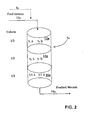
- the catalyst blend 5 includes a plurality of zones, 12, 14, 16. Each zone has a lower volumetric ratio of the dehydrating catalyst B to the hydrotreating catalyst A than the previous zone. As shown in FIGS. 1 - 3 , the volumetric ratio of the hydrotreating catalyst A to the dehydrating catalyst B increases from a first zone 12 to a middle zone 14 to a last zone 16.
- the term "zone" describes sections of a reactor that contain a different concentration of catalyst blend components than a previous section of the reactor. Zones typically do not have a physical barrier to separate each zone. A physical barrier can be used to separate each zone, if desired. For example, a separate reactor vessel can be used to separate each zone. When there is not a physical barrier present, eventually the different concentrations in each of the zones will intermingle to become a continuum along the reactor vessel.
- each zone contains a lower volumetric ratio of the dehydrating catalyst B to the hydrotreating catalyst A than the prior zone.
- the last zone 16 within the catalyst blend 5 can contain only the hydrotreating catalyst A.
- each zone can have an equal of material contained therein.
- the zones can have varying volumes of material contained therein.
- Catalysts suitable for use in this invention as the hydrotreating catalyst A include at least one Group IIIA-VIIIA transition metal and a support.
- Some suitable catalysts for use as the hydrotreating catalyst A are known as sulfactive hydrogenation catalysts or hydrodesulfurization (HDS) catalysts.
- the hydrotreating catalyst A can include the oxides of Group VIA and Group VIIIA metals such as, but not limited to, cobalt, nickel, molybdenum, iron, tungsten, chromium, and platinum.
- the hydrotreating catalyst A can include the sulfides of Group VIA and Group VIIIA metals such as, but not limited to, cobalt, nickel, molybdenum, iron, tungsten, chromium, and platinum.
- the hydrotreating catalyst A can include the oxides, sulfides, or mixtures thereof, of Group VIA and Group VIIIA metals such as, but not limited to, cobalt, nickel, molybdenum, iron, tungsten, chromium, and platinum.
- the hydrotreating catalyst A comprises molybdenum.
- the hydrotreating catalyst A includes two transition metals.
- the hydrotreating catalyst A includes cobalt and molybdenum.
- the hydrotreating catalyst A includes nickel and molybdenum.
- Supports suitable for use as a carrier for the transition metal component of the hydrotreating catalyst A include a material that is inert to the reaction conditions.
- the supports include activated carbon, alumina, zirconia, thoria, pumice, silica, and silica-alumina.
- the support is alumina.
- the support is a gamma ( ⁇ )-alumina.
- the support comprises from 50 to 90 percent by weight of the catalyst composition.
- the support can comprise from 50 to 70 percent by weight of the catalyst composition; alternatively, from 60 to 85 percent by weight of the catalyst composition; or alternatively, from 70 to 80 percent by weight of the catalyst composition.
- the hydrotreating catalyst A comprises a Group IIIA-VIIIA transition metal oxide, a Group IIIA-VIIIA transition metal sulfide, or mixture thereof and a support.
- the hydrotreating catalyst A can be available in the form of a metal oxide and a support.
- the hydrotreating catalyst A is partially or completely sulfided prior to use.
- the hydrotreating catalyst A can be employed directly in the oxide form because sulfiding occurs in the presence of H 2 S under the reaction conditions.
- the hydrotreating catalyst A comprises an oxide of molybdenum and a support.
- the hydrotreating catalyst A comprises an oxide, sulfide, or mixed oxide/sulfide of molybdenum.
- the hydrotreating catalyst A comprises an oxide of molybdenum supported on alumina.
- the oxide of molybdenum is MoO 3 .
- other oxides, sulfides or mixed oxides/sulfides of molybdenum can be used.
- other molybdenum compounds, including oxides, sulfides, or mixed oxides/sulfides of molybdenum, which can be converted to MoO 3 upon oxidation in oxygen can also be used.
- the hydrotreating catalyst A comprises from 5 to 40 weight percent of an oxide of molybdenum; alternatively, from 8 to 35 weight percent; alternatively, from 8 to 15 weight percent; alternatively, from 10 to 20 weight percent; or alternatively, from 15 to 30 weight percent.
- the hydrotreating catalyst A comprises an oxide of cobalt, an oxide of molybdenum, and a support. In other embodiments, the hydrotreating catalyst A comprises an oxide of cobalt and an oxide of molybdenum supported on alumina.
- the oxide of molybdenum and the support have been described herein and are generally applicable to the catalyst compositions comprising an oxide of cobalt, an oxide of molybdenum, and a support.
- Some suitable commercially available catalysts are commonly referred to as cobalt molybdate on alumina.
- the oxide of cobalt is CoO.
- cobalt compounds including oxides, sulfides, or mixed oxides and sulfides of cobalt, which can be converted to CoO upon oxidation in oxygen
- cobalt compounds including oxides, sulfides, or mixed oxides and sulfides of cobalt, which can be converted to CoO upon oxidation in oxygen
- the applicable quantities of the oxide of cobalt present in the catalyst are stated as weight percent of CoO, one skilled in the art will recognize that the applicable compositions includes other cobalt materials and the quantities of cobalt materials which upon oxidation will yield the disclosed quantities of CoO described herein.
- the hydrotreating catalyst A comprising an oxide of cobalt, an oxide of molybdenum, and a support can comprise from 1 to 10 weight percent of an oxide of cobalt. In other embodiments, the hydrotreating catalyst A comprising an oxide of cobalt, an oxide of molybdenum, and a support can comprise from 2 to 7 weight percent of an oxide of cobalt; or alternatively, from 3 to 5 weight percent of an oxide of cobalt.
- the hydrotreating catalyst A comprising an oxide of cobalt, an oxide of molybdenum, and a support comprises from 8 to 35 weight percent MoO 3 , from 1 to 10 weight percent CoO, and from 50 to 91 percent alumina; alternatively, from 10 to 20 weight percent MoO 3 , from about 3 to 5 weight percent CoO, and from 75 to 87 percent alumina; or alternatively, from 15 to 30 weight percent MoO 3 , from 3 to 5 weight percent CoO, and from 65 to 82 percent alumina.
- the hydrotreating catalyst A can also contain from 0.05 to 1 weight percent Na 2 O.
- the hydrotreating catalyst A can also contain up to 0.05 weight percent iron. In the embodiment wherein the hydrotreating catalyst A also contains iron, the iron can be present as elemental iron or as an oxide.
- the hydrotreating catalyst A comprises an oxide of nickel, an oxide of molybdenum, and a support. In other embodiments, the hydrotreating catalyst A comprises oxides of nickel and an oxide of molybdenum supported on alumina.
- the oxide of molybdenum and the support have been described herein and are generally applicable to the catalysts comprising an oxide of nickel, an oxide of molybdenum, and a support described herein.
- the oxide of nickel is NiO.
- other nickel compounds, including oxides, sulfides, or mixed oxides and sulfides of nickel, which can be converted to NiO upon oxidation in oxygen can also be used.
- the applicable quantities of the oxide of nickel present in the hydrotreating catalyst A are stated as weight percent of NiO, one skilled in the art will recognize that the applicable compositions include other nickel materials and the quantities of nickel materials that, upon oxidation, will yield the disclosed quantities of NiO described herein.
- the catalyst comprising an oxide of nickel, an oxide of molybdenum, and a support can comprise from 0.5 to 10 weight percent of an oxide of nickel. In other embodiments, the catalyst comprising an oxide of nickel, an oxide of molybdenum, and a support can comprise from 1 to 7 weight percent of an oxide of nickel; or alternatively, from 2 to 5 weight percent of an oxide of nickel.
- the catalyst comprising an oxide of nickel, an oxide of molybdenum, and a support comprises from 8 to 35 weight percent MoO 3 , from 0.5 to 10 weight percent NiO, and from 55 to 91.5 percent alumina; alternatively, from 8 to 35 weight percent MoO 3 , from 1 to 7 weight percent NiO, and from 58 to 91 percent alumina; alternatively, from 15 to 30 weight percent MoO 3 , from 2 to 5 weight percent NiO, and from 65 to 83 percent alumina; alternatively, from 10 to 20 weight percent MoO 3 , from 2 to 5 weight percent NiO, and from 75 to 88 percent alumina; or alternatively, from 8 to 15 weight percent MoO 3 , from 2 to 5 weight percent NiO, and from 80 to 90 percent alumina.
- the catalyst can also contain from 0.05 to 1 weight percent Na 2 O. In yet other embodiments, the catalyst can also contain up to 0.05 weight percent iron. In the embodiment wherein the catalyst also contains iron, the iron can be present as elemental iron or as an oxide.
- the dehydration catalyst B comprises gamma ( ⁇ )-alumina.
- the alcohol feed stream 8 can have between two and twenty carbon atoms.
- Example alcohols that can be used in embodiments of the present invention that use gamma ( ⁇ )-alumina as the dehydration catalyst B include methanol, ethanol, 1-propanol, 2-propanol, cyclohexanol, 1-butanol, 2-butanol, or combinations thereof.
- the alcohol feed stream 8 is reacted with the sulfur compound reactant stream 10, in the presence of the catalyst blend 5, to produce the corresponding mercaptan or sulfide product stream 18.
- the sulfur compound reactant stream 10 can include hydrogen sulfide, methanethiol (methyl mercaptan), ethanethiol (ethyl mercaptan), or combinations thereof.
- the mercaptan or sulfide product stream 18 can include ethanethiol (ethyl mercaptan), 2-propanethiol (isopropyl mercaptan), cyclohexanethiol (cyclohexyl mercaptan), 2-butanethiol (secondary butyl mercaptan), 2-thiopropane (dimethyl sulfide), 1-(methylthio)ethane (methyl ethyl sulfide), 1,1'-thiobisethane (diethyl sulfide), or combinations thereof, depending upon the selected sulfur compound reactant stream 10 and the selected alcohol feed stream 8.
- the alcohol feed stream 8 can be a primary or normal alcohol. In other embodiments, the alcohol feed stream 8 can be a secondary alcohol.
- the alcohol feed stream 8 can be cyclohexanol, which produces cyclohexanethiol (cyclohexyl mercaptan).
- Other suitable alcohols will be apparent to those of ordinary skill in the art and are to be considered within the scope of the present invention.
- dimercaptans which contain at least two thiol groups
- 1,6-hexanediol can be fed as the alcohol feed stream 8 and reacted with the sulfur compound reactant stream 10, i.e. hydrogen sulfide, to produce 1,6-hexanedithiol (1,6-dimercaptohexane) in the product stream 18.
- the molar feed rate of the sulfur compound reactant stream 10 to the alcohol feed stream 8 at which the feedstocks are sent to the catalyst blend 5 can be changed, depending upon the alcohol that is being fed, the conversion of the alcohol desired, and other operating parameters.
- the preselected sulfur compound reactant to alcohol molar feed ratio can range from about 9:1 to about 20:1.
- the molar feed ratio can be about 12:1, such as to produce 1-butanethiol ( n -butyl mercaptan) or 1-propanethiol ( n -propyl mercaptan).
- the molar feed ratio can be in a range of about 10:1 to about 20:1, such as to produce 2-butyloctanethiol. More sulfur compound reactant stream 10 can always be supplied, however, the excess sulfur compound reactant will likely not react with the alcohol feed stream 8.
- the catalyst blend 5 can be operated at a preselected temperature that can be varied in a range of about 220°C to about 250°C; or alternatively, from about 230°C to about 240°C.
- the catalyst blend 5 can be operated at a preselected pressure that can be varied in a range of about 450 psig to about 600 psig.
- a process for the selective production of a mercaptan or a sulfide product stream 18b from an alcohol feed stream 8b is advantageously provided as another embodiment of the present invention.
- This process includes the step of contacting the alcohol feed stream 8b, in the presence of a catalyst blend 5b, with a sulfur compound reactant stream 10b to produce the mercaptan or the sulfide stream 10b in one-pass.
- the sulfur compound reactant stream 10b can be a mercaptan, such as methanethiol (methyl mercaptan) or ethanethiol (ethyl mercaptan). Either one of these mercaptans can be reacted with methanol or ethanol as the alcohol feed stream 8b to produce 2-thiopropane (dimethyl sulfide), 1-(methylthio)ethane (methyl ethyl sulfide), or 1,1'-thio b isethane (diethyl sulfide), depending upon the selected sulfur compound reactant stream 10b and alcohol feed stream 8b.
- a mercaptan such as methanethiol (methyl mercaptan) or ethanethiol (ethyl mercaptan). Either one of these mercaptans can be reacted with methanol or ethanol as the alcohol feed stream 8b to produce 2-thiopropane (dimethyl sulfide
- methanethiol methyl mercaptan
- methanethiol can be reacted with methanol, in the presence of the catalyst blend 5b of the present invention, to produce 2-thiopropane (dimethyl sulfide) or with ethanol to produce 1-(methylthio)ethane (methyl ethyl sulfide).
- ethanethiol ethyl mercaptan
- ethanethiol (ethyl mercaptan) can be reacted with methanol to produce 1-(methylthio)ethane (methyl ethyl sulfide) or with ethanol to produce 1,1'-thio b isethane (diethyl sulfide).
- the catalyst blend 5b includes a plurality of zones with each zone having a lower volumetric ratio of the alumina diluent B to the hydrotreating catalyst A than the previous zone.
- the catalyst blend comprises a hydrotreating catalyst A and an alumina diluent B.
- the hydrotreating catalyst A can be any hydrotreating catalyst previously described herein.
- the alumina diluent B comprises alpha ( ⁇ )-alumina.
- the alcohol feed stream 8b can have between two and twenty carbon atoms.
- Example alcohols that can be used in embodiments of the present invention that use alpha ( ⁇ )-alumina as the alumina diluent B include methanol, 1-ethanol, 1-propanol, 2-propanol, cyclohexanol, phenol, 1-butanol, 2-butanol, 2-butyl-1-octanol, ⁇ -hydroxytoluene, 1,6-hexanediol, 1-phenyl-1-ethanol, 2-phenyl-1-ethanol, or combinations thereof.
- the alcohol feed stream 8 is reacted with the sulfur compound reactant stream 10b, in the presence of the catalyst blend 5, to produce the corresponding mercaptan or sulfide stream 18b.
- the sulfur compound reactant stream 10b can include hydrogen sulfide, methanethiol (methyl mercaptan), ethanethiol (ethyl mercaptan), or combinations thereof.
- the mercaptan or sulfide product stream 18 can include methanethiol (methyl mercaptan), ethanethiol (ethyl mercaptan), 1-propanethiol (normal propyl mercaptan), 2-propanethiol (isopropyl mercaptan), cyclohexanethiol (cyclohexyl mercaptan), 1-butanethiol (normal butyl mercaptan), 2-butanethiol (secondary butyl mercaptan), 2-butyloctanethiol, benzenethiol (thiophenol or phenyl mercaptan), ⁇ -toluenethiol (benzyl mercaptan
- the alcohol feed stream 8 and the sulfur compound reactant stream 10 are reacted under near isothermal conditions.
- the reaction of the alcohol feed stream 8 with the sulfur compound reactant stream 10 in the presence of the hydrotreating catalyst A is an exothermic reaction.
- the presence of the alumina diluent B dilutes the concentration of the hydrotreating catalyst A across the catalyst blend 5b.
- greater than or equal to amounts of the alumina diluent B are present than the hydrotreating catalyst A.
- the alumina diluent B reduces rate of the enthalpy released by the exothermic reaction that occurs in the presence of the hydrotreating catalyst A.
- the volumetric ratio of the hydrotreating catalyst A to the alumina diluent B can be varied, depending upon the feed streams and products produced. In an aspect, the volumetric ratio of the hydrotreating catalyst A to the alumina diluent B increases from an inlet of the diluted catalyst blend 5 to an outlet of the diluted catalyst blend 5.
- the present invention also includes a process for selective production of a mercaptan or a sulfide using a catalyst blend 5 having a volumetric ratio of the hydrotreating catalyst A to the dehydration catalyst B or the alumina diluent B that increases from a reactor vessel inlet to a reactor vessel outlet in order to maintain near isothermal conditions during reaction of the alcohol feed stream 8 and the sulfur compound reactant stream 10, as shown in FIGS. 1 - 3 .
- the catalyst blend 5 comprises about 40% by volume to about 95% by volume hydrotreating catalyst A and about 5% by volume to about 60% by volume dehydrating catalyst or alumina diluent B.
- the hydrotreating catalyst A can be any hydrotreating catalyst described herein.
- the dehydrating catalyst B comprises gamma ( ⁇ )-alumina.
- the alumina diluent B can comprise alpha ( ⁇ )-alumina.
- the catalyst blend 5 is typically contained within three zones, the first zone 12, the middle zone 14, and the last zone 16.
- the volumetric ratio of the dehydration catalyst or diluent to the hydrotreating catalyst in the first zone 12 is in a range of 1:0.75 to 1:3.25
- the volumetric ratio of the dehydration catalyst or diluent to the hydrotreating catalyst in the middle zone 14 is in a range of 4:1 to 1.25:1
- the volumetric ratio of the dehydration catalyst or diluent to the hydrotreating catalyst in the last zone 16 is in a range of 1:0 to 3:2.
- the first zone 12 has 1 ⁇ 3 by volume of the hydrotreating catalyst A and about by volume of the dehydration catalyst B, which can also be described as a volumetric ratio of about 1:2.
- the middle zone 14 has about 1 ⁇ 2 by volume of the hydrotreating catalyst A and about 1 ⁇ 2 by volume of the dehydration catalyst B, which corresponds to the volumetric ratio of about 1:1.
- the last zone 16 has the hydrotreating catalyst A, which corresponds to the volumetric ratio of 1:0.
- the catalyst blend 5 shown in FIG. 1 can be used to produce cyclohexanethiol (cyclohexyl mercaptan) or ethanethiol (ethyl mercaptan).
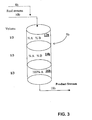
- the first zone 12b has 1 ⁇ 2 by volume of the hydrotreating catalyst A and about 1 ⁇ 2 by volume of the alumina diluent B, which corresponds to the volumetric ratio of about 1:1.
- the middle zone 14b has about 3 ⁇ 4 by volume of the hydrotreating catalyst A and about 1 ⁇ 4 by volume of the alumina diluent B, which corresponds to the volumetric ratio of about 3:1.
- the last zone 16b has the hydrotreating catalyst A, which corresponds to the volumetric ratio of 1:0,
- the catalyst blend 5b can be used to produce 1-butanethiol (normal butyl mercaptan) by reacting normal butanol and hydrogen sulfide in the presence of the catalyst blend 5b.
- FIG. 2 illustrates an embodiment of the present invention that uses normal propanol as the alcohol feed stream 8a to produce the mercaptan product stream 18a.
- the catalyst blend 5a includes the first zone 12a that has 1 ⁇ 4 by volume of the hydrotreating catalyst A and about % by volume of the alumina diluent B, which corresponds to the volumetric ratio of about 1:3.
- the middle zone 14a has about 1 ⁇ 2 by volume of the hydrotreating catalyst A and about 1 ⁇ 2 by volume of the alumina diluent B, which corresponds to the volumetric ratio of about 1:1.
- the last zone 16a has about 3/5 of the hydrotreating catalyst A and about 2/5 of the alumina diluent B, which corresponds to the volumetric ratio of about 3:2.
- the catalyst blend 5a can be used to produce 1-propanethiol (normal propyl mercaptan) by reacting the normal propanol feed stream 8a and the hydrogen sulfide reactant stream 10a in the presence of the catalyst blend 5 a.
- the processes described herein allow a lower cost feedstock to be used to produce mercaptans or sulfides than with prior art processes.
- the conversion rates of the alcohols that are used to produce mercaptans or sulfides are high, which reduces the need to separate the products, when compared with prior attempts to produce mercaptans or sulfides from alcohols using solid acid catalysts.
- various means of controlling the hydrogen sulfide to alcohol molar feed ratio can be used.
- the catalyst blend can be placed in a single vessel or separate vessels including one or more of the zones in each vessel.
- ethanol (alcohol feed stream 8) was converted to ethanethiol (ethyl mercaptan) (mercaptan stream 18) by reacting ethanol with hydrogen sulfide (sulfur compound reactant stream 10), in the presence of the catalyst blend 5 described herein.
- 1,1'-Thio bis ethane (diethyl sulfide) was another product that was formed during production of ethanethiol (ethyl mercaptan) from methanol. Both reactions were exothermic, as indicated in the following two reactions.
- the catalyst blend that was used in this example was a blend of gamma ( ⁇ )-alumina (dehydration catalyst) B and CoMo/alumina (hydrotreating catalyst) A.
- the dehydration catalyst B used was produced by Norton Chemical Process and Products and is available commercially as SA6176.
- the hydrotreating catalyst A was produced by Haldor Topsoe Inc. and is available commercially as TK-554.
- the ethanethiol (ethyl mercaptan) was produced in a fixed bed catalytic flow reactor in a downflow formation.
- the catalyst packing scheme used had three equal zones by volume, as shown in Fig. 1 .
- the first zone 12 was filled with 2 / 3 by volume of the gamma ( ⁇ )-alumina catalyst B and 1 ⁇ 3 by volume of the CoMo/alumina hydrotreating catalyst A.
- the middle zone 14 was filled with 1 ⁇ 2 of each of the gamma ( ⁇ )-alumina catalyst B and the CoMo/alumina hydrotreating catalyst A.
- the last zone was filled with all CoMo/alumina hydrotreating catalyst A.
- Table 1 The results achieved with such a catalyst bed configuration are included in Table 1.
- a weight average bed temperature (WAT) of 225 - 245°C was the optimal temperature range.
- the term weight average bed temperature is the average of the temperatures measured across the reactor bed: (T 1 + T 2 + ... + T n )/n.
- the weight average bed temperature for a reactor where the temperature is measured only at the reactor bed inlet and the reactor bed outlet is (T outlet + T inlet )/2.
- a temperature of at least 240°C was optimal for 100% ethanol conversion. At temperatures greater than 245°C, greater heavies formation resulted.
- a pre-heat temperature of approximately 180°C was used and was beneficial.
- a beneficial pressure range was in a range of about 450 to about 600 psig.
- An ethanol weight hourly space velocity (WHSV) of about 0.15 gr. liq./hr./gr. cat. to about 0.23 gr. liq./hr./gr. cat. was used. In an aspect, the ethanol WHSV ranges from about 0.15 to about 0.50 gr. liq./hr./gr. cat.
- the hydrogen sulfide to methanol molar feed ratio was 15:1 or greater. It is believed that the lights primarily contain ethylene and the heavies primarily contain 1,1'-thiobisethane (diethyl sulfide). The lights can also include carbon monoxide, methane, ethane, and other gaseous, low molecular weight compounds. All weight percents contained in Table 1 are on a water free basis. As shown by the synthesis reactions for ethanethiol (ethyl mercaptan), one mole of water is produced for every mole of ethanol consumed. Essentially no unreacted ethanol was in many of the runs that produced the mercaptan. In some embodiments, however, the amount of unreacted ethanol was less than about 10 wt. %.
- the catalyst that was used in this example was a catalyst blend 5a of a CoMo/alumina (hydrotreating catalyst) A and an alpha ( ⁇ )-alumina (dehydrating catalyst) B, as shown in FIG. 2 .
- the hydrotreating catalyst A was produced by Haldor Topsoe Inc. and is commercially available as TK-554.
- the dehydrating catalyst B was produced by Norton Chemical Process and Products and is available commercially as 14 grit Alundum.
- the catalyst blend 5a was pre-sulfided in place prior to the reactants being fed to the catalyst blend 5a.
- the catalyst blend 5a was packed in the reactor in three equal zones by volume.
- the first zone 12a contained 25% of the hydrotreating catalyst A and 75% of the dehydrating catalyst B.
- the middle zone 14a contained 50% of each of the hydrotreating and dehydrating catalysts A, B.
- the last zone 16 contained 60% or 3/5 of the hydrotreating catalyst A and 40% or 2/5 of the dehydrating catalyst B.
- the results of the synthesis of 1-propanethiol ( n- propyl mercaptan) using this particular catalyst blend are included in Table 2.
- the optimal process conditions included a weight average bed temperature (WAT) of at least 240°C.
- WAT weight average bed temperature
- a pre-heat temperature of approximately of 180°C was used for the synthesis of 1-propanethiol ( n -propyl mercaptan) 18.
- the optimal pressure was in a range of about 450 to 600 psig.
- the optimal normal propanol weight hourly space velocity (WHSV) was in a range of about 0.67 gr. liq./hr./gr. cat. to about 0.69 gr. liq./hr./gr. cat.
- the normal propanol WHSV ranges from about 0.25 to about 0.70 gr. liq./hr./gr. cat.
- the hydrogen sulfide to normal propanol molar feed ratio was 12:1 or greater.
- the best conversion of normal propanol was about 72% of the samples produced. Better conversion of the normal propanol can be achieved using a lower space velocity and a slightly higher temperature.
- the product composition included less than 1 wt. % lights, 50 wt. % to 60 wt. % 1-propanethiol ( n -propyl mercaptan), and 5 wt. % to 10 wt. % heavies, which included primarily 4-thiaheptane (di- n -propyl sulfide).
- the analysis contained in Table 2 is on a water-free basis. One mole of water was formed for every mole of normal propanol consumed.
- the lights can also include propylene and carbon monoxide, methane, ethane, and other gaseous, low molecular weight compounds.
- 1-Butanethiol (normal butyl mercaptan) (mercaptan stream) 18b was produced by reacting normal butanol (alcohol feed stream) 8b with hydrogen sulfide (sulfur compound reactant stream) 10b in the presence of the catalyst blend 5b described herein, as shown in FIG. 3 .
- 1-Butanethiol ( n -butyl mercaptan) 18b was produced in a downflow fixed bed catalytic flow reactor.
- the catalyst used was the catalyst blend 5b of the hydrotreating catalyst A and an alumina diluent B.
- the hydrotreating catalyst A was a CoMo/alumina produced by Haldor Topsoe Inc. and is commercially available as TK-554.
- the hydrotreating catalyst A was diluted with an inert alpha ( ⁇ )-alumina (alumina diluent) B produced by Norton Chemical Process and Products and is commercially available as 14 grit Alundum.
- the catalyst packing that was used had three equal zones (by volume).
- the first zone 12b contained about 1 ⁇ 2 by volume of the hydrotreating catalyst A and about 1 ⁇ 2 by volume alumina diluent B.
- the middle zone 14b contained about 3 ⁇ 4 by volume of the hydrotreating catalyst A and about 1 ⁇ 2 by volume of the alumina diluent B.
- the last zone 16b contained 100% by volume of the hydrotreating catalyst A.
- the normal butanol (alcohol feed stream) 8b and the hydrogen sulfide (sulfur compound reactant stream) 10b were fed separately and controlled using mass flow controllers.
- Product compositions of the mercaptan stream 18b were monitored using an on-line gas chromatograph with a flame detector.
- the weight hourly space velocity (WHSV) was calculated based upon the normal butanol feed stream 8b feedrate.
- the optimal process conditions include a weight average bed temperature (WAT) of about 240°C.
- WAT weight average bed temperature
- the catalyst blend was preheated to about 180°C prior to introducing the feedstreams to the catalyst blend 5b.
- the optimal pressure range was about 450 psig to about 600 psig.
- the optimal normal butanol weight hourly space velocity (WHSV) was about 0.30 gr. liq./hr./gr. cat. and the hydrogen sulfide to normal butanol molar feed ratio was 12:1 or greater.
- the normal butanol WHSV ranges from about 0.25 to about 0.30 gr. liq./hr./gr. cat.
- cyclohexanethiol (cyclohexyl mercaptan) (mercaptan stream) 18 was produced from cyclohexanol (alcohol feed stream) 8 and hydrogen sulfide (sulfur compound reactant stream) 10 that were reacted in the presence of a catalyst blend 5, which contained a hydrotreating catalyst A and a dehydrating catalyst B, in a fixed bed flow reactor, as shown in FIG. 1 .
- the hydrotreating catalyst A was a CoMo/alumina catalyst and the dehydrating catalyst B was a gamma ( ⁇ )-alumina catalyst.
- the catalyst blend 5 was divided into three zones. The three zones were the same used for the conversion of ethanol to ethanethiol (ethyl mercaptan) in Example 1 described herein.
- the selectivity of cyclohexanol 8 to cyclohexanethiol (cyclohexyl mercaptan) 18 at 240°C was as high as about 96%.
- the hydrogen sulfide 10 to cyclohexanol 8 molar feed ratio was varied from about 4:1 to about 16:1 during this example. No heavies were observed to be formed during any of the runs, even at the about 4:1 molar feed ratio. As the molar feed ratio was decreased, the selectivity for cyclohexanethiol (cyclohexyl mercaptan) 18 decreased gradually, as shown in Table 4.
- More cyclohexene and cyclohexane were produced at lower hydrogen sulfide 10 to cyclohexanol 8 molar feed ratios. Although more cyclohexene and cyclohexane were present, at 240°C, there was less than 0.1 mole % cyclohexanol 8 in the cyclohexanethiol (cyclohexyl mercaptan) 18 regardless of the hydrogen sulfide 10 to cyclohexanol 8 molar feed ratio.
- the optimal process conditions in this example included a WAT of 240°C and an hydrogen sulfide 10 to cyclohexanol 8 molar feed ratio of 9:1.
- the pressure should be at least 600 psig and the cyclohexanol space velocity (WHSV) should be 0.30 gr. liq./hr./gr. cat. for optimal conditions.
- the cyclohexanol space velocity (WHSV) ranged from about 0.15 gr. liq./hr./gr. cat. to about 0.61 gr. liq./hr./gr. cat.
Landscapes
- Chemical & Material Sciences (AREA)
- Organic Chemistry (AREA)
- Organic Low-Molecular-Weight Compounds And Preparation Thereof (AREA)
- Catalysts (AREA)
Claims (13)
- Procédé de production sélective d'un mercaptan ou d'un sulfure comprenant les étapes consistant à :a) mettre en contact un alcool, un réactif soufré ayant la formule H-S-R, et un mélange de catalyseurs comprenant un catalyseur d'hydrotraitement et un catalyseur de déshydratation, R comprenant H ou un groupe alkyle ; etb) faire réagir l'alcool et le réactif soufré pour produire le mercaptan ou le sulfure, moins de 30% en poids d'alcool contenu n'ayant pas réagi ; le mélange de catalyseurs comportant une pluralité de zones ;chaque zone contenant un rapport volumétrique catalyseur de déshydratation sur catalyseur d'hydrotraitement inférieur à celui de la zone précédente ;
le catalyseur de déshydratation comprenant de la gamma(y)-alumine ; et
le catalyseur d'hydrotraitement comprenant un oxyde de métal de transition du groupe IIIA-VIIIA, un sulfure de métal de transition du groupe IIIA-VIIIA, ou un mélange de ceux-ci supporté par du charbon actif, de l'alumine, de la zircone, de la thorine, de la pierre ponce, de la silice ou de la silice-alumine. - Procédé de production sélective d'un mercaptan ou d'un sulfure, comprenant les étapes consistant à :a) mettre en contact un alcool, un réactif soufré ayant la formule H-S-R, et un mélange de catalyseurs comprenant un catalyseur d'hydrotraitement et un diluant à base d'alumine, R comprenant H ou un groupe alkyle ; etb) faire réagir l'alcool et le réactif soufré pour produire le mercaptan ou le sulfure, moins de 30% en poids d'alcool contenu n'ayant pas réagi ; etle mélange de catalyseurs comportant une pluralité de zones ;
chaque zone ayant un rapport volumétrique diluant à base d'alumine sur catalyseur d'hydrotraitement inférieur à celui de la zone précédente ; et
le catalyseur d'hydrotraitement comprenant un oxyde de métal de transition du groupe IIIA-VIIIA, un sulfure de métal de transition du groupe IIIA-VIIIA, ou un mélange de ceux-ci supporté par du charbon actif, de l'alumine, de la zircone, de la thorine, de la pierre ponce, de la silice ou de la silice-alumine. - Procédé de production sélective d'un mercaptan ou d'un sulfure, comprenant les étapes consistant à :a) mettre en contact un alcool, un réactif soufré ayant la formule H-S-R, et un mélange de catalyseurs comprenant un catalyseur d'hydrotraitement et un catalyseur de déshydratation ou un diluant à base d'alumine, R comprenant H ou un groupe alkyle ; etb) faire réagir l'alcool et le réactif soufré pour produire le mercaptan ou le sulfure, moins de 30% en poids de l'alcool contenu n'ayant pas réagi ; et le mélange de catalyseurs comportant une pluralité de zones ;le mélange de catalyseur ayant un rapport volumétrique catalyseur d'hydrotraitement sur catalyseur de déshydratation ou sur diluant d'alumine qui augmente depuis une entrée de cuve de réacteur à une sortie de cuve de réacteur afin de rester proche des conditions isothermes au cours de la réaction entre l'alcool et le réactif soufré ;
le catalyseur de déshydratation comprenant de la gamma(y)-alumine ; et
le catalyseur d'hydrotraitement comprenant un oxyde de métal de transition du groupe IIIA-VIIIA, un sulfure de métal de transition du groupe IIIA-VIIIA, ou un mélange de ceux-ci supporté par du charbon actif, de l'alumine, de la zircone, de la thorine, de la pierre ponce, de la silice ou de la silice-alumine. - Procédé selon la revendication 1, dans lequel :a) l'alcool est le méthanol, l'éthanol, le 1-propanol, le 2-propanol, le cyclohexanol, le 1-butanol, le 2-butanol, ou des combinaisons de ceux-ci ;b) le réactif soufré est le sulfure d'hydrogène, le méthanethiol, l'éthanethiol, ou des combinaisons de ceux-ci ; etc) le mercaptan ou le sulfure est l'éthanethiol, le 2-propanethiol, le cyclohexanethiol, le 2-butanethiol, le 2-thiopropane, le 1-(méthylthio)éthane, le 1,1'-thiobiséthane, ou des combinaisons de ceux-ci.
- Procédé selon la revendication 2, dans lequel :a) le diluant à base d'alumine comprend l'alpha(α)-alumine ;b) l'alcool est le méthanol, le 1-éthanol, le 1-propanol, le 2-propanol, le cyclohexanol, le phénol, le 1-butanol, le 2-butanol, le 2-butyl-1-octanol, l'α-hydroxytoluène, le 1,6-hexanediol, le 1-phényl-1-éthanol, le 2-phényl-α-éthanol, ou des combinaisons de ceux-ci ;c) le réactif soufré est le sulfure d'hydrogène, le méthanethiol, l'éthanethiol, ou des combinaisons de ceux-ci ; etd) le mercaptan ou le sulfure est le méthanethiol, l'éthanethiol, le 1-propanethiol, le 2-propanethiol, le cyclohexanethiol, le 1-butanethiol, le 2-butanethiol, le 2-butyloctanethiol, le benzènethiol, l'α-toluènethiol, le 1,6-hexanedithiol, le 1-phényl-1-éthanethiol, le 2-phényl-1-éthanethiol, le 2-thiopropane, le 1-(méthylthio)éthane, le 1,1'-thiobiséthane, ou des combinaisons de ceux-ci.
- Procédé selon la revendication 3, dans lequel :a) l'alcool est le méthanol, l'éthanol, le 1-propanol, le 2-propanol, le cyclohexanol, le 1-butanol, le 2-butanol, ou des combinaisons de ceux-ci ;b) le réactif soufré est le sulfure d'hydrogène, le méthanethiol, l'éthanethiol, ou des combinaisons de ceux-ci ; etc) le mercaptan ou le sulfure est l'éthanethiol, le 2-propanethiol, le cyclohexanethiol, le 2-butanethiol, le 2-thiopropane, le 1-(méthylthio)éthane, le 1,1'-thiobiséthane, ou des combinaisons de ceux-ci.
- Procédé selon la revendication 3, dans lequel le diluant à base d'alumine comprend l'alpha(α)-alumine, et dans lequel :a) l'alcool est le méthanol, le 1-éthanol, le 1-propanol, le 2-propanol, le cyclohexanol, le phénol, le 1-butanol, le 2-butanol, le 2-butyl-1-octanol, l'α-hydroxytoluène, le 1,6-hexanediol, le 1-phényl-1-éthanol, le 2-phényl-a-éthanol, ou des combinaisons de ceux-ci ;b) le réactif soufré est le sulfure d'hydrogène, le méthanethiol, l'éthanethiol, ou des combinaisons de ceux-ci ; etc) le mercaptan ou le sulfure est le méthanethiol, l'éthanethiol, le 1-propanethiol, le 2-propanethiol, le cyclohexanethiol, le 1-butanethiol, le 2-butanethiol, le 2-butyloctanethiol, le benzènethiol, l'α-toluènethiol, le 1,6-hexanedithiol, le 1-phényl-1-éthanethiol, le 2-phényl-1-éthanethiol, le 2-thiopropane, le 1-(méthylthio)éthane, le 1,1'-thiobiséthane, ou des combinaisons de ceux-ci.
- Procédé selon la revendication 3, dans lequel la cuve de réacteur comprend au moins trois zones, dans lesquelles :a) le rapport volumétrique d'une première zone est dans une gamme de 1:0,75 à 1:3,25 ;b) le rapport volumétrique d'une deuxième zone est dans la gamme de 4:1 à 1,25:1 ; etc) le rapport volumétrique d'une dernière zone est dans une gamme de 1:0 à 3:2.
- Procédé selon la revendication 8, dans lequel :a) le rapport volumétrique de la première zone est d'environ 1:2 ;b) le rapport volumétrique de la deuxième zone est d'environ 1:1 ;c) le rapport volumétrique de la dernière zone est d'environ 1:0 ;d) l'alcool est le cyclohexanol, le méthanol, ou des combinaisons de ceux-ci ; ete) le mercaptan est le cyclohexanethiol, l'éthanethiol, ou des combinaisons de ceux-ci.
- Procédé selon la revendication 8, dans lequel :a) le rapport volumétrique de la première zone est d'environ 1:1 ;b) le rapport volumétrique de la deuxième zone est d'environ 3:1 ;c) le rapport volumétrique de la dernière zone est d'environ 1:0 ;d) l'alcool est le 1-butanol, le méthanol, l'éthanol, ou des combinaisons de ceux-ci ; ete) le mercaptan ou le sulfure est le 1-butanethiol, le 1-(méthylthio)éthane, le 1,1'-thiobiséthane, ou des combinaisons de ceux-ci.
- Procédé selon la revendication 8, dans lequel :a) le rapport volumétrique de la première zone est d'environ 1:3 ;b) le rapport volumétrique de la deuxième zone est d'environ 1:1 ;c) le rapport volumétrique de la deuxième zone est d'environ 3:2 ;d) l'alcool est le 1-propanol ; ete) le mercaptan est un propanethiol.
- Procédé selon l'une quelconque des revendications 1 à 11, dans lequel le catalyseur d'hydrotraitement comprend :a) un oxyde de molybdène et un oxyde de cobalt supportés par de l'alumine ; oub) un oxyde de molybdène et un oxyde de nickel supportés par de l'alumine.
- Procédé selon l'une quelconque des revendications 1 à 12, le procédé ayant un rapport d'alimentation molaire réactif soufré sur alcool dans la gamme de 9:1 à 20:1.
Applications Claiming Priority (2)
| Application Number | Priority Date | Filing Date | Title |
|---|---|---|---|
| US11/302,038 US7399893B2 (en) | 2005-12-13 | 2005-12-13 | Process and catalyst for synthesis of mercaptans and sulfides from alcohols |
| PCT/US2006/047335 WO2007070496A2 (fr) | 2005-12-13 | 2006-12-11 | Procede et catalyseur destine a la synthese de mercaptans et de sulfures a partir d’alcools |
Publications (2)
| Publication Number | Publication Date |
|---|---|
| EP1968936A2 EP1968936A2 (fr) | 2008-09-17 |
| EP1968936B1 true EP1968936B1 (fr) | 2015-05-06 |
Family
ID=37908268
Family Applications (1)
| Application Number | Title | Priority Date | Filing Date |
|---|---|---|---|
| EP20060845261 Not-in-force EP1968936B1 (fr) | 2005-12-13 | 2006-12-11 | Procede et catalyseur destine a la synthese de mercaptans et de sulfures a partir d alcools |
Country Status (3)
| Country | Link |
|---|---|
| US (1) | US7399893B2 (fr) |
| EP (1) | EP1968936B1 (fr) |
| WO (1) | WO2007070496A2 (fr) |
Cited By (1)
| Publication number | Priority date | Publication date | Assignee | Title |
|---|---|---|---|---|
| RU2634732C1 (ru) * | 2016-06-02 | 2017-11-03 | Федеральное государственное бюджетное образовательное учреждение высшего профессионального образования "Астраханский государственный технический университет" ФГБОУ ВПО "АГТУ" | Способ электросинтеза циклогексантиола на основе сероводорода |
Families Citing this family (8)
| Publication number | Priority date | Publication date | Assignee | Title |
|---|---|---|---|---|
| US7645906B2 (en) * | 2007-03-27 | 2010-01-12 | Chevron Phillips Chemical Company Lp | Graded catalyst bed for methyl mercaptan synthesis |
| CN105367466A (zh) * | 2015-10-21 | 2016-03-02 | 吴姣 | 一种巯基化合物的制备方法 |
| US9718767B2 (en) * | 2015-12-04 | 2017-08-01 | Chevron Phillips Chemical Company Lp | Beta-mercaptoethanol synthesis |
| CA3020740A1 (fr) | 2016-05-31 | 2017-12-07 | Novus International Inc. | Procede de production de methyle mercaptan a partir de sulfure de dimethyle |
| WO2019173208A1 (fr) * | 2018-03-05 | 2019-09-12 | Chevron Phillips Chemical Company Lp | Synthèse de sulfure de méthyle éthyle et systèmes de production associés |
| EP3762362B1 (fr) | 2018-03-05 | 2023-07-19 | Chevron Phillips Chemical Company Lp | Synthèse de composés de sulfure asymétriques et de composés d'éther asymétriques |
| US10689333B1 (en) | 2019-02-22 | 2020-06-23 | Chevron Phillips Chemical Company Lp | 2-mercaptoethanol synthesis |
| US20240051918A1 (en) * | 2022-08-10 | 2024-02-15 | Chevron Phillips Chemical Company Lp | Sequential and independent synthesis of mercaptans and asymmetrical sulfides in a single reactor |
Family Cites Families (17)
| Publication number | Priority date | Publication date | Assignee | Title |
|---|---|---|---|---|
| US3035097A (en) * | 1960-06-24 | 1962-05-15 | Pennsalt Chemicals Corp | Novel catalytic process for preparation of mercaptans by reaction of h2s with alcohols or ethers |
| US3697602A (en) | 1969-07-02 | 1972-10-10 | Degussa | Process for the production of lower aliphatic mercaptans |
| US3963785A (en) * | 1975-05-01 | 1976-06-15 | Phillips Petroleum Company | Mercaptans by addition of hydrogen sulfide to olefins in presence of carbon disulfide |
| US3994980A (en) * | 1975-10-15 | 1976-11-30 | Phillips Petroleum Company | Cobalt molybdate as catalyst for preparation of mercaptans from carbonyl compounds hydrogen sulfide and hydrogen |
| US4059504A (en) * | 1976-07-21 | 1977-11-22 | The Lummus Company | Hydrotreating of pyrolysis gasoline |
| JPS6115739A (ja) * | 1984-04-25 | 1986-01-23 | Toa Nenryo Kogyo Kk | 水素化処理用触媒 |
| US4591429A (en) * | 1984-09-28 | 1986-05-27 | Exxon Research And Engineering Co. | Hydrotreating process employing catalysts comprising a supported mixture of a sulfide of a promoter metal, trivalent chromium and molybdenum or tungsten |
| EP0354460B1 (fr) | 1988-08-03 | 1994-04-13 | Phillips Petroleum Company | Procédé pour la préparation de composés organosulfuriques |
| US5106484A (en) * | 1990-12-19 | 1992-04-21 | Exxon Chemical Patents Inc. | Purifying feed for reforming over zeolite catalysts |
| US5283369A (en) | 1992-03-24 | 1994-02-01 | Elf Atochem North America, Inc. | Selective synthesis of mercaptans and catalyst therefor |
| US5352838A (en) * | 1993-07-30 | 1994-10-04 | Phillips Petroleum Company | Selective production of ethyl mercaptan |
| US5453544A (en) * | 1994-06-06 | 1995-09-26 | Mobil Oil Corporation | Process for making tertiary-thiols |
| US5733836A (en) * | 1996-03-22 | 1998-03-31 | Phillips Petroleum Company | Compositions comprising inorganic oxide and process for producing mercaptans |
| US5874630A (en) * | 1998-01-06 | 1999-02-23 | Occidental Chemical Corporation | Synthesis of mercaptans from alcohols |
| US6037306A (en) * | 1998-03-20 | 2000-03-14 | China Petrochemical Corporation | Catalyst containing molybdenum and/or tungsten for hydrotreating light oil distillates and preparation method thereof |
| FR2786411B1 (fr) | 1998-12-01 | 2000-12-29 | Atochem Elf Sa | Catalyseurs a base d'oxyde de zirconium pour la fabrication de thiols |
| US6198003B1 (en) * | 1999-04-20 | 2001-03-06 | Albemarle Corporation | Method for producing alkyl mercaptans and/or dialkyl monosulfides |
-
2005
- 2005-12-13 US US11/302,038 patent/US7399893B2/en not_active Expired - Fee Related
-
2006
- 2006-12-11 EP EP20060845261 patent/EP1968936B1/fr not_active Not-in-force
- 2006-12-11 WO PCT/US2006/047335 patent/WO2007070496A2/fr not_active Ceased
Cited By (1)
| Publication number | Priority date | Publication date | Assignee | Title |
|---|---|---|---|---|
| RU2634732C1 (ru) * | 2016-06-02 | 2017-11-03 | Федеральное государственное бюджетное образовательное учреждение высшего профессионального образования "Астраханский государственный технический университет" ФГБОУ ВПО "АГТУ" | Способ электросинтеза циклогексантиола на основе сероводорода |
Also Published As
| Publication number | Publication date |
|---|---|
| WO2007070496A2 (fr) | 2007-06-21 |
| WO2007070496A3 (fr) | 2007-08-02 |
| EP1968936A2 (fr) | 2008-09-17 |
| US7399893B2 (en) | 2008-07-15 |
| US20070135658A1 (en) | 2007-06-14 |
Similar Documents
| Publication | Publication Date | Title |
|---|---|---|
| US7645906B2 (en) | Graded catalyst bed for methyl mercaptan synthesis | |
| US5847256A (en) | Process for producing xylene | |
| US7833929B2 (en) | Process for the manufacture of methylmercaptan | |
| US7723261B2 (en) | Catalyst for the preparation of methyl mercaptan | |
| US5493058A (en) | Synthesis of methyl mercaptan from dimethyl disulphide | |
| JP7814381B2 (ja) | ニッケル-モリブデン触媒を用いてメルカプタン化合物を作製する方法 | |
| JP5818790B2 (ja) | 炭素含有化合物、硫黄および水素からメチルメルカプタンを連続的に製造する方法 | |
| US7399893B2 (en) | Process and catalyst for synthesis of mercaptans and sulfides from alcohols | |
| US4059636A (en) | Mercaptans by catalytic cleavage of organic sulfides | |
| US4618723A (en) | Reduction of carbon oxides with hydrogen sulfide | |
| EP3464239B1 (fr) | Procédé de production de méthyle mercaptan à partir de sulfure de diméthyle | |
| US7217843B2 (en) | Method of making 2-thiols | |
| CN101743221A (zh) | 一种从含碳和氢的化合物连续制备甲硫醇的方法 | |
| JP5295130B2 (ja) | メチルメルカプタンをジアルキルスルフィドおよびジアルキルポリスルフィドから製造する方法 | |
| EP0202420B1 (fr) | Procédé de préparation de disulfures de dialkyles | |
| US5026915A (en) | Process for the manufacture of dialkyl disulfides | |
| US4120944A (en) | Preparation of carbonyl sulfide and production of methyl mercaptan therefrom | |
| Vít et al. | Transformation of Ethene Into Ketones by CO and H 2 Over NiMo Sulfide Catalysts | |
| WO2024036181A1 (fr) | Synthèse séquentielle et indépendante de mercaptans et de sulfures asymétriques dans un réacteur unique |
Legal Events
| Date | Code | Title | Description |
|---|---|---|---|
| PUAI | Public reference made under article 153(3) epc to a published international application that has entered the european phase |
Free format text: ORIGINAL CODE: 0009012 |
|
| 17P | Request for examination filed |
Effective date: 20080701 |
|
| AK | Designated contracting states |
Kind code of ref document: A2 Designated state(s): BE DE FR |
|
| RBV | Designated contracting states (corrected) |
Designated state(s): BE DE FR |
|
| RBV | Designated contracting states (corrected) |
Designated state(s): BE DE FR |
|
| 17Q | First examination report despatched |
Effective date: 20100608 |
|
| DAX | Request for extension of the european patent (deleted) | ||
| GRAP | Despatch of communication of intention to grant a patent |
Free format text: ORIGINAL CODE: EPIDOSNIGR1 |
|
| INTG | Intention to grant announced |
Effective date: 20141120 |
|
| GRAS | Grant fee paid |
Free format text: ORIGINAL CODE: EPIDOSNIGR3 |
|
| GRAA | (expected) grant |
Free format text: ORIGINAL CODE: 0009210 |
|
| AK | Designated contracting states |
Kind code of ref document: B1 Designated state(s): BE DE FR |
|
| REG | Reference to a national code |
Ref country code: DE Ref legal event code: R096 Ref document number: 602006045397 Country of ref document: DE Effective date: 20150618 |
|
| REG | Reference to a national code |
Ref country code: FR Ref legal event code: PLFP Year of fee payment: 10 |
|
| REG | Reference to a national code |
Ref country code: DE Ref legal event code: R097 Ref document number: 602006045397 Country of ref document: DE |
|
| PLBE | No opposition filed within time limit |
Free format text: ORIGINAL CODE: 0009261 |
|
| STAA | Information on the status of an ep patent application or granted ep patent |
Free format text: STATUS: NO OPPOSITION FILED WITHIN TIME LIMIT |
|
| 26N | No opposition filed |
Effective date: 20160209 |
|
| REG | Reference to a national code |
Ref country code: FR Ref legal event code: PLFP Year of fee payment: 11 |
|
| REG | Reference to a national code |
Ref country code: FR Ref legal event code: PLFP Year of fee payment: 12 |
|
| PGFP | Annual fee paid to national office [announced via postgrant information from national office to epo] |
Ref country code: DE Payment date: 20211117 Year of fee payment: 16 Ref country code: FR Payment date: 20211117 Year of fee payment: 16 |
|
| PGFP | Annual fee paid to national office [announced via postgrant information from national office to epo] |
Ref country code: BE Payment date: 20211122 Year of fee payment: 16 |
|
| REG | Reference to a national code |
Ref country code: DE Ref legal event code: R119 Ref document number: 602006045397 Country of ref document: DE |
|
| REG | Reference to a national code |
Ref country code: BE Ref legal event code: MM Effective date: 20221231 |
|
| PG25 | Lapsed in a contracting state [announced via postgrant information from national office to epo] |
Ref country code: DE Free format text: LAPSE BECAUSE OF NON-PAYMENT OF DUE FEES Effective date: 20230701 |
|
| PG25 | Lapsed in a contracting state [announced via postgrant information from national office to epo] |
Ref country code: FR Free format text: LAPSE BECAUSE OF NON-PAYMENT OF DUE FEES Effective date: 20221231 Ref country code: BE Free format text: LAPSE BECAUSE OF NON-PAYMENT OF DUE FEES Effective date: 20221231 |