EP1969083B1 - Organische lichtemittierende vorrichtung - Google Patents
Organische lichtemittierende vorrichtung Download PDFInfo
- Publication number
- EP1969083B1 EP1969083B1 EP06843114A EP06843114A EP1969083B1 EP 1969083 B1 EP1969083 B1 EP 1969083B1 EP 06843114 A EP06843114 A EP 06843114A EP 06843114 A EP06843114 A EP 06843114A EP 1969083 B1 EP1969083 B1 EP 1969083B1
- Authority
- EP
- European Patent Office
- Prior art keywords
- group
- carbon atoms
- compound
- substituent
- polymerizable functional
- Prior art date
- Legal status (The legal status is an assumption and is not a legal conclusion. Google has not performed a legal analysis and makes no representation as to the accuracy of the status listed.)
- Active
Links
- AJYIUHNCRSQQQQ-UHFFFAOYSA-N C=Cc(cc1)cc(c2c3cccc2)c1[n]3-c1nc(-[n]2c3ccccc3c3c2cccc3)nc(-[n]2c3ccccc3c3ccccc23)n1 Chemical compound C=Cc(cc1)cc(c2c3cccc2)c1[n]3-c1nc(-[n]2c3ccccc3c3c2cccc3)nc(-[n]2c3ccccc3c3ccccc23)n1 AJYIUHNCRSQQQQ-UHFFFAOYSA-N 0.000 description 1
- ADOYKPDOFQXKEF-UHFFFAOYSA-N CCCCCc1ccc(C=C)cc1 Chemical compound CCCCCc1ccc(C=C)cc1 ADOYKPDOFQXKEF-UHFFFAOYSA-N 0.000 description 1
- QOVCUELHTLHMEN-UHFFFAOYSA-N CCCCc1ccc(C=C)cc1 Chemical compound CCCCc1ccc(C=C)cc1 QOVCUELHTLHMEN-UHFFFAOYSA-N 0.000 description 1
Images

Classifications
-
- C—CHEMISTRY; METALLURGY
- C09—DYES; PAINTS; POLISHES; NATURAL RESINS; ADHESIVES; COMPOSITIONS NOT OTHERWISE PROVIDED FOR; APPLICATIONS OF MATERIALS NOT OTHERWISE PROVIDED FOR
- C09K—MATERIALS FOR MISCELLANEOUS APPLICATIONS, NOT PROVIDED FOR ELSEWHERE
- C09K11/00—Luminescent materials, e.g. electroluminescent or chemiluminescent
- C09K11/06—Luminescent materials, e.g. electroluminescent or chemiluminescent containing organic luminescent materials
-
- C—CHEMISTRY; METALLURGY
- C07—ORGANIC CHEMISTRY
- C07C—ACYCLIC OR CARBOCYCLIC COMPOUNDS
- C07C211/00—Compounds containing amino groups bound to a carbon skeleton
- C07C211/43—Compounds containing amino groups bound to a carbon skeleton having amino groups bound to carbon atoms of six-membered aromatic rings of the carbon skeleton
- C07C211/54—Compounds containing amino groups bound to a carbon skeleton having amino groups bound to carbon atoms of six-membered aromatic rings of the carbon skeleton having amino groups bound to two or three six-membered aromatic rings
- C07C211/56—Compounds containing amino groups bound to a carbon skeleton having amino groups bound to carbon atoms of six-membered aromatic rings of the carbon skeleton having amino groups bound to two or three six-membered aromatic rings the carbon skeleton being further substituted by halogen atoms or by nitro or nitroso groups
-
- C—CHEMISTRY; METALLURGY
- C07—ORGANIC CHEMISTRY
- C07F—ACYCLIC, CARBOCYCLIC OR HETEROCYCLIC COMPOUNDS CONTAINING ELEMENTS OTHER THAN CARBON, HYDROGEN, HALOGEN, OXYGEN, NITROGEN, SULFUR, SELENIUM OR TELLURIUM
- C07F15/00—Compounds containing elements of Groups 8, 9, 10 or 18 of the Periodic Table
- C07F15/0006—Compounds containing elements of Groups 8, 9, 10 or 18 of the Periodic Table compounds of the platinum group
- C07F15/0033—Iridium compounds
-
- H—ELECTRICITY
- H10—SEMICONDUCTOR DEVICES; ELECTRIC SOLID-STATE DEVICES NOT OTHERWISE PROVIDED FOR
- H10K—ORGANIC ELECTRIC SOLID-STATE DEVICES
- H10K50/00—Organic light-emitting devices
-
- H—ELECTRICITY
- H10—SEMICONDUCTOR DEVICES; ELECTRIC SOLID-STATE DEVICES NOT OTHERWISE PROVIDED FOR
- H10K—ORGANIC ELECTRIC SOLID-STATE DEVICES
- H10K85/00—Organic materials used in the body or electrodes of devices covered by this subclass
- H10K85/30—Coordination compounds
- H10K85/341—Transition metal complexes, e.g. Ru(II)polypyridine complexes
- H10K85/342—Transition metal complexes, e.g. Ru(II)polypyridine complexes comprising iridium
-
- H—ELECTRICITY
- H10—SEMICONDUCTOR DEVICES; ELECTRIC SOLID-STATE DEVICES NOT OTHERWISE PROVIDED FOR
- H10K—ORGANIC ELECTRIC SOLID-STATE DEVICES
- H10K85/00—Organic materials used in the body or electrodes of devices covered by this subclass
- H10K85/60—Organic compounds having low molecular weight
-
- C—CHEMISTRY; METALLURGY
- C09—DYES; PAINTS; POLISHES; NATURAL RESINS; ADHESIVES; COMPOSITIONS NOT OTHERWISE PROVIDED FOR; APPLICATIONS OF MATERIALS NOT OTHERWISE PROVIDED FOR
- C09K—MATERIALS FOR MISCELLANEOUS APPLICATIONS, NOT PROVIDED FOR ELSEWHERE
- C09K2211/00—Chemical nature of organic luminescent or tenebrescent compounds
- C09K2211/10—Non-macromolecular compounds
- C09K2211/1003—Carbocyclic compounds
- C09K2211/1007—Non-condensed systems
-
- C—CHEMISTRY; METALLURGY
- C09—DYES; PAINTS; POLISHES; NATURAL RESINS; ADHESIVES; COMPOSITIONS NOT OTHERWISE PROVIDED FOR; APPLICATIONS OF MATERIALS NOT OTHERWISE PROVIDED FOR
- C09K—MATERIALS FOR MISCELLANEOUS APPLICATIONS, NOT PROVIDED FOR ELSEWHERE
- C09K2211/00—Chemical nature of organic luminescent or tenebrescent compounds
- C09K2211/10—Non-macromolecular compounds
- C09K2211/1018—Heterocyclic compounds
- C09K2211/1025—Heterocyclic compounds characterised by ligands
- C09K2211/1029—Heterocyclic compounds characterised by ligands containing one nitrogen atom as the heteroatom
-
- C—CHEMISTRY; METALLURGY
- C09—DYES; PAINTS; POLISHES; NATURAL RESINS; ADHESIVES; COMPOSITIONS NOT OTHERWISE PROVIDED FOR; APPLICATIONS OF MATERIALS NOT OTHERWISE PROVIDED FOR
- C09K—MATERIALS FOR MISCELLANEOUS APPLICATIONS, NOT PROVIDED FOR ELSEWHERE
- C09K2211/00—Chemical nature of organic luminescent or tenebrescent compounds
- C09K2211/10—Non-macromolecular compounds
- C09K2211/1018—Heterocyclic compounds
- C09K2211/1025—Heterocyclic compounds characterised by ligands
- C09K2211/1029—Heterocyclic compounds characterised by ligands containing one nitrogen atom as the heteroatom
- C09K2211/1033—Heterocyclic compounds characterised by ligands containing one nitrogen atom as the heteroatom with oxygen
-
- C—CHEMISTRY; METALLURGY
- C09—DYES; PAINTS; POLISHES; NATURAL RESINS; ADHESIVES; COMPOSITIONS NOT OTHERWISE PROVIDED FOR; APPLICATIONS OF MATERIALS NOT OTHERWISE PROVIDED FOR
- C09K—MATERIALS FOR MISCELLANEOUS APPLICATIONS, NOT PROVIDED FOR ELSEWHERE
- C09K2211/00—Chemical nature of organic luminescent or tenebrescent compounds
- C09K2211/10—Non-macromolecular compounds
- C09K2211/1018—Heterocyclic compounds
- C09K2211/1025—Heterocyclic compounds characterised by ligands
- C09K2211/1029—Heterocyclic compounds characterised by ligands containing one nitrogen atom as the heteroatom
- C09K2211/1037—Heterocyclic compounds characterised by ligands containing one nitrogen atom as the heteroatom with sulfur
-
- C—CHEMISTRY; METALLURGY
- C09—DYES; PAINTS; POLISHES; NATURAL RESINS; ADHESIVES; COMPOSITIONS NOT OTHERWISE PROVIDED FOR; APPLICATIONS OF MATERIALS NOT OTHERWISE PROVIDED FOR
- C09K—MATERIALS FOR MISCELLANEOUS APPLICATIONS, NOT PROVIDED FOR ELSEWHERE
- C09K2211/00—Chemical nature of organic luminescent or tenebrescent compounds
- C09K2211/10—Non-macromolecular compounds
- C09K2211/1018—Heterocyclic compounds
- C09K2211/1025—Heterocyclic compounds characterised by ligands
- C09K2211/1044—Heterocyclic compounds characterised by ligands containing two nitrogen atoms as heteroatoms
-
- C—CHEMISTRY; METALLURGY
- C09—DYES; PAINTS; POLISHES; NATURAL RESINS; ADHESIVES; COMPOSITIONS NOT OTHERWISE PROVIDED FOR; APPLICATIONS OF MATERIALS NOT OTHERWISE PROVIDED FOR
- C09K—MATERIALS FOR MISCELLANEOUS APPLICATIONS, NOT PROVIDED FOR ELSEWHERE
- C09K2211/00—Chemical nature of organic luminescent or tenebrescent compounds
- C09K2211/10—Non-macromolecular compounds
- C09K2211/1018—Heterocyclic compounds
- C09K2211/1025—Heterocyclic compounds characterised by ligands
- C09K2211/1092—Heterocyclic compounds characterised by ligands containing sulfur as the only heteroatom
-
- C—CHEMISTRY; METALLURGY
- C09—DYES; PAINTS; POLISHES; NATURAL RESINS; ADHESIVES; COMPOSITIONS NOT OTHERWISE PROVIDED FOR; APPLICATIONS OF MATERIALS NOT OTHERWISE PROVIDED FOR
- C09K—MATERIALS FOR MISCELLANEOUS APPLICATIONS, NOT PROVIDED FOR ELSEWHERE
- C09K2211/00—Chemical nature of organic luminescent or tenebrescent compounds
- C09K2211/14—Macromolecular compounds
- C09K2211/1408—Carbocyclic compounds
-
- C—CHEMISTRY; METALLURGY
- C09—DYES; PAINTS; POLISHES; NATURAL RESINS; ADHESIVES; COMPOSITIONS NOT OTHERWISE PROVIDED FOR; APPLICATIONS OF MATERIALS NOT OTHERWISE PROVIDED FOR
- C09K—MATERIALS FOR MISCELLANEOUS APPLICATIONS, NOT PROVIDED FOR ELSEWHERE
- C09K2211/00—Chemical nature of organic luminescent or tenebrescent compounds
- C09K2211/14—Macromolecular compounds
- C09K2211/1408—Carbocyclic compounds
- C09K2211/1425—Non-condensed systems
-
- C—CHEMISTRY; METALLURGY
- C09—DYES; PAINTS; POLISHES; NATURAL RESINS; ADHESIVES; COMPOSITIONS NOT OTHERWISE PROVIDED FOR; APPLICATIONS OF MATERIALS NOT OTHERWISE PROVIDED FOR
- C09K—MATERIALS FOR MISCELLANEOUS APPLICATIONS, NOT PROVIDED FOR ELSEWHERE
- C09K2211/00—Chemical nature of organic luminescent or tenebrescent compounds
- C09K2211/14—Macromolecular compounds
- C09K2211/1408—Carbocyclic compounds
- C09K2211/1433—Carbocyclic compounds bridged by heteroatoms, e.g. N, P, Si or B
-
- C—CHEMISTRY; METALLURGY
- C09—DYES; PAINTS; POLISHES; NATURAL RESINS; ADHESIVES; COMPOSITIONS NOT OTHERWISE PROVIDED FOR; APPLICATIONS OF MATERIALS NOT OTHERWISE PROVIDED FOR
- C09K—MATERIALS FOR MISCELLANEOUS APPLICATIONS, NOT PROVIDED FOR ELSEWHERE
- C09K2211/00—Chemical nature of organic luminescent or tenebrescent compounds
- C09K2211/18—Metal complexes
- C09K2211/185—Metal complexes of the platinum group, i.e. Os, Ir, Pt, Ru, Rh or Pd
Definitions
- the present invention relates to an organic light-emitting device. More particularly, the present invention relates to an organic light-emitting device capable of attaining high brightness and long life together with high luminous efficiency by using a polymer containing a structural unit derived from at specific polymerizable compound having hole transport property.
- an organic light-emitting device there is known a device having a multilayer structure in which a light-emitting layer comprising a phosphorescent low molecular weight compound is provided between a hole transport layer and an electron transport layer.
- a low molecular weight compound such as a triphenylamine derivative is used in the hole transport layer (see Patent Document 1).
- Patent Document 2 discloses a copolymer of a triphenylamine derivative and an iridium complex.
- EP-A-1 394 188 discloses a polymer light-emitting device comprising polyarylamine compounds having aryl substituents which are divalent groups having metal-complex structure, for example with iridium.
- an organic light-emitting device having high brightness and long life together with high luminous efficiency can be obtained using a polymer compound comprising a structural unit derived from a specific polymerizable compound having a hole transport property, and have completed the present invention.
- the organic light-emitting device of the present invention has high brightness and long life together with high luminous-efficiency.
- Figure 1 shows a cross-sectional view of an example of the organic light-emitting device relating to the present invention.
- the organic light-emitting device of the present invention at least one organic layer comprising a light-emitting layer is sandwiched between an anode and a cathode and a phosphorescent compound in the light-emitting layer emits light.
- the light-emitting layer comprises a specific polymer compound.
- the polymer compound is a novel polymer compound comprising a structural unit derived from a hole transport polymerizable compound (A) represented by formula (1).
- the polymer compound may further have a structural unit derived from at phosphorescent polymerizable compound (B) and/or a structural unit derived from an electron transport polymerizable compound (C).
- the polymer compound can be obtained by polymerizing the hole transport polymerizable compound (A) and, if necessary, the phosphorescent polymerizable compound (B) and/or the electron transport polymerizable compound (C).
- the polymer compound may be any of a polymer compound (I) which is obtained by polymerizing the polymerizable compound (A) represented by formula (1) and the phosphorescent polymerizable compound (B), a polymer compound (II) which is obtained by polymerizing the polymerizable compound (A) represented by formula (1), the phosphorescent polymerizable compound (B) and the electron transport polymerizable compound (C), a polymer compound (III) which is obtained by polymerizing the polymerizable compound (A) represented by formula (1), and a polymer compound (IV) which is obtained by polymerizing the polymerizable compound (A) represented by formula (1) and the electron transport polymerizable compound (C).
- a polymer compound (I) which is obtained by polymerizing the polymerizable compound (A) represented by formula (1) and the phosphorescent polymerizable compound (B)
- a polymer compound (II) which is obtained by polymerizing the polymerizable compound (A) represented by formula (1), the phospho
- the polymer compound comprising a structural unit derived from the compound (A) also contains a structural unit derived from a phosphorescent polymerizable compound (B) (for example, in the case of polymer compound (I) and polymer compound (II))
- the polymer compound alone can form the light-emitting layer.
- the polymer compound comprising a structural unit derived from compound (A) contains no structural unit derived from a phosphorescent polymerizable compound (B) (for example, in the case of polymer compound (III) and polymer compound (IV)
- the light-emitting layer is formed by using a phosphorescent low molecular weight compound (E) together with the polymer compound.
- novel polymer compound comprising a structural unit derived from the compound (A) is excellent in hole transport property, and therefore an organic light-emitting device having high brightness and long life together with high luminous efficiency can be obtained in any of the above cases owing to use of said polymer compound.
- a hole transport polymerizable compound and an electron transport polymerizable compound may be collectively referred to as "a carrier transport polymerizable compound”.
- R 1 - R 24 represents a substituent having a polymerizable functional group
- R 1 - R 24 except for the at least one substituent having a polymerizable functional group each represent independently an atom or a substituent selected from the group consisting of a hydrogen atom, a halogen atom, a cyano group, an alkyl group having 1 to 10 carbon atoms, an aryl group having 6 to 10 carbon atoms, an amino group optionally substituted with alkyl group(s) having 1 to 10 carbon atoms, an alkoxy group having 1 to 10 carbon atoms, a carbazolyl group and a silyl group.
- the compound (A) may be used alone or as a combination of two or more kinds thereof.
- Said halogen atom includes a fluorine atom, a chlorine atom, a bromine atom and an iodine atom.
- alkyl group having 1 to 10 carbon atoms there may be mentioned, for example, a methyl group, an ethyl group, a propyl group, an isopropyl group, a butyl group, an isobutyl group, a t-butyl group, an amyl group, a hexyl group, an octyl group, a decyl, group and the like.
- aryl group having 6 to 10 carbon atoms there may be mentioned, for example, a phenyl group, a tolyl group, a xylyl group, a mesityl group, a naphthyl group and the like.
- amino group optionally substituted by alkyl group (s) having 1 to 10 carbon atoms there may be mentioned, for example, an amino group, a dimethylamino group, a diethylamino group, a dibutylamino group and the like.
- alkoxy group having 1 to 10 carbon atoms there may be mentioned, for example, a methoxy group, an ethoxy group, a propoxy group, an isopropoxy group, a butoxy group, an isobutoxy group, a t-butoxy group, a hexyloxy group, a 2-ethylhexyloxy group, a decyloxy group and the like.
- Said carbazolyl group may have a substituent such as a methyl group, an ethyl group, a t-butyl group and a methoxy group.
- silyl group there may be mentioned, for example, a trimethylsilyl group, triethylsilyl group, a t-butyldimethylsilyl group, a trimethoxysilyl group and the like.
- preferable atoms or substituents are a hydrogen atom, a fluorine atom, a cyano group, a methyl group, a t-butyl group, a dimethylamino group, a methoxy group and a carbazolyl group.
- at least one of R 2 , R 7 , R 12 and R 17 is each independently a methyl group, a dimethylamino group, a methoxy group or a carbazolyl group and R 1 - R 24 except for these groups and a substituent having a polymerizable functional group are hydrogen atoms.
- each of R 2 , R 7 , R 12 and R 17 is independently a methyl group, a dimethylamino group, a methoxy group or a carbazolyl group and R 1 - R 24 except for these groups and a substituent having a polymerizable functional group are hydrogen atoms.
- at least one of R 3 , R 8 , R 13 and R 18 is each independently a methyl group, a dimethylamino group, a methoxy group or a carbazolyl group and R 1 - R 24 except for these groups and a substituent having a polymerizable functional group are hydrogen atoms.
- each of R 3 , R 8 , R 13 and R 18 is independently a methyl group, a dimethylamino group, a methoxy group or a carbazolyl group and R 1 - R 24 except for these groups and a substituent having a polymerizable functional group are hydrogen atoms.
- At least one of R 1 - R 24 represents a substituent having a polymerizable functional group.
- Said substituent is not particularly limited as long as it has a polymerizable functional group, and it includes the above-described substituents and the like.
- Said polymerizable functional group is a radical polymerizable functional group because the polymer compound is easily produced.
- the polymerizable functional group is selected from the group consisting of an allyl group, an alkenyl group, an acrylate group, a methacrylate group, an urethane (meth) acrylate group such as a methacryloyloxyethylcarbamate group, and a vinylamide group, among which an alkenyl group is preferable.
- the compound (A) has an alkenyl group as a substituent represented by the following formulae (a1) to (a13).
- substituents represented by the following formulae (a1), (a5), (a8), (a12) and (a13) are further preferable because the functional group can be easily introduced into the compound.
- preferred substituents have structure in which the alkenyl group in formulae (a1) to (a13) is replaced by the functional group.
- R 22 is preferably a substituent having a polymerizable functional group.
- Such a compound (A) can be produced, for example, by palladium-catalyzed substitution reaction of a m-phenylenediamine derivative with an aryl halide or a diarylamine with a m-dibromobenzene derivative.
- a specific method of the substitution reaction is described, for example, in Tetrahedron Letters, 1998, Vol. 39, p. 2367 .
- the compound (B) used in the present invention is not particularly limited as long as it is a low molecular weight compound that has a substituent having a polymerizable functional group and brings about luminescence from the triplet excited state at room temperature.
- The.compound (B) is preferably a palladium complex, an osmium complex, an iridium complex, a platinum complex or a gold complex, more preferably an iridium complex or a platinum complex, most preferably an iridium complex, which comprises a substituent having a polymerizable functional group.
- the substituent having a polymerizable functional group has the same meaning as the substituent having a polymerizable functional group in the compound (A).
- the compound (B) may be used alone or as a combination of two or more kinds thereof.
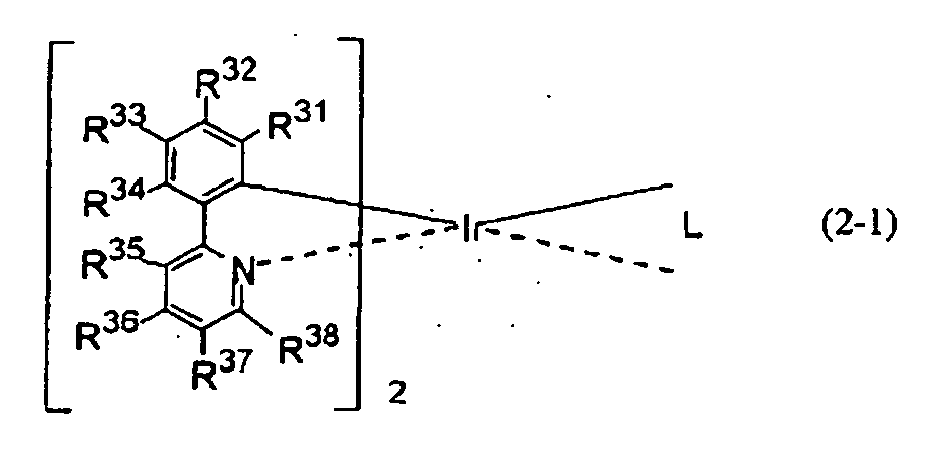
- the complex represented by formula (2-1) is.suitably used.
- R 31 - R 38 each represent independently an atom or a substituent selected from the group consisting of a hydrogen atom, a halogen atom, a cyano group, an alkyl group having 1 to 10 carbon atoms, an aryl group having 6 to 10 carbon atoms, an amino group optionally substituted with alkyl group(s) having 1 to 10 carbon atoms, an alkoxy group having 1 to 10 carbon atoms and a silyl group.
- substituents there may be mentioned the atoms and the substituents as described above.
- each of R 31 - R 38 is a hydrogen atom, a fluorine atom, cyano group, a methyl group, a t-butyl group, a dimethylamino group, a butoxy group or a 2-ethylhexyloxy group.
- R 32 is a t-butyl group and R 31 - R 38 except for R 32 are hydrogen atoms.
- Each two groups of R 31 and R 32 , R 32 and R 33 , R 33 and R 34, R 34 and R 35 , R 35 and R 36 , R 36 and R 37 , and R 37 and R 38 may bond to each other to form a fused ring.
- a fused ring there may be mentioned, for example, a naphthalene ring, an anthracene ring, a phenanthrene ring, a pyrene ring, a perylene ring, a quinoline ring, a isoquinoline ring, a naphthyridine ring and the like.
- L represents a bidentate ligand selected from the group consisting of formulae (2-2) to (2-4)
- At least one of R 41 - R 48 represents a substituent having a polymerizable functional group; and each of R 41 - R 48 except for the at least one substituent having a polymerizable functional group is independently an atom or a substituent which has the same meaning as that of R 31 .
- Each of R 41 - R 48 is preferably a hydrogen atom, a fluorine atom, a cyano group, a methyl group, a t-butyl group, a dimethylamino group, a butoxy group or a 2-ethylhexyloxy group.
- Each, two groups of R 41 and R 42 , R 42 and R 43 , R 43 and R 44 , R 44 and R 45 , R 45 and R 46 , R 46 and R 47 , and R 47 and R 48 may bond to each other to form a fused ring.
- At least one of R 41 - R 48 represents a substituent having a polymerizable functional group, which has the same meaning as the substituent having a polymerizable functional group in the compound (A). Preferred substituents are also the same as those for the compound (A).
- At least one of R 51 - R 53 represents a substituent having a polymerizable functional group; and each of R 51 - R 53 except for the at least one substituent having a polymerizable functional group is independently an atom or a substituent similar to that described for R 31 (provided that a halogen atom is excluded).
- Each of R 51 - R 53 is preferably a methyl group, a t-butyl group, a dimethylamino group or a methoxy group.
- R 51 and R 52 and/or R 52 and R 53 may bond to each other to form a fused ring.
- At least one of R 51 - R 53 represents a substituent having a polymerizable functional group, which has the same meaning as the substituent having a polymerizable functional group in the compound (A). Preferred substituents are also the same as those for compound (A).
- At least one of R 61 - R 64 represents a substituent having a polymerizable functional group; and each of R 61 - R 64 except for the at least one substituent having a polymerizable functional group is independently an atom or a substituent similar to those described for R 31 .
- Each of R 61 - R 64 is preferably a hydrogen atom, a fluorine atom, a cyano group, a methyl group, a t-butyl group, a dimethylamino group, a butoxy group or a 2-ethylhexyloxy group.
- Each two groups of R 61 and R 62 , R 62 and R 63 , and R 63 and R 64 may bond to each other to form a fused ring.
- At least one of R 61 - R 64 represents a substituent having a polymerizable functional group, which has the same meaning as the substituent having a polymerizable functional group in the compound (A). Preferred substituents are also the same as those for the compound (A).
- the iridium complex represented by formula (2-1) is produced, for example, as follows. First, a specific bidentate ligand is reacted with an iridium compound (0.5 equivalent) such as iridium chloride in a solvent such as 2-ethoxyethanol. Next, the resultant metal complex and a bidentate ligand having a polymerizable functional group are heated together with sodium carbonate in a solvent such as 2-ethoxyethanol, and the product is purified to obtain the iridium complex represented by formula (2-1).
- the bidentate ligand having a polymerizable functional group can be obtained by a publicly known method.
- the compound (C) used in the present invention there are no particular limitations as long as it comprises a substituent having a polymerizable functional group, and publicly known electron transport compounds may be used. Among such compounds, an oxadiazole derivative, a triazole derivative and a triarylborane derivative are suitably used.
- the compound (C) may be used alone or as a combination of two or more kinds thereof.
- the compound (C) there may be mentioned the following compounds (C1) to (C9).
- the above-described substituent having a polymerizable functional group has the same meaning as the substituent having a polymerizable functional group in the compound (A) and preferred cases thereof are also the same.
- Such a compound (C) can be produced by a publicly known method.
- another polymerizable compound may be further used.
- another polymerizable compound there may be mentioned, for example, compounds having no carrier transport property including an alkyl (meth) acrylate ester such as methyl acrylate and methyl methacrylate, styrene and a derivative thereof, and the like, although not limited thereto.
- a method for producing said polymer compound may be any of radical polymerization, cation polymerization, anion polymerization and addition polymerization, among which radical polymerization is preferable.
- the weight average molecular weight of said polymer compound is typically 1,000 to 2,000,000, preferably 5, 000 to 1,000,000. It is preferable that the weight average molecular weight falls within this range because said polymer compound is soluble in organic solvents and a uniform thin film can be obtained.
- the weight average molecular weight refers to a value measured by gel permeation chromatography (GPC) using tetrahydrofuran as a solvent at 40°C.
- the ratio of the structural units derived from the compound (B) to the total number of the structural units is preferably in the range of 0.001 to 0.5, more preferably in the range of 0.001 to 0.2. If the value of m/ (m+n) is within this range, there can be obtained an organic light-emitting device having high carrier mobility, less effect of concentration quenching, and hence a high luminous efficiency.
- the optimal values for the ratio of the number of the structural units derived from the compound (A) to the number of the structural units derived from the carrier transport compounds, x/n, and the corresponding ratio of the number of the structural units derived from the compound (C), y/n depend on the charge transporting ability of each structural unit, the concentration and the like.
- the values of x/n and y/n are preferably in the range of 0.05 to 0.95, respectively, more preferably in the range of 0.20 to 0.80.
- the values of x/n and y/n are preferably in the range of 0.05 to 0.95, respectively, more preferably in the range of 0.20 to 0.80.
- the equation, x/n + y/n 1, holds true.
- the ratio of each structural unit in polymer compounds as described above can be determined from ICP elemental analysis and 13 C-NMR measurement.
- the polymer compound may be any of a random copolymer, a block copolymer and an alternate copolymer.
- the light-emitting layer is formed by using polymer compound (I) obtained by polymerizing the compound (A) and the compound (B), an electron transport layer may be provided separately.
- the light-emitting layer is preferably formed by using an electron transport compound together with polymer compound (I).
- a single electron transport compound or a mixture of two or more kinds of such compounds may be used.
- the electron transport compound publicly known compounds as described later may be used, and an oxadiazole derivative and a triarylborane derivative are suitably used.
- the light-emitting layer desirably comprises the electron transport compound in an amount of preferably 5 to 95 parts by weight, more preferably 20 to 80 parts by weight, relative to 100 parts by weight of the polymer compound (I).
- the light-emitting layer is formed by using polymer compound (II) obtained by polymerizing the compound (A), the compound (B), and the compound (C), the polymer compound alone can form the light-emitting layer.
- the light-emitting layer is preferably formed by using a phosphorescent compound (E) together with polymer compound (III).
- a phosphorescent compound (E) or a combination of two or more kinds of such compounds may be used.
- an electron transport layer may be separately provided or the light-emitting layer may be formed by using said electron transport compound together with polymer compound (III) and said phosphorescent compound (E).
- the phosphorescent compound (E) publicly known compounds may be used, and iridium complexes are suitably used. Specifically, there may be mentioned the following complexes (E-1) to (E-39).
- the light-emitting layer desirably comprises the phosphorescent low molecular weight compound (E) in an amount of preferably 1 to 50 parts by weight, more preferably 5 to 20 parts by weight, relative to 100 parts by weight of the polymer compound (III).
- the light-emitting layer desirably comprises the electron transport compound in an amount of preferably 5 to 95 parts by weight, more preferably 20 to 80 parts by weight, relative to 100 parts by weight of the polymer compound (III).
- the light-emitting layer is preferably formed by using said phosphorescent compound (E) together with polymer compound (IV).
- the light-emitting layer desirably comprises the phosphorescent low molecular weight compound (E) in an amount of preferably 1 to 50 parts by weight, more preferably 5 to 20 parts by weight, relative to 100 parts by weight of the polymer compound (IV).
- the method for producing the light-emitting layer is not specifically limited.
- the light-emitting layer can be produced as follows. First, a solution is prepared by dissolving polymer compound (I) and said electron transport compound where necessary.
- the solvent used for preparing the solution is exemplified by, although not specifically limited to, a chlorinated solvent such as chloroform, methylene chloride and dichloroethane, an ether type solvent such as tetrahydrofuran and anisole, an aromatic hydrocarbon solvent such as toluene and xylene, a ketones solvent such as acetone and methyl ethyl ketone, an esters solvent such as ethyl acetate, butyl acetate and ethyl cellusolve acetate, and the like.
- a chlorinated solvent such as chloroform, methylene chloride and dichloroethane
- an ether type solvent such as tetrahydrofuran and anisole
- an aromatic hydrocarbon solvent such as toluene and xylene
- a ketones solvent such as acetone and methyl ethyl ketone
- an esters solvent such as ethyl acetate, butyl
- a film is formed on a substrate by wet film-forming method such as spin coating method, casting method, microgravure coating method, gravure coating method, bar coating method, roll coating method, wire bar coating method, dip coating method, spray coating method, screen printing method, flexo printing method, offset printing method, inkjet printing method and the like.
- said solution preferably contains 0.5 wt% to 5 wt% of polymer compound (I).
- the solution preferably contains 0.1 wt% to 3 wt% of said compound.
- the light-emitting layer can be formed in the same manner as described for polymer compound (I).
- the light-emitting layer is formed by using polymer compound (III)
- a solution is prepared by dissolving polymer compound (III), a phosphorescent compound (E), and said electron transport compound where necessary.
- the solvent used for preparing the solution is the same as above.
- a film is formed on a substrate in the same manner as above.
- said solution preferably contains 0.5 wt% to 5 wt% of polymer compound (III) and 0.01 wt% to 2 wt% of the phosphorescent compound (E).
- the solution preferably contains 0.1 wt% to 3 wt% of said compound.
- the light-emitting layer can be formed in the same manner as described for polymer compound (III).
- the organic light-emitting device relating to the present invention comprises at least one organic layer sandwiched between an anode and a cathode, wherein the specific light-emitting layer described above is contained in at least one of the organic layers.
- the light-emitting layer can be formed in a film by simple coating method as mentioned above and devices with large area can be produced.
- FIG. 1 An example of the configuration of the organic light-emitting device relating to the present invention is shown in Fig. 1 , but the configuration of the organic light-emitting device relating to the present invention is not limited by this example.
- a hole transport layer (3), said light-emitting layer (4), and an electron transport layer (5) are provided in this order between an anode (2) provided on a transparent substrate (1) and a cathode (6).
- said organic light-emitting device for example, either 1) hole transport layer/said light-emitting layer or 2) said light-emitting layer/electron transport layer may be provided between the anode (2) and the cathode (6).
- Each of said layers may be formed with a polymer material and the like mixed as a binder.
- a polymer material there may be mentioned, for example, poly(methyl methacrylate), polycarbonate, polyester, polysulfone, polyphenyleneoxide, and the like.
- each single material may form each layer or materials having different functions may be mixed to form each layer.
- the light-emitting layer in the organic light-emitting device relating to the present invention may also contain another hole transport material and/or electron transport material in addition to the polymer compound relating to the present invention for the purpose of supplementing the carrier transport property.
- Such a transporting material may be either a low molecular weight compound or.a polymer.
- TPD N,N'-dimethyl-N,N'-3-methylphenyl-1,1'-biphenyl-4,4'-dia mine
- ⁇ -NPD 4,4'-bis[N-(1-naphthyl)-N-phenylamino]biphenyl
- a low molecular weight triphenylamine derivative such as m-MTDATA (4,4',4"-tris[3-methylphenyl(phenyl)amino]triphenylamine) and the like
- polyvinylcarbazole a polymer obtained by polymerizing a monomer in which a polymerizable functional group is introduced into said triphenylamine derivative
- a fluorescent light-emitting polymer such as poly(p-phenylenevinylene) and polydialkylfluorene; and the like.
- said polymer there may be mentioned, for example, a polymer having a triphenylamine skeleton disclosed in JP-A-H8-157575 .
- Said hole transport materials may be used alone or as a mixture of two or more kinds thereof. Different hole transport materials may be laminated.
- the preferred range for the thickness of the hole transport layer depends on the conductivity of the hole transport layer or the like, typically, the thickness is preferably 1 nm to 5 ⁇ m, more preferably 5 nm to 1 ⁇ m, particularly preferably 10 nm to 500 nm.
- a glow molecular weight compound including a metal complex of a quinolinol derivative such as Alq3 (aluminum trisquinolinolate), an oxadiazole derivative; a triazole derivative, an imidazole derivative, a triazine derivative, a triarylborane derivative and the like; and a polymer obtained by polymerizing a monomer in which a polymerizable substituent is introduced into said low molecular weight compound.
- a quinolinol derivative such as Alq3 (aluminum trisquinolinolate), an oxadiazole derivative
- a triazole derivative an imidazole derivative, a triazine derivative, a triarylborane derivative and the like
- a polymer obtained by polymerizing a monomer in which a polymerizable substituent is introduced into said low molecular weight compound there may be mentioned, for example, polyPBD disclosed in Japanese Patent JP-A-H10-1665 .
- Said electron transport materials may be used alone or as a mixture of two or more kinds thereof. Different electron transport materials may be laminated.
- the preferred range for the thickness of the electron transport layer depends on the conductivity of the electron transport layer, topically, the thickness is preferably 1 nm to 5 ⁇ m, more preferably 5 nm to 1 ⁇ m, particularly preferably 10 nm to 500 nm.
- a hole-block layer may be provided adjacent to the cathode side of the light-emitting layer in order to prevent holes from passing through the light-emitting layer and to recombine holes and electrons efficiently in the light-emitting layer.
- Said hole-block layer may be formed by using a publicly known material such as a triazole derivative, an oxadiazole derivative, a phenanthroline derivative, and the like.
- a buffer layer may be provided between the anode and the hole transport layer or between the anode and the organic layer laminated adj acent to the anode.
- Said buffer layer may be formed by using a publicly known material such as copper phthalocyanine, a mixture of polyethylenedioxythiophene and polystyrenesulfonic acid (PEDOT:PSS), and the like.
- an insulating layer having a thickness of 0.1 nm to 10 nm may be provided to improve the efficiency of electron injection.
- Said insulating layer may be formed by using a publicly known material such as lithium fluoride, sodium fluoride, magnesium fluoride, magnesium oxide, alumina, and the like.
- anode material used for the organic light-emitting device relating to the present invention one may suitably use a publicly known transparent conductive material, for example, ITO (indium tin oxide), tin oxide, zinc oxide, a conductive polymer such as polythiophene, polypyrrole and polyaniline, and the like.
- the surface resistance of the electrode formed by the transparent conductive material is preferably 1 ⁇ / ⁇ (ohm/square) to 50 ⁇ / ⁇ .
- the thickness of the anode is peferable 50 nm to 300 nm.
- the cathode material used for the organic light-emitting device relating to the present invention one may suitably use a publicly known cathode material, for example, an alkaline metal such as Li, Na, K, Cs and the like; an alkaline earth metal such as Mg, Ca, Ba and the like; Al; MgAg alloy; an alloy of Al and an alkaline metal or an alkaline earth metal such as AlLi and AlCa; and the like.
- the thickness of the cathode is preferably 10 nm to 1 ⁇ m, more preferably 50 nm to 500 nm.
- the thickness of the cathode is preferably 0.1 nm to 100 nm, more preferably 0.5 nm to 50 nm. Further, in this case, a metal layer stable to air is laminated on the cathode for the purpose of protecting said cathode metal.
- a metal forming said metal layer there may be mentioned, four example, Al, Ag, Au, Pt, Cu, Ni, Cr and the like.
- the thickness of said metal layer is preferably 10 nm to 1 ⁇ m, more preferably 50 nm to 500 nm.
- the substrate of the organic light-emitting device relating to the preset invention one may suitably use an insulating substrate transparent at the emission wavelength of said light-emitting material.
- transparent plastics such as PET (polyethylene terephtalate) and polycarbonate as well as glass.
- the film forming method of the hole transport layer and the electron transport layer there may be used, for example, wet film-forming method such as spin coating method, casting method, microgravure coating method, gravure coating method, bar coating method, roll coating method, wire bar coating method, dip coating method, spray coating method, screen printing method, flexo printing method, offset printing method, inkjet printing method and the like, as well as dry film-forming method such as resistance heating vapor deposition method, electron beam vapor deposition method, sputtering method and the like.
- wet film-forming method such as spin coating method, casting method, microgravure coating method, gravure coating method, bar coating method, roll coating method, wire bar coating method, dip coating method, spray coating method, screen printing method, flexo printing method, offset printing method, inkjet printing method and the like
- dry film-forming method such as resistance heating vapor deposition method, electron beam vapor deposition method, sputtering method and the like.
- dry film-forming method is suitably employed, while in the case of a
- the film-forming method of said anode material there is used, for example, electron beam vapor deposition method, sputtering method; chemical reaction method and coating method and the like.
- the film-forming method of said cathode material there is used, for example, resistance heating vapor deposition method, electron beam vapor deposition method, sputtering method, ion plating method and the like.
- the organic light-emitting device relating to the present invention is suitably used for an image display devices by forming pixels in a matrix system or in a segment system by a publicly known method.
- said organic light-emitting device is also suitably used as a area light source without forming pixels.
- the organic light-emitting device relating to the present invention is suitably used for displays, backlights, electrophotographs, illumination light sources, recording light sources, exposure light sources, read-out light sources, indicators, signboards, interior goods, optical communication and the like.
- the produced organic light-emitting device was placed in a dark place and a spectroradiometer (CS-1000T, manufactured by Konica Minolta Holdings, Inc.) was located at 100 cm away to the direction perpendicular to the light-emitting surface.
- a given voltage was applied to the organic light-emitting device for 1 sec to bring about emission, and the value of current running through the device, the value of front brightness observed from the anode side of the device, and the emission spectrum were measured at a viewing angle of 0.2 degree.
- the applied voltage was increase stepwise from 0 V with an increment of 0.1 V, and the current value, the brightness, value and the emission spectrum were measured immediately after the voltage was increased.
- the emission external quantum efficiencies were calculated from these measurements, and the maximum value was recorded as the emission external quantum efficiency of the device.
- the values of front brightness of the produced organic light-emitting device were measured in the same manner as that in the above-mentioned measurement of the emission external quantum efficiency except that the increment of the applied voltage was set at 0.5V, and the maximum of the observed values was recorded as the maximum brightness of the device.
- Tetrahydrofuran (20 mL) was added to methyltriphenylphosphonium bromide (3.150 g, 8.8 mmol). Then potassium t-butoxide (0.989 g, 8.8 mmol) was added here in small portions with ice-cooling, and the mixture was stirred at room temperature for 1 hr. The resultant slurry was cooled to -78°C and a tetrahydrofuran (20 mL) solution containing 3, 5-dibromobenzaldehyde (1.519 g, 5.8 mmol) was added dropwise. The reaction solution was allowed to warm to room temperature and stirred for 1 hr, and then a saturated ammonium chloride aqueous solution was added to the reaction solution. The product was extracted with ethyl acetate, the solvent was distilled off under reduced pressure, and the residue was purified with silica-gel column chromatography to obtain 3,5-dibromostyrene (1.2 g, 4.6 mmol).
- the precipitate was purified twice by re-precipitation with toluene-acetone and dried at 50°C in vacuum overnight to obtain polymer compound (1-1).
- the weight average molecular weight (Mw) of polymer compound (1-1) was. 50200 and its molecular distribution index (Mw/Mn) was 2.19.
- the value of m/(m+n) in the polymer compound was 0.10 which was estimated from the results of ICP elemental analysis and 13 C-NMR measurement.
- polymer compound (2-1) The precipitate was purified twice by re-precipitation with toluene-acetone and then dried at 50°C in vacuum overnight to obtain polymer compound (2-1).
- the weight average molecular weight (Mw) of polymer compound (2-1) was 48000 and its molecular distribution index (Mw/Mn) was 1.95.
- the value of m/ (m+n) in the polymer compound was 0.055 which was estimated from the results of ICP elemental analysis and 13 C-NMR measurement.
- the value of x/n was 0.54 and the value of y/n was 0.46.
- the precipitate was purified twice by re-precipitation with toluene-acetone and then dried at 50°C in vacuum overnight to obtain polymer compound (3-1).
- the weight average molecular weight (Mw) of polymer compound (3-1) was 49200 and its molecular distribution index (Mw/Mn) was 1.89.
- the value of x/n in polymer compound was 0.44 and the value of y/n was 0.56, which were estimated from the results of ICP elemental analysis and 13 C-NMR measurement.
- Polymer compound (1-2) was obtained in the same way as Example 1 except that polymerizable compound (I) was used instead of compound (F)
- the weight average molecular weight (Mw) of polymer compound (1-2) was 46300 and its molecular distribution index (Mw/Mn) was 2.07.
- the value of m/ (m+n) in the polymer compound was 0.12 which was estimated from the results of ICP elemental analysis and 13 C-NMR measurement.
- Polymer compound (2-2) was obtained in the same way as Example 2 except that compound (J) was used instead of compound (F).
- the weight average molecular weight (Mw) of polymer compound (2-2) was 46400 and its molecular distribution index (Mw/Mn) was 2.02.
- the value of m/ (m+n) in the polymer compound was 0.050 which was estimated from the results of ICP elemental analysis and 13 C-NMR measurement.
- the value of x/n was 0.49 and the value of y/n was 0.51.
- Polymer compound (3-2) was obtained in the same way as Example 3 except that compound (K) was used instead of compound (H):
- the weight average molecular weight (Mw) of polymer compound (3-2) was 52000 and its molecular distribution index (Mw/Mn) was 1.96.
- the value of x/n in polymer compound was 0.4.1 and the value of y/n was 0.59 which were estimated from the results of ICP elemental analysis and 13 C -NMR measurement.
- ITO-attached substrate (Nippo Electric Co., Ltd.) was used. This was a substrate in which two lines of ITO (indium tin oxide) electrode (anode) of a width of 4 mm were fabricated in a stripe pattern on one surface of a 25 mm-square glass substrate.
- the above-mentioned ITO-attached substrate was coated with poly(3,4-ethylenedioxythiophene)-polystyrenesulfonic acid (product name, BaytronP, manufactured by Bayer Co., Ltd.,) by spin-coating method with a rotation speed of 3500 rpm and a coating time of 40 sec. Then the coated substrate was dried in a vacuum desiccator under reduced pressure at 60°C for 2 hr to form an anode buffer layer. The film thickness of the obtained anode buffer layer was approximately 50 nm.
- polymer compound (1-1) 48.6 mg
- compound (O) 41.4 mg
- toluene 2910 mg
- the anode buffer layer was coated with the coating solution by spin coating method with a rotation speed.of 3000 rpm and a coating time of 30 sec. After coating the substrate was dried at room temperature (25°C) for 30 min to form a light-emitting layer.
- the film thickness of the obtained light-emitting layer was approximately 100 nm.
- the substrate whereon the light-emitting layer was formed was loaded into a deposition chamber.
- Barium and aluminum were co-deposited with a weight ratio of 1:10 on the substrate so as to form two lines of cathode with a width of 3 mm in a stripe pattern perpendicular to the running direction of the anodes.
- the film thickness of the obtained cathode was approximately 50 nm.
- An organic light-emitting device was produced in the same way as Example 4 except that the coating solution used for forming the light-emitting layer was prepared from polymer compound (2-1) (90 mg) and toluene (2910 mg).
- the maximum external quantum efficiency, the maximum attainable brightness, and the half-life of brightness at an initial brightness of 100 cd/m 2 in constant current driving are shown in Table 1.
- An organic light-emitting device was produced in the same way as Example 4 except that the coating solution used for forming the light-emitting layer was prepared from polymer compound (3-1) (82.8 mg), iridium complex (L) (7.2 mg), and toluene (2910 mg).
- the maximum external quantum efficiency, the maximum attainable brightness, and the half-life of brightness at an initial brightness of 100 cd/m 2 in constant current driving are shown in Table 1.
- An organic light-emitting device was produced in the same way as Example 4 except that the coating solution used for forming the light-emitting layer was prepared from polymer compound (1-2) (48.6 mg), compound (O) (41.4 mg), and toluene, (2910 mg).
- the maximum external quantum efficiency, the maximum attainable brightness, and the half-life of brightness at an initial brightness of 100 cd/m 2 in constant current driving are shown in Table 1.
- An organic light-emitting device was produced in the same way as Example 4 except that the coating solution used forming the light-emitting layer was prepared from polymer compound (2-2) (90 mg) and toluene (2910 mg).
- the maximum external quantum efficiency the maximum attainable brightness and the half-life of brightness at an initial brightness of 100 cd/m 2 in constant current driving are shown in Table 1.
- An organic light-emitting device was produced in the same way as Example 4 except that the coating solution used for forming the light-emitting layer was prepared from polymer compound (3-2) (82.8 mg), iridium complex (L) (7.2 mg), and toluene (2910 mg).
- the maximum external quantum efficiency, the maximum attainable brightness, and the haif-life of brightness at an initial brightness of 100 cd/m 2 in constant current driving are shown in Table 1.
- Compound (R) was obtained in the same way as Synthesis Example 1 except that di-p-tolylamine was used instead of di-m-tolylamine.
- Compound (S) was obtained in the same way as Synthesis Example 1 except that di(4-methoxyphenyl)amine was used instead of di-m-tolylamine.
- Polymer compound (4-1) was obtained in the same way as Example 1 except that compound (R) was used instead of compound (F) and iridium complex (X) was used instead of iridium complex (M).
- the weight average molecular weight (Mw) of polymer compound (4-1) was 72500 and its molecular distribution index (Mw/Mn) was 1.76.
- the value of m/(m+n) in the polymer compound was 0.11 which was estimated from the results of ICP elemental analysis and 13 C-NMR measurement.
- Polymer compound (5-1) was obtained in the same way as Example 2 except that compound (S) was used instead of compound (F) and iridium complex (Y) was used instead of iridium complex (M).
- the weight average molecular weight (Mw) of polymer compound (5-1) was 39800 and its molecular distribution index (Mw/Mn) was 2.20.
- the value of m/(m+n) in the polymer compound was 0.060 which was estimated from the results of ICP elemental analysis and 13 C-NMR measurement.
- the value of x/n was 0.52 and the value of y/n was 0.48.
- Polymer compound (6-1) was obtained in the same way as Example 3 except that compound (W) was mused instead of compound (H) and iridium complex (Q) was used instead of iridium complex (P).
- the weight average molecular weight (Mw) of polymer compound (6-1) was 48400 and its molecular distribution index (Mw/Mn) was 2.55.
- Mw/Mn molecular distribution index
- Polymer compound (4-2) was obtained in the same way as Example 1 except that polymerizable compound (I) was used instead of compound (F) and iridium complex (X) was used instead of iridium complex (M).
- the weight average molecular weight (Mw) of polymer compound (4-2) was 63700 and its molecular distribution index (Mw/Mn) was 2.04.
- the value of m/ (m+n) in the polymer compound was 0.12 which was estimated from the results of ICP elemental analysis and 13 C-NMR measurement.
- Polymer compound (5-2) was obtained in the same way as Example 2 except that compound (J) was used instead of compound (F) and iridium complex (Y) was used instead of iridium complex (M).
- the weight average molecular weight (Mw) of polymer compound (5-2) was 48000 and its molecular distribution index (Mw/Mn) was 2.15.
- the value of m/ (m+n) in the polymer compound was 0.065 which was estimated from the results of ICP elemental analysis and 13 C-NMR measurement.
- the value of x/n was 0.53 and the value of y/n was 0.47.
- Polymer compound (6-2) was obtained in the same way as Example 3 except that compound (K) was used instead of compound (H) and iridium complex (Q) was used instead of iridium complex (P).
- the weight average molecular weight (Mw) of polymer compound (6-2) was 59200 and its molecular distribution index (Mw/Mn) was 2.31.
- Mw/Mn molecular distribution index
- An organic light-emitting device was produced in the same way as Example 4 except that the coating solution used for forming the light-emitting layer was prepared from polymer compound (4-1) (4.8.6 mg), compound (0) (41.4 mg) and toluene (2910 mg).
- the produced organic light-emitting device exhibited yellow light emission.
- the maximum external quantum efficiency, the maximum attainable brightness, and the half-life of brightness at an initial brightness of 100 cd/m 2 in constant current driving are shown in Table 2.
- An organic light-eniitting device was produced in the same way as Example 4 except that the coating solution used for forming the light-emitting.layer was prepared from polymer compound (5-1) (90 mg) and toluene (2910 mug) The produced organic light-emitting device exhibited orange light emission.
- the maximum external quantum efficiency, the maximum attainable brightness, and the half-life of brightness at an initial brightness of 100 cd/m 2 in constant current driving are shown in Table 2.
- An organic light-emitting device was produced in the same way as Example except that the coating solution used for forming the light-emitting layer was prepared from polymer compound (6-1) (82.8 mg), iridium complex (Z) (7.2 mg) and toluene (2910 mg).
- the produced organic light-emitting device exhibited red light emission.
- the maximum external quantum efficiency, the maximum attainable brightness, and the half-life of brightness at an initial brightness of 100 cd/m 2 in constant current driving are shown in Table 2.
- An organic light-emitting device was produced in the same way as Example 4 except that the coating solution used for forming the light-emitting layer was prepared from polymer compound (4-2) (48.6 mg), compound (O) (41.4 mg) and toluene (2910 mg).
- the produced organic light-emitting device exhibited yellow light emission.
- the maximum external quantum efficiency, the maximum attainable brightness, and the half-life of brightness at an initial brightness of 100 cd/m 2 in constant current driving are shown in Table 2.
- An organic light-emitting device was produced in the same way as Example 4 except that the coating solution used for forming the light-emitting layer was prepared from polymer compounds (5-2). (90 mg) and toluene (2910 mg). The produced organic light-emitting device exhibited orange light emission. For the produced organic light-emitting device, the maximum external quantum efficiency, the maximum attainable brightness, and the half-life of brightness at an initial brightness of 100 cd/m 2 in constant current driving are shown in Table 2.
- An organic light-einitting device was produced in the same way as Example 4 except that the coating solution used for forming the light-emitting layer was prepared from polymer compound (6-2) (82.8 mg), iridium complex (Z) (7.2 mg) and toluene (2910 mg).
- the produced organic light-emitting device exhibited red light emission.
- the maximum external quantum efficiency, the maximum attainable brightness, and the half-life of brightness at an initial brightness of 100 Cd/m 2 in constant current driving are shown in Table 2.
- compound (AC) (1.5 g, 2.7 mmol) was dissolved in dichloromethane (50 mL), triethylamine (0.40 g, 4.0 mmol) was added to here, and then 5 mL of a dichloromethane solution of methacryloyl chloride (0.36 g, 3.4 mmol) was added dropwise.
- the reaction solution was stirred for 2 hr at room temperature. After the resultant reaction solution was filtered through celite, the solvent was distilled off under reduced pressure, and the residue was purified with silica-gel column chromatography to obtain compound (AD) (1.5 g, 2.4 mmol).
- Polymer compound (7-1) was obtained in the same way as Example 2 except that compound (AB) was used instead of compound (F).
- the weight average molecular weight (Mw) of polymer compound (7-1) was 70900 and its molecular distribution index (Mw/Mn) was 2.41.
- the value of m/ (m+n) in the polymer compound was 0.058 which was estimated from the results of ICP elemental analysis and 13 C-NMR measurement.
- the value of x/n was 0.49 and the value of y/n was 0.51.
- Polymer compound (8-1) was obtained in the same way as Example 2 except that compound (AD) was used instead of compound (F).
- the weight average molecular weight (Mw) of polymer compound (8-1) was 45100 and its molecular distribution index (Mw/Mn) was 2.85.
- the value of m/ (m+n) in the polymer compound was 0.070 which was estimated from the results of ICP elemental analysis and 13 C-NMR measurement.
- the value of x/n was 0.53 and the value of y/n was 0.47.
- An organic light-emitting device was produced in the same way as Example 4 except'that the coating solution used for forming the light-emitting layer was prepared from polymer compound (7-1). (90 mg) and.toluene (2910 mg). The produced organic light-emitting device exhibited orange light emission.
- the maximum external quantum efficiency, the maximum attainable brightness, and the half-life of brightness at an initial brightness of 100 cd/m 2 in constant current driving are shown in Table 3.
- An organic light-emitting device was produced in the same way as Example 4 except that the coating solution used for forming the light-emitting layer was prepared from polymer compound (8-1) (90 mg) and toluene (2910 mg). The produced organic light-emitting device exhibited orange light emission.
- the maximum external quantum efficiency, the maximum attainable brightness, and the half-life of brightness at an initial brightness of 100 cd/m 2 in constant current driving are shown in Table 3.
- Table 3 Polymer compound Low molecular weight compound Maximum external quantum efficiency (%) Maximum attainable brightness (cd/m 2 ) Half-life of brightness (h)
Landscapes
- Chemical & Material Sciences (AREA)
- Organic Chemistry (AREA)
- Engineering & Computer Science (AREA)
- Materials Engineering (AREA)
- Physics & Mathematics (AREA)
- Optics & Photonics (AREA)
- Crystallography & Structural Chemistry (AREA)
- Inorganic Chemistry (AREA)
- Spectroscopy & Molecular Physics (AREA)
- Electroluminescent Light Sources (AREA)
- Addition Polymer Or Copolymer, Post-Treatments, Or Chemical Modifications (AREA)
Claims (11)
- Organische lichtemittierende Vorrichtung, in der mindestens eine organische Schicht, die eine lichtemittierende Schicht aufweist, zwischen einer Anode und einer Kathode sandwichartig angeordnet ist und eine phosphoreszierende Verbindung in der lichtemittierenden Schicht Licht emittiert,
wobei die lichtemittierende Schicht eine Polymerverbindung aufweist, die eine von einer polymerisierbaren Verbindung (A) der folgenden Formel (1) abgeleitete Struktureinheit enthält:
- Organische lichtemittierende Vorrichtung nach Anspruch 1, wobei die Polymerverbindung außerdem eine von einer phosphoreszierenden polymerisierbaren Verbindung (B) abgeleitete Struktureinheit enthält.
- Organische lichtemittierende Vorrichtung nach Anspruch 1, wobei die Polymerverbindung außerdem eine von einer phosphoreszierenden polymerisierbaren Verbindung (B) abgeleitete Struktureinheit und eine von einer polymerisierbaren Elektronentransportverbindung (C) abgeleitete Struktureinheit enthält.
- Organische lichtemittierende Vorrichtung nach Anspruch 2 oder 3, wobei die phosphoreszierenden polymerisierbare Verbindung (B) ein Komplex der folgenden allgemeinen Formel (2-1) ist:


- Organische lichtemittierende Vorrichtung nach Anspruch 1, wobei die lichtemittierende Schicht außerdem eine phosphoreszierende Verbindung (E) enthält.
- Organische lichtemittierenden Vorrichtung nach Anspruch 1, wobei die lichtemitierende Schicht außerdem eine phosphoreszierende Verbindung (E) enthält und die Polymerverbindung außerdem eine von einer polymerisierbaren Elektronentransportverbindung (C) abgeleitete Struktureinheit enthält.
- Organische lichtemittierende Vorrichtung nach Anspruch 3 oder 6, wobei die polymerisierbare Elektronentransportverbindung (C) ein Oxadiazolderivat, ein Triazolderivat oder ein Triarylboranderivat ist.
- Eine Flächenlichtquelle, worin die organische lichtemittierende Vorrichtung nach einem der Ansprüche 1 bis 7 verwendet wird.
- Bilddarstellungsvorrichtung, wobei die organische lichtemittierende Vorrichtung nach einem der Ansprüche 1 bis 7 verwendet wird.
- Polymerverbindung, die eine von einer polymerisierbaren Verbindung (A) der folgenden allgemeinen Formel (1) abgeleitete Struktureinheit enthält:

- Polymerverbindung nach Anspruch 10, die eine von einer phosphorisierenden polymerisierbaren Verbindung (B) der folgenden allgemeinen Formel (2-1) abgeleitete Struktureinheit enthält:


Applications Claiming Priority (2)
| Application Number | Priority Date | Filing Date | Title |
|---|---|---|---|
| JP2005369455 | 2005-12-22 | ||
| PCT/JP2006/325683 WO2007072962A1 (en) | 2005-12-22 | 2006-12-19 | Organic light-emitting device |
Publications (2)
| Publication Number | Publication Date |
|---|---|
| EP1969083A1 EP1969083A1 (de) | 2008-09-17 |
| EP1969083B1 true EP1969083B1 (de) | 2010-02-10 |
Family
ID=39682639
Family Applications (1)
| Application Number | Title | Priority Date | Filing Date |
|---|---|---|---|
| EP06843114A Active EP1969083B1 (de) | 2005-12-22 | 2006-12-19 | Organische lichtemittierende vorrichtung |
Country Status (6)
| Country | Link |
|---|---|
| US (1) | US8257837B2 (de) |
| EP (1) | EP1969083B1 (de) |
| KR (1) | KR100991347B1 (de) |
| DE (1) | DE602006012229D1 (de) |
| TW (1) | TWI441897B (de) |
| WO (1) | WO2007072962A1 (de) |
Families Citing this family (8)
| Publication number | Priority date | Publication date | Assignee | Title |
|---|---|---|---|---|
| KR20110055563A (ko) * | 2008-07-30 | 2011-05-25 | 스미또모 가가꾸 가부시키가이샤 | 적층 구조체, 그의 제조 방법 및 그것을 포함하는 전자 소자 |
| JP5624275B2 (ja) | 2008-12-22 | 2014-11-12 | ユー・ディー・シー アイルランド リミテッド | 有機電界発光素子 |
| US8273898B2 (en) * | 2009-03-27 | 2012-09-25 | Semiconductor Energy Laboratory Co., Ltd. | Oxadiazole derivative, light-emitting element, display device, lighting device, and electronic device |
| DE102009041289A1 (de) * | 2009-09-16 | 2011-03-17 | Merck Patent Gmbh | Organische Elektrolumineszenzvorrichtung |
| DE102009053191A1 (de) | 2009-11-06 | 2011-05-12 | Merck Patent Gmbh | Materialien für elektronische Vorrichtungen |
| EP2722908A1 (de) | 2012-10-17 | 2014-04-23 | Novaled AG | Phosphoreszente OLED und Lochtransportmaterialien für phophoreszente OLED |
| EP2924753B1 (de) * | 2014-03-25 | 2017-04-19 | Novaled GmbH | Polychromatische lichtemittierende vorrichtungen und vielseitige lochtransportmatrix dafür |
| CN111164113B (zh) | 2018-02-28 | 2022-10-11 | 株式会社Lg化学 | 聚合物、包含其的涂覆组合物和使用其的有机发光元件 |
Family Cites Families (9)
| Publication number | Priority date | Publication date | Assignee | Title |
|---|---|---|---|---|
| TWI293964B (en) | 2001-02-05 | 2008-03-01 | Sumitomo Chemical Co | Polymeric fluorescent substance, production thereof and polymer light-emitting device |
| SG92833A1 (en) * | 2001-03-27 | 2002-11-19 | Sumitomo Chemical Co | Polymeric light emitting substance and polymer light emitting device using the same |
| JP3894760B2 (ja) | 2001-09-26 | 2007-03-22 | Ntn株式会社 | 等速自在継手 |
| JP3951876B2 (ja) * | 2001-11-09 | 2007-08-01 | 昭和電工株式会社 | 重合性化合物およびその製造方法 |
| JP3919583B2 (ja) | 2002-04-12 | 2007-05-30 | キヤノン株式会社 | 有機発光素子 |
| TWI280973B (en) | 2002-08-28 | 2007-05-11 | Sumitomo Chemical Co | Polymer compound and polymer light-emitting device using the same |
| DE602004013003T2 (de) | 2003-05-30 | 2009-06-18 | Merck Patent Gmbh | Halbleitendes Polymer |
| JP4780696B2 (ja) | 2003-08-29 | 2011-09-28 | 昭和電工株式会社 | 燐光発光性高分子化合物およびこれを用いた有機発光素子 |
| EP1915789B1 (de) * | 2005-08-17 | 2012-07-18 | Showa Denko K.K. | Organische elektrolumineszenzvorrichtung unter verwendung eines copolymers und einer phosphoreszierenden iridiumverbindung |
-
2006
- 2006-12-19 KR KR1020087017427A patent/KR100991347B1/ko active Active
- 2006-12-19 WO PCT/JP2006/325683 patent/WO2007072962A1/en not_active Ceased
- 2006-12-19 DE DE602006012229T patent/DE602006012229D1/de active Active
- 2006-12-19 EP EP06843114A patent/EP1969083B1/de active Active
- 2006-12-19 US US12/158,193 patent/US8257837B2/en active Active
- 2006-12-22 TW TW095148489A patent/TWI441897B/zh active
Also Published As
| Publication number | Publication date |
|---|---|
| US8257837B2 (en) | 2012-09-04 |
| US20090091249A1 (en) | 2009-04-09 |
| KR100991347B1 (ko) | 2010-11-01 |
| EP1969083A1 (de) | 2008-09-17 |
| KR20080085172A (ko) | 2008-09-23 |
| TW200745309A (en) | 2007-12-16 |
| WO2007072962A1 (en) | 2007-06-28 |
| TWI441897B (zh) | 2014-06-21 |
| DE602006012229D1 (de) | 2010-03-25 |
Similar Documents
| Publication | Publication Date | Title |
|---|---|---|
| EP1753839B1 (de) | Polymeres lichtemittierendes material und organisches lichtemittierendes element | |
| EP2172989B1 (de) | Organische lichtemittierende vorrichtung mit einer triazinringhaltigen polymerverbindung | |
| EP2196517B1 (de) | Phosphoreszierende polymerverbindung und organisches elektrolumineszenzelement damit | |
| EP2075311B1 (de) | Organisches leuchtbauelement | |
| JP5461793B2 (ja) | 燐光発光性高分子化合物およびそれを用いた有機エレクトロルミネッセンス素子 | |
| EP1969083B1 (de) | Organische lichtemittierende vorrichtung | |
| EP1902076B1 (de) | Lichtemittierendes polymermaterial, organische elektrolumineszente vorrichtung und anzeigevorrichtung mit lichtemittierendem polymermaterial | |
| EP1915789B1 (de) | Organische elektrolumineszenzvorrichtung unter verwendung eines copolymers und einer phosphoreszierenden iridiumverbindung | |
| JP5247024B2 (ja) | 有機発光素子 | |
| JP5031276B2 (ja) | 高分子発光材料、ならびに高分子発光材料を用いた有機エレクトロルミネッセンス素子および表示装置 | |
| JP4823601B2 (ja) | 高分子発光材料、有機エレクトロルミネッセンス素子、および表示装置 | |
| JP5466747B2 (ja) | 高分子化合物 | |
| JP4916792B2 (ja) | 有機エレクトロルミネッセンス素子および表示装置 | |
| JP2007084612A (ja) | 高分子発光材料、有機エレクトロルミネッセンス素子および表示装置 | |
| JP4790381B2 (ja) | 高分子発光材料、有機エレクトロルミネッセンス素子および表示装置 | |
| JP2008010652A (ja) | 有機エレクトロルミネッセンス素子および表示装置 |
Legal Events
| Date | Code | Title | Description |
|---|---|---|---|
| PUAI | Public reference made under article 153(3) epc to a published international application that has entered the european phase |
Free format text: ORIGINAL CODE: 0009012 |
|
| 17P | Request for examination filed |
Effective date: 20080717 |
|
| AK | Designated contracting states |
Kind code of ref document: A1 Designated state(s): AT BE BG CH CY CZ DE DK EE ES FI FR GB GR HU IE IS IT LI LT LU LV MC NL PL PT RO SE SI SK TR |
|
| 17Q | First examination report despatched |
Effective date: 20081009 |
|
| GRAP | Despatch of communication of intention to grant a patent |
Free format text: ORIGINAL CODE: EPIDOSNIGR1 |
|
| GRAS | Grant fee paid |
Free format text: ORIGINAL CODE: EPIDOSNIGR3 |
|
| GRAA | (expected) grant |
Free format text: ORIGINAL CODE: 0009210 |
|
| AK | Designated contracting states |
Kind code of ref document: B1 Designated state(s): AT BE BG CH CY CZ DE DK EE ES FI FR GB GR HU IE IS IT LI LT LU LV MC NL PL PT RO SE SI SK TR |
|
| REG | Reference to a national code |
Ref country code: GB Ref legal event code: FG4D |
|
| REG | Reference to a national code |
Ref country code: CH Ref legal event code: EP |
|
| REG | Reference to a national code |
Ref country code: IE Ref legal event code: FG4D |
|
| REF | Corresponds to: |
Ref document number: 602006012229 Country of ref document: DE Date of ref document: 20100325 Kind code of ref document: P |
|
| REG | Reference to a national code |
Ref country code: NL Ref legal event code: VDEP Effective date: 20100210 |
|
| LTIE | Lt: invalidation of european patent or patent extension |
Effective date: 20100210 |
|
| PG25 | Lapsed in a contracting state [announced via postgrant information from national office to epo] |
Ref country code: PT Free format text: LAPSE BECAUSE OF FAILURE TO SUBMIT A TRANSLATION OF THE DESCRIPTION OR TO PAY THE FEE WITHIN THE PRESCRIBED TIME-LIMIT Effective date: 20100611 Ref country code: IS Free format text: LAPSE BECAUSE OF FAILURE TO SUBMIT A TRANSLATION OF THE DESCRIPTION OR TO PAY THE FEE WITHIN THE PRESCRIBED TIME-LIMIT Effective date: 20100610 Ref country code: LT Free format text: LAPSE BECAUSE OF FAILURE TO SUBMIT A TRANSLATION OF THE DESCRIPTION OR TO PAY THE FEE WITHIN THE PRESCRIBED TIME-LIMIT Effective date: 20100210 Ref country code: ES Free format text: LAPSE BECAUSE OF FAILURE TO SUBMIT A TRANSLATION OF THE DESCRIPTION OR TO PAY THE FEE WITHIN THE PRESCRIBED TIME-LIMIT Effective date: 20100521 |
|
| PG25 | Lapsed in a contracting state [announced via postgrant information from national office to epo] |
Ref country code: FI Free format text: LAPSE BECAUSE OF FAILURE TO SUBMIT A TRANSLATION OF THE DESCRIPTION OR TO PAY THE FEE WITHIN THE PRESCRIBED TIME-LIMIT Effective date: 20100210 Ref country code: AT Free format text: LAPSE BECAUSE OF FAILURE TO SUBMIT A TRANSLATION OF THE DESCRIPTION OR TO PAY THE FEE WITHIN THE PRESCRIBED TIME-LIMIT Effective date: 20100210 Ref country code: LV Free format text: LAPSE BECAUSE OF FAILURE TO SUBMIT A TRANSLATION OF THE DESCRIPTION OR TO PAY THE FEE WITHIN THE PRESCRIBED TIME-LIMIT Effective date: 20100210 Ref country code: PL Free format text: LAPSE BECAUSE OF FAILURE TO SUBMIT A TRANSLATION OF THE DESCRIPTION OR TO PAY THE FEE WITHIN THE PRESCRIBED TIME-LIMIT Effective date: 20100210 Ref country code: SI Free format text: LAPSE BECAUSE OF FAILURE TO SUBMIT A TRANSLATION OF THE DESCRIPTION OR TO PAY THE FEE WITHIN THE PRESCRIBED TIME-LIMIT Effective date: 20100210 |
|
| PG25 | Lapsed in a contracting state [announced via postgrant information from national office to epo] |
Ref country code: SE Free format text: LAPSE BECAUSE OF FAILURE TO SUBMIT A TRANSLATION OF THE DESCRIPTION OR TO PAY THE FEE WITHIN THE PRESCRIBED TIME-LIMIT Effective date: 20100210 Ref country code: NL Free format text: LAPSE BECAUSE OF FAILURE TO SUBMIT A TRANSLATION OF THE DESCRIPTION OR TO PAY THE FEE WITHIN THE PRESCRIBED TIME-LIMIT Effective date: 20100210 Ref country code: GR Free format text: LAPSE BECAUSE OF FAILURE TO SUBMIT A TRANSLATION OF THE DESCRIPTION OR TO PAY THE FEE WITHIN THE PRESCRIBED TIME-LIMIT Effective date: 20100511 Ref country code: EE Free format text: LAPSE BECAUSE OF FAILURE TO SUBMIT A TRANSLATION OF THE DESCRIPTION OR TO PAY THE FEE WITHIN THE PRESCRIBED TIME-LIMIT Effective date: 20100210 Ref country code: CY Free format text: LAPSE BECAUSE OF FAILURE TO SUBMIT A TRANSLATION OF THE DESCRIPTION OR TO PAY THE FEE WITHIN THE PRESCRIBED TIME-LIMIT Effective date: 20100210 Ref country code: RO Free format text: LAPSE BECAUSE OF FAILURE TO SUBMIT A TRANSLATION OF THE DESCRIPTION OR TO PAY THE FEE WITHIN THE PRESCRIBED TIME-LIMIT Effective date: 20100210 Ref country code: BE Free format text: LAPSE BECAUSE OF FAILURE TO SUBMIT A TRANSLATION OF THE DESCRIPTION OR TO PAY THE FEE WITHIN THE PRESCRIBED TIME-LIMIT Effective date: 20100210 |
|
| PG25 | Lapsed in a contracting state [announced via postgrant information from national office to epo] |
Ref country code: BG Free format text: LAPSE BECAUSE OF FAILURE TO SUBMIT A TRANSLATION OF THE DESCRIPTION OR TO PAY THE FEE WITHIN THE PRESCRIBED TIME-LIMIT Effective date: 20100510 Ref country code: CZ Free format text: LAPSE BECAUSE OF FAILURE TO SUBMIT A TRANSLATION OF THE DESCRIPTION OR TO PAY THE FEE WITHIN THE PRESCRIBED TIME-LIMIT Effective date: 20100210 Ref country code: SK Free format text: LAPSE BECAUSE OF FAILURE TO SUBMIT A TRANSLATION OF THE DESCRIPTION OR TO PAY THE FEE WITHIN THE PRESCRIBED TIME-LIMIT Effective date: 20100210 |
|
| PLBE | No opposition filed within time limit |
Free format text: ORIGINAL CODE: 0009261 |
|
| STAA | Information on the status of an ep patent application or granted ep patent |
Free format text: STATUS: NO OPPOSITION FILED WITHIN TIME LIMIT |
|
| 26N | No opposition filed |
Effective date: 20101111 |
|
| PG25 | Lapsed in a contracting state [announced via postgrant information from national office to epo] |
Ref country code: DK Free format text: LAPSE BECAUSE OF FAILURE TO SUBMIT A TRANSLATION OF THE DESCRIPTION OR TO PAY THE FEE WITHIN THE PRESCRIBED TIME-LIMIT Effective date: 20100210 |
|
| PGFP | Annual fee paid to national office [announced via postgrant information from national office to epo] |
Ref country code: IT Payment date: 20101224 Year of fee payment: 5 |
|
| PG25 | Lapsed in a contracting state [announced via postgrant information from national office to epo] |
Ref country code: MC Free format text: LAPSE BECAUSE OF NON-PAYMENT OF DUE FEES Effective date: 20101231 |
|
| REG | Reference to a national code |
Ref country code: CH Ref legal event code: PL |
|
| PG25 | Lapsed in a contracting state [announced via postgrant information from national office to epo] |
Ref country code: CH Free format text: LAPSE BECAUSE OF NON-PAYMENT OF DUE FEES Effective date: 20101231 Ref country code: LI Free format text: LAPSE BECAUSE OF NON-PAYMENT OF DUE FEES Effective date: 20101231 Ref country code: IE Free format text: LAPSE BECAUSE OF NON-PAYMENT OF DUE FEES Effective date: 20101219 |
|
| PG25 | Lapsed in a contracting state [announced via postgrant information from national office to epo] |
Ref country code: HU Free format text: LAPSE BECAUSE OF FAILURE TO SUBMIT A TRANSLATION OF THE DESCRIPTION OR TO PAY THE FEE WITHIN THE PRESCRIBED TIME-LIMIT Effective date: 20100811 Ref country code: LU Free format text: LAPSE BECAUSE OF NON-PAYMENT OF DUE FEES Effective date: 20101219 |
|
| PG25 | Lapsed in a contracting state [announced via postgrant information from national office to epo] |
Ref country code: TR Free format text: LAPSE BECAUSE OF FAILURE TO SUBMIT A TRANSLATION OF THE DESCRIPTION OR TO PAY THE FEE WITHIN THE PRESCRIBED TIME-LIMIT Effective date: 20100210 |
|
| PG25 | Lapsed in a contracting state [announced via postgrant information from national office to epo] |
Ref country code: IT Free format text: LAPSE BECAUSE OF NON-PAYMENT OF DUE FEES Effective date: 20111219 |
|
| REG | Reference to a national code |
Ref country code: DE Ref legal event code: R082 Ref document number: 602006012229 Country of ref document: DE Representative=s name: PATENTANWAELTE RUFF, WILHELM, BEIER, DAUSTER &, DE |
|
| REG | Reference to a national code |
Ref country code: GB Ref legal event code: 732E Free format text: REGISTERED BETWEEN 20140731 AND 20140806 |
|
| REG | Reference to a national code |
Ref country code: DE Ref legal event code: R081 Ref document number: 602006012229 Country of ref document: DE Owner name: SAMSUNG ELECTRONICS CO., LTD., SUWON-SI, KR Free format text: FORMER OWNER: SHOWA DENKO K.K., TOKIO/TOKYO, JP Effective date: 20140818 Ref country code: DE Ref legal event code: R082 Ref document number: 602006012229 Country of ref document: DE Representative=s name: PATENTANWAELTE RUFF, WILHELM, BEIER, DAUSTER &, DE Effective date: 20140818 |
|
| REG | Reference to a national code |
Ref country code: FR Ref legal event code: TP Owner name: SAMSUNG ELECTRONICS CO., LTD., KR Effective date: 20141024 |
|
| REG | Reference to a national code |
Ref country code: FR Ref legal event code: PLFP Year of fee payment: 10 |
|
| REG | Reference to a national code |
Ref country code: FR Ref legal event code: PLFP Year of fee payment: 11 |
|
| REG | Reference to a national code |
Ref country code: FR Ref legal event code: PLFP Year of fee payment: 12 |
|
| PGFP | Annual fee paid to national office [announced via postgrant information from national office to epo] |
Ref country code: DE Payment date: 20251111 Year of fee payment: 20 |
|
| PGFP | Annual fee paid to national office [announced via postgrant information from national office to epo] |
Ref country code: GB Payment date: 20251113 Year of fee payment: 20 |
|
| PGFP | Annual fee paid to national office [announced via postgrant information from national office to epo] |
Ref country code: FR Payment date: 20251124 Year of fee payment: 20 |