EP1970666A1 - Interféromètre - Google Patents
Interféromètre Download PDFInfo
- Publication number
- EP1970666A1 EP1970666A1 EP07300862A EP07300862A EP1970666A1 EP 1970666 A1 EP1970666 A1 EP 1970666A1 EP 07300862 A EP07300862 A EP 07300862A EP 07300862 A EP07300862 A EP 07300862A EP 1970666 A1 EP1970666 A1 EP 1970666A1
- Authority
- EP
- European Patent Office
- Prior art keywords
- detector
- measurement beam
- interferometer
- measurement
- response
- Prior art date
- Legal status (The legal status is an assumption and is not a legal conclusion. Google has not performed a legal analysis and makes no representation as to the accuracy of the status listed.)
- Granted
Links
Images

Classifications
-
- G—PHYSICS
- G01—MEASURING; TESTING
- G01B—MEASURING LENGTH, THICKNESS OR SIMILAR LINEAR DIMENSIONS; MEASURING ANGLES; MEASURING AREAS; MEASURING IRREGULARITIES OF SURFACES OR CONTOURS
- G01B9/00—Measuring instruments characterised by the use of optical techniques
- G01B9/02—Interferometers
- G01B9/02001—Interferometers characterised by controlling or generating intrinsic radiation properties
- G01B9/02012—Interferometers characterised by controlling or generating intrinsic radiation properties using temporal intensity variation
-
- G—PHYSICS
- G01—MEASURING; TESTING
- G01B—MEASURING LENGTH, THICKNESS OR SIMILAR LINEAR DIMENSIONS; MEASURING ANGLES; MEASURING AREAS; MEASURING IRREGULARITIES OF SURFACES OR CONTOURS
- G01B9/00—Measuring instruments characterised by the use of optical techniques
- G01B9/02—Interferometers
- G01B9/02001—Interferometers characterised by controlling or generating intrinsic radiation properties
- G01B9/02002—Interferometers characterised by controlling or generating intrinsic radiation properties using two or more frequencies
-
- G—PHYSICS
- G01—MEASURING; TESTING
- G01B—MEASURING LENGTH, THICKNESS OR SIMILAR LINEAR DIMENSIONS; MEASURING ANGLES; MEASURING AREAS; MEASURING IRREGULARITIES OF SURFACES OR CONTOURS
- G01B2290/00—Aspects of interferometers not specifically covered by any group under G01B9/02
- G01B2290/60—Reference interferometer, i.e. additional interferometer not interacting with object
-
- G—PHYSICS
- G01—MEASURING; TESTING
- G01B—MEASURING LENGTH, THICKNESS OR SIMILAR LINEAR DIMENSIONS; MEASURING ANGLES; MEASURING AREAS; MEASURING IRREGULARITIES OF SURFACES OR CONTOURS
- G01B2290/00—Aspects of interferometers not specifically covered by any group under G01B9/02
- G01B2290/70—Using polarization in the interferometer
Definitions
- the present invention relates to an interferometer, and to a method of interferometry, for obtaining a measure of the distance to an object.
- the invention relates to the measurement of the relative variation in distance between two bodies, which may be separated by a long distance (for example > 1 km), and to a heterodyne laser interferometer for the measurement of such relative variation in distance.
- the invention has particular application in the measurement of relative displacement between satellites operating in a formation flying arrangement.
- Hetyne laser interferometer it is known to use a heterodyne laser interferometer to measure the distance between satellites.
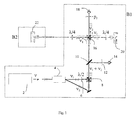
- One example of a known heterodyne interferometer for measuring the displacement between two satellites (B1, B2) separated by a distance d is shown in Figure 1 .
- the interferometer is fed by a laser beam which is the superposition of two sub-beams with frequencies ⁇ 1 , ⁇ 2 , and crossed linear polarisations.
- the laser beam is generated by a single frequency laser source 2 in combination with a frequency shifter 4 and polarising optics (half wave-plate 6, polarising beam-splitter 8), as shown in Figure 1 .
- Another way to generate such a beam is to use a suitable two-frequency laser source.
- a beam splitter (BS) 10 extracts a small portion of the two sub-beams and a polariser 12 selects the 45° components of the two sub-beams, which being parallel can eventually interfere.
- the two sub-beams are then separated again by a further polarising beam-splitter (PBS 16).
- the sub-beam with frequency ⁇ 2 (reference beam) is sent directly towards a detector 18.
- the sub-beam with frequency ⁇ 1 (measurement beam) travels the path between retro-reflectors 20 22, placed respectively on the satellites B1 and B2, before it arrives at the detector 18 where it interferes with the reference beam.
- phase of the interference signal changes with respect to the phase of the reference beam and this changes according to the displacement between the two satellites.
- the phase of the interference signal at the detector 18, measured against the phase of the interference signal at the detector 14, provides information concerning any variation in distance between the two satellites.
- Known heterodyne interferometers such as that described above, which are used to measure high-resolution (at nanometer level) displacements between two satellites, suffer a major problem when the distance between the satellites becomes so large (as for instance, in the case of satellites flying at distances > ⁇ 1 km) that the power of the reflection of the measurement beam coming back from the satellite B2 is much smaller than the portion of the measurement beam leaking through the PBS 16 and reaching directly the detector 18.
- the PBS 16 should direct towards the retro-reflector 22 forming part of the second body M2 the totality of the sub-beam with frequency ⁇ 1 , in practice (because of physical limitations affecting all polarising beam-splitters) it allows a fraction of this beam to pass straight through to the detector 18. In a very good polarising beam-splitter the fraction of the beam thus allowed to pass through to the detector 18, without being directed to the retro-reflector 22, is around 1:1000. Thus the situation depicted in Figure 2 occurs at the detector 18.
- the fraction (s) of the measurement beam reaching directly the detector 18 without first passing to the second body B2 and being reflected back to the detector 18, is much larger than the fraction (m) of the measurement beam reaching the detector 18 after being reflected from the second body B2.
- This very large local beat note (a sinusoid with frequency
- the presence of the fraction (s) of the measurement beam reaching directly the detector 18 introduces a large amount of optical power to the detector 18, increases the shot noise and decreases consequently the signal-to-noise ratio.
- an optical transponder technique for measuring the displacement of two satellites separated by a long distance.
- a second laser is placed on the second satellite and is locked in phase to the laser beam received from the first satellite.
- the beam of the second laser is then sent back to the first satellite and superimposed on the reference beam at the detector (corresponding to the detector 18 of Figure 1 ), which is typically in the form of a photodiode.
- the power of the measurement beam at reaching the second satellite is effectively amplified before being sent back to the first satellite, rather than merely being reflected.
- the power of the beam received by the detector at the first satellite is increased and, by setting the proper amplification, can exceed the power of the spurious beam leaking through the PBS.
- Such a system is particularly well suited to the situation where the satellite distance is very long (> 100-1000 km), but is also complex as it requires two lasers working simultaneously and locked in phase to each other. For distances ⁇ 100 km, an alternative, simpler system is desirable.
- an interferometer for determining a measure of the distance to an object, comprising:- means for providing a measurement beam; means for directing at least a portion of the measurement beam towards the object; a receiver for receiving a response beam from the object in response to the at least a portion of the measurement beam and for passing the response beam to a detector to form part of an interference signal at the detector; and processing means for determining a measure of the distance to the object in dependence upon the interference signal, characterised in that the interferometer further comprises means for interrupting the measurement beam.
- the measure of the distance is the relative variation in the distance to the object.
- interruption of a signal or beam means providing that for at least one portion of time, referred to as an interruption interval, a characteristic of the signal or beam is changed.
- the change in the characteristic of the signal may be a reduction of the amplitude.
- the measurement beam is an oscillating signal with a characteristic amplitude and frequency, it may be the amplitude of the oscillating signal at the characteristic frequency that is reduced during the interruption interval.
- the amplitude of the signal may be reduced to substantially zero during the interruption interval.
- interruption of a signal occurs by way of suppression of the signal during the interruption interval.
- the interferometer is arranged such that in operation a measurement beam is provided by the providing means and the measurement is subsequently interrupted by the interrupting means.
- the interrupting means may interrupt the measurement beam by performing an operation on the measurement beam, such as filtering or switching the measurement beam.
- the interrupting means may form part of, or affect operation of, the providing means, such that in operation the providing means provides an interrupted measurement beam.
- the interrupting means may interrupt the measurement beam by interrupting operation of the providing means.
- the response beam is a reflection of the measurement beam.
- the measurement beam and the response beam are typically beams of electromagnetic radiation.
- the measurement beam and the reference beam are beams of light in the visible range of frequencies.
- the measurement beam and the reference beam provided by the providing means in operation may comprise a series of pulses or may be continuous.
- the interrupting means may be operated in such a way that at least part of a non-interruption interval of the response beam at the detector coincides with a time when the noise or other extraneous signal is not present at the detector.
- the interrupting means is particularly advantageous in the situation where the noise or other extraneous signal comprises a portion of the measurement beam itself, or is derived from the measurement beam, or from operation of the means for providing the measurement beam.
- appropriate operation of the interrupting means may provide a particularly efficient way of that at least part of a non-interruption interval of the response beam at the detector coincides with a time when the noise or other extraneous signal is not present, or is reduced, at the detector.
- the noise or other extraneous signal may comprise a portion of the measurement beam which has passed to the detector without having first been directed to the object, and thus in operation such a portion of the measurement beam may form part of the interference signal at the detector.
- the interrupting means may be operable to ensure that a non-interruption interval at the detector of the response beam overlaps at least partially with an interruption interval at the detector of that interfering portion of the measurement beam.
- the interruption interval at the detector of the response beam coincides with the non-interruption interval at the detector of the interfering portion of the measurement beam.
- the non-interruption interval at the detector of the response beam coincides with the interruption interval at the detector of the portion of the interfering measurement beam.
- the interfering portion of the measurement beam may have leaked through a component of the directing means, for instance a beam splitter, and may be referred to as a leakthrough measurement beam.
- the means for providing a measurement beam may comprise a laser source, the directing means may comprise an arrangement of optical components, the processing means may comprise a processor, and the interrupting means may comprise control circuitry.
- the interrupting means may be configured to interrupt the measurement beam in a periodic cycle.
- each interruption interval takes up half of the respective periodic interruption cycle, and each non-interruption interval takes up the other half of the respective periodic interruption cycle.
- the interferometer preferably comprises control means for controlling the interruption of the measurement beam in dependence upon the distance to the object.
- the arrival time of the response beam at the detector usually depends on the distance to the object, and so by controlling the timing of the interruption of the measurement beam in dependence upon the distance to the object an efficient way of controlling the timing of the presence of the response beam at the detector is provided.
- T h is the round-trip time made up of the time taken for the measurement beam to travel from the interferometer to the object added to the time taken for the response beam to travel from the object to the interferometer
- the round trip time T h may be considered to be the time taken for the measurement beam/response beam to travel over the difference in path length between the path travelled by the measurement beam/response beam to reach the detector and the path travelled by the interfering measurement beam to reach the detector.
- the term substantially equal means within 10% of the value of.
- the period T may be equal to 2. T h / (1 + 2N).
- control means is arranged to control the period ( T ) of the interruption cycle to be substantially equal to double the total T h of the time taken for the measurement beam to travel from the interferometer to the object and the time taken for the response beam to travel from the object to the interferometer.
- the detector is configured to provide a measurement signal representative of the interference signal and the processing means is configured to use the measurement signal in determining the measure of the distance to the object.
- the interferometer further comprises means for maintaining at least one characteristic of the measurement signal during an interruption interval of the response beam at the detector.
- the at least one characteristic is a characteristic of the measurement signal pertaining at a time outside an interruption interval of the response beam at the detector.
- the maintaining means is arranged to maintain the measurement signal to be substantially the same as the measurement signal obtained at a time outside an interruption interval of the response beam at the detector.
- the maintaining means may comprise a phase locked loop arrangement including a voltage controlled oscillator.
- the interferometer may further comprise:- a further detector; and means for directing a portion of the measurement beam to the further detector to form a further interference signal, wherein the further detector is configured to provide a reference signal representative of the further interference signal; and the interferometer further comprises further maintaining mains for maintaining at least one characteristic of the reference signal during an interruption interval of the measurement beam at the further detector.
- the at least one characteristic is a characteristic of the reference signal pertaining during a non-interruption interval of the measurement beam at the further detector.
- the further maintaining means is arranged to maintain the reference signal to be substantially the same as the reference signal pertaining during a non-interruption interval of the measurement beam at the further detector.
- the further maintaining means may comprise a further phase locked loop arrangement including a further voltage controlled oscillator.
- the interferometer comprises means for providing a reference beam, and means for directing the reference beam to the detector to form part of the interference signal.
- the interferometer further comprises means for directing a portion of the reference beam to the further detector to form part of the further interference signal.
- the means for providing a reference beam and the means for providing a measurement beam may be the same, or may have components in common.
- the same laser source may be used in both the means for providing a reference beam and the means for providing a measurement beam.
- the processing means is configured to determine the measure of the distance from the difference between the phase of the interference signal and the phase of the further interference signal.
- the difference between the phase of the interference signal and the phase of the further interference signal is the difference between the phase of the interference signal pertaining at a non-interruption period of the response beam at the detector and the phase of the further interference signal pertaining at a non-interruption period of the measurement beam at the further detector.
- the processing means is configured to determine the measure of the distance to the object by processing together the measurement signal and the reference signal.
- the measure of the distance determined by the interferometer may be the relative variation in the distance to the object.
- the measure of the distance may be the absolute distance to the object.
- the interferometer may further comprise means for measuring the time of flight of a part of the measurement beam from the interferometer to the object and of the corresponding part of the response beam from the object to the interferometer.
- the interrupting mean may be operable to ensure that the measurement beam comprises at least one pulse, and the means for measuring the time of flight may be configured to measure the time of flight of the at least one pulse from the interferometer to the object and of the corresponding at least one response pulse from the object to the interferometer. The absolute distance to the object may then be calculated from the time of flight.
- the measured time of flight and/or calculated absolute distance thus obtained may be used by the control means to determine a suitable value of the period ( T ) of the interruption cycle in order to measure a subsequent variation of the distance to the object.
- At least one of the means for providing the measurement beam and the means for providing the reference beam comprises a laser.
- the measurement beam and the reference beam preferably each comprise a laser signal having a frequency in the range 100 THz to 1000 THz.
- the means for providing the measurement beam and the means for providing the reference beam are preferably configured to provide the measurement beam having a first frequency and the reference beam having a second frequency different from the first frequency.
- the frequency of the measurement beam and the frequency of the reference beam differ by between 10 MHz and 100MHz.
- the directing means may comprise a beam splitter.
- the object may be a satellite.
- the interferometer may form part of a further object, for instance a further satellite.
- the response beam comprises a reflection of the measurement beam by the object, and preferably the object includes reflecting means for reflecting the measurement beam.
- the distance to the object may be less than or equal to 150 km, preferably less than or equal to 100 km, and more preferably less than or equal to 50km.
- the distance to the object may be greater than or equal to 100m, preferably greater than or equal to 1km, and more preferably greater than or equal to 10km.
- Preferably the distance to the object is between 1km and 100km.
- a method of determining a measure of the distance to an object comprising:- providing a measurement beam; directing at least a portion of the measurement beam towards the object; receiving a response beam from the object in response to the at least a portion of the measurement beam and passing the response beam to a detector to form part of an interference signal at the detector; and determining a measure of the distance to the object in dependence upon the interference signal at the detector, characterised in that the method further comprises interrupting the measurement beam.
- the invention provides on/off temporal modulation of a measurement laser beam (sent to a distant body), with a temporal modulation period which is a function of the separation of the bodies, in such a way to avoid the simultaneous presence of the return measurement beam and a spurious fraction of the reference beam on an interferometer detector.
- the interferometer signal is also intermittent. Therefore, in the half of the temporal modulation period in which the measurement beam is not present on the interferometer detector, the information about the relative displacement of the two bodies may be retrieved from a local oscillator which is kept phase locked to the interferometer signal when the measurement beam is present on the detector.
- a heterodyne interferometer using this temporal modulation scheme is also immune from distortion of the beat signal produced by the polarisation mixings. Utilization of a local oscillator phase locked to the interferometer signal (when it is present) may keep track of the relative displacement of the two bodies if an interferometer signal is not present because of the lack of the return measurement beam at the interferometer detector.
- the on/off temporal modulation of the measurement laser beam allows also information about the absolute distance between the two bodies to be obtained, from the measurement of the round-trip time of flight of the modulation pulses. That information concerning the absolute distance (besides being an additional output of the metrology system) may be used in turn to adjust the temporal modulation period of the measurement laser beam as a function of the separation of the bodies.
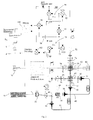
- a heterodyne interferometer system is shown in Figure 3 . All of the components of the system are located on a first satellite, with the exception of a retro-reflector which is located on a second satellite as described in more detail below.
- the system is operable to measure the relative displacement of the second satellite from the first satellite.
- the system includes a laser source 30 aligned with a frequency shifter 32, an amplitude modulation device 34 and coupling optics 36.
- the coupling optics 36 are connected to collimating optics 38 via polarisation-maintaining optical fibre 40.
- the output of the collimating optics 38 is aligned with a polarising beam splitter 42 via a linear polariser 43.
- a control and processing device (not shown) is connected to the amplitude modulation device 34 via amplifier 44, and is configured to control operation of the amplitude modulation device 34.
- the frequency shifter 32 is also aligned with a mirror 46 arranged to direct a part of the laser beam originating at the laser source 30 to coupling optics 48.
- the coupling optics 48 are connected to collimating optics 50 via a polarisation-maintaining optical fibre 52.
- the output of the collimating optics 50 are also aligned with the above-mentioned polarising beam splitter 42, via a linear polariser 51, in a direction orthogonal to the alignment of collimating optics 38.
- the polarising beam splitter 42 is arranged so that radiation entering from the collimating optics 38 or from the collimating optics 50 is directed, in dependence upon its polarisation, either to a further polarising beam splitter 54, or to a reference detector 56 via a linear polariser 58.
- An output of the reference detector 56 is connected, via a bandpass filter, to the control and processing device (not shown) and also to an input of phase locked loop circuitry 70, which includes a voltage controlled oscillator 71.
- the further polarising beam splitter 54 is arranged so that radiation arriving from the polarising beam splitter 42 is directed, in dependence upon its polarisation, either to a detector 72 via a linear polariser 74 or to a retro-reflector 76 located on the second satellite via a quarter-wave plate 78.
- the further polarising beam splitter 54 is also arranged so that radiation reflected back from the retro-reflector 76 via the quarter-wave plate 78 passes through the further polarising beam splitter 54 to a further retro-reflector 80 via a further quarter-wave plate 82. In turn, the radiation reflected back from that further retro-reflector 80 to the further polarising beam splitter 54 is directed by the further polarising beam splitter 54 to the detector 72 via the linear polariser 74.
- An output of the detector 72 is connected via a bandpass filter to the control and processing device (not shown) and is also to an input of further phase locked loop circuitry 90, which includes a voltage controlled oscillator 92.
- phase locked loop circuitry 70 and the output of the further phase locked loop circuitry 90 are both connected to a two-phase detector 94.
- the output of the phase locked loop circuitry 70 and the output of the further phase locked loop circuitry are also both connected to a further two-phase detector 96.
- the output of the phase locked loop circuitry is connected to the further two-phase detector 96 via a phase shifter 98 which is arranged to introduce a phase delay of 90°.
- the output of the two-phase detector 94 and the output of the further two-phase detector 96 are each connected to a respective input of a phase comparator 100.
- the output of the phase comparator 100 is connected to the control and processing device (not shown).
- the control and processing device is configured to carry out a linearisation procedure to linearise the output of the phase comparator 100.
- the linearised output is used by the control and processing device to determine the relative displacement of the first and second satellites.
- the control and processing device is also configured to perform differentiation procedures to determine the relative velocity and relative acceleration of the first and second satellites.
- the heterodyne interferometer is configured to measure the relative variation in distance between the retro-reflectors 76 80 (placed on the first and second satellites respectively, or on any two distinct bodies in general in variants of the preferred embodiment) and also to measure the absolute distance between the retro-reflectors 76 80.
- the preferred mode of operation of the interferometer is now described.
- the laser source 30 emits a beam with frequency ⁇ 1 and with a linear polarisation status (in this case a vertical polarisation).
- the zero order beam emitted by the frequency shifter 32 is the measurement beam.
- the two linearly polarised beams (the measurement beam and the reference beam) are separately brought to the interferometer optical system (constituted by the polarising beam-splitters 42 54, the linear polarisers 43 51 58 74, and the quarter-wave plates 78 82) by means of the two polarisation maintaining fibres 40 52, endowed at each end with coupling optics 36 48 or collimating optics 38 50.
- the interferometer optical system constituted by the polarising beam-splitters 42 54, the linear polarisers 43 51 58 74, and the quarter-wave plates 78 82
- the measurement beam is routed to the polarising beam splitter 42 of the interferometer optical system via the amplitude modulation device 34, the coupling optics 36, the collimating optics 38, the polarisation maintaining optical fibre 40, and the linear polariser 43.
- the operation of the amplitude modulation device 34 which is located between the laser source 30 and the interferometer optical system as described above, enables the periodic interruption of the measurement beam.
- the amplitude modulation device 34 is constituted by an electro-optic voltage-variable waveplate which, in operation, rotates through 90° the polarisation (from vertical to horizontal) of the measurement beam under a given applied voltage.
- the given applied voltage is applied periodically to the amplitude modulation device 34 under the control of the control and processing means, so that the polarisation of the measurement beam leaving the amplitude modulator 34 alternates periodically between a horizontal polarisation and a vertical polarisation.
- the measurement beam Upon the measurement beam reaching the linear polariser 43, those portions of the measurement beam with a horizontal polarisation introduced by the amplitude modulation device 34 cannot pass through, whereas those portions of the measurement beam with a vertical polarisation, unchanged by the amplitude modulation device, are allowed to pass through.
- the measurement beam upon exiting the linear polariser 43, the measurement beam is temporally modulated in an on-off fashion, with the measurement beam being substantially zero during the interruption times.
- the reference beam is routed to the polarising beam splitter 42 the interferometer optical system via the coupling optics 48, the polarisation maintaining optical fibre 52, the collimator 50, and the linear polariser 51.
- the polarisation maintaining optical fibre 52 carrying the reference beam is twisted by 90° so that the reference beam arrives at the polarising beam splitter 42 with a horizontal linear polarisation (indicated by the symbol
- the reference beam passes straight through the polarising beam splitter 42 and then straight through the further polarising beam splitter 54 and follows a straight path to the detector 72. However, a portion of the reference beam leaks through the polarising beam splitter 42 and passes to the reference detector 56 rather than to the detector 72.
- the major portion of the measurement beam is directed by the polarising beam splitter 42 to the further polarising beam splitter 54.
- a portion of the measurement beam also leaks through the polarising beam splitter 42 and passes to the reference detector 56 rather than being directed to the further polarising beam splitter 54.
- the major portion of the measurement beam arriving at the further polarising beam splitter 54 from the polarising beam splitter 42 is directed by the further polarising beam splitter 54 to the retro-reflector 76 located on the second satellite and is reflected back as a response beam.
- the response beam passes back to the further polarising beam splitter 54 located on the first satellite and passes through the further polarising beam splitter 54 to the retro-reflector 80 forming part of the interferometer optical system on the first satellite.
- the response beam is then reflected back by the retro-reflector 80 to the further polarising beam splitter 54, and then passes to the detector 72.
- the particular combination of signals which are superimposed at the detector 72 varies with time. It is also the case that the particular combination of signals which are superimposed at the detector 72 at any point in time can be controlled by selection of an appropriate period for the interruption of the measurement beam, taking into account the separation of the retro-reflectors 76 80 on the first and second satellites.
- the period for the interruption of the measurement beam is selected such as to avoid the simultaneous presence at the detector 72 of the response beam (the weak back-reflected measurement beam) and the larger leakthrough measurement beam.
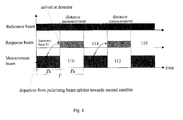
- the amplitude of the reference beam received at the detector 72, the amplitude of the measurement beam at the output of the further polarising beam splitter 54 upon leaving the first satellite and being directed towards the second satellite, and the amplitude of the response beam received at the detector 72 are shown in Figure 4 as a function of time.
- the curved arrows in Figure 4 are used to indicate that the portions of the measurement beam at the output of the further polarising beam splitter 54 at the non-interruption intervals shown 118 120 correspond to the portions of the response beam arising from reflection of those portions of the measurement beam and arriving at the detector 72 at non-interruption intervals 122 124 at times T h later.
- the time T h is the round-trip time for the measurement beam/response beam to travel between the retro-reflectors 76 80.
- the distance from the output of the further polarising beam splitter 54 to the detector 72 (and to the further detector 56) is small compared to the distance from the first satellite to the second satellite.
- the amplitude of the leakthrough measurement beam present at the detector 72 or the amplitude of the portion of the measurement beam present at the further detector 56) were also to be plotted in Figure 4 it would have the same form and variation with time, but lower amplitude, as the measurement beam at the output of the further polarising beam splitter 54 at the intervals shown 110 112 118 120.
- the non-interruption intervals 122 124 of the response beam at the detector 72 coincide with the interruption intervals of the leakthrough measurement beam 110 112 at the detector 72.
- the interruption intervals 110 112 of the measurement beam at the output of the further polarising beam splitter 54 correspond to the interruption intervals 114 116 of the response beam at the detector 72 occurring at times T h later.
- the interruption intervals 114 116 of the response beam at the detector 72 the amplitude of the response beam at the detector 72 is substantially zero.
- the interference signal at the detector 72 is made up primarily of the leakthrough measurement beam and the reference beam.
- the amplitude of the measurement beam at the detector 72 is substantially zero, and the interference signal at the detector 72 is made up primarily of the response beam and the reference beam.
- the relative displacement of the first and second satellites is determined based upon the signals received at the detector 72 during the interruption intervals 110 112 of the leakthrough measurement beam at the detector 72 (which coincide with the non-interruption intervals 122 124 at the detector 72), in comparison with the signals received at the further detector 56 during the non-interruption intervals 118 120 of the measurement beam at the further detector 56.
- effects arising from the leakthrough of the measurement beam can be avoided in the determination of the relative displacements of the satellites.
- the measurement signal from the detector 72 is maintained to have the same form and amplitude during each interruption interval of the response beam at the detector 72, for instance interval 114, as the form and amplitude of the measurement signal obtained during the immediately preceding time interval, for instance interval 110, which is a non-interruption interval of the response beam at the detector 72.
- the reference signal from the further detector 56 is maintained to have the same form and amplitude during each interruption interval of the measurement beam at the further detector 56 as the form and amplitude of the reference signal obtained during the immediately preceding time interval, which is a non-interruption interval of the measurement beam at the further detector 56.
- the reference beam is not subject to any periodic interruption and, consequently, it can be seen that the amplitude of the reference beam received at the detector 72 does not vary with time.
- the two detectors 56 72 transform the received optical interference signals into electronic oscillating output signals, which are the reference signal and measurement signal respectively.
- the oscillating signal of the reference detector 56 referred to as the reference signal
- the oscillating signal for the detector 72 referred to as the measurement signal has frequency
- a narrow band circuit amplifies the signals.
- sample and hold operations are performed by the phase locked loop circuitry to ensure that the output of the VCO 92 is representative of the useful portion of the measurement signal throughout the whole of the cycle, and that the output of the further VCO 71 is representative of the useful portion of the reference signal throughout the whole of the cycle, and thus that the relative displacement can be obtained by performing the phase comparison using the outputs from the VCOs 71 92 at any point in the cycle.
- phase locked loop (PLL) circuitry The structure and operation of the phase locked loop (PLL) circuitry are now considered in more detail.
- the voltage controlled oscillator (VCO) 92 is phase locked (using the PLL circuitry) to the output signal coming from the detector 72 during the half of the cycle in which the amplitude modulated response beam is present on the detector 72.
- a further voltage controlled oscillator (VCO) 71 is phase locked (using PLL circuitry) to the reference detector 56 during the other half of the cycle, in which the amplitude modulated measurement beam is present on the reference detector 56.
- the output of the VCO 92 is representative of the output from the detector 72 during that half of the cycle 122.
- the PLL circuitry forces the VCO 92 to oscillate at a constant frequency and phase, representative of the frequency and phase of the output from the detector 72 during the preceding half of the cycle 122 when the amplitude modulated response beam was present.
- the PLL circuitry performs a sample and hold operation, in which the output of the detector 72 is sampled during one half of the cycle 122 and held during the following half of the cycle 114.
- the output of the further VCO 71 is representative of the output from the reference detector 56 during that half of the cycle 114.
- the PLL circuitry forces the further VCO 71 to oscillate at a constant frequency and phase, representative of the frequency and phase of the output from the reference detector 56 during the preceding half of the cycle 114 when the amplitude modulated measurement beam was present on the further detector 56.
- the PLL circuitry performs a sample and hold operation, in which the output of the reference detector 56 is sampled during one half of the cycle 114 and held during the following half of the cycle 124.
- the relative distance variation measurement scheme of the preferred embodiment described above works most effectively in the presence of an amplitude modulation of the measurement laser beam if the maximum phase change occurring in the period when the response beam is off (two times the round-trip time) is less than ⁇ /2 (i.e. 1/4 of the laser wavelength ⁇ ).
- the VCO oscillates at a constant frequency, which is the modulation frequency ⁇ m corrected by the Doppler effect due to the relative velocity of the objects (satellites). This imposes a limit to the maximum speed changes in time, i.e.
- the interferometer is used primarily to measure the distance variation between satellites (it is used primarily as an incremental metrology system).
- the same interferometer can also be used to measure the absolute distance between satellites (it can be used as an absolute metrology system).
- control and processing device (not shown) is configured to determine the time of flight of a portion of the measurement beam from the interferometer to the retroreflector 76 and the corresponding portion of the response beam reflected back from the retroreflector 76 to the interferometer.
- the amplitude modulation device 34 in the preferred embodiment operates to interrupt the measurement beam periodically. That changes the measurement beam from being continuous to being pulsed in a periodic on/off cycle.
- the distance between the satellites can be obtained by measuring, for each pulse in the cycle, the difference between the time of arrival of the measurement pulse at the reference detector 56 and the time of arrival of the corresponding reflected response pulse at the detector 72.
- each of the detector 72 and the reference detector 56 are connected to a mixer 102.
- the output of the mixer is connected to the control and processing device (not shown).
- the control and processing device includes an absolute metrology module which is configured to process the output of the mixer 102 in order to determine, from the mixed output signals from the reference detector 56 and the detector 72, the difference between the time of arrival of the measurement pulse at the reference detector 56 and the time of arrival of the corresponding reflected response pulse at the detector 72, to give the time of flight of each pulse from the first satellite to the second satellite and back, and thus to determine the absolute distance between the first satellite and the second satellite based upon the known speed of propagation of the pulses.
- the control and processing means is also configured to vary the period of the interruption cycle, by controlling the amplitude modulation device 34, in dependence upon the time of flight of each pulse, representative of the absolute distance between the satellites, which has been determined by the absolute metrology module.
- the absolute distance is measured or estimated using alternative methods, and the interferometer is used only to measure the relative variation of the distance.
Landscapes
- Physics & Mathematics (AREA)
- General Physics & Mathematics (AREA)
- Instruments For Measurement Of Length By Optical Means (AREA)
Priority Applications (2)
| Application Number | Priority Date | Filing Date | Title |
|---|---|---|---|
| PT07300862T PT1970666E (pt) | 2007-03-14 | 2007-03-14 | Interferómetro |
| EP20070300862 EP1970666B8 (fr) | 2007-03-14 | 2007-03-14 | Interféromètre |
Applications Claiming Priority (1)
| Application Number | Priority Date | Filing Date | Title |
|---|---|---|---|
| EP20070300862 EP1970666B8 (fr) | 2007-03-14 | 2007-03-14 | Interféromètre |
Publications (3)
| Publication Number | Publication Date |
|---|---|
| EP1970666A1 true EP1970666A1 (fr) | 2008-09-17 |
| EP1970666B1 EP1970666B1 (fr) | 2012-08-29 |
| EP1970666B8 EP1970666B8 (fr) | 2013-01-09 |
Family
ID=39079627
Family Applications (1)
| Application Number | Title | Priority Date | Filing Date |
|---|---|---|---|
| EP20070300862 Active EP1970666B8 (fr) | 2007-03-14 | 2007-03-14 | Interféromètre |
Country Status (2)
| Country | Link |
|---|---|
| EP (1) | EP1970666B8 (fr) |
| PT (1) | PT1970666E (fr) |
Cited By (3)
| Publication number | Priority date | Publication date | Assignee | Title |
|---|---|---|---|---|
| DE102010062842A1 (de) * | 2010-12-10 | 2012-06-14 | Carl Zeiss Ag | Verfahren und Vorrichtung zur Bestimmung der absoluten Position eines Objekts |
| JP2020512551A (ja) * | 2017-03-22 | 2020-04-23 | エーエスエムエル ネザーランズ ビー.ブイ. | 位置測定システム、ゼロ調整方法、リソグラフィ装置およびデバイス製造方法 |
| CN115955280A (zh) * | 2023-03-13 | 2023-04-11 | 万事通科技(杭州)有限公司 | 一种光纤信道窃听检测装置 |
Families Citing this family (1)
| Publication number | Priority date | Publication date | Assignee | Title |
|---|---|---|---|---|
| CN102419441B (zh) * | 2011-09-01 | 2013-10-02 | 哈尔滨工业大学 | 一种基于四通道探测技术的弱光锁相星间位移测量方法及实现该方法的装置 |
Citations (5)
| Publication number | Priority date | Publication date | Assignee | Title |
|---|---|---|---|---|
| EP0157227A2 (fr) * | 1984-03-16 | 1985-10-09 | Hewlett-Packard Company | Interféromètre |
| DE4029928A1 (de) * | 1990-09-21 | 1992-03-26 | Meier Joachim Dip Ing | Vorrichtung zur vollstaendigen charakterisierung der polarisationseigenschaften von quasi-monochromatischer elektromagnetischer strahlung und verfahren zur kalibrierung der messvorrichtung |
| DE10044690A1 (de) * | 2000-07-04 | 2002-01-17 | Eads Deutschland Gmbh | Verfahren und Vorrichtung zur Messung von Entfernungen und Geschwindigkeiten durch Laserpulse |
| US20020179866A1 (en) * | 2001-04-13 | 2002-12-05 | Frank Hoeller | System and method for determining a position or/and orientation of two objects relative to each other as well as beam guiding arrangement, interferometer arrangement and device for changing an optical path length for use in such a system and method |
| US20050264822A1 (en) * | 2004-05-28 | 2005-12-01 | Bockman John J | Differential interferometer with improved cyclic nonlinearity |
-
2007
- 2007-03-14 EP EP20070300862 patent/EP1970666B8/fr active Active
- 2007-03-14 PT PT07300862T patent/PT1970666E/pt unknown
Patent Citations (5)
| Publication number | Priority date | Publication date | Assignee | Title |
|---|---|---|---|---|
| EP0157227A2 (fr) * | 1984-03-16 | 1985-10-09 | Hewlett-Packard Company | Interféromètre |
| DE4029928A1 (de) * | 1990-09-21 | 1992-03-26 | Meier Joachim Dip Ing | Vorrichtung zur vollstaendigen charakterisierung der polarisationseigenschaften von quasi-monochromatischer elektromagnetischer strahlung und verfahren zur kalibrierung der messvorrichtung |
| DE10044690A1 (de) * | 2000-07-04 | 2002-01-17 | Eads Deutschland Gmbh | Verfahren und Vorrichtung zur Messung von Entfernungen und Geschwindigkeiten durch Laserpulse |
| US20020179866A1 (en) * | 2001-04-13 | 2002-12-05 | Frank Hoeller | System and method for determining a position or/and orientation of two objects relative to each other as well as beam guiding arrangement, interferometer arrangement and device for changing an optical path length for use in such a system and method |
| US20050264822A1 (en) * | 2004-05-28 | 2005-12-01 | Bockman John J | Differential interferometer with improved cyclic nonlinearity |
Cited By (7)
| Publication number | Priority date | Publication date | Assignee | Title |
|---|---|---|---|---|
| DE102010062842A1 (de) * | 2010-12-10 | 2012-06-14 | Carl Zeiss Ag | Verfahren und Vorrichtung zur Bestimmung der absoluten Position eines Objekts |
| DE102010062842B4 (de) * | 2010-12-10 | 2012-08-09 | Carl Zeiss Ag | Verfahren und Vorrichtung zur Bestimmung der absoluten Position eines Objekts |
| DE102010062842B9 (de) * | 2010-12-10 | 2012-08-23 | Carl Zeiss Ag | Verfahren und Vorrichtung zur Bestimmung der absoluten Position eines Objekts |
| JP2020512551A (ja) * | 2017-03-22 | 2020-04-23 | エーエスエムエル ネザーランズ ビー.ブイ. | 位置測定システム、ゼロ調整方法、リソグラフィ装置およびデバイス製造方法 |
| US10883816B2 (en) | 2017-03-22 | 2021-01-05 | Asml Netherlands B.V. | Position measurement system, zeroing method, lithographic apparatus and device manufacturing method |
| JP2021101236A (ja) * | 2017-03-22 | 2021-07-08 | エーエスエムエル ネザーランズ ビー.ブイ. | 位置測定システム、ゼロ調整方法、リソグラフィ装置およびデバイス製造方法 |
| CN115955280A (zh) * | 2023-03-13 | 2023-04-11 | 万事通科技(杭州)有限公司 | 一种光纤信道窃听检测装置 |
Also Published As
| Publication number | Publication date |
|---|---|
| PT1970666E (pt) | 2012-12-10 |
| EP1970666B8 (fr) | 2013-01-09 |
| EP1970666B1 (fr) | 2012-08-29 |
Similar Documents
| Publication | Publication Date | Title |
|---|---|---|
| CA2205937C (fr) | Appareil de mesure electro-optique pour mesurer des distances absolues | |
| US7352446B2 (en) | Absolute distance meter that measures a moving retroreflector | |
| US4846571A (en) | AM-FM laser | |
| EP2329218B1 (fr) | Géométrie compacte à fibre optique pour un radar laser cohérent de type fmcw à modulations de fréquence opposées | |
| AU2009266433B2 (en) | Interferometric distance-measuring method with delayed chirp signal and such an apparatus | |
| US4812035A (en) | AM-FM laser radar | |
| US6014216A (en) | Architecture for air-turbulence-compensated dual-wavelength heterodyne interferometer | |
| GB2241399A (en) | Radar measurement apparatus | |
| CA2337026A1 (fr) | Systeme de mesure de deplacement par laser | |
| AU2006217996B2 (en) | Phase noise compensation for interferometric absolute distance measuring | |
| JPH03170895A (ja) | 光学的距離測定装置 | |
| EP1970666B1 (fr) | Interféromètre | |
| CN111366232A (zh) | 一种全光纤脉冲激光多普勒测振仪及其信号处理方法 | |
| US4995726A (en) | Surface profile measuring device utilizing optical heterodyne interference | |
| US5274436A (en) | Laser interferometer for measuring distance using a frequency difference between two laser beams | |
| JP7720588B2 (ja) | 非接触型測距装置及び方法 | |
| Schmitz et al. | Acousto-optic displacement-measuring interferometer: a new heterodyne interferometer with Ångstrom-level periodic error | |
| US7126695B2 (en) | Heterodyne frequency modulated signal demodulator and method of operating the same | |
| US7436519B2 (en) | System and method for interferometer non-linearity compensation | |
| US11768291B1 (en) | High dynamic range ranging interferometer | |
| US6847455B1 (en) | Heterodyne interferometer with angstrom-level periodic nonlinearity | |
| CN115560680A (zh) | 空间光学组件绝对距离和相对位移融合的测量系统 | |
| PT1989300E (pt) | Estirpe de talaromyces emersonii e utilizações da mesma | |
| JP2509301B2 (ja) | 光波測距装置 | |
| EP1058810B1 (fr) | Appareil et procedes pour la mesure des proprietes optiques intrinseques d'un gaz |
Legal Events
| Date | Code | Title | Description |
|---|---|---|---|
| PUAI | Public reference made under article 153(3) epc to a published international application that has entered the european phase |
Free format text: ORIGINAL CODE: 0009012 |
|
| AK | Designated contracting states |
Kind code of ref document: A1 Designated state(s): AT BE BG CH CY CZ DE DK EE ES FI FR GB GR HU IE IS IT LI LT LU LV MC MT NL PL PT RO SE SI SK TR |
|
| AX | Request for extension of the european patent |
Extension state: AL BA HR MK RS |
|
| 17P | Request for examination filed |
Effective date: 20090213 |
|
| 17Q | First examination report despatched |
Effective date: 20090311 |
|
| AKX | Designation fees paid |
Designated state(s): AT BE BG CH CY CZ DE DK EE ES FI FR GB GR HU IE IS IT LI LT LU LV MC MT NL PL PT RO SE SI SK TR |
|
| GRAP | Despatch of communication of intention to grant a patent |
Free format text: ORIGINAL CODE: EPIDOSNIGR1 |
|
| RAP1 | Party data changed (applicant data changed or rights of an application transferred) |
Owner name: SMITH, BRADFORD LEE Owner name: ALCATEL LUCENT |
|
| GRAS | Grant fee paid |
Free format text: ORIGINAL CODE: EPIDOSNIGR3 |
|
| GRAA | (expected) grant |
Free format text: ORIGINAL CODE: 0009210 |
|
| RAP1 | Party data changed (applicant data changed or rights of an application transferred) |
Owner name: THALES ALENIA SPACE ITALIA S.P.A. Owner name: SMITH, BRADFORD LEE |
|
| AK | Designated contracting states |
Kind code of ref document: B1 Designated state(s): AT BE BG CH CY CZ DE DK EE ES FI FR GB GR HU IE IS IT LI LT LU LV MC MT NL PL PT RO SE SI SK TR |
|
| REG | Reference to a national code |
Ref country code: GB Ref legal event code: FG4D |
|
| REG | Reference to a national code |
Ref country code: CH Ref legal event code: EP |
|
| REG | Reference to a national code |
Ref country code: AT Ref legal event code: REF Ref document number: 573290 Country of ref document: AT Kind code of ref document: T Effective date: 20120915 |
|
| REG | Reference to a national code |
Ref country code: IE Ref legal event code: FG4D |
|
| REG | Reference to a national code |
Ref country code: DE Ref legal event code: R096 Ref document number: 602007025094 Country of ref document: DE Effective date: 20121025 |
|
| RAP2 | Party data changed (patent owner data changed or rights of a patent transferred) |
Owner name: THALES ALENIA SPACE ITALIA S.P.A. |
|
| REG | Reference to a national code |
Ref country code: CH Ref legal event code: NV Representative=s name: MARKS AND CLERK (LUXEMBOURG) LLP, CH |
|
| REG | Reference to a national code |
Ref country code: PT Ref legal event code: SC4A Free format text: AVAILABILITY OF NATIONAL TRANSLATION Effective date: 20121123 |
|
| REG | Reference to a national code |
Ref country code: NL Ref legal event code: T3 |
|
| REG | Reference to a national code |
Ref country code: AT Ref legal event code: MK05 Ref document number: 573290 Country of ref document: AT Kind code of ref document: T Effective date: 20120829 |
|
| REG | Reference to a national code |
Ref country code: LT Ref legal event code: MG4D Effective date: 20120829 |
|
| PG25 | Lapsed in a contracting state [announced via postgrant information from national office to epo] |
Ref country code: FI Free format text: LAPSE BECAUSE OF FAILURE TO SUBMIT A TRANSLATION OF THE DESCRIPTION OR TO PAY THE FEE WITHIN THE PRESCRIBED TIME-LIMIT Effective date: 20120829 Ref country code: LT Free format text: LAPSE BECAUSE OF FAILURE TO SUBMIT A TRANSLATION OF THE DESCRIPTION OR TO PAY THE FEE WITHIN THE PRESCRIBED TIME-LIMIT Effective date: 20120829 Ref country code: AT Free format text: LAPSE BECAUSE OF FAILURE TO SUBMIT A TRANSLATION OF THE DESCRIPTION OR TO PAY THE FEE WITHIN THE PRESCRIBED TIME-LIMIT Effective date: 20120829 Ref country code: IS Free format text: LAPSE BECAUSE OF FAILURE TO SUBMIT A TRANSLATION OF THE DESCRIPTION OR TO PAY THE FEE WITHIN THE PRESCRIBED TIME-LIMIT Effective date: 20121229 Ref country code: CY Free format text: LAPSE BECAUSE OF FAILURE TO SUBMIT A TRANSLATION OF THE DESCRIPTION OR TO PAY THE FEE WITHIN THE PRESCRIBED TIME-LIMIT Effective date: 20120829 |
|
| PG25 | Lapsed in a contracting state [announced via postgrant information from national office to epo] |
Ref country code: BE Free format text: LAPSE BECAUSE OF FAILURE TO SUBMIT A TRANSLATION OF THE DESCRIPTION OR TO PAY THE FEE WITHIN THE PRESCRIBED TIME-LIMIT Effective date: 20120829 Ref country code: SE Free format text: LAPSE BECAUSE OF FAILURE TO SUBMIT A TRANSLATION OF THE DESCRIPTION OR TO PAY THE FEE WITHIN THE PRESCRIBED TIME-LIMIT Effective date: 20120829 Ref country code: SI Free format text: LAPSE BECAUSE OF FAILURE TO SUBMIT A TRANSLATION OF THE DESCRIPTION OR TO PAY THE FEE WITHIN THE PRESCRIBED TIME-LIMIT Effective date: 20120829 Ref country code: LV Free format text: LAPSE BECAUSE OF FAILURE TO SUBMIT A TRANSLATION OF THE DESCRIPTION OR TO PAY THE FEE WITHIN THE PRESCRIBED TIME-LIMIT Effective date: 20120829 Ref country code: GR Free format text: LAPSE BECAUSE OF FAILURE TO SUBMIT A TRANSLATION OF THE DESCRIPTION OR TO PAY THE FEE WITHIN THE PRESCRIBED TIME-LIMIT Effective date: 20121130 |
|
| PG25 | Lapsed in a contracting state [announced via postgrant information from national office to epo] |
Ref country code: DK Free format text: LAPSE BECAUSE OF FAILURE TO SUBMIT A TRANSLATION OF THE DESCRIPTION OR TO PAY THE FEE WITHIN THE PRESCRIBED TIME-LIMIT Effective date: 20120829 Ref country code: RO Free format text: LAPSE BECAUSE OF FAILURE TO SUBMIT A TRANSLATION OF THE DESCRIPTION OR TO PAY THE FEE WITHIN THE PRESCRIBED TIME-LIMIT Effective date: 20120829 Ref country code: ES Free format text: LAPSE BECAUSE OF FAILURE TO SUBMIT A TRANSLATION OF THE DESCRIPTION OR TO PAY THE FEE WITHIN THE PRESCRIBED TIME-LIMIT Effective date: 20121210 Ref country code: CZ Free format text: LAPSE BECAUSE OF FAILURE TO SUBMIT A TRANSLATION OF THE DESCRIPTION OR TO PAY THE FEE WITHIN THE PRESCRIBED TIME-LIMIT Effective date: 20120829 Ref country code: EE Free format text: LAPSE BECAUSE OF FAILURE TO SUBMIT A TRANSLATION OF THE DESCRIPTION OR TO PAY THE FEE WITHIN THE PRESCRIBED TIME-LIMIT Effective date: 20120829 |
|
| PG25 | Lapsed in a contracting state [announced via postgrant information from national office to epo] |
Ref country code: PL Free format text: LAPSE BECAUSE OF FAILURE TO SUBMIT A TRANSLATION OF THE DESCRIPTION OR TO PAY THE FEE WITHIN THE PRESCRIBED TIME-LIMIT Effective date: 20120829 Ref country code: SK Free format text: LAPSE BECAUSE OF FAILURE TO SUBMIT A TRANSLATION OF THE DESCRIPTION OR TO PAY THE FEE WITHIN THE PRESCRIBED TIME-LIMIT Effective date: 20120829 |
|
| PLBE | No opposition filed within time limit |
Free format text: ORIGINAL CODE: 0009261 |
|
| STAA | Information on the status of an ep patent application or granted ep patent |
Free format text: STATUS: NO OPPOSITION FILED WITHIN TIME LIMIT |
|
| PG25 | Lapsed in a contracting state [announced via postgrant information from national office to epo] |
Ref country code: BG Free format text: LAPSE BECAUSE OF FAILURE TO SUBMIT A TRANSLATION OF THE DESCRIPTION OR TO PAY THE FEE WITHIN THE PRESCRIBED TIME-LIMIT Effective date: 20121129 |
|
| 26N | No opposition filed |
Effective date: 20130530 |
|
| REG | Reference to a national code |
Ref country code: DE Ref legal event code: R097 Ref document number: 602007025094 Country of ref document: DE Effective date: 20130530 |
|
| PG25 | Lapsed in a contracting state [announced via postgrant information from national office to epo] |
Ref country code: MC Free format text: LAPSE BECAUSE OF NON-PAYMENT OF DUE FEES Effective date: 20130331 |
|
| REG | Reference to a national code |
Ref country code: IE Ref legal event code: MM4A |
|
| PG25 | Lapsed in a contracting state [announced via postgrant information from national office to epo] |
Ref country code: IE Free format text: LAPSE BECAUSE OF NON-PAYMENT OF DUE FEES Effective date: 20130314 |
|
| PG25 | Lapsed in a contracting state [announced via postgrant information from national office to epo] |
Ref country code: MT Free format text: LAPSE BECAUSE OF FAILURE TO SUBMIT A TRANSLATION OF THE DESCRIPTION OR TO PAY THE FEE WITHIN THE PRESCRIBED TIME-LIMIT Effective date: 20120829 |
|
| PG25 | Lapsed in a contracting state [announced via postgrant information from national office to epo] |
Ref country code: TR Free format text: LAPSE BECAUSE OF FAILURE TO SUBMIT A TRANSLATION OF THE DESCRIPTION OR TO PAY THE FEE WITHIN THE PRESCRIBED TIME-LIMIT Effective date: 20120829 |
|
| PG25 | Lapsed in a contracting state [announced via postgrant information from national office to epo] |
Ref country code: HU Free format text: LAPSE BECAUSE OF FAILURE TO SUBMIT A TRANSLATION OF THE DESCRIPTION OR TO PAY THE FEE WITHIN THE PRESCRIBED TIME-LIMIT; INVALID AB INITIO Effective date: 20070314 Ref country code: LU Free format text: LAPSE BECAUSE OF NON-PAYMENT OF DUE FEES Effective date: 20130314 |
|
| REG | Reference to a national code |
Ref country code: FR Ref legal event code: PLFP Year of fee payment: 10 |
|
| REG | Reference to a national code |
Ref country code: FR Ref legal event code: PLFP Year of fee payment: 11 |
|
| REG | Reference to a national code |
Ref country code: FR Ref legal event code: PLFP Year of fee payment: 12 |
|
| PGFP | Annual fee paid to national office [announced via postgrant information from national office to epo] |
Ref country code: PT Payment date: 20190312 Year of fee payment: 13 |
|
| PG25 | Lapsed in a contracting state [announced via postgrant information from national office to epo] |
Ref country code: PT Free format text: LAPSE BECAUSE OF NON-PAYMENT OF DUE FEES Effective date: 20200914 |
|
| REG | Reference to a national code |
Ref country code: CH Ref legal event code: PL |
|
| PG25 | Lapsed in a contracting state [announced via postgrant information from national office to epo] |
Ref country code: LI Free format text: LAPSE BECAUSE OF NON-PAYMENT OF DUE FEES Effective date: 20200331 Ref country code: CH Free format text: LAPSE BECAUSE OF NON-PAYMENT OF DUE FEES Effective date: 20200331 |
|
| PGFP | Annual fee paid to national office [announced via postgrant information from national office to epo] |
Ref country code: IT Payment date: 20240227 Year of fee payment: 18 |
|
| PGFP | Annual fee paid to national office [announced via postgrant information from national office to epo] |
Ref country code: NL Payment date: 20250227 Year of fee payment: 19 |
|
| PGFP | Annual fee paid to national office [announced via postgrant information from national office to epo] |
Ref country code: DE Payment date: 20250218 Year of fee payment: 19 |
|
| PGFP | Annual fee paid to national office [announced via postgrant information from national office to epo] |
Ref country code: FR Payment date: 20250224 Year of fee payment: 19 |
|
| PGFP | Annual fee paid to national office [announced via postgrant information from national office to epo] |
Ref country code: GB Payment date: 20250213 Year of fee payment: 19 |
|
| PG25 | Lapsed in a contracting state [announced via postgrant information from national office to epo] |
Ref country code: IT Free format text: LAPSE BECAUSE OF NON-PAYMENT OF DUE FEES Effective date: 20250314 |