EP1971071A2 - Dispositif de chiffrage doté d'un bloc de chiffrage à plusieurs étapes - Google Patents
Dispositif de chiffrage doté d'un bloc de chiffrage à plusieurs étapes Download PDFInfo
- Publication number
- EP1971071A2 EP1971071A2 EP08003316A EP08003316A EP1971071A2 EP 1971071 A2 EP1971071 A2 EP 1971071A2 EP 08003316 A EP08003316 A EP 08003316A EP 08003316 A EP08003316 A EP 08003316A EP 1971071 A2 EP1971071 A2 EP 1971071A2
- Authority
- EP
- European Patent Office
- Prior art keywords
- encryption
- data word
- word
- unit
- output
- Prior art date
- Legal status (The legal status is an assumption and is not a legal conclusion. Google has not performed a legal analysis and makes no representation as to the accuracy of the status listed.)
- Withdrawn
Links
Images



Classifications
-
- G—PHYSICS
- G09—EDUCATION; CRYPTOGRAPHY; DISPLAY; ADVERTISING; SEALS
- G09C—CIPHERING OR DECIPHERING APPARATUS FOR CRYPTOGRAPHIC OR OTHER PURPOSES INVOLVING THE NEED FOR SECRECY
- G09C1/00—Apparatus or methods whereby a given sequence of signs, e.g. an intelligible text, is transformed into an unintelligible sequence of signs by transposing the signs or groups of signs or by replacing them by others according to a predetermined system
-
- H—ELECTRICITY
- H04—ELECTRIC COMMUNICATION TECHNIQUE
- H04L—TRANSMISSION OF DIGITAL INFORMATION, e.g. TELEGRAPHIC COMMUNICATION
- H04L9/00—Cryptographic mechanisms or cryptographic arrangements for secret or secure communications; Network security protocols
- H04L9/06—Cryptographic mechanisms or cryptographic arrangements for secret or secure communications; Network security protocols the encryption apparatus using shift registers or memories for block-wise or stream coding, e.g. DES systems or RC4; Hash functions; Pseudorandom sequence generators
- H04L9/0618—Block ciphers, i.e. encrypting groups of characters of a plain text message using fixed encryption transformation
- H04L9/0625—Block ciphers, i.e. encrypting groups of characters of a plain text message using fixed encryption transformation with splitting of the data block into left and right halves, e.g. Feistel based algorithms, DES, FEAL, IDEA or KASUMI
-
- H—ELECTRICITY
- H04—ELECTRIC COMMUNICATION TECHNIQUE
- H04L—TRANSMISSION OF DIGITAL INFORMATION, e.g. TELEGRAPHIC COMMUNICATION
- H04L9/00—Cryptographic mechanisms or cryptographic arrangements for secret or secure communications; Network security protocols
- H04L9/06—Cryptographic mechanisms or cryptographic arrangements for secret or secure communications; Network security protocols the encryption apparatus using shift registers or memories for block-wise or stream coding, e.g. DES systems or RC4; Hash functions; Pseudorandom sequence generators
- H04L9/0618—Block ciphers, i.e. encrypting groups of characters of a plain text message using fixed encryption transformation
- H04L9/0631—Substitution permutation network [SPN], i.e. cipher composed of a number of stages or rounds each involving linear and nonlinear transformations, e.g. AES algorithms
-
- H—ELECTRICITY
- H04—ELECTRIC COMMUNICATION TECHNIQUE
- H04L—TRANSMISSION OF DIGITAL INFORMATION, e.g. TELEGRAPHIC COMMUNICATION
- H04L2209/00—Additional information or applications relating to cryptographic mechanisms or cryptographic arrangements for secret or secure communication H04L9/00
- H04L2209/12—Details relating to cryptographic hardware or logic circuitry
- H04L2209/125—Parallelization or pipelining, e.g. for accelerating processing of cryptographic operations
Definitions
- the invention relates to an encryption device.
- the encryption and decryption of digital data is gaining importance in the transmission of digital audio and video data over public networks.
- audio and image data are also encrypted on data carriers (CD, DVD, etc.).
- the encryption and, most importantly, the decryption of the data is normally done by means of a specially developed circuit, which may for example be implemented in an ASIC. Due to technical advancements, however, it is increasingly possible to realize such encryption and decryption in real-time in a commercially available PC, which also increases the risk of misuse.
- a basic encryption method which includes non-linear encryption operations and which is reversible by a suitable combination of these non-linear operations with linear operations is described, for example, in US Pat US 3,798,359 (Feistel ). Further encryption methods are described, for example, in US Pat WO 2006/033103 , of the US 2005/0111659 or the EP 1 398 901 A1 ,
- the object of the present invention is to provide an encryption device which is unattractive for an abusive implementation on a PC, but which as an application-specific circuit (ASIC) is space-saving and ensures fast encryption.
- ASIC application-specific circuit
- the encryption device comprises an encryption unit having an input for supplying an input data word, an output for providing an encrypted output data word and at least one encryption block.
- This at least one encryption block comprises a plurality of encryption stages connected in series between the input and the output, each having a plurality of logic blocks connected in parallel, logic blocks of a first encryption stage being supplied with data bits of the input data word or data bits dependent on these data bits of the input data word and logic blocks of further encryption stages being data bits of an output data word a preceding encryption level or supplied by these data bits of the output data word dependent data bits.
- the logic blocks may in particular be designed such that they map input data bits supplied to them to output data bits by means of a completely minimized Boolean operation.
- the individual logic blocks of the encryption unit apply so-called single-bit operations to the respective input data bits supplied to them.
- Such single-bit operations are expensive for a CPU of a commercially available PC, since such CPUs are usually designed for processing a whole or even for processing a plurality of long bytes of data words.
- the amount of computation required to replicate an encryption method that can be carried out using the encryption device on a PC increases as a result of the number of encryption stages connected in series, each with a plurality of logic blocks.
- ASIC application specific hardwired circuit
- the encryption device can be implemented with little space and is capable of performing single-bit operations, for example for video playback, in real time.
- the individual encryption stages can each have the same number of logic blocks or also different numbers of logic blocks, wherein the individual logic blocks can in particular be realized identically.
- the encryption unit has a plurality of encryption blocks connected in parallel, each of which is supplied with at least a portion of the input data word or data bits which depend on at least one part of the input data word.
- FIG. 1 shows an embodiment of an encryption unit 100 for encrypting an input data word X and for providing an encrypted output data word Y.
- This encryption unit 100 can be combined with other encryption units in a manner yet to be explained, but can also be used on its own as an encryption device.
- the illustrated encryption unit 100 has an encryption block 10 with a plurality of ciphering stages 1 1 , 1 2 , 1 d connected in series.
- the individual encryption levels 1 1, 1 2, 1 d have in each case several parallel-connected logic blocks 2 ... 1,1 2 1, w 2 ... 2,1 2 2, w 2 d, 1 ... 2 d , w .
- the number of logic blocks per encryption level can be In this case, for all encryption levels 1 1 , 1 2 , 1 d be the same, but the individual encryption levels 1 1 , 1 2 , 1 d can also differ with respect to the number of logic blocks.
- the reference numeral 1 below denotes any one of these encryption stages, and the reference numeral 2 designates any one of these logic blocks below when no reference to a specific encryption stage or logic block is required for purposes of explanation.
- each of the individual logic blocks 2 is supplied with m input data bits and that the logic blocks 2 generate from these m input data bits each n output data bits by applying logical operations to the input data bits.
- the logical operations applied by the logic blocks 2 to the input data bits are, for example, completely minimized Boolean operations, ie these operations can not be further simplified or minimized by means of the Boolean algebra.
- the individual logic blocks 2 can be realized identically, but can also differ from one another and can in particular also differ by the number of their inputs and the number of their outputs.
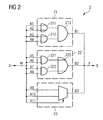
- FIG. 2 An embodiment of a logic block 2 is shown in FIG. 2 shown.
- the illustrated logic block 2 comprises three sub-blocks 21, 22, 23, of which a first and a second sub-block 21, 22 each have four inputs and a third sub-block 23 has three inputs.
- the data bits A1-A11 of the input word A are unambiguously assigned to the sub-blocks, ie each of the data bits is supplied to exactly one of the inputs of the logic block 2.
- NAND here denotes a NAND link
- OR denotes an OR link
- NOR here denotes a NOR operation while AND designates an AND operation.
- the second sub-block 22 comprises a two-input NOR gate 223, preceded by two AND gates 221, 222.
- the third sub-block 23 comprises in the illustrated example an inverting multiplexer to which a first and a second data bit A9, A10 are supplied as input bits and a third data bit A11 as a selection bit.
- An output bit B3 of this multiplexer 23 corresponds to the inverted first input bit A9 or the inverted second input bit A10 depending on the third data bit A11.
- B ⁇ 3 MUX INV A ⁇ 9 .
- INV A ⁇ 10 A ⁇ 11
- INV (.) Denotes an inversion operation
- MUX (x, y: z) generally designates a multiplexing operation in which is selected according to the data bit z of one of the two data bits x, y.
- the logic operations performed by the sub-blocks 21, 22, 23 of the logic block 2 are each completely minimized Boolean operations. Each of these operations has in common that they have a favorable ratio between the required hardware area and a number of CPU processing cycles required to replicate in software. Common to these sub-blocks is that they can be implemented in hardware with little space, while based on the space required, many processing cycles in a software implementation are required.
- An encryption block 10 with logic blocks 2 of in FIG. 2 can be implemented as an application-specific circuit (ASIC) simple and space-saving and allows fast encryption of the input data word X for the provision of the output data word Y. Such an encryption block 10 can be using a conventional CPU and a software program but only consuming and thus comparatively mimic, which makes spying on the encryption algorithm used by the device more difficult.
- ASIC application-specific circuit
- FIG. 2 represented logic block 2 is merely to be regarded as an example of applicable in connection with the invention logic blocks.
- NAND gates and NOR gates also have a favorable ratio between the required hardware area and the number of CPU cycles required for replication.
- the individual logic blocks 2 can each be constructed identically.
- the first encryption stage 1 1 is preceded by an imaging circuit 3 0 , which is the input data word X supplied and the data bits of the input data word X to the inputs of the logic blocks of the first encryption level 1 1 supplies.
- This mapping unit 30 has a number of inputs corresponding to the word width i of the input data word X and a number of outputs corresponding to the number of inputs of the first encryption stage 1 1 .
- the number of inputs of the first encryption stage 1 1 corresponds to the sum of all inputs of the logic blocks 2 1,1 ... 2 1, w of the first encryption level 1 1 .
- the data width i of the input word X is smaller than the number of inputs of the first encryption stage 1 1 , so that individual data bits of the input data word X are supplied to a plurality of inputs of the first encryption stage 1 1 .
- mapping units 3 1 , 3 2 ,..., 3 d-1 are arranged, via which outputs of an encryption stage are connected to inputs of the respective subsequent encryption stage, or map the output bits of an encryption level on input bits of a subsequent encryption level.
- the number of inputs of an imaging unit corresponds to the sum of the outputs of the respectively upstream encryption stage
- the number of outputs of an imaging unit corresponds to the sum of all inputs of a respectively downstream encryption unit.
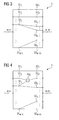
- FIG. 3 schematically shows an embodiment of such an imaging unit 3.
- the illustrated imaging unit is realized as a pure wiring structure and has inputs 31 1 ... 31 w ⁇ n for supplying output bits of the upstream encryption level and outputs 32 1 ... 32 w ⁇ m to provide Input bits for the subsequent encryption level.
- the inputs and outputs are connected to each other here by line connections, wherein an input may be connected to a plurality of outputs in order to achieve an expansion, that is, to generate more output bits than input bits are supplied.
- 31 j is in FIG. 3 denotes such an input, which is connected to more than one output 32 k , 32 1 of the imaging unit 3.
- the imaging unit 3 is advantageously implemented so that each input is connected to at least one of the outputs.
- FIG. 4 shows an embodiment of an imaging unit 3 having logic gates 33 2 between the inputs and the outputs shown in FIG. 4 exemplified by an XOR gate.
- this mapping unit 3 two or more input bits are respectively linked by a logic gate and thereby mapped onto an output bit of the mapping unit 3.
- the logic gates in this mapping unit 3 between individual inputs and outputs also be provided pure wiring.
- there are input data bits of an encryption stage which are not identical to output data bits of a previous encryption stage, but which depend on logic operations from these output data bits.
- a further mapping unit 3 d is provided, which is the last encryption level 1 d downstream and the output bits of this last encryption level 1 d, the encrypted output data word Y with a word width o provides.
- the word width o of the output data word Y can hereby be smaller than the number of output bits of the last encryption stage 1 d .
- the mapping unit 3 d is in this case either realized so that not all output bits of the last encryption level 1 d are mapped to the output data word Y, or that according to the embodiment in FIG. 4 in each case a plurality of output bits of the last encryption stage 1 d are linked to one another by a logic operation, thereby to provide a data bit for the output data word Y in each case.
- FIG. 1 is shown in dashed lines, can also be provided in the encryption block 10, individual data bits that are available at the output of one of the imaging units 3 0 ... 3 d , bypassing the logic blocks of an encryption level directly to the subsequent encryption level or the subsequent encryption level forward the preceding imaging unit.
- individual data bits not just an encryption level (as in FIG. 1 ) but also to "skip" two or more encryption levels or to bypass more than one encryption level.
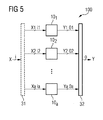
- FIG. 5 shows a further embodiment of an encryption unit 100 for generating an encrypted output data word Y of a word width o from an input data word of the word width i.
- This encryption unit 100 has a plurality of, in the example, three encryption blocks 10 1 , 10 2 , 10 a connected in parallel in the example. It should be understood that the invention is, of course, not limited to the use of three parallel scrambling blocks, but rather that as indicated by the dots in FIG. 5 indicated - any number of encryption blocks can be connected in parallel.
- the encryption blocks 10 1 , 10 2 , 10 a each comprise a plurality of encryption stages connected in series, each encryption stage having a plurality of logic blocks connected in parallel.
- the individual encryption blocks 10 1 , 10 2 , 10 a are each input data words X1, X2, Xa supplied with a word width i1, i2, ia, each of these input data words X1, X2, Xa at least part of the encryption unit 100 supplied input data word X represents.
- these input data words X1, X2, Xa of the encryption blocks 10 1 , 10 2 , 10 a are only partial data words of the input word X.
- these partial data words are generated by an imaging unit 31 from the input data word X.
- This imaging unit may, for example, according to the in the Figures 3 or 4 be realized illustrated imaging units.
- On the encryption blocks 10 1 ... 10 a upstream imaging unit can then be dispensed with.
- one or more encryption blocks, the complete input data word X and one or more to supply only a part of the input data word to several further Verschihrungungsblöcken.
- Output data words Y1, Y2, Ya with a word length o1, o2, oa are available at the outputs of the encryption blocks 10 1 , 10 2 ,..., 10 a, which are mapped by means of a further mapping unit 32 to the output data word Y of the word width o become.
- the word width of the output data words Y1, Y2, Ya of the encryption blocks 10 1 , 10 2 , 10 a corresponds to the word width o of the output data word Y and that the mapping unit 32 performs a bitwise XOR operation of the output data words Y1, Y2, Ya to generate the output data word Y.
- any further mapping or linking operations can be carried out in order to map the output data words Y1, Y2, Ya of the encryption blocks to the output data word Y available at the output of the encryption unit.
- the encryption unit 100 suffices with the at least one multi-level encryption block in order to achieve encryption of a data word.
- the encryption unit 100 can also be combined with other encryption units.
- An embodiment of an encryption device having such an encryption unit 100 and a further encryption unit 201 is shown in FIG FIG. 6 shown.
- the encryption device shown combines encryption of a data word Z using a key RK with an encryption unit 100 having at least one multi-level encryption block.
- An input data word X supplied to the encryption unit 100 is available at the output of an XOR gate 201, the bitwise data bits of a data word Z associated with key bits of a key RK.
- the word length of the data word Z in this case corresponds to the key length of the key RK and the word length i of the input data word X of the encryption unit 100. If the word length of the data word Z does not correspond to the key length, the XOR gate can be preceded by an expansion unit (not shown) consisting of the data word Z generates a data word with a word length corresponding to the key length.
- the encryption device illustrated maps the data word Z using the key RK and the encryption unit 100 to the output data word Y of the word length o.
- This encryption can be done several times consecutively, resulting in FIG. 6 is shown by a dot-dashed feedback loop from the output of the mapping unit 100 to the input of the XOR gate 201.
- the key RK which is generated by a key generator (not shown), can change here with each pass of the encryption device or with each round.
- Encryption devices or encryption algorithms, in which an encryption level is traversed several times, are well known, so that it is possible to dispense with further statements on additionally required circuit components which permit such a multiple traversal.
- An encryption algorithm in which an encryption level is traversed multiple times in succession using a changing key is, for example, the DES algorithm.
- the operation performed by the XOR gate 201 for combining the data word Z (or an expanded data word generated from the data word Z) with the key RK is a linear operation. However, instead of such a linear operation, any nonlinear linking operation may be used (not shown).
- the encryption of the data word Z by means of the key RK can be a linear or a non-linear operation.
- the encryption of the data word X by the encryption unit 100 is always a non-linear operation in the illustrated examples and as such is not reversible, but could also be implemented as a linear (time-consuming for a software realization) structure.
- a reversibility ie a decrypting of a previously encrypted data word, can be achieved.
- This Feistel structure is supplied with a data word W of length 2i, which is divided into two partial data words LW, RW respectively of the word width i and from which a first partial data word RW is supplied to the encryption arrangement with the XOR gate 201 and the encryption unit 100 is.
- a data word Y available at the output of this encryption arrangement is fed to a linear operator 202 which linearly links the second partial data word LWW to this output data word Y.
- An output data word of this Feistel structure is composed of two partial data words LV, RV, of which a first partial data word LV corresponds to the first partial data word RW of the input word W and of which a second partial data word RV that at the output of the linear Operators available data word RV corresponds.
- the encryption unit 100 may in this case be selected such that the word width o of the output data word Y corresponds to the word width i of the input data word or to the word width i of the second partial data word LW.
- the linear operator can also be preceded by an expander or a compressor (not shown), which adjusts the word width o of the output data word Y to the word width of the second sub-data word.
- the linear operator 202 is for example an XOR operator, which is the output data word Y of the encryption unit 100 bitwise associated with the second partial data word LW of the input word W, but may also be any other linear operator.
- the encrypted data word V generated by the illustrated Feistel structure with a word width 2i, which is composed of the partial data words LV, RV, can be represented by a in FIG. 7 Decrypt the inverse Feistel structure shown.
- This inverse Feistel structure contains in a branch, to which the first partial data word LV of the encrypted data word V is fed, an arrangement which is identical to the encryption arrangement in the Feistel structure used for encryption ( FIG. 6 ).
- the Feistel structure used for decryption thus comprises a linear operator 201 in FIG FIG. 6 corresponding linear operator 201 'and one of the encryption unit 100 in FIG FIG. 6 corresponding encryption unit 100 '.
- the round keys used for the encryption are corresponding, but to be applied in the reverse order.
- One of the encryption unit 100 'of the Feistel structure in FIG. 7 Downstream linear operator 202 'has one to the function of linear operator 202 in FIG FIG. 6 inverse function.
- a partial data word LZ available at the output of this linear operator 202 ' corresponds to the second partial data word LW of the structure according to FIG FIG. 6 encrypted data word W.
- a second partial data word RZ of one at the output of the structure according to FIG. 7 available data word Z corresponds to the first partial data word RW by the structure in FIG. 6 encrypted data word W.
- FIG. 8 shows another embodiment of an encryption device having an encryption unit 100 with at least one multi-level encryption block.
- the encryption effected by the encryption unit 100 is combined in this embodiment with encryption using a key RK and an encryption performed by a substitution and permutation unit 40.
- a data word Z to be encrypted is here supplied to the substitution and permutation unit 40, which generates at an output a first encrypted data word Z 'of a word width i.
- This first encrypted data word Z ' is further encrypted using the key RK to provide the input data word x of the word width i of the encryption unit 100.
- the substitution and permutation unit, the key encryption unit 201, and the multi-level encryption unit 100 are sequentially arranged in this embodiment.
- any other logic unit for generating the data word Z 'from the input data word Z can be provided.
- the substitution and permutation unit shown has, for example, two substitution stages 42, 44 and a permutation stage 43 arranged between the two substitution stages.
- the two substitution stages 42, 44 each include a number of parallel-connected substitution blocks 42 1 ... 42 u and 441... 44 u .
- the S-boxes assign an input data word to each input data word.
- the basis for this assignment is, for example, a look-up table, which is converted into a logic structure.
- the first substitution unit 42 At the output of the first substitution unit 42 is a data word available whose data length corresponds to the product of the number of S-boxes 42 1 ... 42 u and the number b of the outputs of the individual S-boxes 42 1 ... 42 u .
- This data word is fed to the permutation unit 43, which generates a data word of corresponding length by interchanging individual data bits of the data word supplied to it.
- the data word generated by the permutation unit 43 is supplied to the further substitution unit 44 which has a number of S boxes connected in parallel to the number of S boxes of the first substitution unit 42, each having b inputs and b outputs.
- the first encrypted data word Z 'of the word width i At the output of the second substitution unit 44, the first encrypted data word Z 'of the word width i is available.
- the word width i corresponds to the product of the number of S-boxes 44 1 ... 44 u of the second substitution unit 44 and the number b of the outputs
- an expansion unit 41 is optionally provided which, for example, a data bit of the input word Z to multiple inputs of the first substitution unit 42 images.
- a compressor may be provided between the encryption unit 100 and the linear operator (202 in FIG. 8 ).
- a further substitution and / or permutation unit can be provided.
- FIG. 9 shows a modification of the in FIG. 8 illustrated encryption arrangement.
- the encryption unit 100 within the encryption arrangement is part of a Feistel structure.
- this encryption unit 100 is supplied only with a first partial data word RX of the input data word X.
- An output data word RY of the encryption unit is in this case linked by a linear operator 203, for example an XOR operator, with a second partial data word LX of the input data word.
- the two partial data words LX, RX in this case have a same word length i / 2.
- An output data word Y is composed in this arrangement from the first partial data word RX and an output of the linear operator available partial data word.
- the described encryption unit 100 with the at least one multi-level encryption block is suitable for the encryption of data bits in the manner explained. Is the unit 100 as in FIG. 6 incorporated into a Feistel structure, the input data words of length 128 bits are supplied, the encryption unit 100 is for example realized so that it processes data words of 64 bits in length.
- the key RK also has 100 key bits in this case.
- the described encryption unit with at least one multi-level encryption block is also suitable for the encryption of key bits, which is dashed in FIG. 8 is represented by an encryption unit 100 2 .
- This encryption unit 100 2 generates, for example, a 100-bit key from a 128-bit key RK 'for further processing.
- RK 128-bit key
Landscapes
- Engineering & Computer Science (AREA)
- Computer Security & Cryptography (AREA)
- Computer Networks & Wireless Communication (AREA)
- Signal Processing (AREA)
- Physics & Mathematics (AREA)
- General Physics & Mathematics (AREA)
- Theoretical Computer Science (AREA)
- Storage Device Security (AREA)
Applications Claiming Priority (1)
| Application Number | Priority Date | Filing Date | Title |
|---|---|---|---|
| DE102007012726A DE102007012726A1 (de) | 2007-03-16 | 2007-03-16 | Verschlüsselungsvorrichtung mit einem mehrstufigen Verschlüsselungsblock |
Publications (2)
| Publication Number | Publication Date |
|---|---|
| EP1971071A2 true EP1971071A2 (fr) | 2008-09-17 |
| EP1971071A3 EP1971071A3 (fr) | 2011-06-29 |
Family
ID=39561249
Family Applications (1)
| Application Number | Title | Priority Date | Filing Date |
|---|---|---|---|
| EP08003316A Withdrawn EP1971071A3 (fr) | 2007-03-16 | 2008-02-23 | Dispositif de chiffrage doté d'un bloc de chiffrage à plusieurs étapes |
Country Status (2)
| Country | Link |
|---|---|
| EP (1) | EP1971071A3 (fr) |
| DE (1) | DE102007012726A1 (fr) |
Citations (10)
| Publication number | Priority date | Publication date | Assignee | Title |
|---|---|---|---|---|
| US3798359A (en) | 1971-06-30 | 1974-03-19 | Ibm | Block cipher cryptographic system |
| US5689451A (en) | 1993-11-30 | 1997-11-18 | Bull S.A. | Device for calculating parity bits associated with a sum of two numbers |
| JP2002368736A (ja) | 2001-06-06 | 2002-12-20 | Atsushi Hirose | ニューロコンピュータシステムを用いた暗号通信方法及びその暗号通信システム |
| US20030198343A1 (en) | 2002-01-28 | 2003-10-23 | International Business Machines Corporation | Combinational circuit, encryption circuit, method for constructing the same and program |
| EP1398901A1 (fr) | 2002-09-11 | 2004-03-17 | Kabushiki Kaisha Toshiba | Methode et appareil de cryptage de type Feistel protégé contre attaques DPA |
| US20050111659A1 (en) | 2003-09-30 | 2005-05-26 | Taizo Shirai | Cryptographic processing apparatus and cryptographic processing method, and computer program |
| WO2005073825A2 (fr) | 2004-01-27 | 2005-08-11 | Koninklijke Philips Electronics N.V. | Protection contre les attaques par analyse de puissance |
| US20050270061A1 (en) | 2004-06-04 | 2005-12-08 | Infineon Technologies Ag | Configurable logic circuit |
| WO2006033103A2 (fr) | 2004-09-21 | 2006-03-30 | Nvr Labs. Ltd. | Compositions et methodes servant a l'expansion et a la differenciation de cellules souches |
| WO2006104544A1 (fr) | 2005-03-29 | 2006-10-05 | General Electric Company | Architecture de tolerance a la defaillance totale pour des dispositifs electroniques organiques |
-
2007
- 2007-03-16 DE DE102007012726A patent/DE102007012726A1/de not_active Withdrawn
-
2008
- 2008-02-23 EP EP08003316A patent/EP1971071A3/fr not_active Withdrawn
Patent Citations (10)
| Publication number | Priority date | Publication date | Assignee | Title |
|---|---|---|---|---|
| US3798359A (en) | 1971-06-30 | 1974-03-19 | Ibm | Block cipher cryptographic system |
| US5689451A (en) | 1993-11-30 | 1997-11-18 | Bull S.A. | Device for calculating parity bits associated with a sum of two numbers |
| JP2002368736A (ja) | 2001-06-06 | 2002-12-20 | Atsushi Hirose | ニューロコンピュータシステムを用いた暗号通信方法及びその暗号通信システム |
| US20030198343A1 (en) | 2002-01-28 | 2003-10-23 | International Business Machines Corporation | Combinational circuit, encryption circuit, method for constructing the same and program |
| EP1398901A1 (fr) | 2002-09-11 | 2004-03-17 | Kabushiki Kaisha Toshiba | Methode et appareil de cryptage de type Feistel protégé contre attaques DPA |
| US20050111659A1 (en) | 2003-09-30 | 2005-05-26 | Taizo Shirai | Cryptographic processing apparatus and cryptographic processing method, and computer program |
| WO2005073825A2 (fr) | 2004-01-27 | 2005-08-11 | Koninklijke Philips Electronics N.V. | Protection contre les attaques par analyse de puissance |
| US20050270061A1 (en) | 2004-06-04 | 2005-12-08 | Infineon Technologies Ag | Configurable logic circuit |
| WO2006033103A2 (fr) | 2004-09-21 | 2006-03-30 | Nvr Labs. Ltd. | Compositions et methodes servant a l'expansion et a la differenciation de cellules souches |
| WO2006104544A1 (fr) | 2005-03-29 | 2006-10-05 | General Electric Company | Architecture de tolerance a la defaillance totale pour des dispositifs electroniques organiques |
Non-Patent Citations (3)
| Title |
|---|
| ELDRIDGE S E ET AL.: "HARDWARE IMPLEMENTATION OF MONTGOMERY'S MODULAR MULTIPLICATION ALGORITHM", IEEE TRANSACTIONS ON COMPUTERS, vol. 42, no. 6, 1 June 1993 (1993-06-01), pages 693 - 699 |
| LIEW POL YEE ET AL.: "Application of MultiLayer Perceptron Networks in Symmetrie Block Ciphers", PROCEEDINGS OF THE 2002 INTERNATIONAL JOINT CONFERENCE ON NEURAL NETWORKS, IJCNN'02, 12 May 2002 (2002-05-12), pages 1455 - 1458 |
| MCILHENNY R ET AL.: "On-line algorithms for complex number arith metic", CONFERENCE RECORD OF THE THIRTY-SE COND ASILOMAR CONFERENCE ON PACIFIC GROVE, vol. 1, 1 November 1998 (1998-11-01), pages 172 - 176 |
Also Published As
| Publication number | Publication date |
|---|---|
| DE102007012726A1 (de) | 2008-09-18 |
| EP1971071A3 (fr) | 2011-06-29 |
Similar Documents
| Publication | Publication Date | Title |
|---|---|---|
| DE69721439T2 (de) | Kryptographisches verfahren und einrichtung zum nichtlinearen zusammenfugen eines datenblocks und eines schlussels | |
| DE69728465T2 (de) | Nichtparalleler Mehrzyklus-Verschlüsselungsapparat | |
| DE69618040T2 (de) | Verfahren zur Verschlüsselung/Entschlüsselung von Daten unter Verwendung von Cipher-Block-Chaining (CBC) und Message Authentication Code (MAC) | |
| DE19827904C2 (de) | Blockchiffrier- oder -dechiffrierverfahren und Blockchiffrier- oder -dechiffriervorrichtung | |
| DE69429126T2 (de) | Hardware-Anordnung zur Verschlüsselung von Bitblocks mit Erneuerung des Schlüssels bei jeder Iteration | |
| DE3689510T2 (de) | Einrichtung und Verfahren zur Datenverschleierung. | |
| DE60105788T2 (de) | AES Verschlüsselungsschaltung | |
| DE102005012098B4 (de) | Datenchiffrierprozessor sowie AES-Chiffriersystem und AES-Chiffrierverfahren | |
| DE60221850T2 (de) | Verfahren und vorrichtung zur datenverschlüsselung | |
| DE2231849B2 (de) | Verschlüsselungsverfahren zur Erhöhung der Entschlüsselungsfestigkeit von blockweise zu verschlüsselnden Binärdaten und Anordnung zur Durchführung des Verfahrens | |
| DE69514261T2 (de) | Pseudozufallzahlengenerator und Kommunikationsverfahren und -einrichtung unter Verwendung eines verschlüsselten Textes basierend auf mittels dieses Generators erzeugten Pseudozufallszahlen | |
| DE102004042826B4 (de) | Verfahren und Vorrichtung zur Datenverschlüsselung | |
| DE60301750T2 (de) | Vorrichtung zur Erzeugung eines erweiterten Schlüssels, Verschlüsselungsvorrichtung und Verschlüsselungssystem | |
| EP1999571B1 (fr) | Procédé et dispositif de réduction d'un polynôme dans un champ fini binaire, en particulier dans le cadre d'une application cryptographique | |
| DE3138698A1 (de) | Verfahren zur potenzierung grosser binaerzahlen in einer restklasse modulo n, insbesondere zur verschluesselung und entschluesselung digital dargestellter nachrichten | |
| DE10324422B4 (de) | Verfahren und Vorrichtung zur Abbildung eines abzubildenden Eingangswertes auf einen verschlüsselten abgebildeten Ausgangswert | |
| DE102004038594B4 (de) | Verschlüsselungsverfahren und -vorrichtung | |
| WO2005043804A1 (fr) | Procede et dispositif de chiffrement et de dechiffrement | |
| DE102007012726A1 (de) | Verschlüsselungsvorrichtung mit einem mehrstufigen Verschlüsselungsblock | |
| DE10352680A1 (de) | Verschlüsselungsvorrichtung und Verschlüsselungsverfahren | |
| DE69829566T2 (de) | Verschlüsselungsgerät | |
| DE19757370C2 (de) | Verfahren zur taktilen Erzeugung pseudo-zufälliger Datenworte | |
| DE102012219205A1 (de) | Vorrichtung und Verfahren zur Ausführung eines kryptographischen Verfahrens | |
| DE102018113772A1 (de) | Verschlüsselungsverfahren | |
| DE69520847T2 (de) | Verschlüsselungseinrichtung mit öffentlichem Schlüssel wobei das Chiffrat mit einem öffentlichen Schlüssel verarbeitet wird |
Legal Events
| Date | Code | Title | Description |
|---|---|---|---|
| PUAI | Public reference made under article 153(3) epc to a published international application that has entered the european phase |
Free format text: ORIGINAL CODE: 0009012 |
|
| AK | Designated contracting states |
Kind code of ref document: A2 Designated state(s): AT BE BG CH CY CZ DE DK EE ES FI FR GB GR HR HU IE IS IT LI LT LU LV MC MT NL NO PL PT RO SE SI SK TR |
|
| AX | Request for extension of the european patent |
Extension state: AL BA MK RS |
|
| RIN1 | Information on inventor provided before grant (corrected) |
Inventor name: STEFFENS, REINHARD Inventor name: KALUZA, SEBASTIAN |
|
| PUAL | Search report despatched |
Free format text: ORIGINAL CODE: 0009013 |
|
| AK | Designated contracting states |
Kind code of ref document: A3 Designated state(s): AT BE BG CH CY CZ DE DK EE ES FI FR GB GR HR HU IE IS IT LI LT LU LV MC MT NL NO PL PT RO SE SI SK TR |
|
| AX | Request for extension of the european patent |
Extension state: AL BA MK RS |
|
| RIC1 | Information provided on ipc code assigned before grant |
Ipc: H04L 9/00 20060101ALI20110525BHEP Ipc: H04L 9/06 20060101AFI20080704BHEP |
|
| 17P | Request for examination filed |
Effective date: 20111222 |
|
| 17Q | First examination report despatched |
Effective date: 20120206 |
|
| AKX | Designation fees paid |
Designated state(s): AT BE BG CH CY CZ DE DK EE ES FI FR GB GR HR HU IE IS IT LI LT LU LV MC MT NL NO PL PT RO SE SI SK TR |
|
| STAA | Information on the status of an ep patent application or granted ep patent |
Free format text: STATUS: THE APPLICATION IS DEEMED TO BE WITHDRAWN |
|
| 18D | Application deemed to be withdrawn |
Effective date: 20131217 |