EP1972151B1 - Verfahren und vorrichtung zur anpassung des deblockierenfilters für mehrsichtsvideokodierung - Google Patents
Verfahren und vorrichtung zur anpassung des deblockierenfilters für mehrsichtsvideokodierung Download PDFInfo
- Publication number
- EP1972151B1 EP1972151B1 EP07717796.2A EP07717796A EP1972151B1 EP 1972151 B1 EP1972151 B1 EP 1972151B1 EP 07717796 A EP07717796 A EP 07717796A EP 1972151 B1 EP1972151 B1 EP 1972151B1
- Authority
- EP
- European Patent Office
- Prior art keywords
- prediction
- block
- video
- video coding
- view
- Prior art date
- Legal status (The legal status is an assumption and is not a legal conclusion. Google has not performed a legal analysis and makes no representation as to the accuracy of the status listed.)
- Active
Links
Images



Classifications
-
- H—ELECTRICITY
- H04—ELECTRIC COMMUNICATION TECHNIQUE
- H04N—PICTORIAL COMMUNICATION, e.g. TELEVISION
- H04N19/00—Methods or arrangements for coding, decoding, compressing or decompressing digital video signals
- H04N19/85—Methods or arrangements for coding, decoding, compressing or decompressing digital video signals using pre-processing or post-processing specially adapted for video compression
- H04N19/86—Methods or arrangements for coding, decoding, compressing or decompressing digital video signals using pre-processing or post-processing specially adapted for video compression involving reduction of coding artifacts, e.g. of blockiness
-
- H—ELECTRICITY
- H04—ELECTRIC COMMUNICATION TECHNIQUE
- H04N—PICTORIAL COMMUNICATION, e.g. TELEVISION
- H04N19/00—Methods or arrangements for coding, decoding, compressing or decompressing digital video signals
- H04N19/10—Methods or arrangements for coding, decoding, compressing or decompressing digital video signals using adaptive coding
- H04N19/102—Methods or arrangements for coding, decoding, compressing or decompressing digital video signals using adaptive coding characterised by the element, parameter or selection affected or controlled by the adaptive coding
- H04N19/117—Filters, e.g. for pre-processing or post-processing
-
- H—ELECTRICITY
- H04—ELECTRIC COMMUNICATION TECHNIQUE
- H04N—PICTORIAL COMMUNICATION, e.g. TELEVISION
- H04N19/00—Methods or arrangements for coding, decoding, compressing or decompressing digital video signals
- H04N19/10—Methods or arrangements for coding, decoding, compressing or decompressing digital video signals using adaptive coding
- H04N19/134—Methods or arrangements for coding, decoding, compressing or decompressing digital video signals using adaptive coding characterised by the element, parameter or criterion affecting or controlling the adaptive coding
- H04N19/157—Assigned coding mode, i.e. the coding mode being predefined or preselected to be further used for selection of another element or parameter
- H04N19/159—Prediction type, e.g. intra-frame, inter-frame or bidirectional frame prediction
-
- H—ELECTRICITY
- H04—ELECTRIC COMMUNICATION TECHNIQUE
- H04N—PICTORIAL COMMUNICATION, e.g. TELEVISION
- H04N19/00—Methods or arrangements for coding, decoding, compressing or decompressing digital video signals
- H04N19/10—Methods or arrangements for coding, decoding, compressing or decompressing digital video signals using adaptive coding
- H04N19/169—Methods or arrangements for coding, decoding, compressing or decompressing digital video signals using adaptive coding characterised by the coding unit, i.e. the structural portion or semantic portion of the video signal being the object or the subject of the adaptive coding
- H04N19/17—Methods or arrangements for coding, decoding, compressing or decompressing digital video signals using adaptive coding characterised by the coding unit, i.e. the structural portion or semantic portion of the video signal being the object or the subject of the adaptive coding the unit being an image region, e.g. an object
- H04N19/176—Methods or arrangements for coding, decoding, compressing or decompressing digital video signals using adaptive coding characterised by the coding unit, i.e. the structural portion or semantic portion of the video signal being the object or the subject of the adaptive coding the unit being an image region, e.g. an object the region being a block, e.g. a macroblock
-
- H—ELECTRICITY
- H04—ELECTRIC COMMUNICATION TECHNIQUE
- H04N—PICTORIAL COMMUNICATION, e.g. TELEVISION
- H04N19/00—Methods or arrangements for coding, decoding, compressing or decompressing digital video signals
- H04N19/46—Embedding additional information in the video signal during the compression process
-
- H—ELECTRICITY
- H04—ELECTRIC COMMUNICATION TECHNIQUE
- H04N—PICTORIAL COMMUNICATION, e.g. TELEVISION
- H04N19/00—Methods or arrangements for coding, decoding, compressing or decompressing digital video signals
- H04N19/50—Methods or arrangements for coding, decoding, compressing or decompressing digital video signals using predictive coding
- H04N19/503—Methods or arrangements for coding, decoding, compressing or decompressing digital video signals using predictive coding involving temporal prediction
- H04N19/51—Motion estimation or motion compensation
-
- H—ELECTRICITY
- H04—ELECTRIC COMMUNICATION TECHNIQUE
- H04N—PICTORIAL COMMUNICATION, e.g. TELEVISION
- H04N19/00—Methods or arrangements for coding, decoding, compressing or decompressing digital video signals
- H04N19/50—Methods or arrangements for coding, decoding, compressing or decompressing digital video signals using predictive coding
- H04N19/597—Methods or arrangements for coding, decoding, compressing or decompressing digital video signals using predictive coding specially adapted for multi-view video sequence encoding
-
- H—ELECTRICITY
- H04—ELECTRIC COMMUNICATION TECHNIQUE
- H04N—PICTORIAL COMMUNICATION, e.g. TELEVISION
- H04N19/00—Methods or arrangements for coding, decoding, compressing or decompressing digital video signals
- H04N19/60—Methods or arrangements for coding, decoding, compressing or decompressing digital video signals using transform coding
- H04N19/61—Methods or arrangements for coding, decoding, compressing or decompressing digital video signals using transform coding in combination with predictive coding
-
- H—ELECTRICITY
- H04—ELECTRIC COMMUNICATION TECHNIQUE
- H04N—PICTORIAL COMMUNICATION, e.g. TELEVISION
- H04N19/00—Methods or arrangements for coding, decoding, compressing or decompressing digital video signals
- H04N19/70—Methods or arrangements for coding, decoding, compressing or decompressing digital video signals characterised by syntax aspects related to video coding, e.g. related to compression standards
Definitions
- the present invention relates generally to video encoding and decoding and, more particularly, to a method and apparatus for providing adaptation of deblocking filtering for multi-view video coding.
- Block-based video coding algorithms may create visible blocking artifacts in the decoded images. These artifacts, caused by block-based motion compensation and residual transform coding, have extensively been studied for the encoding of single view sequences.
- the deblocking filter is a proven tool to suppress visually unpleasant blocking artifacts. It has also been proved that deblocking filters can increase coding efficiency if used in the prediction loop, as in the International Organization for Standardization/International Electrotechnical Commission (ISO/IEC) Moving Picture Experts Group-4 (MPEG-4) Part 10 Advanced Video Coding (AVC) standard/International Telecommunication Union, Telecommunication Sector (ITU-T) H.264 recommendation (hereinafter the "MPEG-4 AVC standard").
- ISO/IEC International Organization for Standardization/International Electrotechnical Commission
- MPEG-4 Moving Picture Experts Group-4
- AVC Advanced Video Coding
- the deblocking filter smoothes over the reconstructed pixels near the block boundaries.
- An effective deblocking filter should adjust the filtering strength according to the nature of the signal and the values of certain coding parameters.
- a high level of adaptability of the filter will introduce an undesirable high complexity in implementation.
- MVC multi-view video coding
- Multi-View Image Coding with Wavelet Lifting and In-Band Disparity Compensation (Anantrasirichai et al., IMAGE PROCESSING 2005, ICIP ) describes multi-view image coding with spatial scalability using in-band prediction and removal of correlations among subbands. The approach uses different filters and estimation parameters at differing resolution levels.
- EP-A-1408697 describes an inter-pixel filter having distinct filters with different filter strengths to filter decoded image data so as to remove block distortion. It does however not deal with multi-view video coding.
- Adaptive Deblocking Filter (List et al., IEEE TRANSACTIONS ON CIRCUITS AND SYSTEMS FOR VIDEO TECHNOLOGY, July 2003 ) describes an adaptive deblocking filter for AVC video coding that analyzes artifacts on coded block boundaries and applies a selected filter to attenuate those effects.
- US2005/243911A1 describes a deblocking filter that adaptively determines threshold values according to at least differences in quantization parameters of a plurality of adjacent blocks and a user defined offset.
- the present invention is directed to a method and apparatus for providing adaptation of deblocking filtering for multi-view video coding.
- processor or “controller” should not be construed to refer exclusively to hardware capable of executing software, and may implicitly include, without limitation, digital signal processor (“DSP”) hardware, read-only memory (“ROM”) for storing software, random access memory (“RAM”), and non-volatile storage.
- DSP digital signal processor
- ROM read-only memory
- RAM random access memory
- any switches shown in the figures are conceptual only. Their function may be carried out through the operation of program logic, through dedicated logic, through the interaction of program control and dedicated logic, or even manually, the particular technique being selectable by the implementer as more specifically understood from the context.
- any element expressed as a means foor performing a specified function is intended to encompass any way of performing that function including, for example, a) a combination of circuit elements that performs that function or b) software in any form, including, therefore, firmware, microcode or the like, combined with appropriate circuitry for executing that software to perform the function.
- the invention as defined by such claims resides in the fact that the functionalities provided by the various recited means are combined and brought together in the manner which the claims call for. It is thus regarded that any means that can provide those functionalities are equivalent to those shown herein.
- each entity such as a macroblock, picture, field, frame, block, pixel, and so forth is provided as such for exemplary purposes, and may also be deemed to refer to "one or more" of each entity and thus, not necessarily, "each", while maintaining the scope of the present principles.
- partial encoding/decoding and/or partial deblocking may be performed in accordance with the teachings of the present principles, while maintaining the scope of the present principles.
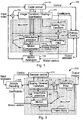
- FIG. 1 an exemplary encoder to which the present principles may be applied is indicated generally by the reference numeral 100.
- the encoder 100 includes a combiner 105 having an output in signal communication with a first input of an integer transformer/scaler/quantizer 115.
- a first output of the integer transformer/scaler/quantizer 115 is connected in signal communication with a first input of an entropy coder 155 and a first input of a scaler/inverse transformer 120.
- An output of the scaler/inverse transformer 120 is connected in signal communication with a first non-inverting input of a combiner 150.
- An output of the combiner 150 is connected in signal communication with a first input of an intra-frame predictor 125 and a first input of a deblocking filter 145.
- An output of the deblocking filter 145 is connected in signal communication with an input of a frame store 140 and a first input of a motion estimator 135.
- An output of the motion estimator 135 is connected in signal communication with a third input of a motion compensator 130 and a third input of the entropy coder 155.
- An inverting input of the combiner105 is connected in signal communication with an output of a switch 177.
- the output of the switch 177 is also connected in signal communication with a second non-inverting input of the combiner 150.
- a first input of the switch 177 is connected in signal communication with an output of the motion compensator 130.
- a second input of the switch 177 is connected in signal communication with an output of the intra-frame predictor 125.
- An output of the frame store 140 is connected in signal communication with a first input of a motion compensator 130.
- An input of the encoder 100 is connected in signal communication with a non-inverting input of the combiner 105, an input of a coder control module 110, and a third input of the motion estimator 135.
- a first output of the coder control module 110 is connected in signal communication with a second input of the motion compensator 130.
- a second output of the coder control module 110 is connected in signal communication with a second input of the motion estimator 135.
- a third output of the coder control module 110 is connected in signal communication with a second input of the intra-frame predictor 125.
- a fourth output of the coder control module 110 is connected in signal communication with a second input of the integer transformer/scaler/quantizer 115.
- a fifth output of the coder control module 110 is connected in signal communication with a second input of deblocking filter 145.
- a sixth output of the coder control module 110 is connected in signal communication with a second input of the scaler/inverse transformer 120.
- a seventh output of the coder control module 110 is connected in signal communication with a second output of the entropy coder 155.
- An output of the entropy coder 155 is available as an output of the encoder 100.
- the decoder 200 includes an entropy decoder 205.
- An input to the entropy decoder 205 is available as an input to the decoder 200.
- a first output of the entropy decoder 205 is connected in signal communication with an input of a decoder control module 210.
- a first output of the decoder control module 210 is connected in signal communication with a second input of a motion compensator 225.
- a second output of the decoder control module 210 is connected in signal communication with a first input of an intra-frame predictor 220.
- a third output of the decoder control module 210 is connected in signal communication with a second input of a scaler/inverse transformer 215.
- a fourth output of the decoder control module 210 is connected in signal communication with a second input of a deblocking filter 235.
- a second output of the entropy decoder 205 is connected in signal communication with a first input of the scaler/inverse transformer 215.
- An output of the scaler/inverse transformer 215 is connected in signal communication with a first non-inverting input of a combiner 230.
- An output of the combiner 230 is connected in signal communication with a second input-of the intra-frame predictor 220 and a first input of the deblocking filter 235.
- An output of the deblocking filter 235 is connected in signal communication with an input of a frame store 240.
- An output of the frame store 240 is connected in signal communication with a third input of a motion compensator 225.
- a second non-inverting input of the combiner 230 is connected in signal communication with an output of a switch 277.
- a first input of the switch 277 is connected in signal communication with an output of the motion compensator 225.
- a second input of the switch 277 is connected in signal communication with an output of the intra-frame predictor 220
- a third output of the entropy decoder 205 is connected in signal communication with a first input of the motion compensator 225.
- an exemplary method for slice encoding/decoding for Multi-view Video Coding (MVC) in.an embodiment of the present principles compliant with the MPEG-4 AVC standard is indicated generally by the reference numeral 300.
- the method 300 includes a start block 305 that passes control to a loop limit block 310.
- the function block 315 encodes/decodes one macroblock, and passes control to a loop limit block 320.
- the loop limit block 320 ends the loop over each macroblock, and passes control to a loop limit block 325.
- the function block 335 selects the boundary strength to be applied, and passes control to a function block 340.
- the function block 340 performs sample filtering, and passes control to a loop limit block 345.
- the loop limit block 345 ends the loop over each vertical edge (vedge) of a current macroblock, and passes control to a loop limit block 350.
- the function block 355 selects the boundary strength, and passes control to a function block 360.
- the function block 360 performs sample filtering, and passes control to a loop limit block 365.
- the loop limit block 365 ends the loop over each horizontal edge (hedge), and passes control to a loop limit block 370.
- the loop limit block 370 ends the loop over each macroblock, and passes control to an end block 375.
- Embodiments of the present principles are directed to adapting deblocking filtering for Multi-view Video Coding (MVC).
- MVC Multi-view video coding
- a Multi-view Video Coding (MVC) sequence is a set of two or more video sequences that capture the same scene from a different view point.
- a stereoscopic video sequence includes two video sequences, one representing the left channel and the other representing the right channel. Frames for each channel are simultaneously captured and have different viewing angles.
- An embodiment involves suppressing the locking artifacts introduced by enabling cross-view prediction, wherein a prediction signal is formed from a decoded picture(s) of another view(s).
- a prediction signal is formed from a decoded picture(s) of another view(s).
- additional blockiness is typically introduced at boundaries between the pixels that are compensated from different camera views.
- this embodiment of the present principles increases the decoded picture quality by reducing the artifacts around block boundaries caused by prediction from different views.
- prediction view information (also interchangeably referred to herein as reference view information) is introduced into the design and/or use of a deblocking filter for MVC.
- the reference view information indicates the views involved in the forming of a prediction signal.
- the prediction signal can come from the previous decoded pictures of the current view or previous decoded pictures of the neighboring view.
- reference view information may be used, e.g., to vary (e.g., increase) the strength of the deblocking filter and/or to select a different type of filter.
- Another embodiment involves suppressing the blocking artifacts introduced by coding multi-view video sequences using MVC by enabling both cross-view prediction and temporal prediction.
- additional blockiness is typically introduced at the boundaries between the pixels that are decoded with different MVC prediction types.
- this embodiment of the present principles increases the decoded picture quality by reducing the artifacts around block boundaries caused by different prediction types (temporal and cross-view). Since the decoded picture quality is improved, the compression efficiency may increase as well.
- prediction type information is introduced into the design and/or use of a deblocking filter for MVC.
- prediction type information may be used, e.g., to vary (e.g., increase) the strength of the deblocking filter and/or to select a different type of filter.
- reference view information may be used, e.g., to vary (e.g., increase) the strength of the deblocking filter and/or to select a different type of filter.
- the deblocking filter in the MPEG-4 AVC standard applies to all edges between 4x4 blocks. Furthermore, for each edge, the deblocking filter has the capability to adapt its strength.
- the parameter that controls the filter strength is referred as boundary strength (Bs).
- Bs boundary strength
- the value of the boundary strength indicates the likeliness of having visual blockiness on each edge and, hence, the need for a more or less deblocking filtering. Higher values of Bs indicate that stronger deblocking filtering will be applied.
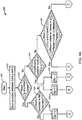
- an exemplary method for selecting boundary strength for use with the MPEG-4AVC standard is indicated generally by the reference numeral 400.
- the method includes a start block 405 that passes control to a function block. 410.
- the function block 410 examines the block boundary between blocks p and q, and passes control to a decision block 415.
- the decision block 415 determines whether or not the block p or q is intra coded. If so, then control is passed to a decision block 420. Otherwise, control is passed to a decision block 435.
- the decision block 420 determines whether or not the block boundary is a macroblock boundary. If so, then control is passed to a function block 425. Otherwise, control is passed to a function block 430.
- the function block 425 sets the boundary strength to 4, and passes control to an end block 465.
- the function block 430 sets the boundary strength to 3, and passes control to the end block 465.
- the decision block 435 determines whether or not the coefficients are coded in blocks p or q. If so, then control is passed to a function block 440. Otherwise, control is passed to a decision block 445.
- the function block 440 sets the boundary strength to 2, and passes control to the end block 465.
- the decision block 445 determines whether or not the blocks p and q have different reference frames or a different number of reference frames. If so, then control is passed to a function block 450. Otherwise, control is passed to a decision block 455.
- the function block 450 sets the boundary strength to 1, and passes control to the end block 465.
- the decision block 455 determines whether or not
- > 1 or
- > 1 or, if bi-predictive,
- > 1 or
- > 1. If so, then control is passed to function block 450. Otherwise, control is passed to a function block 460.
- the function block 460 sets the boundary strength to 0, and passes control to the end block 465.
- the boundary strength computation should also take into account the prediction type information in case of encoding multi-view sequences.
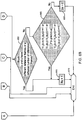
- an exemplary method for selecting the boundary strength based on prediction type information for use in Multi-view Video Coding is indicated generally.by the reference numeral 500.
- the strength is adjusted according to the following exemplary coding parameters: MVC prediction type; edge position; block type; number of coded coefficients; reference frame index; and motion/disparity vector differences.
- MVC prediction type edge position
- block type number of coded coefficients
- reference frame index reference frame index
- motion/disparity vector differences motion/disparity vector differences.
- the method 500 includes a start block 505 that passes control to a function block 510.
- the function block 510 examines the block boundary between blocks p and q, and passes control to a decision block 515.
- the decision block 515 determines whether or not block p or q is intra coded. If so, then control is passed to a decision block 520. Otherwise, control is passed to a decision block 535.
- the decision block 420 determines whether or not the block boundary is a macroblock boundary. If so, then control is passed to a function block 525. Otherwise, control is passed to a function block 530.
- the function block 525 sets the boundary strength to 4, and passes control to an end block 570.
- the function block 530 sets the boundary strength to 3, and passes control to the end block 570.
- the decision block 535 determines whether or not blocks p and q have difference Multi-view Video Coding prediction types. If so, then control is passed to the function block 525. Otherwise, control is passed to the decision block 540. The decision block 540 determines whether or not the coefficients are coded in the blocks p and q. If so, then control is passed to a function block 545. Otherwise, control is passed to a decision block 550.
- the function block 545 sets the boundary strength to 2, and passes control to the end block 570.
- the decision block 550 determines whether or not blocks p and q have different reference frames or a different number of reference frames. If so, then control is passed to the function block 555
- control is passed to a decision block 560.
- the decision block 560 determines whether or not
- > 1 or
- > 1 or, if bi-predictive,
- > 1 or
- > 1. If so, then control is passed to function block 555. Otherwise, control is passed to a function block 565.
- the function block 565 sets the boundary strength to 0, and passes control to the end block 570.
- the boundary strength computation should also take into account the reference view information in case of encoding multi-view sequences.
- an exemplary method for selecting the boundary strength based on prediction view information for use in Multi-view Video Coding is indicated generally by the reference numeral 600.
- the strength is adjusted according to the following exemplary coding parameters: reference views; edge position; block type; number of coded coefficients; reference frame index; and motion/disparity vector differences.
- the cross-view predicted block and temporal predicted block use reference pictures from different views, thus the block edge of two blocks with different MVC prediction types will more likely include higher level of blockiness. Thus, assigning higher boundary strength on these edges will give better filtering results.
- the method 600 includes a start block 605 that passes control to a function block 610.
- the function block 610 examines the block boundary between blocks p and q, and passes control to a decision block 615.
- the decision block 615 determines whether or not block p or q is intra coded. If so, then control is passed to a decision block 620. Otherwise, control is passed to a decision block 635.
- the decision block 620 determines whether or not the block boundary is a macroblock boundary. If so, then control is passed to a function block 625. Otherwise, control is passed to a function block 630.
- the function block 625 sets the boundary strength to 4, and passes control to an end block 670.
- the function block 630 sets the boundary strength to 3, and passes control to the end block 670.
- the decision block 635 determines whether or not blocks p and q have different reference views. If so, then control is passed to the function block 625. Otherwise, control is passed to the decision block 640. The decision block 640 determines whether or not the coefficients are coded in the blocks p and q. If so, then control is passed to a function block 645. Otherwise, control is passed to a decision block 650.
- the function block 645 sets the boundary strength to 2, and passes control to the end block 670.
- the decision block 650 determines whether or not blocks p and q have different reference frames or a different number of reference frames. If so, then control is passed to the function block 655.
- control is passed to a decision block 660.
- the decision block 660 determines whether or not
- > 1 or
- > 1 or, if bi-predictive,
- > 1 or
- > 1. If so, then control is passed to function block 655. Otherwise, control is passed to a function block 665.
- the function block 665 sets the boundary strength to 0, and passes control to the end block 670.
- one advantage/feature is a video encoder that includes a deblocking filter adaptable based on prediction information for encoding multi-view video sequences.
- Another advantage/feature is the video encoder as described above, wherein the prediction information comprises at least one of prediction type information and prediction view information.
- Yet another advantage/feature is the video encoder having the deblocking filter adaptable based on prediction information that includes at least one of prediction type information and prediction view information as described above, wherein the prediction type information comprises at least one of temporal prediction information and cross-view prediction information.
- another advantage/feature is the video encoder having the deblocking filter adaptable based on prediction information that includes at least one of prediction type information and prediction view information as described above, wherein the deblocking filter is adaptable based upon the prediction information of two neighboring blocks with respect to a given block to be filtered by said deblocking filter.
- another advantage/feature is the video encoder having the deblocking filter adaptable based on prediction information that includes at least one of prediction type information and prediction view information as described above, wherein the deblocking filter is compliant with the International Organization for Standardization/International Electrotechnical Commission Moving Picture Experts Group-4 Part 10 Advanced Video Coding standard/International Telecommunication Union, Telecommunication Sector H.264 recommendation, and a boundary strength applied by the deblocking filter is adaptable based upon the prediction information for encoding multi-view video sequences.
- another advantage/feature is the video encoder compliant with the MPEG-4 AVC standard as described above, wherein the boundary strength is set to 4 when the prediction information of two neighboring blocks, with respect to a given block to be filtered by the deblocking filter, is different.
- another advantage/feature is the video encoder as described above, wherein at least one of a boundary strength, a number of samples to be filtered, and a type of the deblocking filter is adaptable.
- another advantage/feature is the video encoder having at least one of a boundary strength, a number of samples to be filtered, and a type of the deblocking filter being adaptable as described above, wherein the boundary strength of the deblocking filter is adaptable based upon the prediction information of two neighboring blocks with respect to a given block to be filtered by the deblocking filter, and the boundary strength is increased when the prediction information of the two neighboring blocks is different.
- another advantage/feature is the video encoder as described above, wherein the multi-view video sequences include stereoscopic video sequences.
- the teachings of the present invention are implemented as a combination of hardware and software.
- the software may be implemented as an application program tangibly embodied on a program storage unit.
- the application program may be uploaded to, and executed by, a machine comprising any suitable architecture.
- the machine is implemented on a computer platform having hardware such as one or more central processing units ("CPU"), a random access memory. (“RAM”), and input/output ("I/O") interfaces.
- CPU central processing units
- RAM random access memory
- I/O input/output
- the computer platform may also include an operating system and microinstruction code.
- the various processes and functions described herein may be either part of the microinstruction code or part of the application program, or any combination thereof, which may be executed by a CPU.
- various other peripheral units may be connected to the computer platform such as an additional data storage unit and a printing unit.
Landscapes
- Engineering & Computer Science (AREA)
- Multimedia (AREA)
- Signal Processing (AREA)
- Compression Or Coding Systems Of Tv Signals (AREA)
Claims (5)
- Vorrichtung, die umfasst:einen Videocodierer oder einen Videodecodierer zum Codieren oder Decodieren mindestens eines Einzelbilds einer Multiview-Videosequenz, wobei das mindestens eine Einzelbild in Blöcke von Daten aufgeteilt ist, wobei die Vorrichtung dadurch gekennzeichnet ist, dass der Videocodierer oder der Videodecodierer ein Entblockierungsfilter (145, 235) umfasst, das Ränder mindestens zweier Nachbarblöcke des mindestens einen Einzelbilds filtert, wobei einem Begrenzungsstärkewert ein höchster Wert zugewiesen wird, wenn die mindestens zwei Nachbarblöcke unterschiedliche Multiview-Videocodierungs-Prädiktionstypen aufweisen, wobei ein Multiview-Videocodierungs-Prädiktionstyp eine Information ist, die angibt, welche Prädiktion unter einer Crossview-Prädiktion oder einer zeitlichen Prädiktion für einen gegebenen Block erfolgt.
- Vorrichtung nach Anspruch 1, wobei das Entblockierungsfilter (145, 235) mit dem Standard Moving Picture Experts Group-4, Teil 10, Advanced Video Coding, der International Organization for Standardization/International Electrotechnical Commission/mit der Empfehlung H-264 der International Telecommunication Union, Telecommunication Sector, konform ist.
- Vorrichtung nach Anspruch 2, wobei der höchste Wert auf 4 eingestellt ist.
- Verfahren, das umfasst:Ausführen einer Videocodierung oder Videodecodierung mindestens eines Einzelbilds einer Multiview-Videosequenz, wobei das mindestens eine Einzelbild in Blöcke von Daten aufgeteilt ist,wobei das Verfahren dadurch gekennzeichnet ist, dass die Videocodierung oder die Videodecodierung das Anwenden eines Entblockierungsfilters zum Filtern von Rändern mindestens zweier Nachbarblöcke des mindestens einen Einzelbilds umfasst, wobei einem Begrenzungsstärkewert ein höchster Wert zugewiesen wird, wenn die mindestens zwei Nachbarblöcke unterschiedliche Multiview-Videocodierungs-Prädiktionstypen aufweisen, wobei ein Multiview-Videocodierungs-Prädiktionstyp eine Information ist, die angibt, welche Prädiktion unter einer Crossview-Prädiktion oder einer zeitlichen Prädiktion für einen gegebenen Block erfolgt.
- Verfahren nach Anspruch 4, wobei die Entblockierungsfilterung mit dem Standard Moving Picture Experts Group-4, Teil 10, Advanced Video Coding, der International Organization for Standardization/International Electrotechnical Commission/mit der Empfehlung H-264 der International Telecommunication Union, Telecommunication Sector, konform ist (400).
Applications Claiming Priority (3)
| Application Number | Priority Date | Filing Date | Title |
|---|---|---|---|
| US75728906P | 2006-01-09 | 2006-01-09 | |
| US75729206P | 2006-01-09 | 2006-01-09 | |
| PCT/US2007/000348 WO2007081838A1 (en) | 2006-01-09 | 2007-01-09 | Method and apparatus for providing reduced resolution update mode for multi-view video coding |
Publications (2)
| Publication Number | Publication Date |
|---|---|
| EP1972151A1 EP1972151A1 (de) | 2008-09-24 |
| EP1972151B1 true EP1972151B1 (de) | 2017-03-29 |
Family
ID=38068328
Family Applications (1)
| Application Number | Title | Priority Date | Filing Date |
|---|---|---|---|
| EP07717796.2A Active EP1972151B1 (de) | 2006-01-09 | 2007-01-09 | Verfahren und vorrichtung zur anpassung des deblockierenfilters für mehrsichtsvideokodierung |
Country Status (6)
| Country | Link |
|---|---|
| US (1) | US9628823B2 (de) |
| EP (1) | EP1972151B1 (de) |
| JP (1) | JP5535485B2 (de) |
| CN (1) | CN101371585B (de) |
| BR (1) | BRPI0706362B1 (de) |
| WO (1) | WO2007081838A1 (de) |
Families Citing this family (30)
| Publication number | Priority date | Publication date | Assignee | Title |
|---|---|---|---|---|
| KR101366092B1 (ko) * | 2006-10-13 | 2014-02-21 | 삼성전자주식회사 | 다시점 영상의 부호화, 복호화 방법 및 장치 |
| WO2008084996A1 (en) * | 2007-01-11 | 2008-07-17 | Samsung Electronics Co, . Ltd. | Method and apparatus for deblocking-filtering video data |
| JP4847890B2 (ja) * | 2007-02-16 | 2011-12-28 | パナソニック株式会社 | 符号化方式変換装置 |
| WO2008104994A2 (en) * | 2007-02-28 | 2008-09-04 | Advinus Therapeutics Private Limited | 2,2,2-tri-substituted acetamide derivatives as glucokinase activators, their process and pharmaceutical application |
| US8548261B2 (en) | 2007-04-11 | 2013-10-01 | Samsung Electronics Co., Ltd. | Method and apparatus for encoding and decoding multi-view image |
| US8625672B2 (en) * | 2008-01-07 | 2014-01-07 | Thomson Licensing | Methods and apparatus for video encoding and decoding using parametric filtering |
| US9794597B2 (en) | 2008-04-11 | 2017-10-17 | Thomson Licensing Dtv | Methods and apparatus for deblocking filtering of non-local intra prediction |
| CN106507117B (zh) | 2008-07-20 | 2020-01-21 | 杜比实验室特许公司 | 立体视频传送系统的编码器优化的方法和设备 |
| JP5375830B2 (ja) * | 2008-09-29 | 2013-12-25 | パナソニック株式会社 | 映像信号処理装置 |
| CN102292990B (zh) * | 2008-11-25 | 2016-10-05 | 汤姆森特许公司 | 对视频编码和解码进行基于稀疏性的去伪像滤波的方法和装置 |
| CN102473240B (zh) * | 2009-08-03 | 2015-11-25 | 摩托罗拉移动有限责任公司 | 编码视频内容的方法 |
| US9445119B2 (en) | 2009-10-29 | 2016-09-13 | Vestel Elektronik Sanayi Ve Ticaret A.S. | Method and device for processing a video sequence |
| RU2012146943A (ru) * | 2010-04-06 | 2014-05-20 | Конинклейке Филипс Электроникс Н.В. | Уменьшение видимости 3d шума |
| JP5544996B2 (ja) * | 2010-04-09 | 2014-07-09 | ソニー株式会社 | 画像処理装置および方法 |
| JP5748463B2 (ja) * | 2010-12-02 | 2015-07-15 | キヤノン株式会社 | 符号化装置およびプログラム |
| JP5159927B2 (ja) * | 2011-07-28 | 2013-03-13 | 株式会社東芝 | 動画像復号装置及び動画像復号方法 |
| CN109246429A (zh) * | 2011-11-04 | 2019-01-18 | Lg 电子株式会社 | 用于编码/解码图像信息的方法和装置 |
| KR102030205B1 (ko) | 2012-01-20 | 2019-10-08 | 선 페이턴트 트러스트 | 시간 움직임 벡터 예측을 사용하여 비디오를 부호화 및 복호하는 방법 및 장치 |
| KR101996682B1 (ko) | 2012-02-03 | 2019-07-04 | 선 페이턴트 트러스트 | 화상 부호화 방법, 화상 복호 방법, 화상 부호화 장치, 화상 복호 장치 및 화상 부호화 복호 장치 |
| WO2013132792A1 (ja) | 2012-03-06 | 2013-09-12 | パナソニック株式会社 | 動画像符号化方法、動画像復号方法、動画像符号化装置、動画像復号装置、及び動画像符号化復号装置 |
| JP6222576B2 (ja) * | 2012-03-21 | 2017-11-01 | サン パテント トラスト | 画像符号化方法、画像復号方法、画像符号化装置、画像復号装置、および画像符号化復号装置 |
| US10075708B2 (en) | 2012-04-09 | 2018-09-11 | Sun Patent Trust | Image encoding method and image decoding method |
| EP2847996B1 (de) | 2012-05-09 | 2020-10-07 | Sun Patent Trust | Verfahren zur durchführung einer bewegungsvektorprädiktion, kodierungs- und dekodierungsverfahren sowie zugehörige vorrichtungen |
| KR20140053448A (ko) * | 2012-10-25 | 2014-05-08 | 에스케이텔레콤 주식회사 | 스테레오스코픽 비디오에서 제1영상에 대한 부호화정보로부터 제2영상을 디블록킹 필터링하는 방법 및 장치 |
| EP3809707B1 (de) | 2013-01-04 | 2024-05-08 | GE Video Compression, LLC | Effizientes skalierbares codierungskonzept |
| EP2984839B1 (de) * | 2013-04-08 | 2020-05-27 | GE Video Compression, LLC | Codierungskonzept für effiziente mehransichts-/mehrschichtcodierung |
| US10554966B2 (en) | 2014-10-07 | 2020-02-04 | Samsung Electronics Co., Ltd. | Multi-view image encoding/decoding method and apparatus |
| CN106657961B (zh) | 2015-10-30 | 2020-01-10 | 微软技术许可有限责任公司 | 立体视频的混合数字-模拟编码 |
| US10694202B2 (en) * | 2016-12-01 | 2020-06-23 | Qualcomm Incorporated | Indication of bilateral filter usage in video coding |
| US11683514B2 (en) * | 2020-12-22 | 2023-06-20 | Tencent America LLC | Method and apparatus for video coding for machine |
Family Cites Families (14)
| Publication number | Priority date | Publication date | Assignee | Title |
|---|---|---|---|---|
| FR2809572B1 (fr) * | 2000-05-29 | 2002-08-16 | Cit Alcatel | Codage video de source avec prediction du mouvement et filtrage des effets de blocs |
| US7450641B2 (en) * | 2001-09-14 | 2008-11-11 | Sharp Laboratories Of America, Inc. | Adaptive filtering based upon boundary strength |
| US6907079B2 (en) * | 2002-05-01 | 2005-06-14 | Thomson Licensing S.A. | Deblocking filter conditioned on pixel brightness |
| MXPA04002265A (es) | 2002-07-11 | 2004-06-29 | Matsushita Electric Ind Co Ltd | Metodo de determinacion de resistencia de filtracion, metodo de codificacion de pelicula y metodo de decodificacion de pelicula. |
| JP4580626B2 (ja) * | 2002-07-11 | 2010-11-17 | パナソニック株式会社 | フィルタリング強度の決定方法、動画像符号化方法、および動画像復号化方法 |
| CN1240025C (zh) * | 2003-04-25 | 2006-02-01 | 北京工业大学 | 基于视频内容的视频编码方法 |
| US7650036B2 (en) * | 2003-10-16 | 2010-01-19 | Sharp Laboratories Of America, Inc. | System and method for three-dimensional video coding |
| CN1233171C (zh) * | 2004-01-16 | 2005-12-21 | 北京工业大学 | 一种用于视频编码的简单化环路滤波方法 |
| JP2005311512A (ja) * | 2004-04-19 | 2005-11-04 | Toshiba Corp | エラーコンシールメント方法及び復号器 |
| US7460596B2 (en) | 2004-04-29 | 2008-12-02 | Mediatek Incorporation | Adaptive de-blocking filtering apparatus and method for MPEG video decoder |
| US7725691B2 (en) * | 2005-01-28 | 2010-05-25 | Analog Devices, Inc. | Method and apparatus for accelerating processing of a non-sequential instruction stream on a processor with multiple compute units |
| CN100345450C (zh) * | 2005-01-31 | 2007-10-24 | 浙江大学 | 视频或图像去块滤波的方法和装置 |
| US8228994B2 (en) * | 2005-05-20 | 2012-07-24 | Microsoft Corporation | Multi-view video coding based on temporal and view decomposition |
| US8644386B2 (en) * | 2005-09-22 | 2014-02-04 | Samsung Electronics Co., Ltd. | Method of estimating disparity vector, and method and apparatus for encoding and decoding multi-view moving picture using the disparity vector estimation method |
-
2007
- 2007-01-09 BR BRPI0706362-8A patent/BRPI0706362B1/pt active IP Right Grant
- 2007-01-09 CN CN200780002185.8A patent/CN101371585B/zh active Active
- 2007-01-09 EP EP07717796.2A patent/EP1972151B1/de active Active
- 2007-01-09 JP JP2008549580A patent/JP5535485B2/ja active Active
- 2007-01-09 WO PCT/US2007/000348 patent/WO2007081838A1/en not_active Ceased
- 2007-01-09 US US12/087,020 patent/US9628823B2/en active Active
Non-Patent Citations (1)
| Title |
|---|
| YEPING SU ET AL: "Deblocking filter adaptation for MVC", 76. MPEG MEETING; 03-04-2006 - 07-04-2006; MONTREUX; (MOTION PICTURE EXPERT GROUP OR ISO/IEC JTC1/SC29/WG11),, no. M13320, 30 March 2006 (2006-03-30), XP030041989, ISSN: 0000-0237 * |
Also Published As
| Publication number | Publication date |
|---|---|
| JP2009522937A (ja) | 2009-06-11 |
| BRPI0706362B1 (pt) | 2019-10-01 |
| US20090028249A1 (en) | 2009-01-29 |
| CN101371585A (zh) | 2009-02-18 |
| CN101371585B (zh) | 2014-07-30 |
| BRPI0706362A2 (pt) | 2011-03-22 |
| EP1972151A1 (de) | 2008-09-24 |
| JP5535485B2 (ja) | 2014-07-02 |
| US9628823B2 (en) | 2017-04-18 |
| WO2007081838A1 (en) | 2007-07-19 |
Similar Documents
| Publication | Publication Date | Title |
|---|---|---|
| US9628823B2 (en) | Method and apparatus for providing reduced resolution update mode for multi-view video coding | |
| US8532175B2 (en) | Methods and apparatus for reducing coding artifacts for illumination compensation and/or color compensation in multi-view coded video | |
| CN101371584B (zh) | 提供用于多视图视频编码的降低分辨率的更新模式的方法和装置 | |
| KR101757947B1 (ko) | 비디오 인코딩 및 디코딩에서의 크로마 성분에 대한 예측 픽셀의 적응성 필터링을 위한 방법 및 장치 | |
| EP2084912B1 (de) | Verfahren, vorrichtungen und speichermedien für lokale beleuchtung und farbausgleich ohne explizite signalisierung | |
| US20180332292A1 (en) | Method and apparatus for intra prediction mode using intra prediction filter in video and image compression | |
| KR101648818B1 (ko) | 움직임 보상 보간 및 참조 픽쳐 필터링에 대한 국부적 적응형 필터링을 위한 방법 및 장치 | |
| HK1214706A1 (zh) | 用於环内去伪影滤波的方法和设备 | |
| EP2082585A2 (de) | Verfahren und vorrichtung zur videokodierung über präzisierte prognosedaten | |
| US9294784B2 (en) | Method and apparatus for region-based filter parameter selection for de-artifact filtering | |
| AU2010279841A1 (en) | Apparatus and method for deblocking filtering image data and video decoding apparatus and method using the same | |
| CA3001216A1 (en) | Adaptive filtering based upon boundary strength |
Legal Events
| Date | Code | Title | Description |
|---|---|---|---|
| PUAI | Public reference made under article 153(3) epc to a published international application that has entered the european phase |
Free format text: ORIGINAL CODE: 0009012 |
|
| 17P | Request for examination filed |
Effective date: 20080721 |
|
| AK | Designated contracting states |
Kind code of ref document: A1 Designated state(s): DE FR GB |
|
| RBV | Designated contracting states (corrected) |
Designated state(s): DE FR GB |
|
| DAX | Request for extension of the european patent (deleted) | ||
| 17Q | First examination report despatched |
Effective date: 20091127 |
|
| RAP1 | Party data changed (applicant data changed or rights of an application transferred) |
Owner name: THOMSON LICENSING |
|
| REG | Reference to a national code |
Ref country code: DE Ref legal event code: R079 Ref document number: 602007050379 Country of ref document: DE Free format text: PREVIOUS MAIN CLASS: H04N0007260000 Ipc: H04N0019597000 |
|
| RIC1 | Information provided on ipc code assigned before grant |
Ipc: H04N 19/51 20140101ALI20160913BHEP Ipc: H04N 19/176 20140101ALI20160913BHEP Ipc: H04N 19/597 20140101AFI20160913BHEP Ipc: H04N 19/86 20140101ALI20160913BHEP Ipc: H04N 19/117 20140101ALI20160913BHEP Ipc: H04N 19/70 20140101ALI20160913BHEP Ipc: H04N 19/61 20140101ALI20160913BHEP Ipc: H04N 19/159 20140101ALI20160913BHEP |
|
| GRAP | Despatch of communication of intention to grant a patent |
Free format text: ORIGINAL CODE: EPIDOSNIGR1 |
|
| INTG | Intention to grant announced |
Effective date: 20161024 |
|
| GRAS | Grant fee paid |
Free format text: ORIGINAL CODE: EPIDOSNIGR3 |
|
| GRAA | (expected) grant |
Free format text: ORIGINAL CODE: 0009210 |
|
| AK | Designated contracting states |
Kind code of ref document: B1 Designated state(s): DE FR GB |
|
| REG | Reference to a national code |
Ref country code: GB Ref legal event code: FG4D |
|
| REG | Reference to a national code |
Ref country code: DE Ref legal event code: R096 Ref document number: 602007050379 Country of ref document: DE |
|
| REG | Reference to a national code |
Ref country code: DE Ref legal event code: R097 Ref document number: 602007050379 Country of ref document: DE |
|
| REG | Reference to a national code |
Ref country code: FR Ref legal event code: PLFP Year of fee payment: 12 |
|
| PLBE | No opposition filed within time limit |
Free format text: ORIGINAL CODE: 0009261 |
|
| STAA | Information on the status of an ep patent application or granted ep patent |
Free format text: STATUS: NO OPPOSITION FILED WITHIN TIME LIMIT |
|
| 26N | No opposition filed |
Effective date: 20180103 |
|
| REG | Reference to a national code |
Ref country code: FR Ref legal event code: TP Owner name: THOMSON LICENSING DTV, FR Effective date: 20180830 |
|
| REG | Reference to a national code |
Ref country code: GB Ref legal event code: 732E Free format text: REGISTERED BETWEEN 20180927 AND 20181005 |
|
| REG | Reference to a national code |
Ref country code: DE Ref legal event code: R082 Ref document number: 602007050379 Country of ref document: DE Representative=s name: DEHNS, DE Ref country code: DE Ref legal event code: R081 Ref document number: 602007050379 Country of ref document: DE Owner name: INTERDIGITAL MADISON PATENT HOLDINGS, FR Free format text: FORMER OWNER: THOMSON LICENSING, ISSY-LES-MOULINEAUX, FR Ref country code: DE Ref legal event code: R082 Ref document number: 602007050379 Country of ref document: DE Representative=s name: DEHNS PATENT AND TRADEMARK ATTORNEYS, DE |
|
| P01 | Opt-out of the competence of the unified patent court (upc) registered |
Effective date: 20230514 |
|
| PGFP | Annual fee paid to national office [announced via postgrant information from national office to epo] |
Ref country code: GB Payment date: 20260126 Year of fee payment: 20 |
|
| PGFP | Annual fee paid to national office [announced via postgrant information from national office to epo] |
Ref country code: DE Payment date: 20260127 Year of fee payment: 20 |
|
| PGFP | Annual fee paid to national office [announced via postgrant information from national office to epo] |
Ref country code: FR Payment date: 20260127 Year of fee payment: 20 |