EP1973277A1 - Procédé et appareil pour planifier en temps réel le trafic dans des réseaux sans fil - Google Patents
Procédé et appareil pour planifier en temps réel le trafic dans des réseaux sans fil Download PDFInfo
- Publication number
- EP1973277A1 EP1973277A1 EP07104830A EP07104830A EP1973277A1 EP 1973277 A1 EP1973277 A1 EP 1973277A1 EP 07104830 A EP07104830 A EP 07104830A EP 07104830 A EP07104830 A EP 07104830A EP 1973277 A1 EP1973277 A1 EP 1973277A1
- Authority
- EP
- European Patent Office
- Prior art keywords
- time
- real
- station
- traffic
- stations
- Prior art date
- Legal status (The legal status is an assumption and is not a legal conclusion. Google has not performed a legal analysis and makes no representation as to the accuracy of the status listed.)
- Withdrawn
Links
Images





Classifications
-
- H—ELECTRICITY
- H04—ELECTRIC COMMUNICATION TECHNIQUE
- H04W—WIRELESS COMMUNICATION NETWORKS
- H04W74/00—Wireless channel access
- H04W74/02—Hybrid access
-
- H—ELECTRICITY
- H04—ELECTRIC COMMUNICATION TECHNIQUE
- H04W—WIRELESS COMMUNICATION NETWORKS
- H04W74/00—Wireless channel access
- H04W74/04—Scheduled access
-
- H—ELECTRICITY
- H04—ELECTRIC COMMUNICATION TECHNIQUE
- H04W—WIRELESS COMMUNICATION NETWORKS
- H04W74/00—Wireless channel access
- H04W74/08—Non-scheduled access, e.g. ALOHA
- H04W74/0833—Random access procedures, e.g. with 4-step access
- H04W74/0841—Random access procedures, e.g. with 4-step access with collision treatment
- H04W74/085—Random access procedures, e.g. with 4-step access with collision treatment collision avoidance
Definitions
- the present invention relates to a method and an apparatus for real-time traffic scheduling in wireless networks.
- Wireless networks have become widely distributed nowadays.
- a widely used type of networks referred to as “wireless LANs” is defined in the IEEE 802.11 standards of which there exists a whole family.
- One issue in such type of wireless networks is the problem of quality of service.
- the nodes of such kind of networks transmit in the so-called “best effort” mode which means that a sender can transmit at a rate which is currently available at the network.
- the "best effort" mode does not ensure a certain quality of service (also referred to as QoS) like a minimum assured bandwidth which could enable "real-time” transmission.
- QoS quality of service
- IEEE 802.11e see IEEE standard for information technology - specific requirements part 11: Wireless LAN medium access control (MAC) and physical layer (PHY) specifications: Amendment 8: Medium access control (MAC) quality of service enhancements.
- IEEE Standard 802.11E-2005, 2005 and the Contention-Free Access using the point coordination function (PCF) defined in the IEEE 802.11 standard (see IEEE standard for information technology - LAN/MAN - specific requirements - part 11: Wireless LAN medium access control (MAC) and physical layer (PHY) specifications.
- the PCF mode in 802.11 can offer strict guarantees.
- strict guarantees rely on "medium reservations" that are usually done on a periodic basis, e.g. a given station reserves the channel for transmitting (P bytes) every T seconds.
- this periodicity does not match the real-time traffic pattern from the data sources.
- voice traffic where the communication channel is typically idle for 1/3 of the time.
- voice codecs tend to optimize the bandwidth use by applying silence suppression functionality, leaving several (periodic) reserved RT slots empty.
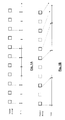
- Fig. 1A shows below the reserved timings for real-time packet transmission indicated as dashs on the time axis, and in the upper part there is shown the packet arrival frequency through dashed boxes, whereas the solid line boxes represent arriving real-time packets.
- RT realtime
- Fig. 1B To increase efficiency one may increase this time period as shown in Fig. 1B .
- Fig. 1B One can see that depending on the arrival time there can be a significant delay in the forwarding of real-time packets, such as in case of the of the fourth real-time packet shown in Fig. 1B which arrives only shortly after the third reserved RT slot and which therefore has to wait for some time until it is sent at the fourth reserved RT slot.
- One possibility to decrease the delay would be to decrease the period between two RT slots reserved for real-time transmission as in the example of Fig. 1A , but as previously mentioned this decreases the reservation efficiency because for a given number of real-time packets there will be a higher number of unused RT slots.
- the mechanism should enable strict guarantees to real-time traffic flows while being backward compatible (deployable in existing 802.11 hotspots), and preferably without starving 802.11 flows.
- method for scheduling of traffic in wireless networks whereas said network comprises real-time stations intending to send real-time traffic and best-effort stations sending best effort traffic, said method comprising:
- said real-time access marker comprises an indication of the number of stations which currently are sending real-time traffic in said network and the number of reserved RT slots for each of them, and incrementally assigning a new sequence number to a real-time station which newly wants to send real-time traffic based on the number of real-time stations which are already sending real-time traffic.
- the next real-time access marker is sent with a delay of ⁇ T and the next round duration is shortened to T - ⁇ T.
- a packet from a real-time station does not use the RT slot assigned to it based on the sequence number of said station, the succeeding station takes over said RT slot.
- a real-time station uses only a defined number of real-time slots per round and further packets are "downgraded" and transmitted in best effort mode.
- a downgraded packet can not be transmitted within a given round (during the contention with other best effort packets) it is upgraded again in the next round and transmitted in the reserved RT slot.
- n stations among which nrt have real-time (RT) traffic to transmit using the protocol or mechanism in accordance with an embodiment of the invention
- nbe n - nrt are legacy 802.11 stations with best-effort (BE) traffic. All n stations are in the same collision domain, contending to access the channel.
- a common destination e.g., the access point (AP) of a hotspot.
- AP access point
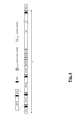
- Fig. 2 illustrates some basic aspects of an embodiment according to the invention.
- a periodic round (a time frame with a predefined time length) which is defined by some beacon signal or packet which may be referred to as real-time access marker (hereinafter referred to also as RAM).
- This RAM is periodically transmitted by some (primary) real-time station and thereby defines some "round” within which packets may be sent.
- the "round” in some sense may be regarded as a "virtual frame" within which there exists a defined structure. In other words one may say that a "round” is an interval within which realtime tranmission follows a certain defined and repeating pattern or sequence.
- some transmission schedule (which at least to some extent is "fixed") according to which the packets from different real-time stations are sent or forwarded by a certain real-time station.
- This is indicated in Fig. 2 by the sequence A-B-C-D, i. e. at first there are transmitted packets from station A, then from station B, then C, and then the packets from D.
- This sequence is fixed with respect to the start of a "round", as can be seen in Fig. 2 from the sequence A-B indicated at the right-hand side in the second round
- a RT slot reserved for a real-time packet is skipped by the station corresponding to this RT slot (eg. due to silence suppression as indicated for packet B in Fig. 2 )
- the succeeding station(s) (here station C) takes over this RT slot).
- the period between two RAMs (the round) is divided into two parts, one for the real-time transmission and the other one for the best effort traffic.
- a RT station uses only one high priority RT slot in a given interval ("round"). Additional RT packets from that station in the same round get BE (best effort) priority (to contend fairly with BE traffic). Such packets may be denoted as best-effort real-time (BE-RT), one such packet (packet A on top of packet C) is shown in Fig. 3 .
- BE-RT best-effort real-time
- the aforementioned aspects and mechanisms can be implemented while maintaining complete backward compatibility, i.e. there are absolutely no changing requirements on 802.11 stations that coexist with the real-time stations according to embodiments of the invention.
- the real-time stations may send a "normal" packet which is transparent for BE stations and which in, for instance, the ToS field of 802.11e header identifies it as RT packet.
- the identification as a RT packet allows the primary station to easily update the list of active RT stations.
- the RAM packet also may be a "normal" 802.11 packet, so that there is no specific handling required which could destroy compatibility.
- a real-time station Before a real-time station starts transmitting real-time packets, it overhears the channel for a given duration of time. If it does not receive a RAM during this time, it is the first station starting a real-time session. In the following this station will be referred to as the primary station.
- the primary station has to broadcast a RAM packet every T to indicate the start of a new round for all RT stations in a synchronous way.
- SIFS Short Inter Frame Space
- the primary station continuously overhears the channel to notice when new real-time stations join. Packets of real-time stations according to one embodiment are identified, for instance, by the IP ToS (type of service) field. Hence, the primary station can maintain a table of all active real-time stations, including their MAC address, and sequence number i (this will be explained in somewhat more detail below), number of packets they are allowed to transmit and the transmission time required for their real-time packets. Additionally, according to one embodiment the time of the last real-time packet transmission of the respective station is stored. It should be noted that preferably other stations should also maintain such a table for the case they become the primary station (such a case will be explained in more detail below).
- the transmission duration of RAM (tram), data packets (tdata,i ), and ACK (tack) depends on the current channel rate and thus may vary.
- the RAM is a normal 802.11 data frame with specific information in the payload. It is not acknowledged by other stations as it is transmitted in broadcast.
- a best-effort station starts sending a data packet shortly before the round ends and tguard should be set appropriately depending on the channel rate, maximum packet size, and T .
- Another positive side-effect of using tguard is that RT stations do not use the total channel capacity, i.e., BE stations are not starving.
- a real-time station wants to join and is not the primary one, it first has to check whether sufficient transmission time in T is available to accommodate its real-time packets. According to one embodiment, if ttot + tguard + 2 SIFS + tslot + tack + tdata ⁇ T , whereas
- the primary station has sequence number one.
- the backoff value attached to the other packets in the queue will increment by one until reaching the number of packets the station is allowed to transmit during the RT period. Choosing the backoffs in the described way results in a given transmission sequence, avoiding collisions among real-time stations.
- the primary station will announce the sequence number of all RT stations along with the number of reserved RT slots per station.
- the backoff AIFS_i chosen by a particular station STAi will be applied to its very first packet waiting in the transmission queue.
- the rest (m-1) packets this STAi is allowed to transmit will obtain incremental backoffs AIFS_i+1, AIFS_i+2, ..., AIFS_i+ (m-1). In this manner it becomes possible to deal with different throughput requirements for different stations by assigning them a different number of reserved RT slots.
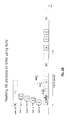
- Fig. 5 also illustrates the RT slot reuse in case of two packets from station A, and one from stations B to D waiting in the buffer where packet B is skipped. It can be seen that instead packet C takes its place, whereas packet D takes the place reserved for packet C.
- a real-time station In case a real-time station has no packet ready upon receiving the RAM, it skips its turn. The subsequent station in the sequence will then transmit next with an idle time of AIFS+tslot after the previous transmission. This means that the subsequent packet actually takes over the RT slot which was reserved for the previous packet, except for an additional idle time period of SIFS + tslot which must be detected to actually determine that the scheduled packet has been skipped and that the following packet may therefore decrease its backoff to take over its role. Generally, if k consecutive stations with a right to transmit 1 packet / round refrain from transmitting a RT packet after the RAM, the idle time between two packets becomes SIFS+k tslot.
- the first packet (the one with the sequence number 1 and originating from the station which joined RT traffic first after the primary station) has a backoff of one corresponding to one tslot
- the next packet with the sequence number of 2 (and originating from the station which joined RT traffic second after the primary station) has a backoff of 2 tslots
- Each detected idle slot after a received RAM causes a packet waiting in the buffer to be forwarded to decrease its backoff until it has reached zero so that the packet can be transmitted, thereby reaching a maximum idle time of. AIFS+k tslot.
- This idle time might be longer than the DIFS (which corresponds to the minimum time between an ACK and a BE packet) of legacy 802.11 stations for large k (or nrt). This means that if the maximum possible idle time is larger than the DIFS this results in possible collisions between RT and BE stations because there is some possibility that a BE station may jump into one of the idle RT slots while a RT packet is still waiting in the buffer.
- the BE packets which could possibly take over a RT slot are informed that they should wait for a time until it is clear that no real-time packets having a valid sequence number for real-time transmission are still waiting in the buffer.
- the duration field in a real-time packet can be set to a duration such that it can be avoided that a best effort packet can capture a RT slot which is reserved for this or its succeeding real-time packet.
- tslot is the length of a 802.11 slot which is generally much shorter than a RT slot reserved for a RT packet.
- a RT slot is, in general, equivalent to a number of 802.11 time slots (tslots).
- the duration field needs to be set in the RAM to SIFS+(total number of RT slots + 1) tslot.
- the duration field is ignored by real-time stations.
- the duration field in the real-time access marker is set to a duration corresponding to the accumulated backoff time of all real-time stations to avoid that a best effort station takes over a RT slot which has been assigned to a real-time station.
- Stations may receive real-time packets from the application layer at any time in between two consecutive RAMs (during a "round").
- the first m packets (of a given station) in a round are assigned high priority, as described before, e.g. by assigning to them an incremental sequence of backoffs (AIFS_i, AIFS_i+1, AIFS_i+2, ...) for the number of packets the station is allowed to transmit during a single RT period, denoted as m..
- an (m+1)th arrives during the same round, it is either queued until the next RAM or contends in equal conditions as BE (as illustrated in Fig. 7 ).
- BE-RT packets Such "degraded" packets are referred to as BE-RT packets in the following.
- a station with a waiting BE-RT packet "promotes" it back to high priority to be transmitted in the RT period. Promoting BE-RT packets has the advantage of:
- RT stations are allowed to transmit m RT packets per interval only. Extra RT packets get "degraded" to BE-RT priority to compete equally with 802.11 stations.
- the primary station At the primary station's side, it increases the "number of RT slots" announced in the beacons accordingly, so a new incoming RT station can choose the appropriate new backoff value.
- the primary station detects the new joining station upon overhearing a RT packet (specified as a new type of packet in the 802.11 header) from a station whose address is not in the list of addresses handled by the primary station. It also detects the value m associated to the new station, by overhearing the number of consecutive RT packets transmitted by the new station. From next beacon, the primary station will start advertising the sequence number and number of RT slots/round to each station (understanding that a RT slot is equivalent to a reserved right to transmit a packet and thus RT slots do not have a fixed time length).
- a real-time station has finished its session, the previously reserved resources must be released. If a station has not transmitted a real-time packet for a duration pT (p being a predefined integer number valid for all stations, e.g., 100), the primary station supposes that it has finished its real-time session. The primary station then informs the other real-time stations about this fact in the next RAM together with the sequence number of the station that has left. Then, all real-time stations with a higher sequence number can decrement their non-random backoff of their first packet in the queue by one.
- pT a predefined integer number valid for all stations
- a station has not transmitted a real-time packet for more than pT although it has not finished its real-time session yet, it has to re-join as described above before transmitting the next real-time packet.
- it might send keep-alive messages (real-time packets without payload) with an interval of (p - 1) T during its inactive period.
- the primary station wants to finish its real-time session, it adds the number of remaining RAMs it will still broadcast to the last j (e.g., 10) RAMs.
- the last j e.g. 10 RAMs.
- other real-time stations know when they have to decrement their sequence number.
- the real-time station with sequence number two then knows when it has to take over the role of the primary station.
- a single round or time frame of length T has been divided into two periods: 1) a guaranteed period for real-time packets, and 2) a conventional 802.11 contention-based period for best-effort traffic, which may also be used by best-effort real-time packets.
- the time frame structure guarantees that every real-time station i will be able to send at least m i data packets every T sec.
- a network comprises nrt real-time stations and nbe best-effort stations in a single collision domain with no channel errors so that all of them can overhear each other in perfect conditions unless there is a packet collision, i.e., simultaneous transmissions by two or more stations.
- Fig. 8 shows a flowchart which illustrates the operation of a mechanism in accordance with an embodiment of the invention. It starts with receiving a packet from an application, if it is not a RT packet it will be forwarded in BE mode.
- the sequence number is chosen accordingly (using an increment of 1) if the admission check results in that there is sufficient time to accommodate a further RT station. Otherwise the packet is forwarded in BE mode.
- the duration field is set to push BE packets and the backoff is chosen in accordance with the order (sequence number and number of previous reserved RT slots).
- a computer program either stored in a data carrier or in some other way embodied by some physical means such as a recording medium or a transmission link which when being executed on a computer enables the computer to operate in accordance with the embodiments of the invention described hereinbefore
- Embodiments of the invention may be implemented e.g. by nodes in a network or any entities in a network which are programmed to operate in accordance with the traffic scheduling mechanisms as described before.
Landscapes
- Engineering & Computer Science (AREA)
- Computer Networks & Wireless Communication (AREA)
- Signal Processing (AREA)
- Mobile Radio Communication Systems (AREA)
Priority Applications (6)
| Application Number | Priority Date | Filing Date | Title |
|---|---|---|---|
| EP07104830A EP1973277A1 (fr) | 2007-03-23 | 2007-03-23 | Procédé et appareil pour planifier en temps réel le trafic dans des réseaux sans fil |
| DE602008001910T DE602008001910D1 (de) | 2007-03-23 | 2008-03-18 | Verfahren und Vorrichtung zur Echtzeit-Verkehrskoordination in drahtlosen Netzwerken |
| EP08102709A EP1973273B1 (fr) | 2007-03-23 | 2008-03-18 | Procédé et appareil pour planifier en temps réel le trafic dans des réseaux sans fil |
| CN2008101446762A CN101350754B (zh) | 2007-03-23 | 2008-03-21 | 无线网络中实时业务调度的方法和设备 |
| US12/077,989 US8085807B2 (en) | 2007-03-23 | 2008-03-24 | Method and apparatus for real time scheduling of traffic in wireless networks |
| JP2008075515A JP4677464B2 (ja) | 2007-03-23 | 2008-03-24 | 無線ネットワークにおけるトラフィックをリアルタイムスケジューリングする方法及び装置 |
Applications Claiming Priority (1)
| Application Number | Priority Date | Filing Date | Title |
|---|---|---|---|
| EP07104830A EP1973277A1 (fr) | 2007-03-23 | 2007-03-23 | Procédé et appareil pour planifier en temps réel le trafic dans des réseaux sans fil |
Publications (1)
| Publication Number | Publication Date |
|---|---|
| EP1973277A1 true EP1973277A1 (fr) | 2008-09-24 |
Family
ID=38457731
Family Applications (2)
| Application Number | Title | Priority Date | Filing Date |
|---|---|---|---|
| EP07104830A Withdrawn EP1973277A1 (fr) | 2007-03-23 | 2007-03-23 | Procédé et appareil pour planifier en temps réel le trafic dans des réseaux sans fil |
| EP08102709A Not-in-force EP1973273B1 (fr) | 2007-03-23 | 2008-03-18 | Procédé et appareil pour planifier en temps réel le trafic dans des réseaux sans fil |
Family Applications After (1)
| Application Number | Title | Priority Date | Filing Date |
|---|---|---|---|
| EP08102709A Not-in-force EP1973273B1 (fr) | 2007-03-23 | 2008-03-18 | Procédé et appareil pour planifier en temps réel le trafic dans des réseaux sans fil |
Country Status (5)
| Country | Link |
|---|---|
| US (1) | US8085807B2 (fr) |
| EP (2) | EP1973277A1 (fr) |
| JP (1) | JP4677464B2 (fr) |
| CN (1) | CN101350754B (fr) |
| DE (1) | DE602008001910D1 (fr) |
Cited By (1)
| Publication number | Priority date | Publication date | Assignee | Title |
|---|---|---|---|---|
| WO2011026724A1 (fr) * | 2009-09-03 | 2011-03-10 | Siemens Aktiengesellschaft | Procédé de transmission |
Families Citing this family (10)
| Publication number | Priority date | Publication date | Assignee | Title |
|---|---|---|---|---|
| US9313800B2 (en) * | 2009-06-23 | 2016-04-12 | Nokia Technologies Oy | Method and apparatus for optimizing energy consumption for wireless connectivity |
| US20120110115A1 (en) * | 2010-04-30 | 2012-05-03 | Qualcomm Incorporated | Exchanging Data Associated With A Communication Session Within A Communications System |
| US8432931B2 (en) * | 2010-06-15 | 2013-04-30 | Dell Products L.P. | System and method for information handling system wireless audio driven antenna |
| US20120163279A1 (en) * | 2010-07-07 | 2012-06-28 | Xuan Mai Tran | Communication apparatus, communication terminal apparatus, communication system, and communication method |
| JP5494382B2 (ja) * | 2010-09-15 | 2014-05-14 | 株式会社リコー | アクセスポイント、通信制御方法、プログラム、及び記録媒体 |
| JP5621588B2 (ja) * | 2010-12-28 | 2014-11-12 | 富士通株式会社 | 通信装置、中継装置及びネットワークシステム |
| US9019857B2 (en) | 2013-01-28 | 2015-04-28 | Qualcomm Incorporated | Idle measurement periods in a communication network |
| KR102091138B1 (ko) * | 2013-09-12 | 2020-03-19 | 삼성전자주식회사 | 무선 네트워크 환경에서 데이터를 전송하는 방법 및 데이터 전송 장치 |
| CN113491152B (zh) | 2019-03-08 | 2024-06-18 | 索尼集团公司 | 非实时数据的受控传送方法、无线设备和无线电网络节点 |
| US11464054B2 (en) | 2019-07-24 | 2022-10-04 | Sony Group Corporation | RTA contention collision avoidance |
Citations (4)
| Publication number | Priority date | Publication date | Assignee | Title |
|---|---|---|---|---|
| US20050135408A1 (en) * | 2003-12-22 | 2005-06-23 | Han Tae M. | Hybrid implicit token carrier sensing multiple access/collision avoidance protocol |
| US20050201340A1 (en) * | 2002-05-13 | 2005-09-15 | Xudong Wang | Distributed TDMA for wireless mesh network |
| EP1662709A1 (fr) * | 2004-11-26 | 2006-05-31 | Samsung Electronics Co., Ltd. | Procédé d'accès au média avec et sans collision |
| US20060153148A1 (en) * | 2003-02-28 | 2006-07-13 | Guillaume Bichot | Method for wlan exclusive downlink channel |
Family Cites Families (9)
| Publication number | Priority date | Publication date | Assignee | Title |
|---|---|---|---|---|
| JP3970563B2 (ja) * | 2001-09-03 | 2007-09-05 | 株式会社エヌ・ティ・ティ・ドコモ | 送信制御方法、通信システムおよび基地局 |
| JP3942863B2 (ja) * | 2001-10-29 | 2007-07-11 | シャープ株式会社 | 無線通信システム、通信プログラム、及び通信プログラムを記録したコンピュータ読み取り可能な記録媒体 |
| JP2004187021A (ja) * | 2002-12-04 | 2004-07-02 | Nec Corp | アクセスポイント装置及びそれに用いるpcf制御方法 |
| US20060009229A1 (en) * | 2004-07-10 | 2006-01-12 | Yuan Yuan | Sequential coordinated channel access in wireless networks |
| US7826472B2 (en) * | 2005-02-18 | 2010-11-02 | Avaya Inc. | Methods and systems for providing priority access to 802.11 endpoints using DCF protocol |
| JP4651419B2 (ja) * | 2005-03-11 | 2011-03-16 | 株式会社エヌ・ティ・ティ・ドコモ | 無線通信装置及び無線通信方法 |
| US7564822B2 (en) * | 2005-05-19 | 2009-07-21 | Alcatel-Lucent Usa Inc. | Method of reverse link transmission in a wireless network using code and frequency multiplexing |
| JP2007074377A (ja) * | 2005-09-07 | 2007-03-22 | Matsushita Electric Ind Co Ltd | 伝送速度制御装置及び通信システム |
| KR101662709B1 (ko) * | 2014-08-18 | 2016-10-05 | 삼성중공업 주식회사 | 부유식 구조물 |
-
2007
- 2007-03-23 EP EP07104830A patent/EP1973277A1/fr not_active Withdrawn
-
2008
- 2008-03-18 EP EP08102709A patent/EP1973273B1/fr not_active Not-in-force
- 2008-03-18 DE DE602008001910T patent/DE602008001910D1/de active Active
- 2008-03-21 CN CN2008101446762A patent/CN101350754B/zh not_active Expired - Fee Related
- 2008-03-24 JP JP2008075515A patent/JP4677464B2/ja not_active Expired - Fee Related
- 2008-03-24 US US12/077,989 patent/US8085807B2/en not_active Expired - Fee Related
Patent Citations (4)
| Publication number | Priority date | Publication date | Assignee | Title |
|---|---|---|---|---|
| US20050201340A1 (en) * | 2002-05-13 | 2005-09-15 | Xudong Wang | Distributed TDMA for wireless mesh network |
| US20060153148A1 (en) * | 2003-02-28 | 2006-07-13 | Guillaume Bichot | Method for wlan exclusive downlink channel |
| US20050135408A1 (en) * | 2003-12-22 | 2005-06-23 | Han Tae M. | Hybrid implicit token carrier sensing multiple access/collision avoidance protocol |
| EP1662709A1 (fr) * | 2004-11-26 | 2006-05-31 | Samsung Electronics Co., Ltd. | Procédé d'accès au média avec et sans collision |
Non-Patent Citations (1)
| Title |
|---|
| "IEEE standard Part 11: wireless LAN medium access control (MAC) and physical layer (PHY) specification. (ISO/IEC 8802-11, ANSI/IEEE Std 802.11-1999) Chapter 9: MAC sublayer functional description", ISO/IEC 8802-11 ANSI/IEEE STD 802.11, 20 August 1999 (1999-08-20), pages 70 - 97, XP002207974 * |
Cited By (2)
| Publication number | Priority date | Publication date | Assignee | Title |
|---|---|---|---|---|
| WO2011026724A1 (fr) * | 2009-09-03 | 2011-03-10 | Siemens Aktiengesellschaft | Procédé de transmission |
| CN102484881A (zh) * | 2009-09-03 | 2012-05-30 | 西门子公司 | 传输方法 |
Also Published As
| Publication number | Publication date |
|---|---|
| US8085807B2 (en) | 2011-12-27 |
| EP1973273B1 (fr) | 2010-07-28 |
| CN101350754B (zh) | 2012-04-18 |
| JP4677464B2 (ja) | 2011-04-27 |
| US20080232285A1 (en) | 2008-09-25 |
| JP2008245283A (ja) | 2008-10-09 |
| CN101350754A (zh) | 2009-01-21 |
| EP1973273A1 (fr) | 2008-09-24 |
| DE602008001910D1 (de) | 2010-09-09 |
Similar Documents
| Publication | Publication Date | Title |
|---|---|---|
| EP1973273B1 (fr) | Procédé et appareil pour planifier en temps réel le trafic dans des réseaux sans fil | |
| US7643509B2 (en) | Hybrid implicit token carrier sensing multiple access/collision avoidance protocol | |
| US9668276B2 (en) | Tiered contention multiple access (TCMA): a method for priority-based shared channel access | |
| EP1646190B1 (fr) | Un dispositif de communication sans fil, un système de communication sans fil et un procédé de communication sans fil utilisant un débit de transmission des données variable | |
| US7251232B1 (en) | Point-controlled contention arbitration in multiple access wireless LANs | |
| EP1430619B1 (fr) | Système et procédé mettant en oeuvre des algorithmeset des protocoles permettant les protocoles d'access multiple par détection de porteuse (CSMA) dans des réseaux sans fil | |
| US8649321B2 (en) | Hybrid coordination function (HCF) access through tiered contention and overlapped wireless cell mitigation | |
| US8553658B2 (en) | Method and apparatus for transmitting data over wireless LAN mesh network | |
| US20040002357A1 (en) | Directional antennas and wireless channel access | |
| AU2024278412A1 (en) | Channel access method and communication apparatus | |
| Hamidian et al. | An enhancement to the IEEE 802.11 e EDCA providing QoS guarantees | |
| US10986629B2 (en) | Apparatus and method for scheduling communications in a wireless communication system | |
| Boggia et al. | Feedback-based bandwidth allocation with call admission control for providing delay guarantees in IEEE 802.11 e networks | |
| US8867518B2 (en) | Method and apparatus performing express forwarding bypass for time-critical frames | |
| WO2009154581A1 (fr) | Dispositifs de mise en réseau local sans fil assurant la protection de paquets prioritaires | |
| Aad et al. | E-mac: Self-organizing 802.11-compatible mac with elastic real-time scheduling | |
| EP1708382A1 (fr) | Algorithmes et protocoles permettant d'optimiser les protocoles CSMA (Carrier Sense Multiple Access) dans des réseaux sans fil | |
| Li et al. | Achieving maximal VoIP calls in 802.11 wireless networks | |
| Wang et al. | Distributed medium access control in wireless networks | |
| WATFA | Quality of service in wireless local and metropolitan area networks | |
| Boudour et al. | Bandwidth Reservation for Heterogeneous Traffics in Mobile Wireless Networks |
Legal Events
| Date | Code | Title | Description |
|---|---|---|---|
| PUAI | Public reference made under article 153(3) epc to a published international application that has entered the european phase |
Free format text: ORIGINAL CODE: 0009012 |
|
| AK | Designated contracting states |
Kind code of ref document: A1 Designated state(s): AT BE BG CH CY CZ DE DK EE ES FI FR GB GR HU IE IS IT LI LT LU LV MC MT NL PL PT RO SE SI SK TR |
|
| AX | Request for extension of the european patent |
Extension state: AL BA HR MK RS |
|
| AKX | Designation fees paid | ||
| STAA | Information on the status of an ep patent application or granted ep patent |
Free format text: STATUS: THE APPLICATION IS DEEMED TO BE WITHDRAWN |
|
| 18D | Application deemed to be withdrawn |
Effective date: 20090325 |
|
| REG | Reference to a national code |
Ref country code: DE Ref legal event code: 8566 |