EP1975188A1 - Cycloaliphatische Polyurethanzusammensetzung enthaltend cycloaliphatische Dialdimine - Google Patents
Cycloaliphatische Polyurethanzusammensetzung enthaltend cycloaliphatische Dialdimine Download PDFInfo
- Publication number
- EP1975188A1 EP1975188A1 EP07105002A EP07105002A EP1975188A1 EP 1975188 A1 EP1975188 A1 EP 1975188A1 EP 07105002 A EP07105002 A EP 07105002A EP 07105002 A EP07105002 A EP 07105002A EP 1975188 A1 EP1975188 A1 EP 1975188A1
- Authority
- EP
- European Patent Office
- Prior art keywords
- composition
- cycloaliphatic
- composition according
- groups
- formula
- Prior art date
- Legal status (The legal status is an assumption and is not a legal conclusion. Google has not performed a legal analysis and makes no representation as to the accuracy of the status listed.)
- Withdrawn
Links
- 239000004814 polyurethane Substances 0.000 title claims abstract description 61
- 229920002635 polyurethane Polymers 0.000 title claims abstract description 61
- 150000001875 compounds Chemical class 0.000 title description 10
- 239000000203 mixture Substances 0.000 claims abstract description 190
- 229920000642 polymer Polymers 0.000 claims abstract description 46
- 239000000758 substrate Substances 0.000 claims abstract description 37
- 229920005862 polyol Polymers 0.000 claims abstract description 36
- 150000003077 polyols Chemical class 0.000 claims abstract description 36
- IQPQWNKOIGAROB-UHFFFAOYSA-N isocyanate group Chemical group [N-]=C=O IQPQWNKOIGAROB-UHFFFAOYSA-N 0.000 claims abstract description 31
- 238000000034 method Methods 0.000 claims abstract description 28
- 238000000576 coating method Methods 0.000 claims abstract description 20
- 150000002148 esters Chemical class 0.000 claims abstract description 16
- RTZKZFJDLAIYFH-UHFFFAOYSA-N Diethyl ether Chemical compound CCOCC RTZKZFJDLAIYFH-UHFFFAOYSA-N 0.000 claims abstract description 15
- XSQUKJJJFZCRTK-UHFFFAOYSA-N Urea Chemical compound NC(N)=O XSQUKJJJFZCRTK-UHFFFAOYSA-N 0.000 claims abstract description 15
- 239000000945 filler Substances 0.000 claims abstract description 15
- 239000011248 coating agent Substances 0.000 claims abstract description 14
- 125000005442 diisocyanate group Chemical group 0.000 claims abstract description 11
- 229910052739 hydrogen Inorganic materials 0.000 claims abstract description 11
- 125000005842 heteroatom Chemical group 0.000 claims abstract description 9
- 125000002924 primary amino group Chemical group [H]N([H])* 0.000 claims abstract description 9
- 125000000217 alkyl group Chemical group 0.000 claims abstract description 8
- 125000002887 hydroxy group Chemical group [H]O* 0.000 claims abstract description 8
- RTWNYYOXLSILQN-UHFFFAOYSA-N methanediamine Chemical group NCN RTWNYYOXLSILQN-UHFFFAOYSA-N 0.000 claims abstract description 8
- UFHFLCQGNIYNRP-UHFFFAOYSA-N Hydrogen Chemical compound [H][H] UFHFLCQGNIYNRP-UHFFFAOYSA-N 0.000 claims abstract description 6
- 125000003118 aryl group Chemical group 0.000 claims abstract description 6
- 239000001257 hydrogen Substances 0.000 claims abstract description 6
- 229910052760 oxygen Inorganic materials 0.000 claims abstract description 6
- 239000001301 oxygen Substances 0.000 claims abstract description 6
- QVGXLLKOCUKJST-UHFFFAOYSA-N atomic oxygen Chemical compound [O] QVGXLLKOCUKJST-UHFFFAOYSA-N 0.000 claims abstract description 5
- 125000002496 methyl group Chemical group [H]C([H])([H])* 0.000 claims abstract description 5
- 125000000467 secondary amino group Chemical group [H]N([*:1])[*:2] 0.000 claims abstract description 4
- 125000003396 thiol group Chemical group [H]S* 0.000 claims abstract description 4
- 125000003710 aryl alkyl group Chemical group 0.000 claims abstract description 3
- 125000001072 heteroaryl group Chemical group 0.000 claims abstract description 3
- 125000002485 formyl group Chemical class [H]C(*)=O 0.000 claims abstract 2
- -1 polyoxyethylene Polymers 0.000 claims description 71
- 239000000853 adhesive Substances 0.000 claims description 30
- 230000001070 adhesive effect Effects 0.000 claims description 30
- 125000004432 carbon atom Chemical group C* 0.000 claims description 25
- NIMLQBUJDJZYEJ-UHFFFAOYSA-N isophorone diisocyanate Chemical compound CC1(C)CC(N=C=O)CC(C)(CN=C=O)C1 NIMLQBUJDJZYEJ-UHFFFAOYSA-N 0.000 claims description 22
- 239000000565 sealant Substances 0.000 claims description 22
- 229920001451 polypropylene glycol Polymers 0.000 claims description 21
- XLYOFNOQVPJJNP-UHFFFAOYSA-N water Substances O XLYOFNOQVPJJNP-UHFFFAOYSA-N 0.000 claims description 21
- 239000005058 Isophorone diisocyanate Substances 0.000 claims description 20
- 238000006243 chemical reaction Methods 0.000 claims description 15
- 239000004215 Carbon black (E152) Substances 0.000 claims description 13
- 229920003171 Poly (ethylene oxide) Polymers 0.000 claims description 13
- 229930195733 hydrocarbon Natural products 0.000 claims description 13
- RNLHGQLZWXBQNY-UHFFFAOYSA-N 3-(aminomethyl)-3,5,5-trimethylcyclohexan-1-amine Chemical compound CC1(C)CC(N)CC(C)(CN)C1 RNLHGQLZWXBQNY-UHFFFAOYSA-N 0.000 claims description 12
- TZCXTZWJZNENPQ-UHFFFAOYSA-L barium sulfate Chemical group [Ba+2].[O-]S([O-])(=O)=O TZCXTZWJZNENPQ-UHFFFAOYSA-L 0.000 claims description 9
- 125000004435 hydrogen atom Chemical group [H]* 0.000 claims description 9
- 229920005906 polyester polyol Polymers 0.000 claims description 8
- 230000008569 process Effects 0.000 claims description 7
- VTYYLEPIZMXCLO-UHFFFAOYSA-L Calcium carbonate Chemical compound [Ca+2].[O-]C([O-])=O VTYYLEPIZMXCLO-UHFFFAOYSA-L 0.000 claims description 6
- 239000006229 carbon black Substances 0.000 claims description 6
- IGSBHTZEJMPDSZ-UHFFFAOYSA-N 4-[(4-amino-3-methylcyclohexyl)methyl]-2-methylcyclohexan-1-amine Chemical compound C1CC(N)C(C)CC1CC1CC(C)C(N)CC1 IGSBHTZEJMPDSZ-UHFFFAOYSA-N 0.000 claims description 5
- 229910052782 aluminium Inorganic materials 0.000 claims description 5
- XAGFODPZIPBFFR-UHFFFAOYSA-N aluminium Chemical compound [Al] XAGFODPZIPBFFR-UHFFFAOYSA-N 0.000 claims description 5
- VKIRRGRTJUUZHS-UHFFFAOYSA-N cyclohexane-1,4-diamine Chemical compound NC1CCC(N)CC1 VKIRRGRTJUUZHS-UHFFFAOYSA-N 0.000 claims description 5
- 238000007789 sealing Methods 0.000 claims description 5
- XBPCUCUWBYBCDP-UHFFFAOYSA-N Dicyclohexylamine Chemical compound C1CCCCC1NC1CCCCC1 XBPCUCUWBYBCDP-UHFFFAOYSA-N 0.000 claims description 4
- 239000004721 Polyphenylene oxide Substances 0.000 claims description 4
- 125000003172 aldehyde group Chemical group 0.000 claims description 4
- 239000011449 brick Substances 0.000 claims description 4
- 239000004567 concrete Substances 0.000 claims description 4
- SSJXIUAHEKJCMH-UHFFFAOYSA-N cyclohexane-1,2-diamine Chemical compound NC1CCCCC1N SSJXIUAHEKJCMH-UHFFFAOYSA-N 0.000 claims description 4
- GEQHKFFSPGPGLN-UHFFFAOYSA-N cyclohexane-1,3-diamine Chemical compound NC1CCCC(N)C1 GEQHKFFSPGPGLN-UHFFFAOYSA-N 0.000 claims description 4
- 229910052751 metal Inorganic materials 0.000 claims description 4
- 239000002184 metal Substances 0.000 claims description 4
- 229920000570 polyether Polymers 0.000 claims description 4
- 239000000843 powder Substances 0.000 claims description 4
- VYPSYNLAJGMNEJ-UHFFFAOYSA-N silicon dioxide Inorganic materials O=[Si]=O VYPSYNLAJGMNEJ-UHFFFAOYSA-N 0.000 claims description 4
- CDMDQYCEEKCBGR-UHFFFAOYSA-N 1,4-diisocyanatocyclohexane Chemical compound O=C=NC1CCC(N=C=O)CC1 CDMDQYCEEKCBGR-UHFFFAOYSA-N 0.000 claims description 3
- RNFJDJUURJAICM-UHFFFAOYSA-N 2,2,4,4,6,6-hexaphenoxy-1,3,5-triaza-2$l^{5},4$l^{5},6$l^{5}-triphosphacyclohexa-1,3,5-triene Chemical group N=1P(OC=2C=CC=CC=2)(OC=2C=CC=CC=2)=NP(OC=2C=CC=CC=2)(OC=2C=CC=CC=2)=NP=1(OC=1C=CC=CC=1)OC1=CC=CC=C1 RNFJDJUURJAICM-UHFFFAOYSA-N 0.000 claims description 3
- DZIHTWJGPDVSGE-UHFFFAOYSA-N 4-[(4-aminocyclohexyl)methyl]cyclohexan-1-amine Chemical compound C1CC(N)CCC1CC1CCC(N)CC1 DZIHTWJGPDVSGE-UHFFFAOYSA-N 0.000 claims description 3
- WNROFYMDJYEPJX-UHFFFAOYSA-K aluminium hydroxide Chemical compound [OH-].[OH-].[OH-].[Al+3] WNROFYMDJYEPJX-UHFFFAOYSA-K 0.000 claims description 3
- 239000010428 baryte Substances 0.000 claims description 3
- 229910052601 baryte Inorganic materials 0.000 claims description 3
- 239000004568 cement Substances 0.000 claims description 3
- 238000010276 construction Methods 0.000 claims description 3
- 125000004122 cyclic group Chemical group 0.000 claims description 3
- 239000003063 flame retardant Substances 0.000 claims description 3
- 239000003973 paint Substances 0.000 claims description 3
- 239000004575 stone Substances 0.000 claims description 3
- OHTRJOZKRSVAOX-UHFFFAOYSA-N 1,3-diisocyanato-2-methylcyclohexane Chemical compound CC1C(N=C=O)CCCC1N=C=O OHTRJOZKRSVAOX-UHFFFAOYSA-N 0.000 claims description 2
- VZDIRINETBAVAV-UHFFFAOYSA-N 2,4-diisocyanato-1-methylcyclohexane Chemical compound CC1CCC(N=C=O)CC1N=C=O VZDIRINETBAVAV-UHFFFAOYSA-N 0.000 claims description 2
- MZEGJNMYXWIQFF-UHFFFAOYSA-N 2,5-diisocyanato-1,1,3-trimethylcyclohexane Chemical compound CC1CC(N=C=O)CC(C)(C)C1N=C=O MZEGJNMYXWIQFF-UHFFFAOYSA-N 0.000 claims description 2
- CSIVUWBDBJMXDY-UHFFFAOYSA-N 4-(4-aminocyclohexyl)cyclohexan-1-amine Chemical group C1CC(N)CCC1C1CCC(N)CC1 CSIVUWBDBJMXDY-UHFFFAOYSA-N 0.000 claims description 2
- JHCBFGGESJQAIQ-UHFFFAOYSA-N 4-[(4-amino-3,5-dimethylcyclohexyl)methyl]-2,6-dimethylcyclohexan-1-amine Chemical compound C1C(C)C(N)C(C)CC1CC1CC(C)C(N)C(C)C1 JHCBFGGESJQAIQ-UHFFFAOYSA-N 0.000 claims description 2
- HCJLTNJVGXHKTN-UHFFFAOYSA-N 4-[(4-amino-3-ethylcyclohexyl)methyl]-2-ethylcyclohexan-1-amine Chemical compound C1CC(N)C(CC)CC1CC1CC(CC)C(N)CC1 HCJLTNJVGXHKTN-UHFFFAOYSA-N 0.000 claims description 2
- QTKDDPSHNLZGRO-UHFFFAOYSA-N 4-methylcyclohexane-1,3-diamine Chemical compound CC1CCC(N)CC1N QTKDDPSHNLZGRO-UHFFFAOYSA-N 0.000 claims description 2
- 239000010426 asphalt Substances 0.000 claims description 2
- 125000002837 carbocyclic group Chemical group 0.000 claims description 2
- 239000000919 ceramic Substances 0.000 claims description 2
- 238000006482 condensation reaction Methods 0.000 claims description 2
- 239000011521 glass Substances 0.000 claims description 2
- 229910001092 metal group alloy Inorganic materials 0.000 claims description 2
- 239000004570 mortar (masonry) Substances 0.000 claims description 2
- 229920003023 plastic Polymers 0.000 claims description 2
- 239000004033 plastic Substances 0.000 claims description 2
- 239000010453 quartz Substances 0.000 claims description 2
- 239000002966 varnish Substances 0.000 claims description 2
- 239000002023 wood Substances 0.000 claims description 2
- XLYOFNOQVPJJNP-UHFFFAOYSA-M hydroxide Chemical compound [OH-] XLYOFNOQVPJJNP-UHFFFAOYSA-M 0.000 claims 2
- VGKUQBORKKSJMG-UHFFFAOYSA-N 2,2,6-trimethylcyclohexane-1,4-diamine Chemical compound CC1CC(N)CC(C)(C)C1N VGKUQBORKKSJMG-UHFFFAOYSA-N 0.000 claims 1
- 229910000019 calcium carbonate Inorganic materials 0.000 claims 1
- 235000013312 flour Nutrition 0.000 claims 1
- 239000011505 plaster Substances 0.000 claims 1
- 239000004202 carbamide Substances 0.000 abstract description 5
- 238000004519 manufacturing process Methods 0.000 abstract description 5
- 125000001183 hydrocarbyl group Chemical group 0.000 abstract 2
- 150000001299 aldehydes Chemical class 0.000 description 35
- 238000001723 curing Methods 0.000 description 34
- 150000001412 amines Chemical class 0.000 description 24
- 239000000126 substance Substances 0.000 description 20
- 150000003254 radicals Chemical class 0.000 description 15
- YRDQAIWXWUHXPQ-UHFFFAOYSA-N (2,2-dimethyl-3-oxopropyl) dodecanoate Chemical compound CCCCCCCCCCCC(=O)OCC(C)(C)C=O YRDQAIWXWUHXPQ-UHFFFAOYSA-N 0.000 description 13
- 239000003054 catalyst Substances 0.000 description 13
- 230000000052 comparative effect Effects 0.000 description 13
- 238000002360 preparation method Methods 0.000 description 13
- PEDCQBHIVMGVHV-UHFFFAOYSA-N Glycerine Chemical compound OCC(O)CO PEDCQBHIVMGVHV-UHFFFAOYSA-N 0.000 description 12
- KWYUFKZDYYNOTN-UHFFFAOYSA-M Potassium hydroxide Chemical compound [OH-].[K+] KWYUFKZDYYNOTN-UHFFFAOYSA-M 0.000 description 12
- MTHSVFCYNBDYFN-UHFFFAOYSA-N diethylene glycol Chemical compound OCCOCCO MTHSVFCYNBDYFN-UHFFFAOYSA-N 0.000 description 11
- 150000002009 diols Chemical class 0.000 description 11
- 230000015572 biosynthetic process Effects 0.000 description 10
- 229920001577 copolymer Polymers 0.000 description 10
- 239000010410 layer Substances 0.000 description 10
- 238000003860 storage Methods 0.000 description 10
- 150000001735 carboxylic acids Chemical class 0.000 description 9
- 239000008199 coating composition Substances 0.000 description 9
- 230000009965 odorless effect Effects 0.000 description 9
- 239000005056 polyisocyanate Substances 0.000 description 9
- 229920001228 polyisocyanate Polymers 0.000 description 9
- 239000003039 volatile agent Substances 0.000 description 9
- 239000002253 acid Substances 0.000 description 8
- 150000001298 alcohols Chemical class 0.000 description 8
- IISBACLAFKSPIT-UHFFFAOYSA-N bisphenol A Chemical compound C=1C=C(O)C=CC=1C(C)(C)C1=CC=C(O)C=C1 IISBACLAFKSPIT-UHFFFAOYSA-N 0.000 description 8
- 239000000470 constituent Substances 0.000 description 8
- 150000004985 diamines Chemical class 0.000 description 8
- 239000012299 nitrogen atmosphere Substances 0.000 description 8
- YGSDEFSMJLZEOE-UHFFFAOYSA-N salicylic acid Chemical compound OC(=O)C1=CC=CC=C1O YGSDEFSMJLZEOE-UHFFFAOYSA-N 0.000 description 8
- 238000010186 staining Methods 0.000 description 8
- 238000003756 stirring Methods 0.000 description 8
- 238000004383 yellowing Methods 0.000 description 8
- KAKZBPTYRLMSJV-UHFFFAOYSA-N Butadiene Chemical compound C=CC=C KAKZBPTYRLMSJV-UHFFFAOYSA-N 0.000 description 7
- OKTJSMMVPCPJKN-UHFFFAOYSA-N Carbon Chemical compound [C] OKTJSMMVPCPJKN-UHFFFAOYSA-N 0.000 description 7
- GWEVSGVZZGPLCZ-UHFFFAOYSA-N Titan oxide Chemical compound O=[Ti]=O GWEVSGVZZGPLCZ-UHFFFAOYSA-N 0.000 description 7
- 239000004615 ingredient Substances 0.000 description 7
- 239000002904 solvent Substances 0.000 description 7
- 239000002562 thickening agent Substances 0.000 description 7
- UPMLOUAZCHDJJD-UHFFFAOYSA-N 4,4'-Diphenylmethane Diisocyanate Chemical compound C1=CC(N=C=O)=CC=C1CC1=CC=C(N=C=O)C=C1 UPMLOUAZCHDJJD-UHFFFAOYSA-N 0.000 description 6
- NLHHRLWOUZZQLW-UHFFFAOYSA-N Acrylonitrile Chemical compound C=CC#N NLHHRLWOUZZQLW-UHFFFAOYSA-N 0.000 description 6
- IAYPIBMASNFSPL-UHFFFAOYSA-N Ethylene oxide Chemical compound C1CO1 IAYPIBMASNFSPL-UHFFFAOYSA-N 0.000 description 6
- HEMHJVSKTPXQMS-UHFFFAOYSA-M Sodium hydroxide Chemical compound [OH-].[Na+] HEMHJVSKTPXQMS-UHFFFAOYSA-M 0.000 description 6
- YXFVVABEGXRONW-UHFFFAOYSA-N Toluene Chemical compound CC1=CC=CC=C1 YXFVVABEGXRONW-UHFFFAOYSA-N 0.000 description 6
- 125000001931 aliphatic group Chemical group 0.000 description 6
- 125000003277 amino group Chemical group 0.000 description 6
- 239000007788 liquid Substances 0.000 description 6
- 238000013008 moisture curing Methods 0.000 description 6
- 229920000573 polyethylene Polymers 0.000 description 6
- 239000007787 solid Substances 0.000 description 6
- LYCAIKOWRPUZTN-UHFFFAOYSA-N Ethylene glycol Chemical compound OCCO LYCAIKOWRPUZTN-UHFFFAOYSA-N 0.000 description 5
- OFOBLEOULBTSOW-UHFFFAOYSA-N Malonic acid Chemical compound OC(=O)CC(O)=O OFOBLEOULBTSOW-UHFFFAOYSA-N 0.000 description 5
- 239000004698 Polyethylene Substances 0.000 description 5
- 239000004743 Polypropylene Substances 0.000 description 5
- XSTXAVWGXDQKEL-UHFFFAOYSA-N Trichloroethylene Chemical compound ClC=C(Cl)Cl XSTXAVWGXDQKEL-UHFFFAOYSA-N 0.000 description 5
- ZJCCRDAZUWHFQH-UHFFFAOYSA-N Trimethylolpropane Chemical compound CCC(CO)(CO)CO ZJCCRDAZUWHFQH-UHFFFAOYSA-N 0.000 description 5
- 125000000524 functional group Chemical group 0.000 description 5
- 235000011187 glycerol Nutrition 0.000 description 5
- 230000001617 migratory effect Effects 0.000 description 5
- 239000003921 oil Substances 0.000 description 5
- 235000019198 oils Nutrition 0.000 description 5
- 229920001155 polypropylene Polymers 0.000 description 5
- 239000002987 primer (paints) Substances 0.000 description 5
- IJGRMHOSHXDMSA-UHFFFAOYSA-N Atomic nitrogen Chemical compound N#N IJGRMHOSHXDMSA-UHFFFAOYSA-N 0.000 description 4
- ZVFDTKUVRCTHQE-UHFFFAOYSA-N Diisodecyl phthalate Chemical compound CC(C)CCCCCCCOC(=O)C1=CC=CC=C1C(=O)OCCCCCCCC(C)C ZVFDTKUVRCTHQE-UHFFFAOYSA-N 0.000 description 4
- AMIMRNSIRUDHCM-UHFFFAOYSA-N Isopropylaldehyde Chemical compound CC(C)C=O AMIMRNSIRUDHCM-UHFFFAOYSA-N 0.000 description 4
- WYURNTSHIVDZCO-UHFFFAOYSA-N Tetrahydrofuran Chemical compound C1CCOC1 WYURNTSHIVDZCO-UHFFFAOYSA-N 0.000 description 4
- UKLDJPRMSDWDSL-UHFFFAOYSA-L [dibutyl(dodecanoyloxy)stannyl] dodecanoate Chemical compound CCCCCCCCCCCC(=O)O[Sn](CCCC)(CCCC)OC(=O)CCCCCCCCCCC UKLDJPRMSDWDSL-UHFFFAOYSA-L 0.000 description 4
- 150000007513 acids Chemical class 0.000 description 4
- WNLRTRBMVRJNCN-UHFFFAOYSA-N adipic acid Chemical compound OC(=O)CCCCC(O)=O WNLRTRBMVRJNCN-UHFFFAOYSA-N 0.000 description 4
- 150000008064 anhydrides Chemical class 0.000 description 4
- YZXBAPSDXZZRGB-DOFZRALJSA-N arachidonic acid Chemical compound CCCCC\C=C/C\C=C/C\C=C/C\C=C/CCCC(O)=O YZXBAPSDXZZRGB-DOFZRALJSA-N 0.000 description 4
- WPYMKLBDIGXBTP-UHFFFAOYSA-N benzoic acid Chemical compound OC(=O)C1=CC=CC=C1 WPYMKLBDIGXBTP-UHFFFAOYSA-N 0.000 description 4
- ZFMQKOWCDKKBIF-UHFFFAOYSA-N bis(3,5-difluorophenyl)phosphane Chemical compound FC1=CC(F)=CC(PC=2C=C(F)C=C(F)C=2)=C1 ZFMQKOWCDKKBIF-UHFFFAOYSA-N 0.000 description 4
- HUCVOHYBFXVBRW-UHFFFAOYSA-M caesium hydroxide Chemical compound [OH-].[Cs+] HUCVOHYBFXVBRW-UHFFFAOYSA-M 0.000 description 4
- 239000012230 colorless oil Substances 0.000 description 4
- 239000012975 dibutyltin dilaurate Substances 0.000 description 4
- 235000014113 dietary fatty acids Nutrition 0.000 description 4
- POULHZVOKOAJMA-UHFFFAOYSA-N dodecanoic acid Chemical compound CCCCCCCCCCCC(O)=O POULHZVOKOAJMA-UHFFFAOYSA-N 0.000 description 4
- 230000032050 esterification Effects 0.000 description 4
- 238000005886 esterification reaction Methods 0.000 description 4
- 239000000194 fatty acid Substances 0.000 description 4
- 229930195729 fatty acid Natural products 0.000 description 4
- 150000004665 fatty acids Chemical class 0.000 description 4
- 229920002521 macromolecule Polymers 0.000 description 4
- 238000002844 melting Methods 0.000 description 4
- 230000008018 melting Effects 0.000 description 4
- FJKROLUGYXJWQN-UHFFFAOYSA-N papa-hydroxy-benzoic acid Natural products OC(=O)C1=CC=C(O)C=C1 FJKROLUGYXJWQN-UHFFFAOYSA-N 0.000 description 4
- 239000004014 plasticizer Substances 0.000 description 4
- 229960004889 salicylic acid Drugs 0.000 description 4
- 150000004072 triols Chemical class 0.000 description 4
- ZWEHNKRNPOVVGH-UHFFFAOYSA-N 2-Butanone Chemical compound CCC(C)=O ZWEHNKRNPOVVGH-UHFFFAOYSA-N 0.000 description 3
- ZMSQJSMSLXVTKN-UHFFFAOYSA-N 4-[2-(2-morpholin-4-ylethoxy)ethyl]morpholine Chemical compound C1COCCN1CCOCCN1CCOCC1 ZMSQJSMSLXVTKN-UHFFFAOYSA-N 0.000 description 3
- CSCPPACGZOOCGX-UHFFFAOYSA-N Acetone Chemical compound CC(C)=O CSCPPACGZOOCGX-UHFFFAOYSA-N 0.000 description 3
- QGZKDVFQNNGYKY-UHFFFAOYSA-N Ammonia Chemical compound N QGZKDVFQNNGYKY-UHFFFAOYSA-N 0.000 description 3
- PAYRUJLWNCNPSJ-UHFFFAOYSA-N Aniline Chemical compound NC1=CC=CC=C1 PAYRUJLWNCNPSJ-UHFFFAOYSA-N 0.000 description 3
- YMWUJEATGCHHMB-UHFFFAOYSA-N Dichloromethane Chemical compound ClCCl YMWUJEATGCHHMB-UHFFFAOYSA-N 0.000 description 3
- 235000001950 Elaeis guineensis Nutrition 0.000 description 3
- 240000003133 Elaeis guineensis Species 0.000 description 3
- LFQSCWFLJHTTHZ-UHFFFAOYSA-N Ethanol Chemical compound CCO LFQSCWFLJHTTHZ-UHFFFAOYSA-N 0.000 description 3
- XEKOWRVHYACXOJ-UHFFFAOYSA-N Ethyl acetate Chemical compound CCOC(C)=O XEKOWRVHYACXOJ-UHFFFAOYSA-N 0.000 description 3
- WSFSSNUMVMOOMR-UHFFFAOYSA-N Formaldehyde Chemical compound O=C WSFSSNUMVMOOMR-UHFFFAOYSA-N 0.000 description 3
- VZCYOOQTPOCHFL-OWOJBTEDSA-N Fumaric acid Chemical compound OC(=O)\C=C\C(O)=O VZCYOOQTPOCHFL-OWOJBTEDSA-N 0.000 description 3
- 239000004831 Hot glue Substances 0.000 description 3
- RRHGJUQNOFWUDK-UHFFFAOYSA-N Isoprene Chemical compound CC(=C)C=C RRHGJUQNOFWUDK-UHFFFAOYSA-N 0.000 description 3
- OKKJLVBELUTLKV-UHFFFAOYSA-N Methanol Chemical compound OC OKKJLVBELUTLKV-UHFFFAOYSA-N 0.000 description 3
- CTQNGGLPUBDAKN-UHFFFAOYSA-N O-Xylene Chemical compound CC1=CC=CC=C1C CTQNGGLPUBDAKN-UHFFFAOYSA-N 0.000 description 3
- 229920002396 Polyurea Polymers 0.000 description 3
- BLRPTPMANUNPDV-UHFFFAOYSA-N Silane Chemical compound [SiH4] BLRPTPMANUNPDV-UHFFFAOYSA-N 0.000 description 3
- PPBRXRYQALVLMV-UHFFFAOYSA-N Styrene Chemical compound C=CC1=CC=CC=C1 PPBRXRYQALVLMV-UHFFFAOYSA-N 0.000 description 3
- YIMQCDZDWXUDCA-UHFFFAOYSA-N [4-(hydroxymethyl)cyclohexyl]methanol Chemical compound OCC1CCC(CO)CC1 YIMQCDZDWXUDCA-UHFFFAOYSA-N 0.000 description 3
- 239000003377 acid catalyst Substances 0.000 description 3
- 150000004705 aldimines Chemical group 0.000 description 3
- 150000007933 aliphatic carboxylic acids Chemical class 0.000 description 3
- XXROGKLTLUQVRX-UHFFFAOYSA-N allyl alcohol Chemical compound OCC=C XXROGKLTLUQVRX-UHFFFAOYSA-N 0.000 description 3
- 239000002585 base Substances 0.000 description 3
- WERYXYBDKMZEQL-UHFFFAOYSA-N butane-1,4-diol Chemical compound OCCCCO WERYXYBDKMZEQL-UHFFFAOYSA-N 0.000 description 3
- 229910052799 carbon Inorganic materials 0.000 description 3
- 238000003776 cleavage reaction Methods 0.000 description 3
- 238000001035 drying Methods 0.000 description 3
- IPCSVZSSVZVIGE-UHFFFAOYSA-N hexadecanoic acid Chemical compound CCCCCCCCCCCCCCCC(O)=O IPCSVZSSVZVIGE-UHFFFAOYSA-N 0.000 description 3
- 230000007062 hydrolysis Effects 0.000 description 3
- 238000006460 hydrolysis reaction Methods 0.000 description 3
- 230000003301 hydrolyzing effect Effects 0.000 description 3
- 239000012948 isocyanate Substances 0.000 description 3
- 150000002513 isocyanates Chemical class 0.000 description 3
- QQVIHTHCMHWDBS-UHFFFAOYSA-N isophthalic acid Chemical compound OC(=O)C1=CC=CC(C(O)=O)=C1 QQVIHTHCMHWDBS-UHFFFAOYSA-N 0.000 description 3
- 230000005012 migration Effects 0.000 description 3
- 238000013508 migration Methods 0.000 description 3
- 239000000178 monomer Substances 0.000 description 3
- SLCVBVWXLSEKPL-UHFFFAOYSA-N neopentyl glycol Chemical compound OCC(C)(C)CO SLCVBVWXLSEKPL-UHFFFAOYSA-N 0.000 description 3
- BDJRBEYXGGNYIS-UHFFFAOYSA-N nonanedioic acid Chemical compound OC(=O)CCCCCCCC(O)=O BDJRBEYXGGNYIS-UHFFFAOYSA-N 0.000 description 3
- 239000003208 petroleum Substances 0.000 description 3
- 229920001200 poly(ethylene-vinyl acetate) Polymers 0.000 description 3
- 238000006116 polymerization reaction Methods 0.000 description 3
- YPFDHNVEDLHUCE-UHFFFAOYSA-N propane-1,3-diol Chemical compound OCCCO YPFDHNVEDLHUCE-UHFFFAOYSA-N 0.000 description 3
- 230000007017 scission Effects 0.000 description 3
- CXMXRPHRNRROMY-UHFFFAOYSA-N sebacic acid Chemical compound OC(=O)CCCCCCCCC(O)=O CXMXRPHRNRROMY-UHFFFAOYSA-N 0.000 description 3
- 150000005846 sugar alcohols Polymers 0.000 description 3
- 229920001169 thermoplastic Polymers 0.000 description 3
- 239000004408 titanium dioxide Substances 0.000 description 3
- ZIBGPFATKBEMQZ-UHFFFAOYSA-N triethylene glycol Chemical compound OCCOCCOCCO ZIBGPFATKBEMQZ-UHFFFAOYSA-N 0.000 description 3
- QXJQHYBHAIHNGG-UHFFFAOYSA-N trimethylolethane Chemical compound OCC(C)(CO)CO QXJQHYBHAIHNGG-UHFFFAOYSA-N 0.000 description 3
- 239000003981 vehicle Substances 0.000 description 3
- 239000008096 xylene Substances 0.000 description 3
- DNIAPMSPPWPWGF-VKHMYHEASA-N (+)-propylene glycol Chemical compound C[C@H](O)CO DNIAPMSPPWPWGF-VKHMYHEASA-N 0.000 description 2
- IHDCVMIUYUAVNR-UHFFFAOYSA-N (2,2-dimethyl-3-oxopropyl) hexadecanoate Chemical compound CCCCCCCCCCCCCCCC(=O)OCC(C)(C)C=O IHDCVMIUYUAVNR-UHFFFAOYSA-N 0.000 description 2
- SRKDPGBALCTPQV-UHFFFAOYSA-N (2,2-dimethyl-3-oxopropyl) octadecanoate Chemical compound CCCCCCCCCCCCCCCCCC(=O)OCC(C)(C)C=O SRKDPGBALCTPQV-UHFFFAOYSA-N 0.000 description 2
- DYNJLLYSKAWFEW-UHFFFAOYSA-N (2,2-dimethyl-3-oxopropyl) tetradecanoate Chemical compound CCCCCCCCCCCCCC(=O)OCC(C)(C)C=O DYNJLLYSKAWFEW-UHFFFAOYSA-N 0.000 description 2
- 238000005160 1H NMR spectroscopy Methods 0.000 description 2
- BKUSIKGSPSFQAC-RRKCRQDMSA-N 2'-deoxyinosine-5'-diphosphate Chemical compound O1[C@H](CO[P@@](O)(=O)OP(O)(O)=O)[C@@H](O)C[C@@H]1N1C(NC=NC2=O)=C2N=C1 BKUSIKGSPSFQAC-RRKCRQDMSA-N 0.000 description 2
- PQXKWPLDPFFDJP-UHFFFAOYSA-N 2,3-dimethyloxirane Chemical compound CC1OC1C PQXKWPLDPFFDJP-UHFFFAOYSA-N 0.000 description 2
- OBETXYAYXDNJHR-UHFFFAOYSA-N 2-Ethylhexanoic acid Chemical compound CCCCC(CC)C(O)=O OBETXYAYXDNJHR-UHFFFAOYSA-N 0.000 description 2
- FTZILAQGHINQQR-UHFFFAOYSA-N 2-Methylpentanal Chemical compound CCCC(C)C=O FTZILAQGHINQQR-UHFFFAOYSA-N 0.000 description 2
- LCZVSXRMYJUNFX-UHFFFAOYSA-N 2-[2-(2-hydroxypropoxy)propoxy]propan-1-ol Chemical class CC(O)COC(C)COC(C)CO LCZVSXRMYJUNFX-UHFFFAOYSA-N 0.000 description 2
- SKIIKRJAQOSWFT-UHFFFAOYSA-N 2-[3-[1-(2,2-difluoroethyl)piperidin-4-yl]oxy-4-[2-(2,3-dihydro-1H-inden-2-ylamino)pyrimidin-5-yl]pyrazol-1-yl]-1-(2,4,6,7-tetrahydrotriazolo[4,5-c]pyridin-5-yl)ethanone Chemical compound FC(CN1CCC(CC1)OC1=NN(C=C1C=1C=NC(=NC=1)NC1CC2=CC=CC=C2C1)CC(=O)N1CC2=C(CC1)NN=N2)F SKIIKRJAQOSWFT-UHFFFAOYSA-N 0.000 description 2
- BYGQBDHUGHBGMD-UHFFFAOYSA-N 2-methylbutanal Chemical compound CCC(C)C=O BYGQBDHUGHBGMD-UHFFFAOYSA-N 0.000 description 2
- JJMOMMLADQPZNY-UHFFFAOYSA-N 3-hydroxy-2,2-dimethylpropanal Chemical compound OCC(C)(C)C=O JJMOMMLADQPZNY-UHFFFAOYSA-N 0.000 description 2
- ZEYHEAKUIGZSGI-UHFFFAOYSA-N 4-methoxybenzoic acid Chemical compound COC1=CC=C(C(O)=O)C=C1 ZEYHEAKUIGZSGI-UHFFFAOYSA-N 0.000 description 2
- PJMDLNIAGSYXLA-UHFFFAOYSA-N 6-iminooxadiazine-4,5-dione Chemical compound N=C1ON=NC(=O)C1=O PJMDLNIAGSYXLA-UHFFFAOYSA-N 0.000 description 2
- QTBSBXVTEAMEQO-UHFFFAOYSA-N Acetic acid Chemical compound CC(O)=O QTBSBXVTEAMEQO-UHFFFAOYSA-N 0.000 description 2
- GMTFURRRXIRGLH-UHFFFAOYSA-N C12CCCC2C2(CN)CC1CC2 Chemical compound C12CCCC2C2(CN)CC1CC2 GMTFURRRXIRGLH-UHFFFAOYSA-N 0.000 description 2
- ODINCKMPIJJUCX-UHFFFAOYSA-N Calcium oxide Chemical compound [Ca]=O ODINCKMPIJJUCX-UHFFFAOYSA-N 0.000 description 2
- CURLTUGMZLYLDI-UHFFFAOYSA-N Carbon dioxide Chemical compound O=C=O CURLTUGMZLYLDI-UHFFFAOYSA-N 0.000 description 2
- 239000004971 Cross linker Substances 0.000 description 2
- XFXPMWWXUTWYJX-UHFFFAOYSA-N Cyanide Chemical compound N#[C-] XFXPMWWXUTWYJX-UHFFFAOYSA-N 0.000 description 2
- MQIUGAXCHLFZKX-UHFFFAOYSA-N Di-n-octyl phthalate Chemical compound CCCCCCCCOC(=O)C1=CC=CC=C1C(=O)OCCCCCCCC MQIUGAXCHLFZKX-UHFFFAOYSA-N 0.000 description 2
- VGGSQFUCUMXWEO-UHFFFAOYSA-N Ethene Chemical compound C=C VGGSQFUCUMXWEO-UHFFFAOYSA-N 0.000 description 2
- 229920013646 Hycar Polymers 0.000 description 2
- 229920006309 Invista Polymers 0.000 description 2
- VQTUBCCKSQIDNK-UHFFFAOYSA-N Isobutene Chemical compound CC(C)=C VQTUBCCKSQIDNK-UHFFFAOYSA-N 0.000 description 2
- 229920002633 Kraton (polymer) Polymers 0.000 description 2
- 239000005639 Lauric acid Substances 0.000 description 2
- LRHPLDYGYMQRHN-UHFFFAOYSA-N N-Butanol Chemical compound CCCCO LRHPLDYGYMQRHN-UHFFFAOYSA-N 0.000 description 2
- IMNFDUFMRHMDMM-UHFFFAOYSA-N N-Heptane Chemical compound CCCCCCC IMNFDUFMRHMDMM-UHFFFAOYSA-N 0.000 description 2
- AFCARXCZXQIEQB-UHFFFAOYSA-N N-[3-oxo-3-(2,4,6,7-tetrahydrotriazolo[4,5-c]pyridin-5-yl)propyl]-2-[[3-(trifluoromethoxy)phenyl]methylamino]pyrimidine-5-carboxamide Chemical compound O=C(CCNC(=O)C=1C=NC(=NC=1)NCC1=CC(=CC=C1)OC(F)(F)F)N1CC2=C(CC1)NN=N2 AFCARXCZXQIEQB-UHFFFAOYSA-N 0.000 description 2
- ALQSHHUCVQOPAS-UHFFFAOYSA-N Pentane-1,5-diol Chemical compound OCCCCCO ALQSHHUCVQOPAS-UHFFFAOYSA-N 0.000 description 2
- YGYAWVDWMABLBF-UHFFFAOYSA-N Phosgene Chemical compound ClC(Cl)=O YGYAWVDWMABLBF-UHFFFAOYSA-N 0.000 description 2
- 229920000538 Poly[(phenyl isocyanate)-co-formaldehyde] Polymers 0.000 description 2
- 229920002367 Polyisobutene Polymers 0.000 description 2
- DUFKCOQISQKSAV-UHFFFAOYSA-N Polypropylene glycol (m w 1,200-3,000) Chemical class CC(O)COC(C)CO DUFKCOQISQKSAV-UHFFFAOYSA-N 0.000 description 2
- DNIAPMSPPWPWGF-UHFFFAOYSA-N Propylene glycol Chemical compound CC(O)CO DNIAPMSPPWPWGF-UHFFFAOYSA-N 0.000 description 2
- GOOHAUXETOMSMM-UHFFFAOYSA-N Propylene oxide Chemical compound CC1CO1 GOOHAUXETOMSMM-UHFFFAOYSA-N 0.000 description 2
- 239000006004 Quartz sand Substances 0.000 description 2
- 235000019484 Rapeseed oil Nutrition 0.000 description 2
- 235000019486 Sunflower oil Nutrition 0.000 description 2
- KKEYFWRCBNTPAC-UHFFFAOYSA-N Terephthalic acid Chemical compound OC(=O)C1=CC=C(C(O)=O)C=C1 KKEYFWRCBNTPAC-UHFFFAOYSA-N 0.000 description 2
- XTXRWKRVRITETP-UHFFFAOYSA-N Vinyl acetate Chemical compound CC(=O)OC=C XTXRWKRVRITETP-UHFFFAOYSA-N 0.000 description 2
- YRKCREAYFQTBPV-UHFFFAOYSA-N acetylacetone Chemical compound CC(=O)CC(C)=O YRKCREAYFQTBPV-UHFFFAOYSA-N 0.000 description 2
- 238000005575 aldol reaction Methods 0.000 description 2
- 235000021342 arachidonic acid Nutrition 0.000 description 2
- 229940114079 arachidonic acid Drugs 0.000 description 2
- 239000011324 bead Substances 0.000 description 2
- 235000012216 bentonite Nutrition 0.000 description 2
- CMCJNODIWQEOAI-UHFFFAOYSA-N bis(2-butoxyethyl)phthalate Chemical compound CCCCOCCOC(=O)C1=CC=CC=C1C(=O)OCCOCCCC CMCJNODIWQEOAI-UHFFFAOYSA-N 0.000 description 2
- 150000001622 bismuth compounds Chemical class 0.000 description 2
- CDQSJQSWAWPGKG-UHFFFAOYSA-N butane-1,1-diol Chemical class CCCC(O)O CDQSJQSWAWPGKG-UHFFFAOYSA-N 0.000 description 2
- 235000010216 calcium carbonate Nutrition 0.000 description 2
- 150000001718 carbodiimides Chemical class 0.000 description 2
- 150000001732 carboxylic acid derivatives Chemical class 0.000 description 2
- 239000003795 chemical substances by application Substances 0.000 description 2
- 239000003240 coconut oil Substances 0.000 description 2
- 235000019864 coconut oil Nutrition 0.000 description 2
- 238000001816 cooling Methods 0.000 description 2
- 150000004696 coordination complex Chemical class 0.000 description 2
- 238000010168 coupling process Methods 0.000 description 2
- 238000005859 coupling reaction Methods 0.000 description 2
- 239000013078 crystal Substances 0.000 description 2
- QSAWQNUELGIYBC-UHFFFAOYSA-N cyclohexane-1,2-dicarboxylic acid Chemical compound OC(=O)C1CCCCC1C(O)=O QSAWQNUELGIYBC-UHFFFAOYSA-N 0.000 description 2
- NZNMSOFKMUBTKW-UHFFFAOYSA-N cyclohexanecarboxylic acid Chemical compound OC(=O)C1CCCCC1 NZNMSOFKMUBTKW-UHFFFAOYSA-N 0.000 description 2
- JHIVVAPYMSGYDF-UHFFFAOYSA-N cyclohexanone Chemical compound O=C1CCCCC1 JHIVVAPYMSGYDF-UHFFFAOYSA-N 0.000 description 2
- GHVNFZFCNZKVNT-UHFFFAOYSA-N decanoic acid Chemical compound CCCCCCCCCC(O)=O GHVNFZFCNZKVNT-UHFFFAOYSA-N 0.000 description 2
- 230000007423 decrease Effects 0.000 description 2
- 150000001991 dicarboxylic acids Chemical class 0.000 description 2
- 150000001993 dienes Chemical class 0.000 description 2
- NKSJNEHGWDZZQF-UHFFFAOYSA-N ethenyl(trimethoxy)silane Chemical compound CO[Si](OC)(OC)C=C NKSJNEHGWDZZQF-UHFFFAOYSA-N 0.000 description 2
- 150000002170 ethers Chemical class 0.000 description 2
- 239000005038 ethylene vinyl acetate Substances 0.000 description 2
- 230000007717 exclusion Effects 0.000 description 2
- 150000002191 fatty alcohols Chemical class 0.000 description 2
- KEMQGTRYUADPNZ-UHFFFAOYSA-N heptadecanoic acid Chemical compound CCCCCCCCCCCCCCCCC(O)=O KEMQGTRYUADPNZ-UHFFFAOYSA-N 0.000 description 2
- MHIBEGOZTWERHF-UHFFFAOYSA-N heptane-1,1-diol Chemical class CCCCCCC(O)O MHIBEGOZTWERHF-UHFFFAOYSA-N 0.000 description 2
- MNWFXJYAOYHMED-UHFFFAOYSA-N heptanoic acid Chemical compound CCCCCCC(O)=O MNWFXJYAOYHMED-UHFFFAOYSA-N 0.000 description 2
- ACCCMOQWYVYDOT-UHFFFAOYSA-N hexane-1,1-diol Chemical class CCCCCC(O)O ACCCMOQWYVYDOT-UHFFFAOYSA-N 0.000 description 2
- NAQMVNRVTILPCV-UHFFFAOYSA-N hexane-1,6-diamine Chemical compound NCCCCCCN NAQMVNRVTILPCV-UHFFFAOYSA-N 0.000 description 2
- XXMIOPMDWAUFGU-UHFFFAOYSA-N hexane-1,6-diol Chemical compound OCCCCCCO XXMIOPMDWAUFGU-UHFFFAOYSA-N 0.000 description 2
- 150000004677 hydrates Chemical class 0.000 description 2
- 150000004679 hydroxides Chemical class 0.000 description 2
- VKOBVWXKNCXXDE-UHFFFAOYSA-N icosanoic acid Chemical compound CCCCCCCCCCCCCCCCCCCC(O)=O VKOBVWXKNCXXDE-UHFFFAOYSA-N 0.000 description 2
- 239000012535 impurity Substances 0.000 description 2
- BUZRAOJSFRKWPD-UHFFFAOYSA-N isocyanatosilane Chemical compound [SiH3]N=C=O BUZRAOJSFRKWPD-UHFFFAOYSA-N 0.000 description 2
- 150000002576 ketones Chemical class 0.000 description 2
- 239000004849 latent hardener Substances 0.000 description 2
- 239000000944 linseed oil Substances 0.000 description 2
- 235000021388 linseed oil Nutrition 0.000 description 2
- 239000000463 material Substances 0.000 description 2
- 239000011159 matrix material Substances 0.000 description 2
- WQEPLUUGTLDZJY-UHFFFAOYSA-N n-Pentadecanoic acid Natural products CCCCCCCCCCCCCCC(O)=O WQEPLUUGTLDZJY-UHFFFAOYSA-N 0.000 description 2
- 229910052757 nitrogen Inorganic materials 0.000 description 2
- ISYWECDDZWTKFF-UHFFFAOYSA-N nonadecanoic acid Chemical compound CCCCCCCCCCCCCCCCCCC(O)=O ISYWECDDZWTKFF-UHFFFAOYSA-N 0.000 description 2
- FBUKVWPVBMHYJY-UHFFFAOYSA-N nonanoic acid Chemical compound CCCCCCCCC(O)=O FBUKVWPVBMHYJY-UHFFFAOYSA-N 0.000 description 2
- WWZKQHOCKIZLMA-UHFFFAOYSA-N octanoic acid Chemical compound CCCCCCCC(O)=O WWZKQHOCKIZLMA-UHFFFAOYSA-N 0.000 description 2
- 235000014593 oils and fats Nutrition 0.000 description 2
- ZQPPMHVWECSIRJ-KTKRTIGZSA-N oleic acid Chemical compound CCCCCCCC\C=C/CCCCCCCC(O)=O ZQPPMHVWECSIRJ-KTKRTIGZSA-N 0.000 description 2
- 239000004006 olive oil Substances 0.000 description 2
- 235000008390 olive oil Nutrition 0.000 description 2
- 150000002902 organometallic compounds Chemical class 0.000 description 2
- 239000003346 palm kernel oil Substances 0.000 description 2
- 239000002540 palm oil Substances 0.000 description 2
- SECPZKHBENQXJG-FPLPWBNLSA-N palmitoleic acid Chemical compound CCCCCC\C=C/CCCCCCCC(O)=O SECPZKHBENQXJG-FPLPWBNLSA-N 0.000 description 2
- UWJJYHHHVWZFEP-UHFFFAOYSA-N pentane-1,1-diol Chemical class CCCCC(O)O UWJJYHHHVWZFEP-UHFFFAOYSA-N 0.000 description 2
- WLJVXDMOQOGPHL-UHFFFAOYSA-N phenylacetic acid Chemical compound OC(=O)CC1=CC=CC=C1 WLJVXDMOQOGPHL-UHFFFAOYSA-N 0.000 description 2
- XNGIFLGASWRNHJ-UHFFFAOYSA-N phthalic acid Chemical compound OC(=O)C1=CC=CC=C1C(O)=O XNGIFLGASWRNHJ-UHFFFAOYSA-N 0.000 description 2
- 229920001083 polybutene Polymers 0.000 description 2
- 229920000166 polytrimethylene carbonate Polymers 0.000 description 2
- 238000002203 pretreatment Methods 0.000 description 2
- 239000011253 protective coating Substances 0.000 description 2
- 238000007127 saponification reaction Methods 0.000 description 2
- 229910000077 silane Inorganic materials 0.000 description 2
- 150000004756 silanes Chemical class 0.000 description 2
- 235000012239 silicon dioxide Nutrition 0.000 description 2
- TYFQFVWCELRYAO-UHFFFAOYSA-N suberic acid Chemical compound OC(=O)CCCCCCC(O)=O TYFQFVWCELRYAO-UHFFFAOYSA-N 0.000 description 2
- 150000003459 sulfonic acid esters Chemical class 0.000 description 2
- 150000003460 sulfonic acids Chemical class 0.000 description 2
- 239000002600 sunflower oil Substances 0.000 description 2
- YLQBMQCUIZJEEH-UHFFFAOYSA-N tetrahydrofuran Natural products C=1C=COC=1 YLQBMQCUIZJEEH-UHFFFAOYSA-N 0.000 description 2
- 239000012974 tin catalyst Substances 0.000 description 2
- JOXIMZWYDAKGHI-UHFFFAOYSA-N toluene-4-sulfonic acid Chemical compound CC1=CC=C(S(O)(=O)=O)C=C1 JOXIMZWYDAKGHI-UHFFFAOYSA-N 0.000 description 2
- VZCYOOQTPOCHFL-UHFFFAOYSA-N trans-butenedioic acid Natural products OC(=O)C=CC(O)=O VZCYOOQTPOCHFL-UHFFFAOYSA-N 0.000 description 2
- SZHOJFHSIKHZHA-UHFFFAOYSA-N tridecanoic acid Chemical compound CCCCCCCCCCCCC(O)=O SZHOJFHSIKHZHA-UHFFFAOYSA-N 0.000 description 2
- JXUKBNICSRJFAP-UHFFFAOYSA-N triethoxy-[3-(oxiran-2-ylmethoxy)propyl]silane Chemical compound CCO[Si](OCC)(OCC)CCCOCC1CO1 JXUKBNICSRJFAP-UHFFFAOYSA-N 0.000 description 2
- 239000013638 trimer Substances 0.000 description 2
- GRXOWOKLKIZFNP-UHFFFAOYSA-N undecane-1,1-diol Chemical class CCCCCCCCCCC(O)O GRXOWOKLKIZFNP-UHFFFAOYSA-N 0.000 description 2
- ZDPHROOEEOARMN-UHFFFAOYSA-N undecanoic acid Chemical compound CCCCCCCCCCC(O)=O ZDPHROOEEOARMN-UHFFFAOYSA-N 0.000 description 2
- UKRDPEFKFJNXQM-UHFFFAOYSA-N vinylsilane Chemical compound [SiH3]C=C UKRDPEFKFJNXQM-UHFFFAOYSA-N 0.000 description 2
- 230000000007 visual effect Effects 0.000 description 2
- 238000010792 warming Methods 0.000 description 2
- PAPBSGBWRJIAAV-UHFFFAOYSA-N ε-Caprolactone Chemical compound O=C1CCCCCO1 PAPBSGBWRJIAAV-UHFFFAOYSA-N 0.000 description 2
- ZZFHBVUWNRIESU-UHFFFAOYSA-N (2,2-dimethyl-3-oxopropyl) benzoate Chemical compound O=CC(C)(C)COC(=O)C1=CC=CC=C1 ZZFHBVUWNRIESU-UHFFFAOYSA-N 0.000 description 1
- NOLPRUBMOXJNDI-UHFFFAOYSA-N (2,2-dimethyl-3-oxopropyl) cyclohexanecarboxylate Chemical compound O=CC(C)(C)COC(=O)C1CCCCC1 NOLPRUBMOXJNDI-UHFFFAOYSA-N 0.000 description 1
- 239000001893 (2R)-2-methylbutanal Substances 0.000 description 1
- MUTGBJKUEZFXGO-OLQVQODUSA-N (3as,7ar)-3a,4,5,6,7,7a-hexahydro-2-benzofuran-1,3-dione Chemical compound C1CCC[C@@H]2C(=O)OC(=O)[C@@H]21 MUTGBJKUEZFXGO-OLQVQODUSA-N 0.000 description 1
- CUXYLFPMQMFGPL-WPOADVJFSA-N (9Z,11E,13E)-octadeca-9,11,13-trienoic acid Chemical compound CCCC\C=C\C=C\C=C/CCCCCCCC(O)=O CUXYLFPMQMFGPL-WPOADVJFSA-N 0.000 description 1
- OYHQOLUKZRVURQ-NTGFUMLPSA-N (9Z,12Z)-9,10,12,13-tetratritiooctadeca-9,12-dienoic acid Chemical compound C(CCCCCCC\C(=C(/C\C(=C(/CCCCC)\[3H])\[3H])\[3H])\[3H])(=O)O OYHQOLUKZRVURQ-NTGFUMLPSA-N 0.000 description 1
- WRIDQFICGBMAFQ-UHFFFAOYSA-N (E)-8-Octadecenoic acid Natural products CCCCCCCCCC=CCCCCCCC(O)=O WRIDQFICGBMAFQ-UHFFFAOYSA-N 0.000 description 1
- DNIAPMSPPWPWGF-GSVOUGTGSA-N (R)-(-)-Propylene glycol Chemical compound C[C@@H](O)CO DNIAPMSPPWPWGF-GSVOUGTGSA-N 0.000 description 1
- FTTATHOUSOIFOQ-UHFFFAOYSA-N 1,2,3,4,6,7,8,8a-octahydropyrrolo[1,2-a]pyrazine Chemical compound C1NCCN2CCCC21 FTTATHOUSOIFOQ-UHFFFAOYSA-N 0.000 description 1
- LZDKZFUFMNSQCJ-UHFFFAOYSA-N 1,2-diethoxyethane Chemical compound CCOCCOCC LZDKZFUFMNSQCJ-UHFFFAOYSA-N 0.000 description 1
- OZXIZRZFGJZWBF-UHFFFAOYSA-N 1,3,5-trimethyl-2-(2,4,6-trimethylphenoxy)benzene Chemical compound CC1=CC(C)=CC(C)=C1OC1=C(C)C=C(C)C=C1C OZXIZRZFGJZWBF-UHFFFAOYSA-N 0.000 description 1
- YXRKNIZYMIXSAD-UHFFFAOYSA-N 1,6-diisocyanatohexane Chemical compound O=C=NCCCCCCN=C=O.O=C=NCCCCCCN=C=O.O=C=NCCCCCCN=C=O YXRKNIZYMIXSAD-UHFFFAOYSA-N 0.000 description 1
- ODJFPJKKFJKPPB-UHFFFAOYSA-N 1-(hydroxymethyl)cyclohexane-1-carbaldehyde;1-(hydroxymethyl)cyclohex-3-ene-1-carbaldehyde Chemical compound OCC1(C=O)CCCCC1.OCC1(C=O)CCC=CC1 ODJFPJKKFJKPPB-UHFFFAOYSA-N 0.000 description 1
- TYVMZSWNEDFDKQ-UHFFFAOYSA-N 1-(hydroxymethyl)cyclopentane-1-carbaldehyde Chemical compound OCC1(C=O)CCCC1 TYVMZSWNEDFDKQ-UHFFFAOYSA-N 0.000 description 1
- DURPTKYDGMDSBL-UHFFFAOYSA-N 1-butoxybutane Chemical compound CCCCOCCCC DURPTKYDGMDSBL-UHFFFAOYSA-N 0.000 description 1
- RRQYJINTUHWNHW-UHFFFAOYSA-N 1-ethoxy-2-(2-ethoxyethoxy)ethane Chemical compound CCOCCOCCOCC RRQYJINTUHWNHW-UHFFFAOYSA-N 0.000 description 1
- RTBFRGCFXZNCOE-UHFFFAOYSA-N 1-methylsulfonylpiperidin-4-one Chemical compound CS(=O)(=O)N1CCC(=O)CC1 RTBFRGCFXZNCOE-UHFFFAOYSA-N 0.000 description 1
- LNETULKMXZVUST-UHFFFAOYSA-N 1-naphthoic acid Chemical compound C1=CC=C2C(C(=O)O)=CC=CC2=C1 LNETULKMXZVUST-UHFFFAOYSA-N 0.000 description 1
- HDYFAPRLDWYIBU-UHFFFAOYSA-N 1-silylprop-2-en-1-one Chemical class [SiH3]C(=O)C=C HDYFAPRLDWYIBU-UHFFFAOYSA-N 0.000 description 1
- LTMRRSWNXVJMBA-UHFFFAOYSA-L 2,2-diethylpropanedioate Chemical compound CCC(CC)(C([O-])=O)C([O-])=O LTMRRSWNXVJMBA-UHFFFAOYSA-L 0.000 description 1
- KLNKSFKJPAJHIC-UHFFFAOYSA-N 2,2-dimethyl-3-octadecoxypropanal Chemical compound CCCCCCCCCCCCCCCCCCOCC(C)(C)C=O KLNKSFKJPAJHIC-UHFFFAOYSA-N 0.000 description 1
- HLLGFGBLKOIZOM-UHFFFAOYSA-N 2,2-diphenylacetaldehyde Chemical compound C=1C=CC=CC=1C(C=O)C1=CC=CC=C1 HLLGFGBLKOIZOM-UHFFFAOYSA-N 0.000 description 1
- BPRJQFIHEGORJE-UHFFFAOYSA-N 2-(1-hydroxypropan-2-yloxy)propan-1-ol 1-(2-hydroxypropoxy)propan-2-ol Chemical compound CC(O)COCC(C)O.CC(CO)OC(C)CO BPRJQFIHEGORJE-UHFFFAOYSA-N 0.000 description 1
- UCEILBKMJKUVFS-UHFFFAOYSA-N 2-(hydroxymethyl)-2-methylbutanal Chemical compound CCC(C)(CO)C=O UCEILBKMJKUVFS-UHFFFAOYSA-N 0.000 description 1
- FKNUYPBTCINVEP-UHFFFAOYSA-N 2-(hydroxymethyl)-2-methylpentanal Chemical compound CCCC(C)(CO)C=O FKNUYPBTCINVEP-UHFFFAOYSA-N 0.000 description 1
- UNNGUFMVYQJGTD-UHFFFAOYSA-N 2-Ethylbutanal Chemical compound CCC(CC)C=O UNNGUFMVYQJGTD-UHFFFAOYSA-N 0.000 description 1
- PTTPXKJBFFKCEK-UHFFFAOYSA-N 2-Methyl-4-heptanone Chemical compound CC(C)CC(=O)CC(C)C PTTPXKJBFFKCEK-UHFFFAOYSA-N 0.000 description 1
- HJZZQNLKBWJYPD-UHFFFAOYSA-N 2-[2-[2-(carboxymethoxy)ethoxy]ethoxy]acetic acid Chemical compound OC(=O)COCCOCCOCC(O)=O HJZZQNLKBWJYPD-UHFFFAOYSA-N 0.000 description 1
- SLXGMYKTPUPXNX-UHFFFAOYSA-N 2-benzyl-3-hydroxy-2-methylpropanal Chemical compound OCC(C)(C=O)CC1=CC=CC=C1 SLXGMYKTPUPXNX-UHFFFAOYSA-N 0.000 description 1
- RCQAUUCWIIQGEP-UHFFFAOYSA-N 2-ethyl-2-(hydroxymethyl)butanal Chemical compound CCC(CC)(CO)C=O RCQAUUCWIIQGEP-UHFFFAOYSA-N 0.000 description 1
- UVEFAZXHHJHMGK-UHFFFAOYSA-N 2-ethyl-2-(hydroxymethyl)hexanal Chemical compound CCCCC(CC)(CO)C=O UVEFAZXHHJHMGK-UHFFFAOYSA-N 0.000 description 1
- HEPHYCJJLAUKSB-UHFFFAOYSA-N 2-methyl-3-phenylpropanal Chemical compound O=CC(C)CC1=CC=CC=C1 HEPHYCJJLAUKSB-UHFFFAOYSA-N 0.000 description 1
- YQRRSRIXFYXCMY-UHFFFAOYSA-N 2-phenylpropanal Chemical compound O=CC(C)C1=CC=CC=C1.O=CC(C)C1=CC=CC=C1 YQRRSRIXFYXCMY-UHFFFAOYSA-N 0.000 description 1
- WMRCTEPOPAZMMN-UHFFFAOYSA-N 2-undecylpropanedioic acid Chemical compound CCCCCCCCCCCC(C(O)=O)C(O)=O WMRCTEPOPAZMMN-UHFFFAOYSA-N 0.000 description 1
- LQJBNNIYVWPHFW-UHFFFAOYSA-N 20:1omega9c fatty acid Natural products CCCCCCCCCCC=CCCCCCCCC(O)=O LQJBNNIYVWPHFW-UHFFFAOYSA-N 0.000 description 1
- HFCHWQRAWARZRT-UHFFFAOYSA-N 3-(2-ethylhexoxy)-2,2-dimethylpropanal Chemical compound CCCCC(CC)COCC(C)(C)C=O HFCHWQRAWARZRT-UHFFFAOYSA-N 0.000 description 1
- ANOPCGQVRXJHHD-UHFFFAOYSA-N 3-[3-(3-aminopropyl)-2,4,8,10-tetraoxaspiro[5.5]undecan-9-yl]propan-1-amine Chemical compound C1OC(CCCN)OCC21COC(CCCN)OC2 ANOPCGQVRXJHHD-UHFFFAOYSA-N 0.000 description 1
- JDHXMEFRAIAHFO-UHFFFAOYSA-N 3-dodecoxy-2,2-dimethylpropanal Chemical compound CCCCCCCCCCCCOCC(C)(C)C=O JDHXMEFRAIAHFO-UHFFFAOYSA-N 0.000 description 1
- NRUZMSHBQGMUGR-UHFFFAOYSA-N 3-hydroxy-2,2-diphenylpropanal Chemical compound C=1C=CC=CC=1C(C=O)(CO)C1=CC=CC=C1 NRUZMSHBQGMUGR-UHFFFAOYSA-N 0.000 description 1
- DEBRVWHWFXLIRK-UHFFFAOYSA-N 3-hydroxy-2-methyl-2-phenylpropanal Chemical compound OCC(C)(C=O)C1=CC=CC=C1 DEBRVWHWFXLIRK-UHFFFAOYSA-N 0.000 description 1
- CBEVWPCAHIAUOD-UHFFFAOYSA-N 4-[(4-amino-3-ethylphenyl)methyl]-2-ethylaniline Chemical compound C1=C(N)C(CC)=CC(CC=2C=C(CC)C(N)=CC=2)=C1 CBEVWPCAHIAUOD-UHFFFAOYSA-N 0.000 description 1
- KWXICGTUELOLSQ-UHFFFAOYSA-N 4-dodecylbenzenesulfonic acid Chemical compound CCCCCCCCCCCCC1=CC=C(S(O)(=O)=O)C=C1 KWXICGTUELOLSQ-UHFFFAOYSA-N 0.000 description 1
- VLJQDHDVZJXNQL-UHFFFAOYSA-N 4-methyl-n-(oxomethylidene)benzenesulfonamide Chemical compound CC1=CC=C(S(=O)(=O)N=C=O)C=C1 VLJQDHDVZJXNQL-UHFFFAOYSA-N 0.000 description 1
- VGVHNLRUAMRIEW-UHFFFAOYSA-N 4-methylcyclohexan-1-one Chemical compound CC1CCC(=O)CC1 VGVHNLRUAMRIEW-UHFFFAOYSA-N 0.000 description 1
- QSBYPNXLFMSGKH-UHFFFAOYSA-N 9-Heptadecensaeure Natural products CCCCCCCC=CCCCCCCCC(O)=O QSBYPNXLFMSGKH-UHFFFAOYSA-N 0.000 description 1
- NIXOWILDQLNWCW-UHFFFAOYSA-M Acrylate Chemical compound [O-]C(=O)C=C NIXOWILDQLNWCW-UHFFFAOYSA-M 0.000 description 1
- PNEYBMLMFCGWSK-UHFFFAOYSA-N Alumina Chemical class [O-2].[O-2].[O-2].[Al+3].[Al+3] PNEYBMLMFCGWSK-UHFFFAOYSA-N 0.000 description 1
- 239000005711 Benzoic acid Substances 0.000 description 1
- DPUOLQHDNGRHBS-UHFFFAOYSA-N Brassidinsaeure Natural products CCCCCCCCC=CCCCCCCCCCCCC(O)=O DPUOLQHDNGRHBS-UHFFFAOYSA-N 0.000 description 1
- DKPFZGUDAPQIHT-UHFFFAOYSA-N Butyl acetate Natural products CCCCOC(C)=O DKPFZGUDAPQIHT-UHFFFAOYSA-N 0.000 description 1
- 239000005632 Capric acid (CAS 334-48-5) Substances 0.000 description 1
- 239000005635 Caprylic acid (CAS 124-07-2) Substances 0.000 description 1
- 229920013683 Celanese Polymers 0.000 description 1
- FBPFZTCFMRRESA-FSIIMWSLSA-N D-Glucitol Natural products OC[C@H](O)[C@H](O)[C@@H](O)[C@H](O)CO FBPFZTCFMRRESA-FSIIMWSLSA-N 0.000 description 1
- FBPFZTCFMRRESA-KVTDHHQDSA-N D-Mannitol Chemical compound OC[C@@H](O)[C@@H](O)[C@H](O)[C@H](O)CO FBPFZTCFMRRESA-KVTDHHQDSA-N 0.000 description 1
- FBPFZTCFMRRESA-JGWLITMVSA-N D-glucitol Chemical compound OC[C@H](O)[C@@H](O)[C@H](O)[C@H](O)CO FBPFZTCFMRRESA-JGWLITMVSA-N 0.000 description 1
- ZNZYKNKBJPZETN-WELNAUFTSA-N Dialdehyde 11678 Chemical compound N1C2=CC=CC=C2C2=C1[C@H](C[C@H](/C(=C/O)C(=O)OC)[C@@H](C=C)C=O)NCC2 ZNZYKNKBJPZETN-WELNAUFTSA-N 0.000 description 1
- ZAFNJMIOTHYJRJ-UHFFFAOYSA-N Diisopropyl ether Chemical compound CC(C)OC(C)C ZAFNJMIOTHYJRJ-UHFFFAOYSA-N 0.000 description 1
- NEHDRDVHPTWWFG-UHFFFAOYSA-N Dioctyl hexanedioate Chemical compound CCCCCCCCOC(=O)CCCCC(=O)OCCCCCCCC NEHDRDVHPTWWFG-UHFFFAOYSA-N 0.000 description 1
- MYMOFIZGZYHOMD-UHFFFAOYSA-N Dioxygen Chemical compound O=O MYMOFIZGZYHOMD-UHFFFAOYSA-N 0.000 description 1
- URXZXNYJPAJJOQ-UHFFFAOYSA-N Erucic acid Natural products CCCCCCC=CCCCCCCCCCCCC(O)=O URXZXNYJPAJJOQ-UHFFFAOYSA-N 0.000 description 1
- 239000005977 Ethylene Substances 0.000 description 1
- 238000005033 Fourier transform infrared spectroscopy Methods 0.000 description 1
- 241001295925 Gegenes Species 0.000 description 1
- 208000008454 Hyperhidrosis Diseases 0.000 description 1
- 229930195725 Mannitol Natural products 0.000 description 1
- SECXISVLQFMRJM-UHFFFAOYSA-N N-Methylpyrrolidone Chemical compound CN1CCCC1=O SECXISVLQFMRJM-UHFFFAOYSA-N 0.000 description 1
- 239000005642 Oleic acid Substances 0.000 description 1
- ZQPPMHVWECSIRJ-UHFFFAOYSA-N Oleic acid Natural products CCCCCCCCC=CCCCCCCCC(O)=O ZQPPMHVWECSIRJ-UHFFFAOYSA-N 0.000 description 1
- 235000021314 Palmitic acid Nutrition 0.000 description 1
- 235000021319 Palmitoleic acid Nutrition 0.000 description 1
- 229930040373 Paraformaldehyde Natural products 0.000 description 1
- 239000005643 Pelargonic acid Substances 0.000 description 1
- LGRFSURHDFAFJT-UHFFFAOYSA-N Phthalic anhydride Natural products C1=CC=C2C(=O)OC(=O)C2=C1 LGRFSURHDFAFJT-UHFFFAOYSA-N 0.000 description 1
- 239000004952 Polyamide Substances 0.000 description 1
- 239000005062 Polybutadiene Substances 0.000 description 1
- 239000002202 Polyethylene glycol Substances 0.000 description 1
- XBDQKXXYIPTUBI-UHFFFAOYSA-N Propionic acid Chemical class CCC(O)=O XBDQKXXYIPTUBI-UHFFFAOYSA-N 0.000 description 1
- 235000021355 Stearic acid Nutrition 0.000 description 1
- KDYFGRWQOYBRFD-UHFFFAOYSA-N Succinic acid Natural products OC(=O)CCC(O)=O KDYFGRWQOYBRFD-UHFFFAOYSA-N 0.000 description 1
- CZMRCDWAGMRECN-UGDNZRGBSA-N Sucrose Chemical compound O[C@H]1[C@H](O)[C@@H](CO)O[C@@]1(CO)O[C@@H]1[C@H](O)[C@@H](O)[C@H](O)[C@@H](CO)O1 CZMRCDWAGMRECN-UGDNZRGBSA-N 0.000 description 1
- 229930006000 Sucrose Natural products 0.000 description 1
- BOTDANWDWHJENH-UHFFFAOYSA-N Tetraethyl orthosilicate Chemical compound CCO[Si](OCC)(OCC)OCC BOTDANWDWHJENH-UHFFFAOYSA-N 0.000 description 1
- ATJFFYVFTNAWJD-UHFFFAOYSA-N Tin Chemical compound [Sn] ATJFFYVFTNAWJD-UHFFFAOYSA-N 0.000 description 1
- TVXBFESIOXBWNM-UHFFFAOYSA-N Xylitol Natural products OCCC(O)C(O)C(O)CCO TVXBFESIOXBWNM-UHFFFAOYSA-N 0.000 description 1
- OXIKYYJDTWKERT-UHFFFAOYSA-N [4-(aminomethyl)cyclohexyl]methanamine Chemical compound NCC1CCC(CN)CC1 OXIKYYJDTWKERT-UHFFFAOYSA-N 0.000 description 1
- 238000005299 abrasion Methods 0.000 description 1
- 238000010521 absorption reaction Methods 0.000 description 1
- 229960000583 acetic acid Drugs 0.000 description 1
- 150000001242 acetic acid derivatives Chemical class 0.000 description 1
- 238000007792 addition Methods 0.000 description 1
- 239000000654 additive Substances 0.000 description 1
- 239000002318 adhesion promoter Substances 0.000 description 1
- 239000013466 adhesive and sealant Substances 0.000 description 1
- 239000012790 adhesive layer Substances 0.000 description 1
- WNLRTRBMVRJNCN-UHFFFAOYSA-L adipate(2-) Chemical compound [O-]C(=O)CCCCC([O-])=O WNLRTRBMVRJNCN-UHFFFAOYSA-L 0.000 description 1
- 239000001361 adipic acid Substances 0.000 description 1
- 235000011037 adipic acid Nutrition 0.000 description 1
- IBVAQQYNSHJXBV-UHFFFAOYSA-N adipic acid dihydrazide Chemical compound NNC(=O)CCCCC(=O)NN IBVAQQYNSHJXBV-UHFFFAOYSA-N 0.000 description 1
- 230000002411 adverse Effects 0.000 description 1
- 239000003619 algicide Substances 0.000 description 1
- 150000001338 aliphatic hydrocarbons Chemical class 0.000 description 1
- 239000003513 alkali Substances 0.000 description 1
- 125000004448 alkyl carbonyl group Chemical group 0.000 description 1
- DTOSIQBPPRVQHS-PDBXOOCHSA-N alpha-linolenic acid Chemical compound CC\C=C/C\C=C/C\C=C/CCCCCCCC(O)=O DTOSIQBPPRVQHS-PDBXOOCHSA-N 0.000 description 1
- 235000020661 alpha-linolenic acid Nutrition 0.000 description 1
- 235000012211 aluminium silicate Nutrition 0.000 description 1
- 150000001414 amino alcohols Chemical class 0.000 description 1
- 229910021529 ammonia Inorganic materials 0.000 description 1
- 229920013640 amorphous poly alpha olefin Polymers 0.000 description 1
- JFCQEDHGNNZCLN-UHFFFAOYSA-N anhydrous glutaric acid Natural products OC(=O)CCCC(O)=O JFCQEDHGNNZCLN-UHFFFAOYSA-N 0.000 description 1
- 239000011952 anionic catalyst Substances 0.000 description 1
- 150000004945 aromatic hydrocarbons Chemical class 0.000 description 1
- 150000007860 aryl ester derivatives Chemical class 0.000 description 1
- JPNZKPRONVOMLL-UHFFFAOYSA-N azane;octadecanoic acid Chemical class [NH4+].CCCCCCCCCCCCCCCCCC([O-])=O JPNZKPRONVOMLL-UHFFFAOYSA-N 0.000 description 1
- 229940067597 azelate Drugs 0.000 description 1
- 230000008901 benefit Effects 0.000 description 1
- 239000000440 bentonite Substances 0.000 description 1
- 229910000278 bentonite Inorganic materials 0.000 description 1
- SVPXDRXYRYOSEX-UHFFFAOYSA-N bentoquatam Chemical compound O.O=[Si]=O.O=[Al]O[Al]=O SVPXDRXYRYOSEX-UHFFFAOYSA-N 0.000 description 1
- 235000010233 benzoic acid Nutrition 0.000 description 1
- 239000003139 biocide Substances 0.000 description 1
- 229940049580 biozide Drugs 0.000 description 1
- BJQHLKABXJIVAM-UHFFFAOYSA-N bis(2-ethylhexyl) phthalate Chemical compound CCCCC(CC)COC(=O)C1=CC=CC=C1C(=O)OCC(CC)CCCC BJQHLKABXJIVAM-UHFFFAOYSA-N 0.000 description 1
- 150000001621 bismuth Chemical class 0.000 description 1
- 229910052797 bismuth Inorganic materials 0.000 description 1
- 230000000740 bleeding effect Effects 0.000 description 1
- 238000009835 boiling Methods 0.000 description 1
- 230000001680 brushing effect Effects 0.000 description 1
- HQABUPZFAYXKJW-UHFFFAOYSA-N butan-1-amine Chemical compound CCCCN HQABUPZFAYXKJW-UHFFFAOYSA-N 0.000 description 1
- KDYFGRWQOYBRFD-NUQCWPJISA-N butanedioic acid Chemical compound O[14C](=O)CC[14C](O)=O KDYFGRWQOYBRFD-NUQCWPJISA-N 0.000 description 1
- JHIWVOJDXOSYLW-UHFFFAOYSA-N butyl 2,2-difluorocyclopropane-1-carboxylate Chemical compound CCCCOC(=O)C1CC1(F)F JHIWVOJDXOSYLW-UHFFFAOYSA-N 0.000 description 1
- BRPQOXSCLDDYGP-UHFFFAOYSA-N calcium oxide Chemical compound [O-2].[Ca+2] BRPQOXSCLDDYGP-UHFFFAOYSA-N 0.000 description 1
- 239000000292 calcium oxide Substances 0.000 description 1
- 239000001569 carbon dioxide Substances 0.000 description 1
- 229910002092 carbon dioxide Inorganic materials 0.000 description 1
- 150000004649 carbonic acid derivatives Chemical class 0.000 description 1
- 150000001244 carboxylic acid anhydrides Chemical class 0.000 description 1
- SECPZKHBENQXJG-UHFFFAOYSA-N cis-palmitoleic acid Natural products CCCCCCC=CCCCCCCCC(O)=O SECPZKHBENQXJG-UHFFFAOYSA-N 0.000 description 1
- 238000004140 cleaning Methods 0.000 description 1
- 239000003086 colorant Substances 0.000 description 1
- 238000011109 contamination Methods 0.000 description 1
- 238000007334 copolymerization reaction Methods 0.000 description 1
- 230000008878 coupling Effects 0.000 description 1
- 238000002425 crystallisation Methods 0.000 description 1
- 230000008025 crystallization Effects 0.000 description 1
- VZFUCHSFHOYXIS-UHFFFAOYSA-N cycloheptane carboxylic acid Natural products OC(=O)C1CCCCCC1 VZFUCHSFHOYXIS-UHFFFAOYSA-N 0.000 description 1
- DCFDVJPDXYGCOK-UHFFFAOYSA-N cyclohex-3-ene-1-carbaldehyde Chemical compound O=CC1CCC=CC1 DCFDVJPDXYGCOK-UHFFFAOYSA-N 0.000 description 1
- KVFDZFBHBWTVID-UHFFFAOYSA-N cyclohexane-carboxaldehyde Natural products O=CC1CCCCC1 KVFDZFBHBWTVID-UHFFFAOYSA-N 0.000 description 1
- 125000000113 cyclohexyl group Chemical group [H]C1([H])C([H])([H])C([H])([H])C([H])(*)C([H])([H])C1([H])[H] 0.000 description 1
- VELDYOPRLMJFIK-UHFFFAOYSA-N cyclopentanecarbaldehyde Chemical compound O=CC1CCCC1 VELDYOPRLMJFIK-UHFFFAOYSA-N 0.000 description 1
- 239000013530 defoamer Substances 0.000 description 1
- 230000001419 dependent effect Effects 0.000 description 1
- 239000002274 desiccant Substances 0.000 description 1
- 150000001983 dialkylethers Chemical class 0.000 description 1
- 239000012973 diazabicyclooctane Substances 0.000 description 1
- RJGHQTVXGKYATR-UHFFFAOYSA-L dibutyl(dichloro)stannane Chemical compound CCCC[Sn](Cl)(Cl)CCCC RJGHQTVXGKYATR-UHFFFAOYSA-L 0.000 description 1
- AYOHIQLKSOJJQH-UHFFFAOYSA-N dibutyltin Chemical compound CCCC[Sn]CCCC AYOHIQLKSOJJQH-UHFFFAOYSA-N 0.000 description 1
- 229940019778 diethylene glycol diethyl ether Drugs 0.000 description 1
- 238000009792 diffusion process Methods 0.000 description 1
- HBGGXOJOCNVPFY-UHFFFAOYSA-N diisononyl phthalate Chemical compound CC(C)CCCCCCOC(=O)C1=CC=CC=C1C(=O)OCCCCCCC(C)C HBGGXOJOCNVPFY-UHFFFAOYSA-N 0.000 description 1
- 239000003085 diluting agent Substances 0.000 description 1
- SZXQTJUDPRGNJN-UHFFFAOYSA-N dipropylene glycol Chemical compound OCCCOCCCO SZXQTJUDPRGNJN-UHFFFAOYSA-N 0.000 description 1
- 239000000428 dust Substances 0.000 description 1
- 230000008030 elimination Effects 0.000 description 1
- 238000003379 elimination reaction Methods 0.000 description 1
- 150000002081 enamines Chemical class 0.000 description 1
- 150000002118 epoxides Chemical class 0.000 description 1
- DPUOLQHDNGRHBS-KTKRTIGZSA-N erucic acid Chemical compound CCCCCCCC\C=C/CCCCCCCCCCCC(O)=O DPUOLQHDNGRHBS-KTKRTIGZSA-N 0.000 description 1
- 238000001125 extrusion Methods 0.000 description 1
- 239000003925 fat Substances 0.000 description 1
- 235000019197 fats Nutrition 0.000 description 1
- 239000000835 fiber Substances 0.000 description 1
- 238000009408 flooring Methods 0.000 description 1
- 150000004675 formic acid derivatives Chemical class 0.000 description 1
- 239000001530 fumaric acid Substances 0.000 description 1
- 230000002538 fungal effect Effects 0.000 description 1
- 239000000417 fungicide Substances 0.000 description 1
- 239000012362 glacial acetic acid Substances 0.000 description 1
- 239000010438 granite Substances 0.000 description 1
- 238000000227 grinding Methods 0.000 description 1
- 238000009499 grossing Methods 0.000 description 1
- 239000010440 gypsum Substances 0.000 description 1
- 229910052602 gypsum Inorganic materials 0.000 description 1
- 150000008282 halocarbons Chemical class 0.000 description 1
- FUZZWVXGSFPDMH-UHFFFAOYSA-N hexanoic acid Chemical compound CCCCCC(O)=O FUZZWVXGSFPDMH-UHFFFAOYSA-N 0.000 description 1
- 229920001519 homopolymer Polymers 0.000 description 1
- QWPPOHNGKGFGJK-UHFFFAOYSA-N hypochlorous acid Chemical compound ClO QWPPOHNGKGFGJK-UHFFFAOYSA-N 0.000 description 1
- 230000006872 improvement Effects 0.000 description 1
- 238000011065 in-situ storage Methods 0.000 description 1
- 238000002329 infrared spectrum Methods 0.000 description 1
- 230000002401 inhibitory effect Effects 0.000 description 1
- 239000011256 inorganic filler Substances 0.000 description 1
- 239000000543 intermediate Substances 0.000 description 1
- UQSXHKLRYXJYBZ-UHFFFAOYSA-N iron oxide Inorganic materials [Fe]=O UQSXHKLRYXJYBZ-UHFFFAOYSA-N 0.000 description 1
- 235000013980 iron oxide Nutrition 0.000 description 1
- YAQXGBBDJYBXKL-UHFFFAOYSA-N iron(2+);1,10-phenanthroline;dicyanide Chemical compound [Fe+2].N#[C-].N#[C-].C1=CN=C2C3=NC=CC=C3C=CC2=C1.C1=CN=C2C3=NC=CC=C3C=CC2=C1 YAQXGBBDJYBXKL-UHFFFAOYSA-N 0.000 description 1
- VBMVTYDPPZVILR-UHFFFAOYSA-N iron(2+);oxygen(2-) Chemical class [O-2].[Fe+2] VBMVTYDPPZVILR-UHFFFAOYSA-N 0.000 description 1
- ZFSLODLOARCGLH-UHFFFAOYSA-N isocyanuric acid Chemical compound OC1=NC(O)=NC(O)=N1 ZFSLODLOARCGLH-UHFFFAOYSA-N 0.000 description 1
- QXJSBBXBKPUZAA-UHFFFAOYSA-N isooleic acid Natural products CCCCCCCC=CCCCCCCCCC(O)=O QXJSBBXBKPUZAA-UHFFFAOYSA-N 0.000 description 1
- 150000003951 lactams Chemical class 0.000 description 1
- 150000002596 lactones Chemical class 0.000 description 1
- 229960004488 linolenic acid Drugs 0.000 description 1
- KQQKGWQCNNTQJW-UHFFFAOYSA-N linolenic acid Natural products CC=CCCC=CCC=CCCCCCCCC(O)=O KQQKGWQCNNTQJW-UHFFFAOYSA-N 0.000 description 1
- 229920001684 low density polyethylene Polymers 0.000 description 1
- 239000004702 low-density polyethylene Substances 0.000 description 1
- VZCYOOQTPOCHFL-UPHRSURJSA-N maleic acid Chemical compound OC(=O)\C=C/C(O)=O VZCYOOQTPOCHFL-UPHRSURJSA-N 0.000 description 1
- 239000011976 maleic acid Substances 0.000 description 1
- 150000002690 malonic acid derivatives Chemical class 0.000 description 1
- 239000000594 mannitol Substances 0.000 description 1
- 235000010355 mannitol Nutrition 0.000 description 1
- 239000004579 marble Substances 0.000 description 1
- 238000005259 measurement Methods 0.000 description 1
- 239000000155 melt Substances 0.000 description 1
- SHOJXDKTYKFBRD-UHFFFAOYSA-N mesityl oxide Natural products CC(C)=CC(C)=O SHOJXDKTYKFBRD-UHFFFAOYSA-N 0.000 description 1
- HEBKCHPVOIAQTA-UHFFFAOYSA-N meso ribitol Natural products OCC(O)C(O)C(O)CO HEBKCHPVOIAQTA-UHFFFAOYSA-N 0.000 description 1
- WSFSSNUMVMOOMR-NJFSPNSNSA-N methanone Chemical compound O=[14CH2] WSFSSNUMVMOOMR-NJFSPNSNSA-N 0.000 description 1
- SMUVTFSHWISULV-UHFFFAOYSA-N methyl 2-methylprop-2-enoate;prop-2-enenitrile Chemical compound C=CC#N.COC(=O)C(C)=C SMUVTFSHWISULV-UHFFFAOYSA-N 0.000 description 1
- 239000012229 microporous material Substances 0.000 description 1
- 150000007522 mineralic acids Chemical class 0.000 description 1
- 238000002156 mixing Methods 0.000 description 1
- 239000002808 molecular sieve Substances 0.000 description 1
- ITZPOSYADVYECJ-UHFFFAOYSA-N n'-cyclohexylpropane-1,3-diamine Chemical compound NCCCNC1CCCCC1 ITZPOSYADVYECJ-UHFFFAOYSA-N 0.000 description 1
- YKYONYBAUNKHLG-UHFFFAOYSA-N n-Propyl acetate Natural products CCCOC(C)=O YKYONYBAUNKHLG-UHFFFAOYSA-N 0.000 description 1
- SYSQUGFVNFXIIT-UHFFFAOYSA-N n-[4-(1,3-benzoxazol-2-yl)phenyl]-4-nitrobenzenesulfonamide Chemical class C1=CC([N+](=O)[O-])=CC=C1S(=O)(=O)NC1=CC=C(C=2OC3=CC=CC=C3N=2)C=C1 SYSQUGFVNFXIIT-UHFFFAOYSA-N 0.000 description 1
- 230000006855 networking Effects 0.000 description 1
- ZWLPBLYKEWSWPD-UHFFFAOYSA-N o-toluic acid Chemical compound CC1=CC=CC=C1C(O)=O ZWLPBLYKEWSWPD-UHFFFAOYSA-N 0.000 description 1
- QIQXTHQIDYTFRH-UHFFFAOYSA-N octadecanoic acid Chemical compound CCCCCCCCCCCCCCCCCC(O)=O QIQXTHQIDYTFRH-UHFFFAOYSA-N 0.000 description 1
- OQCDKBAXFALNLD-UHFFFAOYSA-N octadecanoic acid Natural products CCCCCCCC(C)CCCCCCCCC(O)=O OQCDKBAXFALNLD-UHFFFAOYSA-N 0.000 description 1
- TVMXDCGIABBOFY-UHFFFAOYSA-N octane Chemical compound CCCCCCCC TVMXDCGIABBOFY-UHFFFAOYSA-N 0.000 description 1
- 229960002446 octanoic acid Drugs 0.000 description 1
- 239000010502 orange oil Substances 0.000 description 1
- 150000007524 organic acids Chemical class 0.000 description 1
- 239000012766 organic filler Substances 0.000 description 1
- 125000001181 organosilyl group Chemical group [SiH3]* 0.000 description 1
- 150000002917 oxazolidines Chemical class 0.000 description 1
- 238000010422 painting Methods 0.000 description 1
- 235000019865 palm kernel oil Nutrition 0.000 description 1
- 239000000123 paper Substances 0.000 description 1
- 229920002866 paraformaldehyde Polymers 0.000 description 1
- 235000011837 pasties Nutrition 0.000 description 1
- WXZMFSXDPGVJKK-UHFFFAOYSA-N pentaerythritol Chemical compound OCC(CO)(CO)CO WXZMFSXDPGVJKK-UHFFFAOYSA-N 0.000 description 1
- 150000002989 phenols Chemical class 0.000 description 1
- 125000001997 phenyl group Chemical group [H]C1=C([H])C([H])=C(*)C([H])=C1[H] 0.000 description 1
- 229960003424 phenylacetic acid Drugs 0.000 description 1
- 239000003279 phenylacetic acid Substances 0.000 description 1
- 150000003014 phosphoric acid esters Chemical class 0.000 description 1
- 229910052698 phosphorus Inorganic materials 0.000 description 1
- 125000005498 phthalate group Chemical class 0.000 description 1
- XNGIFLGASWRNHJ-UHFFFAOYSA-L phthalate(2-) Chemical compound [O-]C(=O)C1=CC=CC=C1C([O-])=O XNGIFLGASWRNHJ-UHFFFAOYSA-L 0.000 description 1
- 239000000049 pigment Substances 0.000 description 1
- 238000009832 plasma treatment Methods 0.000 description 1
- 229920000058 polyacrylate Polymers 0.000 description 1
- 229920002647 polyamide Polymers 0.000 description 1
- 229920002857 polybutadiene Polymers 0.000 description 1
- 239000004417 polycarbonate Substances 0.000 description 1
- 229920000515 polycarbonate Polymers 0.000 description 1
- 238000006068 polycondensation reaction Methods 0.000 description 1
- 229920001223 polyethylene glycol Polymers 0.000 description 1
- 229920000582 polyisocyanurate Polymers 0.000 description 1
- 229920000193 polymethacrylate Polymers 0.000 description 1
- 239000004810 polytetrafluoroethylene Substances 0.000 description 1
- 229920001343 polytetrafluoroethylene Polymers 0.000 description 1
- 239000011148 porous material Substances 0.000 description 1
- 238000003825 pressing Methods 0.000 description 1
- 239000013615 primer Substances 0.000 description 1
- SCUZVMOVTVSBLE-UHFFFAOYSA-N prop-2-enenitrile;styrene Chemical compound C=CC#N.C=CC1=CC=CC=C1 SCUZVMOVTVSBLE-UHFFFAOYSA-N 0.000 description 1
- RQAGEUFKLGHJPA-UHFFFAOYSA-N prop-2-enoylsilicon Chemical compound [Si]C(=O)C=C RQAGEUFKLGHJPA-UHFFFAOYSA-N 0.000 description 1
- BDERNNFJNOPAEC-UHFFFAOYSA-N propan-1-ol Chemical compound CCCO BDERNNFJNOPAEC-UHFFFAOYSA-N 0.000 description 1
- 229940090181 propyl acetate Drugs 0.000 description 1
- 235000013772 propylene glycol Nutrition 0.000 description 1
- 238000000425 proton nuclear magnetic resonance spectrum Methods 0.000 description 1
- 238000000197 pyrolysis Methods 0.000 description 1
- 230000005855 radiation Effects 0.000 description 1
- 230000002829 reductive effect Effects 0.000 description 1
- 239000011150 reinforced concrete Substances 0.000 description 1
- 230000008439 repair process Effects 0.000 description 1
- 239000006254 rheological additive Substances 0.000 description 1
- 238000010079 rubber tapping Methods 0.000 description 1
- 238000005488 sandblasting Methods 0.000 description 1
- 229920006395 saturated elastomer Polymers 0.000 description 1
- 229940116351 sebacate Drugs 0.000 description 1
- CXMXRPHRNRROMY-UHFFFAOYSA-L sebacate(2-) Chemical compound [O-]C(=O)CCCCCCCCC([O-])=O CXMXRPHRNRROMY-UHFFFAOYSA-L 0.000 description 1
- SBIBMFFZSBJNJF-UHFFFAOYSA-N selenium;zinc Chemical compound [Se]=[Zn] SBIBMFFZSBJNJF-UHFFFAOYSA-N 0.000 description 1
- FZHAPNGMFPVSLP-UHFFFAOYSA-N silanamine Chemical class [SiH3]N FZHAPNGMFPVSLP-UHFFFAOYSA-N 0.000 description 1
- 125000005624 silicic acid group Chemical class 0.000 description 1
- 239000002356 single layer Substances 0.000 description 1
- URGAHOPLAPQHLN-UHFFFAOYSA-N sodium aluminosilicate Chemical compound [Na+].[Al+3].[O-][Si]([O-])=O.[O-][Si]([O-])=O URGAHOPLAPQHLN-UHFFFAOYSA-N 0.000 description 1
- 239000002689 soil Substances 0.000 description 1
- 239000000600 sorbitol Substances 0.000 description 1
- 235000010356 sorbitol Nutrition 0.000 description 1
- 239000007921 spray Substances 0.000 description 1
- 238000005507 spraying Methods 0.000 description 1
- 239000003381 stabilizer Substances 0.000 description 1
- 239000007858 starting material Substances 0.000 description 1
- 230000003068 static effect Effects 0.000 description 1
- 239000008117 stearic acid Substances 0.000 description 1
- 229920000638 styrene acrylonitrile Polymers 0.000 description 1
- 125000001424 substituent group Chemical group 0.000 description 1
- 238000006467 substitution reaction Methods 0.000 description 1
- 239000005720 sucrose Substances 0.000 description 1
- 235000000346 sugar Nutrition 0.000 description 1
- 150000008163 sugars Chemical class 0.000 description 1
- TXDNPSYEJHXKMK-UHFFFAOYSA-N sulfanylsilane Chemical class S[SiH3] TXDNPSYEJHXKMK-UHFFFAOYSA-N 0.000 description 1
- 229910052717 sulfur Inorganic materials 0.000 description 1
- 125000004434 sulfur atom Chemical group 0.000 description 1
- 239000004094 surface-active agent Substances 0.000 description 1
- 239000000725 suspension Substances 0.000 description 1
- 210000004243 sweat Anatomy 0.000 description 1
- 208000013460 sweaty Diseases 0.000 description 1
- 150000003512 tertiary amines Chemical class 0.000 description 1
- TUNFSRHWOTWDNC-HKGQFRNVSA-N tetradecanoic acid Chemical compound CCCCCCCCCCCCC[14C](O)=O TUNFSRHWOTWDNC-HKGQFRNVSA-N 0.000 description 1
- CZDYPVPMEAXLPK-UHFFFAOYSA-N tetramethylsilane Chemical compound C[Si](C)(C)C CZDYPVPMEAXLPK-UHFFFAOYSA-N 0.000 description 1
- 239000013008 thixotropic agent Substances 0.000 description 1
- 230000009974 thixotropic effect Effects 0.000 description 1
- 210000003813 thumb Anatomy 0.000 description 1
- IMNIMPAHZVJRPE-UHFFFAOYSA-N triethylenediamine Chemical compound C1CN2CCN1CC2 IMNIMPAHZVJRPE-UHFFFAOYSA-N 0.000 description 1
- AVWRKZWQTYIKIY-UHFFFAOYSA-N urea-1-carboxylic acid Chemical compound NC(=O)NC(O)=O AVWRKZWQTYIKIY-UHFFFAOYSA-N 0.000 description 1
- 150000003672 ureas Chemical class 0.000 description 1
- JOYRKODLDBILNP-UHFFFAOYSA-N urethane group Chemical group NC(=O)OCC JOYRKODLDBILNP-UHFFFAOYSA-N 0.000 description 1
- NQPDZGIKBAWPEJ-UHFFFAOYSA-N valeric acid Chemical compound CCCCC(O)=O NQPDZGIKBAWPEJ-UHFFFAOYSA-N 0.000 description 1
- 125000000391 vinyl group Chemical group [H]C([*])=C([H])[H] 0.000 description 1
- 229920002554 vinyl polymer Polymers 0.000 description 1
- 239000001993 wax Substances 0.000 description 1
- 239000000080 wetting agent Substances 0.000 description 1
- 239000000811 xylitol Substances 0.000 description 1
- HEBKCHPVOIAQTA-SCDXWVJYSA-N xylitol Chemical compound OC[C@H](O)[C@@H](O)[C@H](O)CO HEBKCHPVOIAQTA-SCDXWVJYSA-N 0.000 description 1
- 235000010447 xylitol Nutrition 0.000 description 1
- 229960002675 xylitol Drugs 0.000 description 1
Classifications
-
- C—CHEMISTRY; METALLURGY
- C08—ORGANIC MACROMOLECULAR COMPOUNDS; THEIR PREPARATION OR CHEMICAL WORKING-UP; COMPOSITIONS BASED THEREON
- C08G—MACROMOLECULAR COMPOUNDS OBTAINED OTHERWISE THAN BY REACTIONS ONLY INVOLVING UNSATURATED CARBON-TO-CARBON BONDS
- C08G18/00—Polymeric products of isocyanates or isothiocyanates
- C08G18/06—Polymeric products of isocyanates or isothiocyanates with compounds having active hydrogen
- C08G18/08—Processes
- C08G18/10—Prepolymer processes involving reaction of isocyanates or isothiocyanates with compounds having active hydrogen in a first reaction step
- C08G18/12—Prepolymer processes involving reaction of isocyanates or isothiocyanates with compounds having active hydrogen in a first reaction step using two or more compounds having active hydrogen in the first polymerisation step
-
- C—CHEMISTRY; METALLURGY
- C08—ORGANIC MACROMOLECULAR COMPOUNDS; THEIR PREPARATION OR CHEMICAL WORKING-UP; COMPOSITIONS BASED THEREON
- C08G—MACROMOLECULAR COMPOUNDS OBTAINED OTHERWISE THAN BY REACTIONS ONLY INVOLVING UNSATURATED CARBON-TO-CARBON BONDS
- C08G18/00—Polymeric products of isocyanates or isothiocyanates
- C08G18/06—Polymeric products of isocyanates or isothiocyanates with compounds having active hydrogen
- C08G18/08—Processes
- C08G18/16—Catalysts
- C08G18/18—Catalysts containing secondary or tertiary amines or salts thereof
- C08G18/20—Heterocyclic amines; Salts thereof
- C08G18/2081—Heterocyclic amines; Salts thereof containing at least two non-condensed heterocyclic rings
-
- C—CHEMISTRY; METALLURGY
- C08—ORGANIC MACROMOLECULAR COMPOUNDS; THEIR PREPARATION OR CHEMICAL WORKING-UP; COMPOSITIONS BASED THEREON
- C08G—MACROMOLECULAR COMPOUNDS OBTAINED OTHERWISE THAN BY REACTIONS ONLY INVOLVING UNSATURATED CARBON-TO-CARBON BONDS
- C08G18/00—Polymeric products of isocyanates or isothiocyanates
- C08G18/06—Polymeric products of isocyanates or isothiocyanates with compounds having active hydrogen
- C08G18/28—Polymeric products of isocyanates or isothiocyanates with compounds having active hydrogen characterised by the compounds used containing active hydrogen
- C08G18/40—High-molecular-weight compounds
- C08G18/48—Polyethers
- C08G18/4804—Two or more polyethers of different physical or chemical nature
- C08G18/4812—Mixtures of polyetherdiols with polyetherpolyols having at least three hydroxy groups
-
- C—CHEMISTRY; METALLURGY
- C08—ORGANIC MACROMOLECULAR COMPOUNDS; THEIR PREPARATION OR CHEMICAL WORKING-UP; COMPOSITIONS BASED THEREON
- C08G—MACROMOLECULAR COMPOUNDS OBTAINED OTHERWISE THAN BY REACTIONS ONLY INVOLVING UNSATURATED CARBON-TO-CARBON BONDS
- C08G18/00—Polymeric products of isocyanates or isothiocyanates
- C08G18/06—Polymeric products of isocyanates or isothiocyanates with compounds having active hydrogen
- C08G18/70—Polymeric products of isocyanates or isothiocyanates with compounds having active hydrogen characterised by the isocyanates or isothiocyanates used
- C08G18/72—Polyisocyanates or polyisothiocyanates
- C08G18/74—Polyisocyanates or polyisothiocyanates cyclic
- C08G18/75—Polyisocyanates or polyisothiocyanates cyclic cycloaliphatic
- C08G18/751—Polyisocyanates or polyisothiocyanates cyclic cycloaliphatic containing only one cycloaliphatic ring
- C08G18/752—Polyisocyanates or polyisothiocyanates cyclic cycloaliphatic containing only one cycloaliphatic ring containing at least one isocyanate or isothiocyanate group linked to the cycloaliphatic ring by means of an aliphatic group
- C08G18/753—Polyisocyanates or polyisothiocyanates cyclic cycloaliphatic containing only one cycloaliphatic ring containing at least one isocyanate or isothiocyanate group linked to the cycloaliphatic ring by means of an aliphatic group containing one isocyanate or isothiocyanate group linked to the cycloaliphatic ring by means of an aliphatic group having a primary carbon atom next to the isocyanate or isothiocyanate group
- C08G18/755—Polyisocyanates or polyisothiocyanates cyclic cycloaliphatic containing only one cycloaliphatic ring containing at least one isocyanate or isothiocyanate group linked to the cycloaliphatic ring by means of an aliphatic group containing one isocyanate or isothiocyanate group linked to the cycloaliphatic ring by means of an aliphatic group having a primary carbon atom next to the isocyanate or isothiocyanate group and at least one isocyanate or isothiocyanate group linked to a secondary carbon atom of the cycloaliphatic ring, e.g. isophorone diisocyanate
-
- C—CHEMISTRY; METALLURGY
- C09—DYES; PAINTS; POLISHES; NATURAL RESINS; ADHESIVES; COMPOSITIONS NOT OTHERWISE PROVIDED FOR; APPLICATIONS OF MATERIALS NOT OTHERWISE PROVIDED FOR
- C09D—COATING COMPOSITIONS, e.g. PAINTS, VARNISHES OR LACQUERS; FILLING PASTES; CHEMICAL PAINT OR INK REMOVERS; INKS; CORRECTING FLUIDS; WOODSTAINS; PASTES OR SOLIDS FOR COLOURING OR PRINTING; USE OF MATERIALS THEREFOR
- C09D175/00—Coating compositions based on polyureas or polyurethanes; Coating compositions based on derivatives of such polymers
- C09D175/04—Polyurethanes
- C09D175/08—Polyurethanes from polyethers
-
- C—CHEMISTRY; METALLURGY
- C09—DYES; PAINTS; POLISHES; NATURAL RESINS; ADHESIVES; COMPOSITIONS NOT OTHERWISE PROVIDED FOR; APPLICATIONS OF MATERIALS NOT OTHERWISE PROVIDED FOR
- C09J—ADHESIVES; NON-MECHANICAL ASPECTS OF ADHESIVE PROCESSES IN GENERAL; ADHESIVE PROCESSES NOT PROVIDED FOR ELSEWHERE; USE OF MATERIALS AS ADHESIVES
- C09J175/00—Adhesives based on polyureas or polyurethanes; Adhesives based on derivatives of such polymers
- C09J175/04—Polyurethanes
- C09J175/08—Polyurethanes from polyethers
-
- C—CHEMISTRY; METALLURGY
- C08—ORGANIC MACROMOLECULAR COMPOUNDS; THEIR PREPARATION OR CHEMICAL WORKING-UP; COMPOSITIONS BASED THEREON
- C08G—MACROMOLECULAR COMPOUNDS OBTAINED OTHERWISE THAN BY REACTIONS ONLY INVOLVING UNSATURATED CARBON-TO-CARBON BONDS
- C08G2190/00—Compositions for sealing or packing joints
Definitions
- the invention relates to the field of polyurethane compositions, which are used in particular as elastic adhesives, sealants and coatings.
- Moisture-curing compositions based on isocyanate-group-containing polyurethane polymers have been used for some time as elastic adhesives, sealants and coatings.
- These polyurethane polymers are usually composed of polyols, in particular polyether or polyester polyols, and polyisocyanates. Often the polyisocyanates used are aromatic polyisocyanates.
- polyurethane polymers based on aromatic polyisocyanates tend to discolor or yellow under the influence of light and temperature. They are therefore for applications where the color stability of the product is important, for example, in light colors colored or transparent floor coverings or light-colored visual joints, not applicable.
- color-stable polyurethane compositions are accessible.
- cycloaliphatic polyurethane compositions have disadvantages. Their cure rate is significantly slower and their mechanical strength and hardness in the cured state is lower compared to compositions based on aromatic polyisocyanates.
- latent hardeners in moisture-curing polyurethane compositions can increase the rate of curing and also suppress the formation of bubbles.
- latent hardeners such as polyoxazolidines, polyketimines or polyaldimines, usually bring the Disadvantage with releasing volatile and odor-intensive cleavage products, in particular aldehydes or ketones, during the curing and / or reduce the storage stability of the composition.
- US 4,469,831 describes a moisture-curing one-component polyurethane composition, which has a partially higher storage stability, the major disadvantage remains that the cleaved aldehyde has a strong, clearly perceptible odor.
- Moisture-curing polyurethane compositions containing special odor-free polyaldimines are disclosed, which are storage-stable and cure bubble-free without odor. These polyaldimines release in the curing reaction as a cleavage product, a nonvolatile aldehyde, which remains in the cured composition and exerts a softening influence there.
- polyaldimines are moisture-curing polyurethane compositions based on aliphatic polyisocyanates with a higher curing rate accessible.
- the problem of rather low mechanical strength and hardness of such non-yellowing polyurethane compositions has not been solved.
- the object of the present invention is therefore to provide a non-yellowing in the cured state polyurethane composition which cures quickly and has a high hardness and strength, and also has a good storage stability, is easy to work and cures without intense odor bubble-free.
- composition according to claim 1 has the desired properties.
- This composition is based on a combination of cycloaliphatic isocyanate group-containing polyurethane polymers and dialdimines starting from cycloaliphatic diamines.
- the composition of claim 1 hardens rapidly and largely loses its surface tackiness. After curing, the composition exhibits unexpectedly high hardness and strength as it does could not be expected due to the compositions described in the prior art. This makes it ideal as a coating, especially as a floor covering, as well as an adhesive or sealant.
- composition of claim 1 shows a much lower tendency, not embedded in the polymer liquid ingredients, especially the aldehydes used for the preparation of the cycloaliphatic dialdimines as well as optional plasticizers, respectivelyschwitzen by migration, as in comparable compositions according to The prior art which contains non-cycloaliphatic dialdimines or no dialdimines is the case.
- a composition according to claim 1 is less prone, after its application, for example as a joint sealant, to soil on the surface due to adhering impurities, in particular dusts, or to leave stains on the substrates.
- composition is also stable on storage, cures without strong odor bubble-free and does not tend to yellowing under the influence of light and temperature.
- the present invention relates to compositions comprising at least one polyurethane polymer P which has cycloaliphatic isocyanate groups and at least one cycloaliphatic dialdimine of the formula (I).
- R 1 and R 2 are each independently a monovalent hydrocarbon radical having 1 to 12 carbon atoms or together for a bivalent hydrocarbon radical having 4 to 20 carbon atoms, which is part of an optionally substituted, carbocyclic ring having 5 to 8, preferably 6, C atoms.
- R 1 and R 2 are methyl groups.
- the radical R 3 represents a hydrogen atom or an alkyl or arylalkyl group, in particular a hydrogen atom.
- the radical R 4 is a, optionally heteroatom-containing, hydrocarbon radical having 6 to 30 carbon atoms or a radical of the formula (II).
- the radical R 5 is either a linear or branched alkyl radical having 6 to 30 carbon atoms, optionally with cyclic moieties and optionally with at least one heteroatom, in particular oxygen in the form of ether, ester or aldehyde groups, or for a simple or polyunsaturated linear or branched hydrocarbon radical having 6 to 30 carbon atoms, or for an optionally substituted, aromatic or heteroaromatic 5- or 6-membered ring.
- R 4 is preferably a radical of the formula (II), where R 5 is, in particular, an alkyl group having 11 to 30 C atoms, preferably 11 C atoms.
- cycloaliphatic dialdimines of the formula (I) in which R 1 and R 2 are methyl groups, R 3 is a hydrogen atom and R 4 is a radical of the formula (II), wherein R 5 is an alkyl group having 11 to 30 C atoms, in particular with 11 C atoms, stands.
- a in the cycloaliphatic dialdimine of the formula (I) represents the radical of a cycloaliphatic primary diamine after removal of the two primary amino groups, this radical having no groupings which are reactive with isocyanate groups.
- A contains no hydroxyl groups, no primary or secondary amino groups, no mercapto groups, no urea groups, and no other active hydrogen groups.
- polymer in the present document comprises on the one hand a collective of chemically uniform, but differing in terms of degree of polymerization, molecular weight and chain length macromolecules, which was prepared by a polyreaction (polymerization, polyaddition, polycondensation).
- polyreaction polymerization, polyaddition, polycondensation
- the term also encompasses derivatives of such a collective of macromolecules from polyreactions, compounds which have been obtained by reactions, such as additions or substitutions, of functional groups on given macromolecules and which may be chemically uniform or chemically nonuniform.
- prepolymers that is, reactive oligomeric pre-adducts whose functional groups are involved in the construction of macromolecules.
- polyurethane polymer includes all polymers which are prepared by the so-called diisocyanate polyaddition process. This also includes those polymers which are almost or completely free of urethane groups. Examples of polyurethane polymers are polyether-polyurethanes, polyester-polyurethanes, polyether-polyureas, polyureas, polyester-polyureas, polyisocyanurates and polycarbodiimides.
- cycloaliphatic primary diamine refers to a diamine having two primary amino groups attached to a hydrocarbon radical which is cycloaliphatic or has cycloaliphatic moieties.
- active hydrogen refers to a deprotonatable hydrogen atom attached to a nitrogen, oxygen or sulfur atom.
- the cycloaliphatic dialdimine of the formula (I) can be prepared by a condensation reaction between at least one cycloaliphatic primary diamine of the formula H 2 NA-NH 2 and at least one aldehyde of the formula (III) produce.
- Suitable cycloaliphatic primary diamines of the formula H 2 NA-NH 2 are, for example, 1,3- and 1,4-bis (aminomethyl) cyclohexane, 1-cyclohexylamino-3-aminopropane, 2.5 (2.6) - Bis- (aminomethyl) -bicyclo [2.2.1] heptane (NBDA, manufactured by Mitsui Chemicals), 3 (4), 8 (9) -bis (aminomethyl) -tricyclo [5.2.1.0 2,6 ] decane, or 3,9-bis (3-aminopropyl) -2,4,8,10-tetraoxaspiro [5.5] undecane.
- Preferred cycloaliphatic primary diamines of the formula H 2 NA-NH 2 are those in which at least one of the amino groups is bonded directly to a cycloaliphatic ring.
- Such preferred cycloaliphatic primary diamines are in particular selected from the group consisting of 1,2-diaminocyclohexane (DCH), 1,3-diaminocyclohexane, 1,4-diaminocyclohexane, bis (4-aminocyclohexyl) methane (H 12 MDA), bis - (4-amino-3-methylcyclohexyl) methane, bis (4-amino-3-ethylcyclohexyl) methane, bis (4-amino-3,5-dimethylcyclohexyl) methane, 1-amino-3-aminomethyl -3,5,5-trimethylcyclohexane (IPDA), 2,2'-, 2,4'- and 4,4'-di
- DCH 1,3-diaminocyclohexane
- 1,4-diaminocyclohexane IPDA
- H 12 MDA bis (4-amino-3-methylcyclohexyl) methane.
- IPDA Most preferred are IPDA and H 12 MDA.
- Aldehydes of the formula (III) are typically used to prepare a cycloaliphatic dialdimine of the formula (I). These aldehydes have the property that their radicals R 1 , R 2 , R 3 and R 4 have no groups which are reactive with isocyanate groups. In particular, R 1 , R 2 , R 3 and R 4 have no hydroxyl groups, no primary or secondary Amino groups, no mercapto groups, no urea groups or any other groups with active hydrogen.
- Suitable aldehydes of the formula (III) are, in a first embodiment, aldehydes which carry, as the radical R 4, a hydrocarbon radical having 6 to 30 C atoms, optionally containing heteroatoms. They are ethers of aliphatic, arylaliphatic or cycloaliphatic 2,2-disubstituted 3-hydroxyaldehydes with phenols or alcohols, for example fatty alcohols. Suitable 2,2-disubstituted 3-hydroxyaldehydes are themselves obtainable from aldol reactions, in particular crossed aldol reactions.
- primary or secondary aliphatic aldehydes especially formaldehyde, and secondary aliphatic, secondary arylaliphatic or secondary cycloaliphatic aldehydes such as isobutyraldehyde, 2-methylbutyraldehyde, 2-ethylbutyraldehyde, 2-methylvaleraldehyde, 2-ethylcaproic aldehyde, cyclopentanecarboxaldehyde, cyclohexanecarboxaldehyde, 1,2,3 , 6-tetrahydrobenzaldehyde, 2-methyl-3-phenylpropionaldehyde, 2-phenylpropionaldehyde (hydratropaldehyde) or diphenylacetaldehyde.
- Particularly suitable aldehydes are 2,2-dimethyl-3-lauroxy-propanal and 2,2-dimethyl-3-stearoxy-propanal.
- suitable aldehydes of the formula (III) are compounds of the formula (IV) wherein R 1 , R 2 , R 3 and R 5 have the meanings already mentioned.
- esters of the formula (IV) are esters which are prepared, in particular, from the reaction of the 2,2-disubstituted 3-hydroxyaldehydes already described, for example 2,2-dimethyl-3-hydroxypropanal, 2-hydroxymethyl-2-methylbutanal, 2-hydroxymethyl-2-ethyl-butanal, 2-hydroxymethyl-2-methyl-pentanal, 2-hydroxymethyl-2-ethyl-hexanal, 1-hydroxymethyl-cyclopentanecarboxaldehyde, 1-hydroxymethyl-cyclohexanecarboxaldehyde 1-hydroxymethylcyclohex-3-enecarboxaldehyde, 2-hydroxymethyl-2-methyl-3-phenylpropanal, 3-hydroxy-2-methyl-2-phenylpropanal and 3-hydroxy-2,2-diphenyl propanal, with suitable carboxylic acids.
- suitable carboxylic acids are saturated aliphatic carboxylic acids, such as 2-ethylcaproic acid, enanthic acid, caprylic acid, pelargonic acid, capric acid, undecanoic acid, lauric acid, tridecanoic acid, myristic acid, pentadecanoic acid, palmitic acid, margaric acid, stearic acid, nonadecanoic acid, arachidic acid; monounsaturated aliphatic carboxylic acids such as palmitoleic acid, oleic acid, erucic acid; polyunsaturated aliphatic carboxylic acids such as linoleic acid, linolenic acid, elaeostearic acid, arachidonic acid; cycloaliphatic carboxylic acids such as cyclohexane carboxylic acid; arylaliphatic carboxylic acids such as phenylacetic acid; aromatic carboxylic acids such as benzoic acid, naphthoic acid
- Preferred aldehydes of the formula (IV) are 3-benzoyloxy-2,2-dimethylpropanal, 3-cyclohexanoyloxy-2,2-dimethylpropanal, 2,2-dimethyl-3- (2-ethylhexyloxy) -propanal, 2,2- Dimethyl-3-lauroyloxypropanal, 2,2-dimethyl-3-myristoyloxypropanal, 2,2-dimethyl-3-palmitoyloxypropanal, 2,2-dimethyl-3-stearoyloxypropanal and analogous esters of other 2,2-disubstituted ones 3-hydroxyaldehydes.
- R 4 is a radical of formula (II) wherein R 5 is selected from the group consisting of phenyl, cyclohexyl, 2-ethylhexyl and the C 11 , C 13 , C 15 and C 17 alkyl groups.
- an aldehyde of the formula (IV) is a 2,2-disubstituted 3-hydroxy aldehyde, for example 2,2-dimethyl-3-hydroxypropanal, which are prepared for example from formaldehyde (or paraformaldehyde) and isobutyraldehyde, optionally in situ can be reacted with a carboxylic acid to the corresponding ester.
- This esterification can be carried out by known methods without the use of solvents. These are for example described in Houben-Weyl, "Methods of Organic Chemistry", Vol. VIII, pages 516-528 ,
- the 2,2-disubstituted 3-hydroxyaldehyde is reacted either with a carboxylic acid containing the contains corresponding functional groups, or reacted with a dicarboxylic acid.
- the aldehydes of the formula (III) are odorless.
- an "odorless" substance is meant a substance that is so low in odor that it is not palpable to most human individuals, that is imperceptible to the nose.
- Odorless aldehydes of the formula (III) are, on the one hand, aldehydes of the formula (III) which, as the radical R 4 , contain an optionally heteroatom-containing radical, Carry hydrocarbon radical having 11 to 30 carbon atoms; and on the other hand, aldehydes of the formula (IV) which as R 5 either a linear or branched alkyl radical having 11 to 30 carbon atoms, optionally with cyclic moieties and optionally with at least one heteroatom, in particular oxygen in the form of ether, ester or Have aldehyde groups, or for a mono- or polyunsaturated linear or branched hydrocarbon radical having 11 to 30 carbon atoms.
- odorless aldehydes are esterification products of the 2,2-disubstituted 3-hydroxy aldehydes already mentioned with carboxylic acids such as lauric acid, tridecanoic, myristic, pentadecanoic, palmitic, margaric, stearic, nonadecanoic, arachidic, palmitoleic, oleic, erucic, linoleic, linolenic , Elaeostearinklare, arachidonic acid, fatty acids from the technical saponification of natural oils and fats, such as rapeseed oil, sunflower oil, linseed oil, olive oil, coconut oil, oil palm kernel oil and oil palm oil, as well as technical mixtures of fatty acids containing these acids.
- carboxylic acids such as lauric acid, tridecanoic, myristic, pentadecanoic, palmitic, margaric, stearic, nonadecanoic, arachidic, palm
- Preferred odorless aldehydes of the formula (IV) are 2,2-dimethyl-3-lauroyloxypropanal, 2,2-dimethyl-3-myristoyloxypropanal, 2,2-dimethyl-3-palmitoyloxypropanal and 2,2-dimethyl-3-stearoyl -oxypropanal. Particularly preferred is 2,2-dimethyl-3-lauroyloxypropanal.
- cycloaliphatic dialdimine of the formula (I) it is also possible to use mixtures of different cycloaliphatic dialdimines, in particular also mixtures of different dialdimines of different cycloaliphatic primary diamines of the formula H 2 NA-NH 2 and different or identical aldehydes of the formula (III) or (IV).
- the cycloaliphatic dialdimines of the formula (1) have the property that they can not form tautomeric enamines, since they do not bear any hydrogen as a substituent in the a-position relative to the C atom of the aldimino group.
- Such aldimines form storable blends together with polyurethane polymers P even though highly reactive isocyanate groups are present therein.
- cycloaliphatic dialdimines of the formula (I) have the property that they are odorless or odorless, and that also the aldehyde of the formula (III) or (IV) used in their preparation is low odor or odorless.
- the aldehyde used for the preparation of the cycloaliphatic dialdimine of the formula (I), ie an aldehyde of the formula (III) or (IV), is liberated as the cleavage product. Due to the fact that the cycloaliphatic dialdimines of the formula (I) and these aldehydes are low odor or odor free, compositions are obtainable which cure without strong odor formation. If the described odorless embodiments of these aldehydes are used exclusively for the preparation of the cycloaliphatic dialdimines of the formula (I), odor-free curing compositions are obtainable.
- the polyurethane polymer P is typically prepared from at least one polyol and at least one cycloaliphatic diisocyanate.
- These stated polyols preferably have an average molecular weight of 250 to 30,000 g / mol, in particular of 1,000 to 30,000 g / mol, and preferably have an average OH functionality in the range of 1.6 to 3.
- Particularly suitable polyols are polyester polyols and polyether polyols, especially polyoxyethylene polyol, polyoxypropylene polyol and polyoxypropylene polyoxyethylene polyol, preferably polyoxyethylene diol, polyoxypropylene diol, polyoxyethylene triol, polyoxypropylene triol, polyoxypropylene polyoxyethylene diol and polyoxypropylene polyoxyethylene triol.
- small amounts of low molecular weight di- or polyhydric alcohols such as 1,2-ethanediol, 1,2- and 1,3-propanediol, neopentyl glycol, diethylene glycol, triethylene glycol, the isomeric dipropylene glycols and tripropylene glycols, the isomeric butanediols, Pentanediols, hexanediols, heptanediols, octanediols, nonanediols, decanediols, undecanediols, 1,3- and 1,4-cyclohexanedimethanol, hydrogenated bisphenol A, dimeric fatty alcohols, 1,1,1-trimethylolethane, 1,1,1-trimethylolpropane, glycerol, Pentaerythritol, sugar alcohols such as xylito
- Suitable cycloaliphatic diisocyanates for preparing the polyurethane polymer P commercial, cycloaliphatic diisocyanates can be used, which are in particular selected from the group consisting of cyclohexane-1,3-diisocyanate, cyclohexane-1,4-diisocyanate, 1-isocyanato-3,3,5- trimethyl-5-isocyanatomethylcyclohexane (IPDI), perhydro-2,4'-diphenylmethane diisocyanate, perhydro-4,4'-diphenylmethane diisocyanate, 1,4-diisocyanato-2,2,6-trimethylcyclohexane, 2-methyl-1,3 diisocyanatocyclohexane and 4-methyl-1,3-diisocyanatocyclohexane, in particular IPDI, perhydro-2,4'-diphenylmethane diisocyanate and perhydro
- mixtures of polyurethane polymers P in particular mixtures of a polyurethane polymer P which is liquid at room temperature, with a polyurethane polymer P which is solid at room temperature.
- the proportion of the polyurethane polymer P having cycloaliphatic isocyanate groups is preferably 10 to 95 wt .-%, in particular 15 to 80 wt .-%, based on the total composition.
- the proportion of the cycloaliphatic dialdimine of the formula (I) is preferably such that the ratio between the aldimino groups and the isocyanate groups of the polyurethane polymer P is from 0.1 to 1.1, in particular 0.15 to 1.0, preferably 0.2 to 0.9.
- the composition further comprises a filler.
- the filler affects both the rheological properties of the uncured composition and the mechanical properties and surface finish of the cured composition.
- Suitable fillers are inorganic and organic fillers, for example natural, ground or precipitated calcium carbonates, which are optionally coated with fatty acids, in particular stearates, barium sulfate (BaSO 4 , also called barite or barite), calcined kaolins, quartz powder, aluminum oxides, aluminum hydroxides, silicic acids , in particular highly disperse silicas from pyrolysis processes, Russian, in particular industrially produced carbon black (hereinafter referred to as "carbon black”), PVC powder or hollow spheres.
- Preferred fillers are barium sulfate and calcium carbonates, carbon black and flame-retardant fillers such as hydroxides or hydrates, in particular hydroxides or hydrates of aluminum, preferably aluminum hydroxide.
- a suitable amount of filler is for example in the range of 10 to 70 wt .-%, preferably 20 to 60 wt .-%, based on the total composition.
- the composition may or may not contain a solvent. If the composition contains a solvent, it must be ensured that this solvent has no isocyanate-reactive groups, in particular no hydroxyl groups and no other groups with active hydrogen.
- Suitable solvents are in particular selected from the group consisting of ketones, such as acetone, methyl ethyl ketone, diisobutyl ketone, Acetylacetone, mesityl oxide, cyclohexanone and methylcyclohexanone; Esters, for example acetates such as ethyl acetate, propyl acetate and butyl acetate, formates, propionates and malonates such as diethyl malonate; Ethers such as dialkyl ethers, ketone ethers and ester ethers, for example diisopropyl ether, diethyl ether, dibutyl ether, diethylene glycol diethyl ether and ethylene glycol diethyl ether; aliphatic and aromatic hydrocarbons such as toluene, xylene, heptane, octane and petroleum fractions such as naphtha, white spirit, petroleum ether and gasoline;
- Suitable amounts of solvent are typically in the range of 1 to 50 wt .-%, in particular 1 to 25 wt .-%, based on the total composition.
- the composition contains at least one catalyst which accelerates the hydrolysis of the aldimine groups and / or the reaction of the isocyanate groups.
- Catalysts which accelerate the hydrolysis of the dialdimine are, for example, organic carboxylic acids, such as benzoic or salicylic acid, organic carboxylic anhydrides, such as phthalic anhydride or hexahydrophthalic anhydride, silyl esters of organic carboxylic acids, organic sulfonic acids, such as p-toluenesulfonic acid or 4-dodecylbenzenesulfonic acid, sulfonic acid esters, other organic or inorganic acids, or mixtures of the aforementioned acids and acid esters.
- organic carboxylic acids such as benzoic or salicylic acid
- organic carboxylic anhydrides such as phthalic anhydride or hexahydrophthalic anhydride
- silyl esters of organic carboxylic acids organic sulfonic acids, such as p-toluenesulfonic acid or 4-dodecylbenzenesulfonic acid, sulf
- Catalysts which accelerate the reaction of the isocyanate groups with water are, for example, organotin compounds such as dibutyltin dilaurate, dibutyltin dichloride, dibutyltin diacetylacetonate, bismuth organic compounds or bismuth complexes, or amine group-containing compounds such as 2,2'-dimorpholinodiethyl ether or 1,4-diazabicyclo [2.2. 2] -octane, or other catalysts customary in polyurethane chemistry for the reaction of the isocyanate groups.
- organotin compounds such as dibutyltin dilaurate, dibutyltin dichloride, dibutyltin diacetylacetonate, bismuth organic compounds or bismuth complexes, or amine group-containing compounds such as 2,2'-dimorpholinodiethyl ether or 1,4-diazabicyclo [2.2. 2] -oc
- a mixture of a plurality of catalysts is present in the polyurethane composition, in particular a mixture of an acid and an organometallic compound or a metal complex, of an acid and an amino-containing compound, or a mixture of an acid, an organometallic compound or a metal complex, and an amino group-containing compound.
- a typical content of catalyst is usually 0.005 to 2 wt .-%, based on the total composition, it being clear to the skilled worker which amounts are useful for which catalysts.
- composition in particular a filler and a catalyst, such that the storage stability of the composition is not adversely affected by the presence of such a constituent, that is to say that the composition has the properties , in particular the application and curing properties, not or only slightly changed during storage.
- said components contain no or at most traces of water or release during storage. It may therefore be useful to chemically or physically dry certain ingredients before mixing into the composition.
- the composition described is prepared and stored in the absence of moisture.
- the composition is storage stable, that is, it can be stored without moisture in a suitable package or assembly, such as a keg, bag or cartridge, for a period of time from several months to one year and longer without it Changes in their application properties or in their properties after curing in a relevant for their use to the extent.
- the storage stability is determined by measuring the viscosity or the extrusion force.
- a cured composition obtained from the reaction of water, especially in the form of atmospheric moisture, with a composition previously described.
- the aldimino groups of the cycloaliphatic dialdimine of the formula (I) have the property of hydrolyzing on contact with moisture.
- the formally formed free amino groups react with the isocyanate groups present in the composition, urea groups being formed and aldehydes of the formula (III) being liberated.
- the isocyanate groups to the aldimino groups are preferably in stoichiometric excess. These excess isocyanate groups of the composition react directly with moisture and form urea groups with elimination of carbon dioxide. As a result of these and any further reactions of the isocyanate groups, the composition cures. This process is also referred to as networking.
- the cycloaliphatic dialdimine of the formula (I) is incorporated into the cured polyurethane matrix during the curing with release of the aldehyde used for its preparation.
- the reaction of the isocyanate groups with the hydrolyzing dialdimine does not necessarily take place via free amino groups. Of course, reactions of intermediates occurring in the hydrolysis are possible. For example, it is conceivable that a hydrolyzing aldimino group of the cycloaliphatic dialdimine of the formula (I) in the form of a semiaminal group reacts directly with an isocyanate group.
- the composition is used in particular as a one-component composition and is moisture-curing.
- the water needed for curing can either come from the air (atmospheric moisture), or else the above-described composition can be contacted with a water-containing component, for example by painting, for example with a smoothing agent, or by spraying, or it can the composition in the application of a water-containing component may be added, for example in the form of a water-containing paste, which, for example, via a static mixer, is mixed.
- a water-containing component for example by painting, for example with a smoothing agent, or by spraying, or it can the composition in the application of a water-containing component may be added, for example in the form of a water-containing paste, which, for example, via a static mixer, is mixed.
- the described composition hardens on contact with moisture, or water, quickly and without the formation of bubbles.
- the cured composition is largely free of yellowing, even under the influence of light and temperature. This allows their use in adhesives, sealants and coatings, which are used in transparent appearance or in light shades and should be color stable.
- composition described has after curing with consistently good extensibility over a remarkably high hardness and strength, which is surprising for a polyurethane composition, which is composed of cycloaliphatic isocyanate-containing polyurethane polymers, especially those based on IPDI. Their tensile strength and Shore hardness are significantly higher than those of comparable Polyurethane compositions which are based on cycloaliphatic isocyanate group-containing polyurethane polymers and dialdimines starting from non-cycloaliphatic diamines. Such an improvement in strength and hardness resulting from the use of the cycloaliphatic dialdimines of formula (1) could not be expected from the prior art.
- composition described also has a low tendency, after its curing not incorporated in the polymer liquid ingredients, in particular the aldehydes of the formulas (III), (IV) and / or (V) used for the preparation of the cycloaliphatic dialdimines of the formula (I) and optionally existing plasticizers to sweat out through migration.
- aldehydes of the formulas (III), (IV) and / or (V) used for the preparation of the cycloaliphatic dialdimines of the formula (I) and optionally existing plasticizers to sweat out through migration.
- the composition has a different consistency and different properties in the uncured as well as in the cured state. This is characteristic of the particular application of the composition described.
- the present invention comprises the use of a previously described composition as an adhesive, sealant and / or as a coating for construction and industrial applications.
- the composition has a liquid consistency at room temperature with good flow properties. As a result, it can be easily applied as a self-leveling coating on predominantly flat surfaces, for example as a floor covering.
- the application of the composition can take place in several layers. A layer thickness of 0.5 to 3 mm, in particular of 0.5 to 2 mm, is usually applied per layer.
- the composition at room temperature has a pasty consistency with pseudoplastic properties and is typically suitable as an adhesive and / or sealant, in particular as an elastic adhesive or sealant.
- the composition has a fusible component which is solid at room temperature, which is preferably a reactive or a non-reactive thermoplastic polymer as described above, and is preferably applied warm for better handling, ie at a temperature above the melting point of the fusible component ,
- the curing takes place by two processes.
- the composition solidifies on cooling by the melt component, in particular the polyurethane polymer P , solidifies, in particular by crystallization, and thereby greatly increases the viscosity of the composition.
- This physical cure ends the open time at some point and gives the initial strength of the composition.
- the chemical curing of the composition by means of moisture, as already described, associated with the formation of the final strength.
- composition is preferably used in the previously described embodiment as an adhesive or as a sealant, in particular as an elastic adhesive or sealant.
- the composition described above has elastic properties with high strength. That is, it has on the one hand a high extensibility, typically of> 300%, and on the other hand, a high tensile strength, typically of> 2 MPa on.
- the adhesive is applied in particular in the form of so-called triangular beads. Both adhesive and sealant can be due to their consistency, which gives them a certain initial strength, applied to surfaces with any spatial orientation, including on vertical and overhanging surfaces.
- the composition further preferably has a thixotropic behavior and a short threadline.
- composition can be used as a hot melt adhesive.
- the composition When used as a hot-melt adhesive, the composition is heated before application to a temperature above the melting point of the polyurethane polymer P , or the solid component, in particular between 40 ° C and 100 ° C. The subsequent bonding takes place according to the previously described method.
- Suitable substrates S1 and / or S2 are, in particular, substrates which are selected from the group consisting of concrete, cement, mortar, + brick, brick, gypsum, natural stone, asphalt, metal, metal alloy, wood, ceramic, glass, plastic, powder coating , Paint and varnish.
- the substrates S1 and / or S2 can be pretreated prior to the application of the previously described composition.
- Such pretreatments include in particular physical and / or chemical cleaning methods, for example grinding, sandblasting, brushing or the like, or treatment with cleaners or solvents or flame treatment or a plasma treatment, in particular an atmospheric pressure atmospheric plasma pretreatment.
- the substrates S1 and / or S2 may have pretreatments, for example in the form of a primer. Suitable primers are, for example, primer compositions or primer.
- the composition is particularly suitable for odor-sensitive applications, such as, for example, the sealing of joints in the interior of buildings, the production of coatings or floors in interior spaces and the bonding of components in the interior of vehicles.
- odor-sensitive applications such as, for example, the sealing of joints in the interior of buildings, the production of coatings or floors in interior spaces and the bonding of components in the interior of vehicles.
- protective coatings sealants, protective coatings and primer coatings.
- Floor coverings are to be mentioned as preferred among the coverings.
- flooring is used for offices, living areas, hospitals, schools, warehouses, parking garages and other private or industrial applications. These applications have a large surface area, which can lead to work-hygiene difficulties and / or odor nuisances in the case of customary state-of-the-art compositions, even in outdoor applications.
- a large part of the floor coverings is applied indoors. Therefore, the odor of floor coverings is generally a major problem, which can be remedied with the compositions of this invention.
- the application of the described composition for bonding and / or sealing substrates S1 and / or S2 is typically carried out from commercially available cartridges, which are preferably operated manually for smaller applications.
- An application by means of compressed air from a cartridge or from a barrel or hobbock by means of a feed pump or an extruder, optionally by means of an application robot, is also possible.
- Such types of application are particularly preferred in industrial manufacturing applications or in large applications.
- the application of the described composition for producing a coating is typically carried out by pouring onto the substrate to be coated S1, in particular on a floor, and is uniformly distributed in the liquid state using, for example, a doctor blade or a tooth trowel.
- the material can be leveled and bled with a spiked roller.
- it is also a machine application, for example in the form of a spray application, possible.
- composition described before the application with a further filler in particular quartz sand
- a further filler in particular quartz sand
- composition can be applied as a single layer or as a multilayer.
- process of the job is repeated several times, directly or at certain time intervals in succession.
- a so-called seal can be applied, which in a thin layer, for example in a thickness of a few micrometers to a few tenths of a millimeter, again influences the surface quality of the floor covering.
- This can be a transparent or a pigmented seal.
- a so-called wear layer to be additionally applied to a cured layer of a composition according to the invention which has a high elongation at break. In this way, a coating with good dynamic crack bridging and high surface hardness, wherein the composition of the invention with its high elasticity ensures the crack bridging, and the wear layer provides the high surface hardness.
- the wear layer in turn, can still be sealed as needed.
- floor structures according to OS 11 can be obtained according to the "Guideline for the Protection and Repair of Concrete Components" of the German Committee for Reinforced Concrete, where "OS” stands for "surface protection system”.
- the present invention encompasses a sealed and / or coated article bonded to a described composition, which is obtained by one of the described methods.
- These articles are preferably a building or a building of civil engineering, an industrially manufactured good or a consumer good, in particular a window, a household appliance, or a Means of transport, in particular a vehicle, or an attachment of a vehicle.
- these articles are floors, typically indoor and outdoor, of buildings or structures, such as floors of offices, industrial halls, gymnasiums, cold stores, balconies, terraces, bridges, parking decks or sports and playgrounds.
- Infrared spectra were measured on an FT-IR 1600 device from Perkin-Elmer (horizontal ATR measuring unit with ZnSe crystal), the substances being applied undiluted as a film.
- the absorption bands are given in wavenumbers (cm- ') (measurement window: 4000-650 cm -1 ).
- the viscosity was measured on a thermostatically controlled cone-plate viscometer Physica UM (cone diameter 20 mm, cone angle 1 °, cone tip-plate distance 0.05 mm, shear rate 10 to 1000 S -1 ).
- the amine content of the dialdimines prepared ie the content of blocked amino groups in the form of aldimino groups, was determined titrimetrically (with 0.1N HClO 4 in glacial acetic acid, against crystal violet) and is always given in mmol N / g.
- the respective constituents of the coating composition according to Table 1 in the stated parts by weight were weighed without prior drying into a polypropylene screw cap screw and mixed by means of a centrifugal mixer (SpeedMixer TM DAC 150, FlackTek Inc., 1 min at 2500 rpm), The mixture is immediately filled in an internally painted aluminum tube and this hermetically sealed.
- a centrifugal mixer SpeedMixer TM DAC 150, FlackTek Inc., 1 min at 2500 rpm
- the polyurethane polymer P1 was prepared as follows:
- Table 1 Composition of the coating compositions of Examples 1 to 2 and Comparative Example 3.
- b 5% by weight of salicylic acid in dioctyl adipate.
- DABCO ® DMDEE Catalyst, Air Products d 10% by weight of dibutyltin dilaurate in diisodecyl phthalate.
- BYK-088 BYK-Chemie / ALTANA
- the resulting coating compositions were tested for skinning time, mechanical properties in the cured state and yellowing.
- tack-free time In order to determine the skin formation time (time to freedom from tack, "tack-free time"), a small portion of the 2 hours stored at 40 ° C, room-temperature warm coating composition in a layer thickness of about 2 mm to cardboard at 23 ° C and 50% relative humidity determines the time it took for any slight residues of the pipette to be left on the surface of the coating by gently tapping the surface of the coating by means of a pipette made of LDPE for the first time.
- the Shore A hardness, tensile strength, elongation at break and modulus of elasticity were measured.
- the Shore A hardness was determined in accordance with DIN 53505 on the test specimen cured for 28 days under standard conditions (23 ° C., 50% relative atmospheric humidity).
- the coating composition was poured 2 hours after preparation in a flat PTFE mold to a film of about 2 mm thickness, the film cured for 21 days under standard conditions and according to DIN EN 53504 on tensile strength, elongation at break and E Module (pulling speed: 200 mm / min) tested.
- the yellowing was qualitatively tested by keeping pieces of the fully cured coating composition for 4 months in the daylight, behind a sunlit window, and then comparing them in color with pieces of the same material stored in the dark. No yellowing was evaluated when no significant difference in hue was found in this comparison.
- blistering was judged qualitatively (based on the amount of bubbles that occurred during the curing of the film) and the formation of odor (by nose-smelling at a distance of 10 cm on the cured film).
- Table 2 Properties of the coating compositions of Examples 1 to 2 and Comparative Example 3.
- example 1 2 3 (comparison) Skin formation time (min.) 195 165 160 Shore A hardness 76 88 66
- Tensile strength (MPa) 11.7 13.5 8.8 Elongation at break (%) 350
- 300 Modulus of elasticity (MPa) a 48 67 18 blistering none none none odor none none none yellowing none none none a at 0.5-5.0% elongation.
- the respective ingredients according to Table 3 were processed in the specified parts by weight without prior drying in a vacuum mixer with exclusion of moisture to form a homogeneous paste, immediately filled into an internally painted aluminum cartridge and the cartridge hermetically sealed.
- the polyurethane polymer P2 was prepared as follows:
- polyol Acclaim ® 4200 N polypropylene oxide diol having an OH number of 28.5 mg KOH / g; Bayer
- polyol Caradol ® MD34-02 Polypropylenoxidpolyethylenoxid triol, OH number 35.0 mg KOH / g; Shell
- IPDI isophorone diisocyanate
- Vestanat ® IPDI Degussa
- the urea thickener was prepared as follows:
- b urea thickener 3-glycidoxypropyltriethoxysilane (Dynasylan ® GLYEO, Degussa). d salicylic acid (5 wt .-% in dioctyl adipate). e Dibutyltin dilaurate (5 wt .-% in Düsodecylphthalat).
- the ratio between the isocyanate groups in the polyurethane polymer P2 and the sum of the reactive groups (aldimino groups plus hydroxyl groups) in the dialdimines of the formula (I) is 1.0 / 0.52 for all examples.
- the elastic adhesives thus obtained were tested for durability, threading, skinning time, cure rate, post-cure mechanical properties, tack and staining.
- the adhesive was applied by means of a caulking gun via a triangular nozzle as a horizontally extending triangular bead with a base diameter of 8 mm and a height (distance of the triangular tip from the base) of 20 mm on a vertical piece of cardboard. After 5 minutes, it was measured how far the tip had descended, ie moved away from the original position in the middle of the triangular caterpillar. When the tip was in a fully or nearly unchanged position, it was considered “very good” to be “good” if the tip was between the middle and the base end.
- the thread tension was determined qualitatively by applying some adhesive to a wall-mounted piece of cardboard by means of a caulking gun , pulling the caulking gun away from the applied adhesive at the end of the job and measuring the length of the adhesive thread remaining at the break-off point.
- the skin formation time was determined as described in Example 1.
- the cure rate ( cure ) was determined by passing the adhesive by means of a caulking gun through a round tip (10 mm opening) as a horizontal, free-hanging cone with a length of about 50 mm and a thickness in the middle of 30 mm on a wall-mounted Piece cardboard box was left for 7 days in standard climate, then cut vertically in the middle and the thickness of the cured adhesive layer was measured at a scale.
- Shore A hardness was determined according to DIN 53505 on the test specimen cured for 14 days under standard conditions.
- the adhesive was pressed by means of a press into a film of about 2 mm thickness, the film was cured for 14 days under standard conditions and, according to DIN EN 53504, tensile strength , elongation at break and modulus of elasticity ( tensile speed: 200 mm / min) tested.
- the tackiness of the adhesive surface was tested by pressing the curing Shore A test specimen one day after application, and then determining how long the specimen would stick to the thumb while raising the hand. Tack was then seen to be high (specimen sticking for more than 3 seconds), medium (specimen sticking for about 3 seconds), small (specimen sticking for 1 to 2 seconds) and none (specimen sticking for less than 1 second) ) rated.
- the staining was judged (medium / / low / no) based on the size of the fat ring which had formed one week after the application of the Shore A test specimen on the paper sheet, which had been applied to the test specimens.
- Table 4 Properties of the elastic adhesives of Examples 4 to 7 and Comparative Examples 8 to 9. example 4 5 6 7 8 (Cf.) 9 (Cf.) stability s. Good s. Good s. Good s. Good s. Good s. Good s.
- the inventive elastic adhesives of Examples 4 to 7, each containing a cycloaliphatic primary dialdimine of formula (1), compared to the adhesive of Comparative Example 8, which contains a non-cycloaliphatic dialdimine, while otherwise similar Properties have a significantly higher Shore A hardness and a higher modulus of elasticity, are less sticky after a day and show less staining.
- the inventive elastic adhesives of Examples 4 to 7 are characterized by a shorter skinning time, a bubble-free curing, better mechanical properties, less stickiness and less staining.
- the polyurethane polymer P3 was prepared as follows:
- polyol Acclaim ® 4200 N polypropylene oxide diol having an OH number of 28.5 mg KOH / g; Bayer
- polyol Caradol ® MD34-02 Polypropylenoxidpolyethylenoxid triol, OH number 35.0 mg KOH / g; Shell
- IPDI isophorone diisocyanate
- Vestanat ® IPDI Degussa
- the urea thickener was prepared as described in Example 4.
- the ratio between the isocyanate groups in the polyurethane polymer P3 and the sum of the reactive groups (aldimino groups plus hydroxyl groups) in the dialdimines of the formula (I) is 1.0 / 0.67 for all examples.
- Table 5 Composition of the elastic sealants of Examples 10 to 11 and Comparative Example 12.
- the elastic sealants thus obtained were tested for durability, yarn tension, skinning time, curing speed, mechanical properties after curing, tackiness and staining.
- Example 4 The remaining tests were carried out as described in Example 4, wherein the test of the stickiness was additionally carried out on the three-day-old Shore A test specimen.
- Table 6 Properties of the elastic sealants of Examples 10 to 11 and Comparative Example 12.
- example 10 11 12 (comparison) stability Good Good Good Good String (cm) 6 6 4 Skin formation time (min.) 330 220 180 Curing (mm) 7 8th 4 Shore A hardness 27 18
- 11 1 Tensile strength (MPa) 2.1 1.0 nm a Elongation at break (%) 1140 1200 nm a Tensile stress at 100% elongation (MPa) 0.77 12:52 nm a Tackiness after 1 day low low high Tackiness after 3 days low low high Staining low low low low a not measurable (too soft, sticky).
- the sealant of Example 10 which contains a cycloaliphatic dialdimine of formula (I) in which one of the aldimino groups is bonded directly to a cycloaliphatic ring, excels in mechanical properties, in particular tensile strength, over the sealant of Example 11 which a cycloaliphatic dialdimine of the formula (I), in which none of the aldimino groups is bonded directly to a cycloaliphatic ring.
Landscapes
- Chemical & Material Sciences (AREA)
- Organic Chemistry (AREA)
- Health & Medical Sciences (AREA)
- Chemical Kinetics & Catalysis (AREA)
- Medicinal Chemistry (AREA)
- Polymers & Plastics (AREA)
- Life Sciences & Earth Sciences (AREA)
- Engineering & Computer Science (AREA)
- Materials Engineering (AREA)
- Wood Science & Technology (AREA)
- Polyurethanes Or Polyureas (AREA)
- Sealing Material Composition (AREA)
- Compositions Of Macromolecular Compounds (AREA)
- Paints Or Removers (AREA)
- Adhesives Or Adhesive Processes (AREA)
Abstract
Die vorliegende Erfindung betrifft Polyurethanzusammensetzungen, welche mindestens ein cycloaliphatische Isocyanatgruppen aufweisendes Polyurethanpolymer P und mindestens ein cycloaliphatisches Dialdimin aufweisen. Derartige Zusammensetzungen eignen sich insbesondere als elastische Kleb- und Dichtstoffe sowie als Beschichtungen und zeichnen sich dadurch aus, dass sie bei guten Verarbeitungseigenschaften lichtbeständig sind und eine gute Lagerstabilität aufweisen. Weiterhin härten die erfindungsgemässen Zusammensetzungen rasch, blasenfrei und geruchlos aus. Sie verfügen im ausgehärteten Zustand über eine hohe Festigkeit und zeigen eine geringe Oberflächenklebrigkeit sowie eine geringe Tendenz zum Ausschwitzen migrationsfähiger Bestandteile.
Description
- Die Erfindung betrifft das Gebiet der Polyurethanzusammensetzungen, welche insbesondere als elastische Klebstoffe, Dichtstoffe und Beschichtungen eingesetzt werden.
- Feuchtigkeitshärtende Zusammensetzungen, welche auf Isocyanat-gruppen aufweisenden Polyurethanpolymeren basieren, werden seit geraumer Zeit als elastische Klebstoffe, Dichtstoffe und Beschichtungen eingesetzt. Diese Polyurethanpolymere sind üblicherweise aus Polyolen, insbesondere Polyether- oder Polyesterpolyolen, und Polyisocyanaten aufgebaut. Oft handelt es sich bei den verwendeten Polyisocyanaten um aromatische Polyisocyanate. Solche auf aromatischen Polyisocyanaten aufgebauten Polyurethanpolymere neigen aber dazu, sich unter Licht- und Temperatureinfluss zu verfärben, bzw. zu vergilben. Sie sind deshalb für Anwendungen, wo die Farbstabilität des Produkts von Bedeutung ist, beispielsweise bei in hellen Farbtönen eingefärbten oder transparenten Bodenbelägen oder hellfarbigen Sichtfugen, nicht einsetzbar.
- Ausgehend von aliphatischen, insbesondere cycloaliphatischen, Polyisocyanaten sind farbstabile Polyurethanzusammensetzungen zugänglich. Solche cycloaliphatischen Polyurethanzusammensetzungen weisen aber Nachteile auf. Ihre Aushärtungsgeschwindigkeit ist deutlich langsamer und ihre mechanische Festigkeit und Härte im ausgehärteten Zustand ist geringer im Vergleich mit Zusammensetzungen, welche auf aromatischen Polyisocyanten basieren.
- Mit dem Einsatz von blockierten Aminen, sogenannten "latenten Härtern", in feuchtigkeitshärtenden Polyurethanzusammensetzungen lässt sich die Geschwindigkeit der Aushärtung erhöhen und zudem die Bildung von Blasen unterdrücken. Solche latenten Härter, wie beispielsweise Polyoxazolidine, Polyketimine oder Polyaldimine, bringen jedoch meist den Nachteil mit sich, bei der Aushärtung flüchtige und geruchsintensive Abspaltungsprodukte, insbesondere Aldehyde oder Ketone, freizusetzen und/oder die Lagerstabilität der Zusammensetzung herabzusetzen. Während
US 4,469,831 eine feuchtigkeitshärtende einkomponentige Polyurethanzusammensetzung beschreibt, welche eine teilweise höhere Lagerstabilität aufweist, bleibt der grosse Nachteil, dass der abgespaltene Aldehyd einen starken, deutlich wahrnehmbaren Geruch besitzt. - In
WO 2004/013200 A1 sind feuchtigkeitshärtende Polyurethanzusammensetzungen enthaltend spezielle geruchsfreie Polyaldimine offenbart, welche lagerstabil sind und ohne Geruchsbildung blasenfrei aushärten. Diese Polyaldimine setzen bei der Aushärtungsreaktion als Abspaltungsprodukt einen nichtflüchtigen Aldehyd frei, der in der ausgehärteten Zusammensetzung verbleibt und dort einen weichmachenden Einfluss ausübt. Ausgehend von den inWO 2004/013200 offenbarten Polyaldiminen sind zwar feuchtigkeitshärtende Polyurethanzusammensetzungen basierend auf aliphatischen Polyisocyanaten mit einer höheren Aushärtungsgeschwindigkeit zugänglich. Das Problem der eher geringen mechanischen Festigkeit und Härte solcher vergilbungsfreier Polyurethanzusammensetzungen ist jedoch nicht gelöst. - Aufgabe der vorliegenden Erfindung ist es daher, eine im ausgehärteten Zustand vergilbungsfreie Polyurethanzusammensetzung zur Verfügung zu stellen, welche schnell aushärtet und über eine hohe Härte und Festigkeit verfügt, und zudem eine gute Lagerstabilität aufweist, gut zu verarbeiten ist und ohne intensive Geruchsbildung blasenfrei aushärtet.
- Überraschenderweise wurde nun gefunden, dass eine Zusammensetzung nach Anspruch 1 die gewünschten Eigenschaften aufweist. Diese Zusammensetzung beruht auf einer Kombination von cycloaliphatische Isocyanatgruppen aufweisenden Polyurethanpolymeren und Dialdiminen ausgehend von cycloaliphatischen Diaminen.
- Die Zusammensetzung nach Anspruch 1 härtet rasch aus und verliert dabei weitgehend ihre Oberflächenklebrigkeit. Nach ihrer Aushärtung zeigt die Zusammensetzung eine unerwartet hohe Härte und Festigkeit, wie sie aufgrund der im Stand der Technik beschriebenen Zusammensetzungen nicht erwartet werden konnten. Sie eignet sich dadurch hervorragend als Beschichtung, insbesondere als Bodenbelag, sowie als Klebstoff oder Dichtstoff.
- Weiterhin hat sich überraschenderweise herausgestellt, dass die Zusammensetzung nach Anspruch 1 eine deutlich geringere Tendenz zeigt, nicht im Polymer eingebundene flüssige Bestandteile, insbesondere die zur Herstellung der cycloaliphatischen Dialdimine eingesetzten Aldehyde sowie optional vorhandene Weichmacher, durch Migration auszuschwitzen, als dies bei vergleichbaren Zusammensetzungen nach dem Stand der Technik, welche nicht-cycloaliphatische Dialdimine oder keine Dialdimine enthalten, der Fall ist. Dadurch neigt eine Zusammensetzung nach Anspruch 1 weniger stark dazu, nach ihrer Applikation, beispielsweise als Fugendichtstoff, an der Oberfläche durch anhaftende Verunreinigungen, insbesondere Stäube, zu verschmutzen oder Flecken auf den Substraten zu hinterlassen.
- Die Zusammensetzung ist weiterhin lagerstabil, härtet ohne starke Geruchsbildung blasenfrei aus und neigt unter Licht- und Temperatureinfluss nicht zu Vergilbung.
- Weitere Aspekte der Erfindung sind Gegenstand weiterer unabhängiger Ansprüche. Besonders bevorzugte Ausführungsformen der Erfindung sind Gegenstand der abhängigen Ansprüche.
- Gegenstand der vorliegenden Erfindung sind in einem ersten Aspekt Zusammensetzungen umfassend mindestens ein Polyurethanpolymer P, welches cycloaliphatische Isocyanatgruppen aufweist, und mindestens ein cycloaliphatisches Dialdimin der Formel (I).
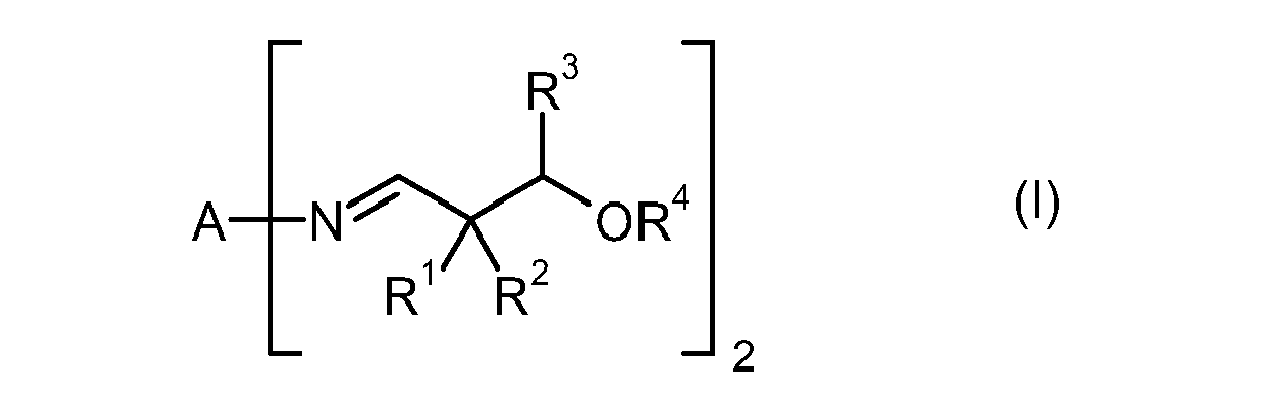
- Die Reste R1 und R2 stehen unabhängig voneinander jeweils für einen einwertigen Kohlenwasserstoffrest mit 1 bis 12 C-Atomen oder zusammen für einen zweiwertigen Kohlenwasserstoffrest mit 4 bis 20 C-Atomen, welcher Teil eines, gegebenenfalls substituierten, carbocyclischen Rings mit 5 bis 8, bevorzugt mit 6, C-Atomen ist. Bevorzugt stehen R1 und R2 für Methylgruppen.
- Der Rest R3 steht für ein Wasserstoffatom oder für eine Alkyl- oder Arylalkylgruppe, insbesondere für ein Wasserstoffatom.
- Der Rest R4 steht für einen, gegebenenfalls Heteroatome enthaltenden, Kohlenwasserstoffrest mit 6 bis 30 C-Atomen oder für einen Rest der Formel (II).

- Hierbei steht der Rest R5 entweder für einen linearen oder verzweigten Alkylrest mit 6 bis 30 C-Atomen, gegebenenfalls mit cyclischen Anteilen und gegebenenfalls mit mindestens einem Heteroatom, insbesondere Sauerstoff in Form von Ether-, Ester- oder Aldehydgruppen, oder für einen einfach oder mehrfach ungesättigten linearen oder verzweigten Kohlenwasserstoffrest mit 6 bis 30 C-Atomen, oder für einen, gegebenenfalls substituierten, aromatischen oder heteroaromatischen 5- oder 6-gliedrigen Ring. Bevorzugt steht R4 für einen Rest der Formel (II), wobei R5 insbesondere für eine Alkylgruppe mit 11 bis 30 C-Atomen, bevorzugt mit 11 C-Atomen, steht.
- Meist bevorzugt sind cycloaliphatische Dialdimine der Formel (I), bei denen R1 und R2 für Methylgruppen stehen, R3 für ein Wasserstoffatom steht und R4 für einen Rest der Formel (II) steht, wobei R5 für eine Alkylgruppe mit 11 bis 30 C-Atomen, insbesondere mit 11 C-Atomen, steht.
- Weiterhin steht A im cycloaliphatischen Dialdimin der Formel (I) für den Rest eines cycloaliphatischen primären Diamins nach Entfernung der beiden primären Aminogruppen, wobei dieser Rest keine Gruppierungen aufweist, welche mit Isocyanatgruppen reaktionsfähig sind.
- Insbesondere enthält A keine Hydroxylgruppen, keine primären oder sekundären Aminogruppen, keine Mercaptogruppen, keine Harnstoffgruppen und keine anderen Gruppen mit aktivem Wasserstoff.
- Mit "Poly" beginnende Substanznamen wie Polyol oder Polyisocyanat bezeichnen im vorliegenden Dokument Substanzen, die formal zwei oder mehr der in ihrem Namen vorkommenden funktionellen Gruppen pro Molekül enthalten.
- Der Begriff "Polymer" umfasst im vorliegenden Dokument einerseits ein Kollektiv von chemisch einheitlichen, sich aber in Bezug auf Polymerisationsgrad, Molmasse und Kettenlänge unterscheidenden Makromolekülen, das durch eine Polyreaktion (Polymerisation, Polyaddition, Polykondensation) hergestellt wurde. Der Begriff umfasst andererseits auch Derivate eines solchen Kollektivs von Makromolekülen aus Polyreaktionen, Verbindungen also, die durch Umsetzungen, wie beispielsweise Additionen oder Substitutionen, von funktionellen Gruppen an vorgegebenen Makromolekülen erhalten wurden und die chemisch einheitlich oder chemisch uneinheitlich sein können. Der Begriff umfasst weiterhin auch so genannte Prepolymere, das heisst reaktive oligomere Voraddukte, deren funktionelle Gruppen am Aufbau von Makromolekülen beteiligt sind.
- Der Begriff "Polyurethanpolymer" umfasst sämtliche Polymere, welche nach dem so genannten Diisocyanat-Polyadditions-Verfahren hergestellt werden. Dies schliesst auch solche Polymere ein, die nahezu oder gänzlich frei sind von Urethangruppen. Beispiele für Polyurethanpolymere sind Polyether-Polyurethane, Polyester-Polyurethane, Polyether-Polyharnstoffe, Polyharnstoffe, Polyester-Polyharnstoffe, Polyisocyanurate und Polycarbodiimide.
- Der Begriff "cycloaliphatisches primäres Diamin" bezeichnet hier und im Folgenden ein Diamin, welches zwei primäre Aminogruppen aufweist, die an einen Kohlenwasserstoffrest gebunden sind, welcher cycloaliphatisch ist oder cycloaliphatische Anteile aufweist.
- Der Begriff "aktiver Wasserstoff" bezeichnet im vorliegenden Dokument ein deprotonierbares, an ein Stickstoff-, Sauerstoff- oder Schwefelatom gebundenes Wasserstoffatom.
- Das cycloaliphatische Dialdimin der Formel (I) lässt sich durch eine Kondensationsreaktion zwischen mindestens einem cycloaliphatischen primären Diamin der Formel H2N-A-NH2 und mindestens einem Aldehyd der Formel (III) herstellen.

- Als cycloaliphatische primäre Diamine der Formel H2N-A-NH2 eignen sich beispielsweise 1,3- und 1,4-Bis-(aminomethyl)cyclohexan, 1-Cyclo-hexylamino-3-aminopropan, 2,5(2,6)-Bis-(aminomethyl)-bicyclo[2.2.1]heptan (NBDA, hergestellt von Mitsui Chemicals), 3(4),8(9)-Bis-(aminomethyl)-tricyclo-[5.2.1.02,6]decan oder 3,9-Bis-(3-aminopropyl)-2,4,8,10-tetraoxaspiro[5.5]-undecan.
- Als cycloaliphatische primäre Diamine der Formel H2N-A-NH2 bevorzugt sind solche, in welchen mindestens eine der Aminogruppen direkt an einen cycloaliphatischen Ring gebunden ist. Solche bevorzugte cycloaliphatische primäre Diamine sind insbesondere ausgewählt aus der Gruppe bestehend aus 1,2-Diaminocyclohexan (DCH), 1,3-Diaminocyclohexan, 1,4-Diaminocyclohexan, Bis-(4-aminocyclohexyl)-methan (H12MDA), Bis-(4-amino-3-methylcyclohexyl)-methan, Bis-(4-amino-3-ethylcyclohexyl)-methan, Bis-(4-amino-3,5-dimethylcyclohexyl)-methan, 1-Amino-3-aminomethyl-3,5,5-trimethylcyclohexan (IPDA), 2,2'-, 2,4'- und 4,4'-Diaminobicyclohexyl, 2- und 4-Methyl-1,3-diaminocyclohexan und 1,4-Diamino-2,2,6-trimethylcyclohexan. Bevorzugt sind DCH, 1,3-Diaminocyclohexan, 1,4-Diaminocyclohexan, IPDA, H12MDA und Bis-(4-amino-3-methylcyclohexyl)-methan. Meist bevorzugt sind IPDA und H12MDA.
- Zur Herstellung eines cycloaliphatischen Dialdimins der Formel (I) werden typischerweise Aldehyde der Formel (III) verwendet. Diese Aldehyde haben die Eigenschaft, dass ihre Reste R1, R2, R3 und R4 keine Gruppierungen aufweisen, die mit Isocyanatgruppen reaktionsfähig sind. Insbesondere weisen R1, R2, R3 und R4 keine Hydroxylgruppen, keine primären oder sekundäre Aminogruppen, keine Mercaptogruppen, keine Harnstoffgruppen oder keine anderen Gruppen mit aktivem Wasserstoff auf.
- Geeignete Aldehyde der Formel (111) sind in einer ersten Ausführungsform Aldehyde, welche als Rest R4 einen, gegebenenfalls Heteroatome enthaltenden, Kohlenwasserstoffrest mit 6 bis 30 C-Atomen tragen. Sie stellen Ether von aliphatischen, arylaliphatischen oder cycloaliphatischen 2,2-disubstituierten 3-Hydroxyaldehyden mit Phenolen oder Alkoholen, beispielsweise Fettalkoholen, dar. Geeignete 2,2-disubstituierte 3-Hydroxyaldehyde sind ihrerseits erhältlich aus Aldol-Reaktionen, insbesondere gekreuzten Aldol-Reaktionen, zwischen primären oder sekundären aliphatischen Aldehyden, insbesondere Formaldehyd, und sekundären aliphatischen, sekundären arylaliphatischen oder sekundären cycloaliphatischen Aldehyden, wie beispielsweise Isobutyraldehyd, 2-Methylbutyraldehyd, 2-Ethylbutyraldehyd, 2-Methylvaleraldehyd, 2-Ethylcapronaldehyd, Cyclopentancarboxaldehyd, Cyclohexancarboxaldehyd, 1,2,3,6-Tetrahydrobenzaldehyd, 2-Methyl-3-phenylpropionaldehyd, 2-Phenylpropionaldehyd (Hydratropaldehyd) oder Diphenylacetaldehyd. Insbesondere geeignete Aldehyde sind 2,2-Dimethyl-3-lauroxy-propanal und 2,2-Dimethyl-3-stearoxy-propanal.
- In einer zweiten, bevorzugten Ausführungsform sind geeignete Aldehyde der Formel (III) Verbindungen der Formel (IV),

- Verbindungen der Formel (IV) sind Ester, welche insbesondere hergestellt werden aus der Reaktion der bereits beschriebenen 2,2-disubstituierten 3-Hydroxyaldehyde, wie beispielsweise 2,2-Dimethyl-3-hydroxypropanal, 2-Hydroxymethyl-2-methyl-butanal, 2-Hydroxymethyl-2-ethyl-butanal, 2-Hydroxymethyl-2-methyl-pentanal, 2-Hydroxymethyl-2-ethyl-hexanal, 1-Hydroxymethyl-cyclopentancarboxaldehyd, 1-Hydroxymethyl-cyclohexancarboxaldehyd 1-Hydroxymethyl-cyclohex-3-encarboxaldehyd, 2-Hydroxymethyl-2-methyl-3-phenyl-propanal, 3-Hydroxy-2-methyl-2-phenyl-propanal und 3-Hyd-roxy-2,2-diphenyl-propanal, mit geeigneten Carbonsäuren.
- Beispiele für geeignete Carbonsäuren sind gesättigte aliphatische Carbonsäuren, wie 2-Ethylcapronsäure, Oenanthsäure, Caprylsäure, Pelargonsäure, Caprinsäure, Undecansäure, Laurinsäure, Tridecansäure, Myristinsäure, Pentadecansäure, Palmitinsäure, Margarinsäure, Stearinsäure, Nonadecansäure, Arachinsäure; einfach ungesättigte aliphatische Carbonsäuren wie Palmitoleinsäure, Ölsäure, Erucasäure; mehrfach ungesättigte aliphatische Carbonsäuren wie Linolsäure, Linolensäure, Elaeostearinsäure, Arachidonsäure; cycloaliphatische Carbonsäuren wie Cyclohexancarbonsäure; arylaliphatische Carbonsäuren wie Phenylessigsäure; aromatische Carbonsäuren wie Benzoesäure, Naphthoesäure, Toluylsäure, Anissäure; Isomere dieser Säuren; Fettsäuregemische aus der technischen Verseifung von natürlichen Ölen und Fetten wie beispielsweise Rapsöl, Sonnenblumenöl, Leinöl, Ölbaumöl, Kokosnussöl, Ölpalmkernöl und Ölpalmöl; sowie Dicarbonsäuremonoalkyl- und -arylester, wie sie aus der einfachen Veresterung von Dicarbonsäuren wie Bernsteinsäure, Glutarsäure, Adipinsäure, Pimelinsäure, Korksäure, Azelainsäure, Sebacinsäure, 1,12-Dodecandisäure, Maleinsäure, Fumarsäure, Hexahydrophthalsäure, Hexahydroisophthalsäure, Hexahydroterephthalsäure, 3,6,9-Trioxaundecandisäure und ähnliche Derivate von Polyethylenglykol, mit Alkoholen wie Methanol, Ethanol, Propanol, Butanol, höheren Homologen und Isomeren dieser Alkohole erhalten werden.
- Bevorzugte Aldehyde der Formel (IV) sind 3-Benzoyloxy-2,2-di-methylpropanal, 3-Cyclohexanoyloxy-2,2-dimethylpropanal, 2,2-Dimethyl-3-(2-ethylhexyloxy)-propanal, 2,2-Dimethyl-3-lauroyloxy-propanal, 2,2-Dimethyl-3-myristoyloxypropanal, 2,2-Dimethyl-3-palmitoyloxy-propanal, 2,2-Dimethyl-3-stearoyloxy-propanal sowie analoge Ester anderer 2,2-disubstituierter 3-Hydroxyaldehyde.
- In einer besonders bevorzugten Ausführungsform steht R4 für einen Rest der Formel (II), wobei R5 ausgewählt ist aus der Gruppe bestehend aus Phenyl, Cyclohexyl, 2-Ethylhexyl und den C11-, C13-, C15- und C17-Alkylgruppen.
- Besonders bevorzugt ist 2,2-Dimethyl-3-lauroyloxypropanal.
- In einer bevorzugten Herstellmethode eines Aldehyds der Formel (IV) wird ein 2,2-disubstituierter 3-Hydroxyaldehyd, beispielsweise 2,2-Dimethyl-3-hydroxypropanal, welcher beispielsweise aus Formaldehyd (oder Paraformaldehyd) und Isobutyraldehyd, gegebenenfalls in situ, hergestellt werden kann, mit einer Carbonsäure zum entsprechenden Ester umgesetzt. Diese Veresterung kann ohne die Verwendung von Lösungsmitteln nach bekannten Methoden erfolgen. Diese sind beispielsweise beschrieben in Houben-Weyl, "Methoden der organischen Chemie", Vol. VIII, Seiten 516 - 528.
- Zur Herstellung eines Aldehyds der Formel (IV), dessen Rest R5 mindestens ein Heteroatom, insbesondere Sauerstoff in Form von Ether-, Ester- oder Aldehydgruppen, aufweist, wird der 2,2-disubstituierte 3-Hydroxyaldehyd entweder mit einer Carbonsäure, welche die entsprechenden funktionellen Gruppen enthält, oder mit einer Dicarbonsäure umgesetzt. So wird beispielsweise aus der Veresterung zweier 2,2-disubstituierter 3-Hydroxyaldehyde mit einer aliphatischen oder cycloaliphatischen Dicarbonsäure, wie beispielsweise Bernsteinsäure, Glutarsäure, Adipinsäure, Azelainsäure, Sebacinsäure oder Cyclohexandisäure, der entsprechende aliphatische oder cycloaliphatische Dialdehyd der Formel (V) erhalten,

- In einer besonders bevorzugten Ausführungsform sind die Aldehyde der Formel (III) geruchsfrei. Unter einer "geruchsfreien" Substanz wird eine Substanz verstanden, die so geruchsarm ist, dass sie für die meisten menschlichen Individuen nicht riechbar, das heisst mit der Nase nicht wahrnehmbar, ist.
- Geruchsfreie Aldehyde der Formel (III) sind einerseits Aldehyde der Formel (III), welche als Rest R4 einen, gegebenenfalls Heteroatome enthaltenden, Kohlenwasserstoffrest mit 11 bis 30 C-Atomen tragen; und andererseits Aldehyde der Formel (IV), welche als Rest R5 entweder einen linearen oder verzweigten Alkylrest mit 11 bis 30 C-Atomen, gegebenenfalls mit cyclischen Anteilen und gegebenenfalls mit mindestens einem Heteroatom, insbesondere Sauerstoff in Form von Ether-, Ester- oder Aldehydgruppen, oder für einen einfach oder mehrfach ungesättigten linearen oder verzweigten Kohlenwasserstoffrest mit 11 bis 30 C-Atomen aufweisen.
- Beispiele für solche geruchsfreien Aldehyde sind Veresterungsprodukte aus den bereits genannten 2,2-disubstituierten 3-Hydroxyaldehyden mit Carbonsäuren wie beispielsweise Laurinsäure, Tridecansäure, Myristinsäure, Pentadecansäure, Palmitinsäure, Margarinsäure, Stearinsäure, Nonadecansäure, Arachinsäure, Palmitoleinsäure, Ölsäure, Erucasäure, Linolsäure, Linolensäure, Elaeostearinsäure, Arachidonsäure, Fettsäuren aus der technischen Verseifung von natürlichen Ölen und Fetten, wie beispielsweise Rapsöl, Sonnenblumenöl, Leinöl, Ölbaumöl, Kokosnussöl, Ölpalmkernöl und Ölpalmöl, sowie technische Gemische von Fettsäuren, welche diese Säuren enthalten. Bevorzugte geruchsfreie Aldehyde der Formel (IV) sind 2,2-Dimethyl-3-lauroyloxypropanal, 2,2-Dimethyl-3-myristoyloxy-propanal, 2,2-Dimethyl-3-palmitoyloxypropanal und 2,2-Dimethyl-3-stearoyl-oxypropanal. Besonders bevorzugt ist 2,2-Dimethyl-3-lauroyloxypropanal.
- Als cycloaliphatisches Dialdimin der Formel (I) können auch Mischungen verschiedener cycloaliphatischer Dialdimine verwendet werden, insbesondere auch Mischungen verschiedener Dialdimine aus verschiedenen cycloaliphatischen primären Diaminen der Formel H2N-A-NH2 und verschiedenen oder gleichen Aldehyden der Formel (III) oder (IV).
- Die cycloaliphatischen Dialdimine der Formel (1) haben die Eigenschaft, dass sie keine tautomeren Enamine bilden können, da sie in a-Stellung zum C-Atom der Aldiminogruppe keinen Wasserstoff als Substituenten tragen. Solche Aldimine bilden zusammen mit Polyurethanpolymeren P lagerfähige Gemische, auch wenn hochreaktive Isocyanatgruppen darin vorhanden sind.
- Des Weiteren haben die cycloaliphatischen Dialdimine der Formel (I) die Eigenschaft, dass sie geruchsarm oder geruchsfrei sind, und dass auch der bei ihrer Herstellung verwendete Aldehyd der Formel (III) oder (IV) geruchsarm oder geruchsfrei ist.
- Bei der Aushärtung der Zusammensetzung wird als Abspaltungsprodukt der zur Herstellung des cycloaliphatischen Dialdimins der Formel (I) verwendete Aldehyd, das heisst ein Aldehyd der Formel (III) oder (IV), freigesetzt. Dadurch, dass die cycloaliphatischen Dialdimine der Formel (I) und diese Aldehyde geruchsarm oder geruchsfrei sind, sind Zusammensetzungen erhältlich, welche ohne starke Geruchsbildung aushärten. Werden zur Herstellung der cycloaliphatischen Dialdimine der Formel (I) ausschliesslich die beschriebenen geruchsfreien Ausführungsformen dieser Aldehyde verwendet, so sind geruchsfrei aushärtende Zusammensetzungen erhältlich.
- Das Polyurethanpolymer P wird typischerweise hergestellt aus mindestens einem Polyol und mindestens einem cycloaliphatischen Diisocyanat.
- Als Polyole für die Herstellung eines Polyurethanpolymers P können beispielsweise die folgenden handelsüblichen Polyole oder Mischungen davon eingesetzt werden:
- Polyetherpolyole, auch Polyoxyalkylenpolyole oder Oligoetherole genannt, welche Polymerisationsprodukte von Ethylenoxid, 1,2-Propylenoxid, 1,2- oder 2,3-Butylenoxid, Tetrahydrofuran oder Mischungen davon sind, eventuell polymerisiert mit Hilfe eines Startermoleküls mit zwei oder mehreren aktiven Wasserstoffatomen wie beispielsweise Wasser, Ammoniak oder Verbindungen mit mehreren OH- oder NH-Gruppen wie beispielsweise 1,2-Ethandiol, 1,2- und 1,3-Propandiol, Neopentylglykol, Diethylenglykol, Triethylenglykol, die isomeren Dipropylenglykole und Tripropylenglykole, die isomeren Butandiole, Pentandiole, Hexandiole, Heptandiole, Octandiole, Nonandiole, Decandiole, Undecandiole, 1,3- und 1,4-Cyclohexandimethanol, Bisphenol A, hydriertes Bisphenol A, 1,1,1-Trimethylolethan, 1,1,1-Trimethylolpropan, Glycerin, Anilin, sowie Mischungen der genannten Verbindungen. Eingesetzt werden können sowohl Polyoxyalkylenpolyole, die einen niedrigen Ungesättigtheitsgrad aufweisen (gemessen nach ASTM D-2849-69 und angegeben in Milliequivalent Ungesättigtheit pro Gramm Polyol (mEq/g)), hergestellt beispielsweise mit Hilfe von so genannten Double Metal Cyanide Complex-Katalysatoren (DMC-Katalysatoren), als auch Polyoxyalkylenpolyole mit einem höheren Ungesättigtheitsgrad, hergestellt beispielsweise mit Hilfe von anionischen Katalysatoren wie NaOH, KOH, CsOH oder Alkalialkoholaten.
Besonders geeignet sind Polyoxyethylenpolyole und Polyoxypropylenpolyole, insbesondere Polyoxyethylendiole, Polyoxypropylendiole, Polyoxyethylentriole und Polyoxypropylentriole.
Insbesondere geeignet sind Polyoxyalkylendiole oder Polyoxyalkylentriole mit einem Ungesättigtheitsgrad tiefer als 0.02 mEq/g und mit einem Molekulargewicht im Bereich von 1'000 bis 30'000 g/mol, sowie Polyoxyethylendiole, Polyoxyethylentriole, Polyoxypropylendiole und Polyoxypropylentriole mit einem Molekulargewicht von 400 bis 8'000 g/mol. Unter "Molekulargewicht" oder "Molgewicht" versteht man im vorliegenden Dokument stets das Molekulargewichtsmittel Mn.
Ebenfalls besonders geeignet sind so genannte Ethylenoxidterminierte ("EO-endcapped", ethylene oxide-endcapped) Polyoxypropylenpolyole. Letztere sind spezielle Polyoxypropylenpolyoxyethylenpolyole, die beispielsweise dadurch erhalten werden, dass reine Polyoxypropylenpolyole, insbesondere Polyoxypropylendiole und -triole, nach Abschluss der Polypropoxylierungsreaktion mit Ethylenoxid weiter alkoxyliert werden und dadurch primäre Hydroxylgruppen aufweisen. Bevorzugt sind in diesem Fall Polyoxypropylenpolyoxyethylendiole und Polyoxypropylenpolyoxyethylentriole. - Styrol-Acrylnitril- oder Acrylnitril-Methylmethacrylat-gepfropfte Polyetherpolyole.
- Polyesterpolyole, auch Oligoesterole genannt, hergestellt beispielsweise aus zwei- bis dreiwertigen Alkoholen wie beispielsweise 1,2-Ethandiol, Diethylenglykol, 1,2-Propandiol, Dipropylenglykol, 1,4-Butandiol, 1,5-Pentandiol, 1,6-Hexandiol, Neopentylglykol, Glycerin, 1,1,1-Trimethylolpropan oder Mischungen der vorgenannten Alkohole mit organischen Dicarbonsäuren oder deren Anhydride oder Ester wie beispielsweise Bernsteinsäure, Glutarsäure, Adipinsäure, Korksäure, Azelainsäure, Sebacinsäure, Dodecandicarbonsäure, Maleinsäure, Fumarsäure, Phthalsäure, Isophthalsäure, Terephthalsäure und Hexahydrophthalsäure oder Mischungen der vorgenannten Säuren, sowie Polyesterpolyole aus Lactonen wie beispielsweise ε-Caprolacton.
- Polycarbonatpolyole, wie sie durch Umsetzung beispielsweise der oben genannten - zum Aufbau der Polyesterpolyole eingesetzten - Alkohole mit Dialkylcarbonaten, Diarylcarbonaten oder Phosgen zugänglich sind.
- Polyacrylat- und Polymethacrylatpolyole.
- Polykohlenwasserstoffpolyole, auch Oligohydrocarbonole genannt, wie beispielsweise polyhydroxyfunktionelle Ethylen-Propylen-, Ethylen-Butylen- oder Ethylen-Propylen-Dien-Copolymere, wie sie beispielsweise von der Firma Kraton Polymers hergestellt werden, oder polyhydroxyfunktionelle Copolymere aus Dienen wie 1,3-Butandien oder Diengemischen und Vinylmonomeren wie Styrol, Acrylnitril oder Isobutylen, oder polyhydroxyfunktionelle Polybutadienpolyole, wie beispielsweise solche, die durch Copolymerisation von 1,3-Butadien und Allylalkohol hergestellt werden und auch hydriert sein können.
- Polyhydroxyfunktionelle Acrylonitril/Butadien-Copolymere, wie sie beispielsweise aus Epoxiden oder Aminoalkoholen und carboxylterminierten Acrylonitril/Butadien-Copolymeren (kommerziell erhältlich unter dem Namen Hycar® CTBN von Noveon) hergestellt werden können.
- Diese genannten Polyole weisen bevorzugt ein mittleres Molekulargewicht von 250 - 30'000 g/mol, insbesondere von 1'000 - 30'000 g/mol, und weisen bevorzugt eine mittlere OH-Funktionalität im Bereich von 1.6 bis 3 auf.
- Besonders geeignete Polyole sind Polyesterpolyole und Polyetherpolyole, insbesondere Polyoxyethylenpolyol, Polyoxypropylenpolyol und Polyoxypropylenpolyoxyethylenpolyol, bevorzugt Polyoxyethylendiol, Polyoxypropylendiol, Polyoxyethylentriol, Polyoxypropylentriol, Polyoxypropylenpolyoxyethylendiol und Polyoxypropylenpolyoxyethylentriol.
- Zusätzlich zu diesen genannten Polyolen können kleine Mengen von niedrigmolekularen zwei- oder mehrwertigen Alkoholen wie beispielsweise 1,2-Ethandiol, 1,2- und 1,3-Propandiol, Neopentylglykol, Diethylenglykol, Triethylenglykol, die isomeren Dipropylenglykole und Tripropylenglykole, die isomeren Butandiole, Pentandiole, Hexandiole, Heptandiole, Octandiole, Nonandiole, Decandiole, Undecandiole, 1,3- und 1,4-Cyclohexandimethanol, hydriertes Bisphenol A, dimere Fettalkohole, 1,1,1-Trimethylolethan, 1,1,1-Trimethylolpropan, Glycerin, Pentaerythrit, Zuckeralkohole wie Xylit, Sorbit oder Mannit, Zucker wie Saccharose, andere höherwertige Alkohole, niedrigmolekulare Alkoxylierungsprodukte der vorgenannten zwei- und mehrwertigen Alkohole, sowie Mischungen der vorgenannten Alkohole bei der Herstellung des Polyurethanpolymers P mitverwendet werden.
- Als cycloaliphatische Diisocyanate zur Herstellung des Polyurethanpolymers P können handelsübliche cycloaliphatische Diisocyanate verwendet werden, welche insbesondere ausgewählt sind aus der Gruppe bestehend aus Cyclohexan-1,3-diisocyanat, Cyclohexan-1,4-düsocyanat, 1-Isocyanato-3,3,5-trimethyl-5-isocyanatomethyl-cyclohexan (IPDI), Perhydro-2,4`-diphenylmethandüsocyanat, Perhydro-4,4'-diphenylmethandiisocyanat, 1,4-Diisocyanato-2,2,6-trimethylcyclohexan, 2-Methyl-1,3-düsocyanatocyclohexan und 4-Methyl-1,3-diisocyanatocyclohexan, insbesondere IPDI, Perhydro-2,4'-diphenylmethandiisocyanat und Perhydro-4,4`-diphenylmethandiisocyanat, bevorzugt IPDI.
- Weiterhin können Mischungen von Polyurethanpolymeren P, insbesondere Mischungen von einem bei Raumtemperatur flüssigen Polyurethanpolymer P mit einem bei Raumtemperatur festen Polyurethanpolymer P, eingesetzt werden.
- Der Anteil des Polyurethanpolymers P, welches cycloaliphatische Isocyanatgruppen aufweist, beträgt vorzugsweise 10 bis 95 Gew.-%, insbesondere 15 bis 80 Gew.-%, bezogen auf die gesamte Zusammensetzung.
- Der Anteil des cycloaliphatischen Dialdimins der Formel (I) ist vorzugsweise derart, dass das Verhältnis zwischen den Aldiminogruppen und den Isocyanatgruppen des Polyurethanpolymers P einen Wert von 0.1 bis 1.1, insbesondere 0.15 bis 1.0, bevorzugt 0.2 bis 0.9, beträgt.
- Vorzugsweise weist die Zusammensetzung weiterhin einen Füllstoff auf. Der Füllstoff beeinflusst sowohl die rheologischen Eigenschaften der nicht ausgehärteten Zusammensetzung als auch die mechanischen Eigenschaften und die Oberflächenbeschaffenheit der ausgehärteten Zusammensetzung. Geeignete Füllstoffe sind anorganische und organische Füllstoffe, zum Beispiel natürliche, gemahlene oder gefällte Calciumcarbonate, welche gegebenenfalls mit Fettsäuren, insbesondere Stearaten, beschichtet sind, Bariumsulfat (BaSO4, auch Baryt oder Schwerspat genannt), calcinierte Kaoline, Quarzmehl, Aluminiumoxide, Aluminiumhydroxide, Kieselsäuren, insbesondere hochdisperse Kieselsäuren aus Pyrolyseprozessen, Russe, insbesondere industriell hergestellter Russ (Carbon Black; im Folgenden als "Russ" bezeichnet), PVC-Pulver oder Hohlkugeln. Bevorzugte Füllstoffe sind Bariumsulfat und Calciumcarbonate, Russ sowie flammhemmende Füllstoffe wie Hydroxide oder Hydrate, insbesondere Hydroxide oder Hydrate von Aluminium, bevorzugt Aluminiumhydroxid.
- Es ist durchaus möglich und kann sogar von Vorteil sein, eine Mischung verschiedener Füllstoffe einzusetzen.
- Eine geeignete Menge Füllstoff liegt beispielsweise im Bereich von 10 bis 70 Gew.-%, bevorzugt 20 bis 60 Gew.-%, bezogen auf die gesamte Zusammensetzung.
- Die Zusammensetzung kann ein Lösungsmittel enthalten, oder auch nicht. Enthält die Zusammensetzung ein Lösungsmittel, ist darauf zu achten, dass dieses Lösungsmittel keine mit Isocyanatgruppen reaktive Gruppen aufweist, insbesondere keine Hydroxylgruppen und keine anderen Gruppen mit aktivem Wasserstoff.
- Geeignete Lösungsmittel sind insbesondere ausgewählt aus der Gruppe bestehend aus Ketonen wie Aceton, Methylethylketon, Diisobutylketon, Acetylaceton, Mesityloxid, Cyclohexanon und Methylcyclohexanon; Ester, beispielsweise Acetate wie Ethylacetat, Propylacetat und Butylacetat, Formiate, Propionate und Malonate wie Diethylmalonat; Ether wie Dialkylether, Ketonether und Esterether, beispielsweise Diisopropylether, Diethylether, Dibutylether, Diethylenglykoldiethylether und Ethylenglykoldiethylether; aliphatische und aromatische Kohlenwasserstoffe wie Toluol, Xylol, Heptan, Octan und Erdölfraktionen wie Naphtha, White Spirit, Petrolether und Benzin; halogenierte Kohlenwasserstoffe wie Methylenchlorid; sowie N-alkylierte Lactame, wie beispielsweise N-Methylpyrrolidon.
- Bevorzugt sind Xylol, Toluol, White Spirit und Erdölfraktionen im Siedebereich von 100 °C bis 200 °C.
- Geeignete Mengen Lösungsmittel liegen typischerweise im Bereich von 1 bis 50 Gew.-%, insbesondere 1 bis 25 Gew.-%, bezogen auf die gesamte Zusammensetzung.
- In der Zusammensetzung können weitere Bestandteile vorhanden sein. Weitere Bestandteile sind insbesondere Hilfs- und Zusatzstoffe wie:
- Weichmacher, beispielsweise Ester organischer Carbonsäuren oder deren Anhydride, zum Beispiel Phthalate wie Dioctylphthalat, Diisononylphthalat oder Diisodecylphthalat, Adipate wie Dioctyladipat, Azelate und Sebacate; organische Phosphor- und Sulfonsäureester, Polybutene und Polyisobutene;
- Katalysatoren, wie sie in der Polyurethanchemie üblich sind, insbesondere Zinn- und Wismutverbindungen, tertiäre Amine, organische Carbon- und Sulfonsäuren;
- Fasern, beispielsweise aus Polyethylen;
- Pigmente, beispielsweise Titandioxid oder Eisenoxide;
- Rheologie-Modifizierer wie beispielsweise Verdickungsmittel oder Thixotropierungsmittel, zum Beispiel Harnstoffverbindungen, Polyamidwachse, Bentonite oder pyrogene Kieselsäuren;
- Reaktivverdünner oder Vernetzer, beispielsweise niedrigmolekulare Oligomere und Derivate von Diisocyanaten wie MDI, PMDI, TDI, HDI, 1,12-Dodecamethylendüsocyanat, Cyclohexan-1,3-diisocyanat oder Cyclohexan-1,4-diisocyanat, IPDI, Perhydro-2,4'-diphenylmethandiisocyanat und Perhydro-4,4`-diphenylmethandüsocyanat, 1,3- und 1,4-Tetramethylxylylendiisocyanat, insbesondere Isocyanurate, Carbodiimide, Uretonimine, Biurete, Allophanate und Iminooxadiazindione der genannten Diisocyanate, Addukte von Diisocyanaten mit kurzkettigen Polyolen, Adipinsäuredihydrazid und andere Dihydrazide, sowie blockierte Amine in Form von Polyaldiminen, Polyketiminen, Oxazolidinen oder Polyoxazolidinen;
- Trocknungsmittel, wie beispielsweise Molekularsiebe, Calciumoxid, hochreaktive Isocyanate wie p-Tosylisocyanat, Orthoameisensäureester, Alkoxysilane wie Tetraethoxysilan, Organoalkoxysilane wie Vinyltrimethoxysilan, und Organoalkoxysilane, welche in α-Stellung zur Silangruppe eine funktionelle Gruppe aufweisen;
- Haftvermittler, insbesondere Organoalkoxysilane, im Folgenden "Silane" genannt, wie beispielsweise Epoxysilane, Vinylsilane, (Meth)acrylsilane, Isocyanatosilane, Carbamatosilane, S-(Alkylcarbonyl)-mercaptosilane und Aldiminosilane, oligomere Formen dieser Silane, sowie Addukte von Aminosilanen und/oder Mercaptosilanen mit Polyisocyanaten;
- nicht-reaktive thermoplastische Polymere, wie beispielsweise Homo- oder Copolymere von ungesättigten Monomeren, insbesondere von ungesättigten Monomeren, welche ausgewählt sind aus der Gruppe umfassend Ethylen, Propylen, Butylen, Isobutylen, Isopren, Vinylacetat oder höhere Ester davon, und (Meth)acrylat, wobei Ethylenvinylacetat-Copolymere (EVA), ataktische Poly-a-Olefine (APAO), Polypropylene (PP) und Polyethylene (PE) besonders geeignet sind;
- reaktive thermoplastische Polymere, insbesondere Isocyanatgruppen terminierte Polyurethanpolymere, zu deren Herstellung Polyester-Polyole, vorzugsweise bei Raumtemperatur feste Polyester-Polyole, verwendet werden und die ihren Schmelzpunkt im Bereich der Applikationstemperatur der Zusammensetzung als Warmschmelzklebstoff, bevorzugt zwischen 40 °C und 80 °C, aufweisen;
- Stabilisatoren gegen Wärme, Licht- und UV-Strahlung;
- flammhemmende Substanzen;
- oberflächenaktive Substanzen wie beispielsweise Netzmittel, Verlaufsmittel, Entlüftungsmittel oder Entschäumer;
- Biozide, wie beispielsweise Algizide, Fungizide oder das Pilzwachstum hemmende Substanzen;
- Weiterhin vorteilhaft enthält die Zusammensetzung mindestens einen Katalysator, welcher die Hydrolyse der Aldimingruppen und/oder die Reaktion der Isocyanatgruppen beschleunigt.
- Katalysatoren, welche die Hydrolyse des Dialdimins beschleunigen, sind beispielsweise organische Carbonsäuren, wie Benzoesäure oder Salicylsäure, organische Carbonsäureanhydride, wie Phthalsäureanhydrid oder Hexahydrophthalsäureanhydrid, Silylester organischer Carbonsäuren, organische Sulfonsäuren wie p-Toluolsulfonsäure oder 4-Dodecylbenzolsulfonsäure, Sulfonsäureester, andere organische oder anorganische Säuren, oder Mischungen der vorgenannten Säuren und Säureester.
- Katalysatoren, welche die Reaktion der Isocyanatgruppen mit Wasser beschleunigen, sind beispielsweise Organozinnverbindungen wie Dibutylzinndilaurat, Dibutylzinndichlorid, Dibutylzinndiacetylacetonat, Bismut-organische Verbindungen oder Bismut-Komplexe, oder amingruppenhaltige Verbindungen wie beispielsweise 2,2'-Dimorpholinodiethylether oder 1,4-Diazabicyclo[2.2.2]-octan, oder andere, in der Polyurethanchemie übliche, Katalysatoren für die Reaktion der Isocyanatgruppen.
- Es kann vorteilhaft sein, wenn in der Polyurethanzusammensetzung eine Mischung aus mehreren Katalysatoren vorhanden ist, insbesondere ein Gemisch aus einer Säure und einer metallorganischen Verbindung oder einem Metallkomplex, aus einer Säure und einer Aminogruppen enthaltenden Verbindung, oder ein Gemisch aus einer Säure, einer metallorganischen Verbindung oder einem Metallkomplex, und einer Aminogruppen enthaltenden Verbindung.
- Ein typischer Gehalt an Katalysator beträgt üblicherweise 0.005 bis 2 Gew.-%, bezogen auf die gesamte Zusammensetzung, wobei dem Fachmann klar ist, welche Einsatzmengen für welche Katalysatoren sinnvoll sind.
- Es ist vorteilhaft, alle genannten, in der Zusammensetzung gegebenenfalls vorhandenen Bestandteile, insbesondere einen Füllstoff und einen Katalysator, so auszuwählen, dass die Lagerstabilität der Zusammensetzung durch die Anwesenheit eines solchen Bestandteils nicht negativ beeinflusst wird, das heisst, dass sich die Zusammensetzung in ihren Eigenschaften, insbesondere den Applikations- und Aushärtungseigenschaften, bei der Lagerung nicht oder nur wenig verändert. Dies bedingt, dass zur chemischen Aushärtung der beschriebenen Zusammensetzung führende Reaktionen, insbesondere der Isocyanatgruppen, während der Lagerung nicht in signifikantem Ausmass auftreten. Es ist deshalb insbesondere von Vorteil, dass die genannten Bestandteile kein oder höchstens Spuren von Wasser enthalten oder beim Lagern freisetzen. Es kann deshalb sinnvoll sein, gewisse Bestandteile vor dem Einmischen in die Zusammensetzung chemisch oder physikalisch zu trocknen.
- Die beschriebene Zusammensetzung wird unter Ausschluss von Feuchtigkeit hergestellt und aufbewahrt. Die Zusammensetzung ist lagerstabil, das heisst, sie kann unter Ausschluss von Feuchtigkeit in einer geeigneten Verpackung oder Anordnung, wie beispielsweise einem Fass, einem Beutel oder einer Kartusche, über einen Zeitraum von mehreren Monaten bis zu einem Jahr und länger aufbewahrt werden, ohne dass sie sich in ihren Anwendungseigenschaften oder in ihren Eigenschaften nach der Aushärtung in einem für ihren Gebrauch relevanten Ausmass verändert. Üblicherweise wird die Lagerstabilität über die Messung der Viskosität oder der Auspresskraft ermittelt.
- Wird die Zusammensetzung in Kontakt mit Feuchtigkeit gebracht, beginnt sie, durch chemische Reaktionen der Aldimino- und der Isocyanatgruppen bedingt, auszuhärten und damit ihre Endfestigkeit zu erlangen. Somit betrifft ein weiterer Aspekt der vorliegenden Erfindung eine ausgehärtete Zusammensetzung, welche aus der Reaktion von Wasser, insbesondere in der Form von Luftfeuchtigkeit, mit einer vorhergehend beschriebenen Zusammensetzung erhalten wird. Die Aldiminogruppen des cycloaliphatischen Dialdimins der Formel (I) haben die Eigenschaft, bei Kontakt mit Feuchtigkeit zu hydrolysieren. Die dabei formal entstehenden freien Aminogruppen reagieren mit den in der Zusammensetzung vorhandenen Isocyanatgruppen, wobei Harnstoffgruppen entstehen und Aldehyde der Formel (III) freigesetzt werden.
- Bevorzugt sind die Isocyanatgruppen zu den Aldiminogruppen in stöchiometrischem Überschuss. Diese überschüssigen Isocyanatgruppen der Zusammensetzung reagieren direkt mit Feuchtigkeit und bilden unter Abspaltung von Kohlendioxid Harnstoffgruppen. Als Ergebnis dieser und allfälliger weiterer Reaktionen der Isocyanatgruppen härtet die Zusammensetzung aus. Dieser Prozess wird auch als Vernetzung bezeichnet. Das cycloaliphatische Dialdimin der Formel (I) wird bei der Aushärtung unter Freisetzung des zu seiner Herstellung eingesetzten Aldehyds in die ausgehärtete Polyurethan-Matrix eingebaut. Die Reaktion der Isocyanatgruppen mit dem hydrolysierenden Dialdimin muss dabei nicht notwendigerweise über freie Aminogruppen erfolgen. Selbstverständlich sind auch Reaktionen von bei der Hydrolyse auftretenden Zwischenstufen möglich. Beispielsweise ist es denkbar, dass eine hydrolysierende Aldiminogruppe des cycloaliphatischen Dialdimins der Formel (I) in der Form einer Halbaminalgruppe direkt mit einer Isocyanatgruppe reagiert.
- Die Zusammensetzung wird insbesondere als einkomponentige Zusammensetzung eingesetzt und ist feuchtigkeitshärtend. Das für die Aushärtung benötigte Wasser kann entweder aus der Luft stammen (Luftfeuchtigkeit), oder aber die vorgängig beschriebene Zusammensetzung kann mit einer Wasser enthaltenden Komponente in Kontakt gebracht werden, zum Beispiel durch Bestreichen, beispielsweise mit einem Abglättmittel, oder durch Besprühen, oder es kann der Zusammensetzung bei der Applikation eine Wasser enthaltende Komponente zugesetzt werden, zum Beispiel in Form einer wasserhaltigen Paste, die, beispielsweise über einen Statikmischer, eingemischt wird. Bei der Aushärtung mittels Luftfeuchtigkeit härtet die Zusammensetzung von aussen nach innen durch. Die Geschwindigkeit der Aushärtung wird dabei von verschiedenen Faktoren, wie beispielsweise der Diffusionsrate des Wassers, der Temperatur, der Umgebungsfeuchte und der Klebegeometrie, bestimmt; sie verlangsamt sich in der Regel mit dem Fortschreiten der Aushärtung.
- Werden bei der Aushärtung der Zusammensetzung nur geruchsfreie Aldehyde, wie die vorgängig beschriebenen, freigesetzt, so entsteht durch die Aushärtung der Zusammensetzung kein störender Geruch, was für viele Anwendungen, insbesondere in Innenräumen, ein grosser Vorteil oder sogar eine Voraussetzung ist.
- Die beschriebene Zusammensetzung härtet bei Kontakt mit Feuchtigkeit, beziehungsweise Wasser, rasch und ohne die Bildung von Blasen aus. Die ausgehärtete Zusammensetzung ist - auch unter Licht- und Temperatureinfluss - weitgehend vergilbungsfrei. Dies ermöglicht ihre Anwendung in Klebstoffen, Dichtstoffen und Beschichtungen, welche in transparenter Erscheinungsform oder in hellen Farbtönen verwendet werden und dabei farbstabil sein sollen.
- Bei der Aushärtung der Zusammensetzung nimmt deren Oberflächenklebrigkeit sehr schnell ab. Dies ist für eine Polyurethanzusammensetzung, welche aus cycloaliphatische Isocyanatgruppen aufweisenden Polyurethanpolymeren, insbesondere solchen auf Basis von IPDI, aufgebaut ist, ungewöhnlich und überraschend. Die Klebrigkeit einer üblichen solchen Zusammensetzung, insbesondere in der Anwendung als elastischer Kleb- oder Dichtstoff, ist oft stark ausgeprägt und nimmt erst einige Tage oder gar Wochen nach der Applikation ab, was die Zusammensetzung anfällig macht auf Verschmutzungen, insbesondere durch Stäube.
- Die beschriebene Zusammensetzung verfügt nach ihrer Aushärtung bei gleichbleibend guter Dehnbarkeit über eine bemerkenswert hohe Härte und Festigkeit, was für eine Polyurethanzusammensetzung, welche aus cycloaliphatische Isocyanatgruppen aufweisenden Polyurethanpolymeren, insbesondere solchen auf Basis von IPDI, aufgebaut ist, überraschend ist. Ihre Zugfestigkeit und Shore-Härte sind deutlich höher als jene von vergleichbaren Polyurethanzusammensetzungen, welche auf cycloaliphatische Isocyanatgruppen aufweisenden Polyurethanpolymeren und Dialdiminen ausgehend von nicht-cycloaliphatischen Diaminen aufgebaut sind. Eine derartige Verbesserung von Festigkeit und Härte, die sich aus der Verwendung der cycloaliphatischen Dialdimine der Formel (1) ergibt, konnte aus dem Stand der Technik nicht erwartet werden.
- Die beschriebene Zusammensetzung zeigt überdies eine geringe Tendenz, nach ihrer Aushärtung nicht im Polymer eingebundene flüssige Bestandteile, insbesondere die zur Herstellung der cycloaliphatischen Dialdimine der Formel (I) eingesetzten Aldehyde der Formeln (III), (IV) und/oder (V) sowie optional vorhandene Weichmacher, durch Migration auszuschwitzen. Dies ist für den Fachmann überraschend, da bei vergleichbaren Zusammensetzungen nach dem Stand der Technik, welche nicht-cycloaliphatische Dialdimine oder gar keine Dialdimine enthalten, ein deutlich stärkeres Ausschwitzen der migrationsfähigen Bestandteile beobachtet wird. Dies kann insbesondere auch für vergleichbare Zusammensetzungen zutreffen, welche Aldimine enthalten, die auf den gleichen Aldehyden wie die Dialdimine der Formel (1) beruhen, das heisst auf Aldehyden der Formeln (III), (IV) und/oder (V). Es wird vermutet, dass bei der beschriebenen Zusammensetzung die geringere Tendenz zum Ausschwitzen der migrationsfähigen Bestandteile darauf zurückzuführen ist, dass letztere, insbesondere die Aldehyde, wesentlich besser mit der Polymer-Matrix, insbesondere den cycloaliphatischen Harnstoff-Gruppen, verträglich sind.
- Das geringere Ausschwitzen von migrationsfähigen Bestandteilen in Kombination mit der raschen Aushärtung der beschriebenen Zusammensetzung verhindert weitgehend, dass die Oberfläche der Zusammensetzung nach deren Applikation über längere Zeit klebrig bleibt und somit Schmutz und Stäube an ihr haften bleiben. Weiterhin treten auf der Oberfläche der Zusammensetzung sowie auf dem Substrat, auf dem die Zusammensetzung appliziert wurde, keine oder weniger Flecken und Verunreinigungen auf als in üblichen Zusammensetzungen nach dem Stand der Technik. Flecken und Verunreinigungen auf Substraten durch migrierende Bestandteile, auch als "Staining" oder "Ausbluten" bezeichnet, treten insbesondere beim Abdichten von Fugen angrenzend an feinporige Materialien, insbesondere Beton, Zemente oder Natursteine, wie Marmor und Granit, auf, da diese Substrate aufgrund ihrer feinen Poren solche migrierenden Bestandteile leicht aufnehmen können. Weiterhin ist das Ausschwitzen von migrationsfähigen Bestandteilen bei Beschichtungen, welche anschliessend versiegelt werden sollen, problematisch, da die Migration von weichmacherartigen Substanzen in die Oberflächenversiegelung hinein oder durch diese hindurch nicht nur das optische Erscheinungsbild der gesamten Beschichtung empfindlich stören, sondern die Versiegelung sogar soweit aufweichen kann, dass diese weitgehend zerstört wird. Weiterhin problematisch ist das Ausschwitzen von migrationsfähigen Bestandteilen bei Verfugungen, bei welchen die Klebefuge anschliessend überstrichen oder überklebt werden soll, da der ausgeschwitzte Film auf der Fuge die Haftung zum Anstrich oder zum Klebstoff beeinträchtigen kann.
- Entsprechend der Inhaltsstoffe und deren Mengen weist die Zusammensetzung eine unterschiedliche Konsistenz und unterschiedliche Eigenschaften im nicht ausgehärteten sowie im ausgehärteten Zustand auf. Dieser ist charakteristisch für die jeweilige Anwendung der beschriebenen Zusammensetzung.
- Weiterhin umfasst die vorliegende Erfindung die Verwendung einer vorhergehend beschriebenen Zusammensetzung als Klebstoff, Dichtstoff und/oder als Beschichtung für Bau- und Industrieanwendungen.
- In einer Ausführungsform weist die Zusammensetzung bei Raumtemperatur eine flüssige Konsistenz mit guten Verlaufeigenschaften auf. Dadurch lässt sie sich einfach als selbstverlaufende Beschichtung auf überwiegend ebene Flächen applizieren, beispielsweise als Bodenbelag. Die Applikation der Zusammensetzung kann in mehreren Schichten erfolgen. Pro Schicht wird üblicherweise eine Schichtdicke von 0.5 bis 3 mm, insbesondere von 0.5 bis 2 mm, appliziert.
- In einer anderen Ausführungsform weist die Zusammensetzung bei Raumtemperatur eine pastöse Konsistenz mit strukturviskosen Eigenschaften auf und ist typischerweise geeignet als Kleb- und/oder Dichtstoff, insbesondere als elastischer Kleb- oder Dichtstoff.
- In einer speziellen Ausführungsform weist die Zusammensetzung eine bei Raumtemperatur feste Schmelzkomponente, welche vorzugsweise ein wie vorhergehend beschriebenes reaktives oder ein nicht-reaktives thermoplastisches Polymer ist, auf und wird zur besseren Handhabung bevorzugt warm, das heisst bei einer Temperatur oberhalb des Schmelzpunktes der Schmelzkomponente, appliziert. Dadurch erfolgt die Aushärtung durch zwei Vorgänge. Einerseits verfestigt sich die Zusammensetzung beim Abkühlen, indem die Schmelzkomponente, insbesondere das Polyurethanpolymer P, erstarrt, insbesondere durch Kristallisation, und sich dadurch die Viskosität der Zusammensetzung stark erhöht. Diese physikalische Aushärtung beendet die Offenzeit ab einem gewissen Zeitpunkt und ergibt die Anfangsfestigkeit der Zusammensetzung. Parallel dazu erfolgt die chemische Aushärtung der Zusammensetzung mittels Feuchtigkeit, wie bereits beschrieben, verbunden mit der Ausbildung der Endfestigkeit.
- Bevorzugt wird die Zusammensetzung in der vorgängig beschriebenen Ausführungsform als Klebstoff oder als Dichtstoff eingesetzt, insbesondere als elastischer Kleb- oder Dichtstoff.
- Im vollständig ausgehärteten Zustand verfügt die vorgängig beschriebene Zusammensetzung über elastische Eigenschaften bei einer hohen Festigkeit. Das heisst, sie weist einerseits eine hohe Dehnbarkeit, typischerweise von > 300%, und andererseits eine hohe Zugfestigkeit, typischerweise von > 2 MPa, auf.
- Weiterhin umfasst die vorliegende Erfindung auch ein Verfahren zur Verklebung eines Substrates S1 und eines Substrates S2. Ein solches Verfahren zur Verklebung umfasst die Schritte
- i) Applikation einer Zusammensetzung gemäss vorhergehender Beschreibung auf ein Substrat S1 und/oder ein Substrat S2;
- ii) Kontaktieren der Substrate S1 und S2 über die applizierte Zusammensetzung; und
- iii) Aushärten der applizierten Zusammensetzung mittels Wasser, insbesondere in der Form von Luftfeuchtigkeit;
- Der Klebstoff wird insbesondere in Form von so genannten Dreiecksraupen aufgetragen. Sowohl Kleb- als auch Dichtstoff können aufgrund ihrer Konsistenz, welche ihnen eine gewisse Anfangsfestigkeit verleiht, an Flächen mit beliebiger räumlicher Ausrichtung, also auch an vertikalen und überhängenden Flächen, appliziert werden. Zur besseren Handhabung bei der Applikation weist die Zusammensetzung weiterhin vorzugsweise ein thixotropes Verhalten und einen kurzen Fadenzug auf.
- Weiterhin kann die beschriebene Zusammensetzung als Warmschmelzklebstoff eingesetzt werden.
- In der Anwendung als Warmschmelzklebstoff wird die Zusammensetzung vor der Applikation auf eine Temperatur über dem Schmelzpunkt des Polyurethanpolymers P, bzw. der festen Komponente, insbesondere zwischen 40 °C und 100 °C, aufgeheizt. Die anschliessende Verklebung erfolgt nach dem vorgängig beschriebenen Verfahren.
- Weiterhin umfasst die vorliegende Erfindung auch ein Verfahren zur Abdichtung. Ein solches Verfahren umfasst die Schritte
- i') Applikation einer Zusammensetzung gemäss vorhergehender Beschreibung zwischen ein Substrat S1 und ein Substrat S2; und
- ii') Aushärten der applizierten Zusammensetzung mittels Wasser, insbesondere in der Form von Luftfeuchtigkeit;
- Weiterhin umfasst die vorliegende Erfindung auch ein Verfahren zur Herstellung einer Beschichtung, insbesondere eines Bodenbelages. Ein solches Verfahren umfasst die Schritte
- i") Applizieren einer Zusammensetzung gemäss vorhergehender Beschreibung auf ein Substrat S1, und
- ii") Aushärten der applizierten Zusammensetzung mittels Wasser, insbesondere in der Form von Luftfeuchtigkeit.
- Betreffend der Schritte iii), ii') oder ii") der chemischen Aushärtung der Zusammensetzung mit Feuchtigkeit versteht der Fachmann, dass die Aushärtungsreaktion, in Abhängigkeit von Faktoren wie der verwendeten Zusammensetzung, der Substrate, der Temperatur, der Umgebungsfeuchtigkeit und der Klebegeometrie, bereits während der Applikation der Zusammensetzung beginnen kann. Der Hauptteil der chemischen Aushärtung findet im Allgemeinen jedoch nach der Applikation der Zusammensetzung statt.
- Als Substrate S1 und/oder S2 eignen sich insbesondere Substrate, welche ausgewählt sind aus der Gruppe bestehend aus Beton, Zement, Mörtel, +Backstein, Ziegel, Gips, Naturstein, Asphalt, Metall, Metalllegierung, Holz, Keramik, Glas, Kunststoff, Pulverbeschichtung, Farbe und Lack.
- Die Substrate S1 und/oder S2 können bei Bedarf vor dem Applizieren der vorgängig beschriebenen Zusammensetzung vorbehandelt werden. Derartige Vorbehandlungen umfassen insbesondere physikalische und/oder chemische Reinigungsverfahren, beispielsweise Schleifen, Sandstrahlen, Bürsten oder dergleichen, oder Behandeln mit Reinigern oder Lösungsmitteln oder eine Beflammung oder eine Plasmabehandlung, insbesondere eine Luftplasma-Vorbehandlung bei atmosphärischem Umgebungsdruck. Weiterhin können die Substrate S1 und/oder S2 Vorbehandlungen beispielsweise in Form einer Grundierung aufweisen. Als Grundierungen in Frage kommen beispielsweise Haftvermittlerzusammensetzungen oder Primer.
- Besonders geeignet ist die Zusammensetzung für geruchssensible Anwendungen, wie beispielsweise das Abdichten von Fugen im Innern von Gebäuden, das Herstellen von Beschichtungen oder Böden in Innenräumen sowie das Verkleben von Bauteilen im Innenraum von Fahrzeugen. Als Beschichtungen bevorzugt sind Schutzanstriche, Versiegelungen, Schutzbeschichtungen und Primer-Beschichtungen. Unter den Belägen sind besonders Bodenbeläge als bevorzugt zu nennen. Beispielsweise werden solche Bodenbeläge für Büros, Wohnbereiche, Spitäler, Schulen, Lagerhallen, Parkgaragen und andere private oder industrielle Anwendungen verwendet. Diese Anwendungen sind grossflächig, was bei üblichen, dem Stand der Technik entsprechenden, Zusammensetzungen selbst bei Anwendungen im Aussenbereich zu arbeitshygienischen Schwierigkeiten und/oder Geruchsbelästigungen führen kann. Weiterhin wird ein Grossteil der Fussbodenbeläge im Innenbereich appliziert. Deshalb stellt der Geruch bei Bodenbelägen generell ein grosses Problem dar, welches jedoch mit den erfindungsgemässen Zusammensetzungen behoben werden kann.
- Der Auftrag der beschriebenen Zusammensetzung zum Verkleben und/oder Abdichten von Substraten S1 und/oder S2 erfolgt typischerweise aus handelsüblichen Kartuschen, welche für kleinere Anwendungen bevorzugt manuell betrieben werden. Eine Applikation mittels Druckluft aus einer Kartusche oder aus einem Fass oder Hobbock mittels einer Förderpumpe oder eines Extruders, gegebenenfalls mittels eines Applikations-Roboters, ist ebenfalls möglich. Derartige Applikationsarten werden insbesondere in Anwendungen der industriellen Fertigung oder bei grossen Applikationen bevorzugt.
- Der Auftrag der beschriebenen Zusammensetzung zur Herstellung einer Beschichtung erfolgt typischerweise durch Aufgiessen auf das zu beschichtende Substrat S1, insbesondere auf einen Boden, und wird im flüssigen Zustand mit Hilfe beispielsweise eines Rakels oder einer Zahntraufel gleichmässig verteilt. Zusätzlich kann das Material mit einer Stachelwalze egalisiert und entlüftet werden. Es ist aber auch eine maschinelle Applikation, beispielsweise in Form einer Spritzapplikation, möglich.
- Es ist auch möglich, dass die beschriebene Zusammensetzung vor der Applikation mit einem weiteren Füllstoff, insbesondere Quarzsand, vermischt wird. Ebenso ist es möglich, nur die Oberfläche der noch flüssigen Zusammensetzung mit Quarzsand zu bestreuen, bzw. einzustreuen. Auf beide Arten wird eine sandige, gut rutschfeste, abrasionsbeständige Oberfläche erhalten, welche je nach Bedarf versiegelt werden kann.
- Weiterhin kann die Zusammensetzung einschichtig oder mehrschichtig aufgetragen werden. Bei einer mehrschichtigen Applikation wiederholt sich das Verfahren des Auftrags mehrere Male unmittelbar oder in bestimmten zeitlichen Abständen nacheinander.
- Schliesslich kann anschliessend an die Applikation der beschriebenen Zusammensetzung eine so genannte Versiegelung aufgetragen werden, welche in einer dünnen Schicht, beispielsweise in einer Dicke von einigen Mikrometern bis einigen Zehntelmillimetern, die Oberflächenbeschaffenheit des Bodenbelages nochmals beeinflusst. Dabei kann es sich um eine transparente oder um eine pigmentierte Versiegelung handeln. Es ist auch möglich, dass auf eine ausgehärtete Schicht einer erfindungsgemässen Zusammensetzung, welche eine hohe Bruchdehnung aufweist, zusätzlich eine so genannte Verschleissschicht aufgetragen wird. Auf diese Weise entsteht ein Belag mit guter dynamischer Rissüberbrückung und hoher Oberflächenhärte, wobei die erfindungsgemässe Zusammensetzung mit ihrer hohen Elastizität die Rissüberbrückung gewährleistet, und die Verschleissschicht die hohe Oberflächenhärte gewährt. Die Verschleissschicht ihrerseits kann je nach Bedarf noch versiegelt werden. Auf diese Weise können Boden-Aufbauten gemäss OS 11 nach der "Richtlinie für Schutz und Instandsetzung von Betonbauteilen" des Deutschen Ausschusses für Stahlbeton erhalten werden, wobei "OS" für "Oberflächenschutzsystem" steht.
- Weiterhin umfasst die vorliegende Erfindung einen mit einer beschriebenen Zusammensetzung verklebten, abgedichteten und/oder beschichteten Artikel, welcher durch eines der beschriebenen Verfahren erhalten wird.
- Bei diesen Artikeln handelt es sich vorzugsweise um ein Gebäude oder ein Bauwerk des Hoch- oder Tiefbaus, ein industriell gefertigtes Gut oder ein Konsumgut, insbesondere ein Fenster, eine Haushaltsmaschine, oder ein Transportmittel, insbesondere ein Fahrzeug, oder ein Anbauteil eines Fahrzeugs.
- Bevorzugt handelt es sich bei diesen Artikeln um Böden, typischerweise im Innen- sowie im Aussenbereich von Gebäuden oder Bauwerken, wie beispielsweise Böden von Büros, Industriehallen, Turnhallen, Kühlhallen, Balkonen, Terrassen, Brücken, Parkdecks oder Sport- und Spielplätze.
- Infrarotspektren wurden auf einem FT-IR Gerät 1600 von Perkin-Elmer (horizontale ATR-Messeinheit mit ZnSe-Kristall) gemessen, wobei die Substanzen unverdünnt als Film aufgetragen wurden. Die Absorptionsbanden sind in Wellenzahlen (cm-') angegeben (Messfenster: 4000-650 cm-1).
- 1H-NMR-Spektren wurden auf einem Spektrometer des Typs Bruker DPX-300 bei 300.13 MHz gemessen; die chemischen Verschiebungen δ sind angegeben in ppm relativ zu Tetramethylsilan (TMS), Kopplungskonstanten J sind angegeben in Hz. Echte und Pseudo-Kopplungsmuster wurden nicht unterschieden.
- Die Viskosität wurde auf einem thermostatisierten Kegel-Platten-Viskosimeter Physica UM (Kegeldurchmesser 20 mm, Kegelwinkel 1°, Kegelspitze-Platten-Abstand 0.05 mm, Schergeschwindigkeit 10 bis 1000 S-1) gemessen.
- Der Amingehalt der hergestellten Dialdimine, das heisst der Gehalt an blockierten Aminogruppen in Form von Aldiminogruppen, wurde titrimetrisch bestimmt (mit 0.1N HCIO4 in Eisessig, gegen Kristallviolett) und ist stets angegeben in mmol N/g.
- In einem Rundkolben wurden unter Stickstoffatmosphäre 55.0 g (0.19 mol) destilliertes 2,2-Dimethyl-3-lauroyloxy-propanal vorgelegt. Unter kräftigem Rühren wurden aus einem Eintropftrichter 15.6 g (0.18 mol N) 1-Amino-3-aminomethyl-3,5,5-trimethylcyclohexan (= Isophorondiamin, IPDA; Vestamin® IPD, Degussa; Amingehalt 11.68 mmol N/g) langsam zugegeben, wobei sich die Mischung erwärmte und zunehmend eintrübte. Danach wurden die flüchtigen Bestandteile im Vakuum entfernt (10 mbar, 80 °C). Ausbeute: 67.1 g eines klaren, farblosen Öls mit einem Amingehalt von 2.73 mmol N/g und einer Viskosität von 190 mPa·s bei 20 °C.
IR: 2952, 2922, 2852, 2819sh, 1738 (C=O), 1666 (C=N), 1464, 1418, 1394, 1378, 1364, 1350, 1298, 1248, 1236sh, 1158, 1112, 1048, 1020, 1000, 938, 928, 910, 894, 868, 772, 722.
1H-NMR (CDCl3, 300 K): δ 7.59 und 7.57 (2xs, total 1 H, CH=N ([Isomere]), 7.47 (s, 1 H, CH=N), 4.03 und 4.01 (2xs, 2x2 H, C(CH3)2-CH 2-O), 3.37 (m, 1 H, N-CHCy), 3.08 (dd, 2 H, J ≈ 11.1, N-CH2-CCy), 2.30 (t, 4 H, J ≈ 7.5, OC(O)-CH 2-CH2), 1.61 (m, 4 H, OC(O)-CH2-CH 2), 1.60-0.85 (m, 65 H, übrige CH). - In einem Rundkolben wurden unter Stickstoffatmosphäre 50.0 g (0.18 mol) destilliertes 2,2-Dimethyl-3-lauroyloxy-propanal vorgelegt und bei Raumtemperatur mit 17.9 g (0.17 mol N) festem Bis-(4-aminocyclohexyl)-methan (H12MDA; Isomerengemisch; Amingehalt 9.37 mmol N/g) versetzt. Dieses ging nach kurzer Zeit vollständig in Lösung, wobei sich die Mischung erwärmte und zunehmend eintrübte. Danach wurden die flüchtigen Bestandteile im Vakuum entfernt (10 mbar, 80 °C). Ausbeute: 64.7 g eines klaren, braunorangefarbenen Öls mit einem Amingehalt von 2.60 mmol N/g und einer Viskosität von 460 mPa·s bei 20 °C.
IR: 2952sh, 2920, 2851, 2818sh, 1737 (C=O), 1665 (C=N), 1466, 1449, 1418, 1394, 1375, 1345, 1300, 1248, 1233, 1159, 1112, 1056, 1019, 1000, 938, 913, 896, 766, 721.
1H-NMR (CDCl3, 300 K): δ 7.55 und 7.53 (2xs, Verhältnis ca. 7/3; 2 H, CH=N), 4.02 und 4.00 (2xs, Verhältnis ca. 3/7; 4 H, C(CH3)2-CH 2-O), 3.09 und 2.88 (2xm, Verhältnis ca. 3/7; 2 H, N-CHCy), 2.29 (t, 4 H, J ≈ 7.5, OC(O)-CH 2-CH2), 1.89 und 1.75 (2xm, Verhältnis ca. 3/7; 4 Cy-H), 1.65-1.40 (m, 16 H, 12 Cy-H und OC(O)-CH2-CH 2), 1.35-0.90 (m, 36 H, 4 Cy-H und CH3-(CH 2)8-CH2-CH2-CO), 1.08 (s, 12 H, C(CH 3)2-CH2-O), 0.88 (t, 6 H, J ≈ 6.9, CH 3-(CH2)10-CO). - In einem Rundkolben wurden unter Stickstoffatmosphäre 60.5 g (0.21 mol) destilliertes 2,2-Dimethyl-3-lauroyloxy-propanal vorgelegt. Unter kräftigem Rühren wurden aus einem Eintropftrichter 11.6 g (0.20 mol N) 1,2-Diaminocyclohexan (DCH; Dytek® DCH-99, Invista; Amingehalt 17.34 mmol N/g) langsam zugegeben, wobei sich die Mischung erwärmte und zunehmend eintrübte. Danach wurden die flüchtigen Bestandteile im Vakuum entfernt (10 mbar, 80 °C). Ausbeute: 68.2 g eines klaren, fast farblosen Öls mit einem Amingehalt von 2.94 mmol N/g und einer Viskosität von 80 mPa·s bei 20 °C.
IR: 2952sh, 2922, 2852, 1738 (C=O), 1666 (C=N), 1466, 1418, 1392, 1374, 1344, 1300, 1246, 1234, 1158, 1112, 1082, 1018, 1000, 932, 858, 846, 830, 802, 766, 722, 676. - In einem Rundkolben wurden unter Stickstoffatmosphäre 50.0 g (0.18 mol) destilliertes 2,2-Dimethyl-3-lauroyloxy-propanal vorgelegt. Unter kräftigem Rühren wurden aus einem Eintropftrichter 19.8 g (0.17 mol N) Bis-(4-amino-3-methylcyclohexyl)-methan (Laromin® C 260, BASF; Amingehalt 8.46 mmol N/g) langsam zugegeben, wobei sich die Mischung erwärmte und zunehmend eintrübte. Danach wurden die flüchtigen Bestandteile im Vakuum entfernt (10 mbar, 80 °C). Ausbeute: 66.5 g eines klaren, farblosen Öls mit einem Amingehalt von 2.50 mmol N/g.
IR: 2952sh, 2920, 2852, 2815sh, 1738 (C=O), 1666 (C=N), 1456, 1418, 1394, 1370, 1344, 1299, 1248, 1234, 1158, 1112, 1046, 1020, 1000, 936, 922, 875, 863, 850, 764, 722. - In einem Rundkolben wurden unter Stickstoffatmosphäre 80.9 g (0.27 mol) destilliertes 2,2-Dimethyl-3-lauroyloxy-propanal vorgelegt. Unter kräftigem Rühren wurden aus einem Eintropftrichter 25.2 g (0.26 mol N) 3(4),8(9)-Bis-(aminomethyl)-tricyclo[5.2.1.02,6]decan (TCD-Diamin, Celanese; Amingehalt 10.23 mmol N/g) langsam zugegeben, wobei sich die Mischung erwärmte und zunehmend eintrübte. Danach wurden die flüchtigen Bestandteile im Vakuum entfernt (10 mbar, 80 °C). Ausbeute: 100.8 g eines klaren, fast farblosen Öls mit einem Amingehalt von 2.56 mmol N/g.
- In einem Rundkolben wurden unter Stickstoffatmosphäre 45.0 g (0.16 mol) destilliertes 2,2-Dimethyl-3-lauroyloxy-propanal vorgelegt. Unter kräftigem Rühren wurden aus einem beheizten Eintropftrichter 19.2 g (0.15 mol N) 4,4'-Isopropyliden-bis-cyclohexylamin (IPCD; BASF, techn., Isomerengemisch; Amingehalt 7.77 mmol N/g) langsam zugegeben, wobei sich die Mischung erwärmte und zunehmend eintrübte. Danach wurden die flüchtigen Bestandteile im Vakuum entfernt (10 mbar, 80 °C). Ausbeute: 61.0 g eines klaren, hellbraunen Öls mit einem Amingehalt von 2.47 mmol N/g.
IR: 2954sh, 2921, 2852, 2822sh, 1737 (C=O), 1666 (C=N), 1466, 1448sh, 1418, 1393sh, 1377sh, 1343, 1300, 1249, 1234, 1159, 1112, 1085, 1058, 1021, 999, 974sh, 937, 898, 871 sh, 761 br, 721, 685. - In einem Rundkolben wurden unter Stickstoffatmosphäre 25.8 g (0.09 mol) destilliertes 2,2-Dimethyl-3-lauroyloxy-propanal vorgelegt. Unter kräftigem Rühren wurden portionenweise 19.2 g (0.15 mol N) festes trans-1,4-Diaminocyclohexan (Invista; Amingehalt 17.25 mmol N/g) zugegeben, die erhaltene Suspension auf 80 °C erwärmt und die flüchtigen Bestandteile im Vakuum entfernt (10 mbar, 80 °C). Ausbeute: 28.7 g eines klaren, blassbraunen Öls mit einem Amingehalt von 2.92 mmol N/g, das beim Stehenlassen innerhalb von einigen Minuten zu einer kristallinen weissen Masse erstarrte. Schmelzpunkt (unkorrigiert): 47-50 °C.
IR: 2953sh, 2922, 2852, 2824sh, 1736 (C=O), 1664 (C=N), 1466, 1454sh, 1418, 1394, 1376, 1364sh, 1346, 1304, 1248, 1232, 1158, 1110, 1086, 1020, 1000, 942, 894, 887sh, 769, 722, 668. - In einem Rundkolben wurden unter Stickstoffatmosphäre 50.9 g (0.18 mol) destilliertes 2,2-Dimethyl-3-lauroyloxy-propanal vorgelegt. Unter kräftigem Rühren wurden aus einem beheizten Eintropftrichter 10.0 g (0.17 mol N) 1,6-Hexamethylendiamin (BASF; Amingehalt 17.04 mmol N/g) langsam zugegeben, wobei sich die Mischung erwärmte und zunehmend eintrübte. Danach wurden die flüchtigen Bestandteile im Vakuum entfernt (10 mbar, 80 °C). Ausbeute: 57.7 g eines klaren, blassgelben Öls mit einem Amingehalt von 2.94 mmol N/g.
- In einem Rundkolben wurden unter Stickstoffatmosphäre 74.3 g (0.26 mol) destilliertes 2,2-Dimethyl-3-lauroyloxy-propanal vorgelegt. Unter kräftigem Rühren wurden aus einem Eintropftrichter 30.0 g (0.25 mol N) Polyetherdiamin (Polyoxypropylen-Diamin mit einem mittleren Molekulargewicht von ca. 240 g/mol; Jeffamine® D-230, Huntsman; Amingehalt 8.29 mmol N/g) langsam zugegeben, wobei sich die Mischung erwärmte und zunehmend eintrübte. Danach wurden die flüchtigen Bestandteile im Vakuum entfernt (10 mbar, 80 °C). Ausbeute: 99.5 g eines klaren, blassgelben Öls mit einem Amingehalt von 2.50 mmol N/g.
- Für jedes Beispiel wurden die jeweiligen Bestandteile der Beschichtungsmasse gemäss Tabelle 1 in den angegebenen Gewichtsteilen ohne vorherige Trocknung in einen Polypropylenbecher mit Schraubverschluss eingewogen und mittels eines Zentrifugalmischers (SpeedMixer™ DAC 150, FlackTek Inc.; 1 min. bei 2500 U/min) gemischt, die Mischung sofort in eine innenlackierte Aluminiumtube abgefüllt und diese luftdicht verschlossen.
- Das Polyurethanpolymer P1 wurde wie folgt hergestellt:
- 1060 g Polyoxypropylen-Diol (Desmophen® 1111 BD, Bayer; OH-Zahl 111.4 mg KOH/g), 650 g Polyoxypropylen-Diol (Desmophen® 2061 BD, Bayer; OH-Zahl 56.1 mg KOH/g), 770 g Isophorondiisocyanat (Vestanat® IPDI, Degussa) und 0.25 g Dibutylzinndilaurat wurden bei 80 °C zu einem NCO-terminierten Polyurethanpolymeren mit einem Gehalt an freien IsocyanatGruppen von 6.8 Gew.-% umgesetzt.
Tabelle 1: Zusammensetzung der Beschichtungsmassen der Beispiele 1 bis 2 und des Vergleichsbeispiels 3. Beispiel 1 2 3 (Vergleich) Polyurethanpolymer P1 48.0 48.0 48.0 IPDI-Trimerisata 27.0 27.0 27.0 Dialdimin A-1, A-2, A-8, 21.0 21.0 21.0 Säurekatalysatorb 1.0 1.0 1.0 Aminkatalysatorc 1.0 1.0 1.0 Zinnkatalysatord 0.5 0.5 0.5 Entschäumere 1.5 1.5 1.5 a45 Gew.-% IPDI-Trimerisat (Vestanat® T 1890/100, Degussa; NCO-Gehalt = 17.3 Gew.-%) in Xylol. b 5 Gew.-% Salicylsäure in Dioctyladipat. c 2,2'-Dimorpholinodiethylether (DABCO® DMDEE Catalyst, Air Products). d 10 Gew.-% Dibutylzinn-dilaurat in Diisodecylphthalat. e BYK-088 (BYK-Chemie/ALTANA). - Die so erhaltenen Beschichtungsmassen wurden auf Hautbildungszeit, mechanische Eigenschaften im ausgehärteten Zustand und Vergilbung geprüft.
- Zur Bestimmung der Hautbildungszeit (Zeit bis zur Klebefreiheit, "tack-free time") wurde ein kleiner Teil der während 2 Stunden bei 40 °C gelagerten, raumtemperaturwarmen Beschichtungsmasse in einer Schichtdicke von ca. 2 mm auf Pappkarton aufgetragen und bei 23 °C und 50% relativer Luftfeuchtigkeit die Zeit bestimmt, die es dauerte, bis beim leichten Antippen der Oberfläche der Beschichtungsmasse mittels einer Pipette aus LDPE erstmals keine Rückstände auf der Pipette mehr zurückblieben.
- Zur Bestimmung der mechanischen Eigenschaften nach der Aushärtung wurden die Shore A-Härte, die Zugfestigkeit, die Bruchdehnung und das E-Modul gemessen. Die Shore A-Härte wurde bestimmt nach DIN 53505 am während 28 Tagen im Normklima (23 °C, 50% relative Luftfeuchtigkeit) ausgehärteten Prüfkörper. Zur Prüfung der weiteren mechanischen Eigenschaften wurde die Beschichtungsmasse 2 Stunden nach der Herstellung in einer planen PTFE-Form zu einem Film von ca. 2 mm Dicke gegossen, der Film während 21 Tagen im Normklima ausgehärtet und nach DIN EN 53504 auf Zugfestigkeit, Bruchdehnung und E-Modul (Zuggeschwindigkeit: 200 mm/min) geprüft.
- Die Vergilbung wurde qualitativ geprüft, indem Stücke der vollständig ausgehärteten Beschichtungsmasse während 4 Monaten am Tageslicht, hinter einem sonnenbeschienenen Fenster, aufbewahrt und danach farblich mit Stücken des gleichen Materials, welche im Dunkeln aufbewahrt worden waren, verglichen wurden. Als keine Vergilbung wurde bewertet, wenn bei diesem Vergleich kein signifikanter Unterschied im Farbton festgestellt werden konnte.
- In qualitativer Weise beurteilt wurden ausserdem die Blasenbildung (anhand der Menge Blasen, die während der Aushärtung des Films auftraten), sowie die Geruchsbildung (durch Riechen mit der Nase in einem Abstand von 10 cm am ausgehärteten Film).
- Die Ergebnisse dieser Prüfungen sind in Tabelle 2 aufgeführt.
Tabelle 2: Eigenschaften der Beschichtungsmassen der Beispiele 1 bis 2 und des Vergleichsbeispiels 3. Beispiel 1 2 3 (Vergleich) Hautbildungszeit (min.) 195 165 160 Shore A-Härte 76 88 66 Zugfestigkeit (MPa) 11.7 13.5 8.8 Bruchdehnung (%) 350 300 310 E-Modul (MPa)a 48 67 18 Blasenbildung keine keine keine Geruchsbildung keine keine keine Vergilbung keine keine keine a bei 0.5-5.0% Dehnung. - Aus der Tabelle 2 ist ersichtlich, dass die erfindungsgemässen Beschichtungsmassen der Beispiele 1 und 2 gegenüber jener des Vergleichsbeispiels 3 bei mindestens gleich guter Bruchdehnung eine deutlich höhere Zugfestigkeit und ein höheres E-Modul aufweisen.
- Für jedes Beispiel wurden die jeweiligen Bestandteile gemäss Tabelle 3 in den angegebenen Gewichtsteilen ohne vorherige Trocknung in einem Vakuummischer unter Feuchtigkeitsausschluss zu einer homogenen Paste verarbeitet, diese unverzüglich in eine innenlackierte Aluminium-Kartusche abgefüllt und die Kartusche luftdicht verschlossen.
- Das Polyurethanpolymer P2 wurde wie folgt hergestellt:
- 590 g Polyol Acclaim® 4200 N (Polypropylenoxid-Diol, OH-Zahl 28.5 mg KOH/g; Bayer), 1180 g Polyol Caradol® MD34-02 (Polypropylenoxidpolyethylenoxid-Triol, OH-Zahl 35.0 mg KOH/g; Shell) und 230 g Isophorondüsocyanat (IPDI; Vestanat® IPDI, Degussa) wurden nach bekanntem Verfahren bei 80 °C zu einem NCO-terminierten Polyurethanpolymeren mit einem titrimetrisch bestimmten Gehalt an freien Isocyanat-Gruppen von 2.1 Gew.-% und einer Viskosität bei 20 °C von 22 Pa.s umgesetzt.
- Das Harnstoff-Verdickungsmittel wurde wie folgt hergestellt:
- In einem Vakuummischer wurden 3000 g Diisodecylphthalat (DIDP; Palatinol® Z, BASF) und 480 g 4,4'-Methylendiphenyldiisocyanat (MDI; Desmodur® 44 MC L, Bayer) vorgelegt und leicht aufgewärmt. Dann wurden unter starkem Rühren 270 g Monobutylamin langsam zugetropft. Die entstehende Paste wurde unter Vakuum und Kühlung eine Stunde weitergerührt.
Tabelle 3: Zusammensetzung der elastischen Klebstoffe der Beispiele 4 bis 7 und der Vergleichsbeispiele 8 bis 9. Beispiel 4 5 6 7 8 (Vgl) 9 (Vgl) Polyurethanpolymer P2 35.0 35.0 35.0 35.0 35.0 35.0 Dialdimin A-1, A-2, A-3, A-4, A-9, _ 4.17 4.37 3.87 4.56 4.56 Vernetzera 0.8 0.8 0.8 0.8 0.8 0.8 Kreide 27.0 27.0 27.0 27.0 27.0 27.0 Verdickungsmittelb 26.83 26.63 27.13 26.44 26.44 31.50 Titandioxid 4.5 4.5 4.5 4.5 4.5 4.5 Epoxysilanc 0.2 0.2 0.2 0.2 0.2 0.2 Säurekatalysatord 1.0 1.0 1.0 1.0 1.0 _ Zinnkatalysatore 0.5 0.5 0.5 0.5 0.5 1.0 a HDI-Trimerisat (Desmodur® N-3600, Bayer), NCO-Gehalt = 23.0 Gew.-%. b Harnstoff-Verdickungsmittel. 3-Glycidoxypropyltriethoxysilan (Dynasylan® GLYEO, Degussa). d Salicylsäure (5 Gew.-% in Dioctyladipat). e Dibutylzinndilaurat (5 Gew.-% in Düsodecylphthalat). - Das Verhältnis zwischen den Isocyanatgruppen im Polyurethanpolymer P2 und der Summe der Reaktivgruppen (Aldiminogruppen plus Hydroxylgruppen) in den Dialdiminen der Formel (I) beträgt für alle Beispiele 1.0 / 0.52.
- Die so erhaltenen elastischen Klebstoffe wurden auf Standfestigkeit, Fadenzug, Hautbildungszeit, Aushärtungsgeschwindigkeit, mechanische Eigenschaften nach Aushärtung, Klebrigkeit und Staining geprüft.
- Zur Bestimmung der Standfestigkeit wurde der Klebstoff mittels Kartuschenpistole über eine Dreiecksdüse als waagrecht verlaufende Dreiecksraupe mit einem Basisdurchmesser von 8 mm und einer Höhe (Abstand der Dreiecksspitze von der Basis) von 20 mm auf ein senkrecht stehendes Stück Pappkarton aufgetragen. Nach 5 Minuten wurde gemessen, wie weit sich die Spitze abgesenkt, d.h. von der ursprünglichen Position in der Mitte der Dreiecksraupe wegbewegt, hatte. Als "sehr gut" wurde bewertet, wenn sich die Spitze in vollständig oder annährend unveränderter Position befand, als "gut", wenn die Spitze sich zwischen Mitte und Basisende befand.
- Der Fadenzug wurde qualitativ bestimmt, indem etwas Klebstoff mittels Kartuschenpistole auf ein an der Wand befestigtes Stück Pappkarton aufgetragen wurde, die Kartuschenpistole beim Auftragsende durch rasches Zurückziehen vom aufgetragenen Klebstoff weggezogen und die Länge des dabei an der Abrissstelle zurückbleibenden Klebstoff-Fadens gemessen wurde.
- Die Hautbildungszeit wurde wie bei Beispiel 1 beschrieben bestimmt.
- Die Aushärtungsgeschwindigkeit (Durchhärtung) wurde bestimmt, indem der Klebstoff mittels Kartuschenpistole durch eine Rundspitze (Öffnung 10 mm) als waagrechter, frei hängender Konus mit einer Länge von ca. 50 mm und einer Dicke in der Mitte von 30 mm auf ein an der Wand befestigtes Stück Pappkarton aufgetragen wurde, während 7 Tagen im Normklima belassen, dann vertikal mittig aufgeschnitten und die Dicke der ausgehärteten KlebstoffSchicht mit einem Massstab gemessen wurde.
- Zur Bestimmung der mechanischen Eigenschaften nach derAushärtung wurden Shore A-Härte, Zugfestigkeit, Bruchdehnung und E-Modul gemessen. Die Shore A-Härte wurde bestimmt nach DIN 53505 am während 14 Tagen im Normklima ausgehärteten Prüfkörper. Zur Prüfung der weiteren mechanischen Eigenschaften wurde der Klebstoff 2 Stunden nach der Herstellung mittels einer Presse zu einem Film von ca. 2 mm Dicke gepresst, der Film während 14 Tagen im Normklima ausgehärtet und nach DIN EN 53504 auf Zugfestigkeit, Bruchdehnung und E-Modul (Zuggeschwindigkeit: 200 mm/min) geprüft.
- Die Prüfung der Klebrigkeit der Klebstoffoberfläche erfolgte dadurch, dass man mit dem Daumen auf den aushärtenden Shore A-Prüfkörper, einen Tag nach dessen Applikation, drückte und danach feststellte, wie lange der Prüfkörper beim Anheben der Hand am Daumen kleben blieb. Die Klebrigkeit wurde darauf als hoch (Prüfkörper bleibt mehr als 3 Sekunden lang kleben), mittel (Prüfkörper bleibt etwa 3 Sekunden lang kleben), gering (Prüfkörper bleibt 1 bis 2 Sekunden lang kleben) und keine (Prüfkörper bleibt weniger als 1 Sekunde lang kleben) bewertet.
- Das Staining wurde anhand der Grösse (gross/mittel/gering/kein) des Fettrings beurteilt, der sich eine Woche nach der Applikation des Shore A-Prüfkörpers auf dem Blatt Papier gebildet hatte, auf welchem der Prüfkörper aufgebracht worden war.
- Die Ergebnisse der Prüfungen sind in der Tabelle 4 aufgeführt.
Tabelle 4: Eigenschaften der elastischen Klebstoffe der Beispiele 4 bis 7 und der Vergleichsbeispiele 8 bis 9. Beispiel 4 5 6 7 8 (Vgl) 9 (Vgl) Standfestigkeit s. gut s. gut s. gut s. gut s. gut s. gut Fadenzug (cm) 3 5 3 3 3 3.5 Hautbildungszeit (min.) 190 90 125 320 135 >480 Durchhärtung (mm) 8 9 7 6 8 9 Shore A-Härte 43 53 46 51 33 45 Zugfestigkeit (MPa) 2.2 2.3 2.6 3.0 2.1 n.m.b Bruchdehnung (%) 640 500 760 700 680 n.m.b E-Modul (MPa)a 3.0 6.1 4.9 7.2 2.6 n.m.b Klebrigkeit keine keine keine keine hoch hoch Staining gering kein kein kein mittel gross a bei 0.5-5.0% Dehnung. b nicht messbar wegen starker Blasenbildung. - Aus der Tabelle 4 ist ersichtlich, dass die erfindungsgemässen elastischen Klebstoffe der Beispiele 4 bis 7, welche jeweils ein cycloaliphatisches primäres Dialdimin der Formel (1) enthalten, gegenüber dem Klebstoff des Vergleichsbeispiels 8, welcher ein nicht-cycloaliphatisches Dialdimin enthält, bei im übrigen ähnlichen Eigenschaften eine deutlich höhere Shore A-Härte und ein höheres E-Modul aufweisen, nach einem Tag weniger klebrig sind und weniger Staining zeigen. Gegenüber dem Klebstoff des Vergleichsbeispiels 9, welcher überhaupt kein Dialdimin enthält, zeichnen sich die erfindungsgemässen elastischen Klebstoffe der Beispiele 4 bis 7 über eine kürzere Hautbildungszeit, eine blasenfreie Aushärtung, bessere mechanische Eigenschaften, eine geringere Klebrigkeit und weniger Staining aus.
- Für jedes Beispiel wurden die jeweiligen Bestandteile gemäss Tabelle 5 in den angegebenen Gewichtsteilen ohne vorherige Trocknung in einem Vakuummischer unter Feuchtigkeitsausschluss zu einer homogenen Paste verarbeitet, diese unverzüglich in eine innenlackierte Aluminium-Kartusche abgefüllt und die Kartusche luftdicht verschlossen.
- Das Polyurethanpolymer P3 wurde wie folgt hergestellt:
- 580 g Polyol Acclaim® 4200 N (Polypropylenoxid-Diol, OH-Zahl 28.5 mg KOH/g; Bayer), 303 g Polyol Caradol® MD34-02 (Polypropylenoxidpolyethylenoxid-Triol, OH-Zahl 35.0 mg KOH/g; Shell) und 117 g Isophorondiisocyanat (IPDI; Vestanat® IPDI, Degussa) wurden nach bekanntem Verfahren bei 80 °C zu einem NCO-terminierten Polyurethanpolymeren mit einem titrimetrisch bestimmten Gehalt an freien Isocyanat-Gruppen von 2.25 Gew.-% und einer Viskosität bei 20 °C von 10 Pa.s umgesetzt.
- Das Harnstoff-Verdickungsmittel wurde wie bei Beispiel 4 beschrieben hergestellt.
- Das Verhältnis zwischen den Isocyanatgruppen im Polyurethanpolymer P3 und der Summe der Reaktivgruppen (Aldiminogruppen plus Hydroxylgruppen) in den Dialdiminen der Formel (I) beträgt für alle Beispiele 1.0 / 0.67.
Tabelle 5: Zusammensetzung der elastischen Dichtstoffe der Beispiele 10 bis 11 und des Vergleichsbeispiels 12. Beispiel 10 11 12 (Vergleich) Polyurethanpolymer P3 24.0 24.0 24.0 Dialdimin A-1, A-5, A-9, 3.24 3.44 3.54 Weichmachera 1.76 1.56 1.46 Kreide 38.0 38.0 38.0 Verdickungsmittelb 28.0 28.0 28.0 Titandioxid 4.5 4.5 4.5 Epoxysilanc 0.2 0.2 0.2 Säurekatalysatord 0.3 0.3 0.3 a Diisodecylphthalat (DIDP; Palatinol® Z, BASF).b Harnstoff-Verdickungsmittel. 3-Glycidoxypropyltriethoxysilan (Dynasylan® GLYEO, Degussa). d Salicylsäure (5 Gew.-% in Dioctyladipat). - Die so erhaltenen elastischen Dichtstoffe wurden auf Standfestigkeit, Fadenzug, Hautbildungszeit, Aushärtungsgeschwindigkeit, mechanische Eigenschaften nach Aushärtung, Klebrigkeit und Staining geprüft.
- Die Bestimmung der mechanischen Eigenschaften erfolgte wie bei Beispiel 4 beschrieben, ausser dass anstatt dem E-Modul die Dehnspannung bei 100% Dehnung bestimmt wurde.
- Die übrigen Prüfungen erfolgten wie bei Beispiel 4 beschrieben, wobei die Prüfung der Klebrigkeit zusätzlich am drei Tage alten Shore A-Prüfkörper durchgeführt wurde.
- Alle Dichtstoffe härteten vollständig blasenfrei aus.
- Die Ergebnisse der Prüfungen sind in der Tabelle 6 aufgeführt.
Tabelle 6: Eigenschaften der elastischen Dichtstoffe der Beispiele 10 bis 11 und des Vergleichsbeispiels 12. Beispiel 10 11 12 (Vergleich) Standfestigkeit gut gut gut Fadenzug (cm) 6 6 4 Hautbildungszeit (min.) 330 220 180 Durchhärtung (mm) 7 8 4 Shore A-Härte 27 18 11 1 Zugfestigkeit (MPa) 2.1 1.0 n.m.a Bruchdehnung (%) 1140 1200 n.m.a Dehnspannung bei 100% Dehnung (MPa) 0.77 0.52 n.m.a Klebrigkeit nach 1 Tag gering gering hoch Klebrigkeit nach 3 Tagen gering gering hoch Staining gering gering gering a nicht messbar (zu weich, klebrig). - Aus der Tabelle 6 ist ersichtlich, dass die erfindungsgemässen elastischen Dichtstoffe der Beispiele 10 bis 11, welche jeweils ein cycloaliphatisches Dialdimin der Formel (I) enthalten, gegenüber dem Dichtstoff des Vergleichsbeispiels 12, welcher ein nicht-cycloaliphatisches Dialdimin enthält, bessere mechanische Eigenschaften und eine deutlich geringere Klebrigkeit nach einem bzw. 3 Tagen aufweisen. Der Dichtstoff des Beispiels 10, welcher ein cycloaliphatisches Dialdimin der Formel (I), in welchem eine der Aldiminogruppen direkt an einen cycloaliphatischen Ring gebunden ist, enthält, zeichnet sich in den mechanischen Eigenschaften, insbesondere der Zugfestigkeit, gegenüber dem Dichtstoff des Beispiels 11, welcher ein cycloaliphatisches Dialdimin der Formel (I) enthält, in welchem keine der Aldiminogruppen direkt an einen cycloaliphatischen Ring gebunden ist, aus.
Claims (30)
- Zusammensetzung umfassend
mindestens ein Polyurethanpolymer P, welches cycloaliphatische Isocyanatgruppen aufweist;
und mindestens ein cycloaliphatisches Dialdimin der Formel (I) unabhängig voneinander jeweils für einen einwertigen Kohlenwasserstoffrest mit 1 bis 12 C-Atomen stehen;oder zusammen für einen zweiwertigen Kohlenwasserstoffrest mit 4 bis 20 C-Atomen stehen, welcher Teil eines, gegebenenfalls substituierten, carbocyclischen Rings mit 5 bis 8, bevorzugt mit 6, C-Atomen ist;R3 für ein Wasserstoffatom oder für eine Alkyl- oder Arylalkylgruppe steht;
R4für einen, gegebenenfalls Heteroatome enthaltenden, Kohlenwasserstoffrest mit 6 bis 30 C-Atomen steht;oder für einen Rest der Formel (II) steht,und A für den Rest eines cycloaliphatischen primären Diamins nach Entfernung der beiden primären Aminogruppen steht, wobei dieser Rest keine Gruppierungen aufweist, welche mit Isocyanatgruppen reaktionsfähig sind. für einen linearen oder verzweigten Alkylrest mit 6 bis 30 C-Atomen, gegebenenfalls mit cyclischen Anteilen und gegebenenfalls mit mindestens einem Heteroatom, insbesondere Sauerstoff in Form von Ether-, Ester-, oder Aldehydgruppen, steht;oder für einen einfach oder mehrfach ungesättigten linearen oder verzweigten Kohlenwasserstoffrest mit 6 bis 30 C-Atomen steht;oder für einen, gegebenenfalls substituierten, aromatischen oder heteroaromatischen 5- oder 6-gliedrigen Ring steht;
 - Zusammensetzung gemäss Anspruch 1, dadurch gekennzeichnet, dass A keine Hydroxylgruppen, keine primären oder sekundären Aminogruppen, keine Mercaptogruppen, keine Harnstoffgruppen und keine anderen Gruppen mit aktivem Wasserstoff aufweist.
- Zusammensetzung gemäss einem der Ansprüche 1 und 2, dadurch gekennzeichnet, dass das Polyurethanpolymer P hergestellt wird aus mindestens einem Polyol und mindestens einem cycloaliphatischen Diisocyanat.
- Zusammensetzung gemäss Anspruch 3, dadurch gekennzeichnet, dass das Polyol ein Polyesterpolyol oder ein Polyetherpolyol, insbesondere ein Polyoxyethylenpolyol, ein Polyoxypropylenpolyol oder ein Polyoxypropylenpolyoxyethylenpolyol, ist.
- Zusammensetzung gemäss einem der Ansprüche 3 und 4, dadurch gekennzeichnet, dass das cycloaliphatische Diisocyanat ausgewählt ist aus der Gruppe bestehend aus Cyclohexan-1,3-diisocyanat, Cyclohexan-1,4-düsocyanat, 1-Isocyanato-3,3,5-trimethyl-5-isocyanatomethyl-cyclohexan (IPDI), Perhydro-2,4'-diphenylmethandiisocyanat, Perhydro-4,4'-diphenylmethandüsocyanat, 1,4-Diisocyanato-2,2,6-trimethylcyclohexan, 2-Methyl-1,3-düsocyanatocyclohexan und 4-Methyl-1,3-düsocyanato-cyclohexan, insbesondere lPDl, Perhydro-2,4'-diphenylmethandiisocyanat und Perhydro-4,4'-diphenyimethandiisocyanat, bevorzugt IPDI.
- Zusammensetzung gemäss einem der vorhergehenden Ansprüche, dadurch gekennzeichnet, dass R1 und R2 für Methylgruppen stehen.
- Zusammensetzung gemäss einem der vorhergehenden Ansprüche, dadurch gekennzeichnet, dass R3 für ein Wasserstoffatom steht.
- Zusammensetzung gemäss einem der vorhergehenden Ansprüche, dadurch gekennzeichnet, dass R4 für einen Rest der Formel (II) steht, wobei R5 für eine Alkylgruppe mit 11 bis 30 C-Atomen, insbesondere mit 11 C-Atomen, steht.
- Zusammensetzung gemäss einem der vorhergehenden Ansprüche,
dadurch gekennzeichnet, dass
R1 und R2 für Methylgruppen stehen;
R3 für ein Wasserstoffatom steht;
und R4 für einen Rest der Formel (11) steht, wobei R5 für eine Alkylgruppe mit 11 bis 30 C-Atomen, insbesondere mit 11 C-Atomen, steht. - Zusammensetzung gemäss einem der vorhergehenden Ansprüche, dadurch gekennzeichnet, dass das cycloaliphatische Dialdimin hergestellt wird durch eine Kondensationsreaktion zwischen mindestens einem cycloaliphatischen primären Diamin der Formel H2N-A-NH2 und mindestens einem Aldehyd der Formel (III).

- Zusammensetzung gemäss Anspruch 10, dadurch gekennzeichnet, dass das cycloaliphatische primäre Diamin ausgewählt ist aus der Gruppe bestehend aus 1,2-Diaminocyclohexan (DCH), 1,3-Diaminocyclohexan, 1,4-Diaminocyclohexan, Bis-(4-aminocyclohexyl)-methan (H12MDA), Bis-(4-amino-3-methylcyclohexyl)-methan, Bis-(4-amino-3-ethylcyclohexyl)-methan, Bis-(4-amino-3,5-dimethylcyclohexyl)-methan, 1-Amino-3-aminomethyl-3,5,5-trimethylcyclohexan (IPDA), 2,2'-, 2,4'- und 4,4'-Diaminobicyclohexyl, 2- und 4-Methyl-1,3-diaminocyclohexan und 1,4-Diamino-2,2,6-trimethylcyclohexan, insbesondere DCH, 1,3-Diaminocyclohexan, 1,4-Diaminocyclohexan, IPDA, H12MDA und Bis-(4-amino-3-methylcyclohexyl)-methan, bevorzugt IPDA und H12MDA.
- Zusammensetzung gemäss einem der vorhergehenden Ansprüche, dadurch gekennzeichnet, dass der Anteil des Polyurethanpolymers P 10 bis 95 Gew.-%, insbesondere 15 bis 80 Gew.-%, bezogen auf die gesamte Zusammensetzung, beträgt.
- Zusammensetzung gemäss einem der vorhergehenden Ansprüche, dadurch gekennzeichnet, dass das Verhältnis zwischen den Aldiminogruppen des Dialdimins der Formel (I) und den Isocyanatgruppen des Polyurethanpolymers P einen Wert von 0.1 bis 1.1, insbesondere 0.15 bis 1.0, bevorzugt 0.2 bis 0.9, aufweist.
- Zusammensetzung gemäss einem der vorhergehenden Ansprüche, dadurch gekennzeichnet, dass die Zusammensetzung mindestens einen Füllstoff, insbesondere in der Menge von 10 bis 70 Gew.-%, bevorzugt 20 bis 60 Gew.-%, bezogen auf die gesamte Zusammensetzung, enthält.
- Zusammensetzung gemäss Anspruch 14, dadurch gekennzeichnet, dass der Füllstoff Russ, insbesondere industriell hergestellter Russ (Carbon Black), ist.
- Zusammensetzung gemäss Anspruch 14, dadurch gekennzeichnet, dass der Füllstoff Bariumsulfat (Baryt), Quarzmehl oder ein Calciumcarbonat ist.
- Zusammensetzung gemäss Anspruch 14, dadurch gekennzeichnet, dass der Füllstoff ein flammhemmender Füllstoff, insbesondere ein Hydroxid oder ein Hydrat, bevorzugt ein Hydroxid oder ein Hydrat von Aluminium, besonders bevorzugt Aluminiumhydroxid, ist.
- Zusammensetzung gemäss einem der vorhergehenden Ansprüche, dadurch gekennzeichnet, dass die Zusammensetzung bei Raumtemperatur selbstverlaufend ist.
- Ausgehärtete Zusammensetzung erhalten aus der Reaktion von Wasser, insbesondere in der Form von Luftfeuchtigkeit, mit einer Zusammensetzung gemäss einem der Ansprüche 1 bis 18.
- Verwendung einer Zusammensetzung gemäss einem der Ansprüche 1 bis 18 als Klebstoff, Dichtstoff und/oder Beschichtung für Bau- und Industrieanwendungen.
- Verfahren der Verklebung von Substraten S1 und S2 umfassend die Schrittei) Applikation einer Zusammensetzung gemäss einem der Ansprüche 1 bis 18 auf ein Substrat S1 und/oder ein Substrat S2;ii) Kontaktieren der Substrate S1 und S2 über die applizierte Zusammensetzung; undiii) Aushärten der applizierten Zusammensetzung mittels Wasser, insbesondere in der Form von Luftfeuchtigkeit;wobei die Substrate S1 und S2 gleich oder verschieden voneinander sind.
- Verfahren des Abdichtens umfassend die Schrittei') Applikation einer Zusammensetzung gemäss einem der Ansprüche 1 bis 18 zwischen ein Substrat S1 und ein Substrat S2; undii') Aushärten der applizierten Zusammensetzung mittels Wasser, insbesondere in der Form von Luftfeuchtigkeit;wobei die Substrate S1 und S2 gleich oder verschieden voneinander sind.
- Verfahren zur Herstellung einer Beschichtung, insbesondere eines Bodenbelages, umfassend die Schrittei") Applizieren einer Zusammensetzung gemäss einem der Ansprüche 1 bis 18 auf ein Substrat S1, undii") Aushärten der applizierten Zusammensetzung mittels Wasser, insbesondere in der Form von Luftfeuchtigkeit.
- Verfahren gemäss einem der Ansprüche 21 bis 23, dadurch gekennzeichnet, dass das Substrat S1 und/oder S2 ausgewählt ist aus der Gruppe bestehend aus Beton, Zement, Mörtel, Backstein, Ziegel, Gips, Naturstein, Asphalt, Metall, Metalllegierung, Holz, Keramik, Glas, Kunststoff, Pulverbeschichtung, Farbe und Lack.
- Verfahren gemäss einem der Ansprüche 21 bis 24, dadurch gekennzeichnet, dass das Substrat S1 und/oder S2 eine Grundierung aufweist.
- Verfahren gemäss einem der Ansprüche 23 bis 25, dadurch gekennzeichnet, dass der Schritt i") des Applizierens einer Zusammensetzung nach einem der Ansprüche 1 bis 18 mehrere Male nacheinander erfolgt.
- Verfahren gemäss einem der Ansprüche 23 bis 26, dadurch gekennzeichnet, dass es zusätzlich einen Schritt des Aufbringens einer Versiegelung umfasst, welcher nach dem letzten Schritt i") des Applizierens der Zusammensetzung erfolgt.
- Artikel, welcher nach einem Verfahren gemäss einem der Ansprüche 21 bis 27 verklebt, abgedichtet oder beschichtet wurde.
- Artikel gemäss Anspruch 28, dadurch gekennzeichnet, dass der Artikel ein Gebäude oder ein Bauwerk des Hoch- oder Tiefbaus, ein industriell gefertigtes Gut oder ein Konsumgut, insbesondere ein Fenster, eine Haushaltsmaschine oder ein Transportmittel, insbesondere ein Fahrzeug, oder ein Anbauteil eines Fahrzeugs, ist.
- Artikel gemäss Anspruch 28, dadurch gekennzeichnet, dass der Artikel ein Boden, insbesondere ein Boden im Innenbereich von Gebäuden oder Bauwerken, ist.
Priority Applications (7)
| Application Number | Priority Date | Filing Date | Title |
|---|---|---|---|
| EP07105002A EP1975188A1 (de) | 2007-03-27 | 2007-03-27 | Cycloaliphatische Polyurethanzusammensetzung enthaltend cycloaliphatische Dialdimine |
| EP08735515.2A EP2132247B1 (de) | 2007-03-27 | 2008-03-27 | Cycloaliphatische polyurethanzusammensetzung enthaltend cycloaliphatische dialdimine |
| JP2010500268A JP5393653B2 (ja) | 2007-03-27 | 2008-03-27 | 脂環式ジアルジミン類を含む脂環式ポリウレタン組成物 |
| US12/450,264 US20100048770A1 (en) | 2007-03-27 | 2008-03-27 | Cycloaliphatic polyurethane composition containing cycloaliphatic dialdimines |
| CN2008800149165A CN101675087B (zh) | 2007-03-27 | 2008-03-27 | 含有脂环族二醛亚胺的脂环族聚氨酯组合物 |
| PCT/EP2008/053631 WO2008116900A1 (de) | 2007-03-27 | 2008-03-27 | Cycloaliphatische polyurethanzusammensetzung enthaltend cycloaliphatische dialdimine |
| BRPI0809353-9A BRPI0809353A2 (pt) | 2007-03-27 | 2008-03-27 | Composição de poliuretano cicloalifático contendo dialdiminas cicloalifáticas |
Applications Claiming Priority (1)
| Application Number | Priority Date | Filing Date | Title |
|---|---|---|---|
| EP07105002A EP1975188A1 (de) | 2007-03-27 | 2007-03-27 | Cycloaliphatische Polyurethanzusammensetzung enthaltend cycloaliphatische Dialdimine |
Publications (1)
| Publication Number | Publication Date |
|---|---|
| EP1975188A1 true EP1975188A1 (de) | 2008-10-01 |
Family
ID=38292631
Family Applications (2)
| Application Number | Title | Priority Date | Filing Date |
|---|---|---|---|
| EP07105002A Withdrawn EP1975188A1 (de) | 2007-03-27 | 2007-03-27 | Cycloaliphatische Polyurethanzusammensetzung enthaltend cycloaliphatische Dialdimine |
| EP08735515.2A Active EP2132247B1 (de) | 2007-03-27 | 2008-03-27 | Cycloaliphatische polyurethanzusammensetzung enthaltend cycloaliphatische dialdimine |
Family Applications After (1)
| Application Number | Title | Priority Date | Filing Date |
|---|---|---|---|
| EP08735515.2A Active EP2132247B1 (de) | 2007-03-27 | 2008-03-27 | Cycloaliphatische polyurethanzusammensetzung enthaltend cycloaliphatische dialdimine |
Country Status (6)
| Country | Link |
|---|---|
| US (1) | US20100048770A1 (de) |
| EP (2) | EP1975188A1 (de) |
| JP (1) | JP5393653B2 (de) |
| CN (1) | CN101675087B (de) |
| BR (1) | BRPI0809353A2 (de) |
| WO (1) | WO2008116900A1 (de) |
Cited By (4)
| Publication number | Priority date | Publication date | Assignee | Title |
|---|---|---|---|---|
| EP2090601A3 (de) * | 2007-09-11 | 2009-11-04 | Sika Technology AG | Feuchtigkeitsreaktive Klebstoffzusammensetzungen mit sehr geringer Temperaturabhängigkeit des Schubmoduls |
| EP3115388A1 (de) | 2015-07-06 | 2017-01-11 | FRANKEN-Systems GmbH | Verwendung eines reaktivsystems zur bauwerksabdichtung und eine bauwerksabdichtung |
| WO2018075228A1 (en) * | 2016-10-18 | 2018-04-26 | Dow Global Technologies Llc | Aldimine containing glass bonding primer |
| CN115443295A (zh) * | 2020-06-12 | 2022-12-06 | Sika技术股份公司 | 在涂漆表面具有改善粘附性的聚氨酯组合物 |
Families Citing this family (19)
| Publication number | Priority date | Publication date | Assignee | Title |
|---|---|---|---|---|
| ATE509972T1 (de) | 2008-10-31 | 2011-06-15 | Sika Technology Ag | Organomethoxysilan enthaltende polyurethanzusammensetzung mit anisotropen materialeigenschaften |
| DE502008002637D1 (de) | 2008-10-31 | 2011-03-31 | Sika Technology Ag | Alpha-Silan enthaltende Polyurethanzusammensetzung mit anisotropen Materialeigenschaften |
| US8455695B2 (en) * | 2010-05-07 | 2013-06-04 | Dow Global Technologies Llc | Process for the production of aliphatic isocyanates |
| US8419872B2 (en) * | 2010-08-05 | 2013-04-16 | Garland Indutries, Inc. | Asphalt-based reactive polyurethane roof membrane adhesive |
| CN104955867A (zh) * | 2013-01-28 | 2015-09-30 | 巴斯夫欧洲公司 | 作为环氧树脂的硬化剂的2,2',6,6'-四甲基-4,4'-亚甲基双(环己胺) |
| JP2014227527A (ja) * | 2013-05-24 | 2014-12-08 | 株式会社ダイフレックス | アスファルトウレタン塗膜組成物 |
| ES2835710T3 (es) * | 2014-04-10 | 2021-06-23 | Sika Tech Ag | Sistema híbrido de poliuretano que combina alta resistencia a la compresión y resistencia temprana al agua |
| EP3150682B1 (de) * | 2014-07-02 | 2020-06-17 | The Yokohama Rubber Company, Limited | Reaktive schmelzkleberzusammensetzung |
| US11214706B2 (en) | 2015-12-21 | 2022-01-04 | Sika Technology Ag | Polyurethane composition with low plasticiser migration |
| CN107064041B (zh) * | 2017-01-22 | 2019-10-08 | 北京华腾新材料股份有限公司 | 一种判断双组份聚氨酯胶粘剂熟化、固化的方法 |
| CN107142068B (zh) * | 2017-04-10 | 2021-02-26 | 广东普赛达密封粘胶有限公司 | 一种热固化单组分聚氨酯组合物及其制备方法 |
| KR102166470B1 (ko) * | 2017-05-16 | 2020-10-16 | 주식회사 엘지화학 | 수지 조성물 |
| EP3428233A1 (de) * | 2017-07-13 | 2019-01-16 | Sika Technology Ag | Beschichtungssystem mit hoher oberflächenrauhigkeit |
| CN108530593A (zh) * | 2018-03-29 | 2018-09-14 | 北京东方雨虹防水技术股份有限公司 | 一种单组分聚氨酯潜固化剂及其制备方法和防水涂料 |
| JP6756393B1 (ja) * | 2019-07-05 | 2020-09-16 | 横浜ゴム株式会社 | イソシアネート系接着剤 |
| JP2023507645A (ja) * | 2019-12-19 | 2023-02-24 | ケメタル ゲゼルシャフト ミット ベシュレンクテル ハフツング | 燃料タンク外部用シーラントとしてのポリウレアコーティングシステム |
| WO2022084254A1 (en) | 2020-10-19 | 2022-04-28 | Sika Technology Ag | Cycloaliphatic aldimine mixture |
| US20230323009A1 (en) | 2020-10-19 | 2023-10-12 | Sika Technology Ag | Moisture-curing polyurethane composition |
| CN119529653A (zh) * | 2024-12-05 | 2025-02-28 | 哈尔滨工程大学 | 一种席夫碱改性硅烷/聚氨酯防污涂层及其制备方法和应用 |
Citations (4)
| Publication number | Priority date | Publication date | Assignee | Title |
|---|---|---|---|---|
| DE2325824A1 (de) * | 1973-05-22 | 1974-12-19 | Veba Chemie Ag | Polyurethan-zweikomponentenlacke |
| DE3133769A1 (de) * | 1981-08-26 | 1983-03-10 | Basf Ag, 6700 Ludwigshafen | Feuchtigkeitshaertendes, lagerstabiles einkomponenten-polyurethansystem |
| EP0254177A2 (de) * | 1986-07-23 | 1988-01-27 | BASF Aktiengesellschaft | Feuchtigkeitshärtende, lagerstabile Einkomponenten-Polyurethansysteme und deren Verwendung |
| WO2004013200A1 (de) * | 2002-07-26 | 2004-02-12 | Sika Technology Ag | Polyaldimin enthaltende polyurethanzusammensetzung |
Family Cites Families (3)
| Publication number | Priority date | Publication date | Assignee | Title |
|---|---|---|---|---|
| US4469831A (en) * | 1981-08-26 | 1984-09-04 | Basf Aktiengesellschaft | Moisture-curing, storage stable, single-component polyurethane systems |
| EP1384709A1 (de) * | 2002-07-26 | 2004-01-28 | Sika Technology AG | Polyaldimine |
| JP4578876B2 (ja) * | 2004-07-22 | 2010-11-10 | セメダイン株式会社 | 湿気硬化型ポリウレタンシーリング材組成物 |
-
2007
- 2007-03-27 EP EP07105002A patent/EP1975188A1/de not_active Withdrawn
-
2008
- 2008-03-27 EP EP08735515.2A patent/EP2132247B1/de active Active
- 2008-03-27 CN CN2008800149165A patent/CN101675087B/zh active Active
- 2008-03-27 US US12/450,264 patent/US20100048770A1/en not_active Abandoned
- 2008-03-27 JP JP2010500268A patent/JP5393653B2/ja active Active
- 2008-03-27 BR BRPI0809353-9A patent/BRPI0809353A2/pt not_active IP Right Cessation
- 2008-03-27 WO PCT/EP2008/053631 patent/WO2008116900A1/de not_active Ceased
Patent Citations (4)
| Publication number | Priority date | Publication date | Assignee | Title |
|---|---|---|---|---|
| DE2325824A1 (de) * | 1973-05-22 | 1974-12-19 | Veba Chemie Ag | Polyurethan-zweikomponentenlacke |
| DE3133769A1 (de) * | 1981-08-26 | 1983-03-10 | Basf Ag, 6700 Ludwigshafen | Feuchtigkeitshaertendes, lagerstabiles einkomponenten-polyurethansystem |
| EP0254177A2 (de) * | 1986-07-23 | 1988-01-27 | BASF Aktiengesellschaft | Feuchtigkeitshärtende, lagerstabile Einkomponenten-Polyurethansysteme und deren Verwendung |
| WO2004013200A1 (de) * | 2002-07-26 | 2004-02-12 | Sika Technology Ag | Polyaldimin enthaltende polyurethanzusammensetzung |
Cited By (7)
| Publication number | Priority date | Publication date | Assignee | Title |
|---|---|---|---|---|
| EP2090601A3 (de) * | 2007-09-11 | 2009-11-04 | Sika Technology AG | Feuchtigkeitsreaktive Klebstoffzusammensetzungen mit sehr geringer Temperaturabhängigkeit des Schubmoduls |
| EP3115388A1 (de) | 2015-07-06 | 2017-01-11 | FRANKEN-Systems GmbH | Verwendung eines reaktivsystems zur bauwerksabdichtung und eine bauwerksabdichtung |
| DE102015110841A1 (de) | 2015-07-06 | 2017-01-12 | Franken Systems Gmbh | Verwendung eines Reaktivsystems zur Bauwerksabdichtung und eine Bauwerksabdichtung |
| WO2018075228A1 (en) * | 2016-10-18 | 2018-04-26 | Dow Global Technologies Llc | Aldimine containing glass bonding primer |
| CN110023367A (zh) * | 2016-10-18 | 2019-07-16 | 陶氏环球技术有限责任公司 | 含有醛亚胺的玻璃粘合底漆 |
| CN110023367B (zh) * | 2016-10-18 | 2022-04-15 | 陶氏环球技术有限责任公司 | 含有醛亚胺的玻璃粘合底漆 |
| CN115443295A (zh) * | 2020-06-12 | 2022-12-06 | Sika技术股份公司 | 在涂漆表面具有改善粘附性的聚氨酯组合物 |
Also Published As
| Publication number | Publication date |
|---|---|
| EP2132247A1 (de) | 2009-12-16 |
| JP2010522789A (ja) | 2010-07-08 |
| EP2132247B1 (de) | 2020-01-15 |
| US20100048770A1 (en) | 2010-02-25 |
| CN101675087B (zh) | 2013-06-12 |
| JP5393653B2 (ja) | 2014-01-22 |
| CN101675087A (zh) | 2010-03-17 |
| BRPI0809353A2 (pt) | 2014-09-02 |
| WO2008116900A1 (de) | 2008-10-02 |
Similar Documents
| Publication | Publication Date | Title |
|---|---|---|
| EP2132247B1 (de) | Cycloaliphatische polyurethanzusammensetzung enthaltend cycloaliphatische dialdimine | |
| EP2038323B1 (de) | Voc-freie oder voc-arme polyurethanbeschichtung | |
| EP1996635B1 (de) | Feuchtigkeitshärtende polyurethanzusammensetzung mit gutem tieftemperaturverhalten | |
| EP2139936B1 (de) | Polyurethanzusammensetzung enthaltend asymmetrisches dialdimin | |
| EP2132245B1 (de) | Isocyanat- und aldiminogruppen aufweisende zusammensetzung mit niedrigem isocyanat-monomergehalt | |
| EP2220034B1 (de) | Aromatische aldimine und aldimin enthaltende polyurethanzusammensetzungen | |
| EP2189484B1 (de) | Organomethoxysilan enthaltende Polyurethanzusammensetzung mit anisotropen Materialeigenschaften | |
| EP2398836B1 (de) | Silanterminierte polyurethanpolymere | |
| EP2089447B1 (de) | Polyurethanzusammensetzung mit guter anfangsfestigkeit | |
| EP2062926A1 (de) | Polyurethanpolymer für reversible Klebeverbindungen | |
| EP2189485A1 (de) | Alpha-Silan enthaltende Polyurethanzusammensetzung mit anisotropen Materialeigenschaften | |
| EP1544204A1 (de) | Aldiminoalkylsilane | |
| EP3642252A1 (de) | Latenter härter und härtbare polyurethanzusammensetzung | |
| EP1873222A1 (de) | Feuchtigkeitsreaktiver Schmelzklebstoff mit erhöhter Offenzeit | |
| WO2009027508A1 (de) | Verwendung einer heissschmelzklebstoffzusammensetzung als primer | |
| EP3642253A1 (de) | Blockierungsmittel für amine, latente härter und polyurethanzusammensetzungen | |
| EP2108669A1 (de) | Feuchtigkeitshärtende Dichtstoffzusammensetzung mit guter Lagerstabilität und geringer Oberflächenklebrigkeit | |
| EP2011809A1 (de) | Polyurethanzusammensetzung enthaltend tertiäre Amine und Anhydridosilane |
Legal Events
| Date | Code | Title | Description |
|---|---|---|---|
| PUAI | Public reference made under article 153(3) epc to a published international application that has entered the european phase |
Free format text: ORIGINAL CODE: 0009012 |
|
| AK | Designated contracting states |
Kind code of ref document: A1 Designated state(s): AT BE BG CH CY CZ DE DK EE ES FI FR GB GR HU IE IS IT LI LT LU LV MC MT NL PL PT RO SE SI SK TR |
|
| AX | Request for extension of the european patent |
Extension state: AL BA HR MK RS |
|
| AKX | Designation fees paid | ||
| REG | Reference to a national code |
Ref country code: DE Ref legal event code: 8566 |
|
| STAA | Information on the status of an ep patent application or granted ep patent |
Free format text: STATUS: THE APPLICATION IS DEEMED TO BE WITHDRAWN |
|
| 18D | Application deemed to be withdrawn |
Effective date: 20090402 |