EP1976200A1 - Amorçage de réseau - Google Patents
Amorçage de réseau Download PDFInfo
- Publication number
- EP1976200A1 EP1976200A1 EP07251413A EP07251413A EP1976200A1 EP 1976200 A1 EP1976200 A1 EP 1976200A1 EP 07251413 A EP07251413 A EP 07251413A EP 07251413 A EP07251413 A EP 07251413A EP 1976200 A1 EP1976200 A1 EP 1976200A1
- Authority
- EP
- European Patent Office
- Prior art keywords
- mpls
- network
- labels
- label
- routers
- Prior art date
- Legal status (The legal status is an assumption and is not a legal conclusion. Google has not performed a legal analysis and makes no representation as to the accuracy of the status listed.)
- Ceased
Links
Images

Classifications
-
- H—ELECTRICITY
- H04—ELECTRIC COMMUNICATION TECHNIQUE
- H04L—TRANSMISSION OF DIGITAL INFORMATION, e.g. TELEGRAPHIC COMMUNICATION
- H04L45/00—Routing or path finding of packets in data switching networks
- H04L45/50—Routing or path finding of packets in data switching networks using label swapping, e.g. multi-protocol label switch [MPLS]
Definitions
- the present invention relates to MPLS network integrity and in particular to a method of bootstrapping an MPLS network without using IP packets.
- MPLS Multi-Protocol Label Switching
- IETF Internet Engineering Task Force
- MPLS is often referred to as a Layer 2.5 protocol because it remains independent of Layer 2 and Layer 3 networks.
- MPLS performs the following functions:
- LSPs label-switched paths
- LSPs are a sequence of labels at each and every node along the path from the source to the destination. LSPs are established either prior to data transmission (control-driven) or upon detection of a certain flow of data (data-driven).
- the labels which are underlying protocol-specific identifiers, are distributed using label distribution protocol (LDP) or RSVP or piggybacked on routing protocols like border gateway protocol (BGP) and OSPF.
- LDP label distribution protocol
- RSVP label distribution protocol
- BGP border gateway protocol
- OSPF OSPF
- Control plane mechanisms must be established before data packets can be transferred across the network.
- MPLS uses the following mechanisms:
- a collection of MPLS enabled devices represents an MPLS domain.
- a path or tunnel called a Label Switched Path (LSP) is set up for a given packet to travel based on a Forward Equivalence Class (FEC).
- LSP Label Switched Path
- FEC Forward Equivalence Class
- a FEC is a representation of a group of packets that share the same requirements for their transport.
- the LSP is set up prior to data transmission.
- MPLS provides the following two options to set up an LSP.
- IP/MPLS networks have a wide range of cause, from deliberate attacks directed specifically against the MPLS network, to mis-configurations in routers of the network.
- the control plane of an MPLS network is used primarily to boot and maintain a network and to allow it to maintain connectivity with other network domains. This includes the routing and signalling protocols of a network as well as some essential services such as DHCP, DNS and SIP. Control information is usually exchanged between:
- edge routers and interior routers can send control traffic but external routers can usually only send control traffic to edge routers in a given network domain.
- MPLS networks currently operate an IP control plane and given the vulnerabilities of IP networks, it is clear that MPLS networks will also be affected by such vulnerabilities.
- MPLS uses IP as its control plane both during the network boot sequence and during normal operation.
- the present invention aims to remove IP during the bootstrap sequence.
- the present invention provides a method of establishing a control plane mechanism on an MPLS network having a plurality MPLS routers, the method comprising the steps of: providing each MPLS router with a set of preconfigured labels; and exchanging control plane information encapsulated in MPLS packets having a label matching at least one of the preconfigured labels.
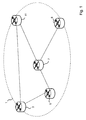
- FIG. 1 shows an overview of an MPLS network 1.
- the MPLS network 1 is includes a number of MPLS routers 3, 5, 7, 9, 11. Whilst the MPLS routers are physically connected, control plane mechanisms have not yet been established and therefore the MPLS routers 3, 5, 7, 9 are not aware of their surrounding neighbours nor the paths that a packet must take across the network to reach a destination.
- bootstrapping The process of establishing these control plane mechanisms prior to using the network for forwarding data plane packets will be referred to as "bootstrapping" the network.
- each MPLS router 3, 5, 7, 9, 11 in the MPLS network 1 is pre-configured with a set of bootstrap labels.
- the bootstrap labels are loaded onto each MPLS router 3, 5, 7, 9, 11 before each router is added to the network.
- the bootstrap labels are used during bootstrapping to establish control plane mechanisms.
- control plane messages are sent across the network as MPLS packets and not I P packets.
- FIG. 2 shows the structure of an MPLS packet 21 transferred during the bootstrap phase of the network 1.
- the packet 21 has four parts: a Layer 2 header 23; an MPLS bootstrap label 25, a layer 3 header; and a packet payload.
- the bootstrap label 25 of the MPLS packet 21 is used to identify a legitimate control plane packet to each MPLS router 3, 5, 7, 9, 11.
- an MPLS router 3, 5, 7, 9, 11 will only forward a received packet to higher layer processes if the value of the bootstrap label 25 matches one of the MPLS router's preconfigured labels.
- FIG. 3 schematically shows the structure of an MPLS bootstrap label 25.
- the MPLS label 25 is a 32 bit length header formed of four fields:
- the twenty bit label value field 31 provides for 1048576 unique MPLS label values.
- a set of the label values are reserved for use as MPLS bootstrap labels. During normal operation of the MPLS network, these reserved label values will not be used for example as labels for routing data plane packets..
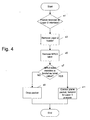
- FIG. 4 shows a flowchart describing the processing of each MPLS router during the bootstrap phase to establish control plane mechanisms.
- the router polls for new packets at a network interface until a packet is received.
- the router removes the layer 2 header to reveal the MPLS label.
- the MPLS label is removed from the packet for inspection. If at step s7 the MPLS label does not match any of the routers set of preconfigured labels, then at step s9 the packet is dropped from the router.
- packets are switched across the network using labels. However, during network bootstrap there should not be any data plane packets being switched across the network and therefore the packet is either not relevant to the receiving router or is a malicious packet.
- the received packet content is delivered to a layer 3 protocol process such as OSPF or LDP.
- the MPLS routers are provided with preconfigured bootstrap labels so that the MPLS network 1 can operate a control plane without using IP. This improves the resilience of the MPLS network 1 during the bootstrap phase because a router of the network cannot be compromised with knowledge of just the IP address of the router.
- each router does not recognise a received packet as being a control plane packet unless the bootstrap label of the received packet matches one of the preconfigured bootstrap labels.
- the preconfigured labels are manually added to each router prior to bootstrap.
- the bootstrap labels are periodically changed simultaneously for all routers via a management interface.
Landscapes
- Engineering & Computer Science (AREA)
- Computer Networks & Wireless Communication (AREA)
- Signal Processing (AREA)
- Data Exchanges In Wide-Area Networks (AREA)
Priority Applications (2)
| Application Number | Priority Date | Filing Date | Title |
|---|---|---|---|
| EP07251413A EP1976200A1 (fr) | 2007-03-30 | 2007-03-30 | Amorçage de réseau |
| PCT/GB2008/001017 WO2008119937A1 (fr) | 2007-03-30 | 2008-03-20 | Amorçage de réseau |
Applications Claiming Priority (1)
| Application Number | Priority Date | Filing Date | Title |
|---|---|---|---|
| EP07251413A EP1976200A1 (fr) | 2007-03-30 | 2007-03-30 | Amorçage de réseau |
Publications (1)
| Publication Number | Publication Date |
|---|---|
| EP1976200A1 true EP1976200A1 (fr) | 2008-10-01 |
Family
ID=38234357
Family Applications (1)
| Application Number | Title | Priority Date | Filing Date |
|---|---|---|---|
| EP07251413A Ceased EP1976200A1 (fr) | 2007-03-30 | 2007-03-30 | Amorçage de réseau |
Country Status (2)
| Country | Link |
|---|---|
| EP (1) | EP1976200A1 (fr) |
| WO (1) | WO2008119937A1 (fr) |
Citations (2)
| Publication number | Priority date | Publication date | Assignee | Title |
|---|---|---|---|---|
| EP1653690A1 (fr) * | 2004-11-01 | 2006-05-03 | Lucent Technologies Inc. | Routeur soft |
| EP1653688A1 (fr) * | 2004-11-01 | 2006-05-03 | Lucent Technologies Inc. | Désagrégation de protocole dans un routeur soft |
-
2007
- 2007-03-30 EP EP07251413A patent/EP1976200A1/fr not_active Ceased
-
2008
- 2008-03-20 WO PCT/GB2008/001017 patent/WO2008119937A1/fr not_active Ceased
Patent Citations (2)
| Publication number | Priority date | Publication date | Assignee | Title |
|---|---|---|---|---|
| EP1653690A1 (fr) * | 2004-11-01 | 2006-05-03 | Lucent Technologies Inc. | Routeur soft |
| EP1653688A1 (fr) * | 2004-11-01 | 2006-05-03 | Lucent Technologies Inc. | Désagrégation de protocole dans un routeur soft |
Non-Patent Citations (1)
| Title |
|---|
| R. AGGARWAL, K. KOMPELLA, T. NADEAU, G. SWALLOW: "BFD For MPLS LSPs", IETF INTERNET DRAFT, June 2006 (2006-06-01), XP002443438, Retrieved from the Internet <URL:http://tools.ietf.org/html/draft-ietf-bfd-mpls-03> [retrieved on 20070720] * |
Also Published As
| Publication number | Publication date |
|---|---|
| WO2008119937A1 (fr) | 2008-10-09 |
Similar Documents
| Publication | Publication Date | Title |
|---|---|---|
| EP3832957B1 (fr) | Procédé de commande de transmission, noeud, système de réseau, et support de stockage | |
| US7440438B2 (en) | Refresh and filtering mechanisms for LDP based VPLS and L2VPN solutions | |
| De Ghein | MPLS fundamentals | |
| EP3632064B1 (fr) | Sélection de table de routage dans un système de routage fondé sur des règles | |
| EP1609279B1 (fr) | Procede permettant des mises a jour recursives de routages bgp dans des reseaux mpls | |
| EP1618688B1 (fr) | Identificateur de source destine a l'apprentissage de l'adresse mac | |
| EP3304812B1 (fr) | Procédé et système pour la resynchronisation d'états de transfert dans un dispositif de transfert de réseau | |
| EP1713197B1 (fr) | Procede de realisation d'une ligne privee virtuelle | |
| JP4511532B2 (ja) | パケット交換通信ネットワークにおけるコネクション指向の転送のための装置 | |
| EP1708408B2 (fr) | Systeme et procede permettant d'assurer une qualite de service dans un reseau virtuel prive | |
| CN108702328B (zh) | 用于穿越分段路由和mpls网络的业务的灵活路径拼接和选择的is-is扩展 | |
| CN101960786B (zh) | 使用链路状态协议受控以太网网络的mpls p节点替换 | |
| US20030026271A1 (en) | L2/L3 network with LSP-enabled virtual routing | |
| US20110188509A1 (en) | Ethernet frame broadcast emulation | |
| US20070242667A1 (en) | System and method for choosing an outgoing path for a media flow in a next generation network | |
| US7843918B2 (en) | Selectively forwarding traffic through tunnels in a computer network | |
| US20090041019A1 (en) | Multi-protocol label switching | |
| US20080112330A1 (en) | Method of Domain Supervision and Protection in Label Switched Network | |
| CN113328934A (zh) | 用于将服务映射到隧道的基于服务的传输类别 | |
| JP5426024B2 (ja) | 内側のmplsラベルと外側のmplsラベルとの連結 | |
| EP1976200A1 (fr) | Amorçage de réseau | |
| KR100560757B1 (ko) | 라우팅 프로토콜 타입별 fec에 대한 lsp설정이가능한 라벨 스위칭 라우터 및 그 설정 방법 | |
| Hoxha | MPLS IMPLEMETATION ON LAYER 3 PROTOCOLS |
Legal Events
| Date | Code | Title | Description |
|---|---|---|---|
| PUAI | Public reference made under article 153(3) epc to a published international application that has entered the european phase |
Free format text: ORIGINAL CODE: 0009012 |
|
| AK | Designated contracting states |
Kind code of ref document: A1 Designated state(s): AT BE BG CH CY CZ DE DK EE ES FI FR GB GR HU IE IS IT LI LT LU LV MC MT NL PL PT RO SE SI SK TR |
|
| AX | Request for extension of the european patent |
Extension state: AL BA HR MK RS |
|
| STAA | Information on the status of an ep patent application or granted ep patent |
Free format text: STATUS: THE APPLICATION HAS BEEN REFUSED |
|
| 18R | Application refused |
Effective date: 20080731 |