EP1976209A2 - Réduction de complexité de calcul dans des décodeurs OFDM MIMO à probabilité maximum - Google Patents
Réduction de complexité de calcul dans des décodeurs OFDM MIMO à probabilité maximum Download PDFInfo
- Publication number
- EP1976209A2 EP1976209A2 EP08102861A EP08102861A EP1976209A2 EP 1976209 A2 EP1976209 A2 EP 1976209A2 EP 08102861 A EP08102861 A EP 08102861A EP 08102861 A EP08102861 A EP 08102861A EP 1976209 A2 EP1976209 A2 EP 1976209A2
- Authority
- EP
- European Patent Office
- Prior art keywords
- points
- matrix
- decoder
- decomposition
- module
- Prior art date
- Legal status (The legal status is an assumption and is not a legal conclusion. Google has not performed a legal analysis and makes no representation as to the accuracy of the status listed.)
- Withdrawn
Links
Images
Classifications
-
- H—ELECTRICITY
- H04—ELECTRIC COMMUNICATION TECHNIQUE
- H04L—TRANSMISSION OF DIGITAL INFORMATION, e.g. TELEGRAPHIC COMMUNICATION
- H04L25/00—Baseband systems
- H04L25/02—Details ; arrangements for supplying electrical power along data transmission lines
- H04L25/03—Shaping networks in transmitter or receiver, e.g. adaptive shaping networks
- H04L25/03006—Arrangements for removing intersymbol interference
- H04L25/03178—Arrangements involving sequence estimation techniques
- H04L25/03248—Arrangements for operating in conjunction with other apparatus
- H04L25/03292—Arrangements for operating in conjunction with other apparatus with channel estimation circuitry
-
- H—ELECTRICITY
- H04—ELECTRIC COMMUNICATION TECHNIQUE
- H04L—TRANSMISSION OF DIGITAL INFORMATION, e.g. TELEGRAPHIC COMMUNICATION
- H04L25/00—Baseband systems
- H04L25/02—Details ; arrangements for supplying electrical power along data transmission lines
- H04L25/03—Shaping networks in transmitter or receiver, e.g. adaptive shaping networks
- H04L25/03006—Arrangements for removing intersymbol interference
- H04L2025/0335—Arrangements for removing intersymbol interference characterised by the type of transmission
- H04L2025/03375—Passband transmission
- H04L2025/03414—Multicarrier
-
- H—ELECTRICITY
- H04—ELECTRIC COMMUNICATION TECHNIQUE
- H04L—TRANSMISSION OF DIGITAL INFORMATION, e.g. TELEGRAPHIC COMMUNICATION
- H04L25/00—Baseband systems
- H04L25/02—Details ; arrangements for supplying electrical power along data transmission lines
- H04L25/03—Shaping networks in transmitter or receiver, e.g. adaptive shaping networks
- H04L25/03006—Arrangements for removing intersymbol interference
- H04L2025/0335—Arrangements for removing intersymbol interference characterised by the type of transmission
- H04L2025/03426—Arrangements for removing intersymbol interference characterised by the type of transmission transmission using multiple-input and multiple-output channels
-
- H—ELECTRICITY
- H04—ELECTRIC COMMUNICATION TECHNIQUE
- H04L—TRANSMISSION OF DIGITAL INFORMATION, e.g. TELEGRAPHIC COMMUNICATION
- H04L25/00—Baseband systems
- H04L25/02—Details ; arrangements for supplying electrical power along data transmission lines
- H04L25/0202—Channel estimation
- H04L25/024—Channel estimation channel estimation algorithms
- H04L25/0242—Channel estimation channel estimation algorithms using matrix methods
- H04L25/0246—Channel estimation channel estimation algorithms using matrix methods with factorisation
Definitions
- the present invention relates to wireless communication systems and more specifically, to maximum-likelihood decoders for high throughput wireless communication systems.
- MIMO multiple-inputs multiple-outputs
- OFDM orthogonal frequency multiplexing modulation
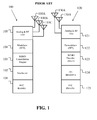
- FIG. 1 shows the general structure of a typical MIMO OFDM system according to the prior art.
- the MIMO transmitter 100 has multiple antennas 110A-110C each capable of transmitting independent signals to a MIMO receiver 120 which is also equipped with multiple receive antennas 130A-130B.
- the transmitter 100 may comprise a forward error correction (FEC) code encoder 101, an interleaver 102, a MIMO constellation Mapper 103, an OFDM MIMO modulator (IFFT) 104 and an analog and RF unit 105.
- FEC forward error correction
- IFFT OFDM MIMO modulator
- the MIMO receiver 120 may comprise an RF and analog unit 121, a MIMO OFDM demodulator (FFT) 122, a MIMO decoder 123 (also known as a slicer), a de-interleaver 124 and a FEC Decoder 125, all of which are used to convert the incoming RF signals into spatial streams representing bits of information sent over the channel.
- the MIMO decoder (Slicer) receives a plurality of spatial streams of bits, and decodes them into information bits.
- the decoder performs hard decision and delivers final value information bits whereas in other systems the decoder delivers soft output for further soft decoding to be performed in a Viterbi decoder, low density parity check (LDPC) decoder or the like.
- LDPC low density parity check
- Maximum-likelihood (ML) decoding provides the best performance for MIMO decoding in BER terms.
- An optimal per bit ML decoder for MIMO OFDM system is the log-likelihood ratio (LLR) decoder, but is very complicated to implement.
- LLR LLR ⁇ r - Ht ⁇ 2
- the LogMax algorithm searches the minimum value over d(t) (expression 2) for transmit vectors that assign a value of 0 to this bit and a second time searches a minimum value over d(t) for transmit vectors that assign a value of 1 to this bit.
- the difference between the two values is the LogMax approximation.
- Another approach in MIMO decoding is to perform a non-exhaustive search over some of the constellation points, a method known as sphere decoding.
- a sphere decoder the search is performed in a hyper sphere centered in a point x with radius r. Points are searches only in the sphere wherein the radius may be dynamically changed according to predefined parameters.
- UK Patent No. GB2427106 which is incorporated by reference in its entirety herein, discloses a sphere decoder for MIMO applications with reduced computational complexity decomposition of the channel estimate matrix.
- SNR signal-to-noise ratio
- the present invention is generally directed to a method and a system for reducing computational complexity in a maximum-likelihood (ML) MIMO OFDM decoder, while retaining high performance.
- ML maximum-likelihood
- the Euclidean distance expression (the abovementioned expression (2) is transformed into a simpler expression (in complexity terms).
- This transformation may be achieved by decomposing the channel matrix H into a product of matrices wherein at least one of the matrices may be sparse, upper triangular, triangular or near triangular while the other matrix is a unitary matrix.
- the transformation is achieved by a QR decomposition wherein H is decomposed into the product of matrix R, an upper triangular matrix with only real-numbers on its diagonal, and Q, a unitary matrix which will be used as a transformation operator.
- the transformation by a unitary matrix does not change the autocorrelation of the (white spatially) noise, therefore there is no need to modify the autocorrelation matrix for each distance.
- an exhaustive search is performed on each and every spatial stream received over the constellation points wherein the search for one of the spatial streams is substantially reduced with no performance degradation.
- the number of constellation points that have to be searched in this spatial stream is reduced from M 2 to 2 M wherein M 2 denotes the total number of points in a given square constellation.
- M 2 denotes the total number of points in a given square constellation.
- the reduction is achieved due to the quadrature nature of square modulations (i.e. the x and y components of the signal are independent and orthogonal).
- Gray coding is used in mapping the constellation before the transmission and upon decoding, a further reduction in the number of distances that has to be calculated may be achieved. This reduction stems from the symmetrical nature of Gray coding in respect to each axis.
- FIG. 1 is a schematic block diagram of a MIMO system according to the prior art
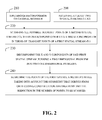
- FIG. 2 is a flowchart diagram illustrating an embodiment of the present invention
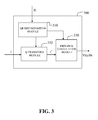
- FIG. 3 is a schematic block diagram showing the decoder according to the present invention.
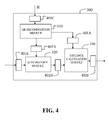
- FIG. 4 is a schematic block diagram showing in further details an embodiment of the decoder according to the present invention.
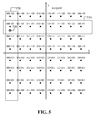
- FIG. 5 is a diagram showing a 64 QAM constellation map as may be applicable to the invention.
- FIG. 2 is a flowchart diagram showing the various aspects of complexity reduction as practiced according to the present invention according to some embodiments. Specifically, FIG. 2 refers to the decoding process of two spatial streams. It should become clear that the invention may be practiced with any number of spatial streams (being a function of receive and transmit antennas).
- at least two spatial streams, (t1) and (t2), are received by the decoder (simultaneously).
- the channel matrix H is decomposed into a first matrix R and a second matrix Q.
- the first matrix R is an upper triangular with real-numbers only on its diagonal
- the second matrix, Q is a unitary matrix.
- the decoder may be applicable to any number and type of receive and transmit antennas and for other communication methods, such as CDMA and the like.
- the Euclidean distance given in the above mentioned expression 2 is transformed by means of linear transformation into a simplified expression with reduced complexity.
- Such transformation may be achieved by applying QR decomposition on the channel matrix H.
- QR factorization decomposition
- matrix R as a linear transformation applied on the expression representing the distance between the transmit points, d(t).
- d(t) is transformed into another expression, d'(t) in accordance with the new channel representation which is materially same as d(t) but with reduced complexity.
- r ' 3 is the third element of Q ⁇ (33) r (3) . Since r ' 3 is independent of the transmit signal then minimization on d and d' gives identical results.
- the QR decomposition simplifies the required computations needed in finding the minimal distance for each point, while retaining the same performance in term of detection likelihood. Moreover, the QR decomposition reduces the matrix to the number of spatial streams (nSS) which may be a smaller number than the number of receive antennas (nRx) therefore another reduction in complexity. Yet another reduction derives from the sparse nature of R as the QR decomposition also zeros out lower diagonal parts of the matrix R as well as the imaginary part of the diagonal element of the matrix R. Specifically, the reduction of the computational complexity due to the zeroing of the imaginary components.
- block 220 denotes that after receiving both spatial streams, the disclosed decoder performs a full (naive) scan of all the possible transmit points of the second spatial stream (t2). In this scan, each point generates a single-input single-output (SISO) decoding (slicing) problem in terms of transmit points of a first spatial stream (t1). This can be achieved because the lower diagonal elements of R are zero. Then, as appears in block 230 the x and y components of said first spatial stream are decomposed, turning a two-dimensional problem into two one-dimensional problems. As a result, the point that have to be searched in t (1) are in one column and one row. The x-y decomposition is possible due to the geometry of quadrature modulation wherein the basic signals on the signal space are orthogonal (in quadrature with each other) and also due to the fact that the diagonal element R 11 is real.
- SISO single-input single-output
- the MIMO decoder may be implemented in hardware in many ways. Clearly, best performance is achieved in application specific integrated circuit (ASIC) technology. However, the invention may be implemented by a digital signal processor (DSP), a designated field programmable gate array (FPGA) or any software.
- FIG. 3 shows a simplified block diagram of a hardware embodiment of the present invention.
- the MIMO decoder 300 comprises three modules. The first module is the QR decomposition module 310 which conducts matrix factorization. The second module is the Q transform module 320 which performs the actual linear transformation (deriving from the QR decomposition). It transforms r into r'. The third module is the distance calculation module 330 which calculates the two shortest distances for each bit for every bit value.
- the distance calculation module 330 presents the pair of points with the minimal Euclidean distance between them.
- the distance calculation module exploits the sparse nature of the channel matrix after the factorization has been conducted to minimize the number of operations to find the distances. These distances are used to generate a soft bit for the Viterbi decoder or the like but they may also provide a hard decision value.
- the output of QR decomposition module 310 is coupled to the input of the Q transform module 320 and to the input of the distance calculation module 330. Further, the output of the Q transform module 320 is coupled to the input of the distance calculation module 330 the output of which may be connected to a Viterbi decoder or the like.
- FIG. 4 shows a schematic block diagram according to some embodiments of the invention.
- shift modules 401A-401F may be added to allow amplification of signal where possible. These elements are known as shift modules, re-shift modules and shift control modules. All of the shift modules are coupled between the decoder's modules: QR decomposition module 310, Q transform module 320 and the distance calculation module 330.
- the QR factorization is implemented with one long pipeline for all carriers.
- the same hardware is used for the calculation of the QR factorization of the channel matrix H and for transforming the input vector r to Q ⁇ r .
- the same hardware is reused for different dimensions of the matrix H.
- the search is implemented by parallel machines running - each machine scanning one point from the first spatial stream per clock handling it in one pipeline.
- the MIMO decoder offers a reuse of the same hardware for update stage and decodes stage as well as for different matrix sizes.
- mapping of bits into symbols on the constellation is performed using Gray code, where a symmetry along the zero axis characterizing Gray code configuration and further reducing the computational complexity of the decoding process.
- mapping of each axis may be defined in the iterative procedure described below.
- the following is a table showing the initial step of the Gray code mapping: Bit Value Symbol map_1(x) (11) 0 -1 1 1
- the iterative mapping is performed as follows: The mapping for the k lower bits maps k and defines the k+1 mapping using that map and the added most significant bit (MSB). k+1 represent either word 0x or 1x where x is the k-bit word that represents the lower least significant bits (LSBs).
- the above-mentioned iterative structure may be exploited to reduce the number of points that are scanned for Log Max calculation.
- the following is an example illustrating how the number of points to be scanned is being reduced.
- the 8 point mapping is provided: b3b4b5 symbol (13) 000 -7 001 -5 011 -3 010 -1 110 1 111 3 101 5 100 7
- FIG. 5 shows the relevant points of t 1 on a 64 QAM constellation map, wherein the receive point is marked as 510.
- the reduction of the entire search plane into one column 520 and one row 530 has become possible due to expression (10) which is a valid expression due to the QR decomposition and the constellation geometry, as has been explained in details above.
- the search on t 1 is reduces from 64 to 15 points.
- Methods of the present invention may be implemented by performing or completing manually, automatically, or a combination thereof, selected steps or tasks.
- method may refer to manners, means, techniques and procedures for accomplishing a given task including, but not limited to, those manners, means, techniques and procedures either known to, or readily developed from known manners, means, techniques and procedures by practitioners of the art to which the invention belongs.
Landscapes
- Engineering & Computer Science (AREA)
- Power Engineering (AREA)
- Computer Networks & Wireless Communication (AREA)
- Signal Processing (AREA)
- Radio Transmission System (AREA)
- Error Detection And Correction (AREA)
Applications Claiming Priority (1)
| Application Number | Priority Date | Filing Date | Title |
|---|---|---|---|
| US11/690,966 US7912140B2 (en) | 2007-03-26 | 2007-03-26 | Reducing computational complexity in maximum likelihood MIMO OFDM decoder |
Publications (2)
| Publication Number | Publication Date |
|---|---|
| EP1976209A2 true EP1976209A2 (fr) | 2008-10-01 |
| EP1976209A3 EP1976209A3 (fr) | 2012-03-21 |
Family
ID=39615841
Family Applications (1)
| Application Number | Title | Priority Date | Filing Date |
|---|---|---|---|
| EP08102861A Withdrawn EP1976209A3 (fr) | 2007-03-26 | 2008-03-21 | Réduction de complexité de calcul dans des décodeurs OFDM MIMO à probabilité maximum |
Country Status (4)
| Country | Link |
|---|---|
| US (1) | US7912140B2 (fr) |
| EP (1) | EP1976209A3 (fr) |
| JP (1) | JP2008245285A (fr) |
| TW (1) | TWI470941B (fr) |
Families Citing this family (20)
| Publication number | Priority date | Publication date | Assignee | Title |
|---|---|---|---|---|
| US8494084B1 (en) | 2006-05-02 | 2013-07-23 | Marvell International Ltd. | Reuse of a matrix equalizer for the purpose of transmit beamforming in a wireless MIMO communication system |
| US8223872B1 (en) | 2007-04-04 | 2012-07-17 | Marvell International Ltd. | Reuse of a matrix equalizer for the purpose of transmit beamforming in a wireless MIMO communication system |
| US8199841B1 (en) | 2007-04-26 | 2012-06-12 | Marvell International Ltd. | Channel tracking in a wireless multiple-input multiple-output (MIMO) communication system |
| US8000422B2 (en) * | 2007-06-12 | 2011-08-16 | Samsung Electronics Co., Ltd. | Apparatus and method for detecting signal in multiple-input multiple-output (MIMO) wireless communication system |
| KR100932789B1 (ko) * | 2007-12-15 | 2009-12-21 | 한국전자통신연구원 | 다중입력 다중출력 시스템에서 qr 분해 장치 및 그 방법 |
| US8234549B2 (en) * | 2008-03-06 | 2012-07-31 | Nec Laboratories America, Inc. | Simultaneous PMD compensation and chromatic dispersion compensation using LDPC coded OFDM |
| US8121220B1 (en) * | 2008-06-06 | 2012-02-21 | Qualcomm Atheros, Inc. | Apparatus and method for reduced complexity maximum likelihood MIMO detection |
| TWI361573B (en) * | 2008-07-16 | 2012-04-01 | Ind Tech Res Inst | Symbol detector and sphere decoding method |
| US8443270B2 (en) * | 2008-12-09 | 2013-05-14 | Entropic Communications, Inc. | Multiple input hardware reuse using LDPC codes |
| KR101210599B1 (ko) | 2009-04-27 | 2012-12-11 | 한국전자통신연구원 | 신호 검출 방법, 신호 검출 장치 및 수신 장치 |
| US20100296554A1 (en) * | 2009-05-19 | 2010-11-25 | Ralink Technology (Singapore) Corporation | Method and system for detecting data from multiple antennas |
| EP2469729B1 (fr) * | 2009-08-17 | 2017-08-16 | Alcatel Lucent | Procédé et dispositif pour maintenir la cohérence d une voie de précodage dans un réseau de communication |
| US8559544B2 (en) * | 2009-11-10 | 2013-10-15 | Georgia Tech Research Corporation | Systems and methods for lattice reduction |
| US8516333B1 (en) * | 2009-11-19 | 2013-08-20 | Viasat, Inc. | Pre-interleaving for forward error correction codes |
| TWI422182B (zh) * | 2010-12-30 | 2014-01-01 | Univ Nat Chiao Tung | 基於幾何方法欠定多輸入多輸出系統之高效率解碼器及其解碼方法 |
| EP2680520B1 (fr) * | 2012-06-29 | 2015-11-18 | Telefonaktiebolaget L M Ericsson (publ) | Procédé et dispositif de réception efficace et à complexité réduite de signaux dans un système de communication de type MIMO |
| US10860683B2 (en) | 2012-10-25 | 2020-12-08 | The Research Foundation For The State University Of New York | Pattern change discovery between high dimensional data sets |
| CN112929300B (zh) * | 2019-12-05 | 2024-05-03 | 深圳市中兴微电子技术有限公司 | 一种数据处理装置、方法、基站和存储介质 |
| CN113965258B (zh) * | 2021-10-19 | 2022-10-28 | 南京理工大学 | 一种基于室内miso vlc系统最小化通信功耗的星座点优化方法 |
| US12057986B2 (en) | 2022-02-24 | 2024-08-06 | Ceva Technologies, Ltd | System and method for using low complexity maximum likelihood decoder in a mimo decoder |
Citations (3)
| Publication number | Priority date | Publication date | Assignee | Title |
|---|---|---|---|---|
| US20050249302A1 (en) | 2004-05-05 | 2005-11-10 | Amir Leshem | System and method of a MIMO transmitter / receiver |
| US20060092882A1 (en) | 2002-12-03 | 2006-05-04 | Monisha Ghosh | Simplified decoder for a bit interleaved cofdm-mimo system |
| GB2427106A (en) | 2005-06-08 | 2006-12-13 | Toshiba Res Europ Ltd | Sphere decoder for MIMO applications with reduced computational complexity decomposition of the channel estimate matrix |
Family Cites Families (13)
| Publication number | Priority date | Publication date | Assignee | Title |
|---|---|---|---|---|
| US7277506B1 (en) * | 1999-08-09 | 2007-10-02 | Broadcom Corporation | Maximum likelihood sequence estimator which computes branch metrics in real time |
| EP1329070A2 (fr) * | 2000-10-16 | 2003-07-23 | Systemonic AG | Procede de production de donnees binaires souples a partir de signaux a codage gray |
| US6529559B2 (en) * | 2001-01-12 | 2003-03-04 | Comsys Communication & Signal Processing Ltd. | Reduced soft output information packet selection |
| US7076000B2 (en) * | 2001-01-18 | 2006-07-11 | Motorola, Inc. | Soft-decision metric generation for higher order modulation |
| US7035361B2 (en) * | 2002-07-15 | 2006-04-25 | Quellan, Inc. | Adaptive noise filtering and equalization for optimal high speed multilevel signal decoding |
| US7451173B1 (en) * | 2003-09-09 | 2008-11-11 | Sandia Corporation | Fast combinatorial algorithm for the solution of linearly constrained least squares problems |
| US7289585B2 (en) * | 2004-01-12 | 2007-10-30 | Intel Corporation | Multicarrier receivers and methods for separating transmitted signals in a multiple antenna system |
| US7489746B1 (en) * | 2004-04-22 | 2009-02-10 | Qualcomm, Inc. | MIMO receiver using maximum likelihood detector in combination with QR decomposition |
| JP4612474B2 (ja) * | 2004-05-28 | 2011-01-12 | パナソニック株式会社 | 無線通信装置 |
| US20060029162A1 (en) * | 2004-08-06 | 2006-02-09 | Stmicroelectronics, Inc. | Modular multi-bit symbol demapper |
| US20060182207A1 (en) * | 2005-02-11 | 2006-08-17 | In-Kyu Lee | Hybrid STBC receiver |
| JP4788879B2 (ja) * | 2005-07-08 | 2011-10-05 | 日本電気株式会社 | 複数のアンテナを用いた無線通信システム、受信装置および、それらに用いる復調方法並びにそのプログラム |
| US7957484B2 (en) * | 2006-12-08 | 2011-06-07 | Texas Instruments Incorporated | Candidate list generation and interference cancellation framework for MIMO detection |
-
2007
- 2007-03-26 US US11/690,966 patent/US7912140B2/en active Active
-
2008
- 2008-03-21 EP EP08102861A patent/EP1976209A3/fr not_active Withdrawn
- 2008-03-25 TW TW97110465A patent/TWI470941B/zh not_active IP Right Cessation
- 2008-03-25 JP JP2008078952A patent/JP2008245285A/ja active Pending
Patent Citations (3)
| Publication number | Priority date | Publication date | Assignee | Title |
|---|---|---|---|---|
| US20060092882A1 (en) | 2002-12-03 | 2006-05-04 | Monisha Ghosh | Simplified decoder for a bit interleaved cofdm-mimo system |
| US20050249302A1 (en) | 2004-05-05 | 2005-11-10 | Amir Leshem | System and method of a MIMO transmitter / receiver |
| GB2427106A (en) | 2005-06-08 | 2006-12-13 | Toshiba Res Europ Ltd | Sphere decoder for MIMO applications with reduced computational complexity decomposition of the channel estimate matrix |
Non-Patent Citations (1)
| Title |
|---|
| "Reduced-Complexity ML Detection for Coded MIMO Systems Using Absolute-Value Search", SPEECH, AND SIGNAL PROCESSING, vol. 3, 2005, pages 1025 - 1028 |
Also Published As
| Publication number | Publication date |
|---|---|
| US20080240277A1 (en) | 2008-10-02 |
| EP1976209A3 (fr) | 2012-03-21 |
| TW200915791A (en) | 2009-04-01 |
| JP2008245285A (ja) | 2008-10-09 |
| US7912140B2 (en) | 2011-03-22 |
| TWI470941B (zh) | 2015-01-21 |
Similar Documents
| Publication | Publication Date | Title |
|---|---|---|
| US7912140B2 (en) | Reducing computational complexity in maximum likelihood MIMO OFDM decoder | |
| EP2200240B1 (fr) | Procédé et appareil pour le calcul quasi optimal d'information de fiabilité des bits dans des systèmes de communication à antennes multiples avec détection et décodage itératifs | |
| JP4208923B2 (ja) | マルチ入力マルチ出力システムにおけるシンボル・デマッピング方法 | |
| CN101268647B (zh) | 用于处理来自多个源的通信的装置和方法 | |
| EP2245808B1 (fr) | Structures de récepteur avec M-algorithme à sortie souple adaptif par rapport à la position dans l arbre | |
| EP2293483B1 (fr) | Procede et dispositif pour détection de sortie ponderée dans des systèmes de communication à antennes multiples. | |
| KR101239760B1 (ko) | Qr 분해를 이용하는 mmse mimo 디코더 | |
| US20100067596A1 (en) | Methods and systems for hybrid mimo decoding | |
| JP5257029B2 (ja) | コンステレーション簡略化装置及びその簡略化方法並びに受信機 | |
| CN107276716A (zh) | 用于解码数据信号的方法和设备 | |
| Xu et al. | Reduced-complexity approx-log-MAP and max-log-MAP soft PSK/QAM detection algorithms | |
| WO2010033437A2 (fr) | Procédés et systèmes de détection du maximum de vraisemblance utilisant une compensation post-quadrature | |
| WO2010091317A2 (fr) | Procédés et systèmes pour une commande de gain dans le domaine fréquentiel dans des systèmes ofdm mimo | |
| Khairy et al. | Efficient FPGA implementation of MIMO decoder for mobile WiMAX system | |
| US8711958B2 (en) | Method for decoding a spatially multiplexed data signal using a maximum likelihood detection | |
| EP2680520B1 (fr) | Procédé et dispositif de réception efficace et à complexité réduite de signaux dans un système de communication de type MIMO | |
| US9917723B2 (en) | Efficient methods and recursive/scalable circuit architectures for QAM symbol mean and variance estimations | |
| JP4980121B2 (ja) | 受信装置 | |
| Lofgren et al. | On MIMO K-best sphere detector architecture complexity reductions | |
| Karjalainen et al. | Antenna-by-antenna and joint-over-antenna MIMO signal detection techniques for turbo-coded SC/MMSE frequency domain equalization | |
| Yashoda et al. | Analysis of LTE based Uplink Baseband Receiver in MIMO System | |
| Wu et al. | Low complexity scalable MIMO sphere detection through antenna detection reordering | |
| Xiao et al. | Decoding algorithms for 3-D space-time-frequency codes |
Legal Events
| Date | Code | Title | Description |
|---|---|---|---|
| PUAI | Public reference made under article 153(3) epc to a published international application that has entered the european phase |
Free format text: ORIGINAL CODE: 0009012 |
|
| AK | Designated contracting states |
Kind code of ref document: A2 Designated state(s): AT BE BG CH CY CZ DE DK EE ES FI FR GB GR HR HU IE IS IT LI LT LU LV MC MT NL NO PL PT RO SE SI SK TR |
|
| AX | Request for extension of the european patent |
Extension state: AL BA MK RS |
|
| RAP1 | Party data changed (applicant data changed or rights of an application transferred) |
Owner name: LANTIQ ISRAEL LTD. |
|
| PUAL | Search report despatched |
Free format text: ORIGINAL CODE: 0009013 |
|
| AK | Designated contracting states |
Kind code of ref document: A3 Designated state(s): AT BE BG CH CY CZ DE DK EE ES FI FR GB GR HR HU IE IS IT LI LT LU LV MC MT NL NO PL PT RO SE SI SK TR |
|
| AX | Request for extension of the european patent |
Extension state: AL BA MK RS |
|
| RIC1 | Information provided on ipc code assigned before grant |
Ipc: H04L 25/03 20060101AFI20120213BHEP Ipc: H04L 25/02 20060101ALN20120213BHEP |
|
| 17P | Request for examination filed |
Effective date: 20120921 |
|
| AKX | Designation fees paid |
Designated state(s): DE FR GB |
|
| STAA | Information on the status of an ep patent application or granted ep patent |
Free format text: STATUS: REQUEST FOR EXAMINATION WAS MADE |
|
| STAA | Information on the status of an ep patent application or granted ep patent |
Free format text: STATUS: THE APPLICATION IS DEEMED TO BE WITHDRAWN |
|
| 18D | Application deemed to be withdrawn |
Effective date: 20161001 |