EP1976245A2 - Tragbares Informationsendgerät - Google Patents
Tragbares Informationsendgerät Download PDFInfo
- Publication number
- EP1976245A2 EP1976245A2 EP08011268A EP08011268A EP1976245A2 EP 1976245 A2 EP1976245 A2 EP 1976245A2 EP 08011268 A EP08011268 A EP 08011268A EP 08011268 A EP08011268 A EP 08011268A EP 1976245 A2 EP1976245 A2 EP 1976245A2
- Authority
- EP
- European Patent Office
- Prior art keywords
- caller
- earphone
- information
- telephone terminal
- portable telephone
- Prior art date
- Legal status (The legal status is an assumption and is not a legal conclusion. Google has not performed a legal analysis and makes no representation as to the accuracy of the status listed.)
- Withdrawn
Links
- 230000000994 depressogenic effect Effects 0.000 claims abstract description 57
- 230000007704 transition Effects 0.000 claims description 11
- 238000012544 monitoring process Methods 0.000 claims description 10
- 230000000007 visual effect Effects 0.000 claims description 2
- 238000000034 method Methods 0.000 description 4
- 238000012790 confirmation Methods 0.000 description 2
- 230000001629 suppression Effects 0.000 description 2
- 238000005516 engineering process Methods 0.000 description 1
- 230000006870 function Effects 0.000 description 1
Images



Classifications
-
- H—ELECTRICITY
- H04—ELECTRIC COMMUNICATION TECHNIQUE
- H04M—TELEPHONIC COMMUNICATION
- H04M1/00—Substation equipment, e.g. for use by subscribers
- H04M1/57—Arrangements for indicating or recording the number of the calling subscriber at the called subscriber's set
- H04M1/575—Means for retrieving and displaying personal data about calling party
- H04M1/578—Means for retrieving and displaying personal data about calling party associated with a synthesized vocal announcement
-
- H—ELECTRICITY
- H04—ELECTRIC COMMUNICATION TECHNIQUE
- H04M—TELEPHONIC COMMUNICATION
- H04M1/00—Substation equipment, e.g. for use by subscribers
- H04M1/60—Substation equipment, e.g. for use by subscribers including speech amplifiers
- H04M1/6033—Substation equipment, e.g. for use by subscribers including speech amplifiers for providing handsfree use or a loudspeaker mode in telephone sets
- H04M1/6041—Portable telephones adapted for handsfree use
- H04M1/6058—Portable telephones adapted for handsfree use involving the use of a headset accessory device connected to the portable telephone
-
- H—ELECTRICITY
- H04—ELECTRIC COMMUNICATION TECHNIQUE
- H04M—TELEPHONIC COMMUNICATION
- H04M1/00—Substation equipment, e.g. for use by subscribers
- H04M1/72—Mobile telephones; Cordless telephones, i.e. devices for establishing wireless links to base stations without route selection
- H04M1/724—User interfaces specially adapted for cordless or mobile telephones
-
- H—ELECTRICITY
- H04—ELECTRIC COMMUNICATION TECHNIQUE
- H04M—TELEPHONIC COMMUNICATION
- H04M2250/00—Details of telephonic subscriber devices
- H04M2250/74—Details of telephonic subscriber devices with voice recognition means
Definitions
- the present invention relates to a portable telephone terminal, and more particularly, to a portable telephone terminal which outputs, from an earphone/microphone, voice representing a caller's telephone number or a caller's name when receiving a call.
- an earphone/microphone for a portable telephone terminal has been proposed in Japanese Unexamined Patent Publication No. 2000-13485 (hereinafter referred to as the "First Conventional Example”). Also, an earphone/microphone with a switch as that described in Japanese Unexamined Patent Publication No. 2000-124983 has been proposed (hereinafter referred to as the "Second Conventional Example”).
- a portable telephone terminal equipped with a function of displaying a caller's telephone number in a displaying part upon receipt of a call and further displaying a caller's name as well in the displaying part if the name corresponding to this telephone number is registered in an address book of the portable telephone terminal, is generally and widely used.
- Inventions revealing an operation of informing regarding a caller's telephone number and name by circuit of voice to thereby allow a user to easily obtain the information in the manner described above include a portable telephone terminal described in Japanese Unexamined Patent Publication No. Hei-10-233833 (hereinafter referred to as the "Third Conventional Example"), a portable telephone terminal and a method for informing regarding a received call described in Japanese Unexamined Patent Publication No.
- Hei-11-32105 (hereinafter referred to as the "Fourth Conventional Example"), a voice accumulating apparatus, an information and communications apparatus and a method for reproducing a transmitted number described in Japanese Unexamined Patent Publication No. Hei-11-187113 (hereinafter referred to as the "Fifth Conventional Example”), etc.
- the First Conventional Example describes an earphone/microphone for a portable telephone terminal which informs regarding a received call by circuit of light, sound, vibrations, etc.
- the Second Conventional Example describes a portable telephone terminal which comprises an earphone/microphone with a switch and accordingly permits a user to execute operations such as control via voice recognition using an external microphone of the earphone/microphone and switching between operation modes in accordance with how long various switches remain depressed.
- the Third Conventional Example describes a portable telephone terminal which displays a caller's telephone number upon receipt of a call, and further informs regarding a caller's name by voice from a speaker if the caller's name corresponding to this telephone number is registered in a memory of the portable telephone terminal.
- the Fourth Conventional Example describes a portable telephone terminal which informs regarding a caller's telephone number or caller specifying information (e.g., caller's name) corresponding to the telephone number from vocalizing circuit as a ringing tone, and a method for informing regarding a received call for such a portable telephone terminal.
- a caller's telephone number or caller specifying information e.g., caller's name
- the Fifth Conventional Example describes a voice accumulating apparatus which stores received information upon receipt of a call, converts the stored information into voice information and outputs voice at any desired timing, an information and communications apparatus and a method for reproducing a transmitted number.
- the Second Conventional Example allows operations such as control via voice recognition using the external microphone of the earphone/microphone and switching between the operation modes in accordance with how long the various switches remain depressed, since information specifying a caller is not reported as voice, the information outputted from the earphone/microphone alone does not make it possible to specify the caller before taking the call.
- the Fourth Conventional Example requires the vocalizing circuit as a ringing tone to inform regarding a caller's telephone number and the corresponding caller's name at the time of receipt of a call, it takes some time to confirm the information regarding the caller after receiving the call if the portable telephone terminal is stowed in a pocket, a bag or another item. Hence, depending on where the portable telephone terminal is stowed, it is difficult to confirm the information regarding the caller.
- the Fifth Conventional Example requires to store received information upon receipt of a call, convert the stored information into voice information and output voice at any desired timing, if the portable telephone terminal is stowed in a pocket, a bag or another item, it takes some time to confirm the information regarding the caller after receiving the call. Hence, depending on where the portable telephone terminal is stowed, it is difficult to confirm the information regarding the caller.
- An invention combining the First and the Third Conventional Examples, an invention combining the First and the Fourth Conventional Examples and an invention combining the First and the Fifth Conventional Examples provide a portable telephone terminal which informs by an incoming call tone through an earphone/microphone upon receipt of a call and further informs regarding caller information by voice through a speaker of a main portable unit if the information corresponding to a caller's telephone number (e.g., caller's name) is registered in a memory.
- a main portable unit is stowed in a pocket, a bag or another item, it is difficult to inform a user without fail of the caller's telephone number, the caller information, etc.
- An invention combining the Second and the Third Conventional Examples, an invention combining the Second and the Fourth Conventional Examples and an invention combining the Second and the Fifth Conventional Examples provide a portable telephone terminal which informs by an incoming call tone through an earphone/microphone upon receipt of a call, further informs regarding caller information by voice through a speaker of a main portable unit if the information corresponding to a caller's telephone number (e.g., caller's name) is registered in a memory, and controls operations in accordance with how long an earphone/microswitch remains depressed.
- a main portable unit is stowed in a pocket, a bag or another item, it is difficult to inform a user without fail of the caller's telephone number, the caller information, etc.
- An object of the present invention is to provide a portable telephone terminal which informs regarding caller information through an earphone/microphone so that a user is easily informed without fail of a caller's telephone number, the caller information, etc., even when it is difficult to confirm a display of the portable telephone terminal such as when a main portable unit is stowed in a pocket, a bag or another item or while driving a car.
- a first aspect of the present invention is directed to a portable telephone terminal which comprises an earphone/microphone outputting an information denoting a caller when a call is received.
- the information denoting the caller is outputted from the earphone/microphone, even if it is difficult to confirm a display of a main portable unit such as when the main portable unit is stowed in a pocket, a bag or another item or while driving a car, it is possible to easily obtain the information denoting the caller without fail.
- the portable telephone terminal of the second aspect of the present invention may further comprises: a connection monitoring circuit which monitors whether the earphone/microphone is connected; an information output switching circuit which switches an information output to the earphone/microphone when the connection monitoring circuit determines that the earphone/microphone is connected; and an informing circuit which informs regarding the information denoting the caller.
- a connection monitoring circuit which monitors whether the earphone/microphone is connected
- an information output switching circuit which switches an information output to the earphone/microphone when the connection monitoring circuit determines that the earphone/microphone is connected
- an informing circuit which informs regarding the information denoting the caller.
- the second aspect of the present invention whether the earphone/microphone is connected is judged, and when it is determined that the earphone/microphone is connected, the information denoting the caller is outputted from the earphone/microphone. Hence, even when it is difficult to confirm a display of a main portable unit, it is possible to easily obtain the information denoting the caller without fail.
- the third aspect of the present invention comprises: display which displays characters and visual information; and a receiver which outputs voice information.
- the portable telephone terminal comprises the receiver and the display (e.g., display), it is possible to easily obtain various information from the receiver and the display.
- the display e.g., display
- the information output switching circuit switches the information output to the display and the receiver.
- the information output is switched to the display and the receiver when it is determined that the earphone/microphone is not connected, and therefore, even when the earphone/microphone is not connected, the information denoting the caller is obtained.
- the fifth aspect of the present invention comprises: a data receiving circuit which receives upon receipt of a call caller data which is data unique to the caller transmitted from a terminal of the caller; and a registering circuit which registers the caller data and caller information which is information specifying the caller and which corresponds to the caller data.
- the caller data and the caller information are registered in advance, when the caller data is received upon receipt of the call and not only the caller data but the caller information as well corresponding to the caller data are reported, it is possible to easily specify the caller.
- the caller data is data which represents a telephone number of the caller.
- the caller data is the telephone number of the caller, it is easy to manage the caller data.
- the caller information is information which represents the name of the caller.
- the caller information is the name of the caller, it is possible to easily specify the caller at the time of informing regarding the caller information.
- the informing circuit informs regarding the caller information that corresponds.
- the caller information corresponding to the registered caller data is reported. Hence, it is easy to specify the caller.
- the informing circuit informs regarding the caller data received by the data receiving circuit.
- the received caller data fails to match with the registered caller data, the received caller data is reported. Hence, even when there is no caller data registered, it is possible to obtain the information denoting the caller.
- the portable telephone terminal comprises a message registering circuit which registers a predetermined message.
- the predetermined message As the predetermined message is registered, it is possible to inform regarding various messages in accordance with a condition.
- the predetermined message when the caller data is not received upon receipt of the call, the predetermined message is outputted.
- the eleventh aspect of the present invention when the caller data is not received upon receipt of the call, the predetermined message registered in advance is outputted. Therefore, when it is difficult to specify the caller, it is possible to inform regarding this.
- the portable telephone terminal further comprises an operation switching circuit which switches an operation based on a predetermined instruction which is inputted by operating the earphone/microphone when the connection monitoring circuit determines that the earphone/microphone is connected and when the information output switching circuit switches the information output to the earphone/microphone.
- the operation switching circuit operates the earphone/microphone upon receipt of the call and outputs the informing circuit as voice from the earphone/microphone.
- the earphone/microphone is operated and the information denoting the caller is reported, even when the main portable unit is stowed in a bag or another item for example, it is possible to shift from the operation of taking the incoming call to the informing operation at any timing desired by a portable telephone terminal holder.
- the operation switching circuit operates the earphone/microphone and shifts an operation of taking the call when an operation of informing regarding the information denoting the caller is initiated by the informing circuit.
- the earphone/microphone is operated and the portable telephone terminal shifts the operation of taking the call when the operation of informing regarding the information denoting the caller is initiated. Therefore, even when the main portable unit is stowed in a bag or another item for example, it is possible to shift from the operation of taking the incoming call to the informing operation at any timing desired by a portable telephone terminal holder.
- the operation switching circuit operates the earphone/microphone upon receipt of the call and suppresses transition to the operation of informing regarding the information denoting the caller by the informing circuit, and shifts the operation of taking the call.
- the earphone/microphone is operated upon receipt of the call, transition to the operation of informing regarding the information denoting the caller is suppressed, and the portable telephone terminal shifts the operation of taking the incoming call.
- a period of time from suppression of the informing operation until the operation of taking the incoming call is shortened.
- the operation switching circuit switches an operation in accordance with a predetermined instruction which is inputted based on how long one or more than one of the switches of the earphone/microphone remain depressed.
- an operation is switched in accordance with the predetermined instruction which is inputted based on how long one or more than one of the switches of the earphone/microphone remain depressed.
- the operation switching circuit recognizes voice information which is inputted through the earphone/microphone and switches an operation in accordance with a predetermined instruction which is inputted based on the recognized voice information.
- voice information inputted through the earphone/microphone is recognized, and an operation is switched in accordance with the predetermined instruction which is inputted based on the recognized voice information.
- voice information inputted through the earphone/microphone is recognized, and an operation is switched in accordance with the predetermined instruction which is inputted based on the recognized voice information.
- Fig. 1 is a drawing of a structure of a portable telephone terminal according to a first preferred embodiment of the present invention.
- the structure of the portable telephone terminal according to the first preferred embodiment will now be described with reference to Fig. 1 .
- the portable telephone terminal comprises a main portable unit 10 and an earphone/microphone 13.
- the main portable unit 10 comprises a wireless sending/receiving part 11, a baseband part 12 which is connected with the earphone/microphone 13, a receiver 14, a microphone 15, a control part 16, a memory part 17, a displaying part 18 and an operation key part 19.
- the earphone/microphone 13 is equipped with an earphone 20, a microphone 21 and an earphone microswitch 22, and normally connected to the main portable unit 10 by one connector.
- the wireless sending/receiving part 11 sends and receives a radio wave.
- the baseband part 12 converts various information into voice information.
- the earphone/microphone 13 communicates voice information to a portable telephone terminal holder through the earphone 20 and accepts voice information from the portable telephone terminal holder thorough the microphone 21.
- the receiver 14 outputs voice information. Voice information of voices uttered by the portable telephone terminal holder is supplied to the microphone 15.
- the control part 16 performs various controls in the portable telephone terminal. Various data are registered in the memory part 17, such as telephone numbers, names corresponding to the telephone numbers and a variety of messages.
- the displaying part 18 displays various information upon receipt of a call, such as a caller's telephone number and name.
- the operation key part 19 has various keys and allows the portable telephone terminal holder to enter various instructions.
- the control part 16 has a connection monitoring circuit and an information output switching circuit in claim 2.
- the baseband part 12 has an information circuit in claim 2. Also, the baseband part 12 has an operating switching circuit in claim 12.
- the wireless sending/receiving part 11 has a data receiving circuit in claim 5.
- the memory part 17 has a registering circuit in claim 5.
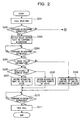
- FIG. 2 and Fig. 3 are flow charts showing operations of the portable telephone terminal according to the first preferred embodiment of the present invention. Operations upon receipt of a call performed by the portable telephone terminal according to the first preferred embodiment will now be described with reference to Fig. 1 , Fig. 2 and Fig. 3 .
- Step S201 When a call arrives at the portable telephone terminal (Step S201), the control part 16 monitors the condition of connection between the main portable unit 10 and the earphone/microphone 13 and determines whether the earphone/microphone 13 is connected to the main portable unit 10 (Step S202).
- Step S202 When it is determined that the earphone/microphone 13 is connected to the main portable unit 10 (Step S202/Yes), the control part 16 switches a voice output path to the earphone/microphone 13 (Step S203), and an incoming call tone is outputted from the earphone 20.
- the control part 16 determines whether the earphone microswitch 22 has been depressed (Step S204). When determining that the earphone microswitch 22 has not been depressed (Step S204/No), the control part 16 determines once again whether the earphone microswitch 22 is depressed (Step S204).
- the control part 16 determines whether an incoming signal contains caller data which is data unique to the caller such as a caller's telephone number (Step S205).
- the control part 16 When determining that the caller data is not included in the incoming signal (Step S205/No), the control part 16 causes the baseband part 12 to vocalize a message, such as the one reading "There is no caller data," registered in the memory part 17 and output to the earphone 20 (Step S209).
- the control part 16 determines whether the earphone microswitch 22 is depressed (Step S210). When determining that the earphone microswitch 22 is not depressed (Step S210/No), the control part 16 determines once again whether the earphone microswitch 22 is depressed (Step S210). When determining that the earphone microswitch 22 is depressed (Step S210/Yes), the control part 16 affirms the offhook state, shifts the operation of taking the call (Step S211) and finishes this operation.
- Step S205/Yes the control part 16 determines whether the caller data (caller's telephone number) are registered in an address book of the memory part 17 (Step S206). When it is determined that the caller data is not registered (Step S206/No), the caller's telephone number is vocalized by the baseband part 12 and then outputted to the earphone 20 (Step S208).
- the control part 16 determines whether the earphone microswitch 22 is depressed (Step S210). When determining that the earphone microswitch 22 is not depressed (Step S210/No), the control part 16 determines once again whether the earphone microswitch 22 is depressed (Step S210). When determining that the earphone microswitch 22 is depressed (Step S210/Yes), the control part 16 affirms the offhook state, shifts the operation of taking the call (Step S211) and finishes this operation.
- Step S206 When it is determined that the caller data (caller's telephone number) are registered in the address book of the memory part 17 (Step S206/Yes), information specifying the caller such as the name corresponding to the caller's telephone number (caller information) is vocalized by the baseband part 12 and then outputted to the earphone 20 (Step S207).
- the control part 16 determines whether the earphone microswitch 22 is depressed (Step S210). When determining that the earphone microswitch 22 is not depressed (Step S210/No), the control part 16 determines once again whether the earphone microswitch 22 is depressed (Step S210). When determining that the earphone microswitch 22 is depressed (Step S210/Yes), the control part 16 affirms the offhook state, shifts the operation of taking the call (Step S211) and finishes this operation.
- a portable telephone terminal holder can confirm various information, such as a caller's telephone number and name, by voice without confirming the displaying part 18.
- Step S202/No Determining that the earphone/microphone 13 is not connected to the main portable unit 10 (Step S202/No), the control part 16 switches the voice output path to the main portable unit 1 (Step S301). Through this switching, the incoming call tone is outputted from the receiver 14.
- the control part 16 determines whether the caller data such as a caller's telephone number is included in the incoming signal (Step S302).
- Step S302/No When determining that the caller data is not included in the incoming signal (Step S302/No), the control part 16 causes the displaying part 18 to display a message such as the one reading "There is no caller data.” (Step S306)
- Step S307 determines whether a call switch of the operation key part 19 is depressed.
- Step S307/No determines once again whether the call switch is depressed.
- Step S307/Yes the control part 16 affirms the offhook state, shifts the operation of taking the call (Step S308) and finishes this operation.
- Step S302/Yes the control part 16 determines whether the caller data (caller's telephone number) are registered in the address book of the memory part 17 (Step S303). When it is determined that the caller data is not registered (Step S303/No), the caller's telephone number is displayed by the displaying part 18 (Step S305).
- Step S307 determines whether the call switch of the operation key part 19 is depressed.
- Step S307/No determines once again whether the call switch is depressed.
- Step S307/Yes the control part 16 affirms the offhook state, shifts the operation of taking the call (Step S308) and finishes this operation.
- Step S303/Yes When it is determined that the caller data (caller's telephone number) is registered in the address book of the memory part 17 (Step S303/Yes), the caller information such as the name corresponding to the caller's telephone number is displayed by the displaying part 18 (Step S304).
- Step S307 determines whether the call switch of the operation key part 19 is depressed.
- Step S307/No determines once again whether the call switch is depressed.
- Step S307/Yes the control part 16 affirms the offhook state, shifts the operation of taking the call (Step S308) and finishes this operation.
- a structure according to the second preferred embodiment of the present invention is similar to the structure according to the first preferred embodiment, and therefore, the second preferred embodiment may be understood as having a structure which is shown in Fig. 1 .
- Fig. 4 is a flow chart showing operations of a portable telephone terminal according to the second preferred embodiment of the present invention. Operations upon receipt of a call performed by the portable telephone terminal according to the second preferred embodiment will now be described with reference to Fig. 4 using Fig. 1 .
- Step S401 When a call arrives at the portable telephone terminal (Step S401), the control part 16 monitors the condition of connection between the main portable unit 10 and the earphone/microphone 13 and determines whether the earphone/microphone 13 is connected to the main portable unit 10 (Step S402).
- Step S402/No When it is determined that the earphone/microphone 13 is not connected to the main portable unit 10 (Step S402/No), operations are performed in accordance with the flow chart in Fig. 3 (Step S301 to Step S308) as in the first preferred embodiment.
- Step S402/Yes When it is determined that the earphone/microphone 13 is connected to the main portable unit 10 (Step S402/Yes), the voice output path is switched to the earphone/microphone 13 (Step S403), and the incoming call tone is outputted from the earphone 20.
- the control part 16 determines whether the earphone microswitch 22 has been depressed (Step S404). When determining that the earphone microswitch 22 has not been depressed (Step S404/No), the control part 16 determines once again whether the earphone microswitch 22 is depressed (Step S404).
- Step S404/Yes the control part 16 judges whether the earphone microswitch 22 remains pressed for a predetermined period or longer (one second or longer, for instance) (Step S405).
- Step S405/Yes When determining that the earphone microswitch 22 remains depressed for the predetermined period or longer (Step S405/Yes), the control part 16 omits the operation of informing regarding the caller data and the caller information and shifts the operation of taking the call (Step S412), and finishes this operation.
- Step S405/No the control part 16 determines whether the caller data such as a caller's telephone number is included in the incoming signal (Step S406).
- the control part 16 When determining that the caller data is not included in the incoming signal (Step S406/No), the control part 16 causes the baseband part 12 to vocalize a message, such as the one reading "There is no caller data," registered in the memory part 17 and outputs to the earphone 20 (Step S410). After the message is outputted, the control part 16 determines whether the earphone microswitch 22 is depressed (Step S411). When determining that the earphone microswitch 22 is not depressed (Step S411/No), the control part 16 determines once again whether the earphone microswitch 22 is depressed (Step S411). When determining that the earphone microswitch 22 is depressed (Step S411/Yes), the control part 16 affirms the offhook state, shifts the operation of taking the call (Step S412) and finishes this operation.
- Step S406/Yes the control part 16 determines whether the caller data is registered in the address book of the memory part 17 (Step S407). When it is determined that the caller data is not registered (Step S407/No), the caller's telephone number is vocalized by the baseband part 12 and then outputted to the earphone 20 (Step S409).
- the control part 16 determines whether the earphone microswitch 22 is depressed (Step S411). When determining that the earphone microswitch 22 is not depressed (Step S411/No), the control part 16 determines once again whether the earphone microswitch 22 is depressed (Step S411). When determining that the earphone microswitch 22 is depressed (Step S411/Yes), the control part 16 affirms the offhook state, shifts the operation of taking the call (Step S412) and finishes this operation.
- the caller information such as the name corresponding to the caller's telephone number is vocalized by the baseband part 12 and then outputted to the earphone 20 (Step S408).
- the control part 16 determines whether the earphone microswitch 22 is depressed (Step S411). When determining that the earphone microswitch 22 is not depressed (Step S411/No), the control part 16 determines once again whether the earphone microswitch 22 is depressed (Step S411). When determining that the earphone microswitch 22 is depressed (Step S411/Yes), the control part 16 affirms the offhook state, shifts the operation of taking the call (Step S412) and finishes this operation.
- a portable telephone terminal holder can confirm various information, such as a caller's telephone number and name, by voice without confirming the displaying part 18. Further, it is possible to omit the operation of informing regarding the caller data and the caller information depending on necessity and shift the operation of taking the call.
- the second preferred embodiment requires to shift the operation of taking the call when the earphone microswitch 22 remains depressed for the predetermined period or longer after receipt of a call and to shift the operation of informing regarding the caller data and the caller information when the earphone microswitch 22 remains depressed for the predetermined period or shorter, the transition may be allowed when the earphone microswitch 22 remains depressed for the predetermined period or shorter.
- voice information may be entered into the microphone 21 of the earphone/microphone 13 using a voice recognition technology for the purpose of transition. For instance, a sound such as "Take a call.” may be uttered and inputted for the transition.
- the transition may be achieved in accordance with a sound volume level of a predetermined or higher level, or the transition may be achieved when a voice input is detected for a predetermined period or longer.
- the transition to the operation of taking the call may be realized through other operations.
- the information denoting the caller is outputted from said earphone/microphone, even if it is difficult to confirm a display of a main portable unit such as when the main portable unit is stowed in a pocket, a bag or another item or while driving a car, it is possible to easily obtain the information denoting the caller without fail.
- the second aspect of the invention whether said earphone/microphone is connected is judged, and when it is determined that said earphone/microphone is connected, the information denoting the caller is outputted from said earphone/microphone. Hence, even when it is difficult to confirm a display of a main portable unit, it is possible to easily obtain the information denoting the caller without fail.
- the portable telephone terminal comprises the receiver and the display (e.g., display), it is possible to obtain various information from the receiver and the display.
- the display e.g., display
- said information output is switched to said display and said receiver when it is determined that said earphone/microphone is not connected, and therefore, even when said earphone/microphone is not connected, the information denoting the caller is obtained.
- the caller data and said caller information are registered in advance, when the caller data is received upon receipt of the call and not only the caller data but the caller information as well corresponding to the caller data are reported, it is possible to easily specify the caller.
- said caller data is the telephone number of said caller, it is easy to manage said caller data.
- said caller information is the name of said caller, it is possible to easily specify the caller at the time of informing regarding said caller information.
- said caller information corresponding to said registered caller data is reported. Hence, it is easy to specify the caller.
- said received caller data fails to match with said registered caller data, said received caller data is reported. Hence, even when there is no caller data registered, it is possible to obtain the information denoting the caller.
- the predetermined message As the predetermined message is registered, it is possible to inform regarding various messages in accordance with a situation.
- said predetermined message registered in advance is outputted. Therefore, when it is difficult to specify the caller, it is possible to inform regarding this.
- the thirteenth aspect of the invention as said earphone/microphone is operated and the information denoting the caller is reported, even when the main portable unit is stowed in a bag or another item for example, it is possible to shift from the operation of taking the incoming call to the informing operation at any timing desired by a portable telephone terminal holder.
- said earphone/microphone is operated and the portable telephone terminal shifts the operation of taking the call when the operation of informing regarding the information denoting the caller is initiated. Therefore, even when the main portable unit is stowed in a bag or another item for example, it is possible to shift from the operation of taking the incoming call to the informing operation at any timing desired by a portable telephone terminal holder.
- said earphone/microphone is operated upon receipt of the call, transition to the operation of informing regarding said information denoting said caller is suppressed, and the portable telephone terminal shifts the operation of taking the incoming call.
- a period of time from suppression of the informing operation until the operation of taking the incoming call is shortened.
- an operation is switched in accordance with the predetermined instruction which is inputted based on how long one or more than one of the switches of said earphone/microphone remain depressed.
- voice information inputted through said earphone/microphone is recognized, and an operation is switched in accordance with the predetermined instruction which is inputted based on the recognized voice information.
- voice information inputted through said earphone/microphone is recognized, and an operation is switched in accordance with the predetermined instruction which is inputted based on the recognized voice information.
Landscapes
- Engineering & Computer Science (AREA)
- Signal Processing (AREA)
- Mobile Radio Communication Systems (AREA)
- Telephone Function (AREA)
Applications Claiming Priority (2)
| Application Number | Priority Date | Filing Date | Title |
|---|---|---|---|
| JP2001000515A JP2002209011A (ja) | 2001-01-05 | 2001-01-05 | 携帯端末 |
| EP02000304A EP1221799B1 (de) | 2001-01-05 | 2002-01-03 | Tragbares Telefonendgerät |
Related Parent Applications (1)
| Application Number | Title | Priority Date | Filing Date |
|---|---|---|---|
| EP02000304A Division EP1221799B1 (de) | 2001-01-05 | 2002-01-03 | Tragbares Telefonendgerät |
Publications (2)
| Publication Number | Publication Date |
|---|---|
| EP1976245A2 true EP1976245A2 (de) | 2008-10-01 |
| EP1976245A3 EP1976245A3 (de) | 2008-10-15 |
Family
ID=18869289
Family Applications (2)
| Application Number | Title | Priority Date | Filing Date |
|---|---|---|---|
| EP08011268A Withdrawn EP1976245A3 (de) | 2001-01-05 | 2002-01-03 | Tragbares Informationsendgerät |
| EP02000304A Expired - Lifetime EP1221799B1 (de) | 2001-01-05 | 2002-01-03 | Tragbares Telefonendgerät |
Family Applications After (1)
| Application Number | Title | Priority Date | Filing Date |
|---|---|---|---|
| EP02000304A Expired - Lifetime EP1221799B1 (de) | 2001-01-05 | 2002-01-03 | Tragbares Telefonendgerät |
Country Status (6)
| Country | Link |
|---|---|
| US (1) | US20020090972A1 (de) |
| EP (2) | EP1976245A3 (de) |
| JP (1) | JP2002209011A (de) |
| CN (1) | CN1364018A (de) |
| DE (1) | DE60230692D1 (de) |
| HK (1) | HK1048907A1 (de) |
Families Citing this family (9)
| Publication number | Priority date | Publication date | Assignee | Title |
|---|---|---|---|---|
| CN100429912C (zh) * | 2002-12-30 | 2008-10-29 | 汉王科技股份有限公司 | 来电报姓名的电话 |
| CN100426904C (zh) * | 2003-04-23 | 2008-10-15 | 海尔集团公司 | 具有双向语音播号功能的手机 |
| KR20050039367A (ko) * | 2003-10-24 | 2005-04-29 | 주식회사 팬택앤큐리텔 | 이동 통신 단말기의 주소록 자동 등록 방법 |
| KR101104441B1 (ko) * | 2004-09-21 | 2012-01-12 | 엘지전자 주식회사 | 휴대용 단말기의 발신자 정보알림 방법 |
| JP2006325116A (ja) * | 2005-05-20 | 2006-11-30 | Sharp Corp | 通知装置、通知方法、通知プログラム |
| US8301123B2 (en) * | 2005-06-24 | 2012-10-30 | Nuance Communications, Inc. | Local intercept methods, such as applications for providing customer assistance for training, information calls and diagnostics |
| US8014760B2 (en) * | 2006-09-06 | 2011-09-06 | Apple Inc. | Missed telephone call management for a portable multifunction device |
| KR102127622B1 (ko) * | 2013-04-30 | 2020-06-29 | 삼성전자 주식회사 | 음성 입력 경로 제어방법 및 이를 지원하는 장치 |
| CN104427088A (zh) * | 2013-08-22 | 2015-03-18 | 深圳富泰宏精密工业有限公司 | 通信通知控制系统及方法 |
Citations (5)
| Publication number | Priority date | Publication date | Assignee | Title |
|---|---|---|---|---|
| JPH10233833A (ja) | 1997-02-17 | 1998-09-02 | Kenwood Corp | 携帯電話機 |
| JPH1132105A (ja) | 1997-07-10 | 1999-02-02 | Sony Corp | 携帯情報端末およびその着信報知方法 |
| JPH11187113A (ja) | 1997-12-19 | 1999-07-09 | Hitachi Ltd | 音声蓄積装置、情報通信装置及び発信番号再生方法 |
| JP2000013485A (ja) | 1998-06-18 | 2000-01-14 | Napolex Co | 携帯電話機用のイヤホンマイク |
| JP2000124983A (ja) | 1998-10-13 | 2000-04-28 | Nec Mobile Commun Ltd | スイッチ付きイヤホンマイクを備えた携帯端末 |
Family Cites Families (12)
| Publication number | Priority date | Publication date | Assignee | Title |
|---|---|---|---|---|
| US5526406A (en) * | 1992-01-29 | 1996-06-11 | Luneau; David J. | Calling party announcement apparatus |
| EP0799529A1 (de) * | 1995-04-11 | 1997-10-08 | Mold-Tech Plastics Limited Partnership | Adapter eines tragbaren kommunikationsgeräts |
| JPH0984141A (ja) * | 1995-09-18 | 1997-03-28 | Casio Comput Co Ltd | 着信呼出装置 |
| US5991637A (en) * | 1996-04-19 | 1999-11-23 | Mack, Ii; Gawins A. | Integrated passive and active communications system |
| US6108630A (en) * | 1997-12-23 | 2000-08-22 | Nortel Networks Corporation | Text-to-speech driven annunciation of caller identification |
| US6453169B1 (en) * | 1997-02-28 | 2002-09-17 | Qualcomm Incorporated | Portable radiotelephone with multiple function power key |
| US5978689A (en) * | 1997-07-09 | 1999-11-02 | Tuoriniemi; Veijo M. | Personal portable communication and audio system |
| JP2933575B2 (ja) * | 1997-09-30 | 1999-08-16 | 静岡日本電気株式会社 | 無線電話機能付き携帯情報端末 |
| AU3361499A (en) * | 1998-03-25 | 1999-10-18 | Qualcomm Incorporated | Method and apparatus for performing handsfree operations and voicing text with acdma telephone |
| JP3855015B2 (ja) * | 1999-02-25 | 2006-12-06 | 株式会社ノボル電機製作所 | ハンドセット押えを有する電話機 |
| SE9904102L (sv) * | 1999-04-26 | 2000-10-27 | Hamid Delalat | Anordning för styrning av en mobiltelefon |
| US20020009184A1 (en) * | 1999-10-22 | 2002-01-24 | J. Mitchell Shnier | Call classification indication using sonic means |
-
2001
- 2001-01-05 JP JP2001000515A patent/JP2002209011A/ja active Pending
-
2002
- 2002-01-03 DE DE60230692T patent/DE60230692D1/de not_active Expired - Lifetime
- 2002-01-03 EP EP08011268A patent/EP1976245A3/de not_active Withdrawn
- 2002-01-03 EP EP02000304A patent/EP1221799B1/de not_active Expired - Lifetime
- 2002-01-03 US US10/033,795 patent/US20020090972A1/en not_active Abandoned
- 2002-01-04 CN CN02100924A patent/CN1364018A/zh active Pending
-
2003
- 2003-02-07 HK HK03100923.9A patent/HK1048907A1/zh unknown
Patent Citations (5)
| Publication number | Priority date | Publication date | Assignee | Title |
|---|---|---|---|---|
| JPH10233833A (ja) | 1997-02-17 | 1998-09-02 | Kenwood Corp | 携帯電話機 |
| JPH1132105A (ja) | 1997-07-10 | 1999-02-02 | Sony Corp | 携帯情報端末およびその着信報知方法 |
| JPH11187113A (ja) | 1997-12-19 | 1999-07-09 | Hitachi Ltd | 音声蓄積装置、情報通信装置及び発信番号再生方法 |
| JP2000013485A (ja) | 1998-06-18 | 2000-01-14 | Napolex Co | 携帯電話機用のイヤホンマイク |
| JP2000124983A (ja) | 1998-10-13 | 2000-04-28 | Nec Mobile Commun Ltd | スイッチ付きイヤホンマイクを備えた携帯端末 |
Also Published As
| Publication number | Publication date |
|---|---|
| HK1048907A1 (zh) | 2003-04-17 |
| US20020090972A1 (en) | 2002-07-11 |
| CN1364018A (zh) | 2002-08-14 |
| EP1221799B1 (de) | 2009-01-07 |
| EP1221799A2 (de) | 2002-07-10 |
| EP1221799A3 (de) | 2005-11-16 |
| EP1976245A3 (de) | 2008-10-15 |
| DE60230692D1 (de) | 2009-02-26 |
| JP2002209011A (ja) | 2002-07-26 |
Similar Documents
| Publication | Publication Date | Title |
|---|---|---|
| KR100771944B1 (ko) | 휴대 전화기용 전자 메일 취급 방법 및 이 취급 방법을이용하는 휴대 전화기 | |
| US7289796B2 (en) | Mobile communications terminal device and method for identifying incoming call for use with the same | |
| KR20010085734A (ko) | 휴대 전화기의 스크롤 모드 변경방법 및 이 스크롤변경방법을 이용하는 휴대 전화기 | |
| US20060258406A1 (en) | Portable communication terminal | |
| EP1246101A2 (de) | Informationskommunikationsendgerät mit elektronischer Post-Empfangsfunktion | |
| EP1976245A2 (de) | Tragbares Informationsendgerät | |
| EP1130890A2 (de) | Mobiltelefon mit elektronischer-Post-Funktion | |
| JP3602322B2 (ja) | 携帯電話装置 | |
| JPH10233833A (ja) | 携帯電話機 | |
| JPH11252216A (ja) | 電話機 | |
| JP2003070069A (ja) | コードレス電話装置 | |
| JP4493617B2 (ja) | 電話機 | |
| KR100617800B1 (ko) | 디지털 휴대용 전화기에서 입력 전화번호 음성 안내 방법 | |
| KR20030056068A (ko) | 착발신시 통화 상대방 음성 알림 방법 | |
| KR100834624B1 (ko) | 이동통신 단말기에서 숫자/문자 변환키 이용 방법 | |
| KR100506282B1 (ko) | 단문 메시지를 이용한 전화번호 편집방법 | |
| JP2000244977A (ja) | 無線通信機 | |
| JP2007124082A (ja) | 電話機 | |
| JP4609571B2 (ja) | 携帯電話装置 | |
| KR100966553B1 (ko) | 맺음말 기능을 이용한 단문 메시지 발송방법 | |
| JPH02278947A (ja) | 通信装置 | |
| KR20030026013A (ko) | 이동 통신 단말기의 발신자 정보 안내 장치 및 그 방법 | |
| KR20060038662A (ko) | 이동통신 단말기의 음성명령 저장 방법 | |
| KR20060037677A (ko) | 이동통신 단말기 및 그를 이용한 전화번호 선택방법 | |
| KR20050024597A (ko) | 이름에 의한 이메일, 문자메시지 전송 방법 |
Legal Events
| Date | Code | Title | Description |
|---|---|---|---|
| PUAI | Public reference made under article 153(3) epc to a published international application that has entered the european phase |
Free format text: ORIGINAL CODE: 0009012 |
|
| PUAL | Search report despatched |
Free format text: ORIGINAL CODE: 0009013 |
|
| AC | Divisional application: reference to earlier application |
Ref document number: 1221799 Country of ref document: EP Kind code of ref document: P |
|
| AK | Designated contracting states |
Kind code of ref document: A2 Designated state(s): DE FR GB IT |
|
| AK | Designated contracting states |
Kind code of ref document: A3 Designated state(s): DE FR GB IT |
|
| RIC1 | Information provided on ipc code assigned before grant |
Ipc: H04M 1/27 20060101ALI20080910BHEP Ipc: H04M 1/2745 20060101ALI20080910BHEP Ipc: H04M 1/60 20060101ALI20080910BHEP Ipc: H04M 1/57 20060101AFI20080822BHEP Ipc: H04M 1/05 20060101ALI20080910BHEP |
|
| AKX | Designation fees paid | ||
| STAA | Information on the status of an ep patent application or granted ep patent |
Free format text: STATUS: THE APPLICATION IS DEEMED TO BE WITHDRAWN |
|
| 18D | Application deemed to be withdrawn |
Effective date: 20090416 |
|
| REG | Reference to a national code |
Ref country code: DE Ref legal event code: 8566 |
|
| RIC1 | Information provided on ipc code assigned before grant |
Ipc: H04M 1/27 20060101ALI20120227BHEP Ipc: H04M 1/05 20060101ALI20120227BHEP Ipc: H04M 1/57 20060101AFI20120227BHEP Ipc: H04M 1/2745 20060101ALI20120227BHEP Ipc: H04M 1/60 20060101ALI20120227BHEP |