EP1976305A2 - Programmaufzeichnungsvorrichtung und Programmaufzeichnungsverfahren - Google Patents
Programmaufzeichnungsvorrichtung und Programmaufzeichnungsverfahren Download PDFInfo
- Publication number
- EP1976305A2 EP1976305A2 EP08004072A EP08004072A EP1976305A2 EP 1976305 A2 EP1976305 A2 EP 1976305A2 EP 08004072 A EP08004072 A EP 08004072A EP 08004072 A EP08004072 A EP 08004072A EP 1976305 A2 EP1976305 A2 EP 1976305A2
- Authority
- EP
- European Patent Office
- Prior art keywords
- broadcasting
- program
- receivers
- data
- recording
- Prior art date
- Legal status (The legal status is an assumption and is not a legal conclusion. Google has not performed a legal analysis and makes no representation as to the accuracy of the status listed.)
- Withdrawn
Links
- 238000000034 method Methods 0.000 title claims description 16
- 230000008685 targeting Effects 0.000 claims abstract description 12
- 238000010586 diagram Methods 0.000 description 5
- 230000006870 function Effects 0.000 description 4
- 238000012545 processing Methods 0.000 description 4
- 238000006243 chemical reaction Methods 0.000 description 3
- 238000012986 modification Methods 0.000 description 2
- 230000004048 modification Effects 0.000 description 2
- 238000004891 communication Methods 0.000 description 1
- 230000006835 compression Effects 0.000 description 1
- 238000007906 compression Methods 0.000 description 1
- 238000012937 correction Methods 0.000 description 1
- 239000000284 extract Substances 0.000 description 1
- 239000004973 liquid crystal related substance Substances 0.000 description 1
- 230000005236 sound signal Effects 0.000 description 1
- 238000006467 substitution reaction Methods 0.000 description 1
Images


Classifications
-
- H—ELECTRICITY
- H04—ELECTRIC COMMUNICATION TECHNIQUE
- H04N—PICTORIAL COMMUNICATION, e.g. TELEVISION
- H04N5/00—Details of television systems
- H04N5/76—Television signal recording
- H04N5/78—Television signal recording using magnetic recording
- H04N5/782—Television signal recording using magnetic recording on tape
-
- H—ELECTRICITY
- H04—ELECTRIC COMMUNICATION TECHNIQUE
- H04H—BROADCAST COMMUNICATION
- H04H20/00—Arrangements for broadcast or for distribution combined with broadcast
- H04H20/20—Arrangements for broadcast or distribution of identical information via plural systems
- H04H20/22—Arrangements for broadcast of identical information via plural broadcast systems
-
- H—ELECTRICITY
- H04—ELECTRIC COMMUNICATION TECHNIQUE
- H04H—BROADCAST COMMUNICATION
- H04H20/00—Arrangements for broadcast or for distribution combined with broadcast
- H04H20/26—Arrangements for switching distribution systems
-
- H—ELECTRICITY
- H04—ELECTRIC COMMUNICATION TECHNIQUE
- H04N—PICTORIAL COMMUNICATION, e.g. TELEVISION
- H04N5/00—Details of television systems
- H04N5/76—Television signal recording
- H04N5/78—Television signal recording using magnetic recording
- H04N5/781—Television signal recording using magnetic recording on disks or drums
Definitions
- One embodiment of the invention relates to a program recording apparatus recording program data transmitted in terrestrial digital broadcasting and a program recording method thereof.
- one channel is divided into thirteen segments (segs) in Japan. Thereby, a band can be used by a unit of segment.
- multi-channel broadcasting it is possible to perform 3-channel broadcasting by broadcasting (hereinafter, referred to as "1-segment broadcasting" and also referred to as 1-seg) for mobile receivers by using one segment (channel), and 1-channel broadcasting for fixed receivers by using remaining twelve segments of a high vision or a standard image quality (SDTV).
- SATV standard image quality
- a program recording apparatus recording program data transmitted in digital broadcasting
- a following program receiving apparatus is disclosed in Japanese Patent Application Publication (KOKAI) No. 2005-204064 (Patent Document 1).
- This program recording apparatus includes a plurality of data receiving means for receiving data transmitted in digital broadcasting per encoding format to demodulate the received data, and the data received and demodulated respectively by the plural data receiving means are concurrently stored in a memory, so that program recording is performed.
- broadcasting (1-segment broadcasting in Japan) for mobile receivers targeting the mobile receivers is simultaneous broadcasting with broadcasting (12-segment broadcasting within Japan) for stationary type fixed receivers targeting the fixed receivers, so that contents of the broadcasting may sometimes be the same as contents of the broadcasting for the fixed receivers.
- broadcasting for mobile receivers is not required to be simultaneous broadcasting with broadcasting for fixed receivers, it is also planned to broadcast an independent program whose contents are different from the contents of the broadcasting for fixed receivers. Then, depending on the program, the broadcasting for mobile receivers is not the simultaneous broadcasting with the broadcasting for fixed receivers, and it is not possible to record the same program as the program of the broadcasting for fixed receivers by using the broadcasting for mobile receivers.
- the present invention is made to solve the above problem, and its object is to provide a program recording apparatus capable of surely recording, for mobile receivers, a program of broadcasting for fixed receivers, and a program recording method thereof.
- the invention provides a program recording apparatus including: a recording means for recording program data transmitted in terrestrial digital broadcasting; a judging means for performing simultaneous judgment of whether or not broadcasting for mobile receivers targeting the mobile receivers is simultaneous broadcasting with broadcasting for fixed receivers targeting the fixed receivers; and a program recording control means for making the recording means selectively record program data of the broadcasting for fixed receivers and program data of the broadcasting for mobile receivers in correspondence with a judgment result of the judging means.
- the invention also provides a program recording method in a program recording apparatus including a recording means for recording program data transmitted in terrestrial digital broadcasting, the program recording method including: performing simultaneous judgment of whether or not broadcasting for mobile receivers targeting the mobile receivers is simultaneous broadcasting with broadcasting for fixed receivers targeting the fixed receivers; and making the recording means selectively record program data of the broadcasting for fixed receivers and program data of the broadcasting for mobile receivers in accordance with a result of the judgment.
- a program recording apparatus capable of surely recording, for mobile receivers, a program of broadcasting for fixed receivers, and a program recording method thereof are provided.
- FIG. 1 is a block diagram showing a constitution of a program recording apparatus 100 according to an embodiment of the invention.
- the program recording apparatus 100 according to the embodiment is a stationary-type fixed receiver including a video display means for displaying a video of a program of terrestrial digital broadcasting and a program recording control means for controlling recording of the program. It should be noted that the program recording apparatus 100 according to the embodiment receives a program of 1-segment broadcasting being broadcasting for mobile receivers' and receives a program of 12-segment broadcasting being broadcasting for fixed receivers.
- the program recording apparatus 100 includes first and second digital tuners 101, 102, first and second OFDM (Orthogonal Frequency Division Multiplexing) demodulation circuits 103, 104, first and second decoding circuits 105, 106, and an OSD circuit 107.
- first and second digital tuners 101, 102 first and second OFDM (Orthogonal Frequency Division Multiplexing) demodulation circuits 103, 104, first and second decoding circuits 105, 106, and an OSD circuit 107.
- OFDM Orthogonal Frequency Division Multiplexing
- the program recording apparatus 100 also includes a D/A converter 108, an LCD (Liquid Crystal Display) 109, a switch (SW) 110, and a memory 111.
- the program recording apparatus 110 further includes a CPU 112, an HDD 113, a converter 114, a USB (Universal Serial Bus) port 115, a card slot 116, and an EPG decoder 117.
- a CPU 112 an HDD 113
- a converter 114 a converter 114
- a USB (Universal Serial Bus) port 115 a card slot 116
- EPG decoder 117 an EPG decoder 117.
- the first and second digital tuners 101, 102 are supplied with broadcast waves received by an antenna AT for terrestrial digital broadcasting. Then, the digital tuners 101, 102 respectively perform receiving processings in which signal components of predetermined frequencies corresponding to designated channels are selected and received from the broadcast wave supplied from the antenna AT, and the digital turners 101, 102 output the received signal components to the first and second demodulation circuit 103, 104.
- the first digital tuner 101 is a receiving means for receiving a broadcast wave of 12-segment broadcasting
- the second tuner 102 is a receiving means for receiving a broadcast wave of 1-segment broadcasting.
- the 12-segment broadcasting is terrestrial digital broadcasting using twelve segments among a plurality of segments (thirteen segments) made by dividing one channel, while the 1-segment broadcasting is terrestrial digital broadcasting using one segment.
- the first and second OFDM demodulation circuits 103, 104 respectively apply predetermined demodulation processings on the signal components extracted by the digital tuners 101, 102, and further perform processings such as error correction, to generate data (in detail, transport streams) respectively.
- the generated data (transport streams) are inputted to the first and second decoding circuits 105, 106 respectively.
- the first and second decoding circuits 105, 106 respectively apply decoding processings on the inputted transport streams to reproduce digital video signals and digital sound signals.
- the first decoding circuit 105 is for the 12-segment broadcasting
- the second decoding circuit 106 is for the 1-segment broadcasting.
- the OSD circuit 107 overlays an OSD (On Screen Display) signal on the inputted digital video signal and outputs the overlaid signal to the D/A converter 108.
- the OSD signal is generated by the CPU 112.
- the D/A converter 108 converts the inputted digital video signal to an analog video signal and outputs it.
- the LDC panel 109 is a video display means for displaying a video of a program being viewed, by using the analog video signal.
- the switch 110 includes various operation switches, while the memory 111 includes a RAM, a ROM or the like. To the ROM is written a control program or a program to be executed by the CPU 112. The RAM can provide a work area necessary for execution of the program by the CPU 112.
- the CPU 112 controls the above-described respective modules in accordance with the control program stored in the memory 111 and manages video display, sound output or the like.
- the CPU 112 has a function as a program recording control means for controlling later-described program recording for mobile by operating in accordance with a later-described program recording program.
- the CPU 112 uses data demodulated by the first and second OFDM demodulation circuits 103, 104 as program data.
- the HDD (Hard Disk Drive) 113 has a function as a recording means for recording the data demodulated by the first and second OFDM demodulation circuits 103, 104 as program data of the terrestrial digital broadcasting.
- the converter 114 is a data converting means for performing transcoding on the program data of the 12-segment broadcasting.
- the transcoding in the embodiment means to convert the program data of the 12-segment broadcasting to program data of a later-described portable terminal apparatus 201.
- the transcoding means conversion of a compression ratio, conversion of a resolution, data conversion to adjust with a screen size for displaying, or the like.
- the USB port 115 can connect with a connector of a USB cable 203.
- the portable terminal apparatus 201 is connected to the USB port 115 via the USB cable 203.
- the portable terminal apparatus 201 is a portable receiver, and is, for example, a portable telephone capable of viewing a program of terrestrial digital broadcasting, PDA, a portable music player or the like.
- a memory card 202 such as an SD memory card (Secure Digital memory card) is inserted into the card slot 116, and the card slot 116 reads/writes data from/to the inserted memory card 202.
- Program data and the like for the portable terminal apparatus 201 are recorded in the memory card 202.
- the EPG decoder 117 separates and extracts, from the data demodulated by the first and second OFDM demodulation circuits 103, 104, later-described EPG data overlaid on the demodulated data.
- FIG. 2 is a block diagram showing a main constitution related to the program recording for mobile among components of the program recording apparatus 100
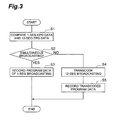
- FIG. 3 is a flowchart showing an operational procedure of the program recording for mobile in accordance with the program recording program by the CPU 112.
- the CPU 112 performs the program recording for mobile by performing operations along the flowchart shown in FIG. 3 .
- the program recording for mobile in the program recording apparatus 100 means to switch data used for recording based on whether or not the 1-segment broadcasting is simultaneous broadcasting with the 12-segment broadcasting and to perform recording for the portable terminal apparatus 201.
- program data d12 of the 12-segment broadcasting or program data d1 of the 1-segment broadcasting are used.
- the converter 114 operates by control of the CPU 112 and program data d13 having been transcoded by the converter 114 are recorded in the HDD 113 as recorded data D for the portable terminal apparatus 2.01.
- the CPU 112 performs the program recording for mobile along the flowchart shown in FIG. 3 when instructed to perform recording of a program of the terrestrial broadcasting by a predetermined operation using the switch provided in the switch 110 or an unshown remote controller.
- the CPU 112 When the CPU 112 starts the program recording for mobile, the CPU 112 obtains EPG (Electronic Program Guide) data of the 1-segment broadcasting and EPG data of the 12-segment broadcasting from the EPG decoder 117, and compares data of designated programs in the respective data (S1).
- EPG Electronic Program Guide
- the EPG data are electronic program information.
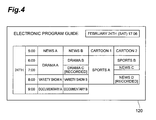
- an electronic program table 120 for example, shown in FIG. 4 is displayed on the LCD 109.
- the EPG data are overlaid on the program data in accordance with a specific format.
- the EPG data include, for example, a program name, a program category, a program start time, a program end time, data of program contents, and so on. Since whether or not the 1-segment broadcasting is simultaneous broadcasting with the 12-segment broadcasting can be judged by whether or not programs of the both are the same, it suffices to compare data of at least program names in S2 described later.
- the CPU 112 compares the EPG data of the 1-segment broadcasting and the EPG data of the 12-segment broadcasting (S2). In this case, the CPU 112 performs an operation as a judging means for performing simultaneous judgment of whether or not the 1-segment broadcasting is simultaneous broadcasting with the 12-segment broadcasting. For example, as described above, it suffices that the CPU 112 performs the simultaneous judgment based on a comparison result of at least the program name data, but the CPU 112 can judge based on at least one of the program names, the program categories and the broadcasting times. When three items of the program names, the program categories, and the broadcasting times coincide, a probability of being simultaneous broadcasting is high, so that usage of three items, i.e., the program names, the program categories, and the broadcasting times enables precise simultaneous judgment.
- the CPU 112 judges that the 1-segment broadcasting is simultaneous broadcasting with the 12-segment broadcasting, the CPU 112 proceeds to S3. If the CPU 112 judges that the 1-segment broadcasting is not simultaneous broadcasting with the 12-segment broadcasting, the CPU 112 proceeds to S4.
- the CPU 112 makes the HDD 113 record the program data d1 of the 1-segment broadcasting as recorded data D for the portable terminal device 201. Further, when proceeding to S4, the CPU 112 instructs the converter 114 to transcode the program data d12 of the 12-segment broadcasting. The CPU 112 subsequently proceeds to S5 and makes the HDD 113 record the transcoded program data d13. In this case, the program data d13 recorded in the HDD 113 are the recorded data D. The CPU 112, after performing S3 or S5, ends the program recording for mobile.
- the program data d1 of the 1-segment broadcasting are used to generate the recorded data D
- the program data d12 of the 12-segment broadcasting are used to generate the recorded data D.
- the 1-segment broadcasting is not required to be simultaneous broadcasting with the 12-segment broadcasting, it may be assumed that an independent program whose contents are different from contents of the 12-segment broadcasting is broadcasted. Then, it becomes unable to record the same program as the program of the 12-segment broadcasting by using the 1-segment broadcasting.
- the program recording apparatus 100 switches the program data to be used for the recording in correspondence with whether or not the 1-segment broadcasting is simultaneous broadcasting with the 12-segment broadcasting.
- the program data d12 of the 12-segment broadcasting are used for recording. Therefore, even if an independent program different from the program of the 12-segment broadcasting is broadcasted in the 1-segment broadcasting (if the 1-segment broadcasting is independent broadcasting independent of the 12-segment broadcasting), the program of the 12-segment broadcasting can be surely recorded for the portable terminal apparatus 201.
- the program recording apparatus 100 judges whether or not the 1-segment broadcasting is simultaneous broadcasting with the 12-segment broadcasting, and based on the judgment result, switches the program data to be used for the recording. Therefore, it is not necessary for a user to mind whether or not the 1-segment broadcasting is simultaneous broadcasting with the 12-segment broadcasting. Accordingly, convenience for the user is ensured in the program recording apparatus 100.
- the program recording apparatus 100 uses the program data d1 of the 1-segment broadcasting. In this case, since transcoding by the converter 114 is not necessary, the operation of the program recording apparatus 100 is simplified. Therefore, the program recording apparatus 100 not only can surely perform the recording for the portable terminal apparatus 201 but also simplifies the operation by performing the transcoding only when necessary.
- the EPG data is overlaid on the program data, and usage of the EPG data enables judgment of whether or not the 1-segment broadcasting is simultaneous broadcasting with the 12-segment broadcasting.
- the program recording apparatus 100 when performing the recording by using the program data d12 of the 12-segment broadcasting, the program recording apparatus 100 performs the transcoding by the converter 14.
- the recorded data D to be acquired are suitable for program viewing by means of the portable terminal apparatus 201. Therefore, when the program is viewed in the portable terminal apparatus 201, it is not necessary to convert the recorded data D.
- the recorded data D generated by the above-described program recording for mobile can be transferred to the portable terminal apparatus 201 via the USB port 115 and the USB cable.
- the recorded data D can also be recorded to the memory card 202 inserted into the card slot 116 and imported to the portable terminal apparatus 201 by using the memory card 202.
- the recorded program of the terrestrial digital broadcasting can be viewed by means of the portable terminal apparatus 201.
- the program data d12 of the 12-segment broadcasting can be recorded to the HDD 113 in addition to the program data d1 of the 1-segment broadcasting. Then, the program data d12 recorded to the HDD 113 can be used as data for viewing (mainly domestic viewing) using the LCD 109. In this case, subsequent to S3 described above, the CPU 112 makes the HDD 113 record the program data d12.
- the above embodiment is described with an example of a television with a recording function, the television including a video display means for displaying a video of a terrestrial broadcasting program and a program recording control means for performing recording of the program.
- the invention can also be applied to a program recording apparatus without a video display means, such as a DVD recorder, an HDD recorder or the like.
- the program recording apparatus 100 in the above embodiment includes a receiving means for receiving a program of 1-segment broadcasting and a receiving means for receiving a program of 12-segment broadcasting. It suffices that the receiving means can receive broadcasting for mobile receivers or broadcasting for fixed receivers, and the program recording apparatus 100 can include a receiving means for receiving broadcasting of a system different from the 1-segment broadcasting and the 12-segment broadcasting.
- the receiving means can be one receiving broadcasting for mobile receivers and broadcasting for fixed receivers, the broadcasting performed without dividing a frequency band of one channel into segments.
- the CPU 112 makes the HDD 113 selectively record program data of the broadcasting for fixed receivers and program data of the broadcasting for mobile receivers.
Landscapes
- Engineering & Computer Science (AREA)
- Multimedia (AREA)
- Signal Processing (AREA)
- Television Signal Processing For Recording (AREA)
- Two-Way Televisions, Distribution Of Moving Picture Or The Like (AREA)
- Circuits Of Receivers In General (AREA)
- Management Or Editing Of Information On Record Carriers (AREA)
Applications Claiming Priority (1)
| Application Number | Priority Date | Filing Date | Title |
|---|---|---|---|
| JP2007093051A JP2008252661A (ja) | 2007-03-30 | 2007-03-30 | 番組録画装置および番組録画方法 |
Publications (2)
| Publication Number | Publication Date |
|---|---|
| EP1976305A2 true EP1976305A2 (de) | 2008-10-01 |
| EP1976305A3 EP1976305A3 (de) | 2011-09-07 |
Family
ID=39659610
Family Applications (1)
| Application Number | Title | Priority Date | Filing Date |
|---|---|---|---|
| EP08004072A Withdrawn EP1976305A3 (de) | 2007-03-30 | 2008-03-05 | Programmaufzeichnungsvorrichtung und Programmaufzeichnungsverfahren |
Country Status (2)
| Country | Link |
|---|---|
| EP (1) | EP1976305A3 (de) |
| JP (1) | JP2008252661A (de) |
Cited By (1)
| Publication number | Priority date | Publication date | Assignee | Title |
|---|---|---|---|---|
| EP2106133A1 (de) * | 2008-03-28 | 2009-09-30 | Kabushiki Kaisha Toshiba | Programmaufzeichnungsvorrichtung |
Families Citing this family (3)
| Publication number | Priority date | Publication date | Assignee | Title |
|---|---|---|---|---|
| JP4491040B1 (ja) * | 2009-03-31 | 2010-06-30 | 株式会社東芝 | 映像処理装置および映像処理方法 |
| US8842974B2 (en) * | 2010-10-01 | 2014-09-23 | Sony Corporation | Content transmission apparatus, content transmission method, content reproduction apparatus, content reproduction method, program, and content delivery system |
| JP7397730B2 (ja) * | 2020-03-18 | 2023-12-13 | シャープ株式会社 | 映像処理装置、テレビ受信機、及びプログラム |
Citations (1)
| Publication number | Priority date | Publication date | Assignee | Title |
|---|---|---|---|---|
| JP2005204064A (ja) | 2004-01-15 | 2005-07-28 | Casio Comput Co Ltd | 番組録画装置、携帯端末装置、及びプログラム |
Family Cites Families (6)
| Publication number | Priority date | Publication date | Assignee | Title |
|---|---|---|---|---|
| JP2004289712A (ja) * | 2003-03-25 | 2004-10-14 | Toshiba Corp | デジタル放送受信機 |
| JP2005020340A (ja) * | 2003-06-26 | 2005-01-20 | Casio Comput Co Ltd | デジタル放送受信装置及びデジタル放送受信制御方法 |
| JP2005166168A (ja) * | 2003-12-03 | 2005-06-23 | Sharp Corp | データ再生装置、そのためのコンピュータプログラム、及び当該コンピュータプログラムを記録した記録媒体 |
| JP4235952B2 (ja) * | 2004-05-24 | 2009-03-11 | カシオ計算機株式会社 | 放送記録装置および放送記録処理プログラム |
| JP4312106B2 (ja) * | 2004-06-14 | 2009-08-12 | シャープ株式会社 | 記録再生装置、その方法、プログラムおよび記録媒体 |
| JP2007036815A (ja) * | 2005-07-28 | 2007-02-08 | Denso Corp | 移動体用デジタル放送受信装置及びプログラム |
-
2007
- 2007-03-30 JP JP2007093051A patent/JP2008252661A/ja active Pending
-
2008
- 2008-03-05 EP EP08004072A patent/EP1976305A3/de not_active Withdrawn
Patent Citations (1)
| Publication number | Priority date | Publication date | Assignee | Title |
|---|---|---|---|---|
| JP2005204064A (ja) | 2004-01-15 | 2005-07-28 | Casio Comput Co Ltd | 番組録画装置、携帯端末装置、及びプログラム |
Cited By (1)
| Publication number | Priority date | Publication date | Assignee | Title |
|---|---|---|---|---|
| EP2106133A1 (de) * | 2008-03-28 | 2009-09-30 | Kabushiki Kaisha Toshiba | Programmaufzeichnungsvorrichtung |
Also Published As
| Publication number | Publication date |
|---|---|
| EP1976305A3 (de) | 2011-09-07 |
| JP2008252661A (ja) | 2008-10-16 |
Similar Documents
| Publication | Publication Date | Title |
|---|---|---|
| US8156526B2 (en) | Apparatus and method for controlling screen layout in digital broadcast receiver for receiving moving picture content | |
| US8233096B2 (en) | Information processing apparatus and television tuner | |
| US6727960B2 (en) | Television channel selection method and apparatus | |
| EP1976305A2 (de) | Programmaufzeichnungsvorrichtung und Programmaufzeichnungsverfahren | |
| US20130229572A1 (en) | Converting image format | |
| JP2011114518A (ja) | デジタル放送受信装置 | |
| JPH11177939A (ja) | ディジタル放送方法およびその受信装置 | |
| US7746407B2 (en) | Apparatus and method for storing data in a digital broadcasting receiver | |
| US20110298990A1 (en) | Digital broadcast receiving apparatus and digital broadcast receiving method | |
| US20080024680A1 (en) | Digital broadcast receiving apparatus and digital broadcast receiving method | |
| JP2008085762A (ja) | デジタル放送受信装置、並びにデジタル放送受信装置の制御方法及び制御プログラム。 | |
| JP2011223128A (ja) | 放送受信装置 | |
| JP4893205B2 (ja) | デジタル放送受信装置 | |
| JP4552200B2 (ja) | デジタル放送受信装置 | |
| JP2009253545A (ja) | 番組録画装置および番組録画方法 | |
| JP4928914B2 (ja) | デジタル放送受信機 | |
| JP2007013820A (ja) | チューナモジュール | |
| KR100265233B1 (ko) | Atv의 채널선택방법 및 장치 | |
| KR101325833B1 (ko) | 교통정보서비스를 제공하는 방송 수신기 및 그의 동작 방법 | |
| JP2004289508A (ja) | 電子機器及び取得方法 | |
| EP2381676A2 (de) | Rundfunkempfangsvorrichtung und Rundfunkempfangsverfahren | |
| JP2007235650A (ja) | チューナモジュールおよび放送受信装置 | |
| JP2009253546A (ja) | 番組録画再生装置および番組録画再生方法 | |
| JP2009303226A (ja) | 番組録画再生装置および番組録画再生方法 | |
| JPH10285485A (ja) | テレビジョン放送受信装置 |
Legal Events
| Date | Code | Title | Description |
|---|---|---|---|
| PUAI | Public reference made under article 153(3) epc to a published international application that has entered the european phase |
Free format text: ORIGINAL CODE: 0009012 |
|
| 17P | Request for examination filed |
Effective date: 20080305 |
|
| AK | Designated contracting states |
Kind code of ref document: A2 Designated state(s): AT BE BG CH CY CZ DE DK EE ES FI FR GB GR HR HU IE IS IT LI LT LU LV MC MT NL NO PL PT RO SE SI SK TR |
|
| AX | Request for extension of the european patent |
Extension state: AL BA MK RS |
|
| PUAL | Search report despatched |
Free format text: ORIGINAL CODE: 0009013 |
|
| AK | Designated contracting states |
Kind code of ref document: A3 Designated state(s): AT BE BG CH CY CZ DE DK EE ES FI FR GB GR HR HU IE IS IT LI LT LU LV MC MT NL NO PL PT RO SE SI SK TR |
|
| AX | Request for extension of the european patent |
Extension state: AL BA MK RS |
|
| RIC1 | Information provided on ipc code assigned before grant |
Ipc: H04N 5/782 20060101ALI20110803BHEP Ipc: H04N 9/79 20060101AFI20110803BHEP |
|
| STAA | Information on the status of an ep patent application or granted ep patent |
Free format text: STATUS: THE APPLICATION HAS BEEN WITHDRAWN |
|
| 18W | Application withdrawn |
Effective date: 20110920 |