EP1977964A1 - Steuervorrichtung zur verhinderung des umstürzens von zweirädrigem fahrzeug - Google Patents
Steuervorrichtung zur verhinderung des umstürzens von zweirädrigem fahrzeug Download PDFInfo
- Publication number
- EP1977964A1 EP1977964A1 EP06822574A EP06822574A EP1977964A1 EP 1977964 A1 EP1977964 A1 EP 1977964A1 EP 06822574 A EP06822574 A EP 06822574A EP 06822574 A EP06822574 A EP 06822574A EP 1977964 A1 EP1977964 A1 EP 1977964A1
- Authority
- EP
- European Patent Office
- Prior art keywords
- angular velocity
- angle
- wheel
- vehicle body
- vehicle
- Prior art date
- Legal status (The legal status is an assumption and is not a legal conclusion. Google has not performed a legal analysis and makes no representation as to the accuracy of the status listed.)
- Withdrawn
Links
Images




Classifications
-
- A—HUMAN NECESSITIES
- A63—SPORTS; GAMES; AMUSEMENTS
- A63H—TOYS, e.g. TOPS, DOLLS, HOOPS OR BUILDING BLOCKS
- A63H17/00—Toy vehicles, e.g. with self-drive; ; Cranes, winches or the like; Accessories therefor
- A63H17/16—Toy vehicles, e.g. with self-drive; ; Cranes, winches or the like; Accessories therefor in the form of a bicycle, with or without riders thereon
-
- A—HUMAN NECESSITIES
- A63—SPORTS; GAMES; AMUSEMENTS
- A63H—TOYS, e.g. TOPS, DOLLS, HOOPS OR BUILDING BLOCKS
- A63H17/00—Toy vehicles, e.g. with self-drive; ; Cranes, winches or the like; Accessories therefor
- A63H17/21—Toy vehicles, e.g. with self-drive; ; Cranes, winches or the like; Accessories therefor shaped as motorcycles with or without figures
-
- A—HUMAN NECESSITIES
- A63—SPORTS; GAMES; AMUSEMENTS
- A63H—TOYS, e.g. TOPS, DOLLS, HOOPS OR BUILDING BLOCKS
- A63H17/00—Toy vehicles, e.g. with self-drive; ; Cranes, winches or the like; Accessories therefor
- A63H17/26—Details; Accessories
- A63H17/36—Steering-mechanisms for toy vehicles
-
- B—PERFORMING OPERATIONS; TRANSPORTING
- B62—LAND VEHICLES FOR TRAVELLING OTHERWISE THAN ON RAILS
- B62H—CYCLE STANDS; SUPPORTS OR HOLDERS FOR PARKING OR STORING CYCLES; APPLIANCES PREVENTING OR INDICATING UNAUTHORIZED USE OR THEFT OF CYCLES; LOCKS INTEGRAL WITH CYCLES; DEVICES FOR LEARNING TO RIDE CYCLES
- B62H7/00—Devices for learning to ride cycles, not otherwise provided for, e.g. assisting balance
Definitions
- the present invention relates to an overturn prevention control device for a two-wheel vehicle, and in particular, to an overturn prevention control device for a two-wheel vehicle capable of traveling autonomously without a human driver.
- Patent Document 1 describes an autonomous vehicle without a human driver, the autonomous vehicle being capable of making a run that is always approximated to an actual machine in stable and various modes from low to high speeds.
- This autonomous driverless vehicle includes a frame forming a vehicle body, a drive wheel disposed in an end of the frame and rotatable by a prime motor, and a fork mounted to another end of the frame and supporting a steerable wheel so as to allow the steerable wheel to be freely driven and also includes an angular velocity sensor that outputs an angular velocity signal for a fall angle of the vehicle body, an arithmetic unit that generates a steering angle control signal, and an actuator that changes an angle of travel of the steered wheel in accordance with the steering angle control signal output from the arithmetic unit.
- the arithmetic unit includes angular velocity command value generating means for generating an angular velocity command value on the basis of an externally provided travel control signal indicating an angle of travel of the steered wheel, control signal generating means for generating a steering angle control signal to be supplied to the actuator on the basis of the deviation between an angular velocity signal being a detection signal of the angular velocity sensor and the angular velocity command value being an output from the angular velocity command value generating means, and feedback means for feeding the steering angle control signal generated by the control signal generating means back to the angular velocity command value generating means.
- the actuator generates a steering control signal for controlling the steered wheel in a direction in which a deviation in fall angular velocity of the vehicle body during travel is reduced in accordance with the steering angle control signal from the arithmetic unit.
- the steering angle control signal to be supplied to the actuator is generated based on the deviation between the detection signal of the angular velocity sensor and the angular velocity command value generated based on the externally provided travel control signal indicating an angle of travel of the steered wheel.
- obtaining a proper angular velocity command value from an angle of travel of the steered wheel and obtaining a steering angle directly from the deviation between a detected angular velocity value and the angular velocity command value need complicated computation and many parameters. This leads to complicated control, so it is difficult to perform stable autonomous travel.
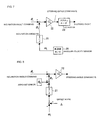
- a relatively simple control method for preventing a two-wheel vehicle from overturning is illustrated in Fig. 7 .
- This method is a method of obtaining a steering angle from the deviation in inclination angle using the proportional gain G 1 . Therefore, it is advantageous in that computation is simple and, because not many parameters are required, the method is executable in a relatively simple manner.
- an angular velocity sensor typically has a deviation (drift) in detection signal due to changes in environmental temperature or a lapse of time, and this has adverse effects as an offset. Together with the offset, external noise entering the angular velocity sensor 20 affects an angular velocity detection signal. In addition, if the vehicle body is already inclined when the vehicle starts traveling, it affects the inclination angle ⁇ f as a zero-set error ⁇ 0 . Such problems may occur in not only the control method illustrated in Fig. 7 but also the control method described in Patent Document 1.
- Fig. 8 is an actual control block diagram in which error factors (zero-set error ⁇ 0 and offset noise ⁇ ) are added to the block diagram illustrated in Fig. 7 .
- the zero-set error ⁇ 0 is applied to the inclination angle ⁇ f
- the offset noise ⁇ is applied to the angular velocity ⁇ 1 .
- Fig. 9 is an equivalent block diagram into which the block diagram illustrated in Fig. 8 is rewritten.
- the zero-set error ⁇ 0 is directly applied to the inclination angle command value ⁇ r
- the integral of the offset noise ⁇ is also applied to the inclination angle command value ⁇ r .
- the zero-set error urges the vehicle body to incline even when the inclination angle command value ⁇ r is zero, so the path taken by the two-wheel vehicle is a curve.
- an object of preferred embodiments of the present invention is to provide an overturn prevention control device that allows a two-wheel vehicle to perform stable autonomous travel using a relatively simple control loop even when a zero-set error or offset noise is present.
- the present invention is an overturn prevention control device for a two-wheel vehicle having a vehicle body, a steerable front wheel provided to a front end of the vehicle body, an actuator that steers the front wheel, a rear wheel provided to a rear end of the vehicle body, and a rear-wheel driving portion that drives the rear wheel.
- the overturn prevention control device includes an angular velocity sensor and control means for outputting a steering angle command signal ⁇ r for controlling the actuator.
- the angular velocity sensor has a detection axis, is mounted on the vehicle body such that the detection axis is downwardly inclined at a predetermined angle relative to a forward direction of the vehicle body, and detects an angular velocity ⁇ about the detection axis.
- the control means includes integration means for integrating the angular velocity ⁇ to obtain a first angle signal and steering-angle-signal generating means for generating the steering angle command signal ⁇ r using a deviation between the first angle signal and an externally provided second angle signal.
- the first angle is controlled so as to be made near the second angle by inputting of the steering angle command signal ⁇ r into the actuator.
- a traditional angular sensor detects only an angular velocity ⁇ 1 in the lateral direction of inclination of the vehicle body, so the sensor is mounted such that its detection axis faces in the forward direction of the vehicle body (horizontal axis in the direction of travel of the vehicle body).
- the angular velocity sensor is mounted on the vehicle body such that its detection axis is downwardly inclined relative to the forward direction of the vehicle body, so the angular velocity ⁇ containing the angular velocity ⁇ 1 component in the lateral direction of inclination of the vehicle body and the angular velocity ⁇ 2 component in the azimuthal direction is thereby detected.
- the zero-set error merely provides an initial value of the azimuth angle command with a deviation, and, for the offset noise, the integral thereof merely affects the azimuth angle command. That is, the zero-set error and the offset noise are incorporated into the azimuth angle command, and the inclination angle in the lateral direction of inclination is automatically controlled in the internal loop (inclination angle loop).
- the two-wheel vehicle can be prevented from overturning.
- the inclination angle is an angle in the lateral direction of inclination of the vehicle body
- the steering angle is an angle that represents the direction of the front wheel.
- the azimuth angle is an angle that represents the direction of travel of the vehicle body
- the mounting angle is an angle of downward tilt of the detection axis of the angular velocity sensor relative to the forward horizontal axis. Because the detection axis of the angular velocity sensor extends in the longitudinal direction, setting the detection axis using an angle of upward tilt to the backward horizontal axis is equal to the above.
- a mounting angle ⁇ of the detection axis of the angular velocity sensor relative to a horizontal axis may preferably be an angle that allows an angular velocity ⁇ 1 in a lateral direction of inclination of the vehicle body and an angular velocity ⁇ 2 in an azimuthal direction to be extracted from the angular velocity ⁇ .
- the optimal value of the mounting angle ⁇ varies depending on the structure of the vehicle body (e.g., the mass or the position of the center of gravity), the traveling speed of the two-wheel vehicle, or other factors.
- the mounting angle ⁇ may preferably be at least an angle that allows the angular velocity ⁇ 1 in the lateral direction of inclination of the vehicle body and the angular velocity ⁇ 2 in the azimuthal direction to be extracted from the angular velocity ⁇ . If the mounting angle ⁇ is too small, the angular velocity ⁇ 2 in the azimuthal direction would be difficult to extract. If the mounting angle ⁇ is too large, the azimuth angle loop gain would be significantly large and control would be unstable.
- the second angle signal can be given by a target azimuth angle ⁇ sin ⁇ . That is, because the second angle signal being a command signal has only an azimuth angle component, the direction of travel of the vehicle body can be directed in a target direction (orientation). In other words, the direction of travel is also controllable. In consideration of that the azimuth angle command is affected by the offset and noise, the vehicle can also be accurately controlled to a target position by correction of the position of the vehicle using other position recognition means.
- the angular velocity sensor is mounted on the vehicle body such that its detection axis is downwardly inclined relative to the forward direction of the vehicle body. Therefore, similar advantages to those obtained when the azimuth angle loop is set outside the inclination angle loop are obtainable.
- This causes the zero-set error and the offset noise to be incorporated into the azimuth angle command, and causes the inclination angle in the lateral direction of inclination to be automatically controlled in the internal loop (inclination angle loop). Accordingly, the two-wheel vehicle can be reliably prevented from overturning.
- the control means for outputting a steering angle command signal can be constructed of the integration means and the simple arithmetic unit having a proportional gain, the structure is simple and easy to make. Best Modes for Carrying Out the Invention
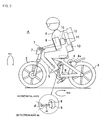
- Figs. 1 to 3 illustrate a first embodiment in which an overturn prevention control device according to the present invention is applied to a bicycle robot.
- the bicycle robot A includes a steering handlebar 1, a front wheel 2 steerable by the steering handlebar 1, a rear wheel 3, a rear-wheel driving motor 4 that drives the rear wheel 3, a frame 5 supporting the front wheel 2 and the rear wheel 3 such that they are freely rotatable, a doll 6 mounted on the frame 5, and an actuator 7 that steers the handlebar 1 (front wheel 2).
- the actuator 7 is provided on the central portion of the handlebar 1.
- the actuator 7 may be provided on any position or take any form as long as it can steer the front wheel 2.
- the front wheel 2 may be steered by an arm of the doll 6 via the handlebar 1.
- the rear wheel 3 is driven by the rear-wheel driving motor 4 via a roller 4a.
- the rear-wheel driving motor 4 may drive the shaft of the rear wheel 3.
- the rear wheel 3 may be driven via a chain by the doll 6 pedaling the bicycle.
- an internal combustion engine or other components may be used in place of the driving motor 4.
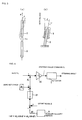
- the frame 5 is equipped with an angular velocity sensor 8 such that a detection axis 8a thereof is downwardly inclined at a predetermined angle ⁇ relative to the forward direction of the vehicle body of the bicycle robot A.
- the angular velocity sensor 8 can detect an angular velocity ⁇ about the detection axis 8a.
- the mounting angle ⁇ of the angular velocity sensor 8 may preferably be an angle that allows an angular velocity ⁇ 1 in a lateral direction of inclination of the vehicle body (including the frame 5 and the doll 6) and an angular velocity ⁇ 2 in an azimuthal direction to be extracted from the angular velocity ⁇ , and may preferably be, for example, on the order of approximately 4° to 8°.
- the optimal value of the mounting angle ⁇ varies depending on the structure of the vehicle body (e.g., the mass or the position of the center of gravity), the traveling speed, or other factors, so the mounting angle ⁇ is not limited to the above angle range.
- the inclination angle ⁇ is an angle in a lateral direction of inclination of the vehicle body (rear wheel 3) relative to a vertical direction.
- the steering angle ⁇ is an angle that represents the direction of the front wheel relative to the direction of travel of the vehicle body.
- the azimuth angle ⁇ is an angle that represents the direction of travel of the vehicle body relative to a reference direction (for example, the north).
- the mounting angle ⁇ is a tilt angle of the detection axis 8a relative to the horizontal axis (in the forward direction), as previously described.
- the angular velocity ⁇ is an angular velocity about the detection axis 8a.
- the angular velocity ⁇ 1 is an angular velocity in a lateral direction of inclination of the vehicle body.
- the angular velocity ⁇ 2 is an angle velocity in an azimuthal direction.
- An inertia rotor 9, a balance motor 10 that drives the inertia rotor 9, and an encoder 11 that measures a rotation angle of the balance motor 10 are mounted in the chest of the doll 6.
- the rotating shaft of each of the inertia rotor 9 and the motor 10 faces in a substantially longitudinal direction of the bicycle A.
- the substantially longitudinal direction here indicates that it includes an exact longitudinal direction and can be slightly displaced upward or downward therefrom.
- a control substrate 12 that controls the rear-wheel driving motor 4, the steering actuator 7, the balance motor 10, and other components and a battery 13 are mounted in the back of the doll 6.
- the vehicle can be prevented from overturning by maintaining its balance by steering the handlebar 1 (front wheel 2). Specifically, the vehicle can be prevented from overturning by steering the handlebar 1 in a direction in which the vehicle body is inclined.
- the vehicle is controlled such that the balance is maintained by exploiting a reaction occurring when the inertia rotor 9 is driven. Control for preventing an overturn by use of the inertia rotor 9 is described in Japanese Patent Application No. 2005-348373 filed by the applicant of the present invention, so the description thereof is omitted here.
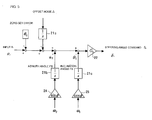
- Fig. 4 illustrates one example of a control block for performing overturn prevention control while the bicycle robot A travels.
- the integral of an output from the angular velocity sensor is made to be a feedback signal, as in the case of Fig. 8 , and the same reference numerals are used as in Fig. 8 for the same portions and the redundant description is omitted.
- the offset noise signal ⁇ is added to the angular velocity signal ⁇ , and the result is integrated by an integrator 21.
- the zero-set error ⁇ 0 is added to the integrated signal, and the result becomes a feedback signal R f .
- the deviation between the feedback signal R f and an input command signal R r is input into arithmetic means 22, and a steering angle command value ⁇ r is formed.
- the command value ⁇ r is output to the actuator 7, and the handlebar 1 (front wheel 2) is steered.
- the command signal R r will be described later.
- Fig. 5 is an equivalent block diagram that illustrates the angular velocity ⁇ in the block diagram of Fig. 4 in such a way that the angular velocity ⁇ is divided into the angular velocity ⁇ 1 component in the lateral direction of inclination and the angular velocity ⁇ 2 component in the azimuthal direction.
- the zero-set error ⁇ 0 is directly applied to the input command signal R r
- the integral of the offset noise ⁇ evaluated by an integrator 21a is also applied to the command signal R r .
- Fig. 6A is an equivalent block diagram into which the block diagram of Fig. 5 is further rewritten.
- Fig. 6B is a block diagram in which the bicycle in a steady travel state (input R r is input so as to increase at a constant speed in a ramp-like manner) is added to Fig. 6A , illustrating an overall control system.
- the bicycle A is a bicycle model that includes the actuator 7 for steering the handlebar.
- the handlebar 1 is steered in accordance with the handlebar steering angle command ⁇ r and a movement of some kind is performed by the bicycle A in response thereto, the inclination angle ⁇ is thereby determined.
- the centripetal force tending to travel in a curve is represented by mg tan ⁇ ⁇ mg ⁇ (m: the mass of the bicycle, g: the acceleration of gravity).
- the deviation between the inclination angle command ⁇ r and the feedback signal ⁇ f obtained by the integration of the angular velocity ⁇ 1 in the lateral direction of inclination performed by the integrator 21c is determined.
- the product of cos ⁇ and G 1 is the inclination angle loop gain.
- the arithmetic means 22 having the gain G 1 may be basically the same as the arithmetic means 22 having the inclination angle loop gain G 1 illustrated in Fig. 7 .
- the steering angle command ⁇ r is input into the bicycle A (including the actuator 7).
- the output inclination angle ⁇ in the lateral direction of inclination is transformed into the angular velocity ⁇ 1 by a differentiator 29.
- a multiplication 30 is performed such that the inclination angle ⁇ is multiplied by a gain g/v, and the angular velocity ⁇ 2 in the azimuthal direction is thereby obtained.
- the angular velocity ⁇ 2 is integrated by an integrator 31, the azimuth angle is obtainable.
- the azimuth angle command ⁇ r is a constant, the inclination angle ⁇ converges to 0°.
- the response in the azimuthal direction can be freely changed.
- a target azimuth angle ⁇ sin ⁇ is input as the command signal R r , the orientation can be controlled.
- the azimuth angle command is affected by the offset and the noise, and thus, the bicycle can be guided to a target position by correction of the position using image recognition performed by other position recognition means, for example, a mounted camera if needed.
- the angular velocity ⁇ output from the angular velocity sensor 8 has the azimuth angle component ⁇ 2 and the angular velocity component ⁇ 1 , similar advantages to those occurring when the azimuth angle loop is set outside the inclination angle loop are obtainable.
- the integral thereof merely affects the azimuth angle command. That is, the zero-set error and the offset noise are incorporated into the azimuth angle command ⁇ r , and the inclination angle is automatically controlled in the internal loop (inclination angle loop). Accordingly, the two-wheel vehicle can be reliably prevented from overturning.
- the prevention of overturning of the bicycle robot is described.
- the present invention is not limited to this embodiment.
- the present invention is applicable to an automatically controlled two-wheel vehicle with a human driver and other types of vehicle.
- example overturn prevention control using the inertia rotor 9 during halts or while the vehicle travels at a very slow speed is described.
- the present invention is applicable to a bicycle that does not have the inertia rotor 9. In this case, if the vehicle body is inclined when the vehicle starts traveling, it affects the azimuth angle.
- the initial inclination angle ⁇ of the vehicle body is substantially 0° and substantially no zero-set error occurs, so it can be accurately controlled to a target orientation.
Landscapes
- Engineering & Computer Science (AREA)
- Mechanical Engineering (AREA)
- Motorcycle And Bicycle Frame (AREA)
- Steering Control In Accordance With Driving Conditions (AREA)
- Toys (AREA)
- Steering Devices For Bicycles And Motorcycles (AREA)
- Control Of Position, Course, Altitude, Or Attitude Of Moving Bodies (AREA)
Applications Claiming Priority (2)
| Application Number | Priority Date | Filing Date | Title |
|---|---|---|---|
| JP2006018471 | 2006-01-27 | ||
| PCT/JP2006/321617 WO2007086176A1 (ja) | 2006-01-27 | 2006-10-30 | 二輪車の転倒防止制御装置 |
Publications (2)
| Publication Number | Publication Date |
|---|---|
| EP1977964A1 true EP1977964A1 (de) | 2008-10-08 |
| EP1977964A4 EP1977964A4 (de) | 2014-05-21 |
Family
ID=38308984
Family Applications (1)
| Application Number | Title | Priority Date | Filing Date |
|---|---|---|---|
| EP06822574.7A Withdrawn EP1977964A4 (de) | 2006-01-27 | 2006-10-30 | Steuervorrichtung zur verhinderung des umstürzens von zweirädrigem fahrzeug |
Country Status (6)
| Country | Link |
|---|---|
| US (1) | US8548679B2 (de) |
| EP (1) | EP1977964A4 (de) |
| JP (1) | JP4743212B2 (de) |
| KR (1) | KR100958532B1 (de) |
| CN (1) | CN101312874B (de) |
| WO (1) | WO2007086176A1 (de) |
Cited By (6)
| Publication number | Priority date | Publication date | Assignee | Title |
|---|---|---|---|---|
| EP2410396A4 (de) * | 2009-03-16 | 2013-06-05 | Murata Manufacturing Co | Bewegungsrichtungssteuerung und computerprogramm |
| US8640809B2 (en) | 2010-01-05 | 2014-02-04 | Honda Motor Company, Ltd. | Flywheel assemblies and vehicles including same |
| US8653681B2 (en) | 2011-04-04 | 2014-02-18 | Honda Motor Co., Ltd. | Power equipment apparatus having flywheel assembly |
| US9168970B2 (en) | 2013-03-15 | 2015-10-27 | Honda Motor Co., Ltd. | Flywheel assemblies and vehicles including same |
| CN106314645A (zh) * | 2015-06-23 | 2017-01-11 | 代志斌 | 车辆平衡装置以及调整车辆平衡的方法 |
| WO2023203100A1 (de) * | 2022-04-19 | 2023-10-26 | Sturmkind Gmbh | Spielfahrzeug mit drehratensensor |
Families Citing this family (12)
| Publication number | Priority date | Publication date | Assignee | Title |
|---|---|---|---|---|
| WO2010023668A1 (en) * | 2008-08-28 | 2010-03-04 | Technion Research & Development Foundation Ltd. | System and method for stabilizing a single-track vehicle |
| JP4936480B2 (ja) * | 2009-06-24 | 2012-05-23 | タマデン工業株式会社 | 姿勢制御付き無人二輪車 |
| JP5240365B2 (ja) * | 2009-09-04 | 2013-07-17 | 株式会社村田製作所 | 移動方向制御装置及びコンピュータプログラム |
| JP5913766B2 (ja) * | 2012-04-01 | 2016-04-27 | タマデン工業株式会社 | 姿勢制御付き無人二輪車 |
| EP2886431B1 (de) * | 2012-07-25 | 2020-10-21 | Bosch Corporation | Verfahren und vorrichtung zur umkippverhinderung bei einem zweiradfahrzeug |
| JP5840109B2 (ja) * | 2012-11-01 | 2016-01-06 | 本田技研工業株式会社 | 移動体 |
| JP5840108B2 (ja) * | 2012-11-01 | 2016-01-06 | 本田技研工業株式会社 | 移動体 |
| KR102698059B1 (ko) * | 2016-03-09 | 2024-08-22 | 얀마 파워 테크놀로지 가부시키가이샤 | 작업 차량 및 주행 영역 특정 장치 |
| CN107344586A (zh) * | 2017-06-09 | 2017-11-14 | 开勒环境科技(上海)股份有限公司 | 一种电动自行车转向的安全控制方法和系统 |
| GB2568912B (en) * | 2017-11-30 | 2022-09-21 | Moss Nicholas | Remote control vehicle |
| DE102017221642A1 (de) * | 2017-12-01 | 2019-06-06 | Continental Automotive Gmbh | Vorrichtung zum Betreiben eines Kraftrads, System und Verfahren zum Betreiben eines Kraftrads |
| WO2022059116A1 (ja) * | 2020-09-17 | 2022-03-24 | ヤマハ発動機株式会社 | 二輪車 |
Family Cites Families (21)
| Publication number | Priority date | Publication date | Assignee | Title |
|---|---|---|---|---|
| US3414909A (en) * | 1966-09-15 | 1968-12-10 | Brearley Co | Clamp-on grab bar or rail for bathtubs or the like |
| US4045842A (en) * | 1976-08-13 | 1977-09-06 | Roland Theriault | Detachable handle for aiding in the manipulation of transport carts |
| US4708357A (en) * | 1986-03-31 | 1987-11-24 | Gerard Berkowitz | Adaptor handle |
| JPS62238183A (ja) | 1986-04-10 | 1987-10-19 | ヤマハ発動機株式会社 | 自動二輪車の操舵制御装置 |
| US5044650A (en) * | 1989-12-20 | 1991-09-03 | Eberle Jr Robert | Wheelchair handle |
| JP2577593Y2 (ja) | 1991-06-25 | 1998-07-30 | 田屋エンジニアリング株式会社 | 無人自走2輪車 |
| US5271636A (en) * | 1991-11-12 | 1993-12-21 | The Jewish Hospital Of St. Louis | Wheelchair travel restricting device and method |
| US5290055A (en) * | 1992-10-07 | 1994-03-01 | Treat Jr Merritt W | Wheelchair push bar and method |
| US5697128A (en) * | 1993-10-07 | 1997-12-16 | Lightware, Inc. | Loop fastening device having an elasticized cord and a slideable lock element |
| JP2990405B2 (ja) * | 1994-01-31 | 1999-12-13 | 本田技研工業株式会社 | 自動二輪車 |
| US5915712A (en) * | 1995-05-23 | 1999-06-29 | Stephenson; John Thomas | Removable handles for mounting on the handles of a wheelchair |
| FR2747935B1 (fr) * | 1996-04-26 | 1998-08-07 | Girardi Philippe | Dispositif de stabilisation pour objets ludiques naturellement instables |
| US6360402B1 (en) * | 2000-03-02 | 2002-03-26 | Amy Marie Crabtree | Travel case pull handle |
| JP2006020652A (ja) | 2001-12-17 | 2006-01-26 | Satoru Kojima | ラジコン模型のロール角制御装置及びラジコン模型二輪車 |
| AU2002354225A1 (en) * | 2002-12-18 | 2004-07-09 | Satoru Kojima | Roll angle controller for remote-controlled traveling body, and roll angle controller for remote-controlled motor cycle |
| KR100521169B1 (ko) * | 2002-12-27 | 2005-10-12 | 현대자동차주식회사 | 롤 오버 제어 방법 |
| WO2004103506A1 (ja) * | 2003-05-23 | 2004-12-02 | Nikko Co., Ltd. | 無線操縦式二輪車玩具 |
| JP4228837B2 (ja) * | 2003-08-26 | 2009-02-25 | 株式会社アドヴィックス | 車輪速度推定装置、車体速度推定装置、および車両挙動制御装置 |
| US6880794B1 (en) * | 2003-11-20 | 2005-04-19 | Peter P. Kahn | Universal tool holder |
| JP2005348373A (ja) | 2004-06-07 | 2005-12-15 | Fujitsu Ten Ltd | 通信装置 |
| US7229367B2 (en) * | 2004-08-11 | 2007-06-12 | Hos Development Corporation | Quick connect basketball practice device |
-
2006
- 2006-10-30 CN CN2006800432352A patent/CN101312874B/zh not_active Expired - Fee Related
- 2006-10-30 JP JP2007555854A patent/JP4743212B2/ja not_active Expired - Fee Related
- 2006-10-30 EP EP06822574.7A patent/EP1977964A4/de not_active Withdrawn
- 2006-10-30 WO PCT/JP2006/321617 patent/WO2007086176A1/ja not_active Ceased
- 2006-10-30 KR KR1020087011492A patent/KR100958532B1/ko not_active Expired - Fee Related
-
2008
- 2008-06-25 US US12/145,585 patent/US8548679B2/en not_active Expired - Fee Related
Cited By (7)
| Publication number | Priority date | Publication date | Assignee | Title |
|---|---|---|---|---|
| EP2410396A4 (de) * | 2009-03-16 | 2013-06-05 | Murata Manufacturing Co | Bewegungsrichtungssteuerung und computerprogramm |
| US9128488B2 (en) | 2009-03-16 | 2015-09-08 | Murata Manufacturing Co., Ltd. | Movement direction control apparatus and computer program |
| US8640809B2 (en) | 2010-01-05 | 2014-02-04 | Honda Motor Company, Ltd. | Flywheel assemblies and vehicles including same |
| US8653681B2 (en) | 2011-04-04 | 2014-02-18 | Honda Motor Co., Ltd. | Power equipment apparatus having flywheel assembly |
| US9168970B2 (en) | 2013-03-15 | 2015-10-27 | Honda Motor Co., Ltd. | Flywheel assemblies and vehicles including same |
| CN106314645A (zh) * | 2015-06-23 | 2017-01-11 | 代志斌 | 车辆平衡装置以及调整车辆平衡的方法 |
| WO2023203100A1 (de) * | 2022-04-19 | 2023-10-26 | Sturmkind Gmbh | Spielfahrzeug mit drehratensensor |
Also Published As
| Publication number | Publication date |
|---|---|
| EP1977964A4 (de) | 2014-05-21 |
| KR20080059645A (ko) | 2008-06-30 |
| CN101312874A (zh) | 2008-11-26 |
| WO2007086176A1 (ja) | 2007-08-02 |
| CN101312874B (zh) | 2010-10-27 |
| KR100958532B1 (ko) | 2010-05-19 |
| JP4743212B2 (ja) | 2011-08-10 |
| US8548679B2 (en) | 2013-10-01 |
| US20080249684A1 (en) | 2008-10-09 |
| JPWO2007086176A1 (ja) | 2009-06-18 |
Similar Documents
| Publication | Publication Date | Title |
|---|---|---|
| US8548679B2 (en) | Overturn prevention control device for two-wheel vehicle | |
| EP3717085B1 (de) | Ferngesteuertes fahrzeug | |
| CN101296838B (zh) | 防翻倒控制装置 | |
| JP4743347B2 (ja) | 転倒防止制御装置及びコンピュータプログラム | |
| US8825254B2 (en) | Inverted pendulum type vehicle, and control method of inverted pendulum type vehicle | |
| CN101549709B (zh) | 车辆行为控制设备和控制方法 | |
| JP5913766B2 (ja) | 姿勢制御付き無人二輪車 | |
| EP2772412B1 (de) | Elektrische Servolenkung | |
| EP2664462A1 (de) | Fahrzeug in der Art eines umgekehrten Pendels | |
| KR20130127372A (ko) | 도립진자형 차량 | |
| JP2009113729A (ja) | 車両制御装置 | |
| EP3995387A1 (de) | Steuervorrichtung, umgebungserfassungssystem, leichtes fahrzeug und steuerverfahren | |
| JP2004338507A (ja) | 自動二輪車 | |
| EP2664532B1 (de) | Fahrzeug in der Art eines umgekehrten Pendels | |
| JP6833666B2 (ja) | 車両 | |
| EP2597022B1 (de) | Fahrzeug in der Art eines umgekehrten Pendels | |
| EP2664531B1 (de) | Fahrzeug in der Art eines umgekehrten Pendels | |
| JPH081268U (ja) | 無人自走2輪車 | |
| EP3354547A1 (de) | Zweirädriges fahrzeug | |
| JPWO2018030407A1 (ja) | 車両 | |
| JP2006044528A (ja) | 後輪操舵装置およびそれを備える自動二輪車 | |
| JPH04349071A (ja) | 車両用後輪操舵装置 |
Legal Events
| Date | Code | Title | Description |
|---|---|---|---|
| PUAI | Public reference made under article 153(3) epc to a published international application that has entered the european phase |
Free format text: ORIGINAL CODE: 0009012 |
|
| 17P | Request for examination filed |
Effective date: 20080725 |
|
| AK | Designated contracting states |
Kind code of ref document: A1 Designated state(s): AT BE BG CH CY CZ DE DK EE ES FI FR GB GR HU IE IS IT LI LT LU LV MC NL PL PT RO SE SI SK TR |
|
| DAX | Request for extension of the european patent (deleted) | ||
| A4 | Supplementary search report drawn up and despatched |
Effective date: 20140424 |
|
| RIC1 | Information provided on ipc code assigned before grant |
Ipc: B62K 21/10 20060101AFI20140430BHEP Ipc: B62J 99/00 20090101ALI20140430BHEP |
|
| GRAP | Despatch of communication of intention to grant a patent |
Free format text: ORIGINAL CODE: EPIDOSNIGR1 |
|
| RIC1 | Information provided on ipc code assigned before grant |
Ipc: B62J 99/00 20090101AFI20160127BHEP |
|
| INTG | Intention to grant announced |
Effective date: 20160301 |
|
| STAA | Information on the status of an ep patent application or granted ep patent |
Free format text: STATUS: THE APPLICATION IS DEEMED TO BE WITHDRAWN |
|
| 18D | Application deemed to be withdrawn |
Effective date: 20160712 |