EP1978132A2 - Procédé destiné à la fabrication d'une couche poreuse - Google Patents
Procédé destiné à la fabrication d'une couche poreuse Download PDFInfo
- Publication number
- EP1978132A2 EP1978132A2 EP08101646A EP08101646A EP1978132A2 EP 1978132 A2 EP1978132 A2 EP 1978132A2 EP 08101646 A EP08101646 A EP 08101646A EP 08101646 A EP08101646 A EP 08101646A EP 1978132 A2 EP1978132 A2 EP 1978132A2
- Authority
- EP
- European Patent Office
- Prior art keywords
- metal
- ceramic
- former
- dispersion
- particles
- Prior art date
- Legal status (The legal status is an assumption and is not a legal conclusion. Google has not performed a legal analysis and makes no representation as to the accuracy of the status listed.)
- Granted
Links
Images
Classifications
-
- C—CHEMISTRY; METALLURGY
- C23—COATING METALLIC MATERIAL; COATING MATERIAL WITH METALLIC MATERIAL; CHEMICAL SURFACE TREATMENT; DIFFUSION TREATMENT OF METALLIC MATERIAL; COATING BY VACUUM EVAPORATION, BY SPUTTERING, BY ION IMPLANTATION OR BY CHEMICAL VAPOUR DEPOSITION, IN GENERAL; INHIBITING CORROSION OF METALLIC MATERIAL OR INCRUSTATION IN GENERAL
- C23C—COATING METALLIC MATERIAL; COATING MATERIAL WITH METALLIC MATERIAL; SURFACE TREATMENT OF METALLIC MATERIAL BY DIFFUSION INTO THE SURFACE, BY CHEMICAL CONVERSION OR SUBSTITUTION; COATING BY VACUUM EVAPORATION, BY SPUTTERING, BY ION IMPLANTATION OR BY CHEMICAL VAPOUR DEPOSITION, IN GENERAL
- C23C24/00—Coating starting from inorganic powder
- C23C24/08—Coating starting from inorganic powder by application of heat or pressure and heat
-
- C—CHEMISTRY; METALLURGY
- C22—METALLURGY; FERROUS OR NON-FERROUS ALLOYS; TREATMENT OF ALLOYS OR NON-FERROUS METALS
- C22C—ALLOYS
- C22C1/00—Making non-ferrous alloys
- C22C1/04—Making non-ferrous alloys by powder metallurgy
- C22C1/05—Mixtures of metal powder with non-metallic powder
- C22C1/051—Making hard metals based on borides, carbides, nitrides, oxides or silicides; Preparation of the powder mixture used as the starting material therefor
-
- C—CHEMISTRY; METALLURGY
- C22—METALLURGY; FERROUS OR NON-FERROUS ALLOYS; TREATMENT OF ALLOYS OR NON-FERROUS METALS
- C22C—ALLOYS
- C22C29/00—Alloys based on carbides, oxides, nitrides, borides, or silicides, e.g. cermets, or other metal compounds, e.g. oxynitrides, sulfides
-
- C—CHEMISTRY; METALLURGY
- C23—COATING METALLIC MATERIAL; COATING MATERIAL WITH METALLIC MATERIAL; CHEMICAL SURFACE TREATMENT; DIFFUSION TREATMENT OF METALLIC MATERIAL; COATING BY VACUUM EVAPORATION, BY SPUTTERING, BY ION IMPLANTATION OR BY CHEMICAL VAPOUR DEPOSITION, IN GENERAL; INHIBITING CORROSION OF METALLIC MATERIAL OR INCRUSTATION IN GENERAL
- C23C—COATING METALLIC MATERIAL; COATING MATERIAL WITH METALLIC MATERIAL; SURFACE TREATMENT OF METALLIC MATERIAL BY DIFFUSION INTO THE SURFACE, BY CHEMICAL CONVERSION OR SUBSTITUTION; COATING BY VACUUM EVAPORATION, BY SPUTTERING, BY ION IMPLANTATION OR BY CHEMICAL VAPOUR DEPOSITION, IN GENERAL
- C23C24/00—Coating starting from inorganic powder
-
- G—PHYSICS
- G01—MEASURING; TESTING
- G01N—INVESTIGATING OR ANALYSING MATERIALS BY DETERMINING THEIR CHEMICAL OR PHYSICAL PROPERTIES
- G01N27/00—Investigating or analysing materials by the use of electric, electrochemical, or magnetic means
- G01N27/26—Investigating or analysing materials by the use of electric, electrochemical, or magnetic means by investigating electrochemical variables; by using electrolysis or electrophoresis
- G01N27/403—Cells and electrode assemblies
- G01N27/414—Ion-sensitive or chemical field-effect transistors, i.e. ISFETS or CHEMFETS
-
- B—PERFORMING OPERATIONS; TRANSPORTING
- B22—CASTING; POWDER METALLURGY
- B22F—WORKING METALLIC POWDER; MANUFACTURE OF ARTICLES FROM METALLIC POWDER; MAKING METALLIC POWDER; APPARATUS OR DEVICES SPECIALLY ADAPTED FOR METALLIC POWDER
- B22F2998/00—Supplementary information concerning processes or compositions relating to powder metallurgy
-
- H—ELECTRICITY
- H10—SEMICONDUCTOR DEVICES; ELECTRIC SOLID-STATE DEVICES NOT OTHERWISE PROVIDED FOR
- H10D—INORGANIC ELECTRIC SEMICONDUCTOR DEVICES
- H10D30/00—Field-effect transistors [FET]
-
- H—ELECTRICITY
- H10—SEMICONDUCTOR DEVICES; ELECTRIC SOLID-STATE DEVICES NOT OTHERWISE PROVIDED FOR
- H10D—INORGANIC ELECTRIC SEMICONDUCTOR DEVICES
- H10D64/00—Electrodes of devices having potential barriers
- H10D64/20—Electrodes characterised by their shapes, relative sizes or dispositions
- H10D64/27—Electrodes not carrying the current to be rectified, amplified, oscillated or switched, e.g. gates
- H10D64/311—Gate electrodes for field-effect devices
Definitions
- the invention relates to a method for producing a porous layer on a substrate, wherein the porous layer contains at least one ceramic material and at least one metal.
- porous structures are used, for example, as gate electrodes of semiconductor field-effect transistors.
- the field effect transistors with a porous gate electrode can be used, for example, as gas sensors.
- the porous metallic gate electrode is produced, for example, by wet-chemical deposition of nanomaterials. Gate electrodes made of nanomaterials exhibit higher thermal stability and higher gas sensitivity than electrodes that have been evaporated. However, especially at higher temperatures, a convergence of metal colloids or porous metal structures is frequently observed on an oxidic surface of the field effect transistor. This reduces the sensitivity of the sensor compared to sample gases. By converging metal colloids continues to decrease the life of the gas sensor.
- a field effect transistor which has a gate electrode made of a cermet of platinum and silicon dioxide.
- the gate electrode is produced, for example, by sputtering.
- the advantage of the cermet layer produced by the process according to the invention is that it does not change even at high temperatures. Thus, for example, no treatment of the layer even at a treatment at 400 ° C.
- Another advantage of the layer produced according to the invention is that it is electrically conductive.
- the dispersion applied to the substrate is preferably liquid or pasty.
- the viscosity of the dispersion is adjusted, for example, by at least one solvent.
- the dispersion may contain additives.
- additives are, for example, surfactants, stabilizers, dispersants or pore formers.
- the solvent may be any solvent known to those skilled in the art.
- Preferred solvents are polar aprotic solvents, alcohols, glycol or glycerol derivatives and derivatives thereof.
- Suitable stabilizers are, for example, glycol derivatives, for example diethylene glycol monobutyl ether or trioxadic acid.
- Pore formers are all substances which can be removed, for example, by pyrolysis or triggering. Suitable pore formers are, for example, soot particles, latex particles or organic polymers.
- the metal former is included in the dispersion at least partially as at least one metal salt or salt precursor that is converted to the at least one metal by the thermal treatment.
- the metal salts or salt-like precursors can be dissolved in the solvent or finely distributed, for example.
- the metal former is preferably in the form of metal particles in the dispersion.
- the ceramic former may also be included in the dispersion in the form of particles of a ceramic material. If both the metal former and the ceramic former are contained in the form of particles in the dispersion, one also speaks of separated particles or separated substances. When the metal former and the ceramic former are present as separated particles or substances, it is possible that a part the metal former or the ceramic former as salt or salt-like precursor dissolved or finely dispersed in the solvent is present. However, it is necessary that at least a part of the metal former or a part of the ceramic former be present as finely divided particles of ceramic material or as metal particles.
- the metal former and the ceramic former may be present as so-called associated particles.
- the ceramic former is at least partially on the surface of the particles of the at least one metal.
- the metal former is located on the surface of the ceramic particles.
- the component that is on the surface of the other component may, for example, be in the form of small, predominantly separated particles on the surface of the other component.
- the outer component encloses the inner component like a shell. In this case, the outer component can enclose the inner component either completely or incompletely.
- a component is present as a particle, wherein the particles have pores.
- This component can be either the metal former or the ceramic former.
- the other component is in the pores of the first component. So if metal particles are present with pores, so the ceramic material is contained in the pores of the metal particles. Accordingly, in the presence of ceramic particles with pores, the metal former is contained in the pores of the ceramic particles.
- both components that is, both the ceramic former and the metal former are collectively in associated dressings of a plurality of primary particles.
- the ceramic former is, for example, a ceramic material.
- the ceramic-forming agent is at least one further metal which forms the ceramic material as oxide.
- the ceramic material forms, for example, in the thermal treatment, when the dispersion in the presence of oxygen, for example from the air, is heated.
- the particles of the metal former or of the ceramic former preferably have an average diameter in the range from 5 to 250 nm.
- the dispersion is applied to the substrate as a liquid, that is to say as a lacquer, this preferably contains in the range between 0.1 and 5% by volume of metal former and ceramic former.
- the proportion of metal particles and ceramic particles is preferably in the range between 5 and 60% by volume.
- the proportion of ceramic material in the dispersion is preferably 1 to 40% by volume.
- this is converted into a cermet coating. This is generally done at a temperature above 250 ° C.
- the temperature is preferably in the range between 400 and 600 ° C.
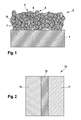
- FIG. 1 a cermet layer is shown on a substrate.
- the porous layer 3 is composed of particles 5 which form a porous cermet coating.
- the cermet coating contains a ceramic material 7 for this purpose and a metallic material 9.
- the metallic material may be, for example, as shown here, on the surface of the ceramic particles 7.
- the ceramic material is located on the surface of metal particles.
- the component that is on the surface of the other component may, for example, be in the form of small, predominantly separated particles on the surface of the other component.
- the outer component encloses the inner component shell-like completely or incompletely.
- the ceramic particles 7 and the metallic material 9 may also be collectively in associated dressings of a plurality of primary particles. Furthermore, it is also possible that one component, either the ceramic material or the metallic material, contains pores in which the other component is located. In general, hybrids of all three variations occur.
- a dispersion which contains at least one metal former and at least one ceramic former is usually applied to the substrate 1, wherein at least a part of the metal former in the form of metal particles and / or at least a part of the ceramic former in the form of ceramic particles in the dispersion is included.
- the dispersion can be applied by any method known to those skilled in the art.
- the dispersion can be present, for example, liquid or pasty.
- the viscosity of the dispersion is generally adjusted via a solvent. In order to achieve a liquid dispersion, the proportion of solvent is higher than with a pasty dispersion.
- the dispersion contains, for example, metal salts or salt-like precursors of the metal, which are converted into the metal of the Cemert coating, for example by thermal treatment.
- Suitable metals are, for example, metals of the eighth, ninth or tenth group of the Periodic Table of the Elements.
- Preferred metals are platinum or gold.
- metals which may be present in the form of a metal salt in the dispersion are also suitable as ceramic formers in the dispersion.
- the metal of the ceramic former is converted by oxidation with oxygen in the corresponding ceramic.
- ceramic particles are already contained in the dispersion.
- Suitable ceramics are, for example, SiO 2 and Al 2 O 3 .
- the dispersion is converted into the cermet coating.
- the dispersion which is converted into the cermet coating may contain pore formers.
- pore formers for example, carbon black particles, latex particles or organic polymers which burn at the temperature at which the thermal treatment is carried out are suitable.
- the porous layer 3 designed as a cermet coating is suitable, for example, as a gate electrode of a field-effect transistor.
- Advantage of the cermet material is that this is electrically conductive due to the metal contained therein.
- a cermet coating is temperature stable and can be used at temperatures above 400 ° C.
- a stable and surface-rich cermet layer is produced by applying a cermet-former as a dispersion, the so-called cermet varnish, to a support.
- a cermet-former as a dispersion
- the so-called cermet varnish to a support.
- salt-like cermet formers may be present in the dispersion.
- at least one component of the cermet-forming agent is at least partially present as a finely divided ceramic or as a finely divided metal.
- the ceramic-forming agent can also be present as a metal, which can be converted into dioxide-containing ceramic during the thermal treatment in an oxidizing atmosphere.
- the cermet formers can be present as particles or substances separated from one another, as particles associated with one another or partly as salts or salt-like precursors.
- the substrate 1 is, for example, a gate substrate of a field effect transistor.
- FIG. 2 a layer structure of a field effect transistor is shown schematically.
- a field effect transistor 11 comprises a source 13, a gate substrate 15 and a drain 17. Both the source 13, the gate substrate 15 and the drain 17 may be implemented as a cermet layer. Preferably, only the gate substrate 15 is formed as a cermet layer.
- Such field effect transistors 11 can be used for example in gas sensors.
- the porous layer formed as a gate coating has a large surface area. This means that on the one hand the total surface of the porous layer 3 is large and on the other hand, a large proportion of 3-phase boundaries is included, that is, phase boundaries at which the ceramic, the metallic and gas phase directly adjacent to each other.
- a porous layer formed according to the invention is produced, for example, by dissolving a solution of 2% by weight of platinum, 0.5% by weight of ZrO 2 in a solvent mixture, for example of tetrahydrofuran, diethyl ether, monobutyl diethylene glycol ether.
- the dissolved platinum particles preferably have a diameter in the range of 10 to 100 nm, the ZrO 2 particles of 5 to 30 nm.
- the solution is applied to a substrate 1. Subsequently, the organic constituents are removed at 300 ° C. in air. This is followed by a second coating, which is treated at 500 ° C. in the presence of air for 30 minutes. This creates a porous layer of a ceramic-metallic composite. This layer is electrically conductive. Even when treated at 400 ° C, the layer does not change.
- the coating by, for example, applying a paste containing 10% by weight of platinum and 2% by weight of ZrO 2 .
- the ZrO 2 is preferably finely distributed on the surface of the platinum particles.
- it was precipitated in a stabilized dispersion of platinum particles ZrO 2 in solution from soluble precursors.
- the platinum particles preferably have a diameter of 30 to 100 nm.
- Suitable solvents are, for example, alcohols or glycol ether derivatives. The precipitation of ZrO 2 takes place, for example, by hydrolysis of Zr alkoxides.
- the porous layer 1 can be further prepared by using a solution of platinum particles in diethylene glycol monobutyl ether whose diameter is in the range of 20 to 50 nm.
- the platinum particles are provided with a chemically deposited Zr metal layer.
- the ratio of platinum to zirconium is preferably in the range of 5: 1.
Landscapes
- Chemical & Material Sciences (AREA)
- Engineering & Computer Science (AREA)
- Materials Engineering (AREA)
- Mechanical Engineering (AREA)
- Metallurgy (AREA)
- Organic Chemistry (AREA)
- Chemical Kinetics & Catalysis (AREA)
- Health & Medical Sciences (AREA)
- Life Sciences & Earth Sciences (AREA)
- Analytical Chemistry (AREA)
- Microelectronics & Electronic Packaging (AREA)
- Electrochemistry (AREA)
- Physics & Mathematics (AREA)
- Molecular Biology (AREA)
- Biochemistry (AREA)
- General Health & Medical Sciences (AREA)
- General Physics & Mathematics (AREA)
- Immunology (AREA)
- Pathology (AREA)
- Chemically Coating (AREA)
- Powder Metallurgy (AREA)
- Other Surface Treatments For Metallic Materials (AREA)
Applications Claiming Priority (1)
| Application Number | Priority Date | Filing Date | Title |
|---|---|---|---|
| DE102007015874A DE102007015874A1 (de) | 2007-04-02 | 2007-04-02 | Verfahren zur Herstellung einer porösen Schicht |
Publications (3)
| Publication Number | Publication Date |
|---|---|
| EP1978132A2 true EP1978132A2 (fr) | 2008-10-08 |
| EP1978132A3 EP1978132A3 (fr) | 2010-08-11 |
| EP1978132B1 EP1978132B1 (fr) | 2014-12-03 |
Family
ID=39367516
Family Applications (1)
| Application Number | Title | Priority Date | Filing Date |
|---|---|---|---|
| EP08101646.1A Not-in-force EP1978132B1 (fr) | 2007-04-02 | 2008-02-15 | Procédé destiné à la fabrication d'une couche poreuse |
Country Status (2)
| Country | Link |
|---|---|
| EP (1) | EP1978132B1 (fr) |
| DE (1) | DE102007015874A1 (fr) |
Cited By (1)
| Publication number | Priority date | Publication date | Assignee | Title |
|---|---|---|---|---|
| WO2011095257A1 (fr) | 2010-02-05 | 2011-08-11 | Robert Bosch Gmbh | Procédé de détection de deux espèces gazeuses ou plus |
Families Citing this family (1)
| Publication number | Priority date | Publication date | Assignee | Title |
|---|---|---|---|---|
| DE102009057697A1 (de) | 2009-12-03 | 2011-06-09 | Fraunhofer-Gesellschaft zur Förderung der angewandten Forschung e.V. | Chemischer Mediensensor, Verfahren zu dessen Herstellung sowie Verwendungszwecke |
Citations (1)
| Publication number | Priority date | Publication date | Assignee | Title |
|---|---|---|---|---|
| US4931851A (en) | 1986-03-12 | 1990-06-05 | Thorn Emi Plc | Gas sensitive device |
Family Cites Families (6)
| Publication number | Priority date | Publication date | Assignee | Title |
|---|---|---|---|---|
| US4073999A (en) * | 1975-05-09 | 1978-02-14 | Minnesota Mining And Manufacturing Company | Porous ceramic or metallic coatings and articles |
| IT1277439B1 (it) * | 1995-08-04 | 1997-11-10 | Eniricerche Spa | Cernet di nichel e relativo procedimento di preparazione |
| US7625420B1 (en) * | 1997-02-24 | 2009-12-01 | Cabot Corporation | Copper powders methods for producing powders and devices fabricated from same |
| JP4004675B2 (ja) * | 1999-01-29 | 2007-11-07 | 株式会社日清製粉グループ本社 | 酸化物被覆金属微粒子の製造方法 |
| US20070044662A1 (en) * | 2005-08-25 | 2007-03-01 | The University Of Chicago | Method for fabricating dense thin film cermet hydrogen separation membrane |
| DE102006047928A1 (de) * | 2006-10-10 | 2008-04-17 | Robert Bosch Gmbh | Verfahren zur Herstellung mindestens einer porösen Schicht |
-
2007
- 2007-04-02 DE DE102007015874A patent/DE102007015874A1/de not_active Ceased
-
2008
- 2008-02-15 EP EP08101646.1A patent/EP1978132B1/fr not_active Not-in-force
Patent Citations (1)
| Publication number | Priority date | Publication date | Assignee | Title |
|---|---|---|---|---|
| US4931851A (en) | 1986-03-12 | 1990-06-05 | Thorn Emi Plc | Gas sensitive device |
Cited By (2)
| Publication number | Priority date | Publication date | Assignee | Title |
|---|---|---|---|---|
| WO2011095257A1 (fr) | 2010-02-05 | 2011-08-11 | Robert Bosch Gmbh | Procédé de détection de deux espèces gazeuses ou plus |
| DE102010001624A1 (de) | 2010-02-05 | 2011-08-11 | Robert Bosch GmbH, 70469 | Verfahren zur Detektion von zwei oder mehr Gasspezies |
Also Published As
| Publication number | Publication date |
|---|---|
| EP1978132A3 (fr) | 2010-08-11 |
| DE102007015874A1 (de) | 2008-10-09 |
| EP1978132B1 (fr) | 2014-12-03 |
Similar Documents
| Publication | Publication Date | Title |
|---|---|---|
| DE102013227205B4 (de) | Verfahren zum Herstellen einer Beschichtungsschicht aus einem Graphenoxid-Keramik-Hybridmaterial | |
| DE602004009751T2 (de) | Verfahren zur Abtrennung von halbleitenden Kohlenstoff-Nanoröhren | |
| DE112015002494B4 (de) | Brennstoffzellen-Separatormaterial und Verfahren zum Herstellen des Materials | |
| DE69814560T2 (de) | Nickelpulver und Verfahren zu seiner Herstellung | |
| DE102014204124A1 (de) | Verfahren zum Herstellen eines Sensorelements zur Erfassung mindestens einer Eigenschaft eines Messgases in einem Messgasraum | |
| DE102008008837A1 (de) | Druckbare Zusammensetzung zur Erzeugung elektrisch leitfähiger Beschichtungen und Verfahren zu ihrer Herstellung | |
| DE102011083118A1 (de) | Gasdiffusionsschicht mit verbesserter elektrischer Leitfähigkeit und Gasdurchlässigkeit | |
| EP2468826A1 (fr) | Emulsion Pickering destinée à la fabrication de revêtements conducteurs d'électricité et procédé de fabrication d'une émulsion Pickering | |
| WO2008017409A1 (fr) | Électrode pour une pile à combustible à carbonate fondu et son procédé de fabrication | |
| DE4130441A1 (de) | Verfahren zur herstellung waesseriger keramischer suspensionen und verwendung dieser suspensionen | |
| DE3118299A1 (de) | "verfahren zum erzeugen einer zelle zur messung der sauerstoffkonzentration" | |
| DE602004000821T2 (de) | Oberflächenbehandeltes ultrafeines Metallpulver | |
| DE102017006390A1 (de) | Poröse Keramikstruktur | |
| DE112014005640B4 (de) | Verfahren zur Herstellung von Silberteilchen und Silberteilchen, die durch das Verfahren hergestellt werden | |
| DE10108438A1 (de) | Oxidionenleiter, Herstellungsmethode dafür und ihn verwendende Brennstoffzelle | |
| EP1978132B1 (fr) | Procédé destiné à la fabrication d'une couche poreuse | |
| DE19514643C2 (de) | Verfahren zum Herstellen eines Keramikheizers für Sauerstoffsensoren | |
| DE2920268A1 (de) | Paste zur herstellung von festelektrolyten | |
| DE3238824A1 (de) | Sauerstoffmessfuehlerelement und verfahren zu dessen herstellung | |
| DE3686857T2 (de) | Verfahren zur herstellung eines zwischenverbindungstraegers fuer elektronische bauelemente. | |
| EP2058650A1 (fr) | Elément de capteur doté d'un électrolyte solide et élément conducteur isolé | |
| EP1601810A1 (fr) | Procede de fabrication d'un systeme a couches comportant un support metallique et une couche a fonction d'anode | |
| DE69703572T2 (de) | Nickel Pulver und Verfahren seiner Herstellung | |
| DE2824408C3 (de) | Verfahren zur Herstellung eines elektronisch | |
| DE102016206345B4 (de) | Verfahren zum Herstellen von dreidimensionalen Strukturen oder Strukturelementen auf Substratoberflächen |
Legal Events
| Date | Code | Title | Description |
|---|---|---|---|
| PUAI | Public reference made under article 153(3) epc to a published international application that has entered the european phase |
Free format text: ORIGINAL CODE: 0009012 |
|
| AK | Designated contracting states |
Kind code of ref document: A2 Designated state(s): AT BE BG CH CY CZ DE DK EE ES FI FR GB GR HR HU IE IS IT LI LT LU LV MC MT NL NO PL PT RO SE SI SK TR |
|
| AX | Request for extension of the european patent |
Extension state: AL BA MK RS |
|
| PUAL | Search report despatched |
Free format text: ORIGINAL CODE: 0009013 |
|
| AK | Designated contracting states |
Kind code of ref document: A3 Designated state(s): AT BE BG CH CY CZ DE DK EE ES FI FR GB GR HR HU IE IS IT LI LT LU LV MC MT NL NO PL PT RO SE SI SK TR |
|
| AX | Request for extension of the european patent |
Extension state: AL BA MK RS |
|
| RIC1 | Information provided on ipc code assigned before grant |
Ipc: H01L 29/772 20060101ALI20100708BHEP Ipc: C23C 26/00 20060101ALI20100708BHEP Ipc: G01N 27/414 20060101ALI20100708BHEP Ipc: C23C 24/00 20060101ALI20100708BHEP Ipc: C23C 24/08 20060101AFI20080519BHEP Ipc: B22F 1/02 20060101ALI20100708BHEP |
|
| 17P | Request for examination filed |
Effective date: 20110211 |
|
| AKX | Designation fees paid |
Designated state(s): AT BE BG CH CY CZ DE DK EE ES FI FR GB GR HR HU IE IS IT LI LT LU LV MC MT NL NO PL PT RO SE SI SK TR |
|
| REG | Reference to a national code |
Ref country code: DE Ref legal event code: R079 Ref document number: 502008012449 Country of ref document: DE Free format text: PREVIOUS MAIN CLASS: C23C0024080000 Ipc: C22C0001050000 |
|
| RIC1 | Information provided on ipc code assigned before grant |
Ipc: B22F 1/02 20060101ALI20140611BHEP Ipc: C22C 1/05 20060101AFI20140611BHEP Ipc: H01L 29/423 20060101ALI20140611BHEP Ipc: C23C 26/00 20060101ALI20140611BHEP Ipc: G01N 27/414 20060101ALI20140611BHEP Ipc: C23C 24/08 20060101ALI20140611BHEP Ipc: C22C 29/00 20060101ALI20140611BHEP Ipc: H01L 29/772 20060101ALI20140611BHEP Ipc: C22C 1/10 20060101ALI20140611BHEP Ipc: C23C 24/00 20060101ALI20140611BHEP |
|
| GRAP | Despatch of communication of intention to grant a patent |
Free format text: ORIGINAL CODE: EPIDOSNIGR1 |
|
| INTG | Intention to grant announced |
Effective date: 20140813 |
|
| GRAS | Grant fee paid |
Free format text: ORIGINAL CODE: EPIDOSNIGR3 |
|
| GRAA | (expected) grant |
Free format text: ORIGINAL CODE: 0009210 |
|
| AK | Designated contracting states |
Kind code of ref document: B1 Designated state(s): AT BE BG CH CY CZ DE DK EE ES FI FR GB GR HR HU IE IS IT LI LT LU LV MC MT NL NO PL PT RO SE SI SK TR |
|
| REG | Reference to a national code |
Ref country code: GB Ref legal event code: FG4D Free format text: NOT ENGLISH |
|
| REG | Reference to a national code |
Ref country code: CH Ref legal event code: EP Ref country code: AT Ref legal event code: REF Ref document number: 699427 Country of ref document: AT Kind code of ref document: T Effective date: 20141215 |
|
| REG | Reference to a national code |
Ref country code: IE Ref legal event code: FG4D Free format text: LANGUAGE OF EP DOCUMENT: GERMAN |
|
| REG | Reference to a national code |
Ref country code: DE Ref legal event code: R096 Ref document number: 502008012449 Country of ref document: DE Effective date: 20150115 |
|
| REG | Reference to a national code |
Ref country code: NL Ref legal event code: VDEP Effective date: 20141203 |
|
| PG25 | Lapsed in a contracting state [announced via postgrant information from national office to epo] |
Ref country code: ES Free format text: LAPSE BECAUSE OF FAILURE TO SUBMIT A TRANSLATION OF THE DESCRIPTION OR TO PAY THE FEE WITHIN THE PRESCRIBED TIME-LIMIT Effective date: 20141203 Ref country code: NO Free format text: LAPSE BECAUSE OF FAILURE TO SUBMIT A TRANSLATION OF THE DESCRIPTION OR TO PAY THE FEE WITHIN THE PRESCRIBED TIME-LIMIT Effective date: 20150303 Ref country code: FI Free format text: LAPSE BECAUSE OF FAILURE TO SUBMIT A TRANSLATION OF THE DESCRIPTION OR TO PAY THE FEE WITHIN THE PRESCRIBED TIME-LIMIT Effective date: 20141203 Ref country code: LT Free format text: LAPSE BECAUSE OF FAILURE TO SUBMIT A TRANSLATION OF THE DESCRIPTION OR TO PAY THE FEE WITHIN THE PRESCRIBED TIME-LIMIT Effective date: 20141203 Ref country code: NL Free format text: LAPSE BECAUSE OF FAILURE TO SUBMIT A TRANSLATION OF THE DESCRIPTION OR TO PAY THE FEE WITHIN THE PRESCRIBED TIME-LIMIT Effective date: 20141203 |
|
| REG | Reference to a national code |
Ref country code: LT Ref legal event code: MG4D |
|
| PG25 | Lapsed in a contracting state [announced via postgrant information from national office to epo] |
Ref country code: CY Free format text: LAPSE BECAUSE OF FAILURE TO SUBMIT A TRANSLATION OF THE DESCRIPTION OR TO PAY THE FEE WITHIN THE PRESCRIBED TIME-LIMIT Effective date: 20141203 Ref country code: GR Free format text: LAPSE BECAUSE OF FAILURE TO SUBMIT A TRANSLATION OF THE DESCRIPTION OR TO PAY THE FEE WITHIN THE PRESCRIBED TIME-LIMIT Effective date: 20150304 Ref country code: LV Free format text: LAPSE BECAUSE OF FAILURE TO SUBMIT A TRANSLATION OF THE DESCRIPTION OR TO PAY THE FEE WITHIN THE PRESCRIBED TIME-LIMIT Effective date: 20141203 Ref country code: SE Free format text: LAPSE BECAUSE OF FAILURE TO SUBMIT A TRANSLATION OF THE DESCRIPTION OR TO PAY THE FEE WITHIN THE PRESCRIBED TIME-LIMIT Effective date: 20141203 Ref country code: HR Free format text: LAPSE BECAUSE OF FAILURE TO SUBMIT A TRANSLATION OF THE DESCRIPTION OR TO PAY THE FEE WITHIN THE PRESCRIBED TIME-LIMIT Effective date: 20141203 |
|
| PG25 | Lapsed in a contracting state [announced via postgrant information from national office to epo] |
Ref country code: EE Free format text: LAPSE BECAUSE OF FAILURE TO SUBMIT A TRANSLATION OF THE DESCRIPTION OR TO PAY THE FEE WITHIN THE PRESCRIBED TIME-LIMIT Effective date: 20141203 Ref country code: SK Free format text: LAPSE BECAUSE OF FAILURE TO SUBMIT A TRANSLATION OF THE DESCRIPTION OR TO PAY THE FEE WITHIN THE PRESCRIBED TIME-LIMIT Effective date: 20141203 Ref country code: PT Free format text: LAPSE BECAUSE OF FAILURE TO SUBMIT A TRANSLATION OF THE DESCRIPTION OR TO PAY THE FEE WITHIN THE PRESCRIBED TIME-LIMIT Effective date: 20150403 Ref country code: RO Free format text: LAPSE BECAUSE OF FAILURE TO SUBMIT A TRANSLATION OF THE DESCRIPTION OR TO PAY THE FEE WITHIN THE PRESCRIBED TIME-LIMIT Effective date: 20141203 Ref country code: CZ Free format text: LAPSE BECAUSE OF FAILURE TO SUBMIT A TRANSLATION OF THE DESCRIPTION OR TO PAY THE FEE WITHIN THE PRESCRIBED TIME-LIMIT Effective date: 20141203 |
|
| PG25 | Lapsed in a contracting state [announced via postgrant information from national office to epo] |
Ref country code: PL Free format text: LAPSE BECAUSE OF FAILURE TO SUBMIT A TRANSLATION OF THE DESCRIPTION OR TO PAY THE FEE WITHIN THE PRESCRIBED TIME-LIMIT Effective date: 20141203 Ref country code: IS Free format text: LAPSE BECAUSE OF FAILURE TO SUBMIT A TRANSLATION OF THE DESCRIPTION OR TO PAY THE FEE WITHIN THE PRESCRIBED TIME-LIMIT Effective date: 20150403 |
|
| REG | Reference to a national code |
Ref country code: DE Ref legal event code: R097 Ref document number: 502008012449 Country of ref document: DE |
|
| PG25 | Lapsed in a contracting state [announced via postgrant information from national office to epo] |
Ref country code: LU Free format text: LAPSE BECAUSE OF FAILURE TO SUBMIT A TRANSLATION OF THE DESCRIPTION OR TO PAY THE FEE WITHIN THE PRESCRIBED TIME-LIMIT Effective date: 20150215 |
|
| REG | Reference to a national code |
Ref country code: CH Ref legal event code: PL |
|
| PLBE | No opposition filed within time limit |
Free format text: ORIGINAL CODE: 0009261 |
|
| STAA | Information on the status of an ep patent application or granted ep patent |
Free format text: STATUS: NO OPPOSITION FILED WITHIN TIME LIMIT |
|
| PG25 | Lapsed in a contracting state [announced via postgrant information from national office to epo] |
Ref country code: LI Free format text: LAPSE BECAUSE OF NON-PAYMENT OF DUE FEES Effective date: 20150228 Ref country code: CH Free format text: LAPSE BECAUSE OF NON-PAYMENT OF DUE FEES Effective date: 20150228 Ref country code: MC Free format text: LAPSE BECAUSE OF FAILURE TO SUBMIT A TRANSLATION OF THE DESCRIPTION OR TO PAY THE FEE WITHIN THE PRESCRIBED TIME-LIMIT Effective date: 20141203 Ref country code: DK Free format text: LAPSE BECAUSE OF FAILURE TO SUBMIT A TRANSLATION OF THE DESCRIPTION OR TO PAY THE FEE WITHIN THE PRESCRIBED TIME-LIMIT Effective date: 20141203 |
|
| 26N | No opposition filed |
Effective date: 20150904 |
|
| REG | Reference to a national code |
Ref country code: IE Ref legal event code: MM4A |
|
| GBPC | Gb: european patent ceased through non-payment of renewal fee |
Effective date: 20150303 |
|
| PG25 | Lapsed in a contracting state [announced via postgrant information from national office to epo] |
Ref country code: IE Free format text: LAPSE BECAUSE OF NON-PAYMENT OF DUE FEES Effective date: 20150215 Ref country code: GB Free format text: LAPSE BECAUSE OF NON-PAYMENT OF DUE FEES Effective date: 20150303 |
|
| REG | Reference to a national code |
Ref country code: FR Ref legal event code: PLFP Year of fee payment: 9 |
|
| PG25 | Lapsed in a contracting state [announced via postgrant information from national office to epo] |
Ref country code: SI Free format text: LAPSE BECAUSE OF FAILURE TO SUBMIT A TRANSLATION OF THE DESCRIPTION OR TO PAY THE FEE WITHIN THE PRESCRIBED TIME-LIMIT Effective date: 20141203 |
|
| REG | Reference to a national code |
Ref country code: AT Ref legal event code: MM01 Ref document number: 699427 Country of ref document: AT Kind code of ref document: T Effective date: 20150215 |
|
| PG25 | Lapsed in a contracting state [announced via postgrant information from national office to epo] |
Ref country code: AT Free format text: LAPSE BECAUSE OF NON-PAYMENT OF DUE FEES Effective date: 20150215 |
|
| PG25 | Lapsed in a contracting state [announced via postgrant information from national office to epo] |
Ref country code: MT Free format text: LAPSE BECAUSE OF FAILURE TO SUBMIT A TRANSLATION OF THE DESCRIPTION OR TO PAY THE FEE WITHIN THE PRESCRIBED TIME-LIMIT Effective date: 20141203 |
|
| REG | Reference to a national code |
Ref country code: FR Ref legal event code: PLFP Year of fee payment: 10 |
|
| PG25 | Lapsed in a contracting state [announced via postgrant information from national office to epo] |
Ref country code: BG Free format text: LAPSE BECAUSE OF FAILURE TO SUBMIT A TRANSLATION OF THE DESCRIPTION OR TO PAY THE FEE WITHIN THE PRESCRIBED TIME-LIMIT Effective date: 20141203 Ref country code: HU Free format text: LAPSE BECAUSE OF FAILURE TO SUBMIT A TRANSLATION OF THE DESCRIPTION OR TO PAY THE FEE WITHIN THE PRESCRIBED TIME-LIMIT; INVALID AB INITIO Effective date: 20080215 |
|
| PG25 | Lapsed in a contracting state [announced via postgrant information from national office to epo] |
Ref country code: BE Free format text: LAPSE BECAUSE OF NON-PAYMENT OF DUE FEES Effective date: 20150228 |
|
| PG25 | Lapsed in a contracting state [announced via postgrant information from national office to epo] |
Ref country code: TR Free format text: LAPSE BECAUSE OF FAILURE TO SUBMIT A TRANSLATION OF THE DESCRIPTION OR TO PAY THE FEE WITHIN THE PRESCRIBED TIME-LIMIT Effective date: 20141203 |
|
| REG | Reference to a national code |
Ref country code: FR Ref legal event code: PLFP Year of fee payment: 11 |
|
| PGFP | Annual fee paid to national office [announced via postgrant information from national office to epo] |
Ref country code: IT Payment date: 20180221 Year of fee payment: 11 Ref country code: FR Payment date: 20180222 Year of fee payment: 11 |
|
| PGFP | Annual fee paid to national office [announced via postgrant information from national office to epo] |
Ref country code: DE Payment date: 20180426 Year of fee payment: 11 |
|
| REG | Reference to a national code |
Ref country code: DE Ref legal event code: R119 Ref document number: 502008012449 Country of ref document: DE |
|
| PG25 | Lapsed in a contracting state [announced via postgrant information from national office to epo] |
Ref country code: DE Free format text: LAPSE BECAUSE OF NON-PAYMENT OF DUE FEES Effective date: 20190903 |
|
| PG25 | Lapsed in a contracting state [announced via postgrant information from national office to epo] |
Ref country code: FR Free format text: LAPSE BECAUSE OF NON-PAYMENT OF DUE FEES Effective date: 20190228 Ref country code: IT Free format text: LAPSE BECAUSE OF NON-PAYMENT OF DUE FEES Effective date: 20190215 |