EP1978361A2 - Procédé pour effectuer la correction de polarisation d'analyse sanguine du glucose utilisant une concentration d'hémoglobine comme déterminé par un système de combinaison A1C glucose-hémoglobine et dispositifs pour celui-ci - Google Patents
Procédé pour effectuer la correction de polarisation d'analyse sanguine du glucose utilisant une concentration d'hémoglobine comme déterminé par un système de combinaison A1C glucose-hémoglobine et dispositifs pour celui-ci Download PDFInfo
- Publication number
- EP1978361A2 EP1978361A2 EP08006729A EP08006729A EP1978361A2 EP 1978361 A2 EP1978361 A2 EP 1978361A2 EP 08006729 A EP08006729 A EP 08006729A EP 08006729 A EP08006729 A EP 08006729A EP 1978361 A2 EP1978361 A2 EP 1978361A2
- Authority
- EP
- European Patent Office
- Prior art keywords
- concentration
- glucose
- glu
- hct
- hemoglobin
- Prior art date
- Legal status (The legal status is an assumption and is not a legal conclusion. Google has not performed a legal analysis and makes no representation as to the accuracy of the status listed.)
- Withdrawn
Links
- WQZGKKKJIJFFOK-GASJEMHNSA-N Glucose Natural products OC[C@H]1OC(O)[C@H](O)[C@@H](O)[C@@H]1O WQZGKKKJIJFFOK-GASJEMHNSA-N 0.000 title claims abstract description 149
- 239000008103 glucose Substances 0.000 title claims abstract description 149
- 210000004369 blood Anatomy 0.000 title claims abstract description 131
- 239000008280 blood Substances 0.000 title claims abstract description 131
- 108010054147 Hemoglobins Proteins 0.000 title claims abstract description 94
- 102000001554 Hemoglobins Human genes 0.000 title claims abstract description 94
- 238000000034 method Methods 0.000 title claims abstract description 79
- 238000012937 correction Methods 0.000 title claims abstract description 60
- 238000003556 assay Methods 0.000 title claims abstract description 36
- 238000005534 hematocrit Methods 0.000 claims abstract description 87
- 238000012360 testing method Methods 0.000 claims abstract description 78
- 238000012806 monitoring device Methods 0.000 claims abstract description 11
- XUFXOAAUWZOOIT-SXARVLRPSA-N (2R,3R,4R,5S,6R)-5-[[(2R,3R,4R,5S,6R)-5-[[(2R,3R,4S,5S,6R)-3,4-dihydroxy-6-methyl-5-[[(1S,4R,5S,6S)-4,5,6-trihydroxy-3-(hydroxymethyl)-1-cyclohex-2-enyl]amino]-2-oxanyl]oxy]-3,4-dihydroxy-6-(hydroxymethyl)-2-oxanyl]oxy]-6-(hydroxymethyl)oxane-2,3,4-triol Chemical compound O([C@H]1O[C@H](CO)[C@H]([C@@H]([C@H]1O)O)O[C@H]1O[C@@H]([C@H]([C@H](O)[C@H]1O)N[C@@H]1[C@@H]([C@@H](O)[C@H](O)C(CO)=C1)O)C)[C@@H]1[C@@H](CO)O[C@@H](O)[C@H](O)[C@H]1O XUFXOAAUWZOOIT-SXARVLRPSA-N 0.000 claims description 28
- 239000003153 chemical reaction reagent Substances 0.000 claims description 21
- 230000003287 optical effect Effects 0.000 claims description 17
- 238000008479 Hemoglobin A1c Assay Methods 0.000 claims description 13
- 230000001419 dependent effect Effects 0.000 claims description 9
- 230000000694 effects Effects 0.000 claims description 5
- 230000008569 process Effects 0.000 description 21
- 210000003743 erythrocyte Anatomy 0.000 description 9
- 238000003487 electrochemical reaction Methods 0.000 description 5
- 238000005259 measurement Methods 0.000 description 5
- 238000012544 monitoring process Methods 0.000 description 5
- 230000003595 spectral effect Effects 0.000 description 5
- 108090000790 Enzymes Proteins 0.000 description 4
- 102000004190 Enzymes Human genes 0.000 description 4
- 229940088598 enzyme Drugs 0.000 description 4
- 230000002641 glycemic effect Effects 0.000 description 4
- NOESYZHRGYRDHS-UHFFFAOYSA-N insulin Chemical compound N1C(=O)C(NC(=O)C(CCC(N)=O)NC(=O)C(CCC(O)=O)NC(=O)C(C(C)C)NC(=O)C(NC(=O)CN)C(C)CC)CSSCC(C(NC(CO)C(=O)NC(CC(C)C)C(=O)NC(CC=2C=CC(O)=CC=2)C(=O)NC(CCC(N)=O)C(=O)NC(CC(C)C)C(=O)NC(CCC(O)=O)C(=O)NC(CC(N)=O)C(=O)NC(CC=2C=CC(O)=CC=2)C(=O)NC(CSSCC(NC(=O)C(C(C)C)NC(=O)C(CC(C)C)NC(=O)C(CC=2C=CC(O)=CC=2)NC(=O)C(CC(C)C)NC(=O)C(C)NC(=O)C(CCC(O)=O)NC(=O)C(C(C)C)NC(=O)C(CC(C)C)NC(=O)C(CC=2NC=NC=2)NC(=O)C(CO)NC(=O)CNC2=O)C(=O)NCC(=O)NC(CCC(O)=O)C(=O)NC(CCCNC(N)=N)C(=O)NCC(=O)NC(CC=3C=CC=CC=3)C(=O)NC(CC=3C=CC=CC=3)C(=O)NC(CC=3C=CC(O)=CC=3)C(=O)NC(C(C)O)C(=O)N3C(CCC3)C(=O)NC(CCCCN)C(=O)NC(C)C(O)=O)C(=O)NC(CC(N)=O)C(O)=O)=O)NC(=O)C(C(C)CC)NC(=O)C(CO)NC(=O)C(C(C)O)NC(=O)C1CSSCC2NC(=O)C(CC(C)C)NC(=O)C(NC(=O)C(CCC(N)=O)NC(=O)C(CC(N)=O)NC(=O)C(NC(=O)C(N)CC=1C=CC=CC=1)C(C)C)CC1=CN=CN1 NOESYZHRGYRDHS-UHFFFAOYSA-N 0.000 description 4
- 230000005540 biological transmission Effects 0.000 description 3
- 238000006243 chemical reaction Methods 0.000 description 3
- 238000000840 electrochemical analysis Methods 0.000 description 3
- -1 for example Proteins 0.000 description 3
- 230000007774 longterm Effects 0.000 description 3
- 102000004877 Insulin Human genes 0.000 description 2
- 108090001061 Insulin Proteins 0.000 description 2
- XEEYBQQBJWHFJM-UHFFFAOYSA-N Iron Chemical compound [Fe] XEEYBQQBJWHFJM-UHFFFAOYSA-N 0.000 description 2
- 108010061951 Methemoglobin Proteins 0.000 description 2
- 239000012491 analyte Substances 0.000 description 2
- 210000001124 body fluid Anatomy 0.000 description 2
- 239000010839 body fluid Substances 0.000 description 2
- 230000008859 change Effects 0.000 description 2
- 206010012601 diabetes mellitus Diseases 0.000 description 2
- 238000001506 fluorescence spectroscopy Methods 0.000 description 2
- 235000019420 glucose oxidase Nutrition 0.000 description 2
- 229940125396 insulin Drugs 0.000 description 2
- 238000012986 modification Methods 0.000 description 2
- 230000004048 modification Effects 0.000 description 2
- NNFCIKHAZHQZJG-UHFFFAOYSA-N potassium cyanide Chemical compound [K+].N#[C-] NNFCIKHAZHQZJG-UHFFFAOYSA-N 0.000 description 2
- 125000006850 spacer group Chemical group 0.000 description 2
- 239000000126 substance Substances 0.000 description 2
- 238000002235 transmission spectroscopy Methods 0.000 description 2
- 108010050375 Glucose 1-Dehydrogenase Proteins 0.000 description 1
- 108010015776 Glucose oxidase Proteins 0.000 description 1
- 239000004366 Glucose oxidase Substances 0.000 description 1
- 108010016811 Sulfhemoglobin Proteins 0.000 description 1
- 238000002835 absorbance Methods 0.000 description 1
- 230000002411 adverse Effects 0.000 description 1
- 238000004458 analytical method Methods 0.000 description 1
- 239000012503 blood component Substances 0.000 description 1
- 238000004737 colorimetric analysis Methods 0.000 description 1
- 230000000536 complexating effect Effects 0.000 description 1
- 239000000306 component Substances 0.000 description 1
- 238000007796 conventional method Methods 0.000 description 1
- 238000013461 design Methods 0.000 description 1
- 238000011161 development Methods 0.000 description 1
- 238000010586 diagram Methods 0.000 description 1
- 230000002255 enzymatic effect Effects 0.000 description 1
- 238000011156 evaluation Methods 0.000 description 1
- YAGKRVSRTSUGEY-UHFFFAOYSA-N ferricyanide Chemical class [Fe+3].N#[C-].N#[C-].N#[C-].N#[C-].N#[C-].N#[C-] YAGKRVSRTSUGEY-UHFFFAOYSA-N 0.000 description 1
- 239000012530 fluid Substances 0.000 description 1
- 229940116332 glucose oxidase Drugs 0.000 description 1
- 230000036252 glycation Effects 0.000 description 1
- 230000005484 gravity Effects 0.000 description 1
- 230000036541 health Effects 0.000 description 1
- 230000008105 immune reaction Effects 0.000 description 1
- 238000010324 immunological assay Methods 0.000 description 1
- 229910052742 iron Inorganic materials 0.000 description 1
- 230000002934 lysing effect Effects 0.000 description 1
- 239000000049 pigment Substances 0.000 description 1
- 238000012552 review Methods 0.000 description 1
- 238000002834 transmittance Methods 0.000 description 1
- BYGOPQKDHGXNCD-UHFFFAOYSA-N tripotassium;iron(3+);hexacyanide Chemical compound [K+].[K+].[K+].[Fe+3].N#[C-].N#[C-].N#[C-].N#[C-].N#[C-].N#[C-] BYGOPQKDHGXNCD-UHFFFAOYSA-N 0.000 description 1
Images




Classifications
-
- G—PHYSICS
- G01—MEASURING; TESTING
- G01N—INVESTIGATING OR ANALYSING MATERIALS BY DETERMINING THEIR CHEMICAL OR PHYSICAL PROPERTIES
- G01N33/00—Investigating or analysing materials by specific methods not covered by groups G01N1/00 - G01N31/00
- G01N33/48—Biological material, e.g. blood, urine; Haemocytometers
- G01N33/50—Chemical analysis of biological material, e.g. blood, urine; Testing involving biospecific ligand binding methods; Immunological testing
- G01N33/72—Chemical analysis of biological material, e.g. blood, urine; Testing involving biospecific ligand binding methods; Immunological testing involving blood pigments, e.g. haemoglobin, bilirubin or other porphyrins; involving occult blood
- G01N33/721—Haemoglobin
-
- G—PHYSICS
- G01—MEASURING; TESTING
- G01N—INVESTIGATING OR ANALYSING MATERIALS BY DETERMINING THEIR CHEMICAL OR PHYSICAL PROPERTIES
- G01N33/00—Investigating or analysing materials by specific methods not covered by groups G01N1/00 - G01N31/00
- G01N33/48—Biological material, e.g. blood, urine; Haemocytometers
- G01N33/50—Chemical analysis of biological material, e.g. blood, urine; Testing involving biospecific ligand binding methods; Immunological testing
- G01N33/66—Chemical analysis of biological material, e.g. blood, urine; Testing involving biospecific ligand binding methods; Immunological testing involving blood sugars, e.g. galactose
Definitions
- the invention relates to methods and devices for correcting the blood glucose assay bias in glucose-monitoring devices to provide more accurate glucose readings of blood samples.
- the invention relates to methods for using hemoglobin concentrations determined from a hemoglobin A 1C assay to correct the glucose assay bias resulting from sample hematocrit interference.
- the hemoglobin A 1C assay and the glucose assay may be performed using a single monitoring system.
- the system may include a meter and one or more testing devices, such as one or more test strips, one or more test cartridges, a combination of a test strip and test cartridge, etc.
- Blood hematocrit is the ratio of the volume of packed red blood cells to the total blood volume, expressed as a percentage of the volume of red blood cells in a whole blood sample.
- the normal hematocrit range for a typical human being is about 35 vol.% to about 45 vol.%, though in extreme cases, the hematocrit may range from about 20 vol.% to about 70 vol. %.
- the mean hematocrit range for neonatal is about 53 vol.% to about 69 vol.%.
- Blood hematocrit levels outside of the normal range of 35 vol.% to 45 vol.% may interfere with blood glucose-monitoring systems which are based on either optical or electrochemical reaction principles. Hematocrit interference contributes to a glucose assay bias in glucose-monitoring systems, which can be as large as +/- 50% of the measured glucose concentration.
- the glucose bias caused by the hematocrit content of a blood sample can have an adverse effect on patients.
- Patients who have low hematocrit levels i.e., blood with about 35 vol.% hematocrit or lower
- the actual glucose level is not as high as the perceived glucose level
- patients may drop their glucose level too low by unnecessarily taking too much insulin.
- patients who have high hematocrit levels i.e., blood with about 45 vol.% hematocrit or higher
- the blood sample may either be filtered to eliminate the red blood cells or the amount of red blood cells in the blood sample must be accurately determined.
- hematocrit values of whole blood samples have been measured routinely in the clinical or laboratory setting, hematocrit values are not commonly measured with hand-held, home-use, blood glucose-monitoring devices.
- Some blood glucose-monitoring devices have been developed to determine hematocrit values of a whole blood sample in a glucose-monitoring device using a blood reflectance system for measuring the reflectance of the blood sample at a specific wavelength. The results are then used to normalize the glucose-concentration readings.
- Other monitoring devices use a transmission system wherein a blood sample is illuminated with light and the total transmission through the blood sample is collected and used to correct the glucose concentration based on the spectral properties of the hemoglobin of the blood sample.
- the spectral properties of the blood sample are measured through either light reflectance or transmittance using a specific wavelength where the optical property of hemoglobin of the red blood cells, which is less sensitive to other components in the blood, must be chosen to minimize the interference with other blood components.
- the amount of hemoglobin from the red blood cells is estimated optically at a wavelength of about 680 nanometers or other wavelengths characteristic of hemoglobin spectral properties.
- a correction for glucose can be made if the device also measures the spectral property of the hemoglobin molecule at about the 680 nanometer wavelength or other wavelengths characteristic of hemoglobin spectral properties.
- Such systems for correcting glucose concentrations in a blood sample must have an optical reflectance or transmission system.
- some glucose monitoring devices are based on electrochemical reactions and do not employ optical systems.
- a desirable testing system would employ a method for adjusting glucose concentrations based on hematocrit interference that is not dependent on the type of glucose testing system employed.
- a device that is adapted to measure a combination of analytes e.g., glucose and hemoglobin A 1C ) is desirable as a patient has the convenience of monitoring current glucose concentrations to determine the long term glycemic control in a single device.
- a method for correcting the blood glucose assay bias in a testing device or system that measures glucose and hemoglobin concentrations in a blood sample comprises the acts of measuring the total hemoglobin concentration, Hb, of the blood sample as part of a hemoglobin A 1C assay, measuring the glucose concentration, Glu uncor , of the blood sample, and calculating the percent hematocrit, %Hct, of the blood sample based on an empirical relationship between the total hemoglobin concentration, Hb, and the percent hematocrit, %Hct.
- the method further comprises calculating a correction factor, %Correction, based on an empirical relationship between the percent hematocrit, %Hct and the correction factor, %Correction and correcting the glucose concentration, Glu uncor , of the blood sample using the %Correction to provide a corrected glucose concentration, Glu cor .
- a testing device or system for measuring the blood glucose concentration and total hemoglobin concentration in a blood sample and correcting the measured glucose concentration for a glucose assay bias effect includes a reagent system adapted to measure the blood glucose concentration, Glu uncor of the blood sample and a reagent system adapted to measure the total hemoglobin concentration, Hb, of the blood sample as part of a hemoglobin A 1C assay.
- the testing device or system also includes a processor adapted to calculate a percent hematocrit, %Hct, of the blood sample based on an empirical relationship using the total hemoglobin concentration, Hb, a correction factor, %Correction, based on an empirical relationship using the percent hematocrit, %Hct, and a corrected glucose concentration, Glu cor , of the blood sample based on the correction factor, %Correction.
- the testing device or system further includes a display adapted to display the corrected glucose concentration, Glu cor , to a user.
- a single combination testing device is adapted for measuring blood glucose concentration and total hemoglobin concentration in a blood sample, the total hemoglobin concentration being measured as part of a hemoglobin A 1C assay.
- FIG. 1 is a top view of a test sensor according to one embodiment.
- FIG. 2 is a top view of a test sensor according to another embodiment.
- FIG. 3 is a schematic diagram describing a method for adjusting the blood glucose assay bias using blood hemoglobin concentration
- FIG. 4 is a graph showing the relationship between blood hemoglobin concentration and % hematocrit level.
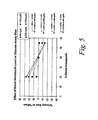
- FIG. 5 is a graph showing the relationship between the % hematocrit level and the % glucose assay bias for samples at different glucose concentrations.
- FIG. 6 is a graph showing the relationship between constant C3 and the "uncorrected" glucose concentrations.
- FIG. 7 is a graph showing the relationship between constant C4 and the "uncorrected" blood glucose concentrations.
- Embodiments of the invention are, in part, based on the discovery that the performance of glucose-monitoring devices or systems may be improved by adjusting the blood glucose value based on sample hematocrit level in glucose-monitoring devices or systems. It has been discovered that by using the methods and devices described herein, a more accurate glucose reading can be obtained. By obtaining a more accurate glucose reading, a more accurate assessment of the glycermic stage of a patient can be obtained and readily reported to the patient's physician.
- blood glucose assay bias is defined as a trend in the collection, analysis, interpretation, or review of glucose data from a glucose assay that leads to the conclusion that the patient's measured glucose level of the blood sample is systematically different from the patient's actual glucose level.
- the present invention generally includes measuring the blood glucose concentration and the total blood hemoglobin concentration in a whole blood sample on the same testing device.
- the tests for measuring the blood glucose concentration and the total blood hemoglobin concentration may be performed using the same blood sample or a different blood sample.
- the total blood hemoglobin concentration of the red blood cells may be measured optically as part of a hemoglobin A 1C assay.
- the total hemoglobin concentration can then be used to calculate the hematocrit level in the blood sample using an empirical relationship.
- the hematocrit level can in turn be used to calculate a correction factor using an empirical relationship.
- the correction factor is applied to the measured blood glucose concentration to calculate a corrected blood glucose concentration, which is reported or displayed to a patient.
- the calculated hematocrit level can be stored in the testing device and used to correct the glucose test results.
- the calculated hematocrit level may be stored in the testing device until a new hematocrit level is determined which replaces the previous hematocrit level.
- FIG. 1 depicts a test sensor 70 that includes a capillary channel 72, an area for meter contacts 86, and a plurality of electrodes 76, 80, 84.
- the plurality of electrodes includes a counter electrode 76, a working (measuring) electrode 80, and an optional trigger electrode 84.
- the trigger electrode 84 may assist in determining whether a sufficient blood sample has been placed on the sensor 70.
- the electrochemical test sensor may also contain other numbers and/or types of electrodes.
- the capillary channel 72 contains reagent.
- the reagent typically contains an enzyme such as, for example, glucose oxidase, which reacts with the analyte and with an electron acceptor such as a ferricyanide salt to produce an electrochemically measurable species that can be detected by the electrodes. It is contemplated that other enzymes may be used to react with glucose such as glucose dehydrogenase. Examples of electrochemical test sensors, including their operation, may be found in, for example, U.S. Patent No. 6,531,040 (entitled "Electrochemical-sensor Design") assigned to Bayer Corporation.
- FIG. 2 shows an optical test sensor 88 according to one embodiment.
- the test sensor 88 includes a base (not shown), a lid 89, and a spacer (not shown) positioned between the lid 89 and the base.
- a fluid-receiving area 90 is formed.
- the fluid-receiving area provides a flow path for introducing the fluid sample into the test sensor 88.
- the fluid-receiving area 90 is formed at a first end or testing end 91 of the test sensor 88.
- the test sensor 88 includes a second opposing end 92. The second opposing end 92 is adapted to be placed into a meter or instrument.
- Optical test sensor systems may use techniques such as, for example, transmission spectroscopy, diffuse reflectance or fluorescence spectroscopy for measuring the analyte concentration.
- An indicator reagent system and glucose in a sample of body fluid are reacted to produce a chromatic reaction-the reaction between the reagent and glucose causes the reagent to change color.
- the degree of color change is indicative of the glucose concentration in the body fluid measured by the absorbance level of the transmitted light.
- Transmission spectroscopy is described in, for example, U.S. Patent No. 5,866,349 (entitled “Method for Determination of Glucose in Whole Blood and Cuvette and Photometer for Carrying out said Method").
- Diffuse reflectance and fluorescence spectroscopy are described in, for example, U.S. Patents Nos. 5,518,689 (entitled “Diffuse Light Reflectance Read Head”); 5,611,999 (entitled “Diffuse Light Reflectance Read Head”); and 5,194,393 (entitled “Optical Biosensor and Method of Use”). It is contemplated that other optical and electrochemical test sensors may be employed.
- the measurement of the concentration of total hemoglobin occurs in the same testing device that is used for measuring the glucose concentration.
- the measurement of the total hemoglobin in the whole blood sample may be based on chemical reactions between the hemoglobin molecules and a chemical reagent.
- one such method for measuring the total hemoglobin concentration includes the acts of: (1) lysing the red blood cells to release hemoglobin molecules, (2) complexing the hemoglobin molecules with the chemical reagents to form a colored species, and (3) measuring the extent of the color development at a particular wavelength.
- cyanmethemoglobin method One example of such a colorimetric method is the cyanmethemoglobin method.
- the principle of this method is based on the fact that when a sample of blood is mixed with a solution containing potassium ferricyanide and potassium cyanide, the potasium ferricyanide oxidizes iron of hemoglobin to form methemoglobin. The potassium cyanide then combines with methemoglobin to form cyanmethemoglobin, a stable color pigment which can be read photometrically at a wave length of about 540 nm.
- cyanmethemoglobin method Some advantages of the cyanmethemoglobin method are that (1) all forms of hemoglobin, except sulfhemoglobin, are measured, (2) the method is easily standardized, (3) the cyanmethemoglobin reagent, also called Drabkin's solution, is very stable, and (4) the method may be used in combination with an immunological assay to determine the amount of hemoglobin A 1C in a blood sample.
- hemoglobin and hemoglobin A 1C measurement can be performed using the same testing device as the glucose measurement (a "combo" meter).
- a single drop of blood can be used for performing both the hemoglobin/hemoglobin A 1C assay as well as the glucose assay.
- the total hemoglobin concentration (Hb) can be used to calculate the hemoglobin A 1C concentration.
- Hemoglobin A 1C may be formed by an immunological reaction involving the non-enzymatic glycation of the N-terminus of the ⁇ -chain of hemoglobin. Other reactions to determine the hemoglobin A 1C concentration may also be used with the present invention.
- the concentration of hemoglobin A 1C is commonly reported as the percent hemoglobin A 1C , %HbA 1C , in a blood sample.
- the percent hemoglobin A 1C , %HbA 1C is reported as the ratio of the concentration of hemoglobin A 1C to the concentration of total hemoglobin.
- the percent hemoglobin A 1C , %HbA 1C is commonly used to monitor the long-term (i.e., 3-week) glycemic control for people with diabetes.
- the total hemoglobin concentration is used to determine the hematocrit of the whole blood sample.
- the hematocrit may be used to correct the glucose assay bias as shown in FIG. 3 .
- the hematocrit is the ratio of the volume of packed red blood cells to the total blood volume.
- % Hct C ⁇ 1 ⁇ Hb + C ⁇ 2
- Hb is the total hemoglobin concentration in gram/dL.
- C 1 and C2 are constants that may be determined from plotting hemoglobin concentration vs.
- C1 equals about 2.95, which is the mean slope of the three systems shown in FIG. 4
- C2 equals about -2.0, which is the mean intercept of the three systems shown in FIG. 4 .
- This empirical relationship between the percent hematocrit, %Hct, and the total hemoglobin (Hb) concentration is based on studies performed using hemoglobin reagents (i.e., Drabkin's reagent) obtained from Sigma Chemical Co, HemoCue Ltd. and Bayer DCA 2000 analyzer. From those studies, the two constants, C1 and C2, were determined empirically based on the hemoglobin test results as plotted in FIG. 4 . The values of the constants C1 and C2 are dependent on the specific reagent system that is used to determine the hemoglobin concentration.
- the 95% confidence limit for C1 ranges from about 2.2 to about 3.4 and for C2 ranges from about -9 to about 4, based on the evaluation of the three systems using the Drabkin's reagent discussed above.
- the sample hematocrit levels were varied in the range of 0 to 60% and the average values of two replicates for each sample were used for plotting.
- the percent hematocrit, %Hct, determined from Equation 1 may be used to derive a correction factor, %Correction, for correcting the "apparent" glucose concentration, Glu uncor ., measured by the "combo" device before blood hematocrit correction.
- % Correction % Hct ⁇ C ⁇ 3 + C ⁇ 4
- %Hct is the % hematocrit determined from Equation 1
- C3 and C4 are constants that may be determined from plotting % hematocrit vs. % glucose assay bias based on the results of a blood glucose monitoring system using whole blood samples at different hematrocrit levels (i.e., 20%, 40% and 55%) as described below and shown in FIG. 5 .
- the blood glucose concentrations for each hematocrit level was adjusted to 50, 100, 200 and 400 mg/dL. Twenty replicates per sample were collected.
- the mean assay bias at each glucose level was calculated by comparing glucose assay results obtained from samples with low (i.e., 20% hematocrit) and high (i.e., 55% hematocrit) hematocrit levels to the assay results of the 40% hematocrit sample.
- the data plotted in FIG. 5 is an average % assay bias from three lots of test sensors.
- C3 and C4 are equal to the mean slope and mean interecept, respectively, for each glucose assay performed and thus are dependent on the concentration of glucose in each sample.
- the sample hematocrit levels were adjusted to 20%, 40% and 55%.
- FIG. 6 is a plot of the blood glucose concentration vs. the constant C3.
- FIG. 7 is a plot of the blood glucose concentration vs. the constant C4. The curves were fitted with a logarithmic function.
- the "apparent" glucose assay results Glu uncor
- the sample hematocrit level, obtained from Equation 1 from the hemoglobin assay, in combination with C3 and C4 can then be used to calculate the hematocrit correction factor (%Correction) based on Equation 2.
- the output of Equations 1 and 2 above may be used to correct the blood glucose assay bias of the measured glucose concentration, Glu uncor , using Equations 5 and 6 below.
- Glu cor Glu uncor where %Hct is greater than about 35% and less than about 45%.
- the reagent system used to develop the Equations 1-6 is based on an electrochemical reaction using glucose oxidase enzyme and potassium ferricyanide mediator.
- the present invention is not limited to a specific enzyme or mediator, and could include other enzymes or mediators typically used in testing devices.
- FIG. 3 illustrates one embodiment of the inventive method described herein in for correcting the blood glucose assay bias in a whole blood sample.
- the inventive method involves the acts of (1) measuring the glucose concentration, Glu uncor , of the blood sample; (2) measuring the total hemoglobin concentration, Hb, of the blood sample; (3) calculating the percent hematocrit, % Hct, of the blood sample using an empirical relationship; (4) calculating the correction factor, % Correction, of the blood sample using an empirical relationship; and (5) calculating the corrected glucose concentration, Glu cor , and displaying the corrected glucose concentration, Glu cor , to the user of the testing device or system.
- the calculating acts may be performed by a processor.
- a blood glucose concentration of a blood sample can be provided to a patient or physician that has been corrected for the hematocrit bias or effect and, hence, a more accurate assessment of the patient's glycemic stage may be obtained.
- hematocrit adjustments may be performed during blood glucose testing.
- a corrected blood glucose concentration can be calculated and reported to the user.
- one or more pieces of data obtained from the equations described herein may be manually calculated and/or entered into the software that is used with the optical or electrochemical device or system to provide a corrected blood glucose concentration.
- the corrected blood glucose concentration will more accurately reflect the true glucose concentrations and, hence, the true glycemic stage of the patient.
- the methods described herein may be employed in a single "combo" testing device or system that determines hemoglobin, hemoglobin A 1C and glucose concentrations.
- the system may include a meter and one or more testing devices, such as a one or more test strips, one or more test cartridges, a combination of a test strip and test cartridge, etc.
- the combination testing device or system may be based on either an optical or electrochemical reaction system and may provide an easier, more convenient and more reliable method for correcting the blood glucose assay bias.
- the methods and devices described herein may obviate the need to measure the percent hematocrit and hemoglobin A 1C of the blood sample in a clinical or laboratory setting. Because the methods described herein allow a patient to determine an accurate hemoglobin A 1C and glucose value from home without waiting on test results from a laboratory or clinic, the patient can immediately relay his or her true glucose value to a physician or other health care professional.
- a method for correcting the blood glucose assay bias in a testing device or system that measures glucose and hemoglobin concentrations in a blood sample comprising the acts of:
- the method of alternative process A, wherein the testing device or system that measures glucose and hemoglobin concentrations in a blood sample includes a single combination monitoring device.
- a testing device or system for measuring the blood glucose concentration and total hemoglobin concentration in a blood sample and correcting the measured glucose concentration for a glucose assay bias effect comprising:
- %Correction (%Hct x C3) + C4, wherein C3 and C4 are constants which are glucose-concentration dependent.
- the testing device of alternative embodiment O wherein the normal range is from about 35% to about 45%.
- the testing device of alternative embodiment L wherein the glucose concentration is performed using an optical testing method.
- the testing device of alternative embodiment L wherein the glucose concentration is performed using an electrochemical testing method.
- a single combination testing device adapted for measuring blood glucose concentration and total hemoglobin concentration in a blood sample, the total hemoglobin concentration being measured as part of a hemoglobin A 1C assay.
Landscapes
- Health & Medical Sciences (AREA)
- Life Sciences & Earth Sciences (AREA)
- Engineering & Computer Science (AREA)
- Hematology (AREA)
- Molecular Biology (AREA)
- Urology & Nephrology (AREA)
- Biomedical Technology (AREA)
- Chemical & Material Sciences (AREA)
- Immunology (AREA)
- Food Science & Technology (AREA)
- Microbiology (AREA)
- Cell Biology (AREA)
- Biotechnology (AREA)
- Medicinal Chemistry (AREA)
- Physics & Mathematics (AREA)
- Analytical Chemistry (AREA)
- Biochemistry (AREA)
- General Health & Medical Sciences (AREA)
- General Physics & Mathematics (AREA)
- Pathology (AREA)
- Diabetes (AREA)
- Investigating Or Analysing Biological Materials (AREA)
Applications Claiming Priority (1)
| Application Number | Priority Date | Filing Date | Title |
|---|---|---|---|
| US92208907P | 2007-04-06 | 2007-04-06 |
Publications (2)
| Publication Number | Publication Date |
|---|---|
| EP1978361A2 true EP1978361A2 (fr) | 2008-10-08 |
| EP1978361A3 EP1978361A3 (fr) | 2008-12-31 |
Family
ID=39495773
Family Applications (1)
| Application Number | Title | Priority Date | Filing Date |
|---|---|---|---|
| EP08006729A Withdrawn EP1978361A3 (fr) | 2007-04-06 | 2008-04-02 | Procédé pour effectuer la correction de polarisation d'analyse sanguine du glucose utilisant une concentration d'hémoglobine comme déterminé par un système de combinaison A1C glucose-hémoglobine et dispositifs pour celui-ci |
Country Status (3)
| Country | Link |
|---|---|
| US (1) | US20080248581A1 (fr) |
| EP (1) | EP1978361A3 (fr) |
| WO (1) | WO2008124063A1 (fr) |
Cited By (2)
| Publication number | Priority date | Publication date | Assignee | Title |
|---|---|---|---|---|
| WO2014159077A1 (fr) * | 2013-03-14 | 2014-10-02 | Bayer Healthcare Llc | Déterminations d'étalonnage normalisé de la concentration en analyte |
| EP3428623A4 (fr) * | 2016-03-08 | 2019-10-16 | Terumo Kabushiki Kaisha | Dispositif de mesure de composé, procédé de mesure de composé et programme de mesure de composé |
Families Citing this family (16)
| Publication number | Priority date | Publication date | Assignee | Title |
|---|---|---|---|---|
| WO2005114163A1 (fr) * | 2004-05-14 | 2005-12-01 | Bayer Healthcare Llc | Methodes d'execution d'un ajustement d'hematocrite dans des tirages du glucose et dispositifs pour ce faire |
| ITMI20050866A1 (it) * | 2005-05-13 | 2006-11-14 | Marco Ranucci | Sistema di monitoraggio per interventi di chirurgia cardiaca con bypass cardiopolmonare |
| CN101999073B (zh) * | 2007-12-10 | 2013-12-18 | 拜尔健康护理有限责任公司 | 斜率式补偿 |
| EP2373984B1 (fr) | 2008-12-08 | 2022-11-30 | Ascensia Diabetes Care Holdings AG | Ajustement de signal d'un biocapteur |
| MX2011009387A (es) * | 2009-03-20 | 2011-09-28 | Hoffmann La Roche | Elemento de prueba para analizar un fluido corporal y metodo para su medicion. |
| EP2319394A1 (fr) * | 2009-11-05 | 2011-05-11 | Rus Medical Technology S.A. | Dispositif et procédénon invasive pour la surveillance des analytes contenus dans des échantillons biologiques |
| CN103003692B (zh) | 2010-03-22 | 2015-01-14 | 拜尔健康护理有限责任公司 | 用于生物传感器的剩余补偿 |
| BR112012031166A2 (pt) * | 2010-06-07 | 2018-02-27 | Bayer Healthcare Llc | compensação baseada eminclinação incluindo sinais de saída secundários |
| EP3315123B1 (fr) | 2011-09-21 | 2019-08-21 | Ascensia Diabetes Care Holdings AG | Compensation d'analyse comprenant des signaux segmentés |
| US20130084592A1 (en) * | 2011-10-04 | 2013-04-04 | Siemens Healthcare Diagnostics Inc. | Methods for correcting assay measurements |
| CA2879841C (fr) * | 2012-07-27 | 2018-06-12 | Bern Harrison | Systeme et procede pour la detection de detecteurs utilises et secs |
| US9097659B2 (en) * | 2013-03-14 | 2015-08-04 | Bayer Healthcare Llc | Maintaining electrode function during manufacture with a protective layer |
| EP3295159B1 (fr) * | 2015-05-15 | 2021-12-01 | Ascensia Diabetes Care Holdings AG | Meilleure mesure d'analyte de système de biocapteur |
| CN111239227B (zh) * | 2020-02-24 | 2023-03-03 | 江苏鱼跃医疗设备股份有限公司 | 一种红细胞压积校正方法及生物传感器测试装置 |
| CN114544732A (zh) * | 2020-11-25 | 2022-05-27 | B-生物有限公司 | 用于测量葡萄糖的设备和方法 |
| CN119574538A (zh) * | 2024-11-28 | 2025-03-07 | 湖南宏怡生物科技有限公司 | 一种基于光化学原理的血脂测试卡及血脂检测方法 |
Citations (5)
| Publication number | Priority date | Publication date | Assignee | Title |
|---|---|---|---|---|
| US5194393A (en) | 1989-11-21 | 1993-03-16 | Bayar Aktiengesellschaft | Optical biosensor and method of use |
| US5518689A (en) | 1995-09-05 | 1996-05-21 | Bayer Corporation | Diffused light reflectance readhead |
| US5611999A (en) | 1995-09-05 | 1997-03-18 | Bayer Corporation | Diffused light reflectance readhead |
| US5866349A (en) | 1989-04-25 | 1999-02-02 | Lilja; Jan Evert | Method for determination of glucose in whole blood and cuvette and photometer for carrying out said method |
| US6531040B2 (en) | 1999-08-02 | 2003-03-11 | Bayer Corporation | Electrochemical-sensor design |
Family Cites Families (7)
| Publication number | Priority date | Publication date | Assignee | Title |
|---|---|---|---|---|
| US4747687A (en) * | 1984-06-08 | 1988-05-31 | Milton Roy Company | Ball cell windows for spectrophotometers |
| US4843869A (en) * | 1988-03-21 | 1989-07-04 | Levine Robert A | Method for measuring hemoglobin |
| US5037199A (en) * | 1989-02-22 | 1991-08-06 | Linear Instruments Corporation | Ball lens micro-cell |
| US5770389A (en) * | 1993-09-27 | 1998-06-23 | Abbott Laboratories | Apparatus and method for determining the quanity of an analyte in a biological sample by means of transmission photometry |
| US5926271A (en) * | 1995-12-20 | 1999-07-20 | Zeta Technology | Laser-induced fluorescence detector having a capillary detection cell and method for identifying trace compounds implemented by the same device |
| US6184990B1 (en) * | 1999-12-22 | 2001-02-06 | Beckman Coulter, Inc. | Miniature multiple wavelength excitation and emission optical system and method for laser-induced fluorescence detectors in capillary electrophoresis |
| DE10033457A1 (de) * | 2000-07-10 | 2002-01-24 | Bayer Ag | Transmissionsspektroskopische Vorrichtung für Behälter |
-
2008
- 2008-03-26 US US12/079,363 patent/US20080248581A1/en not_active Abandoned
- 2008-04-02 EP EP08006729A patent/EP1978361A3/fr not_active Withdrawn
- 2008-04-04 WO PCT/US2008/004404 patent/WO2008124063A1/fr not_active Ceased
Patent Citations (5)
| Publication number | Priority date | Publication date | Assignee | Title |
|---|---|---|---|---|
| US5866349A (en) | 1989-04-25 | 1999-02-02 | Lilja; Jan Evert | Method for determination of glucose in whole blood and cuvette and photometer for carrying out said method |
| US5194393A (en) | 1989-11-21 | 1993-03-16 | Bayar Aktiengesellschaft | Optical biosensor and method of use |
| US5518689A (en) | 1995-09-05 | 1996-05-21 | Bayer Corporation | Diffused light reflectance readhead |
| US5611999A (en) | 1995-09-05 | 1997-03-18 | Bayer Corporation | Diffused light reflectance readhead |
| US6531040B2 (en) | 1999-08-02 | 2003-03-11 | Bayer Corporation | Electrochemical-sensor design |
Cited By (7)
| Publication number | Priority date | Publication date | Assignee | Title |
|---|---|---|---|---|
| WO2014159077A1 (fr) * | 2013-03-14 | 2014-10-02 | Bayer Healthcare Llc | Déterminations d'étalonnage normalisé de la concentration en analyte |
| CN105378484A (zh) * | 2013-03-14 | 2016-03-02 | 拜尔健康护理有限责任公司 | 分析物浓度测定的标准化校准 |
| JP2016516191A (ja) * | 2013-03-14 | 2016-06-02 | バイエル・ヘルスケア・エルエルシーBayer HealthCare LLC | 分析物濃度決定の正規化された較正 |
| EP3276355A1 (fr) * | 2013-03-14 | 2018-01-31 | Ascensia Diabetes Care Holdings AG | Déterminations d'étalonnage normalisé de la concentration en analyte |
| US9958410B2 (en) | 2013-03-14 | 2018-05-01 | Ascensia Diabetes Care Holdings Ag | Normalized calibration of analyte concentration determinations |
| EP3428623A4 (fr) * | 2016-03-08 | 2019-10-16 | Terumo Kabushiki Kaisha | Dispositif de mesure de composé, procédé de mesure de composé et programme de mesure de composé |
| US11320382B2 (en) | 2016-03-08 | 2022-05-03 | Terumo Kabushiki Kaisha | Component measurement device, component measurement method, and component measurement program |
Also Published As
| Publication number | Publication date |
|---|---|
| EP1978361A3 (fr) | 2008-12-31 |
| WO2008124063A1 (fr) | 2008-10-16 |
| US20080248581A1 (en) | 2008-10-09 |
Similar Documents
| Publication | Publication Date | Title |
|---|---|---|
| EP1978361A2 (fr) | Procédé pour effectuer la correction de polarisation d'analyse sanguine du glucose utilisant une concentration d'hémoglobine comme déterminé par un système de combinaison A1C glucose-hémoglobine et dispositifs pour celui-ci | |
| US10921278B2 (en) | Slope-based compensation including secondary output signals | |
| US20200271615A1 (en) | Biosensor Systems for Determining Analyte Concentration Based On Complex Index Functions | |
| JP6448504B2 (ja) | 勾配ベース補正 | |
| Clarke et al. | A history of blood glucose meters and their role in self-monitoring of diabetes mellitus | |
| EP1359409B1 (fr) | Appareils et méthodes pour la détermination des concentrations des analytes | |
| CA2643163A1 (fr) | Determination d'analyte ajustee a une temperature pour des systemes biocapteurs | |
| JP2011506966A5 (fr) | ||
| US7998742B2 (en) | Fluorescent assay | |
| JP2012511160A5 (fr) | ||
| WO1999035487A1 (fr) | Procedes et appareil permettant l'analyse exacte des composants d'un fluide corporel | |
| Mohr et al. | Glucoflex-R | |
| HK1179346B (en) | Biosensor system with signal adjustment | |
| HK1194136B (zh) | 斜率式补偿 | |
| HK1057398B (en) | Apparatuses and methods for analyte concentration determination |
Legal Events
| Date | Code | Title | Description |
|---|---|---|---|
| PUAI | Public reference made under article 153(3) epc to a published international application that has entered the european phase |
Free format text: ORIGINAL CODE: 0009012 |
|
| AK | Designated contracting states |
Kind code of ref document: A2 Designated state(s): AT BE BG CH CY CZ DE DK EE ES FI FR GB GR HR HU IE IS IT LI LT LU LV MC MT NL NO PL PT RO SE SI SK TR |
|
| AX | Request for extension of the european patent |
Extension state: AL BA MK RS |
|
| PUAL | Search report despatched |
Free format text: ORIGINAL CODE: 0009013 |
|
| AK | Designated contracting states |
Kind code of ref document: A3 Designated state(s): AT BE BG CH CY CZ DE DK EE ES FI FR GB GR HR HU IE IS IT LI LT LU LV MC MT NL NO PL PT RO SE SI SK TR |
|
| AX | Request for extension of the european patent |
Extension state: AL BA MK RS |
|
| 17P | Request for examination filed |
Effective date: 20090630 |
|
| 17Q | First examination report despatched |
Effective date: 20090731 |
|
| AKX | Designation fees paid |
Designated state(s): AT BE BG CH CY CZ DE DK EE ES FI FR GB GR HR HU IE IS IT LI LT LU LV MC MT NL NO PL PT RO SE SI SK TR |
|
| STAA | Information on the status of an ep patent application or granted ep patent |
Free format text: STATUS: THE APPLICATION IS DEEMED TO BE WITHDRAWN |
|
| 18D | Application deemed to be withdrawn |
Effective date: 20101109 |