EP1978686B1 - Système de détection des dangers radio multihop - Google Patents
Système de détection des dangers radio multihop Download PDFInfo
- Publication number
- EP1978686B1 EP1978686B1 EP07105778.0A EP07105778A EP1978686B1 EP 1978686 B1 EP1978686 B1 EP 1978686B1 EP 07105778 A EP07105778 A EP 07105778A EP 1978686 B1 EP1978686 B1 EP 1978686B1
- Authority
- EP
- European Patent Office
- Prior art keywords
- message
- node
- nodes
- adjacent
- base unit
- Prior art date
- Legal status (The legal status is an assumption and is not a legal conclusion. Google has not performed a legal analysis and makes no representation as to the accuracy of the status listed.)
- Not-in-force
Links
Images


Classifications
-
- G—PHYSICS
- G08—SIGNALLING
- G08B—SIGNALLING SYSTEMS, e.g. PERSONAL CALLING SYSTEMS; ORDER TELEGRAPHS; ALARM SYSTEMS
- G08B25/00—Alarm systems in which the location of the alarm condition is signalled to a central station, e.g. fire or police telegraphic systems
- G08B25/009—Signalling of the alarm condition to a substation whose identity is signalled to a central station, e.g. relaying alarm signals in order to extend communication range
-
- H—ELECTRICITY
- H04—ELECTRIC COMMUNICATION TECHNIQUE
- H04L—TRANSMISSION OF DIGITAL INFORMATION, e.g. TELEGRAPHIC COMMUNICATION
- H04L45/00—Routing or path finding of packets in data switching networks
- H04L45/12—Shortest path evaluation
-
- H—ELECTRICITY
- H04—ELECTRIC COMMUNICATION TECHNIQUE
- H04L—TRANSMISSION OF DIGITAL INFORMATION, e.g. TELEGRAPHIC COMMUNICATION
- H04L45/00—Routing or path finding of packets in data switching networks
- H04L45/12—Shortest path evaluation
- H04L45/121—Shortest path evaluation by minimising delays
-
- H—ELECTRICITY
- H04—ELECTRIC COMMUNICATION TECHNIQUE
- H04L—TRANSMISSION OF DIGITAL INFORMATION, e.g. TELEGRAPHIC COMMUNICATION
- H04L45/00—Routing or path finding of packets in data switching networks
- H04L45/12—Shortest path evaluation
- H04L45/122—Shortest path evaluation by minimising distances, e.g. by selecting a route with minimum of number of hops
-
- H—ELECTRICITY
- H04—ELECTRIC COMMUNICATION TECHNIQUE
- H04W—WIRELESS COMMUNICATION NETWORKS
- H04W40/00—Communication routing or communication path finding
- H04W40/02—Communication route or path selection, e.g. power-based or shortest path routing
- H04W40/12—Communication route or path selection, e.g. power-based or shortest path routing based on transmission quality or channel quality
-
- H—ELECTRICITY
- H04—ELECTRIC COMMUNICATION TECHNIQUE
- H04W—WIRELESS COMMUNICATION NETWORKS
- H04W40/00—Communication routing or communication path finding
- H04W40/02—Communication route or path selection, e.g. power-based or shortest path routing
- H04W40/04—Communication route or path selection, e.g. power-based or shortest path routing based on wireless node resources
- H04W40/10—Communication route or path selection, e.g. power-based or shortest path routing based on wireless node resources based on available power or energy
Definitions
- the invention relates to a method and a system for transmitting a message in a radio-controlled communication network with a base unit and a plurality of subscribers, the base unit and the subscribers each having a transmitter and a receiver, and wherein the receiver is activated at cyclic turn-on times for a particular receiving period ,
- a monitoring system with a two-stage communication network is known.
- a plurality of first network nodes each have a wireless or RF sensor, which is each equipped with a transceiver with a first low transmission power.
- the wireless sensors can be, for example, motion, glass breakage, temperature or carbon monoxide sensors.
- a plurality of second network nodes are spaced apart both for communication with selected low-bandwidth wireless sensors and for communication with other routers at higher transmit power and higher bandwidth to communicate the communications of the wireless sensors to a central controller.
- a routing table is generated dynamically for direct communication between the routers and the central controller.
- the radio sensors for power saving are designed such that the receiver unit of the respective transceiver is cyclically switched on and off. The next to the radio receiver nearest router schedules this for the communication in a corresponding manner in time.
- Radio-based or radio-operated hazard detection systems comprise in a radio cell signaling sensors as participants of the danger detection system, which in the case of a detected danger (fire, burglary etc.) transmit a danger message via a radio link to a central office.
- the transmission can be done directly to a security alarm center (then the danger detection system only one radio cell) or subscribers, such as alarm units, such as fire detectors, burglar alarm, gas detectors, audible alarm units, optical reporting units, optoacoustic reporting units, etc. of the danger detection system.
- alarm units such as fire detectors, burglar alarm, gas detectors, audible alarm units, optical reporting units, optoacoustic reporting units, etc.
- such radio-based hazard detection systems as so-called multi-hop radio hazard detection systems, if there are participants who are not directly connected to the control center. Messages are then transmitted along communication paths.
- a multihop hazard detection system is referred to as connected if there is at least one communication path between each pair
- the alarm sensors comprise a transmitting and receiving device and should be as self-sufficient for use in inadequate locations, that is to be operated with a battery and not by a cable connection to a power grid.
- all the components of the alarm sensor must be designed as energy-efficient as possible, and the components should only be switched on at certain times and not be constantly in operation. For example, the battery life should be greater than five years.
- Other subscribers, such as control panels, optical, acoustic, optoacoustic reporting units, etc. should be able to communicate with the control center or with intermediate stations via a radio transmission and are therefore designed to be energy efficient as the alarm sensors.
- Every participant in the base unit can transmit messages reliably and quickly. In particular, it must be ensured that a participant can safely report a detected hazard to the base unit. In this case, it is not necessary for the sending user and the base unit to be adjacent, ie a message can be transmitted via possibly several users or intermediate stations Goal to be guided. This feature is typically called routing.
- a routing method is said to be reliable when a message reaches the destination, even if one or more subscribers of the radio-controlled hazard detection system fail or communication between two or more adjacent subscribers is disrupted. Of course, this is not always possible, but only as long as there is a communication path between source and destination unit. If such a communication path exists, a reliable routing method is expected to transport the message to the destination station with high probability.
- the duration of a message in a multihop system is basically determined by the number of intermediate stations on the shortest communication path between the source and destination unit, as well as the average transmission time between two adjacent participants.
- the average transmission time between two adjacent subscribers is determined mainly by the length of the inactive phase of the subscribers.
- a routing method is said to be fast if the runtime generally falls below or never significantly exceeds the runtime described above.
- the object of the present invention is to propose a solution for the fastest possible reliable but energy-efficient transmission of messages in a radio-operated alarm system.
- a core of the invention is to be seen in the fact that in a radio-operated communication network, a message to be sent by a subscriber to a base unit is transmitted by the sending subscriber to at least one adjacent subscriber in dependence on at least one rule.
- the at least one neighboring subscriber transmits the message in the direction of the base unit to at least one of its neighboring subscribers in accordance with the at least one rule. This process is repeated accordingly so that each message receiving party in turn transmits the message to at least one of its participants.
- the latter Upon receipt of the message by at least one subscriber adjacent to the bag unit, the latter transmits the message to the base unit.
- the turn-on time of the neighboring users is used as at least one rule.
- a radio-operated communication network has at least one base unit and a plurality of subscribers.
- the base unit and the subscribers each have a transmitter and a receiver, wherein the receiver is activated at cyclic switch-on times for a particular receiving period.
- at least one item of information concerning the switch-on time of the subscriber is sent by each subscriber to the directly adjacent subscriber. According to a rule, the information of the on-time of a subscriber is used by sending the message to the at least one subscriber having the earliest possible switch-on time.
- the base unit used is a danger control center, since, for example, dangers usually have to be reported quickly and reliably to a danger control center.
- a further rule for message transmission can be the use of the communication level of a subscriber.
- Each participant assigns their neighboring participants, for example, in three groups.
- An adjacent participant is either closer to the parent unit (parent), which assigns him to the group "close”. Or he is "equidistant" (peer) away from the base unit or the adjacent participant is farther away "far” (Child).
- peer is "equidistant" away from the base unit or the adjacent participant is farther away "far” (Child).
- any classifications in groups concerned for the inventive method are conceivable.
- SPT shortest path tree
- a signaling message having a value which is lower than the currently stored communication level or distance to the base unit, that level of communication is stored and the adjacent users are notified accordingly with a signaling message with the parameter representing the next higher level of communication , In the other case, ie the value obtained is equal to or greater than the currently stored communication level, the signaling message is ignored and discarded.
- a message is then sent only to those subscribers who have a lower and / or the same level of communication.
- the lower level of communication is seen in relation to the communication level of the sending party.
- the subscriber with a lower communication level is determined by the sending user comparing his own communication level with the communication level of his neighboring subscriber, which he knows because of the exchanged signaling messages.
- Another rule of the procedure determines the order in which the selected "parents” and “peers” are addressed.
- the described switch-on times of the adjacent participants are used.
- the switch-on times can be used, for example, as a secondary order feature, but also as a primary order feature. That is, first "parents” and then “peers” are addressed. If multiple parents (or peers) are available for selection, they will be addressed in the order of the wakeup times.
- a message to be sent can be sent by a subscriber to a plurality of neighboring subscribers. In each case, a single adjacent participant is addressed. Subscribers who receive the message can in turn forward them to a plurality of adjacent subscribers in accordance with the method according to the invention. This ensures that the message reaches the base unit at least once.
- Another rule may specify that subscribers never forward a danger message to an adjacent party from which that message was received.
- a participant can always receive the same message several times. In this case, the message is forwarded only on the first reception, subsequently received copies of the message are ignored.
- the various parameters or the various rules can be transmitted by the base unit with each communication with a subscriber in the form of a signaling message.
- the participant saves the parameters and the rules and applies them if necessary.
- An advantage of the method according to the invention is that an event, such as an alarm, is fast and reliable can be reported to a base unit via several subscribers. Particularly pronounced is the speed advantage over such systems, in which the participants are not permanent but only periodically available for communication.
- a further advantage of the method is the reliability in the sense that the system reliably transmits a message from a subscriber to the base unit even if one or more subscribers, of course apart from the subscriber originally sending the message and the base unit, do not function or function One or more adjacent participants temporarily can not communicate with each other.
- the method according to the invention has considerable advantages over the usual routing method over an a priori defined route. Such a "conventional" routing method can be made more reliable if a new route is dynamically searched for problems encountered, but such a dynamic method takes much more time to transmit a message.
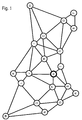
- FIG. 1 shows a typical example of a Multihop radio hazard detection system.
- this system has a base unit A and several participants B to T.
- FIG. 2 shows a multihop wireless hazard system in which the participants in communication levels 0, 1, 2, 3, 4 are divided.
- the base unit A has the communication level 0.
- the directly adjacent subscribers T, B, J, P, S have the communication level 1.
- the communication level indicates the minimum number of subscribers between the subscriber and the base unit.
- the dark highlighted subscriber D has the distance or communication level 2 (an intermediate unit) to the base unit A, and thus two close participants T, B with communication level 1 (Parents), two equally distant participants I, C with communication level 2 (peers) , as well as two remote participants G, E with communication level 3 (Children).
- the participants B, T, J, P, S, which are directly connected to the base unit A, ie adjacent have the communication level 1 and thus the distance 1 to the base unit A.
- FIG. 3 shows a message delivery in a according FIG. 2 Divided Multihop radio hazard detection system with the name of the participants according to FIG. 1 .
- the subscriber C generates a danger message for the base unit A.
- the subscriber C sends this message to his single "parent" subscriber B and additionally to a "peer" subscriber D.
- the Subscriber B forwards the message to the base unit A as well as to the subscriber J.
- the subscriber D sends the message to the two "parent" subscribers B and T, etc.
- the subscribers involved in the despatch are highlighted in the dark.
- the communication connections used are shown in bold.
- a participant never sends the message back to the participant from whom he received the message, according to a rule.
- the subscriber J sends the message to the base unit A and the subscriber P and not to the subscriber B, since the message was received by the subscriber B.
- a message can be a signaling message, an alarm message, a message regarding the exchange of user data, etc.
- participant B Receives a participant B of several participants, here the participants C and D, the message, the participant B still forwards the message according to a rule only once to the participants A and J.
- Each participating in the messaging participants J, B, D, T, S, P transmits the message to two adjacent participants J, B, D, T, S, P.
- the inventive method is reliable against failures of individual participants or a disturbed Communication between neighboring participants.
- the number of adjacent participants J, B, D, T, S, P to be notified can be determined using a parameter k. Higher values of k lead to increased reliability, but also to correspondingly increased energy consumption as more messages are sent.
- the notification of two adjacent participants J, B, D, T, S, P has proved to be advantageous because so already high reliability at relatively low cost bez. Energy consumption is achieved.
- FIG. 4 shows an example of sending a message from the base unit to the subscribers BT.
- a message is sent to the participants BT.
- Participants E, G with high level of communication (Children) evaluate this message.
- the participants D, I, C, K, L, R, Q, 0 discard this message, for example. So all participants B to T can be reached. But this is only guaranteed if every planned transfer is successful. Nevertheless, due to the method according to the invention, the message can be transmitted to the destination subscriber even though subscribers in the communication network have failed.
Landscapes
- Engineering & Computer Science (AREA)
- Computer Networks & Wireless Communication (AREA)
- Signal Processing (AREA)
- Business, Economics & Management (AREA)
- Emergency Management (AREA)
- Physics & Mathematics (AREA)
- General Physics & Mathematics (AREA)
- Mobile Radio Communication Systems (AREA)
Claims (26)
- Procédé de transmission d'un message dans un réseau de communication radio comportant une unité de base (A) et plusieurs usagers (B à T}, l'unité de base (A) et les usagers (B à T) comportant respectivement un émetteur et un récepteur et le récepteur étant activé, à des instants de mise en marche cycliques, respectivement pour une période de réception déterminée, un message à envoyer par un usager (C} à l'unité de base (A) étant transmis par l'usager (C) à un moins un usager voisin (D, B, I) en fonction d'au moins une règle, le message étant transmis en direction de l'unité de base (A) par l'au moins un usager voisin (D, B, I), conformément à l'au moins une règle, à au moins l'un de ses usagers voisins (T, B, K, J, D), cette opération étant répétée par analogie, de sorte que l'usager respectif (T, B, K, J, D} recevant le message transmet à son tour le message conformément à l'au moins une règle à au moins un de ses usagers (T, B, K, J, D), le message étant transmis au moins à l'unité de base (A), chaque usager (B à T) transmettant au moins une information concernant l'instant de mise en marche de l'usager (B à T) à ses usagers voisins (B à T), le temps de mise en marche des usagers voisins (B à T) étant utilisé comme au moins une règle pour transmettre le message et l'usager (B à T) transmettant le message à celui de ses usagers voisins (B à T) qui présente l'instant de mise en marche le plus tôt possible.
- Procédé selon la revendication 1, caractérisé en ce qu'est utilisé, en tant qu'autre règle, le niveau de communication d'un usager (B à T).
- Procédé selon la revendication 2, caractérisé en ce que la distance la plus courte entre un usager (B à T) et l'unité de base (A) est déterminée pour définir le niveau de communication des usagers (B à T).
- Procédé selon la revendication 3, caractérisé en ce que :l'unité de base (A) envoie un message de signalisation avec au moins un paramètre aux usagers voisins (J, B, D, T, S, P) pour déterminer le chemin de transmission le plus court ;les usagers (J, B, D, T, S, P) recevant le message de signalisation sauvegardent un niveau de communication en fonction du paramètre ;ces usagers (J, B, D, T, S, P) envoient un autre message de signalisation avec un autre paramètre à leurs usagers voisins (R, Q, 0, L, K, I, C, E, G) etles usagers (R, Q, 0, L, K, I, C, E, G) recevant l'autre message de signalisation sauvegardent un autre niveau de communication en fonction de l'autre paramètre etle procédé se poursuit jusqu'à ce qu'un niveau de communication soit associé à tous les usagers (B à T) en fonction du chemin de transmission le plus court entre les usagers (B à T) et l'unité de base (A).
- Procédé selon les revendications 3 et 4, caractérisé en ce que le paramètre indique, dans le message de signalisation, le nombre d'usagers (B à T) entre l'usager (B à T) et l'unité de base (A).
- Procédé selon les revendications 3 à 5,
caractérisé en ce que l'usager (B à T) recevant un message de signalisation avec un paramètre compare le paramètre contenu dans le message de signalisation avec un paramètre déjà reçu. - Procédé selon la revendication 6, caractérisé en ce que le message de signalisation contenant le paramètre est rejeté si la valeur du paramètre est supérieure au paramètre déjà reçu.
- Procédé selon l'une des revendications précédentes, caractérisé en ce que, conformément à une règle, l'au moins un usager (R, Q, 0, L, K, I, C, E, G) émettant le message retransmet le message à au moins un usager (J, B, D, T, S, P) avec un niveau de communication inférieur.
- Procédé selon la revendication 8, caractérisé en ce que l'au moins un usager voisin (J, B, D, T, S, P} avec un niveau de communication inférieur est défini par l'usager émetteur (R, Q, 0, L, K, I, C, E, G) par comparaison avec son propre niveau de communication.
- Procédé selon l'une des revendications précédentes, caractérisé en ce que sont utilisées, en tant qu'unité de base (A), une centrale de signalisation de danger et/ou une unité de danger.
- Procédé selon l'une des revendications précédentes, caractérisé en ce qu'une unité de danger est utilisée en tant qu'usager (B à T).
- Procédé selon la revendication 10, caractérisé en ce que sont utilisées, en tant que centrale de signalisation de danger, une centrale de signalisation d'incendie, une centrale de signalisation d'effraction et/ou une centrale de signalisation de gaz.
- Procédé selon les revendications 10 et 11, caractérisé en ce que sont utilisés, en tant qu'unité de danger, un détecteur d'incendie, un détecteur d'effraction, un détecteur de gaz, une unité de détection acoustique, une unité de détection optique, une caméra de surveillance et/ou une unité de détection opto-acoustique.
- Procédé selon l'une des revendications précédentes, caractérisé en ce que le message représente un message d'alarme, un message de signalisation et/ou un message concernant les échanges de données utiles.
- Procédé selon l'une des revendications précédentes, caractérisé en ce qu'au moins une règle indique le nombre d'usagers voisins (I, B, D) auxquels le message doit être transmis.
- Procédé selon la revendication 15, caractérisé en ce que le nombre d'usagers voisins (I, B, D) devant recevoir le message est déterminé par un paramètre sauvegardé auprès de l'usager (C).
- Procédé selon l'une des revendications précédentes, caractérisé en ce qu'un message n'est transmis qu'une fois par un usager (C) à au moins un usager voisin (I, B, D).
- Procédé selon l'une des revendications précédentes, caractérisé en ce que la réception du message est confirmée par l'usager voisin (I, B, D) à l'usager émetteur (C).
- Procédé selon la revendication 18, caractérisé en ce que le message n'est de nouveau transmis à un usager voisin (I, B, D) qui n'a pas confirmé la réception du message que si au moins une tentative de transmission du message à au moins un autre usager voisin (I, B, D) n'a pas réussi ou n'a réussi que partiellement.
- Procédé selon les revendications 18 et 19, caractérisé en ce que les usagers voisins (B) avec un niveau de communication inférieur ne sont utilisés préférentiellement par rapport aux usagers (I, D) avec un niveau de communication supérieur que lors de la première tentative de transmission.
- Procédé selon les revendications 18 à 20, caractérisé en ce que, à la deuxième tentative de transmission, le message est transmis aux usagers voisins (B, D, I) en fonction de leurs instants de mise en marche.
- Procédé selon les revendications 18 à 21, caractérisé en ce que le message n'est transmis qu'aux usagers voisins (B, I, D} qui n'ont pas encore envoyé de confirmation à l'usager émetteur (C).
- Procédé selon les revendications 18 à 22, caractérisé en ce qu'un paramètre sauvegardé auprès de l'usager émetteur (C) indique le nombre de tentatives de transmission à effectuer.
- Procédé selon l'une des revendications précédentes, caractérisé en ce qu'un message que l'unité de base (A) doit envoyer à au moins un usager (B à T) est transmis à des usagers (E, G, H, F, N, M) avec un niveau de communication élevé.
- Procédé selon la revendication 24, caractérisé en ce que l'ordre de transmission aux usagers (E, G, H, F, N, M) avec un niveau de communication élevé est déterminé d'après les instants de mise en marche des usagers (E, G, H, F, N, M).
- Système de transmission d'un message dans un réseau de communication radio comportant une unité de base (A) et plusieurs usagers (B à T), l'unité de base (A) et les usagers (B à T) comportant respectivement un émetteur et un récepteur et le récepteur étant activé, à des instants de mise en marche cycliques, respectivement pour une période de réception déterminée, comportant :- un usager (C) pour la transmission d'un message à envoyer par l'usager (C) à l'unité de base (A) à un moins un usager voisin (I, B, D) en fonction d'au moins une règle ;- l'au moins un usager voisin (I, B, D) pour la transmission du message en direction de l'unité de base (A) selon l'au moins une règle à au moins un de ses usagers voisins (T, B, K, J, D) ;- l'au moins un usager voisin (T, B, K, J, D) recevant le message pour la transmission du message selon l'au moins une règle en direction de l'unité de base (A) à au moins un de ses usagers voisins (T, B, K, J, D), cette opération étant répétée par analogie, de sorte que l'usager respectif (T, B, K, J, D) recevant le message transmet à son tour le message conformément à l'au moins une règle à au moins un de ses usagers (T, B, K, J, D), chaque usager (B à T) transmettant au moins une information concernant l'instant de mise en marche de l'usager (B à T) à ses usagers voisins (B à T), le temps de mise en marche des usagers voisins (B à T) étant utilisé comme au moins une règle pour transmettre le message et l'usager (B à T) transmettant le message à celui de ses usagers voisins (B à T) qui présente l'instant de mise en marche le plus tôt possible et- l'au moins un usager (B, T, J) qui est directement voisin de l'unité de base (A) pour la transmission du message au moins à l'unité de base (A).
Priority Applications (4)
| Application Number | Priority Date | Filing Date | Title |
|---|---|---|---|
| EP16001368.6A EP3098795B1 (fr) | 2007-04-05 | 2007-04-05 | Transmission d'un message dans un système de signalisation d'alarme sans fil à sauts multiples |
| EP07105778.0A EP1978686B1 (fr) | 2007-04-05 | 2007-04-05 | Système de détection des dangers radio multihop |
| US12/594,709 US8228847B2 (en) | 2007-04-05 | 2008-04-03 | Multihop radio hazard reporting system |
| PCT/EP2008/054060 WO2008122590A1 (fr) | 2007-04-05 | 2008-04-03 | Système de radiosignalisation de danger à bonds multiples |
Applications Claiming Priority (1)
| Application Number | Priority Date | Filing Date | Title |
|---|---|---|---|
| EP07105778.0A EP1978686B1 (fr) | 2007-04-05 | 2007-04-05 | Système de détection des dangers radio multihop |
Related Child Applications (2)
| Application Number | Title | Priority Date | Filing Date |
|---|---|---|---|
| EP16001368.6A Division-Into EP3098795B1 (fr) | 2007-04-05 | 2007-04-05 | Transmission d'un message dans un système de signalisation d'alarme sans fil à sauts multiples |
| EP16001368.6A Division EP3098795B1 (fr) | 2007-04-05 | 2007-04-05 | Transmission d'un message dans un système de signalisation d'alarme sans fil à sauts multiples |
Publications (2)
| Publication Number | Publication Date |
|---|---|
| EP1978686A1 EP1978686A1 (fr) | 2008-10-08 |
| EP1978686B1 true EP1978686B1 (fr) | 2016-07-27 |
Family
ID=38476359
Family Applications (2)
| Application Number | Title | Priority Date | Filing Date |
|---|---|---|---|
| EP07105778.0A Not-in-force EP1978686B1 (fr) | 2007-04-05 | 2007-04-05 | Système de détection des dangers radio multihop |
| EP16001368.6A Active EP3098795B1 (fr) | 2007-04-05 | 2007-04-05 | Transmission d'un message dans un système de signalisation d'alarme sans fil à sauts multiples |
Family Applications After (1)
| Application Number | Title | Priority Date | Filing Date |
|---|---|---|---|
| EP16001368.6A Active EP3098795B1 (fr) | 2007-04-05 | 2007-04-05 | Transmission d'un message dans un système de signalisation d'alarme sans fil à sauts multiples |
Country Status (3)
| Country | Link |
|---|---|
| US (1) | US8228847B2 (fr) |
| EP (2) | EP1978686B1 (fr) |
| WO (1) | WO2008122590A1 (fr) |
Families Citing this family (7)
| Publication number | Priority date | Publication date | Assignee | Title |
|---|---|---|---|---|
| US8552857B2 (en) | 2010-10-14 | 2013-10-08 | Honeywell International Inc. | Failsafe signal transmission for wireless sensor mesh |
| ITTO20110185A1 (it) * | 2011-03-02 | 2012-09-03 | Sisvel Technology Srl | Procedimento e apparato di trasmissione cooperativa di allarme |
| ITTO20110284A1 (it) * | 2011-03-29 | 2011-06-28 | Sisvel Technology Srl | Procedimento di localizzazione cooperativa e relativi apparati |
| JP5684630B2 (ja) * | 2011-03-31 | 2015-03-18 | 能美防災株式会社 | 警報システム |
| DE102011085152A1 (de) * | 2011-10-25 | 2013-04-25 | Robert Bosch Gmbh | Brandmeldesystem mit Alarmsignalkontrolle sowie Verfahren zur Meldung eines Brands |
| FR2994009B1 (fr) * | 2012-07-26 | 2016-06-17 | Cynove | Procedes et dispositifs de radiocommunication destines a la surveillance de surfaces de grandes dimensions |
| CN112770283A (zh) * | 2019-10-21 | 2021-05-07 | 中国石油化工股份有限公司 | 用于离散控制系统的信号传输方法和系统 |
Family Cites Families (7)
| Publication number | Priority date | Publication date | Assignee | Title |
|---|---|---|---|---|
| US6044062A (en) * | 1996-12-06 | 2000-03-28 | Communique, Llc | Wireless network system and method for providing same |
| US7027416B1 (en) * | 1997-10-01 | 2006-04-11 | Honeywell, Inc. | Multi tier wireless communication system |
| DE10138229B4 (de) * | 2001-08-03 | 2009-10-01 | Siemens Gebäudesicherheit GmbH & Co. oHG | Verfahren zur Funkübertragung in einem Gefahrenmeldesystem |
| WO2003092225A1 (fr) * | 2002-04-26 | 2003-11-06 | Siemens Aktiengesellschaft | Configuration automatique d'acheminement pour liaisons m3ua quasi-associees |
| DE10337093A1 (de) * | 2003-08-12 | 2005-03-17 | Siemens Gebäudesicherheit GmbH & Co. oHG | Verfahren zur Funkübertragung in einem Gefahrenmeldesystem |
| KR20060006583A (ko) * | 2004-07-16 | 2006-01-19 | 아주대학교산학협력단 | 무선 센서 네트워크에 있어서의 방향성 플러딩 방법 |
| US7668146B2 (en) * | 2004-12-20 | 2010-02-23 | Connectivities Llc | Internet-oriented ad-hoc network |
-
2007
- 2007-04-05 EP EP07105778.0A patent/EP1978686B1/fr not_active Not-in-force
- 2007-04-05 EP EP16001368.6A patent/EP3098795B1/fr active Active
-
2008
- 2008-04-03 WO PCT/EP2008/054060 patent/WO2008122590A1/fr not_active Ceased
- 2008-04-03 US US12/594,709 patent/US8228847B2/en not_active Expired - Fee Related
Also Published As
| Publication number | Publication date |
|---|---|
| WO2008122590A1 (fr) | 2008-10-16 |
| US20100110924A1 (en) | 2010-05-06 |
| US8228847B2 (en) | 2012-07-24 |
| EP3098795A1 (fr) | 2016-11-30 |
| EP1978686A1 (fr) | 2008-10-08 |
| EP3098795B1 (fr) | 2020-01-29 |
Similar Documents
| Publication | Publication Date | Title |
|---|---|---|
| DE69434586T2 (de) | Kommunikationsnetz mit drahtloser und drahtgebundener dynamischer leitweglenkung | |
| DE69233608T2 (de) | Lokales Funkfrequenznetzwerk | |
| DE60113708T2 (de) | Verfahren zur weiterleitung in mehrstreckennetzwerke | |
| EP3098795B1 (fr) | Transmission d'un message dans un système de signalisation d'alarme sans fil à sauts multiples | |
| DE60118076T2 (de) | Drahtloses mobiles Netzwerk zur örtlichen Leitweglenkung von Multimedia-Daten | |
| EP1256242A2 (fr) | Procede de transmission d'informations de donnees par paquets dans un systeme de communication radio | |
| EP2237592A2 (fr) | Procédé d'optimisation de structures de réseau dans des réseaux radio | |
| EP0911775B1 (fr) | Procédé de transmission radio dans un système de signalisation d'alarmes | |
| DE102020003707A1 (de) | Verfahren zum Betreiben eines mobilen Systems und eines Alarm-Gateways als Teilnehmer in einem drahtlosen Netzwerk | |
| EP3477961B1 (fr) | Procédé de transfert des données et collecteur de données | |
| DE10138229B4 (de) | Verfahren zur Funkübertragung in einem Gefahrenmeldesystem | |
| DE19536379C2 (de) | Verfahren für die völlig dezentrale Verbindungssteuerung in kanal- oder paketvermittelnden Mobilfunknetzen, insbesondere ATM basierter Zugangsnetze | |
| DE102005049931B4 (de) | Sende-/Empfangsvorrichtung | |
| EP3107219B1 (fr) | Système et procédé pour la liaison redondante à un réseau d'ossature ainsi qu'un noeud de liaison montante pouvant ëtre inséré dans ce système | |
| EP1849293B1 (fr) | Procede et systeme pour transmettre une information et creer un systeme global d'appel d'urgence /d'alerte, notamment au moyen d'un systeme de navigation par satellite comme, par ex., galileo | |
| WO2008034676A1 (fr) | Procédé de radiotransmission dans un système avertisseur de danger | |
| EP1901256B1 (fr) | Procédé destiné à la transmission radio dans une cellule de système de détection des dangers | |
| EP2365643A1 (fr) | Système de station radio pour un réseau sans fil | |
| EP1494191B1 (fr) | Procédé de la demande d'un utilisateur au système d'alarme radio | |
| DE102022209224A1 (de) | Kommuniaktionssystem und Verfahren zur Auswahl von Kommunikationspfaden | |
| DE102015220422A1 (de) | System und Verfahren zur redundanten Anbindung an ein Backbone-Netzwerk sowie ein in diesem System einsetzbarer Uplink-Knoten | |
| EP1469437A2 (fr) | Méthode de transmission radio dans un système de signalisation de danger | |
| WO2008015209A1 (fr) | Synchronisation de niveaux avec des réseaux de communication radio | |
| EP3176971B1 (fr) | Procédé de transmission d'accusés de réception pour la communication en bande large ou à diffusion groupée | |
| EP1282095B1 (fr) | Procédé de communication radio dans un système d'alarme |
Legal Events
| Date | Code | Title | Description |
|---|---|---|---|
| PUAI | Public reference made under article 153(3) epc to a published international application that has entered the european phase |
Free format text: ORIGINAL CODE: 0009012 |
|
| AK | Designated contracting states |
Kind code of ref document: A1 Designated state(s): AT BE BG CH CY CZ DE DK EE ES FI FR GB GR HU IE IS IT LI LT LU LV MC MT NL PL PT RO SE SI SK TR |
|
| AX | Request for extension of the european patent |
Extension state: AL BA HR MK RS |
|
| RAP1 | Party data changed (applicant data changed or rights of an application transferred) |
Owner name: SIEMENS SCHWEIZ AG |
|
| 17P | Request for examination filed |
Effective date: 20090408 |
|
| RAP1 | Party data changed (applicant data changed or rights of an application transferred) |
Owner name: SIEMENS AKTIENGESELLSCHAFT |
|
| 17Q | First examination report despatched |
Effective date: 20090514 |
|
| AKX | Designation fees paid |
Designated state(s): AT BE BG CH CY CZ DE DK EE ES FI FR GB GR HU IE IS IT LI LT LU LV MC MT NL PL PT RO SE SI SK TR |
|
| RAP1 | Party data changed (applicant data changed or rights of an application transferred) |
Owner name: SIEMENS AKTIENGESELLSCHAFT |
|
| RAP1 | Party data changed (applicant data changed or rights of an application transferred) |
Owner name: SIEMENS SCHWEIZ AG |
|
| REG | Reference to a national code |
Ref country code: DE Ref legal event code: R079 Ref document number: 502007014968 Country of ref document: DE Free format text: PREVIOUS MAIN CLASS: H04L0012560000 Ipc: G08B0025000000 |
|
| GRAP | Despatch of communication of intention to grant a patent |
Free format text: ORIGINAL CODE: EPIDOSNIGR1 |
|
| RIC1 | Information provided on ipc code assigned before grant |
Ipc: G08B 25/00 20060101AFI20160125BHEP Ipc: H04L 12/721 20130101ALI20160125BHEP Ipc: H04L 12/701 20130101ALI20160125BHEP Ipc: H04L 12/727 20130101ALI20160125BHEP Ipc: H04L 12/733 20130101ALI20160125BHEP Ipc: H04W 40/12 20090101ALI20160125BHEP Ipc: H04W 40/10 20090101ALI20160125BHEP |
|
| INTG | Intention to grant announced |
Effective date: 20160212 |
|
| GRAS | Grant fee paid |
Free format text: ORIGINAL CODE: EPIDOSNIGR3 |
|
| GRAA | (expected) grant |
Free format text: ORIGINAL CODE: 0009210 |
|
| AK | Designated contracting states |
Kind code of ref document: B1 Designated state(s): AT BE BG CH CY CZ DE DK EE ES FI FR GB GR HU IE IS IT LI LT LU LV MC MT NL PL PT RO SE SI SK TR |
|
| REG | Reference to a national code |
Ref country code: GB Ref legal event code: FG4D Free format text: NOT ENGLISH |
|
| REG | Reference to a national code |
Ref country code: CH Ref legal event code: EP |
|
| REG | Reference to a national code |
Ref country code: AT Ref legal event code: REF Ref document number: 816336 Country of ref document: AT Kind code of ref document: T Effective date: 20160815 |
|
| REG | Reference to a national code |
Ref country code: IE Ref legal event code: FG4D Free format text: LANGUAGE OF EP DOCUMENT: GERMAN |
|
| REG | Reference to a national code |
Ref country code: DE Ref legal event code: R096 Ref document number: 502007014968 Country of ref document: DE |
|
| REG | Reference to a national code |
Ref country code: LT Ref legal event code: MG4D |
|
| REG | Reference to a national code |
Ref country code: NL Ref legal event code: MP Effective date: 20160727 |
|
| PG25 | Lapsed in a contracting state [announced via postgrant information from national office to epo] |
Ref country code: LT Free format text: LAPSE BECAUSE OF FAILURE TO SUBMIT A TRANSLATION OF THE DESCRIPTION OR TO PAY THE FEE WITHIN THE PRESCRIBED TIME-LIMIT Effective date: 20160727 Ref country code: FI Free format text: LAPSE BECAUSE OF FAILURE TO SUBMIT A TRANSLATION OF THE DESCRIPTION OR TO PAY THE FEE WITHIN THE PRESCRIBED TIME-LIMIT Effective date: 20160727 Ref country code: IS Free format text: LAPSE BECAUSE OF FAILURE TO SUBMIT A TRANSLATION OF THE DESCRIPTION OR TO PAY THE FEE WITHIN THE PRESCRIBED TIME-LIMIT Effective date: 20161127 Ref country code: NL Free format text: LAPSE BECAUSE OF FAILURE TO SUBMIT A TRANSLATION OF THE DESCRIPTION OR TO PAY THE FEE WITHIN THE PRESCRIBED TIME-LIMIT Effective date: 20160727 Ref country code: IT Free format text: LAPSE BECAUSE OF FAILURE TO SUBMIT A TRANSLATION OF THE DESCRIPTION OR TO PAY THE FEE WITHIN THE PRESCRIBED TIME-LIMIT Effective date: 20160727 |
|
| PG25 | Lapsed in a contracting state [announced via postgrant information from national office to epo] |
Ref country code: PT Free format text: LAPSE BECAUSE OF FAILURE TO SUBMIT A TRANSLATION OF THE DESCRIPTION OR TO PAY THE FEE WITHIN THE PRESCRIBED TIME-LIMIT Effective date: 20161128 Ref country code: GR Free format text: LAPSE BECAUSE OF FAILURE TO SUBMIT A TRANSLATION OF THE DESCRIPTION OR TO PAY THE FEE WITHIN THE PRESCRIBED TIME-LIMIT Effective date: 20161028 Ref country code: SE Free format text: LAPSE BECAUSE OF FAILURE TO SUBMIT A TRANSLATION OF THE DESCRIPTION OR TO PAY THE FEE WITHIN THE PRESCRIBED TIME-LIMIT Effective date: 20160727 Ref country code: LV Free format text: LAPSE BECAUSE OF FAILURE TO SUBMIT A TRANSLATION OF THE DESCRIPTION OR TO PAY THE FEE WITHIN THE PRESCRIBED TIME-LIMIT Effective date: 20160727 Ref country code: ES Free format text: LAPSE BECAUSE OF FAILURE TO SUBMIT A TRANSLATION OF THE DESCRIPTION OR TO PAY THE FEE WITHIN THE PRESCRIBED TIME-LIMIT Effective date: 20160727 Ref country code: PL Free format text: LAPSE BECAUSE OF FAILURE TO SUBMIT A TRANSLATION OF THE DESCRIPTION OR TO PAY THE FEE WITHIN THE PRESCRIBED TIME-LIMIT Effective date: 20160727 |
|
| REG | Reference to a national code |
Ref country code: FR Ref legal event code: PLFP Year of fee payment: 11 |
|
| PG25 | Lapsed in a contracting state [announced via postgrant information from national office to epo] |
Ref country code: EE Free format text: LAPSE BECAUSE OF FAILURE TO SUBMIT A TRANSLATION OF THE DESCRIPTION OR TO PAY THE FEE WITHIN THE PRESCRIBED TIME-LIMIT Effective date: 20160727 Ref country code: RO Free format text: LAPSE BECAUSE OF FAILURE TO SUBMIT A TRANSLATION OF THE DESCRIPTION OR TO PAY THE FEE WITHIN THE PRESCRIBED TIME-LIMIT Effective date: 20160727 |
|
| REG | Reference to a national code |
Ref country code: DE Ref legal event code: R097 Ref document number: 502007014968 Country of ref document: DE |
|
| PG25 | Lapsed in a contracting state [announced via postgrant information from national office to epo] |
Ref country code: DK Free format text: LAPSE BECAUSE OF FAILURE TO SUBMIT A TRANSLATION OF THE DESCRIPTION OR TO PAY THE FEE WITHIN THE PRESCRIBED TIME-LIMIT Effective date: 20160727 Ref country code: SK Free format text: LAPSE BECAUSE OF FAILURE TO SUBMIT A TRANSLATION OF THE DESCRIPTION OR TO PAY THE FEE WITHIN THE PRESCRIBED TIME-LIMIT Effective date: 20160727 Ref country code: CZ Free format text: LAPSE BECAUSE OF FAILURE TO SUBMIT A TRANSLATION OF THE DESCRIPTION OR TO PAY THE FEE WITHIN THE PRESCRIBED TIME-LIMIT Effective date: 20160727 Ref country code: BG Free format text: LAPSE BECAUSE OF FAILURE TO SUBMIT A TRANSLATION OF THE DESCRIPTION OR TO PAY THE FEE WITHIN THE PRESCRIBED TIME-LIMIT Effective date: 20161027 |
|
| PLBE | No opposition filed within time limit |
Free format text: ORIGINAL CODE: 0009261 |
|
| STAA | Information on the status of an ep patent application or granted ep patent |
Free format text: STATUS: NO OPPOSITION FILED WITHIN TIME LIMIT |
|
| 26N | No opposition filed |
Effective date: 20170502 |
|
| PG25 | Lapsed in a contracting state [announced via postgrant information from national office to epo] |
Ref country code: SI Free format text: LAPSE BECAUSE OF FAILURE TO SUBMIT A TRANSLATION OF THE DESCRIPTION OR TO PAY THE FEE WITHIN THE PRESCRIBED TIME-LIMIT Effective date: 20160727 |
|
| REG | Reference to a national code |
Ref country code: IE Ref legal event code: MM4A |
|
| PG25 | Lapsed in a contracting state [announced via postgrant information from national office to epo] |
Ref country code: MC Free format text: LAPSE BECAUSE OF FAILURE TO SUBMIT A TRANSLATION OF THE DESCRIPTION OR TO PAY THE FEE WITHIN THE PRESCRIBED TIME-LIMIT Effective date: 20160727 |
|
| PG25 | Lapsed in a contracting state [announced via postgrant information from national office to epo] |
Ref country code: LU Free format text: LAPSE BECAUSE OF NON-PAYMENT OF DUE FEES Effective date: 20170405 |
|
| REG | Reference to a national code |
Ref country code: BE Ref legal event code: MM Effective date: 20170430 |
|
| REG | Reference to a national code |
Ref country code: FR Ref legal event code: PLFP Year of fee payment: 12 |
|
| PG25 | Lapsed in a contracting state [announced via postgrant information from national office to epo] |
Ref country code: IE Free format text: LAPSE BECAUSE OF NON-PAYMENT OF DUE FEES Effective date: 20170405 |
|
| PG25 | Lapsed in a contracting state [announced via postgrant information from national office to epo] |
Ref country code: BE Free format text: LAPSE BECAUSE OF NON-PAYMENT OF DUE FEES Effective date: 20170430 |
|
| REG | Reference to a national code |
Ref country code: AT Ref legal event code: MM01 Ref document number: 816336 Country of ref document: AT Kind code of ref document: T Effective date: 20170405 |
|
| PG25 | Lapsed in a contracting state [announced via postgrant information from national office to epo] |
Ref country code: AT Free format text: LAPSE BECAUSE OF NON-PAYMENT OF DUE FEES Effective date: 20170405 |
|
| PG25 | Lapsed in a contracting state [announced via postgrant information from national office to epo] |
Ref country code: MT Free format text: LAPSE BECAUSE OF FAILURE TO SUBMIT A TRANSLATION OF THE DESCRIPTION OR TO PAY THE FEE WITHIN THE PRESCRIBED TIME-LIMIT Effective date: 20160727 |
|
| PG25 | Lapsed in a contracting state [announced via postgrant information from national office to epo] |
Ref country code: HU Free format text: LAPSE BECAUSE OF FAILURE TO SUBMIT A TRANSLATION OF THE DESCRIPTION OR TO PAY THE FEE WITHIN THE PRESCRIBED TIME-LIMIT; INVALID AB INITIO Effective date: 20070405 |
|
| PG25 | Lapsed in a contracting state [announced via postgrant information from national office to epo] |
Ref country code: CY Free format text: LAPSE BECAUSE OF NON-PAYMENT OF DUE FEES Effective date: 20160727 |
|
| PG25 | Lapsed in a contracting state [announced via postgrant information from national office to epo] |
Ref country code: TR Free format text: LAPSE BECAUSE OF FAILURE TO SUBMIT A TRANSLATION OF THE DESCRIPTION OR TO PAY THE FEE WITHIN THE PRESCRIBED TIME-LIMIT Effective date: 20160727 |
|
| PGFP | Annual fee paid to national office [announced via postgrant information from national office to epo] |
Ref country code: DE Payment date: 20210618 Year of fee payment: 15 Ref country code: FR Payment date: 20210419 Year of fee payment: 15 |
|
| PGFP | Annual fee paid to national office [announced via postgrant information from national office to epo] |
Ref country code: GB Payment date: 20210504 Year of fee payment: 15 |
|
| PGFP | Annual fee paid to national office [announced via postgrant information from national office to epo] |
Ref country code: CH Payment date: 20210705 Year of fee payment: 15 |
|
| REG | Reference to a national code |
Ref country code: DE Ref legal event code: R119 Ref document number: 502007014968 Country of ref document: DE |
|
| REG | Reference to a national code |
Ref country code: CH Ref legal event code: PL |
|
| GBPC | Gb: european patent ceased through non-payment of renewal fee |
Effective date: 20220405 |
|
| PG25 | Lapsed in a contracting state [announced via postgrant information from national office to epo] |
Ref country code: LI Free format text: LAPSE BECAUSE OF NON-PAYMENT OF DUE FEES Effective date: 20220430 Ref country code: GB Free format text: LAPSE BECAUSE OF NON-PAYMENT OF DUE FEES Effective date: 20220405 Ref country code: FR Free format text: LAPSE BECAUSE OF NON-PAYMENT OF DUE FEES Effective date: 20220430 Ref country code: DE Free format text: LAPSE BECAUSE OF NON-PAYMENT OF DUE FEES Effective date: 20221103 Ref country code: CH Free format text: LAPSE BECAUSE OF NON-PAYMENT OF DUE FEES Effective date: 20220430 |