EP1978743A1 - Procédé et appareil de transcodage d'un signal vidéo - Google Patents
Procédé et appareil de transcodage d'un signal vidéo Download PDFInfo
- Publication number
- EP1978743A1 EP1978743A1 EP07251456A EP07251456A EP1978743A1 EP 1978743 A1 EP1978743 A1 EP 1978743A1 EP 07251456 A EP07251456 A EP 07251456A EP 07251456 A EP07251456 A EP 07251456A EP 1978743 A1 EP1978743 A1 EP 1978743A1
- Authority
- EP
- European Patent Office
- Prior art keywords
- frame
- block
- bit stream
- stream
- blocks
- Prior art date
- Legal status (The legal status is an assumption and is not a legal conclusion. Google has not performed a legal analysis and makes no representation as to the accuracy of the status listed.)
- Granted
Links
Images


Classifications
-
- H—ELECTRICITY
- H04—ELECTRIC COMMUNICATION TECHNIQUE
- H04N—PICTORIAL COMMUNICATION, e.g. TELEVISION
- H04N19/00—Methods or arrangements for coding, decoding, compressing or decompressing digital video signals
- H04N19/10—Methods or arrangements for coding, decoding, compressing or decompressing digital video signals using adaptive coding
- H04N19/189—Methods or arrangements for coding, decoding, compressing or decompressing digital video signals using adaptive coding characterised by the adaptation method, adaptation tool or adaptation type used for the adaptive coding
- H04N19/196—Methods or arrangements for coding, decoding, compressing or decompressing digital video signals using adaptive coding characterised by the adaptation method, adaptation tool or adaptation type used for the adaptive coding being specially adapted for the computation of encoding parameters, e.g. by averaging previously computed encoding parameters
- H04N19/198—Methods or arrangements for coding, decoding, compressing or decompressing digital video signals using adaptive coding characterised by the adaptation method, adaptation tool or adaptation type used for the adaptive coding being specially adapted for the computation of encoding parameters, e.g. by averaging previously computed encoding parameters including smoothing of a sequence of encoding parameters, e.g. by averaging, by choice of the maximum, minimum or median value
-
- H—ELECTRICITY
- H04—ELECTRIC COMMUNICATION TECHNIQUE
- H04N—PICTORIAL COMMUNICATION, e.g. TELEVISION
- H04N19/00—Methods or arrangements for coding, decoding, compressing or decompressing digital video signals
- H04N19/10—Methods or arrangements for coding, decoding, compressing or decompressing digital video signals using adaptive coding
- H04N19/102—Methods or arrangements for coding, decoding, compressing or decompressing digital video signals using adaptive coding characterised by the element, parameter or selection affected or controlled by the adaptive coding
- H04N19/132—Sampling, masking or truncation of coding units, e.g. adaptive resampling, frame skipping, frame interpolation or high-frequency transform coefficient masking
-
- H—ELECTRICITY
- H04—ELECTRIC COMMUNICATION TECHNIQUE
- H04N—PICTORIAL COMMUNICATION, e.g. TELEVISION
- H04N19/00—Methods or arrangements for coding, decoding, compressing or decompressing digital video signals
- H04N19/10—Methods or arrangements for coding, decoding, compressing or decompressing digital video signals using adaptive coding
- H04N19/134—Methods or arrangements for coding, decoding, compressing or decompressing digital video signals using adaptive coding characterised by the element, parameter or criterion affecting or controlling the adaptive coding
- H04N19/146—Data rate or code amount at the encoder output
- H04N19/149—Data rate or code amount at the encoder output by estimating the code amount by means of a model, e.g. mathematical model or statistical model
-
- H—ELECTRICITY
- H04—ELECTRIC COMMUNICATION TECHNIQUE
- H04N—PICTORIAL COMMUNICATION, e.g. TELEVISION
- H04N19/00—Methods or arrangements for coding, decoding, compressing or decompressing digital video signals
- H04N19/10—Methods or arrangements for coding, decoding, compressing or decompressing digital video signals using adaptive coding
- H04N19/134—Methods or arrangements for coding, decoding, compressing or decompressing digital video signals using adaptive coding characterised by the element, parameter or criterion affecting or controlling the adaptive coding
- H04N19/157—Assigned coding mode, i.e. the coding mode being predefined or preselected to be further used for selection of another element or parameter
- H04N19/159—Prediction type, e.g. intra-frame, inter-frame or bidirectional frame prediction
-
- H—ELECTRICITY
- H04—ELECTRIC COMMUNICATION TECHNIQUE
- H04N—PICTORIAL COMMUNICATION, e.g. TELEVISION
- H04N19/00—Methods or arrangements for coding, decoding, compressing or decompressing digital video signals
- H04N19/10—Methods or arrangements for coding, decoding, compressing or decompressing digital video signals using adaptive coding
- H04N19/169—Methods or arrangements for coding, decoding, compressing or decompressing digital video signals using adaptive coding characterised by the coding unit, i.e. the structural portion or semantic portion of the video signal being the object or the subject of the adaptive coding
- H04N19/17—Methods or arrangements for coding, decoding, compressing or decompressing digital video signals using adaptive coding characterised by the coding unit, i.e. the structural portion or semantic portion of the video signal being the object or the subject of the adaptive coding the unit being an image region, e.g. an object
- H04N19/176—Methods or arrangements for coding, decoding, compressing or decompressing digital video signals using adaptive coding characterised by the coding unit, i.e. the structural portion or semantic portion of the video signal being the object or the subject of the adaptive coding the unit being an image region, e.g. an object the region being a block, e.g. a macroblock
-
- H—ELECTRICITY
- H04—ELECTRIC COMMUNICATION TECHNIQUE
- H04N—PICTORIAL COMMUNICATION, e.g. TELEVISION
- H04N19/00—Methods or arrangements for coding, decoding, compressing or decompressing digital video signals
- H04N19/10—Methods or arrangements for coding, decoding, compressing or decompressing digital video signals using adaptive coding
- H04N19/169—Methods or arrangements for coding, decoding, compressing or decompressing digital video signals using adaptive coding characterised by the coding unit, i.e. the structural portion or semantic portion of the video signal being the object or the subject of the adaptive coding
- H04N19/18—Methods or arrangements for coding, decoding, compressing or decompressing digital video signals using adaptive coding characterised by the coding unit, i.e. the structural portion or semantic portion of the video signal being the object or the subject of the adaptive coding the unit being a set of transform coefficients
-
- H—ELECTRICITY
- H04—ELECTRIC COMMUNICATION TECHNIQUE
- H04N—PICTORIAL COMMUNICATION, e.g. TELEVISION
- H04N19/00—Methods or arrangements for coding, decoding, compressing or decompressing digital video signals
- H04N19/40—Methods or arrangements for coding, decoding, compressing or decompressing digital video signals using video transcoding, i.e. partial or full decoding of a coded input stream followed by re-encoding of the decoded output stream
-
- H—ELECTRICITY
- H04—ELECTRIC COMMUNICATION TECHNIQUE
- H04N—PICTORIAL COMMUNICATION, e.g. TELEVISION
- H04N19/00—Methods or arrangements for coding, decoding, compressing or decompressing digital video signals
- H04N19/60—Methods or arrangements for coding, decoding, compressing or decompressing digital video signals using transform coding
- H04N19/61—Methods or arrangements for coding, decoding, compressing or decompressing digital video signals using transform coding in combination with predictive coding
Definitions
- the present invention relates to a method and apparatus for transcoding a video signal.
- the invention relates to dynamic bit-rate reduction of pre-compressed video streams. Reducing the bit-rate of a pre-compressed data stream is called transrating, and devices that perform this task are called transrators. Transrating and transrators are sub-sets of more general fields of transcoding and transcoders, respectively.
- Video transcoding is a process in which pre-compressed video data is converted to another compressed valid video data. Embodiments of the present invention may be used in a variety of applications where bit-rate reduction is desired or required such as in video recorders, servers, network video servers and clients.
- Digital video compression has made it possible to store, stream and transport large amounts of video content which was once impractical due to the excessive size of the data files required to convey the necessary information.
- Digital video compression, especially the MPEG formats and particularly the MPEG-2 format is widely used in devices including DVD players, satellite and terrestrial set top boxes, network video servers and receivers and many more.
- a digital video is made up of the individual still images or "frames" that, when played in sequence, are able to give the impression of movement.
- each digital video compression format has its own particular characteristics a number of common features are also present.
- One such common feature is the use of intra frames which are coded independently from other frames.
- MPEG terminology such frames are referred to as I frames.
- An I frame may be thought of as a key frame or reference video frame which acts as a point of comparison to other frames during encoding, decoding and play-back.
- Inter frames are of two types, commonly referred to in MPEG terminology as P frames and B frames.
- P frames may also be referred to as reference inter frames whereas B frames may be referred to as non-reference inter frames.
- transrating is a subset of a broader type of video stream processing referred to as transcoding.
- transcoding is used to mean the changing of any characteristics of a digitally compressed video stream to produce a new valid digitally compressed video stream.
- Transrating is a transcoding process which aims only at bit-rate change, usually reduction, and it is an essential component in band-limited network environments.
- Transrators with dynamic bit-rate adaptation mechanisms are particularly important when variable bit-rate (VBR) encoded video is to be streamed over a constant bit-rate (CBR) channel. If the bit-rate of the VBR video fluctuates continuously, fast adaptation is required to produce a suitable CBR output signal. Therefore, the ratio of instantaneous output bit-rate to instantaneous input bit-rate must dynamically change to produce a nearly CBR video output whose bit-rate is always below that of the transmission channel.
- VBR variable bit-rate
- CBR constant bit-rate
- transrating there are four main issues to consider. These are complexity of the operation, quality required of the output signal, bit-rate required of the output signal and adaptation speed. A method and apparatus are sought which provides the highest quality output video using the lowest complexity of system and the lowest bit-rate with the fastest adaptation speed possible. Different transrating techniques have been developed and implemented. The architecture and performance of known systems differ and they trade speed for quality and are useful for applications with no time constraint. In other examples, the transrator architectures trade quality for speed and for simplicity such as to be useful in real-time applications.
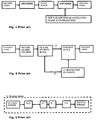
- transrator architectures there are a variety of transrator architectures currently used. Examples of architectures and methods of transrating that are known are shown in each of Figures 1 to 7 .
- a simple transrator is shown comprising a cascade of a decoder and an encoder.
- the digital video stream can be decoded into frames and encoded again using different encoding parameters.
- the decoder and encoder parts are decoupled and this is therefore an extremely flexible transrator architecture.
- the cost of this flexibility is high computational complexity, relatively low speed and high latency.
- FIG. 2 shows an example in which only B frames are transcoded. I and P frames are routed directly through the system.
- the transcoding system used in the apparatus of Figure 2 is shown in more detail in Figure 3 .
- the system is complex as it requires the sequence of variable length decoding, de-quantisation, inverse transformation, quantisation, forward transformation and variable length encoding.
- the complexity is significant. Although such an arrangement may be effective, transrating only the B frames and leaving I and P frames untouched will not produce a satisfactory reduction in bit-rate, where this required, for most digital videos.
- the complex sequence of steps performed on the B frames means that the process is slow and the lossy inverse quantisation can lead to significant degradation in quality of the output signal.
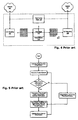
- Figures 4 and 5 show an apparatus and method flow diagram as described in US-A-6,763,070 .
- the system described herein relates to a transrating scheme in which a cut-off index is determined and transform coefficients beyond this cut-off index are eliminated.
- the cut-off index is determined by the rate control information derived from the input bit-rate, required output bit-rate and previously processed macro blocks.
- US-A-6,937,770 discloses a system and apparatus for adapted bit-rate control for rate reduction of MPEG coded video.
- the system utilises a scale factor between average frame size (number of bits) of input stream and desired frame size of output. This scale factor is used to compute the number of bits used for each macro block of desired rate output stream. The scale factor may be dynamically changed to produce a desired rate output.
- the scheme leads to problems such as distortion, heavy blocking and drift artefacts in high motion areas of a frame.
- a method of transrating a video signal made up of an input bit stream representative of frames of a video, each frame being made up of blocks of pixels, there being a corresponding block of data within the input bit stream for each block of pixels, the method comprising: for the bit stream of a frame of the video signal, identifying the type of frame; and for certain types of frame, disregarding a configurable proportion of the data in respect of plural blocks within the frame, thereby taking into account local motion activity within the frame.
- the proportion of data is disregarded in respect of all blocks within the frame.
- the proportion is the same in respect of all blocks.
- the input bit stream is representative of transform coefficients of frames of the video signal, e.g. a pre-compressed video signal in accordance with some format such as one of the MPEG formats, and wherein the disregarded data is a proportion of the non-zero transform coefficients for all blocks within a frame.
- the local motion activity within a block of an image is dependent on the number of non-zero transform coefficients coded for that block. Therefore, by taking into account the number of coefficients on a per block basis, local motion activity is considered and accounted for in the transrating operation. This contrasts with known transrating operations in which the only factor taken into account when determining the size or number of bits that can be allocated to each macro-block in a frame of a transrated video signal is input bit-rate and desired output bit-rate.
- the use of some proportion (preferably substantially the same for all blocks within any frame) of the coefficients as opposed to fixed number ensures that motion activity within a block is accounted for and blocks in which there is motion do not suffer significant amounts of visual degradation.
- the method allows for the transrating of reference inter or "P" frames.
- transrating of P frames would increase the drift effect and blockiness especially in high motion scenes.
- this may be avoided by leaving the I frames within the input bit stream intact and directly copying them to the output bit stream and so motion vectors and other such parameters are copied directly to the output bit stream. Any loss of data in an I frame will propagate directly to related P and B inter frames. Using the original I frames within the output bit stream will reduce the drift effect significantly.
- a block is a subregion of pixels within a frame.
- a block is typically an 8x8 group of pixels.
- the invention provides a method of transrating a video signal made up of a bit stream corresponding to a series of non-zero transform coefficients representative of frames of a video each frame being made up of blocks of pixels, there being a corresponding block of transform coefficients for each block of pixels, the method comprising for the bit stream of a frame of the video signal, identifying the type of frame; and in dependence on the type of frame, performing a transrating operation on the frame, wherein for certain types of frame, a configurable proportion of the transform coefficients are disregarded in respect of all blocks within the frame, thereby generating a transrated output bit stream.
- the method comprises identifying whether the frame is an I frame, a P frame or a B frame and, if it is identified as an I frame, performing no transrating operation on the frame.
- certain transform coefficients are removed from the frame by the insertion of an End of Block (EOB) code at a defined point within each block of the frame within the output bit stream.
- EOB End of Block
- an output bit stream is generated comprising all the non-zero coefficients from blocks within I frames and only the maintained coefficients of blocks from the P and B frames.
- apparatus for transrating a video signal made up of a bit stream corresponding to a series of transform coefficients for frames of the video, each frame being made up of blocks of pixels, the apparatus comprising a receiver for receiving the encoded video signal in the form of a digital bit stream; a reader arranged upon receipt of a frame to identify the type of frame; and a controller for varying the operation performed on the frame in dependence on the type of frame, wherein for certain types of frame, a configurable proportion of the transform coefficients are disregarded in respect of all blocks within the frame, to thereby generate an output bit stream.
- transrator as one particular example of a transcoder.
- the transrator of Figure 8 is arranged to receive an input bit stream of video data X and produce a transrated output bit stream of video data Y.
- the transrator 2 has a header decoder 4 arranged to decode the header of each received frame.
- a block coefficient counter 6 is provided for counting the number of non-zero transform coefficients N within each block of the stream of data preferably only for inter frames.
- the blocks of data within the input stream X correspond to blocks of pixels, e.g. 8x8 or 4x4, within a frame of the received video signal.
- the number of non-zero coefficients N is only determined for certain types of frames, preferably the inter frames (both P and B frames).
- the transrator is arranged to discard a certain, configurable proportion of the non-zero transform coefficients in respect of plural (preferably all) blocks within a frame being processed.
- Local motion activity in a block is related to the number N of non-zero transform coefficients for that block.
- N the number of non-zero transform coefficients for that block.
- local motion activity is taken into account, since an even distribution of visual degradation will be made to all blocks within the frame and not concentrated within blocks which are part of a motion sequence. If a fixed number of coefficients (as opposed to some proportion or derived value based on a mathematical function) were used for every block irrespective of the actual number necessary accurately to represent the block then the effect on blocks of a high number of coefficients would be disproportionately large. Since blocks of local motion have a larger number of coefficients the effect would be to concentrate degradation around those blocks. Preferably the same proportion of coefficients is disregarded in respect of all blocks within any frame.
- this is achieved by determining an integer number M, which is a function of N, for each block, and then by retaining the first M non-zero coefficients whilst discarding the remaining N-M non-zero coefficients.
- An Original End Of Block position detector 8 is provided to detect the position of an end of block code that will typically be provided between blocks of coefficients within the input stream X.
- a switch 10 is provided that is arranged when closed to copy bits from the input stream X directly to the output stream Y.
- the switch 10 When the switch 10 is opened, the direct copying of bits from the input stream X to the output stream Y is stopped. In its place, a stream of bits is provided via the stream copy control 12.
- the stream copy control 12 is arranged to send an open or closed or "start” and "stop” signal to the switch 10.
- the header decoder 4 is used to decode the headers from blocks to enable variable length decoding to take place.
- the EOB position detector 8 detects the bit position of the original EOB code in the input stream X and communicates this position to the stream copy control 12.
- the block coefficient counter 6 is arranged to count the number of non-zero coefficients N within a block and communicate the determined number N to the stream copy control 12.
- a feedback signal 14 is provided to the stream copy control 12 from the output video stream Y.
- a desired bit-rate signal 16 is also provided to the stream copy control 12.
- a number of inputs are provided to the stream copy control 12 including the number of non-zero coefficients in each block within a frame represented by N, the picture or frame type (I,P or B), various stream parameters, a desired bit-rate, the achieved output bit-rate and the position of the original EOB code within the input bit stream X.
- the stream copy control 12 sends a signal to the switch 10 to copy all bits of the input stream X to the output stream Y. Copying is performed on a bitwise basis and not on a byte or word basis. In addition, start codes and header information of the inter frames along with motion information are all copied by the switch 10 to the output bit stream X.
- the stream copy control 12 decides where and when an EOB code must be inserted in the output stream. Insertion of an EOB code requires the switch 10 to be stopped, i.e. effectively opened, such that the required EOB code can be inserted into the output stream Y. No further bits from the input stream are copied to the output stream Y until the original EOB code in the input stream is detected by the EOB position detector 8. Once the original EOB is detected by the EOB position detector 8, the stream copy control 12 sends a signal to the switch 10 to resume a bit copy operation until the next EOB code insertion is carried out. This process continues until all blocks within a frame are processed.
- the apparatus of Figure 8 provides a good compromise between complexity, quality and adaptation speed by employing an open loop architecture that truncates transform coefficients in parsing order and producing as a result a lower bit-rate video stream.
- the example shown in Figure 8 provides a fast, low complexity, transform domain transrator which uniformly distributes any visual degradation to all blocks within a frame, e.g. 8x8 pixel blocks, by taking into account local motion activity on a per block basis.
- the utilisation of a feedback signal from the output stream Y together with a desired bit-rate input enable fast and simple dynamic bit-rate adaptation.
- the apparatus takes into account local motion activity and makes an even distribution of visual degradation to all blocks within any particular frame thereby to make distortion less visible and to prevent heavy blocking and drift artefacts in high motion areas of a frame.
- the conversion rate can be dynamically altered in dependence on instantaneous bit-rate requirements while still taking into account local motion activity.
- the apparatus and method takes advantage of the fact that transform coefficients above a certain frequency level require a large number of bits to encode but add little to the image quality. This is particularly so on inter frames in which, typically, only the difference block, after motion compensation, is transform encoded.
- the difference blocks due to the motion compensation generally have less correlation than the absolute blocks in intra frames and blocks within the frames. Less correlation reduces the overall importance of the transform coefficients and in particular of high frequency transform coefficients. Therefore, the elimination of these bit-consuming coefficients will not harm the resulting image quality in a significant way, but will produce a substantial reduction of the bit-rate of the video stream.
- a block adaptive truncation is applied in dependence on the type of frame, i.e. only to certain of the frames, typically P and B frames, and this is achieved by the insertion of an EOB code in the corresponding output bit stream before the position that it would appear were the output bit stream a complete copy of the input bit stream.
- the stream copy control 12 enables a block adaptive truncation of the transform coefficients by generating a number M representing the first M non-zero coefficients (out of a total N).
- the first M non-zero coefficients are stream copied in bitwise order to the output before the insertion of a new EOB code.
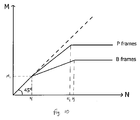
- M is a function of parameters including any or all of N, picture type, block position in the picture, picture position in a group of pictures (GOP), output bit-rate and other stream parameters. If M is a proportion of N and a function of the picture type and target bit-rate, drift effect and blocking artefacts are significantly reduced. Any suitable relation between M and N may be used which, as will be explained below, need not be linear. If M is determined to be greater than N, all transform coefficients in the block are kept and none are disregarded. If M, when calculated, is not an integer, rounding is performed to determine an integer value for M.
- Figure 9 shows a schematic representation of a block from an input stream and the corresponding block produced as part of the output stream using apparatus such as that shown in Figure 8 .
- the example of Figure 9 assumes that a discrete cosine transform has first been used to compress the input video stream.
- Such compression is used in, for example, MPEG-2 compression.
- any suitable transform can be used to generate the transform coefficients and indeed other frequency space transforms are used in other video compression algorithms and techniques.
- the block 18 from the input stream is made up of a quantised discrete cosine coefficient and a total of N run length codes for quantised DCT coefficients taken from a zig-zag scan order corresponding to a block of pixels within a frame of the video represented by the input stream.
- N run length codes for quantised DCT coefficients taken from a zig-zag scan order corresponding to a block of pixels within a frame of the video represented by the input stream.
- a block 20 from the output stream comprises M components followed by an EOB code 24.
- the EOB code is inserted into output bit stream by the stream copy control 12 within the apparatus of Figure 8 . It can be seen that the components C 1 to C M are the same in both the block 18 from the input bit stream and the block 22 from the output bit stream. Thus, no processing is required of the first M non-zero coefficients of any block from the input bit stream. The remaining N minus M coefficients are simply discarded.
- M can be, but is not necessarily, restricted to a constant proportion of N such that M is equal to N multiplied by a constant ⁇ .
- instantaneous variation of ⁇ stabilises the output bit-rate and can be controlled so that the output bit-rate is always just below a desired bit-rate, thereby complying with channel bandwidth requirements.
- the degree to which ⁇ may be varied can be quite small so that the benefit of distributing the visual degradation across all blocks is not lost by the variation between blocks of ⁇ .
- Block adaptive truncation of transform coefficients in frames produces low drift and low bit-rate streams by allowing transrating of P reference frames in addition to the B inter frames.
- the proposed architecture does not perform any quantisation, inverse quantisation, transform, inverse transform, motion vector search or variable length encoding. It is an extremely low complexity architecture which in practice simply performs header decoding, non-zero transform coefficient counting and EOB code insertion. The computational requirements are relatively low bearing in mind the output quality, the bit-rate reduction and speed achieved.
- b and p may be computed easily offline.
Landscapes
- Engineering & Computer Science (AREA)
- Multimedia (AREA)
- Signal Processing (AREA)
- Computing Systems (AREA)
- Theoretical Computer Science (AREA)
- Physics & Mathematics (AREA)
- Algebra (AREA)
- General Physics & Mathematics (AREA)
- Mathematical Analysis (AREA)
- Mathematical Optimization (AREA)
- Pure & Applied Mathematics (AREA)
- Compression Or Coding Systems Of Tv Signals (AREA)
Priority Applications (4)
| Application Number | Priority Date | Filing Date | Title |
|---|---|---|---|
| EP07251456.5A EP1978743B1 (fr) | 2007-04-02 | 2007-04-02 | Procédé et appareil de transcodage d'un signal vidéo |
| RU2008112789/07A RU2504105C2 (ru) | 2007-04-02 | 2008-04-02 | Способ и устройство для транскодирования видеосигнала |
| KR20080030981A KR101478834B1 (ko) | 2007-04-02 | 2008-04-02 | 비디오 신호 트랜스코딩 방법 및 장치 |
| JP2008096270A JP5345797B2 (ja) | 2007-04-02 | 2008-04-02 | ビデオ信号の変換方法及び装置 |
Applications Claiming Priority (1)
| Application Number | Priority Date | Filing Date | Title |
|---|---|---|---|
| EP07251456.5A EP1978743B1 (fr) | 2007-04-02 | 2007-04-02 | Procédé et appareil de transcodage d'un signal vidéo |
Publications (2)
| Publication Number | Publication Date |
|---|---|
| EP1978743A1 true EP1978743A1 (fr) | 2008-10-08 |
| EP1978743B1 EP1978743B1 (fr) | 2020-07-01 |
Family
ID=38468535
Family Applications (1)
| Application Number | Title | Priority Date | Filing Date |
|---|---|---|---|
| EP07251456.5A Active EP1978743B1 (fr) | 2007-04-02 | 2007-04-02 | Procédé et appareil de transcodage d'un signal vidéo |
Country Status (4)
| Country | Link |
|---|---|
| EP (1) | EP1978743B1 (fr) |
| JP (1) | JP5345797B2 (fr) |
| KR (1) | KR101478834B1 (fr) |
| RU (1) | RU2504105C2 (fr) |
Cited By (2)
| Publication number | Priority date | Publication date | Assignee | Title |
|---|---|---|---|---|
| EP2360928A1 (fr) * | 2010-02-12 | 2011-08-24 | Vestel Elektronik Sanayi ve Ticaret A.S. | Un procédé de compression d'image |
| CN101917384B (zh) * | 2009-11-17 | 2013-05-01 | 新奥特(北京)视频技术有限公司 | 一种分布式转码系统的任务分发方法及装置 |
Families Citing this family (4)
| Publication number | Priority date | Publication date | Assignee | Title |
|---|---|---|---|---|
| KR101457418B1 (ko) | 2009-10-23 | 2014-11-04 | 삼성전자주식회사 | 계층적 부호화 단위의 크기에 따른 비디오 부호화 방법과 그 장치, 및 비디오 복호화 방법과 그 장치 |
| CN102014284B (zh) * | 2010-12-10 | 2014-09-10 | 中兴通讯股份有限公司 | 转码业务中获取视频码流的参数集值的方法、系统及装置 |
| EP2661045A1 (fr) * | 2012-05-04 | 2013-11-06 | Thomson Licensing | Procédé et appareil pour fournir plusieurs flux de contenu transcodés |
| US11019349B2 (en) | 2017-01-20 | 2021-05-25 | Snap Inc. | Content-based client side video transcoding |
Citations (5)
| Publication number | Priority date | Publication date | Assignee | Title |
|---|---|---|---|---|
| WO2003067778A1 (fr) * | 2002-02-08 | 2003-08-14 | Sony Electronics, Inc. | Transcodeur de debit binaire a base de trains de bits pour video codee mpeg |
| US6763070B1 (en) * | 2001-05-29 | 2004-07-13 | Cisco Technology, Inc. | Methods and apparatus for selecting a cut-off index |
| EP1553779A1 (fr) * | 2004-01-12 | 2005-07-13 | Deutsche Thomson-Brandt GmbH | Réduction de données de flux vidéo par sélection de trames et éffacement partiel de coéfficients de transformation |
| US6937770B1 (en) * | 2000-12-28 | 2005-08-30 | Emc Corporation | Adaptive bit rate control for rate reduction of MPEG coded video |
| US20060126736A1 (en) * | 2004-12-14 | 2006-06-15 | Bo Shen | Reducing the resolution of media data |
Family Cites Families (10)
| Publication number | Priority date | Publication date | Assignee | Title |
|---|---|---|---|---|
| DE4416967A1 (de) * | 1994-05-13 | 1995-11-16 | Thomson Brandt Gmbh | Verfahren und Vorrichtung zur Transcodierung von Bitströmen mit Videodaten |
| CA2265089C (fr) * | 1998-03-10 | 2007-07-10 | Sony Corporation | Systeme de transcodage utilisant les informations d'encodage |
| JP2000244872A (ja) | 1999-02-19 | 2000-09-08 | Toshiba Corp | トランスコーダ装置 |
| JP2002027469A (ja) * | 2000-07-05 | 2002-01-25 | Matsushita Electric Ind Co Ltd | ビットストリーム変換方法、ビットストリーム変換装置およびプログラム記録媒体 |
| KR20030029961A (ko) * | 2001-07-10 | 2003-04-16 | 코닌클리케 필립스 일렉트로닉스 엔.브이. | 스케일불가능한 코딩된 비디오 신호로부터 스케일가능한코딩된 비디오 신호를 생성하기 위한 방법 및 장치 |
| KR20040075951A (ko) * | 2002-01-22 | 2004-08-30 | 코닌클리케 필립스 일렉트로닉스 엔.브이. | 이미 압축된 멀티미디어의 비트 레이트의 감소 |
| US20030206590A1 (en) * | 2002-05-06 | 2003-11-06 | Koninklijke Philips Electronics N.V. | MPEG transcoding system and method using motion information |
| TWI262660B (en) * | 2003-11-19 | 2006-09-21 | Inst Information Industry | Video transcoder adaptively reducing frame rate |
| JP2005191897A (ja) * | 2003-12-25 | 2005-07-14 | Shijin Kogyo Sakushinkai | 適応性フレーム速度低減ビデオコード変換システム |
| EP1628484B1 (fr) * | 2004-08-18 | 2019-04-03 | STMicroelectronics Srl | Procédé et dispositif de transcodage de video compressée |
-
2007
- 2007-04-02 EP EP07251456.5A patent/EP1978743B1/fr active Active
-
2008
- 2008-04-02 RU RU2008112789/07A patent/RU2504105C2/ru active
- 2008-04-02 KR KR20080030981A patent/KR101478834B1/ko active Active
- 2008-04-02 JP JP2008096270A patent/JP5345797B2/ja active Active
Patent Citations (5)
| Publication number | Priority date | Publication date | Assignee | Title |
|---|---|---|---|---|
| US6937770B1 (en) * | 2000-12-28 | 2005-08-30 | Emc Corporation | Adaptive bit rate control for rate reduction of MPEG coded video |
| US6763070B1 (en) * | 2001-05-29 | 2004-07-13 | Cisco Technology, Inc. | Methods and apparatus for selecting a cut-off index |
| WO2003067778A1 (fr) * | 2002-02-08 | 2003-08-14 | Sony Electronics, Inc. | Transcodeur de debit binaire a base de trains de bits pour video codee mpeg |
| EP1553779A1 (fr) * | 2004-01-12 | 2005-07-13 | Deutsche Thomson-Brandt GmbH | Réduction de données de flux vidéo par sélection de trames et éffacement partiel de coéfficients de transformation |
| US20060126736A1 (en) * | 2004-12-14 | 2006-06-15 | Bo Shen | Reducing the resolution of media data |
Non-Patent Citations (2)
| Title |
|---|
| "ISO/IEC CD 13818-: INFORMATION TECHNOLOGY - GENERIC CODING OF MOVING PICTURES AND ASSOCIATED AUDIO INFORMATION PART 2: VIDEO", INTERNATIONAL STANDARD - ISO, ZUERICH, CH, no. 659, 1 December 1993 (1993-12-01), pages A - C,I, XP000567291 * |
| BENYAMINOVICH S ET AL: "Optimal transrating via DCT coefficients modification and dropping", INFORMATION TECHNOLOGY: RESEARCH AND EDUCATION, 2005. ITRE 2005. 3RD INTERNATIONAL CONFERENCE ON HSINCHU, TAIWAN JUNE 27-30, 2005, PISCATAWAY, NJ, USA,IEEE, 27 June 2005 (2005-06-27), pages 100 - 104, XP010832619, ISBN: 0-7803-8932-8 * |
Cited By (2)
| Publication number | Priority date | Publication date | Assignee | Title |
|---|---|---|---|---|
| CN101917384B (zh) * | 2009-11-17 | 2013-05-01 | 新奥特(北京)视频技术有限公司 | 一种分布式转码系统的任务分发方法及装置 |
| EP2360928A1 (fr) * | 2010-02-12 | 2011-08-24 | Vestel Elektronik Sanayi ve Ticaret A.S. | Un procédé de compression d'image |
Also Published As
| Publication number | Publication date |
|---|---|
| JP2008259209A (ja) | 2008-10-23 |
| RU2008112789A (ru) | 2009-10-10 |
| RU2504105C2 (ru) | 2014-01-10 |
| KR101478834B1 (ko) | 2015-01-06 |
| JP5345797B2 (ja) | 2013-11-20 |
| EP1978743B1 (fr) | 2020-07-01 |
| KR20080090335A (ko) | 2008-10-08 |
Similar Documents
| Publication | Publication Date | Title |
|---|---|---|
| US7301999B2 (en) | Quantization method and system for video MPEG applications and computer program product therefor | |
| EP1615447B1 (fr) | Méthode et système de livraison des flux d'informations et reseau et programme informatique associés | |
| US7170938B1 (en) | Rate control method for video transcoding | |
| US8279922B2 (en) | Hybrid rate control in a digital stream transcoder | |
| KR100756596B1 (ko) | 비디오 데이터 부호화 장치 및 비디오 데이터 부호화 방법 | |
| US5986710A (en) | Image encoding method and apparatus for controlling the number of bits generated using quantization activities | |
| US6956899B2 (en) | Precise bit control apparatus with look-ahead for MPEG encoding | |
| KR19990077445A (ko) | 실시간단일패스가변비트레이트제어방법및그인코더 | |
| US5844607A (en) | Method and apparatus for scene change detection in digital video compression | |
| EP1978743B1 (fr) | Procédé et appareil de transcodage d'un signal vidéo | |
| JPH09154143A (ja) | ビデオデータ圧縮方式 | |
| US6763070B1 (en) | Methods and apparatus for selecting a cut-off index | |
| Liu et al. | Secure steganography in compressed video bitstreams | |
| KR100229796B1 (ko) | 열화영상에 대한 보상기능을 갖는 영상 복호화 시스템 | |
| KR20060103424A (ko) | 이중 패스 인코딩의 비트 예산 조정의 선택을 위한 방법 및장치 | |
| US6804299B2 (en) | Methods and systems for reducing requantization-originated generational error in predictive video streams using motion compensation | |
| US6040875A (en) | Method to compensate for a fade in a digital video input sequence | |
| JP4081727B2 (ja) | 画像符号化装置および画像符号化方法、並びに記録装置および記録方法 | |
| US9253491B2 (en) | Method and apparatus for transcoding a video signal | |
| US7054362B1 (en) | Methods and apparatus for updating a reduction ratio | |
| EP1720356A1 (fr) | Compression vidéo sélective en fréquence | |
| CA2390904C (fr) | Methodes et appareil de reglage dynamique de codes f d'en-tete d'image numerique | |
| EP1944980A2 (fr) | Algorithme de contrôle de débit | |
| JP2001145108A (ja) | 画像情報変換装置及び方法 | |
| KR20040067239A (ko) | 양자화 수행시에 사용되는 비트의 할당방법 및 장치 |
Legal Events
| Date | Code | Title | Description |
|---|---|---|---|
| PUAI | Public reference made under article 153(3) epc to a published international application that has entered the european phase |
Free format text: ORIGINAL CODE: 0009012 |
|
| AK | Designated contracting states |
Kind code of ref document: A1 Designated state(s): AT BE BG CH CY CZ DE DK EE ES FI FR GB GR HU IE IS IT LI LT LU LV MC MT NL PL PT RO SE SI SK TR |
|
| AX | Request for extension of the european patent |
Extension state: AL BA HR MK RS |
|
| 17P | Request for examination filed |
Effective date: 20090330 |
|
| 17Q | First examination report despatched |
Effective date: 20090519 |
|
| AKX | Designation fees paid |
Designated state(s): AT BE BG CH CY CZ DE DK EE ES FI FR GB GR HU IE IS IT LI LT LU LV MC MT NL PL PT RO SE SI SK TR |
|
| STAA | Information on the status of an ep patent application or granted ep patent |
Free format text: STATUS: EXAMINATION IS IN PROGRESS |
|
| REG | Reference to a national code |
Ref country code: DE Ref legal event code: R079 Ref document number: 602007060403 Country of ref document: DE Free format text: PREVIOUS MAIN CLASS: H04N0007260000 Ipc: H04N0019400000 |
|
| GRAP | Despatch of communication of intention to grant a patent |
Free format text: ORIGINAL CODE: EPIDOSNIGR1 |
|
| RIC1 | Information provided on ipc code assigned before grant |
Ipc: H04N 19/196 20140101ALI20191030BHEP Ipc: H04N 19/40 20140101AFI20191030BHEP Ipc: H04N 19/176 20140101ALI20191030BHEP Ipc: H04N 19/149 20140101ALI20191030BHEP Ipc: H04N 19/159 20140101ALI20191030BHEP Ipc: H04N 19/18 20140101ALI20191030BHEP Ipc: H04N 19/61 20140101ALI20191030BHEP Ipc: H04N 19/132 20140101ALI20191030BHEP |
|
| STAA | Information on the status of an ep patent application or granted ep patent |
Free format text: STATUS: GRANT OF PATENT IS INTENDED |
|
| INTG | Intention to grant announced |
Effective date: 20191205 |
|
| GRAS | Grant fee paid |
Free format text: ORIGINAL CODE: EPIDOSNIGR3 |
|
| GRAA | (expected) grant |
Free format text: ORIGINAL CODE: 0009210 |
|
| STAA | Information on the status of an ep patent application or granted ep patent |
Free format text: STATUS: THE PATENT HAS BEEN GRANTED |
|
| AK | Designated contracting states |
Kind code of ref document: B1 Designated state(s): AT BE BG CH CY CZ DE DK EE ES FI FR GB GR HU IE IS IT LI LT LU LV MC MT NL PL PT RO SE SI SK TR |
|
| REG | Reference to a national code |
Ref country code: GB Ref legal event code: FG4D |
|
| REG | Reference to a national code |
Ref country code: AT Ref legal event code: REF Ref document number: 1287280 Country of ref document: AT Kind code of ref document: T Effective date: 20200715 Ref country code: CH Ref legal event code: EP |
|
| REG | Reference to a national code |
Ref country code: DE Ref legal event code: R096 Ref document number: 602007060403 Country of ref document: DE |
|
| REG | Reference to a national code |
Ref country code: IE Ref legal event code: FG4D |
|
| REG | Reference to a national code |
Ref country code: LT Ref legal event code: MG4D |
|
| PG25 | Lapsed in a contracting state [announced via postgrant information from national office to epo] |
Ref country code: BG Free format text: LAPSE BECAUSE OF FAILURE TO SUBMIT A TRANSLATION OF THE DESCRIPTION OR TO PAY THE FEE WITHIN THE PRESCRIBED TIME-LIMIT Effective date: 20201001 |
|
| REG | Reference to a national code |
Ref country code: NL Ref legal event code: MP Effective date: 20200701 |
|
| REG | Reference to a national code |
Ref country code: AT Ref legal event code: MK05 Ref document number: 1287280 Country of ref document: AT Kind code of ref document: T Effective date: 20200701 |
|
| PG25 | Lapsed in a contracting state [announced via postgrant information from national office to epo] |
Ref country code: GR Free format text: LAPSE BECAUSE OF FAILURE TO SUBMIT A TRANSLATION OF THE DESCRIPTION OR TO PAY THE FEE WITHIN THE PRESCRIBED TIME-LIMIT Effective date: 20201002 Ref country code: FI Free format text: LAPSE BECAUSE OF FAILURE TO SUBMIT A TRANSLATION OF THE DESCRIPTION OR TO PAY THE FEE WITHIN THE PRESCRIBED TIME-LIMIT Effective date: 20200701 Ref country code: CZ Free format text: LAPSE BECAUSE OF FAILURE TO SUBMIT A TRANSLATION OF THE DESCRIPTION OR TO PAY THE FEE WITHIN THE PRESCRIBED TIME-LIMIT Effective date: 20200701 Ref country code: ES Free format text: LAPSE BECAUSE OF FAILURE TO SUBMIT A TRANSLATION OF THE DESCRIPTION OR TO PAY THE FEE WITHIN THE PRESCRIBED TIME-LIMIT Effective date: 20200701 Ref country code: LT Free format text: LAPSE BECAUSE OF FAILURE TO SUBMIT A TRANSLATION OF THE DESCRIPTION OR TO PAY THE FEE WITHIN THE PRESCRIBED TIME-LIMIT Effective date: 20200701 Ref country code: SE Free format text: LAPSE BECAUSE OF FAILURE TO SUBMIT A TRANSLATION OF THE DESCRIPTION OR TO PAY THE FEE WITHIN THE PRESCRIBED TIME-LIMIT Effective date: 20200701 Ref country code: PT Free format text: LAPSE BECAUSE OF FAILURE TO SUBMIT A TRANSLATION OF THE DESCRIPTION OR TO PAY THE FEE WITHIN THE PRESCRIBED TIME-LIMIT Effective date: 20201102 Ref country code: AT Free format text: LAPSE BECAUSE OF FAILURE TO SUBMIT A TRANSLATION OF THE DESCRIPTION OR TO PAY THE FEE WITHIN THE PRESCRIBED TIME-LIMIT Effective date: 20200701 |
|
| PG25 | Lapsed in a contracting state [announced via postgrant information from national office to epo] |
Ref country code: IS Free format text: LAPSE BECAUSE OF FAILURE TO SUBMIT A TRANSLATION OF THE DESCRIPTION OR TO PAY THE FEE WITHIN THE PRESCRIBED TIME-LIMIT Effective date: 20201101 Ref country code: PL Free format text: LAPSE BECAUSE OF FAILURE TO SUBMIT A TRANSLATION OF THE DESCRIPTION OR TO PAY THE FEE WITHIN THE PRESCRIBED TIME-LIMIT Effective date: 20200701 Ref country code: LV Free format text: LAPSE BECAUSE OF FAILURE TO SUBMIT A TRANSLATION OF THE DESCRIPTION OR TO PAY THE FEE WITHIN THE PRESCRIBED TIME-LIMIT Effective date: 20200701 |
|
| PG25 | Lapsed in a contracting state [announced via postgrant information from national office to epo] |
Ref country code: NL Free format text: LAPSE BECAUSE OF FAILURE TO SUBMIT A TRANSLATION OF THE DESCRIPTION OR TO PAY THE FEE WITHIN THE PRESCRIBED TIME-LIMIT Effective date: 20200701 |
|
| REG | Reference to a national code |
Ref country code: DE Ref legal event code: R097 Ref document number: 602007060403 Country of ref document: DE |
|
| PG25 | Lapsed in a contracting state [announced via postgrant information from national office to epo] |
Ref country code: RO Free format text: LAPSE BECAUSE OF FAILURE TO SUBMIT A TRANSLATION OF THE DESCRIPTION OR TO PAY THE FEE WITHIN THE PRESCRIBED TIME-LIMIT Effective date: 20200701 Ref country code: EE Free format text: LAPSE BECAUSE OF FAILURE TO SUBMIT A TRANSLATION OF THE DESCRIPTION OR TO PAY THE FEE WITHIN THE PRESCRIBED TIME-LIMIT Effective date: 20200701 Ref country code: DK Free format text: LAPSE BECAUSE OF FAILURE TO SUBMIT A TRANSLATION OF THE DESCRIPTION OR TO PAY THE FEE WITHIN THE PRESCRIBED TIME-LIMIT Effective date: 20200701 |
|
| PLBE | No opposition filed within time limit |
Free format text: ORIGINAL CODE: 0009261 |
|
| STAA | Information on the status of an ep patent application or granted ep patent |
Free format text: STATUS: NO OPPOSITION FILED WITHIN TIME LIMIT |
|
| 26N | No opposition filed |
Effective date: 20210406 |
|
| PG25 | Lapsed in a contracting state [announced via postgrant information from national office to epo] |
Ref country code: SK Free format text: LAPSE BECAUSE OF FAILURE TO SUBMIT A TRANSLATION OF THE DESCRIPTION OR TO PAY THE FEE WITHIN THE PRESCRIBED TIME-LIMIT Effective date: 20200701 |
|
| PG25 | Lapsed in a contracting state [announced via postgrant information from national office to epo] |
Ref country code: SI Free format text: LAPSE BECAUSE OF FAILURE TO SUBMIT A TRANSLATION OF THE DESCRIPTION OR TO PAY THE FEE WITHIN THE PRESCRIBED TIME-LIMIT Effective date: 20200701 |
|
| PG25 | Lapsed in a contracting state [announced via postgrant information from national office to epo] |
Ref country code: MC Free format text: LAPSE BECAUSE OF FAILURE TO SUBMIT A TRANSLATION OF THE DESCRIPTION OR TO PAY THE FEE WITHIN THE PRESCRIBED TIME-LIMIT Effective date: 20200701 |
|
| PG25 | Lapsed in a contracting state [announced via postgrant information from national office to epo] |
Ref country code: LU Free format text: LAPSE BECAUSE OF NON-PAYMENT OF DUE FEES Effective date: 20210402 |
|
| REG | Reference to a national code |
Ref country code: BE Ref legal event code: MM Effective date: 20210430 |
|
| PG25 | Lapsed in a contracting state [announced via postgrant information from national office to epo] |
Ref country code: CH Free format text: LAPSE BECAUSE OF NON-PAYMENT OF DUE FEES Effective date: 20210430 Ref country code: LI Free format text: LAPSE BECAUSE OF NON-PAYMENT OF DUE FEES Effective date: 20210430 |
|
| PG25 | Lapsed in a contracting state [announced via postgrant information from national office to epo] |
Ref country code: IE Free format text: LAPSE BECAUSE OF NON-PAYMENT OF DUE FEES Effective date: 20210402 |
|
| PG25 | Lapsed in a contracting state [announced via postgrant information from national office to epo] |
Ref country code: IS Free format text: LAPSE BECAUSE OF FAILURE TO SUBMIT A TRANSLATION OF THE DESCRIPTION OR TO PAY THE FEE WITHIN THE PRESCRIBED TIME-LIMIT Effective date: 20201101 |
|
| PG25 | Lapsed in a contracting state [announced via postgrant information from national office to epo] |
Ref country code: BE Free format text: LAPSE BECAUSE OF NON-PAYMENT OF DUE FEES Effective date: 20210430 |
|
| PG25 | Lapsed in a contracting state [announced via postgrant information from national office to epo] |
Ref country code: HU Free format text: LAPSE BECAUSE OF FAILURE TO SUBMIT A TRANSLATION OF THE DESCRIPTION OR TO PAY THE FEE WITHIN THE PRESCRIBED TIME-LIMIT; INVALID AB INITIO Effective date: 20070402 Ref country code: CY Free format text: LAPSE BECAUSE OF FAILURE TO SUBMIT A TRANSLATION OF THE DESCRIPTION OR TO PAY THE FEE WITHIN THE PRESCRIBED TIME-LIMIT Effective date: 20200701 |
|
| PG25 | Lapsed in a contracting state [announced via postgrant information from national office to epo] |
Ref country code: MT Free format text: LAPSE BECAUSE OF FAILURE TO SUBMIT A TRANSLATION OF THE DESCRIPTION OR TO PAY THE FEE WITHIN THE PRESCRIBED TIME-LIMIT Effective date: 20200701 |
|
| PGFP | Annual fee paid to national office [announced via postgrant information from national office to epo] |
Ref country code: DE Payment date: 20250422 Year of fee payment: 19 |
|
| PGFP | Annual fee paid to national office [announced via postgrant information from national office to epo] |
Ref country code: GB Payment date: 20250418 Year of fee payment: 19 |
|
| PGFP | Annual fee paid to national office [announced via postgrant information from national office to epo] |
Ref country code: IT Payment date: 20250424 Year of fee payment: 19 |
|
| PGFP | Annual fee paid to national office [announced via postgrant information from national office to epo] |
Ref country code: FR Payment date: 20250424 Year of fee payment: 19 |
|
| PGFP | Annual fee paid to national office [announced via postgrant information from national office to epo] |
Ref country code: TR Payment date: 20260331 Year of fee payment: 20 |