EP1978975B1 - Zusammensetzung zur hemmung von adhäsion - Google Patents
Zusammensetzung zur hemmung von adhäsion Download PDFInfo
- Publication number
- EP1978975B1 EP1978975B1 EP07701070.0A EP07701070A EP1978975B1 EP 1978975 B1 EP1978975 B1 EP 1978975B1 EP 07701070 A EP07701070 A EP 07701070A EP 1978975 B1 EP1978975 B1 EP 1978975B1
- Authority
- EP
- European Patent Office
- Prior art keywords
- peo
- adhesion
- acid
- surgery
- use according
- Prior art date
- Legal status (The legal status is an assumption and is not a legal conclusion. Google has not performed a legal analysis and makes no representation as to the accuracy of the status listed.)
- Not-in-force
Links
- 230000002401 inhibitory effect Effects 0.000 title claims description 64
- 239000000203 mixture Substances 0.000 title claims description 35
- 229920006030 multiblock copolymer Polymers 0.000 claims description 124
- 229920003171 Poly (ethylene oxide) Polymers 0.000 claims description 83
- 229920000642 polymer Polymers 0.000 claims description 64
- 229920001400 block copolymer Polymers 0.000 claims description 46
- LFQSCWFLJHTTHZ-UHFFFAOYSA-N Ethanol Chemical compound CCO LFQSCWFLJHTTHZ-UHFFFAOYSA-N 0.000 claims description 44
- 238000001356 surgical procedure Methods 0.000 claims description 43
- 229920001451 polypropylene glycol Polymers 0.000 claims description 39
- OFOBLEOULBTSOW-UHFFFAOYSA-N Malonic acid Chemical compound OC(=O)CC(O)=O OFOBLEOULBTSOW-UHFFFAOYSA-N 0.000 claims description 26
- 239000007864 aqueous solution Substances 0.000 claims description 25
- 230000007704 transition Effects 0.000 claims description 23
- 239000000126 substance Substances 0.000 claims description 18
- 230000036760 body temperature Effects 0.000 claims description 14
- 239000004094 surface-active agent Substances 0.000 claims description 13
- XLYOFNOQVPJJNP-UHFFFAOYSA-N water Chemical compound O XLYOFNOQVPJJNP-UHFFFAOYSA-N 0.000 claims description 13
- 230000004888 barrier function Effects 0.000 claims description 12
- 230000006870 function Effects 0.000 claims description 12
- 229920001748 polybutylene Polymers 0.000 claims description 11
- MUBZPKHOEPUJKR-UHFFFAOYSA-N Oxalic acid Chemical compound OC(=O)C(O)=O MUBZPKHOEPUJKR-UHFFFAOYSA-N 0.000 claims description 9
- 239000002253 acid Substances 0.000 claims description 9
- 239000002504 physiological saline solution Substances 0.000 claims description 9
- -1 polybutylene Polymers 0.000 claims description 9
- 239000012153 distilled water Substances 0.000 claims description 7
- 229940079593 drug Drugs 0.000 claims description 7
- VZCYOOQTPOCHFL-OWOJBTEDSA-N Fumaric acid Chemical compound OC(=O)\C=C\C(O)=O VZCYOOQTPOCHFL-OWOJBTEDSA-N 0.000 claims description 6
- WNLRTRBMVRJNCN-UHFFFAOYSA-N adipic acid Chemical compound OC(=O)CCCCC(O)=O WNLRTRBMVRJNCN-UHFFFAOYSA-N 0.000 claims description 6
- 125000003118 aryl group Chemical group 0.000 claims description 6
- 150000001768 cations Chemical group 0.000 claims description 6
- 239000003814 drug Substances 0.000 claims description 6
- 229940102212 intraperitoneal solution Drugs 0.000 claims description 6
- VZCYOOQTPOCHFL-UHFFFAOYSA-N trans-butenedioic acid Natural products OC(=O)C=CC(O)=O VZCYOOQTPOCHFL-UHFFFAOYSA-N 0.000 claims description 6
- 229910052727 yttrium Inorganic materials 0.000 claims description 6
- KDYFGRWQOYBRFD-UHFFFAOYSA-N Succinic acid Natural products OC(=O)CCC(O)=O KDYFGRWQOYBRFD-UHFFFAOYSA-N 0.000 claims description 5
- 150000003839 salts Chemical class 0.000 claims description 5
- IAYPIBMASNFSPL-UHFFFAOYSA-N Ethylene oxide Chemical class C1CO1 IAYPIBMASNFSPL-UHFFFAOYSA-N 0.000 claims description 4
- KKEYFWRCBNTPAC-UHFFFAOYSA-N Terephthalic acid Chemical compound OC(=O)C1=CC=C(C(O)=O)C=C1 KKEYFWRCBNTPAC-UHFFFAOYSA-N 0.000 claims description 4
- 238000004519 manufacturing process Methods 0.000 claims description 4
- XNGIFLGASWRNHJ-UHFFFAOYSA-N phthalic acid Chemical compound OC(=O)C1=CC=CC=C1C(O)=O XNGIFLGASWRNHJ-UHFFFAOYSA-N 0.000 claims description 4
- 239000007921 spray Substances 0.000 claims description 4
- TYFQFVWCELRYAO-UHFFFAOYSA-N suberic acid Chemical compound OC(=O)CCCCCCC(O)=O TYFQFVWCELRYAO-UHFFFAOYSA-N 0.000 claims description 4
- RTBFRGCFXZNCOE-UHFFFAOYSA-N 1-methylsulfonylpiperidin-4-one Chemical compound CS(=O)(=O)N1CCC(=O)CC1 RTBFRGCFXZNCOE-UHFFFAOYSA-N 0.000 claims description 3
- 239000001361 adipic acid Substances 0.000 claims description 3
- 235000011037 adipic acid Nutrition 0.000 claims description 3
- JFCQEDHGNNZCLN-UHFFFAOYSA-N anhydrous glutaric acid Natural products OC(=O)CCCC(O)=O JFCQEDHGNNZCLN-UHFFFAOYSA-N 0.000 claims description 3
- KDYFGRWQOYBRFD-NUQCWPJISA-N butanedioic acid Chemical compound O[14C](=O)CC[14C](O)=O KDYFGRWQOYBRFD-NUQCWPJISA-N 0.000 claims description 3
- 239000001530 fumaric acid Substances 0.000 claims description 3
- 125000003010 ionic group Chemical group 0.000 claims description 3
- VZCYOOQTPOCHFL-UPHRSURJSA-N maleic acid Chemical compound OC(=O)\C=C/C(O)=O VZCYOOQTPOCHFL-UPHRSURJSA-N 0.000 claims description 3
- 239000011976 maleic acid Substances 0.000 claims description 3
- 235000006408 oxalic acid Nutrition 0.000 claims description 3
- GOOHAUXETOMSMM-UHFFFAOYSA-N Propylene oxide Chemical class CC1CO1 GOOHAUXETOMSMM-UHFFFAOYSA-N 0.000 claims description 2
- WYURNTSHIVDZCO-UHFFFAOYSA-N Tetrahydrofuran Chemical class C1CCOC1 WYURNTSHIVDZCO-UHFFFAOYSA-N 0.000 claims description 2
- 239000003795 chemical substances by application Substances 0.000 claims description 2
- 238000002316 cosmetic surgery Methods 0.000 claims description 2
- 239000006071 cream Substances 0.000 claims description 2
- 230000001747 exhibiting effect Effects 0.000 claims description 2
- 239000005556 hormone Substances 0.000 claims description 2
- 229940088597 hormone Drugs 0.000 claims description 2
- 238000002357 laparoscopic surgery Methods 0.000 claims description 2
- 238000002350 laparotomy Methods 0.000 claims description 2
- 229940021182 non-steroidal anti-inflammatory drug Drugs 0.000 claims description 2
- 239000008215 water for injection Substances 0.000 claims description 2
- 229940005553 analgesics and anesthetics Drugs 0.000 claims 1
- RVGRUAULSDPKGF-UHFFFAOYSA-N Poloxamer Chemical compound C1CO1.CC1CO1 RVGRUAULSDPKGF-UHFFFAOYSA-N 0.000 description 56
- 238000002360 preparation method Methods 0.000 description 54
- 239000000243 solution Substances 0.000 description 45
- 229920001983 poloxamer Polymers 0.000 description 34
- 229920001992 poloxamer 407 Polymers 0.000 description 33
- 239000000499 gel Substances 0.000 description 31
- 229940044476 poloxamer 407 Drugs 0.000 description 28
- 239000003112 inhibitor Substances 0.000 description 26
- 238000000034 method Methods 0.000 description 23
- 210000001519 tissue Anatomy 0.000 description 22
- 229960000502 poloxamer Drugs 0.000 description 20
- 239000002202 Polyethylene glycol Substances 0.000 description 15
- 208000027418 Wounds and injury Diseases 0.000 description 15
- 206010052428 Wound Diseases 0.000 description 14
- 230000015572 biosynthetic process Effects 0.000 description 14
- 238000001879 gelation Methods 0.000 description 14
- 238000011282 treatment Methods 0.000 description 14
- 125000005647 linker group Chemical group 0.000 description 13
- 210000000056 organ Anatomy 0.000 description 12
- 239000002904 solvent Substances 0.000 description 12
- 229920002134 Carboxymethyl cellulose Polymers 0.000 description 11
- RTZKZFJDLAIYFH-UHFFFAOYSA-N ether Substances CCOCC RTZKZFJDLAIYFH-UHFFFAOYSA-N 0.000 description 11
- 229920001993 poloxamer 188 Polymers 0.000 description 11
- 239000000047 product Substances 0.000 description 11
- 238000003786 synthesis reaction Methods 0.000 description 11
- 238000005481 NMR spectroscopy Methods 0.000 description 10
- 239000000463 material Substances 0.000 description 10
- 208000005422 Foreign-Body reaction Diseases 0.000 description 9
- 229920000463 Poly(ethylene glycol)-block-poly(propylene glycol)-block-poly(ethylene glycol) Polymers 0.000 description 9
- 238000006731 degradation reaction Methods 0.000 description 9
- 230000000717 retained effect Effects 0.000 description 9
- 241001465754 Metazoa Species 0.000 description 8
- 241000700159 Rattus Species 0.000 description 8
- IRXBNHGNHKNOJI-UHFFFAOYSA-N butanedioyl dichloride Chemical compound ClC(=O)CCC(Cl)=O IRXBNHGNHKNOJI-UHFFFAOYSA-N 0.000 description 8
- 230000005764 inhibitory process Effects 0.000 description 8
- 238000011084 recovery Methods 0.000 description 8
- IJOOHPMOJXWVHK-UHFFFAOYSA-N chlorotrimethylsilane Chemical compound C[Si](C)(C)Cl IJOOHPMOJXWVHK-UHFFFAOYSA-N 0.000 description 7
- 239000007857 degradation product Substances 0.000 description 7
- 229940044519 poloxamer 188 Drugs 0.000 description 7
- WEVYAHXRMPXWCK-UHFFFAOYSA-N Acetonitrile Chemical compound CC#N WEVYAHXRMPXWCK-UHFFFAOYSA-N 0.000 description 6
- OKKJLVBELUTLKV-UHFFFAOYSA-N Methanol Chemical compound OC OKKJLVBELUTLKV-UHFFFAOYSA-N 0.000 description 6
- JUJWROOIHBZHMG-UHFFFAOYSA-N Pyridine Chemical compound C1=CC=NC=C1 JUJWROOIHBZHMG-UHFFFAOYSA-N 0.000 description 6
- ZMANZCXQSJIPKH-UHFFFAOYSA-N Triethylamine Chemical compound CCN(CC)CC ZMANZCXQSJIPKH-UHFFFAOYSA-N 0.000 description 6
- 238000004458 analytical method Methods 0.000 description 6
- 230000015556 catabolic process Effects 0.000 description 6
- 238000006243 chemical reaction Methods 0.000 description 6
- 230000000694 effects Effects 0.000 description 6
- 125000002887 hydroxy group Chemical group [H]O* 0.000 description 6
- KIUKXJAPPMFGSW-DNGZLQJQSA-N (2S,3S,4S,5R,6R)-6-[(2S,3R,4R,5S,6R)-3-Acetamido-2-[(2S,3S,4R,5R,6R)-6-[(2R,3R,4R,5S,6R)-3-acetamido-2,5-dihydroxy-6-(hydroxymethyl)oxan-4-yl]oxy-2-carboxy-4,5-dihydroxyoxan-3-yl]oxy-5-hydroxy-6-(hydroxymethyl)oxan-4-yl]oxy-3,4,5-trihydroxyoxane-2-carboxylic acid Chemical compound CC(=O)N[C@H]1[C@H](O)O[C@H](CO)[C@@H](O)[C@@H]1O[C@H]1[C@H](O)[C@@H](O)[C@H](O[C@H]2[C@@H]([C@@H](O[C@H]3[C@@H]([C@@H](O)[C@H](O)[C@H](O3)C(O)=O)O)[C@H](O)[C@@H](CO)O2)NC(C)=O)[C@@H](C(O)=O)O1 KIUKXJAPPMFGSW-DNGZLQJQSA-N 0.000 description 5
- 229920002674 hyaluronan Polymers 0.000 description 5
- 229960003160 hyaluronic acid Drugs 0.000 description 5
- 238000000425 proton nuclear magnetic resonance spectrum Methods 0.000 description 5
- 238000000746 purification Methods 0.000 description 5
- 208000031737 Tissue Adhesions Diseases 0.000 description 4
- 239000001768 carboxy methyl cellulose Substances 0.000 description 4
- 229920002678 cellulose Polymers 0.000 description 4
- 235000010980 cellulose Nutrition 0.000 description 4
- 239000012046 mixed solvent Substances 0.000 description 4
- 239000003607 modifier Substances 0.000 description 4
- 238000000655 nuclear magnetic resonance spectrum Methods 0.000 description 4
- YMWUJEATGCHHMB-UHFFFAOYSA-N Dichloromethane Chemical compound ClCCl YMWUJEATGCHHMB-UHFFFAOYSA-N 0.000 description 3
- PEDCQBHIVMGVHV-UHFFFAOYSA-N Glycerine Chemical compound OCC(O)CO PEDCQBHIVMGVHV-UHFFFAOYSA-N 0.000 description 3
- 238000010521 absorption reaction Methods 0.000 description 3
- 150000001450 anions Chemical group 0.000 description 3
- 229910052791 calcium Inorganic materials 0.000 description 3
- 125000003178 carboxy group Chemical group [H]OC(*)=O 0.000 description 3
- 239000001913 cellulose Substances 0.000 description 3
- 229910052802 copper Inorganic materials 0.000 description 3
- 150000001991 dicarboxylic acids Chemical class 0.000 description 3
- 229910052737 gold Inorganic materials 0.000 description 3
- 230000007062 hydrolysis Effects 0.000 description 3
- 238000006460 hydrolysis reaction Methods 0.000 description 3
- 230000002209 hydrophobic effect Effects 0.000 description 3
- 229910052742 iron Inorganic materials 0.000 description 3
- 229910052744 lithium Inorganic materials 0.000 description 3
- 229910052749 magnesium Inorganic materials 0.000 description 3
- 230000007246 mechanism Effects 0.000 description 3
- VLKZOEOYAKHREP-UHFFFAOYSA-N n-Hexane Chemical compound CCCCCC VLKZOEOYAKHREP-UHFFFAOYSA-N 0.000 description 3
- 229920005615 natural polymer Polymers 0.000 description 3
- 229910052759 nickel Inorganic materials 0.000 description 3
- 239000008177 pharmaceutical agent Substances 0.000 description 3
- 229920001223 polyethylene glycol Polymers 0.000 description 3
- 229910052700 potassium Inorganic materials 0.000 description 3
- UMJSCPRVCHMLSP-UHFFFAOYSA-N pyridine Natural products COC1=CC=CN=C1 UMJSCPRVCHMLSP-UHFFFAOYSA-N 0.000 description 3
- 230000035807 sensation Effects 0.000 description 3
- 229910052709 silver Inorganic materials 0.000 description 3
- 229910052708 sodium Inorganic materials 0.000 description 3
- 239000011734 sodium Substances 0.000 description 3
- 229910052725 zinc Inorganic materials 0.000 description 3
- IJGRMHOSHXDMSA-UHFFFAOYSA-N Atomic nitrogen Chemical compound N#N IJGRMHOSHXDMSA-UHFFFAOYSA-N 0.000 description 2
- 229920002307 Dextran Polymers 0.000 description 2
- 102000004190 Enzymes Human genes 0.000 description 2
- 108090000790 Enzymes Proteins 0.000 description 2
- 102000009123 Fibrin Human genes 0.000 description 2
- 108010073385 Fibrin Proteins 0.000 description 2
- 206010061218 Inflammation Diseases 0.000 description 2
- 229920002511 Poloxamer 237 Polymers 0.000 description 2
- DNIAPMSPPWPWGF-UHFFFAOYSA-N Propylene glycol Chemical compound CC(O)CO DNIAPMSPPWPWGF-UHFFFAOYSA-N 0.000 description 2
- 210000001015 abdomen Anatomy 0.000 description 2
- 210000003815 abdominal wall Anatomy 0.000 description 2
- DPXJVFZANSGRMM-UHFFFAOYSA-N acetic acid;2,3,4,5,6-pentahydroxyhexanal;sodium Chemical compound [Na].CC(O)=O.OCC(O)C(O)C(O)C(O)C=O DPXJVFZANSGRMM-UHFFFAOYSA-N 0.000 description 2
- 150000007513 acids Chemical class 0.000 description 2
- 239000000654 additive Substances 0.000 description 2
- PWAXUOGZOSVGBO-UHFFFAOYSA-N adipoyl chloride Chemical compound ClC(=O)CCCCC(Cl)=O PWAXUOGZOSVGBO-UHFFFAOYSA-N 0.000 description 2
- 239000002260 anti-inflammatory agent Substances 0.000 description 2
- 230000035587 bioadhesion Effects 0.000 description 2
- 230000037396 body weight Effects 0.000 description 2
- 235000010948 carboxy methyl cellulose Nutrition 0.000 description 2
- 150000001732 carboxylic acid derivatives Chemical class 0.000 description 2
- 239000008112 carboxymethyl-cellulose Substances 0.000 description 2
- 230000008859 change Effects 0.000 description 2
- 239000011248 coating agent Substances 0.000 description 2
- 238000000576 coating method Methods 0.000 description 2
- 230000000052 comparative effect Effects 0.000 description 2
- 230000000295 complement effect Effects 0.000 description 2
- WMPOZLHMGVKUEJ-UHFFFAOYSA-N decanedioyl dichloride Chemical compound ClC(=O)CCCCCCCCC(Cl)=O WMPOZLHMGVKUEJ-UHFFFAOYSA-N 0.000 description 2
- 229920006237 degradable polymer Polymers 0.000 description 2
- 229960004132 diethyl ether Drugs 0.000 description 2
- 238000011156 evaluation Methods 0.000 description 2
- 238000002474 experimental method Methods 0.000 description 2
- 238000005227 gel permeation chromatography Methods 0.000 description 2
- 150000004676 glycans Chemical class 0.000 description 2
- 208000015181 infectious disease Diseases 0.000 description 2
- 208000000509 infertility Diseases 0.000 description 2
- 230000036512 infertility Effects 0.000 description 2
- 230000004054 inflammatory process Effects 0.000 description 2
- 238000002156 mixing Methods 0.000 description 2
- 230000004048 modification Effects 0.000 description 2
- 238000012986 modification Methods 0.000 description 2
- 239000000178 monomer Substances 0.000 description 2
- CTSLXHKWHWQRSH-UHFFFAOYSA-N oxalyl chloride Chemical compound ClC(=O)C(Cl)=O CTSLXHKWHWQRSH-UHFFFAOYSA-N 0.000 description 2
- 230000036961 partial effect Effects 0.000 description 2
- 239000004626 polylactic acid Substances 0.000 description 2
- 229920001282 polysaccharide Polymers 0.000 description 2
- 239000005017 polysaccharide Substances 0.000 description 2
- BDERNNFJNOPAEC-UHFFFAOYSA-N propan-1-ol Chemical compound CCCO BDERNNFJNOPAEC-UHFFFAOYSA-N 0.000 description 2
- 230000001681 protective effect Effects 0.000 description 2
- 230000002441 reversible effect Effects 0.000 description 2
- 235000019812 sodium carboxymethyl cellulose Nutrition 0.000 description 2
- 229920001027 sodium carboxymethylcellulose Polymers 0.000 description 2
- 230000002194 synthesizing effect Effects 0.000 description 2
- 238000012360 testing method Methods 0.000 description 2
- 125000000026 trimethylsilyl group Chemical group [H]C([H])([H])[Si]([*])(C([H])([H])[H])C([H])([H])[H] 0.000 description 2
- 238000005406 washing Methods 0.000 description 2
- FZWBNHMXJMCXLU-UHFFFAOYSA-N 2,3,4,5-tetrahydroxy-6-[3,4,5-trihydroxy-6-[[3,4,5-trihydroxy-6-(hydroxymethyl)oxan-2-yl]oxymethyl]oxan-2-yl]oxyhexanal Chemical compound OC1C(O)C(O)C(CO)OC1OCC1C(O)C(O)C(O)C(OCC(O)C(O)C(O)C(O)C=O)O1 FZWBNHMXJMCXLU-UHFFFAOYSA-N 0.000 description 1
- SMZOUWXMTYCWNB-UHFFFAOYSA-N 2-(2-methoxy-5-methylphenyl)ethanamine Chemical compound COC1=CC=C(C)C=C1CCN SMZOUWXMTYCWNB-UHFFFAOYSA-N 0.000 description 1
- NIXOWILDQLNWCW-UHFFFAOYSA-N 2-Propenoic acid Natural products OC(=O)C=C NIXOWILDQLNWCW-UHFFFAOYSA-N 0.000 description 1
- JDTUPLBMGDDPJS-UHFFFAOYSA-N 2-methoxy-2-phenylethanol Chemical compound COC(CO)C1=CC=CC=C1 JDTUPLBMGDDPJS-UHFFFAOYSA-N 0.000 description 1
- SQDAZGGFXASXDW-UHFFFAOYSA-N 5-bromo-2-(trifluoromethoxy)pyridine Chemical compound FC(F)(F)OC1=CC=C(Br)C=N1 SQDAZGGFXASXDW-UHFFFAOYSA-N 0.000 description 1
- BSYNRYMUTXBXSQ-UHFFFAOYSA-N Aspirin Chemical compound CC(=O)OC1=CC=CC=C1C(O)=O BSYNRYMUTXBXSQ-UHFFFAOYSA-N 0.000 description 1
- 239000004970 Chain extender Substances 0.000 description 1
- VEXZGXHMUGYJMC-UHFFFAOYSA-M Chloride anion Chemical compound [Cl-] VEXZGXHMUGYJMC-UHFFFAOYSA-M 0.000 description 1
- 229920001287 Chondroitin sulfate Polymers 0.000 description 1
- 102000008186 Collagen Human genes 0.000 description 1
- 108010035532 Collagen Proteins 0.000 description 1
- BWGVNKXGVNDBDI-UHFFFAOYSA-N Fibrin monomer Chemical compound CNC(=O)CNC(=O)CN BWGVNKXGVNDBDI-UHFFFAOYSA-N 0.000 description 1
- HTTJABKRGRZYRN-UHFFFAOYSA-N Heparin Chemical compound OC1C(NC(=O)C)C(O)OC(COS(O)(=O)=O)C1OC1C(OS(O)(=O)=O)C(O)C(OC2C(C(OS(O)(=O)=O)C(OC3C(C(O)C(O)C(O3)C(O)=O)OS(O)(=O)=O)C(CO)O2)NS(O)(=O)=O)C(C(O)=O)O1 HTTJABKRGRZYRN-UHFFFAOYSA-N 0.000 description 1
- HEFNNWSXXWATRW-UHFFFAOYSA-N Ibuprofen Chemical compound CC(C)CC1=CC=C(C(C)C(O)=O)C=C1 HEFNNWSXXWATRW-UHFFFAOYSA-N 0.000 description 1
- CERQOIWHTDAKMF-UHFFFAOYSA-N Methacrylic acid Chemical compound CC(=C)C(O)=O CERQOIWHTDAKMF-UHFFFAOYSA-N 0.000 description 1
- 208000012868 Overgrowth Diseases 0.000 description 1
- 102000001938 Plasminogen Activators Human genes 0.000 description 1
- 108010001014 Plasminogen Activators Proteins 0.000 description 1
- 229920000464 Poly(propylene glycol)-block-poly(ethylene glycol)-block-poly(propylene glycol) Polymers 0.000 description 1
- BCKXLBQYZLBQEK-KVVVOXFISA-M Sodium oleate Chemical compound [Na+].CCCCCCCC\C=C/CCCCCCCC([O-])=O BCKXLBQYZLBQEK-KVVVOXFISA-M 0.000 description 1
- 229920002472 Starch Polymers 0.000 description 1
- QAOWNCQODCNURD-UHFFFAOYSA-L Sulfate Chemical compound [O-]S([O-])(=O)=O QAOWNCQODCNURD-UHFFFAOYSA-L 0.000 description 1
- 102000003978 Tissue Plasminogen Activator Human genes 0.000 description 1
- 108090000373 Tissue Plasminogen Activator Proteins 0.000 description 1
- 229960001138 acetylsalicylic acid Drugs 0.000 description 1
- 230000009471 action Effects 0.000 description 1
- 230000003213 activating effect Effects 0.000 description 1
- 239000004480 active ingredient Substances 0.000 description 1
- 230000000996 additive effect Effects 0.000 description 1
- 230000002411 adverse Effects 0.000 description 1
- 229940035676 analgesics Drugs 0.000 description 1
- 229940035674 anesthetics Drugs 0.000 description 1
- 238000010171 animal model Methods 0.000 description 1
- 239000000730 antalgic agent Substances 0.000 description 1
- 229940121363 anti-inflammatory agent Drugs 0.000 description 1
- 229940124599 anti-inflammatory drug Drugs 0.000 description 1
- 230000008901 benefit Effects 0.000 description 1
- 230000000975 bioactive effect Effects 0.000 description 1
- 230000003115 biocidal effect Effects 0.000 description 1
- 229920002988 biodegradable polymer Polymers 0.000 description 1
- 239000004621 biodegradable polymer Substances 0.000 description 1
- 210000004369 blood Anatomy 0.000 description 1
- 238000009835 boiling Methods 0.000 description 1
- 150000001735 carboxylic acids Chemical class 0.000 description 1
- 229940105329 carboxymethylcellulose Drugs 0.000 description 1
- 229920003086 cellulose ether Polymers 0.000 description 1
- 229940059329 chondroitin sulfate Drugs 0.000 description 1
- 230000001684 chronic effect Effects 0.000 description 1
- 229920001436 collagen Polymers 0.000 description 1
- 150000001875 compounds Chemical class 0.000 description 1
- 238000001816 cooling Methods 0.000 description 1
- 238000005859 coupling reaction Methods 0.000 description 1
- 230000006378 damage Effects 0.000 description 1
- 230000001419 dependent effect Effects 0.000 description 1
- 238000011161 development Methods 0.000 description 1
- 229940119743 dextran 70 Drugs 0.000 description 1
- 235000014113 dietary fatty acids Nutrition 0.000 description 1
- 238000009826 distribution Methods 0.000 description 1
- SNRUBQQJIBEYMU-UHFFFAOYSA-N dodecane Chemical compound CCCCCCCCCCCC SNRUBQQJIBEYMU-UHFFFAOYSA-N 0.000 description 1
- 230000007613 environmental effect Effects 0.000 description 1
- 210000002615 epidermis Anatomy 0.000 description 1
- 229960004756 ethanol Drugs 0.000 description 1
- 238000001704 evaporation Methods 0.000 description 1
- 230000008020 evaporation Effects 0.000 description 1
- 239000000194 fatty acid Substances 0.000 description 1
- 229930195729 fatty acid Natural products 0.000 description 1
- 150000004665 fatty acids Chemical class 0.000 description 1
- 230000035558 fertility Effects 0.000 description 1
- 229950003499 fibrin Drugs 0.000 description 1
- 239000012530 fluid Substances 0.000 description 1
- 238000004108 freeze drying Methods 0.000 description 1
- 239000003193 general anesthetic agent Substances 0.000 description 1
- 229960005150 glycerol Drugs 0.000 description 1
- 229920000669 heparin Polymers 0.000 description 1
- 229960002897 heparin Drugs 0.000 description 1
- 229960001680 ibuprofen Drugs 0.000 description 1
- 238000001727 in vivo Methods 0.000 description 1
- 231100000535 infertility Toxicity 0.000 description 1
- 239000004615 ingredient Substances 0.000 description 1
- 238000002347 injection Methods 0.000 description 1
- 239000007924 injection Substances 0.000 description 1
- 208000014674 injury Diseases 0.000 description 1
- 208000003243 intestinal obstruction Diseases 0.000 description 1
- DKYWVDODHFEZIM-UHFFFAOYSA-N ketoprofen Chemical compound OC(=O)C(C)C1=CC=CC(C(=O)C=2C=CC=CC=2)=C1 DKYWVDODHFEZIM-UHFFFAOYSA-N 0.000 description 1
- 229960000991 ketoprofen Drugs 0.000 description 1
- 238000002844 melting Methods 0.000 description 1
- 230000008018 melting Effects 0.000 description 1
- 229940073584 methylene chloride Drugs 0.000 description 1
- 229910052757 nitrogen Inorganic materials 0.000 description 1
- 239000004745 nonwoven fabric Substances 0.000 description 1
- 230000003647 oxidation Effects 0.000 description 1
- 238000007254 oxidation reaction Methods 0.000 description 1
- 125000005702 oxyalkylene group Chemical group 0.000 description 1
- 208000011735 pelvic symptom Diseases 0.000 description 1
- 230000000144 pharmacologic effect Effects 0.000 description 1
- 229940127126 plasminogen activator Drugs 0.000 description 1
- 229920000747 poly(lactic acid) Polymers 0.000 description 1
- 229920001495 poly(sodium acrylate) polymer Polymers 0.000 description 1
- 229920000058 polyacrylate Polymers 0.000 description 1
- 229940068886 polyethylene glycol 300 Drugs 0.000 description 1
- 229940068918 polyethylene glycol 400 Drugs 0.000 description 1
- 230000001376 precipitating effect Effects 0.000 description 1
- 238000012545 processing Methods 0.000 description 1
- 229960004063 propylene glycol Drugs 0.000 description 1
- 239000012264 purified product Substances 0.000 description 1
- 239000000376 reactant Substances 0.000 description 1
- 230000009467 reduction Effects 0.000 description 1
- 230000002829 reductive effect Effects 0.000 description 1
- 239000004627 regenerated cellulose Substances 0.000 description 1
- 230000004044 response Effects 0.000 description 1
- 230000035945 sensitivity Effects 0.000 description 1
- 238000000926 separation method Methods 0.000 description 1
- 239000000344 soap Substances 0.000 description 1
- 229960005480 sodium caprylate Drugs 0.000 description 1
- BTURAGWYSMTVOW-UHFFFAOYSA-M sodium dodecanoate Chemical compound [Na+].CCCCCCCCCCCC([O-])=O BTURAGWYSMTVOW-UHFFFAOYSA-M 0.000 description 1
- 229940082004 sodium laurate Drugs 0.000 description 1
- BYKRNSHANADUFY-UHFFFAOYSA-M sodium octanoate Chemical compound [Na+].CCCCCCCC([O-])=O BYKRNSHANADUFY-UHFFFAOYSA-M 0.000 description 1
- FIWQZURFGYXCEO-UHFFFAOYSA-M sodium;decanoate Chemical compound [Na+].CCCCCCCCCC([O-])=O FIWQZURFGYXCEO-UHFFFAOYSA-M 0.000 description 1
- 210000000952 spleen Anatomy 0.000 description 1
- 238000005507 spraying Methods 0.000 description 1
- 239000008107 starch Substances 0.000 description 1
- 235000019698 starch Nutrition 0.000 description 1
- 150000003431 steroids Chemical class 0.000 description 1
- 238000006467 substitution reaction Methods 0.000 description 1
- 239000001384 succinic acid Substances 0.000 description 1
- 125000002730 succinyl group Chemical group C(CCC(=O)*)(=O)* 0.000 description 1
- 208000024891 symptom Diseases 0.000 description 1
- 229920001059 synthetic polymer Polymers 0.000 description 1
- 210000002435 tendon Anatomy 0.000 description 1
- 238000001248 thermal gelation Methods 0.000 description 1
- 229960000187 tissue plasminogen activator Drugs 0.000 description 1
- 150000003673 urethanes Chemical class 0.000 description 1
- 229920002554 vinyl polymer Polymers 0.000 description 1
Images












Classifications
-
- A—HUMAN NECESSITIES
- A61—MEDICAL OR VETERINARY SCIENCE; HYGIENE
- A61K—PREPARATIONS FOR MEDICAL, DENTAL OR TOILETRY PURPOSES
- A61K31/00—Medicinal preparations containing organic active ingredients
- A61K31/74—Synthetic polymeric materials
- A61K31/765—Polymers containing oxygen
-
- A—HUMAN NECESSITIES
- A61—MEDICAL OR VETERINARY SCIENCE; HYGIENE
- A61K—PREPARATIONS FOR MEDICAL, DENTAL OR TOILETRY PURPOSES
- A61K47/00—Medicinal preparations characterised by the non-active ingredients used, e.g. carriers or inert additives; Targeting or modifying agents chemically bound to the active ingredient
-
- A—HUMAN NECESSITIES
- A61—MEDICAL OR VETERINARY SCIENCE; HYGIENE
- A61L—METHODS OR APPARATUS FOR STERILISING MATERIALS OR OBJECTS IN GENERAL; DISINFECTION, STERILISATION OR DEODORISATION OF AIR; CHEMICAL ASPECTS OF BANDAGES, DRESSINGS, ABSORBENT PADS OR SURGICAL ARTICLES; MATERIALS FOR BANDAGES, DRESSINGS, ABSORBENT PADS OR SURGICAL ARTICLES
- A61L26/00—Chemical aspects of, or use of materials for, wound dressings or bandages in liquid, gel or powder form
- A61L26/0009—Chemical aspects of, or use of materials for, wound dressings or bandages in liquid, gel or powder form containing macromolecular materials
- A61L26/0019—Chemical aspects of, or use of materials for, wound dressings or bandages in liquid, gel or powder form containing macromolecular materials obtained otherwise than by reactions only involving carbon-to-carbon unsaturated bonds
-
- A—HUMAN NECESSITIES
- A61—MEDICAL OR VETERINARY SCIENCE; HYGIENE
- A61L—METHODS OR APPARATUS FOR STERILISING MATERIALS OR OBJECTS IN GENERAL; DISINFECTION, STERILISATION OR DEODORISATION OF AIR; CHEMICAL ASPECTS OF BANDAGES, DRESSINGS, ABSORBENT PADS OR SURGICAL ARTICLES; MATERIALS FOR BANDAGES, DRESSINGS, ABSORBENT PADS OR SURGICAL ARTICLES
- A61L26/00—Chemical aspects of, or use of materials for, wound dressings or bandages in liquid, gel or powder form
- A61L26/0061—Use of materials characterised by their function or physical properties
- A61L26/0076—Sprayable compositions
-
- A—HUMAN NECESSITIES
- A61—MEDICAL OR VETERINARY SCIENCE; HYGIENE
- A61L—METHODS OR APPARATUS FOR STERILISING MATERIALS OR OBJECTS IN GENERAL; DISINFECTION, STERILISATION OR DEODORISATION OF AIR; CHEMICAL ASPECTS OF BANDAGES, DRESSINGS, ABSORBENT PADS OR SURGICAL ARTICLES; MATERIALS FOR BANDAGES, DRESSINGS, ABSORBENT PADS OR SURGICAL ARTICLES
- A61L26/00—Chemical aspects of, or use of materials for, wound dressings or bandages in liquid, gel or powder form
- A61L26/0061—Use of materials characterised by their function or physical properties
- A61L26/008—Hydrogels or hydrocolloids
-
- A—HUMAN NECESSITIES
- A61—MEDICAL OR VETERINARY SCIENCE; HYGIENE
- A61L—METHODS OR APPARATUS FOR STERILISING MATERIALS OR OBJECTS IN GENERAL; DISINFECTION, STERILISATION OR DEODORISATION OF AIR; CHEMICAL ASPECTS OF BANDAGES, DRESSINGS, ABSORBENT PADS OR SURGICAL ARTICLES; MATERIALS FOR BANDAGES, DRESSINGS, ABSORBENT PADS OR SURGICAL ARTICLES
- A61L31/00—Materials for other surgical articles, e.g. stents, stent-grafts, shunts, surgical drapes, guide wires, materials for adhesion prevention, occluding devices, surgical gloves, tissue fixation devices
- A61L31/04—Macromolecular materials
- A61L31/06—Macromolecular materials obtained otherwise than by reactions only involving carbon-to-carbon unsaturated bonds
-
- A—HUMAN NECESSITIES
- A61—MEDICAL OR VETERINARY SCIENCE; HYGIENE
- A61L—METHODS OR APPARATUS FOR STERILISING MATERIALS OR OBJECTS IN GENERAL; DISINFECTION, STERILISATION OR DEODORISATION OF AIR; CHEMICAL ASPECTS OF BANDAGES, DRESSINGS, ABSORBENT PADS OR SURGICAL ARTICLES; MATERIALS FOR BANDAGES, DRESSINGS, ABSORBENT PADS OR SURGICAL ARTICLES
- A61L31/00—Materials for other surgical articles, e.g. stents, stent-grafts, shunts, surgical drapes, guide wires, materials for adhesion prevention, occluding devices, surgical gloves, tissue fixation devices
- A61L31/14—Materials characterised by their function or physical properties, e.g. injectable or lubricating compositions, shape-memory materials, surface modified materials
- A61L31/145—Hydrogels or hydrocolloids
-
- A—HUMAN NECESSITIES
- A61—MEDICAL OR VETERINARY SCIENCE; HYGIENE
- A61P—SPECIFIC THERAPEUTIC ACTIVITY OF CHEMICAL COMPOUNDS OR MEDICINAL PREPARATIONS
- A61P17/00—Drugs for dermatological disorders
- A61P17/02—Drugs for dermatological disorders for treating wounds, ulcers, burns, scars, keloids, or the like
-
- A—HUMAN NECESSITIES
- A61—MEDICAL OR VETERINARY SCIENCE; HYGIENE
- A61P—SPECIFIC THERAPEUTIC ACTIVITY OF CHEMICAL COMPOUNDS OR MEDICINAL PREPARATIONS
- A61P41/00—Drugs used in surgical methods, e.g. surgery adjuvants for preventing adhesion or for vitreum substitution
Definitions
- This invention relates to a composition for inhibiting adhesion comprising a water-soluble and temperature-sensitive polymer showing a sol-gel phase transition dependant upon temperature, wherein the polymer solution is subjected to phase-transition from a sol state to a gel state by body temperature, and is thus stably coated within tissues, thereby it functions as a barrier inhibiting adhesion, and as time lapses, it is degraded into a low molecular weight surfactant and a biodegradable single-molecular substance, whereby the degraded products exhibit secondary adhesion inhibiting effects.
- the invention relates to the use of a water-soluble and temperature-sensitive polymer showing a sol-gel phase transition dependant upon temperature in manufacturing a medicament for inhibiting adhesion of tissues
- Adhesion refers to the phenomena that surrounding organs or tissues which are supposed to be separated from each other adhere together where fibrous tissues are excessively generated or bloods are run out and coagulated in the recovery course of wounds in inflammation, gash, friction, surgery cuts, etc. This adhesion causes serious problems, especially after surgery.
- the adhesion can be generally resulted from all kinds of surgery, and due to the adhesion, organs or tissues adjacent to surgery regions adhere to each other in the recovery process after surgery and accordingly, serious clinical sequelae may occur.
- barriers In order for barriers to be effective for adhesion inhibition, they are required to function as physical protective walls for tissues or organs during the recovery of wounds and at the same time, to prevent the formation of adhesion among adjacent tissues or organs without causing adverse effects on the recovery of the wounds. Also, after a certain period of time following treatments, they have to be eliminated by degradation or absorption in easy way and the materials for the adhesion barriers themselves and degradation products thereof should be harmless to human..
- Adhesion barriers that are available as the protective walls can be classified into two types in their shapes: one is a solution-type including a gel-type and the other is a membrane-type including film, non-woven fabric, sponge, and so on.
- Those known to be used as the materials of adhesion inhibitors are polyethylene glycol including poloxamer, polyethylene glycol, polysaccharides such as cellulose, chondroitin sulfate and hyaluronic acid, polylactic acid (PLA), collagen, fibrin and so on. So far, commercialized products based on the use of the above materials are oxidized regenerated cellulose, carboxyl methylcellulose, dextran (sulfate), hyaluronic acid and the like which are polysaccharides and polyethylene glycol, poloxamer and the like which are synthetic polymers.
- celluloses and dextrans may generate foreign body reaction when inserted into a living body because they are not components constituting the living body although they are natural polymers. Furthermore, as there are no degradation enzymes targeted on those materials in the living body and their degradation in body is not thus possible, it has been known that additional treatments of converting them into absorbable forms in living body such as oxidation or hydrolysis are to be conducted.
- US Patent No. 4,141,973 by Balazs, et al. discloses the use of hyaluronic acid as a main component for inhibiting adhesion.
- hyaluronic acid is readily degraded in a living body, it is relatively well dissolved and its half life in living body is relatively short, that is, 1 to 3 days so that it cannot be retained in body for the time necessary for inhibiting adhesion, it has a severe limit in functioning as an adhesion inhibitor.
- Bromberg, et al. in US Patent No. 5,939,485 described that a polymer network has been developed which is responsive to environmental stimulus, such as pH, temperature and ionic strength. They used vinyl polymers, acryl polymers and urethanes that are non-degradable polymers in a living body as the structural components of the polymer network and used polyoxyalkylene polymers and cellulose polymers as the stimuli-sensitive polymers. However, if the non-degradable polymers as illustrated above are used as structural components, they may generate foreign body reaction because they are not degradable in living body and they have low biocompatibility.
- composition for the delivery of pharmaceutical agents for the purpose of preventing adhesion and a method for preventing adhesion after surgery using the same.
- the composition for the delivery of pharmaceutical agents comprises at least one constitutive polymer, modifier polymer and co-surfactant and can further comprise one selected from the group consisting of several pharmaceutical agents including antibiotic, anti-inflammatory agent.
- poly oxyalkylene block copolymers are illustrated as constitutive polymers
- cellulose ethers, sodium carboxymethylcellulose and polyacrylates are illustrated as modifier polymers
- fatty acid soaps such as sodium oleate, sodium laurate, sodium caprate and sodium caprylate are illustrated as surfactants.
- modifier polymers as sodium carboxymethylcellulose is not a substance derived from a living body but prepared by processing the cellulose obtained from plants, it has been known to be able to generate foreign body reactions in a living body and likewise, other modifier polymers including the polyacrylates are not bio-derived substances and thus have low bio-compatibility, so they may generate foreign body reactions.
- poloxamer As another substance used as an adhesion inhibitor, poloxamer can be mentioned.
- Poloxamer a polymer manufactured by BASF Company, has been known as a thermosensitive substance that exists in solution state at low temperature but is gelated as temperature increases (see US Patent No. 4,188,373 , US Patent No. 4,478,822 and US Patent No. 4,474,751 ).
- US Patent No. 5,939,485 by Bromberg, et al. describes that these poloxamers are substances capable of reversible gelation by stimulus of pH, temperature, ionic strength.
- Steinleitner, et al. published an evaluation of the anti-adhesion efficacy of fluid gels having poloxamers as a basic composition [ Fertility and sterility 57(2): 305 (1992 )].
- poloxamers have the structure of polyethylene oxide (PEO)-polypropylene oxide (PPO)-polyethylene oxide (PEO).
- PEO polyethylene oxide
- PPO polypropylene oxide
- Poloxamer 407 has a gelation temperature of 25°C or so and its gelation is influenced by factors such as poloxamer grade, concentration, pH and additive.
- the melting temperature of Poloxamer 407 is 56 °C and its specific weight is 1.05.
- this poloxamer forms polymer gel in aqueous solutions but it is easily dissolves in water, it has the drawback that it does not retain its gel state at a certain area for a time sufficient to inhibit adhesion.
- US Patent No. 6,316,011 B1 by Ron, et al. describes a heat-reversible composition with a polymer or oligomer for modification at its end portion.
- the heat-reversible composition comprises PPG-PEG-PPG block copolymers and biocompatible polyvinylcarboxylic acid was used as the polymer for modification located at the end.
- bioadhesion polyvinylcarboxylic acid comprises acrylic acid and methacrylic acid, which have low biodegradability and biocompatibility and thus may induce foreign body reaction in living body.
- Flowgel (Mediventures) comprising carboxymethylcellulose, dextran 70 and Poloxamer 407 consisting of PEO-PPO-PEO in the form of gel, Adcon-L (Gliatech) based on polylactic acid, Intergel (Lifecore Biomedical) based on hyaluronic acid, AdbA (Amitie) using natural polymers and Spraygel (Confluent Surgical) based on polyethylene oxide in the form of spray have been developed and some of them were placed on the market. The period required for the recovery of wounds varies, depending on the degree of the wounds, but it generally takes 7 days or so.
- adhesion inhibitors in the form of gel developed above, as they are melted and discharged before the wounds are recovered, that is, they do not retain their shapes within the wounded tissues for a sufficient time, they fail to fully exert adhesion inhibiting effects and also their ingredients cause foreign body reaction, making it difficult to place them on the market.
- US 2003/187148 relates to water-soluble and temperature sensitive multiblock copolymers showing a sol-gel phase transition at a specific temperature for inhibiting the adhesion of tissues.
- the block copolymers comprise polyethylene oxide (PEO)-polypropylene oxide (PPO)-polyethylene oxide (PEO) repeating units and are linked by a dicarboxyl group chain extender.
- PEO polyethylene oxide
- PPO polypropylene oxide
- PEO polyethylene oxide
- US 2005/095302 relates to the same multiblock copolymer and is centered on the methods of treatment using this polymer to reduce tissue adhesions in subjects in need. Since the polymer is the same, this document does not address the need for an improved drug release profile from the gelled polymer in vivo, either.
- adhesion inhibitors in the form of gel which complement the drawbacks of the adhesion inhibitor in the form of film and have more ideal conditions are developed, the application fields of the adhesion inhibitors that are currently used in a very restrictive way in surgical operation fields can be extended to where the adhesion inhibitors in the form of film could not be applied and it is expected that it can be used in surgical fields where the application of the adhesion inhibitors was not possible to date. Further, in view of transition trend in surgery methods in the direction for reducing infection at its maximum, it is expected that the adhesion inhibitors in the form of gel can make surgery easy and reduce the risk associated with infection at the least while they still have excellent adhesion inhibiting effects, compared with regional treatment based on adhesion inhibitors in the form of film.
- an adhesion inhibitor in the form of a gel comprising a temperature-sensitive polymer with biocompatibility that it can be degraded in the body, absorbed and excreted and capable of gelation by body temperature and more particularly, an ideal adhesion inhibitor in the form of gel which can be safely retained within a desirable location in body for a certain period of time, the degradation products of which can be easily absorbed and excreted when it is degraded in the body wherein the substances generated from the degradation process function as a surfactant, conferring synergy effects on adhesion inhibition, and that can exert adhesion inhibiting effects for a long time.
- This invention relates to the use of a water-soluble and temperature-sensitive polymer showing a sol-gel phase transition dependent on temperature as defined in claim 1 in the manufacture of a medicament for inhibiting the adhesion of tissues, wherein the polymer is subjected to phase-transition from a sol state to a gel state by body temperature, is thus stably coated within tissues, thereby it functions as a barrier inhibiting adhesion, and as time lapses, it is degraded into a low molecular weight surfactant and a biodegradable single-molecular substance, whereby the degraded products exhibit secondary adhesion inhibiting effects.
- the surfactants may be a unit polymer of low molecular weight constituting the polymers of the invention and the single molecule substances may be a linker linking the unit polymers of low molecular weight.
- the content of the polymers is preferably 0.1 to 40 % by weight of the total composition and the composition for inhibiting adhesion is preferably present in a gel type.
- An ideal adhesion inhibitor has the following conditions:
- the described polymers are gelated by body temperature and safely retained within organs for a certain period of time, thereby not only functioning to inhibit adhesion but also they can be absorbed into body or degraded, and after degradation in living body, the degradation products are also easily absorbed into the body and excreted and at the same time, the substances generated from the degradation process function to inhibit adhesion as a surfactant, thereby maintaining adhesion inhibiting effects for a long time. Furthermore, they can minimize a foreign body sensation in a living body and can be applied by being locally sprayed or coated onto wounded regions during surgery and/or after surgery and accordingly, they can be handled in an easy and convenient way.
- the multiblock copolymers contained in the composition for inhibiting adhesion of the invention are those fully satisfying the conditions as adhesion inhibitors, and detailed description for them is as follows.
- a "block copolymer” refers to a basic unit where polyethylene oxide (PEO) block that is a hydrophilic block is linked to polypropylene oxide (PPO) or polybutylene oxide (PBO) block that is a hydrophobic block, which is then linked to polyethylene oxide (PEO) block and it is represented by a PEO-PPO-PEO block copolymer or PEO-PBO-PEO block copolymer.
- PEO polyethylene oxide
- PPO polypropylene oxide
- PBO polybutylene oxide
- multiblock copolymer refers to a polymer having a block copolymer where polyethylene oxide (PEO) block that is a hydrophilic block is linked to polypropylene oxide (PPO) or polybutylene oxide (PBO) block that is a hydrophobic block which is then linked to polyethylene oxide (PEO) block, as a basic unit, the two or more block copolymers being linked by a dicarboxyl group linker.
- PEO polyethylene oxide
- PBO polybutylene oxide
- the present discloses a composition for inhibiting adhesion comprising a multiblock copolymer where two or more identical or different block copolymers selected from the group consisting of a PEO-PPO-PEO block copolymer and PEO-PBO-PEO block copolymer are linked by a dicarboxyl group linker, wherein the multiblock copolymer in the above is a temperature sensitive polymer and exists in its gel state within body temperature ranges because its phase transition temperature is lower than the body temperature, its retainment period in polymer aqueous solution environment of low concentration can be improved over a few days because its weight average molecular weight is relatively high, it is water-soluble, and it is easily degraded in a living body so as to be absorbed and excreted because it is linked by biodegradable linkers.
- the present invention provides a new use of the multiblock copolymer comprising PEO-PPO (or PBO)-PEO block copolymers sensitive to temperature as an effective adhesion inhibitor.
- the multiblock copolymer used in the invention in the composition for inhibiting adhesion, has an average molecular weight within the ranges of 1,000 to 20,000 daltons, it is in the form where two or more identical or different block copolymers selected from the group consisting of PEO-PPO-PEO and PEO-PBO-PEO block copolymers having identical or different molecular weights are multiblock-copolymerized by being linked by a dicarboxyl group linker within the above weight ranges, and its total weight average molecular weight is 25,000 to 1,000,000 daltons, preferably 50,000 to 500,000 daltons.
- the multiblock copolymers of the invention can exhibit a sol-gel phase transition at a low concentration by having increased molecular weight by being multiblocked with a dicarboxyl group linker and accordingly, they have the merit that they can show continuance for a sufficient period of time.
- the molecular weight ratio of PEO and PPO or PBO of the multiblock copolymers can vary within the limits at which the polymers maintain their water-soluble property, can be about 0.2:1 to about 40:1, preferably 1:1 to 7.5:1, and more preferably 1:1 to 5:1, and the PEO block can be included in the amount of 10 to 85 % by weight, preferably 40 to 85 % by weight of the PEO-PPO or PBO-PEO units
- the polyethylene oxide (PEO) block in the block copolymers can comprise about 2 to 2000, preferably about 5 to 500, and more preferably about 80 to 120 ethylene oxides, and the number of the each ethylene oxides constituting the two PEO blocks contained in the respective block copolymers can be either the same or different.
- the polypropylene oxide block or polybutylene oxide block can comprise 2 to 2000, preferably about 20 to 500, and more preferably about 30 to 250 propylene oxides or butylene oxides.
- the multiblock copolymers of the invention are formed by linking two or more randomly selected from the group consisting of PEO-PPO-PEO block copolymers and PEO-PBO-PEO block copolymers, and the two or more block copolymers can be either the same or different from each other.
- the dicarboxyl group linker used for the linkage is a pharmacologically acceptable one, which can be one or more dicarboxylic acids selected from the group consisting of alkyldicarboxylic acids such as oxalic acid, succinic acid, glutaric acid, adipic acid, sebacoyl acid, malonic acid, suberic acid and dodecanonic acid; unsaturated dicarboxylic acids such as fumaric acid and maleic acid; and allyldicarboxylic acids such as phthalic acid and terephthalic acid and of them, oxalic acid, succinic acid, glutaric acid, adipic acid, sebacoyl acid, fumaric acid or maleic acid is preferable.
- alkyldicarboxylic acids such as oxalic acid, succinic acid, glutaric acid, adipic acid, sebacoyl acid, malonic acid, suberic acid and dodecanonic acid
- the dicarboxyl group linkers are linked to hydroxyl groups at the both ends of the block copolymers via an ester bond, which allows the polymers to be easily degraded into carboxylic acids and PEO-PPO (or PBO)-PEO block copolymers by hydrolysis or the action of enzymes in aqueous solutions or a living body, giving the multiblock copolymers a water-soluble property.
- the degraded PEO-PPO (or PBO)-PEO block copolymers function as a surfactant and can thus exert secondary adhesion inhibiting effects.
- the invention can provide continuous adhesion inhibiting effects by the continuous release of the block copolymers even after the polymers having a high molecular weight are degraded.
- the basic unit of the multiblock copolymers can be commercially available poloxamers.
- the poloxamer is a compound where hydrophilic block, polyethylene oxide (PEO) and hydrophobic block, polypropylene oxide (PPO) are linked via ether bond in the triple block form of PEO-PPO-PEO, has a weight average molecular weight of 1,000 to 20,000 daltons and is a block copolymer with hydroxyl groups at its terminals.
- PEO-PPO-PEO polyethylene oxide
- PEO-PPO-PEO polypropylene oxide
- a composition for inhibiting adhesion comprising a multiblock copolymer where Poloxamer 407 is linked via ester bond by a dicarboxylic acid in an amount of 1 to 20 % by weight in the state of an aqueous solution, wherein the weight average molecular weight of the multiblock copolymer is 50,000 to 500,000 daltons, and it is gelated at 15 °C and higher in an aqueous solution is also hereby disclosed.
- the poloxamers can be used after purification or without purification to prepare the polymers of the invention and if purification is performed, it is easy to prepare polymers having high molecular weight.
- the purification of poloxamers can be performed by dissolving it in methylenechloride and then precipitating it in hexane or by layer separation methods in n-propanol/H 2 O solvent as disclosed in US Patent No. 5,800,711 .
- the multiblock copolymers can be prepared by the following methods. First, diluted dicarboxylic acid dichloride is added to the block copolymers of PEO-PPO (or PBO)-PEO in a suitable amount depending on the type of the terminal groups present at the both ends of the polymers and then coupling reaction is carried out for a certain period of time, thereby to obtain a product with increased molecular weight. The obtained product is purified by adding it to ether to precipitate polymers, which are then dissolved in methanol, followed by the addition of ether to precipitate polymers. The both ends of the multiblock copolymers can be introduced to the precipitated polymers by all the known methods.
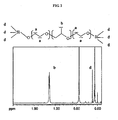
- Synthesis of the multiblock block copolymers from the poloxamers can be identified by nuclear magnetic resonance (NMR).
- NMR nuclear magnetic resonance
- a peak that does not exist in the NMR spectrum of the monomer poloxamer alone used in the reaction which is the peak of terminal -CH 2 CH 2 - generated by the bond of carboxylic acid and hydroxyls at the both ends of the poloxamer, is generated near 4.2 ppm in the multiblock copolymers synthesized using dicarboxylic acid as a linker.
- the introduction of dicarboxylic acid can be verified by reacting the synthesized poloxamer oligomers with trimethylsilylchloride (TMS-Cl) in the presence of triethylamine and then determining their NMR spectrum.
- TMS-Cl trimethylsilylchloride
- the terminal group is a hydroxyl
- the signal of trimethylsilyl proton is observed at 0.12 ppm and if it is a carboxyl terminal group, this peak is observed at 0.3 ppm. Based on them, the synthesis of poloxamer oligomers can be identified.
- the content of the multiblock copolymers in the composition for inhibiting adhesion can be 0.1 to 40 % by weight, preferably 1 to 30 % by weight and most preferably 1 to 20 % by weight. If the content of the multiblock copolymers is less than the above ranges, it is difficult to obtain effective adhesion inhibiting effects and to maintain gel state within body temperature ranges, and if it is in excess of the above ranges, handling is not easy and effect increase versus contents is slight, cost-ineffective in the light of the fact that it involves a large amount of polymers.
- the multiblock copolymers used in the invention has a sol-gel phase transition temperature within the ranges of 10 to 35 °C in the state of aqueous solution of 0.1 to 40 % by weight concentrations and accordingly, they can maintain their gel state within body temperature ranges.
- they can be retained in attachment to the regions as desired for 7 days or longer when applied to wounded regions, they have the merits that they remain in living body for a sufficient period of time.
- the fact that the multiblock copolymers can be retained at the desired position in body for 7 days or longer is very important to inhibit adhesion.
- the existing poloxamer becomes the sol state at temperatures lower than 20°C when the concentration of the poloxamers in aqueous solutions is 20 to 40 % by weight and it becomes the gel state at 20°C or higher and can exist in the gel state within the body temperature ranges.
- the multiblock copolymers become the sol state at temperatures lower than 20°C even in the state of aqueous solution having relatively low concentrations of 1 to 20 % by weight and maintain the gel state at 20°C or higher, it can be maintained in the gel state within the body temperature ranges with low concentration.
- Such characteristics are in accord with the requirements of adhesion inhibitors that should be retained for 3 days or longer with a one-time dose.
- the solvent contained in the composition for inhibiting adhesion is a solvent capable of dissolving the multiblock copolymers and there can be used those selected from the group consisting of a distilled water, water for injection, physiological saline, 0.1 to 50 v/v% alcohol aqueous solution, natural intraperitoneal solution and artificial intraperitoneal solution having the compositions of the natural intraperitoneal solution.
- the alcohol is ethanol, 1,2-propyleneglycol, glycerol, polyethyleneglycol 300 or polyethyleneglycol 400.
- the invention employs 0.1 to 50 v/v% alcohol aqueous solution as a solvent.
- aqueous solutions that do not contain ethanol show excellent adhesion inhibiting effects, there are matters to be considered in terms of the concentration of the polymers and phase transition change pattern. If the concentration of the polymers is high, adhesion inhibiting effects are improved, but they exhibit phase transition within narrow ranges due to their high viscosity and thus they easily become the gel when handled as adhesion inhibition solutions so that their handling might be difficult. On the contrary, in the case of solutions having low concentrations, they can be handled easily due to their broad phase transition ranges but their adhesion inhibiting efficiency can be low.
- the viscosity of the solutions exhibit sudden phase transition at a certain temperature whereas in the case of using alcohol aqueous solutions as a solvent, as the content of ethanol increases, the viscosity of the solutions exhibits phase transition over some broad temperature ranges. That is, the aqueous solutions that do not contain ethanol involve troubles to be stored in an ice container when stored or treated at room temperature for a long time because the viscosity of the solutions increases and they might be difficult to be handled. In particular, when handled at temperatures near phase transition, the solutions are difficult to be handled due to sudden phase transition phenomena.
- the mixed solvents with ethanol provide phase transition over broad temperature ranges, it is very easy to handle polymer solutions.
- the use of ethanol containing aqueous solutions can complement the drawbacks of solutions of which the viscosity is too high to be handled.
- the polymer solutions having the same amounts can be readily handled by including ethanol, thereby lowering the viscosity of the solutions.
- the solutions when coated into body, the solutions can be easily gelated due to the absorption and evaporation of ethanol.
- the multiblock copolymers used for manufacturing a medicament for inhibiting adhesion of tissue according to the invention are characterized in that they can comprise only the single substances of PEO-PPO-PEO or PEO-PBO-PEO block copolymers, they do not necessarily need to comprise active ingredient other than the block copolymers, they are degraded into PEO-PPO-PEO or PEO-PBO-PEO block copolymers of the single substances and the linker, dicarboxylic acid, and the degradation products function as another adhesion inhibiting mechanism.
- the composition for inhibiting adhesion of the invention comprises multiblock copolymers that exhibit sufficient temperature sensitivity merely with these single substances, it is characterized in that the mere use of the multiblock copolymers without other natural polymer components exhibiting foreign body sensation enables a sol-gel phase transition within the body temperature ranges.
- the composition for inhibiting adhesion of the invention is characterized in that it exhibits adhesion inhibiting performance of tissues and/or organs merely with the use of the multiblock copolymers without the addition of antiphlogistic agent and other additives and even after they are degraded in body, the degradation products function as a surfactant having a secondary adhesion inhibiting effects.
- composition for inhibiting adhesion comprising the multiblock copolymers may further comprise pharmaceutical drugs having independent pharmacological effects.
- pharmaceutical drugs can be those that adjust the gelation properties of the composition to be coated onto wounded regions or function as an active component for treating the wounds.
- Available pharmaceutical drugs are anti-thrombogenesis agents such as heparin or tissue plasminogen activator, non-steroid anti-inflammatory drugs such as aspirin, ibuprofen and ketoprofen, hormone chemostatic factors, analgesics or anesthetics.
- composition for inhibiting adhesion is applicable to laparotomy and laparoscopic surgery and also can be applied to general surgical fields including not only existing peritoneal surgery, bladder or gynecological surgery and spine surgery but also heart surgery, rectal surgery, dental surgery and various kinds of plastic surgery.
- composition is applicable in various forms such as a tube, cream, syringe and spray, depending on its use, and it can inhibit the adhesion of tissues by injection, coating or spray onto wounded regions and then gelation.
- the aqueous solution composition is a biodegradable polymer substance and thus cannot be stored in the state of its aqueous solution. Therefore, a container comprising the multiblock copolymers and a container comprising the aqueous solution are packaged separately and then when in use, they are mixed and dispersed to become a polymer aqueous solution.
- the multiblock copolymers filled in the container can be those prepared by lyophilization.
- the content of the composition for inhibiting adhesion to be applied can vary by polymer composition, molecular weight, concentration, period required for adhesion inhibition, region to be applied in body, patient's condition and so on.
- TMS-Cl trimethylsilylchloride
- MBP-36 of which the weight average molecular weight was 230,000 daltons. All the average molecular weights throughout the examples of the present invention including this example were determined by Gel Permeation Chromatography (GPC).
- multiblock copolymers having an average molecular weight of 160,000 were synthesized in accordance with the same methods as used in Preparation Example 1. Through the peak generation near 4.2 ppm and terminal peak analysis due to the introduction of dicarboxylic acid using nuclear magnetic resonance, the produced multiblock copolymers were identified as the poloxamers linked by dicarboxylic acid.
- multiblock copolymers having an average molecular weight of 150,000 were synthesized in accordance with the same methods as used in Preparation Example 1 using succinyl dichloride as a dicarboxylic acid linker. Through the peak generation near 4.2 ppm and terminal peak analysis due to the introduction of dicarboxylic acid using nuclear magnetic resonance, the produced multiblock copolymers were identified as the poloxamers linked by dicarboxylic acid.
- multiblock copolymers having an average molecular weight of 124,000 were synthesized in accordance with the same methods as used in Preparation Example 1 and named MBP-22. Through the peak generation near 4.2 ppm and terminal peak analysis due to the introduction of dicarboxylic acid using nuclear magnetic resonance, the produced multiblock copolymers were identified as the poloxamers linked by dicarboxylic acid.
- the multiblock copolymers synthesized in Preparation Examples 1 to 8 were dissolved in a distilled water to prepare solutions with the concentrations as described in Table 1 below. As controls, Poloxamer 407 (Pluronic® F-127) and Poloxamer 188 (Pluronic® F-68) solutions were prepared. The gelation temperatures of the multiblock copolymer solutions prepared in Preparation Examples 1 to 8 and the control solutions according to the concentrations are shown in Table 1.
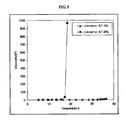
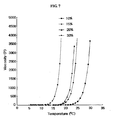
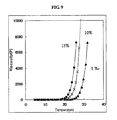
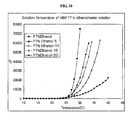
- viscosity according to concentrations in Poloxamer 407 solution of the control group solutions and the multiblock copolymer solutions prepared in Preparation Examples 1, and 5 to 7 was determined using Brookfield viscometer and the results were shown in Fig. 5 to Fig. 9 , respectively.
- the viscosity determination results obtained from Brookfield showed correlation with the gelation points obtained using the gradient methods.
- the viscosity of the solution showed sudden phase transition at a specific temperature as temperature increased whereas in the ethanol containing solvents, it was observed that the viscosity of the solutions had phase transition curves showing gelation points over some broad temperature ranges as the content of ethanol increased.
- Example 2 Determination of Degree of Adhesion of Adhesion Inhibitors Comprising Multiblock Copolymers
- the degree of adhesion was investigated through animal experiment using SD rats as an animal model.
- the rats used in this experiment were 6 weeks or older and they were raised separately from another in environments where the temperature of 16 to 22°C and relative humidity of 50 to 70% or so were maintained.
- the abdomen of the anesthetized rats was cut, wound of 1.5 cm x 1.5 cm was artificially formed at epidermal portions of the abdominal walls using scalpel, appendix in contact with this wound was wounded to the extent that its epidermis was slightly peeled off, and the wounded portions were sutured with sutures for surgery.
- the multiblock copolymer solutions prepared above were coated onto the sutured region in the amount of 0.5 ⁇ 5 ml depending on their concentrations, the degree of tissue adhesion and the weight of the rats were determined on 7 days. Those treated with no solutions were used as a control and compared for adhesion inhibiting effects.
- the degree of tissue adhesion was evaluated using the following method [Rodgers et al. (1990)].
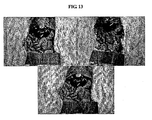
- the multiblock copolymer MBP-36 synthesized in Preparation Example 1 was dissolved in physiological saline to prepare solutions with the concentrations as shown in Table 3 below and then the degree of adhesion was determined and the results were shown in Table 3 and Fig. 12 to Fig. 14 .
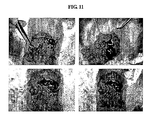
- the controls treated with no polymers showed severe adhesion at their abdomen and appendix with wounds ( Fig. 11 ), whereas the multiblock copolymers of the invention showed improved adhesion inhibiting effects ( Fig. 12 to Fig. 14 ). Although partial adhesion inhibiting effects were obtained at low concentrations, adhesion was inhibited 100% at concentrations of 5 % or higher.
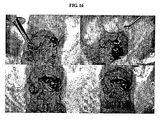
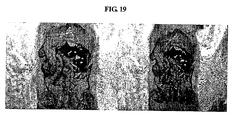
- the multiblock copolymer MBP-53 synthesized in Preparation Example 4 was dissolved in physiological saline to prepare solutions with the concentrations as shown in Table 4 below and then the degree of adhesion was determined and the results were shown in Table 4 and Fig. 16 to Fig. 20 ( Fig. 16 (1%), Fig. 17 (3%), Fig. 18 (5%), Fig. 19 (7%) and Fig. 20 (10%)).
- the multiblock copolymer MBP-53 inhibited adhesion 100 % at concentrations of 10 % or higher, it could be seen, from the fact that no remaining MBP-53 was observed, that the applied MBP-53 was all absorbed ( Fig. 20 ), and adhesion inhibiting effects were observed even at low concentrations.
- the multiblock copolymer MBP-77 prepared in Preparation Example 8 was dissolved in a mixing solvent of ethanol and distilled water in accordance with the compositions as shown in Table 5 and then the degree of adhesion was determined and the results were shown in Table 5.
- the MBP-77 dissolved in the mixed solvent exhibited 100% adhesion inhibiting effects, generally showing possibility of adhesion inhibition. Furthermore, as the content of ethanol increased, the solution was easy to handle during treatment.
- Poloxamer 407 was dissolved in physiological saline shown below to prepare solutions with the concentrations as shown in Table 6 below.
- Table 6 Multiblock Copolymer Molecular Weight Concentration (wt%) Multiblock Copolymer (g) Physiological Saline (g) Poloxamer407 (Pluronic ® F-127) 12,500 5 2.5 47.5 10 5.0 45.0
- Fig. 21 The adhesion inhibiting determination results obtained from animal test using the poloxamer 407 containing solutions were shown in Fig. 21 . As seen in Fig. 21 , when animals were treated with the Poloxamer 407 solutions, they were not secured within abdominal walls due to their low viscosity unlike gels, flowed like water and less retained within determined positions and importantly, they showed no adhesion inhibiting effects.
- the multiblock copolymer MBP-36 prepared in Preparation Example 1 was dissolved in physiological saline, to which carboxylmethylcellulose (CMC) was added in the amount of 1 % by weight, thereby to prepare solutions with the concentrations as shown in Table 7 below.
- Table 7 Multiblock Copolymer Concentration (wt%) Molecular Weight Multiblock Copolymer (g) Physiological Saline (g) CMC (g) MBP-36 5 230,000 2.5 47.5 0.5 10 5.0 45.0 0.5
- the multiblock copolymer MBP-36 prepared in Preparation Example 1 and carboxymethylcellulose that was reported to have excellent bio-adhesion were dissolved in physiological saline, thereby to prepare solutions where the concentrations of MBP-36 were 5 and 10 wt% and the concentration of carboxylmethylcellulose was 1 wt% and then, adhesion inhibiting effects were determined in rats in accordance with the same methods as used in Example 2 and the results are shown in Fig. 15 .
- carboxylmethylcellulose When a small amount of carboxylmethylcellulose was added, partial adhesion inhibiting effects were obtained but it has the side effects that spleen exhibited significant overgrowth and some of the animals died.
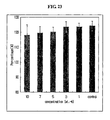
- the weight of the rats treated using the same solutions and methods as used in Example 2 (1) and (2) was observed for one week and the results are shown in Fig. 22 (MBP-36) and Fig. 23 (MBP-53). Those treated with no solutions were used as a control.
- the weight of the animals treated with the compositions for inhibiting adhesion increased stably, like the control and this indicates that the compositions for inhibiting adhesion are suitable and safe for use in living body.
- the polymers of the invention are gelated by body temperature and retained safely within organs for a certain period of time, functioning as an adhesion inhibitor and also, they can be absorbed into body or degraded and after degradation in living body, the degradation products can be also easily absorbed into body and excreted and at the same time, the substances generated from the degradation process function to inhibit adhesion as a surfactant, thereby enabling continuous adhesion inhibiting effects for a long time.
- foreign body sensation in living body can be minimized and it is simple and convenient to handle them as they can be regionally applied to wounded regions by spraying or coating during surgery and/or after surgery.
Landscapes
- Health & Medical Sciences (AREA)
- Chemical & Material Sciences (AREA)
- Life Sciences & Earth Sciences (AREA)
- Veterinary Medicine (AREA)
- Public Health (AREA)
- General Health & Medical Sciences (AREA)
- Animal Behavior & Ethology (AREA)
- Epidemiology (AREA)
- Engineering & Computer Science (AREA)
- Materials Engineering (AREA)
- Medicinal Chemistry (AREA)
- Chemical Kinetics & Catalysis (AREA)
- Pharmacology & Pharmacy (AREA)
- Surgery (AREA)
- Dispersion Chemistry (AREA)
- Vascular Medicine (AREA)
- Heart & Thoracic Surgery (AREA)
- Bioinformatics & Cheminformatics (AREA)
- General Chemical & Material Sciences (AREA)
- Nuclear Medicine, Radiotherapy & Molecular Imaging (AREA)
- Organic Chemistry (AREA)
- Dermatology (AREA)
- Medicinal Preparation (AREA)
- Materials For Medical Uses (AREA)
- Pharmaceuticals Containing Other Organic And Inorganic Compounds (AREA)
- Compositions Of Macromolecular Compounds (AREA)
Claims (14)
- Verwendung eines wasserlöslichen und temperaturempfindlichen Polymers, das einen temperaturabhängigen Sol-Gel-Phasenübergang zeigt, bei der Herstellung eines Medikaments zur Inhibierung der Adhäsion von Geweben,
wobei es sich bei dem Polymer um ein temperaturempfindliches Multiblockcopolymer handelt, wobei zwei oder mehr gleiche oder verschiedene Blockcopolymere, die aus Polyethylenoxid(PEO)-Polypropylenoxid(PPO)-Polyethylenoxid(PEO)-Blockcopolymer und Polyethylenoxid(PEO)-Polybutylenoxid(PBO)-Polyethylenoxid(PEO)-Blockcopolymer ausgewählt sind, durch einen biologisch abbaubaren Dicarboxylgruppen-Linker verknüpft sind,
wobei das Multiblockcopolymer eine ionische Gruppe aus der Gruppe bestehend aus einem einwertigen und zweiwertigen Salz von -SO3 -, -PO3 2- oder -C(=O)-R-C(=O)-O- an beiden terminalen Enden aufweist, wobei R für -(CH2)m- oder ein Aryl von Cm' steht, m für eine ganze Zahl von 0 bis 20 steht und m' für eine ganze Zahl von 6 bis 12 steht,
wobei das Polymer durch die Körpertemperatur einem Phasenübergang von einem Sol-Zustand zu einem Gel-Zustand unterworfen wird, stabil in Geweben beschichtet wird, dadurch als adhäsions-inhibierende Barriere fungiert und im Lauf der Zeit zu einem niedermolekularen Tensid und einer biologisch abbaubaren einzelmolekularen Substanz abgebaut wird, wodurch die abgebauten Produkte sekundäre adhäsionsinhibierende Wirkungen zeigen. - Verwendung nach Anspruch 1, wobei das Blockcopolymer ein gewichtsmittleres Molekulargewicht von 1000 bis 20.000 Dalton aufweist und das Multiblockcopolymer ein gesamtes gewichtsmittleres Molekulargewicht von 25.000 bis 1.000.000 Dalton aufweist.
- Verwendung nach Anspruch 1, wobei das Blockcopolymer ein gewichtsmittleres Molekulargewicht von 1000 bis 20.000 Dalton aufweist und das Multiblockcopolymer ein gesamtes gewichtsmittleres Molekulargewicht von 50.000 bis 500.000 Dalton aufweist.
- Verwendung nach Anspruch 1, wobei das Multiblockcopolymer bei der Konzentration von 0,1 bis 40 Gew.-% eine Sol-Gel-Phasenübergangstemperatur im Bereich von 10 bis 35°C aufweist.
- Verwendung nach Anspruch 1, wobei der Gehalt des Multiblockcopolymers 0,1 bis 40 Gew.-% beträgt.
- Verwendung nach Anspruch 1, wobei der Gehalt des Multiblockcopolymers 1 bis 20 Gew.-% beträgt.
- Verwendung nach Anspruch 1, wobei das Polymer in Form einer Zusammensetzung, die ein Element aus der Gruppe bestehend aus destilliertem Wasser, Wasser für Injektionszwecke, physiologischer Kochsalzlösung, einer wässrigen Lösung mit 0,1 bis 50 v/v-% Alkohol, natürlicher intraperitonealer Lösung und künstlicher intraperitonealer Lösung mit den Zusammensetzungen der natürlichen intraperitonealen Lösung umfasst, verwendet wird.
- Verwendung nach Anspruch 1,
wobei in dem Blockcopolymer
der Polyethylenoxid(PEO)-Block 2 bis 2000 Ethylenoxid-Einheiten umfasst, wobei die Zahl der Ethylenoxid-Einheiten, aus denen die beiden Polyethylenoxide in den jeweiligen Blockcopolymeren aufgebaut sind, jeweils gleich oder voneinander verschieden ist,
der Polypropylenoxid(PPO)-Block 2 bis 2000 Propylenoxid-Einheiten umfasst und
der Polybutylenoxid(PBO)-Block 2 bis 2000 Butylenoxid-Einheiten umfasst. - Verwendung nach Anspruch 1, wobei es sich bei dem Dicarboxylgruppen-Linker um einen oder mehrere aus der Gruppe bestehend aus Oxalsäure, Bernsteinsäure, Glutarsäure, Adipinsäure, Sebacoylsäure, Malonsäure, Suberinsäure, Dodecanonsäure, Fumarsäure, Maleinsäure, Phthalsäure und Terephthalsäure handelt.
- Verwendung nach Anspruch 1, wobei das Multiblockcopolymer eine Struktur der Formel 2 aufweist:
< Formel 2> M-X-O-[PEO-Y-PEO-C(=O)-R-C(=O)-O]n-PEO-Y'-PEO-X-M
wobei PEO für ein Polyethylenoxid steht;Y und Y' jeweils unabhängig für Polypropylenoxid (PPO), Polybutylenoxid (PBO) oder eine Kombination von PPO und PBO stehen;X für -SO3 -, -PO3 2- oder -C(=O)-R-C(=O)-O- steht;n für eine ganze Zahl von 1 bis 100 steht;R für -(CH2)m- oder ein Aryl von Cm' steht;m für eine ganze Zahl von 0 bis 20 steht und m' für eine ganze Zahl von 6 bis 12 steht; undM für eine einwertige oder zweiwertige Kationgruppe steht. - Verwendung nach Anspruch 1, wobei das Polymer mit einem oder mehreren pharmazeutischen Arzneistoffen aus der Gruppe bestehend aus Antithrombogenesemitteln, nichtsteroidalen Antiphlogistika, hormonchemostatischen Faktoren, Analgetika und Anästhetika kombiniert wird.
- Verwendung nach Anspruch 1, wobei das Polymer nach Laparotomie, laparoskopischer Chirurgie, Peritonealchirurgie, Blasenchirurgie, gynäkologischer Chirurgie, Wirbelsäulenchirurgie, Herzchirurgie, Rektalchirurgie, Dentalchirurgie oder plastischer Chirurgie aufgebracht wird.
- Verwendung nach Anspruch 1, bei dem das Polymer in Form eines Schlauchs, einer Creme, einer Spritze oder eines Sprays formuliert wird.
- Verwendung nach Anspruch 1, wobei das Multiblockcopolymer im Körper abgebaut wird und kontinuierlich ein Polyethylenoxid(PEO)-Polypropylenoxid(PPO)-Polyethylenoxid(PEO)-Blockcopolymer oder Polyethylenoxid(PEO)-Polybutylenoxid(PBO)-Polyethylenoxid(PEO)-Blockcopolymer freisetzt und dadurch sekundäre adhäsionsinhibierende Wirkungen zeigt.
Applications Claiming Priority (2)
| Application Number | Priority Date | Filing Date | Title |
|---|---|---|---|
| KR20060009849 | 2006-02-01 | ||
| PCT/KR2007/000543 WO2007089103A1 (en) | 2006-02-01 | 2007-02-01 | Composition for inhibiting adhesion |
Publications (3)
| Publication Number | Publication Date |
|---|---|
| EP1978975A1 EP1978975A1 (de) | 2008-10-15 |
| EP1978975A4 EP1978975A4 (de) | 2011-05-11 |
| EP1978975B1 true EP1978975B1 (de) | 2014-12-24 |
Family
ID=38327633
Family Applications (1)
| Application Number | Title | Priority Date | Filing Date |
|---|---|---|---|
| EP07701070.0A Not-in-force EP1978975B1 (de) | 2006-02-01 | 2007-02-01 | Zusammensetzung zur hemmung von adhäsion |
Country Status (10)
| Country | Link |
|---|---|
| US (1) | US20090196844A1 (de) |
| EP (1) | EP1978975B1 (de) |
| JP (1) | JP5479739B2 (de) |
| KR (1) | KR101015734B1 (de) |
| CN (1) | CN101378766B (de) |
| AU (1) | AU2007210406B2 (de) |
| CA (1) | CA2640409C (de) |
| MX (1) | MX2008009747A (de) |
| NZ (1) | NZ570668A (de) |
| WO (1) | WO2007089103A1 (de) |
Families Citing this family (34)
| Publication number | Priority date | Publication date | Assignee | Title |
|---|---|---|---|---|
| GB0508531D0 (en) | 2005-04-27 | 2005-06-01 | Smith & Nephew | Sai with ultrasound |
| GB0716897D0 (en) * | 2007-08-30 | 2007-10-10 | Univ Muenchen Tech | Cancer imaging and treatment |
| ES2555204T3 (es) | 2007-11-21 | 2015-12-29 | T.J. Smith & Nephew Limited | Dispositivo de succión y venda |
| ES2776709T3 (es) | 2007-11-21 | 2020-07-31 | Smith & Nephew | Apósito para heridas |
| GB0722820D0 (en) | 2007-11-21 | 2008-01-02 | Smith & Nephew | Vacuum assisted wound dressing |
| US20130096518A1 (en) | 2007-12-06 | 2013-04-18 | Smith & Nephew Plc | Wound filling apparatuses and methods |
| GB0723875D0 (en) | 2007-12-06 | 2008-01-16 | Smith & Nephew | Wound management |
| US11253399B2 (en) | 2007-12-06 | 2022-02-22 | Smith & Nephew Plc | Wound filling apparatuses and methods |
| GB0803564D0 (en) | 2008-02-27 | 2008-04-02 | Smith & Nephew | Fluid collection |
| WO2010020247A1 (en) | 2008-08-22 | 2010-02-25 | Reapplix Aps | Multilayered blood product |
| JP5372170B2 (ja) * | 2008-12-29 | 2013-12-18 | サミャン バイオファーマシューティカルズ コーポレイション | 凍結乾燥剤形の薬剤学的組成物及びその製造方法 |
| GB0902816D0 (en) | 2009-02-19 | 2009-04-08 | Smith & Nephew | Fluid communication path |
| US9061095B2 (en) | 2010-04-27 | 2015-06-23 | Smith & Nephew Plc | Wound dressing and method of use |
| GB201011173D0 (en) | 2010-07-02 | 2010-08-18 | Smith & Nephew | Provision of wound filler |
| GB201020005D0 (en) | 2010-11-25 | 2011-01-12 | Smith & Nephew | Composition 1-1 |
| JP6078472B2 (ja) | 2010-11-25 | 2017-02-08 | スミス アンド ネフュー ピーエルシーSmith & Nephew Public Limited Company | 組成物i−iiおよび生成物ならびにそれらの使用 |
| KR101275262B1 (ko) * | 2010-12-30 | 2013-06-19 | 주식회사 삼양바이오팜 | 유착방지기능을 갖는 수술용 메쉬 복합체 및 이의 제조 방법 |
| US20150159066A1 (en) | 2011-11-25 | 2015-06-11 | Smith & Nephew Plc | Composition, apparatus, kit and method and uses thereof |
| KR101389831B1 (ko) * | 2012-05-25 | 2014-05-07 | 한남대학교 산학협력단 | 온도 감응형 유착방지제 |
| KR101399341B1 (ko) | 2012-06-25 | 2014-05-27 | (주)에이씨티 | 피부흡수 촉진용 양친매성 트리블록 공중합체, 이의 제조방법 및 이를 함유하는 화장료 조성물 |
| US10568975B2 (en) | 2013-02-05 | 2020-02-25 | The Johns Hopkins University | Nanoparticles for magnetic resonance imaging tracking and methods of making and using thereof |
| US20160120706A1 (en) | 2013-03-15 | 2016-05-05 | Smith & Nephew Plc | Wound dressing sealant and use thereof |
| EP2968647B1 (de) | 2013-03-15 | 2022-06-29 | Smith & Nephew plc | Wundverbanddichtmasse und verwendung davon |
| KR101627787B1 (ko) * | 2014-07-24 | 2016-06-07 | 주식회사 메디톡스 | 열감응성 유착 방지용 조성물 및 그의 용도 |
| EP3233098B1 (de) | 2014-12-15 | 2024-05-29 | The Johns Hopkins University | Cvs-transplantation zur behandlung von bakterieller vaginose |
| KR20240126072A (ko) * | 2015-01-27 | 2024-08-20 | 더 존스 홉킨스 유니버시티 | 점막표면에서 활성제의 향상된 수송을 위한 저장성 하이드로겔 제제 |
| WO2016122164A1 (ko) * | 2015-01-30 | 2016-08-04 | (주)메디팁 | 바이오폴리머를 이용한 창상 피복재의 제조방법 및 이를 이용하여 제조된 바이오폴리머를 이용한 창상 피복재 |
| KR101841469B1 (ko) | 2015-01-30 | 2018-03-23 | (주)메디팁 | 바이오폴리머를 이용한 창상 피복재의 제조방법 및 이를 이용하여 제조된 바이오폴리머를 이용한 창상 피복재 |
| CN106362222B (zh) * | 2016-09-30 | 2019-06-18 | 天津大学 | 一种温敏可注射术后防粘连材料及其制备方法 |
| TWI777516B (zh) | 2020-04-24 | 2022-09-11 | 博唯弘展生技股份有限公司 | 用於預防組織沾黏的溫度敏感組成物及其應用 |
| WO2022084478A1 (en) * | 2020-10-21 | 2022-04-28 | Reapplix A/S | Blood product for preventing surgical adhesion |
| CN115400219B (zh) * | 2021-05-26 | 2024-09-17 | 博唯弘展生技股份有限公司 | 用于预防组织沾粘的温度敏感组合物及其应用 |
| CN115403760B (zh) * | 2021-05-26 | 2023-10-03 | 博唯弘展生技股份有限公司 | 用于预防沾粘的氨基酸改质的聚合物及其应用 |
| KR102810380B1 (ko) * | 2022-11-23 | 2025-05-22 | 주식회사 티앤알바이오팹 | 조직 재생 촉진형 유착 방지 피복재 조성물 |
Family Cites Families (27)
| Publication number | Priority date | Publication date | Assignee | Title |
|---|---|---|---|---|
| US4141973A (en) * | 1975-10-17 | 1979-02-27 | Biotrics, Inc. | Ultrapure hyaluronic acid and the use thereof |
| US4188373A (en) * | 1976-02-26 | 1980-02-12 | Cooper Laboratories, Inc. | Clear, water-miscible, liquid pharmaceutical vehicles and compositions which gel at body temperature for drug delivery to mucous membranes |
| US4478822A (en) * | 1983-05-16 | 1984-10-23 | Merck & Co., Inc. | Drug delivery system utilizing thermosetting gels |
| US4474751A (en) * | 1983-05-16 | 1984-10-02 | Merck & Co., Inc. | Ophthalmic drug delivery system utilizing thermosetting gels |
| US4911926A (en) * | 1988-11-16 | 1990-03-27 | Mediventures Inc. | Method and composition for reducing postsurgical adhesions |
| AU673160B2 (en) * | 1992-02-28 | 1996-10-31 | Board Of Regents, The University Of Texas System | Photopolymerizable biodegradable hydrogels as tissue contacting materials and controlled-release carriers |
| US5939485A (en) * | 1995-06-19 | 1999-08-17 | Medlogic Global Corporation | Responsive polymer networks and methods of their use |
| WO1997005185A2 (en) * | 1995-07-28 | 1997-02-13 | Focal, Inc. | Multiblock biodegradable hydrogels for use as controlled release agents for drugs delivery and tissue treatment agents |
| US6280745B1 (en) * | 1997-12-23 | 2001-08-28 | Alliance Pharmaceutical Corp. | Methods and compositions for the delivery of pharmaceutical agents and/or the prevention of adhesions |
| US5711958A (en) * | 1996-07-11 | 1998-01-27 | Life Medical Sciences, Inc. | Methods for reducing or eliminating post-surgical adhesion formation |
| US5800711A (en) * | 1996-10-18 | 1998-09-01 | Mdv Technologies, Inc. | Process for the fractionation of polyoxyalkylene block copolymers |
| US6211249B1 (en) * | 1997-07-11 | 2001-04-03 | Life Medical Sciences, Inc. | Polyester polyether block copolymers |
| EP1039932A1 (de) | 1997-12-23 | 2000-10-04 | Alliance Pharmaceutical Corporation | Verfahren und zusammensetzungenzur verabreichung pharmazeutischer wirkstoffeund/oder der prävention von adhesion |
| EP1109563A4 (de) * | 1998-08-04 | 2009-07-22 | Madash Llp | Am ende modifizierte hydrogele mit temperaturabhängigen eigenschaften |
| US7347850B2 (en) * | 1998-08-14 | 2008-03-25 | Incept Llc | Adhesion barriers applicable by minimally invasive surgery and methods of use thereof |
| US6579951B1 (en) * | 1999-06-08 | 2003-06-17 | Life Medical Sciences, Inc. | Chain-extended or crosslinked polyethylene oxide/polypropylene oxide/polyethylene oxide block polymer with optional polyester blocks |
| US6521431B1 (en) * | 1999-06-22 | 2003-02-18 | Access Pharmaceuticals, Inc. | Biodegradable cross-linkers having a polyacid connected to reactive groups for cross-linking polymer filaments |
| FR2803223B1 (fr) * | 1999-12-30 | 2002-06-21 | Rhodia Chimie Sa | Procede de preparation d'un materiau mesostructure a partir de particules de dimensions nanometriques |
| US20030054954A1 (en) * | 1999-12-30 | 2003-03-20 | Jean-Yves Chane-Ching | Method for preparing a mesostructured material from particles with nanometric dimensions |
| US6465425B1 (en) * | 2000-02-10 | 2002-10-15 | Alkermes Controlled Therapeutics, Inc. | Microencapsulation and sustained release of biologically active acid-stable or free sulfhydryl-containing proteins |
| NZ528994A (en) * | 2001-04-26 | 2006-02-24 | Control Delivery Sys Inc | Sustained release drug delivery system containing codrugs |
| US20030082235A1 (en) * | 2001-08-13 | 2003-05-01 | Yissum Research Development Company Of The Hebrew University Of Jerusalem | Novel reverse thermo-sensitive block copolymers |
| US6809231B2 (en) * | 2001-11-21 | 2004-10-26 | The United States Of America As Represented By The Secretary Of Agriculture | Flexible and absorbent alginate wound dressing |
| KR100552954B1 (ko) * | 2002-09-04 | 2006-02-20 | 주식회사 바이오레인 | 열감응성 유착방지용 조성물, 용액, 필름, 스폰지 및 분말 |
| KR100565881B1 (ko) * | 2003-07-24 | 2006-03-29 | 이진호 | 생체적합성 공중합체를 이용한 조직유착 방지제 |
| CA2566746A1 (en) * | 2004-05-14 | 2005-12-01 | Baylor College Of Medicine | Beta adrenergic drug conjugated to bone targeting moiety for modulating bone mass |
| CA2574976C (en) * | 2004-08-02 | 2012-01-10 | Samyang Corporation | Biodegradable multi-block polymeric composition capable of sol-gel transition |
-
2007
- 2007-02-01 US US12/162,497 patent/US20090196844A1/en not_active Abandoned
- 2007-02-01 CN CN2007800043700A patent/CN101378766B/zh not_active Expired - Fee Related
- 2007-02-01 AU AU2007210406A patent/AU2007210406B2/en not_active Ceased
- 2007-02-01 CA CA2640409A patent/CA2640409C/en active Active
- 2007-02-01 NZ NZ570668A patent/NZ570668A/en not_active IP Right Cessation
- 2007-02-01 MX MX2008009747A patent/MX2008009747A/es active IP Right Grant
- 2007-02-01 EP EP07701070.0A patent/EP1978975B1/de not_active Not-in-force
- 2007-02-01 WO PCT/KR2007/000543 patent/WO2007089103A1/en not_active Ceased
- 2007-02-01 KR KR1020087019015A patent/KR101015734B1/ko not_active Expired - Fee Related
- 2007-02-01 JP JP2008553161A patent/JP5479739B2/ja not_active Expired - Fee Related
Also Published As
| Publication number | Publication date |
|---|---|
| NZ570668A (en) | 2010-07-30 |
| EP1978975A4 (de) | 2011-05-11 |
| JP2009525122A (ja) | 2009-07-09 |
| US20090196844A1 (en) | 2009-08-06 |
| MX2008009747A (es) | 2008-10-17 |
| CN101378766A (zh) | 2009-03-04 |
| CA2640409C (en) | 2013-01-29 |
| JP5479739B2 (ja) | 2014-04-23 |
| CA2640409A1 (en) | 2007-08-09 |
| EP1978975A1 (de) | 2008-10-15 |
| KR101015734B1 (ko) | 2011-02-22 |
| AU2007210406B2 (en) | 2010-02-11 |
| AU2007210406A1 (en) | 2007-08-09 |
| KR20080096766A (ko) | 2008-11-03 |
| CN101378766B (zh) | 2013-05-01 |
| WO2007089103A1 (en) | 2007-08-09 |
Similar Documents
| Publication | Publication Date | Title |
|---|---|---|
| EP1978975B1 (de) | Zusammensetzung zur hemmung von adhäsion | |
| EP2629762B1 (de) | Biologisch abbaubare zusammensetzungen mit hydrophilen seitengruppen und entsprechende vorrichtungen | |
| US20050074495A1 (en) | Compositions of polyacids and methods for their use in reducing adhesions | |
| EP1181023B1 (de) | ZUSAMMENSETZUNGEN VON POLYSÄUREN, NICHTIONISCHEN POLYMEREN VON ALKYLENOXID-MONOMEREN UND MEHRWERTIGEN KATIONEN, UND DEREN vERWENDUNG ZUR REDUZIERUNG DER GEWEBEADHÄSION | |
| US5962006A (en) | Polymer formulation for prevention of surgical adhesions | |
| KR102444452B1 (ko) | 온도 감응성 고분자 조성물 | |
| EP0815879A2 (de) | Bioresorbierbare medizinische Vorrichtungen aus oxidierten Polysacchariden | |
| KR101452041B1 (ko) | 유착방지재 및 유착방지 방법 | |
| KR101845885B1 (ko) | 입자형 무세포 진피 기반의 온도감응성 유착방지 조성물의 제조방법 | |
| US20130252921A1 (en) | Adhesion barrier containing hyaluronic acids and l-arginine | |
| AU2021312621B2 (en) | Anti-adhesion polymer composition | |
| JP4735260B2 (ja) | 三元ブロック共重合体、その製造法及び生体内適合材料 | |
| KR20070078944A (ko) | 유착 방지용 조성물 | |
| JP6143286B2 (ja) | 癒着防止材及びその製造方法 | |
| CN116271265A (zh) | 一种预防术后组织粘连的温敏型水凝胶及其制备方法 | |
| JP2003019194A (ja) | ヒアルロン酸とカルボキシメチルセルロースからなる共架橋ゲル組成物 | |
| KR101275262B1 (ko) | 유착방지기능을 갖는 수술용 메쉬 복합체 및 이의 제조 방법 | |
| CN111378125A (zh) | Pebp嵌段聚合物凝胶及其制备和应用 | |
| HK1161128A1 (en) | Composition for preventing adhesion | |
| HK1161128B (zh) | 用於防止粘连的组合物 |
Legal Events
| Date | Code | Title | Description |
|---|---|---|---|
| PUAI | Public reference made under article 153(3) epc to a published international application that has entered the european phase |
Free format text: ORIGINAL CODE: 0009012 |
|
| 17P | Request for examination filed |
Effective date: 20080731 |
|
| AK | Designated contracting states |
Kind code of ref document: A1 Designated state(s): AT BE BG CH CY CZ DE DK EE ES FI FR GB GR HU IE IS IT LI LT LU LV MC NL PL PT RO SE SI SK TR |
|
| A4 | Supplementary search report drawn up and despatched |
Effective date: 20110408 |
|
| DAX | Request for extension of the european patent (deleted) | ||
| 17Q | First examination report despatched |
Effective date: 20121109 |
|
| RAP1 | Party data changed (applicant data changed or rights of an application transferred) |
Owner name: SAMYANG BIOPHARMACEUTICALS CORPORATION |
|
| GRAP | Despatch of communication of intention to grant a patent |
Free format text: ORIGINAL CODE: EPIDOSNIGR1 |
|
| INTG | Intention to grant announced |
Effective date: 20140815 |
|
| GRAS | Grant fee paid |
Free format text: ORIGINAL CODE: EPIDOSNIGR3 |
|
| GRAA | (expected) grant |
Free format text: ORIGINAL CODE: 0009210 |
|
| AK | Designated contracting states |
Kind code of ref document: B1 Designated state(s): AT BE BG CH CY CZ DE DK EE ES FI FR GB GR HU IE IS IT LI LT LU LV MC NL PL PT RO SE SI SK TR |
|
| REG | Reference to a national code |
Ref country code: GB Ref legal event code: FG4D |
|
| REG | Reference to a national code |
Ref country code: CH Ref legal event code: EP |
|
| REG | Reference to a national code |
Ref country code: IE Ref legal event code: FG4D |
|
| REG | Reference to a national code |
Ref country code: AT Ref legal event code: REF Ref document number: 702775 Country of ref document: AT Kind code of ref document: T Effective date: 20150115 |
|
| REG | Reference to a national code |
Ref country code: DE Ref legal event code: R096 Ref document number: 602007039783 Country of ref document: DE Effective date: 20150212 |
|
| REG | Reference to a national code |
Ref country code: NL Ref legal event code: VDEP Effective date: 20141224 |
|
| PG25 | Lapsed in a contracting state [announced via postgrant information from national office to epo] |
Ref country code: LT Free format text: LAPSE BECAUSE OF FAILURE TO SUBMIT A TRANSLATION OF THE DESCRIPTION OR TO PAY THE FEE WITHIN THE PRESCRIBED TIME-LIMIT Effective date: 20141224 Ref country code: FI Free format text: LAPSE BECAUSE OF FAILURE TO SUBMIT A TRANSLATION OF THE DESCRIPTION OR TO PAY THE FEE WITHIN THE PRESCRIBED TIME-LIMIT Effective date: 20141224 |
|
| REG | Reference to a national code |
Ref country code: LT Ref legal event code: MG4D |
|
| PG25 | Lapsed in a contracting state [announced via postgrant information from national office to epo] |
Ref country code: LV Free format text: LAPSE BECAUSE OF FAILURE TO SUBMIT A TRANSLATION OF THE DESCRIPTION OR TO PAY THE FEE WITHIN THE PRESCRIBED TIME-LIMIT Effective date: 20141224 Ref country code: GR Free format text: LAPSE BECAUSE OF FAILURE TO SUBMIT A TRANSLATION OF THE DESCRIPTION OR TO PAY THE FEE WITHIN THE PRESCRIBED TIME-LIMIT Effective date: 20150325 Ref country code: SE Free format text: LAPSE BECAUSE OF FAILURE TO SUBMIT A TRANSLATION OF THE DESCRIPTION OR TO PAY THE FEE WITHIN THE PRESCRIBED TIME-LIMIT Effective date: 20141224 |
|
| REG | Reference to a national code |
Ref country code: AT Ref legal event code: MK05 Ref document number: 702775 Country of ref document: AT Kind code of ref document: T Effective date: 20141224 |
|
| PG25 | Lapsed in a contracting state [announced via postgrant information from national office to epo] |
Ref country code: NL Free format text: LAPSE BECAUSE OF FAILURE TO SUBMIT A TRANSLATION OF THE DESCRIPTION OR TO PAY THE FEE WITHIN THE PRESCRIBED TIME-LIMIT Effective date: 20141224 |
|
| PG25 | Lapsed in a contracting state [announced via postgrant information from national office to epo] |
Ref country code: EE Free format text: LAPSE BECAUSE OF FAILURE TO SUBMIT A TRANSLATION OF THE DESCRIPTION OR TO PAY THE FEE WITHIN THE PRESCRIBED TIME-LIMIT Effective date: 20141224 Ref country code: ES Free format text: LAPSE BECAUSE OF FAILURE TO SUBMIT A TRANSLATION OF THE DESCRIPTION OR TO PAY THE FEE WITHIN THE PRESCRIBED TIME-LIMIT Effective date: 20141224 Ref country code: SK Free format text: LAPSE BECAUSE OF FAILURE TO SUBMIT A TRANSLATION OF THE DESCRIPTION OR TO PAY THE FEE WITHIN THE PRESCRIBED TIME-LIMIT Effective date: 20141224 Ref country code: CZ Free format text: LAPSE BECAUSE OF FAILURE TO SUBMIT A TRANSLATION OF THE DESCRIPTION OR TO PAY THE FEE WITHIN THE PRESCRIBED TIME-LIMIT Effective date: 20141224 Ref country code: RO Free format text: LAPSE BECAUSE OF FAILURE TO SUBMIT A TRANSLATION OF THE DESCRIPTION OR TO PAY THE FEE WITHIN THE PRESCRIBED TIME-LIMIT Effective date: 20141224 |
|
| PG25 | Lapsed in a contracting state [announced via postgrant information from national office to epo] |
Ref country code: AT Free format text: LAPSE BECAUSE OF FAILURE TO SUBMIT A TRANSLATION OF THE DESCRIPTION OR TO PAY THE FEE WITHIN THE PRESCRIBED TIME-LIMIT Effective date: 20141224 Ref country code: IS Free format text: LAPSE BECAUSE OF FAILURE TO SUBMIT A TRANSLATION OF THE DESCRIPTION OR TO PAY THE FEE WITHIN THE PRESCRIBED TIME-LIMIT Effective date: 20150424 Ref country code: PL Free format text: LAPSE BECAUSE OF FAILURE TO SUBMIT A TRANSLATION OF THE DESCRIPTION OR TO PAY THE FEE WITHIN THE PRESCRIBED TIME-LIMIT Effective date: 20141224 |
|
| REG | Reference to a national code |
Ref country code: DE Ref legal event code: R097 Ref document number: 602007039783 Country of ref document: DE |
|
| PG25 | Lapsed in a contracting state [announced via postgrant information from national office to epo] |
Ref country code: LU Free format text: LAPSE BECAUSE OF FAILURE TO SUBMIT A TRANSLATION OF THE DESCRIPTION OR TO PAY THE FEE WITHIN THE PRESCRIBED TIME-LIMIT Effective date: 20150201 |
|
| REG | Reference to a national code |
Ref country code: CH Ref legal event code: PL |
|
| PG25 | Lapsed in a contracting state [announced via postgrant information from national office to epo] |
Ref country code: CH Free format text: LAPSE BECAUSE OF NON-PAYMENT OF DUE FEES Effective date: 20150228 Ref country code: LI Free format text: LAPSE BECAUSE OF NON-PAYMENT OF DUE FEES Effective date: 20150228 Ref country code: DK Free format text: LAPSE BECAUSE OF FAILURE TO SUBMIT A TRANSLATION OF THE DESCRIPTION OR TO PAY THE FEE WITHIN THE PRESCRIBED TIME-LIMIT Effective date: 20141224 Ref country code: MC Free format text: LAPSE BECAUSE OF FAILURE TO SUBMIT A TRANSLATION OF THE DESCRIPTION OR TO PAY THE FEE WITHIN THE PRESCRIBED TIME-LIMIT Effective date: 20141224 |
|
| PLBE | No opposition filed within time limit |
Free format text: ORIGINAL CODE: 0009261 |
|
| STAA | Information on the status of an ep patent application or granted ep patent |
Free format text: STATUS: NO OPPOSITION FILED WITHIN TIME LIMIT |
|
| REG | Reference to a national code |
Ref country code: IE Ref legal event code: MM4A |
|
| 26N | No opposition filed |
Effective date: 20150925 |
|
| REG | Reference to a national code |
Ref country code: FR Ref legal event code: PLFP Year of fee payment: 10 |
|
| PG25 | Lapsed in a contracting state [announced via postgrant information from national office to epo] |
Ref country code: IT Free format text: LAPSE BECAUSE OF FAILURE TO SUBMIT A TRANSLATION OF THE DESCRIPTION OR TO PAY THE FEE WITHIN THE PRESCRIBED TIME-LIMIT Effective date: 20141224 |
|
| PG25 | Lapsed in a contracting state [announced via postgrant information from national office to epo] |
Ref country code: IE Free format text: LAPSE BECAUSE OF NON-PAYMENT OF DUE FEES Effective date: 20150201 |
|
| PG25 | Lapsed in a contracting state [announced via postgrant information from national office to epo] |
Ref country code: SI Free format text: LAPSE BECAUSE OF FAILURE TO SUBMIT A TRANSLATION OF THE DESCRIPTION OR TO PAY THE FEE WITHIN THE PRESCRIBED TIME-LIMIT Effective date: 20141224 |
|
| PG25 | Lapsed in a contracting state [announced via postgrant information from national office to epo] |
Ref country code: BE Free format text: LAPSE BECAUSE OF FAILURE TO SUBMIT A TRANSLATION OF THE DESCRIPTION OR TO PAY THE FEE WITHIN THE PRESCRIBED TIME-LIMIT Effective date: 20141224 |
|
| REG | Reference to a national code |
Ref country code: FR Ref legal event code: PLFP Year of fee payment: 11 |
|
| PG25 | Lapsed in a contracting state [announced via postgrant information from national office to epo] |
Ref country code: BG Free format text: LAPSE BECAUSE OF FAILURE TO SUBMIT A TRANSLATION OF THE DESCRIPTION OR TO PAY THE FEE WITHIN THE PRESCRIBED TIME-LIMIT Effective date: 20141224 Ref country code: HU Free format text: LAPSE BECAUSE OF FAILURE TO SUBMIT A TRANSLATION OF THE DESCRIPTION OR TO PAY THE FEE WITHIN THE PRESCRIBED TIME-LIMIT; INVALID AB INITIO Effective date: 20070201 |
|
| PG25 | Lapsed in a contracting state [announced via postgrant information from national office to epo] |
Ref country code: CY Free format text: LAPSE BECAUSE OF FAILURE TO SUBMIT A TRANSLATION OF THE DESCRIPTION OR TO PAY THE FEE WITHIN THE PRESCRIBED TIME-LIMIT Effective date: 20141224 |
|
| PG25 | Lapsed in a contracting state [announced via postgrant information from national office to epo] |
Ref country code: PT Free format text: LAPSE BECAUSE OF FAILURE TO SUBMIT A TRANSLATION OF THE DESCRIPTION OR TO PAY THE FEE WITHIN THE PRESCRIBED TIME-LIMIT Effective date: 20150424 |
|
| PG25 | Lapsed in a contracting state [announced via postgrant information from national office to epo] |
Ref country code: TR Free format text: LAPSE BECAUSE OF FAILURE TO SUBMIT A TRANSLATION OF THE DESCRIPTION OR TO PAY THE FEE WITHIN THE PRESCRIBED TIME-LIMIT Effective date: 20141224 |
|
| REG | Reference to a national code |
Ref country code: FR Ref legal event code: PLFP Year of fee payment: 12 |
|
| REG | Reference to a national code |
Ref country code: DE Ref legal event code: R081 Ref document number: 602007039783 Country of ref document: DE Owner name: SAMYANG HOLDINGS CORPORATION, KR Free format text: FORMER OWNER: SAMYANG BIOPHARMACEUTICALS CORP., SEOUL, KR |
|
| REG | Reference to a national code |
Ref country code: GB Ref legal event code: 732E Free format text: REGISTERED BETWEEN 20211111 AND 20211117 |
|
| PGFP | Annual fee paid to national office [announced via postgrant information from national office to epo] |
Ref country code: GB Payment date: 20221220 Year of fee payment: 17 Ref country code: FR Payment date: 20221220 Year of fee payment: 17 |
|
| PGFP | Annual fee paid to national office [announced via postgrant information from national office to epo] |
Ref country code: DE Payment date: 20221220 Year of fee payment: 17 |
|
| P01 | Opt-out of the competence of the unified patent court (upc) registered |
Effective date: 20230602 |
|
| REG | Reference to a national code |
Ref country code: DE Ref legal event code: R119 Ref document number: 602007039783 Country of ref document: DE |
|
| GBPC | Gb: european patent ceased through non-payment of renewal fee |
Effective date: 20240201 |
|
| PG25 | Lapsed in a contracting state [announced via postgrant information from national office to epo] |
Ref country code: DE Free format text: LAPSE BECAUSE OF NON-PAYMENT OF DUE FEES Effective date: 20240903 |
|
| PG25 | Lapsed in a contracting state [announced via postgrant information from national office to epo] |
Ref country code: GB Free format text: LAPSE BECAUSE OF NON-PAYMENT OF DUE FEES Effective date: 20240201 |
|
| PG25 | Lapsed in a contracting state [announced via postgrant information from national office to epo] |
Ref country code: FR Free format text: LAPSE BECAUSE OF NON-PAYMENT OF DUE FEES Effective date: 20240229 |
|
| PG25 | Lapsed in a contracting state [announced via postgrant information from national office to epo] |
Ref country code: GB Free format text: LAPSE BECAUSE OF NON-PAYMENT OF DUE FEES Effective date: 20240201 Ref country code: FR Free format text: LAPSE BECAUSE OF NON-PAYMENT OF DUE FEES Effective date: 20240229 Ref country code: DE Free format text: LAPSE BECAUSE OF NON-PAYMENT OF DUE FEES Effective date: 20240903 |