EP1979201B1 - Dispositif de prétraitement de signaux doté de filtres passe-bande pour capteurs de bruits de structure - Google Patents
Dispositif de prétraitement de signaux doté de filtres passe-bande pour capteurs de bruits de structure Download PDFInfo
- Publication number
- EP1979201B1 EP1979201B1 EP07703862.8A EP07703862A EP1979201B1 EP 1979201 B1 EP1979201 B1 EP 1979201B1 EP 07703862 A EP07703862 A EP 07703862A EP 1979201 B1 EP1979201 B1 EP 1979201B1
- Authority
- EP
- European Patent Office
- Prior art keywords
- signal
- preprocessing device
- pass
- sensor
- filter
- Prior art date
- Legal status (The legal status is an assumption and is not a legal conclusion. Google has not performed a legal analysis and makes no representation as to the accuracy of the status listed.)
- Ceased
Links
Images


Classifications
-
- B—PERFORMING OPERATIONS; TRANSPORTING
- B60—VEHICLES IN GENERAL
- B60R—VEHICLES, VEHICLE FITTINGS, OR VEHICLE PARTS, NOT OTHERWISE PROVIDED FOR
- B60R21/00—Arrangements or fittings on vehicles for protecting or preventing injuries to occupants or pedestrians in case of accidents or other traffic risks
- B60R21/01—Electrical circuits for triggering passive safety arrangements, e.g. airbags, safety belt tighteners, in case of vehicle accidents or impending vehicle accidents
- B60R21/013—Electrical circuits for triggering passive safety arrangements, e.g. airbags, safety belt tighteners, in case of vehicle accidents or impending vehicle accidents including means for detecting collisions, impending collisions or roll-over
- B60R21/0132—Electrical circuits for triggering passive safety arrangements, e.g. airbags, safety belt tighteners, in case of vehicle accidents or impending vehicle accidents including means for detecting collisions, impending collisions or roll-over responsive to vehicle motion parameters, e.g. to vehicle longitudinal or transversal deceleration or speed value
-
- B—PERFORMING OPERATIONS; TRANSPORTING
- B60—VEHICLES IN GENERAL
- B60R—VEHICLES, VEHICLE FITTINGS, OR VEHICLE PARTS, NOT OTHERWISE PROVIDED FOR
- B60R21/00—Arrangements or fittings on vehicles for protecting or preventing injuries to occupants or pedestrians in case of accidents or other traffic risks
- B60R21/01—Electrical circuits for triggering passive safety arrangements, e.g. airbags, safety belt tighteners, in case of vehicle accidents or impending vehicle accidents
- B60R21/013—Electrical circuits for triggering passive safety arrangements, e.g. airbags, safety belt tighteners, in case of vehicle accidents or impending vehicle accidents including means for detecting collisions, impending collisions or roll-over
- B60R21/0132—Electrical circuits for triggering passive safety arrangements, e.g. airbags, safety belt tighteners, in case of vehicle accidents or impending vehicle accidents including means for detecting collisions, impending collisions or roll-over responsive to vehicle motion parameters, e.g. to vehicle longitudinal or transversal deceleration or speed value
- B60R21/0133—Electrical circuits for triggering passive safety arrangements, e.g. airbags, safety belt tighteners, in case of vehicle accidents or impending vehicle accidents including means for detecting collisions, impending collisions or roll-over responsive to vehicle motion parameters, e.g. to vehicle longitudinal or transversal deceleration or speed value by integrating the amplitude of the input signal
-
- B—PERFORMING OPERATIONS; TRANSPORTING
- B60—VEHICLES IN GENERAL
- B60R—VEHICLES, VEHICLE FITTINGS, OR VEHICLE PARTS, NOT OTHERWISE PROVIDED FOR
- B60R21/00—Arrangements or fittings on vehicles for protecting or preventing injuries to occupants or pedestrians in case of accidents or other traffic risks
- B60R21/01—Electrical circuits for triggering passive safety arrangements, e.g. airbags, safety belt tighteners, in case of vehicle accidents or impending vehicle accidents
- B60R21/013—Electrical circuits for triggering passive safety arrangements, e.g. airbags, safety belt tighteners, in case of vehicle accidents or impending vehicle accidents including means for detecting collisions, impending collisions or roll-over
- B60R21/0132—Electrical circuits for triggering passive safety arrangements, e.g. airbags, safety belt tighteners, in case of vehicle accidents or impending vehicle accidents including means for detecting collisions, impending collisions or roll-over responsive to vehicle motion parameters, e.g. to vehicle longitudinal or transversal deceleration or speed value
- B60R21/01332—Electrical circuits for triggering passive safety arrangements, e.g. airbags, safety belt tighteners, in case of vehicle accidents or impending vehicle accidents including means for detecting collisions, impending collisions or roll-over responsive to vehicle motion parameters, e.g. to vehicle longitudinal or transversal deceleration or speed value by frequency or waveform analysis
- B60R21/01336—Electrical circuits for triggering passive safety arrangements, e.g. airbags, safety belt tighteners, in case of vehicle accidents or impending vehicle accidents including means for detecting collisions, impending collisions or roll-over responsive to vehicle motion parameters, e.g. to vehicle longitudinal or transversal deceleration or speed value by frequency or waveform analysis using filtering
Definitions
- the invention relates to a signal preprocessing device according to the preamble of claim 1, a method for pre-processing of output signals of structure-borne sound sensors according to the preamble of claim 9 and the use of the signal preprocessing device in electronic motor vehicle safety systems.
- acceleration sensors within an occupant protection system for motor vehicles.
- Such acceleration sensors are distributed, for example, as so-called assistance sensors in the vehicle in order to enable a quick and precise detection of an impact or an accident.
- a large amount of cabling always carries a certain risk of failure, which can be reduced in a safety-critical environment, which is a motor vehicle, for example, by redundancies.
- acoustic emission sensors are alternatively used for accident detection, which need not be arranged so close to the vehicle outer skin, as structure-borne sound waves propagate much faster in the vehicle, as generated by changes in acceleration vibrations.
- WO 2005/036108 proposes a generic vehicle sensor for detecting acceleration and of Structure-borne sound (structure-borne sound sensor), which is used for example as a crash sensor. Two such sensors are arranged substantially centrally in the motor vehicle, each with a different orientation. These structure-borne noise sensors are coupled to the vehicle chassis. In addition, these structure-borne sound sensors are followed by a local signal processing unit, which has a filter for signal processing and for selectively detecting the acceleration and structure-borne sound. This processing unit transmits its output signals to a central processing unit for evaluation.
- the output signals of the structure-borne sound sensors in such an arrangement have relatively broadband frequency spectra and in particular have high-frequency signal components.
- the object of the present invention is to propose a signal preprocessing device and a method for preprocessing structure-borne noise sensor signals, which facilitates the use of broadband structure-borne sound sensors and / or reduces the requirements for the data interface to at least one central electronic control unit and / or the amount of data to be processed by the central processing unit reduced.
- the object is achieved by the signal preprocessing device according to claim 1 and by the method for pre-processing of output signals from structure-borne sound sensors according to claim 7.
- the invention is based on the idea of proposing a signal preprocessing device which is integrated in a structure-borne sound sensor or in an acceleration sensor for detecting structure-borne sound or which is connected on the input side to at least one such sensor and whose output is connected to at least one signal channel to at least one central electronic control unit ,
- the signal preprocessing device has at least one filter module, which comprises at least two bandpass filters.
- the cutting out of the at least two frequency bands represents an irrelevance coding, in which the design of the at least two bandpasses is preferably selected such that the least possible loss of information takes place.
- the design of the at least two bandpasses is preferably selected such that the least possible loss of information takes place.
- structure-borne sound sensor is also understood to mean an acceleration sensor or an acceleration sensor, which is designed such that this structure-borne noise can be detected, in particular structure-borne noise, which propagates in a motor vehicle chassis.
- sensor signal is understood to mean both the direct output signal of at least one structure-borne sound sensor and the already partially preprocessed signal which is to be further processed in the course of a preferably multi-stage process or when passing through several modules in the signal path as part of the signal preprocessing device.
- the signal preprocessing device contains modules, circuits and / or elements for signal and / or data processing, wherein the module (s) is expediently wholly or partly, in particular also the at least one filter module, embodied as electronic circuit (s) or by at least one program is / are implemented by an integrated electronic circuit.
- the modules and other parts of the signal preprocessing device are alternatively preferably designed as analog or digital or for analog or digital signal / data processing suitable.
- the respective signal path expediently has a corresponding analog / digital converter or digital / analog converter.
- the filter module preferably has at least three bandpass filters.
- the at least two bandpass filters of the filter module are preferably designed to be parameterizable, at least with regard to the bandwidth and / or the center frequency.
- the forward attenuation and / or further bandpass parameters can additionally be parametrized.
- the signal paths of the at least two bandpass filter outputs of the filter module each have one or a common signal amplifier circuit, whereby a conditioning of the signals is achieved.
- the signal preprocessing device expediently has a low-pass filter or a filter with a low-pass characteristic, which essentially passes the acceleration spectrum of the at least one sensor signal.
- the filter having a low-pass characteristic is a bandpass which passes frequencies below a first defined frequency but additionally filters out frequencies below a second defined frequency, this second defined frequency being well below the first defined frequency.
- a coding module is in particular designed so that it can perform source coding and / or channel coding of its at least one input signal.
- the coding module is followed by a defined interface.
- the at least one output signal of the signal preprocessing device is processed so that a robust and defined Transmission can take place via at least one transmission channel to at least one electronic control unit.
- the line coding or an interface-appropriate signal adaptation takes place in the coding module, whereby an additional interface is eliminated.
- the data is transmitted digitally and serially.
- the signal preprocessing device is expediently integrated on a chip together with at least one structure-borne sound sensor and / or at least one structure-borne sound transducer element.
- the signal preprocessing device and / or the at least one structure-borne sound sensor / sensor element are integrated separately on two chips, and these two are connected to one another, in particular by flip-chip technology.
- the entire signal preprocessing device or individual modules or parts are preferably implemented as a program and / or subprograms, which are executed by an integrated circuit, preferably a DSP (Digital Signal Processor), or processed by this.
- a DSP Digital Signal Processor
- the design of the signal preprocessing device is flexible.
- DSPs are in part cheaper than custom integrated circuits (ASICs).
- individual modules or parts of the signal preprocessing device are implemented as a code, in particular as a bit code, which are used as a control of a general-purpose logic chip, such as an FPGA (field-programmable gate array). Especially with relatively small quantities, costs compared to the use of ASICs can be saved.
- the at least one structure-borne sound sensor is preferably designed such that it can / at least also detect frequencies from 2 kilohertz.
- the structure-borne sound sensor is designed such that it can detect accelerations, particularly preferably with frequencies below 500 Hz, in addition to structure-borne noise, and additionally transmits them to the signal preprocessing device.
- the inventive method is based on the idea of proposing a method which performs a preprocessing of at least one output signal of one or more structure-borne sound sensor (s) / s or one or more acceleration sensor (s) / s for the detection of structure-borne noise.
- the at least one output signal is transmitted to a signal preprocessing device, in which at least one filtering is performed, wherein at least two frequency bands are passed through in the filtering, which are at least partially part of the structure-borne sound spectrum.
- the signals of the at least two frequency bands transmitted in the context of the filtering are added to at least one summation signal, whereby in particular a common signal arises, which is spectrally evaluated with respect to the sensor signal.
- the at least one sum signal is more conveniently integrated, thereby performing a power density assessment.
- the at least one sum signal and / or the integrated signal and / or a transmitted Signal which essentially comprises the acceleration spectrum of the at least one sensor signal, a source coding and / or channel coding passes.
- the output signal of this at least one coding is in particular sent to a defined interface for transmission to at least one electronic control unit.
- the source coding preferably comprises a redundancy reduction, in particular a redundancy reduction in accordance with the Huffman code, alternatively, in particular, an irrelevance coding.
- Irrelevance coding is particularly preferably carried out as a function of known parameters and / or conditions according to which less relevant data / signal components are omitted.
- the signal preprocessing device is for use in motor vehicles, in particular in electronic motor vehicle safety systems, particularly preferably in occupant protection systems and / or pedestrian protection systems, intended.
- the signal preprocessing device according to the invention When using the signal preprocessing device according to the invention in motor vehicles, preferably at least two differently oriented structure-borne noise sensors are provided, the output signals of which are correspondingly preprocessed.
- the signal preprocessing device according to the invention and the structure-borne sound sensor / sensor elements are preferably arranged at a substantially central position within the motor vehicle, in particular on or in the center tunnel.
- the use of the signal preprocessing device according to the invention and of the method according to the invention is provided in particular for crash detection in occupant protection systems, such as airbag systems, and / or in pedestrian protection systems.
- These systems which include crash detection through the use of structure-borne noise sensors, particularly preferably determine the location of the accident on the vehicle, for example, whether it is a frontal crash or a side crash and very particularly preferably determine the type of accident obstacle, be it a tree, for example or a pedestrian.
- Other possible applications are, for example, the use in diagnostic or monitoring systems in which a vibration analysis of certain elements is required, such as a bearing monitoring, in a system for monitoring the road condition, in which a vibration analysis of the vibrations occurring in the chassis is performed.
- use in chassis and vehicle dynamics control systems is preferred.
- Fig. 1 shows an arrangement of structure-borne sound sensors S1, S2 in a motor vehicle according to the prior art.
- these two differently oriented structure-borne sound sensors S1, S2 and a device for signal preprocessing 1, in which, for example, a filtering of the sensor signals is carried out are arranged relatively centrally in the motor vehicle. Since these sensors S1, S2 detect the structure-borne noise in addition to the acceleration, an attachment near the vehicle outer skin is not required because of the Structure-borne sound waves propagate much faster in the vehicle than the vibrations generated by changes in acceleration. As a result, an accident can be detected in a time required to trigger a safety system.
- Fig. 2 is the exemplary spectrum of a signal, a structure-borne sound sensor used in a motor vehicle illustrated. This has between 0Hz and 1kHz a first spectral portion 11 of certain bandwidth, which is characteristic of the accelerations detected by the sensor.
- the second spectral component 12 is clearly high-frequency and is characteristic of the recorded structure-borne noise.
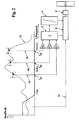
- Fig. 3 schematically shows an embodiment of a signal preprocessing device and its operation.
- the spectrum of a sensor signal 10 can be seen, from which three defined frequency bands 13, 14, 15 are cut out by bandpass filtering.
- These frequency bands 13, 14, 15 transmitted through the bandpass filters are part of the structure-borne sound spectrum sensor signal 10 and have, for example, frequencies of well above 1 kHz.
- the frequency range well below 1 kHz is assigned to the acceleration spectrum 11 and is cut out by a low-pass filter.
- the three frequency bands 13, 14, 15 are amplified by a respective signal amplifier G1, G2, G3 and fed to an adder 3, which adds these three signals and generates therefrom, with respect to sensor signal 10, spectrally evaluated signal.
- This signal of the adder output is transmitted to an integrator 4, which makes a power density evaluation in the course of integration.
- an output signal of the adder, the output signal of the integrator and the signal of the acceleration spectrum are fed to a coding module 5.
- Coding module 5 encodes the information of the spectral and the power density evaluated signal, as well as the acceleration signal and transmits them to an interface 9.
- interface 9 the coded signal is prepared and converted into a defined line code. Thereafter, this signal is transmitted to the electronic control unit ECU for evaluation.
- the signal adaptation to the respective interface or the corresponding line coding is performed in coding module 5, whereby additional interface 9 is omitted.
- signal preprocessing device 1 which is connected between the structure-borne sound sensor S1 and the electronic control unit ECU and performs analog signal filtering.
- signal preprocessing device 1 has filter module 2, which lpf a low-pass filter and four band-pass filter bpf1, bpf2, pbf3, pbf4 comprises.
- the output signal sensor S1 passes in parallel through these five filters lpf, bpf1, bpf2, pbf3, pbf4, which transmit the acceleration spectrum and four frequency bands of the structure-borne sound spectrum.
- the output signals of the bandpass filters bpf1, bpf2, pbf3, pbf4 are added in summing circuit 3 to a spectrally evaluated signal with respect to the sensor signal, and this signal is transmitted to integrator circuit 4.
- the output of integrator circuit 4 contains the information about the power density of the sensor signal and becomes as well as the acceleration signal digitized in an analog / digital converter A / DC of a coding module 5. This happens, not shown, for example via a multiplexer.
- coding module 5 comprises a source coding element 6 and a channel coding element 7.
- the coded signals or the output signal coding module 5 and thus the output signal of the exemplary signal preprocessing device 1 are transmitted to an electronic control unit ECU of a motor vehicle safety system.
- Fig. 4 the output signal of the summing circuit 3 is digitized in analog / digital converter A / DC coding module 5 and further processed in the further stages of the coding module. It is further proposed by way of example that coding module 5 additionally has an encoding element which performs line coding in accordance with the specification of a defined data transmission interface.
- FIG. 5 illustrated embodiment of a signal preprocessing circuit 1 is formed so that the signal preprocessing is carried out substantially completely digital.
- the output signal of the structure-borne sound sensor S1 is digitized in an analog / digital converter A / DC and transmitted to a digital filter module 2.
- Filter module 2 includes, for example, two bandpass filters, which pass two frequency bands of the structure-borne sound spectrum.
- the filtered signals are added in a summing circuit 3 to form a signal and integrated in integrator circuit 4.
- the output data integrator circuit 4 are source-coded in coding module 5, channel coded and provided according to the exemplary serial interface specification with a corresponding line coding and transmitted to electronic control unit ECU.
- FIG. 3 illustrates an exemplary embodiment in which two structure-borne sound sensors S1, S2 are connected to a signal preprocessing device 1, which includes, for example, a digital signal processor DSP.
- a signal preprocessing device 1 which includes, for example, a digital signal processor DSP.
- DSP digital signal processor
- a source coding of these signals (signal of the acceleration spectrum, spectrally evaluated signal, power density-evaluated signal), for example according to the Huffman code, a channel coding and a line coding according to the specifications of the interface, which is a digital serial interface, for example.
- the output signals of the DSP are transmitted via a data transmission channel 8, to the central electronic control unit ECU
Landscapes
- Engineering & Computer Science (AREA)
- Mechanical Engineering (AREA)
- Measurement Of Mechanical Vibrations Or Ultrasonic Waves (AREA)
Claims (9)
- Dispositif de prétraitement de signaux (1), lequel est intégré dans un capteur de bruits de structures (S1, S2) ou dans un capteur d'accélération pour la détection de bruits de structure ou lequel est relié du côté entrée à au moins un tel capteur (S1, S2) et est relié du côté sortie par au moins un canal de signal (8) à au moins une unité de commande électronique (ECU), et le dispositif de prétraitement de signaux (1) présentant au moins un module de filtre (2), le module de filtre (2) présentant au moins deux filtres passe-bande (bpf1, bpf2, bpf3, bpf4), les chemins de signaux des au moins deux sorties de filtres passe-bande du module de filtre (2) étant connectés à au moins un circuit additionneur (3), caractérisé en ce qu'au moins une sortie de l'au moins un circuit additionneur (3) est connectée à l'entrée d'un circuit intégrateur (4) et en ce que le circuit intégrateur (4) est formé pour exécuter une évaluation de la densité de puissance lors de l'intégration.
- Dispositif de prétraitement de signaux (1) selon la revendication 1, caractérisé en ce que les au moins deux filtres passe-bande (bpfl, bpf2, bpf3, bpf4) du module de filtre (2) sont conçus de façon paramétrable, au moins relativement à la bande passante et/ou à la fréquence centrale.
- Dispositif de prétraitement de signaux (1) selon la revendication 1 ou 2, caractérisé en ce que les chemins de signaux des au moins deux sorties de filtres passe-bande du module de filtre (2) présentent chacun un circuit d'amplification de signal ou un circuit d'amplification de signal commun (G1, G2, G3).
- Dispositif de prétraitement de signaux (1) selon au moins l'une des revendications 1 à 3, caractérisé en ce que celui-ci présente un passe-bas (lpf) ou un filtre avec caractéristique passe-bas, lequel transmet essentiellement le spectre d'accélération (11) de l'au moins un signal de capteur (10).
- Dispositif de prétraitement de signaux selon au moins l'une des revendications 1 ou 4, caractérisé en ce que l'au moins un circuit additionneur (3) et/ou le circuit intégrateur (4) et/ou la sortie du passe-bas (lpf) ou du filtre avec caractéristique passe-bas, lequel transmet essentiellement le spectre d'accélération (11), est/sont connecté(s) à un module de codage (5).
- Dispositif de prétraitement de signaux selon la revendication 5, caractérisé en ce que le module de codage (5) est conçu de telle sorte qu'il peut exécuter un codage de source et/ou un codage de canal de son au moins un signal d'entrée.
- Procédé, lequel exécute un prétraitement d'au moins un signal de sortie (10) d'un ou de plusieurs capteur(s) de bruits de structure (S1, S2) ou d'un ou de plusieurs capteur(s) d'accélération pour la détection de bruits de structure, le procédé étant exécuté en particulier dans un dispositif de prétraitement de signaux (1) selon au moins l'une des revendications 1 à 8, l'au moins un signal de sortie (10) étant transmis à un dispositif de prétraitement de signaux (1) dans lequel au moins un filtrage est exécuté, au moins deux bandes de fréquence (13, 14, 15) transmises lors du filtrage, lesquelles font partie, au moins partiellement, du spectre de bruits de structure, étant ajoutées à au moins un signal somme,
caractérisé en ce que l'au moins un signal somme est intégré et en ce qu'une évaluation de densité de puissance est exécutée lors de l'intégration. - Procédé selon la revendication 7, caractérisé en ce que l'au moins un signal somme et/ou le signal intégré et/ou au moins un signal transmis, lequel comprend essentiellement le spectre d'accélération (11) de l'au moins un signal de capteur (10) sont soumis à un codage de source et/ou un codage de canal.
- Utilisation d'un dispositif de prétraitement de signaux (1) selon au moins l'une des revendications 1 à 6 dans des systèmes de sécurité électroniques pour véhicules à moteur, en particulier dans des systèmes de protection des occupants et/ou des systèmes de protection de piétons.
Applications Claiming Priority (3)
| Application Number | Priority Date | Filing Date | Title |
|---|---|---|---|
| DE102006002203 | 2006-01-16 | ||
| DE102006060277A DE102006060277A1 (de) | 2006-01-16 | 2006-12-20 | Signalvorverarbeitungseinrichtung mit Bandpassfiltern für Körperschallsensoren |
| PCT/EP2007/050346 WO2007082865A1 (fr) | 2006-01-16 | 2007-01-15 | Dispositif de prétraitement de signaux doté de filtres passe-bande pour capteurs de bruits de structure |
Publications (2)
| Publication Number | Publication Date |
|---|---|
| EP1979201A1 EP1979201A1 (fr) | 2008-10-15 |
| EP1979201B1 true EP1979201B1 (fr) | 2018-10-24 |
Family
ID=37930361
Family Applications (1)
| Application Number | Title | Priority Date | Filing Date |
|---|---|---|---|
| EP07703862.8A Ceased EP1979201B1 (fr) | 2006-01-16 | 2007-01-15 | Dispositif de prétraitement de signaux doté de filtres passe-bande pour capteurs de bruits de structure |
Country Status (4)
| Country | Link |
|---|---|
| US (1) | US8076958B2 (fr) |
| EP (1) | EP1979201B1 (fr) |
| DE (1) | DE102006060277A1 (fr) |
| WO (1) | WO2007082865A1 (fr) |
Families Citing this family (12)
| Publication number | Priority date | Publication date | Assignee | Title |
|---|---|---|---|---|
| EP1678013B1 (fr) * | 2003-10-09 | 2008-02-27 | Conti Temic microelectronic GmbH | Dispositif pour declencher un systeme de securite dans un vehicule |
| DE102007006769A1 (de) * | 2007-02-12 | 2008-08-14 | Robert Bosch Gmbh | Verfahren und Vorrichtung zur Ansteuerung von Personenschutzmitteln |
| DE102007046982B3 (de) * | 2007-10-01 | 2009-03-05 | Fendt, Günter | Einrichtung zur Erfassung einer Unfallsituation und Verfahren zum Erkennen einer Unfallsituation und/oder zum Steuern eines Personschutzsystems |
| DE102008009906A1 (de) * | 2008-02-19 | 2009-08-20 | Robert Bosch Gmbh | Verfahren und Steuergerät zur Ansteuerung von Personenschutzmitteln für ein Fahrzeug |
| DE102009038430A1 (de) * | 2009-05-06 | 2010-11-11 | Continental Automotive Gmbh | Verfahren zur Aufprallerkennung bei Kraftfahrzeugen mit mindestens einer Körperschallerzeugungseinrichtung |
| DE102009037619A1 (de) * | 2009-08-14 | 2011-02-17 | Continental Automotive Gmbh | Verfahren zur Signalverarbeitung von Körperschallsignalen, insbesondere in Kraftfahrzeugen, sowie Insassenschutzsystem mit entsprechender Signalverarbeitungseinheit |
| DE102011006984A1 (de) * | 2011-04-07 | 2012-10-11 | Robert Bosch Gmbh | Verfahren und Vorrichtung zur Auswertung von Körperschall bei einer Kollision eines Fahrzeugs |
| US10017142B2 (en) * | 2016-09-12 | 2018-07-10 | Ford Global Technologies, Llc | Filtration of acoustic contaminate from vehicle safety sensors |
| WO2018191725A1 (fr) * | 2017-04-14 | 2018-10-18 | Paradromics, Inc. | Circuit d'enregistrement neuronal de faible surface et de faible puissance, et procédé d'apprentissage de celui-ci |
| WO2020002975A1 (fr) | 2018-06-29 | 2020-01-02 | Bosch Car Multimedia Portugal, S.A. | Module de filtrage adaptatif |
| SE2130292A1 (en) * | 2021-10-30 | 2023-05-01 | Sensorbee AB | An acoustic sensor |
| IL288247B2 (en) * | 2021-11-19 | 2024-01-01 | D Fend Solutions Ad Ltd | Self-controlled radio frequency (rf) filtering unit |
Citations (3)
| Publication number | Priority date | Publication date | Assignee | Title |
|---|---|---|---|---|
| EP1710133A2 (fr) * | 2005-04-05 | 2006-10-11 | Robert Bosch Gmbh | Dispositif pour détection d'un accident |
| WO2006125719A1 (fr) * | 2005-05-27 | 2006-11-30 | Siemens Vdo Automotive Ag | Dispositif et procede permettant de commander un systeme de protection de personnes d'un vehicule |
| WO2006131224A1 (fr) * | 2005-06-06 | 2006-12-14 | Daimlerchrysler Ag | Procede de commande pour dispositif de protection contre les accidents dans un vehicule |
Family Cites Families (16)
| Publication number | Priority date | Publication date | Assignee | Title |
|---|---|---|---|---|
| CA2060340C (fr) * | 1991-01-31 | 1995-12-05 | Manabu Hirao | Dispositif de detection de collision de vehicules |
| DE4213673C2 (de) * | 1992-04-25 | 1994-09-08 | Dornier Gmbh | Auslöseverfahren für ein Rückhaltesystem |
| US5710720A (en) * | 1996-04-30 | 1998-01-20 | Board Of Regents Of The University Of Nebraska | Phase lock loop based system and method for decomposing and tracking decomposed frequency components of a signal, with application to vibration compensation system |
| KR19990016488A (ko) * | 1997-08-16 | 1999-03-05 | 구자홍 | 트랙킹 제어 장치 및 그 방법 |
| DE10015273B4 (de) * | 2000-03-28 | 2007-05-10 | Siemens Ag | Steuervorrichtung für eine Unfallschutzeinrichtung in einem Fahrzeug |
| US7522900B2 (en) * | 2001-03-20 | 2009-04-21 | Broadcom Corporation | DC offset correction for use in a radio architecture |
| US6888888B1 (en) * | 2001-06-26 | 2005-05-03 | Microsoft Corporation | Simultaneous tuning of multiple channels using intermediate frequency sub-sampling |
| US6950796B2 (en) * | 2001-11-05 | 2005-09-27 | Motorola, Inc. | Speech recognition by dynamical noise model adaptation |
| JP4016723B2 (ja) * | 2002-05-30 | 2007-12-05 | ソニー株式会社 | 撮影装置、信号処理方法、記録媒体、並びにプログラム |
| DE10249495B3 (de) * | 2002-10-24 | 2004-05-27 | Daimlerchrysler Ag | Vorrichtung zum Testen von Lautsprechern auf Funktionsfähigkeit |
| EP1678013B1 (fr) * | 2003-10-09 | 2008-02-27 | Conti Temic microelectronic GmbH | Dispositif pour declencher un systeme de securite dans un vehicule |
| US20060139093A1 (en) * | 2004-12-23 | 2006-06-29 | Bbe Sound Inc. | Three-channel state-variable compressor circuit |
| US7656977B2 (en) * | 2005-10-21 | 2010-02-02 | Lsi Corporation | Method and system of frequency domain equalization |
| US20070155350A1 (en) * | 2005-12-29 | 2007-07-05 | Wionics Research | Method of frequency planning in an ultra wide band system |
| DE102006042769C5 (de) * | 2006-09-12 | 2011-07-28 | Continental Automotive GmbH, 30165 | Verfahren und Vorrichtung zum Auslösen eines Personenschutzmittels für ein Fahrzeug |
| US8107569B2 (en) * | 2007-05-21 | 2012-01-31 | Spatial Digital Systems, Inc. | Method and apparatus for channel bonding using a multiple-beam antenna |
-
2006
- 2006-12-20 DE DE102006060277A patent/DE102006060277A1/de not_active Withdrawn
-
2007
- 2007-01-15 US US12/160,817 patent/US8076958B2/en not_active Expired - Fee Related
- 2007-01-15 WO PCT/EP2007/050346 patent/WO2007082865A1/fr not_active Ceased
- 2007-01-15 EP EP07703862.8A patent/EP1979201B1/fr not_active Ceased
Patent Citations (3)
| Publication number | Priority date | Publication date | Assignee | Title |
|---|---|---|---|---|
| EP1710133A2 (fr) * | 2005-04-05 | 2006-10-11 | Robert Bosch Gmbh | Dispositif pour détection d'un accident |
| WO2006125719A1 (fr) * | 2005-05-27 | 2006-11-30 | Siemens Vdo Automotive Ag | Dispositif et procede permettant de commander un systeme de protection de personnes d'un vehicule |
| WO2006131224A1 (fr) * | 2005-06-06 | 2006-12-14 | Daimlerchrysler Ag | Procede de commande pour dispositif de protection contre les accidents dans un vehicule |
Also Published As
| Publication number | Publication date |
|---|---|
| EP1979201A1 (fr) | 2008-10-15 |
| DE102006060277A1 (de) | 2007-09-20 |
| WO2007082865A1 (fr) | 2007-07-26 |
| US20100176866A1 (en) | 2010-07-15 |
| US8076958B2 (en) | 2011-12-13 |
Similar Documents
| Publication | Publication Date | Title |
|---|---|---|
| EP1979201B1 (fr) | Dispositif de prétraitement de signaux doté de filtres passe-bande pour capteurs de bruits de structure | |
| DE102018207408B4 (de) | Ursachenbestimmung für ein Störgeräusch eines Kraftfahrzeugs | |
| EP1019271B1 (fr) | Dispositif pour la protection des occupants dans un vehicule automobile | |
| EP2329279B1 (fr) | Procédé et dispositif pour déterminer un état cinématique d'un véhicule à l'aide d'un capteur d'accélération | |
| DE102013015402B4 (de) | Verfahren zum Betreiben einer Sensorvorrichtung eines Kraftfahrzeugs, Sensor für ein Kraftfahrzeug, Sensorvorrichtung und Kraftfahrzeug | |
| EP3374799B1 (fr) | Procédé et dispositif permettant d'évaluer une position d'un véhicule, en particulier selon une étape de sécurité asil | |
| EP2079990A1 (fr) | Procédé et dispositif pour contrôler le signal d'un capteur | |
| DE19855452A1 (de) | Vorrichtung zum Steuern eines Insassenschutzmittels eines Fahrzeugs | |
| DE102023128247A1 (de) | Systeme und Verfahren zum Überwachen von Antriebseinheitslagern | |
| EP1639315B1 (fr) | Procede de surveillance d'un capteur de vitesse de rotation | |
| DE102007008379B4 (de) | Steuergerät und Verfahren zur Ansteuerung von Personenschutzmitteln | |
| EP2628646A1 (fr) | Système de capteur de choc avec au moins un capteur de pression | |
| DE19854529B4 (de) | Auslösesteuerungsverfahren und -system für ein Insassenschutzsystem | |
| EP2188156B1 (fr) | Procédé et appareil de commande destinés à la commande de moyens de protection de personnes dans un véhicule | |
| DE102006055768A1 (de) | Signalvorverarbeitungseinrichtung für Körperschallsensoren | |
| DE102006040653B4 (de) | Vorrichtung und Verfahren zur Detektion eines Fußgängeraufpralls | |
| DE102007028228B4 (de) | Verfahren zum Überprüfen eines Sensorsignals | |
| DE102006026879A1 (de) | Sensor und Verfahren zur Datengewinnung | |
| DE102008053226B4 (de) | Verfahren zur Bewertung eines Körperschallsignals für ein Personenschutzsystem | |
| DE102012200796B4 (de) | System und Verfahren zur plausibilisierten Beschleunigungsmessung | |
| EP1515875B1 (fr) | Procede et dispositif de reconnaissance d'impact | |
| DE102017126828B4 (de) | Verfahren zum Betreiben eines Ultraschallsensors für ein Kraftfahrzeug mit Unterdrückung von Störungen in einem zweiten Empfangspfad, Ultraschallsensor sowie Fahrerassistenzsystem | |
| DE102017104149B3 (de) | Verfahren zum Betreiben einer Sensorvorrichtung für ein Kraftfahrzeug mit unterschiedlichen Betriebsmodi eines Abstandssensors, Sensorvorrichtung, Fahrerassistenzsystem sowie Kraftfahrzeug | |
| DE102006032938A1 (de) | Verfahren zur Verarbeitung eines Signals zumindest eines Beschleunigungssensors sowie entsprechende Signalverarbeitungseinrichtung | |
| DE19900105A1 (de) | Vorrichtung zur Fahrzeugsicherheitserprobung |
Legal Events
| Date | Code | Title | Description |
|---|---|---|---|
| PUAI | Public reference made under article 153(3) epc to a published international application that has entered the european phase |
Free format text: ORIGINAL CODE: 0009012 |
|
| 17P | Request for examination filed |
Effective date: 20080818 |
|
| AK | Designated contracting states |
Kind code of ref document: A1 Designated state(s): DE FR |
|
| DAX | Request for extension of the european patent (deleted) | ||
| RBV | Designated contracting states (corrected) |
Designated state(s): DE FR |
|
| 17Q | First examination report despatched |
Effective date: 20131121 |
|
| GRAP | Despatch of communication of intention to grant a patent |
Free format text: ORIGINAL CODE: EPIDOSNIGR1 |
|
| STAA | Information on the status of an ep patent application or granted ep patent |
Free format text: STATUS: GRANT OF PATENT IS INTENDED |
|
| INTG | Intention to grant announced |
Effective date: 20180523 |
|
| GRAS | Grant fee paid |
Free format text: ORIGINAL CODE: EPIDOSNIGR3 |
|
| RAP1 | Party data changed (applicant data changed or rights of an application transferred) |
Owner name: CONTI TEMIC MICROELECTRONIC GMBH Owner name: CONTINENTAL TEVES AG & CO. OHG |
|
| GRAA | (expected) grant |
Free format text: ORIGINAL CODE: 0009210 |
|
| STAA | Information on the status of an ep patent application or granted ep patent |
Free format text: STATUS: THE PATENT HAS BEEN GRANTED |
|
| AK | Designated contracting states |
Kind code of ref document: B1 Designated state(s): DE FR |
|
| REG | Reference to a national code |
Ref country code: DE Ref legal event code: R096 Ref document number: 502007016457 Country of ref document: DE |
|
| REG | Reference to a national code |
Ref country code: DE Ref legal event code: R097 Ref document number: 502007016457 Country of ref document: DE |
|
| PLBE | No opposition filed within time limit |
Free format text: ORIGINAL CODE: 0009261 |
|
| STAA | Information on the status of an ep patent application or granted ep patent |
Free format text: STATUS: NO OPPOSITION FILED WITHIN TIME LIMIT |
|
| 26N | No opposition filed |
Effective date: 20190725 |
|
| PGFP | Annual fee paid to national office [announced via postgrant information from national office to epo] |
Ref country code: DE Payment date: 20200131 Year of fee payment: 14 |
|
| PGFP | Annual fee paid to national office [announced via postgrant information from national office to epo] |
Ref country code: FR Payment date: 20200121 Year of fee payment: 14 |
|
| REG | Reference to a national code |
Ref country code: DE Ref legal event code: R119 Ref document number: 502007016457 Country of ref document: DE |
|
| PG25 | Lapsed in a contracting state [announced via postgrant information from national office to epo] |
Ref country code: FR Free format text: LAPSE BECAUSE OF NON-PAYMENT OF DUE FEES Effective date: 20210131 |
|
| PG25 | Lapsed in a contracting state [announced via postgrant information from national office to epo] |
Ref country code: DE Free format text: LAPSE BECAUSE OF NON-PAYMENT OF DUE FEES Effective date: 20210803 |