EP1980338A2 - Plieuse - Google Patents
Plieuse Download PDFInfo
- Publication number
- EP1980338A2 EP1980338A2 EP08154297A EP08154297A EP1980338A2 EP 1980338 A2 EP1980338 A2 EP 1980338A2 EP 08154297 A EP08154297 A EP 08154297A EP 08154297 A EP08154297 A EP 08154297A EP 1980338 A2 EP1980338 A2 EP 1980338A2
- Authority
- EP
- European Patent Office
- Prior art keywords
- bending
- bending machine
- elements
- machine according
- measuring
- Prior art date
- Legal status (The legal status is an assumption and is not a legal conclusion. Google has not performed a legal analysis and makes no representation as to the accuracy of the status listed.)
- Withdrawn
Links
- 238000005452 bending Methods 0.000 title claims abstract description 132
- 239000000463 material Substances 0.000 claims abstract description 9
- XBWAZCLHZCFCGK-UHFFFAOYSA-N 7-chloro-1-methyl-5-phenyl-3,4-dihydro-2h-1,4-benzodiazepin-1-ium;chloride Chemical compound [Cl-].C12=CC(Cl)=CC=C2[NH+](C)CCN=C1C1=CC=CC=C1 XBWAZCLHZCFCGK-UHFFFAOYSA-N 0.000 description 9
- 238000010276 construction Methods 0.000 description 3
- 230000001627 detrimental effect Effects 0.000 description 1
- 239000002184 metal Substances 0.000 description 1
- 229920003023 plastic Polymers 0.000 description 1
- 239000004033 plastic Substances 0.000 description 1
- 230000000630 rising effect Effects 0.000 description 1
Images

Classifications
-
- B—PERFORMING OPERATIONS; TRANSPORTING
- B21—MECHANICAL METAL-WORKING WITHOUT ESSENTIALLY REMOVING MATERIAL; PUNCHING METAL
- B21D—WORKING OR PROCESSING OF SHEET METAL OR METAL TUBES, RODS OR PROFILES WITHOUT ESSENTIALLY REMOVING MATERIAL; PUNCHING METAL
- B21D5/00—Bending sheet metal along straight lines, e.g. to form simple curves
- B21D5/01—Bending sheet metal along straight lines, e.g. to form simple curves between rams and anvils or abutments
-
- B—PERFORMING OPERATIONS; TRANSPORTING
- B21—MECHANICAL METAL-WORKING WITHOUT ESSENTIALLY REMOVING MATERIAL; PUNCHING METAL
- B21D—WORKING OR PROCESSING OF SHEET METAL OR METAL TUBES, RODS OR PROFILES WITHOUT ESSENTIALLY REMOVING MATERIAL; PUNCHING METAL
- B21D5/00—Bending sheet metal along straight lines, e.g. to form simple curves
- B21D5/02—Bending sheet metal along straight lines, e.g. to form simple curves on press brakes without making use of clamping means
-
- B—PERFORMING OPERATIONS; TRANSPORTING
- B21—MECHANICAL METAL-WORKING WITHOUT ESSENTIALLY REMOVING MATERIAL; PUNCHING METAL
- B21D—WORKING OR PROCESSING OF SHEET METAL OR METAL TUBES, RODS OR PROFILES WITHOUT ESSENTIALLY REMOVING MATERIAL; PUNCHING METAL
- B21D5/00—Bending sheet metal along straight lines, e.g. to form simple curves
- B21D5/004—Bending sheet metal along straight lines, e.g. to form simple curves with program control
-
- B—PERFORMING OPERATIONS; TRANSPORTING
- B21—MECHANICAL METAL-WORKING WITHOUT ESSENTIALLY REMOVING MATERIAL; PUNCHING METAL
- B21D—WORKING OR PROCESSING OF SHEET METAL OR METAL TUBES, RODS OR PROFILES WITHOUT ESSENTIALLY REMOVING MATERIAL; PUNCHING METAL
- B21D5/00—Bending sheet metal along straight lines, e.g. to form simple curves
- B21D5/006—Bending sheet metal along straight lines, e.g. to form simple curves combined with measuring of bends
-
- B—PERFORMING OPERATIONS; TRANSPORTING
- B21—MECHANICAL METAL-WORKING WITHOUT ESSENTIALLY REMOVING MATERIAL; PUNCHING METAL
- B21D—WORKING OR PROCESSING OF SHEET METAL OR METAL TUBES, RODS OR PROFILES WITHOUT ESSENTIALLY REMOVING MATERIAL; PUNCHING METAL
- B21D7/00—Bending rods, profiles, or tubes
- B21D7/06—Bending rods, profiles, or tubes in press brakes or between rams and anvils or abutments; Pliers with forming dies
Definitions
- the present invention relates to a bending machine, which is intended for bending material, and which includes bending elements, as well as an apparatus for operating and controlling the bending machine, measuring elements being connected to the bending elements, for determining the bending angle when operating the bending machine.
- free bending which is also referred to as air-gap bending, is used particularly when bending metallic sheet and bar material.
- the blank being bent only touches the two points of the die, and the ram.
- Free pressing permits a large number of different pieces to be manufactured using a small number of tools, by only altering the control setting of the bending machine and/or by changing the die and ram.
- spring-back of the blank occurs in free pressing, which is taken into account by using a sufficient amount of over bending. The magnitude of the spring-back depends on several variables, for example, the thickness, grade, and hardness of the material, as well as the bending angle.
- Modern bending machines are numerically controlled and largely automated. In other words, after making the settings even large batches of similar blanks can be bent rapidly and accurately. The settings can concern directly the operating device driving the ram, which can, however, lead to inaccuracies in the finished product. Thus various ways have been developed to determine the real bending angle, which can in turn be used to control the bending machine. The question is then of a kind of feedback, by means of which good bending accuracy can be achieved in relation to the bending angle.
- German utility model number 8234901 discloses a bending machine, which is equipped with an electronic angle measuring system.
- the two points of the die are formed from two flattened parallel die pins, which are arranged to rotate around their longitudinal axes.
- each die pin rotates in the opposite direction and the angles of rotation of both are measured.
- the bending angle reached is measured, and is utilized, for example, as feedback in the control devices.
- US patent number 5259224 discloses a pipe-bending machine, in which the end of the pipe is locked in the jaws of the die. The rest of the pipe is supported on the ram. When operating the pipe-bending machine, the die rotates and the ram moves. Measuring elements are fitted in connection with both of these, in order to determine the real bending angle. There can also be several dies.
- Electronic elements for measuring the angle of rotation are integrated in the die.
- the die becomes large and there must be electronic elements in each die.
- each die must also have its own operating device to return the die pins. This increases the purchase and operating costs of the bending machine.
- the die itself is an expensive tool.
- a significant drawback is the location of electronic elements in the working area. In other words, the elements are in danger of being broken when the blank is placed in, or removed from the bending machine. Sometimes the elements can even entirely prevent the blank from being placed in the bending machine.
- electrical and pneumatic connections must be made. At the same time, erroneous connections are possible.
- the invention is intended to create a new type of bending machine, by means of which the drawbacks of the prior art can be avoided.
- the characteristic features of the present invention are stated in the accompanying Claims.
- the measuring elements are located in a new and surprising manner, so that their breakage is avoided.
- the bending elements can be made simpler and cheaper than previously.
- the measuring elements can be used in connection with various kinds of bending elements while the changing of the bending elements is simple and quick. Further, the measuring elements can be fitted to very different kinds of bending machine.
- the measuring elements according to the invention can also be used in manually controlled bending machines.
- a bending machine intended for bending a material includes bending elements and an apparatus for operating and controlling the bending machine.
- measuring elements are connected to the bending elements, for determining the bending angle when operating the bending machine.
- the measuring elements are fitted structurally separately from the bending elements and the measuring elements are connected to the bending elements by means of a rotationally rigid connecting element.
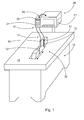
- the bending machine, intended for the free bending of sheet or bar material, is shown in Figure 1 .
- the invention can also be applied in other bending machines, for example, in profile and pipe-bending machines.
- the bending machine includes, as bending elements 32, a die 11 and a ram 12. Also included is an apparatus 13 for operating and controlling the bending machine.
- the ram moves horizontally, so that the plane 14 belonging to the bending machine can be used to support the blank being bent.
- the ram is often arranged to move vertically.
- the ram generally performs the actual work movement while the die remains stationary.
- the die too can have various directions of movement, but these are largely intended for positioning the die in the desired manner.
- the two points of the die are formed from flattened die pins.
- the parallel die pins rotate around their longitudinal axes when the die is used for bending.
- measuring elements 16 which are arranged to measure the angle of rotation of the die pins 15, are connected to the die pins 15.
- the difference in angle of the die pins 15 is defined, in order to determine the bending angle reached.
- the measuring elements 16 are fitted structurally separately from the die 11. In other words, the measuring elements are not attached to the die. This avoids the measuring elements being broken during bending, or when the blank is set in place or removed.
- the measuring elements 16 are, in addition, connected to the die pins 15 by means of a rotationally rigid connector element 17.
- the connector element 17 is preferably flexible.
- the measuring elements can be freely located. If necessary, the die too can be arranged to be moveable. The rotational angle of the die pins will also be transmitted accurately, despite the distance of the measuring elements.
- the connector element 17 is attached to the die pins 15, or more generally to the bending elements, in a quick-release manner.
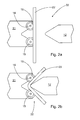
- Figures 2a, 2b , 3 and 4 show a square hole 18 machined in the end of the die pin 15, a corresponding square pin 19 being arranged in the end of the connector element 17 ( Figures 3 and 4 ).
- the quick-release attachment is preferably based on shape locking, the shape of which can, of course, vary in different applications.
- the shape locking is ensured by using a sufficiently tight fit, or separate locking.
- the essential feature is, however, a lack of clearance in the direction of rotation, to preserve precision.
- the die pins and measuring elements can be connected to each other in different ways.
- the apparatus preferably includes one connector element 17 and one measuring element 16 for each die pin 15, Thus the construction of the arrangement is kept simple and the angle of rotation of each die pin can be determined precisely.
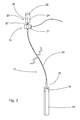
- Figure 3 shows the arrangement according to the invention, in the case of one die pin 15.
- the connector element 17 is a mechanical cable shaft 20, which is flexible, but which transmits accurately the mechanical rotational movement of the die pin to the measuring element.
- the rotational angle can also be determined using different kinds of measuring element, which are preferably electronic or mechanical angle sensors.
- the measuring element 16 is preferably a pulse sensor 21.
- Modern pulse sensors are extremely accurate and above all small and durable. It is preferable to use a pulse sensor with a resolution of at least 1000 pulses per rotation. Pulse sensors that are even more precise than this exist and can be used to distinguish between rising and falling pulses. In that case a resolution of several thousand rotation pulses can be achieved, so that the accuracy of the arrangement in relation to the bending angle will be less than a tenth of a degree.
- Figure 2a shows part of the blank 22 being bent, which is placed against the die pins 15 of the die 11.
- the measuring elements can, if necessary, be calibrated by setting a measuring piece against the die pins and setting the measuring elements to zero (not shown).
- the ram 12 begins its work stroke, during which the blank 22 bends while the die pins 15 rotate.
- the ram 12 is at the end of its work stroke and the die pins 15 have rotated along with the blank 22.
- the ram returns to its initial position, after which it can be decided, on the basis of the measuring results of the measuring elements, whether the desired bending angle has been reached.
- the measuring elements can also be arranged as feedback for the control apparatus.
- the ram when the work stroke ends, the ram returns only slightly more than the spring-back of the blank. At the same time, the die pins rotate slightly backwards. If the bending angle measured after the spring-back is greater than the desired bending angle, the ram presses again slightly farther, to achieve the desired bending angle.
- the spring-back of the blank is taken into account already in the setting values, but the feedback of the measuring elements will bring greater accuracy and repeatability to free bending and other forms of bending.
- a single bending machine can include several different bending elements, such as dies and rams, which can be changed to bend different blanks to different angles.
- the height of the die and ram is at least the width of the blank, or greater than it.
- the height of the tool is 100 - 300 mm.
- the bending machine includes an operating element 23 for rotating the die pins 15, which operating element 23 is fitted to the end of the connector element 17 on side facing the measuring element 16.
- the operating element 23 is a linear cylinder 24, which is fitted in connection with the measuring element 16 as a continuation of the connector element 17.
- the cylinder in question is small and reliable in operation. After the return rotation of the die pins, the pressure is released from the cylinder, which avoids the cylinder affecting the measuring result.
- a linear cylinder it is also possible to use a rotary cylinder.
- the linear movement of the piston 25 is converted, for example with the aid of nesting helical gears, into a rotary movement. By adjusting the feed pressure, the piston 25 is moved and through the gears rotates a shaft 26 ( Figures 3 and 4 ).
- FIG 4 shows a second embodiment of the connector element according to the invention according to Figure 3 .
- the rotationally rigid connector shaft 17 is formed from a cardan shaft 31, which is preferably also at least slightly telescopic. This allows the cardan shaft to be easily removed from the die pin when the die is changed.
- a cardan shaft or other connecting element more rigid than a cable shaft can be used in applications, in which the die remains in place.
- a telescopic cardan shaft will permit small movements.
- the bending machine of Figure 1 is numerically controlled and its apparatus 13 includes control means 28.
- control means there are, for example, values entered for each grade of blank and the desired bending angle.
- the measuring elements 16 are preferably fitted to the control means, in which case they will be well protected.
- the measuring elements fitted to the control means are shown by broken lines.
- the measuring elements 16 can be fitted to a separate auxiliary device 29.
- the auxiliary device 29 preferably includes a display element 30, from which the operator can read the real bending angle achieved.
- the separate auxiliary device 29 can be attached to the control means 28 both structurally and electrically. The desired feedback will then be provided for the control means.
- the invention can also be applied in other bending machines.
- the connector element in a pipe-bending machine the connector element can be attached to some rotating or turning structure, for example, the die. This will avoid clearances and the construction of the bending machine will be simplified in other ways too. At the same time, the changing of the bending elements will be simple and quick.
- the bending machine it is also possible to use the bending machine to bend other materials, such as various plastics.
- the measuring elements are far from the bending point, which will avoid their detrimental effect on the actual bending. At the same time, the measuring elements are well protected.
- the die of the bending machine will become clearly cheaper than previously and, if necessary, the die can be made to be moveable.
Landscapes
- Engineering & Computer Science (AREA)
- Mechanical Engineering (AREA)
- Bending Of Plates, Rods, And Pipes (AREA)
Applications Claiming Priority (1)
| Application Number | Priority Date | Filing Date | Title |
|---|---|---|---|
| FI20075240A FI20075240A7 (fi) | 2007-04-10 | 2007-04-10 | Taivutuskone |
Publications (1)
| Publication Number | Publication Date |
|---|---|
| EP1980338A2 true EP1980338A2 (fr) | 2008-10-15 |
Family
ID=38009893
Family Applications (1)
| Application Number | Title | Priority Date | Filing Date |
|---|---|---|---|
| EP08154297A Withdrawn EP1980338A2 (fr) | 2007-04-10 | 2008-04-10 | Plieuse |
Country Status (2)
| Country | Link |
|---|---|
| EP (1) | EP1980338A2 (fr) |
| FI (1) | FI20075240A7 (fr) |
Cited By (3)
| Publication number | Priority date | Publication date | Assignee | Title |
|---|---|---|---|---|
| CN103722055A (zh) * | 2013-12-10 | 2014-04-16 | 龙口市丛林铝合金船舶有限公司 | 一种船首折弯工装系统及方法 |
| CN113305181A (zh) * | 2021-06-28 | 2021-08-27 | 常州众研科技发展有限公司 | 一种可防误碰的折弯机控制装置 |
| CN116351916A (zh) * | 2023-03-29 | 2023-06-30 | 东台市远洋不锈钢制造有限公司 | 一种大型弯头板材加工用弯曲装置 |
Citations (2)
| Publication number | Priority date | Publication date | Assignee | Title |
|---|---|---|---|---|
| DE8234901U1 (de) | 1982-12-11 | 1983-04-21 | Ehrt Maschinenbau GmbH, 5340 Bad Honnef | Vorrichtung zum biegen von metallprofilen |
| US5259224A (en) | 1991-09-05 | 1993-11-09 | Rigobert Schwarze | Method and apparatus for controlling a pipe bending machine |
-
2007
- 2007-04-10 FI FI20075240A patent/FI20075240A7/fi unknown
-
2008
- 2008-04-10 EP EP08154297A patent/EP1980338A2/fr not_active Withdrawn
Patent Citations (2)
| Publication number | Priority date | Publication date | Assignee | Title |
|---|---|---|---|---|
| DE8234901U1 (de) | 1982-12-11 | 1983-04-21 | Ehrt Maschinenbau GmbH, 5340 Bad Honnef | Vorrichtung zum biegen von metallprofilen |
| US5259224A (en) | 1991-09-05 | 1993-11-09 | Rigobert Schwarze | Method and apparatus for controlling a pipe bending machine |
Cited By (5)
| Publication number | Priority date | Publication date | Assignee | Title |
|---|---|---|---|---|
| CN103722055A (zh) * | 2013-12-10 | 2014-04-16 | 龙口市丛林铝合金船舶有限公司 | 一种船首折弯工装系统及方法 |
| CN103722055B (zh) * | 2013-12-10 | 2016-08-17 | 山东丛林凯瓦铝合金船舶有限公司 | 一种船首折弯工装系统及方法 |
| CN113305181A (zh) * | 2021-06-28 | 2021-08-27 | 常州众研科技发展有限公司 | 一种可防误碰的折弯机控制装置 |
| CN113305181B (zh) * | 2021-06-28 | 2024-01-19 | 广东毅青电器股份有限公司 | 一种可防误碰的折弯机控制装置 |
| CN116351916A (zh) * | 2023-03-29 | 2023-06-30 | 东台市远洋不锈钢制造有限公司 | 一种大型弯头板材加工用弯曲装置 |
Also Published As
| Publication number | Publication date |
|---|---|
| FI20075240L (fi) | 2008-10-11 |
| FI20075240A7 (fi) | 2008-10-11 |
| FI20075240A0 (fi) | 2007-04-10 |
Similar Documents
| Publication | Publication Date | Title |
|---|---|---|
| EP1258298B1 (fr) | Dispositif de mesure pour une machine à travailler des ébauches | |
| US5007264A (en) | Method and apparatus for the bending of workpieces | |
| EP3254782B1 (fr) | Procédé et appareil d'étalonnage automatique d'une machine de pliage de fil | |
| DE202008002913U1 (de) | Betätigungsvorrichtung zum Kalibrieren von Drehmomentschlüsseln | |
| EP2155444A2 (fr) | Dispositif et procédé d'étalonnage d'ensembles pivotants, en particulier sur des machines de découpage | |
| EP2845660B1 (fr) | Appareil de redressage d'un tube automatisé et procédé de redressage d'un tube | |
| US4565094A (en) | Apparatus for precision placement and parameter measurement | |
| EP1980338A2 (fr) | Plieuse | |
| CA2525693A1 (fr) | Systeme permettant de mesurer l'angle de cintrage d'une machine destinee a cintrer des toles et/ou des sections metalliques ainsi qu'un procede et une machine destines a cintrer des toles et/ou des sections metalliques au moyen de ce systeme | |
| EP1398094B1 (fr) | Procédé et dispositif pour déterminer la longueur de branche de pièces cintrées | |
| EP2683505B1 (fr) | Procédure de contrôle de la forme d'un profilé métallique complexe obtenu par une série de cintrages successifs d'une tôle métallique sur une cintreuse de panneaux | |
| EP1262251B1 (fr) | Procede et dispositif de pliage | |
| DE19737231A1 (de) | Verfahren und Vorrichtung zum Richten von Wellen mit Lauf- oder Steckverzahnung | |
| CN115255062A (zh) | 一种细管类零件折弯装置及其折弯方法 | |
| DE10006512C2 (de) | Vorrichtung für eine Abkantpresse zum Messen des Biegewinkels am Werkstück | |
| EP1080801B1 (fr) | Procede et dispositif pour mesurer un angle de pliage | |
| GB2057702A (en) | Calibration of torque measuring transducers | |
| CN106457332A (zh) | 用于扩展压力机的功能的设备 | |
| EP1635972B1 (fr) | Procede et dispositif pour travailler des pieces par formage | |
| CN214108367U (zh) | 一种用于弯折钣金件的装置 | |
| KR20030030862A (ko) | 프로그램식 쉬트 굽힘공정을 위한 세팅 시간이 감소된고성능 장치 | |
| CN223775741U (zh) | 折弯机上料机构 | |
| JP5659874B2 (ja) | 加工径補正装置 | |
| JP3101207B2 (ja) | パンチ摩耗検出装置 | |
| CN222491818U (zh) | 一种工件折弯机用辅助定位装置 |
Legal Events
| Date | Code | Title | Description |
|---|---|---|---|
| PUAI | Public reference made under article 153(3) epc to a published international application that has entered the european phase |
Free format text: ORIGINAL CODE: 0009012 |
|
| AK | Designated contracting states |
Kind code of ref document: A2 Designated state(s): AT BE BG CH CY CZ DE DK EE ES FI FR GB GR HR HU IE IS IT LI LT LU LV MC MT NL NO PL PT RO SE SI SK TR |
|
| AX | Request for extension of the european patent |
Extension state: AL BA MK RS |
|
| STAA | Information on the status of an ep patent application or granted ep patent |
Free format text: STATUS: THE APPLICATION IS DEEMED TO BE WITHDRAWN |
|
| 18D | Application deemed to be withdrawn |
Effective date: 20101103 |