EP1981299A1 - Appareil de communication, systeme de communication radio et procede de communication radio - Google Patents
Appareil de communication, systeme de communication radio et procede de communication radio Download PDFInfo
- Publication number
- EP1981299A1 EP1981299A1 EP06712990A EP06712990A EP1981299A1 EP 1981299 A1 EP1981299 A1 EP 1981299A1 EP 06712990 A EP06712990 A EP 06712990A EP 06712990 A EP06712990 A EP 06712990A EP 1981299 A1 EP1981299 A1 EP 1981299A1
- Authority
- EP
- European Patent Office
- Prior art keywords
- nack
- ack
- cqi
- channel
- quality
- Prior art date
- Legal status (The legal status is an assumption and is not a legal conclusion. Google has not performed a legal analysis and makes no representation as to the accuracy of the status listed.)
- Withdrawn
Links
Images


Classifications
-
- H—ELECTRICITY
- H04—ELECTRIC COMMUNICATION TECHNIQUE
- H04L—TRANSMISSION OF DIGITAL INFORMATION, e.g. TELEGRAPHIC COMMUNICATION
- H04L1/00—Arrangements for detecting or preventing errors in the information received
- H04L1/0001—Systems modifying transmission characteristics according to link quality, e.g. power backoff
- H04L1/0023—Systems modifying transmission characteristics according to link quality, e.g. power backoff characterised by the signalling
- H04L1/0027—Scheduling of signalling, e.g. occurrence thereof
-
- H—ELECTRICITY
- H04—ELECTRIC COMMUNICATION TECHNIQUE
- H04L—TRANSMISSION OF DIGITAL INFORMATION, e.g. TELEGRAPHIC COMMUNICATION
- H04L1/00—Arrangements for detecting or preventing errors in the information received
- H04L1/0001—Systems modifying transmission characteristics according to link quality, e.g. power backoff
- H04L1/0023—Systems modifying transmission characteristics according to link quality, e.g. power backoff characterised by the signalling
- H04L1/0026—Transmission of channel quality indication
-
- H—ELECTRICITY
- H04—ELECTRIC COMMUNICATION TECHNIQUE
- H04L—TRANSMISSION OF DIGITAL INFORMATION, e.g. TELEGRAPHIC COMMUNICATION
- H04L1/00—Arrangements for detecting or preventing errors in the information received
- H04L1/0001—Systems modifying transmission characteristics according to link quality, e.g. power backoff
- H04L1/0023—Systems modifying transmission characteristics according to link quality, e.g. power backoff characterised by the signalling
- H04L1/0028—Formatting
-
- H—ELECTRICITY
- H04—ELECTRIC COMMUNICATION TECHNIQUE
- H04L—TRANSMISSION OF DIGITAL INFORMATION, e.g. TELEGRAPHIC COMMUNICATION
- H04L1/00—Arrangements for detecting or preventing errors in the information received
- H04L1/12—Arrangements for detecting or preventing errors in the information received by using return channel
- H04L1/16—Arrangements for detecting or preventing errors in the information received by using return channel in which the return channel carries supervisory signals, e.g. repetition request signals
- H04L1/1607—Details of the supervisory signal
- H04L1/1671—Details of the supervisory signal the supervisory signal being transmitted together with control information
-
- H—ELECTRICITY
- H04—ELECTRIC COMMUNICATION TECHNIQUE
- H04W—WIRELESS COMMUNICATION NETWORKS
- H04W72/00—Local resource management
- H04W72/20—Control channels or signalling for resource management
- H04W72/21—Control channels or signalling for resource management in the uplink direction of a wireless link, i.e. towards the network
-
- H—ELECTRICITY
- H04—ELECTRIC COMMUNICATION TECHNIQUE
- H04L—TRANSMISSION OF DIGITAL INFORMATION, e.g. TELEGRAPHIC COMMUNICATION
- H04L1/00—Arrangements for detecting or preventing errors in the information received
- H04L1/0001—Systems modifying transmission characteristics according to link quality, e.g. power backoff
- H04L1/0002—Systems modifying transmission characteristics according to link quality, e.g. power backoff by adapting the transmission rate
- H04L1/0003—Systems modifying transmission characteristics according to link quality, e.g. power backoff by adapting the transmission rate by switching between different modulation schemes
-
- H—ELECTRICITY
- H04—ELECTRIC COMMUNICATION TECHNIQUE
- H04L—TRANSMISSION OF DIGITAL INFORMATION, e.g. TELEGRAPHIC COMMUNICATION
- H04L1/00—Arrangements for detecting or preventing errors in the information received
- H04L1/0001—Systems modifying transmission characteristics according to link quality, e.g. power backoff
- H04L1/0006—Systems modifying transmission characteristics according to link quality, e.g. power backoff by adapting the transmission format
-
- H—ELECTRICITY
- H04—ELECTRIC COMMUNICATION TECHNIQUE
- H04W—WIRELESS COMMUNICATION NETWORKS
- H04W72/00—Local resource management
- H04W72/50—Allocation or scheduling criteria for wireless resources
- H04W72/54—Allocation or scheduling criteria for wireless resources based on quality criteria
- H04W72/542—Allocation or scheduling criteria for wireless resources based on quality criteria using measured or perceived quality
Definitions
- the present invention relates to a communication apparatus and a radio communication method for establishing communications using an assigned communication channel in a radio communication system that has plural communication channels on a frequency domain, and, more particularly to a communication apparatus that provides a CQI (Channel Quality Indicator).
- CQI Channel Quality Indicator
- Nonpatent Literature 1 discloses a format of a HS-DPCCH (High Speed-Dedicated Physical Control CHannel) of a physical layer channel, in which a CQI indicating channel quality information, and an ACK or a NACK relating to retransmission are set.
- This technology employs a radio system called WCDMA (Wideband Code Division Multiple Access).
- a terminal measures the quality of the channel on a downlink (from a base station to a terminal), sets the result of the measurement in a CQI field, and reports the CQI field to the base station. Such reporting is repeated at a predetermined period, and this period is decided by a control station of a radio access network to which the base station is connected.
- the terminal When data is transmitted from the base station to the terminal, the terminal returns an ACK if a result of decoding of the data indicates successful reception, or an NACK if the reception is unsuccessful.
- the return of an ACK or an NACK and the reporting of the CQI are performed independently. Therefore, in the HS-DPCCH, there are cases of returning only the ACK or the NACK, returning only the CQI, returning both of the ACK or the NACK and the CQI, and returning neither.
- a radio network adopting a new radio system is studied on an LTE (Long Term Evolution).
- the studied new radio system defines plural communication channels on a frequency domain, and selects a channel on the frequency domain to be used for communication according to the quality (base station scheduling).
- a system frequency band is divided into many frequency groups #1 to #n, and scheduling is performed in units of sub-frames in a direction of a time domain, thereby selecting a terminal to be assigned to each of the frequency groups for each period of the subframe. That is, in assignment of frequency groups to a terminal #1, a frequency group having the highest channel quality, for example a frequency group #1 is assigned first. In the next period, according to the latest channel quality, a frequency group having the highest quality at that time, for example a frequency group #2 is assigned.
- Nonpatent Literature 1 3GPP, TS25.211, V6.6.0, Section 5.2.1.2, Figure 2A
- a communication apparatus i.e., a base station
- scheduling must know the channel quality of each channel.
- the channel quality changes constantly so that each communication apparatus (corresponding to a terminal) that establishes desired communications must periodically report the channel quality even when the channel has not changed.
- the terminal needs to return an ACK or an NACK according to a result of decoding of the data. Therefore, when the return of an ACK or an NACK and the report of the CQI are separately performed independently according to the above conventional method, these two elements may occupy many of the communication channels.
- the present invention has been achieved in view of the above problem, and it is an object of the present invention to provide a communication apparatus, a radio communication system, and a radio communication method for reducing occupancy of the communication channels by an ACK or an NACK or the report of a CQI.
- a communication apparatus for use in a radio communication system having plural communication channels on a frequency domain.
- the communication apparatus includes an ACK/NACK generating unit that generates an ACK or a NACK based on a result of decoding of a received signal; a quality-information organizing unit that accumulates a channel quality obtained by a predetermined measuring process, of each of the communication channels, and outputs a CQI in timing of an ACK or an NACK output by the ACK/NACK generating unit; and a transmitting unit that receives a CQI from the quality-information organizing unit and receives an ACK or an NACK from the ACK/NACK generating unit, and transmits the CQI and the ACK or the NACK through same communication channel.
- occupancy of the communication channels can be reduced, and therefore there is an effect that radio resources can be effectively utilized.
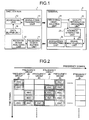
- Fig. 1 is an example of a configuration of a radio communication system according to the present invention.
- the radio communication system includes, for example, a base station 1, and a plurality of terminals (although only one terminal 2 is shown in Fig. 1 as an example) each being under control of the base station 1.
- the base station 1 includes a receiving/demodulating unit 11, a received-signal analyzing unit 12, a scheduling unit 13, a modulating/transmitting unit 14, and a data buffer unit 15.
- the terminal 2 includes a receiving/demodulating unit 21, a quality-information organizing unit 22, an ACK/NACK generating unit 23, a signal multiplexing unit 24, and a modulating/transmitting unit 25.
- Fig. 2 depicts how five terminals in the communication system return an ACK or an NACK and a CQI through the same channels (the same frequency groups).
- a system frequency band is divided into many frequency groups from #1 to #n.
- the base station 1 performs scheduling in units of sub-frames in a direction of a time domain.
- the channels (frequency groups) assigned to the respective terminals are represented by different hatchings.
- channel assignment is performed according to a method of previously relating channels to be assigned to data transmission and channels to be assigned to return of an ACK or an NACK (ACK or NACK return), a method of reassigning channels for an ACK or an NACK return (ACK/NACK returning channels) regardless of channels assigned to data transmission, and the like.
- each terminal reports a CQI using the ACK/NACK returning channel. Accordingly, unoccupied channels that can be used for data transmission can be increased as compared to the conventional technology.
- the 3GPP does not specify a method of assigning channels to be used for return of the ACK or the NACK.
- the receiving/demodulating unit 21 periodically receives a pilot signal from the base station 1, measures a channel quality based on the received pilot signal, and outputs the channel quality (such as a level of the received signal) to the quality-information organizing unit 22.
- the quality-information organizing unit 22 accumulates the channel quality information that it receives periodically. At this time, an average of the information received during a given time period can be calculated.
- the receiving/demodulating unit 21 sometimes receives data dedicated to the terminal 2 itself. In such cases, the receiving/demodulating unit 21 outputs a result of decoding of the data to the ACK/NACK generating unit 23.
- the ACK/NACK generating unit 23 generates an ACK (in the case of a successful reception) or an NACK (in the case of an unsuccessful reception) based on the received result of the decoding.
- the quality-information organizing unit 22 outputs a CQI at a timing at which an ACK or a NACK is output by the ACK/NACK generating unit 23.
- the signal multiplexing unit 24 multiplexes a CQI received from the quality-information organizing unit 22 and an ACK or an NACK received from the ACK/NACK generating unit 23, and outputs a multiplexed signal to the modulating/transmitting unit 25.
- the modulating/transmitting unit 25 transmits the received multiplexed signal (including the CQI and the ACK or the NACK) to the base station 1 as a radio signal.
- the receiving/demodulating unit 11 demodulates the received signal, and outputs a demodulated signal to the received-signal analyzing unit 12.
- the received-signal analyzing unit 12 demultiplexes the demodulated signal into the original CQI, the ACK or the NACK, and other signals, identifies the demultiplexed signals, and outputs the CQI and information relating to the ACK or the NACK (ACK/NACK information) to the scheduling unit 13.
- the scheduling unit 13 selects a channel (frequency group) to which the data to be transmitted is assigned, and specifies an appropriate modulation method and error correcting redundancy.
- the scheduling unit 13 determines whether new data is to be transmitted or retransmission data is to be transmitted, based on the obtained ACK/NACK information.
- the scheduling unit 13 outputs information about the selected channel, the modulation method, and the error correcting coding rate, together with the transmission data, to the modulating/transmitting unit 14.
- the modulating/transmitting unit 14 performs predetermined error correction coding and modulation to the data, and transmits resultant data to the terminal as a radio signal. Pilot signals are appropriately inserted into the channel through which the data is transmitted, and channels used for other purposes.
- the data buffer unit 15 buffers data for each terminal, arriving from upper layers.
- the channel assigned to the return of an ACK or an NACK can be used also for the report of a CQI, thereby increasing unoccupied channels. Accordingly, radio resource can be effectively utilized.
- Fig. 3 depicts how a CQI is reported in the first embodiment.
- a CQI is reported at times t1, t2, and t3, respectively, together with an ACK or an NACK.
- frequency groups having higher channel qualities are reported. Specifically, at the time t1, frequency group IDs of frequency groups f3, f2, and f5, and qualities x3, x2, and x5 thereof are reported.
- the quality-information organizing unit 22 performs a process of organizing the order of channel qualities.
- the CQI reporting method when reporting a CQI, always only N frequency groups having higher channel qualities are reported. Thus, a data amount of one CQI report can be reduced.
- a scheduler i.e., the scheduling unit 13
- receives the CQI report and selects a channel for data transmission always selects a channel having a satisfactory channel quality and that can transmit the maximum amount of data. Therefore, the CQI reporting method according to the present embodiment has compatibility with the scheduling method.
- Fig. 4 depicts how a CQI is reported in the second embodiment.
- N frequency groups among target frequency groups are reported in one CQI report.
- a CQI report of N different frequency groups is repeatedly provided, resulting in CQI reporting of all the frequency groups to be reported by plural times of the reports.
- frequency group IDs of frequency groups f1, f2, and f3, and qualities x1, x2, and x3 thereof are reported.
- frequency groups (f4, f5, and f6) and qualities (x4, x5, and x6) are reported at the time t2
- frequency groups (f7, f8, and f9) and qualities (x7, x8, and x9) are reported at the time t3.
- the frequency group f1 and the qualities (x1, x2, and x3) are reported at the time t1
- the frequency group f4 and the qualities (x4, x5, and x6) are reported at the time t2
- the frequency group f7 and qualities (x7, x8, and x9) are reported at the time t3.
- the quality-information organizing unit 22 performs a process of changing the channel qualities to be reported at each time.
- the CQI reporting of all the frequency groups to be reported is performed in plural batches.
- a data amount of one CQI report can be reduced.
- This invention is particularly effective in environments in which it takes time to report channel qualities of all frequency groups to the scheduler (corresponding to the scheduling unit 13), while the terminal has a low movement speed and the channel qualities change slowly.
- a configuration of a radio communication system, and a manner in which a terminal returns an NACK and a CQI through the same channel according to the third embodiment are the same as those described with reference to Figs. 1 and 2 . Processes that are performed in a different manner from that in the first embodiment are only explained below.
- Fig. 5 depicts how a CQI is reported in the third embodiment.
- N frequency groups having higher channel qualities among target frequency groups are reported in one CQI report.
- no CQI report is provided when an ACK is returned, and a CQI report is provided only when an NACK is returned.
- An NACK is returned at the time t1.
- frequency group IDs of frequency groups f3, f2, and f5 having higher channel qualities, and qualities x3, x2, and x5 thereof are reported simultaneously with the NACK.
- an ACK is returned at the time t2 so that no CQI report is provided.
- an NACK is returned again at the time t3.
- the quality-information organizing unit 22 performs a process of organizing the order of the channel qualities and a process of determining an ACK or an NACK. For example, the quality-information organizing unit 22 detects a trigger of NACK transmission from the ACK/NACK generating unit 23 (corresponding to the process of determining an ACK or an NACK), and outputs a CQI only when a trigger is detected.
- a CQI report is provided through the same channel as an NACK. Accordingly, a data amount of the CQI report can be reduced more than that of the first embodiment.
- the scheduler i.e., the scheduling unit 13
- the scheduler can be informed that selection of a channel used for data transmission is inappropriate, or the modulation method or the error correcting coding rate during use of the selected channel is inappropriate. Because the CQI report is not provided when an ACK is returned, the corresponding field can be used for other purposes. For example, an unused field can be used to further encode the ACK, thereby reducing an error rate of the ACK.
- a configuration of a radio communication system, and a manner in which a terminal returns an ACK or an NACK and a CQI through the same channel according to the fourth embodiment are the same as those described with reference to Figs. 1 and 2 . Processes that are performed in a different manner from that in the first embodiment are only explained below.
- Fig. 6 depicts how a CQI is reported in the fourth embodiment.
- N frequency groups having higher channel qualities among target frequency groups, and an average of qualities of other frequency groups are reported in one CQI report.
- frequency group IDs of frequency groups f3, f2, and f5, and qualities x3, x2, and x5 thereof are reported.
- An average quality xa1 of frequency groups f1, f4, and f6 to f9 is also reported.
- frequency groups (f5, f3, and f6) and qualities (x5, x3, and x6), and an average quality xa2 of frequency groups f1, f2, f4, and f7 to f9 are reported at the time t2.
- Frequency groups (f6, f5, and f2) and qualities (x6, x5, and x2), and an average quality xa3 of frequency groups f1, f3, f4, and f7 to f9 are reported at the time t3.
- the quality-information organizing unit 22 performs a process of calculating the average quality.
- N frequency groups having higher channel qualities and an average quality of frequency groups having qualities equal to and lower than that of an (N+1)th frequency group are reported.
- an appropriate modulation method or error correcting coding rate can be defined more easily as compared to a case that there is no latest quality information relating to the (N+1)th frequency group and frequency groups having lower qualities. Accordingly, an increase in a data reception probability is expected.
- frequency groups that have been individually reported are eliminated from targets of the quality averaging. However, these frequency groups can be included in the targets of the quality averaging.
- the explanations have been given based on the CQI reporting using the same channel as the ACK/NACK returning channel.
- a method of always providing a CQI report with respect to N frequency groups having higher channel qualities, or a method of providing a CQI report with respect to all frequency groups to be reported in plural branches is not affected by a channel that is used to provide a report. Accordingly, the present invention can be applied also to a case that an independent channel is used for CQI reporting.
- the communication apparatus according to the present invention is effective in a radio communication system having plural communication channels on a frequency domain, and is particularly suitable for a communication apparatus that provides a CQI report.
Landscapes
- Engineering & Computer Science (AREA)
- Computer Networks & Wireless Communication (AREA)
- Signal Processing (AREA)
- Quality & Reliability (AREA)
- Mobile Radio Communication Systems (AREA)
Applications Claiming Priority (1)
| Application Number | Priority Date | Filing Date | Title |
|---|---|---|---|
| PCT/JP2006/301847 WO2007088629A1 (fr) | 2006-02-03 | 2006-02-03 | Appareil de communication, systeme de communication radio et procede de communication radio |
Publications (2)
| Publication Number | Publication Date |
|---|---|
| EP1981299A1 true EP1981299A1 (fr) | 2008-10-15 |
| EP1981299A4 EP1981299A4 (fr) | 2009-11-18 |
Family
ID=38327219
Family Applications (1)
| Application Number | Title | Priority Date | Filing Date |
|---|---|---|---|
| EP06712990A Withdrawn EP1981299A4 (fr) | 2006-02-03 | 2006-02-03 | Appareil de communication, systeme de communication radio et procede de communication radio |
Country Status (5)
| Country | Link |
|---|---|
| US (1) | US20100232367A1 (fr) |
| EP (1) | EP1981299A4 (fr) |
| JP (1) | JPWO2007088629A1 (fr) |
| CN (1) | CN101361391A (fr) |
| WO (1) | WO2007088629A1 (fr) |
Cited By (2)
| Publication number | Priority date | Publication date | Assignee | Title |
|---|---|---|---|---|
| WO2014153769A1 (fr) * | 2013-03-29 | 2014-10-02 | 华为技术有限公司 | Procédé de transmission d'informations de rétroaction, équipement utilisateur et nœud b évolué |
| EP3836467A4 (fr) * | 2018-08-10 | 2022-05-11 | ZTE Corporation | Procédé, dispositif et système d'amélioration de rétroaction d'indicateur de qualité de canal, équipement utilisateur et station de base |
Families Citing this family (8)
| Publication number | Priority date | Publication date | Assignee | Title |
|---|---|---|---|---|
| TWI446744B (zh) | 2006-03-20 | 2014-07-21 | Koninkl Philips Electronics Nv | 時變信號品質報告 |
| KR101269201B1 (ko) * | 2006-06-30 | 2013-05-28 | 삼성전자주식회사 | 폐 루프 방식의 다중 안테나 시스템에서 데이터송/수신장치 및 방법 |
| US8281201B2 (en) | 2008-02-03 | 2012-10-02 | Lg Electronics Inc. | Method and apparatus for supporting HARQ |
| KR101558571B1 (ko) * | 2008-02-03 | 2015-10-08 | 엘지전자 주식회사 | Harq를 지원하는 방법 및 장치 |
| JP2010278887A (ja) * | 2009-05-29 | 2010-12-09 | Panasonic Corp | 基地局装置、端末装置、無線通信システム及び送信方法 |
| CN101997666B (zh) * | 2009-08-18 | 2013-08-07 | 华为技术有限公司 | 多载波模式下的信息处理方法和设备 |
| US10097336B2 (en) * | 2015-11-30 | 2018-10-09 | Qualcomm Incorporated | Uplink (UL) frequency-division duplex (FDD) subframe |
| JP2019208083A (ja) * | 2016-09-29 | 2019-12-05 | シャープ株式会社 | 端末装置、基地局装置、通信方法、および、集積回路 |
Family Cites Families (5)
| Publication number | Priority date | Publication date | Assignee | Title |
|---|---|---|---|---|
| DE60216269T2 (de) * | 2002-08-06 | 2007-05-10 | Mitsubishi Electric Information Technology Centre Europe B.V. | Übertragungsqualitätsberichtverfahren |
| JP4256158B2 (ja) * | 2002-12-26 | 2009-04-22 | パナソニック株式会社 | 無線通信装置及び無線通信方法 |
| JP3860556B2 (ja) * | 2003-04-04 | 2006-12-20 | 松下電器産業株式会社 | 基地局装置及び通信方法 |
| EP1646163B1 (fr) * | 2003-08-06 | 2013-04-24 | Panasonic Corporation | Dispositif et procede de radiocommunication |
| KR100566274B1 (ko) * | 2003-11-20 | 2006-03-30 | 삼성전자주식회사 | 직교주파수분할다중 시스템에서 부반송파 할당 장치 및방법 |
-
2006
- 2006-02-03 US US12/160,609 patent/US20100232367A1/en not_active Abandoned
- 2006-02-03 EP EP06712990A patent/EP1981299A4/fr not_active Withdrawn
- 2006-02-03 JP JP2007556765A patent/JPWO2007088629A1/ja active Pending
- 2006-02-03 WO PCT/JP2006/301847 patent/WO2007088629A1/fr not_active Ceased
- 2006-02-03 CN CNA2006800511208A patent/CN101361391A/zh active Pending
Cited By (4)
| Publication number | Priority date | Publication date | Assignee | Title |
|---|---|---|---|---|
| WO2014153769A1 (fr) * | 2013-03-29 | 2014-10-02 | 华为技术有限公司 | Procédé de transmission d'informations de rétroaction, équipement utilisateur et nœud b évolué |
| EP3836467A4 (fr) * | 2018-08-10 | 2022-05-11 | ZTE Corporation | Procédé, dispositif et système d'amélioration de rétroaction d'indicateur de qualité de canal, équipement utilisateur et station de base |
| AU2019318672B2 (en) * | 2018-08-10 | 2022-07-07 | Zte Corporation | Channel quality indicator feedback enhancement method, device and system, user equipment, and base station |
| US11870568B2 (en) | 2018-08-10 | 2024-01-09 | Zte Corporation | Channel quality indicator feedback enhancement method, device and system, user equipment, and base station |
Also Published As
| Publication number | Publication date |
|---|---|
| WO2007088629A1 (fr) | 2007-08-09 |
| US20100232367A1 (en) | 2010-09-16 |
| CN101361391A (zh) | 2009-02-04 |
| JPWO2007088629A1 (ja) | 2009-06-25 |
| EP1981299A4 (fr) | 2009-11-18 |
Similar Documents
| Publication | Publication Date | Title |
|---|---|---|
| US10165558B2 (en) | Data communication method, communication system and mobile terminal | |
| US8325593B2 (en) | Mobile communication system, base station, user device, and method | |
| US9008034B2 (en) | Base station and broadcast channel transmission method | |
| US8195186B2 (en) | Resource allocation | |
| US8150405B2 (en) | Transmitting apparatus and method | |
| US8483170B2 (en) | User equipment terminal, base station, and channel quality information report method | |
| AU2008308186B2 (en) | User equipment terminal, base station, and control information transmission method | |
| US20080253336A1 (en) | Multi-Carrier CQI Feedback Method and Apparatus | |
| JP4122233B2 (ja) | 物理チャネル構成シグナルプロシージャ | |
| EP2063654A1 (fr) | Station de base radio utilisée dans un système de communication mobile | |
| CN103139924A (zh) | 一种调度资源的方法及装置 | |
| US20100014490A1 (en) | Mobile station apparatus and base station apparatus | |
| EP1981299A1 (fr) | Appareil de communication, systeme de communication radio et procede de communication radio | |
| US20020191579A1 (en) | Physical channel configuration signaling procedures | |
| EP1681812A1 (fr) | Procédé de transmission des canaux de radiodiffusion dans un système cellulaire de communications sans fil | |
| US20080031217A1 (en) | Method For Selecting Receiving Stations In A Data Radio Transmitting System | |
| RU2021112813A (ru) | Пользовательское оборудование и система, выполняющая операции передачи и приема |
Legal Events
| Date | Code | Title | Description |
|---|---|---|---|
| PUAI | Public reference made under article 153(3) epc to a published international application that has entered the european phase |
Free format text: ORIGINAL CODE: 0009012 |
|
| 17P | Request for examination filed |
Effective date: 20080804 |
|
| AK | Designated contracting states |
Kind code of ref document: A1 Designated state(s): DE FR GB |
|
| RAP1 | Party data changed (applicant data changed or rights of an application transferred) |
Owner name: MITSUBISHI ELECTRIC CORPORATION |
|
| RBV | Designated contracting states (corrected) |
Designated state(s): DE FR GB |
|
| A4 | Supplementary search report drawn up and despatched |
Effective date: 20091020 |
|
| RIC1 | Information provided on ipc code assigned before grant |
Ipc: H04W 72/08 20090101AFI20091014BHEP |
|
| STAA | Information on the status of an ep patent application or granted ep patent |
Free format text: STATUS: THE APPLICATION HAS BEEN WITHDRAWN |
|
| 18W | Application withdrawn |
Effective date: 20101102 |