EP1982817A2 - Herstellung von Formteilen - Google Patents
Herstellung von Formteilen Download PDFInfo
- Publication number
- EP1982817A2 EP1982817A2 EP08450058A EP08450058A EP1982817A2 EP 1982817 A2 EP1982817 A2 EP 1982817A2 EP 08450058 A EP08450058 A EP 08450058A EP 08450058 A EP08450058 A EP 08450058A EP 1982817 A2 EP1982817 A2 EP 1982817A2
- Authority
- EP
- European Patent Office
- Prior art keywords
- thermoplastic material
- decorative material
- thermoplastic
- gas
- decorative
- Prior art date
- Legal status (The legal status is an assumption and is not a legal conclusion. Google has not performed a legal analysis and makes no representation as to the accuracy of the status listed.)
- Withdrawn
Links
- 238000004519 manufacturing process Methods 0.000 title claims abstract description 11
- 239000000463 material Substances 0.000 claims abstract description 54
- 238000000034 method Methods 0.000 claims abstract description 27
- 239000007789 gas Substances 0.000 claims abstract description 20
- 238000000465 moulding Methods 0.000 claims abstract description 19
- 238000002347 injection Methods 0.000 claims abstract description 16
- 239000007924 injection Substances 0.000 claims abstract description 16
- 239000002649 leather substitute Substances 0.000 claims abstract description 16
- 229920001169 thermoplastic Polymers 0.000 claims abstract description 13
- -1 polybutylene terephthalate Polymers 0.000 claims abstract description 12
- 239000004033 plastic Substances 0.000 claims abstract description 11
- 229920003023 plastic Polymers 0.000 claims abstract description 11
- 239000004416 thermosoftening plastic Substances 0.000 claims abstract description 11
- 229920006324 polyoxymethylene Polymers 0.000 claims abstract description 7
- KAKZBPTYRLMSJV-UHFFFAOYSA-N Butadiene Chemical compound C=CC=C KAKZBPTYRLMSJV-UHFFFAOYSA-N 0.000 claims abstract description 6
- CURLTUGMZLYLDI-UHFFFAOYSA-N Carbon dioxide Chemical compound O=C=O CURLTUGMZLYLDI-UHFFFAOYSA-N 0.000 claims abstract description 6
- 239000004743 Polypropylene Substances 0.000 claims abstract description 6
- PPBRXRYQALVLMV-UHFFFAOYSA-N Styrene Chemical compound C=CC1=CC=CC=C1 PPBRXRYQALVLMV-UHFFFAOYSA-N 0.000 claims abstract description 6
- 229920001155 polypropylene Polymers 0.000 claims abstract description 6
- 229920001707 polybutylene terephthalate Polymers 0.000 claims abstract description 5
- 229920000642 polymer Polymers 0.000 claims abstract description 4
- NLHHRLWOUZZQLW-UHFFFAOYSA-N Acrylonitrile Chemical compound C=CC#N NLHHRLWOUZZQLW-UHFFFAOYSA-N 0.000 claims abstract description 3
- IJGRMHOSHXDMSA-UHFFFAOYSA-N Atomic nitrogen Chemical compound N#N IJGRMHOSHXDMSA-UHFFFAOYSA-N 0.000 claims abstract description 3
- 229920000049 Carbon (fiber) Polymers 0.000 claims abstract description 3
- 229930182556 Polyacetal Natural products 0.000 claims abstract description 3
- 229910002092 carbon dioxide Inorganic materials 0.000 claims abstract description 3
- 239000001569 carbon dioxide Substances 0.000 claims abstract description 3
- 239000004917 carbon fiber Substances 0.000 claims abstract description 3
- 239000000835 fiber Substances 0.000 claims abstract description 3
- 239000003365 glass fiber Substances 0.000 claims abstract description 3
- JCXJVPUVTGWSNB-UHFFFAOYSA-N nitrogen dioxide Inorganic materials O=[N]=O JCXJVPUVTGWSNB-UHFFFAOYSA-N 0.000 claims abstract description 3
- 229920000515 polycarbonate Polymers 0.000 claims abstract description 3
- 239000004417 polycarbonate Substances 0.000 claims abstract description 3
- 239000012779 reinforcing material Substances 0.000 claims abstract description 3
- 239000012815 thermoplastic material Substances 0.000 claims description 27
- 229930040373 Paraformaldehyde Natural products 0.000 claims description 2
- 239000000945 filler Substances 0.000 claims description 2
- 239000000203 mixture Substances 0.000 claims description 2
- 229920002397 thermoplastic olefin Polymers 0.000 claims description 2
- 238000001746 injection moulding Methods 0.000 abstract description 21
- 239000010985 leather Substances 0.000 abstract description 18
- 229920000098 polyolefin Polymers 0.000 abstract description 2
- 229920002994 synthetic fiber Polymers 0.000 abstract 4
- 240000004759 Inga spectabilis Species 0.000 abstract 1
- 238000005187 foaming Methods 0.000 description 7
- 238000005516 engineering process Methods 0.000 description 6
- 238000002474 experimental method Methods 0.000 description 5
- 239000002991 molded plastic Substances 0.000 description 2
- 230000000717 retained effect Effects 0.000 description 2
- 239000004753 textile Substances 0.000 description 2
- 239000004604 Blowing Agent Substances 0.000 description 1
- 239000011324 bead Substances 0.000 description 1
- 238000005452 bending Methods 0.000 description 1
- 230000006835 compression Effects 0.000 description 1
- 238000007906 compression Methods 0.000 description 1
- 239000002657 fibrous material Substances 0.000 description 1
- 238000003475 lamination Methods 0.000 description 1
- 239000002984 plastic foam Substances 0.000 description 1
- 239000000126 substance Substances 0.000 description 1
- 229920005992 thermoplastic resin Polymers 0.000 description 1
- 230000000007 visual effect Effects 0.000 description 1
- 239000002699 waste material Substances 0.000 description 1
Images

Classifications
-
- B—PERFORMING OPERATIONS; TRANSPORTING
- B29—WORKING OF PLASTICS; WORKING OF SUBSTANCES IN A PLASTIC STATE IN GENERAL
- B29C—SHAPING OR JOINING OF PLASTICS; SHAPING OF MATERIAL IN A PLASTIC STATE, NOT OTHERWISE PROVIDED FOR; AFTER-TREATMENT OF THE SHAPED PRODUCTS, e.g. REPAIRING
- B29C44/00—Shaping by internal pressure generated in the material, e.g. swelling or foaming ; Producing porous or cellular expanded plastics articles
- B29C44/34—Auxiliary operations
- B29C44/3469—Cell or pore nucleation
- B29C44/348—Cell or pore nucleation by regulating the temperature and/or the pressure, e.g. suppression of foaming until the pressure is rapidly decreased
-
- B—PERFORMING OPERATIONS; TRANSPORTING
- B29—WORKING OF PLASTICS; WORKING OF SUBSTANCES IN A PLASTIC STATE IN GENERAL
- B29C—SHAPING OR JOINING OF PLASTICS; SHAPING OF MATERIAL IN A PLASTIC STATE, NOT OTHERWISE PROVIDED FOR; AFTER-TREATMENT OF THE SHAPED PRODUCTS, e.g. REPAIRING
- B29C44/00—Shaping by internal pressure generated in the material, e.g. swelling or foaming ; Producing porous or cellular expanded plastics articles
- B29C44/02—Shaping by internal pressure generated in the material, e.g. swelling or foaming ; Producing porous or cellular expanded plastics articles for articles of definite length, i.e. discrete articles
- B29C44/12—Incorporating or moulding on preformed parts, e.g. inserts or reinforcements
- B29C44/14—Incorporating or moulding on preformed parts, e.g. inserts or reinforcements the preformed part being a lining
-
- B—PERFORMING OPERATIONS; TRANSPORTING
- B29—WORKING OF PLASTICS; WORKING OF SUBSTANCES IN A PLASTIC STATE IN GENERAL
- B29C—SHAPING OR JOINING OF PLASTICS; SHAPING OF MATERIAL IN A PLASTIC STATE, NOT OTHERWISE PROVIDED FOR; AFTER-TREATMENT OF THE SHAPED PRODUCTS, e.g. REPAIRING
- B29C44/00—Shaping by internal pressure generated in the material, e.g. swelling or foaming ; Producing porous or cellular expanded plastics articles
- B29C44/34—Auxiliary operations
- B29C44/3442—Mixing, kneading or conveying the foamable material
- B29C44/3446—Feeding the blowing agent
-
- B—PERFORMING OPERATIONS; TRANSPORTING
- B29—WORKING OF PLASTICS; WORKING OF SUBSTANCES IN A PLASTIC STATE IN GENERAL
- B29K—INDEXING SCHEME ASSOCIATED WITH SUBCLASSES B29B, B29C OR B29D, RELATING TO MOULDING MATERIALS OR TO MATERIALS FOR MOULDS, REINFORCEMENTS, FILLERS OR PREFORMED PARTS, e.g. INSERTS
- B29K2105/00—Condition, form or state of moulded material or of the material to be shaped
- B29K2105/04—Condition, form or state of moulded material or of the material to be shaped cellular or porous
- B29K2105/041—Microporous
Definitions
- the present invention relates to a method for the production of molded parts with surface-structured decorative material, in particular real or artificial leather, covered surface by injection molding by means of physical foaming process, hereinafter called "back-foaming" of the decorative material with thermoplastic material in a mold.
- injection-molded plastic parts are used today in a variety of applications, including in vehicle manufacturing. To improve the appearance, it is also known to occupy the injection-molded plastic parts on their surface with decorative material.
- decorative material In particular, textiles as well as synthetic or genuine leather are considered as decorative materials.
- the covering of the plastic parts can be done in principle in two ways, namely by relatively complex lamination of the finished plastic parts, but this is particularly problematic in complicated shaped plastic parts, or by back-foaming the decorative material with thermoplastic material in a mold.
- foam-foaming the decorative material is first inserted into the still empty mold and then in one step, a thermoplastic material injected behind the decorative material ("back-foamed”), which is obtained when you open the mold, the already occupied plastic part.
- the DE 41 27 241 A1 also relates to a process for the production of molded parts with a surface covered with decorative material by injection molding the decorative material with thermoplastic material in a mold, wherein the decorative material inserted into the mold is curved by the movement of a part of the mold at the outer edges, whereby also the production of Decor-covered moldings with Umbug, ie completely covered outer edges, is made possible.
- the decorative material of a molded back part is at least partially more than 1.1 times its original length and / or Width stretched, to which the decorative material is heated before injection selectively at the points with strong curvature.
- surface-structured decorative materials in particular genuine or artificial leather (for example PVC skins), are also mentioned as a possible decorative material.
- genuine or artificial leather for example PVC skins
- any surface structures of the decorative material are lost or the decorative material can warp irregularly due to stretching, whereby, for example, uniform geometric structures in the decorative material contained, the visual appearance of the occupied plastic parts is disturbed.
- the EP 1 621 312 A2 discloses injection molding processes which include admixing gas to a molten thermoplastic material prior to injecting the plastic into a mold, which mold may also include an outer layer of leather. It is an "Injection Compression" process in which the mold is expanded during injection or after injection in terms of its volume.
- the EP 0 876 891 A1 discloses injection molded parts in which a synthetic leather is injected behind.
- the thermoplastic material, the gas is mixed only after introduction.
- the EP 1 243 397 A2 also relates to a method in which a molded part is produced by injection molding, wherein the volume of the mold is increased during injection molding.
- the EP 1 336 462 A2 finally describes moldings which are foamed; Again, an opening of the tool halves is disclosed by a predetermined amount.
- the object of the present invention is to provide a method for the production of molded parts with surface-structured decorative material, in particular real or artificial leather, covered surface by injection molding by means of physical foaming of the decorative material with thermoplastic material in a mold, wherein the finished product substantially the same Surface structure has like the original surface-structured decorative material.
- This object is achieved in that prior to or during the injection of the thermoplastic material in the already containing the decorative material mold, the molten thermoplastic material, a gas is added in a supercritical state.
- a gas is added in a supercritical state.
- higher foaming degrees are possible than with conventional addition of the gas, for example only under elevated pressure.
- the thermoplastic material is selected from the group comprising acrylonitrile / butadiene / styrene (ABS), polybutylene terephthalate (PBT, PBTP), polycarbonate (PC), polypropylene (PP), polyoxymethylene / polyacetal (POM), thermoplastic Olefin polymer (TPO-ET) and mixtures thereof, optionally containing filler and reinforcing material, such as glass fibers, carbon fibers or plastic fibers.
- ABS acrylonitrile / butadiene / styrene
- PBT polybutylene terephthalate
- PC polycarbonate
- PP polypropylene
- POM polyoxymethylene / polyacetal
- TPO-ET thermoplastic Olefin polymer
- the molten thermoplastic plastic is admixed with nitrogen or carbon dioxide as gas.
- the gas is added to the thermoplastic during injection into the already containing the decorative material molding tool.
- This process variant also known as "Optifoam system” or “Optifoam process” and brought by the company. Sulzer (Switzerland) to series maturity, can be retrofitted in injection molding machines, wherein on the machine itself no changes are necessary, also the machine continue to be used for conventional injection molding.
- the shot weight ie the amount of injectable in an injection molding in the mold mass of molten thermoplastic material
- the upper limit of the shot weight is depending on the design at about 1000 g.
- the gas is added to the molten thermoplastic material prior to injection into the already containing the decorative material molding tool.
- the gas is already admixed in the plasticizing of the injection molding machine to the molten thermoplastic, whereby a separate plasticizing unit is necessary.
- the advantage of the MuCell process lies in the fact that even larger moldings with a required shot weight well over 1000 g can be produced.
- the present invention relates to a molded part consisting of thermoplastic material back-injected surface-structured decorative material, in particular real or artificial leather, wherein the thermoplastic resin compact edge layers and a core area with bubbles having a diameter of 10 to 100 .mu.m, preferably 10 to 50 microns , having.
- Such moldings have improved properties than compact moldings, for example, allow the compact edge layers and the core with microscopic bubbles improved bending property.
- Such moldings can be prepared, for example, by the two methods according to the invention, but they can also be produced by chemical foaming (use of a polymer with blowing agent).
- a particular advantage of the new molded parts lies in the fact that for the first time a shaped part coated with surface-structured decorative material is made available, which represents an emission-free bond of the decorative material with the plastic part, with the possibility of wrinkle-free execution of beads, corners or radii.
- 3 and 4 consists of the molding 1 of the invention with foamed-thermoplastic 2 hinterspritzten surface-structured decorative material 4, in particular real or artificial leather, wherein the molding 1 according to the invention further comprises a veneer 3.
- both one using Optifoam technology ie admixing a supercritical gas to the molten thermoplastic during injection into the decorating material already contained in the decorating material
- one using MuCell technology ie admixing a supercritical gas to the molten thermoplastic Plastic before injection
- the molded parts consisted of genuine leather or synthetic leather, back-foamed with Hostacom G2, a polypropylene from Basell Polyolefins (USA).
- the mold using the Optifoam technology was equipped with a hot runner and 4 needle shut-off nozzles (2 per cavity) as well as air connections for controlling the textile fastening.
- CO 2 was used as gas due to the better solubility in the thermoplastic material. It was used as decorative material art and genuine leather parts inserted into the mold and recorded both in the injection molding of the leather parts in conventional compact injection molding process as well as the back molding of the leather parts with the method according to the invention internal cavity pressure curves.
- the first attempt was by means of a conventional compact injection molding process using Hostacom G2 without admixing a gas Genuine leather parts at a temperature of the molten thermoplastic material of 250 ° C and internal mold back pressures of 270 - 300 bar back-injected.
- the leather decor of the finished moldings showed a significant loss of the leather surface structure distributed over the entire surface.
- the structural loss was not so bad, but still clearly noticeable.
Landscapes
- Injection Moulding Of Plastics Or The Like (AREA)
Abstract
Description
- Die vorliegende Erfindung betrifft ein Verfahren zur Herstellung von Formteilen mit von oberflächenstrukturiertem Dekormaterial, insbesondere Echt- oder Kunstleder, bedeckter Oberfläche durch Hinterspritzen mittels physikalischen Schäumverfahren, nachfolgend "Hinterschäumen" genannt des Dekormaterials mit thermoplastischem Kunststoff in einem Formwerkzeug.
- Allgemein werden spritzgegossene Kunststoffteile heutzutage in einer Vielzahl von Anwendungen verwendet, darunter auch im Fahrzeugbau. Zur Verbesserung des Aussehens ist es auch bekannt, die spritzgegossenen Kunststoffteile an ihrer Oberfläche mit Dekormaterial zu belegen. Als Dekormaterialien kommen dabei insbesondere Textilien sowie Kunst- oder Echtleder in Betracht. Das Belegen der Kunststoffteile kann dabei prinzipiell auf zwei Arten erfolgen, nämlich durch relativ aufwändiges Kaschieren der fertigen Kunststoffteile, was jedoch insbesondere bei kompliziert geformten Kunststoffteilen problematisch ist, oder durch Hinterschäumen des Dekormaterials mit thermoplastischem Kunststoff in einem Formwerkzeug. Beim Hintersschäumen wird das Dekormaterial zuerst in das noch leere Formwerkzeug eingelegt und dann wird in einem Arbeitsschritt ein thermoplastischer Kunststoff hinter das Dekormaterial gespritzt ("hinterschäumt"), wodurch beim Öffnen des Formwerkzeugs der bereits fertig belegte Kunststoffteil erhalten wird.
- So beschreibt die
DE 41 22 412 A1 ein Verfahren zur Herstellung von Formteilen mit von Dekormaterial bedeckter Oberfläche durch Hinterspritzen des Dekormaterials mit thermoplastischem Kunststoff in einem Formwerkzeug, bei dem das Dekormaterial mit rinnenförmig gebogenen Außenrändern in das Formwerkzeug eingelegt wird. Das Verfahren ermöglicht die Herstellung von dekorbedeckten Formteilen mit Umbug, d.h. vollständig bedeckten Außenkanten. - Die
DE 41 27 241 A1 betrifft ebenfalls ein Verfahren zur Herstellung von Formteilen mit von Dekormaterial bedeckter Oberfläche durch Hinterspritzen des Dekormaterials mit thermoplastischem Kunststoff in einem Formwerkzeug, wobei das in die Form eingelegte Dekormaterial durch die Bewegung eines Teils des Formwerkzeugs an den Außenrändern rinnenförmig gebogen wird, wodurch ebenfalls die Herstellung von dekorbedeckten Formteilen mit Umbug, d.h. vollständig bedeckten Außenkanten, ermöglicht wird. - Gemäß der
DE 42 28 282 wird das Dekormaterial eines hinterspritzen Formteils zumindest teilweise auf mehr als das 1,1-fache seiner ursprünglichen Länge und/oder Breite verstreckt, wozu das Dekormaterial vor dem Hinterspritzen selektiv an den Stellen mit starker Raumkrümmung erwärmt wird. - In allen drei Schriften werden als mögliches Dekormaterial auch oberflächenstrukturierte Dekormaterialien, insbesondere Echt- oder Kunstleder (beispielsweise PVC-Häute) erwähnt. Problematisch und nachteilig ist dabei jedoch, dass aufgrund der notwendigen hohen Innendrücke in Kombination mit relativ hohen Temperaturen beim Hinterspritzen des Dekormaterials etwaige Oberflächenstrukturen des Dekormaterials verloren gehen bzw. sich das Dekormaterial durch die Verstreckung unregelmäßig verziehen kann, wodurch, etwa wenn im Dekormaterial gleichmäßige geometrische Strukturen enthalten sind, das optische Erscheinungsbild der belegten Kunststoffteile gestört wird.
- Die
EP 1 621 312 A2 offenbart Spritzgussverfahren, welche das Beimischen von Gas zu einem schmelzflüssigen, thermoplastischen Kunststoff, vor Einspritzen des Kunststoffes in ein Formwerkzeug umfassen, wobei das Formwerkzeug auch eine Außenschicht aus Leder beinhalten kann. Es handelt sich dabei um ein "Injection Compression" Verfahren, in welchem das Formwerkzeug während des Einspritzens bzw. nach dem Einspritzen hinsichtlich seines Volumens erweitert wird. - Die
EP 0 876 891 A1 offenbart Spritzgussformteile, bei denen ein Kunstleder hinterspritzt wird. Dem thermoplastischen Kunststoff wird das Gas erst nach Einbringen beigemischt. - Die
EP 1 243 397 A2 betrifft ebenfalls ein Verfahren, in welchem ein Formteil durch Spritzguss hergestellt wird, wobei das Volumen der Gussform während des Spritzgießens vergrößert wird. - In der
EP 0 446 941 A2 wird wiederum nur Kunstleder als Dekormaterial benannt, auch hier erfolgt die Expansion in der Form. Die Form ist dabei ebenfalls hinsichtlich ihres Volumens veränderlich. - Die
EP 1 336 462 A2 schließlich beschreibt Formteile, welche geschäumt werden; auch hier wird ein Öffnen der Werkzeughälften um einen vorbestimmten Betrag geoffenbart. - Aufgabe der vorliegenden Erfindung ist es, ein Verfahren zur Herstellung von Formteilen mit von oberflächenstrukturiertem Dekormaterial, insbesondere Echt- oder Kunstleder, bedeckter Oberfläche durch Hinterspritzen mittels physikalischen Schäumverfahren des Dekormaterials mit thermoplastischem Kunststoff in einem Formwerkzeug vorzusehen, bei welchem das fertige Produkt im Wesentlichen dieselbe Oberflächenstruktur besitzt wie das ursprüngliche oberflächenstrukturierte Dekormaterial.
- Diese Aufgabe wird erfindungsgemäß dadurch gelöst, dass vor oder während des Einspritzens des thermoplastischen Kunststoffes in das bereits das Dekormaterial enthaltende Formwerkzeug dem schmelzflüssigen thermoplastischen Kunststoff ein Gas in überkritischem Zustand beigemischt wird. Durch das Beimischen (Injizieren) von Gas im überkritischen Zustand in den schmelzflüssigen thermoplastischen Kunststoff vor dem Spritzgießen sind höhere Aufschäumgrade möglich als bei herkömmlicher Beimengung des Gases, beispielsweise nur unter erhöhtem Druck. So entstehen beim Druckabfall im Formwerkzeug im Kunststoff mikroskopisch kleine Bläschen, wodurch der Kunststoff von selbst aufschäumt. Dadurch braucht man bei der Produktion weniger Druck (d.h. einen niedrigeren Innendruck im Formwerkzeug im Vergleich zu herkömmlichem Spritzgießen) und Wärmeenergie, wodurch das fertige Produkt weniger beansprucht wurde und daher praktisch dieselbe Oberflächenstruktur besitzt wie das ursprüngliche oberflächenstrukturierte Dekormaterial. Insbesondere beim Hinterschäumen von stark oberflächenstrukturiertem Dekormaterial, wie Echt- oder Kunstleder, hat sich gezeigt, dass die fertigen Formteile eine praktisch unveränderte Oberflächenstruktur (Narbung) aufweisen wie das eingesetzte Leder. Es sei an dieser Stelle erwähnt, dass das Spritzgießen von mikrozelligem Material, also das Beimischen (Injizieren) von Gas in den schmelzflüssigen thermoplastischen Kunststoff vor dem Spritzgießen, an sich bekannt ist, etwa aus der
EP 0 952 908 B1 , derWO 99/32544 WO 02/26485 WO 02/26482 - Gemäß einer bevorzugten Ausführungsform der vorliegenden Erfindung wird der thermoplastische Kunststoff ausgewählt aus der Gruppe umfassend Acrylnitril/Butadien/Styrol (ABS), Polybutylenterephthalat (PBT, PBTP), Polycarbonat (PC), Polypropylen (PP), Polyoxymethylen/Polyacetal (POM), thermoplastisches Olefin-Polymer (TPO-ET) und Mischungen hievon, gegebenenfalls enthaltend Füll- und Verstärkungsmaterial, wie beispielsweise Glasfasern, Carbonfasern oder Kunststofffasern.
- Vorzugsweise wird beim erfindungsgemäßen Verfahren dem schmelzflüssigen thermoplastischen Kunststoff Stickstoff oder Kohlendioxid als Gas beigemischt.
- Besonders bevorzugt wird das Gas dem thermoplastischen Kunststoff während des Einspritzens in das bereits das Dekormaterial enthaltende Formwerkzeug beigemischt. Diese Verfahrensvariante, auch als "Optifoam-System" bzw. "Optifoam-Verfahren" bekannt und von der Fa. Sulzer (Schweiz) zur Serienreife gebracht, ist bei Spritzgießmaschinen nachrüstbar, wobei an der Maschine selbst keine Änderungen nötig sind, auch kann die Maschine weiterhin für konventionelles Spritzgießen verwendet werden. Weiters sind dem Schussgewicht (also der Menge der in einem Spritzvorgang in das Formwerkzeug einbringbaren Masse an schmelzflüssigem thermoplastischem Kunststoff) auch keine Untergrenzen gesetzt, die Obergrenze des Schussgewichts liegt je nach Ausführung bei etwa 1000 g.
- Gemäß einer weiteren Ausführungsform des erfindungsgemäßen Verfahrens wird das Gas dem schmelzflüssigen thermoplastischen Kunststoff vor dem Einspritzen in das bereits das Dekormaterial enthaltende Formwerkzeug beigemischt. Bei dieser Verfahrensvariante, im Stand der Technik als "MuCell-Verfahren" z.B. der Fa. Trexel (USA), bekannt, wird das Gas bereits in der Plastifiziereinheit der Spritzgießmaschine dem schmelzflüssigen thermoplastischen Kunststoff beigemischt, wodurch eine eigene Plastifiziereinheit notwendig ist. Der Vorteil des MuCell-Verfahrens liegt jedoch darin, dass damit auch größere Formteile mit einem erforderlichen Schussgewicht weit über 1000 g herstellbar sind.
- In einem weiteren Aspekt betrifft die vorliegende Erfindung einen Formteil bestehend aus mit thermoplastischem Kunststoff hinterspritzten oberflächenstrukturierten Dekormaterial, insbesondere Echt- oder Kunstleder, wobei der thermoplastische Kunststoff kompakte Randschichten und einen Kernbereich mit Bläschen mit einem Durchmesser von 10 bis 100 µm, vorzugsweise 10 bis 50 µm, aufweist. Derartige Formteile weisen verbesserte Eigenschaften auf als kompakte Formteile, beispielsweise ermöglichen die kompakten Randschichten und der Kern mit mikroskopisch kleinen Bläschen eine verbesserte Biegeeigenschaft. Herstellbar sind derartige Formteile beispielsweise durch die beiden erfindungsgemäßen Verfahren, sie können aber auch durch chemisches Schäumen (Verwendung eines Polymers mit Treibmittel), hergestellt werden. Ein besonderer Vorteil der neuen Formteile liegt darin, dass mit diesem erstmals ein mit oberflächenstrukturiertem Dekormaterial beschichteter Formteil zur Verfügung gestellt wird, welcher einen emissionsfreien Verbund des Dekormaterials mit dem Kunststoffteil darstellt, mit der Möglichkeit der faltenfreien Ausführung von Sicken, Ecken bzw. Radien.
- In den Zeichnungen zeigen:
-
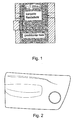
Fig. 1 einen Querschnitt durch einen mittels des Optifoam-Verfahrens hergestellten Formteil ohne Dekormaterial, -
Fig. 2 eine KFZ-Türseitenverkleidung, hergestellt nach dem erfindungsgemäßen Verfahren unter Verwendung der MuCell-Technologie, aus einem einzigen Lederzuschnitt ohne Nähte, -
Fig. 3 einen schematischen Querschnitt durch einen erfindungsgemäßen beschichteten Formteil, und -
Fig. 4 einen teilweise erfindungsgemäß beschichteten Formteil. - Gemäß
Fig. 3 und 4 besteht der erfindungsgemäße Formteil 1 aus mit aufgeschäumtem thermoplastischem Kunststoff 2 hinterspritzten oberflächenstrukturierten Dekormaterial 4, insbesondere Echt- oder Kunstleder, wobei der erfindungsgemäße Formteil 1 weiters eine Verblendung 3 aufweist. - Die vorliegende Erfindung wird nun unter Bezugnahme auf die nachstehenden Beispiele näher erläutert.
- Für die nachstehend beschriebenen Versuche wurde sowohl eine mit Optifoamtechnologie (d.h. Beimischen eines überkritischen Gases zu dem schmelzflüssigen thermoplastischen Kunststoff während des Einspritzens in das bereits das Dekormaterial enthaltende Formwerkzeug) als auch alternativ eine mit MuCell-Technologie (d.h. Beimischen eines überkritischen Gases zu dem schmelzflüssigen thermoplastischen Kunststoff vor dem Einspritzen) ausgerüstete Spritzgussmaschine verwendet. Die Formteile bestanden aus Echtleder oder Kunstleder, hinterschäumt mit Hostacom G2, einem Polypropylen der Fa. Basell Polyolefins (USA). Das Formwerkzeug bei Verwendung der Optifoamtechnologie war mit einem Heißkanal und 4 Nadelverschlussdüsen (2 je Kavität) sowie Luftanschlüssen für die Steuerung der Textilbefestigung ausgestattet. Für die Versuche wurde aufgrund der besseren Löslichkeit im thermoplastischen Kunststoff CO2 als Gas verwendet. Es wurde als Dekormaterial Kunst- und Echtlederteile in das Formwerkzeug eingelegt und sowohl beim Hinterspritzen der Lederteile in herkömmlichen Kompaktspritzgussverfahren als auch beim Hinterspritzen der Lederteile mit dem erfindungsgemäßen Verfahren Forminnendruckkurven aufgezeichnet.
- Beim ersten Versuch mittels eines herkömmlichen Kompaktspritzgussverfahrens unter Verwendung von Hostacom G2 ohne Beimischung eines Gases wurden Echtlederteile bei einer Temperatur des schmelzflüssigen thermoplastischen Kunststoffes von 250 °C und Forminnendrücken von 270 - 300 bar hinterspritzt.
- Die Forminnendruckkurve war wie in Bild 1 dargestellt.

- Das Lederdekor der fertigen Formteile zeigte jedoch einen deutlichen Verlust der Lederoberflächenstruktur verteilt über die ganze Oberfläche. Bei einer Wiederholung des Versuchs mit Kunstleder als Dekormaterial war der Strukturverlust nicht ganz so schlimm, aber immer noch deutlich merkbar.
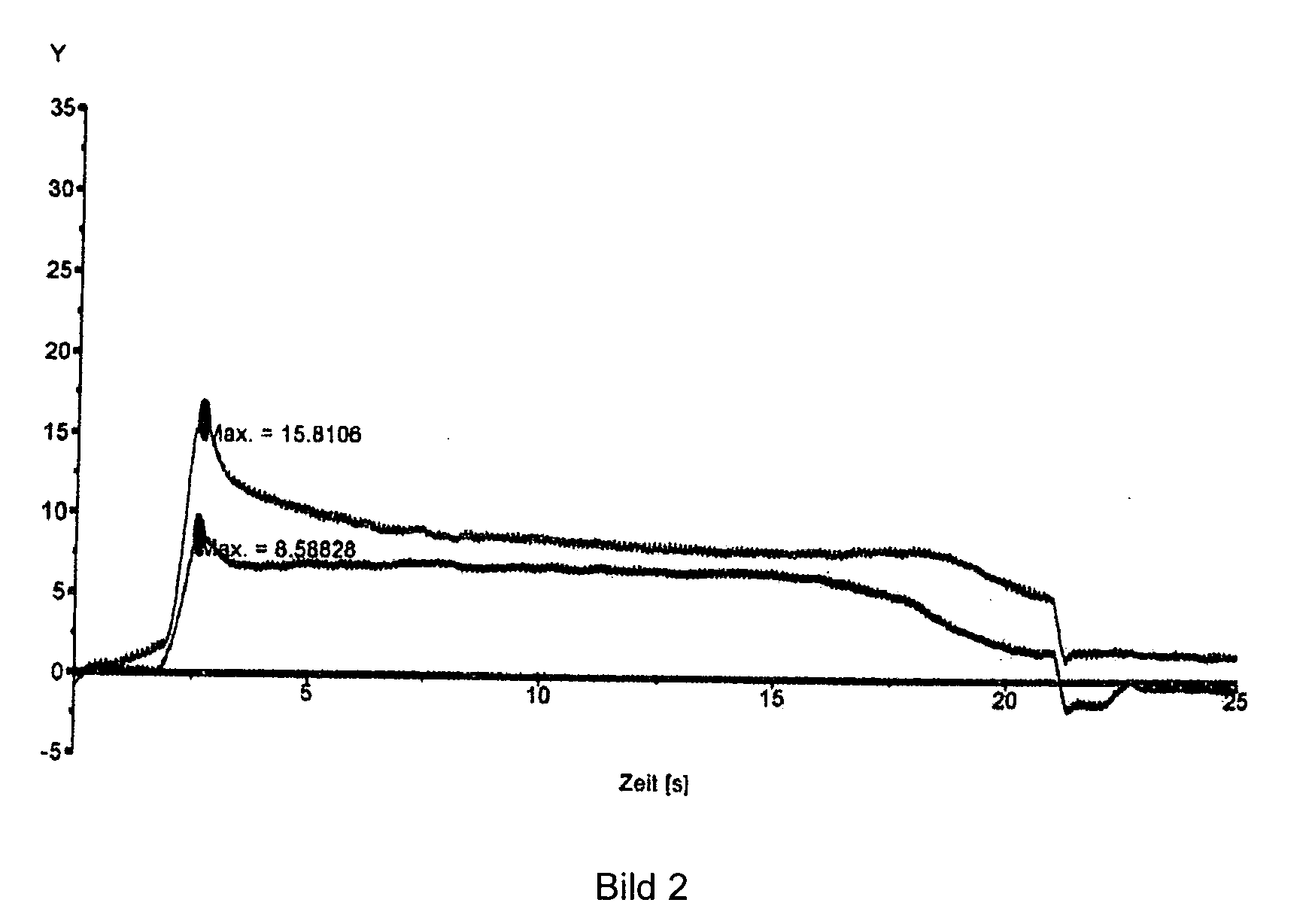
- Bei einer Wiederholung der Versuche unter Einsatz des erfindungsgemäßen Verfahrens (unter Verwendung der Optifoam- und MuCell-Technologie) zeigte sich, dass aufgrund des verbesserten Fließverhaltens des schmelzflüssigen thermoplastischen Kunststoffes wegen des beigemischten Gases eine Verarbeitung des Materials bei einer verringerten Temperatur von 230 °C und Innendrücken im Formwerkzeug von 10 bis 100 bar möglich war. Das Kunstlederdekor der fertigen Formteile blieb erhalten. Eine Wiederholung des Versuches unter Einsatz des erfindungsgemäßen Verfahrens bei Verwendung von Echtleder als Dekormaterial zeigte ähnliche Ergebnisse, auch hier war die Lederstruktur am fertigen Formteil erhalten geblieben, bei einer Freistellung der Kontur blieb die Struktur selbst in kritischen Radienbereichen erhalten.
- Die Forminnendruckkurve beim Versuch mit Kunstleder war wie in Bild 2 dargestellt.
- Die Forminnendruckkurve beim Versuch mit Echtleder war wie in Bild 3 dargestellt.

Claims (7)
- Verfahren zur Herstellung von Formteilen mit von oberflächenstrukturiertem Dekormaterial, insbesondere Echt- oder Kunstleder, bedeckter Oberfläche durch Hinterspritzen des Dekormaterials mit thermoplastischem Kunststoff in einem Formwerkzeug, dadurch gekennzeichnet, dass vor oder während des Einspritzens des thermoplastischen Kunststoffes in das bereits das Dekormaterial enthaltende Formwerkzeug dem schmelzflüssigen thermoplastischen Kunststoff ein Gas in überkritischem Zustand beigemischt wird.
- Verfahren nach Anspruch 1, dadurch gekennzeichnet, dass der thermoplastische Kunststoff ausgewählt wird aus der Gruppe umfassend Acrylnitril/Butadien/Styrol (ABS), Polybutylenterephthalat (PBT, PBTP), Polycarbonat (PC), Polypropylen (PP), Polyoxymethylen/Polyacetal (POM), thermoplastisches Olefin-Polymer (TPO-ET) und Mischungen hievon, gegebenenfalls enthaltend Füll- und Verstärkungsmaterial, wie beispielsweise Glasfasern, Carbonfasern oder Kunststofffasern.
- Verfahren nach Anspruch 1 oder 2, dadurch gekennzeichnet, dass dem schmelzflüssigen thermoplastischen Kunststoff Stickstoff oder Kohlendioxid als Gas beigemischt wird.
- Verfahren nach einem der Ansprüche 1 bis 3, dadurch gekennzeichnet, dass das Gas dem thermoplastischen Kunststoff während des Einspritzens in das bereits das Dekormaterial enthaltende Formwerkzeug beigemischt wird.
- Verfahren nach einem der Ansprüche 1 bis 3, dadurch gekennzeichnet, dass das Gas dem thermoplastischen Kunststoff vor dem Einspritzen in das bereits das Dekormaterial enthaltende Formwerkzeug beigemischt wird.
- Formteil bestehend aus mit thermoplastischem Kunststoff hinterspritztem oberflächenstrukturiertem Dekormaterial, insbesondere Echt- oder Kunstleder, dadurch gekennzeichnet, dass der thermoplastische Kunststoff kompakte Randschichten und einen Kernbereich mit Bläschen mit einem Durchmesser von 10 bis 100 µm aufweist.
- Formteil nach Anspruch 6, dadurch gekennzeichnet, dass der thermoplastische Kunststoff einen Kernbereich mit Bläschen mit einem Durchmesser von 10 bis 50 µm aufweist.
Applications Claiming Priority (1)
| Application Number | Priority Date | Filing Date | Title |
|---|---|---|---|
| AT0024407U AT9902U1 (de) | 2007-04-18 | 2007-04-18 | Herstellung von formteilen |
Publications (2)
| Publication Number | Publication Date |
|---|---|
| EP1982817A2 true EP1982817A2 (de) | 2008-10-22 |
| EP1982817A3 EP1982817A3 (de) | 2012-10-03 |
Family
ID=39154342
Family Applications (1)
| Application Number | Title | Priority Date | Filing Date |
|---|---|---|---|
| EP08450058A Withdrawn EP1982817A3 (de) | 2007-04-18 | 2008-04-18 | Herstellung von Formteilen |
Country Status (2)
| Country | Link |
|---|---|
| EP (1) | EP1982817A3 (de) |
| AT (1) | AT9902U1 (de) |
Cited By (2)
| Publication number | Priority date | Publication date | Assignee | Title |
|---|---|---|---|---|
| CN116373332A (zh) * | 2023-03-09 | 2023-07-04 | 长春富维安道拓汽车饰件系统有限公司 | 降低气囊骨架熟化时间的方法 |
| CN116690943A (zh) * | 2023-05-04 | 2023-09-05 | 台州市黄岩亮科模具机械有限公司 | 可调式片材成型模具 |
Citations (12)
| Publication number | Priority date | Publication date | Assignee | Title |
|---|---|---|---|---|
| EP0446941A2 (de) | 1990-03-15 | 1991-09-18 | MITSUI TOATSU CHEMICALS, Inc. | Verfahren zum Herstellen von Verbundformteilen und Form zur Durchführung des Verfahrens |
| DE4122412A1 (de) | 1991-07-06 | 1993-01-14 | Bayer Ag | Hinterspritzverfahren |
| DE4127241A1 (de) | 1991-08-17 | 1993-02-18 | Bayer Ag | Hinterspritzverfahren |
| DE4228282A1 (de) | 1992-08-26 | 1994-03-03 | Dura Tufting Gmbh | Hinterspritztes Formteil sowie Verfahren und Spritzgießmaschine zur Herstellung eines hinterspritzten Formteils |
| EP0876891A1 (de) | 1997-05-07 | 1998-11-11 | Idemitsu Petrochemical Co., Ltd. | Verfahren zur Herstellung eines faserverstärkten spritzgegossenen Kunststoffgegenstandes mit eingeführtem Gas und so hergestellter gegossener Gegenstand |
| WO1999032544A1 (en) | 1997-12-19 | 1999-07-01 | Trexel, Inc. | Microcellular foam extrusion/blow molding process and article made thereby |
| WO2002026482A1 (en) | 2000-09-29 | 2002-04-04 | Trexel, Inc. | Fiber-filler molded articles |
| WO2002026485A1 (en) | 2000-09-29 | 2002-04-04 | Trexel, Inc. | Thin wall injection molding |
| EP0952908B1 (de) | 1997-01-16 | 2002-06-12 | Trexel, Inc. | Spritzgiessen von mikrozelligem material |
| EP1243397A2 (de) | 1997-11-26 | 2002-09-25 | Idemitsu Petrochemical Co., Ltd. | Faserverstärkter Formkörper aus Kunststoff und Verfahren zur dessen Herstellung |
| EP1336462A2 (de) | 2002-02-16 | 2003-08-20 | Bayerische Motoren Werke Aktiengesellschaft | Thermoplastisches Bauteil |
| EP1621312A2 (de) | 2000-06-22 | 2006-02-01 | Mitsui Chemicals, Inc. | Thermoplastisches Harzschaumprodukt |
Family Cites Families (6)
| Publication number | Priority date | Publication date | Assignee | Title |
|---|---|---|---|---|
| US4255367A (en) * | 1978-09-21 | 1981-03-10 | Standard Oil Company (Indiana) | Method for injection molding articles wherein additives are added in selective portions |
| JP4339296B2 (ja) * | 1996-04-04 | 2009-10-07 | 三井化学株式会社 | 熱可塑性樹脂発泡射出成形体の製造方法 |
| DE19853021B4 (de) * | 1998-11-18 | 2006-02-23 | Vereinigung zur Förderung des Instituts für Kunststoffverarbeitung in Industrie und Handwerk an der Rhein.-Westf. Technischen Hochschule Aachen eV | Vorrichtung zur Herstellung geschäumter Kunststoff-Formteile durch Einbringen eines physikalischen Treibmittels in den Schmelzestrom einer konventionellen Spritzgießmaschine |
| JP2001287237A (ja) * | 2000-04-05 | 2001-10-16 | Japan Steel Works Ltd:The | 貼合成形品の射出成形方法 |
| DE10327725B4 (de) * | 2003-06-16 | 2015-02-26 | Volkswagen Ag | Verfahren zur Herstellung eines Verbundbauteils und nach dem Verfahren hergestelltes Verbundbauteil |
| US7524556B2 (en) * | 2003-07-23 | 2009-04-28 | Sumitomo Chemical Company, Limited | Thermoplastic resin foamed article |
-
2007
- 2007-04-18 AT AT0024407U patent/AT9902U1/de not_active IP Right Cessation
-
2008
- 2008-04-18 EP EP08450058A patent/EP1982817A3/de not_active Withdrawn
Patent Citations (12)
| Publication number | Priority date | Publication date | Assignee | Title |
|---|---|---|---|---|
| EP0446941A2 (de) | 1990-03-15 | 1991-09-18 | MITSUI TOATSU CHEMICALS, Inc. | Verfahren zum Herstellen von Verbundformteilen und Form zur Durchführung des Verfahrens |
| DE4122412A1 (de) | 1991-07-06 | 1993-01-14 | Bayer Ag | Hinterspritzverfahren |
| DE4127241A1 (de) | 1991-08-17 | 1993-02-18 | Bayer Ag | Hinterspritzverfahren |
| DE4228282A1 (de) | 1992-08-26 | 1994-03-03 | Dura Tufting Gmbh | Hinterspritztes Formteil sowie Verfahren und Spritzgießmaschine zur Herstellung eines hinterspritzten Formteils |
| EP0952908B1 (de) | 1997-01-16 | 2002-06-12 | Trexel, Inc. | Spritzgiessen von mikrozelligem material |
| EP0876891A1 (de) | 1997-05-07 | 1998-11-11 | Idemitsu Petrochemical Co., Ltd. | Verfahren zur Herstellung eines faserverstärkten spritzgegossenen Kunststoffgegenstandes mit eingeführtem Gas und so hergestellter gegossener Gegenstand |
| EP1243397A2 (de) | 1997-11-26 | 2002-09-25 | Idemitsu Petrochemical Co., Ltd. | Faserverstärkter Formkörper aus Kunststoff und Verfahren zur dessen Herstellung |
| WO1999032544A1 (en) | 1997-12-19 | 1999-07-01 | Trexel, Inc. | Microcellular foam extrusion/blow molding process and article made thereby |
| EP1621312A2 (de) | 2000-06-22 | 2006-02-01 | Mitsui Chemicals, Inc. | Thermoplastisches Harzschaumprodukt |
| WO2002026482A1 (en) | 2000-09-29 | 2002-04-04 | Trexel, Inc. | Fiber-filler molded articles |
| WO2002026485A1 (en) | 2000-09-29 | 2002-04-04 | Trexel, Inc. | Thin wall injection molding |
| EP1336462A2 (de) | 2002-02-16 | 2003-08-20 | Bayerische Motoren Werke Aktiengesellschaft | Thermoplastisches Bauteil |
Cited By (2)
| Publication number | Priority date | Publication date | Assignee | Title |
|---|---|---|---|---|
| CN116373332A (zh) * | 2023-03-09 | 2023-07-04 | 长春富维安道拓汽车饰件系统有限公司 | 降低气囊骨架熟化时间的方法 |
| CN116690943A (zh) * | 2023-05-04 | 2023-09-05 | 台州市黄岩亮科模具机械有限公司 | 可调式片材成型模具 |
Also Published As
| Publication number | Publication date |
|---|---|
| EP1982817A3 (de) | 2012-10-03 |
| AT9902U1 (de) | 2008-05-15 |
Similar Documents
| Publication | Publication Date | Title |
|---|---|---|
| DE69826733T2 (de) | Faserverstärkter Formkörper aus Kunststoff und Verfahren zur dessen Herstellung | |
| EP1064135B1 (de) | Vorrichtung und verfahren zum hinterpressen und/oder hinterspritzen sowie zum einfassen eines dekormaterials mit einem trägermaterial | |
| EP2655035A1 (de) | Verfahren zur herstellung von oberflächenendbearbeiteten leichtbauteilen mit hohem naturfaseranteil und integrierten befestigungselementen | |
| WO2009052889A1 (de) | Verfahren und vorrichtung zur herstellung eines formteils mit einer sollbruchlinie für eine airbagöffnung | |
| DE102007021750B4 (de) | Verfahren zur Herstellung geschäumter Kunststoffkörper | |
| DE69107916T2 (de) | Verfahren zum Formen eines aus einem Schaumkern und einer oder mehreren Deckschichten bestehenden Gegenstandes. | |
| DE102011105775A9 (de) | Verfahren zum Spritzgießen von Kunststoff-Formteilen aus thermoplastischem Kunststoff | |
| DE102012018801A1 (de) | Beplankungsbauteil für einen Kraftwagen und Verfahren zum Herstellen eines Beplankungsbauteils | |
| EP1917134B1 (de) | Verfahren und werkzeug zur herstellung eines bauteils aus kunststoff mit einer dekorations-schicht und einer träger-schicht mit einem zusätzlich an dieser angeordneten formteil | |
| DE102004060009B4 (de) | Verfahren zur Herstellung eines Schichtkörpers | |
| DE102007037800A1 (de) | Hohles Bauelement mit verstärktem Stützelement und Prozess zu dessen Herstellung | |
| DE102005039124A1 (de) | Verfahren zur Herstellung eines zweischichtigen Verbundteils | |
| EP1982817A2 (de) | Herstellung von Formteilen | |
| DE102015200275A1 (de) | 3-dimensionales hochfestes Faserverbundbauteil und Verfahren zu seiner Herstellung | |
| EP3107705B1 (de) | Verfahren zur herstellung eines verbundbauteils | |
| DE102004033139B4 (de) | Kunststoffverbundformteil sowie Verfahren zu dessen Herstellung | |
| DE102013020494B4 (de) | Filmscharniere aus faserverstärkten Kunststoffen | |
| EP2922679B1 (de) | Verfahren zur herstellung eines flächigen kraftfahrzeugkarosserieelements | |
| DE10327725B4 (de) | Verfahren zur Herstellung eines Verbundbauteils und nach dem Verfahren hergestelltes Verbundbauteil | |
| DE102014205896A1 (de) | Verfahren zur Herstellung eines Bauteils aus Organoblech und Werkzeug | |
| DE102008044026B4 (de) | Verfahren zur Herstellung eines Verbundbauteils und dadurch hergestelltes Verbundbauteil | |
| DE102014212287A1 (de) | Verfahren zur Herstellung eines naturfaserverstärkten Kunststoffbauteils | |
| DE102011108287A1 (de) | Faserverstärktes Kunststoffverbundbauteil, Faser-Matrix-Halbzeug und Herstellungsverfahren | |
| EP1775110A1 (de) | Kunststoffformteil mit einer von einem Kunststoffmaterial teilweise durchdrungenen Vliesschicht und mit textiler Oberfläche sowie Verfahren zu seiner Herstellung | |
| DE102009050807A1 (de) | Spritzprägewerkzeug und Verfahren zum Spritzprägen eines Bauteils, insbesondere eines flächigen, dünnwandigen Innenraumteils für den Fahrgastraum eines Fahrzeugs |
Legal Events
| Date | Code | Title | Description |
|---|---|---|---|
| PUAI | Public reference made under article 153(3) epc to a published international application that has entered the european phase |
Free format text: ORIGINAL CODE: 0009012 |
|
| AK | Designated contracting states |
Kind code of ref document: A2 Designated state(s): AT BE BG CH CY CZ DE DK EE ES FI FR GB GR HR HU IE IS IT LI LT LU LV MC MT NL NO PL PT RO SE SI SK TR |
|
| AX | Request for extension of the european patent |
Extension state: AL BA MK RS |
|
| PUAL | Search report despatched |
Free format text: ORIGINAL CODE: 0009013 |
|
| AK | Designated contracting states |
Kind code of ref document: A3 Designated state(s): AT BE BG CH CY CZ DE DK EE ES FI FR GB GR HR HU IE IS IT LI LT LU LV MC MT NL NO PL PT RO SE SI SK TR |
|
| AX | Request for extension of the european patent |
Extension state: AL BA MK RS |
|
| RIC1 | Information provided on ipc code assigned before grant |
Ipc: B29C 44/34 20060101ALI20120827BHEP Ipc: B29K 105/04 20060101ALI20120827BHEP Ipc: B29C 44/14 20060101AFI20120827BHEP |
|
| AKY | No designation fees paid | ||
| REG | Reference to a national code |
Ref country code: DE Ref legal event code: R108 |
|
| REG | Reference to a national code |
Ref country code: DE Ref legal event code: R108 Effective date: 20130612 |
|
| STAA | Information on the status of an ep patent application or granted ep patent |
Free format text: STATUS: THE APPLICATION IS DEEMED TO BE WITHDRAWN |
|
| 18D | Application deemed to be withdrawn |
Effective date: 20130404 |