EP1985509A2 - Gurthaltevorrichtung - Google Patents
Gurthaltevorrichtung Download PDFInfo
- Publication number
- EP1985509A2 EP1985509A2 EP08006360A EP08006360A EP1985509A2 EP 1985509 A2 EP1985509 A2 EP 1985509A2 EP 08006360 A EP08006360 A EP 08006360A EP 08006360 A EP08006360 A EP 08006360A EP 1985509 A2 EP1985509 A2 EP 1985509A2
- Authority
- EP
- European Patent Office
- Prior art keywords
- strap
- strap support
- slot
- support
- support apparatus
- Prior art date
- Legal status (The legal status is an assumption and is not a legal conclusion. Google has not performed a legal analysis and makes no representation as to the accuracy of the status listed.)
- Withdrawn
Links
Images







Classifications
-
- B—PERFORMING OPERATIONS; TRANSPORTING
- B60—VEHICLES IN GENERAL
- B60R—VEHICLES, VEHICLE FITTINGS, OR VEHICLE PARTS, NOT OTHERWISE PROVIDED FOR
- B60R22/00—Safety belts or body harnesses in vehicles
- B60R22/18—Anchoring devices
- B60R22/26—Anchoring devices secured to the seat
-
- B—PERFORMING OPERATIONS; TRANSPORTING
- B60—VEHICLES IN GENERAL
- B60N—SEATS SPECIALLY ADAPTED FOR VEHICLES; VEHICLE PASSENGER ACCOMMODATION NOT OTHERWISE PROVIDED FOR
- B60N2/00—Seats specially adapted for vehicles; Arrangement or mounting of seats in vehicles
- B60N2/24—Seats specially adapted for vehicles; Arrangement or mounting of seats in vehicles for particular purposes or particular vehicles
- B60N2/26—Seats specially adapted for vehicles; Arrangement or mounting of seats in vehicles for particular purposes or particular vehicles for children
- B60N2/28—Seats readily mountable on, and dismountable from, existing seats or other parts of the vehicle
- B60N2/2803—Adaptations for seat belts
- B60N2/2812—Adaptations for seat belts for securing the child to the child seat
-
- B—PERFORMING OPERATIONS; TRANSPORTING
- B60—VEHICLES IN GENERAL
- B60N—SEATS SPECIALLY ADAPTED FOR VEHICLES; VEHICLE PASSENGER ACCOMMODATION NOT OTHERWISE PROVIDED FOR
- B60N2/00—Seats specially adapted for vehicles; Arrangement or mounting of seats in vehicles
- B60N2/24—Seats specially adapted for vehicles; Arrangement or mounting of seats in vehicles for particular purposes or particular vehicles
- B60N2/26—Seats specially adapted for vehicles; Arrangement or mounting of seats in vehicles for particular purposes or particular vehicles for children
- B60N2/28—Seats readily mountable on, and dismountable from, existing seats or other parts of the vehicle
- B60N2/2803—Adaptations for seat belts
- B60N2/2818—Adaptations for seat belts characterised by guiding means for children belts
-
- B—PERFORMING OPERATIONS; TRANSPORTING
- B60—VEHICLES IN GENERAL
- B60R—VEHICLES, VEHICLE FITTINGS, OR VEHICLE PARTS, NOT OTHERWISE PROVIDED FOR
- B60R22/00—Safety belts or body harnesses in vehicles
- B60R22/18—Anchoring devices
- B60R22/20—Anchoring devices adjustable in position, e.g. in height
- B60R22/201—Anchoring devices adjustable in position, e.g. in height with the belt anchor connected to a slider movable in a vehicle-mounted track
Definitions
- the invention relates to a support for a strap.
- the invention relates to a support that provides adjustable support for a strap of a harness.
- Harnesses are used for supporting seated occupants in various types of seats. For example, over the shoulder seat belts are used to support occupants in vehicle seats such as car seats and the like.
- Buggies Conventionally, babies and toddlers have been transported in a buggy. Buggies have harnesses that typically comprise two over-the-shoulder straps and a crotch strap that extends up between the legs and couples (directly or indirectly) with the over-the-shoulder straps. Once the harness is coupled, the baby or toddler is maintained in position by the harness.
- Some buggies have harnesses with height adjustable shoulder straps to accommodate a growing child, and which enable the buggy to be used with children of different sizes.
- height adjustment of those shoulder straps is a complex task; requiring part of the shoulder strap to be unfed from a support for the height to be adjusted. That adjustment may require the removal of part of the strap.
- a strap support apparatus for adjustable support of a strap comprising:
- the body is provided with at least one engagement position, and the strap support is adjustable into the engaged configuration at the engagement position.
- the body is provided with a plurality of discrete engagement positions, and the strap support is adjustable into the engaged configuration at any one of the discrete engagement positions.
- the strap support apparatus is suitably configured such that the strap support must be generally aligned with an engagement position prior to rotating the strap support to adjust the strap support into the engaged configuration.
- the body may be provided with two discrete engagement positions. Alternatively, the body may be provided with three or more discrete engagement positions, such as four, five, or six engagement positions for example.
- the engagement portion has a shorter dimension and a longer dimension
- the apparatus is configured such that the engaged configuration of the strap support corresponds to the longer dimension extending across the slot while the sliding configuration of the strap support corresponds to the shorter dimension extending across the slot.
- the body may comprise a channel behind the slot, and the engagement portion of the strap support is defined by said portion that is positioned on an opposite side of the slot and is at least partly received in the channel, wherein the channel defines the engagement position(s).
- the channel may define one or more enlarged regions, each of which defines an engagement position for the strap support.
- said engagement portion that is defined by said portion that is positioned on an opposite side of the slot comprises an enlargement having a shorter dimension and a longer dimension
- the apparatus is configured such that the engaged configuration of the strap support corresponds to the longer dimension extending across the channel while the sliding configuration of the strap support corresponds to the shorter dimension extending across the channel.
- the longer dimension will suitably be configured to fit within the enlargement(s) of the channel, but will be longer than the transverse width of the remainder of the channel other than the enlargement(s).
- the receiving portion, portion that extends through the slot, and portion that is positioned on an opposite side of the slot may suitably form a general "I" shape.
- discrete projections or detents could be provided to define the engagement positions of the strap support.
- the elongate slot may define one or more enlarged regions, each of which defines an engagement position for the strap support, and the engagement portion of the strap support may be defined by the portion that extends through the elongate slot, wherein the longer dimension of said engagement portion that is defined by the portion that extends through the elongate slot is configured to fit within the enlarged region(s) of the slot, but is longer than the transverse width of the remainder of the slot other than the enlarged region(s).
- the body may comprise a plurality of recesses provided in a front face of the body corresponding to the receiving portion of the strap support
- the engagement portion may be defined by the receiving portion of the strap support
- said engagement portion that is defined by the receiving portion of the strap support may be selectively engageable with the recesses to define the engagement position(s).
- the recesses are provided in pairs, with the recesses in each pair being positioned on respective sides of the slot
- said engagement portion that is defined by the receiving portion of the strap support comprises two projections, each of which is configured to engage with a respective recess of each pair of recesses, with the projections being positioned on respective sides of the portion that extends through the slot.
- Said engagement portion that is defined by the receiving portion of the strap support is preferably frictionally engageable with the recesses.
- the receiving portion of the strap support may comprise a loop for receiving the strap.
- the receiving portion could be in any other suitable form, such as a hook or a partial loop for example.
- a loop is preferred, as it will help prevent the strap from inadvertently disengaging from the receiving portion.
- the strap support is adjustable between the sliding configuration and the engaged configuration by rotating the strap support about the axis relative to the body, wherein the required amount of rotation is between about 30 degrees and about 90 degrees. More preferably, the required amount of rotation is between about 45 degrees and about 90 degrees. Most preferably, the required amount of rotation is about 90 degrees.
- the body may be an integral part of a support surface, such as a back portion or seat portion of a seat, or a side support portion or wall or other part of a seat for example.
- the body may be adapted to mount to a support surface such as those mentioned in the preceding sentence for example.
- the body may comprise a forward flange and a rearward flange, with the forward flange adapted to be positioned in front of the support surface and the rearward flange adapted to be positioned behind the support surface.
- the two flanges may be spaced apart by a wall portion of the body.
- the forward and rearward flanges may provide a means for capturing part of the support surface, to mount the body to the support surface.
- the cushion or membrane may be provided with an aperture sized smaller than the size of the forward and rearward flanges, and may be mounted to the cushion or membrane by positioning the wall portion of the body in the aperture of the membrane or cushion with one flange on one side of the membrane or cushion and the other flange on the other side of the membrane or cushion.
- a part of the body having the forward flange may be formed separately from a part of the body having the rearward flange.
- the part of the body having the rearward flange also defines the elongate slot.
- a seat for supporting a baby, infant, or child comprising:
- the body may be formed as an integral part of the seat, or could be a separate component.
- the strap support apparatus may have any one or more features outlined in relation to the first aspect above.
- the strap may be a shoulder strap.
- the slot may be oriented generally vertically to provide selective height adjustment of the point of support of the shoulder strap.
- the slot may be oriented generally horizontally to provide transverse adjustment of the point of support of the shoulder strap.
- a longer dimension of the receiving portion may be transverse to the longer dimension of the engagement portion, such that when the engagement portion is engaged, the longer dimension of the receiving portion is generally horizontal.
- the slot may be oriented at an intermediate angle to provide both horizontal and vertical movement of the point of support of the shoulder strap.
- the slot may be oriented such that the point of support for the shoulder strap moves outward as it moves upward.
- the engagement portion may be oriented at an intermediate angle relative to the receiving portion.
- the harness may be provided with more than one shoulder strap, and each shoulder strap may be provided with a preferred form strap support apparatus.
- the harness may be provided with only a single shoulder strap, possibly with or without a waist strap or crotch strap.
- the harness may have a crotch strap that extends between the legs of the baby, infant, or child, and the crotch strap may be supported by a strap support apparatus as outlined in relation to the first aspect above.
- the slot would run in a generally forward-rearward direction of the seat portion, to provide selective depth adjustment of the crotch strap.
- the harness may have side straps that extend around the sides of the baby, infant, or child, and each side strap may be supported by a strap support apparatus outlined in relation to the first aspect above.
- the strap supports may be provided on any of the possible orientations described in relation to the shoulder strap supports.
- the harness may have only a waist strap, and the strap support apparatus may provide vertical and/or horizontal adjustment of the waist strap.
- the seat may be any suitable type of seat that requires a harness for a baby, child, or infant, such as a buggy.
- the seat may be any other type of seat that requires a harness for a baby, child, or infant, for example: a car seat for a baby, infant or child; a backpack for carrying a baby, infant, or child; wheelchair; shopping cart; booster seat; safety bassinet; highchair; or bouncer.
- the seat is one selected from the group consisting of: a buggy; a car seat for a baby, infant, or child; a backpack for carrying a baby, infant, or child; wheelchair; shopping cart; a booster seat; a safety bassinet; a highchair; or a bouncer.
- This invention may also be said broadly to consist in the parts, elements and features referred to or indicated in the specification of the application, individually or collectively, and any or all combinations of any two or more said parts, elements or features, and where specific integers are mentioned herein which have known equivalents in the art to which this invention relates, such known equivalents are deemed to be incorporated herein as if individually set forth.
- buggy While the preferred form buggy to which the present invention is applied is an "all terrain" type of buggy that is suitable for some off road use, it will be appreciated that the invention can be applied to any suitable type of pushing vehicle for transporting children. Therefore, the term “buggy” as used in this specification and claims should be interpreted to cover other alternative pushing vehicles, such as strollers, push chairs, and the like.
- Figure 1 shows a buggy 1 for transporting a baby, infant, or child, that can be used with the present invention.
- the buggy 1 has a frame 3 operatively supported above the ground by wheels (not shown), and a seat 5.
- the seat 5 has a seat portion 7, a back portion 9, and side wall portions 10 that can provide lateral support to a seated occupant.
- the buggy may be of the type described in our US provisional application number 60/923,318 and our PCT application number PCT/NZ2007/000264 and entitled "a Buggy". The contents of those documents are incorporated herein in their entirety by way of reference. Alternatively, the buggy could be any other suitable type of buggy.
- the seated occupant is supported by a harness 11.
- the harness has a generally flexible crotch strap 13 adapted to extend upward from the seat portion 7 and between the legs of the occupant.
- the harness also has a pair of generally flexible shoulder straps 15a, 15b, each of which is adapted to extend forward and downward from the back portion 9.
- the shoulder straps are supported by preferred form strap support apparatuses 21 that will be described in further detail below.
- the strap support apparatuses are mounted to a cushion of the buggy seat.
- the strap support apparatuses could be mounted to a fabric or rigid backing of the buggy seat, and optionally behind a cushion. In such a configuration, the cushion could have one or more slots through which the straps of the harness can extend.
- a loop 15a', 15b' of each strap is received in part of a respective strap support apparatus to support the shoulder straps from the back portion 9.
- the harness also has a pair of side straps 16a, 16b, each of which is adapted to extend forward and inward from the back portion 9 to extend around the sides of the occupant.
- the shoulder straps 15a, 15b and side straps 16a, 16b are coupled (either directly or indirectly) with the crotch strap 13, in this form by a selectively releasable coupling 17. Any of the straps may have adjustment mechanisms to provide length adjustment of the strap. When a baby, infant, or child is sitting in the seat, they are supported and held in position by the coupled harness.
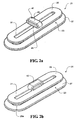
- the preferred form strap support apparatus 21 provides adjustable support of a strap.
- the apparatus 21 comprises a body 23.
- the body has a forward flange 25 and a rearward flange 27, with the two flanges 25, 27 spaced apart by a wall portion 29 of the body.
- the body defines an elongate slot 31 that extends a major part of the length of the body.
- the body has a channel 33 behind the slot.
- the channel defines one or more enlarged regions 35.
- the body is provided with three enlarged regions.
- the body may be provided with two or more enlarged regions, such as four, five, or six enlarged regions for example. The purpose of the enlarged regions will be described below.
- the apparatus additionally has a strap support 41.
- the strap support has a receiving portion 43 for receipt of a strap and that is adjacent to the forward flange 25 of the body.
- the receiving portion 43 of the strap support comprises a loop for receiving a loop 15a', 15b' of a respective strap 15a, 15b.
- a shank portion 45 of the strap support extends rearwardly through the elongate slot 31 of the body and defines an axis A ( Figures 4 and 5 ).
- a portion 47 of the strap support is positioned on an opposite (rear) side of the slot from the receiving portion 43. That portion 47 is sized to be larger than the width of the slot 31 of the body, so the strap support cannot be removed from the body by pulling it forward relative to the body.
- the strap support has an engagement portion for selectively engaging part of the body to inhibit movement of the strap support 41 along the slot 31.
- the engagement portion is part of the portion 47.
- the engagement portion 47 of the strap support is at least partly received in the channel 33, as can be seen from Figures 3a and 3b .
- the receiving portion 43, the portion that extends through the slot 45, and engagement portion 47 of the strap support form a general "I" shape.
- the apparatus is configured such that the strap support 41 has a sliding configuration in which it can be moved along the slot 31 and an engaged configuration in which sliding movement of the strap support along the slot 31 is inhibited.
- the strap support 41 is adjustable between the sliding configuration and the engaged configuration by rotating the strap support 41 relative to the body 21 about the axis A.
- the body is provided with at least one engagement position for the strap support 31, and the strap support is adjustable into the engaged configuration at that engagement position.
- the body has a plurality of discrete engagement positions, and the strap support is adjustable into the engaged configuration at any one of the discrete engagement positions.
- the discrete engagement positions are defined by the enlarged regions 35 of the channel 33.
- the engagement portion 47 comprises an enlargement having a shorter dimension S and a longer dimension L.
- the apparatus is configured such that the engaged configuration of the strap support corresponds to the longer dimension L extending across the channel 31, and the sliding configuration corresponds to the shorter dimension S extending across the channel and the longer dimension being generally aligned with the slot.
- the longer dimension L is configured to fit within the enlargements 35 of the channel, but is longer than the transverse width of the remainder of the channel other than the enlargements. Accordingly, when the longer dimension L extends across the channel and is received in an enlargement 35, the strap support cannot be moved along the slot 31.
- the discrete engagement positions 35 are configured such that the strap support 41 must be generally aligned with an engagement position prior to rotating the strap support to lock the strap support in position relative to the body.
- the configuration of the body is such that when the longer dimension L of the engagement portion is generally aligned with the longitudinal direction of the slot 31, the strap support can be slid along the slot.
- the longer dimension L of the engagement portion is at a generally perpendicular orientation, it will be engaged with an enlargement 35 and movement of the strap support along the slot will be inhibited. Only a partial turn, and in this embodiment a quarter turn, is required to adjust the strap support between the engaged configuration and the sliding configuration.
- the channel, engagement portion, and enlargements could be configured and oriented such that a different amount of rotation adjusts the strap support between the engaged configuration and the sliding configuration.
- a rotation about the axis of as little as about 30 degrees (about one twelfth of a turn) can adjust the strap support between the engaged and sliding configuration.
- a rotation of the strap support about its axis of between about one twelfth of a turn (about 30 degrees) and about one quarter of a turn (about 90 degrees) can adjust the strap support between the engaged and sliding configuration, more preferably a rotation of between about one eighth of a turn (45 degrees) and about one quarter of a turn, and most preferably a rotation of about one quarter of a turn.
- the desired angle can be obtained by orienting the enlargement(s) at a desired angle relative to the slot.
- the engagement portion 47 will be a relatively tight fit in the enlargement, which will help minimise the likelihood of the strap support being inadvertently moved from an engaged position.
- the engagement portion may be a relatively loose fit, and loading applied to the strap by a person that is being supported will assist with maintaining the strap support in the desired enlargement 35.
- the body 23 may be formed as an integral part of a support surface, such as a back portion or seat portion of a seat, or a side support portion or wall or other part of a seat for example. Alternatively, the body may be adapted to mount to a support surface such as those mentioned in the preceding sentence for example.
- the back portion 9 of the seat comprises a cushion.
- the cushion has an aperture for receiving each body portion 23. Each aperture is sized smaller than the size of the forward 25 and rearward 27 flanges, and is mounted to the cushion by positioning the wall portion 29 of the body in the aperture of the cushion with one flange 25 on one side of the cushion and the other flange 27 on the other side of the cushion.
- the forward 25 and rearward 27 flanges thereby provide a means for capturing part of the cushion, to mount the body to the cushion.
- a similar mounting arrangement could be used to mount the body to any other support surface, such as a membrane of some type or a panel for example. If necessary, adhesive, stitching, or other fastening could be used to secure the body to the support surface.
- the body may be a two part device.
- the part of the body having the front flange 25 also defines the elongate slot 31. That is, the front flange is an integral part of the body with the slot. That part of the body has a boss 25a extending rearwardly from the front flange 25.
- the part of the body having the rear flange 27 is formed separately, but has a recess 27a that receives the boss 25a. That part of the body is engaged with the boss 25a and held in engagement by tapered locking members 28 formed on the boss.
- the tapered locking members provide a one-way engagement of the rear flange 27 with the boss 25a, so that those components cannot be easily separated.
- the strap support 41 engages the part of the body that is positioned in front of the support surface, and the rear flange that is positioned behind the support surface engages that part of the body.
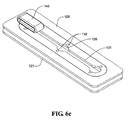
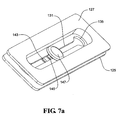
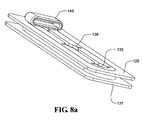
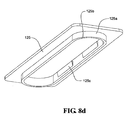
- FIGS. 6a-9 show a second preferred embodiment of the present invention.
- the features and functioning should generally be considered the same as for the embodiment above, and like reference numerals indicate like parts with the addition of 100.
- the strap support 141 has a receiving portion 143 for receipt of a strap, a portion 145 that extends through the elongate slot 131 of the body and that defines an axis, and a portion 147 that is positioned on an opposite side of the slot 131 from the receiving portion 143. That portion 147 is sized to be larger than the width of the slot 131 of the body, so the strap support cannot be removed from the body by pulling it forward relative to the body.
- the strap support has an engagement portion for selectively engaging part of the body to inhibit movement of the strap support along the slot.
- the strap support 141 has a sliding configuration in which it can be moved along the slot 131 and an engaged configuration in which sliding movement of the strap support along the slot is inhibited.
- the strap support 141 is adjustable between the sliding configuration and the engaged configuration by rotating the strap support about the axis A relative to the body.
- the part of the body having the rear flange 127 also defines the elongate slot 131. That is, the rear flange 127 is an integral part of the body with the slot 131. That part of the body also has a boss 127a that extends forward of the rear flange 127.
- the slot 131 is formed in a front face of the boss 127b.
- the part of the body having the front flange 125 is formed separately, and has a boss 125a that defines a recess 125b that receives the boss 127a of the rear part.
- the two bosses 125a, 127a are engaged with one another and held in engagement by tapered locking members 125c on one of the bosses that engage in respective locking recesses 127c on the other of the bosses.
- the tapered locking members provide a one-way engagement of the bosses, so that they cannot be easily separated.
- the strap support 141 engages the part of the body that is integral with the rear flange 127. That means any pulling force on the loop 143 of the strap support is directly transferred to the rear flange 127. That provides a stronger configuration than that of the first embodiment.
- the elongate slot 131 defines one or more enlarged regions 135, each of which defines an engagement position for the strap support.
- the engagement portion of the strap support is part of the portion 145 that extends through the elongate slot 131.
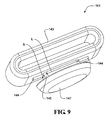
- the engagement portion 145 has a shorter dimension S and a longer dimension L as shown in Figure 9 , and the apparatus is configured such that the engaged configuration of the strap support 141 corresponds to the longer dimension L extending across the slot 131 while the sliding configuration of the strap support corresponds to the shorter dimension S extending across the slot 131.
- the longer dimension L of the engagement portion is configured to fit within the enlarged region(s) 135 of the slot, but is longer than the transverse width of the remainder of the slot 131 other than the enlarged region(s).
- the body has a plurality of detents in the form of recesses 132 provided in the front face of the body corresponding to the receiving portion 143 of the strap support.
- the recesses 132 are provided in pairs, with the recesses in each pair being positioned on respective sides of the slot 132 at the enlarged regions.
- the strap support has a further engagement portion comprising two projections 144 on the rear side of the loop 143 of the receiving portion, with the projections being positioned on respective sides of the portion 145 of the strap support that extends through the slot 131.
- Each projection 144 is configured to engage with a respective recess 132 of each pair of recesses. That further engagement portion 144 of the strap support is selectively engageable with the recesses 132 to define the engagement position(s).
- the projections 144 are frictionally engageable with the recesses 132. This configuration minimises the likelihood of the strap support 141 being inadvertently rotated about the axis A, and thereby the strap support being inadvertently moved to the sliding configuration.
- the enlargements 35 in the rear channel of the first embodiment could be provided in combination with the enlargements 135 in the slot 131 and/or the recesses 132.
- the recesses 132 could be used alone, or the slot enlargements 135 could be used alone.
- each strap is shown as a shoulder strap and each slot is oriented generally vertically to provide selective height adjustment of the point of support of the shoulder strap.
- the slot may be oriented generally horizontally to provide transverse adjustment of the point of support of the shoulder strap.
- a longer dimension of the receiving portion may be transverse to the longer dimension L of the engagement portion, such that when the engagement portion is engaged, the longer dimension of the receiving portion is generally horizontal.
- the slot may be oriented at an intermediate angle to provide both horizontal and vertical movement of the point of support of the shoulder strap.
- the slot may be oriented such that the point of support for the shoulder strap moves outward as it moves upward.
- the engagement portion may be oriented at an intermediate angle relative to the receiving portion.
- the harness may have only a single shoulder strap, possibly with or without a waist strap or crotch strap.
- the strap support may be positioned and configured to support the crotch strap 13 that extends between the legs of the baby, infant, or child.
- the slot would run in a generally forward-rearward direction of the seat portion, to provide selective depth adjustment of the crotch strap.
- the strap supports may be positioned and configured to support side straps 16a, 16b that extend around the sides of the baby, infant, or child.
- the strap supports may be provided on any of the possible orientations described in relation to the shoulder strap supports for example.
- the harness may have only a waist strap, and the harness support may provide vertical and/or horizontal adjustment of the waist strap.
- the seat may be any suitable type of seat that requires a harness for a baby, child, or infant.
- the seat may be: a car seat for a baby, infant or child; a backpack for carrying a baby, infant, or child; wheelchair; shopping cart; booster seat; safety bassinet; highchair; or bouncer.
- discrete projections or detents could be provided to define the engagement positions of the strap support.
- the receiving portion could be in any other suitable form, such as a hook or a partial loop for example.
- a loop is preferred, as it will help prevent the strap from inadvertently disengaging from the receiving portion.
Landscapes
- Engineering & Computer Science (AREA)
- Mechanical Engineering (AREA)
- Health & Medical Sciences (AREA)
- Child & Adolescent Psychology (AREA)
- General Health & Medical Sciences (AREA)
- Aviation & Aerospace Engineering (AREA)
- Transportation (AREA)
- Seats For Vehicles (AREA)
Applications Claiming Priority (1)
| Application Number | Priority Date | Filing Date | Title |
|---|---|---|---|
| US91344207P | 2007-04-23 | 2007-04-23 |
Publications (1)
| Publication Number | Publication Date |
|---|---|
| EP1985509A2 true EP1985509A2 (de) | 2008-10-29 |
Family
ID=39535306
Family Applications (1)
| Application Number | Title | Priority Date | Filing Date |
|---|---|---|---|
| EP08006360A Withdrawn EP1985509A2 (de) | 2007-04-23 | 2008-03-31 | Gurthaltevorrichtung |
Country Status (5)
| Country | Link |
|---|---|
| US (1) | US20080258527A1 (de) |
| EP (1) | EP1985509A2 (de) |
| AU (1) | AU2008201394A1 (de) |
| CA (1) | CA2627571A1 (de) |
| NZ (1) | NZ566997A (de) |
Cited By (3)
| Publication number | Priority date | Publication date | Assignee | Title |
|---|---|---|---|---|
| WO2012105988A1 (en) * | 2011-02-03 | 2012-08-09 | Workshop Xi, Inc. | Improved coupling systems |
| CN104417485A (zh) * | 2013-08-23 | 2015-03-18 | 宋志奎 | 汽车安全带舒适度调节器 |
| CN104999937A (zh) * | 2015-08-03 | 2015-10-28 | 苏州逗乐儿童用品有限公司 | 带遮阳伞的车路两用儿童座椅 |
Families Citing this family (20)
| Publication number | Priority date | Publication date | Assignee | Title |
|---|---|---|---|---|
| JP2011079514A (ja) * | 2009-09-11 | 2011-04-21 | Phil & Teds Most Excellent Buggy Co Ltd | 小児運搬用押し車、モジュラー支持システム、および構成部品 |
| US8262426B1 (en) | 2009-09-14 | 2012-09-11 | Swimways Corporation | Life vest with rescue handle |
| CN201882129U (zh) * | 2010-11-18 | 2011-06-29 | 中山市隆成日用制品有限公司 | 一种婴童车座椅的肩安全带调整机构 |
| US9113721B2 (en) * | 2011-06-20 | 2015-08-25 | Mattel, Inc. | Restraint system for child support |
| USD663003S1 (en) | 2011-06-27 | 2012-07-03 | Swimways Corporation | Animal flotation vest with shark fin decoration |
| JP6138800B2 (ja) | 2011-09-11 | 2017-05-31 | ソーラー ブライト リミテッドSolar Bright Limited | ロードマーカーまたはライト式警告装置 |
| USD667911S1 (en) | 2011-09-29 | 2012-09-25 | Swimways Corporation | Life jacket with fin and headrest |
| US8919889B2 (en) * | 2011-11-15 | 2014-12-30 | Wonderland Nurserygoods Company Limited | Adjustable harness and chair therewith |
| CN105212595B (zh) * | 2011-11-15 | 2017-12-22 | 明门香港股份有限公司 | 座椅及其可调整座带 |
| CN204580651U (zh) | 2012-06-07 | 2015-08-26 | 菲尔和特德设计有限公司 | 将儿童固定到座椅的安全带、车辆车厢、车辆座椅及推车 |
| US9371017B2 (en) | 2012-07-03 | 2016-06-21 | Kids Ii, Inc. | Pivotal handle lock/release mechanism for child car seat |
| US20150320233A1 (en) * | 2014-05-06 | 2015-11-12 | Sandra Comer Cooper | Baby seating and enclosure apparatus |
| TWI551482B (zh) * | 2015-08-11 | 2016-10-01 | 國立清華大學 | 車用安全座椅 |
| US10561254B2 (en) | 2017-04-04 | 2020-02-18 | Wonderland Switzerland Ag | Child tray assembly and multi-function high chair |
| DE102018204778B4 (de) * | 2017-04-04 | 2019-06-27 | Wonderland Switzerland Ag | Multifunktioneller Hochstuhl |
| US10668892B2 (en) * | 2017-04-21 | 2020-06-02 | E.V.S. Ltd. | Vehicle seat with dual shoulder strap seat belts |
| US10596929B2 (en) * | 2017-09-22 | 2020-03-24 | Jodi L. Houin | Child restraint system including harness and adjustment mechanism |
| JP6922756B2 (ja) * | 2018-01-23 | 2021-08-18 | トヨタ自動車株式会社 | 車両用シートベルト装置 |
| CN110816466B (zh) * | 2018-08-07 | 2024-04-30 | 北京弦歌科技有限公司 | 一种安全带肩带高度调节装置及交通工具 |
| CN214823556U (zh) * | 2021-02-18 | 2021-11-23 | 明门瑞士股份有限公司 | 幼儿载具 |
Family Cites Families (25)
| Publication number | Priority date | Publication date | Assignee | Title |
|---|---|---|---|---|
| US2859710A (en) * | 1956-07-12 | 1958-11-11 | Aeroquip Corp | Rail-connected fitting |
| US3964798A (en) * | 1974-02-14 | 1976-06-22 | Britax (London) Limited | Safety belt anchorages |
| DE3120182C2 (de) * | 1981-05-21 | 1984-08-16 | Ford-Werke AG, 5000 Köln | Kraftfahrzeug mit höhenverstellbarem Sicherheitsgurt-Umlenkbeschlag |
| ES516139A0 (es) * | 1981-10-03 | 1983-06-01 | Autoflug Gmbh | Perfeccionamientos en dispositivos para regular en altura el herraje de fijacion o desvio superior para el cinturon del hombro de un sistema de cinturon de seguridad. |
| US4550933A (en) * | 1982-04-08 | 1985-11-05 | Ase (Uk) Limited | Adjustable anchorage |
| GB8313023D0 (en) * | 1983-05-11 | 1983-06-15 | Britax Wingard Ltd | Anchorage means for vehicle safety seats |
| GB8709141D0 (en) * | 1987-04-15 | 1987-05-20 | Britax Excelsior | Child's seat |
| FR2626826B2 (fr) * | 1987-10-07 | 1991-05-24 | Ecia Equip Composants Ind Auto | Dispositif de maintien pour sangle de ceinture de securite a reglage manuel de la position |
| JPH0285030A (ja) * | 1988-09-21 | 1990-03-26 | Takata Kk | 子供用拘束シート |
| FR2638689B1 (fr) * | 1988-11-04 | 1991-01-25 | Ecia Equip Composants Ind Auto | Mecanisme pour ceinture de securite a position reglable manuellement |
| US5161522A (en) * | 1991-05-28 | 1992-11-10 | Clevenger Dennis L | Therapeutic swing for handicapped persons |
| US5135285A (en) * | 1991-08-09 | 1992-08-04 | Chrysler Corporation | Twin shoulder belt adjustment mechanism for a child restraint system |
| US6030047A (en) * | 1998-04-06 | 2000-02-29 | Cosco, Inc. | Child vehicle seat with child-restraint harness adjustment mechanism |
| JP4255180B2 (ja) * | 1999-09-14 | 2009-04-15 | コンビ株式会社 | チャイルドシートおよびヘッドレスト |
| US6491348B1 (en) * | 2000-07-31 | 2002-12-10 | Cosco Management, Inc. | Child vehicle seat with child-restraint harness adjustment mechanism |
| US6626493B2 (en) * | 2000-09-22 | 2003-09-30 | Cosco Management, Inc. | Juvenile carrier with juvenile-restraint harness adjustment mechanism |
| CA2358814A1 (en) * | 2000-10-11 | 2002-04-11 | Evenflo Company, Inc. | Car seat having buckle with visual feedback |
| US6695412B2 (en) * | 2001-06-20 | 2004-02-24 | Evenflo Company, Inc. | Car seat with adjustable harness |
| NO316877B1 (no) * | 2001-07-18 | 2004-06-07 | Hts Hans Torgersen & Sonn As | Festesystem for barnesete |
| US6779843B2 (en) * | 2002-12-27 | 2004-08-24 | Cosco Management, Inc. | Harness-control panel adjuster for child-restraint seat |
| TW573636U (en) * | 2003-05-01 | 2004-01-21 | Wonderland Nursery Goods | Child safety seat for automobile |
| US6799807B1 (en) * | 2003-10-08 | 2004-10-05 | Wonderland Nurserygoods Co., Ltd. | Child safety chair with a belt-adjusting unit |
| CN101124104B (zh) * | 2004-02-13 | 2010-09-01 | 米克研究和开发有限公司 | 婴儿载体和接纳基座 |
| US7306284B2 (en) * | 2004-03-26 | 2007-12-11 | Cosco Management, Inc. | Adjustor for juvenile vehicle seat |
| US7547065B2 (en) * | 2007-02-23 | 2009-06-16 | Evenflo Company, Inc. | Child vehicle seat with harness adjustment mechanism |
-
2008
- 2008-03-27 NZ NZ566997A patent/NZ566997A/en not_active IP Right Cessation
- 2008-03-27 AU AU2008201394A patent/AU2008201394A1/en not_active Abandoned
- 2008-03-28 CA CA002627571A patent/CA2627571A1/en not_active Abandoned
- 2008-03-28 US US12/058,641 patent/US20080258527A1/en not_active Abandoned
- 2008-03-31 EP EP08006360A patent/EP1985509A2/de not_active Withdrawn
Cited By (4)
| Publication number | Priority date | Publication date | Assignee | Title |
|---|---|---|---|---|
| WO2012105988A1 (en) * | 2011-02-03 | 2012-08-09 | Workshop Xi, Inc. | Improved coupling systems |
| US8539646B2 (en) | 2011-02-03 | 2013-09-24 | Workshop Xi, Inc. | Coupling systems |
| CN104417485A (zh) * | 2013-08-23 | 2015-03-18 | 宋志奎 | 汽车安全带舒适度调节器 |
| CN104999937A (zh) * | 2015-08-03 | 2015-10-28 | 苏州逗乐儿童用品有限公司 | 带遮阳伞的车路两用儿童座椅 |
Also Published As
| Publication number | Publication date |
|---|---|
| CA2627571A1 (en) | 2008-10-23 |
| US20080258527A1 (en) | 2008-10-23 |
| NZ566997A (en) | 2008-11-28 |
| AU2008201394A1 (en) | 2008-11-06 |
Similar Documents
| Publication | Publication Date | Title |
|---|---|---|
| EP1985509A2 (de) | Gurthaltevorrichtung | |
| AU2006292651B2 (en) | Adjustable head rest for child car seat | |
| CN104540709A (zh) | 用于约束儿童的基础单元 | |
| US9162593B2 (en) | Infant carrier and car safety seat with no-rethread harness adjustment | |
| US6702316B2 (en) | Stroller with car seat fastening arrangement | |
| US5265931A (en) | Detachable child seat and supporting frame | |
| US20120299349A1 (en) | Rear-facing child vehicle restraint system | |
| EP1759916B1 (de) | Kindersicherheitssitzaufbau mit einem Schnallpositionierelement | |
| EP2370304B1 (de) | Kinderwagen | |
| US20160128491A1 (en) | A combination of child carrier and stroller | |
| US20090309405A1 (en) | Child safety seat with adjustable headrest | |
| AU2011200416B2 (en) | A child restraint for a vehicle | |
| AU2016256730B2 (en) | A Child Restraint for a Vehicle | |
| JP2025106615A (ja) | 肩ベルトアセンブリ及びベビーカー | |
| US20020109320A1 (en) | Holder, such as a stroller assembly, and method for attaching an infant seat | |
| NL2003029C2 (en) | Child vehicle seat for forwardly facing and rearwardly facing use. | |
| JP2006101976A (ja) | 座席 | |
| EP3068662B1 (de) | Anordnung in einem fahrzeugsitz | |
| KR200299810Y1 (ko) | 자동차용 유아 안전의자 | |
| JP4223875B2 (ja) | チャイルドシート | |
| CN201784662U (zh) | 座兜可变的婴儿推车及配套的座兜 | |
| JP2010233941A (ja) | シートベルトホルダ | |
| AU2024227700A1 (en) | Child safety seat for a vehicle | |
| US20110140495A1 (en) | Head and Neck Support Apparatus and Method | |
| JP2001137081A (ja) | 自動車用ベビーベッド |
Legal Events
| Date | Code | Title | Description |
|---|---|---|---|
| PUAI | Public reference made under article 153(3) epc to a published international application that has entered the european phase |
Free format text: ORIGINAL CODE: 0009012 |
|
| AK | Designated contracting states |
Kind code of ref document: A2 Designated state(s): AT BE BG CH CY CZ DE DK EE ES FI FR GB GR HR HU IE IS IT LI LT LU LV MC MT NL NO PL PT RO SE SI SK TR |
|
| AX | Request for extension of the european patent |
Extension state: AL BA MK RS |
|
| STAA | Information on the status of an ep patent application or granted ep patent |
Free format text: STATUS: THE APPLICATION HAS BEEN WITHDRAWN |
|
| 18W | Application withdrawn |
Effective date: 20110321 |