EP1986108A1 - Verfahren und Datenbanksystem zur Durchführung einer XML-Datenbankabfrage - Google Patents
Verfahren und Datenbanksystem zur Durchführung einer XML-Datenbankabfrage Download PDFInfo
- Publication number
- EP1986108A1 EP1986108A1 EP07008680A EP07008680A EP1986108A1 EP 1986108 A1 EP1986108 A1 EP 1986108A1 EP 07008680 A EP07008680 A EP 07008680A EP 07008680 A EP07008680 A EP 07008680A EP 1986108 A1 EP1986108 A1 EP 1986108A1
- Authority
- EP
- European Patent Office
- Prior art keywords
- query
- execution
- xml
- database query
- xml database
- Prior art date
- Legal status (The legal status is an assumption and is not a legal conclusion. Google has not performed a legal analysis and makes no representation as to the accuracy of the status listed.)
- Granted
Links
Images


Classifications
-
- G—PHYSICS
- G06—COMPUTING OR CALCULATING; COUNTING
- G06F—ELECTRIC DIGITAL DATA PROCESSING
- G06F16/00—Information retrieval; Database structures therefor; File system structures therefor
- G06F16/80—Information retrieval; Database structures therefor; File system structures therefor of semi-structured data, e.g. markup language structured data such as SGML, XML or HTML
- G06F16/83—Querying
- G06F16/835—Query processing
- G06F16/8365—Query optimisation
Definitions
- the present invention relates to a method and a database system for executing a XML database query.
- XML databases are due to their flexibility more and more important technical tools of modem information societies.
- the efficient retrieval of XML data in response to a XML database query is the primary purpose of almost any database system operating on a XML data base.
- a query is at first compiled.
- the compilation of a query includes parsing, semantic checks and optimization.
- the result of the compilation is a query execution plan that specifies how the query result can be obtained from the stored data.
- the query execution plan is defined in terms of operations that are eventually performed by the query execution engine. The operations include database access operations, filer operations as well as XML query specific operations.
- a database management system may maintain statistical information about the content of the database. Based on this information, a query processor is able to determine how efficient it is to execute a certain query execution plan. Using the statistics a query processor is able to select the optimal query execution plan from multiple alternatives during compile time.
- the US 7,051,034 discloses the execution of a query execution plan, comprising several restartable sub-trees. During execution it is dynamically decided, whether it is preferable to execute the same sub-tree using a single server process or multiple parallel server processes.
- the US 2003/0208484 A1 relates to searches for multimedia data, for example images, in huge databases, wherein it is impossible to perform an exhaustive search in a realistically given response time.
- the US 2003/0208484 A1 teaches to evaluate different combinations of access plans, wherein the numbers of search features are different, and to select the plan having the lowest associated "costs".
- varying the number of search features will affect the results of the different access plans so that the response to a given query will be different depending on the access plan. This might be acceptable, if it is impossible to perform an exhaustive search over the whole data repository so that any response will always be a kind of educated guess.
- the database is not excessively large, it is important that a query provides consistent results, regardless of the strategy used for its execution.
- this problem is solved by a method for executing a XML database query in accordance with claim 1 of the present application. Accordingly, the method comprises the following steps:
- the various query execution plans to not have to be fully separate but they may also have one or more common operations.
- the "cost" of the alternatives are assessed, i.e. the integral of their processing time, number of steps, network accesses etc.
- the assessment is performed depending on intermediate results obtained during execution of the XML database query. Subsequently, the most effective plan is executed.
- Such a dynamic XML query optimization substantially improves the efficiency of the overall database access but assures at the same time that the results are consistent regardless of the optimization of the query execution.
- the described method may involve the use of XML database statistics, thereby improving the query execution both, during runtime and during compile time.
- a dynamic XML query execution is particularly important, if the at least two execution plans differ by the use of at least one XML database index.
- the efficiency gain obtained by using an index largely depends of the content of the XML data, to which the index relates. Therefore, it might in some cases be more efficient to use the XML database index, whereas in other cases it is more efficient not to use the XML database index and to directly operate on the elements in the XML database.
- the described method is particularly useful for database queries serving for text retrieval and / or sort queries.
- the decision of step b. is made depending on the results of a scan for the text to be retrieved.
- the at least two execution plans both comprise a sorting step but differ in the sequence in which the sorting step and other steps of the respective execution plan are executed.
- the present invention is directed to a database system for executing a database query, in particular a XML query, comprising:
- the switch is in one embodiment adapted to select one of the at least two alternative execution plans depending on intermediate results obtained during execution of the database query. Accordingly, the dynamic switch enables the dynamic optimization of the XML query execution by switching between two execution plans, which provide the same result, but which may for a certain XML query substantially differ with respect to the time and efficiency of the query processing.
- the present invention relates according to a further aspect to a computer program and a data carrier comprising such a program with instructions to perform any of the above described methods.
- Algebraic query processing is based on an operator set that reflects the capabilities of the underlying query execution engine.
- the operators consume and produce ordered tuple lists.
- Each tuple entry contains a piece of data that has for example been read from an index, extracted from a document or determined by applying a math formula. These tuple entries are called variable bindings.
- the tuples lists exchanged by the operators are called table structures.
- the following exemplary query is expressed in the syntax of the XML query specification, which is proposed by the W3C.
- the query acts on XML data representing bibliographic data. It looks for books published in 1996 and returns their titles:
- the first line of the query iterates over all documents stored in the given collection of XML documents. It extracts the contained book elements by applying a simple path expression and binds the extracted elements to the variable $b. The next line binds the variable $t to the title contained in the book element that has been bound to variable $b. The next line binds the variable $y to the year attribute.
- the for and the two let clauses produce a tuple for each book element.
- the generated tuples have three entries holding the bindings for the variables $b , $t and $y.
- the tuple list is filtered by the where clause. Only those tuples pass the filter that have an attribute bound to $y that contains a value that is equal to 1996.
- the last line of the query holds a return clause that produces a book element for each filtered tuple. Each generated element contains a title of a selected book.
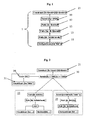
- Operator tree 1 of Fig. 1 The algebraic expression that results form translating the query is shown by the operator tree 1 of Fig. 1 .
- Operator tree means that the operators of the algebraic expression are represented as nodes. Each operator consumes the result of its input operator and produces a result that can be consumed by any other operator.
- the directed edges of the operator tree visualize the data flow between the operators. Operators that do not consume any input are called scan operators. Scan operators are responsible for reading documents from the disk or accessing an index that has been defined on the documents for efficient retrieval.
- the example operator tree contains a doctypeScan operator 11. It scans all documents belonging to the doctype bib. The documents are bound to the variable $d. This means the operator produces a tuple for each document in the doctype. The tuples just have a single entry holding the complete document.
- the following path operator 13 extracts the book elements from the scanned documents and binds them to the variable $b.
- the subscript of a path operator consists of the output variable and a restricted XQuery path expression.
- a path operator evaluates the path expression for each tuple of the input table structure and binds the output variable to the resulting XML fragments.
- the next two path operators 15, 17 extract from each book element the year attribute and the title element.
- the result of the doctypeScan and the path operators is a table structure with the variables $d, $b, $y and $t.
- the resulting table structure is filtered by a select operator 19 by applying the filter predicate of its subscript on each input tuple. In this example only those tuples are passed that have a $y variable that is bound to a year attribute with a value equal to 1996.
- the filter predicate of a select operator can be an arbitrary Boolean XQuery expression.
- the filtered table structure is consumed by a construct operator 21 that creates a book element for each input tuple. Its content is taken from the binding of variable $t.
- the translated query is the input for the actual query optimization.
- an operator tree gives a nice visualization of an algebraic expression, it is not very handy for describing algebraic transformations. Therefore, a more concise textual representation is used in the following that looks for the given algebraic expression like this:
- Index access operators can be introduced by algebraic rewriting. Assuming there is an index on the year attribute, the above examplary query can be optimized by introducing a corresponding index access operator. The resulting algebraic expression looks like this:
- the IdxScan delivers the documents containing books published in 1996.
- the advantage is that only those documents have to be read from disk that fulfill the given search predicate. In case of big databases with many documents stored in it this will lead to tremendous performance improvement if the database not just contains documents published in 1996.
- the default strategy for evaluating this query is to access an index defined on the year attribute. But this can be sub-optimal if the search predicate matches more than a certain percentage of all searched documents. If the doctype operator just provides books published after 1996, searching the index does not give any performance advantage. Even worse, scanning the complete index can be much slower than just scanning the whole library and returning the books to get the query result.
- the query declares an external variable to pass a value to the search predicate.
- the advantage is that it can be compiled and optimized only once and executed multiples time with different search values. This saves a lot of overhead compared to a complete re-compilation whenever a query is executed.
- the query processor does not have enough knowledge to select the optimal query execution plan, because he does not know how many documents will fulfill the given search predicates. Even if database statistics are available, this is not possible due to the missing value of the query parameter.
- the problem can be solved by dynamic query optimization.
- the query processor makes only those decisions that can be done with the available information. In other words, the query processor does not generate a single query execution plan. Instead, it generates a plurality of alternative execution plans. When the query is executed, all input parameters are bound to a value. Based on runtime information the query processor is able to determine the "costs" of the given alternatives based on the database statistics. After that it can choose the most efficient plan for execution.
- Dynamic query optimization may still rely on database statistics, but for certain query operations statistics are not possible or difficult to determine. Additionally, databases statistics can not be updated whenever data is modified, deleted or inserted. This would lead unacceptable response times when modifying, deleting or inserting data.
- dynamic switches in query execution plans can be used for query optimization during query execution. The selection of alternatives is based on intermediate query results and only optionally also on database statistics. Using a dynamic switch, at least a certain amount of optimization can be done even for parameterized queries.
- the query finds books that contain a word starting with the term “data” in their title. Therefore, the query features a where clause applying a predicate with the search pattern "data*" that matches all words starting with "data”.
- a common indexing strategy for text-retrieval queries uses inverted lists.
- An inverted list maps a word to those documents that contain the word. In order limit their size inverted lists do not contain words but ids. These are created by a vocabulary that maps all words contained in the given database to a unique id.
- wildcard query processing is done in two steps: First, the wildcard search pattern is matched against the vocabulary and second, for each of the matching vocabulary entries the containing documents are retrieved via the inverted list.
- the according algebraic expression that gives the result for the example query looks like this:
- the VocabScan determines the ids of the matching words. These are bound to variable $w, which is the input for the IdxScan that finds those documents which have book elements with a title containing the corresponding word. This approach has a good performance if the number of matching vocabulary entries is small. If the number is above a certain threshold, it is much faster just to scan the documents and matching the wildcard search pattern directly on the scanned documents.
- the according algebraic expression looks like this:
- the problem can be solved by applying a dynamic switch.
- the dynamic switch selects an alternative in the query execution plan based on an intermediate result.
- the intermediate result is the number of matching words that are determined by scanning the vocabulary. If the number is below a certain threshold. The first alternative is selected otherwise the second one.
- the algebraic expression with the dynamic switch is illustrated in Fig. 2 .
- the dynamic switch of Fig. 2 is a true extension of the given operator set of the query execution engine.
- a dynamic switch operator has a probe input and an arbitrary number of input alternatives. During query execution the probe input is evaluated and the result is used to choose between the given alternatives, which must return the same result. The result of the chosen alternative is passed by the switch operator to any possible consumer. Once the dynamic switch has selected an input alternative the decision can not be reversed.
- the switch operator 30 in the example of Fig. 2 has beside the probe input two alternative inputs 33 and 35.
- the probe input expression counts the number of matching vocabulary entries and binds the result to variable $c.
- the switch operator 30 checks the value of $c. If it is below 1000 it reads the result from the input 33 and passes it to the construct operator 21 that creates the final result. If $c is greater or equal than 1000, it reads the result from alternative input 35.
- Fig. 3 illustrates how an intermediate result can be used to trigger an optimization with limited overhead. The required overhead is minimized by reusing the collected data for evaluating the query result. Since the information for the optimization is collected during query execution, the dynamic switch approach works perfectly for parameterized queries.
- Dynamic switches can also be helpful to optimize parameterized sorting XML queries.
- the following XML query delivers a list of books that are published in a certain year. The books are sorted according to their title. The publication year is passed as a parameter:
Landscapes
- Engineering & Computer Science (AREA)
- Theoretical Computer Science (AREA)
- Data Mining & Analysis (AREA)
- Databases & Information Systems (AREA)
- Physics & Mathematics (AREA)
- General Engineering & Computer Science (AREA)
- General Physics & Mathematics (AREA)
- Information Retrieval, Db Structures And Fs Structures Therefor (AREA)
Priority Applications (5)
| Application Number | Priority Date | Filing Date | Title |
|---|---|---|---|
| AT07008680T ATE443294T1 (de) | 2007-04-27 | 2007-04-27 | Verfahren und datenbanksystem zur durchführung einer xml-datenbankabfrage |
| DE602007002474T DE602007002474D1 (de) | 2007-04-27 | 2007-04-27 | Verfahren und Datenbanksystem zur Durchführung einer XML-Datenbankabfrage |
| EP07008680A EP1986108B1 (de) | 2007-04-27 | 2007-04-27 | Verfahren und Datenbanksystem zur Durchführung einer XML-Datenbankabfrage |
| US11/924,297 US8843474B2 (en) | 2007-04-27 | 2007-10-25 | Method and database system for executing a XML database query |
| CN2008100950831A CN101295315B (zh) | 2007-04-27 | 2008-04-28 | 用于执行xml数据库查询的方法和数据库系统 |
Applications Claiming Priority (1)
| Application Number | Priority Date | Filing Date | Title |
|---|---|---|---|
| EP07008680A EP1986108B1 (de) | 2007-04-27 | 2007-04-27 | Verfahren und Datenbanksystem zur Durchführung einer XML-Datenbankabfrage |
Publications (2)
| Publication Number | Publication Date |
|---|---|
| EP1986108A1 true EP1986108A1 (de) | 2008-10-29 |
| EP1986108B1 EP1986108B1 (de) | 2009-09-16 |
Family
ID=38359750
Family Applications (1)
| Application Number | Title | Priority Date | Filing Date |
|---|---|---|---|
| EP07008680A Active EP1986108B1 (de) | 2007-04-27 | 2007-04-27 | Verfahren und Datenbanksystem zur Durchführung einer XML-Datenbankabfrage |
Country Status (5)
| Country | Link |
|---|---|
| US (1) | US8843474B2 (de) |
| EP (1) | EP1986108B1 (de) |
| CN (1) | CN101295315B (de) |
| AT (1) | ATE443294T1 (de) |
| DE (1) | DE602007002474D1 (de) |
Cited By (3)
| Publication number | Priority date | Publication date | Assignee | Title |
|---|---|---|---|---|
| EP2234025A1 (de) | 2009-03-24 | 2010-09-29 | Software AG | XML-Datenbankverwaltungssystem für eine XML-Datenbank mit zugangsgeschützten XML-Daten |
| EP2648115A1 (de) | 2012-04-03 | 2013-10-09 | Seeburger AG | Verfahren und/oder System zur Ausführung von Transformationen von hierarchisch strukturierten Daten und relationalen Daten |
| WO2016146057A3 (en) * | 2015-03-16 | 2016-10-20 | Huawei Technologies Co., Ltd. | Method and plan optimizing apparatus for optimizing query execution plan |
Families Citing this family (12)
| Publication number | Priority date | Publication date | Assignee | Title |
|---|---|---|---|---|
| US9281994B2 (en) * | 2007-12-28 | 2016-03-08 | International Business Machines Corporation | Processing algebraic expressions for keyed data sets |
| CN102479239B (zh) | 2010-11-29 | 2016-03-09 | 国际商业机器公司 | 预存储rdf三元数据的方法和装置 |
| US8442971B2 (en) * | 2010-12-21 | 2013-05-14 | International Business Machines Corporation | Execution plans with different driver sources in multiple threads |
| CN102081678B (zh) * | 2011-03-14 | 2013-07-03 | 华中科技大学 | 一种数据库查询中最优执行计划的搜索方法 |
| US8862611B2 (en) * | 2011-06-28 | 2014-10-14 | Infosys Limited | Bottom-up query processing scheme for XML twigs with arbitrary boolean predicates |
| CN103902574A (zh) * | 2012-12-27 | 2014-07-02 | 中国移动通信集团内蒙古有限公司 | 一种基于数据流技术的实时数据加载方法和装置 |
| US10019478B2 (en) * | 2013-09-05 | 2018-07-10 | Futurewei Technologies, Inc. | Mechanism for optimizing parallel execution of queries on symmetric resources |
| CN104598454A (zh) * | 2013-10-31 | 2015-05-06 | 南京思润软件有限公司 | 一种基于xml的信息搜索方法 |
| US10210210B2 (en) | 2015-10-21 | 2019-02-19 | International Business Machines Corporation | Adaptive multi-index access plan for database queries |
| CN107102995B (zh) * | 2016-02-19 | 2020-02-21 | 华为技术有限公司 | 一种sql执行计划的确定方法及装置 |
| CN106909674B (zh) * | 2017-03-01 | 2021-04-30 | 郑州云海信息技术有限公司 | 一种数据库统计信息更新的方法及装置 |
| CN110807030B (zh) * | 2019-09-27 | 2021-03-16 | 蚂蚁金服(杭州)网络技术有限公司 | 一种数据连接的方法、装置及电子设备 |
Family Cites Families (6)
| Publication number | Priority date | Publication date | Assignee | Title |
|---|---|---|---|---|
| US6356887B1 (en) * | 1999-06-28 | 2002-03-12 | Microsoft Corporation | Auto-parameterization of database queries |
| US7103611B2 (en) * | 2003-05-01 | 2006-09-05 | Oracle International Corporation | Techniques for retaining hierarchical information in mapping between XML documents and relational data |
| CN100410933C (zh) * | 2004-12-29 | 2008-08-13 | 复旦大学 | 一种基于xml数据的高效路径索引方法 |
| US20080222087A1 (en) * | 2006-05-15 | 2008-09-11 | International Business Machines Corporation | System and Method for Optimizing Query Access to a Database Comprising Hierarchically-Organized Data |
| US7577642B2 (en) * | 2006-07-13 | 2009-08-18 | Oracle International Corporation | Techniques of XML query optimization over static and dynamic heterogeneous XML containers |
| US9436779B2 (en) * | 2006-11-17 | 2016-09-06 | Oracle International Corporation | Techniques of efficient XML query using combination of XML table index and path/value index |
-
2007
- 2007-04-27 DE DE602007002474T patent/DE602007002474D1/de active Active
- 2007-04-27 EP EP07008680A patent/EP1986108B1/de active Active
- 2007-04-27 AT AT07008680T patent/ATE443294T1/de not_active IP Right Cessation
- 2007-10-25 US US11/924,297 patent/US8843474B2/en active Active
-
2008
- 2008-04-28 CN CN2008100950831A patent/CN101295315B/zh not_active Expired - Fee Related
Non-Patent Citations (6)
| Title |
|---|
| A. BALMIN ET AL.: "Cost-based optimization in DB2 XML", IBM SYSTEMS JOURNAL, vol. 45, no. 2, 2006, XP002447729 * |
| JOSE DE AGUIAR MORAES FILHO ET AL.: "Statistics for Cost-Based XML Query Optimization", 18. WORKSHOP ÜBER GRUNDLAGEN VON DATENBANKEN, 2006, XP002447728 * |
| JOSE DE AGUIAR MORAES FILHO ET AL.: "Workshop ilber Grundlagen von Daten- banken", 2006, article "Statistics for Cost-Based XML Query Optimization" |
| MCHUGH ET AL.: "VLDB, Proceedings of the twenty-fifth international conference on very large data bases", 1999, MORGAN KAUFINANN PUBLISHERS, article "Query Optimization for XML", pages: 315 - 326 |
| MCHUGH J ET AL: "Query optimization for XML", VERY LARGE DATA BASES. PROCEEDINGS OF THE TWENTY-FIFTH INTERNATIONAL CONFERENCE ON VERY LARGE DATA BASES MORGAN KAUFMANN PUBLISHERS ORLANDO, FL, USA, 1999, pages 315 - 326, XP002447727 * |
| YUQING WU ET AL.: "Estimating Answer Sizes for XML Queries", EDBT 2002, 2002, pages 590 - 608, XP002447874 * |
Cited By (3)
| Publication number | Priority date | Publication date | Assignee | Title |
|---|---|---|---|---|
| EP2234025A1 (de) | 2009-03-24 | 2010-09-29 | Software AG | XML-Datenbankverwaltungssystem für eine XML-Datenbank mit zugangsgeschützten XML-Daten |
| EP2648115A1 (de) | 2012-04-03 | 2013-10-09 | Seeburger AG | Verfahren und/oder System zur Ausführung von Transformationen von hierarchisch strukturierten Daten und relationalen Daten |
| WO2016146057A3 (en) * | 2015-03-16 | 2016-10-20 | Huawei Technologies Co., Ltd. | Method and plan optimizing apparatus for optimizing query execution plan |
Also Published As
| Publication number | Publication date |
|---|---|
| EP1986108B1 (de) | 2009-09-16 |
| DE602007002474D1 (de) | 2009-10-29 |
| US8843474B2 (en) | 2014-09-23 |
| ATE443294T1 (de) | 2009-10-15 |
| CN101295315A (zh) | 2008-10-29 |
| US20080270371A1 (en) | 2008-10-30 |
| CN101295315B (zh) | 2012-11-07 |
Similar Documents
| Publication | Publication Date | Title |
|---|---|---|
| EP1986108B1 (de) | Verfahren und Datenbanksystem zur Durchführung einer XML-Datenbankabfrage | |
| DeHaan et al. | A comprehensive XQuery to SQL translation using dynamic interval encoding | |
| US7693820B2 (en) | Use of materialized transient views in query optimization | |
| US6925462B2 (en) | Database management system, and query method and query execution program in the database management system | |
| Moro et al. | Tree-pattern queries on a lightweight XML processor | |
| CN107818181A (zh) | 基于Plcient交互式引擎的索引方法及其系统 | |
| Schlieder | ApproXQL: Design and implementation of an approximate pattern matching language for XML | |
| US8577865B2 (en) | Document searching system | |
| EP2031520A1 (de) | Verfahren und Datenbanksystem zur Vorverarbeitung einer XQuery | |
| Su et al. | Raindrop: A uniform and layered algebraic framework for XQueries on XML streams | |
| Paparizos et al. | A physical algebra for XML | |
| Phillips et al. | InterJoin: Exploiting indexes and materialized views in XPath evaluation | |
| Weigel | Content-aware dataguides for indexing semi-structured data | |
| Fisher et al. | Algebraic transformation and optimization for XQuery | |
| Schallehn et al. | Supporting similarity operations based on approximate string matching on the web | |
| JP4649339B2 (ja) | XPath処理装置、XPath処理方法、XPath処理プログラム、および、記憶媒体 | |
| Theodoratos et al. | Assigning semantics to partial tree-pattern queries | |
| Liu | Efficient computation via incremental computation | |
| Stárka et al. | Analyzer: A Complex System for Data Analysis | |
| Shao et al. | Querying data-intensive programs for data design | |
| Chen et al. | On the evaluation of path-oriented queries in document databases | |
| Yin Ming et al. | Discovery of concept entities from Web sites using web unit mining | |
| Bădică et al. | A new path generalization algorithm for html wrapper induction | |
| Muezzinoglu et al. | Lightweight Database Wrapper for Unstructured Data. | |
| CN119271692A (zh) | 数据库视图的处理方法、装置、设备、介质和程序产品 |
Legal Events
| Date | Code | Title | Description |
|---|---|---|---|
| PUAI | Public reference made under article 153(3) epc to a published international application that has entered the european phase |
Free format text: ORIGINAL CODE: 0009012 |
|
| 17P | Request for examination filed |
Effective date: 20071102 |
|
| AK | Designated contracting states |
Kind code of ref document: A1 Designated state(s): AT BE BG CH CY CZ DE DK EE ES FI FR GB GR HU IE IS IT LI LT LU LV MC MT NL PL PT RO SE SI SK TR |
|
| AX | Request for extension of the european patent |
Extension state: AL BA HR MK RS |
|
| GRAP | Despatch of communication of intention to grant a patent |
Free format text: ORIGINAL CODE: EPIDOSNIGR1 |
|
| RTI1 | Title (correction) |
Free format text: METHOD AND DATABASE SYSTEM FOR EXECUTING AN XML DATABASE QUERY |
|
| AKX | Designation fees paid |
Designated state(s): AT BE BG CH CY CZ DE DK EE ES FI FR GB GR HU IE IS IT LI LT LU LV MC MT NL PL PT RO SE SI SK TR |
|
| GRAS | Grant fee paid |
Free format text: ORIGINAL CODE: EPIDOSNIGR3 |
|
| GRAA | (expected) grant |
Free format text: ORIGINAL CODE: 0009210 |
|
| AK | Designated contracting states |
Kind code of ref document: B1 Designated state(s): AT BE BG CH CY CZ DE DK EE ES FI FR GB GR HU IE IS IT LI LT LU LV MC MT NL PL PT RO SE SI SK TR |
|
| REG | Reference to a national code |
Ref country code: GB Ref legal event code: FG4D |
|
| REG | Reference to a national code |
Ref country code: CH Ref legal event code: EP |
|
| REG | Reference to a national code |
Ref country code: IE Ref legal event code: FG4D |
|
| REF | Corresponds to: |
Ref document number: 602007002474 Country of ref document: DE Date of ref document: 20091029 Kind code of ref document: P |
|
| PG25 | Lapsed in a contracting state [announced via postgrant information from national office to epo] |
Ref country code: FI Free format text: LAPSE BECAUSE OF FAILURE TO SUBMIT A TRANSLATION OF THE DESCRIPTION OR TO PAY THE FEE WITHIN THE PRESCRIBED TIME-LIMIT Effective date: 20090916 Ref country code: SE Free format text: LAPSE BECAUSE OF FAILURE TO SUBMIT A TRANSLATION OF THE DESCRIPTION OR TO PAY THE FEE WITHIN THE PRESCRIBED TIME-LIMIT Effective date: 20090916 Ref country code: LT Free format text: LAPSE BECAUSE OF FAILURE TO SUBMIT A TRANSLATION OF THE DESCRIPTION OR TO PAY THE FEE WITHIN THE PRESCRIBED TIME-LIMIT Effective date: 20090916 |
|
| LTIE | Lt: invalidation of european patent or patent extension |
Effective date: 20090916 |
|
| PG25 | Lapsed in a contracting state [announced via postgrant information from national office to epo] |
Ref country code: SI Free format text: LAPSE BECAUSE OF FAILURE TO SUBMIT A TRANSLATION OF THE DESCRIPTION OR TO PAY THE FEE WITHIN THE PRESCRIBED TIME-LIMIT Effective date: 20090916 Ref country code: NL Free format text: LAPSE BECAUSE OF FAILURE TO SUBMIT A TRANSLATION OF THE DESCRIPTION OR TO PAY THE FEE WITHIN THE PRESCRIBED TIME-LIMIT Effective date: 20090916 Ref country code: PL Free format text: LAPSE BECAUSE OF FAILURE TO SUBMIT A TRANSLATION OF THE DESCRIPTION OR TO PAY THE FEE WITHIN THE PRESCRIBED TIME-LIMIT Effective date: 20090916 Ref country code: LV Free format text: LAPSE BECAUSE OF FAILURE TO SUBMIT A TRANSLATION OF THE DESCRIPTION OR TO PAY THE FEE WITHIN THE PRESCRIBED TIME-LIMIT Effective date: 20090916 |
|
| NLV1 | Nl: lapsed or annulled due to failure to fulfill the requirements of art. 29p and 29m of the patents act | ||
| PG25 | Lapsed in a contracting state [announced via postgrant information from national office to epo] |
Ref country code: CY Free format text: LAPSE BECAUSE OF FAILURE TO SUBMIT A TRANSLATION OF THE DESCRIPTION OR TO PAY THE FEE WITHIN THE PRESCRIBED TIME-LIMIT Effective date: 20090916 |
|
| PG25 | Lapsed in a contracting state [announced via postgrant information from national office to epo] |
Ref country code: CZ Free format text: LAPSE BECAUSE OF FAILURE TO SUBMIT A TRANSLATION OF THE DESCRIPTION OR TO PAY THE FEE WITHIN THE PRESCRIBED TIME-LIMIT Effective date: 20090916 Ref country code: PT Free format text: LAPSE BECAUSE OF FAILURE TO SUBMIT A TRANSLATION OF THE DESCRIPTION OR TO PAY THE FEE WITHIN THE PRESCRIBED TIME-LIMIT Effective date: 20100118 Ref country code: EE Free format text: LAPSE BECAUSE OF FAILURE TO SUBMIT A TRANSLATION OF THE DESCRIPTION OR TO PAY THE FEE WITHIN THE PRESCRIBED TIME-LIMIT Effective date: 20090916 Ref country code: RO Free format text: LAPSE BECAUSE OF FAILURE TO SUBMIT A TRANSLATION OF THE DESCRIPTION OR TO PAY THE FEE WITHIN THE PRESCRIBED TIME-LIMIT Effective date: 20090916 Ref country code: ES Free format text: LAPSE BECAUSE OF FAILURE TO SUBMIT A TRANSLATION OF THE DESCRIPTION OR TO PAY THE FEE WITHIN THE PRESCRIBED TIME-LIMIT Effective date: 20091227 Ref country code: IS Free format text: LAPSE BECAUSE OF FAILURE TO SUBMIT A TRANSLATION OF THE DESCRIPTION OR TO PAY THE FEE WITHIN THE PRESCRIBED TIME-LIMIT Effective date: 20100116 |
|
| PG25 | Lapsed in a contracting state [announced via postgrant information from national office to epo] |
Ref country code: SK Free format text: LAPSE BECAUSE OF FAILURE TO SUBMIT A TRANSLATION OF THE DESCRIPTION OR TO PAY THE FEE WITHIN THE PRESCRIBED TIME-LIMIT Effective date: 20090916 |
|
| PG25 | Lapsed in a contracting state [announced via postgrant information from national office to epo] |
Ref country code: BE Free format text: LAPSE BECAUSE OF FAILURE TO SUBMIT A TRANSLATION OF THE DESCRIPTION OR TO PAY THE FEE WITHIN THE PRESCRIBED TIME-LIMIT Effective date: 20090916 Ref country code: AT Free format text: LAPSE BECAUSE OF FAILURE TO SUBMIT A TRANSLATION OF THE DESCRIPTION OR TO PAY THE FEE WITHIN THE PRESCRIBED TIME-LIMIT Effective date: 20090916 |
|
| PLBE | No opposition filed within time limit |
Free format text: ORIGINAL CODE: 0009261 |
|
| STAA | Information on the status of an ep patent application or granted ep patent |
Free format text: STATUS: NO OPPOSITION FILED WITHIN TIME LIMIT |
|
| PG25 | Lapsed in a contracting state [announced via postgrant information from national office to epo] |
Ref country code: DK Free format text: LAPSE BECAUSE OF FAILURE TO SUBMIT A TRANSLATION OF THE DESCRIPTION OR TO PAY THE FEE WITHIN THE PRESCRIBED TIME-LIMIT Effective date: 20090916 |
|
| 26N | No opposition filed |
Effective date: 20100617 |
|
| PG25 | Lapsed in a contracting state [announced via postgrant information from national office to epo] |
Ref country code: GR Free format text: LAPSE BECAUSE OF FAILURE TO SUBMIT A TRANSLATION OF THE DESCRIPTION OR TO PAY THE FEE WITHIN THE PRESCRIBED TIME-LIMIT Effective date: 20091217 |
|
| PG25 | Lapsed in a contracting state [announced via postgrant information from national office to epo] |
Ref country code: MC Free format text: LAPSE BECAUSE OF NON-PAYMENT OF DUE FEES Effective date: 20100430 |
|
| REG | Reference to a national code |
Ref country code: FR Ref legal event code: ST Effective date: 20101230 |
|
| PG25 | Lapsed in a contracting state [announced via postgrant information from national office to epo] |
Ref country code: IE Free format text: LAPSE BECAUSE OF NON-PAYMENT OF DUE FEES Effective date: 20100427 |
|
| PG25 | Lapsed in a contracting state [announced via postgrant information from national office to epo] |
Ref country code: IT Free format text: LAPSE BECAUSE OF FAILURE TO SUBMIT A TRANSLATION OF THE DESCRIPTION OR TO PAY THE FEE WITHIN THE PRESCRIBED TIME-LIMIT Effective date: 20090916 |
|
| PG25 | Lapsed in a contracting state [announced via postgrant information from national office to epo] |
Ref country code: MT Free format text: LAPSE BECAUSE OF FAILURE TO SUBMIT A TRANSLATION OF THE DESCRIPTION OR TO PAY THE FEE WITHIN THE PRESCRIBED TIME-LIMIT Effective date: 20090916 |
|
| REG | Reference to a national code |
Ref country code: CH Ref legal event code: PL |
|
| PG25 | Lapsed in a contracting state [announced via postgrant information from national office to epo] |
Ref country code: CH Free format text: LAPSE BECAUSE OF NON-PAYMENT OF DUE FEES Effective date: 20110430 Ref country code: LI Free format text: LAPSE BECAUSE OF NON-PAYMENT OF DUE FEES Effective date: 20110430 |
|
| PG25 | Lapsed in a contracting state [announced via postgrant information from national office to epo] |
Ref country code: FR Free format text: LAPSE BECAUSE OF NON-PAYMENT OF DUE FEES Effective date: 20100430 |
|
| PG25 | Lapsed in a contracting state [announced via postgrant information from national office to epo] |
Ref country code: LU Free format text: LAPSE BECAUSE OF NON-PAYMENT OF DUE FEES Effective date: 20100427 Ref country code: HU Free format text: LAPSE BECAUSE OF FAILURE TO SUBMIT A TRANSLATION OF THE DESCRIPTION OR TO PAY THE FEE WITHIN THE PRESCRIBED TIME-LIMIT Effective date: 20100317 Ref country code: BG Free format text: LAPSE BECAUSE OF FAILURE TO SUBMIT A TRANSLATION OF THE DESCRIPTION OR TO PAY THE FEE WITHIN THE PRESCRIBED TIME-LIMIT Effective date: 20090916 |
|
| PG25 | Lapsed in a contracting state [announced via postgrant information from national office to epo] |
Ref country code: TR Free format text: LAPSE BECAUSE OF FAILURE TO SUBMIT A TRANSLATION OF THE DESCRIPTION OR TO PAY THE FEE WITHIN THE PRESCRIBED TIME-LIMIT Effective date: 20090916 |
|
| REG | Reference to a national code |
Ref country code: DE Ref legal event code: R079 Ref document number: 602007002474 Country of ref document: DE Free format text: PREVIOUS MAIN CLASS: G06F0017300000 Ipc: G06F0016000000 |
|
| REG | Reference to a national code |
Ref country code: GB Ref legal event code: 732E Free format text: REGISTERED BETWEEN 20250313 AND 20250319 |
|
| PGFP | Annual fee paid to national office [announced via postgrant information from national office to epo] |
Ref country code: DE Payment date: 20250318 Year of fee payment: 19 |
|
| REG | Reference to a national code |
Ref country code: GB Ref legal event code: 732E Free format text: REGISTERED BETWEEN 20250612 AND 20250618 |
|
| REG | Reference to a national code |
Ref country code: DE Ref legal event code: R081 Ref document number: 602007002474 Country of ref document: DE Owner name: INTERNATIONAL BUSINESS MACHINES CORPORATION, A, US Free format text: FORMER OWNER: SOFTWARE AG, 64297 DARMSTADT, DE Ref country code: DE Ref legal event code: R082 Ref document number: 602007002474 Country of ref document: DE Ref country code: DE Ref legal event code: R082 Ref document number: 602007002474 Country of ref document: DE Representative=s name: KUISMA, SIRPA, FI |
|
| REG | Reference to a national code |
Ref country code: DE Ref legal event code: R082 Ref document number: 602007002474 Country of ref document: DE Representative=s name: KUISMA, SIRPA, FI |
|
| PGFP | Annual fee paid to national office [announced via postgrant information from national office to epo] |
Ref country code: GB Payment date: 20260305 Year of fee payment: 20 |