EP1986485B1 - Procédé et dispositif pour déterminer le commencement de la floraison des plantes - Google Patents
Procédé et dispositif pour déterminer le commencement de la floraison des plantes Download PDFInfo
- Publication number
- EP1986485B1 EP1986485B1 EP07722856.7A EP07722856A EP1986485B1 EP 1986485 B1 EP1986485 B1 EP 1986485B1 EP 07722856 A EP07722856 A EP 07722856A EP 1986485 B1 EP1986485 B1 EP 1986485B1
- Authority
- EP
- European Patent Office
- Prior art keywords
- plant
- plants
- flowering
- inflorescence
- inflorescences
- Prior art date
- Legal status (The legal status is an assumption and is not a legal conclusion. Google has not performed a legal analysis and makes no representation as to the accuracy of the status listed.)
- Not-in-force
Links
Images


Classifications
-
- A—HUMAN NECESSITIES
- A01—AGRICULTURE; FORESTRY; ANIMAL HUSBANDRY; HUNTING; TRAPPING; FISHING
- A01G—HORTICULTURE; CULTIVATION OF VEGETABLES, FLOWERS, RICE, FRUIT, VINES, HOPS OR SEAWEED; FORESTRY; WATERING
- A01G22/00—Cultivation of specific crops or plants not otherwise provided for
- A01G22/20—Cereals
- A01G22/22—Rice
-
- A—HUMAN NECESSITIES
- A01—AGRICULTURE; FORESTRY; ANIMAL HUSBANDRY; HUNTING; TRAPPING; FISHING
- A01G—HORTICULTURE; CULTIVATION OF VEGETABLES, FLOWERS, RICE, FRUIT, VINES, HOPS OR SEAWEED; FORESTRY; WATERING
- A01G7/00—Botany in general
-
- A—HUMAN NECESSITIES
- A01—AGRICULTURE; FORESTRY; ANIMAL HUSBANDRY; HUNTING; TRAPPING; FISHING
- A01G—HORTICULTURE; CULTIVATION OF VEGETABLES, FLOWERS, RICE, FRUIT, VINES, HOPS OR SEAWEED; FORESTRY; WATERING
- A01G22/00—Cultivation of specific crops or plants not otherwise provided for
-
- A—HUMAN NECESSITIES
- A01—AGRICULTURE; FORESTRY; ANIMAL HUSBANDRY; HUNTING; TRAPPING; FISHING
- A01G—HORTICULTURE; CULTIVATION OF VEGETABLES, FLOWERS, RICE, FRUIT, VINES, HOPS OR SEAWEED; FORESTRY; WATERING
- A01G22/00—Cultivation of specific crops or plants not otherwise provided for
- A01G22/20—Cereals
-
- A—HUMAN NECESSITIES
- A01—AGRICULTURE; FORESTRY; ANIMAL HUSBANDRY; HUNTING; TRAPPING; FISHING
- A01G—HORTICULTURE; CULTIVATION OF VEGETABLES, FLOWERS, RICE, FRUIT, VINES, HOPS OR SEAWEED; FORESTRY; WATERING
- A01G22/00—Cultivation of specific crops or plants not otherwise provided for
- A01G22/40—Fabaceae, e.g. beans or peas
-
- A—HUMAN NECESSITIES
- A01—AGRICULTURE; FORESTRY; ANIMAL HUSBANDRY; HUNTING; TRAPPING; FISHING
- A01G—HORTICULTURE; CULTIVATION OF VEGETABLES, FLOWERS, RICE, FRUIT, VINES, HOPS OR SEAWEED; FORESTRY; WATERING
- A01G22/00—Cultivation of specific crops or plants not otherwise provided for
- A01G22/50—Cotton
-
- A—HUMAN NECESSITIES
- A01—AGRICULTURE; FORESTRY; ANIMAL HUSBANDRY; HUNTING; TRAPPING; FISHING
- A01G—HORTICULTURE; CULTIVATION OF VEGETABLES, FLOWERS, RICE, FRUIT, VINES, HOPS OR SEAWEED; FORESTRY; WATERING
- A01G22/00—Cultivation of specific crops or plants not otherwise provided for
- A01G22/60—Flowers; Ornamental plants
Definitions
- the present invention relates generally to the field of plant breeding and concerns a method for determining the point at which a plant starts to flower. More specifically, the invention concerns a method for determining the start of flowering on an individual plant basis by measuring the reproductive structures of plants from digital images of these structures and deducing the start of flowering from the measurements and average growth rates. The invention also concerns apparatus for determining the start of flowering in plants, particularly in a high-throughput manner.
- Plant development is composed of two distinct phases, namely a vegetative phase and a reproductive phase; the transition between these two phases represents the start of flowering.
- the vegetative phase the plant builds up light-harvesting structures (typically in the form of stems and leaves and other green parts) and nutrient-capturing structures (typically in the form of roots).
- the reproductive stage plant resources are directed to structures involved in flower and seed development and to the production of reserve carbohydrates for storage in reproductive structures, such as seeds and fruits.
- the length of the vegetative phase determines the size of the light-harvesting structures, which in turn determines the amount of reserve carbohydrates that can be produced and subsequently stored in the reproductive structures.
- the vegetative phase will end allowing reproductive development to proceed and to be completed before the end of the growing season.
- the length of the growing season is dependent on seasonal factors and can differ widely from one location to the next.
- a wide range of environmental signals control the transition of the vegetative phase into the reproductive phase. Important signals are day length, temperature (vernalisation), nutrient and water availability and phytohormones, such as gibberellic acid (GA). These signals induce a shift in vegetative apical meristem identity, named the floral transition, and this transition establishes the inflorescence meristem. Whereas the product of the vegetative apical meristem are leaf primordia, the inflorescence meristem produces primordia that differentiate into secondary inflorescences during early generative development and into flowers later in this stage.
- This transition between the vegetative phase and reproductive phase is a critical developmental event in the plant life cycle, and being the first step of sexual reproduction, it is of great importance in agriculture, horticulture and plant breeding.
- the ability to accurately measure the start of flowering would be of great benefit to the agricultural and breeding industries where plants are frequently bred and selected for flowering-related traits, such as early or late flowering, and even non flowering traits.
- a less time-consuming method often used by plant breeders to determine the start of flowering is to monitor emergence of the inflorescence, otherwise known as "emergence” or “heading time". Heading time is defined as the moment when the first inflorescence is exerted from the leaf sheaths and becomes visible to the naked eye. This method however provides a poor estimation of the start of flowering since the start of flowering may have occurred days or even weeks before emergence of the inflorescence is noticed.
- a further method for determining the start of flowering is to monitor anthesis, which is the moment pollen is released from the anthers. This method suffers from the drawback that it is limited to open-pollinating species where the anthers are clearly visible.
- a widely used method for determining the start of flowering in crops in the field involves repeated visual inspection of plots to estimate the number of flowering plants present in a plot. It is conventionally accepted in agronomics that a plot is "flowering" when 50% of plants in a plot exhibit emerged inflorescences. This technique will give a rough idea as to whether a group of plants is flowering, but is not suitable for determining the start of flowering on an individual plant basis. However differences on an individual plant basis can be important, for example the harvesting of grains or fruits is best achieved when all plants are mature, which means that the late flowering individuals determine harvest time, with the risk that early individuals become over-ripe or lose their seeds or fruits. Similarly, if harvest is triggered by the early flowering individuals there is a risk of a harvest with unripe material.
- WO 01/09711 A2 discloses a computerized method for determining growth stages of an organism based upon measurements of traits associated to a growth stage. It is therefore an object of the present invention to provide means to determine the start of flowering which alleviate some of the aforementioned problems.
- a method for determining the start of flowering comprising the steps of:
- inflorescence as used herein is taken to broadly mean a reproductive structure.
- the form of the inflorescence may vary depending on the plant species in question, however a person skilled in the art would be well aware of the relevant structure(s) to be measured.
- the method of the invention allows the start of flowering to be accurately determined on an individual plant level.
- the method provides means to discriminate flowering and non-flowering plants from the presence or absence of an inflorescence.
- the dimensions (typically the area, but this may also be the length and/or width) of the inflorescence is measured from the digital image and using this information and the average growth rate for inflorescences (of the plant species or variety in question) one may back calculate the point of emergence of the inflorescence.
- the average growth rate of an inflorescence of a particular plant species or variety is 10cm per day
- the observed size of an inflorescence of a plant of the same species or variety is 30cm, therefore it can be deduced that the inflorescence appeared 3 days before the moment of the observation. Therefore the start of flowering would also have been 3 days before the moment of the observation.
- the method of the invention to determine the start of flowering requires a detectable and measurable inflorescence to be present at the time of imaging, however this need not be the first inflorescence. Furthermore, the inflorescence should not have reached its maximum size at the time of imaging. This would require observations of a sufficient frequency so that at least one observation is performed between emergence of the inflorescence and before it reaches its maximum size. The frequency of observations can readily be determined by a person skilled in the art and will of course depend upon the species or variety in question.
- the method of the invention is particularly suited to handling large numbers of plants in a high throughput manner, especially in a greenhouse environment, whilst retaining a high level of accuracy, since the start of flowering can be determined on an individual plant level.
- the advantage of a greenhouse is that plants can be grown on a defined substrate so that any variability due to local soil conditions is minimized. Also, the amount of water and nutrients given to the plants can be controlled.
- an apparatus for determining the start of flowering which apparatus comprises:
- plants are moved on transporter means, typically in the form of one or more conveyor belts (endless belts), to a station where the one or more digital cameras take images of the plant inflorescences.
- transporter means typically in the form of one or more conveyor belts (endless belts)
- the one or more digital cameras take images of the plant inflorescences.
- An alternative embodiment may also be envisaged in which the plants are stationary and where the one or more digital cameras are arranged to move over the plants to take images of the plant inflorescences.
- the embodiment in which plants are moved is however preferable since the effect of local environmental conditions may be minimised.
- the container in which one or more plant is growing may be a pot, tray, or the like.
- the container is a classical plant pot.
- the growing medium may be any substrate suited for growing plants. Plants may be organized so that plants belonging to a given experimental group can be easily retrieved and transported to an imaging station. Preferably, the plants will be grown in a greenhouse and plants belonging to the same experimental group are randomized in order to reduce the effect of local environmental conditions.
- Plants can be retrieved and transported to the imaging station manually, however, where large samples (of the order of say several thousands) are to be evaluated, the process may be further automated by having a system of retrieving plants from a location where they are cultivated in the greenhouse and presenting the pots sequentially to a camera, recording images of the plants, and returning the plants to their original location or to another location, all without human intervention except that of selecting, by means of a computer program, the series of plants for which an evaluation of flowering time is desired. In general, a minimum of 500 plants per hour may be imaged and analysed using the apparatus of the invention.
- each container or plant has an associated unique identifier allowing information concerning that plant or container of plants to be linked to that unique identifier in a computer database.
- the type of information which could be useful to record may include the species, cultivar, parental information, the presence of a transgene, a transgene identifier, an experiment group, sowing date, inflorescence measurements and/or other measurements (with a date stamp), and any other quantitative or qualitative observations made on the plant.
- Data contained in the database can be retrieved by means of appropriate software. These data may be statistically analysed to discriminate groups of plants with differing flowering time characteristics and to identify plants having interesting traits.
- the use of unique identifiers allows plants to be selected based on traits of interest for further breeding or for commercial use.
- the identifier is a transponder but any other suitable means such as barcodes may also be used.
- Plants on the transporter means are moved to an imaging station. Plants should be presented to the camera in such a way that individual plants can be discriminated and identified. This allows assessment of population homogeneity for flowering time using existing statistical techniques. Digital cameras suitable for imaging emerging plant inflorescences are those allowing the inflorescences imaged to have a minimum size of about 100 pixels.
- the computer means for detecting and measuring plant inflorescences comprises image-processing software.
- image-processing software uses features specific to inflorescences to distinguish these from, say, vegetative organs (stems and leaves). For example, flowers often exhibit a different colour and/or texture than the rest of the plant.
- the software uses differences in shape and pattern to distinguish from the more granular structure of the inflorescence which results in a higher pixel-to-pixel variation than that of the leaves or stem.
- Topological cues can also be used to refine detection. For example, inflorescences are usually found at the top of the plant and they are always connected to a stem.
- Figure 2 shows example digital images of rice plants from which the plant inflorescences may be measured.
- a of Figure 2 is the starting or original image. This image is subjected a so-called “thresholding” process involving removal of all non-plant parts. Thresholding is achieved by virtue of the background and non-plant parts exhibiting a different colour range to the plant organs.
- B of Figure 2 shows the image after thresholding. This is followed by a statistical method termed "colour variation analysis" which is applied to the remaining pixels to determine which parts exhibit textural properties akin to that of inflorescences.
- C of Figure 2 shows the image after colour variation analysis. Previous knowledge of inflorescence colour and texture would be required for this step.
- Statistical analysis may also be carried out on data collected using the unique identifier.
- statistical data analysis to determine the start of flowering may be based on the following three steps.
- the first step corrects for the presence of an inflorescence based on logic rules, i.e. assumes that there is consistency between the six pictures or images taken of any one image, that there are no inflorescences on plants that are smaller than a certain size and that inflorescences do not disappear once present.
- the second step estimates the speed of inflorescence growth in the entire batch of plants.
- inflorescence size is corrected for plant size, an exponential inflorescence growth is assumed in the first week of growth and a date for inflorescence emergence is estimated for each plant.
- population means of the inflorescence emergence date and standard errors on these estimates are calculated based on survival method (Cox models).
- inflorescence size may be used to interpolate between two images and to determine the start of flowering with a lower resolution for individual plants. More thorough data analysis making use of inflorescence size may also be used to provide more reliable estimates of the mean start of flowering for a population of plants considering the presence of plants that were not flowering at the time of last imaging.
- the method and the apparatus of the invention are suitable for any plant.
- Preferred plants are cereals, such as rice, wheat, and corn. Also preferred are plants such as soybean, cotton and oilseed rape/canola.
- Figure 2 shows digital images of rice plants from which the plant inflorescences may be measured.
- A shows the starting or original image
- B shows the image after thresholding
- C shows the image after colour variation analysis.
- Figure 3 is a graphical representation of the results of the experiment of Example 1.
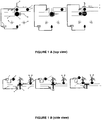
- the apparatus shown is housed in a greenhouse (not shown) which may have a number of areas which are treated differently to produce different environments. For example, the temperature and humidity of the areas may vary according to the needs of the particular plants being grown or according to the experimental setup.
- the apparatus comprises: a first transporter means (1) to support and move containers (2) shown as plant pots in Figures 1a and 1b in which one plant is growing in a growth-promoting medium.
- the containers (2) are moved along the first transporter means (1) to a station for imaging the plants and recording details of the images.
- the containers (2) are moved onto rotating plate (3) allowing rotation on a central vertical axis.
- a first pusher (4) is shown for moving container (2) from the first transporter means (1) onto the rotating plate (3).
- Camera (5) for recording pictures of the plants is placed horizontally at a suitable distance from rotating plate (3) and a light source (6) is placed horizontally at a suitable distance from rotating plate (3) to uniformly illuminate the plant.
- Computer (7), connected to camera (5), comprises appropriate software programs for collecting, storing, and analysing images taken by the camera.
- Unique identifier reader (8) is shown for reading the unique identifier associated with the plant or plants in container (2).
- Second transporter means (9) is shown for supporting and moving containers (2) back to their original location or to another location.
- a second pusher (10) moves containers (2) from the rotating plate (3) onto second transporter means (9).
- the process for determining the start of flowering using the apparatus of the invention typically includes the following steps.
- the first transporter means (1) is set in motion to bring container (2) in front of rotating plate (3).
- First transporter means (1) is then stopped.
- First pusher (4) is activated and pushes container (2) onto rotating plate (3).
- the action of placing the plant on the rotating plate can be performed manually or by a robotic arm with a suitable gripper that can seize the plant and move it to a defined location.
- Container (2) on rotating plate (3) is rotated in front of the camera (5) and light source (6) is switched on.
- Light-source (6) is generally not switched off between each plant so as to ensure stable illumination at each cycle of picture acquisition.
- Camera (5) then starts taking pictures at regular intervals as soon as the rotating plate (3) is turning and stops after a complete revolution.
- the number of pictures taken per cycle is generally at least 3 and generally not more than 6.
- the unique identifier associated with the plant or plants in container (2) is read by the identifier reader (8) and sent through a data cable connection to computer (7).
- Camera (5) sends recorded pictures through a data cable connection to computer (7).
- the unique identifier of the plant (not shown) is linked to the images at the moment the images are stored and analysed.
- the identifier is incorporated in the name of the image files when the image files are stored, but any naming system can be used to name the images provided that the identifier and the image names are linked unequivocally in a computer database.
- Second pusher (10) moves container (2) onto second transporter means (9) which is set in motion to take away container (2) from camera (5).
- second transporter means (9) which is set in motion to take away container (2) from camera (5).
- the same action can be performed manually or by a robotic arm with a suitable gripper that can seize the plant and move it to a defined location.
- Table 1 summarises the results of an experiment aimed at demonstrating that the presence of a particular gene construct confers an altered flowering time to transgenic rice plants transformed with the construct compared to control plants (siblings from the same mother plant as the transgenics, but that did not inherit the construct because of mendelian segregation).
- the experiment involved 7 independent transformation attempts or transformation events, named A, B, C, D, E, F and G. For each event, 9 transgenic plants and 9 control plants were taken. Each plant was imaged once every 7 days, starting 10 days after sowing until maturity. The flowering time of each plant in the experiment was calculated as described hereinabove. Suitable statistical methods were applied to determine the level of significance of the differences found between transgenics and controls in each transformation event.
Landscapes
- Life Sciences & Earth Sciences (AREA)
- Environmental Sciences (AREA)
- Botany (AREA)
- Biodiversity & Conservation Biology (AREA)
- Ecology (AREA)
- Forests & Forestry (AREA)
- Image Processing (AREA)
- Cultivation Of Plants (AREA)
- Image Analysis (AREA)
- Investigating Or Analysing Biological Materials (AREA)
Claims (8)
- Procédé pour déterminer le début de la floraison d'une plante, comprenant les étapes consistant :(i) à former une image numérique de l'inflorescence de ladite plante ; et(ii) à mesurer l'inflorescence à partir de l'image numérique ; et(iii) à calculer à nouveau par un moyen informatique (7) le début de la floraison de ladite plante à partir de la vitesse de croissance moyenne des inflorescences et des mesures dérivées de l'étape (ii).
- Procédé selon la revendication 1, dans lequel ladite inflorescence est imagée avant que l'inflorescence n'atteigne sa taille maximale.
- Procédé selon la revendication 1 ou 2, dans lequel ladite inflorescence est imagée au moins tous les 7 jours jusqu'à la maturité de la plante.
- Procédé selon l'une quelconque des revendications 1 à 3, comprenant l'étape supplémentaire consistant à sélectionner des plantes ayant un temps de floraison modifié par comparaison avec des plantes témoins.
- Procédé selon l'une quelconque des revendications 1 à 4, dans lequel ladite plante est une céréale, telle que le riz, le blé et le maïs.
- Appareil pour déterminer le début de la floraison, lequel appareil comprend :(i) un moyen de transport (1) pour supporter et déplacer un récipient (2) dans lequel une ou plusieurs plantes poussent ;(ii) un ou plusieurs appareils de prise de vue numériques (5) ayant une résolution suffisante pour imager l'émergence des inflorescences de plante de ladite ou desdites plantes ;(iii) un moyen informatique (7) configuré pour détecter et mesurer des inflorescences de plante et pour calculer à nouveau le début de la floraison à partir desdites mesures et des vitesses de croissance moyennes des inflorescences.
- Appareil selon la revendication 6, dans lequel ledit récipient (2) comprend un identifiant unique associé.
- Appareil selon la revendication 6 ou 7, dans lequel ledit ou lesdits appareils de prise de vue numériques (5) permettent aux inflorescences imagées d'avoir une taille minimale d'environ 100 pixels.
Priority Applications (1)
| Application Number | Priority Date | Filing Date | Title |
|---|---|---|---|
| EP07722856.7A EP1986485B1 (fr) | 2006-02-17 | 2007-02-19 | Procédé et dispositif pour déterminer le commencement de la floraison des plantes |
Applications Claiming Priority (3)
| Application Number | Priority Date | Filing Date | Title |
|---|---|---|---|
| EP06110081A EP1820391A1 (fr) | 2006-02-17 | 2006-02-17 | Procédé et dispositif pour déterminer le commencement de la floraison en plantes |
| PCT/EP2007/001422 WO2007093444A1 (fr) | 2006-02-17 | 2007-02-19 | Procede et appareil permettant de determiner le debut de la floraison chez les plantes |
| EP07722856.7A EP1986485B1 (fr) | 2006-02-17 | 2007-02-19 | Procédé et dispositif pour déterminer le commencement de la floraison des plantes |
Publications (2)
| Publication Number | Publication Date |
|---|---|
| EP1986485A1 EP1986485A1 (fr) | 2008-11-05 |
| EP1986485B1 true EP1986485B1 (fr) | 2018-10-03 |
Family
ID=36648646
Family Applications (2)
| Application Number | Title | Priority Date | Filing Date |
|---|---|---|---|
| EP06110081A Withdrawn EP1820391A1 (fr) | 2006-02-17 | 2006-02-17 | Procédé et dispositif pour déterminer le commencement de la floraison en plantes |
| EP07722856.7A Not-in-force EP1986485B1 (fr) | 2006-02-17 | 2007-02-19 | Procédé et dispositif pour déterminer le commencement de la floraison des plantes |
Family Applications Before (1)
| Application Number | Title | Priority Date | Filing Date |
|---|---|---|---|
| EP06110081A Withdrawn EP1820391A1 (fr) | 2006-02-17 | 2006-02-17 | Procédé et dispositif pour déterminer le commencement de la floraison en plantes |
Country Status (7)
| Country | Link |
|---|---|
| US (2) | US8559679B2 (fr) |
| EP (2) | EP1820391A1 (fr) |
| JP (1) | JP4913160B2 (fr) |
| CN (1) | CN101384164B (fr) |
| AU (1) | AU2007214616B2 (fr) |
| DE (1) | DE202007019655U1 (fr) |
| WO (1) | WO2007093444A1 (fr) |
Families Citing this family (61)
| Publication number | Priority date | Publication date | Assignee | Title |
|---|---|---|---|---|
| CN101022719B (zh) | 2004-09-16 | 2010-06-09 | 克罗普迪塞恩股份有限公司 | 评价植物根的方法和装置 |
| US20100199380A1 (en) | 2007-06-29 | 2010-08-05 | Basf Plant Science Gmbh | Plants having enhanced yield-related traits and a method for making the same |
| EP2669379A3 (fr) | 2008-07-31 | 2014-03-19 | BASF Plant Science GmbH | Installations dotées de caractéristiques d croissance modifiées et procédé de fabrication de celles-ci |
| CN102159065A (zh) * | 2008-09-16 | 2011-08-17 | 巴斯夫植物科学有限公司 | 改善的植物育种方法 |
| JP5180772B2 (ja) * | 2008-10-03 | 2013-04-10 | 本田技研工業株式会社 | 穂の構造の解析方法および装置 |
| BRPI0924537A2 (pt) | 2008-12-03 | 2015-08-11 | Basf Plant Science Gmbh | Método para aumentar as características relacionadas ao rendimento em plantas, plantas ou parte das mesmas, ou células de planta, construto, uso de um construto e de uma sequência de ácido nucleico, método para a produção de plantas transgênicas, partes colhíveis, e, produtos |
| US20120277117A1 (en) * | 2009-02-27 | 2012-11-01 | Adel Zayed | Hydroponic apparatus and methods of use |
| CA2764732A1 (fr) | 2009-06-19 | 2011-01-20 | Basf Plant Science Company Gmbh | Plantes ayant des caracteres lies au rendement ameliores et leur procede de production |
| CN104530202A (zh) | 2009-08-19 | 2015-04-22 | 巴斯夫植物科学有限公司 | 具有增强的产量相关性状的植物和用于产生该植物的方法 |
| CA2773879A1 (fr) | 2009-09-25 | 2011-03-31 | Basf Plant Science Company Gmbh | Plantes presentant des caracteres ameliores lies au rendement et procede de production correspondant |
| CN104745608A (zh) | 2009-09-25 | 2015-07-01 | 巴斯夫植物科学有限公司 | 具有增强的产量相关性状的植物及其制备方法 |
| KR20120126061A (ko) | 2009-10-22 | 2012-11-20 | 재단법인 작물유전체기능연구사업단 | 향상된 수확량 관련 형질을 갖는 식물 및 이의 제조 방법 |
| US9025831B2 (en) * | 2009-11-10 | 2015-05-05 | Monsanto Technology Llc | Apparatus and methods for automated phenotypic screening of plant genotypes |
| TWI401412B (zh) * | 2009-11-13 | 2013-07-11 | Inst Information Industry | Automatic measurement system, method and recording medium for plant characteristics |
| CN101718522B (zh) * | 2009-12-25 | 2011-07-27 | 华南农业大学 | 一种植物生长的非接触式无损检测装置及其检测方法 |
| JP4651743B1 (ja) * | 2010-03-12 | 2011-03-16 | 株式会社椿本チエイン | 植物栽培装置 |
| WO2011114305A1 (fr) | 2010-03-18 | 2011-09-22 | Basf Plant Science Company Gmbh | Plantes présentant des caractéristiques liées au rendement améliorées et procédé de production de ces plantes |
| EP2998401A3 (fr) | 2010-06-24 | 2016-07-06 | BASF Plant Science Company GmbH | Installations dotées de caractéristiques de rendement améliorées et procédé de fabrication de celles-ci |
| AU2011268562A1 (en) | 2010-06-25 | 2013-01-10 | Basf Plant Science Company Gmbh | Plants with enhanced yield-related traits and producing method thereof |
| AU2011277925A1 (en) | 2010-07-16 | 2013-02-21 | Basf Plant Science Company Gmbh | Plants having enhanced yield-related traits and method for making the same |
| MX2013002137A (es) | 2010-08-24 | 2013-05-17 | Basf Plant Science Co Gmbh | Plantas que tienen mejores rasgos relacionados con el rendimiento y un metodo para prepararlas. |
| DE102010048298A1 (de) | 2010-10-14 | 2012-04-19 | Johnson Controls Systems & Service Gmbh | Einrichtung zur Erfassung des Wachstums einer Vielzahl biologischer Proben |
| BR112013011523A2 (pt) | 2010-11-10 | 2019-09-24 | Basf Plant Science Co Gmbh | método, planta, construto, uso, planta transgênica, partes colhíveis de uma planta, produtos e partes colhíveis de uma planta |
| BR112013018545A2 (pt) | 2011-01-20 | 2019-02-05 | Basf Plant Science Co Gmbh | plantas com características melhoras relacionadas á produção e um método para produção das mesma |
| CN103492573A (zh) | 2011-02-28 | 2014-01-01 | 巴斯夫植物科学有限公司 | 具有增强的产量相关性状的植物和其生产方法 |
| AU2012222999A1 (en) | 2011-02-28 | 2013-09-19 | Basf Plant Science Company Gmbh | Plants having enhanced yield-related traits and producing methods thereof |
| CN103582702A (zh) | 2011-03-01 | 2014-02-12 | 巴斯夫植物科学有限公司 | 具有增强的产量相关性状的植物和用于制备该植物的方法 |
| US10096073B2 (en) | 2011-05-13 | 2018-10-09 | The Climate Corporation | Systems to prescribe and deliver fertilizer over agricultural fields and related methods |
| US10842144B2 (en) * | 2011-05-13 | 2020-11-24 | The Climate Corporation | Method and system to map biological pests in agricultural fields using remotely-sensed data for field scouting and targeted chemical application |
| RU2014102263A (ru) | 2011-06-27 | 2015-08-10 | Басф Плант Сайенс Компани Гмбх | Устройство для скрининга экземпляров растений |
| JP5866156B2 (ja) * | 2011-07-25 | 2016-02-17 | 西部電機株式会社 | 植物栽培設備 |
| CN102565061B (zh) * | 2012-01-16 | 2014-03-12 | 沈阳农业大学 | 作物生物量无损检测图像采集处理装置及检测方法 |
| CN102608349B (zh) * | 2012-02-21 | 2013-08-07 | 南京农业大学 | 基于嵌入式双相机平台的智能温室油桃果实生长速率无线监测系统 |
| EP2677035A1 (fr) | 2012-06-22 | 2013-12-25 | BASF Plant Science Company GmbH | Installations dotées de caractéristiques de rendement améliorées et procédé de fabrication de celles-ci |
| JP5904044B2 (ja) * | 2012-07-18 | 2016-04-13 | 富士通株式会社 | 農作物の状態変化日特定方法、装置及びプログラム |
| TWI489097B (zh) * | 2012-11-27 | 2015-06-21 | Inst Information Industry | Characteristic measurement system, method and recording medium for plant image |
| EP2816115A1 (fr) | 2013-06-17 | 2014-12-24 | BASF Plant Science Company GmbH | Plantes dotées d'une ou de plusieurs caractéristiques de rendement améliorées et procédé de fabrication de celles-ci |
| MY183702A (en) * | 2013-12-04 | 2021-03-09 | Mimos Berhad | A method for monitoring anthesis of an inflorescence and a system for implementing the same |
| EP2896698A1 (fr) | 2014-01-17 | 2015-07-22 | BASF Plant Science Company GmbH | Installations dotées d'une ou de plusieurs caractéristiques de rendement améliorées et procédé de fabrication de celles-ci |
| CN103858690A (zh) * | 2014-04-03 | 2014-06-18 | 黑龙江八一农垦大学 | 一种植物生长观察台 |
| WO2016022779A1 (fr) | 2014-08-06 | 2016-02-11 | Envera, Llc | Compositions de spores bactériennes à usages industriels |
| US10186029B2 (en) * | 2014-09-26 | 2019-01-22 | Wisconsin Alumni Research Foundation | Object characterization |
| CN104457620A (zh) * | 2014-12-09 | 2015-03-25 | 浙江省农业科学院 | 一种快速无损测量作物分枝角度和节间长度的方法 |
| CN104941330B (zh) * | 2015-05-29 | 2017-08-01 | 小米科技有限责任公司 | 一种净化空气的方法和装置 |
| US10674685B2 (en) * | 2015-06-04 | 2020-06-09 | Elwha Llc | Systems and methods for selective pollination |
| EP3387416A1 (fr) * | 2015-12-10 | 2018-10-17 | Basf Plant Science Company GmbH | Procédé et appareil de mesure de phénotype d'inflorescence, de graine et/ou de rendement de graine |
| US10028452B2 (en) * | 2016-04-04 | 2018-07-24 | Beesprout, Llc | Horticultural monitoring system |
| US10772275B2 (en) * | 2016-05-06 | 2020-09-15 | Basf Plant Science Company Gmbh | Method and apparatus for high throughput testing of a treatment on one or more characteristic of plants |
| WO2017203519A1 (fr) | 2016-05-22 | 2017-11-30 | Weedout Ltd. | Compositions, kits et procédés de lutte contre les mauvaises herbes |
| WO2019106666A1 (fr) | 2017-11-29 | 2019-06-06 | Weedout Ltd. | Compositions, kits et procédés de régulation des adventices |
| US11304355B2 (en) | 2018-05-06 | 2022-04-19 | Weedout Ltd. | Methods and systems for reducing fitness of weed |
| WO2019215581A1 (fr) | 2018-05-06 | 2019-11-14 | Weedout Ltd. | Procédés de lutte contre les mauvaises herbes du genre amaranthus |
| US11957097B2 (en) | 2018-10-25 | 2024-04-16 | Weedout Ltd. | Methods of inhibiting growth of weeds |
| TWI720842B (zh) * | 2020-03-11 | 2021-03-01 | 崑山科技大學 | 智慧型竹筍栽培採收監控系統及方法 |
| US11696542B1 (en) * | 2020-04-28 | 2023-07-11 | Sentera, Inc. | Systems and methods of seed production plant counting using aerial images |
| CN111512944B (zh) * | 2020-04-29 | 2021-12-17 | 成都市农林科学院 | 适合于水培苗的移栽机器人 |
| MX2023004347A (es) * | 2020-10-14 | 2023-08-09 | Accelerated Ag Tech Llc | Sistema predictor de polinizacion y metodo. |
| CN113615512B (zh) * | 2021-09-15 | 2022-05-13 | 湖南科技大学 | 一种采用混种荞麦减少油菜苗期病草害的方法 |
| US20240407364A1 (en) | 2021-10-14 | 2024-12-12 | Weedout Ltd. | Methods of weed control |
| WO2024210113A1 (fr) * | 2023-04-05 | 2024-10-10 | オムロン株式会社 | Dispositif de traitement d'informations, procédé de traitement d'informations et programme |
| CN117397661A (zh) * | 2023-10-27 | 2024-01-16 | 佛山市天下谷科技有限公司 | 一种喷药机器人的喷药控制方法及喷药机器人 |
Citations (2)
| Publication number | Priority date | Publication date | Assignee | Title |
|---|---|---|---|---|
| WO2001009711A2 (fr) * | 1999-08-03 | 2001-02-08 | Paradigm Genetics, Inc. | Procede d'identification de plantes et d'autres organismes presentant des caracteristiques differents d'une population normale |
| EP1433377A1 (fr) * | 2002-12-23 | 2004-06-30 | CropDesign N.V. | Système automatisé de manipulation de conteneurs à plantes |
Family Cites Families (8)
| Publication number | Priority date | Publication date | Assignee | Title |
|---|---|---|---|---|
| DE3906215A1 (de) * | 1989-02-28 | 1990-08-30 | Robert Prof Dr Ing Massen | Automatische klassifikation von pflaenzlingen |
| EP1155133A1 (fr) * | 1999-02-25 | 2001-11-21 | Wisconsin Alumni Research Foundation | Alteration de la periode de floraison des plantes |
| JP3918143B2 (ja) * | 2000-12-28 | 2007-05-23 | 独立行政法人科学技術振興機構 | 植物認識システム |
| JP4276414B2 (ja) * | 2002-09-30 | 2009-06-10 | 浜松ホトニクス株式会社 | 植物体栽培装置および方法 |
| JP2005026873A (ja) * | 2003-06-30 | 2005-01-27 | Casio Comput Co Ltd | 撮影方法、撮像装置、及びプログラム |
| CN101022719B (zh) * | 2004-09-16 | 2010-06-09 | 克罗普迪塞恩股份有限公司 | 评价植物根的方法和装置 |
| US20090288226A1 (en) * | 2005-11-21 | 2009-11-19 | Hallahan David L | Method for manipulating growth, yield, and architecture in plants |
| US8637735B2 (en) * | 2007-06-20 | 2014-01-28 | The Australian National University | Method for improving stress resistance in plants and materials therefor |
-
2006
- 2006-02-17 EP EP06110081A patent/EP1820391A1/fr not_active Withdrawn
-
2007
- 2007-02-19 AU AU2007214616A patent/AU2007214616B2/en not_active Ceased
- 2007-02-19 WO PCT/EP2007/001422 patent/WO2007093444A1/fr not_active Ceased
- 2007-02-19 CN CN2007800058443A patent/CN101384164B/zh not_active Expired - Fee Related
- 2007-02-19 JP JP2008554696A patent/JP4913160B2/ja not_active Expired - Fee Related
- 2007-02-19 EP EP07722856.7A patent/EP1986485B1/fr not_active Not-in-force
- 2007-02-19 US US12/279,353 patent/US8559679B2/en not_active Expired - Fee Related
- 2007-02-19 DE DE202007019655.5U patent/DE202007019655U1/de not_active Expired - Lifetime
-
2013
- 2013-09-09 US US14/021,438 patent/US8670594B2/en not_active Expired - Fee Related
Patent Citations (2)
| Publication number | Priority date | Publication date | Assignee | Title |
|---|---|---|---|---|
| WO2001009711A2 (fr) * | 1999-08-03 | 2001-02-08 | Paradigm Genetics, Inc. | Procede d'identification de plantes et d'autres organismes presentant des caracteristiques differents d'une population normale |
| EP1433377A1 (fr) * | 2002-12-23 | 2004-06-30 | CropDesign N.V. | Système automatisé de manipulation de conteneurs à plantes |
Also Published As
| Publication number | Publication date |
|---|---|
| US8559679B2 (en) | 2013-10-15 |
| CN101384164A (zh) | 2009-03-11 |
| WO2007093444A1 (fr) | 2007-08-23 |
| JP4913160B2 (ja) | 2012-04-11 |
| CN101384164B (zh) | 2011-06-15 |
| DE202007019655U1 (de) | 2015-06-17 |
| AU2007214616B2 (en) | 2012-05-17 |
| US20140010414A1 (en) | 2014-01-09 |
| EP1986485A1 (fr) | 2008-11-05 |
| EP1820391A1 (fr) | 2007-08-22 |
| AU2007214616A1 (en) | 2007-08-23 |
| JP2009526536A (ja) | 2009-07-23 |
| US20090226042A1 (en) | 2009-09-10 |
| US8670594B2 (en) | 2014-03-11 |
Similar Documents
| Publication | Publication Date | Title |
|---|---|---|
| EP1986485B1 (fr) | Procédé et dispositif pour déterminer le commencement de la floraison des plantes | |
| US10031117B2 (en) | Apparatus and methods for automated phenotypic screening of plant genotypes | |
| CA2579804C (fr) | Evaluation de la croissance d'une racine | |
| US9335313B2 (en) | Immature ear photometry in maize | |
| US20070186313A1 (en) | Method for high throughput transgene function analysis for agronomic traits in maize | |
| Lopes et al. | Growing Princesa apples under semiarid conditions in northeastern Brazil | |
| Reynolds et al. | Heat tolerance in tuber bearing Solanum species: a protocol for screening | |
| Ibáñez et al. | Cultivated grapevine displays a great diversity for reproductive performance variables | |
| Bridgemohan et al. | The application of BBCH scale for codification and illustrations of the floral stages of Caribbean fine cacao Theobroma cacao L | |
| Ling et al. | TRANSPLANT UNIFORMITY INSPECTION USING MACHINE VISION1 | |
| Priyadarshini et al. | Genetic divergence in root system architecture of tomato genotypes at vegetative stage. | |
| Saleem et al. | Lootens P, De Swaef T and Roldán-Ruiz I (2022) Response of a Diverse European Soybean Collection to" Short Duration” and “Long Duration” Drought Stress | |
| de Lima Filho et al. | PHENOLOGY AND HARVEST POINTS OF SNAP BEAN VARIETIES RELATED TO DEGREE-DAY ACCUMULATION | |
| Takeda et al. | Morphological changes in the shoot apex predicts anthesis time in Chrysanthemum morifolium | |
| Turna et al. | Effects of Short Term Pollen Storage on Fruit Set, Seed Number and Seed Germination Rate in Cut Rose Hybridization | |
| Kawasaki et al. | Early Prediction of Fruit Size Based on Flower Characteristics of Strawberry | |
| JP2024007928A (ja) | ライブラリー生産方法 | |
| Everaarts | A decimal code describing the developmental stages of head cabbage (Brassica oleracea var. capitata) | |
| CN121826037A (zh) | 敲除OsPRR1基因的生物材料在提高水稻耐高温性中的应用 | |
| Carey | Increasing productivity and extending seasonality in soil grown vegetables using capsicum as a candidate | |
| Kadam et al. | Harnessing Hydroponics: A Promising Approach for Screening Drought Tolerance in Citrus | |
| Mihajlovic et al. | Changes of composition of dry matter of pea during growing season. |
Legal Events
| Date | Code | Title | Description |
|---|---|---|---|
| PUAI | Public reference made under article 153(3) epc to a published international application that has entered the european phase |
Free format text: ORIGINAL CODE: 0009012 |
|
| 17P | Request for examination filed |
Effective date: 20080917 |
|
| AK | Designated contracting states |
Kind code of ref document: A1 Designated state(s): AT BE BG CH CY CZ DE DK EE ES FI FR GB GR HU IE IS IT LI LT LU LV MC NL PL PT RO SE SI SK TR |
|
| DAX | Request for extension of the european patent (deleted) | ||
| STAA | Information on the status of an ep patent application or granted ep patent |
Free format text: STATUS: EXAMINATION IS IN PROGRESS |
|
| 17Q | First examination report despatched |
Effective date: 20161107 |
|
| GRAP | Despatch of communication of intention to grant a patent |
Free format text: ORIGINAL CODE: EPIDOSNIGR1 |
|
| RIC1 | Information provided on ipc code assigned before grant |
Ipc: A01G 7/00 20060101AFI20170829BHEP Ipc: A01G 1/00 20060101ALI20170829BHEP Ipc: A01G 9/00 20060101ALI20170829BHEP |
|
| STAA | Information on the status of an ep patent application or granted ep patent |
Free format text: STATUS: GRANT OF PATENT IS INTENDED |
|
| INTG | Intention to grant announced |
Effective date: 20171005 |
|
| GRAS | Grant fee paid |
Free format text: ORIGINAL CODE: EPIDOSNIGR3 |
|
| REG | Reference to a national code |
Ref country code: DE Ref legal event code: R079 Ref document number: 602007056348 Country of ref document: DE Free format text: PREVIOUS MAIN CLASS: A01G0001000000 Ipc: A01G0022600000 |
|
| GRAJ | Information related to disapproval of communication of intention to grant by the applicant or resumption of examination proceedings by the epo deleted |
Free format text: ORIGINAL CODE: EPIDOSDIGR1 |
|
| GRAL | Information related to payment of fee for publishing/printing deleted |
Free format text: ORIGINAL CODE: EPIDOSDIGR3 |
|
| GRAP | Despatch of communication of intention to grant a patent |
Free format text: ORIGINAL CODE: EPIDOSNIGR1 |
|
| RIC1 | Information provided on ipc code assigned before grant |
Ipc: A01G 7/00 20060101ALI20180222BHEP Ipc: A01G 22/60 20180101AFI20180222BHEP |
|
| INTG | Intention to grant announced |
Effective date: 20180319 |
|
| RIN1 | Information on inventor provided before grant (corrected) |
Inventor name: LEYNS, FREDERIK Inventor name: LEJEUNE, PIERRE |
|
| RAP1 | Party data changed (applicant data changed or rights of an application transferred) |
Owner name: CROPDESIGN N.V. |
|
| RIN1 | Information on inventor provided before grant (corrected) |
Inventor name: LEYNS, FREDERIK Inventor name: LEJEUNE, PIERRE |
|
| GRAS | Grant fee paid |
Free format text: ORIGINAL CODE: EPIDOSNIGR3 |
|
| GRAA | (expected) grant |
Free format text: ORIGINAL CODE: 0009210 |
|
| STAA | Information on the status of an ep patent application or granted ep patent |
Free format text: STATUS: THE PATENT HAS BEEN GRANTED |
|
| AK | Designated contracting states |
Kind code of ref document: B1 Designated state(s): AT BE BG CH CY CZ DE DK EE ES FI FR GB GR HU IE IS IT LI LT LU LV MC NL PL PT RO SE SI SK TR |
|
| REG | Reference to a national code |
Ref country code: GB Ref legal event code: FG4D |
|
| REG | Reference to a national code |
Ref country code: CH Ref legal event code: EP Ref country code: AT Ref legal event code: REF Ref document number: 1047616 Country of ref document: AT Kind code of ref document: T Effective date: 20181015 |
|
| REG | Reference to a national code |
Ref country code: IE Ref legal event code: FG4D Ref country code: DE Ref legal event code: R096 Ref document number: 602007056348 Country of ref document: DE |
|
| REG | Reference to a national code |
Ref country code: NL Ref legal event code: FP |
|
| REG | Reference to a national code |
Ref country code: LT Ref legal event code: MG4D |
|
| REG | Reference to a national code |
Ref country code: AT Ref legal event code: MK05 Ref document number: 1047616 Country of ref document: AT Kind code of ref document: T Effective date: 20181003 |
|
| PG25 | Lapsed in a contracting state [announced via postgrant information from national office to epo] |
Ref country code: ES Free format text: LAPSE BECAUSE OF FAILURE TO SUBMIT A TRANSLATION OF THE DESCRIPTION OR TO PAY THE FEE WITHIN THE PRESCRIBED TIME-LIMIT Effective date: 20181003 Ref country code: CZ Free format text: LAPSE BECAUSE OF FAILURE TO SUBMIT A TRANSLATION OF THE DESCRIPTION OR TO PAY THE FEE WITHIN THE PRESCRIBED TIME-LIMIT Effective date: 20181003 Ref country code: IS Free format text: LAPSE BECAUSE OF FAILURE TO SUBMIT A TRANSLATION OF THE DESCRIPTION OR TO PAY THE FEE WITHIN THE PRESCRIBED TIME-LIMIT Effective date: 20190203 Ref country code: PL Free format text: LAPSE BECAUSE OF FAILURE TO SUBMIT A TRANSLATION OF THE DESCRIPTION OR TO PAY THE FEE WITHIN THE PRESCRIBED TIME-LIMIT Effective date: 20181003 Ref country code: LT Free format text: LAPSE BECAUSE OF FAILURE TO SUBMIT A TRANSLATION OF THE DESCRIPTION OR TO PAY THE FEE WITHIN THE PRESCRIBED TIME-LIMIT Effective date: 20181003 Ref country code: BG Free format text: LAPSE BECAUSE OF FAILURE TO SUBMIT A TRANSLATION OF THE DESCRIPTION OR TO PAY THE FEE WITHIN THE PRESCRIBED TIME-LIMIT Effective date: 20190103 Ref country code: AT Free format text: LAPSE BECAUSE OF FAILURE TO SUBMIT A TRANSLATION OF THE DESCRIPTION OR TO PAY THE FEE WITHIN THE PRESCRIBED TIME-LIMIT Effective date: 20181003 Ref country code: FI Free format text: LAPSE BECAUSE OF FAILURE TO SUBMIT A TRANSLATION OF THE DESCRIPTION OR TO PAY THE FEE WITHIN THE PRESCRIBED TIME-LIMIT Effective date: 20181003 Ref country code: LV Free format text: LAPSE BECAUSE OF FAILURE TO SUBMIT A TRANSLATION OF THE DESCRIPTION OR TO PAY THE FEE WITHIN THE PRESCRIBED TIME-LIMIT Effective date: 20181003 |
|
| PG25 | Lapsed in a contracting state [announced via postgrant information from national office to epo] |
Ref country code: SE Free format text: LAPSE BECAUSE OF FAILURE TO SUBMIT A TRANSLATION OF THE DESCRIPTION OR TO PAY THE FEE WITHIN THE PRESCRIBED TIME-LIMIT Effective date: 20181003 Ref country code: GR Free format text: LAPSE BECAUSE OF FAILURE TO SUBMIT A TRANSLATION OF THE DESCRIPTION OR TO PAY THE FEE WITHIN THE PRESCRIBED TIME-LIMIT Effective date: 20190104 Ref country code: PT Free format text: LAPSE BECAUSE OF FAILURE TO SUBMIT A TRANSLATION OF THE DESCRIPTION OR TO PAY THE FEE WITHIN THE PRESCRIBED TIME-LIMIT Effective date: 20190203 |
|
| REG | Reference to a national code |
Ref country code: DE Ref legal event code: R097 Ref document number: 602007056348 Country of ref document: DE |
|
| PG25 | Lapsed in a contracting state [announced via postgrant information from national office to epo] |
Ref country code: IT Free format text: LAPSE BECAUSE OF FAILURE TO SUBMIT A TRANSLATION OF THE DESCRIPTION OR TO PAY THE FEE WITHIN THE PRESCRIBED TIME-LIMIT Effective date: 20181003 Ref country code: DK Free format text: LAPSE BECAUSE OF FAILURE TO SUBMIT A TRANSLATION OF THE DESCRIPTION OR TO PAY THE FEE WITHIN THE PRESCRIBED TIME-LIMIT Effective date: 20181003 |
|
| PLBE | No opposition filed within time limit |
Free format text: ORIGINAL CODE: 0009261 |
|
| STAA | Information on the status of an ep patent application or granted ep patent |
Free format text: STATUS: NO OPPOSITION FILED WITHIN TIME LIMIT |
|
| PG25 | Lapsed in a contracting state [announced via postgrant information from national office to epo] |
Ref country code: EE Free format text: LAPSE BECAUSE OF FAILURE TO SUBMIT A TRANSLATION OF THE DESCRIPTION OR TO PAY THE FEE WITHIN THE PRESCRIBED TIME-LIMIT Effective date: 20181003 Ref country code: RO Free format text: LAPSE BECAUSE OF FAILURE TO SUBMIT A TRANSLATION OF THE DESCRIPTION OR TO PAY THE FEE WITHIN THE PRESCRIBED TIME-LIMIT Effective date: 20181003 Ref country code: SK Free format text: LAPSE BECAUSE OF FAILURE TO SUBMIT A TRANSLATION OF THE DESCRIPTION OR TO PAY THE FEE WITHIN THE PRESCRIBED TIME-LIMIT Effective date: 20181003 |
|
| 26N | No opposition filed |
Effective date: 20190704 |
|
| GBPC | Gb: european patent ceased through non-payment of renewal fee |
Effective date: 20190219 |
|
| PG25 | Lapsed in a contracting state [announced via postgrant information from national office to epo] |
Ref country code: LU Free format text: LAPSE BECAUSE OF NON-PAYMENT OF DUE FEES Effective date: 20190219 Ref country code: MC Free format text: LAPSE BECAUSE OF FAILURE TO SUBMIT A TRANSLATION OF THE DESCRIPTION OR TO PAY THE FEE WITHIN THE PRESCRIBED TIME-LIMIT Effective date: 20181003 Ref country code: SI Free format text: LAPSE BECAUSE OF FAILURE TO SUBMIT A TRANSLATION OF THE DESCRIPTION OR TO PAY THE FEE WITHIN THE PRESCRIBED TIME-LIMIT Effective date: 20181003 |
|
| REG | Reference to a national code |
Ref country code: IE Ref legal event code: MM4A |
|
| PG25 | Lapsed in a contracting state [announced via postgrant information from national office to epo] |
Ref country code: IE Free format text: LAPSE BECAUSE OF NON-PAYMENT OF DUE FEES Effective date: 20190219 Ref country code: GB Free format text: LAPSE BECAUSE OF NON-PAYMENT OF DUE FEES Effective date: 20190219 |
|
| PG25 | Lapsed in a contracting state [announced via postgrant information from national office to epo] |
Ref country code: TR Free format text: LAPSE BECAUSE OF FAILURE TO SUBMIT A TRANSLATION OF THE DESCRIPTION OR TO PAY THE FEE WITHIN THE PRESCRIBED TIME-LIMIT Effective date: 20181003 |
|
| PGFP | Annual fee paid to national office [announced via postgrant information from national office to epo] |
Ref country code: NL Payment date: 20200225 Year of fee payment: 14 |
|
| PGFP | Annual fee paid to national office [announced via postgrant information from national office to epo] |
Ref country code: CH Payment date: 20200225 Year of fee payment: 14 Ref country code: BE Payment date: 20200225 Year of fee payment: 14 |
|
| PGFP | Annual fee paid to national office [announced via postgrant information from national office to epo] |
Ref country code: FR Payment date: 20200225 Year of fee payment: 14 |
|
| PGFP | Annual fee paid to national office [announced via postgrant information from national office to epo] |
Ref country code: DE Payment date: 20200429 Year of fee payment: 14 |
|
| PG25 | Lapsed in a contracting state [announced via postgrant information from national office to epo] |
Ref country code: CY Free format text: LAPSE BECAUSE OF FAILURE TO SUBMIT A TRANSLATION OF THE DESCRIPTION OR TO PAY THE FEE WITHIN THE PRESCRIBED TIME-LIMIT Effective date: 20181003 |
|
| PG25 | Lapsed in a contracting state [announced via postgrant information from national office to epo] |
Ref country code: HU Free format text: LAPSE BECAUSE OF FAILURE TO SUBMIT A TRANSLATION OF THE DESCRIPTION OR TO PAY THE FEE WITHIN THE PRESCRIBED TIME-LIMIT; INVALID AB INITIO Effective date: 20070219 |
|
| REG | Reference to a national code |
Ref country code: DE Ref legal event code: R119 Ref document number: 602007056348 Country of ref document: DE |
|
| REG | Reference to a national code |
Ref country code: BE Ref legal event code: MM Effective date: 20210228 |
|
| PG25 | Lapsed in a contracting state [announced via postgrant information from national office to epo] |
Ref country code: LI Free format text: LAPSE BECAUSE OF NON-PAYMENT OF DUE FEES Effective date: 20210228 Ref country code: CH Free format text: LAPSE BECAUSE OF NON-PAYMENT OF DUE FEES Effective date: 20210228 |
|
| REG | Reference to a national code |
Ref country code: NL Ref legal event code: MM Effective date: 20210301 |
|
| PG25 | Lapsed in a contracting state [announced via postgrant information from national office to epo] |
Ref country code: NL Free format text: LAPSE BECAUSE OF NON-PAYMENT OF DUE FEES Effective date: 20210301 |
|
| PG25 | Lapsed in a contracting state [announced via postgrant information from national office to epo] |
Ref country code: FR Free format text: LAPSE BECAUSE OF NON-PAYMENT OF DUE FEES Effective date: 20210228 Ref country code: DE Free format text: LAPSE BECAUSE OF NON-PAYMENT OF DUE FEES Effective date: 20210901 |
|
| PG25 | Lapsed in a contracting state [announced via postgrant information from national office to epo] |
Ref country code: BE Free format text: LAPSE BECAUSE OF NON-PAYMENT OF DUE FEES Effective date: 20210228 |