EP1987010B1 - Tricyclische n-heteroaryl-carboxamid-derivate mit einer benzimidazol-einheit, verfahren zu ihrer herstellung und ihre therapeutische verwendung - Google Patents
Tricyclische n-heteroaryl-carboxamid-derivate mit einer benzimidazol-einheit, verfahren zu ihrer herstellung und ihre therapeutische verwendung Download PDFInfo
- Publication number
- EP1987010B1 EP1987010B1 EP07730900A EP07730900A EP1987010B1 EP 1987010 B1 EP1987010 B1 EP 1987010B1 EP 07730900 A EP07730900 A EP 07730900A EP 07730900 A EP07730900 A EP 07730900A EP 1987010 B1 EP1987010 B1 EP 1987010B1
- Authority
- EP
- European Patent Office
- Prior art keywords
- alkyl
- group
- cycloalkyl
- compound
- alkylene
- Prior art date
- Legal status (The legal status is an assumption and is not a legal conclusion. Google has not performed a legal analysis and makes no representation as to the accuracy of the status listed.)
- Active
Links
- 0 CCC=C[C@@](C)(*)C=CC1=C(C*)*=C2C(C)(*)CCC*12 Chemical compound CCC=C[C@@](C)(*)C=CC1=C(C*)*=C2C(C)(*)CCC*12 0.000 description 3
- MTGGRLAOTSXHNS-UHFFFAOYSA-N CN1c2nc(cc(cc3)N)c3[n]2CC1 Chemical compound CN1c2nc(cc(cc3)N)c3[n]2CC1 MTGGRLAOTSXHNS-UHFFFAOYSA-N 0.000 description 1
- UKCQZIWGXXACMD-UHFFFAOYSA-N NCC(CCc1nc2c3)[n]1c2ccc3N Chemical compound NCC(CCc1nc2c3)[n]1c2ccc3N UKCQZIWGXXACMD-UHFFFAOYSA-N 0.000 description 1
- WLLMNOSZWAGEPC-UHFFFAOYSA-N Nc(cc1)cc2c1[n](CCN1)c1n2 Chemical compound Nc(cc1)cc2c1[n](CCN1)c1n2 WLLMNOSZWAGEPC-UHFFFAOYSA-N 0.000 description 1
- MINQZEGSOMTNBR-UHFFFAOYSA-O Nc1cc(N=C(C2C3)C4CCCC23[NH3+])c4cc1 Chemical compound Nc1cc(N=C(C2C3)C4CCCC23[NH3+])c4cc1 MINQZEGSOMTNBR-UHFFFAOYSA-O 0.000 description 1
Classifications
-
- C—CHEMISTRY; METALLURGY
- C07—ORGANIC CHEMISTRY
- C07D—HETEROCYCLIC COMPOUNDS
- C07D471/00—Heterocyclic compounds containing nitrogen atoms as the only ring hetero atoms in the condensed system, at least one ring being a six-membered ring with one nitrogen atom, not provided for by groups C07D451/00 - C07D463/00
- C07D471/02—Heterocyclic compounds containing nitrogen atoms as the only ring hetero atoms in the condensed system, at least one ring being a six-membered ring with one nitrogen atom, not provided for by groups C07D451/00 - C07D463/00 in which the condensed system contains two hetero rings
- C07D471/04—Ortho-condensed systems
-
- C—CHEMISTRY; METALLURGY
- C07—ORGANIC CHEMISTRY
- C07D—HETEROCYCLIC COMPOUNDS
- C07D235/00—Heterocyclic compounds containing 1,3-diazole or hydrogenated 1,3-diazole rings, condensed with other rings
- C07D235/02—Heterocyclic compounds containing 1,3-diazole or hydrogenated 1,3-diazole rings, condensed with other rings condensed with carbocyclic rings or ring systems
-
- A—HUMAN NECESSITIES
- A61—MEDICAL OR VETERINARY SCIENCE; HYGIENE
- A61K—PREPARATIONS FOR MEDICAL, DENTAL OR TOILETRY PURPOSES
- A61K31/00—Medicinal preparations containing organic active ingredients
- A61K31/33—Heterocyclic compounds
- A61K31/395—Heterocyclic compounds having nitrogen as a ring hetero atom, e.g. guanethidine or rifamycins
- A61K31/41—Heterocyclic compounds having nitrogen as a ring hetero atom, e.g. guanethidine or rifamycins having five-membered rings with two or more ring hetero atoms, at least one of which being nitrogen, e.g. tetrazole
- A61K31/4164—1,3-Diazoles
- A61K31/4188—1,3-Diazoles condensed with other heterocyclic ring systems, e.g. biotin, sorbinil
-
- A—HUMAN NECESSITIES
- A61—MEDICAL OR VETERINARY SCIENCE; HYGIENE
- A61P—SPECIFIC THERAPEUTIC ACTIVITY OF CHEMICAL COMPOUNDS OR MEDICINAL PREPARATIONS
- A61P1/00—Drugs for disorders of the alimentary tract or the digestive system
-
- A—HUMAN NECESSITIES
- A61—MEDICAL OR VETERINARY SCIENCE; HYGIENE
- A61P—SPECIFIC THERAPEUTIC ACTIVITY OF CHEMICAL COMPOUNDS OR MEDICINAL PREPARATIONS
- A61P1/00—Drugs for disorders of the alimentary tract or the digestive system
- A61P1/04—Drugs for disorders of the alimentary tract or the digestive system for ulcers, gastritis or reflux esophagitis, e.g. antacids, inhibitors of acid secretion, mucosal protectants
-
- A—HUMAN NECESSITIES
- A61—MEDICAL OR VETERINARY SCIENCE; HYGIENE
- A61P—SPECIFIC THERAPEUTIC ACTIVITY OF CHEMICAL COMPOUNDS OR MEDICINAL PREPARATIONS
- A61P11/00—Drugs for disorders of the respiratory system
-
- A—HUMAN NECESSITIES
- A61—MEDICAL OR VETERINARY SCIENCE; HYGIENE
- A61P—SPECIFIC THERAPEUTIC ACTIVITY OF CHEMICAL COMPOUNDS OR MEDICINAL PREPARATIONS
- A61P11/00—Drugs for disorders of the respiratory system
- A61P11/08—Bronchodilators
-
- A—HUMAN NECESSITIES
- A61—MEDICAL OR VETERINARY SCIENCE; HYGIENE
- A61P—SPECIFIC THERAPEUTIC ACTIVITY OF CHEMICAL COMPOUNDS OR MEDICINAL PREPARATIONS
- A61P13/00—Drugs for disorders of the urinary system
-
- A—HUMAN NECESSITIES
- A61—MEDICAL OR VETERINARY SCIENCE; HYGIENE
- A61P—SPECIFIC THERAPEUTIC ACTIVITY OF CHEMICAL COMPOUNDS OR MEDICINAL PREPARATIONS
- A61P13/00—Drugs for disorders of the urinary system
- A61P13/02—Drugs for disorders of the urinary system of urine or of the urinary tract, e.g. urine acidifiers
-
- A—HUMAN NECESSITIES
- A61—MEDICAL OR VETERINARY SCIENCE; HYGIENE
- A61P—SPECIFIC THERAPEUTIC ACTIVITY OF CHEMICAL COMPOUNDS OR MEDICINAL PREPARATIONS
- A61P13/00—Drugs for disorders of the urinary system
- A61P13/10—Drugs for disorders of the urinary system of the bladder
-
- A—HUMAN NECESSITIES
- A61—MEDICAL OR VETERINARY SCIENCE; HYGIENE
- A61P—SPECIFIC THERAPEUTIC ACTIVITY OF CHEMICAL COMPOUNDS OR MEDICINAL PREPARATIONS
- A61P15/00—Drugs for genital or sexual disorders; Contraceptives
-
- A—HUMAN NECESSITIES
- A61—MEDICAL OR VETERINARY SCIENCE; HYGIENE
- A61P—SPECIFIC THERAPEUTIC ACTIVITY OF CHEMICAL COMPOUNDS OR MEDICINAL PREPARATIONS
- A61P15/00—Drugs for genital or sexual disorders; Contraceptives
- A61P15/02—Drugs for genital or sexual disorders; Contraceptives for disorders of the vagina
-
- A—HUMAN NECESSITIES
- A61—MEDICAL OR VETERINARY SCIENCE; HYGIENE
- A61P—SPECIFIC THERAPEUTIC ACTIVITY OF CHEMICAL COMPOUNDS OR MEDICINAL PREPARATIONS
- A61P15/00—Drugs for genital or sexual disorders; Contraceptives
- A61P15/08—Drugs for genital or sexual disorders; Contraceptives for gonadal disorders or for enhancing fertility, e.g. inducers of ovulation or of spermatogenesis
-
- A—HUMAN NECESSITIES
- A61—MEDICAL OR VETERINARY SCIENCE; HYGIENE
- A61P—SPECIFIC THERAPEUTIC ACTIVITY OF CHEMICAL COMPOUNDS OR MEDICINAL PREPARATIONS
- A61P17/00—Drugs for dermatological disorders
-
- A—HUMAN NECESSITIES
- A61—MEDICAL OR VETERINARY SCIENCE; HYGIENE
- A61P—SPECIFIC THERAPEUTIC ACTIVITY OF CHEMICAL COMPOUNDS OR MEDICINAL PREPARATIONS
- A61P17/00—Drugs for dermatological disorders
- A61P17/04—Antipruritics
-
- A—HUMAN NECESSITIES
- A61—MEDICAL OR VETERINARY SCIENCE; HYGIENE
- A61P—SPECIFIC THERAPEUTIC ACTIVITY OF CHEMICAL COMPOUNDS OR MEDICINAL PREPARATIONS
- A61P17/00—Drugs for dermatological disorders
- A61P17/06—Antipsoriatics
-
- A—HUMAN NECESSITIES
- A61—MEDICAL OR VETERINARY SCIENCE; HYGIENE
- A61P—SPECIFIC THERAPEUTIC ACTIVITY OF CHEMICAL COMPOUNDS OR MEDICINAL PREPARATIONS
- A61P25/00—Drugs for disorders of the nervous system
-
- A—HUMAN NECESSITIES
- A61—MEDICAL OR VETERINARY SCIENCE; HYGIENE
- A61P—SPECIFIC THERAPEUTIC ACTIVITY OF CHEMICAL COMPOUNDS OR MEDICINAL PREPARATIONS
- A61P25/00—Drugs for disorders of the nervous system
- A61P25/04—Centrally acting analgesics, e.g. opioids
-
- A—HUMAN NECESSITIES
- A61—MEDICAL OR VETERINARY SCIENCE; HYGIENE
- A61P—SPECIFIC THERAPEUTIC ACTIVITY OF CHEMICAL COMPOUNDS OR MEDICINAL PREPARATIONS
- A61P25/00—Drugs for disorders of the nervous system
- A61P25/06—Antimigraine agents
-
- A—HUMAN NECESSITIES
- A61—MEDICAL OR VETERINARY SCIENCE; HYGIENE
- A61P—SPECIFIC THERAPEUTIC ACTIVITY OF CHEMICAL COMPOUNDS OR MEDICINAL PREPARATIONS
- A61P25/00—Drugs for disorders of the nervous system
- A61P25/24—Antidepressants
-
- A—HUMAN NECESSITIES
- A61—MEDICAL OR VETERINARY SCIENCE; HYGIENE
- A61P—SPECIFIC THERAPEUTIC ACTIVITY OF CHEMICAL COMPOUNDS OR MEDICINAL PREPARATIONS
- A61P25/00—Drugs for disorders of the nervous system
- A61P25/28—Drugs for disorders of the nervous system for treating neurodegenerative disorders of the central nervous system, e.g. nootropic agents, cognition enhancers, drugs for treating Alzheimer's disease or other forms of dementia
-
- A—HUMAN NECESSITIES
- A61—MEDICAL OR VETERINARY SCIENCE; HYGIENE
- A61P—SPECIFIC THERAPEUTIC ACTIVITY OF CHEMICAL COMPOUNDS OR MEDICINAL PREPARATIONS
- A61P27/00—Drugs for disorders of the senses
- A61P27/02—Ophthalmic agents
-
- A—HUMAN NECESSITIES
- A61—MEDICAL OR VETERINARY SCIENCE; HYGIENE
- A61P—SPECIFIC THERAPEUTIC ACTIVITY OF CHEMICAL COMPOUNDS OR MEDICINAL PREPARATIONS
- A61P29/00—Non-central analgesic, antipyretic or antiinflammatory agents, e.g. antirheumatic agents; Non-steroidal antiinflammatory drugs [NSAID]
-
- A—HUMAN NECESSITIES
- A61—MEDICAL OR VETERINARY SCIENCE; HYGIENE
- A61P—SPECIFIC THERAPEUTIC ACTIVITY OF CHEMICAL COMPOUNDS OR MEDICINAL PREPARATIONS
- A61P3/00—Drugs for disorders of the metabolism
-
- A—HUMAN NECESSITIES
- A61—MEDICAL OR VETERINARY SCIENCE; HYGIENE
- A61P—SPECIFIC THERAPEUTIC ACTIVITY OF CHEMICAL COMPOUNDS OR MEDICINAL PREPARATIONS
- A61P31/00—Antiinfectives, i.e. antibiotics, antiseptics, chemotherapeutics
- A61P31/12—Antivirals
- A61P31/20—Antivirals for DNA viruses
- A61P31/22—Antivirals for DNA viruses for herpes viruses
-
- A—HUMAN NECESSITIES
- A61—MEDICAL OR VETERINARY SCIENCE; HYGIENE
- A61P—SPECIFIC THERAPEUTIC ACTIVITY OF CHEMICAL COMPOUNDS OR MEDICINAL PREPARATIONS
- A61P43/00—Drugs for specific purposes, not provided for in groups A61P1/00-A61P41/00
-
- A—HUMAN NECESSITIES
- A61—MEDICAL OR VETERINARY SCIENCE; HYGIENE
- A61P—SPECIFIC THERAPEUTIC ACTIVITY OF CHEMICAL COMPOUNDS OR MEDICINAL PREPARATIONS
- A61P5/00—Drugs for disorders of the endocrine system
-
- A—HUMAN NECESSITIES
- A61—MEDICAL OR VETERINARY SCIENCE; HYGIENE
- A61P—SPECIFIC THERAPEUTIC ACTIVITY OF CHEMICAL COMPOUNDS OR MEDICINAL PREPARATIONS
- A61P7/00—Drugs for disorders of the blood or the extracellular fluid
- A61P7/10—Antioedematous agents; Diuretics
-
- A—HUMAN NECESSITIES
- A61—MEDICAL OR VETERINARY SCIENCE; HYGIENE
- A61P—SPECIFIC THERAPEUTIC ACTIVITY OF CHEMICAL COMPOUNDS OR MEDICINAL PREPARATIONS
- A61P7/00—Drugs for disorders of the blood or the extracellular fluid
- A61P7/12—Antidiuretics, e.g. drugs for diabetes insipidus
-
- C—CHEMISTRY; METALLURGY
- C07—ORGANIC CHEMISTRY
- C07D—HETEROCYCLIC COMPOUNDS
- C07D487/00—Heterocyclic compounds containing nitrogen atoms as the only ring hetero atoms in the condensed system, not provided for by groups C07D451/00 - C07D477/00
- C07D487/02—Heterocyclic compounds containing nitrogen atoms as the only ring hetero atoms in the condensed system, not provided for by groups C07D451/00 - C07D477/00 in which the condensed system contains two hetero rings
- C07D487/04—Ortho-condensed systems
-
- C—CHEMISTRY; METALLURGY
- C07—ORGANIC CHEMISTRY
- C07D—HETEROCYCLIC COMPOUNDS
- C07D513/00—Heterocyclic compounds containing in the condensed system at least one hetero ring having nitrogen and sulfur atoms as the only ring hetero atoms, not provided for in groups C07D463/00, C07D477/00 or C07D499/00 - C07D507/00
- C07D513/02—Heterocyclic compounds containing in the condensed system at least one hetero ring having nitrogen and sulfur atoms as the only ring hetero atoms, not provided for in groups C07D463/00, C07D477/00 or C07D499/00 - C07D507/00 in which the condensed system contains two hetero rings
- C07D513/04—Ortho-condensed systems
Definitions
- the invention relates to tricyclic N-heteroaryl carboxamide derivatives containing a benzimidazole moiety, their preparation and their therapeutic application.
- Tricyclic N-heteroaryl carboxamide compounds containing a benzimidazole moiety have antagonist or agonist activity in vitro and in vivo for TRPV1 (or VR1) type receptors.
- WO 2005/028445 WO 2005/05798 and EP 1535922 describe compounds capable of binding VR1 receptors.
- the compounds of formula (I) may comprise one or more asymmetric carbon atoms. They can therefore exist as enantiomers or diastereoisomers. These enantiomers, diastereoisomers, as well as their mixtures, including racemic mixtures, form part of the invention.
- the compounds of formula (I) may exist in the form of bases or addition salts with acids. Such addition salts are part of the invention.
- salts can be prepared with pharmaceutically acceptable acids, but the salts of other acids that are useful, for example, for the purification or the isolation of the compounds of formula (I) are also part of the invention.
- the compounds of formula (I) may also exist in the form of hydrates or solvates, namely in the form of associations or combinations with one or more water molecules or with a solvent. Such hydrates and solvates are also part of the invention.
- a third group of compounds is constituted by the compounds of general formula (IV): wherein W is a tricyclic heterocycle or a tricyclic heteroaryl selected from: R 1 , R 2 , R 3 , P and Y being as defined in the general formula (I).
- a fifth group of compounds is constituted by the compounds of general formula (V) in which R 2 represents a hydrogen atom, a C 1 -C 6 -alkyl or C 1 -C 6 -alkoxy group; R 3 represents from one to three atoms or groups, which may be identical or different, chosen from a hydrogen atom, a C 1 -C 6 -alkyl or C 1 -C 6 -alkoxy or hydroxyl group, when R 3 is carried by a carbon atom; or R 3 represents from one to two atoms or groups, which may be identical or different, chosen from a hydrogen atom, a C 1 -C 6 -alkyl, C 1 -C 6 -alkyl-OC (O) -, aryl-C group; 1 -C 3 -alkyl-OC (O) -, when R 3 is carried by a nitrogen atom; R 1 , A and P being as defined in general formula (I).
- a sixth group of compounds is constituted by the compounds of general formula (V) in which A represents, with the CN bond of the benzimidazole unit to which it is fused, a monocyclic heterocycle or a 5- to 7-membered monocyclic heteroaryl containing from one to three heteroatoms selected from O, S or N, including the nitrogen atom the benzimidazole moiety; R 1 , R 2 , R 3 and P being as defined in the general formula (I).
- a seventh group of compounds is constituted by the compounds of general formula (Va) in which A represents, with the CN bond of the benzimidazole unit to which it is fused, a monocyclic heterocycle or a 5- to 7-membered monocyclic heteroaryl containing one or two heteroatoms selected from O, S or N, including the nitrogen atom the benzimidazole moiety;
- R 1a represents one or more atoms or groups, which may be identical or different, chosen from a hydrogen atom, a halogen atom, more particularly fluorine, bromine, chlorine, or a C 1 -C 6 -alkyl group, more particularly methyl ethyl, isopropyl, tert-butyl, C 1 -C 6 -fluoroalkyl, more particularly trifluoro
- an eighth group of compounds is constituted by the compounds of general formula (I) in which both R 1 and / or R 2 and / or R 3 , and / or A, and / or P and / or Y are as defined in the groups above.
- a twelfth group of compounds is constituted by the compounds of general formula (IV '): wherein W is a tricyclic heterocycle or a tricyclic heteroaryl selected from: R 1 , R 2 , R 3 , P and Y being as defined in the general formula (I).
- a thirteenth group of compounds is constituted by the compounds of general formula (V ') in which R 1 , R 2 , R 3 , A, P and Y are as defined in the general formula (I).
- a fifteenth group of compounds is constituted by the compounds of general formula (I) in which both R 1 and / or R 2 and / or R 3 , and / or A, and / or P and / or Y are as defined in groups 9 to 14 above.
- leaving group is meant, in what follows, a group that can be easily cleaved from a molecule by breaking a heterolytic bond, with departure from an electronic pair. This group can thus be easily replaced by another group during a substitution reaction for example.
- Such leaving groups are, for example, halogens or an activated hydroxy group such as methanesulfonate, benzenesulfonate, p-toluenesulfonate, triflate, acetate, etc. Examples of starting groups as well as references for their preparation are given in "Advances in Organic Chemistry," J. March, 5th Edition, Wiley Interscience, 2001 .
- protective group in the following a group that can be momentarily incorporated into a chemical structure for the purpose of temporarily inactivating part of the molecule during a reaction and which can be easily removed at a later stage of the reaction. synthesis. Examples of protective groups and references concerning their properties are given in TW Greene, PGM Wutz, 3rd Edition, Wiley Interscience, 1999.
- the compounds of general formula (I) can be prepared according to the process illustrated by the general scheme 1 which follows:
- the compounds (I) can be obtained by reacting a compound of the general formula (VI) in which B represents a C 1 -C 6 -alkoxy, C 3 -C 7 -cycloalkyloxy or C 3 -C 7 -cycloalkyl group.
- B represents a C 1 -C 6 -alkoxy, C 3 -C 7 -cycloalkyloxy or C 3 -C 7 -cycloalkyl group.
- C 1 -C 3 -alkylenoxy, aryl-C 1 -C 3 -alkylenoxy, and P, Y and R 1 are as defined in the general formula (I), with an amide of the compound of general formula (VII), in which A, R 2 and R 3 are as defined in the general formula (I) above, at reflux of a solvent such as toluene.
- the aluminum amide of the compound of general formula (VII) is prepared by prior action of trimethylaluminium on the amines of general formula (VII).
- the carboxylic acid function can be converted into a halogenide.
- acid such as an acid chloride by action, for example, thionyl chloride, under reflux of a solvent such as dichloromethane or dichloroethane.
- the compound of general formula (I) is then obtained by reaction of the compounds of general formula (VI), in which B represents a chlorine atom, and P, Y and R 1 are as defined in general formula (I), with the compound of general formula (VII), wherein A, R 2 and R 3 are as defined in general formula (I) above, in the presence of a base such as triethylamine or sodium carbonate.
- a base such as triethylamine or sodium carbonate.
- the compounds of general formula (VI), wherein B represents a hydroxyl group, and P, Y and R 1 are as defined in general formula (I), may be coupled with compounds of general formula (VII) in the presence of a coupling agent such as a dialkylcarbodiimide, [(benzotriazol-1-yl) oxy] [tris (pyrrolidino)] phosphonium hexafluorophosphate, diethylcyanophosphonate or any other coupling agent known to man of the in the presence of a base such as triethylamine in a solvent such as, for example, dimethylformamide.
- a coupling agent such as a dialkylcarbodiimide, [(benzotriazol-1-yl) oxy] [tris (pyrrolidino)] phosphonium hexafluorophosphate, diethylcyanophosphonate or any other coupling agent known to man of the in the presence of a base such as triethyl
- the compounds of general formula (VI) or (I), C-substituted on an aryl or heteroaryl group by an alkyl group may be obtained by a coupling reaction, catalyzed by a metal such as palladium or iron, carried out on compounds of the general formulas (VI) or (I) thereof, substituted by a halogen atom, such as a chlorine, in the presence for example of an alkylmagnesium halide or an alkylzinc halide, according to the methods described in the literature ( A. Furstner et al J Am Chem Soc. 2002, 124 (46), 13856 ; G.
- the compounds of general formula (VI) or (I), C-substituted on an aryl or heteroaryl group by a cyano, aryl or heteroaryl group may be obtained by a coupling reaction, catalyzed by a metal such as palladium, carried out on the corresponding compounds of general formula (VI) or (I), substituted, for example, with a bromine atom, in the presence of trimethylsilyl cyanide, arylboronic acid or heteroarylboronic acid, or by any other method described in literature or known to those skilled in the art.
- the compounds of general formula (VI) or (I), wherein P is N-substituted with a substituent R 1 corresponding to an aryl or heteroaryl group may be obtained by a metal catalyzed cutting reaction such as copper , carried out on the amines of general formula (VI) or (I) corresponding, in the presence of an aryl or heteroaryl halide, according to the method of Buchwald ( SL Buchwald et al J Am Chem Soc 2002, 124, 11684 ), or by any other method described in the literature or known to those skilled in the art.
- the compounds of general formula (I) or (VI) C-substituted on an aryl or heteroaryl group by a group NR 4 R 5 , NR 6 COR 7 or NR 6 SO 2 R 8 can be obtained from compounds of formula corresponding (I) or (VI) substituted, for example, by a bromine atom, by a coupling reaction with an amine, an amide or a sulfonamide respectively in the presence of a base, a phosphine and a Palladium catalyst, according to methods described in the literature or known to those skilled in the art.
- the compounds of general formula (I) or (VI) substituted with a C (O) NR 4 R 5 group may be obtained from the corresponding compounds of general formula (I) or (VI) substituted with a cyano group, according to methods described in the literature or known to those skilled in the art.
- the compounds of general formula (I) or (VI) substituted with a -S (O) -alkyl or -S (O) 2 -alkyl group can be obtained by oxidation of the compounds of general formula (VI) or (I) corresponding, substituted by a thioalkyl group, according to methods described in the literature or known to those skilled in the art.
- the compounds of general formula (VI) or (I), substituted with a group NR 4 R 5 , NR 6 COR 7 or NR 6 SO 2 R 8 may be obtained from compounds of general formula (VI) or (I ) corresponding, substituted by a nitro group, for example by reduction, and then acylation or sulfonylation, according to methods described in the literature or known to those skilled in the art.
- the compounds of general formula (VI) or (I), substituted with a group SO 2 NR 4 R 5 may be obtained by a method analogous to that described in Pharmazie 1990, 45, 346 or according to methods described in the literature or known to those skilled in the art.
- the compounds of general formula (1) or (VI) in which Y represents a sulfur atom may, for example, be obtained by reaction of the corresponding compounds of general formula (I) or (VI) in which Y represents an atom of oxygen, with a reagent such as Lawesson's reagent.
- a reagent such as Lawesson's reagent.
- the compounds of general formula (I) for which R 3 corresponds to a protective group carried by a nitrogen, such as an ethoxycarbonyl, terbutyloxycarbonyl or a benzyloxycarbonyl group may be deprotected, according to chemical methods known to those skilled in the art. art, to yield compounds of general formula (I) wherein R 3 is a hydrogen atom.
- the invention also relates to the compounds of formula (VII-x) with x ranging from a to n. These compounds are useful as synthesis intermediates for the compounds of formula (I).
- the amines (V) Ib), (VII-j), (VII-k) and (VII-I) can be prepared according to scheme 2 below:
- the addition products (X) thus obtained are then cyclized to heterocycles (XI) in the presence of a reagent such as trifluoroacetic acid and a reagent such as hydrogen peroxide, the reaction being carried out in solution in a solvent such as dichloromethane (by optimization of a process described in AR Freedman et al J.Het.Chem., 1966, 3 (3), 257 ).
- a reagent such as trifluoroacetic acid
- a reagent such as hydrogen peroxide
- a base such as sodium hydride
- an alkylating agent such as methyl iodide or dimethylsulfate.
- the nitro group of the compounds (XI) or (XII) is then reduced to give the amines (VII-b), (VII-j), (VII-k) or (VII-1), by catalytic hydrogenation in the presence of a catalyst such as palladium on carbon or by any other method, reducing a nitro group to amine, known to those skilled in the art.
- the amines (VII-e) and (VII-f) can be prepared according to scheme 3 below:
- a process for preparing the amines (VII-e) and (VII-f) consists, in a first step, of substituting 2-fluoro-5-nitroaniline (IX) with piperazine (XIII), substituted on one This reaction is carried out, for example, by heating the two reagents without solvent.
- the adduct (XIV), thus obtained, is then cyclized to a heterocyclic compound (XV) in the presence of a reagent such as trifluoroacetic acid or formic acid and a reagent such as peroxide. hydrogen, the reaction being carried out in solution in a solvent such as dichloromethane.
- a base such as sodium hydride and an alkylating agent such as methyl iodide
- solvent such as tetrahydrofuran or dimethylformamide
- the nitro group of the compound (XVII) is then reduced to give the amine (VII-e) by catalytic hydrogenation in the presence of a catalyst such as palladium on carbon or by any other method of reducing a nitro group to amine known to those skilled in the art.
- the amines (VII-a), (VII-c) and (VII-d) can be prepared according to scheme 4 below:
- the amine (VII-a) can be prepared by reduction of a corresponding nitro precursor (XVIII), described in the literature ( RJ North et al J.Het.Chem. 1969, 6, 655 ), for example, by catalytic hydrogenation in the presence of a catalyst such as palladium on carbon or by any other method, of reducing a nitro group to amine, known to those skilled in the art.
- the amine (VII-c) can be prepared in two stages from the nitro precursor (XVIII) described above.
- Intermediate (XIX) is prepared from precursor (XVIII) using a base such as sodium hydride and an alkylating agent such as methyl iodide in a solvent such as tetrahydrofuran or dimethylformamide.
- the compound (XIX), thus obtained, can then be converted into amine (VII-c) by catalytic hydrogenation in the presence of a catalyst such as palladium on carbon or by any other method, reducing a nitro group to amine, known to those skilled in the art.
- the amine (VII-d) can be prepared in two stages from the nitro precursor (XVIII) described above.
- Intermediate (XX) is prepared from precursor (XVIII) using a base such as sodium hydride and diterbutyl dicarbonate.
- the compound (XX) thus obtained can then be converted into amine (VII-d) by catalytic hydrogenation in the presence of a catalyst such as palladium on charcoal or by any other method, of reducing a nitro group to amine. known to those skilled in the art.
- the amine (VII-g) may be prepared according to scheme 5 below:
- the amine (VII-g) can be prepared in two stages from 2-iodo-4-nitro-chlorobenzene (XXI) ( GAOlah, J.Org.Chem. 1993 (58) 3194 - 3195 ).
- XXI 2-iodo-4-nitro-chlorobenzene
- a first step the compound (XXI) is reacted with the aminopyrazine (XXII) in the presence of a catalyst such as palladium diacetate, a phosphine and a base such as cesium carbonate, in a solvent such as than toluene.
- the cyclization product (XXIII), which can finally lead to the amine (VII-g), is isolated by catalytic hydrogenation in the presence of a catalyst such as palladium on charcoal or by any other method, reduction of a nitro group to amine, known to those skilled in the art.
- the amines (VII-h) and (VII-i) can be prepared according to scheme 6 below:
- XXIV 2-amino-5-nitrobenzimidazole
- XXV diacetal
- XXVI cyclization product
- the nitro group of the heterocycle (XXVI) can be reduced to the amine group by reaction with tin chloride or by any other method, reducing a nitro group to amine, known to those skilled in the art.
- the amines (VII-h) and (VII-i) are thus obtained.
- the amines (VII-m) and (VII-n) can be prepared according to scheme 7 below:
- the amines (VII-m) and (VII-n) can be prepared in four stages from formamide (XXVII) ( SL Chupak, US2006135447 ).
- Formamide (XXVII) can be activated as dichloroimine (XXVIII) by reaction with a mixture of SOCl 2 and SO 2 Cl 2 .
- the latter can then be converted to tricyclic benzimidazole (XXXI) in the presence of a catalyst such as palladium diacetate, a phosphine and a base such as cesium carbonate.
- the resulting foam is purified by chromatography on a silica column eluting with a mixture of dichloromethane and methanol. 3.9 g of the expected compound are thus isolated in the form of a solid which will be used as it is in the following. synthesis.
- Example VIII-2 During the extraction described in Example VIII-2, an insoluble precipitate in the aqueous phase. This insoluble material is collected by sinter filtration to isolate 0.13 g of an orange solid corresponding to compound No. VII-i.
- Example IX 6-amino-2,3-dihydro-3-hydroxy- 1H- pyrrolo [1,2- a ] benzimidazole (Compound No. VII-j) and 6-amino-2,3-dihydro-hydrochloride 2-hydroxy- 1H pyrrolo [1,2- a ] benzimidazole (Compounds No. VII-k)
- step IX-2 A mixture of 0.3 g (1.36 mmol) of 2,3-dihydro-2-hydroxy-6-nitro- 1H- pyrrolo [1,2- a ] benzimidazole obtained in step IX-2, and of 100 mg of 10% palladium on carbon in 15 ml of ethanol and 2 ml of 1 N hydrochloric acid is stirred for hours at 20 ° C. under 4 bar of hydrogen. After this time, the reaction mixture is filtered through a pad of celite, the filtrate is concentrated under reduced pressure and 0.35 g of the expected product is obtained in the form of a solid.
- Example VII-2 According to a process similar to that described in Example VII-2, starting from 0.185 g (0.79 mmol) of 2,3-dihydro-2-methoxy-6-nitro- 1H- pyrrolo [1,2- a ] benzimidazole, after purification by chromatography on a silica column, 60 mg of a beige solid corresponding to the expected product are obtained.
- the compound may optionally be isolated in the form of a hydrochloride by taking up the product obtained in 50 ml of a 0.1 N hydrochloric acid solution in isopropanol and concentrating the resulting solution under reduced pressure.
- the hydrochloride of the amine (VII-m) is thus isolated.
- step 1.1 0.5 g (1.68 mMol) 5-fluoro-1 - [(pyridin-4-yl) methyl] -1 H -indole-2-carboxylate, obtained in step 1.1.
- the reaction mixture is refluxed for 12 h and then cooled and added to 20 ml of an ice-cold solution of 1 N hydrochloric acid.
- the pH of the aqueous phase is adjusted to 9.
- An insoluble, collected by filtration, is purified by chromatography on a silica column (eluent: dichloromethane-methanol). The product thus purified is recrystallized from a mixture of dichloromethane and heptane. 0.41 g of a white solid is obtained after drying under reduced pressure.
- step 3.1 The reaction mixture is refluxed for 6 h and then cooled, and 150 ml of water, 2 drops of a 35% aqueous sodium hydroxide solution and 150 ml of dichloromethane are added with stirring. The aqueous phase is separated and extracted twice with 50 ml of dichloromethane. The The organic phases are combined, washed with 100 ml of water, dried over sodium sulphate and then concentrated under reduced pressure.
- the resulting product is purified by chromatography on a silica column eluting with a mixture of methanol-dichloromethane. 0.55 g of product is thus isolated and which is recrystallized in ethanol to obtain, after drying under vacuum, 0.45 g of the expected compound in the form of a powder.
- step 4.1 The reaction mixture is refluxed for 6 h and then cooled, and 150 ml of water, 2 drops of a 35% aqueous sodium hydroxide solution and 150 ml of dichloromethane are added with stirring. The aqueous phase is separated and extracted twice with 50 ml of dichloromethane. The organic phases are combined, washed with 100 ml of water, dried over sodium sulphate and then concentrated under reduced pressure.
- step 1.1 The mixture was cooled to 0 ° C and 0.5 g (1.68 mMol) 5-fluoro-1 - [(pyridin-4-yl) methyl] -1 H -indole-2-carboxylate obtained in step 1.1.
- the reaction mixture is refluxed for 12 h and then cooled and poured into 20 ml of an ice-cold solution of 1 N hydrochloric acid.
- the pH of the aqueous phase is adjusted to 9.
- An insoluble material is collected by filtration. it is purified by chromatography on a silica column (eluent: dichloromethane-methanol). The product thus purified is recrystallized from a mixture of dichloromethane-heptane.
- step 4.1 ethyl 1-benzyl-5-trifluoromethyl-1H-pyrrolo [2,3-b] pyridine-2-carboxylate, obtained in step 4.1.
- the reaction mixture is refluxed for 6 h and then cooled, and 150 ml of water, 2 drops of a 35% aqueous sodium hydroxide solution and 150 ml of dichloromethane are added with stirring.
- the aqueous phase is separated and extracted twice with 50 ml of dichloromethane.
- the organic phases are combined, washed with 100 ml of water, dried over sodium sulfate and then concentrated under reduced pressure.
- N - (pyrido [1,2-a] benzimidazol-7-yl) -5-fluoro-1- (3-fluorobenzyl) -1 H -indole-2-carboxamide was added under argon to a solution of 0.348 g ( 1.9 mmol) of 7-amino-pyrido [1,2-a] benzimidazole ( Begunov et al., Russian J. Org. Chem. 2004, (40), 11, 1694-1696 ) in 70 mL of dry toluene, 1.19 mL of trimethylaluminum (2M in toluene). After stirring for 15 minutes at 0 ° C., the mixture is brought to 50 ° C.
- step 2.1 The reaction mixture is refluxed for 12 h and then cooled and added to 20 ml of an ice-cold solution of 1 N hydrochloric acid. The pH of the aqueous phase is adjusted to 9. An insoluble material is collected by filtration. which is purified by preparative chromatography (eluent: dichloromethane - methanol). The product thus purified is recrystallized from methanol.
- Example 10 (Compound No. 149 of Table 3)
- step 1.1 The mixture was then cooled to 0 ° C and 0.6 g (2.01 mmol) of 5-fluoro-1 - [(pyridin-4-yl) methyl] -1 H -indole-2-carboxylate ethyl, obtained in step 1.1.
- the reaction mixture is refluxed for 12 h and then cooled and added to 20 ml of ice-cold 1N hydrochloric acid solution.
- the pH of the aqueous phase is adjusted to 9.
- An insoluble material is filtered and purified by preparative chromatography (eluent: dichloromethane-methanol). The product thus purified is recrystallized from methanol. 0.35 g of the expected product is obtained in the form of a white solid after drying under reduced pressure.
- Example 11 (Compound No. 150 of Table 3)
- aqueous solution of sodium hydroxide prepared from 1.15 g (28.92 mmol) of sodium pellet in 50 ml of water, is added to a solution of 7.6 g (24.10 mmol) of fluoro-1- (3-fluorobenzyl) -1 H -indole-2-carboxylate (obtained in stage 2.1) in 240 mL of ethanol.
- the mixture is heated for two hours and then concentrated under reduced pressure.
- the resulting solid is taken up in 200 mL of water.
- the solution is washed with twice 100 ml of ethyl ether, acidified by successive additions of small amounts of concentrated hydrochloric acid and then extracted with 200 ml of ethyl acetate.
- the mixture is then extracted with 3 times 30 ml of ethyl acetate.
- the combined organic phases are washed twice with 20 ml of water, dried over magnesium sulphate and then concentrated under reduced pressure.
- the product obtained is purified by chromatography on a silica column, eluting with a mixture of dichloromethane and methanol. 90 mg of the expected product are thus isolated.
- Example 12 (Compound No. 154 of Table 4)
- Compound 154 is prepared, according to a method similar to the method described in Example 11.2, from the acid prepared in step 11.1 and 6-amino-2-methoxy-pyrrolo [1,2-a] benzimidazole (VII-I). The resulting solid is then dissolved under heat in a mixture of 2.1 ml of 0.1N hydrochloric acid in isopropanol and 1 ml of methanol. After cooling the medium, a precipitate is collected by filtration which is dried under reduced pressure. The expected product is thus isolated in the form of a hydrochloride.
- Compound 151 is prepared according to a method similar to the method described in Example 12, starting from the acid prepared in step 11.1 and 7-amino-pyrazino [1,2-a] benzimidazole (VII-g ).
- PF (1: 1 HCl) 225 - 230 ° C 1 H NMR (DMSO D 6 ) ⁇ (ppm): 5.91 (s, 2H); 6.81 - 7.38 (m, 5H); 7.58 (m, 3H); 7.91 (d, 1H); 8.22 (d, 1H); 8.49 (m, 2H); 9.2 (d, 1H); 9.33 (s, 1H); 10.8 (s, 1H).
- Compound 26 is prepared according to a method similar to the method described in Example 1.2, from 5-fluoro-1- (3-fluorobenzyl) - 1H -indole-2-carboxylate, obtained in step 2.1 and 6-amino-2,3-dihydro-1-methyl-imidazo [1,2-a] benzimidazole (VII-c).
- the compound 50 is prepared according to a method similar to the method described in Example 5, starting from 0.18 g (0.45 mmol) of compound obtained in step 15.1 and 0.094 g (0.541 mmol) of -amino-2,3-dihydro-1H- pyrrolo [1,2-a] benzimidazole ( Freedman et al., J.Het.Chem. 1966, 3, (3), 257 - 259 ). 0.22 g of the expected product is thus obtained.
- the compound is prepared, according to a process similar to that described in Example 11.2, starting from the 5-fluoro-1- (3-fluorobenzyl) -1H- indole-2-carboxylic acid described in Example 11.1. and amine VII-f.
- a suspension of 1 g (1.69 mmol) of the compound prepared in the preceding step and 0.1 g of 10% palladium on carbon in 100 ml of ethanol is stirred for 6 hours at 20 ° C. under 5.5 bar of carbon dioxide. 'hydrogen.
- the suspension is then filtered through a pad of celite and concentrated under reduced pressure.
- the resulting product is purified by chromatography on a silica column eluting with a mixture of dichloromethane and methanol.
- the purified product is taken up in 10 ml of a solution of 0.1 N hydrochloric acid in isopropanol, the solution is concentrated under reduced pressure and the resulting solid is triturated in ethyl ether to isolate 0.48. g of the expected product.
- Compound 81 is prepared according to a process similar to that described in Example 6, starting from ethyl 5-fluoro-1- (3-fluorobenzyl) -1H- indole-2-carboxylate, obtained in step 2.1 and 7 -a mino-3-methyl-1,2,3,4-tetrahydropyrazino [1,2-a] benzimidazole (VII-e).
- Compound 84 is prepared, according to a method similar to the method described in Example 6, starting from ethyl 5-fluoro-1- (2-benzyloxyethyl) -1H indole-2-carboxylate, obtained in step previous, and 6 -a mino-2,3-dihydro-1H- pyrrolo [1,2-a] benzimidazole ( Freedman et al., J.Het.Chem. 1966, 3, (3), 257 - 259 ).
- ethyl 5-fluoro-1- [2 - [(5-methylpyridin-2-yl) oxy] ethyl] -1H- indole-2-carboxylate intermediate is prepared in a manner similar to the method described in US Pat. example 18.1, from 5-fluoro-1H- indole-2-carboxylate and 2- (5-methylpyridin-2-yloxy) ethanol prepared in the preceding step.
- Compound 82 is prepared according to the method similar to the method described in Example 6, starting from the compound obtained in the preceding step, and 6-amino-2,3-dihydro- 1H- pyrrolo [1,2 - a ] benzimidazole ( Freedman et al., J.Het.Chem. 1966, 3, (3), 257 - 259 ).
- the compound is prepared according to a method similar to that described in Example 19.1 from 2-bromoethanol and 2-hydroxy-5- (trifluoromethyl) pyridine.
- This intermediate is prepared, similarly to the method described in Example 18.1, from 5-fluoro-1H- indole-2-carboxylate and 2 - [[5- (trifluoromethyl) pyridin-2 -yl] oxy] ethanol prepared in the previous step.
- Compound 83 is prepared according to a method similar to the method described in Example 6, starting from 5-fluoro-1- [2 - [[(5-trifluoromethyl) pyridin-2-yl] oxy] ethyl] -1 indole-2-carboxylate H, obtained in the preceding step, and 6-amino-2,3-dihydro-1H- pyrrolo [1,2-a] benzimidazole ( Freedman et al., J.Het.Chem. 1966, 3, (3), 257-259 ).
- Compound No. 127 is prepared according to a method similar to that described in Example 4.2 from 1-benzyl-5-Fluoro-1 H- pyrrolo [2,3 -b] pyridine-2-carboxylate, described in the preceding step, and 7-amino-morpholino [4,3-a] benzimidazole ( Mullock, EBJChem. Soc. Section C, 1970, (6), 829-833 ).
- Compound No. 128 is prepared according to a method similar to that described in Example 4.2 from 1-benzyl-5-Fluoro-1 H- pyrrolo [2,3 -b] pyridine-2-carboxylate, described in Example 21.4, and 6-amino-2,3-dihydro- 1H- pyrrolo [1,2-a] benzimidazole ( Freedman et al., J.Het.Chem. 1966, 3, (3), 257 - 259 ).
- Example 23 (Compound No. 129 of Table No. 2)
- the organic phase is washed successively with 20 ml of a 5% aqueous sodium hydroxide solution, 40 ml of water and 20 ml of saturated aqueous sodium chloride solution, dried over sodium sulphate, concentrated under reduced pressure and then purified with chromatography on a silica column (eluent: heptane-ethyl acetate). 1.17 g of the expected product are thus isolated, which is then used as it is in the rest of the synthesis.
- the cooled solution is then concentrated under reduced pressure and the residue is taken up in 100 ml of ethyl acetate.
- the organic phase is extracted successively with twice 50 ml of a 2N aqueous sodium hydroxide solution.
- the basic aqueous phases are combined, cooled to 0 ° C., acidified by addition of hydrochloric acid and then extracted with 4 times 50 ml of ethyl acetate.
- These organic phases are combined, washed with 20 ml of a saturated aqueous sodium chloride solution, dried over sodium sulfate and then concentrated under reduced pressure. 0.22 g of product is obtained which is used as such in the next step.
- Compound No. 129 is prepared according to a method similar to that described in Example 4.2 from 1-benzyl-5-trifluoromethyl-1 H -pyrrolo [3,2 -b] ethyl pyridine-2-carboxylate, described in the preceding step, and 6-amino-2,3-dihydro-1H- pyrrolo [1,2-a] benzimidazole ( Freedman et al., J.Het.Chem. 1966, 3, (3), 257-259 ).
- the reaction mixture is stirred for 16 hours at 20 ° C., filtered through a pad of celite, concentrated under reduced pressure and then taken up in 100 ml of dichloromethane.
- the organic solution is washed twice with 50 ml of a 5% aqueous potassium carbonate solution and then once with 50 ml of water, dried over sodium sulphate and concentrated under reduced pressure.
- the product obtained is chromatographed on a silica column, eluting with a mixture of heptane and ethyl acetate, thereby isolating 4.5 g of the expected ester.
- Mp 120-121 ° C
- Compound No. 130 is prepared according to a method similar to that described in Example 1.2 from 1 - [(pyridin-4-yl) methyl] -5-fluoro-1 H- pyrrolo [2,3 -b] pyridine-2-carboxylate, described in the preceding step, and 6-amino-2,3-dihydro-1H- pyrrolo [1,2-a] benzimidazole ( Freedman et al., J.Het.Chem. 1966, 3, (3), 257 - 259 ).
- Example 25 (Compound No. 131 of Table No. 2)
- Example 26 (Compound No. 132 of Table No. 2)
- Compound 24 was prepared according to a method similar to that described in Example 4.2, by reaction between 1-benzyl-5-trifluoromethyl-1 H- pyrrolo [2,3 -b] pyridine-2-carboxylate ethyl, described in Example 4.1 and 7-aminooxazino [1,4] [4,3-a] benzimidazole ( Mullock, EBJChem. Soc. Section C, 1970, (6), 829-833 ).
- Compound 15 was prepared, according to a method similar to that described in Example 6, by reaction between ethyl 5-fluoro-1- (3-fluorobenzyl) -1H- indole-2-carboxylate, obtained from step 2.1 and 7 -a minooxazino [1,4] [4,3 -a] benzimidazole ( Mullock, EBJChem. Soc. Section C, 1970, (6), 829-833 ).
- Example 29 (Compound No. 133 of Table No. 2)
- Compound 133 is prepared according to a method described in Example 11, from 6 -a mino-2,3-dihydro-1-terbutoxycarbonyl-imidazo [1,2-a] benzimidazole (VII-d) and 1-benzyl-5-trifluoromethyl-pyrrolo [3,2 -b] pyridine-2-carboxylate (23.4).
- Example 30 (Compound No. 137 of Table No. 2)
- NMR for Compound No. 9 1 H NMR (DMSO D 6 ) ⁇ (ppm): 2.68 (m, 2H); 2.98 (t, 2H); 3.04 (t, 2H); 4.11 (t, 2H); 4.82 (t, 2H); 7.1 (dxt, 1H); 7.2 (m, 1H); 7.3 (s, 1H); 7.49 (m, 5H); 8 (s, 1H); 8.3 (s, 1H); 8.32 (d, 1H); 10.11 (s, 1H). NMR for compound no.
- the compounds according to the invention have been the subject of in vitro and in vivo pharmacological tests which have demonstrated their interest as substances with therapeutic activities. These compounds exhibit antagonist or agonist activity for TRPV1 (or VR1) receptors.
- DRG dorsal root ganglia
- the DRG neurons naturally express the TRPV1 receptor.
- Primary DRG cultures of newborn rats are prepared from 1 day old pups. Briefly, after dissection, the ganglia are trypsinized and the cells dissociated mechanically by gentle trituration. The cells are resuspended in an Eagle culture medium containing 10% fetal calf serum, 25 mM KCl, 2 mM glutamine, 100 ⁇ g / ml gentamicin and 50 ng / ml NGF, then deposited on glass coverslips coated with laminin (0.25 x 10 6 cells per coverslip) which are then placed in Corning 12-well dishes. The cells are incubated at 37 ° C. in a humidified atmosphere containing 5% CO 2 and 95% air. Cytosine ⁇ -D-arabinoside (1 ⁇ M) is added 48 hours after culturing, to prevent the development of non-neuronal cells. The slides are transferred to the experimental chambers for patch-clamp studies after 7-10 days of
- the measurement chambers (volume, 800 ⁇ l) containing the cell preparation are placed on the stage of an inverted microscope (Olympus IMT2) equipped with Hoffman optics (Modulation Contrast, New York) and observed at 400X magnification.
- the chambers are continuously perfused by gravity (2.5 mL / min) using an 8-way solution distributor whose single outlet, consisting of a polyethylene tube (500 ⁇ m opening) is placed within 3 mm of the studied cell.
- the "whole cell" configuration of the patch-clamp technique was used. Borosilicate glass pipettes (resistance 5-10 MOhms) are approached from the cell thanks to a 3D piezoelectric micromanipulator (Burleigh, PC1000).
- the compounds of the invention to be tested are applied alone at a given concentration (concentration of 10 nM or 1 nM) for a period of 4 to 5 minutes, during which several capsaicin + compound tests are performed (obtaining the maximum inhibition).
- concentration concentration of 10 nM or 1 nM
- the results are expressed in% inhibition of the control capsaicin response.
- the percentage inhibition of the capsaicin response (1 microM) is between 20% and 100% for the most active compounds of the invention tested at concentrations of 0.1 to 10 nM. . They are therefore effective antagonists of TRPV1 type receptors.
- Table 5 gives some examples of the% inhibition obtained with the compounds of the invention. ⁇ b> ⁇ u> Table 5 ⁇ / u> ⁇ /b> No compound % inhibition in DRG patch 1 37% (10 nM) 5 53% (10 nM)
- the agonist effect of the compounds can be evaluated by measuring the induced current at different concentrations of compound on the rat DRG, in the presence or absence of capsazepine.
- capsaicin The irritating nature of capsaicin is easily appreciated in the cornea since this organ is one of the most innervated by the C-fibers.
- the application of a very small amount of capsaicin ( 2 ⁇ l to a concentration of 160 ⁇ M) on the surface of the cornea of an animal leads to a number of stereotyped behaviors related to irritation and easy to list.
- these behaviors we note: blinking of the eye, rubbing of the eye instilled by the ipsilateral front paw, friction of the face with the two front legs, scratching of the ipsilateral face by the hind paw.
- the duration of these behaviors does not exceed 2 minutes of observation, and the animal then resumes its normal activity. Its appearance is also normal.
- the mouse is not recluse in a corner with bristly hairs and develops no observable signs of suffering. It can be concluded that the duration of action of capsaicin at these doses is less than 2 minutes.
- Capsaicin is initially diluted to 25mM in DMSO and diluted for final use in physiological saline with 10% Tween 80. It appears from controlled studies that under these conditions, the solvent has no effect.
- the product to be tested prepared at 25 mM in DMSO and diluted for its end use in physiological saline with 10% Tween 80 at the highest concentration of 500 ⁇ M, is administered topically on the surface of the skin. cornea under a volume of 2 .mu.l, 10 minutes before the application of capsaicin.
- the animal receives the ocular instillation of 2 ⁇ l of a 160 ⁇ M capsaicin solution prepared as indicated above. During an observation of 2 minutes following the instillation, the number of rubs of the eye instilled by the ipsilateral foreleg is counted for each animal.
- the compounds of the invention can therefore be used for the preparation of medicaments, in particular for the preparation of a medicament intended to prevent or treat pathologies in which the TRPV1 type receptors are involved.
- the compounds of the invention may be useful for preventing or treating diseases in which TRPV1 receptors are involved.
- the subject of the invention is medicaments which comprise at least one compound of formula (I), or a pharmaceutically acceptable salt, or a hydrate or a solvate of said compound.
- These drugs find their therapeutic use, in particular in the prevention and / or treatment of pain and inflammation, chronic pain, neuropathic (traumatic, diabetic, metabolic, infectious, toxic, induced by an anticancer or hiatrogenic treatment). osteo-, rheumatic, fibromyalgia, back pain, cancer pain, facial neuralgia, headache, migraine, dental pain, burn, sun, bite or sting, post-herpetic neuralgia, muscle pain, nerve compression (central and / or peripheral), trauma to the spinal cord and / or brain, ischemia ( marrow and / or brain), neurodegeneration, haemorrhagic (marrow and / or brain) stroke, post-stroke pain.
- neuropathic traumatic, diabetic, metabolic, infectious, toxic, induced by an anticancer or hiatrogenic treatment.
- the compounds of the invention may also be used to prevent and / or treat metabolic disorders such as diabetes.
- the compounds of the invention may also be used to prevent and / or treat urological disorders such as overactive bladder, bladder hyperflexia, bladder instability, incontinence, urinary urgency, urinary incontinence, cystitis, renal colic, pelvic hypersensitivity and pelvic pain.
- the compounds of the invention may be useful for preventing and / or treating gynecological disorders such as vulvodynia, pain related to salpingitis, dysmenorrhoea.
- These products can also be used to prevent and / or treat gastrointestinal disorders such as gastroesophageal reflex disorder, stomach ulcer, duodenal ulcer, functional dyspepsia, colitis, IBS, Crohn's disease, pancreatitis, esophagitis, hepatic colic.
- the products of the present invention may be useful in the prevention and / or treatment of respiratory disorders such as asthma, cough, chronic obstructive pulmonary disease (COPD), bronchoconstriction and inflammatory disorders.
- COPD chronic obstructive pulmonary disease
- bronchoconstriction fibrosis
- These products can also be used to prevent and / or treat psoriasis, pruritis, dermal irritations, eyes or mucous membranes, herpes, shingles.
- the compounds of the invention can also be used to treat depression.
- the compounds of the invention can also be used to treat diseases of the central nervous system such as multiple sclerosis
- the present invention relates to pharmaceutical compositions comprising, as active ingredient, at least one compound according to the invention.
- These pharmaceutical compositions contain an effective dose of at least one compound according to the invention, or a pharmaceutically acceptable salt, a hydrate or solvate of said compound, as well as at least one pharmaceutically acceptable excipient.
- Said excipients are chosen according to the pharmaceutical form and the desired mode of administration, from the usual excipients which are known to those skilled in the art.
- compositions of the present invention can be administered orally, sublingually; subcutaneous, intramuscular, intravenous, topical, local, intratracheal, intranasal, transdermal or rectal. These compositions may be administered in unit form, in admixture with conventional pharmaceutical excipients. They are intended to be administered to animals and humans for the prophylaxis or treatment of the disorders or diseases mentioned above.
- Suitable unit dosage forms include oral forms such as tablets, soft or hard capsules, powders, granules and the like. oral solutions or suspensions, sublingual, oral, intratracheal, intraocular, intranasal, inhalation, forms of topical, transdermal, subcutaneous, intramuscular or intravenous administration, rectal administration forms and implants.
- oral solutions or suspensions sublingual, oral, intratracheal, intraocular, intranasal, inhalation, forms of topical, transdermal, subcutaneous, intramuscular or intravenous administration, rectal administration forms and implants.
- the compounds according to the invention can be used in creams, gels, ointments or lotions.
- a unitary form of administration of a compound according to the invention in tablet form may comprise the following components: Compound according to the invention 50.0 mg mannitol 223.75 mg Croscaramellose sodium 6.0 mg Corn starch 15.0 mg Hydroxypropylmethylcellulose 2.25 mg Magnesium stearate 3.0 mg
- Said unit forms are dosed to allow a daily administration of 0.001 to 30 mg of active ingredient per kg of body weight, according to the dosage form.
- the dosage appropriate to each patient is determined by the physician according to the mode of administration, the weight and the response of said patient.
- the compounds of the invention may also be used for the preparation of medicaments, in particular for the preparation of a medicament intended to prevent or treat pathologies in which the TRPV1 type receptors are involved, as mentioned above.
- the compounds of the invention may also be used in a method of treating the pathologies indicated above, which comprises the administration to a patient of an effective dose of at least one compound according to the invention, or a of its pharmaceutically acceptable salts or hydrates or solvates.
Landscapes
- Health & Medical Sciences (AREA)
- Chemical & Material Sciences (AREA)
- Organic Chemistry (AREA)
- Life Sciences & Earth Sciences (AREA)
- Veterinary Medicine (AREA)
- Public Health (AREA)
- General Health & Medical Sciences (AREA)
- Animal Behavior & Ethology (AREA)
- Medicinal Chemistry (AREA)
- Pharmacology & Pharmacy (AREA)
- General Chemical & Material Sciences (AREA)
- Engineering & Computer Science (AREA)
- Chemical Kinetics & Catalysis (AREA)
- Nuclear Medicine, Radiotherapy & Molecular Imaging (AREA)
- Bioinformatics & Cheminformatics (AREA)
- Neurosurgery (AREA)
- Neurology (AREA)
- Biomedical Technology (AREA)
- Diabetes (AREA)
- Pain & Pain Management (AREA)
- Endocrinology (AREA)
- Reproductive Health (AREA)
- Dermatology (AREA)
- Urology & Nephrology (AREA)
- Virology (AREA)
- Hematology (AREA)
- Pulmonology (AREA)
- Gynecology & Obstetrics (AREA)
- Psychiatry (AREA)
- Molecular Biology (AREA)
- Communicable Diseases (AREA)
- Obesity (AREA)
- Rheumatology (AREA)
- Hospice & Palliative Care (AREA)
- Pregnancy & Childbirth (AREA)
- Oncology (AREA)
- Ophthalmology & Optometry (AREA)
- Biotechnology (AREA)
- Epidemiology (AREA)
- Pharmaceuticals Containing Other Organic And Inorganic Compounds (AREA)
Claims (16)
- Verbindung der allgemeinen Formel (I)
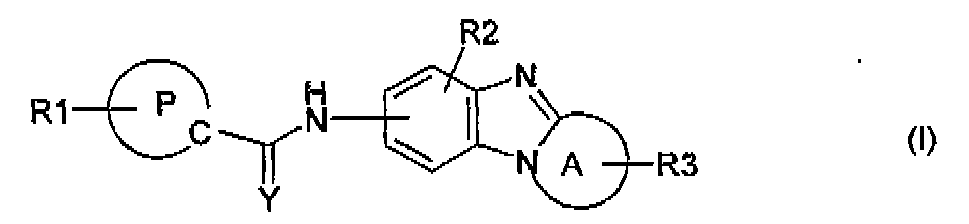 A mit der C-N-Bindung der Benzimidazol-Einheit, mit der es kondensiert ist, für einen 4- bis 7-gliedrigen monocyclischen Heterocyclus oder ein 4- bis 7-gliedriges monocyclisches Heteroaryl mit einem bis drei unter O, S oder N ausgewählten Heteroatomen einschließlich des Stickstoffatoms der Benzimidazol-Einheit steht;P für einen 8-, 9-, 10- oder 11-gliedrigen bicyclischen Heterocyclus oder ein 8-, 9-, 10- oder 11-gliedriges bicyclisches Heteroaryl mit 1 bis 6 unter N, O und S ausgewählten Heteroatomen steht; wobei P über ein Kohlenstoffatom an die -C(Y)-Gruppe gebunden ist;
mit der Maßgabe, daß dann, wenn A für einen 7-gliedrigen gesättigten Heterocyclus steht, P von der 2,3-Dihydro-1,4-benzodioxangruppe, der 1-Benzopyran-2-ongruppe und der Isoindolgruppe verschieden ist;R1 für ein bis vier gleiche oder verschiedene Atome oder eine bis vier gleiche oder verschiedene Gruppen, die unter einem Wasserstoffatom, einem Halogenatom und einer Oxo-, Thio-, C1-C6-Alkyl-, C3-C7-Cycloalkyl-, C3-C7-Cycloalkyl-C1-C3-alkylen-, C1-C6-Fluoralkyl-, Aryloxy-C1-C6-alkyl-, Heteroaryloxy-C1-C6-alkyl-, Aryl-C1-C3-alkylenoxy-C1-C6-alkyl-, Heteroaryl-C1-C3-alkylenoxy-C1-C6-alkyl-, Arylthio-C1-C6-alkyl-, Heteroarylthio-C1-C6-alkyl, Aryl-C1-C3-alkylenthio-C1-C6-alkyl-, Heteroaryl-C1-C3-alkylenthio-C1-C6-alkyl-, C1-C6-Alkoxy-, C3-C7-Cycloalkyloxy-, C3-C7-Cycloalkyl-C1-C3-alkylenoxy-, C1-C6-Fluoralkoxy-, Cyano-, C(O)NR4R5-, Nitro-, NR4R5-, C1-C6-Thioalkyl-, C3-C7-Cycloalkylthio-, C3-C7-Cycloalkyl-C1-C3-alkylenthio-, -S(O)-C1-C6-Alkyl-, -S(O)-C3-C7-Cycloalkyl-, -S(O)-C1-C3-Alkylen-C3-C7-cycloalkyl-, C1-C6-Alkyl-S(O)2-, C1-C6-Fluoralkyl-S(O)2-, C3-C7-Cycloalkyl-S(O)2-, C3-C7-Cycloalkyl-C1-C3-alkylen-S(O)2-, SO2NR9R5-, SF5-, NR6C(O)R7-,NR6SO2R8-, R4R5NC(O)-C1-C3-Alkylan-, Aryl-, Heteroaryl-, Aryl-C1-C5-alkylen-, Heteroaryl-C1-C5-alkylen-, Aryloxy-, Arylthio-, Heteroaryloxy- oder Heteroarylthiogruppe ausgewählt sind, steht;
wobei die Heteroaryl- oder Arylgruppen von R1 gegebenenfalls durch einen oder mehrere gleiche oder voneinander verschiedene Substituenten R9 substituiert sind;
mit der Maßgabe, daß R1 dann, wenn es an ein Stickstoffatom von P gebunden ist, von einem Halogenatom und einer Oxo-, Thio-, Cyano-, Nitro-, SF5-, NR4R5-, C1-C6-Thioalkyl-, Thioaryl-, Thioheteroaryl-, C1-C6-Alkoxy-, Aryloxy-, Heteroaryloxy-, -NR6COR7- und NR6SO2R8-Gruppe verschieden ist;Y für ein Sauerstoff- oder Schwefelatom steht;R2 für ein Wasserstoffatom, ein Halogenatom oder eine C1-C6-Alkyl-, C3-C7-Cycloalkyl-, C3-C7-Cycloalkyl-C1-C3-alkylen-, C1-C6-Fluoralkyl- oder C1-C6-Alkoxygruppe steht;R3 für ein bis drei gleiche oder verschiedene Atome oder eine bis drei gleiche oder verschiedene Gruppen, die unter einem Wasserstoffatom, einem Halogenatom und einer C1-C6-Alkyl-, C3-C7-Cycloalkyl-, C3-C7-Cycloalkyl-C1-C3-alkylen-, C1-C6-Fluoralkyl-, Hydroxyl-, C1-C6-Alkoxy-, C3-C7-Cycloalkyloxy- oder C3-C7-Cycloalkyl-C1-C3-alkylenoxygruppe ausgewählt sind, steht, wenn R3 an ein Kohlenstoffatom gebunden ist;
oderR3 für ein oder zwei gleiche oder verschiedene Atome oder eine oder zwei gleiche oder verschiedene Gruppen, die unter einem Wasserstoffatom, einem Halogenatom und einer C1-C6-Alkyl-, C3-C7-Cycloalkyl-, C3-C7-Cycloalkyl-C1-C3-alkylen-, C1-C6-Fluoralkyl-, Aryl-C(O)-, C1-C6-Alkyl-C(O)-, C3-C7-Cycloalkyl-C(O)-, C3-C7-Cycloalkyl-C1-C3-alkylen-C(O)-, C1-C6-Fluoralkyl-C(O)-, Aryl-S(O)2-, C1-C6-Alkyl-S(O)2-, C1-C6-Fluoralkyl-S(O)2-, C3-C7-Cycloalkyl-S(O)2-, C3-C7-Cycloalkyl-C1-C3-alkylen-S(O)2-, C1-C6-Alkyl-O-C(O)-, Aryl-C1-C3-alkyl-O-C(O)-, C3-C7-Cycloalkyl-O-C(O)-, C3-C7-Cycloalkyl-C1-C3-alkylen-O-C(O)-, C1-C6-Fluoralkyl-O-C(O)-, Aryl-O-C(O)- oder Heteroaryl-O-C(O)-Gruppe ausgewählt sind, steht, wenn R3 an ein Stickstoffatom gebunden ist;R4 und R5 unabhängig voneinander für ein Wasserstoffatom oder eine C1-C6-Alkyl-, C3-C7-Cycloalkyl-, C3-C7-Cycloalkyl-C1-C3-alkylen-, Aryl-C1-C5-alkylen- oder Arylgruppe stehen;
oder R4 und R5 zusammen mit dem Stickstoffatom, an das sie gebunden sind, eine Azetidin-, Pyrrolidin-, Piperidin-, Azepin-, Morpholin-, Thiomorpholin-, Piperazin- oder Homopiperazingruppe bilden, wobei die NR4R5-Gruppe gegebenenfalls durch eine C1-C6-Alkyl-, C3-C7-Cycloalkyl-, C3-C7-Cycloalkyl-C1-C3-alkylen-, Aryl-C1-C6-alkylen-, Aryl-, Heteroaryl-, Aryl-S(O)2-, C1-C6-Alkyl-S(O)2-, C1-C6-Fluoralkyl-S(O)2-, C3-C7-Cycloalkyl-S(O)2-, C3-C7-Cycloalkyl-C1-C3-alkylen-S(O)2-, Aryl-C(O)-, C1-C6-Alkyl-C(O)-, C3-C7-Cycloalkyl-C(O)-, C3-C7-Cycloalkyl-C1-C3-alkylen-C(O)-, C1-C6-Fluoralkyl-C(O)-, Hydroxyl-, C1-C6-Alkyloxy-, C1-C6-Fluoralkyl-, Aryloxy-C1-C6-alkylen-, Aryloxy-, Heteroaryloxy-C1-C6-alkylen- oder Heteroaryloxygruppe substituiert ist;R6 und R7 unabhängig voneinander für ein Wasserstoffatom oder eine C1-C6-Alkyl-, C3-C7-Cycloalkyl-, C3-C7-Cycloalkyl-C1-C3-alkylen-, Aryl-C1-C6-alkylen- oder Arylgruppe stehen;
oder R6 und R7 zusammen ein 4- bis 7-gliedriges Lactam, das das Stickstoffatom und die C(O)-Gruppe, an die sie gebunden sind, enthält, bilden;R8 für eine C1-C6-Alkyl-, C3-C7-Cycloalkyl-, C3-C7-Cycloalkyl-C1-C3-alkylen-, Aryl-C1-C6-alkylen- oder Arylgruppe steht;
oder R6 und R8 zusammen ein 4- bis 7-gliedriges Sultam, das das Stickstoffatom und die S(O)2-Gruppe, an die sie gebunden sind, enthält, bilden;R9 für ein Halogenatom oder eine C1-C6-Alkyl-, C3-C7-Cycloalkyl-, C3-C7-Cycloalkyl-C1-C3-alkylen-, C1-C6-Fluoralkyl-, C1-C6-Alkoxy-, C1-C6-Fluoralkoxy-, Nitro-, Cyano-, NR4R5-, R4R5N-C1-C3-Alkylen-, Aryl-, Heteroaryl-, Aryloxy-, Arylthio-, Heteroaryloxy- oder Heteroarylthiogruppe steht,wobei die Heteroaryl- oder Arylgruppen gegebenenfalls durch einen oder mehrere Substituenten, die unter einem Halogenatom und einer C1-C6-Alkyl-, C3-C7-Cycloalkyl-, C3-C7-Cycloalkyl-C1-C3-alkylen-, C1-C6-Fluoralkyl-, C1-C6-Alkoxy-, C1-C6-Fluoralkoxy-, Nitro-, Cyano-, NR4R5- oder R4R5N-C1-C3-Alkylengruppe ausgewählt sind, substituiert sind;
wobei das oder die Schwefelatome des Heterocyclus A in oxidierter Form (S(O) oder S(O)2) vorliegen können;
wobei das oder die Stickstoffatome in oxidierter Form (N-Oxid) vorliegen können;
in Basen- oder Säureadditionssalzform sowie in Hydrat- oder Solvatform;
wobei 2-(2-Chlorphenyl)-1,3-clioxo-N-(7,8,9,10-tetrahydro-6H-azepino[1,2-a]benzimidazol-3-yl)-isoindolin-5-carboxamid ausgeschlossen ist. - Erfindungsgemäße Verbindung nach Anspruch 1, dadurch gekennzeichnet, daß sie der allgemeinen Formel (II) entspricht:

X für ein Kohlenstoffatom oder ein Stickstoffatom steht; wobei die Variablen X gleich oder voneinander verschieden sind und die Zahl von X = N nicht größer als 2 ist;
R1, R2, R3, Y und A die unter der allgemeinen Formel (I) nach Anspruch 1 angegebene Bedeutung besitzen, wobei R1 an die Einheit mit 6 Elementen oder mit 5 Elementen des Bicyclus gebunden sein kann;
in Basen- oder Säureadditionssalzform sowie in Hydrat- oder Solvatform. - Erfindungsgemäße Verbindung nach Anspruch 1 oder 2, dadurch gekennzeichnet, daß sie der allgemeinen Formel (III) entspricht:
 R1a für ein oder mehrere gleiche oder verschiedene Atome oder eine oder mehrere gleiche oder verschiedene Gruppen, die unter einem Wasserstoffatom, einem Halogenatom oder einer C1-C6-Alkyl-, C1-C6-Fluoroalkyl-, C1-C6-Alkoxy-, C1-C6-Thioalkyl-, C1-C6-Alkyl-S(O)2-, NR4R5- oder Nitrogruppe ausgewählt sind, steht;R1b für ein Wasserstoffatom oder eine C1-C6-Alkyl-, Heteroaryloxy-C1-C6-alkyl-, Aryl-C1-C3-alkylenoxy-C1-C6-alkyl-, R4R5NC(O)-C1-C3-Alkylen-, Aryl-, Heteroaryl-, Aryl-C1-C6-alkylen- oder Heteroaryl-C1-C6-alkylengruppe steht;
wobei die Heteroaryl- oder Arylgruppen von R1b gegebenenfalls durch einen oder mehrere gleiche oder voneinander verschiedene Substituenten R9 substituiert sind;R9 für ein Halogenatom oder eine C1-C6-Alkyl-, C1-C6-Alkoxy-, C1-C6-Fluoralkyl-, Aryl-, Heteroaryl-, NR4R5- oder Arylthiogruppe steht, wobei die Heteroaryl- oder Arylgruppen gegebenenfalls durch einen oder mehrere unter einem Halogenatom und einer C1-C6-Alkyl-, C3-C7-Cycloalkyl-, C3-C7-Cycloalkyl-C1-C3-alkylen-, C1-C6-Fluoralkyl-, C1-C6-Alkoxy-, C1-C8-Fluoralkoxy-, Nitro-, Cyano- oder R4R5N-C1-C3-alkylengruppe ausgewählte Substituenten substituiert sind;R2, R3, R4, R5, A, X und Y die unter der allgemeinen Formel (II) nach Anspruch 2 angegebene Bedeutung besitzen;in Basen- oder Säureadditionssalzform sowie in Hydrat- oder Solvatform. - Erfindungsgemäße Verbindung nach einem der Ansprüche 1 bis 3, dadurch gekennzeichnet, daß sie der allgemeinen Formel (IV) entspricht:


in Basen- oder Säureadditionssalzform sowie in Hydrat- oder Solvatform. - Erfindungsgemäße Verbindung nach einem der Ansprüche 1 bis 4, dadurch gekennzeichnet, daß sie der allgemeinen Formel (V) entspricht:
 R1, R2, R3, A und P die unter der allgemeinen Formel (I) nach Anspruch 1 angegebene Bedeutung besitzen;in Basen- oder Säureadditionssalzform sowie in Hydrat- oder Solvatform.
 - Erfindungsgemäße Verbindung nach einem der Ansprüche 1 bis 5, dadurch gekennzeichnet, daß sie der allgemeinen Formel (V) entspricht:
 R2 für ein Wasserstoffatom oder eine C1-C6-Alkyl- oder C1-C6-Alkoxygruppe steht;R3 für ein bis drei gleiche oder verschiedene Atome oder eine bis drei gleiche oder verschiedene Gruppen steht, die unter einem Wasserstoffatom und einer C1-C6-Alkyl-, C1-C6-Alkoxy- oder Hydroxylgruppe ausgewählt sind, wenn R3 an ein Kohlenstoffatom gebunden ist;
oderR3 für ein oder zwei gleiche oder verschiedene Atome oder eine oder zwei gleiche oder verschiedene Gruppen steht, die unter einem Wasserstoffatom und einer C1-C6-Alkyl-, C1-C6-Alkyl-O-C(O)-oder Aryl-C1-C3-alkyl-O-C(O)-Gruppe ausgewählt sind, wenn R3 an ein Stickstoffatom gebunden ist;wobei R1, A und P die unter der allgemeinen Formel (I) nach Anspruch 1 angegebene Bedeutung besitzen; in Basen- oder Säureadditionssalzform sowie in Hydrat- oder Solvatform. - Erfindungsgemäße Verbindung nach einem der Ansprüche 1 bis 6, dadurch gekennzeichnet, daß sie der allgemeinen Formel (V) entspricht:
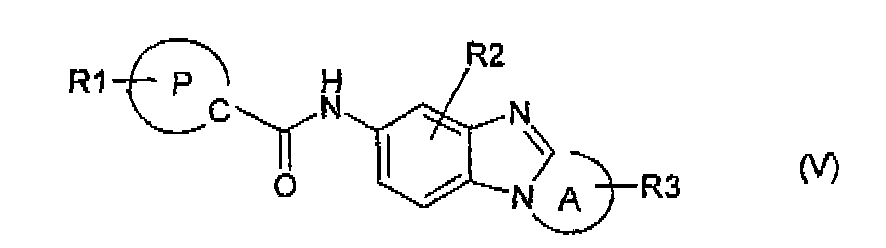 A mit der C-N-Bindung der Benzimidazol-Einheit, mit der es kondensiert ist, für einen 5- bis 7-gliedrigen monocyclischen Heterocyclus oder ein 5- bis 7-gliedriges monocyclisches Heteroaryl mit einem bis drei unter O, S oder N ausgewählten Heteroatomen einschließlich des Stickstoffatoms der Benzimidazol-Einheit steht;wobei R1, R2, R3 und P die unter der allgemeinen Formel (I) nach Anspruch 1 angegebene Bedeutung besitzen;
in Basen- oder Säureadditionssalzform sowie in Hydrat- oder Solvatform. - Erfindungsgemäße Verbindung nach einem der Ansprüche 1 bis 7, dadurch gekennzeichnet, daß sie der allgemeinen Formel (Va) entspricht:

A mit der C-N-Bindung der Benzimidazol-Einheit, mit der es kondensiert ist, für einen 5- bis 7-gliedrigen monocyclischen Heterocyclus oder ein 5- bis 7-gliedriges monocyclisches Heteroaryl mit einem oder zwei unter O, S oder N ausgewählten Heteroatomen einschließlich des Stickstoffatoms der Benzimidazol-Einheit steht;
X für ein Kohlenstoffatom oder ein Stickstoffatom steht; wobei die Variablen X gleich oder voneinander verschieden sind und die Zahl von X = N nicht größer als 1 ist;
R1a für ein oder mehrere gleiche oder verschiedene Atome oder eine oder mehrere gleiche oder verschiedene Gruppen, die unter einem Wasserstoffatom, einem Halogenatom oder einer C1-C6-Alkyl-, C1-C6-Fluoroalkyl-, C1-C6-Alkoxy-, C1-C6-Thioalkyl-, C1-C6-Alkyl-S(O)2-, NR4R5- oder Nitrogruppe ausgewählt sind, steht;
R1b für ein Wasserstoffatom oder eine C1-C6-Alkyl-, Heteroaryloxy-C1-C6-alkyl-, Aryl-C1-C3-alkylenoxy-C1-C6-alkyl-, R4R5NC(O)-C1-C3-Alkylen-, Aryl-, Heteroaryl-, Aryl-C1-C6-alkylen- oder Heteroaryl-C1-C6-alkylengruppe steht;
wobei die Heteroaryl- oder Arylgruppen von R1b gegebenenfalls durch einen oder mehrere gleiche oder voneinander verschiedene Substituenten R9 substituiert sind;
R2 für ein Wasserstoffatom steht;
R3 für ein Atom oder eine Gruppe steht, das bzw. die unter einem Wasserstoffatom und einer C1-C6-Alkyl-, C1-C6-Alkoxy- oder Hydroxylgruppe ausgewählt ist, wenn R3 an ein Kohlenstoffatom gebunden ist;
oder
R3 für ein Atom oder eine Gruppe steht, das bzw. die unter einem Wasserstoffatom und einer C1-C6-Alkyl- oder C1-C6-Alkyl-O-C(O)-Gruppe ausgewählt ist, wenn R3 an ein Stickstoffatom gebunden ist;
R9 und R5 unabhängig voneinander für eine C1-C6-Alkylgruppe stehen;
oder R4 und R5 gemeinsam mit dem Stickstoffatom, an das sie gebunden sind, eine Pyrrolidin- oder Morpholingruppe bilden;
R9 für ein Halogenatom oder eine C1-C6-Alkyl-, C1-C6-Alkoxy-, C1-C6-Fluoralkyl-, Aryl-, Heteroaryl-, NR4R5- oder Arylthiogruppe steht, wobei die Arylgruppen gegebenenfalls durch eine oder mehrere C1-C6-Alkylgruppen substituiert sind;
in Basen- oder Säureadditionssalzform sowie in Hydrat- oder Solvatform. - Erfindungsgemäße Verbindung nach einem der Ansprüche 1 bis 8, dadurch gekennzeichnet, daß sie der allgemeinen Formel (I) entspricht, worin gleichzeitig R1 und/oder R2 und/oder R3 und/oder A und/oder P und/oder Y die in den Ansprüchen 1 bis 8 angegebene Bedeutung besitzen;
in Basen- oder Säureadditionssalzform sowie in Hydrat- oder Solvatform. - Verfahren zur Herstellung einer Verbindung der Formel (I) nach einem der Ansprüche 1 bis 9, dadurch gekennzeichnet, daß man eine Verbindung der allgemeinen Formel (VI):


- Verfahren zur Herstellung einer Verbindung der Formel (I) nach einem der Ansprüche 1 bis 9, dadurch gekennzeichnet, daß man eine Verbindung der allgemeinen Formel (VI):


oder auch eine Kupplungsreaktion zwischen einer Verbindung der allgemeinen Formel (VI), worin P, R1 und Y die unter der allgemeinen Formel (I) nach Anspruch 1 angegebene Bedeutung besitzen und B für eine Hydroxylgruppe steht, und der Verbindung der allgemeinen Formel (VII), worin A, R2 und R3 die unter der allgemeinen Formel (I) nach Anspruch 1 angegebene Bedeutung besitzen, in Gegenwart eines Kupplungsmittels und einer Base in einem Lösungmittel durchführt. - Verbindung der allgemeinen Formel (VIIa), (VIIb), (VIIc), (VIId), (VIIe), (VIIf), (VIIg), (VIIh), (VIIi), (VIIj), (VIIk), (VIIl), (VIIm), (VIIn):



- Arzneimittel, dadurch gekennzeichnet, daß es mindestens eine Verbindung der Formel (I) nach einem der Ansprüche 1 bis 9 oder ein Additionssalz dieser Verbindung mit einer pharmazeutisch unbedenklichen Säure oder auch ein Hydrat oder Solvat der Verbindung der Formel (I) enthält.
- Pharmazeutische Zusammensetzung, dadurch gekennzeichnet, daß sie mindestens eine Verbindung der Formel (I) nach einem der Ansprüche 1 bis 9 oder ein pharmazeutisch unbedenkliches Salz, ein Hydrat oder ein Solvat dieser Verbindung sowie mindestens einen pharmazeutisch unbedenklichen Hilfsstoff enthält.
- Verwendung einer Verbindung der Formel (I) nach einem der Ansprüche 1 bis 9 zur Herstellung eines Arzneimittels zur Prävention oder Behandlung von Pathologien, an denen die Rezeptoren vom TRPV1-Typ beteiligt sind.
- Verwendung einer Zusammensetzung der Formel (I) nach einem der Ansprüche 1 bis 9 zur Herstellung eines Arzneimittels zur Prävention oder Behandlung von Schmerzen, Entzündungen, Stoffwechselstörungen, urologischen Störungen, gynäkologischen Störungen, gastrointestinalen Störungen, respiratorischen Störungen, Psoriasis, Pruritis, Haut-, Augen- oder Schleimhautreizungen, Herpes, Zona, multipler Sklerose und Depression.
Priority Applications (3)
| Application Number | Priority Date | Filing Date | Title |
|---|---|---|---|
| SI200730254T SI1987010T1 (sl) | 2006-02-03 | 2007-02-01 | Triciklični N-heteroaril-karboksamidni derivati, ki vsebujejo benzimidazolno enoto, postopek za njihovo pripravo in njihova terapevtska uporaba |
| PL07730900T PL1987010T3 (pl) | 2006-02-03 | 2007-02-01 | Pochodne N-heteroarylokarboksyamidów tricyklicznych zawierających ugrupowanie benzimidazolu, ich wytwarzanie i ich zastosowanie w lecznictwie |
| CY20101100609T CY1110168T1 (el) | 2006-02-03 | 2010-07-01 | Παραγωγα των τρικυκλικων ν-ετεροαρυλο-καρβοξαμιδιων που περιεχουν ενα μοτιβο βενζιμιδαζολης, η παρασκευη τους και η εφαρμογη τους στη θεραπευτικη |
Applications Claiming Priority (2)
| Application Number | Priority Date | Filing Date | Title |
|---|---|---|---|
| FR0601007A FR2897061B1 (fr) | 2006-02-03 | 2006-02-03 | Derives de n-heteroaryl-carboxamides tricycliques contenant un motif benzimidazole, leur preparation et leur application en therapeutique. |
| PCT/FR2007/000183 WO2007088277A1 (fr) | 2006-02-03 | 2007-02-01 | Dérivés de ν-heteroaryl-carboxamides tricycliques contenant un motif benzimidazole, leur préparation et leur application en thérapeutique |
Publications (2)
| Publication Number | Publication Date |
|---|---|
| EP1987010A1 EP1987010A1 (de) | 2008-11-05 |
| EP1987010B1 true EP1987010B1 (de) | 2010-04-07 |
Family
ID=36954977
Family Applications (1)
| Application Number | Title | Priority Date | Filing Date |
|---|---|---|---|
| EP07730900A Active EP1987010B1 (de) | 2006-02-03 | 2007-02-01 | Tricyclische n-heteroaryl-carboxamid-derivate mit einer benzimidazol-einheit, verfahren zu ihrer herstellung und ihre therapeutische verwendung |
Country Status (32)
| Country | Link |
|---|---|
| US (2) | US8143248B2 (de) |
| EP (1) | EP1987010B1 (de) |
| JP (1) | JP5136938B2 (de) |
| KR (1) | KR20080090495A (de) |
| CN (1) | CN101379041B (de) |
| AR (1) | AR059279A1 (de) |
| AT (1) | ATE463484T1 (de) |
| AU (1) | AU2007211399B2 (de) |
| BR (1) | BRPI0710480A2 (de) |
| CA (1) | CA2637333C (de) |
| CY (1) | CY1110168T1 (de) |
| DE (1) | DE602007005779D1 (de) |
| DK (1) | DK1987010T3 (de) |
| DO (1) | DOP2007000022A (de) |
| EA (1) | EA014450B1 (de) |
| ES (1) | ES2344087T3 (de) |
| FR (1) | FR2897061B1 (de) |
| HR (1) | HRP20100327T1 (de) |
| IL (1) | IL192648A (de) |
| JO (1) | JO2602B1 (de) |
| MA (1) | MA30229B1 (de) |
| NO (1) | NO20083520L (de) |
| NZ (1) | NZ569669A (de) |
| PE (1) | PE20071325A1 (de) |
| PL (1) | PL1987010T3 (de) |
| PT (1) | PT1987010E (de) |
| RS (1) | RS51366B (de) |
| SI (1) | SI1987010T1 (de) |
| TW (1) | TWI401256B (de) |
| UY (1) | UY30130A1 (de) |
| WO (1) | WO2007088277A1 (de) |
| ZA (1) | ZA200806139B (de) |
Families Citing this family (30)
| Publication number | Priority date | Publication date | Assignee | Title |
|---|---|---|---|---|
| JP2945891B2 (ja) | 1998-02-16 | 1999-09-06 | 大豊建設株式会社 | セグメント継手構造 |
| FR2888848B1 (fr) * | 2005-07-22 | 2007-09-28 | Sanofi Aventis Sa | Derives de n-(arylalkyl)-1h-pyrrrolopyridine-2-carboxamides, leur preparation et leur application en therapeutique |
| FR2911604B1 (fr) * | 2007-01-19 | 2009-04-17 | Sanofi Aventis Sa | Derives de n-(heteroaryl-1h-indole-2-carboxamides, leur preparation et leur application en therapeutique |
| FR2911605B1 (fr) | 2007-01-19 | 2009-04-17 | Sanofi Aventis Sa | Derives de pyrrolopyridine-2-carbowamides, leur preparation et leur application en therapeutique |
| FR2919610B1 (fr) * | 2007-08-02 | 2009-10-16 | Sanofi Aventis Sa | Derives de n-heteroaryl-carboxamides tricycliques,leur preparation et leur application en therapeutique |
| FR2926556B1 (fr) * | 2008-01-22 | 2010-02-19 | Sanofi Aventis | Derives de carboxamides n-azabicycliques, leur preparation et leur application en therapeutique |
| FR2926554B1 (fr) | 2008-01-22 | 2010-03-12 | Sanofi Aventis | Derives de carboxamides azabicycliques, leur preparation et leur application en therapeutique |
| FR2926555B1 (fr) * | 2008-01-22 | 2010-02-19 | Sanofi Aventis | Derives bicycliques de carboxamides azabicycliques, leur preparation et leur application en therapeutique |
| FR2926553B1 (fr) * | 2008-01-23 | 2010-02-19 | Sanofi Aventis | Derives d'indole-2-carboxamides et d'azaindole-2- carboxamides substitues par un groupe silanyle, leur preparation et leur application en therapeutique |
| WO2009108551A2 (en) * | 2008-02-25 | 2009-09-03 | H. Lundbeck A/S | Heteroaryl amide analogues |
| US20110312938A1 (en) * | 2008-06-30 | 2011-12-22 | Ironwood Pharmaceuticals, Inc. | Pyrrolopyridine Carboxylic Acid Derivatives |
| WO2010051561A1 (en) * | 2008-11-03 | 2010-05-06 | Chemocentryx, Inc. | Compounds for the treatment of osteoporosis and cancers |
| RU2011137419A (ru) * | 2009-02-11 | 2013-03-20 | Суновион Фармасьютикалз Инк. | Обратные агонисты и антагонисты гистамина н3 и способы их применения |
| CA2772522A1 (en) * | 2009-09-11 | 2011-03-17 | Sunovion Pharmaceuticals Inc. | Histamine h3 inverse agonists and antagonists and methods of use thereof |
| CA2797762A1 (en) * | 2010-04-27 | 2011-11-03 | Astellas Pharma Inc. | Imidazo[1,2-a]pyridine derivative |
| SMT201700009T1 (it) | 2012-03-16 | 2017-03-08 | Vitae Pharmaceuticals Inc | Modulatori del recettore x del fegato |
| SG11201405328SA (en) | 2012-03-16 | 2014-11-27 | Vitae Pharmaceuticals Inc | Liver x receptor modulators |
| CA2877146C (en) | 2012-06-18 | 2020-10-20 | Dart Neuroscience (Cayman) Ltd | Substituted thiophene- and furan-fused azolopyrimidine-5-(6h)-one compounds |
| CR20170076A (es) | 2014-08-04 | 2017-06-26 | Nuevolution As | Derivados de pirimidima sustituidos con heterociclilo opcionalmente condensados útiles para el tratamiento de enfermedades inflamatorias, metabólicas, oncológicas y autoinmunitarias |
| US10513694B2 (en) | 2015-06-25 | 2019-12-24 | Promega Corporation | Thienopyrrole compounds and uses thereof |
| EP4105203A1 (de) * | 2016-09-30 | 2022-12-21 | Epizyme Inc | Spiro-kondensierten indol-verbindungen als ehmt2-inhibitoren |
| WO2018125992A1 (en) | 2016-12-28 | 2018-07-05 | Promega Corporation | Functionalized nanoluc inhibitors |
| WO2018195450A1 (en) | 2017-04-21 | 2018-10-25 | Epizyme, Inc. | Combination therapies with ehmt2 inhibitors |
| CN109761974B (zh) * | 2019-01-21 | 2021-05-14 | 河南大学 | 1,2,3,4-四氢-9H-吡啶并[3,4-b]吲哚类TRPV1拮抗剂及其应用 |
| AU2020405446A1 (en) | 2019-12-20 | 2022-05-26 | Nuevolution A/S | Compounds active towards nuclear receptors |
| AU2020408107B2 (en) | 2019-12-20 | 2026-04-23 | Nuevolution A/S | Compounds active towards nuclear receptors |
| US11613532B2 (en) | 2020-03-31 | 2023-03-28 | Nuevolution A/S | Compounds active towards nuclear receptors |
| EP4126874A1 (de) | 2020-03-31 | 2023-02-08 | Nuevolution A/S | Gegen nukleare rezeptoren aktive verbindungen |
| CN114276354B (zh) * | 2022-01-07 | 2023-06-02 | 中山大学 | 1-氨基苯并[4,5]咪唑并[1,2-a]吡嗪-3-甲酰胺类化合物及其制备和应用 |
| CN114539265B (zh) * | 2022-03-02 | 2023-07-21 | 中山大学 | 靶向a2a的苯并咪唑并吡嗪-3-甲酰胺及其肿瘤免疫功能 |
Family Cites Families (7)
| Publication number | Priority date | Publication date | Assignee | Title |
|---|---|---|---|---|
| DE60235114D1 (de) * | 2001-11-01 | 2010-03-04 | Icagen Inc | Pyrazolamide zur anwendung in der behandlung von schmerz |
| WO2004007495A1 (ja) * | 2002-07-11 | 2004-01-22 | Takeda Pharmaceutical Company Limited | ピロロピリジン誘導体およびその用途 |
| TW200505450A (en) * | 2003-02-03 | 2005-02-16 | Janssen Pharmaceutica Nv | Quinoline-derived amide modulators of vanilloid VR1 receptor |
| GB0322016D0 (en) * | 2003-09-19 | 2003-10-22 | Merck Sharp & Dohme | New compounds |
| US7544803B2 (en) * | 2004-01-23 | 2009-06-09 | Amgen Inc. | Vanilloid receptor ligands and their use in treatments |
| DE102004021716A1 (de) * | 2004-04-30 | 2005-12-01 | Grünenthal GmbH | Substituierte Imidazo[1,2-a]pyridin-Verbindungen und Arzneimittel enthaltend substituierte Imidazo[1,2-a]pyridin-Verbindungen |
| WO2006006741A1 (ja) * | 2004-07-15 | 2006-01-19 | Japan Tobacco Inc. | 縮合ベンズアミド化合物及びバニロイド受容体1型(vr1)活性阻害剤 |
-
2006
- 2006-02-03 FR FR0601007A patent/FR2897061B1/fr not_active Expired - Fee Related
-
2007
- 2007-01-30 PE PE2007000106A patent/PE20071325A1/es not_active Application Discontinuation
- 2007-01-31 TW TW096103550A patent/TWI401256B/zh not_active IP Right Cessation
- 2007-02-01 KR KR1020087019041A patent/KR20080090495A/ko not_active Ceased
- 2007-02-01 AU AU2007211399A patent/AU2007211399B2/en not_active Ceased
- 2007-02-01 ES ES07730900T patent/ES2344087T3/es active Active
- 2007-02-01 PL PL07730900T patent/PL1987010T3/pl unknown
- 2007-02-01 NZ NZ569669A patent/NZ569669A/en not_active IP Right Cessation
- 2007-02-01 AR ARP070100426A patent/AR059279A1/es not_active Application Discontinuation
- 2007-02-01 HR HR20100327T patent/HRP20100327T1/hr unknown
- 2007-02-01 CA CA2637333A patent/CA2637333C/fr not_active Expired - Fee Related
- 2007-02-01 BR BRPI0710480-4A patent/BRPI0710480A2/pt not_active IP Right Cessation
- 2007-02-01 JO JO200729A patent/JO2602B1/en active
- 2007-02-01 AT AT07730900T patent/ATE463484T1/de active
- 2007-02-01 DE DE602007005779T patent/DE602007005779D1/de active Active
- 2007-02-01 EP EP07730900A patent/EP1987010B1/de active Active
- 2007-02-01 DK DK07730900.3T patent/DK1987010T3/da active
- 2007-02-01 DO DO2007000022A patent/DOP2007000022A/es unknown
- 2007-02-01 JP JP2008552848A patent/JP5136938B2/ja not_active Expired - Fee Related
- 2007-02-01 CN CN2007800042835A patent/CN101379041B/zh not_active Expired - Fee Related
- 2007-02-01 ZA ZA200806139A patent/ZA200806139B/xx unknown
- 2007-02-01 SI SI200730254T patent/SI1987010T1/sl unknown
- 2007-02-01 EA EA200870226A patent/EA014450B1/ru not_active IP Right Cessation
- 2007-02-01 RS RSP-2010/0301A patent/RS51366B/sr unknown
- 2007-02-01 PT PT07730900T patent/PT1987010E/pt unknown
- 2007-02-01 WO PCT/FR2007/000183 patent/WO2007088277A1/fr not_active Ceased
- 2007-02-02 UY UY30130A patent/UY30130A1/es not_active Application Discontinuation
-
2008
- 2008-07-06 IL IL192648A patent/IL192648A/en not_active IP Right Cessation
- 2008-08-01 US US12/184,437 patent/US8143248B2/en not_active Expired - Fee Related
- 2008-08-13 NO NO20083520A patent/NO20083520L/no not_active Application Discontinuation
- 2008-08-26 MA MA31193A patent/MA30229B1/fr unknown
-
2010
- 2010-07-01 CY CY20101100609T patent/CY1110168T1/el unknown
-
2012
- 2012-01-24 US US13/357,015 patent/US8288376B2/en not_active Expired - Fee Related
Also Published As
Similar Documents
| Publication | Publication Date | Title |
|---|---|---|
| CA2637333C (fr) | Derives de n-heteroaryl-carboxamides tricycliques contenant un motif benzimidazole, leur preparation et leur application en therapeutique | |
| EP2125811B1 (de) | N-(amino-heteroaryl)-1h-pyrrolopyridin-2-carboxamidderivate, ihre herstellung und therapeutische anwendung | |
| EP2235015B1 (de) | Azabizyklische carboxamid-derivate sowie ihre herstellung und therapeutische verwendung | |
| EP2235014B1 (de) | Bizyklische derivate aus azabizyklischen carboxamiden, ihre herstellung und therapeutische verwendung | |
| EP2235016B1 (de) | Azabizyklische carboxamid-derivate sowie ihre herstellung und therapeutische verwendung | |
| EP2049525B1 (de) | N-(aminoheteroaryl)-1h-indol-2-carboxamid-derivate sowie deren herstellung und therapeutische anwendung | |
| EP2046775B1 (de) | N-(aminoheteroaryl)-1h-indol-2-carboxamid-derivate sowie deren herstellung und therapeutische anwendung | |
| EP2125787B1 (de) | Derivate von n-(heteroaryl)-1-heteroaryl-1h-indol-2-carboxamiden sowie ihre herstellung und therapeutische verwendung | |
| EP1910335B1 (de) | N-(heteroaryl)-1-heteroarylakyl-1h-indol-2-carbonsäureamidderivate, deren herstellung und verwendung | |
| EP1912644B1 (de) | N-(arylalkyl)-1h-pyrrolopyridin-2-carboxamid-derivate, ihre herstellung und verwendung | |
| EP2106401B1 (de) | Derivate von pyrrolopyridin-2-carboxamiden, ihre herstellung und ihre therapeutische anwendung | |
| EP2185558B1 (de) | Tricyclische n-heteroaryl-carboxamid-derivate sowie deren herstellung und therapeutische anwendung | |
| HK1129670B (en) | Tricyclic n-heteroaryl-methyl carboxamide derivatives containing a benzimedazole unit, method for preparing same and their therapeutic use |
Legal Events
| Date | Code | Title | Description |
|---|---|---|---|
| PUAI | Public reference made under article 153(3) epc to a published international application that has entered the european phase |
Free format text: ORIGINAL CODE: 0009012 |
|
| 17P | Request for examination filed |
Effective date: 20080903 |
|
| AK | Designated contracting states |
Kind code of ref document: A1 Designated state(s): AT BE BG CH CY CZ DE DK EE ES FI FR GB GR HU IE IS IT LI LT LU LV MC NL PL PT RO SE SI SK TR |
|
| AX | Request for extension of the european patent |
Extension state: AL BA HR MK RS |
|
| GRAP | Despatch of communication of intention to grant a patent |
Free format text: ORIGINAL CODE: EPIDOSNIGR1 |
|
| GRAC | Information related to communication of intention to grant a patent modified |
Free format text: ORIGINAL CODE: EPIDOSCIGR1 |
|
| GRAS | Grant fee paid |
Free format text: ORIGINAL CODE: EPIDOSNIGR3 |
|
| GRAA | (expected) grant |
Free format text: ORIGINAL CODE: 0009210 |
|
| AK | Designated contracting states |
Kind code of ref document: B1 Designated state(s): AT BE BG CH CY CZ DE DK EE ES FI FR GB GR HU IE IS IT LI LT LU LV MC NL PL PT RO SE SI SK TR |
|
| AX | Request for extension of the european patent |
Extension state: AL BA HR MK RS |
|
| REG | Reference to a national code |
Ref country code: GB Ref legal event code: FG4D Free format text: NOT ENGLISH |
|
| REG | Reference to a national code |
Ref country code: CH Ref legal event code: EP |
|
| REG | Reference to a national code |
Ref country code: IE Ref legal event code: FG4D Free format text: LANGUAGE OF EP DOCUMENT: FRENCH |
|
| REF | Corresponds to: |
Ref document number: 602007005779 Country of ref document: DE Date of ref document: 20100520 Kind code of ref document: P |
|
| REG | Reference to a national code |
Ref country code: HR Ref legal event code: TUEP Ref document number: P20100327 Country of ref document: HR |
|
| REG | Reference to a national code |
Ref country code: PT Ref legal event code: SC4A Free format text: AVAILABILITY OF NATIONAL TRANSLATION Effective date: 20100617 |
|
| REG | Reference to a national code |
Ref country code: RO Ref legal event code: EPE |
|
| REG | Reference to a national code |
Ref country code: NL Ref legal event code: T3 |
|
| REG | Reference to a national code |
Ref country code: GR Ref legal event code: EP Ref document number: 20100401500 Country of ref document: GR |
|
| REG | Reference to a national code |
Ref country code: SE Ref legal event code: TRGR |
|
| REG | Reference to a national code |
Ref country code: DK Ref legal event code: T3 |
|
| REG | Reference to a national code |
Ref country code: EE Ref legal event code: FG4A Ref document number: E004363 Country of ref document: EE Effective date: 20100618 |
|
| REG | Reference to a national code |
Ref country code: ES Ref legal event code: FG2A Ref document number: 2344087 Country of ref document: ES Kind code of ref document: T3 |
|
| REG | Reference to a national code |
Ref country code: HR Ref legal event code: T1PR Ref document number: P20100327 Country of ref document: HR |
|
| REG | Reference to a national code |
Ref country code: PL Ref legal event code: T3 |
|
| REG | Reference to a national code |
Ref country code: SK Ref legal event code: T3 Ref document number: E 7512 Country of ref document: SK |
|
| PLBE | No opposition filed within time limit |
Free format text: ORIGINAL CODE: 0009261 |
|
| STAA | Information on the status of an ep patent application or granted ep patent |
Free format text: STATUS: NO OPPOSITION FILED WITHIN TIME LIMIT |
|
| 26N | No opposition filed |
Effective date: 20110110 |
|
| REG | Reference to a national code |
Ref country code: HU Ref legal event code: AG4A Ref document number: E009231 Country of ref document: HU |
|
| PGFP | Annual fee paid to national office [announced via postgrant information from national office to epo] |
Ref country code: TR Payment date: 20120113 Year of fee payment: 6 |
|
| REG | Reference to a national code |
Ref country code: HR Ref legal event code: ODRP Ref document number: P20100327 Country of ref document: HR Payment date: 20130103 Year of fee payment: 7 |
|
| PGFP | Annual fee paid to national office [announced via postgrant information from national office to epo] |
Ref country code: MC Payment date: 20121231 Year of fee payment: 7 Ref country code: BG Payment date: 20121227 Year of fee payment: 7 |
|
| PGFP | Annual fee paid to national office [announced via postgrant information from national office to epo] |
Ref country code: PL Payment date: 20121219 Year of fee payment: 7 |
|
| REG | Reference to a national code |
Ref country code: DE Ref legal event code: R081 Ref document number: 602007005779 Country of ref document: DE Owner name: SANOFI, FR Free format text: FORMER OWNER: SANOFI-AVENTIS, PARIS, FR Effective date: 20130205 Ref country code: DE Ref legal event code: R081 Ref document number: 602007005779 Country of ref document: DE Owner name: SANOFI-AVENTIS, FR Free format text: FORMER OWNER: SANOFI-AVENTIS, PARIS, FR Effective date: 20130205 |
|
| PGFP | Annual fee paid to national office [announced via postgrant information from national office to epo] |
Ref country code: LU Payment date: 20130213 Year of fee payment: 7 |
|
| PGFP | Annual fee paid to national office [announced via postgrant information from national office to epo] |
Ref country code: DK Payment date: 20130212 Year of fee payment: 7 Ref country code: IS Payment date: 20130107 Year of fee payment: 7 Ref country code: IE Payment date: 20130212 Year of fee payment: 7 Ref country code: RO Payment date: 20130114 Year of fee payment: 7 Ref country code: LT Payment date: 20130130 Year of fee payment: 7 Ref country code: SE Payment date: 20130212 Year of fee payment: 7 Ref country code: HU Payment date: 20130122 Year of fee payment: 7 Ref country code: EE Payment date: 20130128 Year of fee payment: 7 Ref country code: CZ Payment date: 20130123 Year of fee payment: 7 Ref country code: FI Payment date: 20130212 Year of fee payment: 7 |
|
| PGFP | Annual fee paid to national office [announced via postgrant information from national office to epo] |
Ref country code: SI Payment date: 20130115 Year of fee payment: 7 Ref country code: GR Payment date: 20130124 Year of fee payment: 7 Ref country code: SK Payment date: 20130122 Year of fee payment: 7 Ref country code: LV Payment date: 20130129 Year of fee payment: 7 |
|
| PGFP | Annual fee paid to national office [announced via postgrant information from national office to epo] |
Ref country code: PT Payment date: 20130201 Year of fee payment: 7 |
|
| PGFP | Annual fee paid to national office [announced via postgrant information from national office to epo] |
Ref country code: CY Payment date: 20130130 Year of fee payment: 7 |
|
| REG | Reference to a national code |
Ref country code: HR Ref legal event code: PBON Ref document number: P20100327 Country of ref document: HR Effective date: 20140201 |
|
| REG | Reference to a national code |
Ref country code: PT Ref legal event code: MM4A Free format text: LAPSE DUE TO NON-PAYMENT OF FEES Effective date: 20140801 |
|
| REG | Reference to a national code |
Ref country code: LT Ref legal event code: MM4D Effective date: 20140201 |
|
| REG | Reference to a national code |
Ref country code: DK Ref legal event code: EBP Effective date: 20140228 |
|
| PG25 | Lapsed in a contracting state [announced via postgrant information from national office to epo] |
Ref country code: LU Free format text: LAPSE BECAUSE OF NON-PAYMENT OF DUE FEES Effective date: 20140201 Ref country code: MC Free format text: LAPSE BECAUSE OF NON-PAYMENT OF DUE FEES Effective date: 20140228 |
|
| REG | Reference to a national code |
Ref country code: SE Ref legal event code: EUG |
|
| REG | Reference to a national code |
Ref country code: EE Ref legal event code: MM4A Ref document number: E004363 Country of ref document: EE Effective date: 20140228 |
|
| REG | Reference to a national code |
Ref country code: GR Ref legal event code: ML Ref document number: 20100401500 Country of ref document: GR Effective date: 20140903 |
|
| REG | Reference to a national code |
Ref country code: SI Ref legal event code: KO00 Effective date: 20140909 |
|
| PG25 | Lapsed in a contracting state [announced via postgrant information from national office to epo] |
Ref country code: GR Free format text: LAPSE BECAUSE OF NON-PAYMENT OF DUE FEES Effective date: 20140903 Ref country code: CZ Free format text: LAPSE BECAUSE OF NON-PAYMENT OF DUE FEES Effective date: 20140201 Ref country code: BG Free format text: LAPSE BECAUSE OF NON-PAYMENT OF DUE FEES Effective date: 20140930 Ref country code: IS Free format text: LAPSE BECAUSE OF FAILURE TO SUBMIT A TRANSLATION OF THE DESCRIPTION OR TO PAY THE FEE WITHIN THE PRESCRIBED TIME-LIMIT Effective date: 20140829 Ref country code: EE Free format text: LAPSE BECAUSE OF NON-PAYMENT OF DUE FEES Effective date: 20140228 Ref country code: FI Free format text: LAPSE BECAUSE OF NON-PAYMENT OF DUE FEES Effective date: 20140201 Ref country code: CY Free format text: LAPSE BECAUSE OF NON-PAYMENT OF DUE FEES Effective date: 20140201 Ref country code: RO Free format text: LAPSE BECAUSE OF NON-PAYMENT OF DUE FEES Effective date: 20140201 Ref country code: LT Free format text: LAPSE BECAUSE OF NON-PAYMENT OF DUE FEES Effective date: 20140201 |
|
| REG | Reference to a national code |
Ref country code: SK Ref legal event code: MM4A Ref document number: E 7512 Country of ref document: SK Effective date: 20140201 |
|
| PG25 | Lapsed in a contracting state [announced via postgrant information from national office to epo] |
Ref country code: SE Free format text: LAPSE BECAUSE OF NON-PAYMENT OF DUE FEES Effective date: 20140202 Ref country code: SI Free format text: LAPSE BECAUSE OF NON-PAYMENT OF DUE FEES Effective date: 20140202 Ref country code: SK Free format text: LAPSE BECAUSE OF NON-PAYMENT OF DUE FEES Effective date: 20140201 Ref country code: LV Free format text: LAPSE BECAUSE OF NON-PAYMENT OF DUE FEES Effective date: 20140201 Ref country code: HU Free format text: LAPSE BECAUSE OF NON-PAYMENT OF DUE FEES Effective date: 20140202 |
|
| REG | Reference to a national code |
Ref country code: IE Ref legal event code: MM4A |
|
| PG25 | Lapsed in a contracting state [announced via postgrant information from national office to epo] |
Ref country code: PT Free format text: LAPSE BECAUSE OF NON-PAYMENT OF DUE FEES Effective date: 20140801 |
|
| PG25 | Lapsed in a contracting state [announced via postgrant information from national office to epo] |
Ref country code: DK Free format text: LAPSE BECAUSE OF NON-PAYMENT OF DUE FEES Effective date: 20140228 Ref country code: IE Free format text: LAPSE BECAUSE OF NON-PAYMENT OF DUE FEES Effective date: 20140201 |
|
| PG25 | Lapsed in a contracting state [announced via postgrant information from national office to epo] |
Ref country code: PL Free format text: LAPSE BECAUSE OF NON-PAYMENT OF DUE FEES Effective date: 20140201 |
|
| REG | Reference to a national code |
Ref country code: PL Ref legal event code: LAPE |
|
| REG | Reference to a national code |
Ref country code: FR Ref legal event code: PLFP Year of fee payment: 10 |
|
| REG | Reference to a national code |
Ref country code: FR Ref legal event code: PLFP Year of fee payment: 11 |
|
| PGFP | Annual fee paid to national office [announced via postgrant information from national office to epo] |
Ref country code: CH Payment date: 20170214 Year of fee payment: 11 |
|
| PGFP | Annual fee paid to national office [announced via postgrant information from national office to epo] |
Ref country code: NL Payment date: 20170210 Year of fee payment: 11 Ref country code: AT Payment date: 20170125 Year of fee payment: 11 Ref country code: BE Payment date: 20161228 Year of fee payment: 11 |
|
| PGFP | Annual fee paid to national office [announced via postgrant information from national office to epo] |
Ref country code: IT Payment date: 20170221 Year of fee payment: 11 Ref country code: ES Payment date: 20170112 Year of fee payment: 11 |
|
| PG25 | Lapsed in a contracting state [announced via postgrant information from national office to epo] |
Ref country code: TR Free format text: LAPSE BECAUSE OF NON-PAYMENT OF DUE FEES Effective date: 20140201 |
|
| REG | Reference to a national code |
Ref country code: FR Ref legal event code: PLFP Year of fee payment: 12 |
|
| REG | Reference to a national code |
Ref country code: CH Ref legal event code: PL |
|
| REG | Reference to a national code |
Ref country code: NL Ref legal event code: MM Effective date: 20180301 |
|
| REG | Reference to a national code |
Ref country code: AT Ref legal event code: MM01 Ref document number: 463484 Country of ref document: AT Kind code of ref document: T Effective date: 20180201 |
|
| REG | Reference to a national code |
Ref country code: BE Ref legal event code: MM Effective date: 20180228 |
|
| PG25 | Lapsed in a contracting state [announced via postgrant information from national office to epo] |
Ref country code: CH Free format text: LAPSE BECAUSE OF NON-PAYMENT OF DUE FEES Effective date: 20180228 Ref country code: LI Free format text: LAPSE BECAUSE OF NON-PAYMENT OF DUE FEES Effective date: 20180228 Ref country code: AT Free format text: LAPSE BECAUSE OF NON-PAYMENT OF DUE FEES Effective date: 20180201 |
|
| PG25 | Lapsed in a contracting state [announced via postgrant information from national office to epo] |
Ref country code: NL Free format text: LAPSE BECAUSE OF NON-PAYMENT OF DUE FEES Effective date: 20180301 |
|
| PG25 | Lapsed in a contracting state [announced via postgrant information from national office to epo] |
Ref country code: IT Free format text: LAPSE BECAUSE OF NON-PAYMENT OF DUE FEES Effective date: 20180201 Ref country code: BE Free format text: LAPSE BECAUSE OF NON-PAYMENT OF DUE FEES Effective date: 20180228 |
|
| PGFP | Annual fee paid to national office [announced via postgrant information from national office to epo] |
Ref country code: FR Payment date: 20181213 Year of fee payment: 13 |
|
| PGFP | Annual fee paid to national office [announced via postgrant information from national office to epo] |
Ref country code: GB Payment date: 20190130 Year of fee payment: 13 Ref country code: DE Payment date: 20190122 Year of fee payment: 13 |
|
| REG | Reference to a national code |
Ref country code: ES Ref legal event code: FD2A Effective date: 20190731 |
|
| PG25 | Lapsed in a contracting state [announced via postgrant information from national office to epo] |
Ref country code: ES Free format text: LAPSE BECAUSE OF NON-PAYMENT OF DUE FEES Effective date: 20180202 |
|
| REG | Reference to a national code |
Ref country code: DE Ref legal event code: R119 Ref document number: 602007005779 Country of ref document: DE |
|
| GBPC | Gb: european patent ceased through non-payment of renewal fee |
Effective date: 20200201 |
|
| PG25 | Lapsed in a contracting state [announced via postgrant information from national office to epo] |
Ref country code: DE Free format text: LAPSE BECAUSE OF NON-PAYMENT OF DUE FEES Effective date: 20200901 Ref country code: GB Free format text: LAPSE BECAUSE OF NON-PAYMENT OF DUE FEES Effective date: 20200201 |
|
| PG25 | Lapsed in a contracting state [announced via postgrant information from national office to epo] |
Ref country code: FR Free format text: LAPSE BECAUSE OF NON-PAYMENT OF DUE FEES Effective date: 20200302 |