EP1987678B1 - Procede et systeme pour l'application d'une protection inegale contre les erreurs sur une video non compressee pour la transmission sur des canaux sans fil - Google Patents
Procede et systeme pour l'application d'une protection inegale contre les erreurs sur une video non compressee pour la transmission sur des canaux sans fil Download PDFInfo
- Publication number
- EP1987678B1 EP1987678B1 EP07708981.1A EP07708981A EP1987678B1 EP 1987678 B1 EP1987678 B1 EP 1987678B1 EP 07708981 A EP07708981 A EP 07708981A EP 1987678 B1 EP1987678 B1 EP 1987678B1
- Authority
- EP
- European Patent Office
- Prior art keywords
- bits
- channel
- constellation
- protection
- video
- Prior art date
- Legal status (The legal status is an assumption and is not a legal conclusion. Google has not performed a legal analysis and makes no representation as to the accuracy of the status listed.)
- Ceased
Links
Images


Classifications
-
- H—ELECTRICITY
- H03—ELECTRONIC CIRCUITRY
- H03M—CODING; DECODING; CODE CONVERSION IN GENERAL
- H03M13/00—Coding, decoding or code conversion, for error detection or error correction; Coding theory basic assumptions; Coding bounds; Error probability evaluation methods; Channel models; Simulation or testing of codes
- H03M13/35—Unequal or adaptive error protection, e.g. by providing a different level of protection according to significance of source information or by adapting the coding according to the change of transmission channel characteristics
- H03M13/356—Unequal error protection [UEP]
-
- H—ELECTRICITY
- H03—ELECTRONIC CIRCUITRY
- H03M—CODING; DECODING; CODE CONVERSION IN GENERAL
- H03M13/00—Coding, decoding or code conversion, for error detection or error correction; Coding theory basic assumptions; Coding bounds; Error probability evaluation methods; Channel models; Simulation or testing of codes
- H03M13/37—Decoding methods or techniques, not specific to the particular type of coding provided for in groups H03M13/03 - H03M13/35
- H03M13/39—Sequence estimation, i.e. using statistical methods for the reconstruction of the original codes
- H03M13/41—Sequence estimation, i.e. using statistical methods for the reconstruction of the original codes using the Viterbi algorithm or Viterbi processors
-
- H—ELECTRICITY
- H03—ELECTRONIC CIRCUITRY
- H03M—CODING; DECODING; CODE CONVERSION IN GENERAL
- H03M13/00—Coding, decoding or code conversion, for error detection or error correction; Coding theory basic assumptions; Coding bounds; Error probability evaluation methods; Channel models; Simulation or testing of codes
- H03M13/63—Joint error correction and other techniques
- H03M13/635—Error control coding in combination with rate matching
- H03M13/6362—Error control coding in combination with rate matching by puncturing
-
- H—ELECTRICITY
- H04—ELECTRIC COMMUNICATION TECHNIQUE
- H04L—TRANSMISSION OF DIGITAL INFORMATION, e.g. TELEGRAPHIC COMMUNICATION
- H04L1/00—Arrangements for detecting or preventing errors in the information received
- H04L1/004—Arrangements for detecting or preventing errors in the information received by using forward error control
- H04L1/0041—Arrangements at the transmitter end
-
- H—ELECTRICITY
- H04—ELECTRIC COMMUNICATION TECHNIQUE
- H04L—TRANSMISSION OF DIGITAL INFORMATION, e.g. TELEGRAPHIC COMMUNICATION
- H04L1/00—Arrangements for detecting or preventing errors in the information received
- H04L1/004—Arrangements for detecting or preventing errors in the information received by using forward error control
- H04L1/0056—Systems characterized by the type of code used
-
- H—ELECTRICITY
- H04—ELECTRIC COMMUNICATION TECHNIQUE
- H04L—TRANSMISSION OF DIGITAL INFORMATION, e.g. TELEGRAPHIC COMMUNICATION
- H04L1/00—Arrangements for detecting or preventing errors in the information received
- H04L1/004—Arrangements for detecting or preventing errors in the information received by using forward error control
- H04L1/0056—Systems characterized by the type of code used
- H04L1/0067—Rate matching
- H04L1/0068—Rate matching by puncturing
-
- H—ELECTRICITY
- H04—ELECTRIC COMMUNICATION TECHNIQUE
- H04L—TRANSMISSION OF DIGITAL INFORMATION, e.g. TELEGRAPHIC COMMUNICATION
- H04L1/00—Arrangements for detecting or preventing errors in the information received
- H04L1/004—Arrangements for detecting or preventing errors in the information received by using forward error control
- H04L1/0056—Systems characterized by the type of code used
- H04L1/007—Unequal error protection
-
- H—ELECTRICITY
- H04—ELECTRIC COMMUNICATION TECHNIQUE
- H04L—TRANSMISSION OF DIGITAL INFORMATION, e.g. TELEGRAPHIC COMMUNICATION
- H04L1/00—Arrangements for detecting or preventing errors in the information received
- H04L1/004—Arrangements for detecting or preventing errors in the information received by using forward error control
- H04L1/0056—Systems characterized by the type of code used
- H04L1/0071—Use of interleaving
-
- H—ELECTRICITY
- H04—ELECTRIC COMMUNICATION TECHNIQUE
- H04L—TRANSMISSION OF DIGITAL INFORMATION, e.g. TELEGRAPHIC COMMUNICATION
- H04L27/00—Modulated-carrier systems
- H04L27/32—Carrier systems characterised by combinations of two or more of the types covered by groups H04L27/02, H04L27/10, H04L27/18 or H04L27/26
- H04L27/34—Amplitude- and phase-modulated carrier systems, e.g. quadrature-amplitude modulated carrier systems
-
- H—ELECTRICITY
- H04—ELECTRIC COMMUNICATION TECHNIQUE
- H04N—PICTORIAL COMMUNICATION, e.g. TELEVISION
- H04N19/00—Methods or arrangements for coding, decoding, compressing or decompressing digital video signals
- H04N19/65—Methods or arrangements for coding, decoding, compressing or decompressing digital video signals using error resilience
- H04N19/67—Methods or arrangements for coding, decoding, compressing or decompressing digital video signals using error resilience involving unequal error protection [UEP], i.e. providing protection according to the importance of the data
-
- H—ELECTRICITY
- H04—ELECTRIC COMMUNICATION TECHNIQUE
- H04N—PICTORIAL COMMUNICATION, e.g. TELEVISION
- H04N19/00—Methods or arrangements for coding, decoding, compressing or decompressing digital video signals
- H04N19/85—Methods or arrangements for coding, decoding, compressing or decompressing digital video signals using pre-processing or post-processing specially adapted for video compression
- H04N19/89—Methods or arrangements for coding, decoding, compressing or decompressing digital video signals using pre-processing or post-processing specially adapted for video compression involving methods or arrangements for detection of transmission errors at the decoder
-
- H—ELECTRICITY
- H03—ELECTRONIC CIRCUITRY
- H03M—CODING; DECODING; CODE CONVERSION IN GENERAL
- H03M13/00—Coding, decoding or code conversion, for error detection or error correction; Coding theory basic assumptions; Coding bounds; Error probability evaluation methods; Channel models; Simulation or testing of codes
- H03M13/03—Error detection or forward error correction by redundancy in data representation, i.e. code words containing more digits than the source words
- H03M13/23—Error detection or forward error correction by redundancy in data representation, i.e. code words containing more digits than the source words using convolutional codes, e.g. unit memory codes
-
- H—ELECTRICITY
- H04—ELECTRIC COMMUNICATION TECHNIQUE
- H04L—TRANSMISSION OF DIGITAL INFORMATION, e.g. TELEGRAPHIC COMMUNICATION
- H04L1/00—Arrangements for detecting or preventing errors in the information received
- H04L2001/0098—Unequal error protection
Definitions
- the present invention related to wireless communications and in particular, to video transmission over wireless channels.
- HD video high-definition
- electronics devices e.g., consumer electronics devices
- HD video high-definition
- some video information can be lost and the picture quality is degraded.
- compression and decompression of the video signal incurs significant hardware cost.
- the High-Definition Multimedia Interface (HDMI) specification defines an interface for uncompressed HD transmission between devices through HDMI cables (wired links). Three separate channels are used to transmit three pixel component streams (e.g., R, B, G). For each channel, pixels are transmitted in a pixel-by-pixel order for each video line and line-by-line for each video frame or field.
- the HDMI provide pixel-repetition functionality which repeats each pixel one or multiple times. Copies of each pixel directly follow the original pixel during the transmission at each pixel component channel.
- WLANs Wireless Local Area Networks
- existing wireless networks may suffer from undesirable interference originated from nearby/ neighboring devices, either in the same network or in other networks. As such, new frequency bands are needed for transmission of uncompressed HD video over wireless channels.
- FEC forward error correction
- the present invention provides a method and a system for efficient and reliable process for communication of uncompressed video over wireless channels, wherein certain bits have higher importance level than other bits.
- the invention is defined by the appended independent claims.
- such a communication process involves applying unequal protection to the bits at different importance levels such that important bits are provided with more protection for transmission and error recovery. Applying unequal protection further includes applying unequal protection to bits at different importance levels using skewed constellations such that more important bits are provided with more protection for transmission error recovery.
- an unequal error protection (UEP) scheme is implemented using asymmetric coding and/or asymmetric constellation mapping for wireless transmission of video signals, and in particular wireless transmission of uncompressed HD video.
- the UEP mechanism enables efficient communication of video such as uncompressed HD video over communication links such as wireless channels.
- the present invention provides a method and a system for efficient and reliable transmission of uncompressed video over wireless channels.
- An unequal error protection (UEP) scheme is implemented using asymmetric coding and/or asymmetric constellation mapping for wireless transmission of video signals, and in particular wireless transmission of uncompressed HD video.
- One implementation involves inputting information bits, wherein certain bits have higher importance (priority) than other bits, and applying unequal error protection using FEC codes, to the bits according to importance levels of the information bits.
- FEC codes encode information bits by adding some redundancy bits. Both the original information bits and the redundancy bits are transmitted from a transmitter over the wireless channel and colleted at a receiver. The receiver then determines the type of information bits. Using the redundancy bits, at least a portion of the bit errors can be corrected, leading to a controllable bit error rate.
- error protection of the information bits can also be controlled by adjusting constellation mapping of the FEC-encoded bits, which equivalently changes signal-to-noise ratio (SNR) of the targeted information bits. It is straightforward that higher SNR would lead to better error protection of the information bits.
- SNR signal-to-noise ratio
- different coding rates are used for the most significant bit (MSB) and the least significant bit (LSB) information. Additional unequal error protection is achieved with constellation mapping wherein an asymmetric constellation mapping is used for wireless transmission.
- uncompressed video is represented by 24 bits per pixel (i.e., 8 bits per pixel component such as Red, Green, and Blue).
- Uncompressed video can also be represented by 30 bits per pixel, corresponding to 10 bits per pixel component Red, Green, and Blue, or by 36 bits per pixel, corresponding to 12 bits per pixel component Red, Green, and Blue. Representation of uncompressed video by more or less bits is also possible and the present invention is not limited to any particular representation.
- Bits at higher video importance levels have a more significant contribution in terms of video information than bits at lower video importance levels.
- the MSB is at a higher importance level than the LSB.
- bit 7 be the most significant bit and bit 0 be the least significant bit.
- Bit 7, 6, 5, 4 thus are more important than bits 3, 2, 1, 0. For this reason, stronger error protection is applied to bits 7, 6, 5, 4, while less strong (or no) error protection is applied to bits 3, 2, 1, and 0.
- unequal error protection is realized by an asymmetric Quadrature Amplitude Modulation (QAM) symbol mapping.
- QAM Quadrature Amplitude Modulation
- c i p represents the subset of the constellation points such that for every constellation point in this subset, bit i is equal to value p with p with p ⁇ ⁇ 0,1 ⁇ .
- Fig. 1 shows a diagrammatical example of a conventional distance computation process 10 using Quadrature Phase Shift Keying (QPSK) modulation. Each constellation point (show as a solid circle ⁇ ) is represented by two binary bits b0, b1. Fig. 1 also shows the decision regions for bits b0 and b1.
- QPSK Quadrature Phase Shift Keying
- Fig. 2 shows a conventional gray coded 16 QAM constellation
- Fig. 3 shows decision regions used for calculating soft decision metrics for soft Viterbi decoding of received symbols in Fig. 2 .
- all four constellation points form a symmetric square shape, with regard to the center of the constellation. It can be shown that such a symmetric QPSK mapping leads to equal error protection for all information bits. Because different bits of the video signal have different priority, applying equal error protection would either lead to under-protection for MSBs, or over-protection for LSBs which causes inefficiency.
- shape of the constellation can be optimize, which typically leads to an asymmetric constellation mapping, to provide unequal error protection for different bits.
- unequal error protection is achieved by skewed constellation mapping such as those shown in Fig. 4-6 .
- FIG. 4 shows a 16 QAM UEP example constellation 40 wherein the 16 constellation points 42 (shown as solid circles .) are represented as ⁇ (d I + r I ⁇ r I , d Q + r Q ⁇ r Q ), (-d I - r I ⁇ r I , d Q + r Q ⁇ r Q ), (-d I - r I ⁇ r I - d Q - r Q ⁇ r Q ), (d I + r I ⁇ r I , -d Q - r Q ⁇ r Q ) ⁇ which are determined by four independent design parameters ⁇ d I , r I , d Q , r Q ⁇ .
- a constellation points is transmitted through two separated and orthogonal channels.
- the x-axis component (or the I-component), d I + 2r I is transmitted over one channel (also know as the I-channel), and the y-axis component (or the Q-component), d Q , is transmitted over another channel (also know as the Q-channel), which is orthogonal to the I-channel.
- bits b0 and b2 have only one closest neighbor while bits b1 and b3 have 2 closest neighbors. Normally, the closer the neighbors are, the higher the likelihood of an incorrect decoding decision. Therefore, it is less likely that bits b0, b2 will be mistakenly decoded and thus, buts b0 and b2 are better protected than bits b1 and b3.
- the difference between said two cases of creating unequal error protection is that the first case can control the degree of error protection disparity by adjusting the system parameters d I , r I , d Q , r Q , while the second case has to live with fixed degree of error protection disparity. Furthermore, the first case for unequal error protection can be applied for all possible constellations, while the second case for unequal error protection can not be applied toward QPSK constellation mapping. In the following example, the first case is utilized for application of unequal error protection, due its flexibility in adjusting error protection disparity. By choosing different design parameters d I , r I , d Q , r Q , different constellation shapes can be generated, and different levels of unequal error protection can be provided to data on the I and Q channels.
- Fig. 5 show an example UEP function 50 for mapping input bits to output constellation based on the four independent parameters ⁇ d I , r I , d Q , r Q ⁇ .
- Many different UEP schemes can be developed by changing the four independent parameters ⁇ d I , r I , d Q , r Q ⁇ .
- the resulting constellation generally has a square shape.
- the resulting constellation generally has a rectangular shape.
- the inputs are the I and Q components (i.e., above-mentioned x-axis and y-axis components) for the current constellation point before the application of UEP.
- the I and Q components are multiplied by the gain factors g1 and g2, respectively, to generate I and Q component outputs with UEP applied thereto.
- FIGS. 7A-B Example applications of UEP for a QPSK constellation are diagrammatically shown in FIGS. 7A-B , according to the present invention.
- FIG. 7A shows the QPSK constellation 70 with enhanced unequal error protection
- FIG. 7B shows decision regions 72 and 74 for the bits b1 and b0, respectively.
- bit b1 is more protected than bit b0.
- FIGS. 8A-B Example applications of UEP for a 16 QAM constellation are diagrammatically shown in FIGS. 8A-B , according to the present invention.
- FIG. 8A shows a 16 QAM constellation 80 with unequal error protection
- FIG. 8B shows the decision regions 82, 84, 86 and 88 for bits b0, b1, b2, and b3, respectively, for the constellation 80.
- bits b0 and b2 are more protected than bits b1 and b3.
- bit b0 all the received symbols falling to the left of the vertical line 82A are decided as 0.
- b2 all of the received symbols below the horizontal line 84A are decided as 0.
- bit b1 the inner distance between 0 and 1 is much shorter compared to b0 and b2, which provides less error protection for b1 compared to b0 and b2.
- Bit b3 has the same error performance as b1.
- FIG. 3 shows the conventional constellation mapping scheme
- FIG. 8B shows the corresponding UEP constellation mapping scheme according to the present invention.
- a wireless communication system functions by inputting information bits for transmission from a transmitter to a receiver over a wireless channel. Because certain input bits have higher importance levels than other bits, unequal protection is applied to the bits at different importance levels, such that more important bits are provided with more protection for transmission and error recovery. Applying unequal protection involves using skewed constellations, such that more important bits are provided with more error recovery protection.
- the input bits are parsed into different data paths and encoded based on importance level.
- the encoded bits from different paths are then multiplexed into one stream using a selected multiplexing pattern.
- skewed constellation mapping is applied in order to generate unequal protection to coded bits according to their respective importance levels. As such, more important bits are provided with more protection for transmission to provide better error recovery.
- the skew-mapped bits are transmitted as symbols over a wireless channel.
- the received symbols are processed suing decision decoding metrics and demodulation, to determine the transmitted information bits.
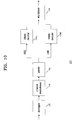
- FIG. 9 shows a functional block diagram of an encoding section 100 of an example transmitter in such a wireless communication system employing unequal error protection, according to the present invention.
- the encoding section 100 includes a parser 102, two data paths 103A and 103B, a multiplexer 108, an interleaver 110, and a QAM mapper 110.
- the first data path 103A includes a FEC encoder 104A and a puncturer 106A.
- the second data pattern 103B includes a FEC encoder 104B and a puncturer 106B.
- the parser 102 separates an input bit stream into two spatial steams, a MSB stream for the first data path 103A and a LSB stream for the second data path 103B.
- the FEC encoder 104A can be a rate 1/2 convolutional code (or can be a convolutional code with some other rate or can be some other code) and the puncturer 106A is used to puncture the coded MSB bits to change the overall coding rate for MSBs.
- the encoder 104B can be a rate 1/2 convolutional code as well (or can be a convolutional code with some other rate or can be some other code) and the puncturer 106B is used to pucture the bits to change the coding rate for LSBs.
- the four coded MSBs i.e., bits 7, 6, 5, 4 of each 8 bit pixel component
- the four coded LSBs i.e., bits 3, 2, 1, 0
- Different mappings and/or more than two (2) streams are also possible.
- the parser 102 receives a video data stream from a higher layer, and for every 8 bits inside each color of a pixel, and for every 8 bits inside each color of a pixel, parses 4 MSBs (i.e., bits 7, 6, 5, 4) to the first data path 103A, and pareses the other 4 LSBs (i.e., bits 3, 2, 1, 0) to the second data path 103B.
- the parser 102 can be either a bit parser or a group parser.
- Each data path then performs FEC encoding and puncturing.
- Each data path can utilize different codes and puncturing patterns, than the other data paths, depending on bit importance level. Further, although only two data paths are shown in Fig. 9 , the present invention contemplates parsing input bits into more than two data paths, depending on the number of importance levels for the bits (e.g., the number of data paths can be equal to the number of importance levels).
- the punctured and encoded bits are then provided to the multiplexer 108.
- the MSBs and LSBs may be coded at different coding rates on the data paths 103A and 103B, resulting in a differing number of coded bits on the two data paths 103A and 103B.
- a multiplexer is utilized in handling any data rate mismatch over the two data paths.
- the channel interleaver 110 provides channel interleaving, in order to decorrelate the adjacent channel coefficients and to reduce the overall error rate probability.
- the interleaving operation preserves the bit pattern of MSBs and LSBs.
- the QAM mapper 112 may use either a standard non-skewed constellation mapping (e.g., Figs. 2 and 3 ) or a skewed unequal error protection constellation (e.g., Figs. 4-6 ).
- the detailed constellation design and labeling i.e., how asymmetrical the constellation is) depends on the channel condition and implementation, and can be configured by system parameters, (e.g., ⁇ d I , r I , d Q , r Q ⁇ ) for the 16QAM modulation.
- an example receiver 150 performs the reverse steps of the transmitter.
- a demapper 152 demaps (or demodulates) received symbols into demodulated binary bits.
- the demapper can 152 can implement either a hard decision or a soft decision process.
- the demodulated bits are then deinterleaved by a channel deinterleaver 154 to restore bits into their original positions.
- a parser 156 then de-parses the deinterleaved bits into two or more bit streams, each bit stream including bits of different levels of importance in relation to other bit streams (e.g., bit stream 1 including bits of importance level 1, ..., bit stream n including bits of importance level n).
- bit stream 1 including bits of importance level 1
- bit stream n including bits of importance level n
- bit streams MSB and LSB are shown.
- Each bit stream is decoded by a corresponding FEC decoder (e.g., the Viterbi decoder).
- the MSB bit stream is decoded by a decoder 158A and the LSB bit stream is decided by a decoder 158B.
- the separately decoded bits are multiplexed together by a multiplexer (de-multiplexer) 160 to recover the transmitted information.
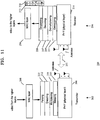
- FIG. 11 shows a functional block diagram of an example wireless communication system 200, according to an embodiment of the present invention, including a wireless communication station 202 functioning as a transmitter (a sender) and a wireless communication station functioning as a receiver 204, which implements an example process for communicating uncompressed video, as discussed above.
- the transmitter 202 includes a PHY layer 206 and a MAC layer 208.
- the receiver 204 includes a PHY layer 214 and a MAC layer 216.
- the PHY and MAC layers provide wireless communication between the transmitter 202 and the receiver 204 via antennas through a wireless channel 201.
- the transmitter 202 further includes: a parsing module 210 parsing input video bits into separate streams based on importance level, such as the function of the above-mentioned parser 102 ( Fig. 9 ); an encoding module 212 implementing encoding on the different bit streams, such as the function of the above-mentioned encoders 104A, 104B; a multiplexing module 211 that combines the encoded bit stream into one stream, such as the function of the multiplexing module 108; a mapper module 213 that performs constellation mapping using skewed constellations for unequal error protection, such as the functions of the QAM mapper 112.
- the bits are then converted to frequency band signals transmitted by the PHY layer 206 via one or more antennas over the wireless channel 201 to the receiver 204.
- the steps of parsing, encoding, multiplexing and mapping takes place in the PHY layer 206.
- the PHY layer 214 receives the signals and converts them to bits.
- a de-mapping module 221 then demaps the received bits by implementing the reverse steps of the mapping module 213 of the transmitter.
- the demultiplexing module 219 de-multiplexes the bits into different streams at different priority levels by reverse steps of the multiplexer 211.
- a decoding module 217 then decodes the bits in each stream by reverse steps of the encoding module 212.
- a de-parsing module 218 then de-parses the multiple bit streams into one video bit stream by reverse steps of the parsing module 210, thereby reconstructing the transmitted vide.
- the steps of de-parsing, decoding, demultiplexing and demapping takes place in the PHY layer 214.
- the receiver 204 further includes an error detection module 222 and an error correction module 224.
- the error detection module 222 detects lost or damaged bits (e.g., using Cyclic Redundancy Code (CRC) information provided by the transmitter).
- the correction module 224 utilizes the encoding and UEP information to compensate for the lost or damaged bits.
- CRC Cyclic Redundancy Code
- the stations 202 and 204 have been described as a transmitter and a receiver, respectively, each is a type of wireless communication station (as noted) capable of transmitting and/or receiving over a wireless channel in a wireless communication system. Therefore, a wireless communication station herein can function as a transmitter, a sender, a receiver, an initiator and/or a responder. As such, the present invention provides unequal error protection without significant additional implementation cost and improves the uncompressed video quality.
Landscapes
- Engineering & Computer Science (AREA)
- Signal Processing (AREA)
- Computer Networks & Wireless Communication (AREA)
- Physics & Mathematics (AREA)
- Probability & Statistics with Applications (AREA)
- Theoretical Computer Science (AREA)
- Multimedia (AREA)
- Error Detection And Correction (AREA)
- Digital Transmission Methods That Use Modulated Carrier Waves (AREA)
- Detection And Prevention Of Errors In Transmission (AREA)
- Compression Or Coding Systems Of Tv Signals (AREA)
Claims (11)
- Procédé de communication sans fil, comprenant les étapes suivantes :entrée de bits d'information vidéo, certains bits ayant un niveau d'importance plus élevé que d'autres bits ;analyse des bits sur la base de leurs niveaux d'importance ;codage FEC des bits analysés ;choix de paramètres {dI, rI, dQ, rQ}, respectivement, pour un mappage de constellation asymétrique sur la base d'un état de voie, le paramètre dQ étant choisi sur la base de l'état de voie, indépendamment de dI, et le paramètre rQ étant choisi sur la base de l'état de voie, indépendamment de rI ;détermination de points de constellation du mappage de constellation asymétrique sur la base des paramètres, les points de constellation déterminés étant représentés comme {(dI+rI±rI dQ+rQ±rQ) , (-dI-rI±rI, dQ+rQ±rQ) , (-dI-rI±rI, -dQ-rQ±rQ), (dI+rI±rI, -dQ-rQ±rQ)} ;application d'une protection inégale aux bits en fonction du niveau d'importance au moyen du mappage de constellation asymétrique de telle sorte que des bits plus importants sont pourvus d'une plus grande protection pour la récupération d'erreurs de transmission ; ettransmission de chaque point de constellation des bits protégés par le biais de deux voies séparées et orthogonales, la voie I et la voie Q, en modulation 16-QAM sur une voie sans fil.
- Procédé de la revendication 1 dans lequel l'application d'une protection inégale comporte en outre l'application d'une protection inégale à des bits à différents niveaux d'importance au moyen d'un codage asymétrique de telle sorte que des bits plus importants sont pourvus d'une plus grande protection pour la récupération d'erreurs de transmission.
- Procédé de la revendication 1 dans lequel les bits d'information comprennent des informations vidéo non compressées représentées par de multiples bits par pixel vidéo, de telle sorte que des bits d'ordre supérieur par pixel sont d'une plus grande importance vidéo.
- Procédé de la revendication 1 comprenant en outre les étapes suivantes :réception des bits transmis ; etdétection et décodage des bits reçus.
- Émetteur sans fil comportant :un analyseur qui est configuré pour analyser des bits d'entrée dans différents flux, des bits dans différents flux ayant différents niveaux importance ;de multiples codeurs FEC qui sont configurés pour coder les bits issus de différents flux ;un multiplexeur qui est configuré pour multiplexer les bits codés issus des flux pour former un seul flux ;un mappeur qui est configuré pour choisir des paramètres {dI, rI, dQ, rQ}, respectivement, pour un mappage de constellation asymétrique sur la base d'un état de voie, le paramètre dQ étant choisi sur la base de l'état de voie, indépendamment de dI, et le paramètre rQ étant choisi sur la base de l'état de voie, indépendamment de rI, déterminer des points de constellation du mappage de constellation asymétrique sur la base des paramètres, et appliquer une protection inégale à des bits à différents niveaux d'importance dans le flux en utilisant le mappage de constellation asymétrique, de telle sorte que des bits plus importants sont pourvus d'une plus grande protection pour la récupération d'erreurs de transmission, les points de constellation déterminés étant représentés comme {(dI+rI±rI, dQ+rQ±rQ), (-dI-rI±rI, dQ+rQ±rQ), (-dI-rI±rI, -dQ-rQ±rQ), (dI+rI±rI, -dQ-rQ±rQ)} ; etun module de transmission qui est configuré pour transmettre chaque point de constellation des bits protégés par le biais de deux voies séparées et orthogonales, la voie I et la voie Q, en modulation 16-QAM sur une voie sans fil.
- Émetteur de la revendication 5 dans lequel les bits d'information représentent des informations vidéo non compressées.
- Émetteur de la revendication 5 dans lequel les bits d'information comprennent des informations vidéo non compressées représentées par de multiples bits par pixel vidéo, de telle sorte que des bits d'ordre supérieur par pixel sont d'une plus grande importance vidéo.
- Récepteur sans fil comprenant :un module de réception qui est configuré pour recevoir des bits transmis sous forme de symboles comportant des bits codés et protégés de façon inégale sur la base du niveau d'importance de bit au moyen d'une constellation asymétrique provenant d'un émetteur sans fil par le biais de deux voies séparées et orthogonales, la voie I et la voie Q, en modulation 16-QAM sur une voie sans fil ;un démappeur qui est configuré pour démapper les symboles reçus en points de constellation ;un analyseur qui est configuré pour analyser les bits dans de multiples flux, les bits dans différents flux ayant différents niveaux d'importance ; etde multiples décodeurs FEC qui sont configurés pour décoder les bits dans chaque flux en bits décodés séparément,dans lequel :
le démappeur détermine les points de constellation sur la base de paramètres {dI, rI, dQ, rQ}, respectivement, choisis par l'émetteur sans fil, le paramètre dQ étant choisi sur la base de l'état de voie, indépendamment de dI, et le paramètre rQ étant choisi sur la base de l'état de voie, indépendamment de rI, et les points de constellation du mappage de constellation asymétrique étant représentés comme { (dI+rI±rI, dQ+rQ±rQ), (-dI-rI±rI, dQ+rQ±rQ), (-dI-rI±rI, -dQ-rQ±rQ), (dI+rI±rI, -dQ-rQ±rQ)}. - Récepteur de la revendication 8, comprenant en outre un désentrelaceur configuré pour restaurer les bits démappés dans leurs positions initiales avant décodage.
- Récepteur de la revendication 8, comprenant en outre un démultiplexeur qui est configuré pour multiplexer les bits décodés séparément, pour récupérer les informations transmises.
- Procédé de la revendication 1, dans lequel un mappage UEP est effectué avec dI = rI, dQ = rQ, en utilisant des paramètres de gain g1 = dI = rI et g2 = dQ = rQ pour ajuster le niveau de protection contre les erreurs pour la voie I et la voie Q, respectivement, de telle sorte que les composantes I et Q sont multipliées par les facteurs de gain g1 et g2, respectivement, pour générer des sorties de composantes I et Q avec un UEP appliqué à celles-ci.
Applications Claiming Priority (2)
| Application Number | Priority Date | Filing Date | Title |
|---|---|---|---|
| US77382706P | 2006-02-15 | 2006-02-15 | |
| PCT/KR2007/000831 WO2007094634A1 (fr) | 2006-02-15 | 2007-02-15 | Procédé et système pour l'application d'une protection inégale contre les erreurs sur une vidééo non compressée pour la transmission sur des canaux sans fil |
Publications (3)
| Publication Number | Publication Date |
|---|---|
| EP1987678A1 EP1987678A1 (fr) | 2008-11-05 |
| EP1987678A4 EP1987678A4 (fr) | 2014-06-04 |
| EP1987678B1 true EP1987678B1 (fr) | 2020-04-29 |
Family
ID=38371765
Family Applications (1)
| Application Number | Title | Priority Date | Filing Date |
|---|---|---|---|
| EP07708981.1A Ceased EP1987678B1 (fr) | 2006-02-15 | 2007-02-15 | Procede et systeme pour l'application d'une protection inegale contre les erreurs sur une video non compressee pour la transmission sur des canaux sans fil |
Country Status (5)
| Country | Link |
|---|---|
| US (1) | US7987415B2 (fr) |
| EP (1) | EP1987678B1 (fr) |
| KR (1) | KR20080100413A (fr) |
| CN (1) | CN101385357B (fr) |
| WO (1) | WO2007094634A1 (fr) |
Families Citing this family (82)
| Publication number | Priority date | Publication date | Assignee | Title |
|---|---|---|---|---|
| US9138644B2 (en) | 2002-12-10 | 2015-09-22 | Sony Computer Entertainment America Llc | System and method for accelerated machine switching |
| US9077991B2 (en) | 2002-12-10 | 2015-07-07 | Sony Computer Entertainment America Llc | System and method for utilizing forward error correction with video compression |
| US8964830B2 (en) | 2002-12-10 | 2015-02-24 | Ol2, Inc. | System and method for multi-stream video compression using multiple encoding formats |
| US9192859B2 (en) | 2002-12-10 | 2015-11-24 | Sony Computer Entertainment America Llc | System and method for compressing video based on latency measurements and other feedback |
| US9314691B2 (en) | 2002-12-10 | 2016-04-19 | Sony Computer Entertainment America Llc | System and method for compressing video frames or portions thereof based on feedback information from a client device |
| US9061207B2 (en) | 2002-12-10 | 2015-06-23 | Sony Computer Entertainment America Llc | Temporary decoder apparatus and method |
| KR100984811B1 (ko) * | 2007-03-27 | 2010-10-01 | 삼성전자주식회사 | 데이터를 송수신하는 장치 및 방법 |
| US8300661B2 (en) * | 2007-04-10 | 2012-10-30 | Samsung Electronics Co., Ltd. | System and method for wireless communication of uncompressed video using mode changes based on channel feedback (CF) |
| US20090022242A1 (en) * | 2007-07-18 | 2009-01-22 | Texas Instruments Incorporated | Systems and methods for increased data rate modes using multiple encoders/decoders |
| WO2009020288A1 (fr) | 2007-08-09 | 2009-02-12 | Samsung Electronics Co., Ltd. | Appareil et procédé pour rechercher des données erronées |
| US7889707B2 (en) | 2007-10-02 | 2011-02-15 | Samsung Electronics Co., Ltd. | Method and system for unequal error protection with block codes for wireless transmission |
| US8116386B2 (en) * | 2007-10-17 | 2012-02-14 | Mahbod Eyvazkhani | Method, apparatus and computer program product for providing improved gray mapping |
| US8837435B2 (en) * | 2007-10-31 | 2014-09-16 | Samsung Electronics Co., Ltd. | Method and system for medium access control in communication networks |
| EP2109317B1 (fr) * | 2008-04-10 | 2020-12-30 | Sony Corporation | Amélioration de la solidité vidéo utilisant la diversité spatiale et temporelle |
| US8289940B2 (en) * | 2008-07-15 | 2012-10-16 | Samsung Electronics Co., Ltd. | System and method for channel access in dual rate wireless networks |
| US20100014584A1 (en) * | 2008-07-17 | 2010-01-21 | Meir Feder | Methods circuits and systems for transmission and reconstruction of a video block |
| US8537850B2 (en) * | 2008-07-18 | 2013-09-17 | Samsung Electronics Co., Ltd. | Method and system for directional virtual sensing random access for wireless networks |
| US8355387B2 (en) * | 2008-07-24 | 2013-01-15 | Samsung Electronics Co., Ltd. | System and method for bandwidth reservation protocol for spatial reuse in a wireless communication network |
| US8908799B2 (en) * | 2008-08-15 | 2014-12-09 | Blackberry Limited | Systems and methods for communicating using ASK or QAM with uneven symbol constellation |
| US8817910B2 (en) * | 2008-08-15 | 2014-08-26 | Blackberry Limited | Systems and methods for communicating using ASK or QAM with uneven symbol constellation |
| WO2010064209A1 (fr) * | 2008-12-04 | 2010-06-10 | Amimon Ltd | Dispositif, procédé et système pour la transmission et la réception de données |
| US8811420B2 (en) * | 2009-01-05 | 2014-08-19 | Samsung Electronics Co., Ltd. | System and method for contention-based channel access for peer-to-peer connection in wireless networks |
| US9571326B2 (en) * | 2009-03-05 | 2017-02-14 | SeeScan, Inc. | Method and apparatus for high-speed data transfer employing self-synchronizing quadrature amplitude modulation |
| US8948286B2 (en) * | 2009-10-20 | 2015-02-03 | Wisconsin Alumni Research Foundation | Wireless communication system mapping data bits to symbol bit positions according to error rates of those bit positions and data content |
| US20110222556A1 (en) * | 2010-03-10 | 2011-09-15 | Shefler David | Method circuit and system for adaptive transmission and reception of video |
| US20130194510A1 (en) * | 2010-03-22 | 2013-08-01 | Amimon Ltd | Methods circuits devices and systems for wireless transmission of mobile communication device display information |
| US9288089B2 (en) | 2010-04-30 | 2016-03-15 | Ecole Polytechnique Federale De Lausanne (Epfl) | Orthogonal differential vector signaling |
| US9077386B1 (en) | 2010-05-20 | 2015-07-07 | Kandou Labs, S.A. | Methods and systems for selection of unions of vector signaling codes for power and pin efficient chip-to-chip communication |
| US9288082B1 (en) | 2010-05-20 | 2016-03-15 | Kandou Labs, S.A. | Circuits for efficient detection of vector signaling codes for chip-to-chip communication using sums of differences |
| US9251873B1 (en) | 2010-05-20 | 2016-02-02 | Kandou Labs, S.A. | Methods and systems for pin-efficient memory controller interface using vector signaling codes for chip-to-chip communications |
| KR101551919B1 (ko) * | 2010-10-22 | 2015-09-09 | 한국전자통신연구원 | 무선 통신 시스템에서 데이터 블록 전송 방법 및 전송기 |
| US9634878B1 (en) | 2011-09-08 | 2017-04-25 | See Scan, Inc. | Systems and methods for data transfer using self-synchronizing quadrature amplitude modulation (QAM) |
| KR101318609B1 (ko) * | 2011-10-28 | 2013-10-15 | 세종대학교산학협력단 | 다중입력 다중출력 안테나를 이용한 데이터 전송 장치 및 그 방법 |
| KR101291014B1 (ko) * | 2012-02-22 | 2013-08-07 | 세종대학교산학협력단 | 영상 데이터의 msb를 고려한 비대칭 변조방법 및 그 장치 |
| US9021313B2 (en) * | 2012-11-21 | 2015-04-28 | Microsoft Technology Licensing, Llc | Priority-assignment interface to enhance approximate computing |
| WO2014124450A1 (fr) | 2013-02-11 | 2014-08-14 | Kandou Labs, S.A. | Procédés et systèmes pour interface de communication de puce à puce à haut débit |
| CN110166217B (zh) | 2013-04-16 | 2022-05-17 | 康杜实验室公司 | 高带宽通信接口方法和系统 |
| CN105393512B (zh) | 2013-06-25 | 2019-06-28 | 康杜实验室公司 | 具有低接收器复杂度的向量信令 |
| US9806761B1 (en) | 2014-01-31 | 2017-10-31 | Kandou Labs, S.A. | Methods and systems for reduction of nearest-neighbor crosstalk |
| JP6317474B2 (ja) | 2014-02-02 | 2018-04-25 | カンドウ ラボズ ソシエテ アノニム | 制約isi比を用いる低電力チップ間通信の方法および装置 |
| EP3672176B1 (fr) | 2014-02-28 | 2022-05-11 | Kandou Labs, S.A. | Code de signalisation vectorielle avec horloge imbriquée |
| US9509437B2 (en) | 2014-05-13 | 2016-11-29 | Kandou Labs, S.A. | Vector signaling code with improved noise margin |
| US9852806B2 (en) | 2014-06-20 | 2017-12-26 | Kandou Labs, S.A. | System for generating a test pattern to detect and isolate stuck faults for an interface using transition coding |
| US9112550B1 (en) | 2014-06-25 | 2015-08-18 | Kandou Labs, SA | Multilevel driver for high speed chip-to-chip communications |
| CN106797352B (zh) * | 2014-07-10 | 2020-04-07 | 康杜实验室公司 | 高信噪特性向量信令码 |
| US9432082B2 (en) | 2014-07-17 | 2016-08-30 | Kandou Labs, S.A. | Bus reversable orthogonal differential vector signaling codes |
| CN106664272B (zh) | 2014-07-21 | 2020-03-27 | 康杜实验室公司 | 从多点通信信道接收数据的方法和装置 |
| US9461862B2 (en) | 2014-08-01 | 2016-10-04 | Kandou Labs, S.A. | Orthogonal differential vector signaling codes with embedded clock |
| US9674014B2 (en) | 2014-10-22 | 2017-06-06 | Kandou Labs, S.A. | Method and apparatus for high speed chip-to-chip communications |
| EP3314835B1 (fr) | 2015-06-26 | 2020-04-08 | Kandou Labs S.A. | Système de communication à grande vitesse |
| US10055372B2 (en) | 2015-11-25 | 2018-08-21 | Kandou Labs, S.A. | Orthogonal differential vector signaling codes with embedded clock |
| CN115085727B (zh) | 2016-04-22 | 2026-04-21 | 康杜实验室公司 | 高性能锁相环 |
| WO2017185070A1 (fr) | 2016-04-22 | 2017-10-26 | Kandou Labs, S.A. | Appareil et procédé d'étalonnage destinés à un échantillonneur à gain haute fréquence réglable |
| US10003454B2 (en) | 2016-04-22 | 2018-06-19 | Kandou Labs, S.A. | Sampler with low input kickback |
| US10193716B2 (en) | 2016-04-28 | 2019-01-29 | Kandou Labs, S.A. | Clock data recovery with decision feedback equalization |
| US10153591B2 (en) | 2016-04-28 | 2018-12-11 | Kandou Labs, S.A. | Skew-resistant multi-wire channel |
| CN109313622B (zh) | 2016-04-28 | 2022-04-15 | 康杜实验室公司 | 用于密集路由线组的向量信令码 |
| CN109417521B (zh) | 2016-04-28 | 2022-03-18 | 康杜实验室公司 | 低功率多电平驱动器 |
| CN106162183B (zh) * | 2016-07-05 | 2019-05-31 | 重庆邮电大学 | 基于不等错误保护策略的最小化图像无线传输能耗方法 |
| US9906358B1 (en) | 2016-08-31 | 2018-02-27 | Kandou Labs, S.A. | Lock detector for phase lock loop |
| US10200188B2 (en) | 2016-10-21 | 2019-02-05 | Kandou Labs, S.A. | Quadrature and duty cycle error correction in matrix phase lock loop |
| US10372665B2 (en) | 2016-10-24 | 2019-08-06 | Kandou Labs, S.A. | Multiphase data receiver with distributed DFE |
| US10200218B2 (en) | 2016-10-24 | 2019-02-05 | Kandou Labs, S.A. | Multi-stage sampler with increased gain |
| EP3610576B1 (fr) | 2017-04-14 | 2022-12-28 | Kandou Labs, S.A. | Correction d'erreurs sans voie de retour en pipeline d'un canal de code de signalisation de vecteur |
| US10116468B1 (en) | 2017-06-28 | 2018-10-30 | Kandou Labs, S.A. | Low power chip-to-chip bidirectional communications |
| CN109218792A (zh) * | 2017-06-29 | 2019-01-15 | 上海数字电视国家工程研究中心有限公司 | 解复用方法 |
| US10686583B2 (en) | 2017-07-04 | 2020-06-16 | Kandou Labs, S.A. | Method for measuring and correcting multi-wire skew |
| US10693587B2 (en) | 2017-07-10 | 2020-06-23 | Kandou Labs, S.A. | Multi-wire permuted forward error correction |
| US10203226B1 (en) | 2017-08-11 | 2019-02-12 | Kandou Labs, S.A. | Phase interpolation circuit |
| US10326623B1 (en) | 2017-12-08 | 2019-06-18 | Kandou Labs, S.A. | Methods and systems for providing multi-stage distributed decision feedback equalization |
| US10554380B2 (en) | 2018-01-26 | 2020-02-04 | Kandou Labs, S.A. | Dynamically weighted exclusive or gate having weighted output segments for phase detection and phase interpolation |
| US10972215B2 (en) * | 2018-03-09 | 2021-04-06 | Nokia Solutions And Networks Oy | Methods and apparatus for joint use of probabilistic signal shaping and forward error correction |
| WO2020006738A1 (fr) * | 2018-07-05 | 2020-01-09 | Huawei Technologies Co., Ltd. | Procédé et appareil pour des communications sans fil avec protection inégale contre les erreurs |
| US11057053B2 (en) | 2018-09-28 | 2021-07-06 | Huawei Technologies Co., Ltd. | Method and apparatus for wirelessly communicating over a noisy channel with a variable codeword length polar code to improve transmission capacity |
| CN109874019A (zh) * | 2019-03-26 | 2019-06-11 | 深圳大学 | 一种不平等误差保护辅助关注区域无线全景视频的方法 |
| US11044049B1 (en) * | 2019-12-23 | 2021-06-22 | United States Of America As Represented By The Secretary Of The Navy | Hybrid unequal error protection (UEP) for heterogeneous multi-service provisioning |
| US11356197B1 (en) | 2021-03-19 | 2022-06-07 | Kandou Labs SA | Error-tolerant forward error correction ordered set message decoder |
| US12363316B2 (en) | 2021-12-17 | 2025-07-15 | Lenovo (Singapore) Pte. Ltd. | Video codec importance indication and radio access network awareness configuration |
| US11824653B2 (en) | 2021-12-17 | 2023-11-21 | Lenovo (Singapore) Pte. Ltd. | Radio access network configuration for video approximate semantic communications |
| US11917206B2 (en) | 2021-12-17 | 2024-02-27 | Lenovo (Singapore) Pte. Ltd. | Video codec aware radio access network configuration and unequal error protection coding |
| US12308953B2 (en) * | 2023-05-14 | 2025-05-20 | Realtek Semiconductor Corp. | Communication device and host system for reducing communication interference based on bit extension mechanism |
| US12445326B2 (en) * | 2023-10-11 | 2025-10-14 | Qualcomm Incorporated | Asymmetric constellations for channel characterization |
Family Cites Families (14)
| Publication number | Priority date | Publication date | Assignee | Title |
|---|---|---|---|---|
| US5214656A (en) * | 1990-12-13 | 1993-05-25 | At&T Bell Laboratories | Multiplexed coded modulation with unequal error protection |
| US5544328A (en) * | 1991-10-31 | 1996-08-06 | At&T Bell Laboratories | Coded modulation with unequal error protection |
| US6154499A (en) * | 1996-10-21 | 2000-11-28 | Comsat Corporation | Communication systems using nested coder and compatible channel coding |
| US5987069A (en) * | 1996-12-24 | 1999-11-16 | Gte Government Systems Corporation | Method and apparatus for variably allocating upstream and downstream communication spectra |
| US6031874A (en) * | 1997-09-26 | 2000-02-29 | Ericsson Inc. | Unequal error protection in coded modulation schemes |
| BR0012670B1 (pt) | 1999-07-22 | 2014-08-12 | Siemens Ag | Procedimento para a proteção contra falhas de um fluxo de bits de dados |
| US7190732B2 (en) * | 2000-04-06 | 2007-03-13 | Lucent Technologies Inc. | Multilevel coding with unequal error protection and time diversity for bandwidth efficient transmission |
| KR100401186B1 (ko) * | 2000-10-20 | 2003-10-10 | 삼성전자주식회사 | 이동 통신시스템의 패킷 데이터 전송율 결정 장치 및 방법 |
| US6651210B1 (en) * | 2000-12-21 | 2003-11-18 | Arraycomm, Inc. | Flexible multi-bit per symbol rate encoding |
| US7165207B2 (en) * | 2002-01-18 | 2007-01-16 | Koninklijke Philips Electronics N.V. | Robust signal coding |
| US20040083417A1 (en) * | 2002-10-29 | 2004-04-29 | Lane Richard D. | Multimedia transmission using variable error coding rate based on data importance |
| US7860180B2 (en) * | 2005-10-21 | 2010-12-28 | Amimon Ltd | OFDM modem for transmission of continuous complex numbers |
| US8006168B2 (en) * | 2005-12-19 | 2011-08-23 | Amimon Ltd | Apparatus and method for applying unequal error protection during wireless video transmission |
| US20070183523A1 (en) * | 2006-02-09 | 2007-08-09 | Interdigital Technology Corporation | Method and apparatus for improving packet error rate performance using beamforming techniques |
-
2007
- 2007-02-13 US US11/706,941 patent/US7987415B2/en not_active Expired - Fee Related
- 2007-02-15 KR KR1020087002171A patent/KR20080100413A/ko not_active Withdrawn
- 2007-02-15 WO PCT/KR2007/000831 patent/WO2007094634A1/fr not_active Ceased
- 2007-02-15 CN CN2007800055905A patent/CN101385357B/zh not_active Expired - Fee Related
- 2007-02-15 EP EP07708981.1A patent/EP1987678B1/fr not_active Ceased
Non-Patent Citations (1)
| Title |
|---|
| None * |
Also Published As
| Publication number | Publication date |
|---|---|
| EP1987678A4 (fr) | 2014-06-04 |
| CN101385357B (zh) | 2011-08-24 |
| EP1987678A1 (fr) | 2008-11-05 |
| KR20080100413A (ko) | 2008-11-18 |
| US7987415B2 (en) | 2011-07-26 |
| US20070204205A1 (en) | 2007-08-30 |
| WO2007094634A1 (fr) | 2007-08-23 |
| CN101385357A (zh) | 2009-03-11 |
Similar Documents
| Publication | Publication Date | Title |
|---|---|---|
| EP1987678B1 (fr) | Procede et systeme pour l'application d'une protection inegale contre les erreurs sur une video non compressee pour la transmission sur des canaux sans fil | |
| US8102949B2 (en) | Bit log likelihood ratio evaluation | |
| US8196020B2 (en) | Method of matching codeword size and transmitter therefor in mobile communications system | |
| US8135082B2 (en) | High-order modulation-based burst mapping method and apparatus in a mobile communication system | |
| US8793551B2 (en) | Serial concatenation of trellis coded modulation and an inner non-binary LDPC code | |
| EP0732832B1 (fr) | Emetteur de signaux, recepteur de signaux et procede d'emission/reception de signaux | |
| US20060056541A1 (en) | Improving hierarchical 8psk performance | |
| US7856067B2 (en) | Unequal hierarchical communications modulation method | |
| US20150171991A1 (en) | Flexible data transmission scheme adaptive to communication channel quality | |
| US20090046771A1 (en) | Reception quality estimating apparatus, wireless communication system, and reception quality estimating method | |
| US20120033752A1 (en) | Wireless communication device and wireless communication method | |
| KR20080095809A (ko) | 신호 송수신 방법 및 신호 송수신 장치 | |
| KR100951029B1 (ko) | 가변 유클리드 거리 비율 및 블라인드 수신기를 사용하는다중 해상도 변조 | |
| US8369449B2 (en) | Method and system of diversity transmission of data employing M-point QAM modulation | |
| US20120327306A1 (en) | Method and apparatus for transmitting and receiving data in broadcasting system | |
| US8391411B2 (en) | Wireless communication apparatus and wireless communication method | |
| EP1929734B1 (fr) | Procede et systeme de transmission en diversite de donnees | |
| US20090141826A1 (en) | Digital signal transmitting system, receiving apparatus and receiving method | |
| JP2006211096A (ja) | 無線通信装置 | |
| US20080159356A1 (en) | Method and a system for low-rate channel communication in wireless communication systems | |
| KR100320953B1 (ko) | 유클리드거리와해밍거리를이용한tcm심볼사상방법및장치 | |
| EP2139139A1 (fr) | Procédé et appareil pour le codage de contrôle de parité à faible densité non binaire |
Legal Events
| Date | Code | Title | Description |
|---|---|---|---|
| PUAI | Public reference made under article 153(3) epc to a published international application that has entered the european phase |
Free format text: ORIGINAL CODE: 0009012 |
|
| 17P | Request for examination filed |
Effective date: 20080908 |
|
| AK | Designated contracting states |
Kind code of ref document: A1 Designated state(s): DE |
|
| DAX | Request for extension of the european patent (deleted) | ||
| RBV | Designated contracting states (corrected) |
Designated state(s): DE |
|
| RAP1 | Party data changed (applicant data changed or rights of an application transferred) |
Owner name: SAMSUNG ELECTRONICS CO., LTD. |
|
| A4 | Supplementary search report drawn up and despatched |
Effective date: 20140508 |
|
| RIC1 | Information provided on ipc code assigned before grant |
Ipc: H04L 1/00 20060101ALI20140430BHEP Ipc: H04L 27/34 20060101ALI20140430BHEP Ipc: H04L 29/06 20060101ALI20140430BHEP Ipc: H04N 7/64 20060101AFI20140430BHEP Ipc: H03M 13/23 20060101ALI20140430BHEP Ipc: H03M 13/35 20060101ALI20140430BHEP Ipc: H04L 29/02 20060101ALI20140430BHEP |
|
| 17Q | First examination report despatched |
Effective date: 20140521 |
|
| STAA | Information on the status of an ep patent application or granted ep patent |
Free format text: STATUS: EXAMINATION IS IN PROGRESS |
|
| REG | Reference to a national code |
Ref country code: DE Ref legal event code: R079 Ref document number: 602007060148 Country of ref document: DE Free format text: PREVIOUS MAIN CLASS: H04N0007640000 Ipc: H04L0001000000 |
|
| GRAP | Despatch of communication of intention to grant a patent |
Free format text: ORIGINAL CODE: EPIDOSNIGR1 |
|
| STAA | Information on the status of an ep patent application or granted ep patent |
Free format text: STATUS: GRANT OF PATENT IS INTENDED |
|
| GRAJ | Information related to disapproval of communication of intention to grant by the applicant or resumption of examination proceedings by the epo deleted |
Free format text: ORIGINAL CODE: EPIDOSDIGR1 |
|
| STAA | Information on the status of an ep patent application or granted ep patent |
Free format text: STATUS: EXAMINATION IS IN PROGRESS |
|
| RIC1 | Information provided on ipc code assigned before grant |
Ipc: H04L 29/02 20060101ALI20191125BHEP Ipc: H04L 27/34 20060101ALI20191125BHEP Ipc: H04L 1/00 20060101AFI20191125BHEP Ipc: H04L 29/06 20060101ALI20191125BHEP Ipc: H03M 13/23 20060101ALI20191125BHEP Ipc: H04N 19/67 20140101ALI20191125BHEP Ipc: H03M 13/35 20060101ALI20191125BHEP Ipc: H04N 19/89 20140101ALI20191125BHEP |
|
| GRAP | Despatch of communication of intention to grant a patent |
Free format text: ORIGINAL CODE: EPIDOSNIGR1 |
|
| STAA | Information on the status of an ep patent application or granted ep patent |
Free format text: STATUS: GRANT OF PATENT IS INTENDED |
|
| INTG | Intention to grant announced |
Effective date: 20191216 |
|
| RIN1 | Information on inventor provided before grant (corrected) |
Inventor name: XIA, PENGFEI Inventor name: NGO, CHIU Inventor name: NIU, HUANING |
|
| INTG | Intention to grant announced |
Effective date: 20200109 |
|
| GRAS | Grant fee paid |
Free format text: ORIGINAL CODE: EPIDOSNIGR3 |
|
| GRAA | (expected) grant |
Free format text: ORIGINAL CODE: 0009210 |
|
| STAA | Information on the status of an ep patent application or granted ep patent |
Free format text: STATUS: THE PATENT HAS BEEN GRANTED |
|
| AK | Designated contracting states |
Kind code of ref document: B1 Designated state(s): DE |
|
| REG | Reference to a national code |
Ref country code: DE Ref legal event code: R096 Ref document number: 602007060148 Country of ref document: DE |
|
| REG | Reference to a national code |
Ref country code: DE Ref legal event code: R097 Ref document number: 602007060148 Country of ref document: DE |
|
| PLBE | No opposition filed within time limit |
Free format text: ORIGINAL CODE: 0009261 |
|
| STAA | Information on the status of an ep patent application or granted ep patent |
Free format text: STATUS: NO OPPOSITION FILED WITHIN TIME LIMIT |
|
| 26N | No opposition filed |
Effective date: 20210201 |
|
| REG | Reference to a national code |
Ref country code: DE Ref legal event code: R119 Ref document number: 602007060148 Country of ref document: DE |
|
| PG25 | Lapsed in a contracting state [announced via postgrant information from national office to epo] |
Ref country code: DE Free format text: LAPSE BECAUSE OF NON-PAYMENT OF DUE FEES Effective date: 20210901 |