EP1988480A1 - Computerprogrammprodukt, Verfahren und Vorrichtung zur Atmungsführung - Google Patents
Computerprogrammprodukt, Verfahren und Vorrichtung zur Atmungsführung Download PDFInfo
- Publication number
- EP1988480A1 EP1988480A1 EP07103821A EP07103821A EP1988480A1 EP 1988480 A1 EP1988480 A1 EP 1988480A1 EP 07103821 A EP07103821 A EP 07103821A EP 07103821 A EP07103821 A EP 07103821A EP 1988480 A1 EP1988480 A1 EP 1988480A1
- Authority
- EP
- European Patent Office
- Prior art keywords
- breathing
- heart
- heart beat
- signals
- user
- Prior art date
- Legal status (The legal status is an assumption and is not a legal conclusion. Google has not performed a legal analysis and makes no representation as to the accuracy of the status listed.)
- Ceased
Links
- 230000029058 respiratory gaseous exchange Effects 0.000 title claims abstract description 185
- 238000000034 method Methods 0.000 title claims abstract description 33
- 238000004590 computer program Methods 0.000 title claims description 29
- 241001465754 Metazoa Species 0.000 claims abstract description 10
- 238000012545 processing Methods 0.000 claims abstract description 6
- 230000033764 rhythmic process Effects 0.000 claims description 27
- 230000003247 decreasing effect Effects 0.000 claims description 16
- 230000001360 synchronised effect Effects 0.000 claims description 14
- 238000005259 measurement Methods 0.000 claims description 8
- 230000008451 emotion Effects 0.000 claims description 4
- 206010049816 Muscle tightness Diseases 0.000 claims description 3
- 241001325280 Tricardia watsonii Species 0.000 claims description 3
- 238000009530 blood pressure measurement Methods 0.000 claims description 3
- 230000000694 effects Effects 0.000 description 4
- 230000001121 heart beat frequency Effects 0.000 description 4
- 230000006870 function Effects 0.000 description 2
- 230000008092 positive effect Effects 0.000 description 2
- 238000012360 testing method Methods 0.000 description 2
- 230000037007 arousal Effects 0.000 description 1
- 230000036772 blood pressure Effects 0.000 description 1
- 230000035565 breathing frequency Effects 0.000 description 1
- 238000005352 clarification Methods 0.000 description 1
- 239000004744 fabric Substances 0.000 description 1
- 238000009532 heart rate measurement Methods 0.000 description 1
- 238000010295 mobile communication Methods 0.000 description 1
- 230000001734 parasympathetic effect Effects 0.000 description 1
- 239000011505 plaster Substances 0.000 description 1
- 230000001953 sensory effect Effects 0.000 description 1
- 230000011664 signaling Effects 0.000 description 1
- 238000007619 statistical method Methods 0.000 description 1
- 238000012549 training Methods 0.000 description 1
- 230000000007 visual effect Effects 0.000 description 1
Images


Classifications
-
- A—HUMAN NECESSITIES
- A61—MEDICAL OR VETERINARY SCIENCE; HYGIENE
- A61B—DIAGNOSIS; SURGERY; IDENTIFICATION
- A61B5/00—Measuring for diagnostic purposes; Identification of persons
- A61B5/02—Detecting, measuring or recording for evaluating the cardiovascular system, e.g. pulse, heart rate, blood pressure or blood flow
- A61B5/0205—Simultaneously evaluating both cardiovascular conditions and different types of body conditions, e.g. heart and respiratory condition
-
- A—HUMAN NECESSITIES
- A61—MEDICAL OR VETERINARY SCIENCE; HYGIENE
- A61B—DIAGNOSIS; SURGERY; IDENTIFICATION
- A61B5/00—Measuring for diagnostic purposes; Identification of persons
- A61B5/02—Detecting, measuring or recording for evaluating the cardiovascular system, e.g. pulse, heart rate, blood pressure or blood flow
- A61B5/024—Measuring pulse rate or heart rate
-
- A—HUMAN NECESSITIES
- A61—MEDICAL OR VETERINARY SCIENCE; HYGIENE
- A61B—DIAGNOSIS; SURGERY; IDENTIFICATION
- A61B5/00—Measuring for diagnostic purposes; Identification of persons
- A61B5/02—Detecting, measuring or recording for evaluating the cardiovascular system, e.g. pulse, heart rate, blood pressure or blood flow
- A61B5/024—Measuring pulse rate or heart rate
- A61B5/02405—Determining heart rate variability
-
- A—HUMAN NECESSITIES
- A61—MEDICAL OR VETERINARY SCIENCE; HYGIENE
- A61B—DIAGNOSIS; SURGERY; IDENTIFICATION
- A61B5/00—Measuring for diagnostic purposes; Identification of persons
- A61B5/48—Other medical applications
- A61B5/486—Biofeedback
Definitions
- the invention relates to a computer program product for guiding the breathing of a user.
- the invention also relates to a method for guiding the breathing of a user.
- the invention relates to a breathing guide for guiding the breathing of a user.
- Heart rate (or heart beat rate) variability is the irregularity in the heart rate during a specific period, i.e. the variability of the time intervals between individual beats. Having a high heart rate variability (also called heart variability) is considered to indicate a healthy flexibility of one's parasympathetic system.
- Heart coherence is related to the heart rate variability.
- a high heart rate variability indicates a high heart coherence score.
- heart coherence is said to improve by combining intentional heart focus (e.g. with the aid of slow breathing) combined with positive feelings.
- the heart rate is measured by measuring a pulse wave with a finger plethysmograph.
- the heart beat signals that are derived are processed such that changes in the heart rate can be shown in a graph. From this graph the heart rate variability can be derived. Also the level of heart coherence in time is indicated on screen with the Freeze-Framer® product.
- the Freeze-Framer® product asks the user to breathe 'through the heart', and for example tries to stimulates this in some way with music.
- Other products claim to lower blood pressure by helping the user to breathe slowly, deep and/or regularly. This principle is for example applied in Yoga practice.
- the breathing process towards an improved heart coherence is guided by an expert.
- Another goal is to maintain and/or improve the heart coherence and/or heart rate variability, preferably in a relatively easy and/or intuitive way.
- At least one of said goals and/or other goals can be achieved individually or in combination, having no preferred hierarchy, by a computer program product for guiding the breathing of a user, which when executed on a computer controls the computer to process received heart beat signals and to provide for breathing guidance signals via a user interface, wherein the computer program product comprises an algorithm that is configured to synchronize the breathing guidance signals with the received heart beat signals for the purpose of guiding the user towards an improved heart coherence and/or heart rate variability.
- Such a computer program product will allow a breathing rhythm of the user that is relatively directly related to the heart beat, which will improve the heart coherence and/or heart rate variability.
- the breathing guidance signals will signal the user to breathe in and/or out in sync with heart beats, such that a heart coherence and/or heart rate variability can be reached, and preferably maintained and/or improved, in a relatively easy and preferably intuitive way. No specialist, training and/or extra knowledge are needed for the user, to achieve a heart coherence and/or heart rate variability.
- the computer program when executed on a computer, functions as a self-adjusting automated breathing guide, such that with relatively little effort and/or intuitively a user that is not an expert may improve his or her heart coherence and/or heart rate variability.
- At least one of said goals and/or other goals can be achieved individually or in combination, having no preferred hierarchy, by a method for guiding the breathing of a user, wherein heart beat signals are measured in an automated way, wherein breathing guidance signals that are synchronized with heart rate signals are given in an automated way for the purpose of guiding the user towards an improved heart coherence and/or heart rate variability.
- At least one of said goals and/or other goals can be achieved individually or in combination, having no preferred hierarchy, by a breathing guide for guiding the breathing of a user, provided with a heart beat sensor configured to convert a human or animal heart beat into heart beat signals, a storage arrangement configured to store an algorithm, a processing circuit configured to process heart beat signals and breathing guidance signals, a user interface configured to indicate a breathing guidance signal, wherein the algorithm is configured to convert the heart beat signals into breathing guidance signals and to synchronize the breathing guidance signals with the processed heart rate signals for the purpose of guiding the user towards an improved heart coherence and/or heart rate variability.
- heart beat signal frequency is related to the heart rate, wherein the heart beat signal frequency refers to the frequency of the measured signals while the heart rate refers to the actual heart rate of a human or animal.
- the noise of the heart rate signals is reduced in such a way that the heart rate of a person and his or her measured heart beat signal frequency are the same.
- the intervals between individual heart beats change continuously, such that the heart rate, i.e. the heart beat signal frequency, also changes continuously.
- This (varying) rate or frequency can be calculated in several ways as will become clear from this description. For example, in an embodiment, the average heart signal frequency over the last five heart beats is calculated and shown in a graph.
- the 'breathing guidance signal frequency' is related to the frequency of providing a breathing signal. For example, one signal can be given to a user 2 for breathing in and again one signal for breathing out.
- the breathing rhythm however is the frequency of performing one breath, wherein one breath refers to one time breathing in and one time breathing out.
- the breathing guidance signal frequency is double the breathing rhythm of the user. Breathing guidance signals could also be given just for breathing in or just for breathing out, wherein the breathing rhythm and the breathing guidance signal frequency could be the same.
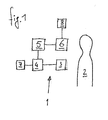
- a breathing guide 1 for guiding the breathing of a user 2 is shown.
- the breathing guide 1 is provided with a heart beat sensor 3 configured to derive heart beat signals from a human or animal heart beat. These signals are processed by a processing circuit 4 with the aid of a programmed algorithm stored in a storage arrangement 5.
- a user interface 6 is configured to indicate breathing guidance signals to the user 2. These elements 3, 4, 5, 6 can be connected to each other in a wired, wireless or integrated way and can be fed by any suitable power supply 7.
- a user setting interface 8 is provided, for example as a part of the user interface 6, such that settings for each user 2 can be set and/or changed, for example by a specialist or the user 2 himself.
- This user setting interface 8 may for example comprise a personal computer or the like.
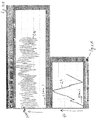
- FIG. 2A shows the results of the test that were rendered by the Freeze framer® product of HeartMath.
- the horizontal axis shows the time in minutes t(min) and the vertical axis shows the heart coherence score, indicated in the figure by HC.
- the heart coherence score is a variable calculated by certain algorithms that are defined in the Freeze framer® software.
- the heart coherence graph 23 clearly inclines, indicating a high coherence.
- the variability of the heart rate, indicated with graph 24, was relatively high, as can be seen from Figure 2B , wherein the variability graph 24 shows relatively large distances between the peaks and the valleys. These distances indicate a relatively large difference between the highest and lowest heart rate, which, in turn, indicates a high variability.
- heart coherence and heart rate variability are related. More importantly, it was shown that bringing the breathing rhythm in sync with the heart beat, in this case breathing in and out, respectively, at every sixth heart beat, has a positive effect on heart coherence and heart rate variability.
- the algorithm that is stored in the storage arrangement 2 is configured to convert the heart beat signals that are received from the heart beat sensor 3 into breathing guidance signals such that the breathing guidance signals are synchronized with the processed heart rate signals. The breathing guidance signals are then perceived by the user 2 such that he or she will breathe in or out on the breathing guidance signal.
- the user 2 is guided to breathe synchronically with the heart beat such that an improved heart coherence and/or variability can be reached, maintained and/or improved without needing to be very occupied with his or her heart beat.
- the breathing guidance signals are preferably communicated in such a way that the user may synchronize its breathing in a relatively easy and intuitive way.
- heart sensors 3 For measuring the heart beat and converting it into heart beat signals, several heart sensors 3 can be applied.
- the heart rate, or pulse may be measured with a plethysmograph for example using photodiode or impedance measuring techniques.
- sensors 3 are just as well suitable within the scope of the invention.
- the user interface 6 is configured to indicate the user 2 to breathe in and to breathe out. Preferably this is indicated in a non-intrusive way that is easy to interpret, more particularly that can be interpreted in an intuitive way by the user 2.
- the user interface 6 could comprise a vibrating element that is attached to the user's body, or one or a series of LED's could be used to indicate breathing guidance signals.
- any type of LCD or TFT screen or the like could be suitable.
- any signal that can be interpreted by a user 2 such as a sound, visual or other sensory signal, may be used to communicate a breathing signal to the user 2, such that multiple user interfaces 6 are suitable.
- a breathing guide 1 has a storage arrangement 5 for storing a computer program product.
- the computer program product may be configured for guiding the breathing of the user.
- An algorithm that is configured to synchronize the breathing guidance signals with the heart beat signals, is programmed in the computer program product, for the purpose of guiding the user towards a high(er) heart coherence and/or heart rate variability.
- the computer program product may in principle be executed on any computer such that in connection with a heart sensor 3, breathing guidance signals can be presented on screen. Also a specially configured breathing guide 1 device can be arranged to run the computer program. Obviously, in multiple ways, a convenient method for guiding the breathing of a user can be realized. For convenience as well as precision reasons, the heart beat signals are measured in an automated and preferably non-obtrusive way, and the breathing guidance signals that are synchronized with heart rate signals are given in an automated and preferably intuitively perceivable way.
- Said algorithm may be configured to calculate the timing of the breathing guidance signal by dividing the heart beat signal frequency by a number, defined by dividing constant N.
- N is an integer number.
- N is the ratio between the heart beat signal frequency and the breathing guidance signal frequency.
- the user has a breathing rhythm of 9 breaths per minute.
- heart rates may vary from 50 to 180 beats per minute, while breathing rhythms may for example vary from 2 to 15 breaths per minute (guidance signal frequencies may for example be twice as much).
- N e.g. 2 or 3
- the device 1 may increase N, so that gradually the breathing guidance signal frequency, and hence the breathing rhythm, is decreased and the variability may be increased.
- N will be less than 45 and will most probably lie between 12 and 2.
- the breathing guidance signal frequency is approximately 15 breaths per minute, for example.
- N can be chosen such that a breathing guidance signal frequency of approximately 15 is achieved.
- Other convenient breathing guidance signal frequencies, for which N can be calculated may for example be between 10 and 18 breaths per minute.
- N is calculated to provide for a convenient breathing rhythm for the user 2, for example such that heart coherence and/or heart rate variability can be improved and/or upheld during relatively long periods.
- the breathing guidance is synchronized with the individual heart beats.
- the heart beat signal frequency is the average heart beat frequency calculated over a predetermined number of previous heart beat signals, for example the previous five heart beat signals. This may be advantageous because the heart beat signals are usually slightly distorted by noise. Also, the time intervals between individual beats will vary slightly. Calculating an average over the last previous heart beats may then be advantageous. For example, the average heart beat frequency over the last 5 heart beats can be calculated and divided by N in order to calculate the breathing guidance frequency. Instead of 5, the average heart beat frequency could for example be calculated over the last 20 or over the last three heart beats, or somewhere in between. In this embodiment a relatively high regularity of the breathing guidance signal frequency may be reached whereas at the same time the breathing guidance signals will be approximately in synchronization with the heart beat. Also other statistical methods could be applied over the last series of heart beats to even out distortion and synchronize heart beat and breathing.
- a heart beat signal pattern can be plotted in time, from which a breathing rhythm of a user 2 can be calculated.
- a breathing rhythm of a user 2 For example when there already is a high heart coherence and/or high heart rate variability the speeding up and slowing down of the heart rate is already related to the breathing rhythm of the user 2. Consequently, the breathing guidance signal frequency of the computer program can be synchronized with the breathing rhythm of the user 2 such that coherence and/or variability is upheld or improved. Therefore, N is calculated such that the breathing guidance signals are synchronized with the calculated breathing rhythm. This allows for relatively steady, easy and/or personally adapted breathing in sync with the user's heart beats.
- a heart beat rate pattern 24 in time can be provided, see for example the graph 24 of Figure 2B , from which high and low points on the graph can be derived that correspond to the beginning of breathing in and the beginning of breathing out, respectively, of the user 2.
- N can then be calculated such that the breathing guidance signals are at least approximately synchronized with the breathing rhythm of the user 2.
- an algorithm can be applied such that the breathing guidance signal frequency is gradually decreased in time. For this, N is gradually increased in time. This may allow the user 2 to reach a slow as well as synchronized breathing rhythm. In this way the heart coherence and/or heart rate variability may be improved gradually and intuitively.
- the algorithm is configured such that the value of N is increased (e.g. to N+1) and stored in steps and the time intervals between those steps are stored in the storage arrangement 5 of the breathing guide 1.
- N is increased again, but now by a larger value than the previous time (e.g. N+2), such that the process is sped up.
- Figure 3A and 3B illustrates a first time of usage and Figure 3B a second time of usage of a breathing guide 1.
- N has increased with a larger value for a corresponding time interval, with respect to the previous step ( Figure 3A ).
- the values of increasing N and time intervals may vary.
- a first time of usage e.g. Figure 3A
- N is increased again with the same value, e.g. from N to N+1, but within a shorter time interval than a first usage, e.g. the second time interval t1 could be 50 seconds instead of 60 seconds.
- Figure 3C refers to a second usage after a first usage that is indicated in Figure 3A .
- the breathing of a user 2 may be slowed down more rapidly and more optimal heart coherence and/or heart rate variability can be achieved relatively more rapidly in an automated way.
- the breathing guidance signal frequency could be relatively low while the heart coherence and/or heart rate variability is relatively high.
- the breathing guidance signal frequency is lowered whereas the heart beat signal frequency increases. This may have a negative effect on the heart rate variability and/or the user may be too tense, for example because his or her breathing rhythm is too low. Therefore, in an embodiment, an algorithm is present that is configured such that when an increase in the heart beat signal frequency and/or heart rate variability is measured after N is increased, N is decreased until the measured heart rate signal frequency and/or heart rate variability is stable, i.e.
- the average heart rate may go up and/or the heart rate variability may change undesirably. Since this will have a counter-effective effect the guidance tool 1 will allow the user 2 to decrease the breathing rhythm to a more convenient level, or use the N value that was used before it was increased, until a satisfactory heart rate and/or heart rate variability is measured. When a certain heart coherence and/or heart rate variability is again reached, after a certain period, N may be increased again, for example. In this way, a self learning breathing guide 1 is provided.
- a breathing guide 1 is provided that is adapted to the user and so that the user will improve his heart rate variability and/or heart coherence in a relatively intuitively fashion.
- N is continuously and automatically increased and/or decreased such that the user's effort to follow the guidance signals are relatively little. For example, said little effort can be indicated by a relatively stable or increasing heart rate variability.
- the heart rate variability increases, which is generally positive, it may be more secure and/or have more enduring effects if the breathing signal frequency is stabilized or even slightly increased. This may help the user 2 better to keep control over him or herself and will not demand too much of the user 2 and/or will avoid negative emotions. In this way, also a steady course can be set for the user 2 and the heart coherence and/or variability may be improved steadily and in a relatively intuitive way.
- FIG. 4 A possible flow chart that indicates a self-adjusting breathing guide is illustrated in Figure 4 , wherein in step 17 a first heart beat signal frequency (HR1) is measured and in step 18, N is increased, for example to N + 1. In this step 18, the breathing guidance signal frequency is decreased as a consequence of the increased N. As a consequence the user 2 applies a slower breathing rhythm and the average heart rate (and hence the heart beat signal frequency) should may drop. In step 19, a second heart beat signal frequency is measured (HR2). In step 20 it is determined whether the first heart beat signal frequency is larger than the second heart beat signal frequency (HR1>HR2) or smaller (HR2>HR1).
- N+1 may be increased again, to N+2, and the loop may start again at step 18.
- the first heart beat signal frequency is lower than the second (HR1 ⁇ HR2) then the heart rate has gone up while the breathing rhythm was slowed down or supposed to slow down. Probably the heart coherence and/or heart rate variability have gone down and the user 2 may increase his breathing rhythm again to start over and slowly reach a more optimal breathing rhythm. Therefore N is again in step 21 decreased and again the heart rate is measured as indicated in step 17. In such a way, a self-adjusting system is reached.
- a user 2 may for example be guided by a breathing guide 1 during relatively long periods.
- the breathing guide 1 as a non-obtrusive, easy to wear breathing guide 1, see for example Figure 5 .
- the breathing guide can be worn under and/or as clothing by a person.
- the breathing guide 1 can be integrated with clothes, a piece of cloth, a ribbon, a plaster, a piece of bandage, a patch 10, etc.
- the breathing guide 1 may have connecting means such that it is connectable to the body of a human or animal or may be worn by a human or animal.
- the guide 1 can be configured to be of light weight such that it is hardly noticed and can be conveniently carried during long periods.
- An embodiment that may be worn in a convenient way, for example as shown in Figure 5 may be combined with above mentioned self adjusting features of N.
- the breathing guide 1 can be worn and the heart coherence and/or heart rate variability can be improved in an intuitive and automated way for the user 2.
- the user 2 may for example be occupied with other or related tasks, e.g. such as doing the daily job, reading, jogging, listening to music, yoga, practicing any sport, etc., while he or she is breathing synchronous with the breathing guidance signals that are given by the breathing guide 1.
- the user interface 6 may comprise a vibration actuator 9 that may directly or indirectly vibrate against the body of the user 2.
- the vibration actuator 9 is preferably configured such as to signal the user 2 when to breathe in and/or out in an unobtrusive way.
- the vibration signals may be given while the user 2 is talking and the user's heart beat may be synchronous with his or her breathing while he or she is performing other tasks.
- the breathing guide 1 may for example comprise a user setting interface 22 with which the settings of the breathing guide 1 can be adjusted.
- N can be adjusted manually with the user setting interface 22.
- means for connecting the breathing guide 1 to a computer and/or power supply 7 may be provided.
- a convenient breathing guide can be achieved wherein the user's breathing is guided in an intuitive way.
- the user 2 may then synchronize his or her breathing with the heart beats without being expressively conscious.
- a certain heart coherence and/or heart rate variability may be achieved, maintained and preferably improved.
- the breathing guide 1 is integrated with a mobile device, such as for example a music player and/or a mobile communication device and/or a mobile computer.
- a mobile device such as for example a music player and/or a mobile communication device and/or a mobile computer.
- computer program products and/or sensors 3 could be stored in and/or connected to these mobile devices, such that the functions of a breathing guide 1 as explained above can be achieved.
- the breathing guide 1 is coupled to and/or integrated with a second emotion measuring device, for example a device measuring tension, arousal and/or relaxation of a user 2 in an automated way.
- the breathing guide 1 may comprise a second sensor and an algorithm configured to process a body parameter signal, such as for example skin resistance (e.g. by GSR measurement and/or EMG measurement) muscle tension and/or blood pressure measurement, for deriving information about the state of the user 2 in an other way than measuring the heart rate.
- Body parameter signals such as these are known to derive information concerning the state of the user 2. In this way through a combination of techniques, i.e. heart rate measurement as well as measuring another body parameter, feedback about the state of the user 2 can be obtained in an automated way.
- emotion measuring techniques may include GSR measurements, EMG measurement, muscle tension measurement, blood pressure measurement, but are not limited to those.
Landscapes
- Health & Medical Sciences (AREA)
- Life Sciences & Earth Sciences (AREA)
- Cardiology (AREA)
- Heart & Thoracic Surgery (AREA)
- Molecular Biology (AREA)
- Veterinary Medicine (AREA)
- Biophysics (AREA)
- Pathology (AREA)
- Engineering & Computer Science (AREA)
- Biomedical Technology (AREA)
- Physiology (AREA)
- Medical Informatics (AREA)
- Physics & Mathematics (AREA)
- Surgery (AREA)
- Animal Behavior & Ethology (AREA)
- General Health & Medical Sciences (AREA)
- Public Health (AREA)
- Pulmonology (AREA)
- Biodiversity & Conservation Biology (AREA)
- Measuring Pulse, Heart Rate, Blood Pressure Or Blood Flow (AREA)
- Measurement Of The Respiration, Hearing Ability, Form, And Blood Characteristics Of Living Organisms (AREA)
Priority Applications (2)
| Application Number | Priority Date | Filing Date | Title |
|---|---|---|---|
| EP07103821A EP1988480A1 (de) | 2007-03-09 | 2007-03-09 | Computerprogrammprodukt, Verfahren und Vorrichtung zur Atmungsführung |
| PCT/IB2008/050756 WO2008110956A1 (en) | 2007-03-09 | 2008-03-03 | Computer program product, method and device for guiding the breathing |
Applications Claiming Priority (1)
| Application Number | Priority Date | Filing Date | Title |
|---|---|---|---|
| EP07103821A EP1988480A1 (de) | 2007-03-09 | 2007-03-09 | Computerprogrammprodukt, Verfahren und Vorrichtung zur Atmungsführung |
Publications (1)
| Publication Number | Publication Date |
|---|---|
| EP1988480A1 true EP1988480A1 (de) | 2008-11-05 |
Family
ID=38326926
Family Applications (1)
| Application Number | Title | Priority Date | Filing Date |
|---|---|---|---|
| EP07103821A Ceased EP1988480A1 (de) | 2007-03-09 | 2007-03-09 | Computerprogrammprodukt, Verfahren und Vorrichtung zur Atmungsführung |
Country Status (2)
| Country | Link |
|---|---|
| EP (1) | EP1988480A1 (de) |
| WO (1) | WO2008110956A1 (de) |
Families Citing this family (15)
| Publication number | Priority date | Publication date | Assignee | Title |
|---|---|---|---|---|
| GB2469547B (en) * | 2009-01-08 | 2016-03-23 | Simon Christopher Wegerif | Method, system and software product for the measurement of heart rate variability |
| JP5676491B2 (ja) | 2009-03-05 | 2015-02-25 | コーニンクレッカ フィリップス エヌ ヴェ | 刺激信号をユーザに通知するシステム、方法及びコンピュータプログラム |
| WO2010133986A1 (en) | 2009-05-19 | 2010-11-25 | Koninklijke Philips Electronics, N.V. | System and method for prompting a subject to alter one or more breathing parameters |
| EP2311533A1 (de) | 2009-10-13 | 2011-04-20 | Koninklijke Philips Electronics N.V. | Atmungssteuerungsvorrichtung |
| JP6141765B2 (ja) * | 2010-11-23 | 2017-06-07 | コーニンクレッカ フィリップス エヌ ヴェKoninklijke Philips N.V. | 対象者の呼吸活動のペーシングのための呼吸ペーシング装置及び方法 |
| WO2012117376A1 (en) * | 2011-03-02 | 2012-09-07 | Koninklijke Philips Electronics N.V. | Breathing guidance device and method |
| WO2012149558A1 (en) * | 2011-04-29 | 2012-11-01 | Chamberlin D Eric | Systems and methods for eliciting a therapeutic zone |
| FR3050633B1 (fr) * | 2016-04-28 | 2021-11-19 | Urgotech | Procede d'evaluation d'un facteur de coherence cardiaque |
| US11033708B2 (en) * | 2016-06-10 | 2021-06-15 | Apple Inc. | Breathing sequence user interface |
| CN111568423B (zh) * | 2019-02-15 | 2023-03-03 | 南京昇翠人工智能有限公司 | 用户呼吸的共振频率估计值的量测方法及装置 |
| US12124668B2 (en) | 2021-05-21 | 2024-10-22 | Apple Inc. | Methods and user interfaces for tracking execution times of certain functions |
| CN115025358B (zh) * | 2022-06-01 | 2024-03-08 | 广州小鹏汽车科技有限公司 | 呼吸引导方法、系统、车辆及存储介质 |
| WO2023234840A1 (en) * | 2022-06-02 | 2023-12-07 | Linkura Ab | A method, software product, and system for determining respiration quality |
| US12461589B2 (en) | 2023-06-04 | 2025-11-04 | Apple Inc. | Devices, methods, and graphical user interfaces for generating reminders for a user experience session in an extended reality environment |
| US12613571B2 (en) | 2024-06-09 | 2026-04-28 | Apple Inc. | User interfaces for breath tracking |
Citations (5)
| Publication number | Priority date | Publication date | Assignee | Title |
|---|---|---|---|---|
| US4519395A (en) * | 1982-12-15 | 1985-05-28 | Hrushesky William J M | Medical instrument for noninvasive measurement of cardiovascular characteristics |
| GB2315332A (en) * | 1996-07-13 | 1998-01-28 | Ernesto Marcelo Dario Korenman | Assisting breathing in synchronism with the heart |
| EP0978256A1 (de) * | 1998-08-05 | 2000-02-09 | Fabio Paolo Marchesi | Gerät zur Erleichterung der Steuerung der Atmungsfrequenz |
| US20050096555A1 (en) * | 2003-11-03 | 2005-05-05 | Elliott Stephen B. | Method and system for consciously synchronizing the breathing cycle with the natural heart rate cycle |
| WO2005044092A2 (en) * | 2003-11-04 | 2005-05-19 | Quantum Intech, Inc. | Facilitating physiological coherence using respiratory training |
-
2007
- 2007-03-09 EP EP07103821A patent/EP1988480A1/de not_active Ceased
-
2008
- 2008-03-03 WO PCT/IB2008/050756 patent/WO2008110956A1/en not_active Ceased
Patent Citations (5)
| Publication number | Priority date | Publication date | Assignee | Title |
|---|---|---|---|---|
| US4519395A (en) * | 1982-12-15 | 1985-05-28 | Hrushesky William J M | Medical instrument for noninvasive measurement of cardiovascular characteristics |
| GB2315332A (en) * | 1996-07-13 | 1998-01-28 | Ernesto Marcelo Dario Korenman | Assisting breathing in synchronism with the heart |
| EP0978256A1 (de) * | 1998-08-05 | 2000-02-09 | Fabio Paolo Marchesi | Gerät zur Erleichterung der Steuerung der Atmungsfrequenz |
| US20050096555A1 (en) * | 2003-11-03 | 2005-05-05 | Elliott Stephen B. | Method and system for consciously synchronizing the breathing cycle with the natural heart rate cycle |
| WO2005044092A2 (en) * | 2003-11-04 | 2005-05-19 | Quantum Intech, Inc. | Facilitating physiological coherence using respiratory training |
Non-Patent Citations (2)
| Title |
|---|
| BELALCAZAR A ET AL: "Voluntary cardio-respiratory synchronization", IEEE ENGINEERING IN MEDICINE AND BIOLOGY MAGAZINE, IEEE SERVICE CENTER, PISACATAWAY, NJ, US, vol. 23, no. 6, November 2004 (2004-11-01), pages 52 - 56, XP011124815, ISSN: 0739-5175 * |
| HEARTMATH: "emWave Personal Stress Reliever (TM). Owner's Manual", June 2006, QUANTUM INTECH, INC, BOULDER CREEK, CA, XP002446786 * |
Also Published As
| Publication number | Publication date |
|---|---|
| WO2008110956A1 (en) | 2008-09-18 |
Similar Documents
| Publication | Publication Date | Title |
|---|---|---|
| EP1988480A1 (de) | Computerprogrammprodukt, Verfahren und Vorrichtung zur Atmungsführung | |
| US11369312B2 (en) | Systems and methods for coordinating musculoskeletal and cardiovascular hemodynamics | |
| US20230277800A1 (en) | Sleep performance system and method of use | |
| EP3756194B1 (de) | System und verfahren zur bereitstellung von sensorischer stimulation an einen benutzer auf der grundlage eines schlafarchitekturmodells | |
| US9956470B2 (en) | Systems and methods for coordinating musculoskeletal and cardiovascular or cerebrovascular hemodynamics | |
| US10278638B2 (en) | System and method to monitor and assist individual's sleep | |
| JP6414940B2 (ja) | 睡眠を導入し、睡眠への移行を検出するためのシステムおよび方法 | |
| US20160148531A1 (en) | Systems and methods for coordinating musculoskeletal and cardiovascular or cerebrovascular hemodynamics | |
| EP3723598B1 (de) | System und verfahren zur bestimmung der schlafbeginnlatenz | |
| US11745079B2 (en) | Systems and methods for coordinating musculoskeletal and cardiovascular or cerebrovascular hemodynamics | |
| JP2021503339A (ja) | ユーザの認知領域を強化するためにユーザに感覚刺激を供給するためのシステム及び方法 | |
| EP4362781B1 (de) | Schlafunterstützungsvorrichtung und steuerung dafür | |
| US20240001069A1 (en) | Sleep aid apparatus and control thereof | |
| WO2019212953A1 (en) | Systems and methods for coordinating musculoskeletal and cardiovascular or cerebrovascular hemodynamics | |
| EP4299098A1 (de) | Schlafunterstützungsvorrichtung und steuerung dafür | |
| EP2277437A1 (de) | Verfahren und System zur einstellbaren Atemschrittvorgabe | |
| EP4298999A1 (de) | Schlafunterstützungsvorrichtung und steuerung dafür |
Legal Events
| Date | Code | Title | Description |
|---|---|---|---|
| PUAI | Public reference made under article 153(3) epc to a published international application that has entered the european phase |
Free format text: ORIGINAL CODE: 0009012 |
|
| AK | Designated contracting states |
Kind code of ref document: A1 Designated state(s): AT BE BG CH CY CZ DE DK EE ES FI FR GB GR HU IE IS IT LI LT LU LV MC MT NL PL PT RO SE SI SK TR |
|
| AX | Request for extension of the european patent |
Extension state: AL BA HR MK RS |
|
| 17P | Request for examination filed |
Effective date: 20090506 |
|
| AKX | Designation fees paid |
Designated state(s): AT BE BG CH CY CZ DE DK EE ES FI FR GB GR HU IE IS IT LI LT LU LV MC MT NL PL PT RO SE SI SK TR |
|
| STAA | Information on the status of an ep patent application or granted ep patent |
Free format text: STATUS: THE APPLICATION HAS BEEN REFUSED |
|
| 18R | Application refused |
Effective date: 20090416 |