EP1989948A1 - Struktur zum ankleben eines grauen haarbündels an ein faserbündel für haar und verfahren zum ankleben eines grauen haarbündels an ein faserbündel für haar - Google Patents
Struktur zum ankleben eines grauen haarbündels an ein faserbündel für haar und verfahren zum ankleben eines grauen haarbündels an ein faserbündel für haar Download PDFInfo
- Publication number
- EP1989948A1 EP1989948A1 EP07715294A EP07715294A EP1989948A1 EP 1989948 A1 EP1989948 A1 EP 1989948A1 EP 07715294 A EP07715294 A EP 07715294A EP 07715294 A EP07715294 A EP 07715294A EP 1989948 A1 EP1989948 A1 EP 1989948A1
- Authority
- EP
- European Patent Office
- Prior art keywords
- scalp
- strand
- hair
- supplemental
- fiber strand
- Prior art date
- Legal status (The legal status is an assumption and is not a legal conclusion. Google has not performed a legal analysis and makes no representation as to the accuracy of the status listed.)
- Withdrawn
Links
Images





Classifications
-
- A—HUMAN NECESSITIES
- A41—WEARING APPAREL
- A41G—ARTIFICIAL FLOWERS; WIGS; MASKS; FEATHERS
- A41G5/00—Hair pieces, inserts, rolls, pads, or the like; Toupées
- A41G5/004—Hairpieces, e.g. hair extensions
- A41G5/0046—Hairpieces, e.g. hair extensions forming hair extensions from bundles of hair
-
- A—HUMAN NECESSITIES
- A41—WEARING APPAREL
- A41G—ARTIFICIAL FLOWERS; WIGS; MASKS; FEATHERS
- A41G5/00—Hair pieces, inserts, rolls, pads, or the like; Toupées
- A41G5/004—Hairpieces, e.g. hair extensions
- A41G5/0053—Fastening thereof
Definitions
- the present invention relates generally to a supplemental hair fiber strand attachment method, and more particularly to a method of attaching a supplemental fiber strand for human or artificial hairs to scalp hairs.
- the attachment of a supplemental hair fiber strand to scalp hairs has generally been used.
- Called hair extension the hair fiber strand is broken down to two types: one made of human hairs and the other made of synthetic fibers such as polyethylene.
- Supplemental hair fiber strands fabricated from human hairs have a natural texture, are well compatible with scalp hairs, and are skin-friendly, because they are themselves made from human hairs.
- supplemental hair fiber strands fabricated from synthetic fibers such as polyethylene fibers have some merits of costing less, bering compatible with hairs in various colors, and changing less in quality.
- supplemental hair fiber strands fabricated from human hairs and synthetic fibers have their own merits; so they are used for separate purposes depending on users' demands.
- the supplemental hair fiber strand fabricated from human hairs or man-made fibers is attached to the hair to make the whole hair longer than scalp hairs or volumize and/or extend the hair, and it is generally attached to the hair by weaving a portion of the hair or using fixing means such as metal fixtures.
- the attachment of the supplemental hair fiber strand to the hair is implemented by weaving it through a portion of the hair, for instance, brading it with the hair in three or four.
- scalp hairs sorted out of a few mm 2 or a few cm 2 of the scalp are parted into two: scalp hair strands A and B.
- a supplemental hair fiber strand is placed near the scalp between the root of the scalp hair strands A and B.
- scalp hair strand A crosses the scalp hair strand B, in which case the intersection of the scalp hair strands A and B is positioned on the upper surface of the supplemental hair fiber strand.
- the supplemental hair fiber strand is parted into two portions: upper and lower.
- the upper and lower portions of the supplemental hair fiber stand cross each other, in which case that intersection is placed on the upper surface of the scalp hair strands A and B.
- the scalp hair strands A and B cross each other, and the second intersection of the scalp hair strands A and B is positioned on the upper surface of the Intersection of the upper and lower portions of the supplemental hair fiber strand.
- the upper and lower portions of the supplemental hair fiber strand cross each other, and the interjection of the upper and lower portions of the supplemental hair fiber strand are positioned on the upper surface of the second intersection of the scalp hair strands A and B. This cycle is repeated a few times, and the finally formed intersection is tied up with a rubber cord or the like.
- the supplemental hair fiber strand could be fixed in place with little risk of untying, and the amount of fibers or scalp hairs could easily and freely be adjusted.
- weaving allows the supplemental hair fiber strand to be surely fixed to the scalp hairs, yet it offers some problems in that stronger pulls are given to the scalp hairs, and pain is inflicted on the wearer.
- weaving requires expertise, and unsuccessful weaving would result in detachment of the supplemental hair fiber strand just after attachment, and untying. Thus, weaving requires careful and reliable work, and is time consuming.
- the scalp hairs upon removal of the supplemental hair fiber strand, the scalp hairs would get entangled in the supplemental hair fiber stand, inflicting pain on the wearer and doing damage to the scalp hairs.
- the metal ring fixture is passed through scalp hairs, then the supplemental hair fiber strand is inserted into the metal ring mixture, and then the scalp hairs are located within the metal ring fixture while they are tied up by the supplemental hair fiber strand. Finally, the metal fixture is crushed flat.
- extension attachment method Referring typically to the "extension attachment method" set forth in JP(A)2004-156157 , the extension is attached in place using the extension, a bar engagement with the extension, a ring adapted to fix the extension in place and a nipper adapted to crush the ring flat.
- the attachment method involves the first step of inserting the hooked bar into the ring, the second step of catching hairs up in the hook, the third step of pulling the inserted bar out of the ring, the fourth step of again inserting the bar into the ring to catch the extension up in the hook, the fifth step of pulling the inserted bar from the ring, and the sixth step of crushing the ring flat by the nipper to fix the extension in the hairs.
- the metal fixture While asleep, the metal fixture would strike upon the head of the wearer, keeping the wearer from sleeping well or inflicting pain on the wearer.
- the invention provides a scalp hair strand/supplemental hair fiber strand attachment structure and method which makes a supplemental hair fiber strand attachment easier and ensures that a supplemental hair fiber strand is attached to a wearer quickly yet without any load on the scalp or scalp hairs and any expertise.
- scalp hair strand/supplemental hair fiber strand attachment structure and method of the invention are embodied as set forth below.
- the scalp hair stand/supplemental hair fiber strand attachment structure and method according to the invention have such advantages as set forth bellow.
- the invention provides a scalp hair strand/supplemental hair fiber strand attachment structure and method. More specifically, the invention provides a scalp hair strand/supplemental hair fiber strand attachment structure comprising a scalp hair strand made by sorting a plurality of scalp hairs out of a portion of the surface of the scalp and a supplemental hair fiber strand fixed to the scalp hair strand, wherein the tying portion of both strands is tied up by a bonding adhesive and a tape having an adhesive which is wrapped around the Lying portion.
- the invention also provides a scalp hair strand/supplemental hair fiber strand attachment method wherein the root of the scalp hair strand is tied to one end of the supplemental hair fiber strand via a binder or bonding adhesive, and the tying portion of both strands is wrapped around with a tape having an adhesive.
- hairs sorted out of an area of 1 to 20 mm 2 in general, and 5 to 15 mm 2 in particular, on the surface of the scalp may be used as the scalp hair strand here, and the tying portion of the scalp hair strand/supplemental hair fiber strand, at which the scalp hair strand and the supplemental hair fiber strand are tied up, is formed at a position 0.5 to 5 cm, preferably 1 to 3 cm from the surface of the scalp, i.e., the root of the scalp heir strand.
- the supplemental hair fiber strand here refers to a fiber strand that can be attached to the scalp hairs, for instance, a supplemental hair fiber strand composed of human hairs, and an artificial supplemental hair fiber strand composed of synthetic fibers such as polyethylene.
- scalp hairs here refer to the ones growing from the scalp; however, for instance, a hair wig or hairs grafted onto the surface of the scalp may also be tied as the scalp hairs to the supplemental hair fiber strand.
- the scalp hair strand/supplemental hair fiber strand attachment structure and method although there is no limit to the amount of hairs sorted out of a portion of the surface of the scalp, it is desired that depending on the amount of the supplemental hair fiber strand to be tied up, the scalp hair strand be composed of scalp hairs properly sorted out of the scalp. As noted above, it is desired that scalp hairs sorted out of the area of 1 to 20 mm 2 , especially 5 to 15 mm 2 be configured into the scalp hair strand, because the supplemental hair fiber strand is naturally tied up to the scalp hair strand upon finishing.
- the tape having an adhesive used is fabricated of a fabric or unwoven fabric that is preferably capable of stretching. That tape is sized to have a width of 1 to 8 mm, specially 2 to 5 mm, and a length of 15 to 50 mm, especially 20 to 40 mm.
- the fabric or unwoven fabric tape having an adhesive works for firmly Lying together the scalp hair and supplemental hair fiber strands because it shrinks when wetted upon washing or with sweat or the like, and dries fast because of its high water repellency, making the wearer comfortable.
- That tape having an adhesive may or may not be capable of stretching; however, when the stretchable tape having an adhesive is used, it deforms following the deformation of the tying portion of the scalp hair and supplemental hair fiber strands due to the movement of hairs and the various shapes of the tying portion upon attachment, so that the scalp hair strand is less likely to come off the supplemental hair fiber strand, making tying easy and giving aesthetic finishing touches to the tying portions.
- scalp hair strand/supplemental hair fiber strand attachment structure and method of the invention use may be made of a tape having an adhesive with its end colored.
- the tape having an adhesive with its end colored is meant a tape having an adhesive, which is colored at a position that becomes the final end of the tape to be wrapped around the tying portion.
- the supplemental hair fiber strand could easily be removed from the scalp hair strand because that end is easily visible.
- That end of the tape is preferably colored in white, etc. in such a way as to be easily visible while at work.
- the binder or bonding adhesive used for the tying of the scalp hair and supplemental hair fiber strands in the invention may be any desired material that can tie together the scalp hair and supplemental hair fiber strands.
- olefin resins such as polyethylene and polypropylene, polyvinyl chloride, polyvinyl acetate, polyamide, polyethylene terephthalate, and polyphenylene sulfide
- adhesives such as keratin resin and gelatin
- the prepolymers (containing small amounts of curing agents) of such resins may just as well be used.
- the prepolymers of photo-curable resins may be used, in which case they may be cured by irradiation with ultraviolet radiation or visible light, in place of the aforesaid ultrasonic waves.
- the binder or bonding adhesive used for the tying of the scalp hair and supplemental hair fiber strands is molten or polymerized by heating means for curing.
- heating means specifically but not exclusively, use may be made of heating machines such as commercially available ultrasonic welding (bonding) machines.
- ultrasonic welding machines are designed to apply ultrasonic vibration energy to the hot-melt or thermoplastic resin used as the aforesaid binder or bonding adhesive to melt or heat them.
- the hot-melt resin or thermoplastic resin previously coated and hardened by heating to a portion of the supplemental hair fiber strand melts by heating, entering the vicinity of the engaging portion of the scalp hairs with the supplemental hair fibers. Later spontaneous cooling causes it to be solidified so that the scalp hair strand bonds firmly to the supplemental hair fiber strand. It is thus possible to prevent the hand or hair from getting stained with the adhesive, etc., as often encountered with the use of a liquid adhesive, and implement sure tying without relying upon an expert in the art.
- the scalp hair and supplemental hair fiber strands may be firmly tied together if heat-curable binders or bonding adhesives are used.
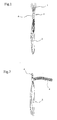
- Fig. 1 is illustrative of the outside configuration of the scalp hair strand/supplemental hair fiber strand of the invention
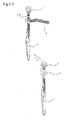
- Figs. 2 to 4 are illustrative of examples of the supplemental hair fiber strand used herein
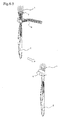
- Figs. 5-1 to 5-7 are illustrative of the steps in Example 1 of the scalp hair strand/supplemental hair fiber strand attachment method of the invention
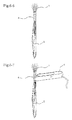
- Figs. 6-1 to 6-9 are illustrative of the steps in the scalp hair strand/supplemental hair fiber strand attachment method of the invention.
- reference numeral 1 stands for a scalp hair strand; 2 a supplemental hair fiber strand; 3 a tying portion of the scalp hair strand/supplemental hair fiber strand; 4 a tape having an adhesive; 4a an end of the tape having an adhesive; 5 a portion coated with a bonding adhesive; 6 heating means; and 7 a temporal fixing tool.
- the supplemental hair fiber stand 2 is fixed to the scalp hair strand 1 made by sorting a plurality of scalp hairs out of a portion of the surface of the scalp, and the tying portion 3 of both strands is tied up by wrapping the bonding adhesive and the tape 4 having an adhesive around the tying portion 3.
- the supplemental hair fiber stand 2 is fixed to the scalp hair strand 1 made by sorting a plurality of scalp hairs out of a portion of the surface of the scalp, the tying portion 3 of both strands is tied up via a binder or a bonding adhesive, and the tying portion 3 of both strands is wrapped around with the tape 4 having an adhesive.
- the binder or bonding adhesive may be applied to the tying portion 3 when the scalp hair strand 1 is tied up to the supplemental hair fiber strand 2 or, alternatively, it may have been applied to the supplemental hair fiber strand 2 at one end or on the way.
- a portion coated with the hot-melt or thermoplastic resin defines the tying portion to the scalp hairs; the supplemental hair fibers remain in order while at tying work. That is, the tying work is easy to implement, and the finishing touches are aesthetic with much higher work efficiency.
- the supplemental hair fiber strand 2 which has the binder or bonding adhesive applied at one end or on the way, which has the tape 4 having a bonding adhesive bonded at one end, which has none of the binder or bonding adhesive applied on it, which has none of the tape 4 having an adhesive applied on it, etc., as can be seen from the examples of the supplemental hair fiber strand of the invention shown in Fig. 2 to 4 .
- the bonding adhesive is coated on one end of the supplemental hair fiber strand 2 to form a bonding adhesive applied portion 5, and one end of the tape 4 having an adhesive is further bonded to the supplemental hair fiber strand 2.
- the supplemental hair fiber strand 2 is composed of a bundle of supplemental hair fibers.
- the bonding adhesive is coated on and applied to the bent supplemental hair fiber strand 2 on the way to form a bonding adhesive applied portion 5, and one end of the tape 4 having an adhesive is further bonded to the supplemental hair fiber strand 2.
- the tying portion 3 of the scalp hair strand 1 and the supplemental hair fiber strand 2 may be defined by (1) tying the root of the scalp hair strand 1 to the supplemental hair fiber strand 2 at one end, (2) tying the root of the scalp hair strand 1 to the supplemental hair fiber strand 2 on the way, (3) trying the scalp hair strand 1 on the way to the supplemental hair fiber strand 2 on the way, and (4) tying the scalp hair strand 1 on the way to the supplemental hair fiber strand 2 at one end; it is preferable to make a selection in consideration of the hair style of the wearer, the type, shape and length of the supplemental hair fiber strand 2, etc.
- thermoplastic resin that is solid at normal temperature but melts upon heating.
- hot-melt or thermoplastic resin for instance, there is the mention of olefin resins such as polyethylene and polypropylene, polyvinyl chloride resins, polyvinyl acetate resins, polyamide resins, polyethylene terephthalate resins, polyester resins and polyphenylene sulfide resins. If the hot-melt resin is beforehand coated on and applied to the supplemental hair fiber strand 2 at one end or on the way, it is then possible to implement tying work without the hands or hairs being stained, because the hot-melt resin is hardened already while at work.
- the tying portion 3 is wrapped around with the tape 4 having an adhesive and the hot-melt resin is heated by heating means such as an ultrasonic welding machine from outside the tape 4 having an adhesive, then it melts to tie up the engaging portion (3a) of the scalp hair strand 1 and supplemental hair fiber strand 2, thereby making sure the tying of both the strands.
- the taps 4 having an adhesive used should be capable of wrapping up the outer surface of the tying portion of the scalp hair strand/supplemental hair fiber strand.
- the material for the tape 4 having an adhesive it is suitable to use a fabric or unwoven fabric resistant enough to hair washing or perspiration where the scalp hair and supplemental hair fiber strand are tied up, and rain so that the tying portion is less likely to untie. That fabric or unwoven fabric is also resistant enough to heat from driers, irons, etc.
- the tied scalp hair and supplemental hair fiber strands must be untied when the scalp hairs grow too much to get out of control or the hair style is changed.
- the tape 4 having an adhesive, used with the scalp hair strand/supplemental hair fiber strand attachment structure of the invention, may be colored at an end portion to make untying easy. If the end 4a, i.e., a portion of the tape having an adhesive that becomes the final end when it is wrapped around the tying portion 3, is colored, then where the end of the tape 4 is located is easily found to improve on work efficiency for removal.
- Figs. 5-1 to 5-7 are illustrative of the steps in Example 1 of the scalp hair strand/supplemental hair fiber strand attachment method of the invention.
- Example 1 is directed to the scalp hair strand/supplemental hair fiber strand attachment method wherein the supplement hair fiber strand 2 of Fig. 2 is used, and one end of the supplemental hair fiber strand 2 is tied to the root of the scalp hair strand 1.
- the attachment method of Example 1 comprises the following steps.
- a plurality of scalp hairs are sorted out of a portion of the surface of the scalp into the scalp hair strand 1 ( Fig. 5-1 ).
- one end of the supplemental hair fiber strand 2 is engaged with the root of the scalp hair strand 1 ( Fig. 5-2 ).
- the supplemental hair fiber strand 2 shown in Fig. 5-1 is coated at one end (the portion 5 having the bonding adhesive coated on it) with the binder or bonding adhesive, and has one end of the tape having an adhesive bonded to it.
- one end of the supplemental hair fiber strand 2 is engaged with the root of the plurality of scalp hairs, and the tape 4 having an adhesive is wrapped around the engaging portion 3a ( Figs. 5-3 and 5-4 ).
- the tape 4 having an adhesive is put on in the root (upward) direction of the scalp hair strand to make the untying of the scalp hair and supplemental hair fiber strands less likely to occur.
- the binder or bonding adhesive inside is molten or polymerized for curing from outside the tape 4 having an adhesive put on in Lhe third step, using the heating means 6 built up of a tweezers type of ultrasonic irradiation machine adapted to radiate ultrasonic waves across ( Fig. 5-5 ).
- the portion molten or polymerized for curing in the fourth step is shaped while kept in place by fingers or a press member to confirm whether or not it is cured ( Fig. 5-6 ).
- the supplemental hair fiber strand 2 used is provided at one end (the portion 5 coated with the bonding adhesive) with the binder or bonding adhesive, and has one end of the tape 4 having a bonding adhesive bonded to it; however, it is understood that even the supplemental hair fiber strand 2 having none of the binder or bonding adhesive coated on it or none of the tape having a bonding adhesive bonded to it may be tied up in the same manner.
- the binder or bonding adhesive may be coated on the aforesaid engaging portion. 3a after the engagement in the second step of one end of the supplemental hair fiber strand 2 with the scalp hair strand 1.
- the tape 4 having an adhesive may be wrapped around the aforesaid engaging portion 3a ( Figs. 5-3 and 5-4 ) with the end of the tape 4 having an adhesive bonded Lo the lower end of the engaging potion 3, after the engagement in the third step of one end of the supplemental hair fiber strand 2 with the root of the scalp hair strand 1.
- Figs. 6-1 to 6-9 are illustrative of the steps in Example 2 of the scalp hair strand/supplemental hair fiber strand attachment method of the invention.
- the supplemental hair fiber stand 2 is engaged with the scalp hair strand 1 using at the engaging portion the temporal fixing tool 7 having a groove of U shape in section, so that the tying work of the scalp hair and supplement hair fiber strands can be facilitated.
- Example 2 of the scalp hair strand/supplemental hair fiber strand attachment method uses the supplemental hair fiber strand 2 of Fig. 2 to Lie one end of the supplemental hair fiber strand 2 to the root of the scalp hair strand 1; however, the use of the temporal fixing tool 7 enables the scalp hair strand 1 to be tied up to even the supplemental hair fiber strand 2 of Fig. 3 in the same manner.
- the attachment method of Example 2 involves the following steps.
- a plurality of scalp hairs are sorted out of a portion of the surface of the scalp into the scalp hair strand 1 ( Fig. 6-1 ).
- the scalp hair strand 1 made in the first step is held in place by the temporal fixing tool 7 ( Fig. 6-2 ).
- one end of the supplemental hair fiber strand 2 is engaged with the scalp hair strand 1 held by the temporal fixing tool 7, so that they are held by the temporal fixing tool 7 ( Figs. 6-3 and 6-4 ).
- the tape 4 having an adhesive is wrapped around the temporal fixing tool 7 by which the scalp hair 1 and the supplemental hair fiber strand 2 are held in place ( Figs. 6-5 and 6-6 ).
- the bonding adhesive inside and the temporal fixing tool 7 are heated, molten and polymerized for curing from outside the tape 4 having an adhesive wrapped around in the fourth step by the heating means 6 ( Fig. 6-7 ).
- the temporal fixing tool 7 used in Example 2 is formed of the hot-melt or thermoplastic resin that is molten upon heating; upon heating by the heating means 6, the resin is molten while the scalp hair strand 1 and the supplemental hair fiber strand 2 held within the temporal fixing tool 7 are held in place, so that the scalp hair strand 1 and the supplemental hair fiber strand 2 are tied together.
- the portion polymerized for curing in the fifth step is shaped while kept in place by fingers or a press member to confirm whether or not it is cured ( Fig. 6-8 ).
- irradiation with ultrasonic waves is used for the heating means, in which case the frequency is preferably 10 to 100 kHz, and more preferably 20 to 60 kHz, and the irradiation time is preferably 20 to 60 seconds, and more preferably 30 to 40 seconds per site.
Landscapes
- Engineering & Computer Science (AREA)
- Textile Engineering (AREA)
- Cleaning And Drying Hair (AREA)
Applications Claiming Priority (2)
| Application Number | Priority Date | Filing Date | Title |
|---|---|---|---|
| JP2006055618 | 2006-03-01 | ||
| PCT/JP2007/054492 WO2007100149A1 (ja) | 2006-03-01 | 2007-03-01 | 自毛束・毛髪用繊維束結合構造及び自毛束・毛髪用繊維束結合方法 |
Publications (1)
| Publication Number | Publication Date |
|---|---|
| EP1989948A1 true EP1989948A1 (de) | 2008-11-12 |
Family
ID=38459235
Family Applications (1)
| Application Number | Title | Priority Date | Filing Date |
|---|---|---|---|
| EP07715294A Withdrawn EP1989948A1 (de) | 2006-03-01 | 2007-03-01 | Struktur zum ankleben eines grauen haarbündels an ein faserbündel für haar und verfahren zum ankleben eines grauen haarbündels an ein faserbündel für haar |
Country Status (3)
| Country | Link |
|---|---|
| US (1) | US20090272396A1 (de) |
| EP (1) | EP1989948A1 (de) |
| WO (1) | WO2007100149A1 (de) |
Cited By (2)
| Publication number | Priority date | Publication date | Assignee | Title |
|---|---|---|---|---|
| EP2332430A1 (de) * | 2009-12-11 | 2011-06-15 | Angelo International Hairstyle BVBA | Verfahren zur Herstellung von Haarverlängerung |
| US9491978B2 (en) * | 2015-03-11 | 2016-11-15 | Chade Fashions, Inc. | Hair extension |
Families Citing this family (10)
| Publication number | Priority date | Publication date | Assignee | Title |
|---|---|---|---|---|
| US20100059079A1 (en) * | 2008-09-08 | 2010-03-11 | Ryan Tokko | Extension hair piece and hair extension using the device |
| AT511595B1 (de) * | 2011-12-12 | 2013-01-15 | Hairdreams Haarhandels Gmbh | Ersatzhaarsträhne mit haarverbindungselement |
| GB2534587B (en) * | 2015-01-28 | 2020-12-30 | Tung Hing Plastic Manufactory Ltd | Hair fastener and method of manufacture thereof |
| MA44250A (fr) | 2016-02-05 | 2018-12-26 | Shake N Go Fashion Inc | Appareil à mèche de cheveux et son procédé de fabrication |
| USD834255S1 (en) * | 2016-04-25 | 2018-11-20 | Ryan Tokko | Hair extension package |
| US11234471B1 (en) | 2016-12-15 | 2022-02-01 | JBS Hair, Inc. | Packaged synthetic braiding hair |
| US10945478B1 (en) | 2016-12-15 | 2021-03-16 | JBS Hair Inc. | Packaged synthetic braiding hair |
| USD907297S1 (en) | 2016-12-15 | 2021-01-05 | JBS Hair Inc. | Packaged hair |
| US10786026B1 (en) | 2016-12-15 | 2020-09-29 | JBS Hair Inc. | Synthetic braiding hair of differing lengths packaged with a cardioid |
| USD1072356S1 (en) * | 2024-03-18 | 2025-04-22 | Kristin Griepentrog | Hair extension |
Family Cites Families (9)
| Publication number | Priority date | Publication date | Assignee | Title |
|---|---|---|---|---|
| US5107867A (en) * | 1991-08-29 | 1992-04-28 | Barrington Mark C | Process for extending human hair |
| AT412U3 (de) * | 1994-11-09 | 1996-01-25 | Gaeng Heide Rose | Vorrichtung und verfahren zur haarverlängerung |
| US5868145A (en) * | 1997-05-19 | 1999-02-09 | Spann; Carolyn H. | Hair extension and thickening process |
| JP2003278021A (ja) * | 2002-03-22 | 2003-10-02 | Hideji Yasui | 毛髪用連結体 |
| US6820625B2 (en) * | 2002-05-30 | 2004-11-23 | Hui Suk Park | Method for attaching supplemental hair to human hair |
| JP2004027402A (ja) * | 2002-06-24 | 2004-01-29 | Yoshikuni Ito | エクステンション取付具及びエクステンションの取付方法 |
| JP2004156157A (ja) | 2002-11-05 | 2004-06-03 | Akira Inoue | エクステンションの取付方法 |
| US20040149302A1 (en) * | 2003-01-31 | 2004-08-05 | Isao Toda | Method of attaching hair-thickening hair material and hair-thickening hair material fixture used for the method |
| KR100505740B1 (ko) * | 2003-11-07 | 2005-08-05 | 김종원 | 붙임머리 및 그 제조방법 |
-
2007
- 2007-03-01 US US12/224,562 patent/US20090272396A1/en not_active Abandoned
- 2007-03-01 WO PCT/JP2007/054492 patent/WO2007100149A1/ja not_active Ceased
- 2007-03-01 EP EP07715294A patent/EP1989948A1/de not_active Withdrawn
Non-Patent Citations (1)
| Title |
|---|
| See references of WO2007100149A1 * |
Cited By (3)
| Publication number | Priority date | Publication date | Assignee | Title |
|---|---|---|---|---|
| EP2332430A1 (de) * | 2009-12-11 | 2011-06-15 | Angelo International Hairstyle BVBA | Verfahren zur Herstellung von Haarverlängerung |
| BE1019106A5 (nl) * | 2009-12-11 | 2012-03-06 | Angelo Internat Hairstyle Bvba | Werkwijze voor het vervaardigen van een haarextensie. |
| US9491978B2 (en) * | 2015-03-11 | 2016-11-15 | Chade Fashions, Inc. | Hair extension |
Also Published As
| Publication number | Publication date |
|---|---|
| US20090272396A1 (en) | 2009-11-05 |
| WO2007100149A1 (ja) | 2007-09-07 |
Similar Documents
| Publication | Publication Date | Title |
|---|---|---|
| US20090272396A1 (en) | Scalp Hair Strand/Supplemental Hair Fiber Strand Attachment Structure and Method | |
| KR100889004B1 (ko) | 붙임머리 | |
| KR100869064B1 (ko) | 장식용 헤어피스 | |
| US20130276807A1 (en) | Method for Applying Hair Extensions | |
| US20120037177A1 (en) | Method for Applying Hair Extensions | |
| US20050098190A1 (en) | Ornamental hairpiece and method for manufacturing the same | |
| CN100484424C (zh) | 带有毛发导入环的毛发连接器 | |
| US8578946B2 (en) | Method for fabricating hair extensions | |
| CN101541198A (zh) | 假发及其制造方法 | |
| SK286646B6 (sk) | Spôsob a súprava na zväčšovanie objemu vlasov | |
| US9033196B1 (en) | Pre-threaded and knotted hair weaving needle and method | |
| GB2490399A (en) | Hair Extension Means and Method of Attachment Thereof | |
| KR101013887B1 (ko) | 붙임머리 착용방법 및 이에 사용되는 붙임머리 | |
| JP4636631B1 (ja) | エクステンション | |
| JPWO2011064867A1 (ja) | ヘアエクステンション及びヘアエクステンションの装着方法 | |
| RU2404691C2 (ru) | Устройство для увеличения количества волос и способ его изготовления | |
| JP2007262646A (ja) | 自毛束・毛髪用繊維束結合構造及び自毛束・毛髪用繊維束結合方法 | |
| KR101935998B1 (ko) | 이질감이 줄어드는 붙임머리 | |
| JPH02234903A (ja) | 補毛具 | |
| JP2025120709A (ja) | ヘアエクステンション | |
| JP4753400B2 (ja) | 自毛活用型かつら及びその製造方法 | |
| JP2579666B2 (ja) | かつらの取付部の形成方法およびかつらの固定方法 | |
| KR100467194B1 (ko) | 장식용 헤어피스 | |
| KR100616111B1 (ko) | 플렉시블소재의 서로 다른 길이의 줄을 갖는 줄 가발 | |
| JP3100503U (ja) | 付け毛 |
Legal Events
| Date | Code | Title | Description |
|---|---|---|---|
| PUAI | Public reference made under article 153(3) epc to a published international application that has entered the european phase |
Free format text: ORIGINAL CODE: 0009012 |
|
| 17P | Request for examination filed |
Effective date: 20080924 |
|
| AK | Designated contracting states |
Kind code of ref document: A1 Designated state(s): AT BE BG CH CY CZ DE DK EE ES FI FR GB GR HU IE IS IT LI LT LU LV MC MT NL PL PT RO SE SI SK TR |
|
| STAA | Information on the status of an ep patent application or granted ep patent |
Free format text: STATUS: THE APPLICATION HAS BEEN WITHDRAWN |
|
| 18W | Application withdrawn |
Effective date: 20090409 |