EP1990312A2 - Pigments de sécurité et leur procédé de fabrication - Google Patents
Pigments de sécurité et leur procédé de fabrication Download PDFInfo
- Publication number
- EP1990312A2 EP1990312A2 EP08159146A EP08159146A EP1990312A2 EP 1990312 A2 EP1990312 A2 EP 1990312A2 EP 08159146 A EP08159146 A EP 08159146A EP 08159146 A EP08159146 A EP 08159146A EP 1990312 A2 EP1990312 A2 EP 1990312A2
- Authority
- EP
- European Patent Office
- Prior art keywords
- pigment
- security
- phosphate
- rare earth
- quantum dot
- Prior art date
- Legal status (The legal status is an assumption and is not a legal conclusion. Google has not performed a legal analysis and makes no representation as to the accuracy of the status listed.)
- Withdrawn
Links
Images



Classifications
-
- C—CHEMISTRY; METALLURGY
- C01—INORGANIC CHEMISTRY
- C01B—NON-METALLIC ELEMENTS; COMPOUNDS THEREOF; METALLOIDS OR COMPOUNDS THEREOF NOT COVERED BY SUBCLASS C01C
- C01B25/00—Phosphorus; Compounds thereof
- C01B25/16—Oxyacids of phosphorus; Salts thereof
- C01B25/26—Phosphates
-
- B—PERFORMING OPERATIONS; TRANSPORTING
- B41—PRINTING; LINING MACHINES; TYPEWRITERS; STAMPS
- B41M—PRINTING, DUPLICATING, MARKING, OR COPYING PROCESSES; COLOUR PRINTING
- B41M3/00—Printing processes to produce particular kinds of printed work, e.g. patterns
- B41M3/14—Security printing
- B41M3/144—Security printing using fluorescent, luminescent or iridescent effects
-
- B—PERFORMING OPERATIONS; TRANSPORTING
- B82—NANOTECHNOLOGY
- B82Y—SPECIFIC USES OR APPLICATIONS OF NANOSTRUCTURES; MEASUREMENT OR ANALYSIS OF NANOSTRUCTURES; MANUFACTURE OR TREATMENT OF NANOSTRUCTURES
- B82Y30/00—Nanotechnology for materials or surface science, e.g. nanocomposites
-
- C—CHEMISTRY; METALLURGY
- C01—INORGANIC CHEMISTRY
- C01F—COMPOUNDS OF THE METALS BERYLLIUM, MAGNESIUM, ALUMINIUM, CALCIUM, STRONTIUM, BARIUM, RADIUM, THORIUM, OR OF THE RARE-EARTH METALS
- C01F17/00—Compounds of rare earth metals
- C01F17/20—Compounds containing only rare earth metals as the metal element
- C01F17/206—Compounds containing only rare earth metals as the metal element oxide or hydroxide being the only anion
- C01F17/224—Oxides or hydroxides of lanthanides
-
- C—CHEMISTRY; METALLURGY
- C01—INORGANIC CHEMISTRY
- C01F—COMPOUNDS OF THE METALS BERYLLIUM, MAGNESIUM, ALUMINIUM, CALCIUM, STRONTIUM, BARIUM, RADIUM, THORIUM, OR OF THE RARE-EARTH METALS
- C01F17/00—Compounds of rare earth metals
- C01F17/20—Compounds containing only rare earth metals as the metal element
- C01F17/247—Carbonates
-
- C—CHEMISTRY; METALLURGY
- C01—INORGANIC CHEMISTRY
- C01F—COMPOUNDS OF THE METALS BERYLLIUM, MAGNESIUM, ALUMINIUM, CALCIUM, STRONTIUM, BARIUM, RADIUM, THORIUM, OR OF THE RARE-EARTH METALS
- C01F17/00—Compounds of rare earth metals
- C01F17/20—Compounds containing only rare earth metals as the metal element
- C01F17/288—Sulfides
-
- C—CHEMISTRY; METALLURGY
- C09—DYES; PAINTS; POLISHES; NATURAL RESINS; ADHESIVES; COMPOSITIONS NOT OTHERWISE PROVIDED FOR; APPLICATIONS OF MATERIALS NOT OTHERWISE PROVIDED FOR
- C09C—TREATMENT OF INORGANIC MATERIALS, OTHER THAN FIBROUS FILLERS, TO ENHANCE THEIR PIGMENTING OR FILLING PROPERTIES ; PREPARATION OF CARBON BLACK ; PREPARATION OF INORGANIC MATERIALS WHICH ARE NO SINGLE CHEMICAL COMPOUNDS AND WHICH ARE MAINLY USED AS PIGMENTS OR FILLERS
- C09C1/00—Treatment of specific inorganic materials other than fibrous fillers; Preparation of carbon black
-
- C—CHEMISTRY; METALLURGY
- C09—DYES; PAINTS; POLISHES; NATURAL RESINS; ADHESIVES; COMPOSITIONS NOT OTHERWISE PROVIDED FOR; APPLICATIONS OF MATERIALS NOT OTHERWISE PROVIDED FOR
- C09D—COATING COMPOSITIONS, e.g. PAINTS, VARNISHES OR LACQUERS; FILLING PASTES; CHEMICAL PAINT OR INK REMOVERS; INKS; CORRECTING FLUIDS; WOODSTAINS; PASTES OR SOLIDS FOR COLOURING OR PRINTING; USE OF MATERIALS THEREFOR
- C09D11/00—Inks
- C09D11/02—Printing inks
- C09D11/03—Printing inks characterised by features other than the chemical nature of the binder
- C09D11/037—Printing inks characterised by features other than the chemical nature of the binder characterised by the pigment
-
- C—CHEMISTRY; METALLURGY
- C09—DYES; PAINTS; POLISHES; NATURAL RESINS; ADHESIVES; COMPOSITIONS NOT OTHERWISE PROVIDED FOR; APPLICATIONS OF MATERIALS NOT OTHERWISE PROVIDED FOR
- C09D—COATING COMPOSITIONS, e.g. PAINTS, VARNISHES OR LACQUERS; FILLING PASTES; CHEMICAL PAINT OR INK REMOVERS; INKS; CORRECTING FLUIDS; WOODSTAINS; PASTES OR SOLIDS FOR COLOURING OR PRINTING; USE OF MATERIALS THEREFOR
- C09D11/00—Inks
- C09D11/30—Inkjet printing inks
- C09D11/32—Inkjet printing inks characterised by colouring agents
- C09D11/322—Pigment inks
-
- C—CHEMISTRY; METALLURGY
- C09—DYES; PAINTS; POLISHES; NATURAL RESINS; ADHESIVES; COMPOSITIONS NOT OTHERWISE PROVIDED FOR; APPLICATIONS OF MATERIALS NOT OTHERWISE PROVIDED FOR
- C09K—MATERIALS FOR MISCELLANEOUS APPLICATIONS, NOT PROVIDED FOR ELSEWHERE
- C09K11/00—Luminescent materials, e.g. electroluminescent or chemiluminescent
- C09K11/02—Use of particular materials as binders, particle coatings or suspension media therefor
- C09K11/025—Use of particular materials as binders, particle coatings or suspension media therefor non-luminescent particle coatings or suspension media
-
- C—CHEMISTRY; METALLURGY
- C09—DYES; PAINTS; POLISHES; NATURAL RESINS; ADHESIVES; COMPOSITIONS NOT OTHERWISE PROVIDED FOR; APPLICATIONS OF MATERIALS NOT OTHERWISE PROVIDED FOR
- C09K—MATERIALS FOR MISCELLANEOUS APPLICATIONS, NOT PROVIDED FOR ELSEWHERE
- C09K11/00—Luminescent materials, e.g. electroluminescent or chemiluminescent
- C09K11/08—Luminescent materials, e.g. electroluminescent or chemiluminescent containing inorganic luminescent materials
- C09K11/77—Luminescent materials, e.g. electroluminescent or chemiluminescent containing inorganic luminescent materials containing rare earth metals
- C09K11/7709—Phosphates
-
- C—CHEMISTRY; METALLURGY
- C09—DYES; PAINTS; POLISHES; NATURAL RESINS; ADHESIVES; COMPOSITIONS NOT OTHERWISE PROVIDED FOR; APPLICATIONS OF MATERIALS NOT OTHERWISE PROVIDED FOR
- C09K—MATERIALS FOR MISCELLANEOUS APPLICATIONS, NOT PROVIDED FOR ELSEWHERE
- C09K11/00—Luminescent materials, e.g. electroluminescent or chemiluminescent
- C09K11/08—Luminescent materials, e.g. electroluminescent or chemiluminescent containing inorganic luminescent materials
- C09K11/77—Luminescent materials, e.g. electroluminescent or chemiluminescent containing inorganic luminescent materials containing rare earth metals
- C09K11/7756—Luminescent materials, e.g. electroluminescent or chemiluminescent containing inorganic luminescent materials containing rare earth metals containing neodynium
-
- C—CHEMISTRY; METALLURGY
- C09—DYES; PAINTS; POLISHES; NATURAL RESINS; ADHESIVES; COMPOSITIONS NOT OTHERWISE PROVIDED FOR; APPLICATIONS OF MATERIALS NOT OTHERWISE PROVIDED FOR
- C09K—MATERIALS FOR MISCELLANEOUS APPLICATIONS, NOT PROVIDED FOR ELSEWHERE
- C09K11/00—Luminescent materials, e.g. electroluminescent or chemiluminescent
- C09K11/08—Luminescent materials, e.g. electroluminescent or chemiluminescent containing inorganic luminescent materials
- C09K11/77—Luminescent materials, e.g. electroluminescent or chemiluminescent containing inorganic luminescent materials containing rare earth metals
- C09K11/7766—Luminescent materials, e.g. electroluminescent or chemiluminescent containing inorganic luminescent materials containing rare earth metals containing two or more rare earth metals
- C09K11/7767—Chalcogenides
- C09K11/7769—Oxides
-
- C—CHEMISTRY; METALLURGY
- C09—DYES; PAINTS; POLISHES; NATURAL RESINS; ADHESIVES; COMPOSITIONS NOT OTHERWISE PROVIDED FOR; APPLICATIONS OF MATERIALS NOT OTHERWISE PROVIDED FOR
- C09K—MATERIALS FOR MISCELLANEOUS APPLICATIONS, NOT PROVIDED FOR ELSEWHERE
- C09K11/00—Luminescent materials, e.g. electroluminescent or chemiluminescent
- C09K11/08—Luminescent materials, e.g. electroluminescent or chemiluminescent containing inorganic luminescent materials
- C09K11/77—Luminescent materials, e.g. electroluminescent or chemiluminescent containing inorganic luminescent materials containing rare earth metals
- C09K11/7766—Luminescent materials, e.g. electroluminescent or chemiluminescent containing inorganic luminescent materials containing rare earth metals containing two or more rare earth metals
- C09K11/7777—Phosphates
-
- G—PHYSICS
- G07—CHECKING-DEVICES
- G07D—HANDLING OF COINS OR VALUABLE PAPERS, e.g. TESTING, SORTING BY DENOMINATIONS, COUNTING, DISPENSING, CHANGING OR DEPOSITING
- G07D7/00—Testing specially adapted to determine the identity or genuineness of valuable papers or for segregating those which are unacceptable, e.g. banknotes that are alien to a currency
- G07D7/06—Testing specially adapted to determine the identity or genuineness of valuable papers or for segregating those which are unacceptable, e.g. banknotes that are alien to a currency using wave or particle radiation
- G07D7/12—Visible light, infrared or ultraviolet radiation
- G07D7/1205—Testing spectral properties
-
- C—CHEMISTRY; METALLURGY
- C01—INORGANIC CHEMISTRY
- C01P—INDEXING SCHEME RELATING TO STRUCTURAL AND PHYSICAL ASPECTS OF SOLID INORGANIC COMPOUNDS
- C01P2002/00—Crystal-structural characteristics
- C01P2002/70—Crystal-structural characteristics defined by measured X-ray, neutron or electron diffraction data
- C01P2002/72—Crystal-structural characteristics defined by measured X-ray, neutron or electron diffraction data by d-values or two theta-values, e.g. as X-ray diagram
-
- C—CHEMISTRY; METALLURGY
- C01—INORGANIC CHEMISTRY
- C01P—INDEXING SCHEME RELATING TO STRUCTURAL AND PHYSICAL ASPECTS OF SOLID INORGANIC COMPOUNDS
- C01P2002/00—Crystal-structural characteristics
- C01P2002/80—Crystal-structural characteristics defined by measured data other than those specified in group C01P2002/70
- C01P2002/84—Crystal-structural characteristics defined by measured data other than those specified in group C01P2002/70 by UV- or VIS- data
-
- C—CHEMISTRY; METALLURGY
- C01—INORGANIC CHEMISTRY
- C01P—INDEXING SCHEME RELATING TO STRUCTURAL AND PHYSICAL ASPECTS OF SOLID INORGANIC COMPOUNDS
- C01P2004/00—Particle morphology
- C01P2004/60—Particles characterised by their size
- C01P2004/64—Nanometer sized, i.e. from 1-100 nanometer
-
- C—CHEMISTRY; METALLURGY
- C01—INORGANIC CHEMISTRY
- C01P—INDEXING SCHEME RELATING TO STRUCTURAL AND PHYSICAL ASPECTS OF SOLID INORGANIC COMPOUNDS
- C01P2004/00—Particle morphology
- C01P2004/80—Particles consisting of a mixture of two or more inorganic phases
-
- C—CHEMISTRY; METALLURGY
- C01—INORGANIC CHEMISTRY
- C01P—INDEXING SCHEME RELATING TO STRUCTURAL AND PHYSICAL ASPECTS OF SOLID INORGANIC COMPOUNDS
- C01P2006/00—Physical properties of inorganic compounds
- C01P2006/60—Optical properties, e.g. expressed in CIELAB-values
-
- Y—GENERAL TAGGING OF NEW TECHNOLOGICAL DEVELOPMENTS; GENERAL TAGGING OF CROSS-SECTIONAL TECHNOLOGIES SPANNING OVER SEVERAL SECTIONS OF THE IPC; TECHNICAL SUBJECTS COVERED BY FORMER USPC CROSS-REFERENCE ART COLLECTIONS [XRACs] AND DIGESTS
- Y10—TECHNICAL SUBJECTS COVERED BY FORMER USPC
- Y10T—TECHNICAL SUBJECTS COVERED BY FORMER US CLASSIFICATION
- Y10T428/00—Stock material or miscellaneous articles
- Y10T428/29—Coated or structually defined flake, particle, cell, strand, strand portion, rod, filament, macroscopic fiber or mass thereof
- Y10T428/2982—Particulate matter [e.g., sphere, flake, etc.]
- Y10T428/2991—Coated
-
- Y—GENERAL TAGGING OF NEW TECHNOLOGICAL DEVELOPMENTS; GENERAL TAGGING OF CROSS-SECTIONAL TECHNOLOGIES SPANNING OVER SEVERAL SECTIONS OF THE IPC; TECHNICAL SUBJECTS COVERED BY FORMER USPC CROSS-REFERENCE ART COLLECTIONS [XRACs] AND DIGESTS
- Y10—TECHNICAL SUBJECTS COVERED BY FORMER USPC
- Y10T—TECHNICAL SUBJECTS COVERED BY FORMER US CLASSIFICATION
- Y10T428/00—Stock material or miscellaneous articles
- Y10T428/29—Coated or structually defined flake, particle, cell, strand, strand portion, rod, filament, macroscopic fiber or mass thereof
- Y10T428/2982—Particulate matter [e.g., sphere, flake, etc.]
- Y10T428/2991—Coated
- Y10T428/2993—Silicic or refractory material containing [e.g., tungsten oxide, glass, cement, etc.]
Definitions
- the invention relates to a family of color inconstancy pigments, and in particular, crystalline, highly pure, rare earth doped color inconstancy pigments.
- the pigments exhibit a rapid and strong color change when changing the spectral distribution of the light emitted by the illumination sources.
- the primary intended application is a semi-overt security feature of currencies and other secured documents.
- the present invention provides methods for using color inconstancy pigments, and/or dyes, preferably rare earth doped color inconstancy pigments, in security applications, and preferably in semi-overt and covert security applications.
- rare earth doped color inconstancy pigments this is done by exploiting the mechanism of rare earth (RE) doped materials that have a discrete absorption band located in the visible (in particular holmium-based and neodymium-bascd doped materials) under illumination of discrete and broad spectral distribution light sources, especially tri-phosphor fluorescent light (TL84) and sunlight (D65).
- TL84 tri-phosphor fluorescent light
- D65 tri-phosphor fluorescent light
- the color change exhibited by these color inconstancy pigments is not due to a luminescent emission.
- the present invention also provides synthesis (manufacturing) processes for making color inconstancy pigments, preferably the rare earth-based doped color inconstancy pigments that have a discrete absorption band located in the visible region of the electromagnetic spectrum, and especially those doped with holmium-based and neodymium-based materials,
- the present invention also provides color inconstancy materials produced by the process of the present invention and compositions and articles made therewith.
- the present invention also provides compositions comprising RE elements including, but not limited to holmium, neodymium, ytterbium, dysprosium, and praseodymium-based doped color inconstancy pigments, especially those produced by the process of the present invention.
- the present invention further provides methods of tagging articles with the color inconstancy pigments of the present invention comprising incorporating the taggant into a composition such as an ink, coating, paper, fiber or a polymer matrix and forming a tagged security article that exhibits extreme color inconstancy.
- the present invention also provides methods of authenticating an article tagged with color inconstancy pigments including selecting a broad spectral light source and a discrete spectral light source wherein at least one emission peak of the discrete light source matches the absorption of the color inconstancy pigment.
- the present invention further provides method of providing a security feature by using narrow band absorption pigments matched with specific discrete emission light sources to create an extreme color inconstancy effect.
- the present invention also provides pigments/dyes that have a similar color inconstancy effect to the above color inconstancy pigments when exposed to discrete light source vs. broad light source as a result of the presence of a strong absorption band at a key wavelength of the discrete light source.
- Non-limiting examples include squaraine dyes/pigments that have a very narrow absorption peak that can be tuned to absorb at a key source emission wavelength.
- the present invention also provides RE pigments that can be used to produce both semi-overt and covert security features.
- the semi-overt characteristics correspond to the color inconstancy behavior of these pigments and the covert features are associated with sharp muld-peak absorptions in the near infrared range.
- An example of such dual-effect pigment is the Holmium-Neodymium Phosphate material of this invention which produces an ultra color inconstancy effect when viewed broad versus discrete white light source and shows a multiple near infrared fingerprint spectrum.
- Near infrared fingerprints may be used for example in automated telling machine (ATM) to verify the authenticity of banknotes or cards.
- ATM automated telling machine
- the near-infrared peaks produced by the pigments of this invention are located in a range that is easily accessible for low cost light emitting diodes and photodetectors which makes them a very interesting solution.
- Figure 1 shows the ATR reflectance curve of HoImium Phosphate (HoPO 4 ) fused quantum dot pigment. Key bands are at 419 nm, 455 nm, 468.89 to 487.04 nm, 540 nm, and the series of bands at 643 to 659 nm. The primary band (broad) is at 363 nm.
- HoImium Phosphate HoPO 4
- Figure 2 shows the X-ray diffraction pattern of the synthesized HoPO 4 pigment with the key peak at 25.8 on the 2-theta scale and an absolute intensity of 1193.
- Figure 3 shows the ATR spectrum of Neodymium Phosphate (NdPO 4 ) fused quantum dot pigment. Key bands are at 524.7 nm, 580.1 nm, 737.3 nm, 743.7 nm, 791.7 nm, 800.0 nm, 804.3 nm, 862.7 nm, and 871.0 nm.
- NdPO 4 Neodymium Phosphate
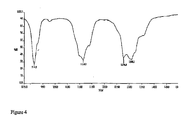
- Figure 4 shows the reflectance NIR (near infrared spectrum) spectrum of dysprosium phosphate (DyPO 4 ). Key bands are at 453.8 nm, 760.9 nm, 811.9 nm, 827.6 nm.
- Figure 5 shows the reflectance visible spectrum of dysprosium phosphate (DyPO 4 ). Key bands are at 914.9 nm, 1114.2 nm, 1276.5 nm and 1348.1 nm.
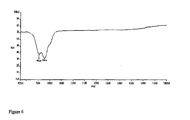
- Figure 6 shows the NIR (near infrared spectrum) absorption spectrum of ytterbium sulphide/phosphate (YbPO 4 ) quantum dots. Key bands are at 953.9 and 976.6 nm.
- Color inconstancy refers to the apparent change in color of a single sample under different light sources having different wavelengths.
- the degree of color inconstancy for a sample is represented by the Euclidean difference (color distance) between the corresponding color of a sample, or color coordinates calculated from the spectral curve (such as for example, remission), and the actual color of that sample measured, or computed via its color coordinates in the reference illuminant.
- the larger the Euclidean color distance the greater the color inconstancy and vice-versa.
- Extreme (ultra) color inconsistency is defined as an dramatic change in appearance of the pigment with a change in viewing conditions.
- a “pigment” is a material that changes the color of light it reflects as the result of selective color absorption.
- Quantum dots also known as nanocrystals, refers to semiconductors, which are crystals composed transition elements, lanthanides and actinides. Quantum dots comprise a unique class of semiconductor because of their size, which ranges from about 2 to about 10 nanometers (10-50 atoms) in diameter.
- Rare Earth (RE) elements refers to the lanthanide series of elements La, Ce, Pr, Nd, Pm, Sm, Eu, Gd, Tb, Dy, Ho, Er, Tm and Yb (lanthanum, cerium, praseodymium, neodymium, promethium, samarium, europium, gadolinium, terbium, dysprosium, holmium, erbium, thulium, ytterbium).
- the initials 'RE' are used throughout the specification to refer to these rare earth elements.
- the "rare earth doped quantum dot color inconstancy pigment” refers to pigments comprising a lanthanide-based material with the appropriate counterion/ligand for the oxidation state of the given lanthanide.
- the lanthanides include La, Ce, Pr, Nd, Pm, Sm, Eu, Gd, Tb, Dy, Ho, Er, Tm and Yb; and the counterions/ligands include, but are not limited to phosphate, oxide, sulfide, halides (fluoride, chloride, bromide), oxyhalide, carbonate, oxalate, and hydroxycarbonate.
- lanthanide phosphates of the general formula LaPO4 are also referred to orthophosphates. These terms are to be used interchangeably in this invention.
- 'oxysulfide' ligands/counterions are excluded from the scope of this invention.
- the Visible Spectrum refers to wavelengths of light from about 380 nm to about 760 nm.
- a family of color inconstancy pigments has been discovered. These pigments exhibit dramatic color-change when switching from one illumination source to another, particularly between a broad spectral distribution light source (e.g., outdoor light) and a discrete spectral distribution source (e.g., indoor white fluorescent light based on a tri-phosphor lamp). This unique effect is perceived by the human eye as a "photochromic" change. Rarity of the material and the ease of authentication make this family of pigments promising materials for semi-overt security features on currencies, credit cards and secure documents in general, such as identity cards, driver licenses and passports. Although the pigments are particularly suitable for use in an ink system, they could also be used in coating or plastics applications to provide security or special effect features.
- the pigments of the present invention comprise rare earth (RE) doped materials.
- the pigments of the present invention comprise crystalline and highly pure RE doped materials, specifically including holmium, neodymium, dysprosium, praseodymium, and ytterbium doped materials.
- Examples include glass encapsulated holmium chloride or fluoride, glass encapsulated holmium oxide, naked and glass encapsulated holmium phosphate, naked and glass encapsulated holmium-yttrium sulfide fused quantum dot, hohnium-yttrium hydroxycarbonate fused quantum dot, and likewise for neodymium, praseodymium and yttrium and other rare earth elements.
- Encapsulating materials may also be various types of polymers.
- the holmium-based material primarily exhibits pink to yellow color transition when being switched to viewing conditions in indoor fluorescent light and outdoor sunlight, whereas neodymium-based materials exhibits blue-gray to violet color transition.
- the invention also covers any combination of above classes (Ho 3+ and Nd 3+ , Pr 3+ , Yb 3+ , Y 3+ ) materials (either physical blend or solid solution) for utilizing their color inconstancy characteristics.
- the materials of this invention exhibit a very strong color inconstancy effect when comparing the appearance under a broad spectral distribution light source versus a discrete spectral source (e.g., a tri-phosphor lamp). This color inconstancy effect of these materials may be attributable to both sample purity and crystallinity of the sample,
- the operating mechanism of this particular family of pigments is based on the phenomenon of color inconstancy.
- a ripe apple is red in the sunlight and remains red when it is brought indoors. This is known as color constancy.
- Color inconstancy is defined as the change in color of a single sample under different light sources.
- This invention discloses a family of materials whose color inconstancy is so strong, that a shift in color with change in viewing conditions produces a dramatic change in appearance. This strong color effect may be termed "Ultra or Extreme Color Inconstancy.”
- ultra color inconstancy pigment is that of fused holmium phosphate quantum dot pigment. This particular pigment is pink under regular tri-phosphor indoor fluorescent light, and immediately shifts to a yellow color, if moved under sunlight or incandescent light. This dramatic color change is attributed to pigment's sharp absorption at 530-550 nm (see Figure 1 ), which coincides with the discrete green emission peak of tri-phosphor fluorescent lamp at 545-555 nm.
- this family of pigments can be incorporated into or onto secured paper and/or fabric documents, substrates and packaging in forms on inks, coatings, laminates, inserts, etc. Given the ease of authentication, overt security features are the primary applications.
- the arts of making inks and coatings, as well the various printing processes i.e., intaglio, flexo, screen, offset, gravure
- Other less common printing processes include digital offset solutions such as the Hewlett-Packard Indigo presses which are used for instance in the production of security labels.
- the pigments can be incorporated directly into substrates during the formation stage.
- the fine pigments can be introduced along with other regular paper fillers such as calcite, talc during paper making to fill the open pores of paper near the surface. If the substrate is of plastic, such as an Australian bill, the pigment can be introduced during the extrusion of substrate.
- the pigment can also be incorporated into a ceramic glaze, which can be fired into a non-scratchable mark
- the applications include permanent marking of high-priced ceramic, glass and porcelain artworks, engine parts, or any other valued objects with metal, glass or ceramic surfaces. Its high temperature stability will also allow for many demanding plastics applications such as extruding into polycarbonate, polyester (such as polyethyleneterephthalate) and other high performing engineering plastics and fibers.
- Rare earth color inconstancy pigments may be used alone or in combination with other pigments (meaning either in the same layer or in a different layer such as an overprint), dyes or additives such as those listed in " The Printing Ink Manual” by R.H. Leach, 5th edition (ed. Taylor & Francis Inc., 1993 ).
- Traditional pigments or dyes (often referred to as colorants) would be used to alter the colored state of the article, print or coating under a certain light source. By doing so, one color inconstancy pigment can provide multiple security features that can be for example assigned to specific applications, markets, products or customers.
- color inconstancy pigments may be used either in the same layer or applied in an adjacent layer (e.g., an overprint) to the color inconstancy pigment.
- color inconstancy pigments with security color shifting pigments such as the one commercialized by FlexProducts / JDS Uniphase ("Chromaflair” or “Secureshift” pigments), by Merck AG (“Securalic” pigments), or by Wacker (Helicones).
- security color shifting pigments such as the one commercialized by FlexProducts / JDS Uniphase (“Chromaflair” or “Secureshift” pigments), by Merck AG (“Securalic” pigments), or by Wacker (Helicones).
- the materials typically correspond to inorganic substrates with multiple layers having different refractive indices that will produce a light interference effect with incident light which translates into a viewing angle dependent color.
- Security inks are broadly defined as inks used for security purposes, such as to prevent counterfeiting or unauthorized photocopying. Examples include water- and solvent chemical-fugitive inks, UV-sensitive inks, and magnetic inks. Accordingly, in another aspect, the product or product package may also include visible or invisible ink containing a particular photoreactive active compound for visualization (i.e., a 'security ink').
- the photoreactive material includes ultraviolet or near infrared absorbers, fluorescent compounds and phosphors (both down-converting or up-converting) or combinations thereof.
- the ink may be printed in one or more locations on the product or product packaging to produce an authentication mark.
- the device includes an assembly for providing a source of light to irradiate the ink containing the light-sensitive compound on the sample product or product package, an optical detector to detect certain spectral properties emitted or absorbed by the irradiated ink and a controller to determine the authenticity of the sample product or product package by comparing the emitted or absorbed properties to a standard.
- authentic or any derivative thereof, means an identification as being genuine or without adulteration or identification of point of origin or other desired information.
- Authentication marks are defined as follows: a] the case where the ink is printed to form very small marks (e.g.
- ink not visible (i.e., "invisible ink”) to the naked eye but that are used to encode information for example via steganography; and b] the case where the ink is printed next to or inside a colored layer that matches its color under normal lighting conditions (e.g. broad light sources). The security mark would then be revealed when the light source is switched to a different spectral distribution (e.g. a tri-phosphor) because of the contrast created between the 2 colors (i.e., "visible ink”)
- a different spectral distribution e.g. a tri-phosphor
- the ink may be applied to any substrate such as a package or product, by any technique capable of causing the ink to adhere to the substrate, including any technique by which conventional inks may be transferred.
- any kind of printer can be used, such as a flexographic, gravure or offset press, an inkjet printer, digital offset printer, screen printing, or pad printing.
- the ink may be first applied to a decal or adhesive label which is in turn applied to the substrate.
- Water-based printing inks for use in flexographic printing processes are known in the prior art. Printing by the flexographic process requires relatively low pressure while sufficient pressure is applied to transfer the ink from the face of the image carrier to the surface of the substrate. Examples of useful water-based flexographic printing inks are disclosed in U.S. Pat. No. 4,173,554 , U.S. Pat. No. 5,725,646 and The Printing Ink Manual, edited by R. H. Leach and R. J. Pierce, pages 571-576, 5th edition, (Blueprint, 1993 ).
- Water-based inks for gravure printing are also well known.
- the printing image is engraved into a cylinder in the form of cells which become filled with ink.
- Printing is achieved by passing the substrate between the gravure cylinder and impression roller under pressure. Examples of useful water-based gravure printing inks are disclosed in U.S. Pat Nos. 4,954,556 and 5,098,478 .
- the plate is damped before it is inked with an oil-based ink.
- the damping process utilizes a fountain solution such as those described in U.S. Pat. Nos. 3,877,372 , 4,278,467 and 4,854,969 .
- the color inconstancy pigment When used in an ink or coating, the color inconstancy pigment are generally incorporated at a loading varying from 20 to 80 weight percent, with 30 to 74wt% being more desirable and 40 to 60wt% preferred. As known by those skilled in the art, adequate print thickness needs to be achieved for the security feature to be easily detectable by the naked eye. Of course, if the detection of color inconstancy is done via a machine read then lower loadings of pigment and/or thinner layers may be used.
- RE doped color inconstancy pigments include:
- the synthesis pathway consists of three basic steps:
- a 0.6M holmium solution is pumped slowly into a solution of sodium phosphate to form a 0.15M rare earth - 0.6M phosphate slurry.
- Sodium sulfide (0.5M) is then slowly pumped into the RE-phosphate slurry under agitation over a period of 2 hours.
- the solution is then aged for 48 hours without agitation until it becomes a light gray opaque paste. This aging is an optional step as there are also alternative methods of drying the sample.
- the quantum dots settled by centrifugation are washed with water to remove excess sodium sulfide and other salts.
- the quantum dots are reslurried and recentrifuged until the wash water conductivity is below 2 S/m.
- a final wash with ethanol produces a pellet of translucent pink gel. Drying the pellet in a vacuum oven (80°C, 25" head) shrinks the pellet to a translucent glassy mass.
- the quantum dots are then calcinated in a porcelain crucible at 1100°C for at least 2 hours, where the mass becomes denser and develops a deeper color.
- the product is released from the crucible by sonication in a water bath. The resulting water slurry is collected and washed in ethanol before drying at 60°C to produce a dry pigment. Optional dry mechanical milling may be performed at this point.
- This substance produces narrow and intense absorption bands at 419 nm, 455 nm, 469 to 487 nm, 540 nm and a series of bands at 643 nm to 659 nm.
- the primary (and somewhat broad) absorption band is at approximately 363nm.
- the color of the material is pink under tri-phosphors fluorescent light and changes to a pale yellow under incandescent light.
- the X-Ray diffraction pattern of the synthesized pigment taken with a Siemens 505 X-Ray diffractometer indicates that the material is essentially composed of Holmium phosphate (HoPO 4 ), Fig. 2 .
- Purity data from sample Sample Holmium (%) Sulfur (%) Sodium (%) Phosphorus (%) Prepared HoPO 4 62.1 0.11 1.1 13.8 HoPO 4 * 63.4 0 0 11.9 * Theoretical values for pure Holmium Phosphate
- Encapsulation provides a barrier to holmium phosphate-sulfide QD. It provides the benefits of reduced moisture sensitivity, reduced pH sensitivity and universal compatibility with all solvent systems, which are essential for the demanding applications such as currency printing. Given the abrasive nature of naked holmium phosphate-sulfide QD, there is potentially an added benefit of less wear and tear to the printing plate due to the soft glass capsule.
- the synthesis process is identical to example 1 until the ethanol wetted pellet is recovered from the centrifuge, This wet "presscake'" with a typical dry content of 10%-13% wt is the starting material for encapsulation.
- the encapsulation glass can be pure silica or borosilcate.
- the encapsulation process is a heterogeneous sol-gel process with TEOS (tetraethyl orthosilicate) as glass precursor, or TEDS+TMB (trimethylborate) as in the case of borosilicate capsule.
- TEOS tetraethyl orthosilicate
- TMB trimethylborate
- the example given below is a borosilicate encapsulation process, with a borate-silicate molar composition of 78 / 22, for its excellent glass transparency.
- the synthesis procedure is similar to example 1. The only difference is that part of holmium nitrate salt is replaced with lower cost yttrium nitrate salt. Yttrium compounds are known for their transparency. The rationale for doping holmium into a transparent matrix is to boost absorption efficiency on per mole of holmium ion base.
- the material exhibited similar absorption characteristics as example 1 and 2.
- the rationale for glass encapsulation is to provide barrier function to holmium oxide. It will provide the benefits of reduced moisture sensitivity, reduced pH sensitivity and universal compatibility with all solvent systems, which are essential for demanding applications such as currency printing.
- Holmium oxide nanophases are formed in situ inside the glass matrix.
- the glass precursor can be TEOS, or a combination of TEOS and TMB.
- the preferred holmium precursor is nitrate due to its high solubility in water/ethanol mixture. Less soluble RE precursors like acetate, oxalate or acetoacetonate can also be used if doping level is low.
- a typical compositional recipe is given below as an example.
- the operating procedure is as follows:
- the rationale for glass encapsulation is to provide barrier function to holmium fluoride. It will provide the benefits of reduced moisture sensitivity, reduced pH sensitivity and universal compatibility with all solvent systems, which are essential for demanding applications such as currency printing. Holmium fluoride nanophases are formed in situ inside the glass matrix.
- the glass precursor can be TEOS, or a combination of TEOS and TMB.
- TEOS TEOS
- TMB TMB
- the entire synthesis procedure is similar to example 4, except that trichloroacetic acid is used in place of TFA, and the calcination temperature is substantially lower.
- the maximum calcination temperature is 500°C. At above this temperature, HoCl 3 will gradually turn into Ho 2 O 3 due to the loss of chloride as HCl gas. Due to the low annealing temperature (i.e., 500°C vs. 1100°C), this pigment is more porous than pigments of example 1 to 5.
- a typical recipe is given below.
- the synthesis procedure is almost identical to example 3.
- the precipitant is Na 2 CO 3 rather than Na 2 S.
- hydroxycarbonate quantum dot is formed rather sulfide quantum dot.
- the maximum calcination temperature for this pigment is 300°C. Above that temperature, hydroxycarbonate is dehydrated and turned into oxide.
- a typical formulation recipe is given below.
- Example 8 Holmium-Doped Yttria Ceramic
- This particular pigment is simply the dehydrated form of example 7,
- the pigment from example 7 can be calcined at an extremely high temperature, typically 1000°C to 1500°C, to yield yttria ceramic, which is known for good durability (i.e., solvent and pH resistance) and transparency.
- Holmium-Doped Yttria Ceramic illustrates the ability to form mixed ceramic compounds that still exhibit an color inconstancy effect.
- Mixed ceramic compounds such as the one described in the example offer a route to lower cost pigments since Yttrium is significantly less expensive than Holmium.
- Examples 7 and 8 are not limited to Holmium-yttria mixtures, but also other lanthides, including but not limited to praseodymium, dysprosium, neodymium, and ytterbium.
- the neodymium phosphate quantum dot has a different color transition, compared to holmium phosphate-sulfide quantum dots. It undergoes a blue-gray to violet transition.
- the synthesis method is nearly identical to example 1.
- the typical recipe is given below.
- Holmium oxide quantum dots are prepared in chilled ethanol by precipitation of an alcoholic solution of holmium nitrate (6.95g in a saturated solution) using LiOH (0.84g in 200ml EtOH) in a manner similar to the preperation of ZnO quantum dots as described by Zhou, Alves, et al. (Phys. Stat. Sol. (b) 229 No. 2, pp. 825-828, 2002 ).
- Sodium hexametaphosphate (1.14g) is added as a sequestering agent to assist in formation of small particles.
- the resulting material exhibits the ultra-color inconstancy effect with a pink-yellow transition, based upon illumination wavelength.
- sequestering agent is used to define a chemical entity that can cover part of another material and render it stable and soluble. In the present case, the agent prevents the formation of agggregates to maintain a smaller particle size.
- Other agents that can act as sequestering agents are chelates such as citrate. EDTA, crown ethers and some amine compounds as well.
- Surface active agents in general may be considered “sequestering agents”.
- Praseodymium phosphate quantum dots are prepared according to the method of example 1, The color transition of the resulting material is a pale green in outdoor light to a weak grey-yellow in triphosphor light,
- Dysprosium Phosphate is made by the method used in example 1 (replacing the Holmium nitrate with Dysprosium nitrate at equal molar quantity).
- the resulting fused quantum dot pigments are useful as a multi-peak near-infrared absorber in the range between 800 ⁇ 1400nm.
- Ytterbium sulphide/phosphate quantum dots are made by the method of example 1 (replacing Holmium nitrate with Ytterbium nitrate).
- the resulting pigment may be useful as a multi-peak near-infrared absorber with absorption peaks at about 954 and 977 nm.
- a slightly modified procedure is used to recover the material when made on a larger scale.
- a larger scale e.g., 5L
- a vacuum filtration funnel is then used to remove as much of the mother liquor as possible (which may take 6-7 hours). Rinse the resulting crystals with ethanol (2x1L). The material is then dried in the oven to yield about 80g of material which is then calcined at high temperature.
- Neodymium oxide quantum dots were made using a similar method to the one used to produce the holmium oxide of example 8. Neodymium (III) acetate was dissolved in dry ethanol and precipitated under chilled conditions using tetramethylammonium hydroxide as the base. A small amount of tetraethyl orthosilicate was added to arrest crystal growth by Ostwald ripening. After isolation, the Neodymium oxide quantum dot pigments produced exhibited visible color inconstancy when exposed to an illumination source changing from a broad spectral distribution (such as illuminant D65) and a discrete spectral distribution such as illuminant TL84.
- a broad spectral distribution such as illuminant D65
- a discrete spectral distribution such as illuminant TL84.
Landscapes
- Chemical & Material Sciences (AREA)
- Organic Chemistry (AREA)
- Engineering & Computer Science (AREA)
- Materials Engineering (AREA)
- Inorganic Chemistry (AREA)
- Life Sciences & Earth Sciences (AREA)
- Physics & Mathematics (AREA)
- Wood Science & Technology (AREA)
- Health & Medical Sciences (AREA)
- General Health & Medical Sciences (AREA)
- Toxicology (AREA)
- General Physics & Mathematics (AREA)
- Geology (AREA)
- Nanotechnology (AREA)
- Spectroscopy & Molecular Physics (AREA)
- Composite Materials (AREA)
- Condensed Matter Physics & Semiconductors (AREA)
- Crystallography & Structural Chemistry (AREA)
- General Chemical & Material Sciences (AREA)
- Chemical Kinetics & Catalysis (AREA)
- Luminescent Compositions (AREA)
- Inks, Pencil-Leads, Or Crayons (AREA)
- Compositions Of Macromolecular Compounds (AREA)
- Pigments, Carbon Blacks, Or Wood Stains (AREA)
Applications Claiming Priority (2)
| Application Number | Priority Date | Filing Date | Title |
|---|---|---|---|
| US72337105P | 2005-10-03 | 2005-10-03 | |
| EP06816112A EP1943188A2 (fr) | 2005-10-03 | 2006-10-03 | Pigments de securite et procede de fabrication |
Related Parent Applications (1)
| Application Number | Title | Priority Date | Filing Date |
|---|---|---|---|
| EP06816112A Division EP1943188A2 (fr) | 2005-10-03 | 2006-10-03 | Pigments de securite et procede de fabrication |
Publications (2)
| Publication Number | Publication Date |
|---|---|
| EP1990312A2 true EP1990312A2 (fr) | 2008-11-12 |
| EP1990312A3 EP1990312A3 (fr) | 2009-09-02 |
Family
ID=37564348
Family Applications (2)
| Application Number | Title | Priority Date | Filing Date |
|---|---|---|---|
| EP06816112A Withdrawn EP1943188A2 (fr) | 2005-10-03 | 2006-10-03 | Pigments de securite et procede de fabrication |
| EP08159146A Withdrawn EP1990312A3 (fr) | 2005-10-03 | 2006-10-03 | Pigments de sécurité et leur procédé de fabrication |
Family Applications Before (1)
| Application Number | Title | Priority Date | Filing Date |
|---|---|---|---|
| EP06816112A Withdrawn EP1943188A2 (fr) | 2005-10-03 | 2006-10-03 | Pigments de securite et procede de fabrication |
Country Status (3)
| Country | Link |
|---|---|
| US (1) | US20080274028A1 (fr) |
| EP (2) | EP1943188A2 (fr) |
| WO (1) | WO2007041579A2 (fr) |
Cited By (3)
| Publication number | Priority date | Publication date | Assignee | Title |
|---|---|---|---|---|
| WO2011073944A1 (fr) * | 2009-12-17 | 2011-06-23 | Arjowiggins Security | Poudre pigmentaire a base de lanthanides |
| RU2541138C2 (ru) * | 2013-05-22 | 2015-02-10 | Общество с ограниченной ответственностью "Ювелирный Дом "Шаховской" | Способ защиты от подделки и контроля подлинности изделий из благородных металлов |
| CN110643222A (zh) * | 2018-06-26 | 2020-01-03 | Tcl集团股份有限公司 | 一种油墨 |
Families Citing this family (23)
| Publication number | Priority date | Publication date | Assignee | Title |
|---|---|---|---|---|
| US20080087189A1 (en) * | 2005-10-03 | 2008-04-17 | Sun Chemical Corporation | Security pigments and the process of making thereof |
| AT505089A1 (de) * | 2007-03-23 | 2008-10-15 | Hueck Folien Gmbh | Sicherheitselement mit lumineszierenden eigenschaften |
| GB0707420D0 (en) * | 2007-04-18 | 2007-05-23 | Bank Of England | Copy-protected documents |
| FR2917226B1 (fr) * | 2007-06-06 | 2009-09-11 | Inst Nat Sciences Appliq | Procede de marquage de materiaux a base de matrices organiques polymeriques thermoplastiques ou thermodurcissables |
| US8784941B2 (en) * | 2008-09-15 | 2014-07-22 | Axalta Coating Systems Ip Co., Llc | Process for the production of a dark-color multi-layer coating |
| WO2010030971A2 (fr) * | 2008-09-15 | 2010-03-18 | E. I. Du Pont De Nemours And Company | Procédé de fabrication d’un revêtement multicouche de couleur sombre |
| DE102008058177A1 (de) * | 2008-11-20 | 2010-06-24 | Eos Gmbh Electro Optical Systems | Verfahren zur Identifizierung von Lasersinterpulvern |
| WO2010077837A2 (fr) | 2008-12-16 | 2010-07-08 | Sun Chemical Corporation | Planchettes contenant un pigment ou un colorant variable pour article sécurisé |
| US8105509B2 (en) * | 2008-12-18 | 2012-01-31 | The United States Of America As Represented By The Secretary Of The Navy | Hot-pressed transparent ceramics and ceramic lasers |
| EP2508882B1 (fr) * | 2009-02-05 | 2016-09-21 | D.I.R. Technologies (Detection Ir) Ltd. | Procédé et système de détermination de la qualité de produits pharmaceutiques |
| KR20140007064A (ko) | 2010-09-10 | 2014-01-16 | 인티그레이티드 일렉트로닉스 매뉴팩쳐링 코포레이션 | 키잉 응용을 위한 신호 및 검출 시스템 |
| DE102010041975A1 (de) * | 2010-10-05 | 2012-04-05 | Bundesdruckerei Gmbh | Verfahren zum Erfassen eines Wert- und/oder Sicherheitsdokuments |
| EP2457588A1 (fr) | 2010-11-05 | 2012-05-30 | UMC Utrecht Holding B.V. | Microsphère comprenant un complexe métallique de lanthanide |
| GB2506413A (en) * | 2012-09-28 | 2014-04-02 | Smartwater Ltd | High temperature marker / taggant for security marking of engines, exhausts and catalytic converters. |
| US10203227B2 (en) | 2012-09-28 | 2019-02-12 | Smartwater Limited | Marker for application to surfaces at high and sustained operating temperatures |
| EP2943714A4 (fr) * | 2013-01-09 | 2016-08-17 | Cidra Corporate Services Inc | Concept de tuyau intelligent faisant appel à un capteur à marqueur et/ou à des éléments à code couleur incrustés pour surveiller l'usure d'un revêtement dans des conduites revêtues, notamment dans un tuyau revêtu d'uréthane |
| KR20160088353A (ko) | 2013-11-19 | 2016-07-25 | 코닝 인코포레이티드 | 다중색성 유리 |
| US9576929B1 (en) | 2015-12-30 | 2017-02-21 | Taiwan Semiconductor Manufacturing Company, Ltd. | Multi-strike process for bonding |
| DE102017103780A1 (de) | 2017-02-23 | 2018-08-23 | Tailorlux Gmbh | Verfahren zur Identifizierung eines Materials bzw. Materialgemisches |
| US10621363B2 (en) * | 2017-06-13 | 2020-04-14 | Bank Of America Corporation | Layering system for resource distribution document authentication |
| EP3775064B1 (fr) | 2018-04-05 | 2023-09-13 | Kao Corporation | Procédés d'impression d'amorce en ligne |
| DE102019122010A1 (de) * | 2019-08-15 | 2021-02-18 | Polysecure Gmbh | Gegenstand, der Fluoreszenz-Markerpartikel umfasst, und Verfahren zur Identifizierung desselben |
| WO2023086506A2 (fr) * | 2021-11-10 | 2023-05-19 | Board Of Supervisors Of Louisiana State University And Agricultural And Mechanical College | Détection de contrefaçon et établissement de provenance avec interférométrie à réseau, chaîne de blocs et contrats intelligents |
Citations (15)
| Publication number | Priority date | Publication date | Assignee | Title |
|---|---|---|---|---|
| US3877372A (en) | 1973-12-03 | 1975-04-15 | Kenneth W Leeds | Treatment of a printing plate with a dampening liquid |
| US4173554A (en) | 1978-07-10 | 1979-11-06 | Sun Chemical Corporation | Aqueous printing inks with improved transfer properties |
| US4278467A (en) | 1978-09-11 | 1981-07-14 | Graphic Arts Technical Foundation | Substitutive additives for isopropyl alcohol in fountain solution for lithographic offset printing |
| US4854969A (en) | 1986-07-02 | 1989-08-08 | Sun Chemical Corporation | Lithographic fountain solutions |
| US4954556A (en) | 1987-11-23 | 1990-09-04 | Ppg Industries, Inc. | Water-based ink compositions |
| US5098478A (en) | 1990-12-07 | 1992-03-24 | Sun Chemical Corporation | Water-based ink compositions |
| US5718754A (en) | 1996-01-26 | 1998-02-17 | Ciba Specialty Chemicals Corporation | Pigment compositions |
| US5725646A (en) | 1996-03-13 | 1998-03-10 | Sun Chemical Corporation | Water-based offset lithographic printing ink |
| US5837042A (en) | 1996-06-10 | 1998-11-17 | Videojet Systems International, Inc. | Invisible fluorescent jet ink |
| US5983065A (en) | 1997-07-23 | 1999-11-09 | Xerox Corporation | Method of printing secure documents |
| US6472455B1 (en) | 1998-10-08 | 2002-10-29 | Sicpa Holding S.A. | Ink composition comprising first and second optically variable pigments |
| US6613137B2 (en) | 2000-01-10 | 2003-09-02 | Sicpa Holding S.A. | Coating composition, preferably printing ink for security applications, method for producing a coating composition and use of glass ceramics |
| US6770687B1 (en) | 1996-11-21 | 2004-08-03 | Ncr Corporation | Water-based dual security ink |
| US6786954B1 (en) | 1999-06-10 | 2004-09-07 | The Board Of Trustees Of The Leland Stanford Junior University | Document security method utilizing microdrop combinatorics, ink set and ink composition used therein, and product formed |
| US7079230B1 (en) | 1999-07-16 | 2006-07-18 | Sun Chemical B.V. | Portable authentication device and method of authenticating products or product packaging |
Family Cites Families (22)
| Publication number | Priority date | Publication date | Assignee | Title |
|---|---|---|---|---|
| US4567370A (en) * | 1984-02-21 | 1986-01-28 | Baird Corporation | Authentication device |
| FR2694281B1 (fr) * | 1992-07-29 | 1994-09-16 | Rhone Poulenc Chimie | Procédé de préparation de phosphates de terres rares et produits obtenus. |
| EP0603117B1 (fr) * | 1992-12-03 | 1996-12-27 | Ciba-Geigy Ag | Procédé pour la fabrication des papiers de sécurité imprimés et colorés |
| AU717158B2 (en) * | 1995-06-13 | 2000-03-16 | Sun Chemical Corporation | Intaglio printing ink |
| US6358353B1 (en) * | 1996-07-08 | 2002-03-19 | Lawson Mardon Usa Inc. | Label scanning system |
| US6162957A (en) * | 1997-03-24 | 2000-12-19 | Showa Denko K.K. | Catalytic decomposition of perfluoro-compound |
| PT927749E (pt) * | 1997-12-29 | 2003-06-30 | Sicpa Holding Sa | Composicao de revestimento utilizacao das particulas metodo para etiquetar e identificar um documento de seguranca compreendendo a referida composicaode revestimento |
| DE19804032A1 (de) * | 1998-02-02 | 1999-08-05 | Giesecke & Devrient Gmbh | Wertdokument |
| GB9824246D0 (en) * | 1998-11-06 | 1998-12-30 | Kelsill Limited | Electronic circuit |
| US6402986B1 (en) * | 1999-07-16 | 2002-06-11 | The Trustees Of Boston University | Compositions and methods for luminescence lifetime comparison |
| US6473165B1 (en) * | 2000-01-21 | 2002-10-29 | Flex Products, Inc. | Automated verification systems and methods for use with optical interference devices |
| EP1322722A1 (fr) * | 2000-06-22 | 2003-07-02 | S.L.E. (Australia) Pty Ltd | Pigments phosphorescents |
| WO2002020695A1 (fr) * | 2000-09-08 | 2002-03-14 | Nanosolutions Gmbh | Nanoparticules dopees |
| JP2002156777A (ja) * | 2000-11-21 | 2002-05-31 | Fujitsu Ltd | 光定着用トナー |
| US6712894B2 (en) * | 2001-05-09 | 2004-03-30 | Cabot Corporation | Method of producing secure images using inks comprising modified pigment particles |
| EP1308485A1 (fr) * | 2001-10-31 | 2003-05-07 | Sicpa Holding S.A. | Assortiment d' encres avec un marquage d'infrarouge |
| US6863999B1 (en) * | 2002-01-23 | 2005-03-08 | Innovative Technology Licensing, Llc | Monazite-based thermal barrier coatings |
| JP4276864B2 (ja) * | 2002-03-19 | 2009-06-10 | 大日本印刷株式会社 | セキュリティ要素、熱転写シート、中間転写記録媒体及びセキュリティ要素の形成方法 |
| ES2283674T3 (es) * | 2003-04-30 | 2007-11-01 | Centrum Fur Angewandte Nanotechnologie (Can) Gmbh | Nanoparticulas de cucleos/recubrimientos luminiscentes. |
| GB0314883D0 (en) * | 2003-06-26 | 2003-07-30 | Ncr Int Inc | Security labelling |
| JP3804804B2 (ja) * | 2004-04-08 | 2006-08-02 | 信越化学工業株式会社 | 希土類元素りん酸塩組成物及びその製造方法 |
| US7531473B2 (en) * | 2004-08-23 | 2009-05-12 | Kigre, Inc. | Ytterbium-phosphate glass |
-
2006
- 2006-10-03 EP EP06816112A patent/EP1943188A2/fr not_active Withdrawn
- 2006-10-03 WO PCT/US2006/038623 patent/WO2007041579A2/fr not_active Ceased
- 2006-10-03 EP EP08159146A patent/EP1990312A3/fr not_active Withdrawn
- 2006-10-03 US US11/542,082 patent/US20080274028A1/en not_active Abandoned
Patent Citations (15)
| Publication number | Priority date | Publication date | Assignee | Title |
|---|---|---|---|---|
| US3877372A (en) | 1973-12-03 | 1975-04-15 | Kenneth W Leeds | Treatment of a printing plate with a dampening liquid |
| US4173554A (en) | 1978-07-10 | 1979-11-06 | Sun Chemical Corporation | Aqueous printing inks with improved transfer properties |
| US4278467A (en) | 1978-09-11 | 1981-07-14 | Graphic Arts Technical Foundation | Substitutive additives for isopropyl alcohol in fountain solution for lithographic offset printing |
| US4854969A (en) | 1986-07-02 | 1989-08-08 | Sun Chemical Corporation | Lithographic fountain solutions |
| US4954556A (en) | 1987-11-23 | 1990-09-04 | Ppg Industries, Inc. | Water-based ink compositions |
| US5098478A (en) | 1990-12-07 | 1992-03-24 | Sun Chemical Corporation | Water-based ink compositions |
| US5718754A (en) | 1996-01-26 | 1998-02-17 | Ciba Specialty Chemicals Corporation | Pigment compositions |
| US5725646A (en) | 1996-03-13 | 1998-03-10 | Sun Chemical Corporation | Water-based offset lithographic printing ink |
| US5837042A (en) | 1996-06-10 | 1998-11-17 | Videojet Systems International, Inc. | Invisible fluorescent jet ink |
| US6770687B1 (en) | 1996-11-21 | 2004-08-03 | Ncr Corporation | Water-based dual security ink |
| US5983065A (en) | 1997-07-23 | 1999-11-09 | Xerox Corporation | Method of printing secure documents |
| US6472455B1 (en) | 1998-10-08 | 2002-10-29 | Sicpa Holding S.A. | Ink composition comprising first and second optically variable pigments |
| US6786954B1 (en) | 1999-06-10 | 2004-09-07 | The Board Of Trustees Of The Leland Stanford Junior University | Document security method utilizing microdrop combinatorics, ink set and ink composition used therein, and product formed |
| US7079230B1 (en) | 1999-07-16 | 2006-07-18 | Sun Chemical B.V. | Portable authentication device and method of authenticating products or product packaging |
| US6613137B2 (en) | 2000-01-10 | 2003-09-02 | Sicpa Holding S.A. | Coating composition, preferably printing ink for security applications, method for producing a coating composition and use of glass ceramics |
Non-Patent Citations (3)
| Title |
|---|
| "The Printing Ink Manual", 1993, pages: 571 - 576 |
| "The Printing Ink Manual", TAYLOR & FRANCIS, INC. |
| ZHOU; ALVES, PHYS. STAT. SOL., vol. 229, no. 2, 2002, pages 825 - 828 |
Cited By (4)
| Publication number | Priority date | Publication date | Assignee | Title |
|---|---|---|---|---|
| WO2011073944A1 (fr) * | 2009-12-17 | 2011-06-23 | Arjowiggins Security | Poudre pigmentaire a base de lanthanides |
| FR2954344A1 (fr) * | 2009-12-17 | 2011-06-24 | Arjowiggins Security | Poudre pigmentaire a base de lanthanides. |
| RU2541138C2 (ru) * | 2013-05-22 | 2015-02-10 | Общество с ограниченной ответственностью "Ювелирный Дом "Шаховской" | Способ защиты от подделки и контроля подлинности изделий из благородных металлов |
| CN110643222A (zh) * | 2018-06-26 | 2020-01-03 | Tcl集团股份有限公司 | 一种油墨 |
Also Published As
| Publication number | Publication date |
|---|---|
| WO2007041579A3 (fr) | 2007-06-07 |
| WO2007041579A2 (fr) | 2007-04-12 |
| EP1943188A2 (fr) | 2008-07-16 |
| US20080274028A1 (en) | 2008-11-06 |
| EP1990312A3 (fr) | 2009-09-02 |
Similar Documents
| Publication | Publication Date | Title |
|---|---|---|
| US20080274028A1 (en) | Security pigments and the process of making thereof | |
| US20080087189A1 (en) | Security pigments and the process of making thereof | |
| Sandhyarani et al. | Versatile core–shell SiO2@ SrTiO3: Eu3+, Li+ nanopowders as fluorescent label for the visualization of latent fingerprints and anti-counterfeiting applications | |
| JP7019222B2 (ja) | 有機又は無機蛍光体を含む保安用真珠光沢顔料 | |
| JP4989466B2 (ja) | セキュリティ製品のための機械読取可能なセキュリティ要素 | |
| US8785866B2 (en) | Compositions having multiple responses to excitation radiation and methods for making same | |
| KR20100114020A (ko) | 보안 안료 | |
| Veena et al. | Multimodal responsive Dy3+, Li+ activated Gd2MgTiO6 phosphors for ideal wLED, potent anti-counterfeiting, fingerprint visualization, and encryption coding | |
| CN113518632B (zh) | 拉曼标记 | |
| EP3310878B1 (fr) | Pigment phosphorescent nanostructuré et ses utilisations | |
| RU2743423C1 (ru) | Способ получения неорганического люминесцентного соединения с заданным фракционным составом | |
| KR19980027003A (ko) | 비가시 발광물질(非可視 發光物質) 및 제조 방법 | |
| RU2725599C1 (ru) | Композиционный материал для маркировки материального объекта | |
| HK40062062A (en) | Use of feldspar-based particles as safety markers | |
| HK40062062B (en) | Use of feldspar-based particles as safety markers | |
| Moure Arroyo et al. | Raman markers | |
| KR20250172854A (ko) | 보안 잉크 및 머신 판독가능한 보안 특징 | |
| CN121925462A (zh) | 安全特征、有价文件和印刷颜料 | |
| CN1096040A (zh) | 防伪造防涂改用的安全印刷油墨 | |
| Fluoresc | MS Attia, Soad A. Elsaadany, Kawther A. Ahmed, Mohamed M. El-Molla & MSA Abdel-Mottaleb | |
| HK1248749A1 (en) | Nanostructured phosphorescent pigment and uses thereof | |
| HK1248749B (en) | Nanostructured phosphorescent pigment and uses thereof |
Legal Events
| Date | Code | Title | Description |
|---|---|---|---|
| PUAI | Public reference made under article 153(3) epc to a published international application that has entered the european phase |
Free format text: ORIGINAL CODE: 0009012 |
|
| AC | Divisional application: reference to earlier application |
Ref document number: 1943188 Country of ref document: EP Kind code of ref document: P |
|
| AK | Designated contracting states |
Kind code of ref document: A2 Designated state(s): AT BE BG CH CY CZ DE DK EE ES FI FR GB GR HU IE IS IT LI LT LU LV MC NL PL PT RO SE SI SK TR |
|
| AX | Request for extension of the european patent |
Extension state: AL BA HR MK RS |
|
| PUAL | Search report despatched |
Free format text: ORIGINAL CODE: 0009013 |
|
| AK | Designated contracting states |
Kind code of ref document: A3 Designated state(s): AT BE BG CH CY CZ DE DK EE ES FI FR GB GR HU IE IS IT LI LT LU LV MC NL PL PT RO SE SI SK TR |
|
| AX | Request for extension of the european patent |
Extension state: AL BA HR MK RS |
|
| AKX | Designation fees paid | ||
| STAA | Information on the status of an ep patent application or granted ep patent |
Free format text: STATUS: THE APPLICATION IS DEEMED TO BE WITHDRAWN |
|
| 18D | Application deemed to be withdrawn |
Effective date: 20100303 |
|
| REG | Reference to a national code |
Ref country code: DE Ref legal event code: 8566 |