EP1990456A2 - Procédé et dispositif destinés à la teinture d'un substrat textile - Google Patents
Procédé et dispositif destinés à la teinture d'un substrat textile Download PDFInfo
- Publication number
- EP1990456A2 EP1990456A2 EP07022358A EP07022358A EP1990456A2 EP 1990456 A2 EP1990456 A2 EP 1990456A2 EP 07022358 A EP07022358 A EP 07022358A EP 07022358 A EP07022358 A EP 07022358A EP 1990456 A2 EP1990456 A2 EP 1990456A2
- Authority
- EP
- European Patent Office
- Prior art keywords
- liquor
- dyeing
- textile substrate
- treatment
- ozone
- Prior art date
- Legal status (The legal status is an assumption and is not a legal conclusion. Google has not performed a legal analysis and makes no representation as to the accuracy of the status listed.)
- Withdrawn
Links
- 238000004043 dyeing Methods 0.000 title claims abstract description 106
- 238000000034 method Methods 0.000 title claims abstract description 105
- 239000000758 substrate Substances 0.000 title claims abstract description 81
- 239000004753 textile Substances 0.000 title claims abstract description 80
- 238000011282 treatment Methods 0.000 claims abstract description 68
- CBENFWSGALASAD-UHFFFAOYSA-N Ozone Chemical compound [O-][O+]=O CBENFWSGALASAD-UHFFFAOYSA-N 0.000 claims abstract description 58
- 239000000126 substance Substances 0.000 claims abstract description 36
- 230000001590 oxidative effect Effects 0.000 claims abstract description 8
- 239000000975 dye Substances 0.000 claims description 56
- 239000000985 reactive dye Substances 0.000 claims description 5
- QVGXLLKOCUKJST-UHFFFAOYSA-N atomic oxygen Chemical compound [O] QVGXLLKOCUKJST-UHFFFAOYSA-N 0.000 claims description 4
- 238000005259 measurement Methods 0.000 claims description 4
- 239000001301 oxygen Substances 0.000 claims description 4
- 229910052760 oxygen Inorganic materials 0.000 claims description 4
- 239000003973 paint Substances 0.000 claims description 3
- 238000001139 pH measurement Methods 0.000 claims description 2
- 238000004804 winding Methods 0.000 claims description 2
- 239000004744 fabric Substances 0.000 claims 1
- 238000004040 coloring Methods 0.000 abstract description 3
- 239000000463 material Substances 0.000 abstract description 3
- 238000004045 reactive dyeing Methods 0.000 abstract description 2
- XLYOFNOQVPJJNP-UHFFFAOYSA-N water Substances O XLYOFNOQVPJJNP-UHFFFAOYSA-N 0.000 description 6
- 238000004042 decolorization Methods 0.000 description 5
- 239000007857 degradation product Substances 0.000 description 5
- 238000011161 development Methods 0.000 description 5
- 230000018109 developmental process Effects 0.000 description 5
- 230000002349 favourable effect Effects 0.000 description 4
- 239000007800 oxidant agent Substances 0.000 description 4
- MHAJPDPJQMAIIY-UHFFFAOYSA-N Hydrogen peroxide Chemical compound OO MHAJPDPJQMAIIY-UHFFFAOYSA-N 0.000 description 2
- KFSLWBXXFJQRDL-UHFFFAOYSA-N Peracetic acid Chemical compound CC(=O)OO KFSLWBXXFJQRDL-UHFFFAOYSA-N 0.000 description 2
- 239000000654 additive Substances 0.000 description 2
- 230000000996 additive effect Effects 0.000 description 2
- 230000006378 damage Effects 0.000 description 2
- 238000001514 detection method Methods 0.000 description 2
- 238000010016 exhaust dyeing Methods 0.000 description 2
- 238000011010 flushing procedure Methods 0.000 description 2
- 238000012545 processing Methods 0.000 description 2
- 238000010025 steaming Methods 0.000 description 2
- 239000005708 Sodium hypochlorite Substances 0.000 description 1
- 241001584775 Tunga penetrans Species 0.000 description 1
- 238000005352 clarification Methods 0.000 description 1
- 238000007796 conventional method Methods 0.000 description 1
- 238000013016 damping Methods 0.000 description 1
- 229910003460 diamond Inorganic materials 0.000 description 1
- 239000010432 diamond Substances 0.000 description 1
- 238000003113 dilution method Methods 0.000 description 1
- 230000000694 effects Effects 0.000 description 1
- 238000004049 embossing Methods 0.000 description 1
- 230000007613 environmental effect Effects 0.000 description 1
- 238000010438 heat treatment Methods 0.000 description 1
- 230000001678 irradiating effect Effects 0.000 description 1
- 238000004519 manufacturing process Methods 0.000 description 1
- 239000000203 mixture Substances 0.000 description 1
- 238000012986 modification Methods 0.000 description 1
- 230000004048 modification Effects 0.000 description 1
- 230000003287 optical effect Effects 0.000 description 1
- 239000000344 soap Substances 0.000 description 1
- SUKJFIGYRHOWBL-UHFFFAOYSA-N sodium hypochlorite Chemical compound [Na+].Cl[O-] SUKJFIGYRHOWBL-UHFFFAOYSA-N 0.000 description 1
- 238000010186 staining Methods 0.000 description 1
- 238000003860 storage Methods 0.000 description 1
- 239000002351 wastewater Substances 0.000 description 1
- 238000009970 yarn dyeing Methods 0.000 description 1
Images
Classifications
-
- D—TEXTILES; PAPER
- D06—TREATMENT OF TEXTILES OR THE LIKE; LAUNDERING; FLEXIBLE MATERIALS NOT OTHERWISE PROVIDED FOR
- D06B—TREATING TEXTILE MATERIALS USING LIQUIDS, GASES OR VAPOURS
- D06B3/00—Passing of textile materials through liquids, gases or vapours to effect treatment, e.g. washing, dyeing, bleaching, sizing, impregnating
- D06B3/24—Passing of textile materials through liquids, gases or vapours to effect treatment, e.g. washing, dyeing, bleaching, sizing, impregnating of fabrics in roped form
- D06B3/26—Passing of textile materials through liquids, gases or vapours to effect treatment, e.g. washing, dyeing, bleaching, sizing, impregnating of fabrics in roped form in superimposed, i.e. stack-packed, form
-
- D—TEXTILES; PAPER
- D06—TREATMENT OF TEXTILES OR THE LIKE; LAUNDERING; FLEXIBLE MATERIALS NOT OTHERWISE PROVIDED FOR
- D06B—TREATING TEXTILE MATERIALS USING LIQUIDS, GASES OR VAPOURS
- D06B23/00—Component parts, details, or accessories of apparatus or machines, specially adapted for the treating of textile materials, not restricted to a particular kind of apparatus, provided for in groups D06B1/00 - D06B21/00
-
- D—TEXTILES; PAPER
- D06—TREATMENT OF TEXTILES OR THE LIKE; LAUNDERING; FLEXIBLE MATERIALS NOT OTHERWISE PROVIDED FOR
- D06P—DYEING OR PRINTING TEXTILES; DYEING LEATHER, FURS OR SOLID MACROMOLECULAR SUBSTANCES IN ANY FORM
- D06P5/00—Other features in dyeing or printing textiles, or dyeing leather, furs, or solid macromolecular substances in any form
- D06P5/02—After-treatment
-
- D—TEXTILES; PAPER
- D06—TREATMENT OF TEXTILES OR THE LIKE; LAUNDERING; FLEXIBLE MATERIALS NOT OTHERWISE PROVIDED FOR
- D06B—TREATING TEXTILE MATERIALS USING LIQUIDS, GASES OR VAPOURS
- D06B23/00—Component parts, details, or accessories of apparatus or machines, specially adapted for the treating of textile materials, not restricted to a particular kind of apparatus, provided for in groups D06B1/00 - D06B21/00
- D06B23/20—Arrangements of apparatus for treating processing-liquids, -gases or -vapours, e.g. purification, filtration or distillation
-
- D—TEXTILES; PAPER
- D06—TREATMENT OF TEXTILES OR THE LIKE; LAUNDERING; FLEXIBLE MATERIALS NOT OTHERWISE PROVIDED FOR
- D06B—TREATING TEXTILE MATERIALS USING LIQUIDS, GASES OR VAPOURS
- D06B3/00—Passing of textile materials through liquids, gases or vapours to effect treatment, e.g. washing, dyeing, bleaching, sizing, impregnating
- D06B3/24—Passing of textile materials through liquids, gases or vapours to effect treatment, e.g. washing, dyeing, bleaching, sizing, impregnating of fabrics in roped form
-
- D—TEXTILES; PAPER
- D06—TREATMENT OF TEXTILES OR THE LIKE; LAUNDERING; FLEXIBLE MATERIALS NOT OTHERWISE PROVIDED FOR
- D06P—DYEING OR PRINTING TEXTILES; DYEING LEATHER, FURS OR SOLID MACROMOLECULAR SUBSTANCES IN ANY FORM
- D06P1/00—General processes of dyeing or printing textiles, or general processes of dyeing leather, furs, or solid macromolecular substances in any form, classified according to the dyes, pigments, or auxiliary substances employed
-
- D—TEXTILES; PAPER
- D06—TREATMENT OF TEXTILES OR THE LIKE; LAUNDERING; FLEXIBLE MATERIALS NOT OTHERWISE PROVIDED FOR
- D06P—DYEING OR PRINTING TEXTILES; DYEING LEATHER, FURS OR SOLID MACROMOLECULAR SUBSTANCES IN ANY FORM
- D06P1/00—General processes of dyeing or printing textiles, or general processes of dyeing leather, furs, or solid macromolecular substances in any form, classified according to the dyes, pigments, or auxiliary substances employed
- D06P1/94—General processes of dyeing or printing textiles, or general processes of dyeing leather, furs, or solid macromolecular substances in any form, classified according to the dyes, pigments, or auxiliary substances employed using dyes dissolved in solvents which are in the supercritical state
Definitions
- the present invention relates to a method for dyeing a textile substrate having the features of the preamble of patent claim 1 and to an apparatus for carrying out the method having the features of the preamble of patent claim 13.
- the textile substrate is brought into contact with a dyestuff or dyes containing dyeing liquor, wherein after a predetermined dyeing time, the dyed textile substrate is rinsed.
- the present invention has for its object to provide a method of the type specified, with which it is possible to make the dyeing of a textile substrate, in particular the dyeing of a textile substrate with reactive dyes, particularly economical.
- the process according to the invention for dyeing a textile substrate provides that the textile substrate is brought into contact with a dyeing liquor containing at least one dye and, after a predetermined dyeing time, during which as a rule the substrate is treated at an elevated temperature, the dyed textile substrate is rinsed.
- a dyeing liquor containing at least one dye
- the inventive method at the end of the dyeing of not fixed by the textile substrate and in the dyeing liquor still present at least one dye destroyed by chemical and / or physical treatment to the extent that the dyeing liquor hereafter is largely colorless, so that the textile substrate is then rinsed with the thus discolored, original dye liquor.
- the textile substrate is dyed according to a pad-dwelling method or a pad-damping method, then it is in the method according to the invention, depending on the degree of pinching of the padding, it is first necessary to apply the dyeing liquor to the textile substrate. For this one needs about per kilo textile substrate six hundred to nine hundred grams of dyeing liquor.
- the dyed textile substrate is then preferably rinsed in a liquor ratio of 1: 4 to 1: 6, in which case in this variant of the method in the most favorable case, the first and only rinsing liquor then through the textile Substrate unfixed and contained in the wash liquor dye which is so far destroyed by a chemical and / or physical treatment, that the rinse liquor thereafter is largely colorless, so that accordingly the textile substrate is rinsed with the largely decolourised liquor again.
- This destruction of the dye and rinsing with the then decolorized rinse liquor can, if necessary, be repeated several times.
- this variant of the method according to the invention compared to the conventional pad-dwelling or Klotz-DämpfVerfahren with respect to the water consumption during flushing is significantly more advantageous, especially in the process according to the invention with liquor ratios of 1: 4.6 to 1: 6,9 worked can.
- the method according to the invention has, in addition to the advantages described above, further advantages.
- the amounts of waste water are significantly reduced, which is expressed both in a reduced environmental impact and in a significantly more favorable cost structure. Due to the fact that in the method according to the invention in the best case, only a single rinse is used, it is here only required once to heat this single rinse, while in the prior art, which works with four to eight rinses, here again and again rinse these from room temperature to, for example, 80 ° C. need to be heated.
- the inventive method waives a fleet change when rinsing (soaps)
- the inventive method furthermore also allows a considerable time savings, so that the throughput of substrate to be dyed per given time unit is considerably increased by using the method according to the invention. This in turn leads to a significant saving in personnel capacity, whereby the economics of the method according to the invention is influenced positively embossing positively.
- the textile substrates dyed and in particular rinsed by the process according to the invention have a fastness level, preferably a fastness to wet rubbing fastnesses, dry rub fastnesses, wash fastnesses and waterfastnesses and perspiration fastnesses, which are not those of conventional processes distinguish colored textile substrates.
- the textile substrate is removed after the predetermined dyeing time from the dyeing liquor and thus from the apparatus used for the dyeing and transferred to another apparatus for rinsing.
- the actual rinsing process is then carried out in such a way that the dye adhering to the textile substrate and not fixed is first transferred to the rinsing liquor, the rinse liquor thus loaded with unfixed dyestuff then being subjected to chemical and / or physical treatment is, so that after the treatment, the rinse liquor is largely colorless and, if necessary, can be used for rinsing again.
- This development of the method according to the invention has the advantage that the rinsing process in the other apparatus, which is constructed technically less expensive compared to the actual dyeing apparatus, is carried out, whereby such a workflow can proceed particularly cost-saving.
- a particularly suitable development of the method according to the invention provides that in this case the at least one dye which is not fixed by the textile substrate and is present in the dye liquor or wash liquor is destroyed by a chemical treatment, wherein in particular this chemical treatment is an oxidative treatment.
- the process according to the invention it is possible to treat the dyebath at the end of the actual dyeing in a single bath until the unfixed dyestuff, which is still in the dyeing liquor and on the surface of the textile substrate, is chemically and / or physically Treatment is decolorized. It is particularly suitable, however, if the process of the invention is varied so that the dyeing liquor is separated from the dyed textile substrate and thereafter the chemical and / or physical treatment of the dyeing liquor takes place, so that accordingly preferably the dyeing liquor is passed through a bypass to the actual dyeing apparatus and in this bypass, the dyes contained in the dyeing liquor are changed so far by a suitable chemical and / or physical treatment that arise by this treatment colorless degradation products of the dyes.
- the dye liquor is then decolorized to be hereafter used as a colorless rinse liquor to rinse off again unfixed dye from the dyed textile substrate.
- the thereby obtained, colored rinsing liquor is then treated as previously described for the original dyeing liquor, so that they can be used accordingly after the chemical and / or physical treatment again as a colorless rinsing liquor for further rinsing.
- the term "and / or" used in the present text means that the individual elements in the corresponding enumeration are to be seen both as an additive or as an alternative, with at least two elements of the enumeration being combined in the additive designation,
- dye used in the singular does not refer to a single one Dye but also a mixture of different dyes should cover.
- the dyed textile substrate is rinsed at the end of the dyeing in a favorable case exclusively with the decolourised dyeing liquor, but in the process according to the invention can not be ruled out that at the end of the dyeing in which it preferably a dye-on dye, the dye liquor is discharged and replaced by a single rinse liquor, which is then subjected to chemical and / or physical treatment upon contact with the dyed textile substrate so as to destroy the unfixed dyes contained therein to such an extent colorless degradation products and thus a colorless liquor arise.
- This alternative of the method according to the invention is always applied when the residual dye concentration in the dyeing liquor is so high that the effort for decolorization by means of the chemical and / or physical Treatment is too high and thus for economic reasons a one-off fleet change is cheaper.
- the rinse liquor loaded with unfixed dyestuff is subsequently separated off in a third step in a third step the non-fixed dye present in the rinsing liquor is so far destroyed by the chemical and / or physical treatment that the rinsing liquor is largely colorless, and in a fourth step the textile substrate is rinsed with the largely colorless rinsing liquor.
- an alternative of the method according to the invention provides that in this case the first to fourth step is repeated several times, in particular two to fifteen times.
- the treatment with ozone has the decisive advantage that The ozone within a very short time, ie of a few seconds, decays again.
- the dyed textile substrate is separated from the treatment stage of the dyeing liquor with ozone and / or from the treatment stage of the rinsing liquor with ozone, so that it is ensured accordingly that the ozone does not also act on such dyestuffs. which are already fixed to the textile substrate.
- the process according to the invention is carried out in such a way that, depending on the measured redox potential, the measured ozone concentration and / or the measured pH, the amount of ozone fed into the reactor is controlled so that upon detection of a residual ozone in the decolourised liquor according to the amount of in the Reactor-fed ozone is reduced.
- the process according to the invention can be used in any dyeing process, in particular in the case of the pad-dwelling process or pad-steaming process described briefly above.
- the dyed textile substrate is usually rinsed on a suitable system, be it continuously or discontinuously, after application and fixation of the dye, in which variant of the method according to the invention then the rinsing liquor is subjected to the chemical and / or physical treatment described above so as to destroy the dye contained in the wash liquor so far that the wash liquor is largely colorless.
- the method according to the invention is equally applicable to those dyeings which are carried out on a jigger in the normal or high-temperature range.
- the process according to the invention is used in exhaust dyeing processes, since in this case, as described above, a dyeing liquor is available which can be treated physically and / or chemically correspondingly for decolorization.
- a dyeing liquor is available which can be treated physically and / or chemically correspondingly for decolorization.
- the method according to the invention is applied.
- the method of the invention can also be used in yarn dyeing, be it in Buchspul- or strand dyeings, but it is also suitable if the textile substrate is dyed as a sheet and preferably as endless web strand by the novel process, since in this case the represent the previously mentioned water savings particularly clearly.
- the present invention further relates to an apparatus for carrying out the invention described above Process with which it is possible to carry out the process according to the invention particularly economically.
- the device according to the invention for carrying out the method according to the invention described above has in particular a vessel for receiving the textile substrate to be dyed and a circulation system for the dyeing liquor, wherein the boiler and / or the circulation system a flowed through by the dyeing liquor reactor for carrying out the chemical and / or physical treatment of the liquor to be decolored (dye liquor at the end of the dyeing process and / or rinsing liquor) is assigned.
- the device according to the invention described above has all the advantages analogous to those already described above for the method according to the invention.
- the device according to the invention permits a rational use of a textile substrate to be dyed by a pullout dyeing method, whereby disturbances and in particular unwanted damage to the dyed textile substrate are avoided in that the actual physical and / or chemical treatment for destaining the liquor in a separate Reactor is performed.
- the vessel for receiving the textile substrate to be dyed or to be rinsed forms the reactor for carrying out the chemical and / or physical treatment.
- the dyeing vessel itself or the previously described in the inventive method separately arranged therefrom other apparatus in which the dyed but not yet rinsed textile substrate is transferred to rinse, the actual reactor, so that in the dyeing pot in the Following the staining or in the other apparatus the chemical and / or physical treatment is carried out.
- a particularly suitable and space-saving embodiment of the device according to the invention suggests that in this case in the bottom region of the boiler, in which the actual coloring and rinsing takes place, a first tube system for the dyeing liquor is arranged, which the reactor via a first valve and a liquor pump connects the bottom of the boiler, the reactor is connected via a second pipe system and a second valve to the boiler for supplying the after treatment largely colorless dyeing liquor or rinse liquor.
- the bottom portion of the boiler via a valve and a liquor pump with the reactor and the reactor itself connected via a valve to the boiler again, so that the actual treatment step for chemical and / or physical decolorization of the liquor in this bypass reactor he follows.
- the respective dyeing liquor is thus fed to the reactor at the end of the actual dyeing with the aid of the liquor pump and a correspondingly open first valve, where the chemical and / or physical treatment of the liquor to destroy the dye and thus to decolorization thereof is carried out, so that then the second valve, the so decolourised liquor is supplied to the boiler again to initiate the actual rinsing process.
- the second Pipe system is associated with a heat exchanger.
- At least one sensor for detecting the redox potential, the ozone concentration and / or the pH value can be assigned to the second pipe system so that unwanted residues of oxidizing agents and in particular unwanted residues of ozone can be added via the at least one sensor be detected at a time before such a residual oxidant or with residual ozone loaded fleet comes into contact with the dyed textile substrate, which may possibly lead to errors.
- the at least one sensor is arranged in the direction of flow of the liquor before the second valve, wherein preferably this second valve is then configured such that upon detection of an undesirable residual concentration of oxidizing agents and in particular of ozone via the second valve of the respective Fleet stream, for example, passed through a heat exchanger to drive out these unwanted residues and then only the residue-free liquor is fed to the boiler.
- the reactor means for generating ozone Such devices are per se known in the art. Of course, however, it is also possible to pressurize the reactor with ozone, that corresponding ozone storage tanks are provided here. This variant is particularly suitable when the dyeing liquor at the end of the actual dyeing process still has a high concentration of unfixed dye, so that accordingly an increased amount of ozone in the reactor is needed to destroy this residual, unfixed dye by the ozone treatment so far that colorless components arise from it.
- a third pipe system is assigned, which connects the air space in the reactor via a Restozonvernichter and a third valve with an exhaust fan.
- a sensor for detecting the ozone concentration in the exhaust air is provided, so that, if necessary, a corresponding acoustic or optical alarm signal is generated before exhaust air enriched with ozone can enter the atmosphere accordingly.
- another embodiment of the device according to the invention provides that the ozone generator is connected to a source of oxygen-enriched air, so that, accordingly, the actual ozone production immediately before its application, this is done particularly quickly.
- the device according to the invention is used in particular for those dyeing processes which operate according to the exhaustion process, and accordingly the device according to the invention is correspondingly adapted to the appearance of the material to be dyed.
- the boiler for receiving the textile substrate to be dyed has a memory associated with the bottom region, wherein a deflection device for a web strand of the textile substrate is provided above the vessel. Furthermore, the deflection device for the web strand comprises a driven reel and / or a nozzle channel, so that accordingly during the dyeing and also during rinsing the web strand is laid continuously.
- a second possibility which is used in particular for coloring a web in the wide and bound state, provides that in this case a cylindrical vessel is provided, which is equipped with a dyeing tree for receiving a web winding.
- the third possibility forms the device according to the invention such that in this case the boiler has at least one holder for receiving at least one coil, in particular at least one cross-wound bobbin, so that accordingly this variant of the device according to the invention is adapted for the bobbin dyeing.
- the circulation system through which the dyeing liquor during the actual dyeing process, the decolorized dyeing liquor at the end of the dyeing process or the decolourised rinse liquor flows, a liquor circulating pump, a heat exchanger, a paint batch tank and / or a lint filter assigned.
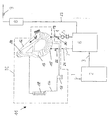
- the illustrated in the single figure embodiment of the device generally designated 11 initially has a conventional dyeing machine 10, which is provided with a vessel 12 for receiving a webbing strand 13 to be dyed. During the dyeing and rinsing, the web strand 13 is continuously transported through the vessel 12, wherein a driven reel 14 is used for the transport of this web strand 13 in the embodiment shown.
- the bottom region 15 of the boiler 12 is assigned a liquor circulation system 16, wherein the respective treatment liquor is withdrawn via this liquor circulation system 16 by means of a liquor circulating pump 17 and a heat exchanger 18 from the boiler 12 and fed again after heating the liquor in the boiler 12.
- the web strand 13 is transported during the treatment by means of the reel 14 at a predetermined speed in the direction of arrow 19 a, wherein the transport speed usually varies between 200 m / min and 800 m / min.
- the fleet circulation system 16 is associated with an unillustrated lint filter and a paint batch container.
- a reactor 6 is provided in which the actual chemical and / or physical treatment of the dyeing liquor or the rinsing liquor takes place, wherein in the illustrated embodiment, the unfixed dye is subjected to a chemical treatment with ozone, so as to destroy the dye so far that colorless components are formed.
- the reactor 6 is connected via a line 3 with an ozone generator 2, wherein in the ozone generator 2 via the line 1 with oxygen enriched air is fed.
- the reactor 6 is connected on the input side via a first pipe system 19 to the bottom region 15 of the boiler 12, wherein in the flow direction of the liquor seen from the boiler 12 to the reactor 6, a valve 20, a liquor pump 4 and a heat exchanger 5 are provided.
- the reactor 6 is connected via a second pipe system 21, again seen in the direction of flow of the liquor, via a sensor 7 and a second valve 22 to the bottom region 15 of the boiler 12.
- the device shown in the figure operates as follows:
- the dyeing system 10 is provided with the textile web strand 13, for which purpose the web strand 13 is opened up as an endless web strand and positioned within the vessel 12.
- the boiler is filled at the bottom with dyeing liquor, the fleet is pumped through the liquor circulation system 16 constantly during the actual dyeing and the web strand 13 is constantly transported.
- Such a dyeing plant 10 and their operation have long been state of the art.
- the dyeing liquor in the boiler 12 is continuously conveyed to the reactor 6 by opening the valve 20 and by means of the liquor pump 4 and the heat exchanger 5 via the first pipe system 19, wherein in the reactor. 6 the liquor, which still contains residual, not absorbed and fixed dye, is acted upon in the reactor 6 with ozone.
- the ozone is continuously prepared from the oxygen-enriched air, which is supplied via the line 1, in the ozone generator 2 and metered by means of the line 3 to the reactor in a predetermined amount.
- the quantity control of the ozone is carried out to the effect that on the one hand, the reactor 6 abandoned fleet is colorless and on the other hand, no residual ozone is indicated on the provided in the second pipe system 21 sensor. Should residual ozone still be found here, however, the valves 20 and 22, which are provided in the pipe systems 19 and 21 and are opened during the treatment, are automatically closed. At the same time the pump 4 is turned off, so that immediately the process is interrupted in the reactor.
- the so decolorized with the aid of ozone treatment liquor passes through the second pipe system 21 and the open valve 22 in the bottom portion 15 of the boiler and causes rinsing of the dyed web strand 13, which is continuously transported at a predetermined speed in the direction of arrow 19 a.
- the boiler 12 can be ventilated and a dyed and properly rinsed web strand can be removed from the vessel 12, so that the dyeing and rinsing process described above can be carried out in particular at a total liquor ratio of 1: 4 to 1: 6.
Landscapes
- Engineering & Computer Science (AREA)
- Textile Engineering (AREA)
- Coloring (AREA)
- Treatment Of Fiber Materials (AREA)
Applications Claiming Priority (1)
| Application Number | Priority Date | Filing Date | Title |
|---|---|---|---|
| DE102007022265A DE102007022265A1 (de) | 2007-05-09 | 2007-05-09 | Verfahren und Vorrichtung zum Färben eines textilen Substrates |
Publications (2)
| Publication Number | Publication Date |
|---|---|
| EP1990456A2 true EP1990456A2 (fr) | 2008-11-12 |
| EP1990456A3 EP1990456A3 (fr) | 2009-06-24 |
Family
ID=38710583
Family Applications (1)
| Application Number | Title | Priority Date | Filing Date |
|---|---|---|---|
| EP07022358A Withdrawn EP1990456A3 (fr) | 2007-05-09 | 2007-11-19 | Procédé et dispositif destinés à la teinture d'un substrat textile |
Country Status (9)
| Country | Link |
|---|---|
| US (2) | US20090126124A1 (fr) |
| EP (1) | EP1990456A3 (fr) |
| JP (1) | JP2008280666A (fr) |
| KR (1) | KR101502917B1 (fr) |
| CN (1) | CN101302722B (fr) |
| BR (1) | BRPI0801267A2 (fr) |
| DE (1) | DE102007022265A1 (fr) |
| TW (1) | TWI399470B (fr) |
| WO (1) | WO2008138282A1 (fr) |
Cited By (2)
| Publication number | Priority date | Publication date | Assignee | Title |
|---|---|---|---|---|
| WO2009121317A1 (fr) * | 2008-04-03 | 2009-10-08 | Thies Gmbh & Co. Kg | Procédé de prétraitement d'un substrat textile et dispositif de réalisation du procédé |
| CN109162051A (zh) * | 2018-10-22 | 2019-01-08 | 石狮市洪顺印染机械制造有限公司 | 一种染整机烘干装置 |
Families Citing this family (12)
| Publication number | Priority date | Publication date | Assignee | Title |
|---|---|---|---|---|
| JP5656985B2 (ja) * | 2010-05-14 | 2015-01-21 | グンゼ株式会社 | 自動染色システム |
| JP5656756B2 (ja) * | 2011-06-23 | 2015-01-21 | グンゼ株式会社 | 自動洗浄システム |
| CN102936813B (zh) * | 2011-08-16 | 2014-09-03 | 紫罗兰家纺科技股份有限公司 | 一种智能家纺和服装成品多功能加压营养素设备 |
| CN102505388B (zh) * | 2011-11-04 | 2013-11-06 | 广东溢达纺织有限公司 | 一种活性染料染色皂洗方法及其设备 |
| JP5707446B2 (ja) * | 2013-06-06 | 2015-04-30 | 株式会社日阪製作所 | 液流式染色装置 |
| DE102013106193A1 (de) * | 2013-06-13 | 2014-12-18 | Prominent Gmbh | Verfahren zur Veredelung von Jeansstoffen |
| DE102015211090A1 (de) * | 2015-06-17 | 2016-12-22 | Vistec Electron Beam Gmbh | Korpuskularstrahlgerät und Verfahren zum Betreiben eines Korpuskularstrahlgeräts |
| CN107938388A (zh) * | 2017-12-14 | 2018-04-20 | 全椒县三安塑业有限公司 | 一种酚醛塑料件染色方法 |
| KR101918154B1 (ko) * | 2018-06-28 | 2019-01-29 | 이효진 | 오존을 이용한 의류 제품 탈색 장치 및 방법 |
| JP2021179055A (ja) * | 2020-05-15 | 2021-11-18 | 小松マテーレ株式会社 | 繊維製品の処理システム、処理方法及び処理装置 |
| CN216809250U (zh) * | 2021-11-11 | 2022-06-24 | 南通帝人有限公司 | 一种液流染色后道净水循环再利用节能减排装置 |
| CN116254660B (zh) * | 2022-12-15 | 2023-08-25 | 河北天茂印染有限责任公司 | 一种纺织面料的染色工艺及使用设备 |
Citations (1)
| Publication number | Priority date | Publication date | Assignee | Title |
|---|---|---|---|---|
| DE4129698A1 (de) | 1991-09-06 | 1993-03-11 | Josef Jasper Gmbh & Co Kg | Verfahren zur behandlung von bedruckten oder gefaerbten waren |
Family Cites Families (20)
| Publication number | Priority date | Publication date | Assignee | Title |
|---|---|---|---|---|
| SU899495A1 (ru) * | 1980-06-16 | 1982-01-23 | Центральный научно-исследовательский институт шерстяной промышленности | Способ очистки сточных вод |
| JPS62246805A (ja) * | 1986-04-18 | 1987-10-28 | Ebara Res Co Ltd | オゾンの発生方法及びその装置 |
| FI903318A7 (fi) * | 1988-11-01 | 1990-06-29 | Institute Of Textile Tech | Menetelmä ja laite loimaukseen käyttäen progressiivisesti valvottua jä nnitystä väritukkiin ja siten värjäystukin geometriaan |
| US5118322A (en) * | 1990-07-31 | 1992-06-02 | Eric Wasinger | Ozone decolorization of garments |
| JPH0522588U (ja) * | 1991-09-04 | 1993-03-23 | 鐘紡株式会社 | パツケージ染色装置 |
| JP2665490B2 (ja) * | 1991-12-13 | 1997-10-22 | ジヨウジフ・クロスフイールド・アンド・ソンズ・リミテツド | 編織布の処理 |
| US5366510A (en) * | 1992-06-09 | 1994-11-22 | Eric Wasinger | Process for desizing and color fading garments |
| JP3130665B2 (ja) * | 1992-07-17 | 2001-01-31 | 三井・デュポンポリケミカル株式会社 | 積層蓋材 |
| RU2072013C1 (ru) * | 1993-07-08 | 1997-01-20 | Ивановская государственная текстильная академия | Система регенерации сточных вод для текстильных промывных машин |
| JPH0731990A (ja) * | 1993-07-23 | 1995-02-03 | Sumitomo Seika Chem Co Ltd | 着色排水の脱色処理法およびそれに用いる装置 |
| US5939030A (en) * | 1997-05-08 | 1999-08-17 | Moxley; Douglas A. | System and method for generating ozonated water |
| JPH11290878A (ja) * | 1998-02-16 | 1999-10-26 | Japan Organo Co Ltd | Toc成分除去の制御方法 |
| US6024766A (en) * | 1999-01-27 | 2000-02-15 | Wasinger; Eric M. | Process for enzymatic desizing of garments and enzyme deactivation |
| DE19940068A1 (de) * | 1999-08-24 | 2001-03-01 | Basf Ag | Verfahren zum Aufhellen von gefärbtem Textilmaterial |
| JP4659939B2 (ja) * | 1999-12-09 | 2011-03-30 | 日金加工株式会社 | 繊維製品の処理方法及びその装置 |
| JP4476472B2 (ja) * | 2000-11-29 | 2010-06-09 | 株式会社日阪製作所 | 染色機における洗浄方法 |
| JP2003126875A (ja) * | 2001-10-24 | 2003-05-07 | Kunio Fukaya | 排水浄化処理方法と排水浄化処理システム |
| JP4254943B2 (ja) * | 2002-05-14 | 2009-04-15 | 日本ワコン株式会社 | 廃水処理システム |
| US7682403B2 (en) * | 2004-01-09 | 2010-03-23 | Ecolab Inc. | Method for treating laundry |
| US7141075B1 (en) * | 2004-09-26 | 2006-11-28 | Fiberzone Technologies Inc. | Process for selective decolorizing fabric |
-
2007
- 2007-05-09 DE DE102007022265A patent/DE102007022265A1/de not_active Withdrawn
- 2007-08-27 WO PCT/DE2007/001524 patent/WO2008138282A1/fr not_active Ceased
- 2007-11-19 EP EP07022358A patent/EP1990456A3/fr not_active Withdrawn
- 2007-12-27 CN CN2007101608616A patent/CN101302722B/zh not_active Expired - Fee Related
-
2008
- 2008-04-15 JP JP2008105626A patent/JP2008280666A/ja active Pending
- 2008-04-22 US US12/081,808 patent/US20090126124A1/en not_active Abandoned
- 2008-04-29 BR BRPI0801267-9A patent/BRPI0801267A2/pt not_active Application Discontinuation
- 2008-05-07 TW TW097116759A patent/TWI399470B/zh not_active IP Right Cessation
- 2008-05-09 KR KR1020080043542A patent/KR101502917B1/ko not_active Expired - Fee Related
-
2012
- 2012-09-19 US US13/622,512 patent/US20130081214A1/en not_active Abandoned
Patent Citations (1)
| Publication number | Priority date | Publication date | Assignee | Title |
|---|---|---|---|---|
| DE4129698A1 (de) | 1991-09-06 | 1993-03-11 | Josef Jasper Gmbh & Co Kg | Verfahren zur behandlung von bedruckten oder gefaerbten waren |
Cited By (2)
| Publication number | Priority date | Publication date | Assignee | Title |
|---|---|---|---|---|
| WO2009121317A1 (fr) * | 2008-04-03 | 2009-10-08 | Thies Gmbh & Co. Kg | Procédé de prétraitement d'un substrat textile et dispositif de réalisation du procédé |
| CN109162051A (zh) * | 2018-10-22 | 2019-01-08 | 石狮市洪顺印染机械制造有限公司 | 一种染整机烘干装置 |
Also Published As
| Publication number | Publication date |
|---|---|
| WO2008138282A1 (fr) | 2008-11-20 |
| BRPI0801267A2 (pt) | 2009-04-28 |
| JP2008280666A (ja) | 2008-11-20 |
| EP1990456A3 (fr) | 2009-06-24 |
| CN101302722B (zh) | 2012-04-04 |
| DE102007022265A1 (de) | 2008-11-13 |
| TWI399470B (zh) | 2013-06-21 |
| HK1125982A1 (en) | 2009-08-21 |
| US20090126124A1 (en) | 2009-05-21 |
| KR20080099824A (ko) | 2008-11-13 |
| KR101502917B1 (ko) | 2015-03-16 |
| TW200905034A (en) | 2009-02-01 |
| US20130081214A1 (en) | 2013-04-04 |
| CN101302722A (zh) | 2008-11-12 |
Similar Documents
| Publication | Publication Date | Title |
|---|---|---|
| WO2008138282A1 (fr) | Procédé et dispositif de coloration d'un substrat textile | |
| DE2713800C2 (de) | Verfahren zur Indigo-Färbung von Kettfäden aus Baumwoll-Spinngarnen | |
| DE102016005441A1 (de) | Verfahren zur Behandlung eines textilen Substrates sowie Vorrichtung zur Durchführung des Verfahrens | |
| DE69624675T2 (de) | Verfahren zum vorbereiten einer behandlungsflüssigkeit im flüssigkeitskreislauf einer textilbehandlungsmaschine sowie verfahren und maschine zur nassbehandlung von textilgut | |
| DE2539350C2 (de) | Verfahren zum kontinuierlichen Färben von Cellulosefasern oder deren Mischungen mit Synthesefasern mit auf der Faser erzeugten wasserunlöslichen Azofarbstoffen | |
| DE19749212A1 (de) | Verfahren zum kontinuierlichen Färben von cellulosischen Rundstrick- und Rundwirkwaren mit Reaktivfarbstoffen | |
| EP0320701B1 (fr) | Procédé et installation de traitement discontinu au mouillé de matières textiles | |
| DE10349375B4 (de) | Verfahren und Vorrichtung zum Spülen von strangförmigen Textilgut | |
| DE10332715B4 (de) | Verfahren und Vorrichtung zum Färben von Textilien | |
| DE2539336C2 (de) | Verfahren zum kontinuierlichen Färben von Cellulosefaser!! oder deren Mischungen mit Synthesefasern mit auf der Faser erzeugten wasserunlöslichen Azofarbstoffen | |
| DE102008056308A1 (de) | Verfahren und Vorrichtung zum Färben eines textilen Substrates | |
| DE3221776C2 (fr) | ||
| DE2456132A1 (de) | Verfahren und vorrichtung zum entschlichten von stoffen | |
| DE19546075A1 (de) | Verfahren und Einrichtung zum Entfärben von Gewebe bzw. Bekleidung, insbesondere Jeansbekleidung | |
| EP4031584A1 (fr) | Procédé de prétraitement et de coloration de cellulose | |
| US5321864A (en) | Continuous method and installation for bleaching a textile fabric web | |
| DE3112409A1 (de) | Verfahren zum kontinuierlichen waschen eines textilen produkts | |
| DE4005979C2 (fr) | ||
| EP0962575B1 (fr) | Dispositif et procédé pour l'ennoblissement des matières textiles | |
| EP3008017B1 (fr) | Procédé d'ennoblissement de tissus denim | |
| DE3106257A1 (de) | "verfahren zum behandeln eines textilen produkts" | |
| DE900687C (de) | Verfahren und Vorrichtung zum Nassbehandeln von Textilgut in laufender Bahn | |
| EP3409832A1 (fr) | Procédé et dispositif de traitement de textiles fabriqués à partir de fibres et textiles fabriqués à partir de fibres synthétiques ou naturelles | |
| CH668999A5 (de) | Vorrichtung zum kontinuierlichen faerben von kettgarnen. | |
| WO2006002570A1 (fr) | Unite polyvalente modulaire et procede d'application de composants de reaction sur des substrats textiles |
Legal Events
| Date | Code | Title | Description |
|---|---|---|---|
| PUAI | Public reference made under article 153(3) epc to a published international application that has entered the european phase |
Free format text: ORIGINAL CODE: 0009012 |
|
| AK | Designated contracting states |
Kind code of ref document: A2 Designated state(s): AT BE BG CH CY CZ DE DK EE ES FI FR GB GR HU IE IS IT LI LT LU LV MC MT NL PL PT RO SE SI SK TR |
|
| AX | Request for extension of the european patent |
Extension state: AL BA HR MK RS |
|
| PUAL | Search report despatched |
Free format text: ORIGINAL CODE: 0009013 |
|
| AK | Designated contracting states |
Kind code of ref document: A3 Designated state(s): AT BE BG CH CY CZ DE DK EE ES FI FR GB GR HU IE IS IT LI LT LU LV MC MT NL PL PT RO SE SI SK TR |
|
| AX | Request for extension of the european patent |
Extension state: AL BA HR MK RS |
|
| 17P | Request for examination filed |
Effective date: 20090827 |
|
| 17Q | First examination report despatched |
Effective date: 20091117 |
|
| AKX | Designation fees paid |
Designated state(s): AT BE BG CH CY CZ DE DK EE ES FI FR GB GR HU IE IS IT LI LT LU LV MC MT NL PL PT RO SE SI SK TR |
|
| STAA | Information on the status of an ep patent application or granted ep patent |
Free format text: STATUS: THE APPLICATION IS DEEMED TO BE WITHDRAWN |
|
| 18D | Application deemed to be withdrawn |
Effective date: 20191105 |