EP1990754A1 - Appareil de stockage et manipulation de documents électroniques et système de stockage et de manipulation de documents électroniques comportant un ou plusieurs de ces appareils - Google Patents
Appareil de stockage et manipulation de documents électroniques et système de stockage et de manipulation de documents électroniques comportant un ou plusieurs de ces appareils Download PDFInfo
- Publication number
- EP1990754A1 EP1990754A1 EP08102017A EP08102017A EP1990754A1 EP 1990754 A1 EP1990754 A1 EP 1990754A1 EP 08102017 A EP08102017 A EP 08102017A EP 08102017 A EP08102017 A EP 08102017A EP 1990754 A1 EP1990754 A1 EP 1990754A1
- Authority
- EP
- European Patent Office
- Prior art keywords
- partition
- enciphered
- keys
- auxiliary device
- cpu
- Prior art date
- Legal status (The legal status is an assumption and is not a legal conclusion. Google has not performed a legal analysis and makes no representation as to the accuracy of the status listed.)
- Ceased
Links
Images


Classifications
-
- G—PHYSICS
- G06—COMPUTING OR CALCULATING; COUNTING
- G06F—ELECTRIC DIGITAL DATA PROCESSING
- G06F21/00—Security arrangements for protecting computers, components thereof, programs or data against unauthorised activity
- G06F21/50—Monitoring users, programs or devices to maintain the integrity of platforms, e.g. of processors, firmware or operating systems
- G06F21/57—Certifying or maintaining trusted computer platforms, e.g. secure boots or power-downs, version controls, system software checks, secure updates or assessing vulnerabilities
- G06F21/575—Secure boot
-
- G—PHYSICS
- G06—COMPUTING OR CALCULATING; COUNTING
- G06F—ELECTRIC DIGITAL DATA PROCESSING
- G06F21/00—Security arrangements for protecting computers, components thereof, programs or data against unauthorised activity
- G06F21/70—Protecting specific internal or peripheral components, in which the protection of a component leads to protection of the entire computer
- G06F21/78—Protecting specific internal or peripheral components, in which the protection of a component leads to protection of the entire computer to assure secure storage of data
- G06F21/80—Protecting specific internal or peripheral components, in which the protection of a component leads to protection of the entire computer to assure secure storage of data in storage media based on magnetic or optical technology, e.g. disks with sectors
Definitions
- the present invention relates to an apparatus for storing and handling electronic documents.
- the invention also relates to a storing and handling system for electronic documents comprising one or more of said apparatuses.
- electronic documents any type of data processing documents (consisting of a textual part and/or a graphic and/or an audio and/or a video part) and any type of information contained in these documents.
- a further requirement within this particular field refers to remote access to the different documents or data that must be available to the responsible staff even when said staff is not at the inside of the firm.
- the present invention aims at providing an apparatus and a system for storing and handling electronic documents that reduces times and costs for activation and maintenance to an important degree.
- Another aim of the invention is to ensure high security and reliability levels as to the stored data.
- Apparatus 1 ( Fig. 1 ) first of all comprises a memory 10 for storing one or more electronic documents.
- electronic document means any type of digital, textual, numeric, figurative, audio or video information, etc.
- the invention can apply to the field of business management, in which the different documents, correspondence, etc. concerning the firm's activity can be electronically stored and handled.
- each document being stored is a record of information items describing this document; the record can contain a unique identification code of the document; a field in which it is entered the date at which the document was made, issued or received; a field in which the type of document is summarised by a key word (e.g. estimate or budget, invoice, note, etc.); for instance, in the case of a DDT (document of transport), fields can be provided for corporate name, supplier's identification code, amount, lines for the details, etc.
- a key word e.g. estimate or budget, invoice, note, etc.
- Associated with the record is the true electronic document, to enable the assembly of information to be complete and of easy reading within the memory.
- Apparatus 1 further comprises a processing unit 20 of which at least one operating system 30, a database management system 40 (or DBMS) and a web server 50 are part.
- a processing unit 20 of which at least one operating system 30, a database management system 40 (or DBMS) and a web server 50 are part.
- the task of the operating system 30 is to enable handling of the different hardware/software sources installed on board apparatus 1.
- the operating system 30 used can be of the Linux Debian or Ubuntu type.
- the DBMS 40 is used for organisation, management and search of documents stored in memory 10.
- This DBMS preferably is of the relational type; by way of example a MySql system can be used.
- the web server 50 allows a remote connection between apparatus 1 and at least another computer, so as to enable the latter to have an at least partial access to the documents stored in memory 10.
- an Apache web server can be used.
- apparatus 1 can be connected to the Internet network and then to other computers.
- Apparatus 1 further comprises an interface 60 for connection with a computer's local area network 70; this interface is preferably of the Ethernet type.
- the local area network (or LAN) 70 to which apparatus 1 is interfaced typically is a network of the firm comprising the machines of the different users being part of the firm itself.
- These local machines allow access, preferably of the selective type, to the contents of memory 10 of apparatus 1; in fact, depending on the position occupied and the role held by them, the different local users can be allocated different levels of accessibility to the electronic documents stored in the memory.
- the local area network 70 in which apparatus 1 is inserted has a connection to the Internet 80 so that the web server 50 of apparatus 1 can be connected to said Internet network following rules and modes to be described in the following.
- Apparatus 1 also comprises a housing body 99 in which at least the hardware/software elements being part of the processing unit 20 are contained as well as, preferably, all hardware/software components included in apparatus 1.
- versions of the different software elements installed are selected that can operate simultaneously in an optimal manner, without creating problems or malfunctions to the machine or the system.
- apparatus 1 can be implemented following different embodiments.
- a first model can be provided with an 80Gb hard disk, a 10/100 Mbs network card and a cd/dvd writer.
- a second model can be provided with two (in mirror) 250Gb hard disks, a 10/100/1000Mbs network card and a cd/dvd writer.
- a third model can be made as a server machine having high-profile performances and features and to be used in applications requiring high-quality performances.
- the cd/dvd writer can be used for legal-value exportation aiming at carrying out the substitute storage of documents; this activity can be handled by the module denoted at 97 in the diagram in Fig. 1 .
- the processing unit 20 of apparatus 1 further comprises a first operating module 90 defining an environment that supports programming in an object-programming language.
- the object-programming language used can be the C# (or "C sharp") and/or C++ language, and the environment enabling this type of programming can be a Mono environment.
- the processing unit 20 may further comprise a connecting module 91 to enable a co-operation between the first operating module 90 and said web server 50 present in apparatus 1.
- the connecting module 91 can be a Mono Apache Server component.
- the processing unit 20 further comprises a second operating module 92 allowing ASP.NET and/or php pages to be handled in a web environment; for instance, this second operating module 92 can be a Mono Xsp component.
- the processing unit 20 further comprises one or more auxiliary modules 93 for carrying out automatic activities on the electronic documents received from apparatus 1 and/or stored in the memory.
- auxiliary modules also called “agents” are provided to perform predetermined activities, within the operating field of apparatus 1, depending on the preset programs and/or as a function of occurrence of asynchronous events.
- auxiliary modules 93 the first of which can be provided for automatic acquisition of documents from printing spool from a remote system, while the second can have the task of acquiring search keys from an operational software or other external application, together with coupling with documents identified by the bar code.
- the processing unit 20 further comprises a bar code reading module 94, provided for identification and recognition of the bar codes present on said electronic documents.
- the information interpreted by recognition of the bar code positioned on an electronic document are then inputted in the record associated with such a document, and help in identifying the same, when necessary, putting a further search key at the users' disposal for retrieval of the stored documents.
- the processing unit 20 can also comprise a module 98 provided for carrying out processing of the OMR (Optical Mark Recognition) type and/or ICR (Intelligent Character Recognition) type.
- OMR Optical Mark Recognition
- ICR Intelligent Character Recognition
- the processing unit 20 further comprises an integration module 95 for directly connecting one or more electronic documents to an electronic-mail handling program following a command entered by a user.
- the integration module 95 allows one or more electronic documents to be directly enclosed, by a single command for example entered by means of a mouse, with an outgoing electronic-mail message, thus avoiding navigation in the database structure through the typical window for adding enclosures to an e-mail message.
- the processing unit may further comprise a security module 96 for protection of the processing unit 20 and/or of the electronic documents stored in memory 10.
- the security module 96 can first of all comprise detecting means 96a for detection of a smart card, preferably of the usb type, said detecting means 96a being active on the processing unit 20 to activate the latter, should a predetermined smart card be recognised and deactivate the processing unit 20 should not said predetermined smart card be recognised.
- Said security module 96 can further comprise a coding/decoding block 96b to code/decode the electronic documents stored in memory 10.
- the key (or keys) used by the coding/decoding block 96b is/are directly stored into said smart card. Therefore, the detecting means 96a is active on the smart card to read thereon both the user's identification data and one or more cryptography keys to supply the coding/decoding block 96b with the same so that, once the user's correct authentication with a valid smart card has taken place, he/she can also accede to the database contents without encountering further security measures.
- apparatus 1 can be inserted into a wider system 100 ( Fig. 2 ) in which a plurality of apparatuses are connected to a main computer 101 so as to define a VPN (Virtual Private Network) 102 based on the Internet network 80.
- VPN Virtual Private Network
- a "private" network is created that uses a public transmission means.
- suitable security protocols such as the SSL/TSL and/or X509 PKI protocol as regards authentication, and the IPSec, ESP and EVP protocols as regards cryptography of the transported data, HMAC-SHA1 as regards tunnel authentication.
- each apparatus 1 being part of system 100 is inserted into a local area network 70 connected to the main computer 101 via the Internet network 80; more particularly, each apparatus can be reached, via the Internet network 80, only through the main computer 101.
- main computer 101 is provided with a reverse proxy module to enable selective access to apparatuses 1 by possible remote users 104 that would wish to reach these machines.
- a further security level implemented in system 100 consists in that the electronic documents stored in each apparatus 1 are selectively accessible, following predetermined rules and/or hierarchies, to computers remotely connected via the main computer 101.
- any network user can reach the main computer 101; depending on the identity of this user, either he/she can be allowed to partly or fully accede to one or more apparatuses 1 and the contents stored therein, or access thereto can be fully denied to him/her.
- the web server 50 installed in said apparatus will carry out exchange of information and data packages through the main computer 101.
- apparatus 1 has the following security levels.
- the main computer 101 is coupled to an auxiliary computer 101a having the same structural and operating features as the main computer and connected to the apparatuses 101 of system 100 following the same modalities as the main computer 101.
- This solution aims at providing more reliability to system 100 and substantially halving the risk of fully interrupting operation of the system itself.
- the BIOS When apparatus 1 is switched on, the BIOS carries out a control of the available peripherals and then goes on seeking for a loader 201a stored on a first partition 201 of a storage medium 200 of apparatus 1.
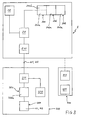
- Fig. 3 shows some of the technical features herein described; it is to be noted that Fig. 3 is not an alternative to Fig. 1 , but merely shows different aspects of the invention.
- the first partition 201 can have sizes of about 10Mb.
- the storage medium 200 can for example be a hard disk, a flash disk, a ROM, an EPROM, a CD-ROM, a DVD or an equivalent medium adapted to contain the herein described data.
- the storage medium 200 may be able to comprise physical devices distinct from each other, such as an EPROM and a hard disk.
- loader 201a and a first kernel 201b to be better described in the following can be stored on an EPROM, while a second kernel 202a, libraries 203a, libraries or DLLs 203b, application software 203c can be stored on a hard disk.
- Loader 201a in turn carries out loading of the first kernel 201b, stored in the memory partition 201.
- the first kernel after due checking and after asking for an activation code to an auxiliary device 300 (to be better described in the following), activates a second partition 202 and passes the control to a second kernel 202a present on the second partition 202.
- the second kernel 202a After further checking on the available peripherals, carries out loading of libraries 203a, DLLs or libraries 203b, application software 203c present in a third memory partition 203.
- the second and/or third partitions 202, 203 are provided to be encrypted in order to increase the system security and confidential character.
- This encrypting activity is performed by use of a suitable algorithm and one or more cryptography keys k1, k2 associated with such an algorithm.
- a suitable algorithm and one or more cryptography keys k1, k2 associated with such an algorithm.
- a symmetric-key "triple des" algorithm and/or a public-private key RSA algorithm can be used.
- said one or more keys k1, k2 are stored in an auxiliary device 300.
- the auxiliary device 300 comprises an interface 310 for a connection to apparatus 1.
- Interface 310 is preferably of the USB (Universal Serial Bus) type.
- Apparatus 1 in turn is provided with an interface 210 for connection to the auxiliary device.
- interface 210 of apparatus 1 is of the USB (Universal Serial Bus) type.
- the auxiliary device 300 further comprises a first public storage register 330 directly accessible by apparatus 1 when the latter is connected to the auxiliary device 300.
- the auxiliary device 300 further comprises a CPU 320.
- the auxiliary device 300 also comprises a second storage register 340 associated with the CPU 320 and only accessible through said CPU 320.
- said one or more cryptography keys k1, k2 are stored in the second storage register 340.
- the auxiliary device 300 is an USB device that, in addition to having a "public” memory (i.e. the first storage register 330) that is made available to apparatus 1 either for reading of the data items therein stored or storage of further files), is also provided with a "private” memory (i.e. the second storage register 340), that is used by the CPU 320 so that it can perform its own functions and is not accessible by apparatus 1, except through the CPU 320 itself.
- a "public" memory i.e. the first storage register 330
- a “private” memory i.e. the second storage register 340
- the auxiliary device 300 can have a substantially parallelepiped shape, with sizes included within the following range:
- auxiliary device 300 and apparatus 1 are not connected to each other through a cable, but through insertion of a suitable expansion (interface 310) of the auxiliary device 300 into the USB port (interface 210) of apparatus 1.
- the first kernel 201b is provided to communicate with an execution module installed on board the CPU 302.
- the first kernel 201b is provided to activate the execution module 320a so that the latter retrieves said one or more cryptography keys k1, k2 and supplies them to loader 201a to enable access to the contents of the encrypted partition/s 202, 203.
- the auxiliary device 300 and apparatus 1 are uniquely associated with each other so that keys k1, k2 contained in the second storage register 340 cannot be supplied to an apparatus other than apparatus 1.
- apparatus 1 is uniquely identified by an identification code or "imprint” or “hash”, calculated based on hardware identification parameters of apparatus 1 (e.g.: mac address of the network card, UUID of the fixed disk, model and speed of the computer used, etc.), that can be utilised to enable selective access to said one or more keys k1, k2.
- an identification code or "imprint” or “hash” calculated based on hardware identification parameters of apparatus 1 (e.g.: mac address of the network card, UUID of the fixed disk, model and speed of the computer used, etc.), that can be utilised to enable selective access to said one or more keys k1, k2.
- the auxiliary device 300 is identified by a unique serial number that cannot be modified and is inserted into the hardware. During preparation of apparatus 1, the serial number of the auxiliary device 300 is stored in apparatus 1 and the apparatus imprint is inputted into the private memory 340.
- the auxiliary device 300 can be efficiently used only with apparatus 1, and apparatus 1 can decode the encrypted partition (or partitions) 202, 203 only through the auxiliary device 300.
- an association step is first performed in which within the auxiliary device 300, in addition to key/keys k1, k2, the identification code or "imprint" is also stored.
- the execution module 320a asks the first kernel 201b for supply of key k1, k2, the execution module 320a asks the first kernel 201b for the identification code of the apparatus; if the identification code received from the execution module 320a is not the same as the previously stored code, the keys are not supplied and the apparatus cannot operate correctly.
- auxiliary device 300 access to the auxiliary device 300 is protected by a further password, stored into the first kernel 201b; should not this password be supplied to the auxiliary device 300, communication between the execution module 320a and apparatus 1 is not allowed.
- keys k1, k2 are further protected by a cryptography algorithm that in turn always uses different keys.
- the auxiliary device 300 and apparatus 1 are therefore "synchronised" so as to employ the right keys.
- Communication between apparatus 1 and auxiliary device 300 can therefore be encrypted with a symmetric-key algorithm (a "triple des", for example) to be used one time in a cycle.
- a symmetric-key algorithm a "triple des", for example
- auxiliary device 300 can be supplied in combination with a memory medium 400 provided with a cryptography module 410 and an auxiliary software module 420.
- the software module 410 allows one or more partitions 202, 203 of the storage medium 200 of apparatus 1 to be encrypted.
- the auxiliary software module 420 allows the first kernel 201b of apparatus 1 to be installed or modified so that when the first kernel 201b starts operating, it asks the auxiliary device 300 (in particular through activation of the execution module 320a) for the key/keys k1, k2 required for decoding the encrypted partition/s 202, 203.
- the memory medium 400 can consist of a CR-ROM or a DVD, on which the above described modules 410, 420 are stored.
- the memory medium 400 can be included in the auxiliary device 300 and in particular can be part of a memory incorporated into said auxiliary device 300.
- the memory medium 400 is advantageously provided to contain all components necessary for operation of apparatus 1; in other words, said medium 400 can constitute a virtual machine, designed to talk to device 300 (when suitably associated with a physical machine) and to perform the above described security operations.
- the invention achieves important advantages.
- the apparatus and system of the invention are characterised by an important reduction in the activation and servicing time and costs.
- the apparatus of the invention can be integrated in a very simple and quick manner into the context of the firm in which it will have to operate.
- this apparatus is such planned that it does not require any type of ordinary or extraordinary servicing, and is able to communicate possible anomalies to a remote service centre in an independent manner, which centre will solve the existing problems in an independent manner too.
Landscapes
- Engineering & Computer Science (AREA)
- Computer Security & Cryptography (AREA)
- Computer Hardware Design (AREA)
- Theoretical Computer Science (AREA)
- Software Systems (AREA)
- General Engineering & Computer Science (AREA)
- Physics & Mathematics (AREA)
- General Physics & Mathematics (AREA)
- Facsimiles In General (AREA)
- Storage Device Security (AREA)
Applications Claiming Priority (1)
| Application Number | Priority Date | Filing Date | Title |
|---|---|---|---|
| ITMI20070369 ITMI20070369A1 (it) | 2007-02-27 | 2007-02-27 | Apparecchiatura per l'archiviazione e la gestione di documenti elettronici e sistema di archiavizione e gestione di documenti elettronici comprendente una o piu'di dette apparecchiature |
Publications (1)
| Publication Number | Publication Date |
|---|---|
| EP1990754A1 true EP1990754A1 (fr) | 2008-11-12 |
Family
ID=39739833
Family Applications (1)
| Application Number | Title | Priority Date | Filing Date |
|---|---|---|---|
| EP08102017A Ceased EP1990754A1 (fr) | 2007-02-27 | 2008-02-26 | Appareil de stockage et manipulation de documents électroniques et système de stockage et de manipulation de documents électroniques comportant un ou plusieurs de ces appareils |
Country Status (2)
| Country | Link |
|---|---|
| EP (1) | EP1990754A1 (fr) |
| IT (1) | ITMI20070369A1 (fr) |
Citations (6)
| Publication number | Priority date | Publication date | Assignee | Title |
|---|---|---|---|---|
| US5212729A (en) * | 1992-01-22 | 1993-05-18 | Schafer Randy J | Computer data security device and method |
| WO1997029416A2 (fr) * | 1996-02-09 | 1997-08-14 | Integrated Technologies Of America, Inc. | Systeme de gestion/cryptographie d'acces |
| US5802175A (en) * | 1996-09-18 | 1998-09-01 | Kara; Salim G. | Computer file backup encryption system and method |
| EP0961193A2 (fr) * | 1998-05-29 | 1999-12-01 | Texas Instruments Incorporated | Dispositif ordinateur sécurisé |
| US20030005300A1 (en) * | 2001-04-12 | 2003-01-02 | Noble Brian D. | Method and system to maintain portable computer data secure and authentication token for use therein |
| WO2003027816A1 (fr) * | 2001-09-28 | 2003-04-03 | High Density Devices As | Procede et dispositif de cryptage/decryptage de donnees sur un dispositif de memoire a grande capacite |
-
2007
- 2007-02-27 IT ITMI20070369 patent/ITMI20070369A1/it unknown
-
2008
- 2008-02-26 EP EP08102017A patent/EP1990754A1/fr not_active Ceased
Patent Citations (6)
| Publication number | Priority date | Publication date | Assignee | Title |
|---|---|---|---|---|
| US5212729A (en) * | 1992-01-22 | 1993-05-18 | Schafer Randy J | Computer data security device and method |
| WO1997029416A2 (fr) * | 1996-02-09 | 1997-08-14 | Integrated Technologies Of America, Inc. | Systeme de gestion/cryptographie d'acces |
| US5802175A (en) * | 1996-09-18 | 1998-09-01 | Kara; Salim G. | Computer file backup encryption system and method |
| EP0961193A2 (fr) * | 1998-05-29 | 1999-12-01 | Texas Instruments Incorporated | Dispositif ordinateur sécurisé |
| US20030005300A1 (en) * | 2001-04-12 | 2003-01-02 | Noble Brian D. | Method and system to maintain portable computer data secure and authentication token for use therein |
| WO2003027816A1 (fr) * | 2001-09-28 | 2003-04-03 | High Density Devices As | Procede et dispositif de cryptage/decryptage de donnees sur un dispositif de memoire a grande capacite |
Also Published As
| Publication number | Publication date |
|---|---|
| ITMI20070369A1 (it) | 2008-08-28 |
Similar Documents
| Publication | Publication Date | Title |
|---|---|---|
| US7360240B2 (en) | Portable network encryption keys | |
| US7168092B2 (en) | Configuring processing units | |
| US8156331B2 (en) | Information transfer | |
| US20020141588A1 (en) | Data security for digital data storage | |
| TW200837602A (en) | Cryptographic key containers on a USB token | |
| US10795581B2 (en) | GPT-based data storage partition securing system | |
| US11995188B2 (en) | Method for faster and safe data backup using GPT remote access boot signatures to securely expose GPT partitions to cloud during OS crash | |
| US20220198466A1 (en) | Deadline management server, agent program, and terminal rental system | |
| US9053315B2 (en) | Trusted system network | |
| CN104361291B (zh) | 数据处理方法和装置 | |
| CN107403109A (zh) | 加密方法及加密系统 | |
| US20110314245A1 (en) | Secure media system | |
| EP1775881A1 (fr) | Procede de gestion de donnees, programme correspondant et support d'enregistrement de programme | |
| CN100587698C (zh) | 保护计算机上的租用资源的方法和系统 | |
| US20040117639A1 (en) | Secure driver | |
| EP1542135B1 (fr) | Procede permettant de centraliser l'administration des informations enregistrees des utilisateurs de reseaux | |
| US20080250486A1 (en) | Design structure for local blade server security | |
| WO2017137481A1 (fr) | Dispositif de sécurité amovible et procédé pour empêcher l'exploitation et le contrôle d'accès non autorisés à des fichiers | |
| US20080162948A1 (en) | Digital Information Storage System, Digital Information Security System, Method for Storing Digital Information and Method for Service Digital Information | |
| US20080104680A1 (en) | Local Blade Server Security | |
| US11153075B2 (en) | Systems and methods for minimizing boot time when using a unique key encryption key per storage resource in secure enterprise key management provisioning | |
| US6959390B1 (en) | Data processing system and method for maintaining secure user private keys in non-secure storage | |
| US20170075608A1 (en) | Solid state memory unit and method for protecting a memory including verification of a sequence of requests for access to physical blocks | |
| CN113961970B (zh) | 跨网段网盘登录身份验证方法、装置、网盘及存储介质 | |
| KR20040082239A (ko) | 스마트카드를 이용한 금융 자동화기기의 보안방법 |
Legal Events
| Date | Code | Title | Description |
|---|---|---|---|
| PUAI | Public reference made under article 153(3) epc to a published international application that has entered the european phase |
Free format text: ORIGINAL CODE: 0009012 |
|
| AK | Designated contracting states |
Kind code of ref document: A1 Designated state(s): AT BE BG CH CY CZ DE DK EE ES FI FR GB GR HR HU IE IS IT LI LT LU LV MC MT NL NO PL PT RO SE SI SK TR |
|
| AX | Request for extension of the european patent |
Extension state: AL BA MK RS |
|
| 17P | Request for examination filed |
Effective date: 20090428 |
|
| 17Q | First examination report despatched |
Effective date: 20090602 |
|
| AKX | Designation fees paid |
Designated state(s): AT BE BG CH CY CZ DE DK EE ES FI FR GB GR HR HU IE IS IT LI LT LU LV MC MT NL NO PL PT RO SE SI SK TR |
|
| STAA | Information on the status of an ep patent application or granted ep patent |
Free format text: STATUS: THE APPLICATION HAS BEEN REFUSED |
|
| 18R | Application refused |
Effective date: 20141115 |