EP1990960A1 - System und Verfahren zur Bereitstellung einer Anwendungskategorisierung und Dienstqualität in einem Netzwerk mit mehreren Benutzern - Google Patents
System und Verfahren zur Bereitstellung einer Anwendungskategorisierung und Dienstqualität in einem Netzwerk mit mehreren Benutzern Download PDFInfo
- Publication number
- EP1990960A1 EP1990960A1 EP08251654A EP08251654A EP1990960A1 EP 1990960 A1 EP1990960 A1 EP 1990960A1 EP 08251654 A EP08251654 A EP 08251654A EP 08251654 A EP08251654 A EP 08251654A EP 1990960 A1 EP1990960 A1 EP 1990960A1
- Authority
- EP
- European Patent Office
- Prior art keywords
- network
- computing device
- packets
- device application
- transfer rate
- Prior art date
- Legal status (The legal status is an assumption and is not a legal conclusion. Google has not performed a legal analysis and makes no representation as to the accuracy of the status listed.)
- Withdrawn
Links
- 238000000034 method Methods 0.000 title claims description 61
- 238000004891 communication Methods 0.000 claims abstract description 43
- 238000012546 transfer Methods 0.000 claims description 65
- 230000005540 biological transmission Effects 0.000 claims description 14
- 238000012913 prioritisation Methods 0.000 abstract description 18
- 241000700605 Viruses Species 0.000 abstract description 4
- 238000012545 processing Methods 0.000 abstract description 2
- 238000010586 diagram Methods 0.000 description 20
- 238000013507 mapping Methods 0.000 description 17
- 238000007726 management method Methods 0.000 description 10
- 238000007493 shaping process Methods 0.000 description 10
- 230000007246 mechanism Effects 0.000 description 8
- 238000013528 artificial neural network Methods 0.000 description 4
- 238000013475 authorization Methods 0.000 description 4
- 235000013410 fast food Nutrition 0.000 description 4
- 238000003860 storage Methods 0.000 description 4
- 238000004883 computer application Methods 0.000 description 3
- 238000005516 engineering process Methods 0.000 description 3
- 238000012986 modification Methods 0.000 description 3
- 230000004048 modification Effects 0.000 description 3
- 238000013139 quantization Methods 0.000 description 3
- 230000008901 benefit Effects 0.000 description 2
- 230000001413 cellular effect Effects 0.000 description 2
- 238000009826 distribution Methods 0.000 description 2
- 239000000835 fiber Substances 0.000 description 2
- ZXQYGBMAQZUVMI-GCMPRSNUSA-N gamma-cyhalothrin Chemical compound CC1(C)[C@@H](\C=C(/Cl)C(F)(F)F)[C@H]1C(=O)O[C@H](C#N)C1=CC=CC(OC=2C=CC=CC=2)=C1 ZXQYGBMAQZUVMI-GCMPRSNUSA-N 0.000 description 2
- 238000012935 Averaging Methods 0.000 description 1
- 238000004590 computer program Methods 0.000 description 1
- 230000001934 delay Effects 0.000 description 1
- 238000005538 encapsulation Methods 0.000 description 1
- 238000001914 filtration Methods 0.000 description 1
- 230000003116 impacting effect Effects 0.000 description 1
- 238000009434 installation Methods 0.000 description 1
- 230000002452 interceptive effect Effects 0.000 description 1
- 238000004519 manufacturing process Methods 0.000 description 1
- 239000000463 material Substances 0.000 description 1
- 235000012054 meals Nutrition 0.000 description 1
- 230000006855 networking Effects 0.000 description 1
- 230000003287 optical effect Effects 0.000 description 1
- 238000003909 pattern recognition Methods 0.000 description 1
- 230000002085 persistent effect Effects 0.000 description 1
- 238000007639 printing Methods 0.000 description 1
- 230000008569 process Effects 0.000 description 1
- 229920006395 saturated elastomer Polymers 0.000 description 1
- 238000005204 segregation Methods 0.000 description 1
- 230000001629 suppression Effects 0.000 description 1
- 230000005641 tunneling Effects 0.000 description 1
- 238000011144 upstream manufacturing Methods 0.000 description 1
Images







Classifications
-
- H—ELECTRICITY
- H04—ELECTRIC COMMUNICATION TECHNIQUE
- H04L—TRANSMISSION OF DIGITAL INFORMATION, e.g. TELEGRAPHIC COMMUNICATION
- H04L47/00—Traffic control in data switching networks
- H04L47/70—Admission control; Resource allocation
- H04L47/80—Actions related to the user profile or the type of traffic
- H04L47/803—Application aware
-
- H—ELECTRICITY
- H04—ELECTRIC COMMUNICATION TECHNIQUE
- H04L—TRANSMISSION OF DIGITAL INFORMATION, e.g. TELEGRAPHIC COMMUNICATION
- H04L47/00—Traffic control in data switching networks
- H04L47/10—Flow control; Congestion control
- H04L47/24—Traffic characterised by specific attributes, e.g. priority or QoS
- H04L47/2475—Traffic characterised by specific attributes, e.g. priority or QoS for supporting traffic characterised by the type of applications
-
- H—ELECTRICITY
- H04—ELECTRIC COMMUNICATION TECHNIQUE
- H04L—TRANSMISSION OF DIGITAL INFORMATION, e.g. TELEGRAPHIC COMMUNICATION
- H04L47/00—Traffic control in data switching networks
- H04L47/70—Admission control; Resource allocation
Definitions
- This invention is in the field of Internet access, more specifically, Internet access with two or more of users wherein the quality of service on the network is managed via a network traffic classification system and various quality of service methods and systems.
- ISPs Internet service providers
- the site may have two or more of portable computing devices as well as back office devices connected to the network, each with one or more network-enabled applications running on each device.
- Some applications require a high quality of service (QoS), but in the current state of the art, only minimal quality of service is available for the customer. If any quality of service is available, it is usually categorized as "free" shared bandwidth over a small amount of bandwidth versus premium bandwidth that can be purchased (also shared).
- QoS quality of service
- some hotels offer free network access at 128 kbps, then allow customers to pay for access to the remainder of a T-1 or other broadband access (1.54 mbps). Whereas this allows for some segregation and prioritization of applications, it is insufficient to provide for the bandwidth for many types of applications. Furthermore, there is no protection from unwanted application types such as worms, viruses, and/or certain types of peer-to-peer file sharing applications.
- High-speed Internet access is a necessity for many business travelers.
- HSIA uses a broadband connection, typically defined in telecommunication terminology as anything greater than 200kbps (200 kilobits/second).
- a home user will have a DSL connection or a cable modem with more than Imbps (1 megabit per second) downstream and greater than 0.5mbps upstream.
- Imbps 1 megabit per second
- Malware e.g., worms, viruses, Trojan horses, etc.
- Malware can spread and consume a large amount of bandwidth on a property.
- a malware suppression system is needed to prevent these from negatively impacting users.
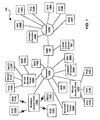
- NCS 100 may include one or more access points (APs) such as APs 120A-120D.
- APs access points
- wired APs 120C-120D may each communicate with one or more computing devices in a wired fashion.
- wired access point (AP) 120C may communicate with portable computing devices (PCDs) 110D-110F in a wired fashion
- wired AP 120D may communicate with portable computing device (PCD) 110A in a wired fashion.
- wireless APs 120A-120 may each communicate with one or more computing devices in a wireless fashion.
- wireless AP 120B may communicate with a PCD 110B and/or a PCD 110C, and wireless AP 120A may communicate with other computing devices.
- Each of wireless APs 120A-120B may include a wireless transceiver and may operate according to one or more wireless standards, such as Institute of Electrical and Electronics Engineers (IEEE) 802.16, wireless Ethernet (IEEE 802.11), Bluetooth (IEEE 802.15), General Packet Radio Service (GPRS), CDMA (code division multiple access), TDMA (time division multiple access), FDMA (frequency division multiple access), ultra wide band, digital, and/or infrared communication technologies, among others.
- IEEE Institute of Electrical and Electronics Engineers
- IEEE 802.11 wireless Ethernet
- Bluetooth IEEE 802.15
- GPRS General Packet Radio Service
- CDMA code division multiple access
- TDMA time division multiple access
- FDMA frequency division multiple access
- ultra wide band digital, and/or infrared communication technologies, among others.
- NMD 105 may be coupled to a network 130A.
- Network 130A may be coupled to a network management device (NMD) 105.
- NMD 105 may be coupled to a network 130B.
- NMD 105 may provide authentication, quality of service (QoS), communication traffic shaping, and/or access control from one or more computing devices (e.g., PCDs 110A-110F, retail entity computing devices (RECDs) 111A-111C, and back office devices (BODs) 170A-170C) coupled to network 130A through one of APs 120A-120D to network 130B.
- NMD 105 may include an access control mechanism and/or a firewall mechanism.
- the access control mechanism and/or the firewall mechanism may be used in conducting data communications in accordance and/or in association with providing various qualities of services and/or traffic shaping.
- NCS 100 may include a historical pattern classifier (HPC) 180A coupled to network 130A and/or a HPC 180B coupled to network 130B.
- HPC 180A-180B may respectfully include a memory medium and/or a processor.
- HPC 180A may monitor at least a portion of network traffic of network 130A
- HPC 180B may monitor at least a portion of network traffic of network 130B.
- the memory medium of HPC 180A may store various histories of network traffic of network 130A
- the memory medium of HPC 180B may store various histories of network traffic of network 130B.
- HPC 180A-180B may determine various computing device application classifications based on the various histories. For example, determining the various computing device application classifications may include using one or more time-series based pattern classification methods such as a neural network, a time-delay neural network, a Bayesian classifier, a learning vector quantization system and/or similar pattern recognition/classification methods, among others.
- HPC 180A and/or HPC 180B may be accessed and/or queried to determine a computing device application classification.
- network 130A and/or network 130B may include a wired network, a wireless network or a combination of wired and wireless networks.
- Network 130A and/or network 130B may include and/or be coupled to various types of communications networks, such as a public switched telephone network (PSTN), an Internet, a wide area network (WAN) (e.g., a private WAN, corporate WAN, etc.), a local area network (LAN).
- PSTN public switched telephone network
- WAN wide area network
- LAN local area network
- NMD 105 may be coupled to a PSTN, e.g., Ethernet cable and DSL; a cable (television) based network; a satellite-based system; and/or a fiber based network; among others.
- network 130A and/or network 130B may include one or more wireless networks, e.g., based on IEEE 802.11 and/or IEEE 802.16.
- one or more wired and/or wireless APs 120A-120D may be coupled to network 130A in a wireless fashion.
- Network 130A and/or network 130B may include one or more DSL (digital subscriber line) and/or cable (e.g., cable television) networks and/or infrastructures.
- DSL digital subscriber line
- cable e.g., cable television
- network 130A and/or network 130B may include one or more of: cable modems, cable modem termination systems (CMTSs), satellite modems, DSL modems, digital subscriber line access multiplexers (DSLAMs), broadband remote access servers (BRASs), telecommunications circuits, and/or metropolitan area networks (MANs), among others.
- network 130B may form part of the Internet, or may couple to other networks, e.g., other local or wide area networks such as the Internet.
- access to these networks may include one or more "services" these networks may provide.
- these one ore more services may include: email, world wide web, file transfer, printing, file sharing, file system sharing, remote file system, network file system (NFS), news, multicast, netbios, encryption, domain name service (DNS), routing, tunneling, chat such as Internet Remote Chat or AOL Instant Messenger, gaming, licensing, license management, digital rights management, network time, remote desktop, remote windowing, audio, database (e.g., Oracle, Microsoft SQL Server, PostgreSQL, etc.), authentication, accounting, authorization, virtual local area network (VLAN) (e.g., IEEE 802.1q), virtual private network or VPN, audio, phone, Voice Over Internet Protocol (VoIP), paging, or video, among others.
- these one or more service may be associated with and/or correspond to one or more protocols of one or more computer and/or software applications.
- NCS 100 may include one or more content providers 160A-160B.
- content provider 160A may be coupled to network 130A.
- content provider 160B may be coupled to network 130B.
- Content provider 160A and/or content provider 160B may provide content such as audio, video, text, pictures, and/or maps among others through one or more protocols.
- Some or all of the information from content provider 160A and/or content provider may be pre-distributed to a local cache device 162 (such as a computer system, a computer hard drive, and/or other memory media) which may facilitate faster local access to the content and/or which may minimize delays and/or costs of transmitting the content through network 130B.
- a local cache device 162 such as a computer system, a computer hard drive, and/or other memory media
- the content may be based on a retail entity and/or one or more promotions of the retail entity.
- the content may be entertainment type content to entice customers into the retail entity locations.
- entertainment type content For example, for a fast food restaurant, such as a McDonalds, content may be provided that is geared to children, such as games based on current McDonalds promotions or themes, etc.
- network access to this type of enticement content may be given freely to purchasing customers to entice them to visit the retail location. This type of network content may be provided in lieu of traditional "plastic toys" or other items routinely given out to children in these restaurants.
- content provider 160A and/or content provider 160B may provide content that may be used by a business itself, e.g., content to train employees of the retail entity and/or provide necessary business information.
- NMD 105 may include content provider 160A or the content and/or functionality of content provider 160A. A portion or all of the content may be cached on the local cache device 162.
- NCS 100 may include a management information base (MIB) 150.
- MIB 150 may be coupled to network 130A.
- MIB 150 may be a mechanism, such as a memory, which may allow the persistent storage and management of information that may be used by network 130A to operate.
- MIB 150 may store a data structure, such as a table comprising a list of identification information and a corresponding list of the plurality of possible networks and/or services.
- the data structure may also store access information, which may include associated methods for providing data to/from the respective plurality of possible networks and/or services.
- the access information may include access level and/or privilege level information.
- the data structure may include a table having a plurality of tuples, with each tuple having the identification information.
- the data structures that store this information may be included in each of the APs 120A-120D, or may be provided in various other locations.
- MIB 150 may store other information, such as a directory of one or more of the elements (e.g., access points, computing devices, etc) in NCS 100, network topology information, characteristics of individual network elements, characteristics of connection links, performance and trend statistics, and/or any information that may be of interest in operating network 130A.
- MIB 150 may store longitude, latitude, altitude and/or other geographic information that may be used to locate one or more access points and/or one or more geographic regions.
- NMD 105 may be a computer system operable to include one or more of MIB 150, network 130A, various networking equipment, one or more APs 120A-120D, and/or one more historical pattern classifiers (HPCs) 180A-180B, among others.
- MIB 150 MIB 150
- network 130A various networking equipment
- APs 120A-120D APs 120A-120D
- HPCs historical pattern classifiers
- a user operating a PCD may communicate with one of the APs 120A-120D to gain access to a network and its services, such as the Internet.
- One or more of PCDs 110B-110C may have a wireless communication device, e.g., a wireless Ethernet card, for communicating with one or more of the wireless APs 120A-120B.
- One or more of PCDs 110A and 110D-110F may have a wired communication device, e.g., an Ethernet card, for communicating with one or more of the wired APs 120C-120D.
- one or more of PCDs 110A-110F may be any of various types of devices, including a computer system, such as a portable computer, a personal digital assistant (PDA), a mobile telephone (e.g., a cellular telephone, a satellite telephone, etc.), an Internet appliance, a communications device, or other wired or wireless device.
- PCD 110 may include various wireless or wired communication devices, such as a wireless Ethernet card, paging logic, RF (radio frequency) communication logic, a wired Ethernet card, a modem, a DSL device, an ISDN device, an ATM (asynchronous transfer mode) device, a parallel or serial port bus interface, and/or other type of communication device.
- one or more of PCDs 110A-110F may include a memory medium which stores identification information.
- the identification information may be a System ID (an IEEE 802.11 System ID), a processor or CPU ID, a Media Access Control (MAC) ID of a wireless or wired Ethernet device, network identification information, and/or other type of information that identifies the portable computing device.
- the identification information may be included in a digital certificate (e.g., an X.509 certificate), which may be stored in a web browser, in a client software, and/or in a memory medium of the portable computing device.
- the wireless communication may be accomplished in a number of ways.
- one or more of PCDs 110B-110C and wireless APs 120A-120B may be equipped with appropriate transmitters and receivers compatible in power and frequency range (e.g., 900 MHz, 2.4 GHz, 3.6 GHz, 5 GHz, among others) to establish a wireless communication link.
- Wireless communication may also be accomplished through cellular, satellite, digital, and/or infrared communication technologies, among others.
- a portable computing device and/or wireless AP may use any of various security systems and/or methods.
- the wired connection may be accomplished through a variety of different ports, connectors, and/or transmission mediums.
- one or more PCDs 110A and 110D-110F may be connected through an Ethernet, universal serial bus (USB), FireWire (IEEE 1394), serial, or parallel transmission cables, among others.
- One or more of PCDs 110A and 110D-110F may include various communication devices for connecting to one of the wired APs 120C-120D, such as wired Ethernet cards, modems, DSL adapters, ATM adapters, IDSN devices, or other communication devices.
- a hotel may have Ethernet connections in the restaurants, shops, meeting rooms, and/or guest rooms.
- a fast-food restaurant and/or a coffee shop may have both wireless and wired connections for mobile users.
- a user may connect to a wired AP 120C through the use of a laptop computer (e.g., one of PCDs 110D-110F), an Ethernet network card, and a network cable.
- This connection may have the same impact as a connection made to a wireless AP 120B.
- a user using a wired portable computing device may be able to use various network infrastructures in the same manner as a user using a wireless portable computing device.
- one or more a back office devices (BODs) 170A-170C may be coupled to network 130A.
- a BODs 170A-170C may include a cash register, a point of sale (POS) terminal, a smart card reader, a camera, a bar code reader, a radio frequency identification (RFID) reader, a credit card reading mechanism, and/or a remote order placing device, among others.
- the remote order placing device may allow a retail entity to remotely accept orders from customers using the remote order placing device. For example, a customer may use a "drive-thru" window and the remote order placing device at one location, and the retail entity may accept the order at another location. For instance, the retail entity may accept orders in a first city from customers using the remote order placing device in a different second city.
- one or more of BODs 170A-170C may be configured to contact a clearinghouse through one or more networks (e.g., one or more of networks 130A-130B) to debit one or more credit and/or debit card accounts.
- One or more of BODs 170A-170C may include other mechanisms to identify a customer and/or customer account information.
- the POS terminal may include a smart card reader.
- a back office device (BOD) may be coupled to a network through a wired AP.
- BOD 170A may be coupled to network 130A through wired AP 120D.
- a BOD may be coupled to a network in a wireless fashion.
- BOD 170C may be coupled to network 130A through wireless AP 120B.
- NCS 100 may be geographic-based.
- the NCS 100 may provide information and/or services to a portable computing device (e.g., one of PCDs 110A-110F) of a user based at least partly on the geographic location of the portable computing device, e.g., as indicated by one or more of APs 120A-120D and/or as indicated by geographic information (e.g., GPS information, fast-food restaurant and/or coffee shop location, room identification, room number, room name, and/or room area, among others) provided from the portable computing device.
- APs 120A-120D may be arranged at known geographic locations and may provide geographic location information regarding the geographic location of the user and/or the portable computing device.
- a computing device may provide geographic location information of the computing device through an access point (e.g., one of APs 120A-120D) to network 130A.
- the computing device may include GPS (Global Positioning System) equipment enabling the computing device to provide its geographic location through the access point to network 130A.
- GPS Global Positioning System
- a retail entity computing device may be coupled to network 130A.
- Retail entity computing devices (RECDs) 111A-111B may be coupled to network 130A in a wired fashion (e.g., through wired AP 120D) while RECD 111C may be coupled to network 130A in a wireless fashion (e.g., through wireless AP 120B).
- a retail entity may provide RECDs 111A-111C at various locations of the retail entity.
- RECDs 111A-111C may be used by customers of the retail entity to access content and/or network services offered at the various locations.
- the retail entity may distribute access codes, and the access codes may be used to authenticate a user for service. For example, an access code may be used to authenticate a user for access to network 130B.
- One or more of RECDs 111A-111C may be "locked down" to prevent theft.
- the retail entity may distribute access codes to access content through one or more of RECDs 111A-111C.
- a customer of the retail entity may receive an access code and use the access code with RECD 111 B to access content from one or more of content providers 160A-160B.
- the content may include audio, video, maps, pictures, and/or text, among others.
- the content may include a movie trailer, a music video, and/or a computer-implemented game, web pages, graphics, and/or a digital magazine, among others.
- Some or all of the content may be cached on a local cache device 162.
- the content cache may be updated, replaced, or added to based on various factors including the date of the content (e.g. digital magazines and/or digital newspapers may be updated once/day or once/week), the local demographics or local area attractions, size of the data, available bandwidth for download, and/or other scheduled mechanism for updating the cached content.
- access codes to content may be provided to customers with a purchase of goods and/or services.
- a customer may receive an access code to download a computer-implemented game.
- the computer-implemented game may be downloaded to one or more of PCDs 110A-110F, for instance.
- the access code to download a computer-implemented game may be distributed instead of a toy or trinket that may have accompanied a purchase of a meal.
- the computer-implemented game may include one or more digital rights management schemes.
- a digital rights management scheme may provide protection against further distribution of the computer-implemented game, e.g., not allowing distribution of the computer-implemented game to another computing device after it is downloaded.
- a digital rights management scheme may allow the computer-implemented game to only be played at a location of the retail entity.
- NMD 105 may service a single location.
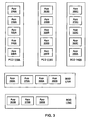
- NMD 105 may service two or more locations (e.g., locations 175A-175C), as shown in FIG. 2 .
- each of various locations 175A-175C may include a portion of NCS 100.
- a geographic location may include a geographic region.
- locations 175A-175 may be referred to as geographic locations and/or geographic regions, and they may include one or more areas of one or more sizes.
- location 175C may include a meeting room.
- location 175A may include a retail entity location, such as a coffee shop, a sandwich shop, a McDonalds location, etc.
- location 175B may include a city. More information regarding geographic location information may be found in U.S. Pat. No. 5,835,061 , referenced above.
- network 130A may support bandwidth shaping or traffic shaping.
- a data rate and/or packet rate may be reserved for one or more computer systems at location 175A.
- one or more of BODs 170A-170C may be able to use a data rate 728 kilobits per second (kbps) to transmit information to network 130B while one or more of PCDs 110A-110F may only be able to use 128 kbps to transmit information to network 130B.
- traffic shaping may "deburst" and/or smooth traffic flows. For example, without traffic shaping, packets traversing network 130A may be: ten packets in a first second, 0 packets in a second second, and twenty packets in a third second. With traffic shaping, the thirty packets may traverse network 130A at ten packets per second, and more than three seconds may transpire before all thirty packets traverse network 130A.
- network 130A may support IEEE 802.1p, which provides various quality of service (QoS) and/or class of service (CoS). This may enable network 130A to enforce certain predefined quality of service metrics to any given port or virtual port included within network 130A. For instance, using QoS, network 130A may be operable to prioritize traffic and/or perform dynamic multicast filtering.
- an IEEE 802.1p header may include a three-bit field for prioritization. For instance, this may allow network 130A to group data packets into various traffic classes. For example, using a three-bit field for prioritization may establish eight levels of priority.
- Network 130A may be configured with any prioritization mapping. In various embodiments, a prioritization mapping may be stored in memory coupled to network 130A, such as MIB 150, among others.
- NMD 105 and/or network 130A may prioritize network traffic based on one or more determined computer-based applications, software, and/or protocols. For example, it may be determined that one or more PCDs 110A-110F is running a VoIP application, and NMD 105 and/or network 130A may prioritize data and/or packets associated with the VoIP application to some QoS.
- a prioritization mapping may map various applications, software, and/or protocols to various QoS metrics and/or to various prioritizations. In various embodiments, a prioritization mapping may map various compensation information and/or payment information to various QoS metrics and/or to various prioritizations.
- a user of a computing device may purchase better and/or higher bandwidth and/or higher QoS, according to some metric, and the purchased QoS and/or bandwidth may be associated with and/or correspond to a geographic location of the computing device, a network identification associated with and/or corresponding to the computing device, and/or one or more applications and/or application classifications.
- a prioritization mapping may include a three-bit number (e.g., 000 through 11 1 in binary or, equivalently, 0 through 7 in decimal) associated with a priority level.
- network-critical traffic such as a Routing Information Protocol (RIP) (e.g., RIP version 2) and/or an Open Shortest Path First (OSPF) table updates may be given a highest priority.
- RIP Routing Information Protocol
- OSPF Open Shortest Path First
- Delay-sensitive applications such as interactive video and/or voice may be associated with moderately high priority values of five or six in the prioritization mapping.
- Other traffic or data classes may range from streaming multimedia and/to business-critical traffic, such as traffic from a database, down to "loss eligible" traffic.
- the streaming multimedia and/to business-critical traffic may be associated with moderate priority values around five or four in the prioritization mapping while the loss eligible traffic may be associated with a value of zero in the prioritization mapping.
- a zero value may be used as a default.
- a zero value may be invoked automatically when no other value has been set.
- VLANs virtual local area networks
- QoS may be used in tandem (e.g., IEEE 802.1q and IEEE 802.1p in tandem).
- a VLAN tag may include two parts, a twelve-bit VLAN ID and a three-bit prioritization. In one example, this may allow network 130A to support one or more priority levels for one or more VLANs. In a second example, this may allow network 130A to support one or more priority levels within one or more VLANs.
- One or more of the systems described herein such as PCDs 110A-110H, APs 120A-120D, BODs 170A-170C, MIB 150, content providers 160A-160B, server computing devices (SCDs) 140A-140C, HPCs 180A-180B, and NMD 105 may include a memory medium on which computer programs and/or data according to the present invention may be stored.
- each of the APs 120A-120D, HPCs 180A-180B, and/or MIB 150 may store a data structure as described above including information regarding identification information, application identification information, protocol identification information, corresponding networks, and/or access information such as associated data routing and/or QoS methods.
- Each of the APs 120A-120D, HPCs 180A-180B, and/or MIB 150 may further store a software program for accessing these data structures and using the information therein to properly provide or route data between personal computing devices and networks, and/or to selectively provide and/or route data depending on the access information and/or the QoS.
- various of the systems and/or methods described herein may be used to "traffic shape", "network shape", and/or "packet shape”.
- memory medium and/or “computer readable medium” is intended to include various types of memory or storage, including an installation medium, e.g., a CD-ROM, or floppy disks, a random access memory or computer system memory such as DRAM, SRAM, EDO RAM, Rambus RAM, NVRAM, EPROM, EEPROM, flash memory etc., or a non-volatile memory such as a magnetic media, e.g., a hard drive, or optical storage.
- the memory medium may include other types of memory as well, or combinations thereof.
- the memory medium may be an article of manufacture and/or a software product.
- the memory medium may be located in a first computer in which the programs are executed, or may be located in a second different computer and/or hardware memory device that connects to the first computer over a network.
- the second computer provides the program instructions to the first computer for execution.
- the memory medium may also be a distributed memory medium, e.g., for security reasons, where a portion of the data is stored on one memory medium and the remaining portion of the data may be stored on a different memory medium.
- the memory medium may be one of the networks to which the current network is coupled, e.g., a SAN (Storage Area Network).
- each of the systems described herein may take various forms, including a personal computer system, server computer system, workstation, network appliance, Internet appliance, personal digital assistant (PDA), laptop, mobile telephone, mobile multimedia device, embedded computer system, television system and/or other device.
- PDA personal digital assistant
- the terms “computing device”, “computer”, and/or “computer system” can be broadly defined to encompass any device having a processor which executes instructions from a memory medium.
- the memory medium in one or more systems thus may store a software program and/or data for performing and/or enabling access and/or selective network access and/or network service.
- a CPU or processing unit in one or more systems executing code and data from a memory medium includes a means for executing one or more software program according to the methods or flowcharts described herein.
- Various embodiments further include receiving or storing instructions and/or data implemented in accordance with the present description upon a carrier medium.
- Suitable carrier media may include signals such as electrical, electromagnetic, and/or other forms of analog and/or digital signals, conveyed via a communication medium such as one or more networks and/or on or more wireless links.
- PCD 110A may include and/or execute applications 300A, 310A, 320A, 330A, and/or 350A
- PCD 110G may include and/or execute applications 300B, 310B, 320B, 330B, and/or 350B
- SCD 140A may include and/or execute applications 300C, 310C, 320C, 360C, and/or 390A
- BOD 170A may include and/or execute applications 360A, 370A, 380A, and/or 390B
- BOD 170C may include and/or execute applications 360B, 370B, and/or 380B.
- application 300A may communicate with application 300B through network 130A, NMD 105, and network 130B.
- each of applications 300A and 300B may be and/or include a peer-to-peer (p2p) application and an application protocol and/or application protocol signature may be associated with communication between applications 300A and 300B.
- one or more of applications 310A and/or 310B may communicate with application 310C.
- applications 310A and/or 310B may be client application and application 310C may be a server application, and an application protocol and/or an application protocol signature may be associated with communications between any two of the applications.
- applications 360A and/or 360B may communicate with application 360C.
- applications 360A and/or 360B may be a client application and application 360C may be a server application, and an application protocol and/or an application protocol signature may be associated with communications between any two of the applications (e.g., applications 360A and 360B).
- applications 360A-360C may be used to conduct business.
- applications 360A-360B may authenticate payment information with application 360C.
- applications 360A-360B may place order information with application 360C.
- applications 300A-390B may communicate with one or more other applications, and communications to and/or from these applications may include an application protocol, an application protocol signature, an application signature, and/or some detectable and/or determinable pattern. These may be used to identify and/or classify the applications.
- applications 330A and 340A may include BitTorrent and Kazaa, respectively, and these applications may be classified as "p2p" applications.
- an application layer e.g., OSI (Open Systems Interconnection) Layer 7, may be used to classify one or more applications. Table 1, below, illustrates some examples of applications and respective classifications.
- data 400 may include one or more packets 410A-410F.
- each of packets 410A-410F may include each of respective application data 420A-420F, as illustrated.
- packets 410A-410F may include one or more of an Internet protocol (IP) packet, a transmission control protocol (TCP) packet, a user datagram protocol (UDP) packet, and/or a packet as described in IEEE 802, among others.
- IP Internet protocol
- TCP transmission control protocol
- UDP user datagram protocol
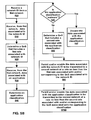
- a network identification may be received from a network 130A.
- the network ID may include one or more of access point identification information, a media access control (MAC) address, a service set identification information, a virtual local area network (VLAN) identification, a wireless communication channel identification, a physical port identification, and/or an Internet protocol (IP) address.
- MAC media access control
- VLAN virtual local area network
- IP Internet protocol
- a network ID may include an address and vice versa.
- the network ID may include a MAC address of a PCD such as a MAC address of one of PCDs 110A-110F.
- the network ID may include a MAC address of an access point, such as one of APS 120A-120D.
- the service set identification information may include one or more of an IEEE 802.11 service set identifier (SSID), an IEEE 802.11 extended service set identifier (ESSID), and/or an IEEE 802.11 basic service set identifier (BSSID).
- SSID IEEE 802.11 service set identifier
- ESSID IEEE 802.11 extended service set identifier
- BSSID IEEE 802.11 basic service set identifier
- one or more APs 120A-120B may use service set identification information in communicating with one or more computing devices.
- one or more of APs 120A-120D may use various VLAN identifications.
- AP 120B may associate service set identification information with one or more VLAN identifications.
- AP 120C may associate one or more physical ports with one or more VLAN identifications.
- each of PCDs 110D-110E may be coupled to a respective physical port of AP 120C, and those ports may be associated with one or more VLAN identifications.
- a mapping stored in one or more memory mediums described herein, may include associations of identification information and network elements (e.g., access points, etc.) and/or computing devices.
- the mapping may include various information illustrated in Table 2.
- identifications e.g., MAC addresses, VLAN identifications, physical port identifications, and/or IP addresses, etc.
- PCDs 110A, BOD 170A, and/or RECDs 111A-111B may be associated and/or correspond with an identification (e.g., a MAC address, VLAN ID, and/or IP address, etc.) of AP 120D.
- an access point such as AP120D
- the mapping that includes a wireless AP may use service identification information (SID) as physical port information.
- SID may include one or more of an IEEE 802.11 service set identifier (SSID), an IEEE 802.11 extended service set identifier (ESSID), and/or an IEEE 802.11 basic service set identifier (BSSID), among others.
- a wireless AP may be operable to concurrently support communicating using multiple SIDs.
- Table 2 Device Device MAC Addr Device IP Addr AP Physic al Port VLAN ID AP MAC Addr AP IP Addr PCD 110A 16:35:77:a3:f9 216.12.255.101 AP 120D 3 0 4f:ae:2b:45:11 216.12.255.100 RECD 111A 33:fa:49:a3:af 216.12.255.109 AP 120D 5 4 4f:ae:2b:45:11 216.12.255.100 RECD 111B cd:33:88:ed:f4 216.12.255.77 AP 120D 6 4 4f:ae:2b:45:11 216.12.255.100 BOD 170A 22:35:2d:a6:a1 216.12.255.188 AP 120D 14 7 4f:ae:2b:45:11 216.12.255.100
- data associated and/or corresponding with the network ID may be received.
- the data may include one or more packets (e.g., one or more of packets 410D-410F), and the one or more packets may include application data (e.g., one or more of application data 420D-420F) of an application (e.g., of an application listed in Table 1, an application of applications 300A-390B, etc.).
- the network ID may be received in the one or more packets.
- the network ID may be determined from the mapping.
- packets 410D-410F may be received from PCD 110A and packets 410A-410C may be received from RECD 111A, and packets 410A-410F may be associated with the network ID which may include a network ID of AP 120D, since PCD 110A and RECD 111A may both be mapped to AP 120D.
- packets may be associated and/or corresond with various network information (e.g., network element identifications, encapsulation, tunnels, etc.), through a mapping, such as the mapping described above.
- a QoS associated with the network ID may be determined.
- the QoS associated with the network ID may include a transfer rate, and the transfer rate may include an upper limit and/or a lower limit.
- an upper limit may include a maximum transfer rate of 256 kilo bits per second (kbps), and a lower limit may include a minimum transfer rate of 128 kbps, among others.
- the QoS associated with the network ID may determine a class of service and/or be used to determine a class of service.
- the QoS associated with the network ID may be used to prioritize data transfers and/or network traffic. For example, the QoS associated with the network ID may be different from another QoS.
- the QoS associated with the network ID may be a better and/or faster QoS than the other QoS, according to some metric, and/or the QoS associated with the network ID may be considered a higher priority than the other QoS.
- packets associated the other QoS may be dropped more often than packets associated with the QoS associated with the network ID.
- packets associated with the QoS associated with the network ID may be given greater bandwidth than packets associated with the other QoS. For instance, packets associated with the QoS associated with the network ID may be given a bandwidth of 256 kbps while packets associated with the other QoS may be given a bandwidth of 64 kbps.
- the QoS associated with the network ID may include a minimum bandwidth.
- the network ID may be associated with a back office device (e.g., one of BODs 170A-170C), and NCS 100 may be operated to and/or be configured to provide at least the minimum bandwidth to the back office device.
- data associated with an application may be received.
- the data associated with the application may include packets 410A-410C which may be received from a computing device coupled to network 130A.
- packets 410A-410C may include application data 420A-420C.
- the application may include one of applications 300B-340B.
- an application classification may be determined at 540.
- one or more of application data 420A-420C may be analyzed to determine the application classification.
- a pattern of the data associated with the application may be determined and may be used to determine the application classification.
- a regular expression may be used to determine the application classification. For instance, a regular expression such as "*HTTP/1.1*Content-type:*text/html*" (where "*" may be used as a wildcard) may be used to determine an application classification of "web" for the application classification.
- an application protocol may be determined and may be used to determine the application classification.
- various protocols may be detected and/or determined from the data associated with the application.
- One or more application protocols may include simple mail transfer protocol (SMTP), file transfer protocol (FTP), hypertext transfer protocol (HTTP), secure HTTP (https), Internet printer protocol (IPP), Internet message access protocol (IMAP), network time protocol (NTP), post office protocol (POP), and/or simple network management protocol (SNMP), among others.
- SMTP simple mail transfer protocol
- FTP file transfer protocol
- HTTP hypertext transfer protocol
- HTTP secure HTTP
- https Internet printer protocol
- IMAP Internet message access protocol
- NTP network time protocol
- POP post office protocol
- SNMP simple network management protocol
- a file protocol and/or a streaming protocol may be determined and may be used to determine the application classification.
- an image file protocol and/or format may be detected and/or determine as a file protocol and/or streaming protocol.
- the data associated with the application may include a file protocol and/or format according to JPEG (joint photographic experts group), PNG (portable network graphics), and/or GIF (graphics interchange format), among others.
- a motion picture file protocol and/or streaming protocol may be determined and may be used to determine the application classification.
- MPEG moving picture experts group
- MPEG moving picture experts group
- an application protocol signature may be determined and may be used to determine the application classification.
- a checksum and/or hash value may be determined using at least a portion of the data associated with the application. The checksum and/or hash value may be used as an application protocol signature.
- a pattern of at least a portion of the data associated with the application may be detected and/or determined and may be used to determine the application classification. For instance, one or more of a neural network, a Bayesian indicator, and/or a learning vector quantization system may be used to detect and/or determine a pattern and/or an application protocol signature.
- determining the application protocol signature may include using and/or accessing one or more of HPCs 180A-180B.
- the method may proceed to 547 where the data associated with the application may be discarded. If not, the method may proceed to 550.
- a QoS associated with the application classification may be determined.
- the QoS associated with the application classification may include a transfer rate, and the transfer rate may include an upper limit and/or a lower limit.
- an upper limit may include a maximum transfer rate of 512 kbps, and a lower limit may include a minimum transfer rate of 256 kbps, among others.
- the QoS associated with the application classification may determine a class of service and/or be used to determine a class of service.
- the QoS associated with the application classification may be used to prioritize data transfers and/or network traffic.
- the data associated with the network ID may be permitted and/or enabled to be transmitted to network 130B.
- various attributes and/or metrics associated with the QoS associated with the network ID may be used to transmit the data associated with the network ID to network 130B.
- the QoS associated with the network ID may include a minimum bandwidth and/or network capacity (e.g., 256 kbps), and the data associated with the network ID may be permitted and/or enabled to be transmitted to network 130B at a rate no less than the minimum bandwidth (e.g., 256 kbps).
- data from one or more of PCDs 110D-110E may be permitted and/or enabled to be transmitted at least at the minimum bandwidth and/or capacity regardless of other network traffic, since PCDs 110D-110E can be associated with a same network ID as shown in the mapping above.
- data from BODs 170A and 170C may be permitted and/or enabled to be transmitted at least at the minimum bandwidth regardless of other network traffic, since BODs 170A and 170C can be associated with a same network ID of same VLAN identification information as shown in the mapping above.
- permitting and/or enabling one or more back office devices a minimum available bandwidth may help a entity conduct business more efficiently and/or at an estimated and/or predicable efficiency and/or rate, since network capacity can be available for the one or more back office devices regardless of other network traffic.
- the data associated with the application classification may be permitted and/or enabled to be transmitted to network 130B.
- various attributes and/or metrics associated with the QoS associated with the application classification may be used to transmit the data associated with the application classification to network 130B.
- the data associated with the application classification may be enabled and/or permitted to be transmitted to network 130B at a rate no greater than the upper limit of the QoS associated with the application classification.
- the QoS associated with the application classification may include a maximum bandwidth and/or network capacity (e.g., 512 kbps), and the data associated with the application classification may be permitted and/or enabled to be transmitted to network 130B at a rate no greater than the maximum bandwidth (e.g., 512 kbps).
- the bandwidth upper-limit and/or maximum capacity e.g., 512 kbps
- the determined application classification may include "p2p", and data from applications classified as "p2p” (e.g., BitTorrent, Kazaa, eDonkey, Gnutella, and/or Napster, among others) may be permitted and/or enabled to be transmitted to network 130A at a rate no greater than the maximum bandwidth and/or network capacity (e.g., 512 kbps) of the QoS associated with the application classification.
- p2p data from applications classified as “p2p”
- p2p e.g., BitTorrent, Kazaa, eDonkey, Gnutella, and/or Napster, among others
- network capacity e.g., 512 kbps
- the data associated with the application classification may be permitted and/or enabled to be transmitted to network 130B.
- the data associated with the application classification may be permitted and/or enabled to be transmitted to network 130B at a rate no less than the minimum bandwidth (e.g., 256 kbps). In other words, there will be the minimum bandwidth (e.g., 256 kbps) and/or capacity available for the data associated with the application classification to be transmitted to network 130B regardless of other network traffic associated with network 130A, in various embodiments.
- the QoS associated with the application classification may include a minimum bandwidth and/or network capacity (e.g., 256 kbps), and the data associated with the application classification may be permitted and/or enabled to be transmitted to network 130B at a rate no less than the minimum bandwidth (e.g., 256 kbps).
- the minimum bandwidth and/or capacity e.g., 256 kbps
- the application classification may include "credit card billing", and data from one or more applications (e.g., applications 360A-380A, 390B, 360B-380B, etc.) that are included in the application classification may be permitted and/or enabled to be transmitted at no less than the minimum bandwidth regardless of other network traffic.
- permitting and/or enabling one or more applications of back office devices a minimum available bandwidth may help an entity conduct business more efficiently and/or at an estimated and/or predicable efficiency and/or rate, since network capacity can be available for the one or more applications, such as for one or more applications running on one or more back office devices, regardless of other network traffic.
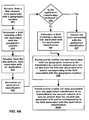
- data from network 130A may be received, and the data may be associated with a geographic location (e.g., one of locations 175A-174C).
- the data may include one or more packets (e.g., one or more of packets 410D-410F), and the one or more packets may include application data (e.g., one or more of application data 420D-420F) of an application (e.g., of an application listed in Table 1, an application of applications 300A-390B, etc.).
- the geographic location may be provided by a computing device (e.g., one of PCDs 110A-110E, BOD 170C, RECDs 111A-111C), determined by a known geographic location of an access point (e.g., APs 120A-120D), and/or determined from known geographic locations of where a computing device may couple to a network.
- location 175C may include a meeting room and a physical access port in the meeting room may be coupled to a physical port of AP 120C.
- PCD 110D may couple to the physical access port in the meeting room and, thus, it may be determined that PCD 110D is at or within location 175C, since PCD 110D is coupled to a physical port of AP 120C.
- AP 120B may provide network access to geographic location 175B, and computing devices communicating with AP 120B may considered to be at and/or within location 175B.
- a computing device may provide geographic location information. For instance, the computing device may provide latitude and/or longitude information that may be used to determine a location of the computing device.
- a QoS associated with the geographic location may be determined.
- the QoS associated with the geographic location may include a transfer rate, and the transfer rate may include an upper limit and/or a lower limit.
- an upper limit may include a maximum transfer rate of 256 kilo bits per second (kbps), and a lower limit may include a minimum transfer rate of 128 kbps, among others.
- the QoS associated with the geographic location may determine a class of service and/or be used to determine a class of service.
- the QoS associated with the geographic location may be used to prioritize data transfers and/or network traffic. For example, the QoS associated with the geographic location may be different from another QoS.
- the QoS associated with the geographic location may be a better and/or faster QoS than the other QoS, according to some metric, and the QoS associated with the geographic location may be considered a higher priority than the other QoS.
- packets associated the other QoS may be dropped more often than packets associated with the QoS associated with the geographic location.
- packets associated with the QoS associated with the geographic location may be given greater bandwidth than packets associated with the other QoS. For instance, packets associated with the QoS associated with the geographic location may be given a bandwidth of 256 kbps while packets associated with the other QoS may be given a bandwidth of 64 kbps.
- the QoS associated with the geographic location may include a minimum bandwidth.
- the geographic location may be location 175B and include BOD 170C, and NCS 100 may be operated to and/or be configured to provide at least the minimum bandwidth to the BOD 170C.
- data associated with an application may be received.
- the data associated with the application may include packets 410A-410C which may be received from a computing device coupled to network 130A.
- packets 410A-410C may include application data 420A-420C.
- the application may include one of applications 300B-340B.
- an application classification may be determined at 630.
- one or more of application data 420A-420C may be analyzed to determine the application classification.
- a pattern of the data associated with the application may be determined and may be used to determine the application classification.
- a regular expression may be used to may be used to determine the application classification. For instance, a regular expression such as "*HTTP/1.1*Content-type:*text/html*" (where "*" may be used as a wildcard) may be used to determine an application classification of "web" for the application classification.
- an application protocol may be determined and may be used to determine the application classification.
- various protocols may be detected and/or determined from the data associated with the application.
- One or more application protocols may include simple mail transfer protocol (SMTP), file transfer protocol (FTP), hypertext transfer protocol (HTTP), secure HTTP (https), Internet printer protocol (IPP), Internet message access protocol (IMAP), network time protocol (NTP), post office protocol (POP), and/or simple network management protocol (SNMP), among others.
- SMTP simple mail transfer protocol
- FTP file transfer protocol
- HTTP hypertext transfer protocol
- HTTP secure HTTP
- https Internet printer protocol
- IMAP Internet message access protocol
- NTP network time protocol
- POP post office protocol
- SNMP simple network management protocol
- a file protocol and/or a streaming protocol may be determined and may be used to determine the application classification.
- an image file protocol and/or format may be detected and/or determine as a file protocol and/or streaming protocol.
- the data associated with the application may include a file protocol and/or format according to JPEG (joint photographic experts group), PNG (portable network graphics), and/or GIF (graphics interchange format), among others.
- a motion picture file protocol and/or streaming protocol may be determined and may be used to determine the application classification.
- MPEG moving picture experts group
- MPEG moving picture experts group
- an application protocol signature may be determined and may be used to determine the application classification.
- a checksum and/or hash value may be determined using at least a portion of the data associated with the application. The checksum and/or hash value may be used as an application protocol signature.
- a pattern of at least a portion of the data associated with the application may be detected and/or determined and may be used to determine the application classification. For instance, one or more of a neural network, a Bayesian indicator, and/or a learning vector quantization system may be used to detect and/or determine a pattern and/or an application protocol signature.
- determining the application protocol signature may include using and/or accessing one or more of HPC 180A-180B.
- the method may proceed to 637 where the data associated with the application may be discarded. If not, the method may proceed to 640.
- a QoS associated with the application classification may be determined.
- the QoS associated with the application classification may include a transfer rate, and the transfer rate may include an upper limit and/or a lower limit.
- an upper limit may include a maximum transfer rate of 512 kbps, and a lower limit may include a minimum transfer rate of 256 kbps, among others.
- the QoS associated with the application classification may determine a class of service and/or be used to determine a class of service.
- the QoS associated with the application classification may be used to prioritize data transfers and/or network traffic.
- the data associated with the geographic location may be permitted and/or enabled to be transmitted to network 130B.
- various attributes and/or metrics associated with the QoS associated with the geographic location may be used to transmit the data associated with the geographic location to network 130B.
- the QoS associated with the geographic location may include a minimum bandwidth and/or network capacity (e.g., 256 kbps), and the data associated with the geographic location may be permitted and/or enabled to be transmitted to network 130B at a rate no less than the minimum bandwidth (e.g., 256 kbps).
- data from one or more of PCDs 110D-110E may be permitted and/or enabled to be transmitted at least at the minimum bandwidth and/or capacity regardless of other network traffic, since PCDs 110D-110E can be associated with a same geographic location.
- the data associated with the application classification may be permitted and/or enabled to be transmitted to network 130B.
- various attributes and/or metrics associated with the QoS associated with the application classification may be used to transmit the data associated with the application classification to network 130B.
- the data associated with the application classification may be enabled and/or permitted to be transmitted to network 130B at a rate no greater than the upper limit of the QoS associated with the application classification.
- the QoS associated with the application classification may include a maximum bandwidth and/or network capacity (e.g., 512 kbps), and the data associated with the application classification may be permitted and/or enabled to be transmitted to network 130B at a rate no greater than the maximum bandwidth (e.g., 512 kbps).
- the bandwidth upper-limit and/or maximum capacity e.g., 512 kbps
- the determined application classification may include "p2p", and data from applications classified as "p2p” (e.g., BitTorrent, Kazaa, eDonkey, Gnutella, and/or Napster, among others) may be permitted and/or enabled to be transmitted to network 130A at a rate no greater than the maximum bandwidth and/or network capacity (e.g., 512 kbps) of the QoS associated with the application classification.
- p2p data from applications classified as “p2p”
- p2p e.g., BitTorrent, Kazaa, eDonkey, Gnutella, and/or Napster, among others
- network capacity e.g., 512 kbps
- the data associated with the application classification may be permitted and/or enabled to be transmitted to network 130B.
- the data associated with the application classification may be permitted and/or enabled to be transmitted to network 130B at a rate no less than the minimum bandwidth (e.g., 256 kbps). In other words, there will be the minimum bandwidth (e.g., 256 kbps) and/or capacity available for the data associated with the application classification to be transmitted to network 130B regardless of other network traffic associated with network 130A, in various embodiments.
- the QoS associated with the application classification may include a minimum bandwidth and/or network capacity (e.g., 256 kbps), and the data associated with the application classification may be permitted and/or enabled to be transmitted to network 130B at a rate no less than the minimum bandwidth (e.g., 256 kbps).
- the minimum bandwidth and/or capacity e.g., 256 kbps
- the application classification may include "credit card billing", and data from one or more applications (e.g., applications 360A-380A, 390B, 360B-380B, etc.) that are included in the application classification may be permitted and/or enabled to be transmitted at least at the minimum bandwidth regardless of other network traffic.
- permitting and/or enabling one or more applications of back office devices a minimum available bandwidth may help a entity conduct business more efficiently and/or at an estimated and/or predicable efficiency and/or rate, since network capacity can be available for the one or more applications, such as for one or more applications running on one or more back office devices, regardless of other network traffic.
- a first packet may be received from a first network, at 700.
- the first network may include network 130A or network 130B.
- the first packet may be enqueued into a queue.
- a second packet may be received from the first network, and then at 715, the second packet may be enqueued into the queue.
- a third packet may be received from the first network, and then at 725, the third packet may be enqueued in the queue.
- a QoS may include and/or be associated with various attributes that may determine data flow and/or transfer rates, and these attributes determining permitted and/or enabled transmission may be based on those attributes.
- the QoS may be used to determine a first amount of time to transpire before permitting and/or enabling a packet to be transmitted to a second network.
- the second network may include network 130A or network 130B. For instance, if the first network includes network 130A, then the second network includes network 130B, and if the first network includes network 130B, then the second network includes network 130A.
- the first amount of time may transpire.
- the first packet may be dequeued, and at 740, the first packet may be permitted and/or enabled to be transmitted to the second network.
- a second amount of time may transpire.
- the second amount of time may be the same as the first amount of time, or the second amount of time may be different than the first amount of time.
- a determination of the second amount of time may be based on the QoS and/or traffic conditions of the first network and/or the second network.
- the second packet may be permitted and/or enabled to be transmitted to the second network.
- a third amount of time may transpire.
- the third amount of time may be the same as the first amount of time and/or the second amount of time, or the third amount of time may be different than the first amount of time and/or the second amount of time. In some embodiments, a determination of the third amount of time may be based on the QoS and/or traffic conditions of the first network and/or the second network.
- the third packet may be dequeued, and at 770, the third packet may be permitted and/or enabled to be transmitted to the second network. In some embodiments, the method and/or portions of the method may repeat.
- the queue may include a priority queue.
- the packets may be associated with various priorities, and each of the packets may be dequeued based on its priority. Moreover, the amounts of time transpiring may be based on each packet's priority in the priority queue. Accordingly, various of the method elements may be executed in various orders according to various priorities and/or various qualities of services.
- one or more packets may be received from a first network.
- the first network may include network 130A or network 130B.
- the one or more packets may be permitted and/or enabled to be transmitted to a second network.
- the second network may include network 130A or network 130B. For instance, if the first network includes network 130A, then the second network includes network 130B, and if the first network includes network 130B, then the second network includes network 130A.
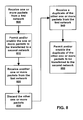
- another one or more packets may be received from the first network, and then at 830, the other one or more packets may be discarded.
- conducting communications in accordance and/or association with a QoS may include discarding one or more packets.
- a duplicate of the other one or more packets may be received from the first network, and then at 850, the duplicate of the other one or more packets may be permitted and/or enabled to be transmitted to the second network.
- the method and/or portions of the method may repeat.
- one or more packets may be received from a network.
- the network may include network 130A or network 130B.
- the one or more packets may be associated with a network ID.
- a pause message and/or command may be sent to the network ID.
- sending the pause message and/or command may include sending a zero window size.
- the zero window size may be included in an acknowledgement.
- an amount of time may transpire.
- a QoS may include and/or be associated with various attributes that may determine data flow and/or transfer rates, and these attributes determining permitted and/or enabled transmission may be based on those attributes.
- the QoS may be used to determine the amount of time to transpire before sending a continue message and/or command to the network ID, at 930.
- the continue message and/or command may include a non-zero window size.
- the non-zero window size may be included in an acknowledgement.
- the method and/or portions of the method may repeat.
- one or more packets may be received from a network.
- the network may include network 130A or network 130B.
- the one or more packets may be associated with a network ID.
- the one or more packets may include and/or be associated with a window size.
- the window size may indicate an amount of application data that may be communicated.
- a QoS may include and/or be associated with various attributes that may determine data flow and/or transfer rates, and these attributes determining permitted and/or enabled transmission may be based on those attributes.
- the QoS may be used to determine a reduced window size.
- the reduced window size may be sent to the network ID.
- the reduced window size may be sent may be included in an acknowledgement.
- another one or more packets from the network may be received.
- data associated with an application may be received.
- the data associated with the application may include packets 410A-410C.
- packets 410A-410C may include application data 420A-420C.
- an application classification may be determined using various methods and/or systems described herein, and at 1110, it may be determined that the application classification is "malware”.
- the malware application data may be discarded.
- input may be received at 1200.
- the input may be from a user of a computing device (e.g., one of PCDs 110A-110F and RECDs 111A-111C).
- NCS 100 may be configured to provide the computing device with a first QoS.
- the first QoS may include a maximum communication transfer rate.
- the maximum communication transfer rate may include a transmission rate of 128 kbps for transmitting data and/or a reception rate of 256 kbps for receiving data.
- the input may be from an operator (e.g., an operator of NCS 100) of a computing device (e.g., one of PCDs 110A-110H, RECDs 111A-111C, BODs 170A-170C, and SCDs 140A-140C).
- a computing device e.g., one of PCDs 110A-110H, RECDs 111A-111C, BODs 170A-170C, and SCDs 140A-140C.
- the input may include a request for a second QoS.
- one or more requests for different and/or alternate qualities of services may include authentication and/or authorization information.
- the authentication and/or authorization information may include one or more of compensation information, credit card information, prepaid card information, username and password information, acceptance information, coupon information, network identification information, and/or access code information, among others.
- the user may provide credit card information, and it may be determined that compensation may be obtained from the provided credit card information.
- the user may provide acceptance information (e.g., clicking on an "ok" or "accept” button on a web page), and the user's hotel room number may be billed.
- the operator may use username and password information, and the username and password information may be authenticated with an authentication and/or authorization device (e.g., a server); however, username and password information is not limited only to operators.
- the computing device using the first QoS may be provided the second QoS.
- the second QoS may be provided to one or more computing devices coupled to an access point (e.g., one or more of PCDs 110D-110F coupled to AP 120C) and/or to one or more computing devices in a geographic location (e.g., one or more of PCDs 110C-110D, BOD 170C, and RECD 111C in location 175B).
- various qualities of service associated with the method illustrated, in FIG. 12 may be based on application classification.
- the user may increase quality of service for a VoIP application (e.g., Vonage, Skype, etc.).
- the operator may increase quality of service for one or more video applications.
- AP 120C may provide network services to a meeting room, and a meeting may use the one or more video applications.
- quality of service may be adjusted to a lesser quality of service.
- the user may adjust to a lesser quality of service after using the VoIP application.
- the operator may adjust all computing devices coupled to AP 120C to a lesser quality of service.
- a better quality of service may be adjusted after a time in the future.
- the user may reserve a minimum amount of bandwidth for an application to be used after the time in the future.
- the user may be traveling to a hotel and reserve bandwidth for the VoIP application.
- the operator may reserve bandwidth for a meeting that is to transpire in the future.
- the operator may reserve bandwidth for all computing devices coupled to AP 120C and using video application data.
- NCS 100 may include a link 1300 coupled to a computing device 1310 and coupled to NMD 105.
- link 1300 and computing device 1310 may be disposed between NMD 105 and network 130B.
- link 1300 may include a communications link.
- link 1300 may include one or more of a public switched telephone network (PSTN), a portion of a PSTN, a PSTN circuit, a cable (television) based network, a satellite-based system, and/or a fiber based network, among others.
- PSTN public switched telephone network
- link 1300 may operate at and/or below a transfer rate.
- link 1300 may include a T-1 circuit and be operable to perform data communications at and/or below 1.54 mega bits per second (mbps).
- link 1300 may include a T-3 (or DS-3) circuit and be operable to perform data communications at and/or below 45 mbps.
- link 1300 may include a cable (television) based network communication connection, and the cable (television) based network communication connection may be operable to transfer data from NMD 105 at and/or below 728 kbps and transfer data to NMD 105 at and/or below mpbs.
- link 1300 may include maximum data transfer rate limits below maximum transfer rate limits of associated with network 130A and/or network 130B.
- each of NMD 105 and computing device 1310 may include routing operability to interface with link 1300. Moreover, each of NMD 105 and computing device 1310 may provide various qualities of services and/or network traffic prioritization through link 1300 based on various the methods and/or systems described herein. In various embodiments, various qualities of services and/or network traffic prioritization may be used, since link 1300 may include lesser communication transfer rates than network 130A and/or network 130B.
- one or more of the method elements described herein may be performed in varying orders, may be performed concurrently with one or more of the other method elements, or may be omitted. Additional method elements may be performed as desired. In various embodiments, concurrently may mean simultaneously. In some embodiments, concurrently may mean apparently simultaneously according to some metric. For example, two or more method elements may be performed such that they appear to be simultaneous to a human. It is also noted that, in various embodiments, one or more of the system elements described herein may be omitted and additional system elements may be added as desired.
Landscapes
- Engineering & Computer Science (AREA)
- Computer Networks & Wireless Communication (AREA)
- Signal Processing (AREA)
- Mobile Radio Communication Systems (AREA)
- Telephonic Communication Services (AREA)
Applications Claiming Priority (1)
| Application Number | Priority Date | Filing Date | Title |
|---|---|---|---|
| US91700407P | 2007-05-09 | 2007-05-09 |
Publications (1)
| Publication Number | Publication Date |
|---|---|
| EP1990960A1 true EP1990960A1 (de) | 2008-11-12 |
Family
ID=39673156
Family Applications (1)
| Application Number | Title | Priority Date | Filing Date |
|---|---|---|---|
| EP08251654A Withdrawn EP1990960A1 (de) | 2007-05-09 | 2008-05-09 | System und Verfahren zur Bereitstellung einer Anwendungskategorisierung und Dienstqualität in einem Netzwerk mit mehreren Benutzern |
Country Status (2)
| Country | Link |
|---|---|
| US (1) | US7958256B2 (de) |
| EP (1) | EP1990960A1 (de) |
Cited By (4)
| Publication number | Priority date | Publication date | Assignee | Title |
|---|---|---|---|---|
| WO2013059760A1 (en) * | 2011-10-21 | 2013-04-25 | Qualcomm Incorporated | Application based bandwidth control for communication networks |
| US8542588B2 (en) | 2008-06-25 | 2013-09-24 | Qualcomm Incorporated | Invoking different wireless link rate selection operations for different traffic classes |
| US9116893B2 (en) | 2011-10-21 | 2015-08-25 | Qualcomm Incorporated | Network connected media gateway for communication networks |
| US9148381B2 (en) | 2011-10-21 | 2015-09-29 | Qualcomm Incorporated | Cloud computing enhanced gateway for communication networks |
Families Citing this family (29)
| Publication number | Priority date | Publication date | Assignee | Title |
|---|---|---|---|---|
| US8605605B1 (en) * | 2008-11-05 | 2013-12-10 | Juniper Networks, Inc. | Setting initial data transmission size based on prior transmission |
| US8131303B2 (en) * | 2009-01-22 | 2012-03-06 | Qwest Communications International Inc. | Simultaneous multi-mode WiFi differentiated by SSID |
| US8732339B2 (en) * | 2009-03-24 | 2014-05-20 | Hewlett-Packard Development Company, L.P. | NPIV at storage devices |
| US9755899B2 (en) | 2009-05-14 | 2017-09-05 | Avaya Inc. | Generation and usage of mobility VLAN ID version value |
| US8477775B2 (en) * | 2009-05-14 | 2013-07-02 | Avaya Inc. | Unifying local and mobility network identifiers |
| AU2010202024A1 (en) * | 2009-05-22 | 2010-12-09 | Aristocrat Technologies Australia Pty Limited | A gaming system |
| US20120327778A1 (en) * | 2011-06-22 | 2012-12-27 | Cygnus Broadband, Inc. | Systems and methods for prioritizing and scheduling packets in a communication network |
| US8665724B2 (en) | 2009-06-12 | 2014-03-04 | Cygnus Broadband, Inc. | Systems and methods for prioritizing and scheduling packets in a communication network |
| US9065779B2 (en) | 2009-06-12 | 2015-06-23 | Wi-Lan Labs, Inc. | Systems and methods for prioritizing and scheduling packets in a communication network |
| WO2010145882A1 (en) * | 2009-06-18 | 2010-12-23 | Venatech Ab | An access point, a server and a system for distributing an unlimited number of virtual ieee 802.11 wireless networks through a heterogeneous infrastructure |
| US8707456B2 (en) * | 2009-07-24 | 2014-04-22 | Broadcom Corporation | Method and system for integrating remote devices into a domestic VLAN |
| US20110087602A1 (en) * | 2009-10-14 | 2011-04-14 | Serge Rutman | Electronic display device content caching and transactions |
| AU2010312287A1 (en) * | 2009-10-29 | 2012-06-21 | Sierra Wireless, Inc. | Routing device and method of configuration for network name resolution of same |
| US20110113134A1 (en) * | 2009-11-09 | 2011-05-12 | International Business Machines Corporation | Server Access Processing System |
| US8762483B2 (en) * | 2010-08-25 | 2014-06-24 | Verizon Patent And Licensing Inc. | System for and method of verifying packages |
| US9264369B2 (en) * | 2010-12-06 | 2016-02-16 | Qualcomm Incorporated | Technique for managing traffic at a router |
| JP6104178B2 (ja) * | 2011-01-18 | 2017-03-29 | ノマディックス・インコーポレイテッドNomadix,Inc. | 通信システムネットワークにおけるグループ帯域幅管理のためのシステムおよび方法 |
| US9401850B2 (en) * | 2013-05-08 | 2016-07-26 | Vringo Infrastructure Inc. | Cognitive radio system and cognitive radio carrier device |
| KR20160092415A (ko) * | 2015-01-27 | 2016-08-04 | 엘지전자 주식회사 | 이동단말기 및 그 제어방법 |
| US12082002B2 (en) | 2015-07-01 | 2024-09-03 | Comcast Cable Communications, Llc | Intelligent selection of operating parameters for a wireless access point |
| US11228925B2 (en) * | 2015-07-01 | 2022-01-18 | Comcast Cable Communications, Llc | Providing utilization information for intelligent selection of operating parameters of a wireless access point |
| US9986578B2 (en) * | 2015-12-04 | 2018-05-29 | Time Warner Cable Enterprises Llc | Apparatus and methods for selective data network access |
| US10327187B2 (en) | 2015-12-04 | 2019-06-18 | Time Warner Cable Enterprises Llc | Apparatus and method for wireless network extensibility and enhancement |
| US10492034B2 (en) | 2016-03-07 | 2019-11-26 | Time Warner Cable Enterprises Llc | Apparatus and methods for dynamic open-access networks |
| US10439956B1 (en) * | 2016-06-23 | 2019-10-08 | 8×8, Inc. | Network path selection for routing data |
| US10803189B2 (en) * | 2016-08-31 | 2020-10-13 | Microsoft Technology Licensing, Llc | Location-based access control of secured resources |
| US10638361B2 (en) | 2017-06-06 | 2020-04-28 | Charter Communications Operating, Llc | Methods and apparatus for dynamic control of connections to co-existing radio access networks |
| US20190306067A1 (en) * | 2018-03-30 | 2019-10-03 | Konica Minolta Laboratory U.S.A., Inc. | End-to-end priority network delivery enforcing application protocol |
| US11601446B2 (en) | 2020-08-20 | 2023-03-07 | Saudi Arabian Oil Company | Method to detect database management system SQL code anomalies |
Citations (6)
| Publication number | Priority date | Publication date | Assignee | Title |
|---|---|---|---|---|
| WO1998026510A2 (en) * | 1996-12-09 | 1998-06-18 | Packeteer, Inc. | Method for managing flow bandwidth utilization at network, transport and application layers in store and forward network |
| US5835061A (en) | 1995-06-06 | 1998-11-10 | Wayport, Inc. | Method and apparatus for geographic-based communications service |
| EP0944209A2 (de) * | 1998-03-20 | 1999-09-22 | Sun Microsystems, Inc. | Dienstqualitätzuweisung in einem Netz |
| US6047322A (en) * | 1997-05-27 | 2000-04-04 | Ukiah Software, Inc. | Method and apparatus for quality of service management |
| US20050261970A1 (en) | 2004-05-21 | 2005-11-24 | Wayport, Inc. | Method for providing wireless services |
| WO2006108282A1 (en) * | 2005-04-13 | 2006-10-19 | Zeugma Systems Canada, Inc. | An application aware traffic shaping service node positioned between the access and core networks |
Family Cites Families (9)
| Publication number | Priority date | Publication date | Assignee | Title |
|---|---|---|---|---|
| US6343073B1 (en) * | 1997-12-31 | 2002-01-29 | Anip, Inc. | Method and system for efficient link utlization |
| ATE412289T1 (de) * | 1998-10-30 | 2008-11-15 | Broadcom Corp | Kabelmodemsystem |
| US20020095684A1 (en) * | 2001-01-12 | 2002-07-18 | St. John James T. | Methods, systems and computer program products for bandwidth allocation based on throughput guarantees |
| US7415723B2 (en) * | 2002-06-11 | 2008-08-19 | Pandya Ashish A | Distributed network security system and a hardware processor therefor |
| US20050052992A1 (en) * | 2003-08-01 | 2005-03-10 | Cloonan Thomas J. | Method and system for dynamically managing cable data bandwidth based on channel congestion state and subscriber usage profile |
| US7971250B2 (en) * | 2003-10-08 | 2011-06-28 | At&T Intellectual Property I, L.P. | System and method for providing data content analysis in a local area network |
| US7664048B1 (en) * | 2003-11-24 | 2010-02-16 | Packeteer, Inc. | Heuristic behavior pattern matching of data flows in enhanced network traffic classification |
| US7372809B2 (en) * | 2004-05-18 | 2008-05-13 | Time Warner Cable, Inc. | Thwarting denial of service attacks originating in a DOCSIS-compliant cable network |
| US11120406B2 (en) * | 2006-11-16 | 2021-09-14 | Comcast Cable Communications, Llc | Process for abuse mitigation |
-
2008
- 2008-05-09 US US12/118,160 patent/US7958256B2/en not_active Expired - Fee Related
- 2008-05-09 EP EP08251654A patent/EP1990960A1/de not_active Withdrawn
Patent Citations (6)
| Publication number | Priority date | Publication date | Assignee | Title |
|---|---|---|---|---|
| US5835061A (en) | 1995-06-06 | 1998-11-10 | Wayport, Inc. | Method and apparatus for geographic-based communications service |
| WO1998026510A2 (en) * | 1996-12-09 | 1998-06-18 | Packeteer, Inc. | Method for managing flow bandwidth utilization at network, transport and application layers in store and forward network |
| US6047322A (en) * | 1997-05-27 | 2000-04-04 | Ukiah Software, Inc. | Method and apparatus for quality of service management |
| EP0944209A2 (de) * | 1998-03-20 | 1999-09-22 | Sun Microsystems, Inc. | Dienstqualitätzuweisung in einem Netz |
| US20050261970A1 (en) | 2004-05-21 | 2005-11-24 | Wayport, Inc. | Method for providing wireless services |
| WO2006108282A1 (en) * | 2005-04-13 | 2006-10-19 | Zeugma Systems Canada, Inc. | An application aware traffic shaping service node positioned between the access and core networks |
Cited By (4)
| Publication number | Priority date | Publication date | Assignee | Title |
|---|---|---|---|---|
| US8542588B2 (en) | 2008-06-25 | 2013-09-24 | Qualcomm Incorporated | Invoking different wireless link rate selection operations for different traffic classes |
| WO2013059760A1 (en) * | 2011-10-21 | 2013-04-25 | Qualcomm Incorporated | Application based bandwidth control for communication networks |
| US9116893B2 (en) | 2011-10-21 | 2015-08-25 | Qualcomm Incorporated | Network connected media gateway for communication networks |
| US9148381B2 (en) | 2011-10-21 | 2015-09-29 | Qualcomm Incorporated | Cloud computing enhanced gateway for communication networks |
Also Published As
| Publication number | Publication date |
|---|---|
| US20080281979A1 (en) | 2008-11-13 |
| US7958256B2 (en) | 2011-06-07 |
Similar Documents
| Publication | Publication Date | Title |
|---|---|---|
| US7958256B2 (en) | System and method for providing application categorization and quality of service in a network with multiple users | |
| Crowcroft | Net neutrality: the technical side of the debate: a white paper | |
| KR101240021B1 (ko) | 과금 및 인증 제어 제공 방법 및 장치 | |
| US9497503B2 (en) | Method to block unauthorized network traffic in a cable data network | |
| CN104363577B (zh) | 用于在网络中提供移动性管理的方法及系统 | |
| US11303560B2 (en) | HCPE-based intelligent path selection over a multipath network | |
| US20060165103A1 (en) | Configurable quality-of-service support per virtual access point (vap) in a wireless lan (wlan) access device | |
| US20030012147A1 (en) | System and method for processing network packet flows | |
| Heckmann | The competitive Internet service provider: network architecture, interconnection, traffic engineering and network design | |
| TW200845676A (en) | Multi-link support for network based mobility management systems | |
| US10904824B2 (en) | Virtual private network | |
| US12289224B2 (en) | Multiple state control interfaces between a control plane and a user plane in a disaggregated broadband network gateway architecture | |
| Podlesny et al. | RD network services: differentiation through performance incentives | |
| TW200820807A (en) | Profile modification for roaming in a communications environment | |
| Habak et al. | What goes around comes around: Mobile bandwidth sharing and aggregation | |
| US20020141420A1 (en) | Throttling control system and method | |
| Habak et al. | OSCAR: A collaborative bandwidth aggregation system | |
| Awasthi | Network Classification for an Enterprise | |
| Asano et al. | Development of Wireless LAN Base Station with QoS Control Based on Web‐QoE by Bandwidth Control and Priority Control | |
| EP4595404A1 (de) | Verfahren zur verwaltung von datenverkehr zwischen einer quell- und empfängereinheit sowie entsprechende einheit und computerprogramm | |
| Logota et al. | Dynamic QoS Support for P2P Communications | |
| Cushnie | QoS Charging for Internet Access Networks: The Wireless Gateway | |
| Eriksson et al. | Beyond Fairness: Flexible and Enforceable Sender Bandwidth Allocation with Justice | |
| McClellan et al. | 4.5 Quality of Service in Packet-Switched Networks | |
| Girão et al. | Implementing charging in mobile ad hoc networks |
Legal Events
| Date | Code | Title | Description |
|---|---|---|---|
| PUAI | Public reference made under article 153(3) epc to a published international application that has entered the european phase |
Free format text: ORIGINAL CODE: 0009012 |
|
| AK | Designated contracting states |
Kind code of ref document: A1 Designated state(s): AT BE BG CH CY CZ DE DK EE ES FI FR GB GR HR HU IE IS IT LI LT LU LV MC MT NL NO PL PT RO SE SI SK TR |
|
| AX | Request for extension of the european patent |
Extension state: AL BA MK RS |
|
| 17P | Request for examination filed |
Effective date: 20090511 |
|
| 17Q | First examination report despatched |
Effective date: 20090609 |
|
| AKX | Designation fees paid |
Designated state(s): AT BE BG CH CY CZ DE DK EE ES FI FR GB GR HR HU IE IS IT LI LT LU LV MC MT NL NO PL PT RO SE SI SK TR |
|
| STAA | Information on the status of an ep patent application or granted ep patent |
Free format text: STATUS: THE APPLICATION IS DEEMED TO BE WITHDRAWN |
|
| 18D | Application deemed to be withdrawn |
Effective date: 20091020 |