EP1991105B1 - Wischtuch mit unterschiedlich erhabener arbeitsfläche - Google Patents
Wischtuch mit unterschiedlich erhabener arbeitsfläche Download PDFInfo
- Publication number
- EP1991105B1 EP1991105B1 EP07717201.3A EP07717201A EP1991105B1 EP 1991105 B1 EP1991105 B1 EP 1991105B1 EP 07717201 A EP07717201 A EP 07717201A EP 1991105 B1 EP1991105 B1 EP 1991105B1
- Authority
- EP
- European Patent Office
- Prior art keywords
- regions
- web
- region
- cleaning wipe
- adhesive
- Prior art date
- Legal status (The legal status is an assumption and is not a legal conclusion. Google has not performed a legal analysis and makes no representation as to the accuracy of the status listed.)
- Not-in-force
Links
Images


Classifications
-
- A—HUMAN NECESSITIES
- A47—FURNITURE; DOMESTIC ARTICLES OR APPLIANCES; COFFEE MILLS; SPICE MILLS; SUCTION CLEANERS IN GENERAL
- A47L—DOMESTIC WASHING OR CLEANING; SUCTION CLEANERS IN GENERAL
- A47L13/00—Implements for cleaning floors, carpets, furniture, walls, or wall coverings
- A47L13/10—Scrubbing; Scouring; Cleaning; Polishing
- A47L13/16—Cloths; Pads; Sponges
-
- A—HUMAN NECESSITIES
- A47—FURNITURE; DOMESTIC ARTICLES OR APPLIANCES; COFFEE MILLS; SPICE MILLS; SUCTION CLEANERS IN GENERAL
- A47L—DOMESTIC WASHING OR CLEANING; SUCTION CLEANERS IN GENERAL
- A47L25/00—Domestic cleaning devices not provided for in other groups of this subclass
- A47L25/005—Domestic cleaning devices not provided for in other groups of this subclass using adhesive or tacky surfaces to remove dirt, e.g. lint removers
-
- A—HUMAN NECESSITIES
- A47—FURNITURE; DOMESTIC ARTICLES OR APPLIANCES; COFFEE MILLS; SPICE MILLS; SUCTION CLEANERS IN GENERAL
- A47L—DOMESTIC WASHING OR CLEANING; SUCTION CLEANERS IN GENERAL
- A47L25/00—Domestic cleaning devices not provided for in other groups of this subclass
-
- B—PERFORMING OPERATIONS; TRANSPORTING
- B08—CLEANING
- B08B—CLEANING IN GENERAL; PREVENTION OF FOULING IN GENERAL
- B08B1/00—Cleaning by methods involving the use of tools
-
- B—PERFORMING OPERATIONS; TRANSPORTING
- B32—LAYERED PRODUCTS
- B32B—LAYERED PRODUCTS, i.e. PRODUCTS BUILT-UP OF STRATA OF FLAT OR NON-FLAT, e.g. CELLULAR OR HONEYCOMB, FORM
- B32B27/00—Layered products comprising a layer of synthetic resin
- B32B27/12—Layered products comprising a layer of synthetic resin next to a fibrous or filamentary layer
-
- B—PERFORMING OPERATIONS; TRANSPORTING
- B32—LAYERED PRODUCTS
- B32B—LAYERED PRODUCTS, i.e. PRODUCTS BUILT-UP OF STRATA OF FLAT OR NON-FLAT, e.g. CELLULAR OR HONEYCOMB, FORM
- B32B3/00—Layered products comprising a layer with external or internal discontinuities or unevennesses, or a layer of non-planar shape; Layered products comprising a layer having particular features of form
- B32B3/26—Layered products comprising a layer with external or internal discontinuities or unevennesses, or a layer of non-planar shape; Layered products comprising a layer having particular features of form characterised by a particular shape of the outline of the cross-section of a continuous layer; characterised by a layer with cavities or internal voids ; characterised by an apertured layer
- B32B3/263—Layered products comprising a layer with external or internal discontinuities or unevennesses, or a layer of non-planar shape; Layered products comprising a layer having particular features of form characterised by a particular shape of the outline of the cross-section of a continuous layer; characterised by a layer with cavities or internal voids ; characterised by an apertured layer characterised by a layer having non-uniform thickness
-
- B—PERFORMING OPERATIONS; TRANSPORTING
- B32—LAYERED PRODUCTS
- B32B—LAYERED PRODUCTS, i.e. PRODUCTS BUILT-UP OF STRATA OF FLAT OR NON-FLAT, e.g. CELLULAR OR HONEYCOMB, FORM
- B32B3/00—Layered products comprising a layer with external or internal discontinuities or unevennesses, or a layer of non-planar shape; Layered products comprising a layer having particular features of form
- B32B3/26—Layered products comprising a layer with external or internal discontinuities or unevennesses, or a layer of non-planar shape; Layered products comprising a layer having particular features of form characterised by a particular shape of the outline of the cross-section of a continuous layer; characterised by a layer with cavities or internal voids ; characterised by an apertured layer
- B32B3/28—Layered products comprising a layer with external or internal discontinuities or unevennesses, or a layer of non-planar shape; Layered products comprising a layer having particular features of form characterised by a particular shape of the outline of the cross-section of a continuous layer; characterised by a layer with cavities or internal voids ; characterised by an apertured layer characterised by a layer comprising a deformed thin sheet, i.e. the layer having its entire thickness deformed out of the plane, e.g. corrugated, crumpled
-
- B—PERFORMING OPERATIONS; TRANSPORTING
- B32—LAYERED PRODUCTS
- B32B—LAYERED PRODUCTS, i.e. PRODUCTS BUILT-UP OF STRATA OF FLAT OR NON-FLAT, e.g. CELLULAR OR HONEYCOMB, FORM
- B32B5/00—Layered products characterised by the non- homogeneity or physical structure, i.e. comprising a fibrous, filamentary, particulate or foam layer; Layered products characterised by having a layer differing constitutionally or physically in different parts
- B32B5/02—Layered products characterised by the non- homogeneity or physical structure, i.e. comprising a fibrous, filamentary, particulate or foam layer; Layered products characterised by having a layer differing constitutionally or physically in different parts characterised by structural features of a fibrous or filamentary layer
- B32B5/022—Non-woven fabric
-
- B—PERFORMING OPERATIONS; TRANSPORTING
- B32—LAYERED PRODUCTS
- B32B—LAYERED PRODUCTS, i.e. PRODUCTS BUILT-UP OF STRATA OF FLAT OR NON-FLAT, e.g. CELLULAR OR HONEYCOMB, FORM
- B32B5/00—Layered products characterised by the non- homogeneity or physical structure, i.e. comprising a fibrous, filamentary, particulate or foam layer; Layered products characterised by having a layer differing constitutionally or physically in different parts
- B32B5/02—Layered products characterised by the non- homogeneity or physical structure, i.e. comprising a fibrous, filamentary, particulate or foam layer; Layered products characterised by having a layer differing constitutionally or physically in different parts characterised by structural features of a fibrous or filamentary layer
- B32B5/08—Layered products characterised by the non- homogeneity or physical structure, i.e. comprising a fibrous, filamentary, particulate or foam layer; Layered products characterised by having a layer differing constitutionally or physically in different parts characterised by structural features of a fibrous or filamentary layer the fibres or filaments of a layer being of different substances, e.g. conjugate fibres, mixture of different fibres
-
- B—PERFORMING OPERATIONS; TRANSPORTING
- B32—LAYERED PRODUCTS
- B32B—LAYERED PRODUCTS, i.e. PRODUCTS BUILT-UP OF STRATA OF FLAT OR NON-FLAT, e.g. CELLULAR OR HONEYCOMB, FORM
- B32B5/00—Layered products characterised by the non- homogeneity or physical structure, i.e. comprising a fibrous, filamentary, particulate or foam layer; Layered products characterised by having a layer differing constitutionally or physically in different parts
- B32B5/14—Layered products characterised by the non- homogeneity or physical structure, i.e. comprising a fibrous, filamentary, particulate or foam layer; Layered products characterised by having a layer differing constitutionally or physically in different parts characterised by a layer differing constitutionally or physically in different parts, e.g. denser near its faces
- B32B5/142—Variation across the area of the layer
-
- B—PERFORMING OPERATIONS; TRANSPORTING
- B32—LAYERED PRODUCTS
- B32B—LAYERED PRODUCTS, i.e. PRODUCTS BUILT-UP OF STRATA OF FLAT OR NON-FLAT, e.g. CELLULAR OR HONEYCOMB, FORM
- B32B5/00—Layered products characterised by the non- homogeneity or physical structure, i.e. comprising a fibrous, filamentary, particulate or foam layer; Layered products characterised by having a layer differing constitutionally or physically in different parts
- B32B5/22—Layered products characterised by the non- homogeneity or physical structure, i.e. comprising a fibrous, filamentary, particulate or foam layer; Layered products characterised by having a layer differing constitutionally or physically in different parts characterised by the presence of two or more layers which are next to each other and are fibrous, filamentary, formed of particles or foamed
- B32B5/24—Layered products characterised by the non- homogeneity or physical structure, i.e. comprising a fibrous, filamentary, particulate or foam layer; Layered products characterised by having a layer differing constitutionally or physically in different parts characterised by the presence of two or more layers which are next to each other and are fibrous, filamentary, formed of particles or foamed one layer being a fibrous or filamentary layer
- B32B5/245—Layered products characterised by the non- homogeneity or physical structure, i.e. comprising a fibrous, filamentary, particulate or foam layer; Layered products characterised by having a layer differing constitutionally or physically in different parts characterised by the presence of two or more layers which are next to each other and are fibrous, filamentary, formed of particles or foamed one layer being a fibrous or filamentary layer another layer next to it being a foam layer
-
- B—PERFORMING OPERATIONS; TRANSPORTING
- B32—LAYERED PRODUCTS
- B32B—LAYERED PRODUCTS, i.e. PRODUCTS BUILT-UP OF STRATA OF FLAT OR NON-FLAT, e.g. CELLULAR OR HONEYCOMB, FORM
- B32B5/00—Layered products characterised by the non- homogeneity or physical structure, i.e. comprising a fibrous, filamentary, particulate or foam layer; Layered products characterised by having a layer differing constitutionally or physically in different parts
- B32B5/22—Layered products characterised by the non- homogeneity or physical structure, i.e. comprising a fibrous, filamentary, particulate or foam layer; Layered products characterised by having a layer differing constitutionally or physically in different parts characterised by the presence of two or more layers which are next to each other and are fibrous, filamentary, formed of particles or foamed
- B32B5/24—Layered products characterised by the non- homogeneity or physical structure, i.e. comprising a fibrous, filamentary, particulate or foam layer; Layered products characterised by having a layer differing constitutionally or physically in different parts characterised by the presence of two or more layers which are next to each other and are fibrous, filamentary, formed of particles or foamed one layer being a fibrous or filamentary layer
- B32B5/26—Layered products characterised by the non- homogeneity or physical structure, i.e. comprising a fibrous, filamentary, particulate or foam layer; Layered products characterised by having a layer differing constitutionally or physically in different parts characterised by the presence of two or more layers which are next to each other and are fibrous, filamentary, formed of particles or foamed one layer being a fibrous or filamentary layer another layer next to it also being fibrous or filamentary
-
- B—PERFORMING OPERATIONS; TRANSPORTING
- B32—LAYERED PRODUCTS
- B32B—LAYERED PRODUCTS, i.e. PRODUCTS BUILT-UP OF STRATA OF FLAT OR NON-FLAT, e.g. CELLULAR OR HONEYCOMB, FORM
- B32B7/00—Layered products characterised by the relation between layers; Layered products characterised by the relative orientation of features between layers, or by the relative values of a measurable parameter between layers, i.e. products comprising layers having different physical, chemical or physicochemical properties; Layered products characterised by the interconnection of layers
- B32B7/04—Interconnection of layers
- B32B7/12—Interconnection of layers using interposed adhesives or interposed materials with bonding properties
- B32B7/14—Interconnection of layers using interposed adhesives or interposed materials with bonding properties applied in spaced arrangements, e.g. in stripes
-
- D—TEXTILES; PAPER
- D04—BRAIDING; LACE-MAKING; KNITTING; TRIMMINGS; NON-WOVEN FABRICS
- D04H—MAKING TEXTILE FABRICS, e.g. FROM FIBRES OR FILAMENTARY MATERIAL; FABRICS MADE BY SUCH PROCESSES OR APPARATUS, e.g. FELTS, NON-WOVEN FABRICS; COTTON-WOOL; WADDING ; NON-WOVEN FABRICS FROM STAPLE FIBRES, FILAMENTS OR YARNS, BONDED WITH AT LEAST ONE WEB-LIKE MATERIAL DURING THEIR CONSOLIDATION
- D04H1/00—Non-woven fabrics formed wholly or mainly of staple fibres or like relatively short fibres
- D04H1/40—Non-woven fabrics formed wholly or mainly of staple fibres or like relatively short fibres from fleeces or layers composed of fibres without existing or potential cohesive properties
- D04H1/44—Non-woven fabrics formed wholly or mainly of staple fibres or like relatively short fibres from fleeces or layers composed of fibres without existing or potential cohesive properties the fleeces or layers being consolidated by mechanical means, e.g. by rolling
-
- D—TEXTILES; PAPER
- D04—BRAIDING; LACE-MAKING; KNITTING; TRIMMINGS; NON-WOVEN FABRICS
- D04H—MAKING TEXTILE FABRICS, e.g. FROM FIBRES OR FILAMENTARY MATERIAL; FABRICS MADE BY SUCH PROCESSES OR APPARATUS, e.g. FELTS, NON-WOVEN FABRICS; COTTON-WOOL; WADDING ; NON-WOVEN FABRICS FROM STAPLE FIBRES, FILAMENTS OR YARNS, BONDED WITH AT LEAST ONE WEB-LIKE MATERIAL DURING THEIR CONSOLIDATION
- D04H1/00—Non-woven fabrics formed wholly or mainly of staple fibres or like relatively short fibres
- D04H1/40—Non-woven fabrics formed wholly or mainly of staple fibres or like relatively short fibres from fleeces or layers composed of fibres without existing or potential cohesive properties
- D04H1/58—Non-woven fabrics formed wholly or mainly of staple fibres or like relatively short fibres from fleeces or layers composed of fibres without existing or potential cohesive properties by applying, incorporating or activating chemical or thermoplastic bonding agents, e.g. adhesives
- D04H1/587—Non-woven fabrics formed wholly or mainly of staple fibres or like relatively short fibres from fleeces or layers composed of fibres without existing or potential cohesive properties by applying, incorporating or activating chemical or thermoplastic bonding agents, e.g. adhesives characterised by the bonding agents used
-
- D—TEXTILES; PAPER
- D04—BRAIDING; LACE-MAKING; KNITTING; TRIMMINGS; NON-WOVEN FABRICS
- D04H—MAKING TEXTILE FABRICS, e.g. FROM FIBRES OR FILAMENTARY MATERIAL; FABRICS MADE BY SUCH PROCESSES OR APPARATUS, e.g. FELTS, NON-WOVEN FABRICS; COTTON-WOOL; WADDING ; NON-WOVEN FABRICS FROM STAPLE FIBRES, FILAMENTS OR YARNS, BONDED WITH AT LEAST ONE WEB-LIKE MATERIAL DURING THEIR CONSOLIDATION
- D04H1/00—Non-woven fabrics formed wholly or mainly of staple fibres or like relatively short fibres
- D04H1/40—Non-woven fabrics formed wholly or mainly of staple fibres or like relatively short fibres from fleeces or layers composed of fibres without existing or potential cohesive properties
- D04H1/58—Non-woven fabrics formed wholly or mainly of staple fibres or like relatively short fibres from fleeces or layers composed of fibres without existing or potential cohesive properties by applying, incorporating or activating chemical or thermoplastic bonding agents, e.g. adhesives
- D04H1/64—Non-woven fabrics formed wholly or mainly of staple fibres or like relatively short fibres from fleeces or layers composed of fibres without existing or potential cohesive properties by applying, incorporating or activating chemical or thermoplastic bonding agents, e.g. adhesives the bonding agent being applied in wet state, e.g. chemical agents in dispersions or solutions
- D04H1/66—Non-woven fabrics formed wholly or mainly of staple fibres or like relatively short fibres from fleeces or layers composed of fibres without existing or potential cohesive properties by applying, incorporating or activating chemical or thermoplastic bonding agents, e.g. adhesives the bonding agent being applied in wet state, e.g. chemical agents in dispersions or solutions at spaced points or locations
-
- D—TEXTILES; PAPER
- D04—BRAIDING; LACE-MAKING; KNITTING; TRIMMINGS; NON-WOVEN FABRICS
- D04H—MAKING TEXTILE FABRICS, e.g. FROM FIBRES OR FILAMENTARY MATERIAL; FABRICS MADE BY SUCH PROCESSES OR APPARATUS, e.g. FELTS, NON-WOVEN FABRICS; COTTON-WOOL; WADDING ; NON-WOVEN FABRICS FROM STAPLE FIBRES, FILAMENTS OR YARNS, BONDED WITH AT LEAST ONE WEB-LIKE MATERIAL DURING THEIR CONSOLIDATION
- D04H13/00—Other non-woven fabrics
-
- B—PERFORMING OPERATIONS; TRANSPORTING
- B32—LAYERED PRODUCTS
- B32B—LAYERED PRODUCTS, i.e. PRODUCTS BUILT-UP OF STRATA OF FLAT OR NON-FLAT, e.g. CELLULAR OR HONEYCOMB, FORM
- B32B2262/00—Composition or structural features of fibres which form a fibrous or filamentary layer or are present as additives
- B32B2262/12—Conjugate fibres, e.g. core/sheath or side-by-side
-
- B—PERFORMING OPERATIONS; TRANSPORTING
- B32—LAYERED PRODUCTS
- B32B—LAYERED PRODUCTS, i.e. PRODUCTS BUILT-UP OF STRATA OF FLAT OR NON-FLAT, e.g. CELLULAR OR HONEYCOMB, FORM
- B32B2262/00—Composition or structural features of fibres which form a fibrous or filamentary layer or are present as additives
- B32B2262/14—Mixture of at least two fibres made of different materials
-
- B—PERFORMING OPERATIONS; TRANSPORTING
- B32—LAYERED PRODUCTS
- B32B—LAYERED PRODUCTS, i.e. PRODUCTS BUILT-UP OF STRATA OF FLAT OR NON-FLAT, e.g. CELLULAR OR HONEYCOMB, FORM
- B32B2264/00—Composition or properties of particles which form a particulate layer or are present as additives
- B32B2264/02—Synthetic macromolecular particles
- B32B2264/0214—Particles made of materials belonging to B32B27/00
- B32B2264/0257—Polyolefin particles, e.g. polyethylene or polypropylene homopolymers or ethylene-propylene copolymers
-
- B—PERFORMING OPERATIONS; TRANSPORTING
- B32—LAYERED PRODUCTS
- B32B—LAYERED PRODUCTS, i.e. PRODUCTS BUILT-UP OF STRATA OF FLAT OR NON-FLAT, e.g. CELLULAR OR HONEYCOMB, FORM
- B32B2264/00—Composition or properties of particles which form a particulate layer or are present as additives
- B32B2264/02—Synthetic macromolecular particles
- B32B2264/0214—Particles made of materials belonging to B32B27/00
- B32B2264/0264—Polyamide particles
-
- B—PERFORMING OPERATIONS; TRANSPORTING
- B32—LAYERED PRODUCTS
- B32B—LAYERED PRODUCTS, i.e. PRODUCTS BUILT-UP OF STRATA OF FLAT OR NON-FLAT, e.g. CELLULAR OR HONEYCOMB, FORM
- B32B2264/00—Composition or properties of particles which form a particulate layer or are present as additives
- B32B2264/02—Synthetic macromolecular particles
- B32B2264/0214—Particles made of materials belonging to B32B27/00
- B32B2264/0278—Polyester particles
-
- B—PERFORMING OPERATIONS; TRANSPORTING
- B32—LAYERED PRODUCTS
- B32B—LAYERED PRODUCTS, i.e. PRODUCTS BUILT-UP OF STRATA OF FLAT OR NON-FLAT, e.g. CELLULAR OR HONEYCOMB, FORM
- B32B2264/00—Composition or properties of particles which form a particulate layer or are present as additives
- B32B2264/02—Synthetic macromolecular particles
- B32B2264/0214—Particles made of materials belonging to B32B27/00
- B32B2264/0278—Polyester particles
- B32B2264/0285—PET or PBT
-
- B—PERFORMING OPERATIONS; TRANSPORTING
- B32—LAYERED PRODUCTS
- B32B—LAYERED PRODUCTS, i.e. PRODUCTS BUILT-UP OF STRATA OF FLAT OR NON-FLAT, e.g. CELLULAR OR HONEYCOMB, FORM
- B32B2307/00—Properties of the layers or laminate
- B32B2307/70—Other properties
- B32B2307/718—Weight, e.g. weight per square meter
-
- B—PERFORMING OPERATIONS; TRANSPORTING
- B32—LAYERED PRODUCTS
- B32B—LAYERED PRODUCTS, i.e. PRODUCTS BUILT-UP OF STRATA OF FLAT OR NON-FLAT, e.g. CELLULAR OR HONEYCOMB, FORM
- B32B2307/00—Properties of the layers or laminate
- B32B2307/70—Other properties
- B32B2307/72—Density
-
- B—PERFORMING OPERATIONS; TRANSPORTING
- B32—LAYERED PRODUCTS
- B32B—LAYERED PRODUCTS, i.e. PRODUCTS BUILT-UP OF STRATA OF FLAT OR NON-FLAT, e.g. CELLULAR OR HONEYCOMB, FORM
- B32B2432/00—Cleaning articles, e.g. mops or wipes
-
- Y—GENERAL TAGGING OF NEW TECHNOLOGICAL DEVELOPMENTS; GENERAL TAGGING OF CROSS-SECTIONAL TECHNOLOGIES SPANNING OVER SEVERAL SECTIONS OF THE IPC; TECHNICAL SUBJECTS COVERED BY FORMER USPC CROSS-REFERENCE ART COLLECTIONS [XRACs] AND DIGESTS
- Y10—TECHNICAL SUBJECTS COVERED BY FORMER USPC
- Y10T—TECHNICAL SUBJECTS COVERED BY FORMER US CLASSIFICATION
- Y10T428/00—Stock material or miscellaneous articles
- Y10T428/24—Structurally defined web or sheet [e.g., overall dimension, etc.]
- Y10T428/24479—Structurally defined web or sheet [e.g., overall dimension, etc.] including variation in thickness
-
- Y—GENERAL TAGGING OF NEW TECHNOLOGICAL DEVELOPMENTS; GENERAL TAGGING OF CROSS-SECTIONAL TECHNOLOGIES SPANNING OVER SEVERAL SECTIONS OF THE IPC; TECHNICAL SUBJECTS COVERED BY FORMER USPC CROSS-REFERENCE ART COLLECTIONS [XRACs] AND DIGESTS
- Y10—TECHNICAL SUBJECTS COVERED BY FORMER USPC
- Y10T—TECHNICAL SUBJECTS COVERED BY FORMER US CLASSIFICATION
- Y10T428/00—Stock material or miscellaneous articles
- Y10T428/24—Structurally defined web or sheet [e.g., overall dimension, etc.]
- Y10T428/24479—Structurally defined web or sheet [e.g., overall dimension, etc.] including variation in thickness
- Y10T428/24595—Structurally defined web or sheet [e.g., overall dimension, etc.] including variation in thickness and varying density
-
- Y—GENERAL TAGGING OF NEW TECHNOLOGICAL DEVELOPMENTS; GENERAL TAGGING OF CROSS-SECTIONAL TECHNOLOGIES SPANNING OVER SEVERAL SECTIONS OF THE IPC; TECHNICAL SUBJECTS COVERED BY FORMER USPC CROSS-REFERENCE ART COLLECTIONS [XRACs] AND DIGESTS
- Y10—TECHNICAL SUBJECTS COVERED BY FORMER USPC
- Y10T—TECHNICAL SUBJECTS COVERED BY FORMER US CLASSIFICATION
- Y10T428/00—Stock material or miscellaneous articles
- Y10T428/24—Structurally defined web or sheet [e.g., overall dimension, etc.]
- Y10T428/24479—Structurally defined web or sheet [e.g., overall dimension, etc.] including variation in thickness
- Y10T428/24595—Structurally defined web or sheet [e.g., overall dimension, etc.] including variation in thickness and varying density
- Y10T428/24603—Fiber containing component
-
- Y—GENERAL TAGGING OF NEW TECHNOLOGICAL DEVELOPMENTS; GENERAL TAGGING OF CROSS-SECTIONAL TECHNOLOGIES SPANNING OVER SEVERAL SECTIONS OF THE IPC; TECHNICAL SUBJECTS COVERED BY FORMER USPC CROSS-REFERENCE ART COLLECTIONS [XRACs] AND DIGESTS
- Y10—TECHNICAL SUBJECTS COVERED BY FORMER USPC
- Y10T—TECHNICAL SUBJECTS COVERED BY FORMER US CLASSIFICATION
- Y10T428/00—Stock material or miscellaneous articles
- Y10T428/24—Structurally defined web or sheet [e.g., overall dimension, etc.]
- Y10T428/24942—Structurally defined web or sheet [e.g., overall dimension, etc.] including components having same physical characteristic in differing degree
-
- Y—GENERAL TAGGING OF NEW TECHNOLOGICAL DEVELOPMENTS; GENERAL TAGGING OF CROSS-SECTIONAL TECHNOLOGIES SPANNING OVER SEVERAL SECTIONS OF THE IPC; TECHNICAL SUBJECTS COVERED BY FORMER USPC CROSS-REFERENCE ART COLLECTIONS [XRACs] AND DIGESTS
- Y10—TECHNICAL SUBJECTS COVERED BY FORMER USPC
- Y10T—TECHNICAL SUBJECTS COVERED BY FORMER US CLASSIFICATION
- Y10T428/00—Stock material or miscellaneous articles
- Y10T428/24—Structurally defined web or sheet [e.g., overall dimension, etc.]
- Y10T428/24942—Structurally defined web or sheet [e.g., overall dimension, etc.] including components having same physical characteristic in differing degree
- Y10T428/2495—Thickness [relative or absolute]
-
- Y—GENERAL TAGGING OF NEW TECHNOLOGICAL DEVELOPMENTS; GENERAL TAGGING OF CROSS-SECTIONAL TECHNOLOGIES SPANNING OVER SEVERAL SECTIONS OF THE IPC; TECHNICAL SUBJECTS COVERED BY FORMER USPC CROSS-REFERENCE ART COLLECTIONS [XRACs] AND DIGESTS
- Y10—TECHNICAL SUBJECTS COVERED BY FORMER USPC
- Y10T—TECHNICAL SUBJECTS COVERED BY FORMER US CLASSIFICATION
- Y10T428/00—Stock material or miscellaneous articles
- Y10T428/24—Structurally defined web or sheet [e.g., overall dimension, etc.]
- Y10T428/24942—Structurally defined web or sheet [e.g., overall dimension, etc.] including components having same physical characteristic in differing degree
- Y10T428/24992—Density or compression of components
-
- Y—GENERAL TAGGING OF NEW TECHNOLOGICAL DEVELOPMENTS; GENERAL TAGGING OF CROSS-SECTIONAL TECHNOLOGIES SPANNING OVER SEVERAL SECTIONS OF THE IPC; TECHNICAL SUBJECTS COVERED BY FORMER USPC CROSS-REFERENCE ART COLLECTIONS [XRACs] AND DIGESTS
- Y10—TECHNICAL SUBJECTS COVERED BY FORMER USPC
- Y10T—TECHNICAL SUBJECTS COVERED BY FORMER US CLASSIFICATION
- Y10T442/00—Fabric [woven, knitted, or nonwoven textile or cloth, etc.]
- Y10T442/20—Coated or impregnated woven, knit, or nonwoven fabric which is not [a] associated with another preformed layer or fiber layer or, [b] with respect to woven and knit, characterized, respectively, by a particular or differential weave or knit, wherein the coating or impregnation is neither a foamed material nor a free metal or alloy layer
-
- Y—GENERAL TAGGING OF NEW TECHNOLOGICAL DEVELOPMENTS; GENERAL TAGGING OF CROSS-SECTIONAL TECHNOLOGIES SPANNING OVER SEVERAL SECTIONS OF THE IPC; TECHNICAL SUBJECTS COVERED BY FORMER USPC CROSS-REFERENCE ART COLLECTIONS [XRACs] AND DIGESTS
- Y10—TECHNICAL SUBJECTS COVERED BY FORMER USPC
- Y10T—TECHNICAL SUBJECTS COVERED BY FORMER US CLASSIFICATION
- Y10T442/00—Fabric [woven, knitted, or nonwoven textile or cloth, etc.]
- Y10T442/20—Coated or impregnated woven, knit, or nonwoven fabric which is not [a] associated with another preformed layer or fiber layer or, [b] with respect to woven and knit, characterized, respectively, by a particular or differential weave or knit, wherein the coating or impregnation is neither a foamed material nor a free metal or alloy layer
- Y10T442/2738—Coating or impregnation intended to function as an adhesive to solid surfaces subsequently associated therewith
-
- Y—GENERAL TAGGING OF NEW TECHNOLOGICAL DEVELOPMENTS; GENERAL TAGGING OF CROSS-SECTIONAL TECHNOLOGIES SPANNING OVER SEVERAL SECTIONS OF THE IPC; TECHNICAL SUBJECTS COVERED BY FORMER USPC CROSS-REFERENCE ART COLLECTIONS [XRACs] AND DIGESTS
- Y10—TECHNICAL SUBJECTS COVERED BY FORMER USPC
- Y10T—TECHNICAL SUBJECTS COVERED BY FORMER US CLASSIFICATION
- Y10T442/00—Fabric [woven, knitted, or nonwoven textile or cloth, etc.]
- Y10T442/20—Coated or impregnated woven, knit, or nonwoven fabric which is not [a] associated with another preformed layer or fiber layer or, [b] with respect to woven and knit, characterized, respectively, by a particular or differential weave or knit, wherein the coating or impregnation is neither a foamed material nor a free metal or alloy layer
- Y10T442/2738—Coating or impregnation intended to function as an adhesive to solid surfaces subsequently associated therewith
- Y10T442/2754—Pressure-sensitive adhesive
-
- Y—GENERAL TAGGING OF NEW TECHNOLOGICAL DEVELOPMENTS; GENERAL TAGGING OF CROSS-SECTIONAL TECHNOLOGIES SPANNING OVER SEVERAL SECTIONS OF THE IPC; TECHNICAL SUBJECTS COVERED BY FORMER USPC CROSS-REFERENCE ART COLLECTIONS [XRACs] AND DIGESTS
- Y10—TECHNICAL SUBJECTS COVERED BY FORMER USPC
- Y10T—TECHNICAL SUBJECTS COVERED BY FORMER US CLASSIFICATION
- Y10T442/00—Fabric [woven, knitted, or nonwoven textile or cloth, etc.]
- Y10T442/60—Nonwoven fabric [i.e., nonwoven strand or fiber material]
Definitions
- the present invention relates to cleaning wipes for removing debris from surfaces. More particularly, it relates to cleaning wipe constructions for removing diverse debris such as hair, dirt, dust, and the like, from hard surfaces.
- a cleaning wipe for piching up debris is already known i.e from WO-03075735 .
- Cloths and other wiping products are used in cleaning.
- Most wiping products, or wipes are made from either a woven or nonwoven sheet, and are used either by hand or attached to a tool like a mop handle to move dirt and dust in a desired direction.
- most wiping products do not have the ability to effectively capture and retain small and large particles of dirt and debris.
- the wipe may be scrunched up by the user to try to capture the dirt or sand that has been collected so that it can be shaken out in the trash. This process is repeated during cleaning and often requires a user who is attempting to pick up larger particles such as sand to repeat the process several times to pick up all the sand or heavier particles that have been collected. Many times a user will pickup the debris with a broom and dust pan once it has been gathered into a pile with the wipe.
- An adhesive sheet may be used to clean a surface. Additionally, adhesive may be incorporated into a wipe to assist with retaining both small and large particle of dirt and debris within the wipe. However, adhesive may adhere to the surface being cleaned. Therefore, sufficient spacing between the surface being cleaned and the adhesive layer is necessary to provide sufficient glide of the wipe while still providing sufficient pick-up of the dirt and debris.
- the cleaning wipe for picking up diverse debris, such as sand, dust, hair, and food particles.
- the cleaning wipe comprises a web defining a working surface opposite a second surface, the working surface defining at least a first region having a first degree of loftiness and a first height, a second region having a second degree of loftiness and a second height, and a third region having a third degree of loftiness and a third height.
- the third region includes an adhesive.
- the first degree of loftiness is greater than the second degree of loftiness, which is greater than the third degree of loftiness.
- the first height is greater than the second height, which is greater than the third height.
- the cleaning wipe comprises a web defining a working surface opposite a second surface and an outer layer connected to the web.
- the working surface has a uniform material construction and defines a plurality of laterally extending first regions, a plurality of laterally extending second regions, and a plurality of laterally extending third regions including an adhesive.
- the first, second, and third regions are arranged in a repeating pattern of adjacent first regions separated by second regions adjacent ones of which are separated by one of the third regions.
- a width of each first region is greater than a width of each third region.
- the cleaning wipe comprises a web defining a working surface opposite a second surface, the working surface having a uniform material construction and defining a plurality of laterally extending first regions having a first height, a plurality of laterally extending second regions having a second height, and a plurality of laterally extending third regions having a third height and wherein the third region includes an adhesive.
- the first height is greater than the second height, which is greater than the third height.
- the first, second, and third regions are arranged in a repeating pattern of adjacent first regions separated by second regions adjacent ones of which are separated by one of the third regions.
- a width of each first region is greater than a width of each third region.
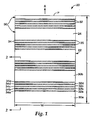
- FIG. 1 One embodiment of a cleaning wipe 20 in accordance with the present invention is provided in FIG. 1 .
- the cleaning wipe 20 includes a fiber web 22 forming a working surface 24.
- the term "working surface” is in reference to a side of the cleaning wipe 20 that is otherwise presented to and guided (or “wiped") across a surface to be cleaned (not shown).
- the working surface 24 is facing out of the page, with the cleaning wipe 20 having a second surface (hidden in FIG. 1 ) opposite the working surface 24.
- the working surface 24 defines one or more first regions 30, one or more second regions 32 and one or more third regions 34.
- the first, second and third regions 30-34 are characterized as having differing degrees of loftiness and height, adapted to facilitate capture or retention of lightweight, fine debris (not shown), for example hair (e.g., human hair, pet hair, etc.) in one or more of the first region(s) 30, and capture or retention of particulate-type debris (not shown), for example dirt in one or more of the second region(s) 32.
- the cleaning wipe 20 of the present invention is well-suited for use in cleaning hard surfaces in areas having both hair and other debris such as a floor.
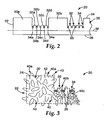
- FIG. 2 is a schematic cross-sectional view of the cleaning wipe 20 (and further illustrates a second side 36 opposite the working surface 24), whereas FIG. 3 provides an enlarged view of one embodiment of the cleaning wipe 20 including fibers 40 (referenced generally).
- the web 22 has a uniform material construction (i.e., the web 22 is comprised of a uniform material/composition as described below), and is processed to generate the differing first, second and third regions 30-34.
- the web 22 is configured such that the first regions 30 have a first degree of loftiness and a first height, the second regions 32 have a second degree of loftiness and a second height, and the third regions 34 have a third degree of loftiness and a third height.
- the regions 30-34 are visually distinct from one another, meaning that they are readily discernable to the naked eye.
- the web 22 can consist of two or more webs brought together to form the first regions 30 (and/or the second regions 32).
- a first web can be provided that forms the second and third regions 32, 34, and second web(s) (higher loft) can be secured to the first web to form the first regions 30.
- degree of loftiness is in reference to the spacing or "openness" of fibers otherwise forming the surface/area/volume in question. For example, a first surface/area/volume with fewer fibers per unit area or volume as compared to a second surface/area/volume comprised of the same denier fibers is considered to have a higher degree of loftiness.
- degree of loftiness can be defined as in terms of bulk density.
- Bulk density is the weight of a given web per unit volume. The web thickness can be measured in many ways; one accurate method employs an optical scanning technique.
- height as used in this specification is in reference to extension of the working surface 24 beyond (or “above” relative to the orientations of FIGS. 2 and 3 ) relative to a mid-plane M that is otherwise generally parallel to a planar orientation of the web 22 (e.g., parallel to the second side 36 when the second side 36 is otherwise generally flat, it being understood that the second side 36 need not necessarily be flat).
- height can be measured from/relative to the second side 36.
- the first degree of loftiness i.e., the degree of loftiness associated with the first regions 30
- the second degree of loftiness is greater than the third degree of loftiness
- the first height i.e., the height associated with the first regions 30
- the second height is greater than the third height.
- the degree of loftiness is better illustrated by the "openness" of the fibers 40.
- the first regions 30 can be described as including fibers 40a, the second regions 32 as including the fibers 40b, and the third regions 34 as including the fibers 40c.
- the fibers 40a are more distinctly spaced apart as compared to the fibers 40b; and the fibers 40b are more distinctly spaced apart as compared to the fibers 40c.
- the first regions 30 can be described as having fewer fibers 40 per unit volume as compared to the number of fibers 40 per unit volume of the second regions 32.
- the second regions 32 can be described as having fewer fibers 40 per unit volume as compared to the number of fibers 40 per unit volume of the third regions 34.
- this difference in degree of loftiness or fibers per unit volume can be achieved by compressing the web 22 to a greater extent in the third regions 34 as compared to the second regions 32, and by compressing the web 22 to a greater extent in the second regions 32 as compared to the first regions 30.
- the bulk density of the first regions 30 is at least 100% less than the bulk density of the second regions 32, more preferably at least 200% less than, and even more preferably at least 300% less than. It will be understood that by having a lesser bulk density, the first degree of loftiness (of the first regions 30) is thus greater than the second degree of loftiness (of the second regions 32) as bulk density has an inverse relationship with loftiness.
- the bulk density of the second regions 32 is at least 100% less than the bulk density of the third regions 34, and more preferably at least 200% less than.
- the fibers 40 comprising the web 22 are, in one embodiment, randomly or semi-randomly dispersed within the web 22.
- the web 22 does not have clear “edges” as otherwise reflected in the schematic illustrations of FIGS. 1 and 2 .
- various ones of the fibers 40 "extend” or project beyond hypothetical edges of the web 22 (shown with dashed lines in FIG. 3 ).
- the "height" of a particular region can be more accurately described as the nominal height defined by a majority of the fibers 40 positioned/extending at the working surface 24.
- the fibers 40a combine to define a height of the first region 30 shown in FIG. 3 . It will be further understood, then, that individual ones of the first regions 30 need not have identical heights, nor need the second regions 32 and/or the third regions 34.
- the height of the first regions 30 is at least 120% of the height of the second regions 32, more preferably at least 150%, and even more preferably at least 200%.
- the height of the second regions 32 is at least 110% of the height of the third regions 34, more preferably at least 125%, and even more preferably at least 135%.
- the second regions 32 extend beyond (or "above” relative to the orientation of FIGS. 2 and 3 ) the third regions 34, and the first regions 30 extend beyond (or "above” relative to the orientation of FIGS. 2 and 3 ) the second regions 32.
- An adhesive 35 is included on the wipe 20 and preferably on at least the third region 34 to assist in holding and retaining dirt and debris.
- U.S. Patent Application 10/093792, filed on March 8, 2002 generally discloses a wipe with raised portions and recessed portions including adhesive in the recessed portion.
- the adhesive 35 is included at the third region 34.
- the adhesive 35 may be included at the third region 34 and the second region 32.
- the adhesive 35 may be included only at the second region 32.
- the adhesive 35 may only be applied in a select number of third regions 34 or second regions 32.
- the adhesive 35 may only be applied across a portion of each of the individual third regions 34 or second regions 32.
- the adhesive 35 is applied from one edge of the wipe continuously across to the other edge, however that is not required.
- adhesive 35 in a tacky form, is not included at the first region 30. If an adhesive 35 is included at the first region 30, that adhesive will generally be detackified or would only be included on a select number of first regions 30. Including adhesive 35 in a tacky form at the first region 30 limits the ability of the web 22 to slide over a surface to be cleaned.
- Suitable adhesives for use with the present invention include any that are capable of being tacky at room temperature, including both adhesives that are initially tacky and those that are initially non-tacky but which can be activated to become tacky.
- Suitable adhesives include any pressure-sensitive adhesives, including materials based on acrylates, silicones, poly-alpha-olefins, polyisobutylenes, rubber block copolymers (such as styrene/isoprene/styrene and styrene/butadiene/styrene block copolymers), styrene butadiene rubbers, synthetic isoprenes, natural rubber, and blends thereof.
- the pressure-sensitive adhesives may be coated from solvent, from water, radiation polymerized, or hot melt processed. These pressure-sensitive adhesives may or may not be crosslinked. Crosslinking can be done by well-known methods, including chemical, ionic, physical, or radiation-induced processes. If the adhesive is to be pushed through the wiping member, materials with low viscosity are preferred. To improve the cohesive strength of the adhesive once deposited into the valleys of the wiping member, some crosslinking may be used. To allow for low viscosity for easy processing while providing for good cohesive strength, adhesives with physical crosslinking, ionic crosslinking, or some form of post-crosslinking are preferred.
- Post-crosslinking can be carried out by exposing the adhesive to radiation, such as electron-beam or high intensity ultraviolet (UV) radiation.
- radiation such as electron-beam or high intensity ultraviolet (UV) radiation.
- UV crosslinking it may be desirable to incorporate a photo-receptive group in the polymer backbone to facilitate the crosslinking reaction.
- United States Patent No. 4,737,559 discloses examples of such UV-crosslinked adhesives.
- Physical or ionic crosslinking provide the advantage that the process is thermally reversible, making it particularly preferred for hot-melt processing.
- Physically-crosslinked adhesives include those based on rubber block copolymers.
- Examples of synthetic rubber block copolymers include KratonTM commercially available from Kraton Polymers of Houston, Texas, and VectorTM commercially available from Exxon-Mobil of Houston, Texas. These block copolymers are typically formulated into pressure sensitive adhesives by compounding them with tackifiers and/or oils. Details about the formulation of these types of adhesives can be found in the Handbook of Pressure Sensitive Adhesive Technology, Second Edition, chapter 13 (D. Satas editor, Van Nostrand Reinhold publisher, N.Y .)
- Other physically crosslinked adhesives include macromer grafted polymers as disclosed in United States Patent No. 5,057,366 (Husman et al. ).
- the adhesives useful in this invention may be tacky under both dry and wet conditions. Adhesives with high tack under wet conditions are disclosed in US Patent 6,855,386 .
- the pressure-sensitive adhesives may also be coated from water in the form of a latex or dispersion. As discussed in the Handbook of Pressure-Sensitive Adhesive Technology 2nd edition (D. Satas editor, Van Nostrand Reinhold, NY, 1989 ), these adhesives may be based on polymers like natural rubber, acrylates, styrene-butadienes, and vinyl ethers. Especially when coated directly on a porous, woven, or nonwoven substrate, the neat latex adhesives may not be viscous enough to prevent excessive penetration into the substrate.
- the viscosity and flow of the latex adhesive may be controlled by the solids content of the material, it may be more beneficial to formulate the latex with thickening agents.
- Thickening agents are typically categorized as watersoluble polymers or associative thickeners. Their nature and mechanism of operation are described in Emulsion Polymerization and Emulsion Polymers, chapter 13, page 455 (P. Lovell and M. El-Aasser editors, John Wiley and Sons, NY, 1997 ). As discussed in the Handbook of Pressure-Sensitive Adhesive Technology 2nd edition, chapter 16, page 473 (D. Satas editor, Van Nostrand Reinhold, NY, 1989 ), in the case of pressure-sensitive adhesives, particular care has to be taken in the selection of the thickening agent so it does not interfere with the adhesive properties.
- the amount of adhesive that should be applied depends on a number of factors, including the tackiness of the adhesive, the degree to which the adhesive may be squeezed through the wiping member, directly coated as shown in FIG. 4 , the characteristics of the wiping member and the backing member (particularly in regard to the amount of adhesive that can be pushed through each member), the degree to which the adhesive adheres to surfaces (and thus makes wiping difficult), and other such factors.
- the amount of adhesive should be sufficient enough for the wipe to capture both small and large particles of various shapes and consistencies, such as lint, dust, hair, sand, food particles, gravel, twigs, leaves, and the like, without having excess adhesive that could create drag and make wiping difficult or that could transfer to the surface being cleaned.
- the adhesive may be applied as a continuous layer or as a discontinuous layer and may be applied by a variety of methods such as stripe coating, pattern coating, spray coating, screen printing, etc., as is known in the art.
- the wipe constructions will typically include from about 5 weight % to about 200 weight % of adhesive, more typically from about 10 weight % as directly applied to regions on the working surface 24 as shown in FIG. 4 or up to about 130 weight % of adhesive as coated and squeezed though to the working surface 24, based on the weight of the input nonwoven wiping member (or the combined weight of the input nonwoven wiping member and the backing member, if a backing member is present). Also, the ratio between areas that have adhesive and those that either have no adhesive or a de-tackified adhesive can range from about 75:25 to about 10:90.
- the first, second and third regions 30-34 are arranged, in one embodiment, to define a pattern.
- the first regions 30 can be defined as including a series of pairs of adjacent first regions, such as the first regions 30a and 30b.
- the adjacent first regions 30a, 30b are spaced from one another by a plurality of the second regions 32 (designated in FIGS. 1 and 2 as the second regions 32a, 32b, 32c, and 32d) and a plurality of the third regions 34 (designated in FIGS. 1 and 2 as the third regions 34a, 34b, 34c, 34d, and 34e).
- the plurality of second regions 32a-32d located between the adjacent first regions 30a, 30b are each separated by a respective one of the third regions 34b-34d.
- the second regions 32a, 32b are separated by the third region 34b.
- this pattern is repeated across an entirety of the working surface 24 (e.g., the same number of second regions 32 and third regions 34 are disposed between adjacent pairs of the first regions 30, with the first regions 30 each having the same dimensions, the second regions 32 each having the same dimensions, and the third regions 34 each having the same dimensions).
- the pattern can be non-repeating. Regardless, at least one adjacent pair of first regions 30 are formed and separated by at least one of the second regions 32 and at least one of the third regions 34.
- each of the regions 30-34 can be described as generally defining a length and a width (it being recalled that in accordance with one embodiment in which the web 22 includes the randomly distributed fibers 40, distinct edges (and thus uniform width) are not necessarily present).
- the regions 30-34 are oriented such that the length of each region 30-34 extends across at least a majority, more preferably at least 75%, and in one embodiment an entirety, of a dimension of the perimeter P.
- the regions 30-34 extends across the width W.
- the length of each of the regions 30-34 approximates the width W of the web 22. Therefore, in this embodiment, the regions 30-34 are preferably arranged such that the respective lengths extend generally perpendicular to an intended wiping direction (shown with an arrow A in FIG. 1 ).
- the web 22, and thus the cleaning wipe 20 can assume a wide variety of other shapes such that the perimeter P need not be rectangular.
- the regions 30-34 are not required to be arranged generally perpendicular to an intended wiping direction.
- Other arrangements of the regions 30-34 are desirable, such as, but not limited to, an arrangement of the regions 30-34 extending parallel to one another but generally diagonal with respect to the intended wiping direction.
- arrow A indicates the intended wiping direction and the regions 30-34 are generally diagonally disposed with respect to direction A.
- the angle of the regions may range from 0 degrees (parallel to the intended wiping direction A) to 90 degrees (perpendicular to the intended wiping direction A).
- the regions 30-34 are at and angle of 45 degrees with respect to an intended wiping direction, as depicted by FIG. 6 .
- a width of each of the first regions 30 is, in one embodiment, wider that a width of the second regions 32 and the third regions 34.
- a width of the first regions 30 is at least 150% of a width of the second and third regions 32, 34; more preferably at least 225%; and even more preferably at least 300%.
- a width of the second regions 32 is wider than the third regions 34, for example on the order of 200% - 300% wider.
- the second regions 32 can be even wider or less wide as compared to the third regions 34.
- a significant spacing is provided between adjacent pairs of the first regions 30 (e.g., the first regions 30a, 30b) via the one or more second regions 32 (e.g., the second regions 32a-32d) and the one or more third regions 34 (e.g., the third regions 34a-34e).
- a spacing between adjacent pairs of the first regions 30 is not less than 75% of the width of the first regions 30; more preferably at least 100% of the width of the first regions 30; even more preferably at least 150% of the width of the first regions 30.
- first regions 30, the second regions 32, and the third regions 34 are illustrated in FIG. 1 as being identical in terms of shape and size, individual ones of the regions 30, 32 and/or 34 can vary from one another.
- a first one of the first regions 30 can be wider that a second one of the first regions 30.
- ones of the second regions 32 can vary in width from others of the second regions 32, as can the third regions 34.
- one or more of the regions 30, 32, and/or 34 need not have the generally rectangular shape depicted in the exemplary embodiment of FIG. 1 .
- one or more or all of the first regions 30 can be triangular, circular or wavy, as can one or more or all of the second regions 32 and/or the third regions 34.
- the present invention encompasses virtually any configuration of the regions 30, 32 and 34 so long as at least one of each of the first, second and third regions 30-34 are provided, with the first region 30 having a higher degree of loftiness and height as compared to the second and third regions 32, 34, and the second region 32 having a higher degree of loftiness and height as compared to the third region 34.
- the cleaning wipe 20 is adapted for attachment to a cleaning tool head (described below) otherwise providing a major dimension on the order of 5 inches (plus or minus 1 inch)
- a minimum of two of the first regions 30 is included with the cleaning wipe 20 to provide uniform weight support.
- the web 22 can assume a wide variety of constructions that facilitate formation of the high loft first regions 30.
- the working surface 24 is defined by subjecting an initial web or combination of two or more webs (that otherwise result in the web 22) to various processing methods, for example compression. With this in mind, the following description of the web 22 is with respect to an initial web 22a (shown in FIG. 4 ) following initial formation and prior to subsequent processing to otherwise form the working surface 24.
- the web 22a or individual fiber web layers thereof can be a knitted, woven, or preferably a non-woven fibrous material.
- the web 22a is comprised of individual fibers entangled with one another (and optionally bonded) in a desired fashion.
- the fibers are preferably synthetic or manufactured, but may include natural fibers.
- the term "fiber” includes fibers of indefinite length (e.g., filaments) and fibers of discrete length (e.g., staple fibers).
- the fibers used in connection with the web 22a may be multicomponent fibers.
- multicomponent fiber refers to a fiber having at least two distinct longitudinally coextensive structured polymer domains in the fiber cross-section as opposed to blends where the domains tend to be dispersed, random, or unstructured.
- useful fiberous materials include, for example, polyesters, polyamides, polyimides, nylon, polyolefins (e.g., polypropylene and polyethylene), etc., of any appropriate fiber length and denier, and mixtures thereof.
- some or all of the fibers can have special treatments to enhance hydrophilic properties, such as additives including super-absorbing gel polymers; also, powder(s) or fiber(s) such as but not limited to rayon, cotton, and cellulose, can be added to enhance liquid holding capacity.
- Small denier size staple fibers provide the web 22a with smaller pore sizes and more surface area as compared to a fiber web made with larger denier fibers (e.g., 20d - 200d) that otherwise provides the web 22a with larger pore sizes and less surface area.
- the small denier fiber webs are best suited for cleaning surfaces contaminated with fine dust and dirt particles, whereas the large denier fiber webs are best suited for cleaning surfaces contaminated with larger dirt particles such as sand, food crumbs, lawn debris, etc.
- the larger pore sizes of the larger denier staple fibers allows the larger contaminant particles to enter, and be retained by, the matrix of the fiber web.
- the web 22a of the present invention can include one or both of the small and/or large denier fibers that may or may not be staple fibers.
- the fiber web 22a includes crimped, high heat distortion fibers.
- a majority of the fibers of the web 22a are of a larger denier (e.g., at least 20 denier, more preferably at least 25 denier).
- the web 22 includes 45% 15 denier PET fibers, 25% 6 denier PET fibers, and 30% 2 denier bi-component (PE sheath/PP core) melty fibers.
- a minimum web weight of 30 gsm has surprisingly been found necessary, in one embodiment, to adequately fill out the web geometry during a subsequent embossing process (described below).
- the fibers 40 are preferably randomly oriented, and bonded by compression and polymeric bonding of the fibers (e.g., bi-component fibers) at the edges to define partial or complete loops and to bond the formed web 22a to a backing (not shown).
- the fibers e.g., bi-component fibers
- spunbond or adhesive webs or spray adhesives, or any other known technique can also be used to bond the formed web 22a to a backing.
- the loop-like fibers 40 are oriented such that a closed end 42 (referenced in FIG. 3 for several of the fibers 40) is at an outer face of the working surface 24.
- This configuration of the fibers 40 is in contrast to other wipe constructions in which the working face has hooks. It has surprisingly been found that by forming the fibers 40 as loops, the resultant cleaning wipe 20 does not generate an audible "scratching" noise as the working surface 24 is wiped across a hard surface, yet desired capture/retention of debris is still achieved.
- the fibers 40 can have a wide variety of other configurations, and need not be loops or loop-like.
- the initial web 22a can be formed in a variety of known fashions including, for example, carding, spunbond, meltblown, airlaid, wetlaid, etc.
- the initial web 22a can be consolidated by any known technique such as, for example, hydroentanglement, thermal bonding (e.g., calender or through air), chemical bonding, etc.
- the web 22a is subjected to processing to produce the working surface 24 consisting of one or more of the first region(s) 30, one or more of the second region(s) 32, and one or more of the third region(s) 34 coated with an adhesive 35.
- the working surface 24 is formed by subjecting the initial web 22a to compressive forces, for example by passing the initial web 22a between a patterned embossing roller and a flat roller (or an engraved roller).
- FIG. 4 illustrates one embodiment of a calender system 50 capable of processing the initial web 22a to form the working surface 24.
- the system 50 includes a patterned embossing roller 52 and a flat roller 54.
- a transfer roller 64 is included.
- the embossing roller 52 defines a pattern of grooves and lands, including first grooves 56 and second grooves 58 as well as first lands 60 and second lands 62 (with the first lands 60 being defined at the base of the second grooves 58 and the second lands 62 defining a maximum outer diameter of the roller 52).
- first grooves 56 are deeper than the second grooves 58, and correspond with/generate the first regions 30, whereas the second grooves 58 correspond with/generate the second regions 32.
- the first lands 60 correspond with/generate the second regions 32
- the second lands 62 correspond with/generate the third regions 34.
- U.S. Patent Application 11/025388 filed on December 29, 2004 discloses a preferred method of applying adhesive to a web. This method may be used in conjunction with the disclosed embossing roller 52 and flat roller 54.
- the arrows included in FIG. 4 indicate the direction of movement of the web 22 and the rollers 52, 54, and 64.
- the initial web 22a is passed between the embossing roller 52 and the flat roller 54.
- a constant distance between center points of the rollers 52, 54 is maintained, whereby a minimum distance between the rollers 52, 54 is achieved at the second lands 62.
- the rollers 52, 54 impart a compression force on to the initial web 22a, with maximum compression being achieved at the second lands 62, intermediate compression being achieved at the first lands 60, and minimal or no compression occurring at the first grooves 56.
- the resultant web 22 is thus characterized by the third regions 34 being more compressed than the second regions 32, and the second regions 32 being more compressed than the first regions 30. While the second side 36 is shown as being relative flat following processing by the system 50, the system 50 can alternatively be configured to render the second side 36 to have desired, non-continuous shape(s).
- the apparatus included to applying the adhesive 3 5 generally includes a dispenser 6 to dispense the adhesive 35 onto the transfer roller 64 that works in conjunction with the embossing roller 52 and flat roller 54.
- the transfer roller 64 rotatably engages with the embossing roller 52 to transfer the adhesive 35 from the transfer roller 64 to the embossing roller 52.
- a doctor blade 7 is provided adjacent the transfer roller 64 to spread the adhesive 35 uniformly over the entire outer surface of the transfer roller 64.
- the second lands 62 contact the transfer roller 64, and therefore the adhesive 35, so that adhesive 35 is placed on the second lands 62.
- the adhesive 35 is transferred to the web 22 so that the adhesive 35 ultimately is placed within third regions 34.
- adhesive separating element 8 and second adhesive separating element 9 may be included to cut any adhesive strands that may bridge the gap between the transfer roller 64 and the embossing roller 52 or between the web 22 and the embossing roller 52.
- Such a separating element may be an electrically resistive heating element, such as NICHROME heating element or wire.
- the desired thickness of the adhesive 35 applied to the transfer roller 64 will depend on the type of adhesive, the intended end use application for the web, and on the geometry of the embossing roller 52. In one embodiment an acrylic hot-melt pressure-sensitive adhesive 35 is applied to the transfer roller 64 in a thickness of 0.001 - 0.004 inches.
- the amount of adhesive 35 applied to the web 22 will depend on a number of factors including the type of adhesive and the physical characteristics of the web.
- the adhesive 35 is typically coated on to the web at a minimum weight of about 1 gsm, more typically of at least about 2.5 gsm, and even more typically at least about 4 gsm, and at a maximum weight of no more than about 25 gsm, more typically no more than about 15 gsm, and even more typically no more than about 8 gsm.
- a number of other manufacturing techniques can be employed to process the initial web 22a in a manner that generates the desired working surface 24.
- the patterned embossing roller 52 can incorporate different patterns from that shown.
- a heavy weight carded web can be embossed as described above with reference to FIG. 4 .
- alternative methods or variations on the application of the adhesive 35 are within the scope of the invention.
- FIG. 5 illustrates one alternative embodiment cleaning wipe 70 including the web 22 and an outer layer 74 attached to the web 22 with adhesive 72. As described below, the outer layer 74 provides additional, beneficial features to the cleaning wipe 70.
- outer layer 74 is directly secured to web 22.
- the outer layer 74 maybe elastic or nonelastic, a nonwoven, a film, a foam, a knitted or woven fabric, or a mesh or scrim.
- outer layer 74 is a nonwoven material having a basis weight of 7 gsm to 70 gsm and preferably from 10 gsm to 30 gms.
- any known attachment mechanism may be use such as, but not limited to, needle punching or melty fibers within either the outer layer 74 or web 22.
- Outer layer 74 provides support to the web 22 to help prevent the web 22 from expanding and therefore collapsing the regions 30-34.
- the outer layer 74 is configured to facilitate attachment/mounting of the cleaning wipe 70 to a cleaning implement or tool.
- the outer layer 74 can include or consist of a plurality of loops (e.g., loop or loop-like fibers) or similar structures (e.g., hooks) extending from a back surface 80 of the cleaning wipe 70.
- the outer layer 74 can include or have attached thereto any other form of fastening component, such as mechanical fasteners, auto-adhesion polymers, polar polymers, etc.
- the fastening component(s) can be provided across an entirety of the back surface 80, or can be discretely located (e.g., pattern coated adhesive).
- the tool can be adapted to retain the cleaning wipe 70 without the provision of an attachment/mounting component with the cleaning wipe 70 (e.g., the tool can include mechanical grippers for retaining the cleaning wipe 20).
- the cleaning wipe 20, 70 may be used in conjunction with an appropriate cleaning implement or tool (not shown) having any variety of shape or configuration. If use with a tool, the cleaning wipe 20, 70 has an overall shape and size commensurate with the tool. Once mounted to the tool, the tool can be manipulated to guide the cleaning wipe 20, 70 across a surface to be cleaned (not shown) as part of a cleaning operation. In another alternative embodiment, the cleaning wipe 70 is handled directly by the user's hand, such that a separate cleaning tool or implement is not required.
- the wipe 20, 70 is uniquely able to capture and retain different types of debris.
- lightweight, fine debris and specifically including human or pet hair, is captured within and retained by the first regions 30 due to their high loft in combination with the above-described spacing between adjacent pairs of the first regions 30.
- dirt and other particulate-type debris, as well as more adherent debris is readily captured and retained within the second regions 32 due to their loft in combination with the spacing provided by the third regions 34 and adhesive 35.
- a carded calendared backing web (15 gsm blend of 65% Wellman 1.5 denier PET/35% Kosa T-254 2 denier melty fiber) was prepared for use as a backing web.
- a second 38 gsm lofty carded thermo-bonded web (65% 6 denier Wellman PET/35% Kosa T-254 2 denier melty fiber) was also prepared.
- the two webs were fed together into a pair of heated embossing rolls so that the lofty web was in contact with the profiled embossing roll.
- the profiled web was coated with 4 gsm of a hot melt acrylic pressure sensitive adhesive as shown in the transfer coating process described in FIG. 4 to make a product described in FIG. 2 .
- the finished profiled web is shown in the attached FIG 6 .
Landscapes
- Engineering & Computer Science (AREA)
- Textile Engineering (AREA)
- Chemical & Material Sciences (AREA)
- Chemical Kinetics & Catalysis (AREA)
- Dispersion Chemistry (AREA)
- General Chemical & Material Sciences (AREA)
- Mechanical Engineering (AREA)
- Cleaning Implements For Floors, Carpets, Furniture, Walls, And The Like (AREA)
Claims (10)
- Reinigungstuch (20) zum Aufnehmen von Schmutz, wobei das Reinigungstuch Folgendes umfasst:eine Bahn (22), die eine Arbeitsfläche (24) einer zweiten Oberfläche gegenüberliegend definiert, wobei die Arbeitsfläche mindestens einen ersten Bereich (30) definiert, der einen ersten Grad der Bauschigkeit und eine erste Höhe aufweist, einen zweiten Bereich (32), der einen zweiten Grad der Bauschigkeit und eine zweite Höhe aufweist, und einen dritten Bereich (34), der einen dritten Grad der Bauschigkeit und eine dritte Höhe aufweist, wobei:der dritte Bereich ein Haftmittel (35) beinhaltet;der erste Grad der Bauschigkeit größer als der zweite Grad der Bauschigkeit ist, der größer als der dritte Grad der Bauschigkeit ist; unddie erste Höhe größer als die zweite Höhe ist, die größer als die dritte Höhe ist.
- Reinigungstuch nach Anspruch 1, wobei die Bahn einen gleichförmigen Aufbau derart aufweist, dass eine Materialzusammensetzung des ersten, zweiten und dritten Bereichs identisch ist.
- Reinigungstuch nach Anspruch 1, wobei die Arbeitsfläche mehrere der ersten Bereiche, mehrere der zweiten Bereiche und mehrere der dritten Bereiche beinhaltet und wobei ferner ein benachbartes Paar erster Bereiche durch mindestens einen der zweiten Bereiche und mindestens einen der dritten Bereiche getrennt ist.
- Reinigungstuch nach Anspruch 3, wobei das benachbarte Paar erster Bereiche durch eine Vielzahl zweiter Bereiche getrennt ist, von denen benachbarte durch einen der dritten Bereiche getrennt sind.
- Reinigungstuch nach Anspruch 3, wobei die mehreren ersten, zweiten und dritten Bereiche kombiniert sind, um ein Muster auf der gesamten Arbeitsfläche zu definieren, wobei das Muster benachbarte Paare erster Bereiche beinhaltet, die durch eine Vielzahl zweiter Bereiche getrennt sind, wobei die Vielzahl zweiter Bereiche, die zwischen jedem benachbarten Paar erster Bereiche gebildet sind, andererseits durch einen der dritten Bereiche getrennt sind.
- Reinigungstuch nach Anspruch 5, wobei jeder der Bereiche eine Länge aufweist, die größer als eine Breite ist, und wobei ferner eine Breite der ersten Bereiche größer als die Breite der zweiten Bereiche und der dritten Bereiche ist.
- Reinigungstuch nach Anspruch 1, wobei die Bahn ein Vliessubstrat derart ist, dass die Arbeitsfläche aus Vliesfasern besteht, und wobei ferner der erste Bereich dadurch gekennzeichnet ist, dass er pro Volumeneinheit weniger Fasern als der zweite Bereich und der dritte Bereich aufweist.
- Reinigungstuch nach Anspruch 1, ferner eine Außenschicht umfassend, die mit der Bahn verbunden ist.
- Reinigungstuch nach Anspruch 1, wobei der erste Bereich, der zweite Bereich und der dritte Bereich linear sind und parallel zueinander liegen.
- Reinigungstuch nach Anspruch 9, wobei der erste Bereich, der zweite Bereich und der dritte Bereich im Verhältnis zu einer beabsichtigten Reinigungsrichtung in einem Winkel zwischen 0 und 90 Grad angeordnet sind.
Applications Claiming Priority (2)
| Application Number | Priority Date | Filing Date | Title |
|---|---|---|---|
| US11/362,549 US7700178B2 (en) | 2006-02-24 | 2006-02-24 | Cleaning wipe with variable loft working surface |
| PCT/US2007/003119 WO2007097910A1 (en) | 2006-02-24 | 2007-02-06 | Cleaning wipe with variable loft working surface |
Publications (3)
| Publication Number | Publication Date |
|---|---|
| EP1991105A1 EP1991105A1 (de) | 2008-11-19 |
| EP1991105A4 EP1991105A4 (de) | 2009-09-02 |
| EP1991105B1 true EP1991105B1 (de) | 2013-05-15 |
Family
ID=38437700
Family Applications (1)
| Application Number | Title | Priority Date | Filing Date |
|---|---|---|---|
| EP07717201.3A Not-in-force EP1991105B1 (de) | 2006-02-24 | 2007-02-06 | Wischtuch mit unterschiedlich erhabener arbeitsfläche |
Country Status (7)
| Country | Link |
|---|---|
| US (1) | US7700178B2 (de) |
| EP (1) | EP1991105B1 (de) |
| KR (1) | KR101283107B1 (de) |
| CN (1) | CN101426411B (de) |
| ES (1) | ES2423201T3 (de) |
| TW (1) | TW200738444A (de) |
| WO (1) | WO2007097910A1 (de) |
Families Citing this family (22)
| Publication number | Priority date | Publication date | Assignee | Title |
|---|---|---|---|---|
| US8011050B2 (en) * | 2005-05-31 | 2011-09-06 | S.C. Johnson & Son, Inc. | Fabric sweeper |
| US20070227928A1 (en) * | 2005-05-31 | 2007-10-04 | Olson Christopher R | Container comprising a disposable cleaning implement and a method of promoting the sale of a disposable cleaning implement |
| US20070192979A1 (en) * | 2005-05-31 | 2007-08-23 | Knopow Jeremy F | Cleaning implement having a visual indicator for determining debris removal effectiveness and end of useful life |
| US7721372B2 (en) | 2005-05-31 | 2010-05-25 | S.C. Johnson & Son, Inc. | Fabric sweeper |
| US20080029204A1 (en) * | 2006-08-03 | 2008-02-07 | Jeremy Knopow | Machine and method for assembling a fabric sweeper |
| USD591468S1 (en) | 2006-10-02 | 2009-04-28 | S. C. Johnson & Son, Inc. | Fabric sweeper |
| USD626339S1 (en) | 2006-10-02 | 2010-11-02 | S.C. Johnson & Son, Inc. | Handheld fabric sweeper having a rounded top |
| USD575018S1 (en) | 2006-10-02 | 2008-08-12 | S.C. Johnson & Son, Inc. | Handheld fabric sweeper with icon |
| US20100044909A1 (en) * | 2008-08-20 | 2010-02-25 | 3M Innovative Properties Company | Lofty, tackified nonwoven sheet and method of making |
| US8347447B2 (en) * | 2009-11-10 | 2013-01-08 | 3M Innovative Properties Company | Mop body having recessed side surfaces |
| US20110247651A1 (en) | 2010-04-13 | 2011-10-13 | Neumann Peter M | Fabric Sweeper |
| USD689660S1 (en) | 2010-06-24 | 2013-09-10 | S.C. Johnson & Son, Inc. | Fabric sweeper |
| USD689659S1 (en) | 2010-06-24 | 2013-09-10 | S.C. Johnson & Son, Inc. | Fabric sweeper |
| USD657573S1 (en) | 2010-07-02 | 2012-04-17 | S.C. Johnson & Son, Inc. | Lid for a fabric sweeper device |
| WO2012006300A1 (en) * | 2010-07-07 | 2012-01-12 | 3M Innovative Properties Company | Patterned air-laid nonwoven fibrous webs and methods of making and using same |
| ITRM20120653A1 (it) * | 2012-12-20 | 2014-06-21 | Eudorex S R L | Spugna abrasiva antigraffio. |
| JP2016214137A (ja) * | 2015-05-19 | 2016-12-22 | 安川 洋一 | ペットトイレ用マット |
| US10464285B2 (en) * | 2016-01-29 | 2019-11-05 | Panasonic Intellectual Property Management Co., Ltd. | Laminate and manufacturing method thereof |
| WO2017131912A1 (en) | 2016-01-29 | 2017-08-03 | Unger Marketing International, Llc | Hard surface cleaning devices for use with cleaning fabrics |
| CN109152507A (zh) * | 2016-05-03 | 2019-01-04 | 3M创新有限公司 | 湿或干清洁介质 |
| JP7667689B2 (ja) * | 2021-04-28 | 2025-04-23 | 日東電工株式会社 | クリーニングシートおよびクリーニング機能付搬送部材 |
| IL284020A (en) | 2021-06-15 | 2023-01-01 | Polymer Gvulot Ltd | Adhesive wet wipes |
Family Cites Families (63)
| Publication number | Priority date | Publication date | Assignee | Title |
|---|---|---|---|---|
| US3765997A (en) | 1968-12-16 | 1973-10-16 | Kimberly Clark Co | Laminate |
| US3542634A (en) | 1969-06-17 | 1970-11-24 | Kendall & Co | Apertured,bonded,and differentially embossed non-woven fabrics |
| US3965519A (en) | 1974-07-08 | 1976-06-29 | S. C. Johnson & Son, Inc. | Disposable floor polishing wipe |
| US4007801A (en) * | 1976-02-06 | 1977-02-15 | Crowley All Terrain Corporation | Suspension for vehicles |
| US4211227A (en) | 1978-07-03 | 1980-07-08 | The Kendall Company | Surgical sponge material |
| US4422892A (en) | 1981-05-04 | 1983-12-27 | Scott Paper Company | Method of making a bonded corrugated nonwoven fabric and product made thereby |
| US4612231A (en) | 1981-10-05 | 1986-09-16 | James River-Dixie Northern, Inc. | Patterned dry laid fibrous web products of enhanced absorbency |
| US5149332A (en) | 1982-06-30 | 1992-09-22 | Richard R. Walton | Absorbent and cushioning products and their manufacture |
| JPS5989892A (ja) * | 1982-10-20 | 1984-05-24 | レイモンド・シ−・ウエンク | スパイラルホ−ス用クランプ |
| US4537819A (en) | 1984-12-05 | 1985-08-27 | The Kendall Company | Scrub-wipe fabric |
| US4761322A (en) | 1985-10-07 | 1988-08-02 | Kimberly-Clark Corporation | Laminated fibrous web comprising differentially bonded layers, and method and apparatus for making the same |
| US5277761A (en) * | 1991-06-28 | 1994-01-11 | The Procter & Gamble Company | Cellulosic fibrous structures having at least three regions distinguished by intensive properties |
| DE3744438A1 (de) | 1987-12-29 | 1989-07-13 | Slaby Kai | Verpackungseinheit aus kunststoff fuer pflege-, reinigungs- und/oder desinfektionsmittel |
| US4883707A (en) | 1988-04-21 | 1989-11-28 | James River Corporation | High loft nonwoven fabric |
| SE463594B (sv) | 1989-05-24 | 1990-12-17 | Ulla Antionett Eriksson | Rengoeringsduk |
| JPH0747753B2 (ja) | 1990-02-08 | 1995-05-24 | 株式会社日本▲砿▼油 | 低騒音ウレアグリース組成物の製法 |
| US5260015A (en) | 1991-08-16 | 1993-11-09 | Velcro Industries, B.V. | Method for making a laminated hook fastener |
| US5302446A (en) | 1992-03-30 | 1994-04-12 | International Paper Company | Two-sided skin care wipe material and method for its manufacture |
| CA2105026C (en) | 1993-04-29 | 2003-12-16 | Henry Louis Griesbach Iii | Shaped nonwoven fabric and method for making the same |
| US5522110A (en) | 1995-05-18 | 1996-06-04 | Borofsky; Gary R. | Cleaning apparatus |
| JP3231993B2 (ja) | 1996-02-28 | 2001-11-26 | ユニ・チャーム株式会社 | 掃除用シート |
| US5655250A (en) | 1996-04-22 | 1997-08-12 | Warrell; Ann M. | Floor cleaning implement |
| US5958555A (en) | 1996-07-03 | 1999-09-28 | Uni-Charm Corporation | Disposable wiper sheet |
| JPH10171595A (ja) | 1996-12-06 | 1998-06-26 | Du Pont Toray Co Ltd | マウスパッド |
| MY121729A (en) | 1997-03-10 | 2006-02-28 | Uni Charm Corp | Wiping sheet and method for producing the same |
| JP3409988B2 (ja) | 1997-03-21 | 2003-05-26 | ユニ・チャーム株式会社 | 拭き取りシート |
| US6213344B1 (en) | 1997-05-23 | 2001-04-10 | The Procter & Gamble Company | Folding and stacking configuration for wet wipes |
| CN1264279A (zh) | 1997-05-23 | 2000-08-23 | 普罗格特-甘布尔公司 | 用作清洁片的结构 |
| US6777064B1 (en) | 1997-05-23 | 2004-08-17 | The Procter & Gamble Company | Cleaning sheets, implements, and articles useful for removing allergens from surfaces and methods of promoting the sale thereof |
| US7350257B2 (en) | 1998-06-12 | 2008-04-01 | Rapid Brands Corporation | Cleaning tool with removable cleaning sheets |
| US6810554B2 (en) | 1998-06-12 | 2004-11-02 | Rapid Brands Corporation | Cleaning tool with removable cleaning sheets |
| JP4320078B2 (ja) | 1999-02-15 | 2009-08-26 | 大和紡績株式会社 | 嵩高性不織布、その製造方法およびこれを用いた清拭材 |
| JP3492245B2 (ja) | 1999-07-06 | 2004-02-03 | ユニ・チャーム株式会社 | 弾性複合シート製造装置および弾性複合シート製造方法 |
| US7115535B1 (en) | 1999-08-02 | 2006-10-03 | The Procter & Gamble Company | Personal care articles comprising batting |
| US20010029966A1 (en) | 1999-12-10 | 2001-10-18 | Arthur Wong | Non-apertured cleaning sheets having non-random macroscopic three-dimensional character |
| US6775622B1 (en) * | 2000-01-31 | 2004-08-10 | Zymogenetics, Inc. | Method and system for detecting near identities in large DNA databases |
| DE10010508A1 (de) | 2000-03-07 | 2001-09-13 | Coronet Werke Gmbh | Reinigungs- oder Applikationsvorrichtung mit einem Schwammkörper und Verfahren zu dessen Herstellung |
| JP3744767B2 (ja) | 2000-03-27 | 2006-02-15 | ユニ・チャーム株式会社 | 複合シート |
| US6613954B1 (en) | 2000-04-20 | 2003-09-02 | The Procter & Gamble Company | Dispersible absorbent products and methods of manufacture and use |
| US6550092B1 (en) | 2000-04-26 | 2003-04-22 | S. C. Johnson & Son, Inc. | Cleaning sheet with particle retaining cavities |
| JP2004500945A (ja) | 2000-06-28 | 2004-01-15 | エス.シー. ジョンソン アンド サン、インコーポレイテッド | 粒子捕獲システム |
| EP1212972B1 (de) * | 2000-10-13 | 2015-12-09 | Kao Corporation | Reinigungstuch zum Reinigen einer samtigen Oberfläche |
| EP1370174A1 (de) | 2001-03-09 | 2003-12-17 | William Hockey-Smith | Reinigungstuch |
| JP2002369782A (ja) | 2001-06-15 | 2002-12-24 | Sansho Shigyo Kk | 清掃用シート及びその製造方法 |
| US20030049407A1 (en) | 2001-06-25 | 2003-03-13 | The Procter & Gamble Company | Disposable cleaning sheets comprising a plurality of protrusions for removing debris from surfaces |
| US20030044569A1 (en) | 2001-06-25 | 2003-03-06 | The Proctor & Gamble Company | Disposable cleaning sheets comprising a plurality of protrusions for removing debris from surfaces |
| US20030003831A1 (en) | 2001-06-29 | 2003-01-02 | Childs Stephen Lee | Cleaning sheets comprising multi-denier fibers |
| JP4979863B2 (ja) | 2001-09-27 | 2012-07-18 | 大王製紙株式会社 | 不織布と繊維ウェブの複合体シート、吸収体製品、および複合体シートの製造方法 |
| DE10153426A1 (de) | 2001-10-30 | 2003-05-22 | Hartmann Paul Ag | Verpackungsbehältnis für Feuchttücher oder feuchte Kosmetikpads |
| US20030094186A1 (en) | 2001-11-19 | 2003-05-22 | David Klein | Cleaning pad |
| US20030171051A1 (en) | 2002-03-08 | 2003-09-11 | 3M Innovative Properties Company | Wipe |
| US6777604B1 (en) * | 2002-08-18 | 2004-08-17 | Stephen N Sanderson | Insertable musical keyboard device with moving inserts to detect key movement |
| US20040121686A1 (en) | 2002-08-29 | 2004-06-24 | The Procter & Gamble Company | Low density, high loft nonwoven substrates |
| US6836923B2 (en) | 2002-09-23 | 2005-01-04 | Harper Corporation | Dust mop adapter |
| AU2003291518A1 (en) | 2002-11-13 | 2004-06-03 | The Procter And Gamble Company | Nonwoven wipe with resilient wet thickness |
| US7431975B2 (en) | 2002-11-29 | 2008-10-07 | Dzs, L.L.C. | Textured composite material |
| US7120388B2 (en) * | 2002-12-16 | 2006-10-10 | 3M Innovative Properties Company | Wireless intercom system and method of communicating using wireless intercom system |
| MXPA05005755A (es) * | 2002-12-20 | 2005-08-16 | Procter & Gamble | Trama fibrosa de hilos en bucle. |
| WO2004060133A1 (ja) | 2002-12-27 | 2004-07-22 | Kao Corporation | 清掃用シート |
| JP2006518223A (ja) | 2003-02-19 | 2006-08-10 | ザ プロクター アンド ギャンブル カンパニー | 洗浄シート |
| JP4320203B2 (ja) | 2003-04-18 | 2009-08-26 | 大和紡績株式会社 | 清掃用シート |
| US20060063456A1 (en) * | 2004-09-22 | 2006-03-23 | Pgi Polymer, Inc. | Nonwoven wiping fabrics having variable surface topography |
| US7846530B2 (en) | 2004-09-27 | 2010-12-07 | Kimberly-Clark Worldwide, Inc. | Creped electret nonwoven wiper |
-
2006
- 2006-02-24 US US11/362,549 patent/US7700178B2/en not_active Expired - Fee Related
-
2007
- 2007-02-06 CN CN2007800147273A patent/CN101426411B/zh not_active Expired - Fee Related
- 2007-02-06 ES ES07717201T patent/ES2423201T3/es active Active
- 2007-02-06 WO PCT/US2007/003119 patent/WO2007097910A1/en not_active Ceased
- 2007-02-06 KR KR1020087022407A patent/KR101283107B1/ko not_active Expired - Fee Related
- 2007-02-06 EP EP07717201.3A patent/EP1991105B1/de not_active Not-in-force
- 2007-02-16 TW TW096105950A patent/TW200738444A/zh unknown
Also Published As
| Publication number | Publication date |
|---|---|
| TW200738444A (en) | 2007-10-16 |
| WO2007097910A1 (en) | 2007-08-30 |
| EP1991105A1 (de) | 2008-11-19 |
| ES2423201T3 (es) | 2013-09-18 |
| US7700178B2 (en) | 2010-04-20 |
| KR20080096702A (ko) | 2008-10-31 |
| KR101283107B1 (ko) | 2013-07-05 |
| EP1991105A4 (de) | 2009-09-02 |
| US20070202768A1 (en) | 2007-08-30 |
| CN101426411A (zh) | 2009-05-06 |
| CN101426411B (zh) | 2011-11-16 |
Similar Documents
| Publication | Publication Date | Title |
|---|---|---|
| EP1991105B1 (de) | Wischtuch mit unterschiedlich erhabener arbeitsfläche | |
| EP2113186B1 (de) | Wischtuch für Staub, Schmutz und schwerere Partikel wie Sand | |
| JP4814845B2 (ja) | 掃除シート、掃除器具、及びこれらの使用 | |
| DE60124251T2 (de) | Reinigungstuch mit hohlräumen zum zurückhalten von schmutzteilchen | |
| US20060138693A1 (en) | Method and apparatus for making a cleaning sheet | |
| JP4369089B2 (ja) | ランダムでない巨視的三次元特徴を有する孔なしクリーニングシート | |
| CA2532563A1 (en) | Cleaning wipe and method of manufacture | |
| US20060240223A1 (en) | Cleaning sheet and method of making | |
| EP1841351B1 (de) | Reinigungstuch mit arbeitsfläche mit variabler höhe | |
| JP4179650B2 (ja) | 清掃用シート | |
| JP4451117B2 (ja) | 起毛状突起を有するワイパー |
Legal Events
| Date | Code | Title | Description |
|---|---|---|---|
| PUAI | Public reference made under article 153(3) epc to a published international application that has entered the european phase |
Free format text: ORIGINAL CODE: 0009012 |
|
| 17P | Request for examination filed |
Effective date: 20080829 |
|
| AK | Designated contracting states |
Kind code of ref document: A1 Designated state(s): AT BE BG CH CY CZ DE DK EE ES FI FR GB GR HU IE IS IT LI LT LU LV MC NL PL PT RO SE SI SK TR |
|
| A4 | Supplementary search report drawn up and despatched |
Effective date: 20090805 |
|
| DAX | Request for extension of the european patent (deleted) | ||
| GRAP | Despatch of communication of intention to grant a patent |
Free format text: ORIGINAL CODE: EPIDOSNIGR1 |
|
| GRAS | Grant fee paid |
Free format text: ORIGINAL CODE: EPIDOSNIGR3 |
|
| GRAA | (expected) grant |
Free format text: ORIGINAL CODE: 0009210 |
|
| AK | Designated contracting states |
Kind code of ref document: B1 Designated state(s): AT BE BG CH CY CZ DE DK EE ES FI FR GB GR HU IE IS IT LI LT LU LV MC NL PL PT RO SE SI SK TR |
|
| REG | Reference to a national code |
Ref country code: CH Ref legal event code: EP Ref country code: GB Ref legal event code: FG4D |
|
| REG | Reference to a national code |
Ref country code: AT Ref legal event code: REF Ref document number: 611689 Country of ref document: AT Kind code of ref document: T Effective date: 20130615 |
|
| REG | Reference to a national code |
Ref country code: IE Ref legal event code: FG4D |
|
| REG | Reference to a national code |
Ref country code: DE Ref legal event code: R096 Ref document number: 602007030439 Country of ref document: DE Effective date: 20130711 |
|
| REG | Reference to a national code |
Ref country code: ES Ref legal event code: FG2A Ref document number: 2423201 Country of ref document: ES Kind code of ref document: T3 Effective date: 20130918 |
|
| REG | Reference to a national code |
Ref country code: AT Ref legal event code: MK05 Ref document number: 611689 Country of ref document: AT Kind code of ref document: T Effective date: 20130515 |
|
| REG | Reference to a national code |
Ref country code: LT Ref legal event code: MG4D |
|
| REG | Reference to a national code |
Ref country code: NL Ref legal event code: VDEP Effective date: 20130515 |
|
| PG25 | Lapsed in a contracting state [announced via postgrant information from national office to epo] |
Ref country code: IS Free format text: LAPSE BECAUSE OF FAILURE TO SUBMIT A TRANSLATION OF THE DESCRIPTION OR TO PAY THE FEE WITHIN THE PRESCRIBED TIME-LIMIT Effective date: 20130915 Ref country code: PT Free format text: LAPSE BECAUSE OF FAILURE TO SUBMIT A TRANSLATION OF THE DESCRIPTION OR TO PAY THE FEE WITHIN THE PRESCRIBED TIME-LIMIT Effective date: 20130916 Ref country code: FI Free format text: LAPSE BECAUSE OF FAILURE TO SUBMIT A TRANSLATION OF THE DESCRIPTION OR TO PAY THE FEE WITHIN THE PRESCRIBED TIME-LIMIT Effective date: 20130515 Ref country code: LT Free format text: LAPSE BECAUSE OF FAILURE TO SUBMIT A TRANSLATION OF THE DESCRIPTION OR TO PAY THE FEE WITHIN THE PRESCRIBED TIME-LIMIT Effective date: 20130515 Ref country code: SI Free format text: LAPSE BECAUSE OF FAILURE TO SUBMIT A TRANSLATION OF THE DESCRIPTION OR TO PAY THE FEE WITHIN THE PRESCRIBED TIME-LIMIT Effective date: 20130515 Ref country code: AT Free format text: LAPSE BECAUSE OF FAILURE TO SUBMIT A TRANSLATION OF THE DESCRIPTION OR TO PAY THE FEE WITHIN THE PRESCRIBED TIME-LIMIT Effective date: 20130515 Ref country code: GR Free format text: LAPSE BECAUSE OF FAILURE TO SUBMIT A TRANSLATION OF THE DESCRIPTION OR TO PAY THE FEE WITHIN THE PRESCRIBED TIME-LIMIT Effective date: 20130816 Ref country code: SE Free format text: LAPSE BECAUSE OF FAILURE TO SUBMIT A TRANSLATION OF THE DESCRIPTION OR TO PAY THE FEE WITHIN THE PRESCRIBED TIME-LIMIT Effective date: 20130515 |
|
| PG25 | Lapsed in a contracting state [announced via postgrant information from national office to epo] |
Ref country code: BG Free format text: LAPSE BECAUSE OF FAILURE TO SUBMIT A TRANSLATION OF THE DESCRIPTION OR TO PAY THE FEE WITHIN THE PRESCRIBED TIME-LIMIT Effective date: 20130815 Ref country code: PL Free format text: LAPSE BECAUSE OF FAILURE TO SUBMIT A TRANSLATION OF THE DESCRIPTION OR TO PAY THE FEE WITHIN THE PRESCRIBED TIME-LIMIT Effective date: 20130515 |
|
| PG25 | Lapsed in a contracting state [announced via postgrant information from national office to epo] |
Ref country code: LV Free format text: LAPSE BECAUSE OF FAILURE TO SUBMIT A TRANSLATION OF THE DESCRIPTION OR TO PAY THE FEE WITHIN THE PRESCRIBED TIME-LIMIT Effective date: 20130515 |
|
| PG25 | Lapsed in a contracting state [announced via postgrant information from national office to epo] |
Ref country code: SK Free format text: LAPSE BECAUSE OF FAILURE TO SUBMIT A TRANSLATION OF THE DESCRIPTION OR TO PAY THE FEE WITHIN THE PRESCRIBED TIME-LIMIT Effective date: 20130515 Ref country code: BE Free format text: LAPSE BECAUSE OF FAILURE TO SUBMIT A TRANSLATION OF THE DESCRIPTION OR TO PAY THE FEE WITHIN THE PRESCRIBED TIME-LIMIT Effective date: 20130515 Ref country code: CZ Free format text: LAPSE BECAUSE OF FAILURE TO SUBMIT A TRANSLATION OF THE DESCRIPTION OR TO PAY THE FEE WITHIN THE PRESCRIBED TIME-LIMIT Effective date: 20130515 Ref country code: DK Free format text: LAPSE BECAUSE OF FAILURE TO SUBMIT A TRANSLATION OF THE DESCRIPTION OR TO PAY THE FEE WITHIN THE PRESCRIBED TIME-LIMIT Effective date: 20130515 Ref country code: EE Free format text: LAPSE BECAUSE OF FAILURE TO SUBMIT A TRANSLATION OF THE DESCRIPTION OR TO PAY THE FEE WITHIN THE PRESCRIBED TIME-LIMIT Effective date: 20130515 |
|
| PG25 | Lapsed in a contracting state [announced via postgrant information from national office to epo] |
Ref country code: NL Free format text: LAPSE BECAUSE OF FAILURE TO SUBMIT A TRANSLATION OF THE DESCRIPTION OR TO PAY THE FEE WITHIN THE PRESCRIBED TIME-LIMIT Effective date: 20130515 Ref country code: RO Free format text: LAPSE BECAUSE OF FAILURE TO SUBMIT A TRANSLATION OF THE DESCRIPTION OR TO PAY THE FEE WITHIN THE PRESCRIBED TIME-LIMIT Effective date: 20130515 Ref country code: IT Free format text: LAPSE BECAUSE OF FAILURE TO SUBMIT A TRANSLATION OF THE DESCRIPTION OR TO PAY THE FEE WITHIN THE PRESCRIBED TIME-LIMIT Effective date: 20130515 |
|
| PLBE | No opposition filed within time limit |
Free format text: ORIGINAL CODE: 0009261 |
|
| STAA | Information on the status of an ep patent application or granted ep patent |
Free format text: STATUS: NO OPPOSITION FILED WITHIN TIME LIMIT |
|
| 26N | No opposition filed |
Effective date: 20140218 |
|
| REG | Reference to a national code |
Ref country code: DE Ref legal event code: R097 Ref document number: 602007030439 Country of ref document: DE Effective date: 20140218 |
|
| PG25 | Lapsed in a contracting state [announced via postgrant information from national office to epo] |
Ref country code: MC Free format text: LAPSE BECAUSE OF FAILURE TO SUBMIT A TRANSLATION OF THE DESCRIPTION OR TO PAY THE FEE WITHIN THE PRESCRIBED TIME-LIMIT Effective date: 20130515 Ref country code: LU Free format text: LAPSE BECAUSE OF FAILURE TO SUBMIT A TRANSLATION OF THE DESCRIPTION OR TO PAY THE FEE WITHIN THE PRESCRIBED TIME-LIMIT Effective date: 20140206 |
|
| REG | Reference to a national code |
Ref country code: CH Ref legal event code: PL |
|
| GBPC | Gb: european patent ceased through non-payment of renewal fee |
Effective date: 20140206 |
|
| PG25 | Lapsed in a contracting state [announced via postgrant information from national office to epo] |
Ref country code: LI Free format text: LAPSE BECAUSE OF NON-PAYMENT OF DUE FEES Effective date: 20140228 Ref country code: CH Free format text: LAPSE BECAUSE OF NON-PAYMENT OF DUE FEES Effective date: 20140228 |
|
| REG | Reference to a national code |
Ref country code: FR Ref legal event code: ST Effective date: 20141031 |
|
| REG | Reference to a national code |
Ref country code: IE Ref legal event code: MM4A |
|
| PG25 | Lapsed in a contracting state [announced via postgrant information from national office to epo] |
Ref country code: FR Free format text: LAPSE BECAUSE OF NON-PAYMENT OF DUE FEES Effective date: 20140228 Ref country code: GB Free format text: LAPSE BECAUSE OF NON-PAYMENT OF DUE FEES Effective date: 20140206 Ref country code: IE Free format text: LAPSE BECAUSE OF NON-PAYMENT OF DUE FEES Effective date: 20140206 |
|
| PGFP | Annual fee paid to national office [announced via postgrant information from national office to epo] |
Ref country code: ES Payment date: 20160113 Year of fee payment: 10 |
|
| PG25 | Lapsed in a contracting state [announced via postgrant information from national office to epo] |
Ref country code: CY Free format text: LAPSE BECAUSE OF FAILURE TO SUBMIT A TRANSLATION OF THE DESCRIPTION OR TO PAY THE FEE WITHIN THE PRESCRIBED TIME-LIMIT Effective date: 20130515 |
|
| PG25 | Lapsed in a contracting state [announced via postgrant information from national office to epo] |
Ref country code: TR Free format text: LAPSE BECAUSE OF FAILURE TO SUBMIT A TRANSLATION OF THE DESCRIPTION OR TO PAY THE FEE WITHIN THE PRESCRIBED TIME-LIMIT Effective date: 20130515 Ref country code: HU Free format text: LAPSE BECAUSE OF FAILURE TO SUBMIT A TRANSLATION OF THE DESCRIPTION OR TO PAY THE FEE WITHIN THE PRESCRIBED TIME-LIMIT; INVALID AB INITIO Effective date: 20070206 |
|
| REG | Reference to a national code |
Ref country code: ES Ref legal event code: FD2A Effective date: 20180705 |
|
| PG25 | Lapsed in a contracting state [announced via postgrant information from national office to epo] |
Ref country code: ES Free format text: LAPSE BECAUSE OF NON-PAYMENT OF DUE FEES Effective date: 20170207 |
|
| PGFP | Annual fee paid to national office [announced via postgrant information from national office to epo] |
Ref country code: DE Payment date: 20200121 Year of fee payment: 14 |
|
| REG | Reference to a national code |
Ref country code: DE Ref legal event code: R119 Ref document number: 602007030439 Country of ref document: DE |
|
| PG25 | Lapsed in a contracting state [announced via postgrant information from national office to epo] |
Ref country code: DE Free format text: LAPSE BECAUSE OF NON-PAYMENT OF DUE FEES Effective date: 20210901 |