EP1992242A1 - Perruque - Google Patents
Perruque Download PDFInfo
- Publication number
- EP1992242A1 EP1992242A1 EP07708359A EP07708359A EP1992242A1 EP 1992242 A1 EP1992242 A1 EP 1992242A1 EP 07708359 A EP07708359 A EP 07708359A EP 07708359 A EP07708359 A EP 07708359A EP 1992242 A1 EP1992242 A1 EP 1992242A1
- Authority
- EP
- European Patent Office
- Prior art keywords
- hair
- attached
- wig
- wig base
- bending rigidity
- Prior art date
- Legal status (The legal status is an assumption and is not a legal conclusion. Google has not performed a legal analysis and makes no representation as to the accuracy of the status listed.)
- Granted
Links
Images










Classifications
-
- A—HUMAN NECESSITIES
- A41—WEARING APPAREL
- A41G—ARTIFICIAL FLOWERS; WIGS; MASKS; FEATHERS
- A41G3/00—Wigs
- A41G3/0075—Processes or apparatus for making wigs
- A41G3/0077—Processes or apparatus for making wigs for fixing hair filaments on wig bases
-
- A—HUMAN NECESSITIES
- A41—WEARING APPAREL
- A41G—ARTIFICIAL FLOWERS; WIGS; MASKS; FEATHERS
- A41G3/00—Wigs
-
- A—HUMAN NECESSITIES
- A41—WEARING APPAREL
- A41G—ARTIFICIAL FLOWERS; WIGS; MASKS; FEATHERS
- A41G3/00—Wigs
- A41G3/0041—Bases for wigs
- A41G3/005—Bases for wigs made of a net structure
-
- A—HUMAN NECESSITIES
- A41—WEARING APPAREL
- A41G—ARTIFICIAL FLOWERS; WIGS; MASKS; FEATHERS
- A41G3/00—Wigs
- A41G3/0083—Wigs characterised by their hair filaments
-
- D—TEXTILES; PAPER
- D01—NATURAL OR MAN-MADE THREADS OR FIBRES; SPINNING
- D01F—CHEMICAL FEATURES IN THE MANUFACTURE OF ARTIFICIAL FILAMENTS, THREADS, FIBRES, BRISTLES OR RIBBONS; APPARATUS SPECIALLY ADAPTED FOR THE MANUFACTURE OF CARBON FILAMENTS
- D01F8/00—Conjugated, i.e. bi- or multicomponent, artificial filaments or the like; Manufacture thereof
- D01F8/04—Conjugated, i.e. bi- or multicomponent, artificial filaments or the like; Manufacture thereof from synthetic polymers
- D01F8/12—Conjugated, i.e. bi- or multicomponent, artificial filaments or the like; Manufacture thereof from synthetic polymers with at least one polyamide as constituent
Definitions
- This invention relates to a wig such that its wearing is not easily visible by controlling the bending rigidity of the hair attached to its wig base for the better blending with the wig wearer's own hair growing on the scalp.
- a wig comprises basically in general a wig base with a net material as its main part or a wig base of an artificial skin made of a thin sheet or film of polyurethane or silicone, and hair attached to said wig base by sewing or bonding.
- the hair attached to a wig base besides natural hair such as human hair, the artificial hairs made of polyamide resins, polyester resins, or modacryl are known.
- the cap-shaped wig for a whole scalp which has a periphery along the wearer's hairline on the forehead, side head, and rear head portions, and the partial wig to be worn to hide only the necessary portion of the head are known in general.
- Patent Reference 1 discloses that various hair styles are available by partitioning a scalp to a plurality of portions, wearing partial wigs on respective portions, and exchanging a part of the plurality of partial wigs with other partial wigs, changing the positions for wearing on the scalp, or by changing the direction of wearing.
- Natural hair has been fondly used since ancient times as the hair attached to a wig base as mentioned above, but there are many cases recently that, from restriction of supply of natural hair material, acrylic, polyester, polyamide synthetic fibers, for example, are used as the hair material for a wig.
- polyamide fibers have appearance and physical properties similar to natural hair in many aspects, they have so far been in practical use, and especially, excellent wigs can be provided by the invention of the present applicant which removes unnatural gloss by surface treatment (See Patent Reference 2.).
- polyacrylic fibers have low melting point and poor heat stability, so that they have such weak points as poor shape preservation after permanent wave setting, resulting in distortion of setting, for example, such as curl and the like when disposed in warm water.
- Polyester fibers excel in strength and heat stability, but have too high bending rigidity, in addition to extremely low moisture absorbency compared with natural hair, resulting in appearance, tactile feeling, or physical properties different from natural hair, for example, in the environment of high humidity, and they give markedly uncomfortable feeling when used for wigs.
- This bending rigidity is defined as the reciprocal number of curvature change generated when a unit bending moment is applied to artificial hair. The larger the bending rigidity of artificial hair, the less bendable, the more resistant to bending, that is, the harder and the less bendable is artificial hair. In other words, the smaller the bending rigidity, the more bendable and softer is artificial hair.
- Said bending rigidity is the property relating to such feeling as tactile and texture of fibers, and is widely recognized in fiber and textile industries as such that capable of numerical expression by KAWABATA method of measurement (See Non-Patent Reference 1.). Also, an apparatus has been developed which can measure the bending rigidity using a single strand of fiber or hair (See Non-Patent Reference 2.).
- Polyamide fibers include linear saturated aliphatic polyamide in which only methylene chains are connected with amide bond as a main chain, for example, such as nylon 6 and nylon 66, and semi-aromatic polyamide in which phenylene units are included in the main chain, for example, such as nylon 6T of TOYOBO, LTD. and MXD6 of MITSUBISHI GAS CHEMICAL COMPANY, INC..
- Patent Reference 2 discloses surface-treated artificial hair of nylon 6 fiber as the material, but only nylon 6 fiber has the bending rigidity lower than natural hair as the property relating to such feeling as tactile and texture, and hence it is difficult to manufacture the artificial hair of the same property as natural hair.
- nylon is a trademark of du Pont
- nylon is a trademark of du Pont
- the artificial hair using nylon 6T has the bending rigidity higher than the natural hair, and hence it is difficult to manufacture the hair of the same property as natural hair. Therefore, it might be considered to manufacture the fiber having the bending rigidity close to natural hair by melt-spinning of nylon 6 and nylon 6T, but these two resins have too different melting points, and if melt temperature is determined fitting to nylon 6T of higher melting point, then there is too serious a problem in the manufacturing process that nylon 6 having low melting point and relatively poor heat stability is deteriorated by thermal oxidation during melting and, consequently, excellent artificial hair can not be obtained.
- the fiber of sheath/core structure is known as the method to utilize both properties of two kinds of resins.
- Said fiber comprises a core fiber and a sheath fiber surrounding it, and has been reported as a generic fiber, or artificial hair material for wigs, by utilizing respective properties of different two kinds of resins.
- Patent References 3 and 4. disclose the fiber of sheath/core structure made of vinylidene chloride, polypropylene, and others, and Patent Reference 4 discloses a polyamide, but modified fiber by blending protein bridged gel into the core part.
- artificial hair used for a wig is primarily required to have feeling close to natural hair (appearance, ductile and texture feeling) and physical properties, and, in addition, ideally to have physical properties superior to natural hair.
- various synthetic fiber materials have their own merits and defects, and, among them, certain polyamide fibers are now in practical use owing to their excellent properties.
- a wig is made by attaching artificial hair made of a polyamide fiber material to a wig base
- bending rigidity of a polyamide fiber is too low compared with the wearer's own hair even if the wearer's own hair growing on the scalp and the artificial hair attached to a wig base are well blended and the hair style is well set upon the wig wearing
- the wearer's own hair and the artificial hair attached to a wig are separated as time elapses since the wig wearing, the wearer's own hair around the wig base periphery stands up to cause unnatural style, resulting in easily visible wig wearing.
- the hairs attached to a wig base are arranged in the same lengths regardless of the region of the wig base, or have a curl diameter different from that of the wearer's own hair, then the hairs of the wig can not be well shaped as a whole, and it takes time to set a hair style after the wig wearing.
- An object of the present invention is, in view of the above-mentioned problems, to provide a wig which does not easily separate the wearer's own hair growing on the scalp and the hair attached to the wig, and which does not easily make the wig- wearing visible by well blending.
- Another object of the present invention is to provide a wig which makes it possible for the wearer to easily set a desired hair style, and not to easily distinguish the wearer's own hair growing on the scalp and the hair attached to the wig.
- one of the embodiments of the present invention is a wig comprising a wig base and hair attached to the wig base, characterized in that the hair attached to at least a periphery of said wig base has bending rigidity lower than natural hair.
- the wig base is partitioned to a plurality of regions including a periphery of a left and right side head portion and a periphery of a rear head portion, the hairs attached to the partitioned regions of the wig base have bending rigidities pre-determined for the respective regions, and the hairs attached to said periphery have bending rigidities lower than natural hair.
- the hair of higher bending rigidity than the hair attached in a periphery is preferably attached.
- Said wig base is partitioned including at least a top portion as the center region of the wig base, the periphery, and an intermediate region zoned between the top portion and the periphery along said periphery, the hair attached to the top portion may have bending rigidity of substantially the same level as natural hair, the hair attached to the periphery may have bending rigidity lower than natural hair, and the hair having bending rigidity of substantially the same level as natural hair and the hair having bending rigidity lower than natural hair may be mixed and attached to the intermediate region.
- the hairs attached to the partitioned regions of said wig base preferably have curl diameters and/or lengths pre-determined for the respective regions, and the hairs attached to said peripheries preferably have curl diameters and/or lengths of substantially the same level as the wearer's own hair growing on the scalp.
- a wig of another embodiment of the present invention is characterized in that the wig base is partitioned to a plurality of regions including the total peripheral portion comprising a periphery of a forehead portion, a periphery of a left and right side head portion, and a periphery of a rear head portion, the hairs attached to the partitioned regions have bending rigidities pre-determined for the respective regions, and the hairs attached to the total peripheral portion have bending rigidities lower than natural hair.
- Said regions are preferably partitioned including a top portion as the center region of the wig base, the total peripheral portion comprising the periphery of the forehead portion, the periphery of the left and right side head portion, and the periphery of a rear head portion, and an intermediate region zoned between said top portion and said total peripheral portion along said total peripheral portion, the hair attached to the top portion has bending rigidity of substantially the same level as natural hair, the hair attached to the total peripheral portion has bending rigidity lower than natural hair, and the hair having bending rigidity of substantially the same level as natural hair and the hair having bending rigidity lower than natural hair are mixed and attached to the intermediate region.
- the hairs attached to the partitioned regions of the wig base have curl diameters and/or lengths pre-determined for the respective regions, and the hair attached to the total peripheral portion has a curl diameter and/or length of substantially the same level as the wearer's own hair growing on the scalp.
- Hair preferably has a sheath/core structure comprising a core portion and a sheath portion covering said core portion, the core portion is made of a polyamide resin, the sheath portion is made of a polyamide resin having lower rigidity than the core portion, and bending rigidity is controlled by the mass ratio of the sheath portion and the core portion.
- hair may be made by mixing a first artificial hair made of a polyamide resin and a second artificial hair made of a polyester resin in the pre-determined ratio, the first artificial hair has a sheath/core structure comprising a core portion and a sheath portion covering said core portion, the core portion is made of a polyamide resin, the sheath portion is made of a polyamide resin having lower rigidity than the core portion, and bending rigidity is controlled by the mass ratio of the sheath portion and the core portion.
- the wig of the present invention is such that the hair attached to the periphery of the wig base has bending rigidity lower than natural hair, and the wearer's own hair growing on the scalp has bending rigidity equal to or lower than natural hair, so that, with the hair having bending rigidity of the same level as the wearer's own hair attached to the left and right side head and the rear head peripheries of the wig base, said hair and the wearer's own hair are well blended and both show similar standing up and curvature. Therefore, the wearer's own hair and the wig hair do not separate to show similar behavior.
- the hair having length and/or curl diameter pre-determined for each wig base region is attached in the wig of the present invention, only partial fine adjustment is required upon wearing said wig, and hence the hair style can be easily formed according to the wearer's preference.
- the hair attached to the wig base the hair whose bending rigidity is controlled can be used by adjusting the mass ratio of a sheath/core structure with polyamide materials, adjusting the cross-sectional size with polyester materials, or adjusting the mixing ratio of polybutylene terephthalate as the incorporated feed material.
- the wearer's own hair growing on the scalp that is, the remaining hair growing around except for the lost hair and the thin hair portions has bending rigidity lower than natural hair on average.
- the hair attached to the periphery of the wig base has bending rigidity lower than natural hair, as a result, the hair having bending rigidity of the same level as the wearer's own hair growing on the scalp is attached to the wig base periphery or the total peripheral region. Therefore, when the wig is worn, and the hair attached to the periphery or the total peripheral region is put over the neighboring wearer's own hair and blended therewith, the wig hair and the wearer's own hair show similar behavior, mutually blend well, and are not easily separated.
- the hair style can be formed which has such bulky feeling that a wearer has so far never accomplished. If the hair attached to the wig base periphery or its total peripheral region has curl diameter or length of about the same level as the wearer's own hair, then the wearer's own hair tends to blend well with the wig hair, and wig wearing is furthermore not easily visible.
- the hair style can be easily formed in short time according to the wearer's preference only by simple adjustment.
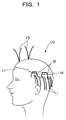
- Fig. 1 schematically illustrates a state of wearing the wig 10 of the present invention on the wearer's scalp.
- the wig 10 of the present invention is so constituted that hair 12 and 13 is attached to a wig base 11.
- artificial hair 12 and 13 is attached to each portion of the wig base 11 with preferred bending rigidities adjusted for respective portions.
- the wig base 11 is partitioned to a plurality of regions, and in said wig base 11, hair 12 of bending rigidity lower than natural hair is attached to the periphery of the left and right side head portions and to the periphery 11a of the rear head portion.
- hair 13 for example, having bending rigidity of about the same level as natural hair is attached.
- the bending rigidity is the property relating to such feeling as tactile and texture of fibers, as mentioned in the section of Background Art in the present Specification, defining the magnitude of force required to bend fiber, that is, the force applied to fiber for bending it, and the higher this value is, the harder is the fiber and more difficult to bend.
- the bending rigidity mentioned in the present Specification is measured by the above-mentioned KAWABATA method of measurement.
- a wig 10 When a wig 10 is worn with such a distribution pattern of bending rigidity of the attached hair, the hair 12 attached to the wig periphery 11a is arranged so as to cover the wearer's own hair 1 growing next to the wig. Therefore, the wig hair 12 having bending rigidity of about the same level as the wearer's own hair 1 and said wearer's own hair 1 can be blended well by brushing.
- a partial wig 10 is made in size to hide the thin hair or the lost hair portion, and, referring to Fig.
- the wearer's own hair 1 growing near the thin hair or the lost hair portion around a forehead and a top portions as the center, for example, the wearer's own hair 1 growing on left and right side head and a rear head portions has low bending rigidity in general compared with ordinary natural hair. Therefore, when the hair 12 of bending rigidity lower than that of natural hair is attached to a wig base periphery 11a, since the hair 12 has bending rigidity of the same low level as that of the wearer's own hair 1 growing next to the partial wig 10, the wig hair 12 and the wearer's own hair 1 can be well blended.
- the wig hair 12 may have bending rigidity more or less lower than that of the wearer's own hair 1.
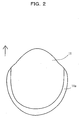
- Fig. 2 as the plan view of the wig base 11 of a typical partial wig, the direction of an arrow mark shows that of the front side of the wig, that is, the direction of the wearer's sight.
- the wig base 11 is constituted with a net base or an artificial skin base or by their combination depending upon the shape and the size of the wearer's head and also upon the distribution and the amount of the wearer's own hair 1.
- the hair 12 having bending rigidity lower than that of natural hair is attached.
- the hair 13 to be attached to the other regions that is, the region up to a center portion other than the periphery 11a preferably has bending rigidity of the same level as that of natural hair.
- Fig. 3(A) is a view schematically illustrating the wig 10 of the present invention
- Fig. 3(B) is a view schematically illustrating the wig 20 as Comparative Example, respectively.
- the wig 10 of the present invention as shown in Fig. 3(A) , is such that the hair 12 attached to the periphery 11a of the left and right side head and the rear head portions of the wig base 11 has bending rigidity lower than that of natural hair. Therefore, only the hair attached to the periphery 11a does not stand up by combing and well blending the wearer's own hair 1 and the hair 12, and further the wearer's own hair 1 and the hair 12 are not separated and both can not be distinguished, so that wig wearing is hardly visible.
- the wearer's own hair is soft and has low bending rigidity in general compared with a person's own hair who does not need a wig. Therefore, as shown in Fig. 3(B) , if the hair 22 attached to the periphery 21a of the left and right side head and the rear head portions of the wig base 20 has higher bending rigidity than that of the wearer's own hair 1, the hair 22 attached to the wig base periphery 21a tends to stand up easily, and since the wearer's own hair 1 next to it lies down, the hair 22 and the wearer's own hair 1 have different hair line and show different behaviors respectively. Therefore, the border line of the wearer's own hair and the wig hair covering it appears linearly in the horizontal direction, and hence wig wearing tends to be visible.
- a wig base in the wig of the present invention Explanation is made here of a wig base in the wig of the present invention.
- the former front hiding type is that corresponding to a retreating hair line
- the latter top wearing type is that corresponding to a person whose hair line does not retreat but the portions around the top are partially thin, and also the type particularly responding the desire to increase hair by fashionable sense.
- the former is desired by male customers while the latter by female customers.
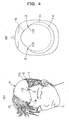
- Fig. 4 is a view illustrating as an image the state of wearing the wig 10 including a front hiding type wig base 11 on the wearer, wherein (A) is a diagonal view of wearing state, and (B) is a plan view of wearing state.
- (A) is a diagonal view of wearing state
- (B) is a plan view of wearing state.
- the front hiding type wig base 11 is such that, as shown in Fig.
- the whole periphery of the wig base 11 is constituted with a forehead portion 11b thrusting from the top to the front side so as to cover a part of the wearer's forehead and the periphery 11a formed with the periphery of the left and right side head and the rear head portions in the region around the lost hair portion of the wearer, and since the curvature of the periphery 11a is larger than that of the forehead portion 11b, a turning point 11D fitted to the shaved portion 2 to be present there is formed.
- Fig. 5 is a view illustrating as an image the state of wearing the wig 30 including a top wearing type wig base 31 on the wearer. As for the top wearing type wig base 31, it is worn on and near the top of the wearer's head.
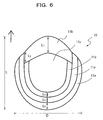
- Fig. 6 is a plan view schematically illustrating the wig base 11 of the front hiding type. Said wig base 11 is partitioned to a plurality of regions by virtual lines, and the direction of an arrow mark shows that of the front side of the wig. As shown in Fig.
- said wig base 11 is constituted about symmetrically to the left and the right according to the shape and the size of the wearer's head, and virtually partitioned to a forehead portion 11b corresponding to a head front with the attached forelock, a top portion 11c zoning a center region of the wig base 11 and corresponding to the head top, the about U-letter shaped first belt portion 11d neighboring the left and right and the rear ends of the top portion 11c, a second belt portion 11e neighboring the left and right and the rear ends of the first belt portion 11d and the left and right ends of the forehead portion 11b, and a peripheral portion 11a neighboring the left and right and the rear ends of the second belt portion 11e except for the forehead portion and hemming the left and right side head and the rear head portions of the wig base 11.
- said wig base 11 is partitioned to a top portion 11c, a forehead portion 11b on its front side, a first belt portion 11d, a second belt portion 11e, and a peripheral portion 11a zoned at three steps in about a U-letter shape from the top portion 11c to the rear and the left and right side head portions.
- the top portion 11c neighbors the forehead portion 11b at its front end and neighbors the first belt portion 11d at its left and right and the rear ends.
- the about U-letter shaped belt-like second belt portion 11e partially surrounds the forehead portion 11b and the first belt portion 11d from the left and right and the rear ends.
- the peripheral portion 11a neighbors the outside of the second belt portion 11e, that is, the left and right and the rear ends, and hems the left and right side head and the rear head portions of the wig base 11.
- the wig base 11 of the front hiding type shown in Fig. 6 is partitioned to five regions for attaching hair of a curl diameter and/or a length pre-determined for each region.
- the reason for it is as described below. Since the forehead portion 11b is the most visible region to the third party besides the wearer, it is extended in the left and right directions from the left and right symmetry line of the forehead portion 11b, and covers the wearer's shaved portion 2 to be present.
- the top portion 11c is an important region to affect the wearer's hair style and appearance and the impression to the third party.
- the peripheral portion 11a is extended from the rear to the left and right side heads to be about U-letter shaped, wherein the hair is attached which is well blended with the wearer's own hair 1, and thus it is the region for preventing exposure of wig wearing.
- the wig of the present invention is, as described below, such that when constituted with the hair of the pre-determined curl diameter and/or length attached to each region, if the hair of different curl diameter and/or length is attached to the forehead portion 11b, the top portion 11c, and to the peripheral portion 11a, then notches are formed at respective borders due to the differences of curl diameters and lengths.
- a notch tends to be formed easily because the attached hairs are not well blended.
- a first belt portion 11d is zoned at the outer hem of the top portion 11c as a buffer region at the top portion side
- a second belt portion 11e is zoned at the inner hem of the peripheral portion 11a as a buffer region at the peripheral portion side.
- the hair attached to the peripheral portion 11a further having a curl diameter and/or a length of about the same level as those of the wearer's own hair growing on the scalp, only such fine adjustment may be required as partial hair cut upon wearing said wig, and the hair style which the wearer prefers can be formed easily and in short time.
- Fig. 7 is a plan view illustrating the manner in which the wig base is partitioned to three regions on the 5-partitioned regions in the wig base shown in Fig. 6 .
- the wig base 11 of the front hiding type as shown in Fig. 6 is partitioned to three regions as shown in Fig. 7 for attaching the hairs of different bending rigidities. Partitioning to three regions is determined based on the 5-partitioned regions shown in Fig. 6 . Namely, the wig base 11 shown in Fig.
- the sixth is 5-partitioned to the forehead portion 11b, the top portion 11c, the first belt portion 11d, the second belt portion 11e, and the peripheral portion 11a for attaching the hairs of curl diameters and/or lengths pre-determined for respective regions, and for having the pre-determined bending rigidities and for attaching the hairs of the pre-determined curl diameters and/or lengths, it is partitioned to three regions based on the 5-partitioned regions, the main region 11B including the first belt portion 11d from the forehead portion 11b to the top portion 11c, the region 11A of the peripheral portion 11a, and the adjustment region 11C between the main region 11B and the peripheral portion 11A.
- the forehead portion 11b and the top portion 11c are the most visible regions to the third party other than the wearer himself, and are the very important regions which determine the wearer's hair style, appearance, and the impression to the third party.
- the peripheral portion 11a is the region where the hair to be blended with the wearer's own hair 1 is attached to prevent the exposure of wig wearing.
- the wig base 11 is constituted by attaching hairs of different bending rigidities in respective regions, if, not providing an adjustment region 11C, hairs of different bending rigidities are attached respectively to the main region 11B comprising the top portion 11c of the wig base 11, the forehead portion 11b neighboring it, and the first belt portion 11d, and the region 11A of the peripheral portion 11a ("the peripheral region"), then hair stands up differently from the wig base 11 due to the difference of bending rigidities at the respective border of the main region 11B and the peripheral region 11A. Therefore, the hairs attached to the main region 11B and the peripheral region 11A, respectively, are not well blended and cause a notch.
- the hair of the bending rigidity of the same level as that of natural hair is attached to the main region 11B from the forehead portion 11b to the top portion 11c, as described later, for generating bulky feeling in the whole hair, whereas the hair of lower bending rigidity than the average natural hair is attached to the peripheral region 11A.
- an adjustment region 11C is provided between the main region 11B and the peripheral region 11A from the forehead portion 11b to the top portion 11c. Said adjustment region 11C corresponds to the region of the second belt portion 11e shown in Fig. 6 .
- the wig base 11 is partitioned to three regions.
- the notch due to the hair attached to the wig base 11 is no longer caused by attaching the hair of the intermediate value of the respective bending rigidities of the hairs attached to the peripheral region 11A and to the main region 11B to the adjustment region 11C provided between the peripheral region 11A and to the main region 11B. Therefore, when a wig 10 is worn, wig wearing is hardly visible because the wearer's own hair 1 and the hair 12 attached to the peripheral region 11A of the wig base 11 are not separated, and the hair border is not caused due to the difference of bending rigidities within the wig base 11.
- the front hiding type wig base 11 shown in Fig. 6 is partitioned to five regions for attaching hair of the pre-determined curl diameter and/or length to respective regions.
- the hair style of bulky appearance can not be created. Therefore, as shown in Fig. 7 , by rearranging three regions based on the five regions of the wig base 11, and attaching the hairs of different bending rigidities to the three partitioned regions, respectively, the wearer's desired hair style can be further formed together with the effect of the hair of the curl diameter and/or length determined to the five partitioned regions, respectively.
- the wig base 11 is designed to have a proper size depending upon the wearer's head shape and size and the lost hair or thin hair state, and by designing the length L 1 on the center axis of the forehead portion 11b, the length L 2 between the left and right ends, the width L 3 of the first belt portion 11d, the width L 4 of the second belt portion 11e, and the length L 5 of the peripheral portion 11a to the pre-determined values, and properly adjusting the size of the top portion 11c, the size of the wig base 11 is designed to fit the wearer's head size.
- the lengths and widths are those along the curved surface of the wig base 11, including those indicating the size of the wig base 11.
- the size of the wig base 11 is larger than a certain level. That the size of the wig base 11 is larger than a certain value means, for example, the front to the back length L of the wig base 11 is 15 cm or more, and the left and right length D is 15 cm or more.
- the size of the top portion 11c is determined for each wearer, taking into consideration the wearer's head shape and size, its lost hair state, or others.
- the peripheral portion 11a of the wig base 11 is zoned belt-shaped of substantially U-letter shaped with its width L 5 of 2 cm at the center on the left and right symmetrical line.
- the forehead portion 11b has the width of 5 cm from the front to the back L 1 at the center on the left and right symmetrical line, and is zoned to have narrower front to back width toward both ends to the left and right as the front to back width L 2 of 3 cm of the side portion neighboring the second belt portion 11e to the left and right.
- the first belt portion 11d is zoned belt-shaped substantially U-letter shaped along the inner periphery of the second belt portion 11e to have the width L 3 of 1.5 cm at the center on the left and right symmetrical line.
- the second belt portion 11e is zoned belt-shaped substantially U-letter shaped along the inner periphery of the peripheral portion 11a to have the width L 4 of 1.5 cm at the center on the left and right symmetrical line.
- the width from the front to the back L 1 on the left and right symmetrical line of the forehead portion 11b is less than 5 cm, then it will be difficult to flow the hair attached to the forehead portion 11b in the forward direction, and at the same time in the directions to the top portion 11c, the first belt portion 11d, the second belt portion 11e and the peripheral portion 11a. Consequently, the hair border becomes exposed, a notch is caused in the whole hair attached to the wig base, resulting in the not preferable exposure of wig wearing.
- the width from the front to the back L 1 is larger than 5 cm, first of all, the region of the forehead portion 11b is too wide, causing unnatural feeling to the third party other than the wearer with the extremely visible forehead portion 11b.
- the width from the front to the back L 1 on the left and right symmetrical line of the forehead portion 11b is preferably 5 cm. If the width from the front to the back L 2 on both sides of the forehead portion 11b neighboring the second belt portion 11e is less than 3 cm, then the hair attached to the forehead portion 11b and those attached to the top portion 11c, the first belt portion 11d and the second belt portion 11e can not blend well, and, in addition, when the hair attached to the forehead portion 11b is combed to the front and the back and to the left and right, it is not preferable because the turning point 11D is visible from outside, and wig wearing is exposed.
- the width from the front to the back L 2 on both sides of the forehead portion 11b neighboring the second belt portion 11e is 3 cm. If said width from the front to the back L 2 is equal to or longer than the width from the front to the back L 1 on the left and right symmetrical line of the forehead portion 11b, then the region of the first belt portion 11d becomes narrow, and wig wearing is visible from outside, as the notch is caused with the hair attached to the first belt portion 11d and the hair attached to the top portion 11c being separated, and hence it is not preferable.
- Fig. 8 is a partially enlarged view illustrating a first belt region 11d , a second belt region 11e and a peripheral portion 11a of the wig base 11 shown in Fig. 6 .
- the first belt portion 11d comprises an inner portion 11f with the hair attached thereon to be blended with the hair attached to the top portion 11c, and an outer portion 11g with the hair attached thereon to be blended with the hair attached to the second belt portion 11e.
- the width L 31 of the inner portion 11f is required to be 1 cm, whereas the width L 32 of the outer portion 11g may be 0.5 cm.
- the first belt portion 11d constitutes a part of a buffer region for solving the problem caused by the difference in the curl diameters and/or the lengths of the hairs attached to the top portion 11c and to the peripheral portion 11a. Therefore, if the width L 31 of the inner portion 11f is shorter than 1 cm, then since the region where the hair is attached to blend with the hair attached to the top portion 11c is small, a notch is caused in the hairs attached to the wig base 11.
- the outer portion 11g since the outer portion 11g has small differences in the curl diameters and/or the lengths of the hairs attached to said outer portion 11g and to the second belt portion 11e, the neighboring hairs can be well blended if the outer portion 11g has a substantially half width as the inner portion 11f. From the above, the width L 3 of the first belt portion 11d needs to be 1.5 cm. Conversely, if the width L 3 of the first belt portion 11d is longer than 2 cm, the region of the top portion 11c is narrow, and hence it is not preferable because hair styles can not be made freely.
- the width L 3 of the first belt portion 11d is wide, there will be caused a portion where the hairs attached to the top portion 11c and to the second belt portion 11e are not blended well near the border of the inner portion 11f and the outer portion 11g, and as a result, the hair attached to the first belt portion 11d is separated, and, not preferably, wig wearing is visible from outside.
- the second belt portion 11e comprises an inner portion 11h with the hair attached thereon to be blended with the hair attached to the first belt portion 11d, and an outer portion 11i with the hair attached thereon to be blended with the hair attached to the peripheral portion 11a.
- the width L 42 of the outer portion 11i is required to be 1 cm, whereas the width L 41 of the inner portion 11h may be 0.5 cm.
- the second belt portion 11e constitutes another part of a buffer region of the bending rigidities of the hairs attached to the top portion 11c and to the peripheral portion 11a.
- the width L 42 of the outer portion 11i is shorter than 1 cm, then since the region where the hair is attached to blend with the hair attached to the peripheral portion 11a is small, a notch is caused between the hair attached to the wig base 11.
- the inner portion 11h has both small differences in the curl diameters and/or the lengths of the hairs attached to said inner portion 11h and to the first belt portion 11d and in bending rigidities, the neighboring hairs can be well blended if it has a substantially half width as the outer portion 11i. From the above, the width L 4 of the second belt portion 11e needs to be 1.5 cm.
- the width L 4 of the second belt portion 11e is longer than 2 cm, the region of the top portion 11c is narrow, and hence it is not preferable because hair styles can not be made freely. Also, if the width L 4 of the second belt portion 11e is wide, there will be caused a portion where the hairs attached to the first belt portion 11d and to the peripheral portion 11a are not blended well near the border of the inner portion 11h and the outer portion 11i, and as a result, the hair attached to the second belt portion 11e is separated, and, not preferably, wig wearing is visible from outside.
- the peripheral portion 11a comprises an inner portion 11j with the hair attached thereon to be blended with the hair attached to the second belt portion 11e, and an outer portion 11k with the hair attached thereon to be blended with the wearer's remaining hair. Since both the curl diameters and/or the lengths and bending rigidities of the hairs attached to said peripheral portion 11a and to the second belt portion 11e in its inside are different, The width L 51 of the inner portion 11j is required to be 1 cm, whereas the outer portion 11k is required to be 1 cm, because the hair for well blending with the wearer's own hair remaining in said outer portion 11k is attached thereto.
- the width L 5 of the peripheral portion 11a is required to be 2 cm. If the width L 5 of the peripheral portion 11a is shorter than 2 cm, then the wearer's own hair and the hairs attached to the peripheral portion 11a and to the second belt portion 11e are not well blended and separated, so that it is not preferable because the periphery of the wig base on the wearer's head is visible from outside. Conversely, if the width L 5 of the peripheral portion 11a is longer than 2 cm, the region of the top portion 11c is narrow, and hence it is not preferable because the wearer's preferred hair styles can not be made.
- the width L 5 of the peripheral portion 11a is wide, there will be caused a portion where the hairs attached to the second belt portion 11e and the wearer's own hair are not blended well near the border of the inner portion 11j and the outer portion 11k, and as a result, the hair attached to the peripheral portion 11a is separated, and, not preferably, wig wearing is visible from outside.
- the size design mentioned above is applicable when the wig base 11 has a size larger than a certain level, but when the wearer's head is small, that is, the wig base 11 has a size smaller than a certain level, if the size design mentioned above is applied, the size of the top portion 11c is smaller than the other regions of the wig base 11. This is contrary to the search result that the top portion 11c is the largest of the wearer's wig wearing regions, and if the top portion 11c is too narrow, then the whole balance of the wig is bad, and natural hair style can not be attained.
- the size design is conducted as follows.
- the width L 1 from the front to the back of the forehead portion 11b of the wig base 11 is made L/3 for the width L from the front to the back from the forehead portion 11b to the peripheral portion 11a of the wig base 11, and the widths L 3 + L 4 + L 5 from the front to the back on the left and right symmetrical line from the first belt portion 11d to the peripheral portion 11a is made L/3.
- the width L 3 from the front to the back on the left and right symmetrical line of the first belt portion 11d, the width L 4 from the front to the back on the left and right symmetrical line of the second belt portion 11e, and the width L 5 from the front to the back on the left and right symmetrical line of the peripheral portion 11a are arranged so that their ratio becomes 1.5 : 1.5 : 2.
- each width of the front to the back and the left and right of the wig base 11 is 15 cm or longer
- the size design of each region of the wig base 11 is such that the widths on the left and right symmetrical line of the forehead portion 11b, the first belt portion 11d, the second belt portion 11e, and the peripheral portion 11a are made 5 cm, 1.5 cm, 1,5 cm, and 2 cm, respectively, and the rest is allocated as the region of the top portion 11c
- the wig base 11 is partitioned to three equally, each of the widths on the left and right symmetrical line of the forehead portion 11b and the top portion 11c is made L/3 of the width L from the front to the back of the wig base 11, and the rests are allocated to the first belt portion 11d, the second belt portion 11e, and the peripheral portion 11a, and arranged so that each width has the ratio 1.5 : 1.5 : 2.
- the hair attached to the wig base 11 partitioned to a plurality of regions has bending rigidity pre-determined for each region. Since the hair 12 attached to the peripheral portion 11a of the wig base 11 is arranged by blending with the wearer's own hair in the surrounding region of the lost hair or the thin hair portion, it has bending rigidity lower than natural hair. On the other hand, the hair attached to the region from the peripheral portion 11a toward the top portion in the wig base 11, for example, the main region 11B of the forehead portion 11b, the top portion 11c, and the first belt portion 11d, is designed as having bending rigidity of the same level as natural hair.
- the hair attached to the adjustment region 11C as the boundary region of the peripheral portion 11a and the region 11B from the forehead toward the top portion among the wig base 11 is designed to have intermediate bending rigidity between the hairs attached to the peripheral portion 11a and to the main region 11B.
- the hair having bending rigidity lower than natural hair and the hair having bending rigidity of the same level as natural hair are mixed in the pre-determined ratio of strands. Otherwise, a structure or a size are adjusted so that the pre-determined value is attained between bending rigidity of the hair attached to the peripheral region 11A and bending rigidity of the hair attached to the main region 11B.
- the hair attached to the region 11A of the peripheral portion 11a in the wig base 11 has bending rigidity lower than natural hair, preferably having bending rigidity of the same level as the wearer's own hair 1, and more preferably the farther from the wearer's own hair 1 on the head, the gradually higher the bending rigidity of the attached hair, and the hair attached to the main region 15B of the wig base 11 has bending rigidity higher than the hair attached to the peripheral region 11A, and of the same level as natural hair.
- the wearer's own hair 1 growing on the scalp and the hair 12 attached to the peripheral portion 11a of the wig base are well blended, stand up and curve similarly to show similar behavior.
- the hair attached to the main region 11B of the wig base has bending rigidity higher than the wearer's own hair 1, unique hair styles can be formed which wearers could not expect to have, depending upon hardness or bending strength of said hair.
- the wig described above is such that the wig base is partitioned to a plurality of regions, and the hairs of bending rigidities corresponding to respective regions are attached to said regions, and in each region of the wig base 11 shown in Fig. 6 , the hair length is adjusted, curled or not, the curl curvature when curled is adjusted, or color is adjusted so that the artificial hair formed at will can be used.
- the hair length is adjusted, curled or not, the curl curvature when curled is adjusted, or color is adjusted so that the artificial hair formed at will can be used.
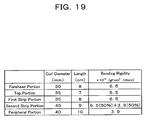
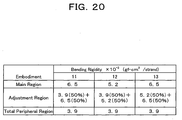
- the hair attached to respective regions of the wig base 11 shown in Fig. 7 that is, to the peripheral region 11A, the main region 11B, and the adjustment region 11C, not only has the pre-determined bending rigidity, but also preferably has the pre-determined curl diameter and/or length for each of the peripheral portion 11a, the forehead portion 11b, the top portion 11c, the first belt portion 11d, and the second belt portion 11e. That is, for a front hiding type wig, the hair 12 attached to the peripheral portion 11a of the wig base 11 preferably not only has bending rigidity equal to the wearer's own hair near the peripheral portion of the wig, but also has equal curl diameter or length.
- a notch is not caused in the hair attached to the wig base 11 by gradually changing the curl diameter and/or length, and hence wig wearing is not visible.
- bending rigidity of the hair 13 attached to the main region 11B from the forehead portion 11b toward the top portion 11c in the wig base 11 and bending rigidity of the hair 12 attached to the region 11A of the peripheral portion 11a are different, the hair is attached which has intermediate bending rigidity to the adjustment region 11C, and hence wig wearing is hardly visible.
- Fig. 9 is a plan view schematically illustrating the wig base 31 of a top wearing type.
- An arrow mark in the figure indicates the wearer's forward direction.
- Said wig base 31 is partitioned to a plurality of regions by virtual lines.
- the wig base 31 is constituted substantially left and right symmetrically fitting to the wearer's head shape and size, and in order for the attached hair to have different curl diameters and/or lengths for respective regions, as shown in Fig. 9 , it is partitioned to five regions.
- the wig base 31 is virtually partitioned to the top portion 31e as its center region, the forehead portion 31a neighboring said top portion 31e on the front side, the left head portion 31b neighboring said top portion 31e on the left side, the right head portion 31c neighboring said top portion 31e on the right side, and the rear head portion 31d neighboring said top portion 31e on the rear side. Since said top wearing type wig base 31 is such that the wig wearing region is only the wearer's top, unlike the front hiding type wig base 11 shown in Fig. 6 , it is not formed to partially cover a shaved portion or a forehead to be present on the wearer.
- the wig base 31 is also otherwise virtually partitioned to three to change bending rigidity of the attached hair in each region, namely, the total peripheral region 31A formed along the outer periphery of a forehead portion 31a, left and right side head portions 31b and 31c, and a rear head portion 31d, the main region 31B corresponding to a head top zoning the center region of the wig base 31, and the circular adjustment region 31C between the total peripheral region 31A and the main region 31B.
- the main region 31e corresponds to the top portion 31e among the five-partitioned regions
- the total peripheral region 31A is the region neighboring the inner periphery of the wearer's wig wearing region.
- the length along the curved surface of the wig base 31 between the front end of the forehead portion 31a and the rear end of the rear head portion 31d of the wig base 31 is defined as L
- the length along the curved surface of the wig base 31 between both ends of the left and the right side head portions 31b and 31c of the wig 31 is defined as D.
- the widths L 6 and L 7 of the front and the rear head portions 31a and 31d of the wig base 31 are made to have the length each 1/4 of the length from the front to the back L of the wig base 31.
- the lengths D 6 and D 7 of the left and right side head portions 31b and 31c are made each 1/4 of the left and right length D.
- the top portion 31e of the wig base 31 is zoned to have length from the front to the back 1/2 of the length from the front to the back L of the wig base 31, and 1/2 of the left and right length D of the wig base 31.
- an adjustment region 31C is zoned with the borders at the positions which equally partition the respective regions of the forehead portion 31a, the left and right side head portions 31b and 31c, and the rear head portion 31d, in order to prevent the hair attached between the total peripheral region 31A and the main region 31B of the wig base 31 to separate for wig wearing to be visible.
- Said borders are provided along the whole outer periphery of the wig base at the intermediate position with the border between the outer periphery of the wig base 31 and the top portion 31e.
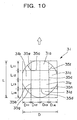
- Fig. 10 is a schematic view for explanation of optimal size design of each region of a wig base 31. It is similar to the case of Fig. 9 to define the length as L in the direction from the front to the back along the wig base 31 from the front end of the forehead portion 31a to the rear end of the rear head portion 31d of the wig base 31, and the length as D in the left and right direction along the wig base 31 between the left end of the left side head portion 31b and the right end of the right side head portion 31c.
- the lengths and the divisions made by equally dividing the length L from the front to the back to four are defined sequentially as L 11 to L 14 from the forehead portion side, the lengths and the divisions made by equally dividing the left and right length D to four are defined sequentially as D 11 to D 14 from the left side head portion side, and the virtual lines equally dividing to four longitudinally and horizontally are shown in the figure.
- the top portion 31e is an important region to affect the wearer's appearance and hair style, it is required to occupy the center of the wig as widely as possible. Therefore, the top portion 31e is zoned, as shown in Fig. 10 , by the border line 35a with the forehead portion 31a, the border line 35b with the left side head portion 31b, the border line 35c with the right side head portion 31c, and by the border line 35d with the rear head portion 31d.
- the top portion 31e is zoned at the center region of the wig base 31 so that the border line 35b with the left side head portion 31b and the border line 35c with the right side head portion 31c are the division of the length L 12 + L 13 , and the border line 35a with the forehead portion 31a and the border line 35d with the rear head portion 31d are the division of the length D 12 + D 13 . That is, the region of the top portion 31e is zoned with the length 1/2 as the length L from the front to the back and as the left and right length D, respectively, of the wig base 31.
- the forehead portion 31a is zoned by the border line 35a with the top portion 31e and by the border lines 35e and 35f with the left and right side head portions 31b and 31c. Its size is so designed that the left and right length on the border line 35a with the top portion 31e is D 12 + D 13 , and the length from the border line 35a with the top portion 31e to the front edge of the wig base 31 is L 11 of the ratio 1/4 of the length L from the front to the back of the wig base 31.
- the border lines 35e and 35f with the left and right side head portions 31b and 31c of the forehead portion 31a are extended respectively diagonally to the left and right from both ends of the border line 35a with the top portion 31e, that is, in the direction of the arrow mark in the figure rotated substantially 45 degrees to the left and right.
- the border lines 35e and 35f extending respectively diagonally to the left and right, undesirable hair parting can not be generated in the hair attached respectively to the forehead portion 31a and to the left and right side head portions 31b and 31c. Therefore, wig wearing is prevented from exposure.
- the left side head portion 31b is zoned by the border line 35e with the forehead portion 31a, the border line 35b with the top portion 31e, and by the border line 35g with the rear head portion 31d. Its size is so designed that the length from the front to the back on the border line 35b with the top portion 31e is L 12 + L 13 , and the length from the border line 35b with the top portion 31e to the left edge of the wig base 31 is D 11 of the ratio 1/4 of the left and right length D of the wig base 31.
- border line 35e with the forehead portion 31a is extended diagonally to the left from the front end of the border line 35b with the top portion 31e, whereas the border line 35g with the rear head portion 31d is extended on the left end of the border line 35d between the top portion 31e and the rear head portion 31d along said border line 35d.
- the right side head portion 31c is zoned by the border line 35f with the forehead portion 31a, the border line 35c with the top portion 31e, and by the border line 35h with the rear head portion 31d. Its size is so designed that the length from the front to the back on the border line 35c with the top portion 31e is L 12 + L 13 , and the length from the border line 35c with the top portion 31e to the right edge of the wig base 31 is D 14 of the ratio 1/4 of the left and right length D of the wig base 31.
- border line 35f with the forehead portion 31a is extended diagonally to the right from the front end of the border line 35c with the top portion 31e, whereas the border line 35h with the rear head portion 31d is extended on the right side of the border line 35d between the top portion 31e and the rear head portion 31d along said border line 35d.
- the rear head portion 31d is zoned by the border line 35d with the top portion 31e and by the border lines 35g and 35h with the left and right side head portions 31b and 31c.
- the left and right length on the border line 35d with the top portion 31e is D 12 + D 13 , but is extended to the outer periphery of the left and right side head portions 31b and 31c.
- the size is so designed that the length from the border line 35d with the top portion 31e to the rear edge of the wig base 31 is L 14 of the ratio 1/4 of the length L from the front to the back of the wig base 31.
- the border lines 35g and 35h with the left and right side head portions 31b and 31c of the rear head portion 31d are extended respectively to the left and right from the border line 35d between the top portion 31e and the rear head portion 31d. Therefore, the hair attached to the rear head portion 31d lies down on the scalp together with the wearer's own hair, resulting in well blending of the hair and the wearer's own hair. Therefore, since hair is not parted improperly, wig wearing is prevented from exposure.
- the top portion 31e is an important region to affect the wearer's appearance and hair style, it is required to occupy as widely as possible, and hence is constituted to have sizes of the ratio 1/2 of the longitudinal L and 1/2 of the horizontal D.
- the portions where the hair selected by consideration of the curl diameter and the length of the wearer's own hair is attached such as the forehead portion 31a, the left and right side head portions 31b and 31c, and the rear head portion 31d, are preferably distributed and arranged with good balance, so as to have the sizes of the ratio substantially 1/4 of longitudinal L and 1/4 of horizontal D in the outward direction from the border lines 35a to 35d with the forehead portion 31a, the left and right side head portions 31b and 31c, and with the rear head portion 31d.
- the top portion 33e as an important region to affect the wearer's appearance and hair style can be reserved as widely as possible, and moreover, to each region of the forehead portion 31a, the left and right side head portions 31b, 31c, and the rear head portion 31d where hair is attached suitably to the curl diameter and the length of the wearer's own hair, the hair can be attached as much as well blendable with the wearer's own hair. Consequently, the wearer's preferred hair style can be formed, and wig wearing is not visible due to well blending of the hair attached to the wig with the wearer's own hair.
- FIG. 11 is a view illustrating a first Comparative Example with respect to the regional partition of a wig base.
- L, D, and an arrow mark are the same as in the case of Fig. 10 .
- the wig base 32 shown in Fig. 11 is common with respect to the aspects that it is partitioned to five regions, the forehead portion 32a, the left and right side head portions 32b, 32c, the rear head portion 32d, the top portion 32e as in Fig. 10 , but is different from Fig.
- the length and the division from three equal division of the length L from the front to the back of the wig base 32 are defined sequentially as L 15 to L 17 from the forehead portion side
- the length and the division from three equal division of the left and right length D are defined sequentially as D 15 to D 17 from the left side head portion side and the virtual lines dividing equally to three longitudinally and horizontally are shown in the figure.
- the top portion 32e is zoned in the center region of the wig base 32 so that the border line 36b with the left side head portion 32b and the border line 36c with the right side head portion 36c are the divisions of the length L 16 , and the border line 36a with the forehead portion 32a and the border line 36d with the rear head portion 32d are the divisions of the length D 16 . That is, the region of the top portion 32e is zoned with the lengths of 1/3 of the length L from the front to the back and the left and right length D of the wig base 32.
- the left side head portion 32b is the same as in Fig. 10 with respect to the aspects that it is zoned by the border line 36e with the forehead portion 32a, the border line 36b with the top portion 32e, and by the border line 36g with the rear head portion 32d, but is different from the case of Fig. 10 with respect to the aspects that the size is so designed that the length from the front to the back on the border line 36b with the top portion 32e is L 16 , and the length from the border line 36b with the top portion 32e to the left edge of the wig base 32 is D 15 of the ratio 1/3 of the left and right length D of the wig base 32.
- the right side head portion 32c is the same as the case of Fig.
- border lines 36e and 36f with the forehead portion 32a are extended from the front end of the border line 36c with the top portion 32e in the left and right diagonal direction, and the border lines 36g and 36h with the rear head portion 32d are extended left and right on the border line 35d between the top portion 32e and the rear head portion 32d.
- each region of the forehead portion 32a, the left and right side head portions 32b, 32c, and the rear head portion 32d has a wide area, and it is not preferable that the hair attached to the whole wig base 32 are unbalanced, and hence wig wearing is visible.
- Fig. 12 is a view illustrating a second Comparative Example with respect to the regional partition of a wig base.
- L, D, and an arrow mark are the same as in the case of Fig. 10 .
- the wig base 33 shown in Fig. 12 is common with respect to the aspects that it is partitioned to five regions, the forehead portion 33a, the left and right side head portions 33b, 33c, the rear head portion 33d, the top portion 33e as in Fig. 10 , but is different from Fig.
- the length and the division from five equal division of the length L from the front to the back of the wig base 33 are defined sequentially as L 18 to L 22 from the forehead portion side
- the length and the division from five equal division of the left and right length D are defined sequentially as D 18 to D 22 from the left side head portion side
- the virtual lines dividing equally to five longitudinally and horizontally are shown in the figure.
- the top portion 33e is zoned in the center region of the wig base 33 so that the border line 37b with the left side head portion 33b and the border line 37c with the right side head portion 33c are the divisions of the length L 19 + L 20 + L 21 , and the border line 37a with the forehead portion 33a and the border line 37d with the rear head portion 33d are the divisions of the length D 19 + D 20 + D 21 . That is, the region of the top portion 33e is zoned with the lengths of 3/5 of the length L from the front to the back and the left and right length D of the wig base 33, respectively.
- the left side head portion 33b is the same as in the case of Fig. 10 with respect to the aspects that it is zoned by the border line 37e with the forehead portion 33a, the border line 37b with the top portion 33e, and by the border line 37g with the rear head portion 33d, but is different from the case of Fig. 10 with respect to the aspects that the size is so designed that the length from the front to the back on the border line 37b with the top portion 33e is L 19 + L 20 + L 21 , and the length from the border line 37b with the top portion 33e to the left edge of the wig base 33 is D 18 of the ratio 1/5 of the left and right length D of the wig base 33.
- the right side head portion 33c is the same as in the case of Fig.
- border lines 37e and 37f with the forehead portion 33a are extended from the front end of the border line 37c with the top portion 33e in the left and right diagonal direction, and the border lines 37g and 37h with the rear head portion 33d are extended left and right on the border line 37d between the top portion 33e and the rear head portion 33d.
- the top portion 33e as an important region to affect the wearer's appearance and hair style can be reserved widely.
- each region is made narrow for the forehead portion 33a, the left and right side head portions 33b, 33c, and the rear head portion 33d where the hair suited to the curl diameter and the length of the wearer's own hair is attached, it is not preferable that the attached hair and the wearer's own hair are not well blended.
- the hair attached to the wig base 31 of a top wearing type shown in Fig. 5 has, as shown in Fig. 9 , bending rigidity pre-determined for each of the total peripheral region 31A, the main region 31B, and the adjustment region 31C between them. Since the hair 32 attached to the total peripheral region 31A of the wig base 31 is blended and arranged with the wearer's own hair in the surrounding region of the wearer's lost hair or the thin hair portions, it has bending rigidity lower than natural hair.
- the hair attached to the region 31B of the top portion 31e in the wig base 31 has bending rigidity of the same level as natural hair
- the hair attached to the adjustment region 31C between the total peripheral region 31A and the region 31B of the top portion 31e of the wig base 31 has intermediate bending rigidity between the hair attached to the total peripheral region 31A and the hair attached to the region 31B of the top portion 31e.
- the hair having bending rigidity lower than natural hair and the hair having bending rigidity of the same level as natural hair are mixed in the pre-determined ratio of strands.
- a structure or a size are adjusted so that the pre-determined value is attained between bending rigidity of the hair attached to the total peripheral region 31A and bending rigidity of the hair attached to the region 31B of the top portion 31e.
- the hair to be attached to each region of the wig base 31 has preferably not only the pre-determined bending rigidity but also a curl diameter and a length pre-determined for each region. That is, in a top wearing type wig, the hair 32 attached to the total peripheral region 31A not only has bending rigidity equivalent to the wearer's own hair near the wig wearing region, but also the curl diameter and the length are preferably equivalent between them. If the hair 33 attached to the region 31B of the top portion 31e and the hair 32 attached to the total peripheral region 31A have different curl diameters and lengths, then a notch is not caused by the hair attached to the wig base 31 and wig wearing is not visible by gradually changing the curl diameter and/or the length. It is possible to curl the hair attached to the wig base 31 and to adjust its length before the wig is worn, or upon wearing the wig, but it is not preferable because the working process becomes complicated.
- the wig of this Comparative Example has an equal length and curl diameter for each strand, and hence the hair is too uniform as a whole, so that it is not preferable that a free hair style can not be formed. If such a wig with the too uniform hair is worn, cutting the hair attached to the wig base is necessary for hair style adjustment.
- the wig of this Comparative Example has a degree of freedom in hair styles themselves, but it is not preferable that the hairs are too random, and a hair style lacks uniformity.
- a free hair style can be formed by attaching the hairs of the pre-determined lengths and the curl diameters for respective regions of the wig base like the wig of the present invention.
- the hairs attached to the wig bases 11 and 31 can be formed to have different bending rigidities for the respective partitioned regions of the wig bases 11 and 31.
- an artificial hair made of, for example, a polyamide fiber with a sheath/core structure can be used as the hair.
- Such an artificial hair made of a polyamide fiber with a sheath/core structure utilizing the property of the polyamide fiber, has a core portion of a polyamide fiber of high bending rigidity, and a sheath portion of a polyamide fiber of bending rigidity lower than the core portion, and the bending rigidity of the whole artificial hair can be controlled by adjusting the mass ratio of the sheath and the core portions.
- a semi-aromatic polyamide resin of high strength and rigidity for example, a polymer of an alternative copolymer of hexamethylene diamine and terephthalic acid expressed by Chemical Formula 1, for example, nylon 6T, or a polymer in which adipic acid and metaxylylene diamine alternatively bonded by amide bonds as expressed by Chemical Formula 2, for example, nylon MXD6, may be used.
- the artificial hair using a polymer material expressed by Chemical Formula 2 as the core portion material is more preferable than the artificial hair using a polymer material expressed by Chemical Formula 1 as the core portion material in that hair setting is easier.
- a polyamide resin of bending rigidity lower than the core portion material for example as a linear aliphatic polyamide, a polymer of a ring opening polymer of caprolactam expressed by Chemical Formula 3, for example, nylon 6, or a polymer of an alternative copolymer of hexamethylene diamine and adipic acid expressed by Chemical Formula 4, for example, nylon 66 may be used.
- a sheath/core structure of a polyamide artificial hair using a polyamide of high bending rigidity for a core portion and using a polyamide of bending rigidity lower than the core portion for a sheath portion, and by adjusting the mass ratio of the sheath and the core portions, a fiber of the desired bending rigidity can be obtained.
- the bending rigidity is a physical property applicable in general to fibers and the like, and for hair, too, recently recognized as a property relating to a sensuous property such as feeling (appearance, tactile and texture feeling).
- KAWABATA method of measurement and its principle are widely known for textile, and its improved version Single Hair Bending Tester (KATOTECH, LTD., Model KES-FB2-SH) was used to measure bending rigidity of artificial hair.
- KAWABATA method of measurement and its principle are widely known for textile, and its improved version Single Hair Bending Tester (KATOTECH, LTD., Model KES-FB2-SH) was used to measure bending rigidity of artificial hair.
- KAWABATA method of measurement and its principle are widely known for textile, and its improved version Single Hair Bending Tester (KATOTECH, LTD., Model KES-FB2-SH) was used to measure bending rigidity of artificial hair.
- KAWABATA method of measurement and its principle are widely known for textile, and its improved version Single Hair Bending Tester (KATOTECH,
- the artificial hair manufactured by the discharge volume ratio of the sheath/core components upon melt spinning 1/7 has bending rigidity close to the maximum value of that of natural hair (about 7.8 X 10 -3 gf ⁇ cm 2 /strand).
- natural hair means the ordinary hair growing on a human's scalp, and has a big personal deviation in bending rigidities. Therefore, head hairs were collected from 25 males and 38 females of age classes between 20 to 50 years old, and their bending rigidities were measured for the samples of 80 ⁇ m diameter under the same circumstance, namely, under the circumstance of temperature 22°C and humidity 40%.
- the bending rigidities shown below are the values under the circumstance of temperature 22°C and humidity 40%.
- Fig. 13 is a table showing the properties of the hair attached to a wig base 11 in a first to a fourth embodiments of attaching patterns.
- Explanation is made of a first embodiment of the pattern to attach hair to a wig base 11.
- Said first embodiment is suitable to an ordinary wearer.
- the hair for a wig is made of a polyamide fiber of a sheath/core structure.
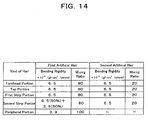
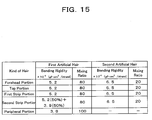
- the artificial hair having bending rigidity 3.9 X 10 -3 gf ⁇ cm 2 /strand which is about 40% lower than the minimum value of that of natural hair (about 6.5 X 10 -3 gf ⁇ cm 2 /strand) is attached to a peripheral portion 11a of a wig base 11.
- a second belt portion 11e In a second belt portion 11e inside it are attached artificial hair having bending rigidity 3.9 X 10 -3 gf ⁇ cm 2 /strand and artificial hair having bending rigidity 6.5 X 10 -3 gf ⁇ cm 2 /strand uniformly distributed so that the mass ratio becomes half to half.
- Artificial hair having 6.5 X 10 -3 gf ⁇ cm 2 /strand is attached to the first belt portion 11d, the top portion 11c, and the forehead portion 11b inside it.
- bending rigidities of natural hair have a big personal deviation, and the hair growing on the wearer's scalp has low bending rigidity in general.
- the wig of the first embodiment is assumed as the case wherein the bending rigidity of the wearer's own hair is about 3.4 to 4.4 X 10 -3 gf ⁇ cm 2 /strand.
- the bending rigidity of the hair attached to at least a peripheral portion of a wig is about ⁇ 0.5 to 0.8 X 10 -3 gf ⁇ cm 2 /strand to the bending rigidity of the wearer's own hair, then it is within the allowable range.
- the attached artificial hair tends to blend well with the wearer's own hair.
- the hair attached to the peripheral portion 11a of the wig base 11 has bending rigidity lower than that of natural hair, that is, bending rigidity of the same level as that of the wearer's own hair
- the hair attached to the top portion 11c and the forehead portion 11b where the hair is not likely to be mixed with the wearer's own hair has high bending rigidity compared with the hair attached to the peripheral portion 11a. Therefore, since the hair attached to the peripheral portion 11a of the wig base 11 is easily blended well with the remaining hair growing on the wearer's scalp, and shows similar behavior to the wearer's own hair by the influence of such circumstances as humidity, it is not likely for wig wearing to be recognized.
- the hair attached to the forehead portion 11b, the top portion 11c, and the first belt portion 11d has higher bending rigidity than the wearer's remaining hair, various hair styles can be made in response to the wearer's needs.
- Explanation is made of a second embodiment of the pattern to attach hair to a wig base 11. Its difference from the first embodiment is that the hair attached to the forehead portion 11b, the top portion 11c, and the first belt portion 11d of the wig base 11 and the hair attached to the second belt portion 11e mixed therein uniformly have low bending rigidities. It is the same case as in the first embodiment that the hair attached to the wig base is made of a polyamide fiber of a sheath/core structure. Artificial hair having bending rigidity 3.9 X 10 -3 gf ⁇ cm 2 /strand is attached to the peripheral portion 11a of the wig base 11.
- a second belt portion 11e In a second belt portion 11e inside it are attached artificial hair having bending rigidity 3.9 X 10 -3 gf ⁇ cm 2 /strand and artificial hair having bending rigidity 5.2 X 10 -3 gf ⁇ cm 2 /strand uniformly distributed so that the mass ratio becomes half to half.
- Artificial hair having bending rigidity 5.2 X 10 -3 gf ⁇ cm 2 /strand is attached to the first belt portion 11d inside, the top portion 11c, and the forehead portion 11b.
- the second embodiment differs from the first in that bending rigidity of the hair attached to the forehead portion 11b, the top portion 11c, and the first belt portion 11d is low compared with the first embodiment, and the whole hair attached to the wig is so designed as to have lower bending rigidity than natural hair, so that it is suitable to the wearer having comparatively soft hair, that is, suitable to the user having hair of bending rigidity about 3.1 to 4.7 X 10 -3 gf ⁇ cm 2 /strand.
- Explanation is made of a third embodiment of the pattern to attach hair to a wig base 11. Its difference from the first embodiment is that, contrary to the second embodiment, the hair attached to the forehead portion 11b, the top portion 11c, and the first belt portion 11d of the wig base 11 and the hair attached to the second belt portion 11e mixed therein have strengthened rigidities. It is the same case as in the first embodiment that the hair attached to the wig base 11 is made of a polyamide fiber of a sheath/core structure. Artificial hair having bending rigidity 3.9 X 10 -3 gf ⁇ cm 2 /strand is attached to the peripheral portion 11a of the wig base 11.
- a second belt portion 11e In a second belt portion 11e inside it are attached artificial hair having bending rigidity 3.9 X 10 -3 gf ⁇ cm 2 /strand and artificial hair having bending rigidity 7.8 X 10 -3 gf ⁇ cm 2 /strand uniformly distributed so that the mass ratio becomes half to half.
- Artificial hair having bending rigidity 7.8 X 10 -3 gf ⁇ cm 2 /strand is attached to the first belt portion 11d inside, the top portion 11c, and the forehead portion 11b.
- bending rigidity of the hair attached to the forehead portion 11b, the top portion 11c, and the first belt portion 11d is high compared with the first embodiment to increase the difference from natural hair, bulky and rough feeling can be attained, thereby hair styles so far not realized, for example, with standing hair can be formed. Therefore, it is suitable to the wearers requiring hair styles of bulky feeling. It is assumed for the case wherein the wearer's own hair has bending rigidity about 3.4 to 4.4 X 10 -3 gf ⁇ cm 2 /strand.
- a fourth embodiment of the pattern to attach hair to a wig base 11 differs from the third in that bending rigidities of the hair attached to the peripheral portion 11a of the wig base 11 and of the hair attached to the second belt portion 11e mixed therein are more strengthened. It is suitable to the case where the wearer's remaining hair has bending rigidity of the same level as natural hair of a person who does not need a wig. It is the same case as in the first embodiment that the hair attached to the wig base 11 is made of a polyamide fiber of a sheath/core structure. Artificial hair having bending rigidity 5.2 X 10 -3 gf ⁇ cm 2 /strand is attached to the peripheral portion 11a of the wig base 11.
- a second belt portion 11e In a second belt portion 11e inside it are attached artificial hair having bending rigidity 5.2 X 10 -3 gf ⁇ cm 2 /strand and artificial hair having bending rigidity 7.8 X 10 -3 gf ⁇ cm 2 /strand uniformly distributed so that the mass ratio becomes half to half.
- Artificial hair having bending rigidity 7.8 X 10 -3 gf ⁇ cm 2 /strand is attached to the first belt portion 11d inside, the top portion 11c, and the forehead portion 11b.
- the wearer's remaining hair has rigidity of the same level as that of ordinary natural hair, that is, if bending rigidity of the wearer's remaining hair is about 5.0 to 6.5 X 10 -3 gf ⁇ cm 2 /strand, the extent of the wearer's remaining hair can be responded by attaching artificial hair having bending rigidity of the same level as that of the remaining hair. Since rigid artificial hair is attached to the forehead portion 11b of the wig base 11 and the top portion 11c, hair styles of bulky feeling can be formed, and the hair disturbance can be prevented.
- the artificial hair attached to the wig base is made of a polyamide fiber having a sheath/core structure in any of the first to the fourth embodiments, but, as explained in the fifth to the eighth embodiments below, a first artificial hair of a polyamide fiber having a sheath/core structure and a second artificial hair of a polyester fiber may be uniformly mixed properly in the pre-determined ratio, and attached to partitioned regions of the wig base.
- the second artificial hair of a polyester fiber has the following structure.
- the second artificial hair of a polyester fiber can change bending rigidity by adjusting the fiber diameter of, for example, polyethylene terephthalate, or by adjusting the mixing ratio of polybutylene terephthalate into polyethylene terephthalate as the feed material to be melted upon spinning.
- the artificial hair with polyethylene terephthalate as a main component increases its bending rigidity linearly as its diameter increases. For example, when the average diameter increases from 50 ⁇ m to 70 ⁇ m, its bending rigidity increases from 6.70 X 10 -3 gf ⁇ cm 2 /strand to 7.67 X 10 -3 gf ⁇ cm 2 /strand.
- Fig. 14 is a table showing the properties of the hair attached to a wig base 11 in a fifth embodiment of attaching patterns.
- Said fifth embodiment is a modified example of the above-mentioned first embodiment. They are different in that it uses the first artificial hair made of a polyamide fiber of a sheath/core structure and the second artificial hair made of a polyester fiber as the hair to be attached to the wig base 11.
- the mixing ratio of the first and the second artificial hair is 80:20 in mass ratio.
- the first artificial hair having bending rigidity 6.5 X 10 -3 gf ⁇ cm 2 /strand and the second artificial hair having bending rigidity 6.5 X 10 -3 gf ⁇ cm 2 /strand are uniformly mixed and attached.
- the mixing ratio of the first and the second artificial hair is 80:20 in mass ratio.
- a sixth to an eighth embodiments of the pattern to attach hair to a wig base 11 Said sixth to the eighth embodiments are modified examples of the above-mentioned second to the fourth embodiments. They are different in that it uses the first artificial hair made of a polyamide fiber of a sheath/core structure and the second artificial hair made of a polyester fiber as the hair to be attached to the wig base 11.
- Fig. 15 is a table showing the properties of the hair attached to a wig base 11 in the sixth embodiment of attaching patterns.
- the mixing ratio of the first and the second artificial hair is 80:20 in mass ratio.
- the first artificial hair having bending rigidity 5.2 X 10 -3 gf ⁇ cm 2 /strand and the second artificial hair having bending rigidity 6.5 X 10 -3 gf ⁇ cm 2 /strand are uniformly mixed and attached.
- the mixing ratio of the first and the second artificial hair is 80:20 in mass ratio.
- Fig. 16 is a table showing the properties of the hair attached to a wig base 11 in a seventh embodiment of attaching patterns.
- the seventh embodiment in the second belt portion 11e of the wig base 11 are the first artificial hair having bending rigidity 3.9 X 10 -3 gf ⁇ cm 2 /strand and the first artificial hair having bending rigidity 7.8 X 10 -3 gf ⁇ cm 2 /strand uniformly distributed and mixed so that the mass ratio becomes half to half, and further the second artificial hair having bending rigidity 6.5 X 10 -3 gf ⁇ cm 2 /strand is uniformly mixed and attached.
- the mixing ratio of the first and the second artificial hair is 80:20 in mass ratio.
- the first artificial hair having bending rigidity 7.8 X 10 -3 gf ⁇ cm 2 /strand and the second artificial hair having bending rigidity 6.5 X 10 -3 gf ⁇ cm 2 /strand are uniformly mixed and attached.
- the mixing ratio of the first and the second artificial hair is 80:20 in mass ratio.
- Fig. 17 is a table showing the properties of the hair attached to a wig base 11 in an eighth embodiment of attaching patterns.
- the first artificial hair having bending rigidity 5.2 X 10 -3 gf ⁇ cm 2 /strand and the first artificial hair having bending rigidity 7.8 X 10 -3 gf ⁇ cm 2 /strand uniformly distributed and mixed so that the mass ratio becomes half to half, and further the second artificial hair having bending rigidity 6.5 X 10 -3 gf ⁇ cm 2 /strand is uniformly mixed and attached.
- the mixing ratio of the first and the second artificial hair is 80:20 in mass ratio.
- the first artificial hair having bending rigidity 7.8 X 10 -3 gf ⁇ cm 2 /strand and the second artificial hair having bending rigidity 6.5 X 10 -3 gf ⁇ cm 2 /strand are uniformly mixed and attached.
- the mixing ratio of the first and the second artificial hair is 80:20 in mass ratio.
- the second polyester fiber artificial hair can further suppress the bundling tendency of a polyamide fiber as the first artificial hair, and hair styles of flow feeling can be formed.
- the hairs of different bending rigidities are attached to respective regions of a front hiding type wig, but the hairs of different curling diameters and/or lengths may be attached further to respective five regions in the cases of the first to the eighth embodiments.
- Explanation is made of the examples as the ninth and the tenth embodiments wherein the hair the curl diameter and the length of which are further determined for the respective portions in the first embodiment is attached, but it may be the case wherein bending rigidities are substantially equal regardless of the wig base regions, and the curl diameters and/or the lengths are different.
- Fig. 18 is a table showing the properties of the hair attached to a wig base 11 in a ninth embodiment of attaching patterns.
- the difference of the ninth embodiment from the first embodiment is that the hair attached to the peripheral portion 11a, the forehead portion 11b, the top portion 11c, the first belt portion 11d, and the second belt portion 11e not only has the pre-determined bending rigidity for respective portions to be attached but also has the pre-determined curl diameter and/or length for respective portions.
- the peripheral portion 11a is attached the hair having a curl diameter 35 mm, a length 9 cm, and bending rigidity 3.9 X 10 -3 gf ⁇ cm 2 /strand.
- the forehead portion 11b is attached the hair having a curl diameter 23 mm, a length 7 cm, and bending rigidity 6.5 X 10 -3 gf ⁇ cm 2 /strand.
- the top portion 11c is attached the hair having a curl diameter 26 mm, a length 6 cm, and bending rigidity 6.5 X 10 -3 gf ⁇ cm 2 /strand.
- the first belt portion 11d is attached the hair having a curl diameter 28 mm, a length 7 cm, and bending rigidity 6.5 X 10 -3 gf ⁇ cm 2 /strand.
- Fig. 19 is a table showing the properties of the hair attached to a wig base 11 in a tenth embodiment of attaching patterns.
- the difference of the tenth embodiment from the first embodiment is that the hair attached to the peripheral portion 11a, the forehead portion 11b, the top portion 11c, the first belt portion 11d, and the second belt portion 11e not only has the pre-determined bending rigidity for respective portions to be attached but also has the pre-determined curl diameter and/or length for respective portions.
- the peripheral portion 11a is attached the hair having a curl diameter 40 mm, a length 10 cm, and bending rigidity 3.9 X 10 -3 gf ⁇ cm 2 /strand.
- the forehead portion 11b is attached the hair having a curl diameter 30 mm, a length 8 cm, and bending rigidity 6.5 X 10 -3 gf ⁇ cm 2 /strand.
- the top portion 11c is attached the hair having a curl diameter 35 mm, a length 7 cm, and bending rigidity 6.5 X 10 -3 gf ⁇ cm 2 /strand.
- the first belt portion 11d is attached the hair having a curl diameter 35 mm, a length 8 cm, and bending rigidity 6.5 X 10 -3 gf ⁇ cm 2 /strand.
- a wig may be constituted by attaching the hair the curl diameter and length of which are pre-determined for respective portions.
- Fig. 20 is a table showing the properties of the hair attached to a wig base 31 in eleventh to thirteenth embodiments of attaching patterns. Explanation is made of an eleventh embodiment of the pattern to attach hair to a wig base 31. Said eleventh embodiment is suitable to an ordinary wearer.
- the hair attached to the wig base 31 is made of a polyamide fiber of a sheath/core structure.
- the artificial hair having bending rigidity 3.9 X 10 -3 gf ⁇ cm 2 /strand which is about 40% lower than the minimum value of that of natural hair (about 6.5 X 10 -3 gf ⁇ cm 2 /strand).
- the region 31B of the top portion 31e of its inside is attached the artificial hair having bending rigidity 6.5 X 10 -3 gf ⁇ cm 2 /strand.
- bending rigidities of natural hair have a personal deviation, and the hair growing on the scalp of a person who needs a wig has low bending rigidity in general.
- the wig of the eleventh embodiment is assumed as the case wherein the bending rigidity of the wearer's own hair is about 3.4 to 4.4 X 10 -3 gf ⁇ cm 2 /strand.
- the hair attached to the total peripheral region 31A of the wig base 31 has bending rigidity lower than that of average natural hair, that is, bending rigidity of the same level as that of the wearer's own hair
- the hair attached to the region 31B of the top portion 31e where the hair is not likely to be mixed with the wearer's own hair has high bending rigidity compared with the hair attached to the total peripheral region 31A. Therefore, since the hair attached to the total peripheral region 31A of the wig base 31 is easily blended well with the remaining hair growing on the wearer's scalp, and shows similar behavior to the wearer's own hair by the influence of such circumstances as humidity, it is not likely for wig wearing to be recognized.
- the hair attached to the region 31B of the top portion 31e and to the adjustment region 31C has higher bending rigidity than the wearer's remaining hair, bulky feeling can be easily attained, and various hair styles can be made in response to the wearer's needs.
- Explanation is made of a twelfth embodiment of the pattern to attach hair to a wig base 31. Its difference from the eleventh embodiment is that the hair attached to the region 31B of the top portion 31e of the wig base 31 and the hair uniformly mixed and attached to the adjustment region 31C have low rigidities. It is the same case as in the eleventh embodiment that the hair is made of a polyamide fiber of a sheath/core structure. Artificial hair having bending rigidity 3.9 X 10 -3 gf ⁇ cm 2 /strand is attached to the total peripheral region 31A of the wig base 31.
- the twelfth embodiment differs from the eleventh embodiment in that bending rigidity of the hair attached to the region 31B of the top portion 31e is low compared with the eleventh embodiment, and the whole hair attached to the wig is so designed as to have lower bending rigidity than natural hair, so that it is suitable to the wearer having comparatively soft hair, that is, suitable to the user having hair of bending rigidity about 3.1 to 4.7 X 10 -3 gf ⁇ cm 2 /strand.
- Explanation is made of a thirteenth embodiment of the pattern to attach hair to a wig base 31. Its difference from the eleventh embodiment is that, contrary to the twelfth embodiment, the hair attached to the region 31B of the top portion 31e of the wig base 31 and the hair attached to the adjustment region 31C mixed therein have strengthened rigidities. It is the same case as in the eleventh embodiment that the hair is made of a polyamide fiber of a sheath/core structure. Artificial hair having bending rigidity 3.9 X 10 -3 gf ⁇ cm 2 /strand is attached to the total peripheral region 31A of the wig base 31.
- the wig of the thirteenth embodiment is assumed for the case wherein the wearer's own hair has bending rigidity about 3.4 to 4.4 X 10 -3 gf ⁇ cm 2 /strand.
- the hairs of different bending rigidities are attached to respective regions of a top wearing type wig, but as described before, like the fifth to the eighth embodiments for the front hiding type wig, the first artificial hair made of a polyamide fiber of a sheath/core structure and the second artificial hair made of a polyester fiber may be used as the hair attached to the wig base 31. Also, the hairs of different curling diameters and/or lengths may be attached further to respective five regions in the cases of the eleventh to the thirteenth embodiments.
- Fig. 21 is a table showing the properties of the hair attached to a wig base 31 in a fourteenth embodiment of attaching patterns.
- the regional partition wherein the hair of the pre-determined bending rigidity is attached in the wig base 31 and the regional partition wherein the hair of the pre-determined curl diameter and/or length is attached are separately determined. Namely, in the main region 31B as a top portion 31e, the hair of the curl diameter 30 mm, the length 18 cm, and bending rigidity 6.5 X 10 -3 gf ⁇ cm 2 /strand is attached.
- the hair of the curl diameter 30 mm, the length 15 cm, and bending rigidity 3.9 X 10 -3 gf ⁇ cm 2 /strand is attached.
- the hair of the curl diameter 35 mm, the length 20 cm, and bending rigidity 3.9 X 10 -3 gf ⁇ cm 2 /strand is attached.
- the hair of the curl diameter 45 mm, the length 30 cm, and bending rigidity 3.9 X 10 -3 gf ⁇ cm 2 /strand is attached.
- the hair of the curl diameter 30 mm, the length 15 cm, and bending rigidity 3.9 X 10 -3 gf ⁇ cm 2 /strand and the hair of the curl diameter 30 mm, the length 15 cm, and bending rigidity 6.5 X 10 -3 gf ⁇ cm 2 /strand are mixed half to half in the mass ratio and attached.
- the hair of the curl diameter 35 mm, the length 20 cm, and bending rigidity 3.9 X 10 -3 gf ⁇ cm 2 /strand and the hair of the curl diameter 35 mm, the length 20 cm, and bending rigidity 6.5 X 10 -3 gf ⁇ cm 2 /strand are mixed half to half in the mass ratio and attached.
- the hair of the curl diameter 45 mm, the length 30 cm, and bending rigidity 3.9 X 10 -3 gf ⁇ cm 2 /strand and the hair of the curl diameter 45 mm, the length 30 cm, and bending rigidity 6.5 X 10 -3 gf ⁇ cm 2 /strand are mixed half to half in the mass ratio and attached.
- Fig. 22 is a table showing the properties of the hair attached to a wig base 31 in a fifteenth embodiment of attaching patterns.
- the regional partition wherein the hair of the pre-determined bending rigidity is attached in the wig base 31 and the regional partition wherein the hair of the pre-determined curl diameter and/or length is attached are separately determined. Namely, in the main region 31B as a top portion 31e, the hair of the curl diameter 40 mm, the length 25 cm, and bending rigidity 6.5 X 10 -3 gf ⁇ cm 2 /strand is attached.
- the hair of the curl diameter 35 mm, the length 20 cm, and bending rigidity 3.9 X 10 -3 gf ⁇ cm 2 /strand is attached.
- the hair of the curl diameter 45 mm, the length 30 cm, and bending rigidity 3.9 X 10 -3 gf ⁇ cm 2 /strand is attached.
- the hair of the curl diameter 60 mm, the length 35 cm, and bending rigidity 3.9 X 10 -3 gf ⁇ cm 2 /strand is attached.
- the hair of the curl diameter 35 mm, the length 20 cm, and bending rigidity 3.9 X 10 -3 gf ⁇ cm 2 /strand and the hair of the curl diameter 35 mm, the length 20 cm, and bending rigidity 6.5 X 10 -3 gf ⁇ cm 2 /strand are mixed half to half in the mass ratio and attached.
- the hair of the curl diameter 45 mm, the length 30 cm, and bending rigidity 3.9 X 10 -3 gf ⁇ cm 2 /strand and the hair of the curl diameter 45 mm, the length 30 cm, and bending rigidity 6.5 X 10 -3 gf ⁇ cm 2 /strand are mixed half to half in the mass ratio and attached.
- the hair of the curl diameter 60 mm, the length 35 cm, and bending rigidity 3.9 X 10 -3 gf ⁇ cm 2 /strand and the hair of the curl diameter 60 mm, the length 35 cm, and bending rigidity 6.5 X 10 -3 gf ⁇ cm 2 /strand are mixed half to half in the mass ratio and attached.
- the present invention may be properly modified within the range of the claimed invention.
- bending rigidity of hair but also the length, diameter, color, and such other properties as the curl size given to the hair may be adjusted depending upon the regions of the hair attached to a wig base, to form the wearer's preferred hair style without exposing wig wearing.
Landscapes
- Textile Engineering (AREA)
- Engineering & Computer Science (AREA)
- Chemical & Material Sciences (AREA)
- Chemical Kinetics & Catalysis (AREA)
- General Chemical & Material Sciences (AREA)
- Prostheses (AREA)
- Multicomponent Fibers (AREA)
- Artificial Filaments (AREA)
- Absorbent Articles And Supports Therefor (AREA)
- Orthopedics, Nursing, And Contraception (AREA)
- Materials For Medical Uses (AREA)
- Toys (AREA)
- Helmets And Other Head Coverings (AREA)
Applications Claiming Priority (2)
| Application Number | Priority Date | Filing Date | Title |
|---|---|---|---|
| JP2006041679 | 2006-02-17 | ||
| PCT/JP2007/052468 WO2007094289A1 (fr) | 2006-02-17 | 2007-02-13 | Perruque |
Publications (3)
| Publication Number | Publication Date |
|---|---|
| EP1992242A1 true EP1992242A1 (fr) | 2008-11-19 |
| EP1992242A4 EP1992242A4 (fr) | 2015-09-09 |
| EP1992242B1 EP1992242B1 (fr) | 2017-08-16 |
Family
ID=38371469
Family Applications (1)
| Application Number | Title | Priority Date | Filing Date |
|---|---|---|---|
| EP07708359.0A Active EP1992242B1 (fr) | 2006-02-17 | 2007-02-13 | Perruque |
Country Status (14)
| Country | Link |
|---|---|
| US (1) | US20100229882A1 (fr) |
| EP (1) | EP1992242B1 (fr) |
| JP (1) | JP5166234B2 (fr) |
| KR (1) | KR101028791B1 (fr) |
| CN (1) | CN101426386B (fr) |
| AU (1) | AU2007216006B2 (fr) |
| CA (1) | CA2641904A1 (fr) |
| DK (1) | DK1992242T3 (fr) |
| ES (1) | ES2638440T3 (fr) |
| NO (1) | NO341971B1 (fr) |
| NZ (1) | NZ570397A (fr) |
| RU (1) | RU2404692C2 (fr) |
| TW (1) | TW200735799A (fr) |
| WO (1) | WO2007094289A1 (fr) |
Cited By (1)
| Publication number | Priority date | Publication date | Assignee | Title |
|---|---|---|---|---|
| US12446643B2 (en) | 2020-07-01 | 2025-10-21 | Kaneka Corporation | Core-sheath composite fiber for artificial hair and headwear product that includes same |
Families Citing this family (11)
| Publication number | Priority date | Publication date | Assignee | Title |
|---|---|---|---|---|
| KR100924319B1 (ko) * | 2005-02-15 | 2009-11-02 | 가부시키가이샤 아데랑스 홀딩스 | 인공 모발 및 인공 모발을 사용한 가발 |
| AU2007208839B2 (en) * | 2006-01-30 | 2011-03-03 | Aderans Company Limited | Artificial hair, wig having artificial hair and method of producing artificial hair |
| JP5063242B2 (ja) * | 2006-08-14 | 2012-10-31 | 株式会社アデランス | 人工毛髪及びそれを用いたかつら |
| KR101129313B1 (ko) * | 2009-05-04 | 2012-03-26 | (주)모하니 | 가발 제조방법 및 이에 따른 가발 |
| JP5858679B2 (ja) * | 2011-08-08 | 2016-02-10 | 株式会社アデランス | かつら |
| KR101989959B1 (ko) * | 2012-08-31 | 2019-06-17 | 후지 케미칼 가부시키가이샤 | 인공 모발 및 이를 이용한 가발 |
| JP6624821B2 (ja) * | 2015-06-30 | 2019-12-25 | 小林製薬株式会社 | かつら |
| WO2020041154A1 (fr) * | 2018-08-20 | 2020-02-27 | Pretty Party LLc | Postiche |
| US11470901B2 (en) * | 2018-08-20 | 2022-10-18 | Laura Mayer | Hair piece |
| JP6978627B1 (ja) * | 2021-06-17 | 2021-12-08 | 株式会社アデランス | かつら及び増毛部材 |
| WO2023105889A1 (fr) * | 2021-12-10 | 2023-06-15 | 株式会社カネカ | Faisceau de fibres pour cheveux artificiels et produit de coiffure le comprenant |
Family Cites Families (17)
| Publication number | Priority date | Publication date | Assignee | Title |
|---|---|---|---|---|
| JPS536253B1 (fr) * | 1970-04-18 | 1978-03-06 | ||
| JPS5222300B2 (fr) * | 1973-01-12 | 1977-06-16 | ||
| JPS5264193U (fr) * | 1975-11-04 | 1977-05-12 | ||
| JPS5444081U (fr) * | 1977-09-02 | 1979-03-26 | ||
| JPS646114A (en) * | 1987-06-26 | 1989-01-10 | Aderans Kk | Synthetic fiber having uneven surface and production thereof |
| JPH01282309A (ja) * | 1988-05-09 | 1989-11-14 | Unitika Ltd | 人工毛髪用ポリアミド繊維 |
| DE4314023C2 (de) * | 1993-04-29 | 1997-05-15 | Bergmann Gmbh & Co Kg | Perücken und Haarersatz aus monofilen Fasern auf der Basis von Polyester und Verfahren zu deren Herstellung |
| JPH08158130A (ja) * | 1994-12-13 | 1996-06-18 | Art Heaa:Kk | 多種パタ−ン形成可能な部分かつら素材 |
| JPH09268413A (ja) * | 1996-03-27 | 1997-10-14 | Art Neichiyaa:Kk | 増毛装具 |
| JPH1136126A (ja) * | 1997-07-17 | 1999-02-09 | Marika:Kk | かつら |
| JP2000303239A (ja) * | 1999-04-16 | 2000-10-31 | Kanegafuchi Chem Ind Co Ltd | 頭飾方法及び頭飾品 |
| JP2000356799A (ja) * | 1999-06-14 | 2000-12-26 | Canon Inc | ファインダー |
| JP2002004123A (ja) * | 2000-06-16 | 2002-01-09 | Sohatsu:Kk | かつらとその装着方法 |
| JP2002129432A (ja) * | 2000-10-18 | 2002-05-09 | Asahi Kasei Corp | 芯鞘型塩化ビニリデン系複合繊維 |
| JP4117614B2 (ja) * | 2003-06-20 | 2008-07-16 | 富士紡ホールディングス株式会社 | 人工毛髪 |
| JP2005350824A (ja) * | 2004-06-14 | 2005-12-22 | Svenson:Kk | かつら |
| JP2007186819A (ja) * | 2006-01-13 | 2007-07-26 | Artnature Co Ltd | かつら |
-
2007
- 2007-02-13 RU RU2008132334/12A patent/RU2404692C2/ru not_active IP Right Cessation
- 2007-02-13 DK DK07708359.0T patent/DK1992242T3/en active
- 2007-02-13 CA CA002641904A patent/CA2641904A1/fr not_active Abandoned
- 2007-02-13 ES ES07708359.0T patent/ES2638440T3/es active Active
- 2007-02-13 US US12/279,712 patent/US20100229882A1/en not_active Abandoned
- 2007-02-13 JP JP2008500493A patent/JP5166234B2/ja active Active
- 2007-02-13 AU AU2007216006A patent/AU2007216006B2/en not_active Ceased
- 2007-02-13 KR KR1020087020735A patent/KR101028791B1/ko not_active Expired - Fee Related
- 2007-02-13 EP EP07708359.0A patent/EP1992242B1/fr active Active
- 2007-02-13 NZ NZ570397A patent/NZ570397A/en unknown
- 2007-02-13 CN CN2007800139116A patent/CN101426386B/zh active Active
- 2007-02-13 WO PCT/JP2007/052468 patent/WO2007094289A1/fr not_active Ceased
- 2007-02-14 TW TW096105442A patent/TW200735799A/zh unknown
-
2008
- 2008-09-09 NO NO20083874A patent/NO341971B1/no not_active IP Right Cessation
Non-Patent Citations (1)
| Title |
|---|
| See references of WO2007094289A1 * |
Cited By (1)
| Publication number | Priority date | Publication date | Assignee | Title |
|---|---|---|---|---|
| US12446643B2 (en) | 2020-07-01 | 2025-10-21 | Kaneka Corporation | Core-sheath composite fiber for artificial hair and headwear product that includes same |
Also Published As
| Publication number | Publication date |
|---|---|
| CN101426386B (zh) | 2011-06-22 |
| TW200735799A (en) | 2007-10-01 |
| NZ570397A (en) | 2010-03-26 |
| NO20083874L (no) | 2008-09-25 |
| AU2007216006A1 (en) | 2007-08-23 |
| JPWO2007094289A1 (ja) | 2009-07-09 |
| WO2007094289A1 (fr) | 2007-08-23 |
| EP1992242A4 (fr) | 2015-09-09 |
| ES2638440T3 (es) | 2017-10-20 |
| TWI351930B (fr) | 2011-11-11 |
| KR101028791B1 (ko) | 2011-04-12 |
| US20100229882A1 (en) | 2010-09-16 |
| NO341971B1 (no) | 2018-03-05 |
| CA2641904A1 (fr) | 2007-08-23 |
| CN101426386A (zh) | 2009-05-06 |
| KR20080083717A (ko) | 2008-09-18 |
| RU2404692C2 (ru) | 2010-11-27 |
| EP1992242B1 (fr) | 2017-08-16 |
| DK1992242T3 (en) | 2017-10-16 |
| RU2008132334A (ru) | 2010-03-27 |
| JP5166234B2 (ja) | 2013-03-21 |
| AU2007216006B2 (en) | 2011-02-17 |
Similar Documents
| Publication | Publication Date | Title |
|---|---|---|
| EP1992242B1 (fr) | Perruque | |
| EP1972218B1 (fr) | Perruque du type de la propre chevelure du porteur | |
| US20100229883A1 (en) | Partial Cap Hair Accessory | |
| CN101374432B (zh) | 人工毛发、具有人工毛发的假发以及人工毛发的制造方法 | |
| JP2008069505A (ja) | 人工毛髪及びそれを用いたかつら | |
| TW200427418A (en) | Fiber for artificial hair | |
| JP5127443B2 (ja) | 人工毛髪及びそれを用いたかつら | |
| JPWO2010090191A1 (ja) | かつら | |
| JP2009062640A (ja) | 縫製糸及び該縫製糸で縫製された衣類 | |
| AU2005201029B2 (en) | Wearer's own hair utilizing type wig and method for manufacturing the same | |
| WO2006062081A1 (fr) | Cheveux de poupee | |
| HK1071278B (en) | Wearer's own hair utilizing type wig and method for manufacturing the same | |
| HK1167790A (en) | Hairpiece |
Legal Events
| Date | Code | Title | Description |
|---|---|---|---|
| PUAI | Public reference made under article 153(3) epc to a published international application that has entered the european phase |
Free format text: ORIGINAL CODE: 0009012 |
|
| 17P | Request for examination filed |
Effective date: 20080915 |
|
| AK | Designated contracting states |
Kind code of ref document: A1 Designated state(s): AT BE BG CH CY CZ DE DK EE ES FI FR GB GR HU IE IS IT LI LT LU LV MC NL PL PT RO SE SI SK TR |
|
| AX | Request for extension of the european patent |
Extension state: HR |
|
| RAP1 | Party data changed (applicant data changed or rights of an application transferred) |
Owner name: UNIHAIR CO., LTD. |
|
| RAX | Requested extension states of the european patent have changed |
Extension state: HR Payment date: 20080915 |
|
| RAP1 | Party data changed (applicant data changed or rights of an application transferred) |
Owner name: ADERANS CO., LTD. |
|
| RA4 | Supplementary search report drawn up and despatched (corrected) |
Effective date: 20150810 |
|
| RIC1 | Information provided on ipc code assigned before grant |
Ipc: A41G 3/00 20060101AFI20150804BHEP Ipc: D01F 8/12 20060101ALI20150804BHEP |
|
| 17Q | First examination report despatched |
Effective date: 20160212 |
|
| GRAP | Despatch of communication of intention to grant a patent |
Free format text: ORIGINAL CODE: EPIDOSNIGR1 |
|
| INTG | Intention to grant announced |
Effective date: 20170306 |
|
| GRAS | Grant fee paid |
Free format text: ORIGINAL CODE: EPIDOSNIGR3 |
|
| GRAA | (expected) grant |
Free format text: ORIGINAL CODE: 0009210 |
|
| AK | Designated contracting states |
Kind code of ref document: B1 Designated state(s): AT BE BG CH CY CZ DE DK EE ES FI FR GB GR HU IE IS IT LI LT LU LV MC NL PL PT RO SE SI SK TR |
|
| AX | Request for extension of the european patent |
Extension state: HR |
|
| REG | Reference to a national code |
Ref country code: GB Ref legal event code: FG4D |
|
| REG | Reference to a national code |
Ref country code: CH Ref legal event code: EP |
|
| REG | Reference to a national code |
Ref country code: IE Ref legal event code: FG4D |
|
| REG | Reference to a national code |
Ref country code: AT Ref legal event code: REF Ref document number: 918220 Country of ref document: AT Kind code of ref document: T Effective date: 20170915 |
|
| REG | Reference to a national code |
Ref country code: DE Ref legal event code: R082 Ref document number: 602007051998 Country of ref document: DE Representative=s name: HOFFMANN - EITLE PATENT- UND RECHTSANWAELTE PA, DE |
|
| REG | Reference to a national code |
Ref country code: NL Ref legal event code: FP |
|
| REG | Reference to a national code |
Ref country code: DE Ref legal event code: R096 Ref document number: 602007051998 Country of ref document: DE |
|
| REG | Reference to a national code |
Ref country code: DK Ref legal event code: T3 Effective date: 20171011 |
|
| REG | Reference to a national code |
Ref country code: SE Ref legal event code: TRGR |
|
| REG | Reference to a national code |
Ref country code: ES Ref legal event code: FG2A Ref document number: 2638440 Country of ref document: ES Kind code of ref document: T3 Effective date: 20171020 |
|
| REG | Reference to a national code |
Ref country code: LT Ref legal event code: MG4D |
|
| REG | Reference to a national code |
Ref country code: AT Ref legal event code: MK05 Ref document number: 918220 Country of ref document: AT Kind code of ref document: T Effective date: 20170816 |
|
| REG | Reference to a national code |
Ref country code: FR Ref legal event code: PLFP Year of fee payment: 12 |
|
| PG25 | Lapsed in a contracting state [announced via postgrant information from national office to epo] |
Ref country code: LT Free format text: LAPSE BECAUSE OF FAILURE TO SUBMIT A TRANSLATION OF THE DESCRIPTION OR TO PAY THE FEE WITHIN THE PRESCRIBED TIME-LIMIT Effective date: 20170816 Ref country code: AT Free format text: LAPSE BECAUSE OF FAILURE TO SUBMIT A TRANSLATION OF THE DESCRIPTION OR TO PAY THE FEE WITHIN THE PRESCRIBED TIME-LIMIT Effective date: 20170816 Ref country code: FI Free format text: LAPSE BECAUSE OF FAILURE TO SUBMIT A TRANSLATION OF THE DESCRIPTION OR TO PAY THE FEE WITHIN THE PRESCRIBED TIME-LIMIT Effective date: 20170816 |
|
| PG25 | Lapsed in a contracting state [announced via postgrant information from national office to epo] |
Ref country code: PL Free format text: LAPSE BECAUSE OF FAILURE TO SUBMIT A TRANSLATION OF THE DESCRIPTION OR TO PAY THE FEE WITHIN THE PRESCRIBED TIME-LIMIT Effective date: 20170816 Ref country code: LV Free format text: LAPSE BECAUSE OF FAILURE TO SUBMIT A TRANSLATION OF THE DESCRIPTION OR TO PAY THE FEE WITHIN THE PRESCRIBED TIME-LIMIT Effective date: 20170816 Ref country code: GR Free format text: LAPSE BECAUSE OF FAILURE TO SUBMIT A TRANSLATION OF THE DESCRIPTION OR TO PAY THE FEE WITHIN THE PRESCRIBED TIME-LIMIT Effective date: 20171117 Ref country code: IS Free format text: LAPSE BECAUSE OF FAILURE TO SUBMIT A TRANSLATION OF THE DESCRIPTION OR TO PAY THE FEE WITHIN THE PRESCRIBED TIME-LIMIT Effective date: 20171216 Ref country code: BG Free format text: LAPSE BECAUSE OF FAILURE TO SUBMIT A TRANSLATION OF THE DESCRIPTION OR TO PAY THE FEE WITHIN THE PRESCRIBED TIME-LIMIT Effective date: 20171116 |
|
| PG25 | Lapsed in a contracting state [announced via postgrant information from national office to epo] |
Ref country code: RO Free format text: LAPSE BECAUSE OF FAILURE TO SUBMIT A TRANSLATION OF THE DESCRIPTION OR TO PAY THE FEE WITHIN THE PRESCRIBED TIME-LIMIT Effective date: 20170816 Ref country code: CZ Free format text: LAPSE BECAUSE OF FAILURE TO SUBMIT A TRANSLATION OF THE DESCRIPTION OR TO PAY THE FEE WITHIN THE PRESCRIBED TIME-LIMIT Effective date: 20170816 |
|
| REG | Reference to a national code |
Ref country code: DE Ref legal event code: R097 Ref document number: 602007051998 Country of ref document: DE |
|
| PG25 | Lapsed in a contracting state [announced via postgrant information from national office to epo] |
Ref country code: SK Free format text: LAPSE BECAUSE OF FAILURE TO SUBMIT A TRANSLATION OF THE DESCRIPTION OR TO PAY THE FEE WITHIN THE PRESCRIBED TIME-LIMIT Effective date: 20170816 Ref country code: IT Free format text: LAPSE BECAUSE OF FAILURE TO SUBMIT A TRANSLATION OF THE DESCRIPTION OR TO PAY THE FEE WITHIN THE PRESCRIBED TIME-LIMIT Effective date: 20170816 Ref country code: EE Free format text: LAPSE BECAUSE OF FAILURE TO SUBMIT A TRANSLATION OF THE DESCRIPTION OR TO PAY THE FEE WITHIN THE PRESCRIBED TIME-LIMIT Effective date: 20170816 |
|
| PLBE | No opposition filed within time limit |
Free format text: ORIGINAL CODE: 0009261 |
|
| STAA | Information on the status of an ep patent application or granted ep patent |
Free format text: STATUS: NO OPPOSITION FILED WITHIN TIME LIMIT |
|
| 26N | No opposition filed |
Effective date: 20180517 |
|
| PG25 | Lapsed in a contracting state [announced via postgrant information from national office to epo] |
Ref country code: SI Free format text: LAPSE BECAUSE OF FAILURE TO SUBMIT A TRANSLATION OF THE DESCRIPTION OR TO PAY THE FEE WITHIN THE PRESCRIBED TIME-LIMIT Effective date: 20170816 |
|
| REG | Reference to a national code |
Ref country code: CH Ref legal event code: PL |
|
| PG25 | Lapsed in a contracting state [announced via postgrant information from national office to epo] |
Ref country code: MC Free format text: LAPSE BECAUSE OF FAILURE TO SUBMIT A TRANSLATION OF THE DESCRIPTION OR TO PAY THE FEE WITHIN THE PRESCRIBED TIME-LIMIT Effective date: 20170816 |
|
| REG | Reference to a national code |
Ref country code: IE Ref legal event code: MM4A |
|
| PG25 | Lapsed in a contracting state [announced via postgrant information from national office to epo] |
Ref country code: CH Free format text: LAPSE BECAUSE OF NON-PAYMENT OF DUE FEES Effective date: 20180228 Ref country code: LU Free format text: LAPSE BECAUSE OF NON-PAYMENT OF DUE FEES Effective date: 20180213 Ref country code: LI Free format text: LAPSE BECAUSE OF NON-PAYMENT OF DUE FEES Effective date: 20180228 |
|
| PG25 | Lapsed in a contracting state [announced via postgrant information from national office to epo] |
Ref country code: IE Free format text: LAPSE BECAUSE OF NON-PAYMENT OF DUE FEES Effective date: 20180213 |
|
| PG25 | Lapsed in a contracting state [announced via postgrant information from national office to epo] |
Ref country code: TR Free format text: LAPSE BECAUSE OF FAILURE TO SUBMIT A TRANSLATION OF THE DESCRIPTION OR TO PAY THE FEE WITHIN THE PRESCRIBED TIME-LIMIT Effective date: 20170816 |
|
| PGFP | Annual fee paid to national office [announced via postgrant information from national office to epo] |
Ref country code: DE Payment date: 20200221 Year of fee payment: 14 Ref country code: DK Payment date: 20200224 Year of fee payment: 14 Ref country code: GB Payment date: 20200113 Year of fee payment: 14 Ref country code: NL Payment date: 20200226 Year of fee payment: 14 Ref country code: SE Payment date: 20200210 Year of fee payment: 14 Ref country code: ES Payment date: 20200302 Year of fee payment: 14 |
|
| PG25 | Lapsed in a contracting state [announced via postgrant information from national office to epo] |
Ref country code: HU Free format text: LAPSE BECAUSE OF FAILURE TO SUBMIT A TRANSLATION OF THE DESCRIPTION OR TO PAY THE FEE WITHIN THE PRESCRIBED TIME-LIMIT; INVALID AB INITIO Effective date: 20070213 Ref country code: PT Free format text: LAPSE BECAUSE OF FAILURE TO SUBMIT A TRANSLATION OF THE DESCRIPTION OR TO PAY THE FEE WITHIN THE PRESCRIBED TIME-LIMIT Effective date: 20170816 |
|
| PGFP | Annual fee paid to national office [announced via postgrant information from national office to epo] |
Ref country code: BE Payment date: 20200116 Year of fee payment: 14 |
|
| PG25 | Lapsed in a contracting state [announced via postgrant information from national office to epo] |
Ref country code: CY Free format text: LAPSE BECAUSE OF FAILURE TO SUBMIT A TRANSLATION OF THE DESCRIPTION OR TO PAY THE FEE WITHIN THE PRESCRIBED TIME-LIMIT Effective date: 20170816 |
|
| PGFP | Annual fee paid to national office [announced via postgrant information from national office to epo] |
Ref country code: FR Payment date: 20200117 Year of fee payment: 14 |
|
| REG | Reference to a national code |
Ref country code: DE Ref legal event code: R119 Ref document number: 602007051998 Country of ref document: DE |
|
| REG | Reference to a national code |
Ref country code: DK Ref legal event code: EBP Effective date: 20210228 |
|
| REG | Reference to a national code |
Ref country code: SE Ref legal event code: EUG |
|
| GBPC | Gb: european patent ceased through non-payment of renewal fee |
Effective date: 20210213 |
|
| REG | Reference to a national code |
Ref country code: BE Ref legal event code: MM Effective date: 20210228 |
|
| PG25 | Lapsed in a contracting state [announced via postgrant information from national office to epo] |
Ref country code: SE Free format text: LAPSE BECAUSE OF NON-PAYMENT OF DUE FEES Effective date: 20210214 |
|
| REG | Reference to a national code |
Ref country code: NL Ref legal event code: MM Effective date: 20210301 |
|
| PG25 | Lapsed in a contracting state [announced via postgrant information from national office to epo] |
Ref country code: NL Free format text: LAPSE BECAUSE OF NON-PAYMENT OF DUE FEES Effective date: 20210301 |
|
| PG25 | Lapsed in a contracting state [announced via postgrant information from national office to epo] |
Ref country code: GB Free format text: LAPSE BECAUSE OF NON-PAYMENT OF DUE FEES Effective date: 20210213 Ref country code: FR Free format text: LAPSE BECAUSE OF NON-PAYMENT OF DUE FEES Effective date: 20210228 Ref country code: DK Free format text: LAPSE BECAUSE OF NON-PAYMENT OF DUE FEES Effective date: 20210228 Ref country code: DE Free format text: LAPSE BECAUSE OF NON-PAYMENT OF DUE FEES Effective date: 20210901 |
|
| REG | Reference to a national code |
Ref country code: ES Ref legal event code: FD2A Effective date: 20220510 |
|
| PG25 | Lapsed in a contracting state [announced via postgrant information from national office to epo] |
Ref country code: ES Free format text: LAPSE BECAUSE OF NON-PAYMENT OF DUE FEES Effective date: 20210214 Ref country code: BE Free format text: LAPSE BECAUSE OF NON-PAYMENT OF DUE FEES Effective date: 20210228 |