EP1992959A2 - Procédé de recherche de source sonore, dispositif de recherche de source sonore, et support de stockage de programme de recherche de source sonore - Google Patents
Procédé de recherche de source sonore, dispositif de recherche de source sonore, et support de stockage de programme de recherche de source sonore Download PDFInfo
- Publication number
- EP1992959A2 EP1992959A2 EP08103628A EP08103628A EP1992959A2 EP 1992959 A2 EP1992959 A2 EP 1992959A2 EP 08103628 A EP08103628 A EP 08103628A EP 08103628 A EP08103628 A EP 08103628A EP 1992959 A2 EP1992959 A2 EP 1992959A2
- Authority
- EP
- European Patent Office
- Prior art keywords
- sound source
- source search
- spectrum
- multiple channels
- plane
- Prior art date
- Legal status (The legal status is an assumption and is not a legal conclusion. Google has not performed a legal analysis and makes no representation as to the accuracy of the status listed.)
- Withdrawn
Links
Images




Classifications
-
- G—PHYSICS
- G01—MEASURING; TESTING
- G01S—RADIO DIRECTION-FINDING; RADIO NAVIGATION; DETERMINING DISTANCE OR VELOCITY BY USE OF RADIO WAVES; LOCATING OR PRESENCE-DETECTING BY USE OF THE REFLECTION OR RERADIATION OF RADIO WAVES; ANALOGOUS ARRANGEMENTS USING OTHER WAVES
- G01S3/00—Direction-finders for determining the direction from which infrasonic, sonic, ultrasonic or electromagnetic waves, or particle emission, not having a directional significance, are being received
- G01S3/80—Direction-finders for determining the direction from which infrasonic, sonic, ultrasonic or electromagnetic waves, or particle emission, not having a directional significance, are being received using ultrasonic, sonic or infrasonic waves
- G01S3/8006—Multi-channel systems specially adapted for direction-finding, i.e. having a single aerial system capable of giving simultaneous indications of the directions of different signals
Definitions
- the present invention relates to a sound source search method and a sound source search device for identifying sound source locations, and a sound source search program storage medium that stores a sound source search program executed in an arithmetic processor of a computer or the like and causing the arithmetic processor to operate as the sound source search device.
- Methods using microphone arrays represented by the delay-and-sum method have been conventionally known as methods for identifying sound source locations. While the methods are convenient in that the processes are executed based on data observed at locations distant from sound sources, the methods are disadvantageous in that the resolution lower than the order of the wavelength cannot be expected. In order to overcome the disadvantage, methods have been proposed in which data is acquired very close to the sound sources, i.e., at near fields where evanescent waves exist, and the particle velocity distributions on the sound source surfaces are estimated with back propagation to calculate the radiated sound field characteristics (See the following Non-patent Documents 1 and 2). On the one hand, the methods are revolutionary in that the resolutions are not limited by the wavelengths.
- the methods are disadvantageous in that the calculation points of the particle velocities are limited to on the sound receiving array points, or that many ghosts of the arrays are generated, thereby making the methods unusable unless the wavelengths of the sound waves are in a frequency range higher than the frequencies corresponding to the sizes of the sound receiving arrays (low frequency limit by the array length).
- Non-patent Document 1 E.G. Williams, "Fourier Acoustics; Sound Radiation and Nearfield Acoustical Holography” (Academic Press, San Diego, 1999 )
- Non-patent Document 2 J. Hald, "Non-stationary STSF,” Bruel & Kjaer Technical Review, No.1, pp. 1-36 (2000 )
- Non-patent Documents 3-5 and Patent Document 1 are also listed below for reference in derivation processes of formulas and embodiments described later.
- Non-patent Document 3 A. Introduction, “Quantum Mechanics 1-3,” (Tokyo Tosho, Tokyo, 1981-1982 ) (especially, 1)
- Non-patent Document 4 Dirac, "Quantum Mechanics” (Iwanami Shoten, Tokyo, 1968 )
- Non-patent Document 5 L.S. Rodberg and R.M. Thaler, "Introduction to the Quantum Theory of Scattering" (Academic Press, New York, 1967 )
- Patent Document 1 Japanese Patent Application Publication No. 2002-278948
- a first sound source search method of the present invention achieving the above abject includes:
- the sound source search step may be a step of calculating ⁇ z ( X s , z s ; ⁇ ) by discretizing an observation point and a calculation point at the same density, substituting G X S
- X Sn ) ⁇ v Z X Sn , z S ; ⁇ ⁇ n F a ⁇ b ⁇ X Sm
- a first sound source search device achieving the above object includes:
- the sound source search device may be a device that discretizes the observation point and the calculation point at the same density, and the sound source search part calculates ⁇ Z ( X S , z S ; ⁇ ) by discretizing an observation point and a calculation point at the same density, substituting G X S
- ⁇ n F a ⁇ b ⁇ X Sm
- a first sound source search program storage medium that stores a sound source search program executed in an arithmetic processor executing programs and causing the arithmetic processor to operate as a sound source identification device, the sound source identification device including:
- the sound source search program may cause discretization of an observation point and a calculation point at the same density, and the sound source search part calculates ⁇ Z ( X S ,z S ; ⁇ ) by discretizing an observation point and a calculation point at the same density, substituting G X S
- ⁇ n F a ⁇ b ⁇ X Sm
- a second sound source search method achieving the above object includes:
- the sound source search step may be a step of calculating ⁇ ( X Sn , z S ; ⁇ ) by discretizing an observation point and a calculation point at the same density, substituting G ( X Sm
- X Sn ) ⁇ ⁇ X Sn , z S ; ⁇ ⁇ n F a ⁇ b ⁇ X Sm
- the matrix element calculation step is a step of calculating the matrix element G ( X Sm
- X S ⁇ ) 1 k 0 2 ⁇ 0 k 0 J 0 ⁇ K ⁇ X S - X S ⁇ k 0 2 + K 2 v - 2 / 2 k 0 v - 2 ⁇ KdK + 1 k 0 2 ⁇ 0 ⁇ J 0 ( K ⁇ X S - X S ⁇ ) ⁇ exp - 2 ⁇ K 2 - k 0 2 1 / 2 ⁇ z H - z S .
- the matrix element calculation step is a step of calculating the matrix element Q ( X Sm
- X S ⁇ ) 1 k 0 2 ⁇ ⁇ + 2 ⁇ 0 k 0 J 0 ⁇ K ⁇ X S - X S ⁇ ⁇ K 2 ⁇ ⁇ + 1 k 0 2 + K 2 v ⁇ / 2 k 0 v ⁇ ⁇ dK + 1 k 0 2 ⁇ ⁇ + 1 ⁇ k 0 ⁇ J 0 ( K ⁇ X S - X S ⁇ ) ⁇ exp ( - 2 ⁇ K 2 - k 0 2 1 / 2 ⁇ z H - z S ) ⁇ K 2 ⁇ ⁇ + 1 ⁇ K 2 - k 0 2 v ⁇ / 2 k 0 v ⁇ ⁇ ⁇
- the matrix element calculation step is a step of calculating the matrix element F ( a,b ) ⁇ ( X Sm
- X H ) 1 k 0 2 ⁇ 0 k 0 J 0 ⁇ K ⁇ X S - X H ⁇ k 0 2 - K 2 ( v - 1 ) / 2 k 0 v - 1 ⁇ exp j ⁇ ⁇ K ; k 0 ⁇ z H - z S ⁇ KdK - j ⁇ 1 k 0 2 ⁇ k 0 ⁇ J 0 ( K ⁇ X S - X H ) ⁇ K 2 - k 0 2 ( v - 1 ) / 2 k 0 v - 1 ⁇ exp - K 2 - k 0 2 1
- a second sound source search device achieving the above object includes:
- the second sound source search device of the present invention may discretize the observation point and the calculation point at the same density, and the sound source search part may calculate ⁇ ( X Sn ,z S ; ⁇ ) by substituting G ( X Sm
- X Sn ) ⁇ ⁇ X Sn , z S ; ⁇ ⁇ n F a ⁇ b ⁇ ⁇ G X Sm
- the matrix element calculation part calculates the matrix element G ( X Sm ,
- X S ⁇ ) 1 k 0 2 ⁇ 0 k 0 J 0 ⁇ K ⁇ X S - X S ⁇ k 0 2 + K 2 v - 2 / 2 k 0 v - 2 ⁇ KdK + 1 k 0 2 ⁇ 0 ⁇ J 0 ( K ⁇ X S - X S ⁇ ) ⁇ exp - 2 ⁇ K 2 - k 0 2 1 / 2 ⁇ z H - z S .
- the matrix element calculation part calculates the matrix element Q ( X Sm
- X S ⁇ ) 1 k 0 2 ⁇ ⁇ + 2 ⁇ 0 k 0 J 0 ⁇ K ⁇ X S - X S ⁇ ⁇ K 2 ⁇ ⁇ + 1 k 0 2 + K 2 v ⁇ / 2 k 0 v ⁇ ⁇ dK + 1 k 0 2 ⁇ ⁇ + 1 ⁇ k 0 ⁇ J 0 ( K ⁇ X S - X S ⁇ ) ⁇ exp ( - 2 ⁇ K 2 - k 0 2 1 / 2 ⁇ z H - z S ) ⁇ K 2 ⁇ ⁇ + 1 ⁇ K 2 - k 0 2 v ⁇ / 2 k 0 v ⁇ ⁇ dK adopting
- the matrix element calculation part calculates the matrix element F ( a,b ) ⁇ ( X Sm
- X H ) 1 k 0 2 ⁇ 0 k 0 J 0 ⁇ K ⁇ X S - X H ⁇ k 0 2 - K 2 ( v - 1 ) / 2 k 0 v - 1 ⁇ exp j ⁇ ⁇ K ; k 0 ⁇ z H - z S ⁇ KdK - j ⁇ 1 k 0 2 ⁇ k 0 ⁇ J 0 ( K ⁇ X S - X H ) ⁇ K 2 - k 0 2 ( v - 1 ) / 2 k 0 v - 1 ⁇ exp - K 2 - k 0 2 1 / 2 ⁇ ⁇ ⁇
- a second sound source search program storage medium achieving the above object is a storage medium that stores a sound source search program executed in an arithmetic processor executing programs and causing the arithmetic processor to operate as a sound source identification device, the sound source identification device including:
- the second sound source search program of the present invention may cause discretization of an observation point and a calculation point at the same density, and the sound source search part may calculate ⁇ ( X Sn ,z S ; ⁇ )by substituting G ( X Sm
- ⁇ n F a ⁇ b ⁇ X Sm
- the matrix element calculation part calculates the matrix element G ( X Sm
- X S ⁇ ) 1 k 0 2 ⁇ 0 k 0 J 0 ⁇ K ⁇ X S - X S ⁇ k 0 2 + K 2 v - 2 / 2 k 0 v - 2 ⁇ KdK + 1 k 0 2 ⁇ 0 ⁇ J 0 ( K ⁇ X S - X S ⁇ ) ⁇ exp - 2 ⁇ K 2 - k 0 2 1 / 2 ⁇ z H - z S .
- the matrix element calculation part calculates the matrix element Q ( X Sm
- X S ⁇ ) 1 k 0 2 ⁇ ⁇ + 2 ⁇ 0 k 0 J 0 ⁇ K ⁇ X S - X S ⁇ ⁇ K 2 ⁇ ⁇ + 1 k 0 2 + K 2 v ⁇ / 2 k 0 v ⁇ ⁇ dK + 1 k 0 2 ⁇ ⁇ + 1 ⁇ k 0 ⁇ J 0 ( K ⁇ X S - X S ⁇ ) ⁇ exp ( - 2 ⁇ K 2 - k 0 2 1 / 2 ⁇ z H - z S ) ⁇ K 2 ⁇ ⁇ + 1 ⁇ K 2 - k 0 2 v ⁇ / 2 k 0 v ⁇ ⁇ dK adopting D
- the matrix element calculation part calculates the matrix element F ( a,b ) ⁇ ( X Sm
- X H ) 1 k 0 2 ⁇ 0 k 0 J 0 ⁇ K ⁇ X S - X H ⁇ k 0 2 - K 2 ( v - 1 ) / 2 k 0 v - 1 ⁇ exp j ⁇ ⁇ K ; k 0 ⁇ z H - z S ⁇ KdK - j ⁇ 1 k 0 2 ⁇ k 0 ⁇ J 0 ( K ⁇ X S - X H ) ⁇ K 2 - k 0 2 ( v - 1 ) / 2 k 0 v - 1 ⁇ exp - K 2 - k 0 2 1 / 2 ⁇ ⁇ ⁇
- sound source locations can be identified in high resolution.
- ⁇ denotes sound pressure
- ⁇ particle velocity
- ⁇ 0 denotes stationary liquid density
- c 0 denotes propagation velocity relative to the finite-amplitude sound wave
- ⁇ denotes angular frequency.
- dK 1 2 ⁇ ⁇ 2 ⁇ 1 j ⁇ ⁇ K ; k 0 ⁇ P K , z S ; ⁇ Z C K ; k 0 ⁇ exp ( - jK
- the sound field at a certain location is uniquely expressed using the sound field on another plane.
- (2.10) can be described as
- P z H ; ⁇ ⁇ H PP ⁇ z H - z S ; k 0
- P z S ; ⁇ ⁇ H PV ⁇ z H - z S ; k 0
- P z H ; ⁇ ⁇ H • ⁇ z H - z S
- the least square solution is a solution of estimating the physical quantity
- ⁇ ( ⁇ ) ( Z S ; ⁇ ) ⁇ in the condition of z z S so as to minimize the error of (3.2).
- the solution may be conditional, such as least norm solution or smooth solution, to guarantee the stability of the solution. Therefore, in the inverse problem, the operator D that is D
- the Lagrange multiplier herein is determined by ⁇ E
- E ⁇ E 0 that is a condition where the value obtained by inputting the solution of (3.7) to (3.2) is constant.
- a constant is often used empirically.
- (4.11) deals with problem setting such as (4.1) and (4.2), which is obtained by rewriting the abstract representation in (3.7) to a location representation. It can be said that the difference between (3.7) and (4.11) is merely the difference in representation.
- K ⁇ ⁇ ⁇ K
- K ⁇ ⁇ ⁇ ⁇ K
- K " ⁇ d K " 2 ⁇ ⁇ 2 ⁇ K " D ⁇ K ⁇ ⁇ 2 ⁇ ⁇ 2
- 2 ⁇ K 2 ⁇ ⁇ ⁇ ⁇ K - K ⁇ ⁇ 2 ⁇ ⁇ 2 ⁇ Q ( K ) ⁇ ⁇ K - K ⁇ is obtained.
- the simplest method of numerically solving the integral equation of (4.11) is to evaluate the integration by discrete approximation and transform (4.11) to obtain the solution of ⁇ n ⁇ G X Sm
- ⁇ n F a ⁇ b ⁇ X Sm
- H ( ⁇ ) ( K ) (B.1) becomes G X S
- X S ⁇ ⁇ ⁇ X S
- X S ⁇ ⁇ d K ⁇ W K 2 ⁇ ⁇ 2 ⁇ ⁇ 0 ⁇ c 0 ⁇ k 0 ⁇ K ; k 0 2 ⁇ exp ( - jK ⁇ X S - X S ⁇ - j ( ⁇ ( K ; k 0 ) - ⁇ * K ;
- ⁇ denotes sound pressure
- ⁇ particle velocity
- ⁇ 0 denotes stationary liquid density
- c 0 denotes propagation velocity relative to the finite-amplitude sound wave
- ⁇ denotes angular frequency.
- dK 1 2 ⁇ ⁇ 2 ⁇ 1 j ⁇ ⁇ K ; k 0 ⁇ P K , z S ; ⁇ Z C K ; k 0 ⁇ exp ( -
- the sound field at a certain location is uniquely expressed using the sound field on another plane.
- (12.11) can be described as
- P z H ; ⁇ ⁇ H • ⁇ z H - z S ; k 0
- (•) is a description in which ( pp ) and ( PV ) are represented.
- the weighted square error is ⁇ E
- E ⁇ ⁇ ⁇ P Obs z H ; ⁇
- H ( • ) ⁇ ( z H - z S ; k 0 ) W ⁇ ⁇
- W denotes a positive definite operator that provides weight.
- ⁇ denotes Hermitian conjugate.
- the least square problem is a problem of estimating the physical quantity
- ⁇ ( ⁇ ) ( z S ; ⁇ )> in the condition of z z S so as to minimize the error of (13.2).
- the solution may be conditional, such as least norm solution or smooth solution, to guarantee the stability of the solution. Therefore, in the inverse problem, the operator D that is D
- the Lagrange multiplier herein is determined by ⁇ E
- E ⁇ E 0 that is a condition where the value obtained by inputting the solution (13.8) of (13.7) to (13.2) is constant.
- a constant is often used empirically.
- the simplest method of numerically solving the integral equation of (14.11) is to evaluate the integration by discrete approximation and transform (14.11) as ⁇ n ⁇ G X Sm
- ⁇ n F ( a , b ) ⁇ X Sm
- K .
- the adoption leads to the convergence of the integration.
- D* ( K ) D ( K ) can be arbitrarily selected as long as the positivity is taken into account.
- D * K ⁇ D K 1 2 ⁇ ⁇ ⁇ k 0 2 ⁇ ⁇ + 2 ⁇ K 2 ⁇ ⁇ ⁇ ⁇ K : k 0 k 0 v ⁇ ⁇ exp j ⁇ ⁇ * K ; k 0 - ⁇ K ; k 0 ⁇ z H - z S ⁇ ⁇ 0 , v ⁇ ⁇ - 1 is assumed to be selected herein, in consideration of the convergence of the infinite integral.
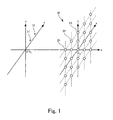
- Fig. 1 depicts a layout of sound sources and a microphone array.
- Signals obtained by the microphone array 20 picking up sounds from the sound sources 11 and 12 are analyzed, and the locations of the sound sources 11 and 12 are specified.
- the microphone array 20 is provided in this example, instead of the microphone array 20, one or multiple microphones may pick up sounds from the sound sources 11 and 12 while moving in the path that passes through the multiplicity of points.
- Fig. 2 is an external perspective view of a sound source search computer operating as an embodiment of a sound source search device of the present invention.
- the sound source search device as an embodiment of the present invention is realized by a combination of hardware of the sound source search computer 100 and software executed in the sound source search computer 100.
- the sound source search computer 100 includes a main body 101 containing a CPU, a RAM, a magnetic disk, a communication board, and the like, a display 102 that displays on a display screen 102a in accordance with an instruction from the main body 101, a keyboard 103 for inputting an instruction of the operator or textual information in the sound source search computer 100, and a mouse 104 for designating an arbitrary location on the display screen 102a to input an instruction in accordance with an icon or the like displayed at the location.
- the main body 101 also contains a CD-ROM drive for driving a CD-ROM 105 (see, Fig. 2 ) that can be freely removed.
- the CD-ROM 105 is an embodiment of a sound source search program storage medium according to the present invention and stores a sound source search program.
- the CD-ROM 105 is mounted on the main body 101.
- the CD-ROM drive installs the sound source search program stored in the CD-ROM 105 into the magnetic disk of the sound source search computer 100. Once the sound source search program installed in the magnetic disk of the sound source search computer 100 is launched, the sound source search computer 100 operates as an embodiment of the sound source search device of the present invention.
- a multiplicity of microphones 21, 22, 23, ... constituting the microphone array 20 shown in Fig. 1 are connected to the sound source search computer 100 through a signal line 105.
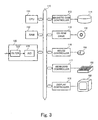
- Fig. 3 is a hardware block diagram of the sound source search computer 100 shown in Fig. 2 .
- the hardware block diagram depicts a central processing unit (CPU) 111, a RAM 112, a magnetic disk controller 113, a CD-ROM drive 115, a mouse controller 116, a keyboard controller 117, a display controller 118, and an A/D conversion board 120, which are interconnected through a bus 110.
- CPU central processing unit
- a filter 121 and an A/D converter 122 are mounted on the A/D conversion board 120, and the A/D conversion board 120 is loaded on the main body 101 of the sound source search computer 100 shown in Fig. 1 .
- the A/D converter 122 on the A/D conversion board 120 samples analog received sound signals obtained by picking up sounds with microphones 21, 22, 23, ... constituting the microphone array 20 at predetermined sampling intervals and generates digital time series data.
- the filter 121 mounted on the A/D conversion board 120 is a low-pass anti-aliasing filter for preventing mixing of aliasing noise (folded noise) with the digital time series data obtained by the A/D converter 122.
- the CD-ROM drive 115 contains the CD-ROM 105 and accesses the mounted CD-ROM 105.
- Fig. 3 also depicts the magnetic disk 114 accessed by the magnetic disk controller 113, the mouse 104 controlled by the mouse controller 116, the keyboard 103 controlled by the keyboard controller 117, and the display 102 controlled by the display controller 118.
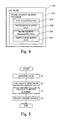
- Fig. 4 depicts a configuration of a sound source search program storage medium as an embodiment of the present invention.
- the sound source search program 200 is stored in the CD-ROM 105.
- the sound source search program 200 is constituted by a data acquisition part 210, a spectrum calculation part 220, a matrix element calculation part 230, and a sound source search part 240.
- Fig. 5 is a flow chart of a configuration of a sound source search method as an embodiment of the present invention.
- the sound source search method is constituted by a data acquisition step (step a), a spectrum calculation step (step b), a matrix element calculation step (step c), and a sound source search step (step d).
- the sound source search program 200 shown in Fig. 4 is installed and executed in the sound source search computer 100 shown in Figs. 2 and 3 , and the sound source search program 200 implements the sound source search method shown in Fig. 5 .
- Fig. 6 is a functional block diagram of an embodiment of the sound source search device of the present invention realized by the sound source search program 200 shown in Fig. 4 being installed and executed in the sound source search computer 100 shown in Figs. 2 and 3 .
- the sound source search device 300 shown in Fig. 6 is constituted by an anti-aliasing filter 301, an analog-digital conversion part 302, a data acquisition part 310, a spectrum calculation part 320, a matrix element calculation part 330, and a sound source search part 340.
- the anti-aliasing filter 301 and the analog-digital conversion part 302 are equivalent to the filter 121 on the A/D conversion board 120 and the A/D converter 122 shown in Fig. 3 .
- the rest of the components, the data acquisition part 310, the spectrum calculation part 320, the matrix element calculation part 330, and the sound source search part 340 are functions realized by the sound source search program 200 within the sound source search computer 100, the sound source search program 200 executed by the CPU 111 of the sound source search computer 100 (see, Figs. 1 and 2 ).
- the spectrum calculation part 320 of the sound source search device 300 of Fig. 6 corresponds to the spectrum calculation part 220 of the sound source search program 200 of Fig. 4 and the spectrum calculation step (step b) of the sound source search method of Fig. 5
- the matrix element calculation part 330 of the sound source search device 300 of Fig. 7 corresponds to the matrix element calculation part 230 of the sound source search program 200 of Fig. 4 and the matrix element calculation step (step c) of the sound source search method of Fig. 5
- the sound source search part 240 of the sound source search program 200 of Fig. 4 corresponds to the sound source search part 240 of the sound source search program 200 of Fig. 4 and the sound source search step (step d) of the sound source search method of Fig. 5 .
- the data acquisition part 310, the spectrum calculation part 320, the matrix element calculation part 330, and the sound source search part 340 of the sound source search device 300 of Fig. 6 are formed of a combination of hardware and software, while the corresponding elements of the sound source search program 200 of Fig. 4 are formed only of an application program.
- the sound source search program of Fig. 4 is installed in the sound source search computer 100 shown in Figs. 2 and 3 and executed in the sound source search computer 100, and the sound source search method of Fig. 5 is implemented in the sound source search computer 100.
- the following description of the operations of the components of the sound source search device 300 of Fig. 6 also serves as the description of the sound source search program 200 of Fig. 4 and the sound source search method of Fig. 5 .
- the data acquisition part 310 of the sound source search device of Fig. 6 assumes a role to control the A/D conversion board 120 shown in Fig. 3 and to import the digital time series data into the sound source search program 200 of Fig. 4 , the data acquired by filtering and A/D conversion in the A/D conversion board 120.
- the CPU 111 or the like that executes the data acquisition part 210 constituting the sound source search program 200 of Fig. 4 is equivalent to the data acquisition part 310.
- the data acquisition part 310 acquires time series data of a multiplicity of channels corresponding to the received sound signals of a multiplicity of channels generated by a multiplicity of microphones 21, 22, 23, ... constituting the microphone array 20 shown in Fig. 1 .
- the spectrum calculation part 320 uses FFT (Fast Fourier Transform) or the like, subjecting the time series data of the channels to the discrete Fourier transform.
- FFT Fast Fourier Transform
- a measure can be taken such as to make the sampling time intervals in the analog-digital conversion part 302 small enough, it is preferable to use algorithms proposed in Patent Document 1 described above.
- the present embodiment does not intend to elicit the method to obtain the highly accurate spectrum of the desired angular frequency ⁇ , and thus, detailed description in regard to that will not be further stated.
- matrix elements G X S
- ⁇ Z ( X S , z S ; ⁇ ) is calculated by substituting G( X S
- Formula (8.1) is transformed as Formula (8.2).
- Formula (8.2) by substituting the matrix elements G X S
- X H ) calculated by the matrix element calculation part 330 for the simultaneous equations (8.2) and solving the simultaneous equations (8.2), ⁇ z ( X s , z s ; ⁇ ), i.e. the particle velocity distribution in the z-direction of the angular frequency ⁇ on the x-y plane of z z S is calculated.
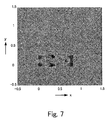
- Fig. 7 depicts a calculation result by the Fourier transform method that has been conventionally widely used, the Fourier transform method being an analytical method of the near-field acoustical holography.
- Fig. 7 serves as an example for comparison with the present invention.
- Fig. 8 depicts a particle velocity distribution obtained in accordance with the present embodiment.
- Fig. 8 serves as an example of the first invention.
- Figs. 1 to 7 have been described above as figures showing the embodiment of the first invention. Although the first invention and the second invention are different in terms of arithmetic algorithm, they are the same in terms of what are shown in these figures. Therefore, Figs. 1 to 6 are employed as figures showing the embodiment of the second invention and the description of these figures will not be provided here and only the algorithm of the second invention will be described below.
- the data acquisition part 310 shown in Fig. 6 acquires time series data of a multiplicity of channels corresponding to the received sound signals of a multiplicity of channels generated by a multiplicity of microphones 21, 22, 23, ... constituting the microphone array 20 shown in Fig. 1 .
- the spectrum calculation part 320 uses FFT (Fast Fourier Transform) or the like, subjecting the time series data of the channels to the discrete Fourier transform.
- FFT Fast Fourier Transform
- a measure can be taken such as to make the sampling time intervals in the analog-digital conversion part 302 small enough, it is preferable to use algorithms proposed in Japanese Patent Laid-Open No. 2002-278948 described above.
- the present embodiment does not intend to elicit the method to obtain the highly accurate spectrum of the desired angular frequency ⁇ , and thus, detailed description in regard to that will not be further stated.
- X Hn ) are calculated by substituting the spectrum of the angular frequency ⁇ of the multiplicity of channels calculated by the spectrum calculation part 320 for Formulas (14.12), (14.13), and (14.14a) described above.
- Formula (16.1) when calculating the matrix element G ( X Sm
- Formula (16.4) when calculating the matrix element Q ( X Sm
- Formula (16.1) is used as W ( K ) in Formula (14.14a), and the matrix element F ( a,b ) ⁇ ( X Sm
- the sound source search part 340 of the sound source search device 300 shown in Fig. 6 calculates ⁇ ( X Sn ,z S ; ⁇ ) by substituting the matrix elements G ( X Sm
- Formula (5.1) is transformed as Formula (15.2).
- Fig. 7 depicts a calculation result by the Fourier transform method that has been conventionally widely used, the Fourier transform method being an analytical method of the near-field acoustical holography.
- Fig. 7 serves as an example for comparison with the present invention.
- Fig. 9 depicts a particle velocity distribution obtained in accordance with the present embodiment.
- Fig. 9 serves as an example of the second invention.
Landscapes
- Physics & Mathematics (AREA)
- Engineering & Computer Science (AREA)
- General Physics & Mathematics (AREA)
- Radar, Positioning & Navigation (AREA)
- Remote Sensing (AREA)
- Circuit For Audible Band Transducer (AREA)
Applications Claiming Priority (2)
| Application Number | Priority Date | Filing Date | Title |
|---|---|---|---|
| JP2007133419A JP2008286710A (ja) | 2007-05-18 | 2007-05-18 | 音源探索方法、音源探索装置、および音源探索プログラム |
| JP2007133418 | 2007-05-18 |
Publications (2)
| Publication Number | Publication Date |
|---|---|
| EP1992959A2 true EP1992959A2 (fr) | 2008-11-19 |
| EP1992959A3 EP1992959A3 (fr) | 2011-02-09 |
Family
ID=39709019
Family Applications (1)
| Application Number | Title | Priority Date | Filing Date |
|---|---|---|---|
| EP08103628A Withdrawn EP1992959A3 (fr) | 2007-05-18 | 2008-04-21 | Procédé de recherche de source sonore, dispositif de recherche de source sonore, et support de stockage de programme de recherche de source sonore |
Country Status (1)
| Country | Link |
|---|---|
| EP (1) | EP1992959A3 (fr) |
Cited By (2)
| Publication number | Priority date | Publication date | Assignee | Title |
|---|---|---|---|---|
| RU2511672C2 (ru) * | 2008-12-16 | 2014-04-10 | Конинклейке Филипс Электроникс Н.В. | Оценка местоположения источника звука с использованием фильтрования частиц |
| WO2016074495A1 (fr) * | 2014-11-14 | 2016-05-19 | 中兴通讯股份有限公司 | Procédé et dispositif de traitement du signal |
Citations (1)
| Publication number | Priority date | Publication date | Assignee | Title |
|---|---|---|---|---|
| JP2002278948A (ja) | 2001-03-15 | 2002-09-27 | Ono Sokki Co Ltd | データ補間方法、データ補間プログラム、およびデータ補間装置 |
Family Cites Families (1)
| Publication number | Priority date | Publication date | Assignee | Title |
|---|---|---|---|---|
| US6005916A (en) * | 1992-10-14 | 1999-12-21 | Techniscan, Inc. | Apparatus and method for imaging with wavefields using inverse scattering techniques |
-
2008
- 2008-04-21 EP EP08103628A patent/EP1992959A3/fr not_active Withdrawn
Patent Citations (1)
| Publication number | Priority date | Publication date | Assignee | Title |
|---|---|---|---|---|
| JP2002278948A (ja) | 2001-03-15 | 2002-09-27 | Ono Sokki Co Ltd | データ補間方法、データ補間プログラム、およびデータ補間装置 |
Non-Patent Citations (5)
| Title |
|---|
| A. MESSIAH, QUANTUM MECHANICS 1-3, 1981 |
| DIRAC, QUANTUM MECHANICS, 1968 |
| E.G. WILLIAMS: "Fourier Acoustics; Sound Radiation and Nearfield Acoustical Holography", 1999, ACADEMIC PRESS |
| J. HALD: "Non-stationary STSF", BRUEL & KJAER TECHNICAL REVIEW, vol. 1, 2000, pages 1 - 36 |
| L.S. RODBERG; R.M. THALER: "Introduction to the Quantum Theory of Scattering", 1967, ACADEMIC PRESS |
Cited By (3)
| Publication number | Priority date | Publication date | Assignee | Title |
|---|---|---|---|---|
| RU2511672C2 (ru) * | 2008-12-16 | 2014-04-10 | Конинклейке Филипс Электроникс Н.В. | Оценка местоположения источника звука с использованием фильтрования частиц |
| WO2016074495A1 (fr) * | 2014-11-14 | 2016-05-19 | 中兴通讯股份有限公司 | Procédé et dispositif de traitement du signal |
| US10181330B2 (en) | 2014-11-14 | 2019-01-15 | Xi'an Zhongxing New Software Co., Ltd. | Signal processing method and device |
Also Published As
| Publication number | Publication date |
|---|---|
| EP1992959A3 (fr) | 2011-02-09 |
Similar Documents
| Publication | Publication Date | Title |
|---|---|---|
| Amini et al. | Underdetermined blind modal identification of structures by earthquake and ambient vibration measurements via sparse component analysis | |
| Hall et al. | Guided wave damage characterization via minimum variance imaging with a distributed array of ultrasonic sensors | |
| Trebuňa et al. | Experimental modal analysis performed by high-speed digital image correlation system | |
| Cho et al. | Source visualization by using statistically optimized near-field acoustical holography in cylindrical coordinates | |
| Dsilva et al. | Data-driven reduction for a class of multiscale fast-slow stochastic dynamical systems | |
| US20080033672A1 (en) | Quantum Resonance Interferometry for Detecting Signals | |
| Williams et al. | Volumetric acoustic vector intensity imager | |
| Yang et al. | Impact source localization in plate utilizing multiple signal classification | |
| Dinsenmeyer et al. | A probabilistic approach for cross-spectral matrix denoising: Benchmarking with some recent methods | |
| Zhang et al. | Reconstruction of nonstationary sound fields based on the time domain plane wave superposition method | |
| Schmid et al. | Spatial reconstruction of the sound field in a room in the modal frequency range using Bayesian inference | |
| US10674261B2 (en) | Transfer function generation apparatus, transfer function generation method, and program | |
| Ioana et al. | Recent advances in non-stationary signal processing based on the concept of recurrence plot analysis | |
| Buljak et al. | Identification of residual stresses by instrumented elliptical indentation and inverse analysis | |
| Grote et al. | Adaptive eigenspace for multi-parameter inverse scattering problems | |
| Roncen et al. | Bayesian inference for the ultrasonic characterization of rigid porous materials using reflected waves by the first interface | |
| US20220260665A1 (en) | Sound source enumeration and direction of arrival estimation using a bayesian framework | |
| Paillasseur et al. | Regularization for improving the deconvolution in real-time near-field acoustic holography | |
| EP1992959A2 (fr) | Procédé de recherche de source sonore, dispositif de recherche de source sonore, et support de stockage de programme de recherche de source sonore | |
| Blais et al. | Forward projection of transient sound pressure fields radiated by impacted plates using numerical Laplace transform | |
| US10191016B2 (en) | Method and system for passive detection, localization and characterization of mechanical wave sources using ultrasonic guided waves | |
| Bockman et al. | Bayesian-based estimation of acoustic surface impedance: Finite difference frequency domain approach | |
| Candy et al. | Multichannel spectral estimation in acoustics: A state-space approach | |
| JP2009002929A (ja) | 音源探索方法、音源探索装置、および音源探索プログラム | |
| US12332868B2 (en) | Database, server, information processing method, and storage medium |
Legal Events
| Date | Code | Title | Description |
|---|---|---|---|
| PUAI | Public reference made under article 153(3) epc to a published international application that has entered the european phase |
Free format text: ORIGINAL CODE: 0009012 |
|
| AK | Designated contracting states |
Kind code of ref document: A2 Designated state(s): AT BE BG CH CY CZ DE DK EE ES FI FR GB GR HR HU IE IS IT LI LT LU LV MC MT NL NO PL PT RO SE SI SK TR |
|
| AX | Request for extension of the european patent |
Extension state: AL BA MK RS |
|
| PUAL | Search report despatched |
Free format text: ORIGINAL CODE: 0009013 |
|
| AK | Designated contracting states |
Kind code of ref document: A3 Designated state(s): AT BE BG CH CY CZ DE DK EE ES FI FR GB GR HR HU IE IS IT LI LT LU LV MC MT NL NO PL PT RO SE SI SK TR |
|
| AX | Request for extension of the european patent |
Extension state: AL BA MK RS |
|
| AKY | No designation fees paid | ||
| REG | Reference to a national code |
Ref country code: DE Ref legal event code: R108 |
|
| REG | Reference to a national code |
Ref country code: DE Ref legal event code: R108 Effective date: 20111012 |
|
| STAA | Information on the status of an ep patent application or granted ep patent |
Free format text: STATUS: THE APPLICATION IS DEEMED TO BE WITHDRAWN |
|
| 18D | Application deemed to be withdrawn |
Effective date: 20110810 |