EP1993096A2 - Optisches Speichermedium und dessen Kryptographie - Google Patents
Optisches Speichermedium und dessen Kryptographie Download PDFInfo
- Publication number
- EP1993096A2 EP1993096A2 EP07014714A EP07014714A EP1993096A2 EP 1993096 A2 EP1993096 A2 EP 1993096A2 EP 07014714 A EP07014714 A EP 07014714A EP 07014714 A EP07014714 A EP 07014714A EP 1993096 A2 EP1993096 A2 EP 1993096A2
- Authority
- EP
- European Patent Office
- Prior art keywords
- data
- optical storage
- storage media
- memory cell
- read
- Prior art date
- Legal status (The legal status is an assumption and is not a legal conclusion. Google has not performed a legal analysis and makes no representation as to the accuracy of the status listed.)
- Withdrawn
Links
Images


Classifications
-
- G—PHYSICS
- G11—INFORMATION STORAGE
- G11B—INFORMATION STORAGE BASED ON RELATIVE MOVEMENT BETWEEN RECORD CARRIER AND TRANSDUCER
- G11B20/00—Signal processing not specific to the method of recording or reproducing; Circuits therefor
- G11B20/00086—Circuits for prevention of unauthorised reproduction or copying, e.g. piracy
- G11B20/00137—Circuits for prevention of unauthorised reproduction or copying, e.g. piracy involving measures which result in a restriction to contents recorded on or reproduced from a record carrier to authorised users
- G11B20/00152—Circuits for prevention of unauthorised reproduction or copying, e.g. piracy involving measures which result in a restriction to contents recorded on or reproduced from a record carrier to authorised users involving a password
-
- G—PHYSICS
- G11—INFORMATION STORAGE
- G11B—INFORMATION STORAGE BASED ON RELATIVE MOVEMENT BETWEEN RECORD CARRIER AND TRANSDUCER
- G11B20/00—Signal processing not specific to the method of recording or reproducing; Circuits therefor
- G11B20/00086—Circuits for prevention of unauthorised reproduction or copying, e.g. piracy
- G11B20/0021—Circuits for prevention of unauthorised reproduction or copying, e.g. piracy involving encryption or decryption of contents recorded on or reproduced from a record carrier
- G11B20/00217—Circuits for prevention of unauthorised reproduction or copying, e.g. piracy involving encryption or decryption of contents recorded on or reproduced from a record carrier the cryptographic key used for encryption and/or decryption of contents recorded on or reproduced from the record carrier being read from a specific source
- G11B20/00253—Circuits for prevention of unauthorised reproduction or copying, e.g. piracy involving encryption or decryption of contents recorded on or reproduced from a record carrier the cryptographic key used for encryption and/or decryption of contents recorded on or reproduced from the record carrier being read from a specific source wherein the key is stored on the record carrier
-
- G—PHYSICS
- G11—INFORMATION STORAGE
- G11B—INFORMATION STORAGE BASED ON RELATIVE MOVEMENT BETWEEN RECORD CARRIER AND TRANSDUCER
- G11B20/00—Signal processing not specific to the method of recording or reproducing; Circuits therefor
- G11B20/00086—Circuits for prevention of unauthorised reproduction or copying, e.g. piracy
- G11B20/0021—Circuits for prevention of unauthorised reproduction or copying, e.g. piracy involving encryption or decryption of contents recorded on or reproduced from a record carrier
- G11B20/00217—Circuits for prevention of unauthorised reproduction or copying, e.g. piracy involving encryption or decryption of contents recorded on or reproduced from a record carrier the cryptographic key used for encryption and/or decryption of contents recorded on or reproduced from the record carrier being read from a specific source
- G11B20/00253—Circuits for prevention of unauthorised reproduction or copying, e.g. piracy involving encryption or decryption of contents recorded on or reproduced from a record carrier the cryptographic key used for encryption and/or decryption of contents recorded on or reproduced from the record carrier being read from a specific source wherein the key is stored on the record carrier
- G11B20/00384—Circuits for prevention of unauthorised reproduction or copying, e.g. piracy involving encryption or decryption of contents recorded on or reproduced from a record carrier the cryptographic key used for encryption and/or decryption of contents recorded on or reproduced from the record carrier being read from a specific source wherein the key is stored on the record carrier the key being derived from a physical signature of the record carrier, e.g. unique feature set
-
- G—PHYSICS
- G11—INFORMATION STORAGE
- G11B—INFORMATION STORAGE BASED ON RELATIVE MOVEMENT BETWEEN RECORD CARRIER AND TRANSDUCER
- G11B20/00—Signal processing not specific to the method of recording or reproducing; Circuits therefor
- G11B20/00086—Circuits for prevention of unauthorised reproduction or copying, e.g. piracy
- G11B20/00572—Circuits for prevention of unauthorised reproduction or copying, e.g. piracy involving measures which change the format of the recording medium
- G11B20/00586—Circuits for prevention of unauthorised reproduction or copying, e.g. piracy involving measures which change the format of the recording medium said format change concerning the physical format of the recording medium
- G11B20/00608—Circuits for prevention of unauthorised reproduction or copying, e.g. piracy involving measures which change the format of the recording medium said format change concerning the physical format of the recording medium wherein the material that the record carrier is made of is altered, e.g. adding reactive dyes that alter the optical properties of a disc after prolonged exposure to light or air
-
- G—PHYSICS
- G11—INFORMATION STORAGE
- G11B—INFORMATION STORAGE BASED ON RELATIVE MOVEMENT BETWEEN RECORD CARRIER AND TRANSDUCER
- G11B20/00—Signal processing not specific to the method of recording or reproducing; Circuits therefor
- G11B20/00086—Circuits for prevention of unauthorised reproduction or copying, e.g. piracy
- G11B20/0092—Circuits for prevention of unauthorised reproduction or copying, e.g. piracy involving measures which are linked to media defects or read/write errors
- G11B20/00927—Circuits for prevention of unauthorised reproduction or copying, e.g. piracy involving measures which are linked to media defects or read/write errors wherein said defects or errors are generated on purpose, e.g. intended scratches
-
- G—PHYSICS
- G11—INFORMATION STORAGE
- G11B—INFORMATION STORAGE BASED ON RELATIVE MOVEMENT BETWEEN RECORD CARRIER AND TRANSDUCER
- G11B23/00—Record carriers not specific to the method of recording or reproducing; Accessories, e.g. containers, specially adapted for co-operation with the recording or reproducing apparatus ; Intermediate mediums; Apparatus or processes specially adapted for their manufacture
- G11B23/28—Indicating or preventing prior or unauthorised use, e.g. cassettes with sealing or locking means, write-protect devices for discs
- G11B23/281—Indicating or preventing prior or unauthorised use, e.g. cassettes with sealing or locking means, write-protect devices for discs by changing the physical properties of the record carrier
-
- G—PHYSICS
- G11—INFORMATION STORAGE
- G11B—INFORMATION STORAGE BASED ON RELATIVE MOVEMENT BETWEEN RECORD CARRIER AND TRANSDUCER
- G11B23/00—Record carriers not specific to the method of recording or reproducing; Accessories, e.g. containers, specially adapted for co-operation with the recording or reproducing apparatus ; Intermediate mediums; Apparatus or processes specially adapted for their manufacture
- G11B23/28—Indicating or preventing prior or unauthorised use, e.g. cassettes with sealing or locking means, write-protect devices for discs
- G11B23/283—Security features, e.g. digital codes
- G11B23/284—Security features, e.g. digital codes on the record carrier
-
- G—PHYSICS
- G11—INFORMATION STORAGE
- G11B—INFORMATION STORAGE BASED ON RELATIVE MOVEMENT BETWEEN RECORD CARRIER AND TRANSDUCER
- G11B7/00—Recording or reproducing by optical means, e.g. recording using a thermal beam of optical radiation by modifying optical properties or the physical structure, reproducing using an optical beam at lower power by sensing optical properties; Record carriers therefor
- G11B7/24—Record carriers characterised by shape, structure or physical properties, or by the selection of the material
- G11B7/24097—Structures for detection, control, recording operation or replay operation; Special shapes or structures for centering or eccentricity prevention; Arrangements for testing, inspecting or evaluating; Containers, cartridges or cassettes
Definitions
- the present invention relates to a data encryption methodology for the optical storage media, and more particularly, to a method for the arrangement of cryptography based on the characteristic of the Read Once/Un-reversible reaction technique.
- codes generated by such method it is not possible to generate the accurate codes by just duplicating the conventional optical storage media as in the conventional technique.
- codes are generated based on the hardware's physical characteristic, it is not possible to crack or recover the original codes by using any software method.
- a DVD data protection technique using the encrypted keys is disclosed in US Patent 5,915,018 .
- two sets of encrypted key are used, wherein one set of keys is applied on another set of keys to re-encrypt the second set of keys, so as to obtain an encryption key, which is then written into the optical disk.
- the optical disk contains the media contents, encryption key and the corresponding decryption control information.
- the encrypted key had been re-encrypted, since the information required for decryption are all recorded in the optical disk, it is still possible to hack the contents of the optical disk.
- the optical storage media is a hardware that stores data by using the optical characteristic, which includes Optical Disk (CD), Digital Versatile Disc (DVD), High Definition DVD (HDVD), Blue-ray DVD, or Magneto-Optical Disk, ... etc. All of the optical storage media mentioned above are the digital data storage hardware that can read/write data from/to the media by using the optical characteristic.
- the author of the present invention discloses a cryptography for data encryption on the optical storage media and the apparatus thereof in the present invention based on many years of experience on electronic product development and research. The technical contents of the present invention are described in great detail hereinafter.
- the present invention can arrange the storing location and attribute of the optical disk data and generate the melting code and developed code or the converse code and developed code by using such arrangement.
- the former i.e. the melting code or the converse code
- the latter i.e. the developed code
- Such two sets of codes that are stored separately in the optical storage media and in the host system can be applied on various data encryption/decryption processes in order to protect the copyright of the content stored in optical disk.
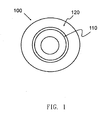
- FIG. 1 is a schematic diagram of an optical storage media (CD/DVD) according to the present invention, wherein a ring-shaped portion is used as a code area 110 to store codes, and the ring-shaped portion is a general data storage area 120 for storing media contents.
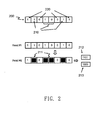
- FIG. 2 schematically shows a detailed process of generating codes.
- FIG. 2 includes a code area 200, a Read Once/Un-reversible reaction cell 210, and a general reading cell 220.
- the code area 200 is composed of a mix of the Read Once/Un-reversible reaction cell 210 and the general reading cell 220.
- the Read Once/Un-reversible reaction cell 210 is a cell with chemical material coated thereon.
- the cell's characteristic is changed and the data structure is changed accordingly.
- the encryption/description technique provided by the present invention is implemented by two processes based on different material-change characteristics, and its detail is described in great detail hereinafter.
- the Read Once/Un-reversible reaction cell 210 of FIG. 2 When the laser beam source is emitted on the material to read data, a chemical or physical reaction occurs on the material, which destroys the data structure, thus the data can be read only once. Therefore, after the Read Once/Un-reversible reaction cell 210 of FIG. 2 is first read by the laser beam, the cell 210 becomes a black cell 211 that cannot record or retain digital data anymore. Then, the data in the code area 200 obtained from the first reading operation is transmitted to a memory unit inside a host system (not shown) from an optical disk drive (not shown). Meanwhile, when the system reads the data a second time, since the black cell 211 does not contain any data at this moment, the system can only read the segment data 213, and a melting code 212 is generated by comparing the segment data 213 with the first reading data.
- the laser beam After the code area 200 is read for the first time, the laser beam reads the code area 200 a second time. Meanwhile, since the black cell 211 had been damaged, the data cannot be read. Then, the segment data 213 is formed in the code area 200, and the segment data 213 is in fact the code that was developed at the first data reading by the laser beam.
- the data that was first read from the code area 200 is transmitted to the memory unit of the host system from the optical disk drive. Afterwards, the system performs a second data reading on the code area 200. Since the data on the Read Once/Un-reversible reaction cell 210 had been reversed, after it had been read and compared with the first read data by the system, a converse code 214 is generated, for example, the converse code is generated from a XOR (Exclusive-OR) operation. While the converse code is being generated, another developed code 215 is also extracted by the system.
- XOR Exclusive-OR
- FIG. 4 is a flow chart illustrating a method of generating the converse and developed codes according to the present invention.
- the bit index values of the first read data (referred as Read #1 hereinafter) and the second read data (referred as Read #2 hereinafter) are set to 0.
- the index values indicate the bit location of the Read #1 and Read #2.
- the Read #2 bit is a developed code bit, and it will be recorded in the developed code.
- a converse code and a developed code are generated.
- the bit index value of Read #1 and Read #2 are incremented by 1.
- the converse code and the developed code are completely extracted.
- the former code is the melting code 212 and the developed code 213 which are generated based on the material's un-reversible damaged characteristic, and the developed code is permanently recorded and retained on the optical disk.
- the latter code is the converse code 214 and the developed code 215 which are generated based on the material's disposable permanently reversed characteristic. Since the latter material has a disposable permanently reversed characteristic, once the data logic level is reversed, it cannot be changed anymore, and the converse code 214 and the developed code 215 are both recorded on the optical storage media. Therefore, for the host system which lacks the converse code 214, it is not possible to effectively recognize the developed code 215 from the optical storage media. Accordingly, this encryption/decryption process is different from the previous process, which uses the material's un-reversible damaged characteristic.
- the melting code 212 and the developed code 213 generated by the formal process and the converse code 214 and the developed code 215 generated by the latter process are respectively stored in the host memory system and the optical storage media 100 based on its specific characteristic. Therefore, these two codes (212, 213) or (214, 215) can be used by the content provider to encrypt and decrypt the media contents through appropriate arrangement.
- the private key Kp-1 and the public key Kp1 used in the public key cryptography operation can be obtained from the aforementioned melting code 212 and the developed code 213 or the converse code 214 and the developed code 215 to encrypt or decrypt the optical disk contents.
- the content vendor first uses the public key Kp1 to encrypt and convert the plaintext to the encrypted content (Equation 1), and then records the encrypted content and the code area 200 onto the optical disk. After the optical disk is first read and the private key Kp-1 is obtained, the encrypted content is decrypted by the host system (Equation 2), and the data encoding/decoding process is completed.
- the technique provided by the present invention effectively protects the contents of the optical disk from being illegally replicated.
- the optical storage media 100 of the present invention is first read, even if the digital data had been duplicated to the conventional optical disk, since the conventional optical disk lacks the Read Once/Un-reversible reaction cell, it is not possible to generate the melting code 212 and the developed code 213 or the converse code 214 and the developed code 215, and the encrypted data stored in the optical disk cannot be decoded.
- the code area 110 shown in FIG. 1 may be a ring-shaped portion, which is also the code area 200 for storing the codes in FIG. 2 .
- the quantity of the code area 200 on the optical storage media 100 can be appropriately increased.
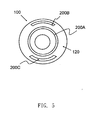
- FIG. 5 which shows an optical storage media 100 with a plurality of code areas (i.e. the melting code and the developed code or the converse code and the developed code) 200A, 200B and 200C.
- code areas i.e. the melting code and the developed code or the converse code and the developed code
- 200A, 200B and 200C different public and private keys are stored in every area, and the public and private keys together form a key pair, such that the software product can be installed on three different host systems by the user.
- the software vendor can select an appropriate optical disk format to record its software product on the optical disk without having to worry about the illegal replication of the optical disk content, thus the data stored in the optical disk is effectively secured.
- the structure shown in FIG. 5 provides a plurality of key pairs. Accordingly, different key pairs can be applied on the digital signature mechanism to authenticate the user and vendor ID, such that the transaction is ensured to be secured. If the data is re-encrypted, the uniqueness of the data can be further ensured, that is to ensure the data does not suffer from malicious modification operations such as delete, change, add and edit during the data transmission and transportation,
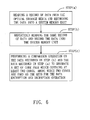
- FIG. 6 shows a flow chart of a data processing method for the optical storage media according to the present invention.
- the data processing method for the optical storage media of the present invention comprises the following steps: (a) reading a record of data from the optical storage media 100 and recording the data into a system memory unit; (b) repeatedly reading the same record of data and record the data into the system memory unit; and (c) performing a comparison operation on the data recorded in step (b) and the data recorded in step (a) to generate a set of code pairs which contains at least two codes, among which two codes are used as the keys for the data encryption and decryption operation.
- step (a) a record of data stored in the optical storage media 100 is read and stored in the system memory unit.
- step (b) the same record of data is read and recorded in the system memory unit.
- steps (a) ⁇ (b) are described in the previous embodiment, thus it is intentionally omitted herein.
- step (c) the data recorded in step (b) is compared with the data recorded in step (a) to generate a set of code pairs which contains at least two codes, among which two codes are used as the keys for the data encryption and decryption operation. Please refer to the aforementioned equations (1) ⁇ (4) and its related description for the technical details of this operation.
- the operation in the comparison process includes, but does not limit to a XOR (Exclusive-OR) operation. Wherein, two keys are used as a public key and a private key, respectively.
- the operation includes, but does not limit to an asymmetric encryption/decryption technique.
- the asymmetric encryption/decryption technique includes, but does not limit to a public key infrastructure, in which one public key and one private key are used as the passwords of the user ID authentication operation.
- the most effective design is to combine the optical disk's data design and material application.
- the present invention designs an optical storage mechanism with a high level of security.
- the hardware mechanism for the reading operation in the optical disk drive is not largely changed, instead, the objective of data protection is achieved by merely modifying the optical storage media's material and data design.
- the present invention effectively prevents the optical disk contents from being illegally replicated as in the prior technique, thus the objective of data protection for the optical storage media is achieved.
Landscapes
- Engineering & Computer Science (AREA)
- Computer Security & Cryptography (AREA)
- Signal Processing (AREA)
- Signal Processing For Digital Recording And Reproducing (AREA)
- Optical Recording Or Reproduction (AREA)
- Storage Device Security (AREA)
Applications Claiming Priority (1)
| Application Number | Priority Date | Filing Date | Title |
|---|---|---|---|
| CN 200710106962 CN101308684A (zh) | 2007-05-14 | 2007-05-14 | 一种光储存媒体及其资料加密方法 |
Publications (2)
| Publication Number | Publication Date |
|---|---|
| EP1993096A2 true EP1993096A2 (de) | 2008-11-19 |
| EP1993096A3 EP1993096A3 (de) | 2009-01-21 |
Family
ID=38458232
Family Applications (1)
| Application Number | Title | Priority Date | Filing Date |
|---|---|---|---|
| EP07014714A Withdrawn EP1993096A3 (de) | 2007-05-14 | 2007-07-26 | Optisches Speichermedium und dessen Kryptographie |
Country Status (2)
| Country | Link |
|---|---|
| EP (1) | EP1993096A3 (de) |
| CN (1) | CN101308684A (de) |
Families Citing this family (1)
| Publication number | Priority date | Publication date | Assignee | Title |
|---|---|---|---|---|
| CN112562744B (zh) * | 2020-07-03 | 2021-09-03 | 暨南大学 | 一种面向超快超分辨全光磁记录的双脉冲激发方法 |
Family Cites Families (5)
| Publication number | Priority date | Publication date | Assignee | Title |
|---|---|---|---|---|
| US5915018A (en) * | 1996-11-05 | 1999-06-22 | Intel Corporation | Key management system for DVD copyright management |
| US6747930B1 (en) * | 1996-12-24 | 2004-06-08 | Hide & Seek Technologies, Inc. | Data protection on an optical disk |
| FR2768842B1 (fr) * | 1997-09-19 | 2000-01-07 | Maurice Milgram | Protection anti-copie d'un disque optique numerique par adjonction d'une zone ayant des proprietes optiques modifiables lors de la lecture |
| US7660415B2 (en) * | 2000-08-03 | 2010-02-09 | Selinfreund Richard H | Method and apparatus for controlling access to storage media |
| US20060064594A1 (en) * | 2001-06-06 | 2006-03-23 | Spectra Systems Corp. | Absorptive coating on a disc to create a reflective modulation for encryption |
-
2007
- 2007-05-14 CN CN 200710106962 patent/CN101308684A/zh active Pending
- 2007-07-26 EP EP07014714A patent/EP1993096A3/de not_active Withdrawn
Also Published As
| Publication number | Publication date |
|---|---|
| CN101308684A (zh) | 2008-11-19 |
| EP1993096A3 (de) | 2009-01-21 |
Similar Documents
| Publication | Publication Date | Title |
|---|---|---|
| TW563319B (en) | Method and device for controlling distribution and use of digital works | |
| JP4600042B2 (ja) | 記録再生装置およびデータ処理装置 | |
| RU2361293C2 (ru) | Способ управления информацией для защиты от копирования носителя записи | |
| CA2381141A1 (en) | Recordable storage medium with protected data area | |
| US7874004B2 (en) | Method of copying and reproducing data from storage medium | |
| KR20040041684A (ko) | 블록식으로 저장된 사용자 데이터를 판독 또는 기록하는장치 및 방법 | |
| US20050076225A1 (en) | Method and apparatus for verifying the intergrity of system data | |
| US20060136342A1 (en) | Content protection method, and information recording and reproduction apparatus using same | |
| TWI271618B (en) | Apparatus and method for reading or writing user data | |
| US20080175389A1 (en) | Method for managing copy protection information of recording medium | |
| JP4062842B2 (ja) | 記録装置及び方法、再生装置及び方法並びに記録媒体 | |
| US8014522B2 (en) | Optical storage media and the corresponding cryptography for data encryption thereof | |
| EP1944766A1 (de) | Verfahren zur Aufzeichnung und Wiedergabe von Daten auf einer optischen Platte | |
| EP1993096A2 (de) | Optisches Speichermedium und dessen Kryptographie | |
| JPH1196674A (ja) | データ記録装置、データ再生装置及びデータ記録媒体 | |
| JP4560086B2 (ja) | コンテンツデータ記録再生装置 | |
| CN100382156C (zh) | 用于管理记录介质的复制保护信息的方法 | |
| JP2004303321A (ja) | 情報記録媒体記録再生システム、情報記録媒体、情報記録媒体記録再生方法、情報記録媒体記録再生プログラム | |
| JP2003115165A (ja) | 光記録媒体記録方法 | |
| US20050169144A1 (en) | Recording medium processing device and recording medium processing method | |
| JP2003109304A (ja) | 光記録媒体再生方法 | |
| JP2003115164A (ja) | 光記録媒体記録装置 | |
| JP2007207407A (ja) | 読取、保護機能を持つシステム |
Legal Events
| Date | Code | Title | Description |
|---|---|---|---|
| PUAI | Public reference made under article 153(3) epc to a published international application that has entered the european phase |
Free format text: ORIGINAL CODE: 0009012 |
|
| AK | Designated contracting states |
Kind code of ref document: A2 Designated state(s): AT BE BG CH CY CZ DE DK EE ES FI FR GB GR HU IE IS IT LI LT LU LV MC MT NL PL PT RO SE SI SK TR |
|
| AX | Request for extension of the european patent |
Extension state: AL BA HR MK RS |
|
| PUAL | Search report despatched |
Free format text: ORIGINAL CODE: 0009013 |
|
| AK | Designated contracting states |
Kind code of ref document: A3 Designated state(s): AT BE BG CH CY CZ DE DK EE ES FI FR GB GR HU IE IS IT LI LT LU LV MC MT NL PL PT RO SE SI SK TR |
|
| AX | Request for extension of the european patent |
Extension state: AL BA HR MK RS |
|
| AKX | Designation fees paid | ||
| STAA | Information on the status of an ep patent application or granted ep patent |
Free format text: STATUS: THE APPLICATION IS DEEMED TO BE WITHDRAWN |
|
| 18D | Application deemed to be withdrawn |
Effective date: 20090722 |
|
| REG | Reference to a national code |
Ref country code: DE Ref legal event code: 8566 |