EP1993122A2 - Halbleiterschicht für Dünnschichttransistoren - Google Patents
Halbleiterschicht für Dünnschichttransistoren Download PDFInfo
- Publication number
- EP1993122A2 EP1993122A2 EP08156207A EP08156207A EP1993122A2 EP 1993122 A2 EP1993122 A2 EP 1993122A2 EP 08156207 A EP08156207 A EP 08156207A EP 08156207 A EP08156207 A EP 08156207A EP 1993122 A2 EP1993122 A2 EP 1993122A2
- Authority
- EP
- European Patent Office
- Prior art keywords
- solution
- zinc
- substrate
- semiconductor layer
- heating
- Prior art date
- Legal status (The legal status is an assumption and is not a legal conclusion. Google has not performed a legal analysis and makes no representation as to the accuracy of the status listed.)
- Withdrawn
Links
Images
Classifications
-
- H—ELECTRICITY
- H10—SEMICONDUCTOR DEVICES; ELECTRIC SOLID-STATE DEVICES NOT OTHERWISE PROVIDED FOR
- H10P—GENERIC PROCESSES OR APPARATUS FOR THE MANUFACTURE OR TREATMENT OF DEVICES COVERED BY CLASS H10
- H10P14/00—Formation of materials, e.g. in the shape of layers or pillars
- H10P14/20—Formation of materials, e.g. in the shape of layers or pillars of semiconductor materials
- H10P14/34—Deposited materials, e.g. layers
- H10P14/3402—Deposited materials, e.g. layers characterised by the chemical composition
- H10P14/3424—Deposited materials, e.g. layers characterised by the chemical composition being Group IIB-VIA materials
- H10P14/3426—Oxides
-
- H—ELECTRICITY
- H10—SEMICONDUCTOR DEVICES; ELECTRIC SOLID-STATE DEVICES NOT OTHERWISE PROVIDED FOR
- H10D—INORGANIC ELECTRIC SEMICONDUCTOR DEVICES
- H10D30/00—Field-effect transistors [FET]
- H10D30/60—Insulated-gate field-effect transistors [IGFET]
- H10D30/67—Thin-film transistors [TFT]
- H10D30/674—Thin-film transistors [TFT] characterised by the active materials
- H10D30/6755—Oxide semiconductors, e.g. zinc oxide, copper aluminium oxide or cadmium stannate
-
- H—ELECTRICITY
- H10—SEMICONDUCTOR DEVICES; ELECTRIC SOLID-STATE DEVICES NOT OTHERWISE PROVIDED FOR
- H10P—GENERIC PROCESSES OR APPARATUS FOR THE MANUFACTURE OR TREATMENT OF DEVICES COVERED BY CLASS H10
- H10P14/00—Formation of materials, e.g. in the shape of layers or pillars
- H10P14/20—Formation of materials, e.g. in the shape of layers or pillars of semiconductor materials
- H10P14/26—Formation of materials, e.g. in the shape of layers or pillars of semiconductor materials using liquid deposition
- H10P14/265—Formation of materials, e.g. in the shape of layers or pillars of semiconductor materials using liquid deposition using solutions
-
- H—ELECTRICITY
- H10—SEMICONDUCTOR DEVICES; ELECTRIC SOLID-STATE DEVICES NOT OTHERWISE PROVIDED FOR
- H10P—GENERIC PROCESSES OR APPARATUS FOR THE MANUFACTURE OR TREATMENT OF DEVICES COVERED BY CLASS H10
- H10P95/00—Generic processes or apparatus for manufacture or treatments not covered by the other groups of this subclass
- H10P95/90—Thermal treatments, e.g. annealing or sintering
Definitions
- the present disclosure relates to methods of making a zinc oxide semiconductor layer for a thin film transistor and the semiconductor layer and/or thin film transistor produced thereby.
- Zinc oxide is a non-toxic inorganic semiconductor which may also offer such salient features as high mobility, excellent environmental stability and high transparency.
- a ZnO semiconductor having high mobility is generally made only through radio-frequency magnetron sputtering.
- ZnO thin-film semiconductors prepared by radio frequency magnetron sputtering in delicately controlled environments have showed high FET mobility (>30 cm 2 /V ⁇ sec), but this technique is not compatible with low-cost TFT manufacturing processes. Such equipment is expensive and leads to high production costs.
- ZnO semiconductors have also been made at low (ambient) temperatures using ZnO nanoparticles or nanorods in solution.
- this approach involved an additional step to prepare the nanoparticles or nanorods. See B. Sun et al., "Solution-Processed Zinc Oxide Field-Effect Transistors Based on Self-Assembly of Colloidal Nanorods," Nano Lett., Vol. 5, No. 12, pp. 2408-2413 (2005 ).
- TFTs are generally composed of, on a support, an electrically conductive gate, source and drain electrodes, an electrically insulating gate dielectric layer which separated the gate electrode from the source and drain electrodes, and a semiconducting layer which is in contact with the gate dielectric layer and bridges the source and drain electrodes. It would be beneficial to produce a zinc oxide semiconductor at low temperatures having good mobility and/or other desirable properties.
- the present disclosure relates, in various embodiments, to a method for producing a ZnO semiconductor layer and/or a thin film transistor comprising the same.
- the method of making a zinc oxide semiconductor comprises providing a solution comprising a zinc salt and a complexing agent; contacting a substrate with the solution; and heating the solution to form a zinc oxide semiconductor layer.
- the zinc salt may be selected from the group consisting of zinc nitrate, zinc chloride, zinc sulfate, and zinc acetate. In more specific embodiments, the zinc salt is zinc nitrate.
- the complexing agent may be a carboxylic acid or an organoamine.
- the complexing agent is an organoamine selected from the group consisting of hexamethylenetetramine, ethanolamine, aminopropanol, diethanolamine, 2-methylaminoethanol, N,N-dimethylaminoethanol, methoxyethylamine, methoxypropylamine, diaminoethane, diaminopropane, diaminobutane, diaminocyclohexane, and mixtures thereof.
- the complexing agent is hexamethylenetetramine.
- the molar ratio of zinc salt to complexing agent in the solution may be from about 0.5 to about 10.
- the concentration of Zn 2+ in the solution may be from about 0.01 M to about 5.0M.
- the substrate may be contacted with the solution comprising the zinc salt and the complexing agent by submerging the substrate therein.
- the substrate may also be contacted with the solution by depositing the solution thereupon.
- the method of liquid deposition may be selected from the group consisting of spin coating, blade coating, rod coating, dip coating, screen printing, microcontact printing, ink jet printing, and stamping.
- the heating may be performed by heating comprising the zinc salt and the complexing agent to a temperature of from about 50°C to about 300°C. In other embodiments, the heating may also be performed by heating to a temperature of from about 50°C to about 150°C. In some embodiments, the solution may be heated for a period of from about 1 minute to about 24 hours. In some embodiments, the solution is heated for a period of from about 1 minute to about 6 hours, preferably from 1 minute to 200 minutes. In further embodiments, the heating may be performed by heating at a rate of from about 0.5°C to about 100°C per minute.
- the method may further comprise rinsing and drying the substrate.
- the resulting thin film transistor may have a field effect mobility of at least 0.1 cm 2 /V ⁇ sec, preferably at least 0.5 cm 2 / V ⁇ sec.
- the resulting semiconductor layer may have a current on/off ratio greater than about 10 3 .
- the substrate may comprise a film or sheet of glass, silicon, or polymeric material.
- a method of making a zinc oxide semiconductor layer for a thin film transistor comprises providing a solution comprising zinc nitrate and hexamethylenetetramine, wherein the ratio of zinc concentration to hexamethylenetetramine concentration in the aqueous solution is from about 0.5 to about 10; submerging a substrate in the solution; and heating the aqueous solution at a rate of from about 0.5°C/min to about 10.0°C/min to a temperature of from about 50°C to about 100°C to form a zinc oxide semiconductor layer.
- the support may have a deformation temperature below 300oC.
- the support can be a polymeric support, such as for example polyester, polycarbonate, polyimide films or sheets.
- the semiconductor of the TFT of the present disclosure has a mobility of at least 1 cm 2 /V ⁇ sec. In other embodiments, the TFT has a mobility of at least 5 cm 2 /V ⁇ sec.
- the semiconductor layers or TFTs made using the processes are also disclosed.
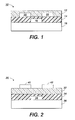
- FIG. 1 is a first exemplary embodiment of a TFT of the present disclosure.
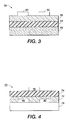
- FIG. 2 is a second exemplary embodiment of a TFT of the present disclosure.
- FIG. 3 is a third exemplary embodiment of a TFT of the present disclosure.
- FIG. 4 is a fourth exemplary embodiment of a TFT of the present disclosure.
- FIG. 1 there is schematically illustrated an TFT configuration 10 comprised of a support 16, in contact therewith a metal contact 18 (gate electrode) and a layer of a gate dielectric layer 14 on top of which two metal contacts, source electrode 20 and drain electrode 22, are deposited. Over and between the metal contacts 20 and 22 is a zinc oxide semiconductor layer 12 as illustrated herein.
- FIG. 2 schematically illustrates another TFT configuration 30 comprised of a support 36, a gate electrode 38, a source electrode 40 and a drain electrode 42, a gate dielectric layer 34, and a zinc oxide semiconductor layer 32.
- FIG. 3 schematically illustrates a further TFT configuration 50 comprised of support (not shown)/indium-tin oxide (ITO)/an aluminum-titanium oxide (ATO), wherein the ITO 56 is a gate electrode, and ATO 54 is a dielectric layer, and a zinc oxide semiconductor layer 52, on top of which are deposited a source electrode 60 and a drain electrode 62.
- ITO indium-tin oxide
- ATO aluminum-titanium oxide
- FIG. 4 schematically illustrates an additional TFT configuration 70 comprised of support 76, a gate electrode 78, a source electrode 80, a drain electrode 82, a zinc oxide semiconductor layer 72, and a gate dielectric layer 74.
- the semiconductor of the TFT of the present disclosure has a mobility of at least 1 cm 2 /V ⁇ sec.
- the zinc oxide semiconductor layer is made by a solution processing technique.
- the technique comprises making a solution of a zinc salt and a complexing agent. The solution is placed in contact with a substrate and heated to form a zinc oxide layer.
- the zinc salt is zinc nitrate.
- Zinc nitrate has the chemical formula Zn(NO 3 ) 2 .
- alternative zinc salts such as zinc chloride, zinc bromide, zinc oxalate, zinc acetylacetonate, zinc sulfate, zinc acetate, and their hydrates can be used.
- the complexing agent is added to facilitate the formation of a ZnO thin film and to increase the viscosity of the solution to improve thin film uniformity.
- the complexing agent may be, for example, a carboxylic acid or an organoamine.
- the complexing agent can be an organoamine selected for example from the group consisting of hexamethylenetetramine, ethanolamine, aminopropanol, diethanolamine, 2-methylaminoethanol, N,N-dimethylaminoethanol, methoxyethylamine, methoxypropylamine, diaminoethane, diaminopropane, diaminobutane, diaminocyclohexane, and the like, and mixtures thereof.
- the complexing agent is hexamethylenetetramine.
- Hexamethylenetetramine has the chemical formula (CH 2 ) 6 N 4 and is also known as hexamine, urotropine, or 1,3,5,7-tetraazaadamantane.
- the substrate and solution comprising a zinc salt and a complexing agent can be contacted by submerging the substrate in the solution or by depositing the solution upon the substrate.
- the substrate comprises the support and any other layers or components of the TFT already deposited upon the support prior to being contacted with the solution.
- Crystalline ZnO species are gradually deposited from the solution comprising a zinc salt and a complexing agent on the substrate to form the desired ZnO semiconductor layer.
- the molar ratio of salt to complexing agent in the solution is from about 0.5 to about 10.
- the concentration of zinc ([Zn 2+ ]) may be from about 0.01 M to about 5.0M. In further embodiments, the concentration of zinc ([Zn 2+ ]) may be from about 0.05M to about 0.1 M.
- the solution may have a beginning temperature around room temperature (i.e., about 25°C).
- Suitable liquid(s) including, for instance, organic solvents and water can be used as the solvent for the solution.
- Suitable organic solvents include hydrocarbon solvents such as pentane, hexane, cyclohexane, heptane, octane, nonane, decane, undecane, dodecane, tridecane, tetradecane, toluene, xylene, mesitylene, and the like; alcohols such as methanol, ethanol, propanol, butanol, pentanol, hexyl alcohol, heptyl alcohol, ethyleneglycol, methoxyethanol, ethoxyethanol, methoxypropanol, ethoxypropanol, methoxybutanol, dimethoxyglycol, and the like, ketones such as acetone, butanone, pentanone, cyclohexanone, and the like, tetrahydrofuran,
- other components can be incorporated in the solution to be incorporated into the semiconductor layer.
- Such components include, for example, a polymer such as polystyrene, poly(methylmethacrylate, poly(vinylpyrollidone), and the like, metal nanoparticles of such as gold, silver, and the like, metal oxide nanoparticles of such as silicon oxide, gallium oxide, zirconium oxide, aluminum oxide, tin oxide, indium-tin oxide (ITO), and the like, and mixtures thereof.
- a polymer such as polystyrene, poly(methylmethacrylate, poly(vinylpyrollidone), and the like
- metal nanoparticles of such as gold, silver, and the like metal oxide nanoparticles of such as silicon oxide, gallium oxide, zirconium oxide, aluminum oxide, tin oxide, indium-tin oxide (ITO), and the like, and mixtures thereof.
- ITO indium-tin oxide
- Liquid processing techniques include submerging the substrate into the solution comprising the zinc salt and the complexing agent or liquid depositing the solution comprising the zinc salt and the complexing agent onto the substrate.
- Liquid depositing the solution onto the substrate can be accomplished by any liquid deposition techniques such as for instance spin coating, blade coating, rod coating, dip coating, screen printing, microcontact printing, ink jet printing, stamping and the like.
- Heating refers to a heat treatment of the solution comprising the zinc salt and complexing agent at a temperature or several temperatures within a range of between about 50°C and about 300°C.
- the heating can be accomplished, for example, in an instant heating manner at a certain temperature using a pre-heated solution comprising the zinc salt and complexing agent.
- the heating can be accomplished in a gradual heating manner with a heating rate that the heating equipment can achieve, ranging from about 0.5 to about 100°C per minute (°C/min).
- the heating step may begin at room temperature (about 25°C) or at a temperature from about 25°C to about 100°C.
- the heating can also be accomplished step-wise at several temperatures, such as, for example, at about 100°C, then at about 200°C, and then at about 300°C. In embodiments, the heating can also be accomplished step-wise at several temperatures, combined with gradual heating. The heating can also be accomplished for instance at a higher temperature and then at a lower temperature such as first at about 300°C and then at about 200°C. In some specific embodiments, all heating is done at temperatures below about 100°C. In a specific embodiment, the heating is performed by heating at a rate of 1°C/min. In a specific embodiment, the heating is performed by heating at a rate of about 1 °C/min up to a temperature of about 90°C. The solution may be heated for a period of from about 1 minute to about 24 hours. Generally, the solution and the substrate are heated together.
- the process may further comprise a cooling phase.
- “Cooling” refers to bringing the temperature of the solution comprising the zinc salt and complexing agent from the final temperature of the heating, and particularly down to about room temperature.
- the cooling can be accomplished for instance in a self-cooling manner by turning off the heating equipment or in a controlled manner at a certain cooling rate such as for example from about 0.1 °C/min to about 100°C/min.
- a slow cooling rate of about 0.1°C/min to about 10°C/min may be employed, especially from a temperature higher than about 200°C, to reduce mechanical strain in the semiconductor layer(s) and the substrate.
- the process may further comprise a cleaning phase.
- “Cleaning” refers to cleaning the substrate comprising the ZnO thin films after the cooling step in order to remove unreacted zinc salt, complexing agent, precipitates, and/or solvent on the surface of the ZnO thin film. Any suitable liquid(s) including, for instance, organic solvents and water can be used for rinsing.
- Suitable organic solvents include hydrocarbon solvents such as pentane, hexane, cyclohexane, heptane, octane, nonane, decane, undecane, dodecane, tridecane, tetradecane, toluene, xylene, mesitylene, and the like; alcohols such as methanol, ethanol, propanol, butanol, pentanol, hexyl alcohol, heptyl alcohol, ethyleneglycol, methoxyethanol, ethoxyethanol, methoxypropanol, ethoxypropanol, methoxybutanol, dimethoxyglycol, and the like, ketones such as acetone, butanone, pentanone, cyclohexanone, and the like, tetrahydrofuran, chlorobenzene, dichlorobenzene, trichlorobenzene, nitrobenzene,
- Cleaning can be carried out in any manner such as, for example, by washing the substrate comprising ZnO thin film with a solvent or by dipping the substrate comprising ZnO thin film into a solvent. Cleaning can be carried out at temperatures from about room temperature (25°C) to about 300 °C, but generally is done at room temperature. Ultrasonic cleaning equipment can be optionally used to facilitate the cleaning.
- the process may further comprise a drying phase.
- "Drying” refers to removing any remaining liquid from the surface of the ZnO thin film after the cleaning step, with or without the heating step.
- the drying phase is performed at temperatures of from 100°C to about 150°C for period of from about 1 to about 120 minutes.
- the zinc oxide semiconductor layer of the present disclosure can be used in electronic devices such as large area displays, radio-frequency identification (RFID) tags, etc. which use thin film transistors with high field-effect mobility of, for example, about 0.1 cm 2 /V ⁇ s.
- RFID radio-frequency identification
- the zinc oxide semiconductor layer has a thickness ranging from about 10 nanometers to about 1 micrometer, particularly a thickness of from about 20 nanometers to about 200 nanometers.
- the TFT devices contain a semiconductor channel with a width, W and length, L.
- the semiconductor channel width may be, for example, from about 0.1 micrometers to about 5 millimeters, with a specific channel width being about 5 micrometers to about 1 millimeter.
- the semiconductor channel length may be from about 0.1 micrometer to about 1 millimeter with a more specific channel length being from about 5 micrometers to about 100 micrometers.
- the support may be composed of any suitable materials, for instance silicon, glass, aluminum, or plastics.
- the thickness of the support may be from about 10 micrometers to over 10 millimeters with a representative thickness being from about 1 to about 10 millimeters for a rigid support such as glass plate or silicon wafer.
- the processes of the present disclosure allow the use of supports which may have a melting or softening temperature near or below about 300°C.
- the gate electrode can be a thin metal film, a conducting polymer film, a conducting film made from conducting ink or paste or the support itself, for example heavily doped silicon.
- gate electrode materials include but are not restricted to aluminum, nickel, gold, silver, copper, zinc, indium, zinc-gallium oxide, indium tin oxide, indium-antimony oxide, conducting polymers such as polystyrene sulfonate-doped poly(3,4-ethylenedioxythiophene) (PSS-PEDOT), conducting ink/paste comprised of carbon black/graphite or colloidal silver dispersion in polymer binders, such as ELECTRODAG TM available from Acheson Colloids Company.
- the gate electrode can be prepared by vacuum evaporation, sputtering of metals or conductive metal oxides, coating from conducting polymer solutions or conducting inks by spin coating, casting or printing.
- the thickness of the gate electrode ranges for example from about 10 to about 200 nanometers for metal films and in the range of about 1 to about 10 micrometers for polymer conductors.
- Typical materials suitable for use as source and drain electrodes include those of the gate electrode materials such as aluminum, zinc, indium, conductive metal oxides such as zinc-gallium oxide, indium tin oxide, indium-antimony oxide, conducting polymers and conducting inks.
- Typical thicknesses of source and drain electrodes are about, for example, from about 40 nanometers to about 1 micrometer with the more specific thickness being about 100 to about 400 nanometers.
- the gate dielectric layer generally can be an inorganic material film or an organic polymer film.
- inorganic materials suitable as the gate dielectric layer include aluminum-titanium oxide, aluminum oxide, silicon oxide, silicon nitride, barium titanate, barium zirconium titanate and the like;
- organic polymers for the gate dielectric layer include polyesters, polycarbonates, poly(vinyl phenol), polyimides, polystyrene, poly(methacrylate)s, poly(acrylate)s, epoxy resin and the like.
- the thickness of the gate dielectric layer is, for example from about 10 nanometers to about 2000 nanometers depending on the dielectric constant of the dielectric material used. An representative thickness of the gate dielectric layer is from about 100 nanometers to about 500 nanometers.
- the gate dielectric layer may have a conductivity that is for example less than about 10 -12 S/cm.
- the gate dielectric layer, the gate electrode, the semiconductor layer, the source electrode, and the drain electrode are formed in any sequence with the gate electrode and the semiconductor layer both contacting the gate dielectric layer, and the source electrode and the drain electrode both contacting the semiconductor layer.
- the phrase "in any sequence" includes sequential and simultaneous formation.
- the source electrode and the drain electrode can be formed simultaneously or sequentially.
- the "substrate” refers to a support or a support comprising dielectric layer and/or electrode(s) (gate, source, and/or drain) such as, for example, a support with a dielectric layer, a support with gate electrode and dielectric layer, or a support with source and drain electrodes, or a support with a dielectric layer and source and drain electrodes, excluding a semiconductor layer.
- dielectric layer and/or electrode(s) gate, source, and/or drain
- the source electrode is grounded and a bias voltage of generally, for example, about 0 volt to about 80 volts is applied to the drain electrode to collect the charge carriers transported across the semiconductor channel when a voltage of generally about -20 volts to about +80 volts is applied to the gate electrode.
- the zinc oxide semiconductor layer in a TFT device generally exhibits a field-effect mobility of greater than for example about 1 cm 2 /Vs (square centimeter per Volt per second), and an on/off ratio of greater than for example about 10 3 .
- On/off ratio refers to the ratio of the source-drain current when the transistor is on to the source-drain current when the transistor is off.
- a glass support (-2x2 cm) coated with a - 260 nm sputtered indium tin oxide (ITO) layer and a - 180 nm layer of Al 2 O 3 and TiO 2 (ATO; Ci 70 nF/cm 2 ) was used.
- the glass acted as a support material, the ITO acted as a gate electrode, and the ATO acted as a dielectric layer.
- the substrates were cleaned by argon plasma and then submerged in a vessel containing an aqueous solution of zinc nitrate and hexamethylenetetramine having a molar ratio of Zn 2+ to hexamethylenetetramine of 1:1 and a zinc concentration ([Zn 2+ ]) of about 0.1 M at room temperature.
- the vessel was then heated to 90°C at a rate of about 1°C/min. After the reaction temperature reached 90°C, the vessel was cooled to room temperature.
- the substrates were then cleaned ultrasonically for 5 minutes in distilled water to remove any precipitate attached to the surface of the deposited films.
- the substrates were then dried at 25°C for one hour and at 150°C for 30 minutes on a hot plate. Finally, an array of aluminum source-drain electrode pairs with channel lengths of 90 microns and channel widths of 5000 microns were evaporated on top of the ZnO layer to form ZnO TFTs similar to FIG. 3 .
- TFT performance was evaluated using a Keithley 4200 SCS semiconductor characterization system.
- the transfer and output characteristics of the devices showed that ZnO was an n-type semiconductor.
Landscapes
- Thin Film Transistor (AREA)
- Liquid Deposition Of Substances Of Which Semiconductor Devices Are Composed (AREA)
Applications Claiming Priority (1)
| Application Number | Priority Date | Filing Date | Title |
|---|---|---|---|
| US11/749,419 US20080286907A1 (en) | 2007-05-16 | 2007-05-16 | Semiconductor layer for thin film transistors |
Publications (2)
| Publication Number | Publication Date |
|---|---|
| EP1993122A2 true EP1993122A2 (de) | 2008-11-19 |
| EP1993122A3 EP1993122A3 (de) | 2010-04-28 |
Family
ID=39591773
Family Applications (1)
| Application Number | Title | Priority Date | Filing Date |
|---|---|---|---|
| EP08156207A Withdrawn EP1993122A3 (de) | 2007-05-16 | 2008-05-14 | Halbleiterschicht für Dünnschichttransistoren |
Country Status (7)
| Country | Link |
|---|---|
| US (1) | US20080286907A1 (de) |
| EP (1) | EP1993122A3 (de) |
| JP (1) | JP2008288593A (de) |
| KR (1) | KR20080101734A (de) |
| CN (1) | CN101582383A (de) |
| CA (1) | CA2631046A1 (de) |
| TW (1) | TW200910427A (de) |
Cited By (5)
| Publication number | Priority date | Publication date | Assignee | Title |
|---|---|---|---|---|
| WO2010125011A3 (de) * | 2009-04-28 | 2011-03-31 | Basf Se | Verfahren zur herstellung von halbleitenden schichten |
| US8691168B2 (en) | 2010-04-28 | 2014-04-08 | Basf Se | Process for preparing a zinc complex in solution |
| EP2684917A4 (de) * | 2011-03-09 | 2015-04-29 | Adeka Corp | Zinkoxidfilmbildende zusammensetzung, zinkoxidfilmherstellungsverfahren und zinkverbindung |
| EP2431833A3 (de) * | 2010-08-26 | 2015-12-16 | Semiconductor Energy Laboratory Co., Ltd. | Halbleiterbauelement |
| EP2167704B1 (de) * | 2007-07-17 | 2018-10-24 | Merck Patent GmbH | Metallorganische zinkverbindung zur herstellung von zinkoxid beschichtungen |
Families Citing this family (19)
| Publication number | Priority date | Publication date | Assignee | Title |
|---|---|---|---|---|
| SG168450A1 (en) * | 2009-08-05 | 2011-02-28 | Sony Corp | Thin film transistor |
| KR20190006091A (ko) * | 2009-10-29 | 2019-01-16 | 가부시키가이샤 한도오따이 에네루기 켄큐쇼 | 반도체 장치 |
| KR101333783B1 (ko) | 2009-11-10 | 2013-11-29 | 삼성디스플레이 주식회사 | 유기 발광 표시 장치 및 그 제조 방법 |
| KR101644321B1 (ko) * | 2009-12-20 | 2016-08-01 | 엘지디스플레이 주식회사 | 산화물 반도체층을 이용한 박막트랜지스터 기판 및 그의 제조방법 |
| US8502218B2 (en) * | 2010-03-12 | 2013-08-06 | Wisconsin Alumni Research Foundation | Large-area, free-standing metal oxide films and transistors made therefrom |
| JP5597510B2 (ja) * | 2010-10-14 | 2014-10-01 | 出光興産株式会社 | コアシェル半導体微粒子 |
| EP2668310B1 (de) | 2011-01-28 | 2017-08-02 | Northwestern University | Herstellung von metalloxid-dünnschichten und nanostoffderivierten metallverbund-dünnschichten bei niedriger temperatur |
| KR101850510B1 (ko) | 2011-03-22 | 2018-04-20 | 삼성디스플레이 주식회사 | 산화물 반도체의 전구체 조성물 및 이를 이용한 박막 트랜지스터 표시판의 제조 방법 |
| KR101165717B1 (ko) * | 2011-04-15 | 2012-07-18 | 한국화학연구원 | 무기 반도체 잉크 조성물 및 이를 통해 제조되는 무기 반도체 박막 |
| KR101301215B1 (ko) | 2011-12-27 | 2013-08-29 | 연세대학교 산학협력단 | 산화물 박막용 조성물, 산화물 박막용 조성물 제조 방법, 산화물 박막용 조성물을 이용한 산화물 박막 및 전자소자 |
| JP5972065B2 (ja) * | 2012-06-20 | 2016-08-17 | 富士フイルム株式会社 | 薄膜トランジスタの製造方法 |
| WO2014164150A1 (en) | 2013-03-11 | 2014-10-09 | Fluidic, Inc. | Integrable redox-active polymer batteries |
| CN103413833B (zh) * | 2013-07-09 | 2016-04-20 | 复旦大学 | 一种柔性ZnO基薄膜晶体管及其制备方法 |
| US9343202B2 (en) | 2013-08-07 | 2016-05-17 | The Regents Of The University Of California | Transparent metal oxide nanoparticle compositions, methods of manufacture thereof and articles comprising the same |
| WO2015106132A1 (en) * | 2014-01-10 | 2015-07-16 | Arizona Board Of Regents On Behalf Of Arizona State University | Redox active polymer devices and methods of using and manufacturing the same |
| US9990578B2 (en) | 2014-05-13 | 2018-06-05 | Arizon Board Of Regents On Behalf Of Arizona State University | Redox active polymer devices and methods of using and manufacturing the same |
| CN105331182B (zh) * | 2015-12-08 | 2018-12-21 | 东北大学 | 一种印制电子用氧化锌墨水及其制备方法和使用方法 |
| CN107603340B (zh) * | 2017-10-12 | 2020-10-30 | 京东方科技集团股份有限公司 | 一种氧化锌墨水及其制备方法、电子传输膜层和显示装置 |
| CN113809247B (zh) * | 2020-06-15 | 2023-04-07 | Tcl科技集团股份有限公司 | 氧化锌薄膜及其制备方法、量子点发光二极管 |
Citations (1)
| Publication number | Priority date | Publication date | Assignee | Title |
|---|---|---|---|---|
| US20070287221A1 (en) | 2006-06-12 | 2007-12-13 | Xerox Corporation | Fabrication process for crystalline zinc oxide semiconductor layer |
Family Cites Families (9)
| Publication number | Priority date | Publication date | Assignee | Title |
|---|---|---|---|---|
| JP3398640B2 (ja) * | 2000-02-09 | 2003-04-21 | 科学技術振興事業団 | 配向性フレーク状酸化亜鉛の製法 |
| US6537845B1 (en) * | 2001-08-30 | 2003-03-25 | Mccandless Brian E. | Chemical surface deposition of ultra-thin semiconductors |
| WO2003029532A1 (en) * | 2001-10-01 | 2003-04-10 | Ceramare Corporation | Mineralizer composition and method for growing zinc oxide crystals, films and powders |
| JP2004289034A (ja) * | 2003-03-25 | 2004-10-14 | Canon Inc | 酸化亜鉛膜の処理方法、それを用いた光起電力素子の製造方法 |
| TWI221341B (en) * | 2003-09-18 | 2004-09-21 | Ind Tech Res Inst | Method and material for forming active layer of thin film transistor |
| US7303631B2 (en) * | 2004-10-29 | 2007-12-04 | Sharp Laboratories Of America, Inc. | Selective growth of ZnO nanostructure using a patterned ALD ZnO seed layer |
| WO2006057467A1 (en) * | 2004-11-26 | 2006-06-01 | Seoul National University Industry Foundation | Method for large-scale production of monodisperse nanoparticles |
| US7402506B2 (en) * | 2005-06-16 | 2008-07-22 | Eastman Kodak Company | Methods of making thin film transistors comprising zinc-oxide-based semiconductor materials and transistors made thereby |
| US8679587B2 (en) * | 2005-11-29 | 2014-03-25 | State of Oregon acting by and through the State Board of Higher Education action on Behalf of Oregon State University | Solution deposition of inorganic materials and electronic devices made comprising the inorganic materials |
-
2007
- 2007-05-16 US US11/749,419 patent/US20080286907A1/en not_active Abandoned
-
2008
- 2008-05-09 CA CA002631046A patent/CA2631046A1/en not_active Abandoned
- 2008-05-14 TW TW097117634A patent/TW200910427A/zh unknown
- 2008-05-14 EP EP08156207A patent/EP1993122A3/de not_active Withdrawn
- 2008-05-15 CN CNA2008100995673A patent/CN101582383A/zh active Pending
- 2008-05-15 KR KR1020080045026A patent/KR20080101734A/ko not_active Ceased
- 2008-05-16 JP JP2008129208A patent/JP2008288593A/ja active Pending
Patent Citations (1)
| Publication number | Priority date | Publication date | Assignee | Title |
|---|---|---|---|---|
| US20070287221A1 (en) | 2006-06-12 | 2007-12-13 | Xerox Corporation | Fabrication process for crystalline zinc oxide semiconductor layer |
Non-Patent Citations (1)
| Title |
|---|
| B. SUN ET AL.: "Solution-Processed Zinc Oxide Field-Effect Transistors Based on Self-Assembly of Colloidal Nanorods", NANO LETT., vol. 5, no. 12, 2005, pages 2408 - 2413, XP009130617, DOI: doi:10.1021/nl051586w |
Cited By (7)
| Publication number | Priority date | Publication date | Assignee | Title |
|---|---|---|---|---|
| EP2167704B1 (de) * | 2007-07-17 | 2018-10-24 | Merck Patent GmbH | Metallorganische zinkverbindung zur herstellung von zinkoxid beschichtungen |
| WO2010125011A3 (de) * | 2009-04-28 | 2011-03-31 | Basf Se | Verfahren zur herstellung von halbleitenden schichten |
| US8877657B2 (en) | 2009-04-28 | 2014-11-04 | Basf Se | Process for producing semiconductive layers |
| US8691168B2 (en) | 2010-04-28 | 2014-04-08 | Basf Se | Process for preparing a zinc complex in solution |
| EP2431833A3 (de) * | 2010-08-26 | 2015-12-16 | Semiconductor Energy Laboratory Co., Ltd. | Halbleiterbauelement |
| EP2684917A4 (de) * | 2011-03-09 | 2015-04-29 | Adeka Corp | Zinkoxidfilmbildende zusammensetzung, zinkoxidfilmherstellungsverfahren und zinkverbindung |
| US9133349B2 (en) | 2011-03-09 | 2015-09-15 | Adeka Corporation | Zinc oxide film-forming composition, zinc oxide film production method, and zinc compound |
Also Published As
| Publication number | Publication date |
|---|---|
| CA2631046A1 (en) | 2008-11-16 |
| EP1993122A3 (de) | 2010-04-28 |
| TW200910427A (en) | 2009-03-01 |
| JP2008288593A (ja) | 2008-11-27 |
| CN101582383A (zh) | 2009-11-18 |
| KR20080101734A (ko) | 2008-11-21 |
| US20080286907A1 (en) | 2008-11-20 |
Similar Documents
| Publication | Publication Date | Title |
|---|---|---|
| US20080286907A1 (en) | Semiconductor layer for thin film transistors | |
| KR101452200B1 (ko) | 박막 트랜지스터 | |
| US20070287221A1 (en) | Fabrication process for crystalline zinc oxide semiconductor layer | |
| US7491575B2 (en) | Fabricating zinc oxide semiconductor using hydrolysis | |
| US20080023698A1 (en) | Device having zinc oxide semiconductor and indium/zinc electrode | |
| CN101358339B (zh) | 制造无定形氧化锌半导体层 | |
| KR101614789B1 (ko) | 용액-처리된 높은 이동도 무기 박막 트랜지스터 | |
| CN100490205C (zh) | 淀积金属硫族化物膜的方法和制备场效应晶体管的方法 | |
| CA2593884C (en) | Electrically conductive feature fabrication process | |
| CN101743340B (zh) | 用于制备氧化锌膜的有机金属锌化合物 | |
| Jang et al. | Surface modification of a polyimide gate insulator with an yttrium oxide interlayer for aqueous-solution-processed ZnO thin-film transistors | |
| US9391211B2 (en) | Compositions for solution process, electronic devices fabricated using the same, and fabrication methods thereof | |
| US9978591B2 (en) | Formulations comprising ammoniacal hydroxozinc compounds | |
| KR100621447B1 (ko) | 칼코겐화물 막의 용액 증착법 및 칼코겐화물 막을 포함하는 전계 효과 트랜지스터의 제조법 | |
| Kumar et al. | Nonvolatile memory devices based on undoped and Hf-and NaF-doped ZnO thin film transistors with Ag nanowires inserted between ZnO and gate insulator interface | |
| JPWO2014136942A1 (ja) | 有機薄膜の形成方法 | |
| US9290671B1 (en) | Low cost semiconducting alloy nanoparticles ink and manufacturing process thereof | |
| KR101607962B1 (ko) | 저온-용액공정으로 제조된 알루미나/폴리이미드 게이트 절연체 및 이를 포함하는 박막 트랜지스터 | |
| HK1195164B (en) | Rfid tags based on self-assembly nanoparticles |
Legal Events
| Date | Code | Title | Description |
|---|---|---|---|
| PUAI | Public reference made under article 153(3) epc to a published international application that has entered the european phase |
Free format text: ORIGINAL CODE: 0009012 |
|
| AK | Designated contracting states |
Kind code of ref document: A2 Designated state(s): AT BE BG CH CY CZ DE DK EE ES FI FR GB GR HR HU IE IS IT LI LT LU LV MC MT NL NO PL PT RO SE SI SK TR |
|
| AX | Request for extension of the european patent |
Extension state: AL BA MK RS |
|
| PUAL | Search report despatched |
Free format text: ORIGINAL CODE: 0009013 |
|
| AK | Designated contracting states |
Kind code of ref document: A3 Designated state(s): AT BE BG CH CY CZ DE DK EE ES FI FR GB GR HR HU IE IS IT LI LT LU LV MC MT NL NO PL PT RO SE SI SK TR |
|
| AX | Request for extension of the european patent |
Extension state: AL BA MK RS |
|
| RIC1 | Information provided on ipc code assigned before grant |
Ipc: H01L 21/02 20060101ALI20100322BHEP Ipc: H01L 21/368 20060101AFI20100322BHEP |
|
| 17P | Request for examination filed |
Effective date: 20101028 |
|
| 17Q | First examination report despatched |
Effective date: 20101123 |
|
| AKX | Designation fees paid |
Designated state(s): DE FR GB |
|
| RAP1 | Party data changed (applicant data changed or rights of an application transferred) |
Owner name: SAMSUNG ELECTRONICS CO., LTD. |
|
| STAA | Information on the status of an ep patent application or granted ep patent |
Free format text: STATUS: THE APPLICATION IS DEEMED TO BE WITHDRAWN |
|
| 18D | Application deemed to be withdrawn |
Effective date: 20141202 |