EP1993234A1 - Drahtloses lan-system, drahtloses lan-endgerät und basisstationssuchverfahren für ein solches system und endgerät - Google Patents
Drahtloses lan-system, drahtloses lan-endgerät und basisstationssuchverfahren für ein solches system und endgerät Download PDFInfo
- Publication number
- EP1993234A1 EP1993234A1 EP07707151A EP07707151A EP1993234A1 EP 1993234 A1 EP1993234 A1 EP 1993234A1 EP 07707151 A EP07707151 A EP 07707151A EP 07707151 A EP07707151 A EP 07707151A EP 1993234 A1 EP1993234 A1 EP 1993234A1
- Authority
- EP
- European Patent Office
- Prior art keywords
- base station
- wireless lan
- terminal
- threshold
- communication quality
- Prior art date
- Legal status (The legal status is an assumption and is not a legal conclusion. Google has not performed a legal analysis and makes no representation as to the accuracy of the status listed.)
- Withdrawn
Links
- 238000000034 method Methods 0.000 title claims description 22
- 238000004891 communication Methods 0.000 claims abstract description 89
- 238000010586 diagram Methods 0.000 description 16
- 230000005540 biological transmission Effects 0.000 description 5
- 238000011112 process operation Methods 0.000 description 2
- 230000015556 catabolic process Effects 0.000 description 1
- 238000006731 degradation reaction Methods 0.000 description 1
- 238000009434 installation Methods 0.000 description 1
- 239000004973 liquid crystal related substance Substances 0.000 description 1
Images






Classifications
-
- H—ELECTRICITY
- H04—ELECTRIC COMMUNICATION TECHNIQUE
- H04W—WIRELESS COMMUNICATION NETWORKS
- H04W36/00—Hand-off or reselection arrangements
- H04W36/24—Reselection being triggered by specific parameters
- H04W36/30—Reselection being triggered by specific parameters by measured or perceived connection quality data
- H04W36/302—Reselection being triggered by specific parameters by measured or perceived connection quality data due to low signal strength
Definitions
- the present invention relates to a wireless LAN system having wireless LAN communication capabilities conforming to the standards of IEEE802.11 series, a wireless LAN terminal, and a base station searching method for such a system and terminal.
- another base station is searched by a wireless LAN terminal for selection as a switching candidate such that even if the wireless LAN terminal moves and cannot communicate with a base station with which it is currently communicating, it can continuously communicate with the other base station.
- This search method continuously observes the signal intensity or the communication quality of a signal transmitted from the base station with which the wireless LAN terminal is currently communicating and which is received at the wireless LAN terminal. Then, when the observed signal intensity or communication quality falls below a previously set base station search start trigger threshold, the wireless LAN terminal searches for another base station which is selected as a switching candidate.
- a method has been contemplated to change the aforementioned base station search start trigger threshold in accordance with the reception level at a terminal of a radio wave transmitted from another base station which is to become a switching candidate (see, for example, JP-2001-145146-A ).
- a method has been contemplated to set a long scan interval for searching another base station which is to be a switching candidate if there are no other base stations exist from which a switching candidate can be selected (see, for example, JP-2003-108271-A ).
- the base station search start trigger threshold is single, a futile search can be made depending on the base station installation situation around the location at which a wireless LAN terminal exists. For example, even though no other base stations are installed in surroundings, another base station may be searched in some cases for use as a switching candidate only under the condition in which the signal intensity and the communication quality of a signal, transmitted from a base station with which communication is currently in progress and which is received at the wireless LAN terminal, fall below the previously set base station search start trigger threshold. This gives rise to a problem in which power, which is often battery driven, is wasted when used in a wireless LAN terminal.
- Fig. 1 is a diagram showing an example in which a wireless LAN terminal moves to a position at which a base station search start trigger threshold is exceeded in a conventional wireless LAN system.
- a base station search start trigger threshold for terminals 901-1 - 901-2 to search another base station is threshold 903 in area 902-1.
- terminal 901-1 exists at position (r), while terminal 901-2 exists at position (t).
- threshold 903 schematically represents a threshold for the signal intensity and communication quality of a signal transmitted from a base station and received at the wireless LAN terminals.
- terminals 901-1 - 901-2 search another base station.
- terminal 901-2 since it exists within area 902-2 covered by base station 900-2, base station 900-2 is detected as a switching candidate.
- terminal 901-1 since it does not exist within an area covered by another base station, any base station is not detected. Since another base station is subsequently searched at regular intervals as well, a problem arises in that the terminal performs the search processing even though it exists at a location at which any base station cannot be searched, causing useless power consumption.
- processing for searching a base station is performed even when a terminal exists at a position at which a radio wave, transmitted from another base station which is to be a switching candidate, does not reach, i.e., at position (s) shown in Fig. 1 , causing a problem that power is wasted, as is the case with the aforementioned problem.
- the present invention is characterized in that:
- the present invention is characterized in that:
- the threshold is changed in accordance with the number of wireless LAN base stations with which the wireless LAN terminal can communicate.
- the threshold is changed in accordance with the changing amount of the signal intensity or the communication quality.
- a base station search method for searching a wireless LAN base station which is to be a switching candidate when the intensity or communication quality of a signal transmitted from the wireless LAN base station and received at the wireless LAN terminal falls below a previously set threshold comprises the process operation of:
- a base station search method for searching a wireless LAN base station which is to be a switching candidate when the intensity or communication quality of a signal transmitted from the wireless LAN base station and received at the wireless LAN terminal falls below a previously set threshold comprises the process operation of:
- the wireless LAN terminal for communicating with the wireless LAN base station changes the threshold for searching a wireless LAN base station which is to become a switching candidate, in which the threshold for the intensity or communication quality of a signal transmitted from the wireless LAN base station and received at the wireless LAN terminal has been previously set, in accordance with the number of wireless LAN base stations with which the wireless LAN terminal can communicate.
- the wireless LAN terminal will not uselessly search a wireless LAN base station which is to become a switching candidate when there exists no other communicable wireless LAN base station, making it possible to reduce power consumption for searching a wireless LAN base station. It is also possible to reduce a degradation in the quality of communication operations that results from a useless search operation for a wireless LAN base station.
- the wireless LAN terminal for communicating with a wireless LAN base station is configured to change the threshold for searching a wireless LAN base station which is to become a switching candidate, in which the threshold for the intensity or communication quality of a signal transmitted from the wireless LAN base station and received at the wireless LAN terminal has been previously set, in accordance with the number of wireless LAN base stations with which the wireless LAN terminal can communicate.
- Fig. 2 is a diagram showing one embodiment of a wireless LAN system of the present invention.
- this embodiment comprises base stations 100-1 - 100-2 which are wireless LAN base stations, and terminals 101-1 - 101-2 which are wireless LAN terminals. Also, communication areas covered by base stations 100-1 - 100-2 are areas 102-1 - 102-2, respectively. Assume herein that terminals 101-1 - 101-2 are communicating with base station 100-1. Also, base stations 100-1 - 100-2 have unique identification numbers for identifying each of them. Also, assume that a first base station search start trigger threshold for terminals 101-1 - 101-2 to search another base station in area 102-1 is threshold 103-1, and a second base station search start trigger threshold is threshold 103-2.
- These thresholds 103-1 - 103-2 schematically represent the first base station search start trigger threshold and second base station search start trigger threshold based on signal intensities or communication qualities of signals transmitted from base station 100-1 and received at terminals 101-1 - 101-2.
- the signal intensity or communication quality of a signal received at terminal 101-1 - 101-2 falls below the first or second base station search start trigger threshold, i.e., when terminal 101-1 - 101-2 goes out of threshold 103-1 - 103-2 in Fig. 2
- terminal 101-1 - 101-2 starts a search for another base station which is to become a switching candidate.
- terminal 101-1 exists at position (a)
- terminal 101-2 exists at position (c).
- terminal 101-1 subsequently moves from position (a) to position (b), and further subsequently from position (b) to position (e).
- terminal 101-2 moves from position (c) to position (d).
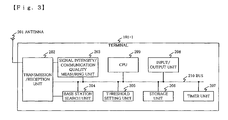
- Fig. 3 is a diagram showing an exemplary configuration of terminal 101-1 in the wireless LAN system shown in Fig. 2 .
- terminal 101-1 shown in Fig. 2 comprises antenna 201, transmission/reception unit 202, signal intensity/communication quality measuring unit 203, base station search unit 204, threshold setting unit 205, storage unit 206, timer unit 207, input/output unit 208, CPU 209, and bus 210.
- Antenna 201 transmits and receives radio waves to and from base stations 100-1 - 100-2.
- Transmission/reception unit 202 receives a signal transmitted from base station 100-1 - 100-2 through antenna 201, and transmits a signal to base station 100-1 - 100-2.
- Signal intensity/communication quality measuring unit 203 measures the intensity of a signal transmitted from base station 100-1 - 100-2 and received at transmission/reception unit 202, and measures the signal reception condition, i.e., the communication quality.
- Base station search unit 204 searches base station 100-1 - 100-2 with which terminal 101-1 can communicate.
- Threshold setting unit 205 sets a threshold at which base station search unit 204 starts a search for base station 100-1 - 100-2.
- Storage unit 206 comprises ROM for storing a variety of control programs executed by CPU 209, and fixed data such as data for transmission/reception adjustments, network addresses and the like, and RAM for storing data temporarily required for CPU 209 to execute a program, and the program itself, and also stores the threshold set by threshold setting unit 205.
- Timer unit 207 is a base station search start timer for measuring the timing at which terminal 101-1 starts a search for base station 100-1 - 100-2.
- Input/output unit 208 comprises an output device such as a LCD (liquid crystal display device), LED (light emitting diode) or the like for displaying the contents processed by CPU 209, and an input device such as a power switch, keyboard and the like for the user to manipulate terminal 101-1.
- CPU 209 starts and controls the programs stored in storage unit 206.
- Bus 210 interconnects them.
- signal intensity/communication quality measuring unit 203, base station search unit 204, and threshold setting unit 205 may be included in CPU 209, such that their respective processing is performed by programs within CPU 209.
- the configuration of terminal 101-2 has a configuration similar to the configuration of terminal 101-1 shown in Fig. 3 .
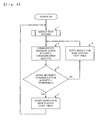
- Fig. 4 is a flow chart for describing the base station search method using terminals 101-1 - 101-2 in the wireless LAN system shown in Fig. 2 .
- terminal 101-1 - 101-2 searches base station 100-1 - 100-2 with which it can communicate at step 1.
- Fig. 5 is a flow chart for describing processing of a subroutine at step 1 in the flow chart shown in Fig. 4 .
- the processing operation at step 1 shown in Fig. 4 involves step 11 in Fig. 5 at which CPU 209 first reads a channel subjected to a search from storage unit 206. Then, at step 12, base station search unit 204 executes a search for communicable base station 100-1 - 100-2 for the read channel.
- base station 100-1 is detected by the processing operation at step 12.
- terminal 101-2 exists at position (c) shown in Fig. 2 at this time
- base stations 100-1 and base station 100-2 are detected by the processing operation at step 12.
- the search processing operation at step 11 and step 12 is similar to conventional search processing, details on the processing are not described here.
- a base station search trigger threshold value that corresponded to the number of detected base stations 100-1 - 100-2 is read from storage unit 206 by CPU 209.
- the read base station search trigger threshold is stored in storage unit 206 as threshold X by threshold setting unit 205 in correspondence to the unique identification number possessed by base station 100- 1 - 100-2 at step 13.
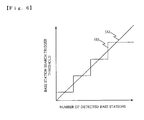
- Fig. 6 is a diagram showing the base station search trigger threshold with respect to the number of base stations detected through the base station search at step 12 in the flow chart shown in Fig. 5 .
- the base station search trigger threshold changes in accordance with the number of base stations detected through the base station search.
- the number of detected base stations and base station search trigger thresholds may have linearly correspondence relationship as shown at (A), or may have correspondence relationship in steps as shown at (B).
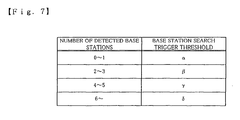
- Fig. 7 is a diagram showing an exemplary correspondence of the number of detected base stations to the base station search trigger threshold shown at (B) of Fig. 6 .
- the correspondence shown in Fig. 7 has been previously stored in storage unit 206.
- base station search trigger threshold " ⁇ " corresponds to that number. Also, when the number of detected base stations is 2 to 3, base station search trigger threshold “ ⁇ " " corresponds to that number. Further, when the number of detected base stations is 4 to 5, base station search trigger threshold " ⁇ " corresponds to that number. Further, when the number of detected base stations is 6 or more, base station search trigger threshold " ⁇ " corresponds to that number.
- the base station search trigger threshold is represented by Greek letters for convenience of description, the base station search trigger threshold is actually a threshold for the intensity or communication quality of a signal transmitted from base station 100-1 - 100-2 and received at transmission/reception unit 202 and measured by signal intensity/communication quality measuring unit 203, and has been previously set by the system. Assume herein that " ⁇ " corresponds to threshold 103-2 shown in Fig. 2 , and " ⁇ " corresponds to threshold 103-1 shown in Fig. 2 .
- threshold X stored in storage unit 206 is threshold 103-2.
- threshold X stored in storage unit 206 is threshold 103-1.
- a communication is made between terminal 101-1 - 101-2 and base station 100-1 at step 2. While communication is made between terminal 101-1 - 101-2 and base station 100-1, the intensity or communication quality of a received signal is measured by signal intensity/communication quality measuring unit 203.
- the measured signal intensity or communication quality is compared with threshold X stored in storage unit 206 by CPU 209 at step 3.
- timer unit 207 stops at step 4, followed by the flow returning to the processing operation at step 2. In this event, when timer unit 207 is not operating, the flow returns to the processing operation at step 2 without any processing taking place.
- timer unit 207 starts at step 5. Subsequently, as the time previously set by timer unit 207 elapses, an interrupt is generated from timer unit 207 to CPU 209, causing the execution of the base station search processing at step 1.
- threshold X is set to threshold 103-2, it is determined at step 3 in Fig. 4 that the signal intensity or communication quality is not a value smaller than threshold X, so that timer unit 207 does not start.
- Fig. 8 is a diagram showing the base station search timing in terminals 101-1 - 101-2 when terminal 101-1 shown in Fig. 2 moves from position (a) to (b) and further from (b) to (e), and when terminal 101-2 moves from position (c) to (d).
- terminal 101-2 exists at position (c) with threshold X set to threshold 103-1, it is determined that the signal intensity or communication quality measured by signal intensity/communication quality measuring unit 203 is not a value smaller than threshold X, so that base station search unit 204 does not execute the base station search processing operation. Subsequently, as terminal 101-2 moves from position (c) to position (d), terminal 101-2 exists outside of threshold 103-1 shown in Fig. 2 , so that it is determined that the signal intensity or communication quality measured by signal intensity/communication quality measuring unit 203 is a value smaller than threshold X. Thus, base station search unit 204 executes a base station search processing operation at period t1 which has been previously set in timer unit 207.
- terminal 101-1 exists at position (a) with threshold X set to threshold 103-2, it is determined that the signal intensity or communication quality measured by signal intensity/communication quality measuring unit 203 is not a value smaller than threshold X, so that base station search unit 204 does not execute a base station search processing operation. Subsequently, even if terminal 101-1 moves from position (a) to position (b), it is determined that the signal intensity or communication quality measured by signal intensity/communication quality measuring unit 203 is not a value smaller than threshold X. Accordingly, base station search unit 204 does not execute a base station search processing operation. Subsequently, as terminal 101-1 moves from position (b) to position (e), terminal 101-1 exists outside of threshold 103-2 shown in Fig.
- base station search unit 204 executes a base station search processing operation at period t1 which has been previously set in timer unit 207.
- a method can also be contemplated to change threshold X in accordance with the changing amount of the signal intensity or communication quality measured by signal intensity/communication quality measuring unit 203.
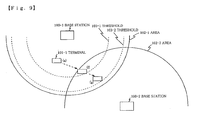
- Fig. 9 is a diagram showing another embodiment of a wireless LAN system of the present invention.
- this embodiment comprises base stations 100-1 - 100-2 which are wireless LAN base stations, and terminal 101-1 which is a wireless LAN terminal. Also, communication areas covered by base stations 100-1 - 100-2 are areas 102-1 - 102-2, respectively. Assume herein that terminal 101-1 is communicating with base station 100-1. Also, base stations 100-1 - 100-2 have unique identification numbers for identifying each of them. Also, assume that a first base station search start trigger threshold for terminal 101-1 to search another base station in area 102-1 is threshold 103-1, and a second base station search start trigger threshold is threshold 103-2.
- These thresholds 103-1 - 103-2 schematically represent the first base station search start trigger threshold and second base station search start trigger threshold based on signal intensities or communication qualities of signals received at terminal 101-1.
- the signal intensity or communication quality of a signal received at terminal 101-1 falls below the first or second base station search start trigger threshold, i.e., when terminal 101-1 goes out of threshold 103-1 - 103-2 in Fig. 9
- terminal 101-1 starts a search for another base station which is to become a switching candidate.
- terminal 101-1 exists at position (a), and terminal 101-1 subsequently moves from position (a) to position (f), and further subsequently moves from position (f) to position (g).
- terminal 101-1 is similar in configuration to that shown in Fig. 3 .
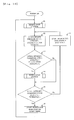
- Fig. 10 is a flow chart for describing the base station search method in the wireless LAN system shown in Fig. 9 .
- terminal 101-1 searches communicable base station 100-1 - 100-2 at step 21.
- This base station search processing operation is similar to the subroutine at step 1 shown in Fig. 4 , i.e., the processing operation at steps 11 - 13 shown in Fig. 5 .
- signal intensity/communication quality measuring unit 203 measures the intensity or communication quality of a received signal.
- a base station search processing operation is executed at step 24.
- Fig. 11 is a flow chart for describing processing of a subroutine at step 24 in the flow chart shown in Fig. 10 .
- the processing operation at step 24 shown in Fig. 10 involves step 31 in Fig. 11 at which CPU 209 first reads a channel subjected to a search from storage unit 206. Then, at step 32, base station search unit 204 executes a search for communicable base station 100-1 - 100-2 to locate for the read channel. In this event, when terminal 101-1 exists, for example, at position (a) shown in Fig. 2 , base station 100-1 is detected by the processing operation at step 32. In this regard, since the search processing operation at step 31 and step 32 is similar to conventional search processing, details on the processing are not described here.
- a base station search trigger threshold value that corresponded to the number of detected base stations 100-1 - 100-2 is read from storage unit 206 by CPU 209.
- the read base station search trigger threshold is stored in storage unit 206 as threshold X by threshold setting unit 205 in correspondence to the unique identification number possessed by base station 100- 1 - 100-2 at step 33.
- the correspondence of the number of detected base stations 100-1 - 100-2 to the base station search trigger threshold may be, for example, similar to that shown in Fig. 7 .
- the value of the signal intensity or communication quality measured at step 21 is stored in storage unit 206 by CPU 209 at step 34.
- the measured signal intensity or communication quality is compared with threshold X stored in storage unit 206 by CPU 209 at step 25.
- timer unit 207 stops at step 26, and the flow returns to the processing operation at step 22. In this event, when timer unit 207 is not operating, the flow returns to the processing operation at step 22 without any processing being performed.
- timer unit 207 starts at step 27. Subsequently, as the time previously set by timer unit 207 elapses, an interrupt is generated from timer unit 207 to CPU 209, causing the execution of the base station search processing at step 21.
- a threshold at which terminal 101-1 existing at position (a) shown in Fig. 9 starts a base station search, is set to threshold 103-2.
- no search is made for base station 100-2 which is to become a switching candidate because the signal intensity or communication quality measured by signal intensity/communication quality measuring unit 203 of terminal 100-1 does not fall below threshold 103-2 although terminal 101-1 exists at a position at which base station 100-2 can be detected.
- new threshold 103-1 is set when the difference between the signal intensity or communication quality measured by signal intensity/communication quality measuring unit 203 and the previously measured signal intensity or communication quality is larger than a previously set changing amount.
- the threshold for searching another base station is changed to a value higher than the current threshold. Subsequently, as terminal 101-1 moves to position (g), a base station search processing operation is executed because the signal intensity or communication quality measured by signal intensity/communication quality measuring unit 203 falls below threshold 103-1.
- Fig. 12 is a diagram showing a base station search timing in terminal 101-1 when terminal 101-1 moves from position (a) to position (f) and further from position (f) to position (g) shown in Fig. 9 .
- the signal intensity or communication quality measured by signal intensity/communication quality measuring unit 203 is designated as change m1.
- terminal 101-1 exists at position (a) with threshold X set to threshold 103-2, it is determined that the signal intensity or communication quality measured by signal intensity/communication quality measuring unit 203 is not a value smaller than threshold X. Accordingly, base station search unit 204 does not execute the base station search processing. Subsequently, as terminal 101-1 moves from position (a) to position (f), the difference between the signal intensity or communication quality measured by signal intensity/communication quality measuring unit 203 and the previously measured signal intensity or communication quality becomes larger than previously set fluctuating amount ⁇ y. Thus, base station search unit 204 executes the base station search processing. Then, threshold X is changed from threshold 103-2 to threshold 103-1.
- terminal 101-1 moves from position (f) to position (g), it is determined that the signal intensity or communication quality measured by signal intensity/communication quality measuring unit 203 is smaller than threshold value 103-1 which is set to threshold X.
- base station search unit 204 executes the base station search processing at period t1 which has been previously set in timer unit 207.
- thresholds may be actually changed in accordance with a systems design.
- two or more thresholds i.e., three or four may be provided, or hysteresis may be defined in order to prevent a terminal located near a threshold from frequently going across the threshold to and fro.
Landscapes
- Engineering & Computer Science (AREA)
- Computer Networks & Wireless Communication (AREA)
- Signal Processing (AREA)
- Mobile Radio Communication Systems (AREA)
- Telephonic Communication Services (AREA)
Applications Claiming Priority (2)
| Application Number | Priority Date | Filing Date | Title |
|---|---|---|---|
| JP2006064112 | 2006-03-09 | ||
| PCT/JP2007/050888 WO2007102283A1 (ja) | 2006-03-09 | 2007-01-22 | 無線lanシステム、無線lan端末及びこれらにおける基地局探索方法 |
Publications (2)
| Publication Number | Publication Date |
|---|---|
| EP1993234A1 true EP1993234A1 (de) | 2008-11-19 |
| EP1993234A4 EP1993234A4 (de) | 2012-08-22 |
Family
ID=38474725
Family Applications (1)
| Application Number | Title | Priority Date | Filing Date |
|---|---|---|---|
| EP07707151A Withdrawn EP1993234A4 (de) | 2006-03-09 | 2007-01-22 | Drahtloses lan-system, drahtloses lan-endgerät und basisstationssuchverfahren für ein solches system und endgerät |
Country Status (5)
| Country | Link |
|---|---|
| US (1) | US8780727B2 (de) |
| EP (1) | EP1993234A4 (de) |
| JP (1) | JPWO2007102283A1 (de) |
| CN (2) | CN101401473A (de) |
| WO (1) | WO2007102283A1 (de) |
Cited By (1)
| Publication number | Priority date | Publication date | Assignee | Title |
|---|---|---|---|---|
| EP2805548A4 (de) * | 2012-01-19 | 2016-02-17 | Intel Corp | Systeme und verfahren zur dienstentdeckung |
Families Citing this family (4)
| Publication number | Priority date | Publication date | Assignee | Title |
|---|---|---|---|---|
| JP5265334B2 (ja) * | 2008-12-24 | 2013-08-14 | 京セラ株式会社 | 無線通信システム、無線端末、無線基地局及び通信制御方法 |
| JP5300096B2 (ja) * | 2011-02-03 | 2013-09-25 | Necインフロンティア株式会社 | 無線lan移動局、無線lanシステム、ハンドオーバ制御方法およびコンピュータプログラム |
| CN104125651B (zh) * | 2014-07-30 | 2017-11-10 | 常州和仕达电子科技有限公司 | 基于wlan网络上下行非对称无线链路状态下的接入、漫游优化方法 |
| CN109451505A (zh) * | 2019-01-04 | 2019-03-08 | 中国联合网络通信集团有限公司 | 一种伪基站的防范方法及系统、存储介质、基站数据库 |
Family Cites Families (12)
| Publication number | Priority date | Publication date | Assignee | Title |
|---|---|---|---|---|
| JPH0591038A (ja) * | 1991-09-30 | 1993-04-09 | Nippon Telegr & Teleph Corp <Ntt> | 移動通信のチヤネル切替方式 |
| WO1999034627A1 (en) | 1997-12-24 | 1999-07-08 | Mitsubishi Denki Kabushiki Kaisha | Radio communication device |
| JP2000197093A (ja) * | 1998-12-25 | 2000-07-14 | Casio Comput Co Ltd | 無線通信装置及びその制御方法 |
| JP2000333233A (ja) * | 1999-05-20 | 2000-11-30 | Toshiba Corp | ハンドオーバ要求機能を備えた移動端末装置 |
| JP3338813B2 (ja) | 1999-11-18 | 2002-10-28 | 日本電気テレコムシステム株式会社 | 無線端末装置 |
| JP2001251657A (ja) * | 2000-03-06 | 2001-09-14 | Matsushita Electric Ind Co Ltd | 無線電話装置 |
| JP3837312B2 (ja) | 2001-09-18 | 2006-10-25 | インターナショナル・ビジネス・マシーンズ・コーポレーション | コンピュータ装置、無線通信モジュール、無線通信モジュールの制御方法、プログラム |
| US7110765B2 (en) | 2002-08-27 | 2006-09-19 | Qualcomm Incorporated | Limiting cell reselection based on pilot power |
| US20050138178A1 (en) * | 2003-12-19 | 2005-06-23 | Shaun Astarabadi | Wireless mobility manager |
| JP2005347906A (ja) * | 2004-06-01 | 2005-12-15 | Nec Corp | 無線通信システム、基地局切替制御方法、プログラム、及び記録媒体 |
| US20060268756A1 (en) * | 2005-05-03 | 2006-11-30 | Hong Kong Applied Science And Technology Research Institute Co., Ltd. | Systems and methods for efficient hand-off in wireless networks |
| US20070115899A1 (en) * | 2005-11-22 | 2007-05-24 | Shlomo Ovadia | Method, apparatus and system architecture for performing handovers between heterogeneous wireless networks |
-
2007
- 2007-01-22 WO PCT/JP2007/050888 patent/WO2007102283A1/ja not_active Ceased
- 2007-01-22 CN CNA2007800085192A patent/CN101401473A/zh active Pending
- 2007-01-22 JP JP2008503758A patent/JPWO2007102283A1/ja active Pending
- 2007-01-22 CN CN201410355723.3A patent/CN104219725A/zh active Pending
- 2007-01-22 US US12/281,387 patent/US8780727B2/en not_active Expired - Fee Related
- 2007-01-22 EP EP07707151A patent/EP1993234A4/de not_active Withdrawn
Cited By (2)
| Publication number | Priority date | Publication date | Assignee | Title |
|---|---|---|---|---|
| EP2805548A4 (de) * | 2012-01-19 | 2016-02-17 | Intel Corp | Systeme und verfahren zur dienstentdeckung |
| RU2602375C2 (ru) * | 2012-01-19 | 2016-11-20 | Интел Корпорейшн | Системы и способы обнаружения обслуживания |
Also Published As
| Publication number | Publication date |
|---|---|
| WO2007102283A1 (ja) | 2007-09-13 |
| CN101401473A (zh) | 2009-04-01 |
| US8780727B2 (en) | 2014-07-15 |
| US20090116465A1 (en) | 2009-05-07 |
| EP1993234A4 (de) | 2012-08-22 |
| CN104219725A (zh) | 2014-12-17 |
| JPWO2007102283A1 (ja) | 2009-07-23 |
Similar Documents
| Publication | Publication Date | Title |
|---|---|---|
| US9877158B2 (en) | Wi-Fi scan scheduling and power adaptation for low-power indoor location | |
| KR100991873B1 (ko) | 스마트 카드 오퍼레이팅 시스템 및 방법 | |
| EP4307775B1 (de) | Betriebsverfahren und -vorrichtung für uwb-etikett sowie uwb-etikett und speichermedium | |
| US9189718B2 (en) | Power supply control method for radio-frequency identification reader in mobile terminal | |
| US8780727B2 (en) | Wireless LAN system, wireless LAN terminal and base station searching method for such system and terminal | |
| CN114080065A (zh) | 非连续发送方法、信号发送处理方法及相关设备 | |
| KR20120124202A (ko) | 휴대용 단말기의 화면 밝기를 조정하기 위한 장치 및 방법 | |
| US8271032B2 (en) | Apparatus and method for managing power consumption in a mobile communication device | |
| US8494580B1 (en) | Method of coordinating the operation of adjacent wireless transceivers on a single device | |
| EP1995894B1 (de) | Mobilkommunikationssystem, mobiles endgerät, für diese verwendetes frequenzdetektionsverfahren und programm dafür | |
| US20090129324A1 (en) | Communication system and communication method | |
| JP2012248939A (ja) | 無線通信装置、無線通信システム、無線通信制御方法及びプログラム | |
| US7978676B2 (en) | Radio relay apparatus, radio terminal apparatus, method, and recording medium for performing radio communication based on beacon | |
| CN106099397A (zh) | 具有多天线的电子装置 | |
| US9848481B2 (en) | Radio-controlled lighting system, radio device, and registration method | |
| CN104283592A (zh) | 信息处理方法及电子设备 | |
| TW201807881A (zh) | 具有多天線的電子裝置 | |
| CN112767894B (zh) | 一种亮度传感方法、设备以及亮度传感单元 | |
| JP2011199447A (ja) | 無線通信システム | |
| CN107580017B (zh) | 一种批量省电管理方法、及接入设备 | |
| US20060217097A1 (en) | Method and apparatus for radio communications in a wireless local area network | |
| CN107465415B (zh) | 一种射频调谐方法、终端及射频前端器件 | |
| US12156173B2 (en) | Terminal device, program, and communication control method | |
| US12483987B2 (en) | Method and communication circuit for communicating with base station | |
| CN115412945B (zh) | 识别过度休眠的方法和装置 |
Legal Events
| Date | Code | Title | Description |
|---|---|---|---|
| PUAI | Public reference made under article 153(3) epc to a published international application that has entered the european phase |
Free format text: ORIGINAL CODE: 0009012 |
|
| 17P | Request for examination filed |
Effective date: 20080814 |
|
| AK | Designated contracting states |
Kind code of ref document: A1 Designated state(s): DE FR GB IT |
|
| RBV | Designated contracting states (corrected) |
Designated state(s): DE FR GB IT |
|
| DAX | Request for extension of the european patent (deleted) | ||
| A4 | Supplementary search report drawn up and despatched |
Effective date: 20120719 |
|
| RIC1 | Information provided on ipc code assigned before grant |
Ipc: H04L 12/28 20060101ALI20120718BHEP Ipc: H04W 36/30 20090101AFI20120718BHEP |
|
| RAP1 | Party data changed (applicant data changed or rights of an application transferred) |
Owner name: LENOVO INNOVATIONS LIMITED (HONG KONG) |
|
| GRAP | Despatch of communication of intention to grant a patent |
Free format text: ORIGINAL CODE: EPIDOSNIGR1 |
|
| RIC1 | Information provided on ipc code assigned before grant |
Ipc: H04W 36/30 20090101AFI20160824BHEP |
|
| INTG | Intention to grant announced |
Effective date: 20160919 |
|
| GRAS | Grant fee paid |
Free format text: ORIGINAL CODE: EPIDOSNIGR3 |
|
| STAA | Information on the status of an ep patent application or granted ep patent |
Free format text: STATUS: GRANT OF PATENT IS INTENDED |
|
| STAA | Information on the status of an ep patent application or granted ep patent |
Free format text: STATUS: THE APPLICATION IS DEEMED TO BE WITHDRAWN |
|
| 18D | Application deemed to be withdrawn |
Effective date: 20170801 |
|
| RIC1 | Information provided on ipc code assigned before grant |
Ipc: H04W 36/30 20090101AFI20160824BHEP |
|
| RIC1 | Information provided on ipc code assigned before grant |
Ipc: H04W 36/30 20090101AFI20160824BHEP |