EP1993248A1 - Procédé et dispositif pour le codage de données - Google Patents
Procédé et dispositif pour le codage de données Download PDFInfo
- Publication number
- EP1993248A1 EP1993248A1 EP07009866A EP07009866A EP1993248A1 EP 1993248 A1 EP1993248 A1 EP 1993248A1 EP 07009866 A EP07009866 A EP 07009866A EP 07009866 A EP07009866 A EP 07009866A EP 1993248 A1 EP1993248 A1 EP 1993248A1
- Authority
- EP
- European Patent Office
- Prior art keywords
- elements
- vector
- data
- subcarriers
- mapping
- Prior art date
- Legal status (The legal status is an assumption and is not a legal conclusion. Google has not performed a legal analysis and makes no representation as to the accuracy of the status listed.)
- Withdrawn
Links
- 238000000034 method Methods 0.000 title claims abstract description 22
- 239000013598 vector Substances 0.000 claims abstract description 69
- 238000013507 mapping Methods 0.000 claims abstract description 45
- 238000012546 transfer Methods 0.000 claims description 12
- 230000001131 transforming effect Effects 0.000 claims description 8
- 238000005457 optimization Methods 0.000 claims 1
- 230000005540 biological transmission Effects 0.000 description 9
- 230000001419 dependent effect Effects 0.000 description 4
- 230000007274 generation of a signal involved in cell-cell signaling Effects 0.000 description 3
- 108010074506 Transfer Factor Proteins 0.000 description 2
- 125000004122 cyclic group Chemical group 0.000 description 2
- 230000002349 favourable effect Effects 0.000 description 2
- 238000005070 sampling Methods 0.000 description 2
- 239000000654 additive Substances 0.000 description 1
- 230000000996 additive effect Effects 0.000 description 1
- 230000015556 catabolic process Effects 0.000 description 1
- 238000004891 communication Methods 0.000 description 1
- 238000006731 degradation reaction Methods 0.000 description 1
- 238000010586 diagram Methods 0.000 description 1
- 238000003780 insertion Methods 0.000 description 1
- 230000037431 insertion Effects 0.000 description 1
- 238000011835 investigation Methods 0.000 description 1
- 239000011159 matrix material Substances 0.000 description 1
- 238000001228 spectrum Methods 0.000 description 1
Images
Classifications
-
- H—ELECTRICITY
- H04—ELECTRIC COMMUNICATION TECHNIQUE
- H04L—TRANSMISSION OF DIGITAL INFORMATION, e.g. TELEGRAPHIC COMMUNICATION
- H04L27/00—Modulated-carrier systems
- H04L27/26—Systems using multi-frequency codes
- H04L27/2601—Multicarrier modulation systems
- H04L27/2614—Peak power aspects
-
- H—ELECTRICITY
- H04—ELECTRIC COMMUNICATION TECHNIQUE
- H04L—TRANSMISSION OF DIGITAL INFORMATION, e.g. TELEGRAPHIC COMMUNICATION
- H04L5/00—Arrangements affording multiple use of the transmission path
- H04L5/0001—Arrangements for dividing the transmission path
- H04L5/0003—Two-dimensional division
- H04L5/0005—Time-frequency
- H04L5/0007—Time-frequency the frequencies being orthogonal, e.g. OFDM(A) or DMT
-
- H—ELECTRICITY
- H04—ELECTRIC COMMUNICATION TECHNIQUE
- H04L—TRANSMISSION OF DIGITAL INFORMATION, e.g. TELEGRAPHIC COMMUNICATION
- H04L5/00—Arrangements affording multiple use of the transmission path
- H04L5/003—Arrangements for allocating sub-channels of the transmission path
- H04L5/0044—Allocation of payload; Allocation of data channels, e.g. PDSCH or PUSCH
-
- H—ELECTRICITY
- H04—ELECTRIC COMMUNICATION TECHNIQUE
- H04L—TRANSMISSION OF DIGITAL INFORMATION, e.g. TELEGRAPHIC COMMUNICATION
- H04L5/00—Arrangements affording multiple use of the transmission path
- H04L5/003—Arrangements for allocating sub-channels of the transmission path
- H04L5/0048—Allocation of pilot signals, i.e. of signals known to the receiver
-
- H—ELECTRICITY
- H04—ELECTRIC COMMUNICATION TECHNIQUE
- H04L—TRANSMISSION OF DIGITAL INFORMATION, e.g. TELEGRAPHIC COMMUNICATION
- H04L25/00—Baseband systems
- H04L25/02—Details ; arrangements for supplying electrical power along data transmission lines
- H04L25/0202—Channel estimation
- H04L25/0224—Channel estimation using sounding signals
- H04L25/0228—Channel estimation using sounding signals with direct estimation from sounding signals
- H04L25/023—Channel estimation using sounding signals with direct estimation from sounding signals with extension to other symbols
- H04L25/0232—Channel estimation using sounding signals with direct estimation from sounding signals with extension to other symbols by interpolation between sounding signals
Definitions
- the invention relates to a method for coding data to be transmitted in a transmitted signal, wherein the transmitted signal comprises multiple subcarriers with orthogonal frequencies and to a data coding device for coding data to be transmitted in a transmitted signal.
- OFDMA orthogonal frequency division multiple access
- the precoded data stream is mapped to the correct subcarrier positions according to the respective subcarrier allocation scheme.
- the data vectors related to different users are mapped on different subsets of subcarriers in a total number of N subcarriers of the transmitted signal.
- the transmitted signal is obtained by applying an N-point Inverse Discrete Fourier Transform (IDFT) to the precoded and mapped data symbols, which is equivalent to an Orthogonal Frequency Division Multiple Access (OFDMA) modulation.
- IDFT Inverse Discrete Fourier Transform
- OFDMA Orthogonal Frequency Division Multiple Access
- SC-FDMA Single Carrier Frequency Division Multiple Access
- DFT Discrete Fourier Transform
- SC-FDMA there are different possibilities for the allocation of a certain set of subcarriers to the specific user under consideration. For example, a blockwise allocation leads to the Localized Frequency Division Multiple Access (LFDMA) scheme, whereas an interleaved allocation results in the Interleaved Frequency Division Multiple Access (IFDMA) scheme.
- LFDMA Localized Frequency Division Multiple Access
- IFDMA Interleaved Frequency Division Multiple Access
- Block-IFDMA Block-IFDMA
- the time domain structure of Single Carrier Frequency Division Multiple Access signals in general includes the insertion of a guard interval in-between consecutive symbols. If a cyclic prefix is used as a guard interval, a low complexity Frequency Domain Equalization (FDE) can be applied, that utilizes a single channel transfer coefficient for the equalization of the data transmitted on a certain subcarrier.
- FDE Frequency Domain Equalization
- the Channel State Information is a coefficient or a matrix mapping the signal transmitted by a signal transmitter onto the signal received by a signal receiver in a simplified model of the channel behaviour.
- the total signal received is modelled as a sum of the signals mapped according to the Channel State Information and a noise component.
- the Channel State Information is time- and frequency dependent.
- the frequency dependency of the Channel State Information may be relatively weak if the maximum delay of the channel is small, the Channel State Information of neighbouring subcarriers may be obtained using interpolations.
- Such a channel estimation can be performed by transmitting pilot symbols that are known a priori at the receiver. In order to perform channel estimation in frequency domain, pilot symbols have to be located at certain subcarrier positions in order to get an estimate of the channel transfer factor at this position in frequency. Pilot and data symbols have to be multiplexed in some way.
- orthogonality between pilot symbols and data symbols has to be maintained. If it is not possible to separate the pilot symbols and the data symbols at the receiver, the quality of the channel estimation suffers due to non-orthogonality resulting in additional disturbances.
- pilot assisted channel estimation for DFT-precoded OFDMA signals with interleaved subcarrier allocation.
- the pilot signal is generated as an IFDMA signal and multiplexed symbol-wise onto the data stream.
- the orthogonality between pilot symbols and data symbols as well as the low Peak-to-Average-Power-Ratio is maintained.
- the data stream is interrupted in time domain while channel estimation is performed. If this proposal is used for pilot multiplexing in case of a blockwise subcarrier allocation, e.g. B-IFDMA or LFDMA, the overhead for pilot transmission is out of scale as the possibility of interpolation is not taken into account.
- pilot multiplexing for communication systems using multi-carrier modulation or frequency division multiplexing
- pilot symbols can be multiplexed across symbol or chip periods.
- the symbol-wise multiplexing leads to a higher Peak-to-Average-Power-Ratio.
- chip-wise multiplexing it is obvious that interference occurs between the chips ad that the pilots and data are not perfectly separable via this Time Division Multiplex component.
- the object of the invention is to provide a coding scheme for pilot multiplexing that avoids to interrupt the data stream in time domain and at the same time maintains a low Peak-to-Average-Power-Ratio and allows to estimate the channel transfer factors without performance degradation due to non-orthogonality between pilot and data symbols.
- the method according to the invention comprises the steps of mapping data symbols relating to the specific user onto at least a part of the elements of a vector with a number of Q elements, applying a unitary transform to the vector with a number of Q elements and mapping the elements of the transform vector to the subcarriers assigned to a specific user.
- the number P of elements of said vector is smaller than or equal to Q.
- pilot symbols for performing a channel estimation are mapped onto a part of the elements of said vector with Q elements before applying said unitary transform to the vector with the number of Q elements.
- each data symbol and each pilot symbol is transmitted on each subcarrier that is allocated to the specific user under consideration.
- the pilot symbols are multiplexed within the stream of data symbols in time domain without necessitating an interruption of the data stream. By doing so, an interruption in data transmission while performing channel estimation may be avoided.
- the number of transmitted pilot symbols may be held the lowest possible, as the possibility of interpolation is fully exploited. Therefore, the overhead due to channel estimation may be kept as small as possible.
- the channel coefficients can be determined via a system of equations. By this means, the channel estimate is not affected by a performance loss due to missing separability of pilot and data symbols.
- the simultaneous transmission of data symbols and pilot symbols can be achieved in particular if the unitary transform mixes the data symbols with the pilot symbols.
- the unitary transform is a Discrete Fourier Transform.
- mapping of the elements of the transformed vector of the subcarriers assigned to the specific user is a block interleaved subcarrier allocation mapping. This leads to a particularly favourable Peak-to-Average-Power-Ratio and enables interpolations for channel estimations within the blocks.
- the pilot symbol overhead is reduced. According to the sampling theorem, the above number of pilot symbols allows a complete reconstruction of the transmitted signal and the system of equations being set up for determining the number of Q : i channel transfer coefficients is solvable.
- the signal to be transmitted is generated by applying an Inverse Discrete Fourier Transform to an elementary vector representing the total number of subcarriers of the signal.
- the elements of the transform vector with Q elements are mapped on the elements of the N elementary vector corresponding to the subcarriers assigned to the specific user in the step of mapping the elements of the transformed vector.
- the transmitted signal in time domain is obtained by applying an Inverse Discrete Fourier Transform.
- the invention proposes to provide a data coding device for coding data to be transmitted in a transmitted signal, wherein the transmitted signal comprises multiple subcarriers with orthogonal frequencies, and wherein at least a subset of a number Q of subcarriers is assigned to a specific user.
- the data coding device comprises a first mapping means, a transforming means and a second mapping means.
- the first mapping means is configured for mapping data symbols relating to the specific user onto at least a part of the elements of a vector with a number of Q elements.
- the transforming means is configured for applying a unitary transform to the vector with the number of Q elements and the second mapping means is configured for mapping the elements of the transformed vector onto the subcarriers assigned to the specific user.
- said first mapping means is configured to map pilot symbols for performing a channel estimation onto a second part of the elements of said vector with Q elements before applying said non-redundant unitary transform to the vector with a number of Q elements. Due to this, the data symbols as well as the pilot symbols are coded over the entire subset of Q subcarriers allocated to the specific user and may be transmitted simultaneously.
- the transforming means is configured to mix the data symbols with the pilot symbols, e.g. by using a Discrete Fourier Transform as a non-redundant unitary transform.
- a favourable channel estimation within blocks of subcarriers may be performed if the second mapping means is configured to perform a block interleaved subcarrier allocation mapping.
- the pilot signal can be reduced, if the first mapping means is configured to map a number of pilot symbols to said second part of the elements of the Q elementary vector, wherein said numbers equal to or higher than the fraction Q : i, wherein i is depth of interpolation in frequency domain, that is dependent on the coherence bandwidth of the channel.
- the data coding device further comprises a signal generating means being configured to generate the signal to be transmitted by applying an inverse Discrete Fourier Transform to an N elementary vector representing the total number of subcarriers of the transmitted signal, wherein said elements of the transformed vector are comprised in the elements of the N elementary vector corresponding to the subcarriers assigned to the specific user.
- the invention further provides the radio transmitter comprising a data coding device of the above described type.
- the radio signal receiver comprises a means for decoding said transmitted signal by estimating the channel transfer coefficients and data symbols with the help of the pilot symbols and the received signal.
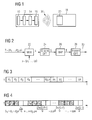
- Fig. 1 shows a system comprising a radio transmitter and a radio signal receiver.
- the radio transmitter comprises a data coding device for coding data to be transmitted in a transmitted signal, wherein the transmitted signal comprises multiple subcarriers with orthogonal frequencies.
- the transmitted signal is a Multiple Access Signal, wherein different subsets of subcarriers are allocated to different users.
- the transmitted signal may code multiple streams of data, such that different subsets of subcarriers are allocated to different data streams.
- the data coding device comprises a first mapping means for mapping data symbols relating to the specific user onto at least the first of the elements of a vector with Q elements.
- the resulting vector with Q elements is transformed by a transforming means of the data coding device.
- the transforming means applies a non-redundant unitary transform to the vector.
- the non-redundant unitary transform is a Discrete Fourier Transform. The skilled person will see that other suitable non-redundant unitary transforms resulting in a low Peak-to-Average-Power-Ratio could be applied alternatively.
- the data coding device comprises a second mapping means for mapping the elements of the transformed vector onto the subcarriers assigned to the specific user or to the specific data stream.
- the second mapping means is configured to perform a block interleaved subcarrier allocation mapping (cf. Fig. 4 ).
- the first mapping means is configured to map the pilot symbols to be used for performing a channel estimation onto a second part of the elements of said vector before applying the non-redundant unitary transform to the vector with Q elements. If the non-redundant unitary transform has no non-trivial Eigenspaces, the transforming means will automatically mix the data symbols with the pilot symbols by applying the non-redundant unitary transform.
- the number of the pilot symbols is equal to or only slightly higher than the fraction Q/i, wherein i is the depth of interpolation in frequency domain, that is dependent on the coherence bandwidth of the channel. Therefore, the amount of data stored in the pilot symbols is sufficient to perform satisfactory channel estimates in the radio signal receiver.
- the data coding device further comprises a signal generating means being configured to generate the signal to be transmitted from one or more of the transformed vectors with Q elements.
- the signal generating means applies an inverse Discrete Fourier Transform to an N-elementary vector representing the total number of subcarriers of the transmitted signal.
- the elements of the transformed vector are comprised in the elements of the N-elementary vector according to the mapping applied by the second mapping means, wherein the elements being assigned to different users are block interleaved as shown in Fig. 4 .
- the radio receiver comprises a means for decoding said transmitted signal by extracting the contribution of the subcarriers assigned to the specific user from the transmitted signal and by storing the extracted symbols in a Q elementary vector.
- the means for decoding calculates the channel transfer factors and the data symbols with the help of the received signal and the pilot symbols.
- Fig. 2 shows schematically a signal generation with multiplexed pilot symbols.
- the signal generation is performed by first replacing a number of P data symbols within the stream of Q data symbols by pilot symbols.
- the resulting Q elementary vector consists of Q - P data symbols and P pilot symbols.
- a unitary precoding e.g. a Q-Point Discrete Fourier Transform is applied to the vector containing pilot symbols and data symbols.
- Each element of the resulting precoded vector consists of a super position of pilot symbols and data symbols.
- the second mapping means applies a mapping according to the respective subcarrier allocation scheme to the multiplexed and precoded vector.
- the Q elements of the Q elementary vector are mapped onto a subset of the total number of N subcarriers in the transmitted signal.
- the signal generating means applies an N-Point Inverse Discrete Fourier Transform (IDFT) to the multiplexed, precoded and mapped vector resulting in the transmitted time domain signal.
- IDFT N-Point Inverse Discrete Fourier Transform
- each data symbol and each pilot symbol is transmitted in a superimposed way on each subcarrier that is allocated to the user under consideration. This superposition is due to the non-redundant unitary precoding applied in the second step to the multiplexed symbol vector.
- the number of Q equations is given by Q subcarriers carrying data and pilot symbols that are distributed by the channel and additive noise. Due to the cyclic structure in time domain, the channel influence on the information transmitted on each subcarrier can be described by the multiplication with a complex channel transfer factor, which has to be estimated using the pilot symbols. Within the coherence bandwidth, neighbouring subcarriers can be assumed to show the same channel behaviour.
- the number of different channel transfer coefficients may be chosen to be smaller than Q and dependent on the coherence bandwidth. Therefore, the information received on each of the Q subcarriers leads to a system of Q equations with Q - P data symbols and Q/i channel transfer coefficient as unknowns.
- the total number of unknowns in the resulting system of equations is Q - P + Q/i. As long as P > Q/i, the system of equations can be solved and the channel vectors can be estimated.
- Fig. 2 an example for signal generation with multiplexed pilot symbols is given for the case of a Discrete Fourier Transform precoded Orthogonal Frequency Division Multiple Access with block interleaved subcarrier allocation.
- d denotes the vector Q - P data symbols and P denotes the vector of pilot symbols.
- Fig. 3 shows an exemplary multiplexed time domain signal with blockwise allocated pilot and data symbols.
- the frequency representation of the block interleaved Frequency Division Multiple Access signal as given in Fig. 4 where pilots and data are transmitted on each subcarrier that is allocated to the user under consideration. The important point is that in the transmitted signal, pilot symbols and data symbols are mixed in a linear superposition generated by the non-redundant unitary transform.
- pilot symbols are multiplexed within the stream of data symbols in time domain. By doing so, pilot and data symbols can be transmitted at the same time, such that there is no interruption in data transmission while performing channel estimation.
- the number of transmitted pilot symbols is the lowest possible, as the possibility of interpolation is fully exploited.
- the overhead due to channel estimation is held as small as possible.
- the channel coefficient can be determined via a system of equations. By this means, the channel estimate is not affected by a performance loss due to missing separability of pilots and data.
Landscapes
- Engineering & Computer Science (AREA)
- Signal Processing (AREA)
- Computer Networks & Wireless Communication (AREA)
- Compression, Expansion, Code Conversion, And Decoders (AREA)
Priority Applications (2)
| Application Number | Priority Date | Filing Date | Title |
|---|---|---|---|
| EP07009866A EP1993248A1 (fr) | 2007-05-16 | 2007-05-16 | Procédé et dispositif pour le codage de données |
| PCT/EP2008/055542 WO2008138807A1 (fr) | 2007-05-16 | 2008-05-06 | Procédé pour coder des données et dispositif de codage de données |
Applications Claiming Priority (1)
| Application Number | Priority Date | Filing Date | Title |
|---|---|---|---|
| EP07009866A EP1993248A1 (fr) | 2007-05-16 | 2007-05-16 | Procédé et dispositif pour le codage de données |
Publications (1)
| Publication Number | Publication Date |
|---|---|
| EP1993248A1 true EP1993248A1 (fr) | 2008-11-19 |
Family
ID=38535258
Family Applications (1)
| Application Number | Title | Priority Date | Filing Date |
|---|---|---|---|
| EP07009866A Withdrawn EP1993248A1 (fr) | 2007-05-16 | 2007-05-16 | Procédé et dispositif pour le codage de données |
Country Status (2)
| Country | Link |
|---|---|
| EP (1) | EP1993248A1 (fr) |
| WO (1) | WO2008138807A1 (fr) |
Cited By (3)
| Publication number | Priority date | Publication date | Assignee | Title |
|---|---|---|---|---|
| WO2014091198A1 (fr) * | 2012-12-14 | 2014-06-19 | Sony Corporation | Appareil de traitement de données et procédé de réduction de papr dans des systèmes de transmission multiporteuse |
| WO2017133471A1 (fr) * | 2016-02-05 | 2017-08-10 | Jrd Communication Inc. | Attribution de ressources de liaison montante |
| WO2021155944A1 (fr) * | 2020-02-07 | 2021-08-12 | Huawei Technologies Co., Ltd. | Premier et second dispositifs de communication ayant une conception de signal de référence améliorée |
Families Citing this family (1)
| Publication number | Priority date | Publication date | Assignee | Title |
|---|---|---|---|---|
| US12463854B2 (en) * | 2022-06-17 | 2025-11-04 | Qualcomm Incorporated | Single-carrier frequency-division multiplexing (SC-FDM) for wireless local area networks (WLANs) |
Citations (2)
| Publication number | Priority date | Publication date | Assignee | Title |
|---|---|---|---|---|
| WO2006096784A1 (fr) * | 2005-03-07 | 2006-09-14 | Qualcomm Incorporated | Emission d'onde pilote et estimation de voie pour systeme de communication faisant appel a un multiplexage par repartition en frequence |
| WO2006118411A2 (fr) * | 2005-05-02 | 2006-11-09 | Lg Electronics Inc. | Dispositif de limitation de bande dans des systemes de communication sc-fdma et procede associe |
-
2007
- 2007-05-16 EP EP07009866A patent/EP1993248A1/fr not_active Withdrawn
-
2008
- 2008-05-06 WO PCT/EP2008/055542 patent/WO2008138807A1/fr not_active Ceased
Patent Citations (2)
| Publication number | Priority date | Publication date | Assignee | Title |
|---|---|---|---|---|
| WO2006096784A1 (fr) * | 2005-03-07 | 2006-09-14 | Qualcomm Incorporated | Emission d'onde pilote et estimation de voie pour systeme de communication faisant appel a un multiplexage par repartition en frequence |
| WO2006118411A2 (fr) * | 2005-05-02 | 2006-11-09 | Lg Electronics Inc. | Dispositif de limitation de bande dans des systemes de communication sc-fdma et procede associe |
Non-Patent Citations (1)
| Title |
|---|
| CHAU-YUN HSU, HSIN-CHIEN CHAO: "Transform Domain Scrambling PAPR reduction Technique for OFDM Systems", 14TH IST MOBILE & WIRELESS COMMUNICATION SUMMIT, June 2005 (2005-06-01), Dresden, pages 1 - 4, XP002453787, Retrieved from the Internet <URL:http://www.eurasip.org/content/Eusipco/IST05/papers/125.pdf> [retrieved on 20071005] * |
Cited By (8)
| Publication number | Priority date | Publication date | Assignee | Title |
|---|---|---|---|---|
| WO2014091198A1 (fr) * | 2012-12-14 | 2014-06-19 | Sony Corporation | Appareil de traitement de données et procédé de réduction de papr dans des systèmes de transmission multiporteuse |
| WO2017133471A1 (fr) * | 2016-02-05 | 2017-08-10 | Jrd Communication Inc. | Attribution de ressources de liaison montante |
| CN108702346A (zh) * | 2016-02-05 | 2018-10-23 | 捷开通讯(深圳)有限公司 | 上行链路资源分配 |
| CN108702346B (zh) * | 2016-02-05 | 2020-10-27 | 捷开通讯(深圳)有限公司 | 上行链路资源分配 |
| WO2021155944A1 (fr) * | 2020-02-07 | 2021-08-12 | Huawei Technologies Co., Ltd. | Premier et second dispositifs de communication ayant une conception de signal de référence améliorée |
| CN114930781A (zh) * | 2020-02-07 | 2022-08-19 | 华为技术有限公司 | 具有改进的参考信号设计的第一通信设备和第二通信设备 |
| US11943088B2 (en) | 2020-02-07 | 2024-03-26 | Huawei Technologies Co., Ltd. | First and second communication devices with improved reference signal design |
| CN114930781B (zh) * | 2020-02-07 | 2024-11-15 | 华为技术有限公司 | 具有改进的参考信号设计的第一通信设备和第二通信设备 |
Also Published As
| Publication number | Publication date |
|---|---|
| WO2008138807A1 (fr) | 2008-11-20 |
Similar Documents
| Publication | Publication Date | Title |
|---|---|---|
| JP4413232B2 (ja) | チャネル転送機能を評価するチャネル評価器及び方法、並びに、パイロットシーケンスを供給する装置及び方法 | |
| KR100740448B1 (ko) | Ofdm 통신 시스템 | |
| US8000224B2 (en) | Receiver and frequency information estimating method | |
| JP4832261B2 (ja) | チャネル推定装置 | |
| EP3065319B1 (fr) | Dispositif de transmission, dispositif de réception et système de communication | |
| CN103997476B (zh) | 信号生成装置和方法、以及移动通信终端测试装置和方法 | |
| US20100124292A1 (en) | Method and System for Receiver Synchronization | |
| US20160013963A1 (en) | Transmission apparatus, reception apparatus, and communication system | |
| JP5486734B2 (ja) | シングルキャリア通信システムにおける送信信号生成装置および方法 | |
| EP2567521B1 (fr) | Transfert de données et d'informations et estimation d'une liaison sans fil entre une source et au moins un récepteur | |
| EP3032767A1 (fr) | Dispositif de transmission, dispositif de réception, et système de communication | |
| JP7204950B2 (ja) | チャネル及び位相雑音の同時推定のための巡回パイロットシーケンス | |
| KR101137345B1 (ko) | 이동 통신 시스템에서 분산된 파일럿 신호가 포함된 신호를송수신하는 방법 | |
| US9225557B2 (en) | Radio communication system and receiving apparatus | |
| EP1993248A1 (fr) | Procédé et dispositif pour le codage de données | |
| CN114731321A (zh) | 用于dft-s-ofdm的具有低papr的混合参考信号 | |
| KR20170018537A (ko) | Docsis 하향 스트림 시스템에서 파일럿 기반 채널등화 장치 및 방법 | |
| JP4728715B2 (ja) | 無線通信システム、無線通信装置及び無線通信方法 | |
| JP2012005118A (ja) | シングルキャリア直交周波数分割多重方式を用いて発信源と少なくとも1つの受信機との間の無線リンクを推定できるようにするデータ及び情報を転送するための方法及びデバイス、並びに、シングルキャリア直交周波数分割多重方式を用いて発信源と受信機との間の無線リンクを推定するための方法及びデバイス | |
| US8917585B2 (en) | Method for estimating a received signal and corresponding device | |
| EP2790363A1 (fr) | Nouvel algorithme d'interpolation pour une estimation de canal pilote dans des systèmes OFDM | |
| KR100768327B1 (ko) | 다중 반송파 신호를 사용하는 시스템의 cinr 추정장치 및 그 방법 | |
| Ma et al. | Low-complexity channel estimation for 3GPP LTE terminals | |
| JP4870076B2 (ja) | マルチチャネル伝送システム、送信装置および送信方法 | |
| JP5163351B2 (ja) | Ofdm信号の送信方法、ofdm送信機、およびofdm受信機 |
Legal Events
| Date | Code | Title | Description |
|---|---|---|---|
| PUAI | Public reference made under article 153(3) epc to a published international application that has entered the european phase |
Free format text: ORIGINAL CODE: 0009012 |
|
| AK | Designated contracting states |
Kind code of ref document: A1 Designated state(s): AT BE BG CH CY CZ DE DK EE ES FI FR GB GR HU IE IS IT LI LT LU LV MC MT NL PL PT RO SE SI SK TR |
|
| AX | Request for extension of the european patent |
Extension state: AL BA HR MK RS |
|
| AKX | Designation fees paid | ||
| STAA | Information on the status of an ep patent application or granted ep patent |
Free format text: STATUS: THE APPLICATION IS DEEMED TO BE WITHDRAWN |
|
| 18D | Application deemed to be withdrawn |
Effective date: 20090520 |
|
| REG | Reference to a national code |
Ref country code: DE Ref legal event code: 8566 |