EP1993266B1 - Internetprotokolladressen-Feststellung in zellularen Netzwerken - Google Patents
Internetprotokolladressen-Feststellung in zellularen Netzwerken Download PDFInfo
- Publication number
- EP1993266B1 EP1993266B1 EP07009867A EP07009867A EP1993266B1 EP 1993266 B1 EP1993266 B1 EP 1993266B1 EP 07009867 A EP07009867 A EP 07009867A EP 07009867 A EP07009867 A EP 07009867A EP 1993266 B1 EP1993266 B1 EP 1993266B1
- Authority
- EP
- European Patent Office
- Prior art keywords
- node
- level domain
- cell
- internet protocol
- domain
- Prior art date
- Legal status (The legal status is an assumption and is not a legal conclusion. Google has not performed a legal analysis and makes no representation as to the accuracy of the status listed.)
- Active
Links
Images





Classifications
-
- H—ELECTRICITY
- H04—ELECTRIC COMMUNICATION TECHNIQUE
- H04L—TRANSMISSION OF DIGITAL INFORMATION, e.g. TELEGRAPHIC COMMUNICATION
- H04L61/00—Network arrangements, protocols or services for addressing or naming
- H04L61/45—Network directories; Name-to-address mapping
- H04L61/4505—Network directories; Name-to-address mapping using standardised directories; using standardised directory access protocols
- H04L61/4511—Network directories; Name-to-address mapping using standardised directories; using standardised directory access protocols using domain name system [DNS]
-
- H—ELECTRICITY
- H04—ELECTRIC COMMUNICATION TECHNIQUE
- H04W—WIRELESS COMMUNICATION NETWORKS
- H04W4/00—Services specially adapted for wireless communication networks; Facilities therefor
- H04W4/02—Services making use of location information
-
- H—ELECTRICITY
- H04—ELECTRIC COMMUNICATION TECHNIQUE
- H04W—WIRELESS COMMUNICATION NETWORKS
- H04W8/00—Network data management
- H04W8/26—Network addressing or numbering for mobility support
Definitions
- the present invention relates to the discovery of Internet Protocol addresses of nodes in cellular networks.
- IP Internet Protocol
- the source node may know a cell identifier (cell-ID) of the cell served by a node or a direct node identifier, but for establishing an IP based connection between nodes an IP address is needed.
- cell-ID cell identifier
- US 2004/026446 discloses a method in which a current access router determines the proxy of the target network.
- the proxy sends a DNS request for the APN to a DNS and the DNS determines the IP address of the target access router.
- US 2003/0216140 discloses a handoff (handover) procedure in which a candidate cell for the mobile terminal to perform a handoff to broadcasts a cell identifier. If it is determined that one of the candidate cells can provide better signal strength and quality to the mobile terminal, a handoff to the selected candidate cell is performed. Otherwise the mobile terminal continues to receive cell identifiers and make measurements of those candidate cells.
- the invention provides a method according to claims 1 and 8, a node of a cellular network according to claim 14 and a server according to claim 19.
- Mobile networks are not purely IP-based as of now, therefore no means are provided to discover IP addresses of nodes in a cellular network, when only an identification of the cell served by said node is known.
- the method according to the invention allows discovering this IP address based on the known cell identification.
- issuing said request comprises including said cell identification in form of an internet domain according to the syntax of the Domain Name System.
- Having the cell identification included in said request in this form allows using Domain Name System (DNS) requests and responses, or in other words handling the cell identification as if it were a standard Internet domain.
- DNS Domain Name System
- the domain names have to be defined in a web based syntax.
- said internet domain comprises a top-level domain and a second-level domain
- each base station or node of an operator is associated to an IP domain, wherein each operator has his own top-level domain.
- each operator has his own top-level domain.
- operator A owns the IP domain xxxx.OpA
- operator B owns the IP domain yyyy.OpB.
- Each node has its own cell identifier (cell-ID) that is unique in the cellular network of its associated operator. Therefore each node could be identified by the global address: "cell-ID1.OpA" or "cell-ID1.OpB".
- the cell-ID is not necessarily unique in a plurality of networks (e.g. operators A/B).
- each node of an operator from a plurality of operators is associated to the same top-level domain (e.g. MRN, Mobile Radio Networks).
- MRN Mobile Radio Networks
- operator A and operator B are members of the IP domain xxxx.MRN.
- Each node has its own cell identifier (cell-ID) that is unique for the plurality of operators (or even all operators). Therefore each base station could be identified by the global address: "cell-ID1.MRN" or "cell-ID2.MRN".
- the cell-ID is has to be unique in at least the plurality of networks sharing a single top-level domain (e.g. operators A/B having the domain ".MRN").
- An advantage is that it can be avoided that a lot of new top level domains have to be introduced within the world wide top level community.
- the cell-IDs have to be unique for all base stations, at least within this top-level domain.
- a registration process has to verify and ensure this.
- the cell identification can be obtained from measurement of a mobile terminal connected with said node. This case for example applies to a handover situation, wherein the user terminal is connected with the target node and a node trying to find out the IP address of said target node, in order to send user of control data to the target node.
- the source node can request and receive the cell identification from the terminal.
- issuing said request comprises querying a local database comprising associations between cell identifications and corresponding IP addresses, and wherein obtaining said response comprises retrieving said IP address from said local database in case said local database contains a corresponding association.
- issuing said request comprises transmitting said request to a server, and wherein obtaining said response comprises receiving said response from said server.
- the request will be issued to a server in the network, for example a gateway.
- issuing said request comprises transmitting said request to at least one multicast address, and wherein obtaining said response comprises receiving said response from said target node.
- This embodiment relates to a kind of de-centralized or self-organized scheme.
- the request is issued to a multicast address (or a plurality thereof), to be received by a plurality of possible target nodes.
- the target node then receives the request, checks the included cell identification, and in case it matches with its own identification, sends back a response indicating its IP address to the source node.
- said cell identification is included in said request in form of an internet domain according to the syntax of the Domain Name System.
- said internet domain comprises a top-level domain and a second-level domain, and wherein
- top-level domain is unique for a particular operator/cellular network, wherein each operator is responsible only for its own domain, with respect to DNS handling.
- the request cannot be handled locally and is forwarded.
- it is possible to determine the target for forwarding based on the top-level domain i.e. the server knows which domains belong to which operator/network and forwards the request accordingly.
- the method further comprises:
- a forwarded request is answered by an external server.
- the association between IP address and cell identification can be stored or cached for further requests.
- a computer program product comprising program instructions stored on a computer readable medium for carrying out the method described above when said program product is run on a computer.
- a node of a cellular network comprising:
- said controller is adapted for including said cell identification in said request in form of an internet domain according to the syntax of the Domain Name System.
- said internet domain comprises a top-level domain and a second-level domain, and wherein
- said controller is adapted for performing said determining of an identification of the cell by requesting a user terminal device served by said target node to provide said cell identification, and for receiving said cell identification from said user terminal.
- said controller is adapted for receiving new associations or updates of existing associations, and storing said new associations or updating existing associations based on said received updates, in said local database.
- said controller is adapted for storing a time-to-live value for each association, and for deleting an entry with the lowest time-to-live value in said local database if the number of stored associations exceeds a threshold.
- a server in a cellular network comprising:
- said cell identification is included in said request in form of an internet domain according to the syntax of the Domain Name System.
- said internet domain comprises a top-level domain and a second-level domain, and wherein
- said controller is adapted for evaluating the top-level domain of said cell identification, for performing said querying of and retrieving from said local database in case said top-level domain corresponds to a pre-determined top-level domain, and for performing said forwarding in case said top-level domain does not correspond to said pre-determined top-level domain.
- said controller is adapted for receiving a response including the Internet Protocol address of said target node, in case said local database does not contain a corresponding association, and for storing said Internet Protocol address and said cell identification of said node as new association in said local database.
- a system comprising at least one server and at least one node as described above.
- a node in a cellular network wants to transmit control data and/or user data to another node via an Internet Protocol connection, it is required to know the destination IP address of that node.
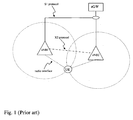
- the system comprises two nodes eNB1 and eNB2, which are in turn connected to a gateway aGW over a wired interface S1.
- a user terminal UE is in connection with (in the coverage area of, indicated by the dotted circles) the two nodes, via a radio interface. It is assumed that the node currently serving the user terminal UE is eNB1 and that a handover to eNB2 is to take place.
- the source node eNB1 now wants to transmit control data and/or user data to eNB2, using an IP connection X2.
- the source node may know a cell identifier (cell-ID) of the cell served by eNB2 or a direct node identifier, for example derived from measurements of a user terminal being connected with the source and the target node, but for establishing an IP based connection between nodes an IP address is needed.
- cell-ID cell identifier
- the prior art does not provide any means for discovering the IP address of node eNB2 when only knowing a cell identification thereof.
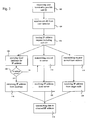
- Fig. 2 is a flow diagram of an embodiment of the method of the invention, for example to be performed in a situation as depicted in fig. 1 .
- a user terminal is requested to provide a cell-ID of a target node to which data (user and/or control data) are to be transmitted via an IP-based protocol.
- a corresponding response including the cell-ID is received in step 104 from the user terminal. It is to be noted that this is just an example embodiment; in other embodiments of the invention the required cell-ID can be determined by other means.
- step 106 a request for the IP address of the target node is issued.
- a request for the IP address of the target node is issued.
- the first alternative in step 108 a local database is queried for the IP address, using the cell identification. In case an association for the cell identification is contained (which is checked in step 109), the corresponding IP address is retrieved from the database in step 110. Otherwise, i.e. in case it is found that no association for the cell identification is contained in the database, in step 109, the process continues with step 114.
- step 114 (which can be an addition instead of an alternative in case of a negative determination in step 109) a request for the IP address is transmitted to an external server, for example a gateway in the cellular network in question.
- an external server for example a gateway in the cellular network in question.
- step 116 a response including the requested IP address is received from the server.
- the request is transmitted to a multicast address (or a plurality thereof), in step 118.
- a multicast address or a plurality thereof
- the target node transmits a response indicating its IP address.
- other nodes knowing the IP address of the target node can provide this answer.
- the process is continued by establishing an IP connection with the target node, using the received IP address, and transmitting (control and/or user) data to this node.
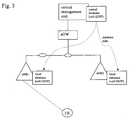
- local look-up tables in the nodes are employed. This corresponds to steps 108, 109 and 110 in fig. 2 .
- These tables are locally stored text files or databases containing mappings between cell ID's and IP addresses.
- the databases can be loaded from a remote control center or Operation and Maintenance (O&M) center periodically or on demand. This first alternative is depicted in fig. 3
- each node has a local database that contains cell ID's, e.g. of all neighboring nodes including the "umbrella cells" and IP addresses associated to them.
- This database can be updated with a defined period (e.g. once an hour or a day), e.g. by a central management unit which has a full information about the structure of the mobile network. During an installation phase of the mobile network this information needs to be input into the central unit, and afterwards downloading the database with neighbor information for each node is performed. When a new node is added, the central management unit must update databases of all surrounding base stations.
- the central database can be setup by
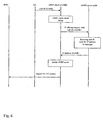
- a second alternative embodiment involves discovering IP addresses in a centralized way, which is depicted in fig. 4 .
- IP discovery in this embodiment is achieved by means of an eDNS (evolved Domain Name Server) located e.g. at a gateway (aGW), using a so-called eNRP protocol (evolved Name Resolution Protocol).
- eDNS evolved Domain Name Server
- aGW gateway
- eNRP protocol evolved Name Resolution Protocol
- the eNRP (evolved Name Resolution Protocol) protocol uses a client-server architecture. Clients make requests and the server is responsible to find a requested IP address, either in its database or in other databases.
- an eNRP service is implemented, an eNRP client is installed in a node and an eNRP server is installed in an aGW or O&M node.
- the eNRP Server is based on a modified DNS server (Domain Name Server).
- an eNB belongs to a domain of a gateway, the gateway or the network behind it should contain a DNS-like server called an eDNS which contains cell-ID/IP address entries in its database and the gateway is called authoritative for that eNB.
- an eNB doesn't belong to the gateway domain, there is no record in the eDNS database in that aGW, then this gateway is called not authoritative for that eNB.
- two base stations or nodes, respectively, are located within a first area are in the domain of aGW1/eDNSI and one base station in a second area is in the domain of aGW2/eDNS2. So aGW1 is not authoritative for eNB3 and aGW2 is not authoritative for eNB1 and eNB2.
- the source eNB will get the target IP address by requesting eDNS1, because the target eNB is within its domain. But if the user terminal crosses a border of two domains, the target IP address is not known to the eDNS. In that case, after receiving a request from the source eNB, the eDNS server in aGW is now responsible to find the IP address of the target eNB which it doesn't know yet.
- FIG. 5 An implementation of this eNRP service is shown in fig. 5 .
- a root server is used in cases when a non-authoritative eNRP server trying to get an IP address needs to communicate with others. It asks the root eNRP server for IP addresses of neighboring eNRP servers and sends to them an IP address request of the target eNB it is interested in.
- the eNRP server on aGW can be either authoritative or not authoritative for this cell-ID. If it is authoritative (see fig. 6 ) it contains a record with the required cell-ID / IP address mapping and sends it back to eNB2. At eNB2 the cache is updated with the newly received cell-ID/IP address association.
- eNRP server on aGW2 If eNRP server on aGW2 is not authoritative (eNB with requested cell-ID belongs to another aGW domain), it asks a root eNRP server and central management unit for IP addresses of the surrounding eNRP servers (see fig. 7 ). Afterwards it consequently requests neighboring eNRP servers for the IP address of the needed eNB. One of the eNRP's will respond (in this case that at aGW1). The IP address of eNB1 is transmitted to aGW2. In this case the root eNRP acts as a resolver of aGW IP addresses. Otherwise the process is similar to fig. 6 .
- An advantage of using such an eNRP System is a good scalability. From an implementation point of view a default DNS implementation could be used for an eNRP server. This DNS can run either on an independent node connected to the same subnet as the aGW, or this DNS can be also run on the same platform as the GW functionalities.
- the third alternative exemplary embodiment involves performing the IP discovery in a self-organized manner, using a so-called eNDP (evolved Network Discovery Protocol).
- eNDP evolved Network Discovery Protocol
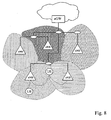
- This embodiment is depicted in fig. 8 .
- eNB's do not need a gateway and try to find out the necessary IP address by interacting with each other.
- the proposed eNDP protocol for self-organized mobile networks is based on IP multicast. This proposal makes use of hierarchical IP discovery protocol for a mobile radio system which is also called eNDP and assumes:
- a lot of base stations e.g. NodeB ⁇ s, eNB
- the network is running in a self-organized network mode.
- the eNBs are connected in a meshed manner, e.g. via cable-based or fiber-based networks.
- this proposal is also working if the eNB is connected via air interface to other eNBs in the manner of wireless base stations or multi hop nodes.
- All eNB's are organized in groups and each group has an assigned multicast address.
- eNB can discover a target IP address by sending a multicast request in its group with an included cell-ID of the target node.
- the target eNB that has this cell-ID responds with its IP address.
- source and target eNB update their eNDP caches in order not to make unnecessary IP discovery in the future.
- the cache entries can have time to live (TTL) parameter. If it TTL is expired, the corresponding element in the cache is deleted and the mechanism is repeated once again.
- TTL time to live
- eNDP cache can be used as an eNDP cache because in general they are very similar.
- the target eNB in group 2 must be able to receive multicast messages from the source eNB in group 1.
- the source eNB can become the target eNB, and the target eNB can become the source eNB, if the user is moving from group 2 to group 1.
- an eNB is located at the border of a group, it should have not only a multicast address of its group, but also multicast addresses of all neighboring groups.
- each one has its own multicast address. Every base station within a group has a group multicast address that is common for all members of the group. Base stations that are located at the interface between groups do additionally have multicast addresses of two or more neighboring groups. Multicast groups can have different sizes. The larger the groups are, the less is the share of border eNB's and hence the less are unnecessary multicasts into neighboring groups.
- each eNB is registered with its typical identifier. This list contains the following information:
- the network can be running in a centralized or self-organized mode. If a communication between eNB's is required, e.g. during a handover HO, exchange of RRM information etc., at first an IP address discovery has to be started:
- the eNB can also analyze the IP address requests of neighbor eNB's and update its local cache with the IP addresses and cell-IDs.
- FIG. 9 Another example of the architecture for an IP based mobile radio network is shown in fig. 9 .
- a scenario with two operators is shown. Each base station is connected to a gateway (aGW1 or aGW2).
- a Domain Name System (DNS1, DNS2) server and a Dynamic Host Configuration Protocol (DHCP server1, DHCP server2) server are co-located to the gateway (aGW1 or aGW2) or are part of it.
- DNS1, DHCP1 and the aGW1 are part of the network of the operator A.
- DNS2, aGW2 and the DHCP2 are part of the network of the Operator B.
- a base station If a base station is switched on, e.g. for the first time, it requests an IP address from the DHCP server. Together with the IP address additional information is transmitted to the base station.
- One of the additional parameters could be the cell-ID of the base station or the sector-IDs.
- all parameters which are relevant for a normal operation are provided by the DHCP mechanism. It is proposed to use the same protocols for the DHCP request and DHCP response as they are defined in the Internet Engineering Task Force (IETF), with the difference that the database contains additional mobile radio specific entries. In order to have the same entries in all databases the DNS and DHCP servers have access to the same database.
- IETF Internet Engineering Task Force
- the invention also suggests using DNS principles for the IP address discovery.
- DNS principles for the IP address discovery.
- a user When sending a request to a web server, a user doesn't need to know a somehow "cryptic" IP address. Instead, some kind of notation or a literal name like www.siemens.com is used, not bothering the user to remember digits. This is helpful also when a web server is moved from one host to another and the corresponding IP address has changed.
- the domain names to be used have to be defined in a web-based syntax.
- the cell-ID's of nodes in a cellular network are used to form the required domain names. Two different embodiments for the domain name convention will be explained.
- each base station or node of an operator is associated to an IP domain, wherein each operator has his own domain. For example:
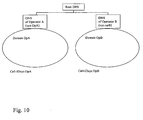
- the IP address resolution scheme for this proposed domain name convention can be performed as follows (see fig. 10 ). At first the DNS of a specific operator (for example operator A) will extract his own top level domain name (xxxx.OpA). If the top level domain name is not equal to the operator domain the request is forwarded to the "root DNS". The root DNS redirects the request to the specific DNS of the target operator (in the example operator B).
- the DNS of the operator A analyzes the domain name.
- the domain name is identical with the cell-ID of a specific base station and associated to a well known IP address.
- the DNS sends the IP address back to the requesting base station.
- a process similar to this is illustrated in fig. 11 .
- a request is received for an IP address of a target node, including the cell-ID of the target node.
- the top-level domain part of the cell identification in the request is examined. If, in step 206, the top-level domain TLD corresponds to the pre-determined top-level domain of the current operator/cellular network, a local database is queried in step 208. The IP address corresponding to the cell-ID is retrieved from the database in step 210. Finally, a response including the found IP address is issued, e.g. transmitted back to the requesting node. It is to be noted that this process can also be performed in a server that has been forwarded the request. In this case the response will be issued to the requesting server.
- step 206 If in step 206 it is determined that the top-level domain belongs to another network/operator, the request is forwarded in step 214, e.g. to a server in another network or even the target network, if the latter is known. From this server (or another server that has in turn been forwarded the request) a response is received in step 216, including the requested IP address. In step 218 the local database is updated with the newly found IP address/cell-ID association, in order to cache the IP address for later requests. The process is again continued with step 212, by issuing a response including the IP address to the requesting entity, e.g. node.
- each base station of an operator is associated to a single top level domain, wherein only one top-level domain exists for a plurality of operators. For example:
Landscapes
- Engineering & Computer Science (AREA)
- Computer Networks & Wireless Communication (AREA)
- Signal Processing (AREA)
- Mobile Radio Communication Systems (AREA)
- Data Exchanges In Wide-Area Networks (AREA)
Claims (22)
- Verfahren zum Entdecken einer Internet-Protokoll-Adresse eines Zielknotens in einem zellularen Netz, wobei der Zielknoten eine Zelle des Netzes versorgt, wobei das Verfahren Folgendes umfasst:- Bestimmen einer Identifikation der durch den Zielknoten versorgten Zelle;- Ausgeben einer Anforderung zum Bereitstellen der Internet-Protokoll-Adresse des Knotens, die die Zellenidentifikation umfasst; und- Erhalten einer Antwort, die die Internet-Protokoll-Adresse umfasst,wobei das Ausgeben der Anforderung das Abfragen einer lokalen Datenbank umfasst, die Assoziationen zwischen Zellenidentifikationen und entsprechenden Internet-Protokoll-Adressen umfasst, und das Erhalten der Antwort das Abrufen des Internet-Protokoll-Adresse aus der lokalen Datenbank umfasst, falls die lokale Datenbank einen entsprechende Assoziation enthält, und
wobei das Verfahren ferner Folgendes umfasst:- Empfangen von neuen Assoziationen oder Aktualisierungen von existierenden Assoziationen; und- Speichern der neuen Assoziationen oder Aktualisieren von existierenden Assoziationen auf der Basis der empfangenen Aktualisierungen in der lokalen Datenbank. - Verfahren nach Anspruch 1, wobei das Ausgeben der Anforderung das Einschließen der Zellenidentifikation in Form einer Internet-Domäne gemäß der Syntax des Domänennamensystems umfasst.
- Verfahren nach Anspruch 2, wobei die Internet-Domäne eine Top-Level-Domäne und eine Second-Level-Domäne umfasst und wobei- die Top-Level-Domäne für den Betreiber des zellularen Netzes einzigartig ist und die Second-Level-Domäne eine für den Knoten in dem zellularen Netz einzigartige Kennung ist;oder- die Top-Level-Domäne eine Top-Level-Domäne ist, die sich mehrere zellulare Netze teilen und die Second-Level-Domäne eine für den Knoten in den mehreren zellularen Netzen einzigartige Kennung ist.
- Verfahren nach einem der vorhergehenden Ansprüche, wobei das Bestimmen der Zellenidentifikation Folgendes umfasst:- Anfordern bei einer von dem Zielknoten versorgten Benutzerendgeräteeinrichtung, Zellenidentifikation bereitzustellen; und- Empfangen der Zellenidentifikation von dem Benutzerendgerät.
- Verfahren nach einem der vorhergehenden Ansprüche, wobei das Speichern Folgendes umfasst:- Speichern eines Time-to-Live-Werts für jede Assoziation; und- Löschen eines Eintrags mit dem niedrigsten Time-to-Live-Werts in der lokalen Datenbank, wenn die Anzahl gespeicherter Assoziationen eine Schwelle übersteigt.
- Verfahren nach einem der vorhergehenden Ansprüche, wobei das Ausgeben der Anforderung das Senden der Anforderung zu einem Server umfasst und wobei das Erhalten der Antwort das Empfangen der Antwort von dem Server umfasst.
- Verfahren nach einem der vorhergehenden Ansprüche, wobei das Ausgeben der Anforderung das Senden der Anforderung zu mindestens einer Multicast-Adresse umfasst und wobei das Erhalten der Antwort das Empfangen der Antwort von dem Zielknoten umfasst.
- Verfahren zur Entdeckung von Internet-Protokoll-Adressen von Knoten in zellularen Netzen, wobei jeder Knoten eine Zelle eines zellularen Netzes versorgt, wobei das Verfahren Folgendes umfasst:- Empfangen einer Anforderung für die Internet-Protokoll-Adresse eines Zielknotens, wobei die Anforderung eine Identifikation der von dem Knoten versorgten Zelle umfasst;- Bestimmen der Internet-Protokoll-Adresse des Zielknotens unter Verwendung der Zellenidentifikation; und- Ausgeben einer Antwort, die die Internet-Protokoll-Adresse umfasst,wobei das Bestimmen das Abfragen einer lokalen Datenbank umfasst, die Assoziationen zwischen Zellenidentifikationen und entsprechenden Internet-Protokoll-Adressen umfasst, und das Ausgeben der Antwort das Abrufen der Internet-Protokoll-Adresse aus der lokalen Datenbank umfasst, falls die lokale Datenbank einen entsprechende Assoziation enthält, und
wobei das Verfahren ferner Folgendes umfasst:- Empfangen einer Antwort, die die Internet-Protokoll-Adresse des Zielknoten umfasst; und- Speichern der Internet-Protokoll-Adresse und der Zellenidentifikation des Knotens als neue Assoziation in der lokalen Datenbank, falls die lokale Datenbank keine entsprechende Assoziation enthält. - Verfahren nach Anspruch 8, wobei die Zellenidentifikation in Form einer Internet-Domäne gemäß der Syntax des Domänennamensystems in der Abfrage eingeschlossen ist.
- Verfahren nach Anspruch 9, wobei die Internet-Domäne eine Top-Level-Domäne und eine Second-Level-Domäne umfasst und wobei- die Top-Level-Domäne für den Betreiber des zellularen Netzes einzigartig ist und die Second-Level-Domäne eine für den Knoten in dem zellularen Netz einzigartige Kennung ist;oder- die Top-Level-Domäne eine Top-Level-Domäne ist, die sich mehrere zellulare Netze teilen und die Second-Level-Domäne eine für den Knoten in den mehreren zellularen Netzen einzigartige Kennung ist.
- Verfahren nach Anspruch 10, ferner umfassend:- Evaluieren der Top-Level-Domäne der Zellenidentifikation;wobei- Das Abfragen und das Abrufen aus der lokalen Datenbank durchgeführt werden, falls die Top-Level-Domäne einer vorbestimmten Top-Level-Domäne entspricht;und- das Weiterleiten durchgeführt wird, falls die Top-Level-Domäne nicht der vorbestimmten Top-Level-Domäne entspricht.
- Verfahren nach einem der Ansprüche 8 bis 11, wobei die Anforderung für die Internet-Protokoll-Adresse des Zielknotens an einer Multicast-Adresse an einem Knoten empfangen wird und wobei der Bestimmungsschritt umfasst zu prüfen, ob die eingeschlossene Zellenidentifikation mit der Zellenidentifikation des Knotens übereinstimmt.
- Computerprogrammprodukt, das auf einem computerlesbaren Medium gespeicherte Programmanweisungen zum Ausführen des Verfahrens nach einem der Ansprüche 1 bis 12, wenn das Programmprodukt auf einem Computer ausgeführt wird, umfasst.
- Knoten eines zellularen Netzes, umfassend:- eine zellulare Netzschnittstelle, die dafür ausgelegt ist, eine erste Zelle des zellularen Netzes zu versorgen;- eine Steuerung, die dafür ausgelegt ist, eine Identifikation einer zweiten von einem Zielknoten versorgten Zelle zu bestimmen, eine Anforderung für die Internet-Protokoll-Adresse des Knotens auszugeben, wobei die Anforderung die Zellenidentifikation umfasst, und eine Antwort, die die Internet-Protokoll-Adresse umfasst, zu erhalten; und- eine lokale Datenbank, die Assoziationen zwischen Zellenidentifikationen und entsprechenden Internet-Protokoll-Adressen umfasst,wobei die Steuerung dafür ausgelegt ist, das Ausgeben der Anforderung durch Abfragen der lokalen Datenbank durchzuführen und die Antwort durch Abrufen der Internet-Protokoll-Adresse aus der lokalen Datenbank zu erhalten, falls die lokale Datenbank eine entsprechende Assoziation enthält, und wobei die Steuerung dafür ausgelegt ist, neue Assoziationen oder Aktualisierungen existierender Assoziationen zu empfangen und in der lokalen Datenbank die neuen Assoziationen zu speichern oder existierende Assoziationen auf der Basis der empfangenen Aktualisierungen zu aktualisieren.
- Knoten nach Anspruch 14, wobei die Steuerung dafür ausgelegt ist, die Zellenidentifikation in der Anforderung in Form einer Internet-Domäne gemäß der Syntax des Domänennamensystems einzuschließen.
- Knoten nach Anspruch 15, wobei die Internet-Domäne eine Top-Level-Domäne und eine Second-Level-Domäne umfasst und wobei- die Top-Level-Domäne für den Betreiber des zellularen Netzes einzigartig ist und die Second-Level-Domäne eine für den Knoten in dem zellularen Netz einzigartige Kennung ist;oder- die Top-Level-Domäne eine Top-Level-Domäne ist, die sich mehrere zellulare Netze teilen und die Second-Level-Domäne eine für den Knoten in den mehreren zellularen Netzen einzigartige Kennung ist.
- Knoten nach einem der Ansprüche 14 bis 16, wobei die Steuerung dafür ausgelegt ist, das Bestimmen einer Identifikation der Zelle durchzuführen, indem eine durch den Zielknoten versorgte Benutzerendgeräteeinrichtung angefordert wird, die Zellenidentifikation bereitzustellen und die Zellenidentifikation von dem Benutzerendgerät zu empfangen.
- Knoten nach einem der Ansprüche 14 bis 17, wobei die Steuerung dafür ausgelegt ist, einen Time-to-Live-Wert für jede Assoziation zu speichern und einen Eintrag mit dem niedrigsten Time-to-Live-Wert in der lokalen Datenbank zu löschen, wenn die Anzahl gespeicherter Assoziationen eine Schwelle übersteigt.
- Server in einem zellularen Netz, umfassend:- eine Netzschnittstelle, die dafür ausgelegt ist, mit Knoten des zellularen Netzes zu verbinden;- eine Steuerung, die dafür ausgelegt ist, eine Anforderung von einem Knoten des zellularen Netzes für die Internet-Protokoll-Adresse des Zielknotens zu empfangen, wobei die Anforderung eine Identifikation der von dem Knoten versorgten Zelle umfasst, die Internet-Protokoll-Adresse des Zielknotens unter Verwendung der Zellenidentifikation zu bestimmen und eine Antwort, die die Internet-Protokoll-Adresse umfasst, an den anfordernden Knoten auszugeben; und- eine lokale Datenbank, die Assoziationen zwischen Zellenidentifikationen und entsprechenden Internet-Protokoll-Adressen umfasst,
wobei die Steuerung dafür ausgelegt ist, das Ausgeben der Anforderung durch Abfragen der lokalen Datenbank und Erhalten der Antwort durch Abrufen der Internet-Protokoll-Adresse aus der lokalen Datenbank, falls die lokale Datenbank eine entsprechende Assoziation enthält, durchzuführen und wobei die Steuerung dafür ausgelegt ist, eine Antwort, die die Internet-Protokoll-Adresse des Zielknotens umfasst, zu empfangen, falls die lokale Datenbank keine entsprechende Assoziation enthält, und die Internet-Protokoll-Adresse und die Zellenidentifikation des Knotens als eine neue Assoziation in der lokalen Datenbank zu speichern. - Server nach Anspruch 19, wobei die Zellenidentifikation in der Anforderung in Form einer Internet-Domäne gemäß der Syntax des Domänennamensystems eingeschlossen ist.
- Server nach Anspruch 20, wobei die Internet-Domäne eine Top-Level-Domäne und eine Second-Level-Domäne umfasst und wobei- die Top-Level-Domäne für den Betreiber des zellularen Netzes einzigartig ist und die Second-Level-Domäne eine für den Knoten in dem zellularen Netz einzigartige Kennung ist;
oder- die Top-Level-Domäne eine Top-Level-Domäne ist, die sich mehrere zellulare Netze teilen und die Second-Level-Domäne eine für den Knoten in den mehreren zellularen Netzen einzigartige Kennung ist. - Server nach Anspruch 21, wobei die Steuerung dafür ausgelegt ist, die Top-Level-Domäne der Zellenidentifikation zu evaluieren, das Abfragen und Abrufen aus der lokalen Datenbank, falls die Top-Level-Domäne einer vorbestimmten Top-Level-Domäne entspricht, durchzuführen, und das Weiterleiten durchzuführen, falls die Top-Level-Domäne nicht der vorbestimmten Top-Level-Domäne entspricht.
Priority Applications (2)
| Application Number | Priority Date | Filing Date | Title |
|---|---|---|---|
| EP07009867A EP1993266B1 (de) | 2007-05-16 | 2007-05-16 | Internetprotokolladressen-Feststellung in zellularen Netzwerken |
| PCT/EP2008/055964 WO2008138965A2 (en) | 2007-05-16 | 2008-05-15 | Internet protocol address discovery in cellular networks |
Applications Claiming Priority (1)
| Application Number | Priority Date | Filing Date | Title |
|---|---|---|---|
| EP07009867A EP1993266B1 (de) | 2007-05-16 | 2007-05-16 | Internetprotokolladressen-Feststellung in zellularen Netzwerken |
Publications (2)
| Publication Number | Publication Date |
|---|---|
| EP1993266A1 EP1993266A1 (de) | 2008-11-19 |
| EP1993266B1 true EP1993266B1 (de) | 2012-07-04 |
Family
ID=38632381
Family Applications (1)
| Application Number | Title | Priority Date | Filing Date |
|---|---|---|---|
| EP07009867A Active EP1993266B1 (de) | 2007-05-16 | 2007-05-16 | Internetprotokolladressen-Feststellung in zellularen Netzwerken |
Country Status (2)
| Country | Link |
|---|---|
| EP (1) | EP1993266B1 (de) |
| WO (1) | WO2008138965A2 (de) |
Families Citing this family (1)
| Publication number | Priority date | Publication date | Assignee | Title |
|---|---|---|---|---|
| US8781435B2 (en) | 2009-02-13 | 2014-07-15 | Qualcomm Incorporated | High rate packet data (HRPD) idle state handout from femto access point to macro access network |
Family Cites Families (2)
| Publication number | Priority date | Publication date | Assignee | Title |
|---|---|---|---|---|
| US20030216140A1 (en) * | 2002-05-17 | 2003-11-20 | Georg Chambert | Universal identification system for access points of wireless access networks |
| US7917152B2 (en) * | 2003-06-27 | 2011-03-29 | Nokia Corporation | Enhanced fast handover procedures |
-
2007
- 2007-05-16 EP EP07009867A patent/EP1993266B1/de active Active
-
2008
- 2008-05-15 WO PCT/EP2008/055964 patent/WO2008138965A2/en not_active Ceased
Also Published As
| Publication number | Publication date |
|---|---|
| WO2008138965A2 (en) | 2008-11-20 |
| EP1993266A1 (de) | 2008-11-19 |
| WO2008138965A3 (en) | 2009-09-11 |
Similar Documents
| Publication | Publication Date | Title |
|---|---|---|
| CN1224231C (zh) | 候选接入路由器发现方法及移动ip网的装置和网络单元 | |
| JP3786268B2 (ja) | 地理的に隣接したアクセス・ルータの発見とモバイル・ノードのためのキャッシング | |
| CN100428719C (zh) | 一种基于身份与位置分离的互联网接入方法 | |
| KR101423743B1 (ko) | 가상 네트워크 환경에서 네트워크 단위의 통신 방법 | |
| EP2230868B1 (de) | Verfahren und Vorrichtung zur Verteilung von Topologieinformationen in Kommunikationsnetzwerken | |
| US8213441B2 (en) | Global reachability in communication networks | |
| US20110219126A1 (en) | Mobile terminal, forwarding intermediate node and mobile communications system | |
| JP5905722B2 (ja) | 移動体ipのためのシステムおよび方法 | |
| CN101127758B (zh) | 移动节点的ip地址获取方法与获取系统 | |
| US8369293B2 (en) | Mobile router, home agent, and terminal position management method | |
| JP2011130387A (ja) | 中継装置および無線通信システム | |
| US10491562B2 (en) | Router node, network and method to allow service discovery in a network | |
| EP1993266B1 (de) | Internetprotokolladressen-Feststellung in zellularen Netzwerken | |
| JP2002271368A (ja) | 移動網における移動端末管理システム | |
| CN110913348B (zh) | 无固定基础设施依托的分布式网络架构及其位置管理方法 | |
| EP2314050B1 (de) | Verfahren zur kommunikationsherstellung in einem mobilen kommunikationssystem und mobiles kommunikationssystem | |
| US9497784B2 (en) | Apparatus and method of establishing interface in a local network | |
| Aydın et al. | A survey on micro mobility management of host identity protocol | |
| KR101024271B1 (ko) | 이종 애드혹 네트워크 간 라우팅 프로토콜 자동 연동 장치 및 그 방법 | |
| Wang et al. | A reactive learning mechanism for multihoming MN on PMIPv6 | |
| CN101494850A (zh) | 用于管理移动的方法和移动终端 | |
| KR20090054147A (ko) | 도메인 네임 시스템 기반 모바일 IPv6 핸드오버 시스템및 방법 | |
| Velayos et al. | A distribution system for large scale IEEE 802.11 Wireless LANs | |
| Speicher et al. | Candidate discovery for connected mobile ad hoc networks | |
| HK1146341B (en) | Method, apparatus and system for mobility management and efficient information retrieval in a communications network |
Legal Events
| Date | Code | Title | Description |
|---|---|---|---|
| PUAI | Public reference made under article 153(3) epc to a published international application that has entered the european phase |
Free format text: ORIGINAL CODE: 0009012 |
|
| AK | Designated contracting states |
Kind code of ref document: A1 Designated state(s): AT BE BG CH CY CZ DE DK EE ES FI FR GB GR HU IE IS IT LI LT LU LV MC MT NL PL PT RO SE SI SK TR |
|
| AX | Request for extension of the european patent |
Extension state: AL BA HR MK RS |
|
| 17P | Request for examination filed |
Effective date: 20090519 |
|
| AKX | Designation fees paid |
Designated state(s): AT BE BG CH CY CZ DE DK EE ES FI FR GB GR HU IE IS IT LI LT LU LV MC MT NL PL PT RO SE SI SK TR |
|
| 17Q | First examination report despatched |
Effective date: 20090702 |
|
| RAP1 | Party data changed (applicant data changed or rights of an application transferred) |
Owner name: NOKIA SIEMENS NETWORKS GMBH & CO. KG |
|
| GRAP | Despatch of communication of intention to grant a patent |
Free format text: ORIGINAL CODE: EPIDOSNIGR1 |
|
| GRAS | Grant fee paid |
Free format text: ORIGINAL CODE: EPIDOSNIGR3 |
|
| GRAA | (expected) grant |
Free format text: ORIGINAL CODE: 0009210 |
|
| AK | Designated contracting states |
Kind code of ref document: B1 Designated state(s): AT BE BG CH CY CZ DE DK EE ES FI FR GB GR HU IE IS IT LI LT LU LV MC MT NL PL PT RO SE SI SK TR |
|
| REG | Reference to a national code |
Ref country code: GB Ref legal event code: FG4D |
|
| REG | Reference to a national code |
Ref country code: CH Ref legal event code: EP |
|
| REG | Reference to a national code |
Ref country code: AT Ref legal event code: REF Ref document number: 565522 Country of ref document: AT Kind code of ref document: T Effective date: 20120715 |
|
| REG | Reference to a national code |
Ref country code: IE Ref legal event code: FG4D |
|
| REG | Reference to a national code |
Ref country code: DE Ref legal event code: R096 Ref document number: 602007023768 Country of ref document: DE Effective date: 20120830 |
|
| REG | Reference to a national code |
Ref country code: NL Ref legal event code: T3 |
|
| REG | Reference to a national code |
Ref country code: AT Ref legal event code: MK05 Ref document number: 565522 Country of ref document: AT Kind code of ref document: T Effective date: 20120704 |
|
| PG25 | Lapsed in a contracting state [announced via postgrant information from national office to epo] |
Ref country code: SI Free format text: LAPSE BECAUSE OF FAILURE TO SUBMIT A TRANSLATION OF THE DESCRIPTION OR TO PAY THE FEE WITHIN THE PRESCRIBED TIME-LIMIT Effective date: 20120704 |
|
| REG | Reference to a national code |
Ref country code: LT Ref legal event code: MG4D Effective date: 20120704 |
|
| PG25 | Lapsed in a contracting state [announced via postgrant information from national office to epo] |
Ref country code: IS Free format text: LAPSE BECAUSE OF FAILURE TO SUBMIT A TRANSLATION OF THE DESCRIPTION OR TO PAY THE FEE WITHIN THE PRESCRIBED TIME-LIMIT Effective date: 20121104 Ref country code: AT Free format text: LAPSE BECAUSE OF FAILURE TO SUBMIT A TRANSLATION OF THE DESCRIPTION OR TO PAY THE FEE WITHIN THE PRESCRIBED TIME-LIMIT Effective date: 20120704 Ref country code: BE Free format text: LAPSE BECAUSE OF FAILURE TO SUBMIT A TRANSLATION OF THE DESCRIPTION OR TO PAY THE FEE WITHIN THE PRESCRIBED TIME-LIMIT Effective date: 20120704 Ref country code: LT Free format text: LAPSE BECAUSE OF FAILURE TO SUBMIT A TRANSLATION OF THE DESCRIPTION OR TO PAY THE FEE WITHIN THE PRESCRIBED TIME-LIMIT Effective date: 20120704 Ref country code: CY Free format text: LAPSE BECAUSE OF FAILURE TO SUBMIT A TRANSLATION OF THE DESCRIPTION OR TO PAY THE FEE WITHIN THE PRESCRIBED TIME-LIMIT Effective date: 20120704 Ref country code: FI Free format text: LAPSE BECAUSE OF FAILURE TO SUBMIT A TRANSLATION OF THE DESCRIPTION OR TO PAY THE FEE WITHIN THE PRESCRIBED TIME-LIMIT Effective date: 20120704 |
|
| PG25 | Lapsed in a contracting state [announced via postgrant information from national office to epo] |
Ref country code: LV Free format text: LAPSE BECAUSE OF FAILURE TO SUBMIT A TRANSLATION OF THE DESCRIPTION OR TO PAY THE FEE WITHIN THE PRESCRIBED TIME-LIMIT Effective date: 20120704 Ref country code: PL Free format text: LAPSE BECAUSE OF FAILURE TO SUBMIT A TRANSLATION OF THE DESCRIPTION OR TO PAY THE FEE WITHIN THE PRESCRIBED TIME-LIMIT Effective date: 20120704 Ref country code: PT Free format text: LAPSE BECAUSE OF FAILURE TO SUBMIT A TRANSLATION OF THE DESCRIPTION OR TO PAY THE FEE WITHIN THE PRESCRIBED TIME-LIMIT Effective date: 20121105 Ref country code: GR Free format text: LAPSE BECAUSE OF FAILURE TO SUBMIT A TRANSLATION OF THE DESCRIPTION OR TO PAY THE FEE WITHIN THE PRESCRIBED TIME-LIMIT Effective date: 20121005 Ref country code: SE Free format text: LAPSE BECAUSE OF FAILURE TO SUBMIT A TRANSLATION OF THE DESCRIPTION OR TO PAY THE FEE WITHIN THE PRESCRIBED TIME-LIMIT Effective date: 20120704 |
|
| PG25 | Lapsed in a contracting state [announced via postgrant information from national office to epo] |
Ref country code: ES Free format text: LAPSE BECAUSE OF FAILURE TO SUBMIT A TRANSLATION OF THE DESCRIPTION OR TO PAY THE FEE WITHIN THE PRESCRIBED TIME-LIMIT Effective date: 20121015 Ref country code: EE Free format text: LAPSE BECAUSE OF FAILURE TO SUBMIT A TRANSLATION OF THE DESCRIPTION OR TO PAY THE FEE WITHIN THE PRESCRIBED TIME-LIMIT Effective date: 20120704 Ref country code: DK Free format text: LAPSE BECAUSE OF FAILURE TO SUBMIT A TRANSLATION OF THE DESCRIPTION OR TO PAY THE FEE WITHIN THE PRESCRIBED TIME-LIMIT Effective date: 20120704 Ref country code: RO Free format text: LAPSE BECAUSE OF FAILURE TO SUBMIT A TRANSLATION OF THE DESCRIPTION OR TO PAY THE FEE WITHIN THE PRESCRIBED TIME-LIMIT Effective date: 20120704 Ref country code: CZ Free format text: LAPSE BECAUSE OF FAILURE TO SUBMIT A TRANSLATION OF THE DESCRIPTION OR TO PAY THE FEE WITHIN THE PRESCRIBED TIME-LIMIT Effective date: 20120704 |
|
| PLBE | No opposition filed within time limit |
Free format text: ORIGINAL CODE: 0009261 |
|
| STAA | Information on the status of an ep patent application or granted ep patent |
Free format text: STATUS: NO OPPOSITION FILED WITHIN TIME LIMIT |
|
| PG25 | Lapsed in a contracting state [announced via postgrant information from national office to epo] |
Ref country code: SK Free format text: LAPSE BECAUSE OF FAILURE TO SUBMIT A TRANSLATION OF THE DESCRIPTION OR TO PAY THE FEE WITHIN THE PRESCRIBED TIME-LIMIT Effective date: 20120704 Ref country code: IT Free format text: LAPSE BECAUSE OF FAILURE TO SUBMIT A TRANSLATION OF THE DESCRIPTION OR TO PAY THE FEE WITHIN THE PRESCRIBED TIME-LIMIT Effective date: 20120704 |
|
| 26N | No opposition filed |
Effective date: 20130405 |
|
| PG25 | Lapsed in a contracting state [announced via postgrant information from national office to epo] |
Ref country code: BG Free format text: LAPSE BECAUSE OF FAILURE TO SUBMIT A TRANSLATION OF THE DESCRIPTION OR TO PAY THE FEE WITHIN THE PRESCRIBED TIME-LIMIT Effective date: 20121004 |
|
| REG | Reference to a national code |
Ref country code: DE Ref legal event code: R097 Ref document number: 602007023768 Country of ref document: DE Effective date: 20130405 |
|
| PG25 | Lapsed in a contracting state [announced via postgrant information from national office to epo] |
Ref country code: MC Free format text: LAPSE BECAUSE OF FAILURE TO SUBMIT A TRANSLATION OF THE DESCRIPTION OR TO PAY THE FEE WITHIN THE PRESCRIBED TIME-LIMIT Effective date: 20120704 |
|
| REG | Reference to a national code |
Ref country code: CH Ref legal event code: PL |
|
| PG25 | Lapsed in a contracting state [announced via postgrant information from national office to epo] |
Ref country code: LI Free format text: LAPSE BECAUSE OF NON-PAYMENT OF DUE FEES Effective date: 20130531 Ref country code: CH Free format text: LAPSE BECAUSE OF NON-PAYMENT OF DUE FEES Effective date: 20130531 |
|
| REG | Reference to a national code |
Ref country code: IE Ref legal event code: MM4A |
|
| PG25 | Lapsed in a contracting state [announced via postgrant information from national office to epo] |
Ref country code: IE Free format text: LAPSE BECAUSE OF NON-PAYMENT OF DUE FEES Effective date: 20130516 |
|
| REG | Reference to a national code |
Ref country code: DE Ref legal event code: R081 Ref document number: 602007023768 Country of ref document: DE Owner name: NOKIA SOLUTIONS AND NETWORKS GMBH & CO. KG, DE Free format text: FORMER OWNER: NOKIA SIEMENS NETWORKS GMBH & CO. KG, 81541 MUENCHEN, DE Effective date: 20140731 |
|
| REG | Reference to a national code |
Ref country code: NL Ref legal event code: TD Effective date: 20150126 |
|
| PG25 | Lapsed in a contracting state [announced via postgrant information from national office to epo] |
Ref country code: MT Free format text: LAPSE BECAUSE OF FAILURE TO SUBMIT A TRANSLATION OF THE DESCRIPTION OR TO PAY THE FEE WITHIN THE PRESCRIBED TIME-LIMIT Effective date: 20120704 |
|
| REG | Reference to a national code |
Ref country code: FR Ref legal event code: CD Owner name: NOKIA SOLUTIONS AND NETWORKS GMBH & CO.KG, DE Effective date: 20150211 |
|
| REG | Reference to a national code |
Ref country code: FR Ref legal event code: PLFP Year of fee payment: 9 |
|
| PG25 | Lapsed in a contracting state [announced via postgrant information from national office to epo] |
Ref country code: TR Free format text: LAPSE BECAUSE OF FAILURE TO SUBMIT A TRANSLATION OF THE DESCRIPTION OR TO PAY THE FEE WITHIN THE PRESCRIBED TIME-LIMIT Effective date: 20120704 |
|
| PG25 | Lapsed in a contracting state [announced via postgrant information from national office to epo] |
Ref country code: HU Free format text: LAPSE BECAUSE OF FAILURE TO SUBMIT A TRANSLATION OF THE DESCRIPTION OR TO PAY THE FEE WITHIN THE PRESCRIBED TIME-LIMIT; INVALID AB INITIO Effective date: 20070516 Ref country code: LU Free format text: LAPSE BECAUSE OF NON-PAYMENT OF DUE FEES Effective date: 20130516 |
|
| REG | Reference to a national code |
Ref country code: FR Ref legal event code: PLFP Year of fee payment: 10 |
|
| REG | Reference to a national code |
Ref country code: FR Ref legal event code: PLFP Year of fee payment: 11 |
|
| REG | Reference to a national code |
Ref country code: FR Ref legal event code: PLFP Year of fee payment: 12 |
|
| REG | Reference to a national code |
Ref country code: DE Ref legal event code: R079 Ref document number: 602007023768 Country of ref document: DE Free format text: PREVIOUS MAIN CLASS: H04L0029120000 Ipc: H04L0067286900 |
|
| REG | Reference to a national code |
Ref country code: FR Ref legal event code: PLFP Year of fee payment: 17 |
|
| PGFP | Annual fee paid to national office [announced via postgrant information from national office to epo] |
Ref country code: NL Payment date: 20250409 Year of fee payment: 19 |
|
| PGFP | Annual fee paid to national office [announced via postgrant information from national office to epo] |
Ref country code: DE Payment date: 20250402 Year of fee payment: 19 |
|
| PGFP | Annual fee paid to national office [announced via postgrant information from national office to epo] |
Ref country code: GB Payment date: 20250401 Year of fee payment: 19 |
|
| PGFP | Annual fee paid to national office [announced via postgrant information from national office to epo] |
Ref country code: FR Payment date: 20250401 Year of fee payment: 19 |