EP1993310A1 - Gestion d'accessibilité de plusieurs unités de communication qui partagent le même code d'identification - Google Patents
Gestion d'accessibilité de plusieurs unités de communication qui partagent le même code d'identification Download PDFInfo
- Publication number
- EP1993310A1 EP1993310A1 EP07108388A EP07108388A EP1993310A1 EP 1993310 A1 EP1993310 A1 EP 1993310A1 EP 07108388 A EP07108388 A EP 07108388A EP 07108388 A EP07108388 A EP 07108388A EP 1993310 A1 EP1993310 A1 EP 1993310A1
- Authority
- EP
- European Patent Office
- Prior art keywords
- communication unit
- network
- register
- reachable
- user identification
- Prior art date
- Legal status (The legal status is an assumption and is not a legal conclusion. Google has not performed a legal analysis and makes no representation as to the accuracy of the status listed.)
- Granted
Links
- 238000010295 mobile communication Methods 0.000 title claims abstract description 141
- 238000004891 communication Methods 0.000 claims abstract description 338
- 238000000034 method Methods 0.000 claims abstract description 27
- 238000011084 recovery Methods 0.000 claims abstract description 7
- 230000000977 initiatory effect Effects 0.000 claims description 14
- 230000009471 action Effects 0.000 claims description 11
- FGUUSXIOTUKUDN-IBGZPJMESA-N C1(=CC=CC=C1)N1C2=C(NC([C@H](C1)NC=1OC(=NN=1)C1=CC=CC=C1)=O)C=CC=C2 Chemical compound C1(=CC=CC=C1)N1C2=C(NC([C@H](C1)NC=1OC(=NN=1)C1=CC=CC=C1)=O)C=CC=C2 FGUUSXIOTUKUDN-IBGZPJMESA-N 0.000 claims description 6
- 238000010561 standard procedure Methods 0.000 claims description 6
- 238000001514 detection method Methods 0.000 claims description 5
- 230000008901 benefit Effects 0.000 description 5
- 230000000737 periodic effect Effects 0.000 description 5
- 230000008859 change Effects 0.000 description 4
- 230000004044 response Effects 0.000 description 3
- 230000005540 biological transmission Effects 0.000 description 2
- 230000000694 effects Effects 0.000 description 2
- 230000004913 activation Effects 0.000 description 1
Images
Classifications
-
- H—ELECTRICITY
- H04—ELECTRIC COMMUNICATION TECHNIQUE
- H04W—WIRELESS COMMUNICATION NETWORKS
- H04W8/00—Network data management
- H04W8/02—Processing of mobility data, e.g. registration information at HLR [Home Location Register] or VLR [Visitor Location Register]; Transfer of mobility data, e.g. between HLR, VLR or external networks
-
- H—ELECTRICITY
- H04—ELECTRIC COMMUNICATION TECHNIQUE
- H04W—WIRELESS COMMUNICATION NETWORKS
- H04W8/00—Network data management
- H04W8/26—Network addressing or numbering for mobility support
Definitions
- the invention relates to a mobile communication network (GSM, UMTS) provided with at least one mobile services switching center (MSC), a plurality of base station controllers (BSC) which are communicatively connected with the at least one mobile services switching center (MSC) and a radio network system which is communicatively connected with the at least one mobile services switching center, wherein the network is further provided with a plurality of mobile communication units (MSE) such as mobile telephones, which are each provided with a memory module (SIM) in which a user identification code (IMSI/TMSI) is stored and which are each arranged for wirelessly communicating with the radio network system, wherein the network is further provided with at least one HLR register in which information about users of the network is stored such as the user identification codes (IMSI), associated telephone numbers (MS-ISDN) and locations of activated associated mobile communication units within the network and at least one VLR register which is associated with the at least one mobile services switching center (MSC) and in which information, such as the user identification codes (IMSI
- Such a mobile communication network is known per se by the name of GSM and UMTS.
- the radio network system is provided with a plurality of base station controllers (BSC) which are communicatively connected with the mobile services switching center (MSC) and a plurality of base transmitting/receiving stations (BTS) which are each communicatively connected with at least one of the base station controllers (BSC).
- BSC base station controllers
- BTS base transmitting/receiving stations
- UMTS a mobile services switching center and a VLR register associated therewith is also referred to as an MSC/VLR server connected with a Media Gateway.
- a base station controller (BSC) is also referred to as a Radio Network Controller (RNC) and, with the UMTS network, a base transmitting/receiving station (BTS) is also referred to as a Node B.
- RNC Radio Network Controller
- BTS base transmitting/receiving station
- MS-ISDN mobile communication units with a same telephone number
- An option to be considered here is a user who wishes to carry a first mobile communication unit with him and wishes to install a second mobile communication unit in his car, both communication units being provided with a same telephone number (MS-ISDN).
- GSM mobile communication network
- MSE mobile communication unit
- IMSI user identification code
- TMSI temporary user identification code
- the HLR register in which information about the respective user identification code is stored, it is then stored through which mobile services switching center (MSC) and/or the VLR register associated therewith the activated mobile communication unit can be reached. It further holds that, in the VLR register associated with the mobile services switching center (MSC) through which the activated mobile communication unit (MSE) has been received, information is stored about through which base station controller (BSC) connected with the mobile services switching center (MSC) an activated mobile communication unit (MSE) can be reached.
- BSC base station controller
- the later activated communication unit is registered with another VLR register than the earlier activated communication unit, in the other VLR register, a record is made in which information of the later activated communication unit is stored, such as for instance user identification code (IMSI) and/or the temporary user identification code (TMSI).
- IMSI user identification code
- TMSI temporary user identification code
- this information is generally erased, i.e. a record in which this information is stored is deleted. The respective communication unit has then become unreachable within the network.
- the later activated communication unit is registered with a same VLR register as the earlier activated communication unit, then, in that VLR register, in the record already present, information of the later activated communication unit is stored, such as for instance the user identification code (IMSI) and/or the temporary user identification code (TMSI).
- IMSI user identification code
- TMSI temporary user identification code
- the VLR register only the data, such as the user identification code (IMSI) and/or the temporary user identification code (TMSI), of the most recently activated communication unit are stored.
- the data of the location and status of the earlier activated communication unit with the same user identification code are overwritten in the VLR register with those of the later activated communication unit with this user identification code when this latter communication unit is activated in an area covered by the mobile services switching center (MSC) associated with the respective VLR register.
- MSC mobile services switching center
- the record with the data of the location and status of the earlier activated communication with the same user identification code is erased in the VLR register when this latter communication unit is activated in an area covered by a mobile services switching center (MSC) associated with another VLR register.
- the mobile communication unit with the respective identification code still reachable according to the network When then the mobile communication unit with the respective identification code still reachable according to the network is deactivated, then it informs the network through one of the base transmitting/receiving stations (BTS) that it is switched off.
- BTS base transmitting/receiving stations
- the network will then indicate in the VLR register, in which the latter mobile communication unit is registered as being active, that a mobile communication unit (MSE) with the respective user identification code is no longer active. It is included in the record that the mobile communication unit is detached. Then, all other still active mobile communication units with the respective user identification code also remain unreachable within the network. This can take a considerable time as will be explained hereinafter.
- an activated mobile communication unit transmits a signal at predetermined (relative) points in time (so-called periodic location update request) to indicate within the network that it is still activated.
- the system may, for instance, be arranged such that when such a signal is not received for 16 hours, in the VLR register in which the respective user identification code (IMSI) and/or temporary user identification code (TMSI) was indicated being associated with an activated communication unit (MSE), it is indicated that a communication unit (MSE) with the respective (optionally temporary) user identification code (IMSI/TMSI) is no longer activated.
- the respective record is, for instance, erased.
- the activated mobile communication unit transmits the respective signal at predetermined relative points in time, for instance each four or eight hours, it may happen that the respective activated mobile communication unit is not reachable within the network up to maximally four or eight hours after the reachable communication unit is switched off. Also, the non-reachable communication unit may become reachable again when it carries out a location update request. The latter may take place when the communication unit detects that it has ended up in a different location area from the one stored in the memory module (SIM) of the respective communication unit.
- SIM memory module
- the invention contemplates providing a solution for the above-mentioned problem and is characterized in that the network is further provided with at least one auxiliary register in which information is stored representing the fact that a user identification code (IMSI) is stored in a plurality of memory modules (SIM) of mobile communication units (MSE), how many communication units of a collection of communication units with a same user identification code (IMSI) the collection comprises and/or are activated, with which VLR registers the activated communication units of the respective collection of communication units are registered, the user identification codes (IMSI) and/or temporary user identification codes (TMSI) associated with the activated communication units, in which location area (LAI) associated with a VLR register the activated communication units of the respective collection are registered and which of the activated communication units is reachable within the system, and while the network is arranged such that, in use, when a mobile communication unit (MSE) is switched off, the network carries out the following steps:
- the network is arranged for bringing about in a step h. that, on the basis of information from the auxiliary register, a special request to provide subscriber information (MAP PSI) is supplied to the VLR register through which the communication unit needs to become reachable, while the special request comprises information about the current location area (LAI) of the respective communication unit, the user identification code (IMSI) and/or the temporary identification code of the respective communication unit (MSE) and the predetermined location area for forced update (LAIFLU).
- LAI current location area
- IMSI user identification code
- MSE temporary identification code of the respective communication unit
- LAIFLU predetermined location area for forced update
- the network is arranged for carrying out step e. on the basis of the step h. carried out.
- MAP PSI non-standard special request to Provide Subscriber Information
- Another problem occurring with the known network is that, for a user owning a plurality of communication units which are provided with a same user identification code, it is not clear and predictable which of the communication units is reachable. When a plurality of such communication units are switched on, they each show, on a display of these communication units, a status as if the respective communication unit were reachable.
- the known network is arranged such that the communication unit which was the last to be active within the network, is reachable within the network.
- This activity may, for instance, consist of carrying out a location update request as a result of changing the location area in which the respective communication unit is located, carrying out a periodic location update request, switching on a communication unit, initiating the transmission of information, such as initiating a telephone call or initiating the sending of a text message. It is then clear to a user that he has transmitted a telephone call or a text message or that he has transmitted a communication unit and that he can then expect that precisely the apparatus used for this is reachable. However, it escapes the notice of a user when a communication unit carries out above-mentioned location update request as a result of a change of the location area in which the respective communication unit is located or that the communication unit carries out a periodic update request. Because the user fails to notice that such an activity takes place, it will not be clear to the user either that, in that case, the communication unit which has carried out the respective location update request as a result of the change of the location area or a periodic update request becomes reachable.
- the network according to the invention is characterized in that the communication units which are part of one of the above-mentioned collections are each provided with a special memory module (SIM) which brings about that a communication unit provided with such a special memory module (SIM) transmits a power-on signal recognizable to the network when the respective communication unit is switched on.
- SIM special memory module
- the network knows that the respective communication unit is switched on.
- the network is arranged for bringing about that, of a collection of communication units comprising a same user identification code (IMSI), that communication unit becomes reachable or, when it is already reachable, remains reachable which has been switched on most recently or which has been used most recently by a user to transmit information of the user, such as initiating a telephone call and sending a text message, etc.
- IMSI user identification code
- the simple rule holds that that communication unit of the collection of communication units is reachable which he has used most recently for transmitting information or which he has switched on most recently.
- the network is arranged for carrying out a step i. when one of the other communication units of the collection which is not reachable, carries out an action which is different from an action where information is transmitted by the user, which is different from an action where a communication unit is switched on and which results in this other communication unit undesirably becoming reachable, while the communication unit which needs to remain reachable because it was switched on most recently or because it was used most recently becomes unreachable, while step i. brings about that the communication unit which needed to remain reachable becomes reachable again.
- the network determines that step i. needs to be carried out for making the respective communication unit reachable again.
- the network is arranged for carrying out step i. by means of the following steps:
- step i. for carrying out step i., use can very effectively be made of the above-mentioned step c. en d. which were already used to prevent, upon switching off a communication unit which is reachable and which is provided with a particular user identification code, any of the communication units which are provided with a same user identification code and which are activated from becoming reachable.
- step c. the command Provide Roaming Number (MAP PRN) of step c. is only carried out if it is stored in the auxiliary register that the mobile communication unit which needs to become reachable can become reachable through a VLR register which differs from the VLR register through which the mobile communication unit was reachable which has been switched off.
- MAP PRN the command Provide Roaming Number
- the network is arranged for carrying out the following steps for the location update procedure according to step d.:
- the network is arranged for bringing about in a step h. that, on the basis of information from the auxiliary register, a special request to provide subscriber information (MAP PSI) is supplied to the VLR register through which the communication unit needs to become reachable, while the special request comprises information about the current location area (LAI) of the respective communication unit, the user identification code (IMSI) and/or the temporary user identification code (TMSI) of the respective communication unit (MSE) and the predetermined location area for forced update (LAIFLU).
- LAI current location area
- IMSI user identification code
- TMSI temporary user identification code
- LAIFLU predetermined location area for forced update
- the power-on signal is transmitted in that, in its memory module, the communication unit overwrites the location area information (LAI) with predetermined location area information (LAIPO) which is recognized by the network as a power-on signal. It then also holds that, because the communication unit overwrites the location area information with a predetermined location area in its memory module, a response by the network is elicited which is inherent in the known network. Also, in this manner, with a minimum amount of adjustments, the known GSM-UMTS network can be improved. It then preferably holds that the transmitted power-on signal relates to the predetermined local area identity (LAIPO).
- LAIPO location area identity
- the number of communication units of a collection is stored by storing, of each communication unit of the collection, its communication unit identification code (IMEI).
- IMEI communication unit identification code
- the at least one auxiliary register and the HLR register are integrated.
- GSM or UMTS is understood to refer to a mobile communication network according to the invention.
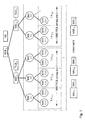
- the network is provided with a mobile services switching center (MSC 1) and a mobile services switching center (MSC 2).
- the network further comprises a plurality of base station controllers (BSC 1.1, BSC 1.2, BSC 1.3) which are each communicatively connected with the mobile services switching center (MSC 1) and a plurality of base station controllers (BSC 2.1, BSC 2.2, BSC 2.3) which are each communicatively connected with the mobile services switching center (MSC 2).
- the mobile communication network is further provided with a plurality of base transmitting/receiving stations (BTS 1.1.1, BTS 1.1.2, BTS 1.2.1, BTS 1.2.2, BTS 1.3.1, BTS 1.3.2) which are each communicatively connected with one of the base stations (BSC 1.1, BSC 1.2 or BSC 1.3).
- the mobile communication network is further provided with a plurality of base transmitting/receiving stations (BTS 2.1.1, BTS 2.1.2) which are each connected with the base station (BTS 2.1) and a plurality of base transmitting/receiving stations (BTS 2.2.1, BTS 2.2.2) which are each communicatively connected with the base station (BSC 2).
- the network further comprises a plurality of mobile communication units (MSE), such as mobile telephones, which are each provided with memory modules (SIM) in which a user identification code (IMSI) is stored.
- MSE mobile communication units
- SIM memory modules
- IMSI user identification code
- the communication units (MSE) are each arranged for wirelessly communicating with the radio network system 3. More in particular, it holds for this example that the communication units (MSE) are each arranged for wirelessly communicating with the base transmitting/receiving stations (BTS).
- the mobile communication network is further provided with at least one HLR register (HLR 1) in which the information about users of the network is stored.
- HLR 1 HLR register
- IMSI allocated user identification codes
- MS-ISDN associated telephone numbers of the users
- MSE activated associated mobile communication units
- the mobile communication network is further provided with at least one VLR register (VLR 1) which is, in this example, associated with the mobile services switching center (MSC 1) and at least one VLR register (VLR 2) which is, in this example, associated with the mobile services switching center (MSC 2).
- VLR 1 which is, in this example, associated with the mobile services switching center (MSC 1)
- VLR 2 which is, in this example, associated with the mobile services switching center (MSC 2).
- the mobile services switching center (MSC 1) and the VLR register (VLR 1) are placed physically in each other's proximity. The same holds for the mobile services switching center (MSC 2) and the VLR register (VLR 2).
- VLR 1 information is stored such as the user identification code (IMSI) and/or a temporary user identification code (TMSI) of all mobile communication units (MSE) which are activated in an area (MSC/VLR service area) covered with the at least one mobile services switching center (MSC 1).
- VLR 2 information is stored such as the user identification code (IMSI) and/or a temporary user identification code (TMSI) of all mobile communication units (MSE) which are activated in an area (MSC/VLR service area) covered with the at least one mobile services switching center (MSC 2).
- the VLR register comprises a record for the respective activated communication unit in which, for instance, the temporary user identification code of the activated communication unit is stored. If a communication record having a record with, for instance, the VLR register (VLR 1) is deactivated, then it is also registered in the record of the VLR register (VLR 2) as being detached.
- MSC mobile services switching center
- VLR 2 the VLR register
- VLR 2 If, however, such an activated communication unit moves to an area covered by the VLR register (VLR 2), then a record is made in the VLR register (VLR 2) with information therein of the respective communication unit such as a (new) temporary user identification code (TMSI).
- TMSI temporary user identification code
- HLR register it is then indicated that the respective communication unit is reachable through the VLR register (VLR 2) and the system gives a command to erase the record of the respective communication unit in the VLR register (VLR 1). If this erasing does not succeed, then the record will be erased automatically if, for instance for seven days, no communication with the respective communication unit has occurred through the VLR register (VLR 1).
- MSE 1 and MSE 2 are each provided with a memory module (SIM 1 and SIM 2), respectively, while one and the same user identification code (IMSI) is stored in the memory modules (SIM 1 and SIM 2).
- SIM 1 and SIM 2 are each provided with a memory module, respectively, while one and the same user identification code (IMSI) is stored in the memory modules (SIM 1 and SIM 2).
- IMSI user identification code
- the mobile communication unit (MSE 1) When the mobile communication unit (MSE 1) is activated, it transmits a signal comprising inter alia its user identification code (IMSI). This signal is, for instance, received by the base transmitting/receiving station (BTS 1.1.1). The base transmitting/receiving station (BTS 1.1.1) passes the received signal on to the associated base station controller (BSC 1.1). This passes information about the received signal on to the mobile services switching center (MSC 1). The mobile services switching center (MSC 1) writes the respective user identification code (IMSI) in the associated VLR register (VLR 1), as well as information about through which base station (BSC 1.1.1) the information was received.
- IMSI user identification code
- VLR 1 a record is made for the communication unit (MSE 1) in which this information is stored. Further, the mobile services switching center (MSC 1) passes a temporary user identification code (TMSI) on to the communication unit (MSE 1). This temporary user identification code (TMSI) is stored in the respective record of the VLR register (VLR 1) and in the communication unit (MSE 1). With the base station controller (BSC 1.1), a so-called location area (LA 1.1) is covered which is part of the MSC/VLR service area. Then, the mobile services switching center (MSC 1.1) transmits information to the HLR register about the activated communication unit.
- TMSI temporary user identification code
- the communication unit (MSE 1) with the user identification code (IMSI) is reachable through, in this example, the mobile services switching center (MSC 1.1).
- MSC 1.1 mobile services switching center
- the latter involves location information of the mobile communication unit with the respective user identification code (IMSI).
- an activated mobile communication unit (MSE 3) wants to call a telephone number (MS-ISDN) associated with the mobile communication unit (MSE 1)
- the mobile communication unit (MSE 3) contacts the network.
- the communication unit (MSE 3) then transmits the respective telephone number (MS-ISDN). This is received by one of the base transmitting/receiving stations (BTS).
- BTS base transmitting/receiving stations
- the network then consults the HLR register to look whether a communication unit with the user identification code IMSI which is coupled to the respective telephone number MS-ISDN is registered. In this example, it appears from the HLR register that a mobile communication unit with the respective user identification code is indeed registered. It is then verified with which mobile services switching center (MSC) the respective mobile communication unit (MSE 1) is registered.
- MSC mobile services switching center
- the HLR register requests this mobile services switching center (MSC 1) to allocate a temporary telephone number to the active user identification code (IMSI) registered in the VLR register.
- IMSI active user identification code
- the mobile services switching center (MSC 1) adds a temporary telephone number (MS-RN) and this temporary telephone number (MS-RN) is then passed on to the HLR register.
- the network ensures that the request of (MSE 3) for a call is coupled to the temporary telephone number (MS-RN) after which then the mobile communication unit (MSE 3), using the temporary telephone number (MS-RN), requests the mobile services switching center (MSC 1.1) to make a connection with the mobile communication unit (MSE 1) which has the user identification code IMSI which is coupled to the temporary telephone number (MS-RN). Then a connection is realized between the mobile communication unit (MSE 1) and the mobile services switching center (MSC 1) using the temporary user identification code (TMSI). Thereby, a connection between the mobile communication unit (MSE 1) and the mobile communication unit (MSE 3) has thus been realized.
- MSE 1 or MSE 3 When a communication can be ended, one of the two or both communication units (MSE 1 or MSE 3) can break the connection. After this, the temporarily allocated telephone number (MS-RN) is cancelled. In a similar known manner, from a fixed apparatus, a connection can be made with the mobile communication unit (MSE 1).
- the mobile communication unit (MSE 2) When then the mobile communication unit (MSE 2) is activated, it is registered within the network as discussed hereinabove for the mobile communication unit (MSE 1). In this example, it holds that the mobile communication unit (MSE 2) is located in the serving area of the mobile services switching center (MSC 1) and logs on through the base transmitting/receiving station (BTS 1.3.2). Because the mobile communication unit (MSE 2) has the same identification code as the mobile communication unit (MSE 1), the data of the mobile communication unit (MSE 1) stored in the HLR register (HLR 1) are maintained. The mobile services switching center (MSC 1) will make a new temporary user identification code and pass this on to the communication unit (MSE 2).
- MSC 1 mobile services switching center
- the information is overwritten with new information of the communication unit (MSE 2) such as the new temporary user identification code (TMSI).
- MSE 2 new information of the communication unit (MSE 2)
- TMSI new temporary user identification code
- the communication unit (MSE 2) becomes reachable and the communication unit (MSE 1) unreachable within the network.
- VLR 2 VLR register
- the HLR register then needs to indicate that the communication unit (MSE 2) with the respective user identification code (IMSI) is reachable through the VLR register (VLR 2).
- the network is arranged such that, in the VLR register (VLR 2), a record is made for the communication unit (MSE 2).
- the mobile services switching center (MSC 2) generates a new temporary user identification code (TMSI) which is stored in the record of the VLR register (VLR 2) and in the communication unit (MSE 2) and which is used for communication between the communication unit (MSE 2) and the mobile services switching center (MSC 2). Further, the network will give a command to erase the record of the communication unit (MSE 1) in the VLR register (VLR 1). This is because the system as described up this point does not know that there are two communication units (MSE 1 and MSE 2) with a same user identification code (IMSI) and only 'thinks' that the communication unit (MSE 1) has been moved from an area covered by the VLR register (VLR 1) and to an area covered by the VLR register (VLR 2).
- TMSI temporary user identification code
- MSE 2 the mobile communication unit (MSE 2) is reachable within the network while this is not the case for the mobile communication unit (MSE 1). It is possible for the user to initiate a telephone call through the mobile communication unit (MSE 1) or through the mobile communication unit (MSE 2) as desired.
- an activated mobile communication unit transmits a signal at predetermined (relative) points in time to indicate within the network that it is still activated while, when such a signal fails to occur, the network indicates in the VLR register in which the respective user identification code (IMSI) was indicated as being associated with an activated communication unit (MSE) that the communication unit (MSE) with the respective user identification code (IMSI) is not longer activated (practically this means that the respective information about the mobile communication unit is erased from the VLR register), while the network indicates or continues to indicate in the VLR register associated with the mobile services switching center (MSC) through which the signal has been received that the mobile communication unit (MSE) with the respective user identification code (IMSI) has indeed been activated when the respective signal is received.
- MSE mobile services switching center
- An advantage is that when, for whatever reason, no signal is received from a mobile communication unit, that it is deactivated while this is still the case, the content of the respective registers is corrected after some time in that it is indicated that the respective mobile communication unit is no longer active.
- the network is further provided with at least one additional auxiliary register (AR) in which information is stored representing the fact that a user identification code (IMSI) is stored in a plurality of memory modules (SIM) of mobile communication units (MSE), how many communication units of a collection of communication units with a same user identification code (IMSI) the collection comprises and/or are activated, with which VLR registers the activated communication units of the respective collection of communication units are registered, the user identification codes (IMSI) and/or temporary user identification codes (TMSI) associated with the activated communication units, in which location area (LAI) associated with a VLR register the activated communication units of the respective collection are registered and which of the activated communication units is reachable within the system.
- the number of communication units of a collection of communication units having a same user identification code (IMSI) within a collection can be indicated by including a communication unit identification code (IMEI) per communication unit in the auxiliary register (AR).
- IMEI communication unit identification code
- the mobile communication units (MSE 1) and (MSE 2) are each activated while, however, the mobile communication unit (MSE 2) is reachable and the communication unit (MSE 1) is not reachable.
- the mobile communication unit (MSE 2) is switched on, a number of steps are carried out in the network to make the communication unit (MSE 1) reachable.
- the mobile communication unit (MSE 2) is switched off while both communication units (MSE 1) and (MSE 2) are activated as described hereinabove.
- the mobile communication unit (MSE 2) passes on to the network that it is switched off.
- VLR 1 VLR register
- the mobile communication unit (MSE 2) is no longer reachable within the network.
- the mobile communication unit (MSE 1) is not reachable within the network either. This is because this was not reachable within the network because the communication unit (MSE 2) was reachable within the network before it was deactivated.
- the network carries out the following steps:
- the location area given is, in this example, a location area which has a predetermined indication which, however, does not exist as a real location area.
- the communication unit (MSE 1) receives the predetermined location area, it stores the location area in its memory module (SIM).
- SIM memory module
- the latter is a standard property of the GSM-UMTS network.
- LAI current real location area
- the communication unit (MSE 1) will then detect that it differs from the predetermined location area (LAIFLU) stored in its memory module.
- the communication unit (MSE 1) will carry out a standard procedure which involves that a location update request is transmitted by the communication unit (MSE 1).
- step e that the HLR register is updated with relevant information in order to make the communication unit (MSE 1) reachable.
- the communication unit (MSE 1) is reachable within the network.
- the network is arranged for bringing about in a step h. that, on the basis of information from the auxiliary register, a special request to provide subscriber information (MAP PSI) is supplied to the VLR register (VLR 1) through which the communication unit (MSE 1) needs to be made reachable.
- the special request comprises information about the current location area (LAI) of the respective communication unit (MSE 1), the user identification code (IMSI) and/or the temporary identification code of the respective communication unit (MSE) and the predetermined location area for forced update (LAIFLU).
- the GSM-UMTS network has such properties that it will carry out step e. and the basis of the step h. carried out. This again involves, as said, a standard property of the GSM-UMTS network.
- the network is arranged such that the paging call is also carried out when the respective communication unit is registered as being not reachable (detached) in the respective VLR register (VLR 1).
- the paging call is carried out by the base transmitting/receiving stations (BTS) which are associated with at least one and the same mobile services switching center (MSC) or VLR register.
- BTS base transmitting/receiving stations
- MSC mobile services switching center
- the paging call is transmitted by those base transmitting/receiving stations (BTS) which are associated with the VLR register (VLR 1) through which, according to the information in the auxiliary register, the mobile communication unit (MSE 1) needs to be made reachable.
- An advantage thereof is that the paging call needs to be transmitted by a limited number of transmitting/receiving stations (BTS).
- An advantage of the above-described method is that an existing GSM-UMTS network requires only minimal adjustments to be able to operate as described hereinabove.
- the first adjustment involves the addition of the auxiliary memory with the above-mentioned information. Further adjustments are that the network needs to carry out the steps a. and b. Further, for carrying out step c., only the command (MAP PRN) needs to be supplied to the respective VLR register and, for carrying out step d., the network only needs to be adjusted such that the network carries out the step h.
- step h. initiates step e. and, on the basis of standard properties of the network, step e. initiates step d.
- the network can be adjusted for making above-mentioned communication unit (MSE 1) reachable. If the communication unit (MSE 1) were registered with the VLR register (VLR 2), the command (MAP PRN) should be supplied to the respective VLR register by the network.
- the network has undergone an adjustment which brings about that the communication unit of a collection of communication units which are provided which a same identification code and which has most recently been used by a user for transmitting information or has most recently been switched on becomes reachable and, when it is already reachable, remains reachable within the network.
- the reason for this is that is comes across as logical to a user.
- a standard property of the GSM-UMTS network is that, when a communication unit of the above-mentioned collection carries out a so-called periodic location update request, which escapes the notice of the user, this communication unit has become reachable within the network. This also holds when a communication unit carries out a location update request because it ends up in a different location area. This respective communication unit will then detect that, in its memory module, a different location area is stored from the one he receives from the network and, as a result, a standard location update request will be carried out by the respective communication unit. Thereby this communication unit becomes reachable within the network. This needs to be prevented because, of the above-mentioned collection, the communication unit most recently used by a user for transmitting information or most recently switched on by a user is reachable but also needs to remain reachable within the network.
- the communication units are provided with a special memory module which brings about that a communication unit which is provided with such a special memory module transmits a power-on signal recognizable to the network when the respective communication unit is switched on.
- a special memory module which brings about that a communication unit which is provided with such a special memory module transmits a power-on signal recognizable to the network when the respective communication unit is switched on.
- the network is arranged for bringing about that, of a collection of communication units comprising a same user identification code (IMSI), that communication unit becomes reachable or, when it is already reachable, remains reachable which has been switched on most recently or which has been used most recently by a user to transmit information of the user, such as initiating a telephone call and sending a text message, etc.
- IMSI user identification code
- the network checks whether the respective power-on signal has been received.
- the network is further arranged for carrying out a step i. when one of the other communication units of the collection is not reachable, carries out an action which is different from an action where information is transmitted with a communication unit by the user, which is different from switching on a communication unit and which results in this communication unit undesirably becoming reachable and therefore in the communication unit which needs to be reachable because a user switched on this communication unit most recently or because is user transmitted information with this communication unit most recently becomes unreachable.
- the step i. brings about that the communication unit which needs to remain reachable becomes reachable again.
- the network ensures that the communication unit which has now become unreachable but has most recently transmitted a power-on signal or has most recently been used by a user for transmitting information becomes reachable again. To this end, on the basis of the information from the auxiliary register, the network determines that step i. needs to be carried out for making the respective communication unit reachable.
- the network can establish, on the basis of the contents of the auxiliary register, when another communication unit of a collection becomes reachable and whether this either is the result of a power-on event or happens because a user has transmitted information with the respective communication unit. If this is not the case, the network knows that the communication unit which was previously reachable needs to be made reachable again.
- step c. it is checked whether the communication unit which needs to be made reachable is registered with a same VLR register as the communication unit which has undesirably become reachable.
- the communication unit (MSE 1) is reachable through the VLR register (VLR 1) while the communication unit (MSE 2) which is activated and is registered in the VLR register (VLR 2) is no longer reachable. Because, in this example, the communication unit (MSE 1) is now reachable, this means that it is indicated in the HLR register that the communication unit with the respective identification code is reachable through the VLR register (VLR 1).
- this communication unit undesirably becomes reachable within the network while the communication unit (MSE 1) becomes not reachable within the network. A user will not be able to notice this directly.
- This change of condition will be registered in the auxiliary register.
- the network is arranged for recognizing this undesired situation on the basis of the change of contents and will intervene. This means that the communication unit (MSE 1) needs to be made reachable again within the network. To this end, the network will now, from step c., supply the command (MAP PRN) to the VLR register (VLR 1) to create a record with this register for the communication unit (MSE 1) with the respective user identification code.
- the network further carries out the above-mentioned.
- the network carries out a location update procedure so that it is registered in the HLR register that the respective communication unit which needs to be made reachable again through the respective VLR register is reachable and so that, in the VLR register (VLR 1), the record of the communication unit made, in this example, in step c. is filled with information which makes the respective communication unit reachable within the network.
- VLR 1 the VLR register
- the network will carry out a step h.
- MAP PSI subscriber information
- VLR 1 VLR register
- the special request comprises information about the current location area (LAI) of the respective communication unit (MSE 1), the user identification code (IMSI) and/or the temporary user identification code of the respective communication unit (MSE) and the predetermined location area for a forced update (LAIFLU).
- LAI current location area
- IMSI user identification code
- LAIFLU temporary user identification code of the respective communication unit
- LAIFLU predetermined location area for a forced update
- the mobile services switching center (MSC 1) and the VLR register (VLR 1) supplies a paging call to the respective communication unit which needs to be made reachable on the basis of the information about the current location area (LAI) of the respective communication unit (MSE 1) stored in the auxiliary memory and on the basis of the information about the user identification code (IMSI) and/or the temporary user identification code (TMSI) stored in the auxiliary memory.
- LAI current location area
- IMSI user identification code
- TMSI temporary user identification code
- the network carries out a step f., in which the network carries out a reallocation procedure, in this example a TMSI reallocation procedure, in which, to the respective communication unit, a predetermined location area (LAIFLU) is supplied which is then stored in its memory module (SIM).
- LAIFLU predetermined location area
- SIM memory module
- the network can do this because the predetermined location area for forced update (LAIFLU) was supplied to the respective VLR register by means of a special request to provide subscriber information (MAP PSI).
- the communication unit (MSE 1) When, after carrying out the paging call, the reallocation procedure is started with the aim to provide the communication unit (MSE 1) with the predetermined location area (LAIFLU), the communication unit (MSE 1) will store the predetermined location area (LAIFLU) in its memory module (SIM) according to standard properties of the network. It is also standard that the respective communication unit receives information from the network about its current location area (LAI). The communication unit (MSE 1) will then detect that its current location area (LAI) differs from the predetermined location area (LAIFLU) stored in its memory module. On the basis of this detection, it will carry out a location update request as a standard procedure with the result that the HLR register is also updated with information about through which VLR register the respective communication unit is reachable.
- SIM memory module
- the network is arranged such that the paging call is also carried out when the respective communication unit (MSE 1) is registered in the respective VLR register (VLR 1) as being non-reachable (detached). In that case, the communication unit (MSE 1) is still forced to become reachable again.
- the above-mentioned power-on signal is transmitted, in this example, because the communication unit transmitting the power-on signal overwrites the location area information (LAI) in its memory module with predetermined location area information which is recognized by the network as a power-on signal. So, for transmitting a power-on signal, again use is made of standard properties of the network.
- LAI location area information
- the adjustment only involves that, for transmitting the power-on signal, the communication unit overwrites the location area information (LAI) in its memory with predetermined location area information. The communication unit will then again detect that location area information it receives from the network differs from that information stored in its memory and will thus transmit the predetermined location area information (LAI PO).
- LAI location area information
- each mobile services switching center is provided with a VLR register.
- MSC mobile services switching center
- the above-mentioned collection of communication units comprises two mobile communication units (MSE 1) and (MSE 2).
- MSE mobile communication units
- a collection may also comprise a larger number of mobile communication units.
- the number of communication units that a collection comprises is indicated in the auxiliary register by storing, of each communication unit of a collection, a communication unit identification code (IMEI) in the collection.
- IMEI communication unit identification code
- each base station controller BSC is only connected with one base transmitting/receiving station (BTS) and vice versa.
- BSC base station controller
- a mobile communication unit will generally involve a mobile telephone but may also be a computer which contacts the network using a telephone number.
- the radio network system may also comprise other variations than the ones discussed hereinabove on the basis of a GSM and UMTS network. Options to be considered are, for instance, WIFI and/or Bluetooth connections. Such variants are each considered to fall within the framework of the invention.
Landscapes
- Engineering & Computer Science (AREA)
- Databases & Information Systems (AREA)
- Computer Networks & Wireless Communication (AREA)
- Signal Processing (AREA)
- Mobile Radio Communication Systems (AREA)
Priority Applications (1)
| Application Number | Priority Date | Filing Date | Title |
|---|---|---|---|
| EP07108388.5A EP1993310B1 (fr) | 2007-05-16 | 2007-05-16 | Gestion d'accessibilité de plusieurs unités de communication qui partagent le même code d'identification |
Applications Claiming Priority (1)
| Application Number | Priority Date | Filing Date | Title |
|---|---|---|---|
| EP07108388.5A EP1993310B1 (fr) | 2007-05-16 | 2007-05-16 | Gestion d'accessibilité de plusieurs unités de communication qui partagent le même code d'identification |
Publications (2)
| Publication Number | Publication Date |
|---|---|
| EP1993310A1 true EP1993310A1 (fr) | 2008-11-19 |
| EP1993310B1 EP1993310B1 (fr) | 2016-08-10 |
Family
ID=38562954
Family Applications (1)
| Application Number | Title | Priority Date | Filing Date |
|---|---|---|---|
| EP07108388.5A Not-in-force EP1993310B1 (fr) | 2007-05-16 | 2007-05-16 | Gestion d'accessibilité de plusieurs unités de communication qui partagent le même code d'identification |
Country Status (1)
| Country | Link |
|---|---|
| EP (1) | EP1993310B1 (fr) |
Cited By (4)
| Publication number | Priority date | Publication date | Assignee | Title |
|---|---|---|---|---|
| DE102008048513A1 (de) * | 2008-09-23 | 2010-03-25 | Giesecke & Devrient Gmbh | Datenkommunikation in einem Telemetriesystem |
| EP2472925A1 (fr) * | 2011-01-03 | 2012-07-04 | Gemalto SA | Procédé de transmission de données dans un réseau de télécommunications cellulaire |
| US10136318B1 (en) | 2017-06-21 | 2018-11-20 | At&T Intellectual Property I, L.P. | Authentication device selection to facilitate authentication via an updateable subscriber identifier |
| US10834063B2 (en) | 2017-07-06 | 2020-11-10 | At&T Intellectual Property I, L.P. | Facilitating provisioning of an out-of-band pseudonym over a secure communication channel |
Citations (6)
| Publication number | Priority date | Publication date | Assignee | Title |
|---|---|---|---|---|
| WO1994008433A1 (fr) * | 1992-10-01 | 1994-04-14 | Ab Nordictel | Systeme de telephones mobiles numerique dans lequel a chaque abonne sont attribues un numero de telephone et plusieurs cartes de module d'identite d'abonne (sim) |
| EP0669774A1 (fr) | 1994-02-23 | 1995-08-30 | MANNESMANN Aktiengesellschaft | Système d'abonné pour réseaux téléphoniques numériques, en particulier réseaux radio mobile |
| EP0711090A2 (fr) * | 1994-11-07 | 1996-05-08 | Oki Electric Industry Co., Ltd. | Système de radio-communication capable d'utiliser une pluralité d'identités d'abonnés partageant une seule identité d'abonné |
| US20040229601A1 (en) * | 2003-05-15 | 2004-11-18 | Zabawskyj Bohdan Konstantyn | Method and system allowing for one mobile phone number (MSISDN) to be associated with a plurality of wireless devices ('Multi-SIM') |
| US20050075106A1 (en) | 2003-08-13 | 2005-04-07 | Jiang Yue Jun | Multiple IMSI multiple/single MSISDN (MIMM/MISM) on multiple SIMs for a single operator |
| EP1617694A1 (fr) * | 1996-11-27 | 2006-01-18 | Nokia Corporation | Utilisation de deux cartes de module d'identification d'abbonné avec le même numéro NRIS d'abbonné mobile |
-
2007
- 2007-05-16 EP EP07108388.5A patent/EP1993310B1/fr not_active Not-in-force
Patent Citations (6)
| Publication number | Priority date | Publication date | Assignee | Title |
|---|---|---|---|---|
| WO1994008433A1 (fr) * | 1992-10-01 | 1994-04-14 | Ab Nordictel | Systeme de telephones mobiles numerique dans lequel a chaque abonne sont attribues un numero de telephone et plusieurs cartes de module d'identite d'abonne (sim) |
| EP0669774A1 (fr) | 1994-02-23 | 1995-08-30 | MANNESMANN Aktiengesellschaft | Système d'abonné pour réseaux téléphoniques numériques, en particulier réseaux radio mobile |
| EP0711090A2 (fr) * | 1994-11-07 | 1996-05-08 | Oki Electric Industry Co., Ltd. | Système de radio-communication capable d'utiliser une pluralité d'identités d'abonnés partageant une seule identité d'abonné |
| EP1617694A1 (fr) * | 1996-11-27 | 2006-01-18 | Nokia Corporation | Utilisation de deux cartes de module d'identification d'abbonné avec le même numéro NRIS d'abbonné mobile |
| US20040229601A1 (en) * | 2003-05-15 | 2004-11-18 | Zabawskyj Bohdan Konstantyn | Method and system allowing for one mobile phone number (MSISDN) to be associated with a plurality of wireless devices ('Multi-SIM') |
| US20050075106A1 (en) | 2003-08-13 | 2005-04-07 | Jiang Yue Jun | Multiple IMSI multiple/single MSISDN (MIMM/MISM) on multiple SIMs for a single operator |
Non-Patent Citations (1)
| Title |
|---|
| VODAFONE NL: "Duokaart - Twee identieke SIM-kaarten", 11 February 2007 (2007-02-11), XP002456074, Retrieved from the Internet <URL:http://web.archive.org/web/20070211032847/http://www.vodafone.nl/prive/handige_diensten/bellen_en_gebeld_worden/duokaart/> [retrieved on 20071022] * |
Cited By (5)
| Publication number | Priority date | Publication date | Assignee | Title |
|---|---|---|---|---|
| DE102008048513A1 (de) * | 2008-09-23 | 2010-03-25 | Giesecke & Devrient Gmbh | Datenkommunikation in einem Telemetriesystem |
| EP2472925A1 (fr) * | 2011-01-03 | 2012-07-04 | Gemalto SA | Procédé de transmission de données dans un réseau de télécommunications cellulaire |
| WO2012093106A1 (fr) * | 2011-01-03 | 2012-07-12 | Gemalto Sa | Procédé de transmission de données dans un réseau de télécommunications cellulaire |
| US10136318B1 (en) | 2017-06-21 | 2018-11-20 | At&T Intellectual Property I, L.P. | Authentication device selection to facilitate authentication via an updateable subscriber identifier |
| US10834063B2 (en) | 2017-07-06 | 2020-11-10 | At&T Intellectual Property I, L.P. | Facilitating provisioning of an out-of-band pseudonym over a secure communication channel |
Also Published As
| Publication number | Publication date |
|---|---|
| EP1993310B1 (fr) | 2016-08-10 |
Similar Documents
| Publication | Publication Date | Title |
|---|---|---|
| US20200382947A1 (en) | Terminal setting change notification | |
| US8032111B2 (en) | Over-the-air service termination for a telematics device | |
| US6104929A (en) | Data packet radio service with enhanced mobility management | |
| AU738855B2 (en) | Data packet radio service with enhanced mobility management | |
| CN100381006C (zh) | 用于获得通信网络中被监控用户的识别信息的方法和系统 | |
| JP5121624B2 (ja) | 移動通信方法及び回線交換局 | |
| CN101369912B (zh) | 一种用户设备上下文更新方法与装置 | |
| US6934391B1 (en) | Method and apparatus for control of a subscriber identity module in a data communication system | |
| HK1079948A1 (zh) | 广播sms消息的过滤 | |
| US20080220743A1 (en) | Customization of mobile stations | |
| JP6751585B2 (ja) | 移動体通信システム、移動通信端末及び通信制御方法 | |
| EP1497968B1 (fr) | Controle d'un tiers fonde sur la contamination dans un reseau de communication | |
| EP1993310B1 (fr) | Gestion d'accessibilité de plusieurs unités de communication qui partagent le même code d'identification | |
| CN101305626A (zh) | 移动通信系统、核心网络、无线电网络系统和用于选择包含该系统的网络的方法 | |
| JPH10508447A (ja) | セルラー無線システム及びベースステーション | |
| US11470464B2 (en) | Communication apparatus, management apparatus, and methods for controlling the same | |
| US7684795B2 (en) | Processing subscriber data regarding services available to a subscriber in a visited area | |
| EP1127472B1 (fr) | Procede et systeme de retablissement d'un contexte d'abonne | |
| CN101953194A (zh) | 通知信号发送方法及移动台 | |
| US20060089146A1 (en) | Method and apparatus for controlling call routing when testing nodes of a network in which mobile services switching centers and serving GPRS support nodes are pooled | |
| WO2002003736A1 (fr) | Systeme et procede de mise a l'epreuve d'un systeme de communication | |
| CN1822684B (zh) | 移动通信系统中的传输载体设置控制系统和方法 | |
| KR20080014281A (ko) | Wcdma 이동통신망의 rnc에서의 셀 관리 장치 및방법 | |
| HK1165926B (en) | Alert system with controlled load of network | |
| HK1165926A1 (en) | Alert system with controlled load of network |
Legal Events
| Date | Code | Title | Description |
|---|---|---|---|
| PUAI | Public reference made under article 153(3) epc to a published international application that has entered the european phase |
Free format text: ORIGINAL CODE: 0009012 |
|
| AK | Designated contracting states |
Kind code of ref document: A1 Designated state(s): AT BE BG CH CY CZ DE DK EE ES FI FR GB GR HU IE IS IT LI LT LU LV MC MT NL PL PT RO SE SI SK TR |
|
| AX | Request for extension of the european patent |
Extension state: AL BA HR MK RS |
|
| 17P | Request for examination filed |
Effective date: 20090227 |
|
| 17Q | First examination report despatched |
Effective date: 20090422 |
|
| AKX | Designation fees paid |
Designated state(s): AT BE BG CH CY CZ DE DK EE ES FI FR GB GR HU IE IS IT LI LT LU LV MC MT NL PL PT RO SE SI SK TR |
|
| RAP1 | Party data changed (applicant data changed or rights of an application transferred) |
Owner name: VODAFONE LIBERTEL B.V. |
|
| REG | Reference to a national code |
Ref country code: DE Ref legal event code: R079 Ref document number: 602007047334 Country of ref document: DE Free format text: PREVIOUS MAIN CLASS: H04Q0007380000 Ipc: H04W0008020000 |
|
| GRAP | Despatch of communication of intention to grant a patent |
Free format text: ORIGINAL CODE: EPIDOSNIGR1 |
|
| RIC1 | Information provided on ipc code assigned before grant |
Ipc: H04W 8/02 20090101AFI20160201BHEP |
|
| INTG | Intention to grant announced |
Effective date: 20160217 |
|
| GRAS | Grant fee paid |
Free format text: ORIGINAL CODE: EPIDOSNIGR3 |
|
| GRAJ | Information related to disapproval of communication of intention to grant by the applicant or resumption of examination proceedings by the epo deleted |
Free format text: ORIGINAL CODE: EPIDOSDIGR1 |
|
| GRAL | Information related to payment of fee for publishing/printing deleted |
Free format text: ORIGINAL CODE: EPIDOSDIGR3 |
|
| GRAA | (expected) grant |
Free format text: ORIGINAL CODE: 0009210 |
|
| AK | Designated contracting states |
Kind code of ref document: B1 Designated state(s): AT BE BG CH CY CZ DE DK EE ES FI FR GB GR HU IE IS IT LI LT LU LV MC MT NL PL PT RO SE SI SK TR |
|
| INTG | Intention to grant announced |
Effective date: 20160217 |
|
| REG | Reference to a national code |
Ref country code: GB Ref legal event code: FG4D |
|
| REG | Reference to a national code |
Ref country code: CH Ref legal event code: EP Ref country code: AT Ref legal event code: REF Ref document number: 820030 Country of ref document: AT Kind code of ref document: T Effective date: 20160815 |
|
| REG | Reference to a national code |
Ref country code: IE Ref legal event code: FG4D |
|
| REG | Reference to a national code |
Ref country code: DE Ref legal event code: R096 Ref document number: 602007047334 Country of ref document: DE |
|
| REG | Reference to a national code |
Ref country code: NL Ref legal event code: FP |
|
| REG | Reference to a national code |
Ref country code: LT Ref legal event code: MG4D |
|
| REG | Reference to a national code |
Ref country code: AT Ref legal event code: MK05 Ref document number: 820030 Country of ref document: AT Kind code of ref document: T Effective date: 20160810 |
|
| PG25 | Lapsed in a contracting state [announced via postgrant information from national office to epo] |
Ref country code: LT Free format text: LAPSE BECAUSE OF FAILURE TO SUBMIT A TRANSLATION OF THE DESCRIPTION OR TO PAY THE FEE WITHIN THE PRESCRIBED TIME-LIMIT Effective date: 20160810 Ref country code: IT Free format text: LAPSE BECAUSE OF FAILURE TO SUBMIT A TRANSLATION OF THE DESCRIPTION OR TO PAY THE FEE WITHIN THE PRESCRIBED TIME-LIMIT Effective date: 20160810 Ref country code: FI Free format text: LAPSE BECAUSE OF FAILURE TO SUBMIT A TRANSLATION OF THE DESCRIPTION OR TO PAY THE FEE WITHIN THE PRESCRIBED TIME-LIMIT Effective date: 20160810 Ref country code: IS Free format text: LAPSE BECAUSE OF FAILURE TO SUBMIT A TRANSLATION OF THE DESCRIPTION OR TO PAY THE FEE WITHIN THE PRESCRIBED TIME-LIMIT Effective date: 20161210 |
|
| PG25 | Lapsed in a contracting state [announced via postgrant information from national office to epo] |
Ref country code: SE Free format text: LAPSE BECAUSE OF FAILURE TO SUBMIT A TRANSLATION OF THE DESCRIPTION OR TO PAY THE FEE WITHIN THE PRESCRIBED TIME-LIMIT Effective date: 20160810 Ref country code: PT Free format text: LAPSE BECAUSE OF FAILURE TO SUBMIT A TRANSLATION OF THE DESCRIPTION OR TO PAY THE FEE WITHIN THE PRESCRIBED TIME-LIMIT Effective date: 20161212 Ref country code: LV Free format text: LAPSE BECAUSE OF FAILURE TO SUBMIT A TRANSLATION OF THE DESCRIPTION OR TO PAY THE FEE WITHIN THE PRESCRIBED TIME-LIMIT Effective date: 20160810 Ref country code: AT Free format text: LAPSE BECAUSE OF FAILURE TO SUBMIT A TRANSLATION OF THE DESCRIPTION OR TO PAY THE FEE WITHIN THE PRESCRIBED TIME-LIMIT Effective date: 20160810 Ref country code: GR Free format text: LAPSE BECAUSE OF FAILURE TO SUBMIT A TRANSLATION OF THE DESCRIPTION OR TO PAY THE FEE WITHIN THE PRESCRIBED TIME-LIMIT Effective date: 20161111 Ref country code: ES Free format text: LAPSE BECAUSE OF FAILURE TO SUBMIT A TRANSLATION OF THE DESCRIPTION OR TO PAY THE FEE WITHIN THE PRESCRIBED TIME-LIMIT Effective date: 20160810 Ref country code: PL Free format text: LAPSE BECAUSE OF FAILURE TO SUBMIT A TRANSLATION OF THE DESCRIPTION OR TO PAY THE FEE WITHIN THE PRESCRIBED TIME-LIMIT Effective date: 20160810 |
|
| PG25 | Lapsed in a contracting state [announced via postgrant information from national office to epo] |
Ref country code: EE Free format text: LAPSE BECAUSE OF FAILURE TO SUBMIT A TRANSLATION OF THE DESCRIPTION OR TO PAY THE FEE WITHIN THE PRESCRIBED TIME-LIMIT Effective date: 20160810 Ref country code: RO Free format text: LAPSE BECAUSE OF FAILURE TO SUBMIT A TRANSLATION OF THE DESCRIPTION OR TO PAY THE FEE WITHIN THE PRESCRIBED TIME-LIMIT Effective date: 20160810 |
|
| REG | Reference to a national code |
Ref country code: DE Ref legal event code: R097 Ref document number: 602007047334 Country of ref document: DE |
|
| REG | Reference to a national code |
Ref country code: FR Ref legal event code: PLFP Year of fee payment: 11 |
|
| PG25 | Lapsed in a contracting state [announced via postgrant information from national office to epo] |
Ref country code: SK Free format text: LAPSE BECAUSE OF FAILURE TO SUBMIT A TRANSLATION OF THE DESCRIPTION OR TO PAY THE FEE WITHIN THE PRESCRIBED TIME-LIMIT Effective date: 20160810 Ref country code: BG Free format text: LAPSE BECAUSE OF FAILURE TO SUBMIT A TRANSLATION OF THE DESCRIPTION OR TO PAY THE FEE WITHIN THE PRESCRIBED TIME-LIMIT Effective date: 20161110 Ref country code: DK Free format text: LAPSE BECAUSE OF FAILURE TO SUBMIT A TRANSLATION OF THE DESCRIPTION OR TO PAY THE FEE WITHIN THE PRESCRIBED TIME-LIMIT Effective date: 20160810 Ref country code: BE Free format text: LAPSE BECAUSE OF FAILURE TO SUBMIT A TRANSLATION OF THE DESCRIPTION OR TO PAY THE FEE WITHIN THE PRESCRIBED TIME-LIMIT Effective date: 20160810 Ref country code: CZ Free format text: LAPSE BECAUSE OF FAILURE TO SUBMIT A TRANSLATION OF THE DESCRIPTION OR TO PAY THE FEE WITHIN THE PRESCRIBED TIME-LIMIT Effective date: 20160810 |
|
| PLBE | No opposition filed within time limit |
Free format text: ORIGINAL CODE: 0009261 |
|
| STAA | Information on the status of an ep patent application or granted ep patent |
Free format text: STATUS: NO OPPOSITION FILED WITHIN TIME LIMIT |
|
| 26N | No opposition filed |
Effective date: 20170511 |
|
| PG25 | Lapsed in a contracting state [announced via postgrant information from national office to epo] |
Ref country code: LU Free format text: LAPSE BECAUSE OF NON-PAYMENT OF DUE FEES Effective date: 20170531 Ref country code: SI Free format text: LAPSE BECAUSE OF FAILURE TO SUBMIT A TRANSLATION OF THE DESCRIPTION OR TO PAY THE FEE WITHIN THE PRESCRIBED TIME-LIMIT Effective date: 20160810 |
|
| REG | Reference to a national code |
Ref country code: CH Ref legal event code: PL |
|
| PG25 | Lapsed in a contracting state [announced via postgrant information from national office to epo] |
Ref country code: MC Free format text: LAPSE BECAUSE OF FAILURE TO SUBMIT A TRANSLATION OF THE DESCRIPTION OR TO PAY THE FEE WITHIN THE PRESCRIBED TIME-LIMIT Effective date: 20160810 |
|
| REG | Reference to a national code |
Ref country code: IE Ref legal event code: MM4A |
|
| PG25 | Lapsed in a contracting state [announced via postgrant information from national office to epo] |
Ref country code: LI Free format text: LAPSE BECAUSE OF NON-PAYMENT OF DUE FEES Effective date: 20170531 Ref country code: CH Free format text: LAPSE BECAUSE OF NON-PAYMENT OF DUE FEES Effective date: 20170531 |
|
| PG25 | Lapsed in a contracting state [announced via postgrant information from national office to epo] |
Ref country code: LU Free format text: LAPSE BECAUSE OF NON-PAYMENT OF DUE FEES Effective date: 20170516 |
|
| PG25 | Lapsed in a contracting state [announced via postgrant information from national office to epo] |
Ref country code: IE Free format text: LAPSE BECAUSE OF NON-PAYMENT OF DUE FEES Effective date: 20170516 |
|
| REG | Reference to a national code |
Ref country code: FR Ref legal event code: PLFP Year of fee payment: 12 |
|
| PG25 | Lapsed in a contracting state [announced via postgrant information from national office to epo] |
Ref country code: MT Free format text: LAPSE BECAUSE OF NON-PAYMENT OF DUE FEES Effective date: 20170516 |
|
| PG25 | Lapsed in a contracting state [announced via postgrant information from national office to epo] |
Ref country code: HU Free format text: LAPSE BECAUSE OF FAILURE TO SUBMIT A TRANSLATION OF THE DESCRIPTION OR TO PAY THE FEE WITHIN THE PRESCRIBED TIME-LIMIT; INVALID AB INITIO Effective date: 20070516 |
|
| PG25 | Lapsed in a contracting state [announced via postgrant information from national office to epo] |
Ref country code: CY Free format text: LAPSE BECAUSE OF NON-PAYMENT OF DUE FEES Effective date: 20160810 |
|
| PG25 | Lapsed in a contracting state [announced via postgrant information from national office to epo] |
Ref country code: TR Free format text: LAPSE BECAUSE OF FAILURE TO SUBMIT A TRANSLATION OF THE DESCRIPTION OR TO PAY THE FEE WITHIN THE PRESCRIBED TIME-LIMIT Effective date: 20160810 |
|
| PGFP | Annual fee paid to national office [announced via postgrant information from national office to epo] |
Ref country code: NL Payment date: 20220419 Year of fee payment: 16 |
|
| PGFP | Annual fee paid to national office [announced via postgrant information from national office to epo] |
Ref country code: GB Payment date: 20220519 Year of fee payment: 16 Ref country code: FR Payment date: 20220523 Year of fee payment: 16 Ref country code: DE Payment date: 20220519 Year of fee payment: 16 |
|
| REG | Reference to a national code |
Ref country code: DE Ref legal event code: R119 Ref document number: 602007047334 Country of ref document: DE |
|
| REG | Reference to a national code |
Ref country code: NL Ref legal event code: MM Effective date: 20230601 |
|
| GBPC | Gb: european patent ceased through non-payment of renewal fee |
Effective date: 20230516 |
|
| PG25 | Lapsed in a contracting state [announced via postgrant information from national office to epo] |
Ref country code: NL Free format text: LAPSE BECAUSE OF NON-PAYMENT OF DUE FEES Effective date: 20230601 |
|
| PG25 | Lapsed in a contracting state [announced via postgrant information from national office to epo] |
Ref country code: DE Free format text: LAPSE BECAUSE OF NON-PAYMENT OF DUE FEES Effective date: 20231201 Ref country code: GB Free format text: LAPSE BECAUSE OF NON-PAYMENT OF DUE FEES Effective date: 20230516 |
|
| PG25 | Lapsed in a contracting state [announced via postgrant information from national office to epo] |
Ref country code: FR Free format text: LAPSE BECAUSE OF NON-PAYMENT OF DUE FEES Effective date: 20230531 |