EP1993451B1 - Chirurgische kompressionsklemmen - Google Patents
Chirurgische kompressionsklemmen Download PDFInfo
- Publication number
- EP1993451B1 EP1993451B1 EP07713309A EP07713309A EP1993451B1 EP 1993451 B1 EP1993451 B1 EP 1993451B1 EP 07713309 A EP07713309 A EP 07713309A EP 07713309 A EP07713309 A EP 07713309A EP 1993451 B1 EP1993451 B1 EP 1993451B1
- Authority
- EP
- European Patent Office
- Prior art keywords
- elements
- clip
- applier
- securing
- hinge members
- Prior art date
- Legal status (The legal status is an assumption and is not a legal conclusion. Google has not performed a legal analysis and makes no representation as to the accuracy of the status listed.)
- Not-in-force
Links
- 230000006835 compression Effects 0.000 title claims abstract description 115
- 238000007906 compression Methods 0.000 title claims abstract description 115
- 239000012781 shape memory material Substances 0.000 claims description 14
- 238000004891 communication Methods 0.000 claims description 12
- 208000037062 Polyps Diseases 0.000 description 45
- 238000003780 insertion Methods 0.000 description 42
- 230000037431 insertion Effects 0.000 description 42
- 238000000034 method Methods 0.000 description 30
- 238000002271 resection Methods 0.000 description 18
- 230000000670 limiting effect Effects 0.000 description 15
- 230000003902 lesion Effects 0.000 description 13
- 239000002184 metal Substances 0.000 description 12
- 229910052751 metal Inorganic materials 0.000 description 12
- 210000000056 organ Anatomy 0.000 description 12
- 239000000956 alloy Substances 0.000 description 11
- 229910045601 alloy Inorganic materials 0.000 description 10
- 229910001000 nickel titanium Inorganic materials 0.000 description 10
- 210000001035 gastrointestinal tract Anatomy 0.000 description 8
- HZEWFHLRYVTOIW-UHFFFAOYSA-N [Ti].[Ni] Chemical compound [Ti].[Ni] HZEWFHLRYVTOIW-UHFFFAOYSA-N 0.000 description 7
- 230000035876 healing Effects 0.000 description 7
- 239000000463 material Substances 0.000 description 7
- 230000004048 modification Effects 0.000 description 7
- 238000012986 modification Methods 0.000 description 7
- 238000006243 chemical reaction Methods 0.000 description 6
- 238000007373 indentation Methods 0.000 description 6
- 238000005304 joining Methods 0.000 description 6
- 230000007246 mechanism Effects 0.000 description 6
- 238000003466 welding Methods 0.000 description 6
- 239000004033 plastic Substances 0.000 description 5
- 229920003023 plastic Polymers 0.000 description 5
- 238000013459 approach Methods 0.000 description 4
- 230000000694 effects Effects 0.000 description 4
- 230000008569 process Effects 0.000 description 4
- 230000002829 reductive effect Effects 0.000 description 4
- 238000001356 surgical procedure Methods 0.000 description 4
- 230000009471 action Effects 0.000 description 3
- HLXZNVUGXRDIFK-UHFFFAOYSA-N nickel titanium Chemical compound [Ti].[Ti].[Ti].[Ti].[Ti].[Ti].[Ti].[Ti].[Ti].[Ti].[Ti].[Ni].[Ni].[Ni].[Ni].[Ni].[Ni].[Ni].[Ni].[Ni].[Ni].[Ni].[Ni].[Ni].[Ni] HLXZNVUGXRDIFK-UHFFFAOYSA-N 0.000 description 3
- 210000000664 rectum Anatomy 0.000 description 3
- 239000010935 stainless steel Substances 0.000 description 3
- 229910001220 stainless steel Inorganic materials 0.000 description 3
- 229910001069 Ti alloy Inorganic materials 0.000 description 2
- 238000004026 adhesive bonding Methods 0.000 description 2
- 230000000740 bleeding effect Effects 0.000 description 2
- -1 but not limited to Chemical class 0.000 description 2
- 238000010276 construction Methods 0.000 description 2
- 238000013461 design Methods 0.000 description 2
- 210000003238 esophagus Anatomy 0.000 description 2
- 210000000232 gallbladder Anatomy 0.000 description 2
- 239000007788 liquid Substances 0.000 description 2
- 150000002739 metals Chemical class 0.000 description 2
- 230000001338 necrotic effect Effects 0.000 description 2
- 210000004789 organ system Anatomy 0.000 description 2
- 230000035515 penetration Effects 0.000 description 2
- 230000008855 peristalsis Effects 0.000 description 2
- 229920001343 polytetrafluoroethylene Polymers 0.000 description 2
- 239000004810 polytetrafluoroethylene Substances 0.000 description 2
- 230000002980 postoperative effect Effects 0.000 description 2
- 231100000241 scar Toxicity 0.000 description 2
- 238000000926 separation method Methods 0.000 description 2
- 210000004291 uterus Anatomy 0.000 description 2
- 206010061218 Inflammation Diseases 0.000 description 1
- 208000031481 Pathologic Constriction Diseases 0.000 description 1
- 208000035965 Postoperative Complications Diseases 0.000 description 1
- RTAQQCXQSZGOHL-UHFFFAOYSA-N Titanium Chemical compound [Ti] RTAQQCXQSZGOHL-UHFFFAOYSA-N 0.000 description 1
- 230000002411 adverse Effects 0.000 description 1
- 230000003872 anastomosis Effects 0.000 description 1
- 210000001367 artery Anatomy 0.000 description 1
- 230000006399 behavior Effects 0.000 description 1
- 239000008280 blood Substances 0.000 description 1
- 210000004369 blood Anatomy 0.000 description 1
- 210000001124 body fluid Anatomy 0.000 description 1
- 230000000295 complement effect Effects 0.000 description 1
- 150000001875 compounds Chemical class 0.000 description 1
- 230000001010 compromised effect Effects 0.000 description 1
- 238000005520 cutting process Methods 0.000 description 1
- 238000005516 engineering process Methods 0.000 description 1
- 238000010304 firing Methods 0.000 description 1
- 229920002457 flexible plastic Polymers 0.000 description 1
- 239000012530 fluid Substances 0.000 description 1
- 238000013110 gastrectomy Methods 0.000 description 1
- 230000002496 gastric effect Effects 0.000 description 1
- 208000014617 hemorrhoid Diseases 0.000 description 1
- 208000015181 infectious disease Diseases 0.000 description 1
- 230000004054 inflammatory process Effects 0.000 description 1
- 210000004185 liver Anatomy 0.000 description 1
- 210000004072 lung Anatomy 0.000 description 1
- 238000004519 manufacturing process Methods 0.000 description 1
- 230000003446 memory effect Effects 0.000 description 1
- 239000007769 metal material Substances 0.000 description 1
- 238000000465 moulding Methods 0.000 description 1
- 230000017074 necrotic cell death Effects 0.000 description 1
- 238000002355 open surgical procedure Methods 0.000 description 1
- 230000036316 preload Effects 0.000 description 1
- 239000002990 reinforced plastic Substances 0.000 description 1
- 238000009877 rendering Methods 0.000 description 1
- 230000000452 restraining effect Effects 0.000 description 1
- 230000000717 retained effect Effects 0.000 description 1
- 238000007789 sealing Methods 0.000 description 1
- 229910001285 shape-memory alloy Inorganic materials 0.000 description 1
- 241000894007 species Species 0.000 description 1
- 210000002784 stomach Anatomy 0.000 description 1
- 238000011477 surgical intervention Methods 0.000 description 1
- 239000003106 tissue adhesive Substances 0.000 description 1
- 229940075469 tissue adhesives Drugs 0.000 description 1
- 229910052719 titanium Inorganic materials 0.000 description 1
- 239000010936 titanium Substances 0.000 description 1
- 210000003932 urinary bladder Anatomy 0.000 description 1
- 210000001635 urinary tract Anatomy 0.000 description 1
- 210000003462 vein Anatomy 0.000 description 1
- 230000000007 visual effect Effects 0.000 description 1
- 230000029663 wound healing Effects 0.000 description 1
Images














Classifications
-
- A—HUMAN NECESSITIES
- A61—MEDICAL OR VETERINARY SCIENCE; HYGIENE
- A61B—DIAGNOSIS; SURGERY; IDENTIFICATION
- A61B17/00—Surgical instruments, devices or methods
- A61B17/12—Surgical instruments, devices or methods for ligaturing or otherwise compressing tubular parts of the body, e.g. blood vessels or umbilical cord
-
- A—HUMAN NECESSITIES
- A61—MEDICAL OR VETERINARY SCIENCE; HYGIENE
- A61B—DIAGNOSIS; SURGERY; IDENTIFICATION
- A61B17/00—Surgical instruments, devices or methods
- A61B17/064—Surgical staples, i.e. penetrating the tissue
- A61B17/0643—Surgical staples, i.e. penetrating the tissue with separate closing member, e.g. for interlocking with staple
-
- A—HUMAN NECESSITIES
- A61—MEDICAL OR VETERINARY SCIENCE; HYGIENE
- A61B—DIAGNOSIS; SURGERY; IDENTIFICATION
- A61B17/00—Surgical instruments, devices or methods
- A61B17/068—Surgical staplers, e.g. containing multiple staples or clamps
-
- A—HUMAN NECESSITIES
- A61—MEDICAL OR VETERINARY SCIENCE; HYGIENE
- A61B—DIAGNOSIS; SURGERY; IDENTIFICATION
- A61B17/00—Surgical instruments, devices or methods
- A61B17/12—Surgical instruments, devices or methods for ligaturing or otherwise compressing tubular parts of the body, e.g. blood vessels or umbilical cord
- A61B17/122—Clamps or clips, e.g. for the umbilical cord
-
- A—HUMAN NECESSITIES
- A61—MEDICAL OR VETERINARY SCIENCE; HYGIENE
- A61B—DIAGNOSIS; SURGERY; IDENTIFICATION
- A61B17/00—Surgical instruments, devices or methods
- A61B17/12—Surgical instruments, devices or methods for ligaturing or otherwise compressing tubular parts of the body, e.g. blood vessels or umbilical cord
- A61B17/128—Surgical instruments, devices or methods for ligaturing or otherwise compressing tubular parts of the body, e.g. blood vessels or umbilical cord for applying or removing clamps or clips
- A61B17/1285—Surgical instruments, devices or methods for ligaturing or otherwise compressing tubular parts of the body, e.g. blood vessels or umbilical cord for applying or removing clamps or clips for minimally invasive surgery
-
- A—HUMAN NECESSITIES
- A61—MEDICAL OR VETERINARY SCIENCE; HYGIENE
- A61B—DIAGNOSIS; SURGERY; IDENTIFICATION
- A61B1/00—Instruments for performing medical examinations of the interior of cavities or tubes of the body by visual or photographical inspection, e.g. endoscopes; Illuminating arrangements therefor
- A61B1/00131—Accessories for endoscopes
- A61B1/0014—Fastening element for attaching accessories to the outside of an endoscope, e.g. clips, clamps or bands
-
- A—HUMAN NECESSITIES
- A61—MEDICAL OR VETERINARY SCIENCE; HYGIENE
- A61B—DIAGNOSIS; SURGERY; IDENTIFICATION
- A61B17/00—Surgical instruments, devices or methods
- A61B17/12—Surgical instruments, devices or methods for ligaturing or otherwise compressing tubular parts of the body, e.g. blood vessels or umbilical cord
- A61B17/122—Clamps or clips, e.g. for the umbilical cord
- A61B17/1227—Spring clips
-
- A—HUMAN NECESSITIES
- A61—MEDICAL OR VETERINARY SCIENCE; HYGIENE
- A61B—DIAGNOSIS; SURGERY; IDENTIFICATION
- A61B17/00—Surgical instruments, devices or methods
- A61B2017/00831—Material properties
- A61B2017/00867—Material properties shape memory effect
-
- A—HUMAN NECESSITIES
- A61—MEDICAL OR VETERINARY SCIENCE; HYGIENE
- A61B—DIAGNOSIS; SURGERY; IDENTIFICATION
- A61B17/00—Surgical instruments, devices or methods
- A61B2017/00831—Material properties
- A61B2017/00867—Material properties shape memory effect
- A61B2017/00871—Material properties shape memory effect polymeric
-
- A—HUMAN NECESSITIES
- A61—MEDICAL OR VETERINARY SCIENCE; HYGIENE
- A61B—DIAGNOSIS; SURGERY; IDENTIFICATION
- A61B17/00—Surgical instruments, devices or methods
- A61B17/064—Surgical staples, i.e. penetrating the tissue
- A61B2017/0641—Surgical staples, i.e. penetrating the tissue having at least three legs as part of one single body
-
- A—HUMAN NECESSITIES
- A61—MEDICAL OR VETERINARY SCIENCE; HYGIENE
- A61B—DIAGNOSIS; SURGERY; IDENTIFICATION
- A61B17/00—Surgical instruments, devices or methods
- A61B17/30—Surgical pincettes, i.e. surgical tweezers without pivotal connections
- A61B2017/306—Surgical pincettes, i.e. surgical tweezers without pivotal connections holding by means of suction
- A61B2017/308—Surgical pincettes, i.e. surgical tweezers without pivotal connections holding by means of suction with suction cups
Definitions
- the present invention relates to the field of surgical compression clips generally, and, in particular, to the field of surgical compression clips, at least partially formed from shape memory material.
- tissue portions at the site of organ resections, particularly gastrointestinal (GI) tract resections, or at the site of other types of tissue perforations or tissue openings.
- GI gastrointestinal
- stapling is being used for suturing.
- Staplers for mechanical suturing ensure a reliable joining of tissue and reduce the time needed for surgery compared with manual suturing.
- metal staples remain in place along the perimeter of the suture, which reduces elasticity of the junction and adversely affects peristalsis when the sutured organ is part of the gastrointestinal tract.
- Staples also often lead to undesired leakage of blood and other body liquids into the region of resected tissue further resulting in severe infection.
- stapling mechanisms generally are relatively large and fairly rigid, limiting the maneuverability of an endoscope used in conjunction with the stapling mechanism. This lack of maneuverability restricts an endoscopic approach to many locations within the body.
- junctions using compression devices such as rings (or loops) and clips, ensure the best seal and post-operative functioning of the organs.
- the compression force exerted by compression rings is applied only momentarily at the tissue junction and is reduced as the tissue is crushed.
- Clips made of memory alloys enable portions of tissue to be pressed together with increasing pressure as they are heated, due to the inherent properties of the alloys. Their design is cheap and they are small in size. Moreover, when used in the GI tract they are often self-evacuated.
- a major disadvantage of known clips is that they permit compression of only approximately 80-85% of the junction perimeter, thus requiring additional manual sutures, which reduce the integrity of the seal of the junction during the healing period and its elasticity during the post-operative period. Furthermore, this additional suturing is problematic inasmuch as it has to be carried out across a joint which includes a portion of the clip, thereby rendering difficult the sealing and anastomosis of the organ portions.
- the compressive force exerted by clips generally is not equal at both ends of the clip because of the clips' typically asymmetric construction. Similarly, compression does not act along a line between the two compressing portions holding the tissue to be compressed. This can lead to the clip disengaging from the closure site before closure is complete and scar tissue mature.
- clips do not necessarily have a securing mechanism against slipping off the tissue. Clips as currently designed may also affect the maneuverability of an endoscope.
- a typical surgical clip is described in WO 2004/080314 to Wild .
- the clip is designed for occluding a vein artery or other body passages, occlusion not including piercing or cutting the body part.
- the surgical clip for occluding a body passageway comprises a base portion, a pair of resilient limbs configured to extend generally laterally outwardly from the base portion and each having a free end disposed forward of the base portion, and a reaction portion mounted to the base portion.
- the reaction portion defines a generally forwardly directed reaction surface disposed between the base portion and the free ends of the limbs.
- the limbs are movable under a resilient restoring force from a first, open, condition, in which a gap is provided between the limbs and the reaction portion for receiving the body passageway into the clip, to a second, closed, condition, in which the limbs cooperate with the reaction portion to grip the body a passageway and to occlude it.
- the clip may be formed from NitinoL When the clip is in use, the base portion twists and forms a plane that is at an angle with the limbs of the clip.
- a surgical suturing clamp is taught in US Publ App 2003/0093091 to Paolitti .
- the clamp provides an improved surgical loop for constricting or ligating, partially or fully, an anatomic conduit during a surgical intervention.
- the surgical loop is preferably comprised of an elastomeric tubular body, a curved needle that is attached to one free end of said tubular body to facilitate its insertion through a body tissue containing an anatomic conduit and a pledget which is frictionally engaged and positionable along the length of said tubular body.
- the pledget is frictionally engaged with a first portion of tubular body through a closed-perimeter opening, thereby forming an integral assembly with said tubular body
- a second portion of tubular body is subsequently frictionally engaged or restrained with pledget through a slot configured therein.
- the pledget is preferably configured with a bias means which maintains said slot in a biased-closed configuration, thereby frictionally engaging and restraining said second portion of tubular body. It should be noted that the linear compression elements in Paolitto compress a flexible elastomeric tubing and not tissue.
- Proximal relates to the side of a clip or device closest to the user, while “distal” refers to the side of a clip or device furthest from the user.
- Lesion may be used in place of the word “polyp” “perforation”, hemorrhoid, tissue adjacent to a resected site, or openings within tissue generated by any surgical procedures, without any intent at differentiating these different types of lesions, except where specifically indicated.
- Gastrointestinal tract or its equivalents are used in the specifications and claims without intent of being limiting. Other organ systems, and lesions found therein, are also contemplated as being treatable with the compression clips and devices described in the present specification.
- Hinge spring is one type of a “force applier” and this latter term may be used herein interchangeably with hinge spring without any intent at differentiating between these terms, except where specifically indicated. Accordingly, the latch described herein, as well as elements having other shapes, may also be considered to be force appliers if they are used for, and their operation is based on, their being formed from and possessing the force applying properties of shape memory materials. Hinge springs may be described herein as “hinge members”, “force means” and “hinge members” again without any attempt at differentiating between these terms except where specifically indicated.
- Endoscope as used herein should be construed as including all types of invasive instruments, flexible or rigid, having scope features. These include, but are not limited to, colonscopes, gastroscopes, laproscopes, and rectoscopes. Similarly, the use of “endoscopic” is to be construed as referring to all types of invasive scopes.
- the present invention seeks to provide an improved surgical compression clip having force appliers/force means formed of a shape memory alloy material.
- These clips may be used for joining tissue at the resection site in resections of many kinds, as well as for closing various other types of organ perforations. They may be used inter alia in polypectomies, gastrectomies and gastroplastic procedures.
- a surgical compression clip which exerts a constant compressive force irrespective of thickness of the compressed tissue, and irrespective of the changes it undergoes during the wound healing process.
- Such a clip reduces the chances of liquid leakage after resection while ensuring proper healing and closure of the resected site.
- no foreign body is left behind after tissue closure is complete.
- Another object of the present invention is to provide a non-unitary surgical clip which exerts a constant compressive force along the entire profile of the surfaces of the clip's clamping elements.
- the clip is made of shape memory material which provides a constant compressive force over large elongations.
- a surgical compression clip that produces continuous clamping compression of tissue adjacent to a resected site.
- the continuous compression is effected along a continuous line, thereby preventing undesired post-surgery fluid leakage and bleeding.
- Such a continuous line is impossible to attain when using surgical staples.
- the surgical clips described herein may find particular use in various types of resections of a suspect lesion, such lesion arising in, for example, but without intending to be limiting, the bowel, rectum, appendix, gallbladder, uterus, stomach, esophagus, etc.
- the improved surgical clip assembly according to the invention comprises:
- the hinge members are typically formed of a shape memory material.
- the assembly further includes a pair of generally linear securing elements, wherein each of the linear compression elements is associated with one of the pair of generally linear securing elements.
- the securing elements are operative for securing tissue to be compressed by the compression elements and the securing elements and form a securing line when grasping the tissue.
- the securing line is not collinear with the line of compressive force produced by the compression elements.
- the securing elements include a gripping portion having a serrated profile formed of a plurality of teeth-like projections over at least part of the length of the securing elements.
- the teeth-like projections of the profile are not necessarily uniformly distributed along the length of the gripping portion although in some embodiments they may be.
- the assembly further includes one or more receiving structures sized and configured to disengageably receive an attachment element of a clip applier.
- the clip applier exerts a force counter to the force exerted by the two hinge members and is operable for bringing the clip assembly from its closed position to its open position or vice versa:
- the pair of securing elements and the pair of compressing elements are formed from material selected from the group of materials consisting of: an insulative material and an insulative-coated metal material.
- the compressing elements and securing elements are integrally formed with each other. In instances where these are not integrally formed, they may be joined by a method chosen from the group of methods consisting of: welding, gluing, a mechanical clip, fixating joint or a mechanical press.
- the first and second hinge members are disposed in proximity to the first and second end portions, respectively, of the linear compression elements.
- the clip assembly may further include a pair of generally linear securing elements, wherein each of the linear compression elements is associated with one of the pair of generally linear securing elements.
- the securing elements are operative for securing tissue to be compressed by the compression elements and the securing elements forming a securing line when grasping the tissue.
- the securing line is not collinear with the line of compressive force produced by the compression elements.
- the securing elements include a gripping portion having a serrated profile formed of a plurality of teeth-like projections over at least part of the length of the securing elements.
- the compressing elements and securing elements are integrally formed with each other. In instances where they are not integrally formed, they may be joined by a method chosen from the group of methods consisting of: welding, gluing, a mechanical clip, fixating joint or a mechanical press.
- the first and second hinge members each has a generally planar body that includes two legs each having an end portion.
- Each of the hinge members has located at each of its end portions a connector having a single insertable end portion.
- the connector is positioned substantially transversally to the planar body.
- the clip assembly further includes a pair of generally linear securing elements, wherein each of the linear compression elements is associated with one of the pair of generally linear securing elements.
- the single insertable end portion of the connectors is pivotably connected to the compression elements, allowing concurrent mechanical communication between the hinge members and the compression elements.
- the first and second hinge members each has a generally planar body that includes two legs. Each leg has an end portion. Each of the hinge members has located at each of its end portions a connector having a single insertable end portion. The connector is positioned substantially transversally to the planar body.
- the clip assembly further includes a pair of generally linear securing elements, and each of the linear compression elements is associated with one of the pair of generally linear securing elements. The single insertable end portion of the connectors is pivotably connected to the securing elements, thereby allowing concurrent mechanical communication between the hinge members and the securing elements.
- the first and second hinge members each has a generally planar body that includes two legs each having an end portion.
- Each of the hinge members has located at each of its end portions a connector having first and second insertable end portions.
- the connectors are positioned substantially transversally to the planar body.
- the clip assembly further includes a pair of generally linear securing elements. Each of the linear compression elements is associated with one of the pair of generally linear securing elements.
- the first end portions of the connectors of the hinge members is pivotably connected to the securing elements, allowing concurrent mechanical communication between the hinge members with the two securing elements.
- the second insertable end portions of the connectors are pivotably connected to the compressing elements, allowing concurrent mechanical communication between the first and second hinge members and the two compressing elements.
- the connectors of the first and second hinge members are joined to the legs of the hinge members on an inner surface of the legs. This produces a preloaded clip assembly when the connectors are pivotably connected to one or more of the compressing elements and one or more of the securing elements.
- the clip assembly further includes one or more gap forming elements positioned on one or more end portions of one or more compression elements.
- the gap forming element creates a gap between the compression elements when the clip assembly is in its closed position.
- the two legs of the first and second hinge members are each of the same length.
- the two hinge members are identical but the legs of the hinge members are of different lengths.
- one of the compression elements has a hollow tubular structure with an elongated slot at each of its ends positioned on the side of the one of the compression elements proximate to the hinge members.
- a projection translationally rides in each of the slots and is pivotally connected to the hinge elements and the one compression element mentioned above.
- the longer of the legs of each of the hinge members travel in opposite directions from each other. This causes the hinge members to bring the clip assembly to its open position.
- the projections ride in the slots towards each other the longer of the legs of each of the hinge members travel toward each other causing each of the hinge members to bring the clip assembly to its closed position.
- the clip assembly further includes two joined threaded bolts positioned inside the hollow compression element.
- Each of the bolts has a different handedness and each has a threaded cylinder with an extension fitted thereon.
- Each of the extensions is pivotably connected to one leg of a different one of the hinge members.
- the extensions are operable as the projections for riding along the elongated slot when the threaded bolts are rotated.
- the projections When rotating the joined bolts in one direction, the projections, being in mechanical communication with the bolts, travel in the slots in a direction away from each other. This brings the clip assembly to its open position.
- the projections travel in the slots in a direction toward each other thereby bringing the clip assembly to its closed position.
- each of the hinge members has a connector positioned near the end portion of one of its legs.
- the connector serves as the projection for insertion into and translationally riding in the slots.
- the clip assembly further includes wires connected to the connectors. When the wires are pulled in one direction the connectors travel in the slots in a direction away from each other thereby bringing the clip assembly to its open position. When the wires are released, the connectors travel in the slots in a direction toward each other, bringing the clip assembly to its closed position.
- the assembly further includes one or more receiving structures sized and configured to disengageably receive an attachment element of a clip applier.
- the clip applier exerts a force counter to the force exerted by the one or more hinge members and is operable for bring the clip assembly from its closed position to its open position or vice versa.
- the present invention describes non-unitary surgical compression clips, which lessen the likelihood of internal leakage of bodily fluids which often occurs when staple suturing is used. These clips, when used, also lessen the likelihood of bleeding and do not leave any permanent foreign body inside the body cavity after tissue closure and healing is complete.
- the non-unitary, i.e. compound, surgical compression clips described herein typically have one or more elements, generally two or more elements, made of a shape memory material, such as a nickel-titanium (Ni-Ti) alloys.
- the clip includes two compressing elements connected operationally by at least one of the shape memory elements.
- the clip also includes securing elements with which to hold the tissue being compressed.
- the compressing elements are linear as are the securing elements. When tissue to be joined is held between the two compressing elements, a constant compressive force acts between the two elements, these latter being connected at both of their ends by the shape memory elements.
- the constant force is a result of the well-documented long plateau region of the shape memory material's stress-strain hysteresis curve. In this plateau region, the force is constant irrespective of the extent of the deformation. This is a consequence of properties exhibited by shape memory materials. Additionally, stress-induced strain is recoverable in these materials; in the case of nitinol, 6-8% of the strain can be recovered.
- the line of compressive force produced by the compression elements of the clips of the present invention is not collinear with the line exerted by the securing elements on the tissue to be resected. These are two different lines of action, separated by a distance. Were they to be co-linear the healing of the tissue at the compression site may be compromised. Additionally the arrangement of non-colinearity allows for more homogeneous tissue compression by the compression elements. Any penetration of the teeth for securing the tissue is compensated for by the continuous compression line more proximate to the body cavity wall.
- the shape memory elements which act as force appliers, are typically made of nickel-titanium (Ni-Ti) alloys but other shape memory materials may also be used.
- the other elements of the clip i.e. the compressing elements and the securing elements (and possibly separate toothed elements for attachment to the securing elements when there is no integrally formed toothed edge on the securing elements) may also be made of a shape memory material such as a nitinol alloy, but that is not essential. Other metals or alloys, such as stainless steel or other titanium alloys, and even certain plastic materials may also be used.
- the compression clips described herein are typically attached to an applier and brought to tissue adjacent to a resection site, or to tissue adjacent to a perforation to be joined, or to any tissue having an opening requiring closure.
- the line of compressive force produced by the compression elements of the clips of the present invention is not collinear with the line exerted by the securing elements on the tissue to be resected and/or closed. These are two different lines of action, separated by a distance. Were they to be co-linear the clip could easily disengage before scar tissue matured at the compression site. Additionally, the non-collinear arrangement allows for more homogeneous tissue compression by the compression elements. Furthermore, any penetration of the teeth on the securing elements for securing the tissue is compensated for by the clip's continuous compression line being further away from the resected site or the opening to be closed.
- the surgical clips described herein may be used with standard commercially available endoscopes. Dedicated or specially designed endoscopes can be used but are not necessary.
- compression clips of the present invention is not limited to any particular direction or shape of resection incision; both radial and longitudinal incisions are contemplated by the present invention.
- the surgical clips described herein have additional advantages.
- the compression force ensures continuous compression of the tissue at the resected site, independent of the variation in tissue thickness. No foreign bodies are left behind in the body cavity as the clip is typically self-evacuating.
- the clip since the invention makes use of shape memory materials, the clip may be of relatively small dimensions and there is no need for large instruments, such as currently employed stapler firing mechanisms. This permits easier advance of the clip and its applier to a site requiring closure.
- Figs. 1A -1C show an overall view of an endoscopic system constructed according to the present invention, an enlarged view of the system's distal end F and an enlarged view of the system's proximal end N, respectively.
- Fig. 1A includes an endoscope insertion shaft 300 encased in a multi-lumen sleeve 150.
- working instruments constructed according to the present invention may exit. These instruments include a surgical clip 10 attached to an applier 30 and a grasper assembly 200 including a grasper transporting element 260. These instruments are inserted into a working channel 154 of endoscope insertion shaft 300 or one or more secondary lumens 158 of sleeve 150. Insertion of the instruments is effected at the proximal end N of endoscope insertion shaft 300. They are advanced in the direction of, and ultimately exit at, or adjacent to, the distal end F of endoscope insertion shaft 300.
- Actuators 306 and 308 may be any of many known to those skilled in the art. They can apply one or a combination of control actions or movements, such as pull and release, articulation, swivel and the like. Endoscope insertion shaft 300 is typically connected to a fiberoptic cable 304 which communicates images to a visual display 302.
- FIG. 2 presents a view of a non-unitary compression clip constructed according to a first embodiment of the present invention.
- the clip is shown in its closed position.
- Figs. 3A and 3B present a view of the compression clip shown in Fig. 2 in its open position.
- Clip 10 is constructed of two shape memory hinge springs 12A and 12B, also herein often denoted as force appliers.
- the shape memory material is a Ni-Ti alloy. The operation of the clip relies on shape memory effects exhibited by these materials.
- Springs 12A and 12B may be made of a single wire or flattened wire or strip or it may be constructed of two or more wires, flattened wires or strips connected together at their ends. Furthermore, in some embodiments, the springs may be constructed to have a coiled shape.
- Clip 10 further includes two securing elements 14A and 14B, each of which has a series of teeth 20 for grasping tissue.
- securing elements 14A and 14B may be formed from a single piece or welded together from several pieces, typically but without intending to be limiting, of metal.
- Teeth 20 may be formed integrally with elements 14A and 14B or they may be joined to the elements, for example, by welding.
- these securing elements are made of metal and typically are welded or otherwise joined to two metal compressing elements 16A and 16B.
- the securing elements and the compressing elements may be joined together by any method known to those skilled in the art.
- Securing elements 14A and 14B may also be formed integrally with compressing elements 16A and 16B, respectively.
- Securing elements 14A and 14B are formed with spacings 18 configured and sized to receive the pushing elements of a clip applier (not shown).
- Compressing elements 16A and 16B typically, but without intending to be limiting, are cylindrically-shaped. These include holes 19 (best seen in Fig. 3B ) into which connectors 17 (also best seen in Fig.3B ) of hinge springs 12A and 12B are insertable. Insertion of hinge springs 12A and 12B occurs prior to welding or otherwise joining toothed securing elements 14A and 14B to compressing elements 16A and 16B, respectively As a result of the weld or other joining method, securing elements 14A and 14B prevent connectors 17 of hinge springs 12A and 12B from dropping out of holes 19.
- Securing elements 14A and 14B, and compressing elements 16A and 16B are joined together by hinge springs using any method known to those skilled in the art, particularly in the art of articulation hinges (swing joints).
- the natural tension of hinge springs 12A and 12B operates to keep compressing elements 16A and 16B in their closed position as in Fig. 2 .
- the metal used for forming securing elements 14A and 14B, compressing elements 16A and 16B and teeth 20, if these latter are made from separate pieces and welded to elements 14A and 14B, should be a rigid metal such as, but without being limiting, stainless steel.
- securing elements 14A and 14B are welded to compressing elements 16A and 16B, respectively, in other embodiments this need not be the case.
- the securing and compressing elements may be joined to each other by mechanical means such as by U-shaped elements positioned on securing elements 14A and 14B clippably engageable to compressing elements 16A and 16B or by press connections wherein an edge on each of securing elements 14A and 14B would be pressed to enter a slit in their respective compressing elements 16A and 16B.
- securing elements 14A and 14B and compressing elements 16A and 16B can be crimped together.
- securing elements 14A and 14B and compressing elements 16A and 16B may be made of a single piece of plastic, for example by ejection molding.
- only hinge springs 12A and 12B are made of metal, specifically a shape memory metal or alloy, typically but without intending to be limiting, a Ni-Ti alloy.
- hinge springs 12A and 12B force appliers
- other methods of introducing the metal hinge springs 12A and 12B could also be used.
- Hinge springs 12A and 12B exert no force when the clip is fully closed, i.e. when compressing elements 16A and 16B lie proximate and tangent to each other. However, as compressing elements 16A and 16B are separated apart, hinge springs 12A and 12B exert a force which tries to bring compressing elements 16A and 16B and securing elements 14A and 14B together.
- pushing elements of a clip applier may be positioned and wedged between teeth 20 of securing elements 14A and 14B or they may be positioned in a spacing or indentation 18. The applier is activated to apply a force via its pushing elements (not shown).
- hinge springs 12A and 12B This force opposes the force exerted by hinge springs 12A and 12B. This counter force spreads securing elements 14A and 14B and compressing elements 16A and 16B apart. It also spreads hinge springs 12A and 12B as in Figs. 3A and 3B .
- the applier After tissue is brought to and positioned between the separated compressing elements 16A and 16B, the applier is operated to relax the applied force allowing securing elements 14A and 14B to move toward each other and to return to their original closed position ( Fig. 2 ). Shape memory hinge springs 12A and 12B also relax and return to their original shape. The tissue positioned between the securing and compressing elements of clip 10 prevents compressing elements 16A and 16B and springs 12A and 12B from completely returning to their original closed positions. Once the compressing elements are stopped by the tissue, continued closure of the applier's pushing elements leads to separation of the pushing elements of the applier from securing elements 14A and 14B of clip 10. This, in turn, causes the applier to disengage from clip 10.
- shape memory elements used to effect opening or closing of clip 10 are here described as hinge springs, these elements can more generally be classified as force appliers. Therefore, it should be understood that elements of any shape which can generate a force for either opening or closing a compression clip may be used and these elements can and will often be denoted herein as force appliers.
- pushing elements of a clip applier are inserted into special indentations in securing elements 14A and 14B.
- the spacing/indentation is best seen as element 718 in Figs. 25A and 26A discussed below.
- the pushing elements of an applier are inserted and loosely held in holes (not shown) positioned on securing elements 14A and 14B.
- Shape memory hinge springs 12A and 12B can have distinctive connectors 17 at their ends as shown in Figs. 4A-4C .
- a hinge spring having uni-directional connectors 17 is shown in Fig 4A .
- the use of hinge springs with bi-directional connectors 17' as shown in Fig. 4B is advantageous over the uni-directional connectors 17 shown in Fig. 4A .
- the hinge spring's bi-directionality allows connectors 17' to be inserted simultaneously into holes 21 in securing elements 14A and 14B and into holes 19 in compressing elements 16A and 16B. This increases stability of the clip 10. It also reduces the chance that hinge springs 12A and 12B will be displaced during operation of the clip and interfere with closure of the clip.
- hinge springs 12A and 12B with connectors 17' can readily be seen in Figs. 2 , 3A and 3B where clip 10, in its closed and open positions, is shown. Reference to the use of hinge springs with connectors of the type of connector 717 shown in Fig. 4C will be made later in the text
- Connectors 17,17' and 717 shown in Figs 4A, 4B and 4C respectively form articulating joints when they are inserted into corresponding apertures or holes in compression elements and/or securing elements as described in the first through fourth compression clip embodiments described below. These connectors rotate or swing in their respective apertures and holes allowing for articulation.
- teeth 20 do not necessarily extend the entire length of securing element 14A and 14B while in others they do. Additionally, it should be noted that in some embodiments of clip 10 in Figs. 2-3B , teeth 20 need not be distributed uniformly along securing elements 14A and 14B. Additionally, at both ends of elements 14A and 14B there is a small bend 22 welded or otherwise joined to the sides. In some embodiments, bend 22 may be integrally formed as part of elements 14A and 14B. This provides extra security against clip 10 slipping off the compressed suspect tissue during resection.
- the securing elements and their respective compressing elements have been described as separate elements. In their operational state within the clips, these are typically a single joined element reflecting a single part and may be thought of as such. In the joined part, the securing elements attach to and grip the tissue to be resected while the compressing elements act to press the parts of the resected site together even when they are formed as separate elements and are only later joined together to operate as a single part.
- Figs. 5-9 various views of a first embodiment of a clip applier are shown.
- the clip applier may be used with surgical compression clip 10 shown in and described in conjunction with Figs. 2-3B .
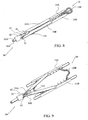
- Fig. 5 shows clip applier 30 in its closed position.
- Clip applier 30 is comprised of applier arms 34A and 34B, applier base 32, and connector elements 36A and 36B.
- the elements of clip applier 30 are typically constructed of stainless steel but they may also be constructed of other metals, such as, but not limited to, titanium, titanium alloys or reinforced plastics.
- each of applier arms 34A and 34B has, at its distal end, an insertion projection 38A and 38B, respectively.
- Insertion projections 38A and 38B are formed substantially transverse to applier arms 34A and 34B and are operative for insertion between teeth 20 of securing elements 14A and 14B in Fig. 2 , or into indentations 718 of clip 710 in Fig. 25A , or alternatively into holes positioned in securing elements 14A and 14B and compressing elements 16A and 16B.
- Fig. 7 shows open clip applier 30 without its applier base 32.
- applier base 32 has a generally barrel-like shape from which emerges a pair of applier base projections 31.
- Each of these projections 31 has an applier base slot 45 and an applier base projection hole 37.
- Each of applier arms 34A and 34B has at its proximal end applier arm slots 40A and 40B and applier arm holes (not shown).
- Applier arm 34B is constructed with a bend 35 in it so that the distal portions of arm 34B and arm 34A can lie in the same plane. It also allows insertion projections 38A and 38B to lie in the same plane.
- Each of connector elements 36A and 36B has a pair of holes 41A- 41D (41C and 41D not visible), one at each end of each element.
- Applier arms 34A and 34B are joined to applier base 32 by connecting pin 43 which passes through applier base projection holes 37 and applier arm holes (not shown).
- Pin 42 is inserted into holes (not shown) in connector elements 36A and 36B and is movable in applier base slots 45 and applier arm slots 40A and 40B. As pin 42 moves it forces applier arm slots 40A and 40B to overlap with applier base slots 45 at the point of the pin, thus creating an opening and closing effect.
- the proximal ends of connector elements 36B and 36A, respectively, are attached to an operating cable (not shown) that exits the proximate end of the endoscope.
- the cable is activated by an actuator 306 ( Fig. 1A ), for example, positioned outside the proximal end N ( Fig. 1A ) of the endoscope.
- Fig. 8 and Fig. 9 show clip applier 30 of the present embodiment attached to surgical compression clip 10 described in Figs. 2-3B in its closed and open position, respectively.
- an operating cable pulls connector elements 36A and 36B in the proximal direction.
- pin 42 moves to the proximal end of applier base slots 45 and the proximal ends of applier arm slots 40A and 40B.
- applier arms 34A and 34B move apart as in Fig. 9 .
- insertion projections 38A and 38B of clip applier 30 push against the spacings between teeth 20 of securing elements 14A and 14B of clip 10 shown in Fig. 2 (or indentations 718 of clip 710 shown in and discussed below in conjunction with Figs. 26A and 26B ) so that securing elements 14A and 14B and compressing elements 16A and 16B of clip 10 move apart.
- insertion projections 38A and 38B of clip applier 30 exert a reduced force on the spacings between the teeth 20 of securing elements 14A and 14B of clip 10 in Fig.
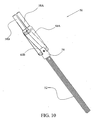
- Figs. 10-13 show various views of a second embodiment of a clip applier constructed according to the present invention.
- the applier is intended for use with the surgical compression clip (slightly modified as discussed below) shown in and discussed in conjunction with Figs. 2-3B .
- Fig. 10 shows the clip applier in its closed position
- Fig. 11 shows the applier in its open position.
- clip applier 50 includes insertion links 60A and 60B which are swing jointed by links 62A, 62B, 64A, 64B and central bar 66.
- An operating cable (not shown) is connected to the proximal end of central bar 66 and inserted into spring 52. The latter connection can be achieved by welding or any other connecting method or means known to those skilled in the art.
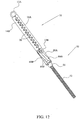
- Insertion links 60A and 60B each have extensions (not shown) which are positioned on their distal end so that these extensions are insertable into cylindrical elements 58A and 58B. As shown in Figs. 12 and 13 , cylindrical elements 58A and 58B (best seen in Figs. 10 and 11 ) are themselves insertable into the ends of compressing elements 16A and 16B of a surgical compression clip similar to clip 10 discussed above in conjunction with Figs. 2-3B .
- Compressing elements 16A and 16B require a slight modification to be compatible with cylindrical elements 58A and 58B of clip applier 50.
- at least one of the ends of elements 16A and 16B should be hollow and tubular so that cylindrical elements 58A and 58B of clip applier 50 can be inserted into them.
- cylindrical elements 58A and 58B are separate elements, in other embodiments they may be integrally formed at the ends of insertion links 60A and 60B.
- Figs. 10 and 11 show assembled clip applier 50 in its closed and open positions, respectively.
- Figs. 12 and 13 show clip applier 50 inserted into compressing elements 16A and 16B of surgical compression clip 10 when the clip is in its closed and open positions, respectively.
- Moving from the open to the closed position of clip applier 50 (or vice versa), and therefore to the open or closed position of clip 10 (or vice versa), can be effected using an operating cable (not shown) joined to, or in other ways in direct communication with, central bar 66 ( Fig. 11 ).
- the cable passes through spring 52 and out of the proximal end N ( Fig. 1A ) of the endoscope where it is activated by a user employing an actuator (schematically shown as element 306 of Fig. 1A ).
- the actuator may be any of several types known to those skilled in the art.
- Spring 52 in addition to protecting the cable (not shown), serves as a stop sleeve for element 56 while pulling the cable thus enabling the separation of insertion links 60A and 60B. In addition, it allows for greater flexibility of the apparatus as it advances through a lumen of a multi-lumen sleeve (or an endoscopic working channel) from the proximal end of the endoscope toward the suspect lesion near the distal end of the endoscope.
- the cable can be covered and protected by a flexible tube.
- the tube may be formed of polytetrafluoroethylene (PTFE), but the choice of this material is exemplary only and it is not intended to be limiting.
- central bar 66 is pulled by the operating cable (not shown) in the proximal direction.
- interconnect links 62A and 62B and 64A and 64B and insertion links 60A and 60B move apart as in Fig. 11 due to the moment exerted on links 64A and 64B.
- insertion links 60A and 60B are inserted into clip 10 as in Fig. 12
- clip 10 also opens as shown in Fig. 13 because of the force exerted by insertion links 60A and 60B and their attached cylindrical elements 58A and 58B on compressing elements 16A and 16B.
- the clip is attached to clip applier 50 and both clip 10 and applier 50 are advanced, in their closed positions, through a secondary lumen of a multi-lumen sleeve (or through a working channel of the endoscope shaft).
- a tension is maintained in the operating cable (not shown) in order to keep clip 10 attached to clip applier 50 during the entire advance from the proximal end of the secondary lumen (or working channel) to its distal end.
- the tension in the cable or wire acts against the force of hinge springs 12A and 12B of clip 10. This creates a force between cylindrical elements 58A and 58B of applier 50 and compressing elements 16A and 16B of clip 10 preventing detachment of clip 10 from applier 50. This force is smaller than the force required to open clip applier 50 and clip 10 attached to it.
- FIG. 14-18 A second embodiment of a compression clip 510 constructed according to the present invention is shown in Figs. 14-18 , to which reference is now made.
- Figs. 14 and 15 show clip 510 in its closed and open position, respectively.
- Fig. 16 is an exploded view of the clip and discussion of the clip will be made in conjunction with that Figure.
- Most of the elements in Figs. 14-18 are the same as those discussed in conjunction with the clip embodiments shown in Figs. 2-3B .
- Elements that are essentially equivalent in structure and operation will not be discussed again. Only new elements or structural features will be described. Essentially identical or equivalent elements in the embodiments have been numbered as in clips 10 with the addition of 500 as a prefix.
- hinge springs 512A and 512B are not symmetrical, each having legs which are of different lengths.
- Legs 508A and 508B are longer than legs 509A and 509B.
- Bi-directional connectors 517 are formed at the end of legs 509A and 509B. These connectors formed substantially transversally to the body of clip 510 are sized and configured to be inserted into holes 521 on securing element 514A and holes 519 on compressing element 516A.
- At the end of legs 508A and 508B are hollow cylinders 532A and 532B insertable over projections 530, more fully described below.
- compressing element 516A is configured essentially as in Figs. 2-3B
- compressing element 516B is a hollow tubular rod with two slots 538 on its surface proximal to securing element 514B.
- a rod, formed of two connected threaded bolts 536A and 536B is positioned inside compressing element 516B.
- the length of each threaded bolt is less than half the length of the rod, with the bolts separated by connector means 540.
- Threaded bolts 536A and 536B each have different "handedness", that is thread direction. Because the two threaded bolts have different "handedness" they separate when turned in one direction and come closer together when turned in the opposite direction.
- Threaded bolts 536A and 536B Over the ends of threaded bolts 536A and 536B are fitted cylindrical elements 528, the latter having complementary threads on their inner surface. Threaded bolts 536A and 536B have an attachment means 534A and 534B on their ends for insertion and joining with cylindrical elements 528. Cylindrical elements 528 are each formed with a projection 530 protruding substantially transversally to the long axis of cylindrical elements 528. Projections 530 pass through slots 538 preventing fitted cylindrical elements 528 from turning as threaded bolts 536A and 536B are turned. This forces cylinders 528 to move linearly along the long axis of compression element 516B. The threaded rod with cylinders 528 are held to compressing element 516B by plugs 526.
- Projections 530 on cylindrical elements 528 are configured and sized to be inserted into hollow cylinders 532A and 532B formed on the longer legs 508A and 508B of springs 512A and 512B.
- the placement of legs 508A and 508B of hinge springs 512A and 512B and the relationship between plugs 526, cylindrical elements 528 and threaded bolts 536A and 536B (which when joined form the threaded rod discussed above) are best seen in Figs. 17 and 18 .
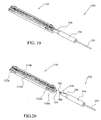
- FIGs. 19-23 show a clip applier 550 that can be used to operate clip 510, the latter described in conjunction with Figs. 14-18 .
- Figs. 19 and 20 show clip applier 550 in its engaged and disengaged position, respectively, with clip 510.
- a cable 552 capable of being rotated is extended through a tube 554, typically a flexible plastic tube capable of advancing the clip to the distal end of an endoscope. Cable 552 ends at rotation head 558 which includes a washer element 560 and a male element 562, the latter sized and configured for insertion into recess 524 of clip 510 ( Figs. 14-18 ).
- tube 554 may be a spring having sufficient flexibility to advance a clip attached to applier 550 past the distal end of the endoscope.
- Clip 510 for example, is inserted into a cup 556 of clip applier 550.
- Cup 556 typically is made of plastic or metal.
- Plug 526 with recess 524 ( Figs. 14-18 ) is positioned proximate to applier 550.
- Male element 562 is inserted into recess 524 of clip 510.
- Recess 524 and male element 562 are configured to be mateable.
- Moving clip 510 forward or backward is effected by pushing or pulling cable 552.
- Rotating cable 552 opens and closes the clip depending on the direction of rotation and the sequence of the bolts and the "handedness" of the threaded bolt proximate to male element 562.
- Pushing forward releases clip 510 from applier 550.
- washer element 560 pushes clip 510 out of cup 556.
- male element 562 is released from recess 524 of clip 510, thereby fully releasing the clip from the applier.
- FIG. 24A and 24B A third embodiment of a compression clip constructed according to the present invention is shown in Figs. 24A and 24B , to which reference is now made.
- FIG. 24A which shows an exploded view of clip 610, it is readily apparent that many of the elements presented there have been encountered and described previously in conjunction with previously discussed embodiments of compression clips constructed according to the present invention. Accordingly, elements that are structurally and operationally similar to previously described elements will not be described again here. Essentially identical or equivalent elements to those found in clips 10 and 510 have been numbered as in clips 10 and 510 with the prefix 600.
- Securing and compressing elements 614A, 614B and 616A, 616B, respectively, are essentially the same as in clip 510.
- Hinge springs 612A and 612B are unsymmetrical as in clip 510.
- Compressing element 616B is again a hollow tubular member with two slots 638.
- the longer legs 608A and 608B of hinge springs 612A and 612B include unidirectional connectors 624 at their ends which extend in the direction of compressing element 616B allowing for insertion into preformed holes 630 of cylindrical elements 628, to be discussed below.
- Cylindrical elements 628 are insertable into and retained in hollow tubular compressing element 616B. Holes 630 of cylindrical elements 628 act as receiving recesses for connectors 624 of springs 612A and 612B. When connectors 624 are inserted into holes 630 they are movable in slots 638 and do so with the opening and closing of springs 612A and 612B. Tubular compressing element 616B is capped by plugs 626. The plug 626 distal to the user has a hole into which pin 634 is inserted.
- wires 639A and 639B Passing through tubular compressing member 616B are wires 639A and 639B. These wires have loops 640A and 640B at their ends configured to fit over connectors 624.
- FIG. 24B Upon viewing Fig. 24B , the arrangement of the various elements of clip 610 and their operation becomes evident.
- clip 610 has been flipped vis-a-vis the view shown in Fig. 24A and compressing element 616B and securing element 614B are not presented.
- legs 608A and 608B of springs 612A and 612B separate as do securing elements 614A and 614B (the latter not shown) and compressing elements 616A and 616B (the latter not shown).
- wire 639B passes around pin 634 when pulled.
- FIG. 25A-26B A fourth embodiment of a surgical compression clip constructed according to the present invention is shown in Figs. 25A-26B , to which reference is now made.
- the present embodiment is different from the embodiment of Figs. 2-3B in that the bi-directional hinge spring connectors 717 are now joined on the inside of hinge spring arms 708 of spring elements 712A and 712B (best seen in Fig. 4C ) and not at the ends of hinge spring arms 8 of hinge spring elements 12A and 12B as in Figs. 2-3B and Figs. 4A and 4B . Additionally, and as a direct result of the new positioning of hinge spring connectors 717, spaces 725 must be formed in lateral walls 727 of securing elements 714A and 714B. These spaces are absent in walls 27 of securing elements 14A and 14B as seen and labeled in Fig. 3B . Its necessity with the present clip embodiment is readily seen in Figs.
- securing elements 714A and 714B may be a single integral structure or elements made from several parts joined together by any process known to those skilled in the art, such as by welding. This is true as well for the securing elements shown in previous embodiments and discussed elsewhere herein.
- connectors 717 on the inside of arms 708 of hinge spring elements 712A and 712B effectively creates a preload that allows the clip to open wider while still applying the forces needed for the necrotic process.
- An alternative, or additional, technique to achieve preloading is to heat hinge spring elements 712A and 712B and shape them during manufacture.
- hinge spring elements 712A and 712B exert a force on compressing elements 716A and 716B even when clip 710 is in its closed position.
- Clip 710 is effectively preloaded and a gap 711 (best seen in Fig. 25B ) exists between securing elements 714A and 714B even when clip 710 is in its closed position.
- This gap typically, but without intending to be limiting, is in the range of 0.7 to 0.9 mm, which ensures that the force exerted by clip 710 falls to zero before it has a chance to cut through the healing tissue. It should be remembered that when the necrotic process is in an advanced stage, tissue thickness is reduced significantly
- Gap 711 can be formed in one of many ways. Without intending to be limiting, one of these ways is by forming gap forming projections 713 (best seen in Figs. 25B , 26A and 26B ) at the end of one or both ends of compressing elements 716A and 716B.
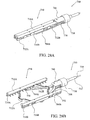
- FIG. 27A-28B An embodiment of a clip applier 750 that can be used with clip 710 of Figs. 25A-26B is shown in Figs. 27A-28B . While discussed in terms of its use with the clip shown in Figs. 25A-26B , it should readily be understood that applier 750, with little or no modification, may be used with other clip embodiments discussed above.
- Figs. 27A and 27B are isometric views of clip applier 750, the applier shown in its closed and open position, respectively.
- Figs. 27C and 27D are cross-sectional views of the applier in Figs. 27A and 27B , respectively.
- Figs. 28A and 28B are isometric views of the clip applier shown in Figs. 27A-27B in its closed and open position, respectively, when attached to and operating the clip shown in Figs. 25A-26B .
- Figs. 27A-27D shows a wire or cable 754 encased in a sheath 752 which extends toward, and exits from, the body cavity so that it can be operated by a user.
- Wire (or cable) 754 is attached to a cam 756 which is positioned inside applier body 760, the later covered by applier body cover 758.
- Applier body 760 at its distal end includes a hole 762 on each of two opposing walls.
- Applier 750 includes two arms 764A and 764B each having a projection 768 at their proximal end and attachment projections 770 at their distal end. Attachment projections 770 attach to clip 710 ( Fig.
- Arms 764A and 764B each have an aperture (not shown) to receive a pin 766 ( Figs. 27C and 27D ) which also passes through holes 762 of applier body 760.
- Pin 766 serves as an axis around which arms 764A and 764B rotate.
- Arms 764A and 764B each have a bend 772 in them which allows the positioning of projections 768 on arms 774 of cam 756.
- applier 750 is shown in its closed position.
- Wire or cable 754 has been pushed in the distal direction, i.e. away from the user, causing attached cam 756 to also move in the distal direction within applier body 760.
- Space 759 is formed between cam arms 774 and cam flanges 757. This results in applier arms 764A and 764B moving to a position where they are adjacent to each other.
- clip 710 is brought to its closed position as best seen in Fig. 28A .
- applier 750 is shown in its open position.
- Wire 754 has been pulled in the proximal direction, i.e. toward the user, causing attached cam 756 to also move in the proximal direction in applier body 760.
- clip 710 is brought to its open position as best seen in Fig. 28B .
- Figs. 29 through Fig. 30C show various views of another embodiment of a clip applier 800 which may be used with many of the surgical clips discussed herein.
- Fig. 29 is an exploded view of clip applier 800.
- Figs. 30A and 30B are isometric views of clip applier 800 shown in Fig. 29 in its closed and open position, respectively.
- Fig. 30C is an inner, totally cut-away view of Fig. 30B .
- a wire or cable 812 with a threaded end 814.
- Wire or cable 812 extends to and exits from the body cavity so that it can be operated by a user.
- Threaded end 814 of wire or cable 812 is inserted into jagged entry 820 of applier body 818.
- a casing (not shown) of wire or cable 812 is caught on the jagged surface of entry 820.
- the threaded end 814 of wire or cable 812 is threaded into a threaded bolt 822 of configuration controller 816 when controller 816 is positioned in guide slot 826A (discussed below) of applier body 818.
- Configuration controller 816 is formed to also include two wing elements 824 and a projection 830.
- Applier body 818 includes a first and a second guide slot 826A and 826B, respectively, and configuration controller 816 is positioned so that it rides in first guide slot 826A. Wing elements 824 of configuration controller 816 move freely in first guide slot 826A. Proximal ends 828 of applier arms 802A and 802B are positioned in and move in second guide slot 826B.
- Applier arms 802A and 802B each include an attachment projection 804, a hole 806 and an arm guide slot 808.
- Projection 804 connects to the surgical clips in a manner similar to that shown elsewhere herein.
- a pin 810 is inserted through hole 829 of applier body 818 and through holes 806 in applier arms 802A and 802B. This pin acts as an axis of rotation when arms 802A and 802B are brought proximate to or spaced apart from each other.
- projection 830 of configuration controller 816 passes through arm guide slots 808 of applier arms 802A and 802B.
- configuration controller 816 advances in the distal direction of guide slot 826A with projection 830 ( Fig. 29 ) moving towards the distal end of arm slots 808 ( Fig. 29 ). This causes applier arms 802A and 802B to rotate towards each other and attain their closed position.
- configuration controller 816 moves in the proximal direction in guide slot 826A and projection 830 moves towards the proximal end of arm slots 808 causing applier arms 802A and 802B to rotate away from each other and attain their open position ( Figs. 30B and 30C ) .
- Wing elements 824 of configuration controller 816 prevent turning of controller 816 when rotated by the threaded end 814 ( Fig. 29 ) of wire/cable 812, thereby allowing for the conversion of rotational motion into translational motion.
- clip appliers can be designed as the surgical procedure and nature of the tissue to be closed warrants. The design would generally require little or no modification to the applier shown in these Figures, and those shown in concurrently filed pending application "Endoscopic Full Thickness Resection Using Surgical Compression Clips" owned by the same Applicant, incorporated by reference herein in its entirety.
- Fig. 45 shows an endoscope insertion shaft 300 with a working channel 154. It also contains several auxiliary elements, here three, denoted as 157A-157C. The number of working and auxiliary channels may be more or less in other embodiments of shaft 300.
- a multi-lumen plastic sleeve 150 is brought to and over endoscope insertion shaft 300 ( Fig. 46 ).
- the endoscope insertion shaft 300 is encased in the primary lumen 155 of the multi-lumen sleeve 150 and the one or more secondary lumens 158 of sleeve 150 are typically collapsed and, if needed, held by bands 160 ( Fig. 47A ).
- the bands 160 are expandable when working instruments are inserted into the collapsed secondary lumens 158. Insertion of these instruments occurs after the distal end 152 of the endoscope shaft 300 is positioned proximate to the suspect lesion. Bands may not be required in some embodiments, if the secondary lumens 158 remain collapsed by themselves while the encased endoscope insertion shaft 300 ( Fig. 47A ) is inserted into a body organ or if not required by the physician. It is to be understood that means or methods other than bands may be used to ensure that the secondary lumens remain collapsed while the encased endoscope shaft is inserted into the body and positioned near the suspect lesion.
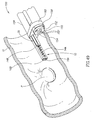
- the encased endoscope insertion shaft 300 is advanced within the body lumen until it is near the lesion, herein taken to be a polyp P in the gastrointestinal (GI) tract. ( Fig. 48 ).
- Clip 10 still in its closed position, is brought to its final position adjacent to polyp P ( Fig. 50 ).
- a grasper assembly is then inserted into a working channel 154 of the endoscope insertion shaft 300, advanced through the shaft, and then advanced out of the distal end 152 of endoscope insertion shaft 300 to the region adjacent to polyp P ( Fig. 51 ).
- the grasper assembly i.e. grasper (not shown) and grasper transporting element 260, is introduced via a secondary lumen 158 of the multi-lumen sleeve 150 and not through a working channel 154 of the endoscope shaft. From an operational point of view, this has no significant effect on the method described.
- the grasper assembly, clip 10 and clip applier 30 may be advanced through the same secondary lumen 158 from the proximal end of the endoscope shaft to the suspect lesion.
- the grasper assembly may be inserted into and advanced through a second working channel of the endoscopic insertion shaft.
- Clip 10 is then opened by applier 30.
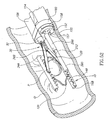
- the opened clip is positioned so as to bound polyp P so that the lesion can be pulled through the clip.
- Fig. 52 shows an isometric view of this step.
- the grasper (not shown) remains inside its grasper transporting element 260. Now the forceps arms 252 of the grasper are ejected from grasper transporting element 260 and positioned to grasp polyp P through the open clip ( Figs. 53 and 54 ).
- Polyp P is then pulled by forceps arms 252 into the separated compressing and securing elements 16A, 16B and 14A, 14B, respectively, of open clip 10. This is shown in a top side view in Fig. 55 . In this view, one of the forceps arms 252 of the grasper is barely visible; most of this arm and the entire second forceps arm are obscured by polyp P.
- the polyp is rotated over and wrapped around grasper transporting element 260.
- This rotation is shown in an isometric view in Fig. 56 and a cross section view ( Fig. 57 ) along line AA' of Fig. 56 .
- Rotation is effected by the rotation of the entire grasper assembly, the grasper with forceps arms 252 holding the pulled polyp P, the grasper transporting element 260 and the assembly's shaft (not shown) using a control handle positioned outside the body cavity.
- rotating the control handle outside the body can be avoided by creating a swivel mechanism in the mechanical connection with the grasper assembly and rotating the swivel mechanism. Rotation ensures that sufficient tissue is being maneuvered into clip 10 and near severing device 310 (shown in Fig. 60 ) to allow for full transmural resection.
- Clip applier 30 then closes clip 10 around the pulled and rotated polyp P ( Fig. 58 ).
- Clip applier 30 is detached from the closed clip 10 and withdrawn via the secondary lumen 158 through which it entered ( Fig. 59 ).
- clip applier 30 could be detached from clip 10 after tissue resection.
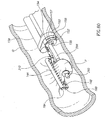
- Polyp P wrapped around grasper transporting element 260 and compressed by clip 10 is severed by a severing device 310 shown being positioned close to polyp P ( Fig. 60 ).
- Severing device 310 may be advanced to the polyp through the endoscope's working channel 154 or through a secondary lumen 158 of sleeve 150.
- severing device 310 has been advanced to its position for severing through the secondary lumen 158 used for advancing clip 10 and its applier 30.
- Severing device 310 approaches polyp P and severs it from the wall of the GI tract. The actual step of severing is not shown.
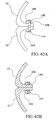
- the closed surgical compression clip 10 remains around that portion of the GI wall from which the tissue was resected ( Figs. 61 , 62A and 62B ). Compression continues until necrosis is induced and healing of the resected site occurs. Clip 10 is naturally expelled from the body through the rectum or retrieved by the physician if needed.
- step of pulling the polyp with a grasper is optional since in most situations wire 90 loop by itself can be maneuvered to encompass, grasp and pull the polyp or its stalk.
- insertion of closed clip 70 is effected through a secondary lumen of a multi lumen sleeve, but it also may be advanced through a working channel of the endoscope.
- the step of applying applier 105 occurs only after clip 70 has exited the secondary lumen or working channel.
- the invention has been described as being used in bowel polyp resections. It should be evident to one skilled in the art that other types of lesions, in other organs in other organ systems, can also be resected using the present invention with little or no modification.
- organs include, but are not limited to, the urinary bladder and other organs of the urinary tract, the uterus, the liver, the esophagus, the gall bladder, the lungs and the rectum.
- system and method of the present invention have been described as being used in endoscopic procedures which do not require a direct incision into the body cavity.
- the system and method as described herein above has been described as being inserted into the body cavity through one of the body's existing orifices.
- the system and method described herein above can be used in open surgical procedures with little or no modification, where the point of entry of the system is an incision into the body cavity.
- the device and method of the present invention can be used to excise animal tissue as well as human tissue, particularly, but without being limiting, tissue of other mammalian species.
Landscapes
- Health & Medical Sciences (AREA)
- Surgery (AREA)
- Life Sciences & Earth Sciences (AREA)
- Heart & Thoracic Surgery (AREA)
- Nuclear Medicine, Radiotherapy & Molecular Imaging (AREA)
- Engineering & Computer Science (AREA)
- Biomedical Technology (AREA)
- Medical Informatics (AREA)
- Molecular Biology (AREA)
- Animal Behavior & Ethology (AREA)
- General Health & Medical Sciences (AREA)
- Public Health (AREA)
- Veterinary Medicine (AREA)
- Vascular Medicine (AREA)
- Reproductive Health (AREA)
- Surgical Instruments (AREA)
Claims (9)
- Chirurgische Klammeranordnung (10) umfassend:- ein Paar in der Regel linear Kompressionselemente (16A,16B) für die Sicherung von Gewebe zwischen den Kompressionselementen und für das Aufbringen einer Druckkraft auf das gesicherte Gewebe, wobei die Klammeranordnung ein erstes und zweites Ende hat und die Klammeranordnung eine anfänglich geöffnete Position hat, in der die linearen Kompressionselemente über Gewebe positioniert werden können, um dieses dazwischen zu sichern, und eine abschließende, geschlossene Position hat, in welcher die Kompressionselemente im Wesentlichen parallel zueinander sind, um dadurch eine Druckkraft auf das gesicherte Gewebe auszuüben und- ein erstes und zweites Gelenkelement (12A,12B), wobei das erste Gelenkelement zwischen den ersten Enden des Paares von Kompressionselementen (16A,16B) angeordnet ist und das zweite Gelenkelement zwischen den zweiten Enden des Paares von Kompressionselementen angeordnet ist, wobei- das erste und zweite Gelenkelement in mechanischer Verbindung mit den ersten bzw. den zweiten Enden der linearen Kompressionselemente stehen und die Gelenkelemente fähig sind zwischen sich Kräfte zu übertragen und- die Gelenkelemente und Kompressionselemente eine geschlossene verbundene Oberfläche in der geschlossenen und geöffneten Position der Klammer bilden.
- Chirurgische Klammeranordnung nach Anspruch 1, dadurch gekennzeichnet, dass die Gelenkelemente (12A,12B) aus einem Material mit Formgedächtnis gebildet sind.
- Chirurgische Klammeranordnung nach Anspruch 2, dadurch gekennzeichnet, dass die zwei Gelenkelemente (12A,12B) aktive Gelenkelemente sind, welche zwischen den linearen Kompressionselementen angeordnet sind.
- Chirurgische Klammeranordnung nach Anspruch 3, weiter einschliessend ein Paar in der Regel linearer Sicherungselemente (14A,14B), wobei jedes der linearen Kompressionselemente mit einem der Sicherungselemente verbunden ist, welche Sicherungselemente fähig sind Gewebe zu sichern, welches von den Kompressionselementen (16A,16B) zusammengedrückt wird und die Sicherungselemente eine Sicherungslinie bilden, wenn das Gewebe erfasst wird und die Sicherungslinie nicht kollinear mit der Linie der durch die Kompressionselemente (16A,16B) erzeugten Druckkraft ist.
- Chirurgische Klammeranordnung nach Anspruch 3, dadurch gekennzeichnet, dass das erste und zweite Gelenkelement (12A, 12B) jeweils einen im Wesentlichen ebene Körper hat, welcher zwei Beine hat, die jeweils einen Endabschnitt haben und jedes Gelenkelement an jedem seiner Endabschnitte eine Verbindung (17) hat, einen einzeln einsetzbaren Endabschnitt aufweisend, wobei die Verbindung (17) im Wesentlich quer zu dem ebenen Körper positioniert ist und die Klammeranordnung ferner ein Paar in der Regel linearer Sicherungselemente (14A,14B) umfasst, wobei jedes der linearen Kompressionselemente (16A,16B) mit einem unterschiedlichen der genannten Paare der in der Regel linearen Sicherungselemente (14A,14B) verbunden ist, und wobei die einzelnen einsetzbaren Endabschnitte der Verbindungen (17) schwenkbar mit einem der folgenden Elemente verbunden ist: Mit den Kompressionselementen (16A,16B), wodurch eine gleichzeitige mechanische Verbindung zwischen den Gelenkelementen (12A,12B) und den Kompressionselementen (16A,16B) ermöglicht ist oder mit den Sicherungselementen (14A,14B), wodurch eine gleichzeitige mechanische Verbindung zwischen den Gelenkelementen (12A,12B) und den Sicherungselementen (14A,14B) ermöglicht ist.
- Chirurgische Klammeranordnung nach Anspruch 3, dadurch gekennzeichnet, dass das erste und zweite Gelenkelement (12A,12B) jeweils einen im Wesentlichen ebene Körper hat, welcher zwei Beine hat, die jeweils einen Endabschnitt haben und jedes Gelenkelement an jedem seiner Endabschnitte eine Verbindung (17') hat, einen ersten und zweiten einsetzbaren Endabschnitt aufweisend, wobei die Verbindung (17') im Wesentlich quer zu dem ebenen Körper positioniert ist und die Klammeranordnung ferner ein Paar in der Regel linearer Sicherungselemente (14A,14B) umfasst, wobei jedes der linearen Kompressionselemente (16A,16B) mit einem unterschiedlichen der genannten Paare der in der Regel linearen Sicherungselemente (14A,14B) verbunden ist, und wobei die ersten einsetzbaren Endabschnitte der Verbindungen (17') schwenkbar mit den Sicherungselementen (14A,14B) verbunden sind, wodurch eine gleichzeitige mechanische Verbindung zwischen den Gelenkelementen (12A,12B) und den Sicherungselementen (14A,14B) ermöglicht ist und wobei die zweiten einsetzbaren Endabschnitte der Verbindungen (17') schwenkbar mit den Kompressionselementen (16A,16B) verbunden sind, wodurch eine gleichzeitige mechanische Verbindung zwischen den Gelenkelementen (12A,12B) und den Kompressionselementen (16A,16B) ermöglicht ist.
- Chirurgische Klammeranordnung nach Anspruch 6, dadurch gekennzeichnet, dass die Verbindungen (717) des ersten und zweiten Gelenkelements (712) mit den Beinen der Gelenkelemente an einer inneren Oberfläche der Beine verbunden sind, um eine vorgeladene Klammeranordnung herzustellen, wenn die Verbindung (717) schwenkbar mit wenigstens einem der Kompressionselemente (16A,16B) und einem der Sicherungselemente verbunden ist.
- Chirurgische Klammeranordnung nach Anspruch 4, dadurch gekennzeichnet, dass die Klammeranordnung zur Verwendung mit einem Klammeranbringer (30) ein Anbauelement (38A, 38B) hat, wobei die Klammeranordnung zusätzlich mindestens eine Aufnahmestruktur umfasst, welche dimensioniert und konfiguriert ist, um das Anbauelement (38A,38B) des Klammeranbringers (30) lösbar aufzunehmen, der Klammeranbringer eine Kraft aufbringt entgegen der Kraft, welche von den zwei Gelenkelementen (12A, 12B) aufgebracht wird, und der Klammeranbringer bedienbar ist, um die Klammeranordnung aus ihrer geschlossenen Position in ihre geöffnete Position zu bringen oder vice versa.
- Chirurgische Klammeranordnung nach Anspruch 1, dadurch gekennzeichnet, dass die zwei Gelenkelemente (12A,12B) nicht einheitlich mit dem Paar der linearen Kompressionselemente sind.
Applications Claiming Priority (3)
| Application Number | Priority Date | Filing Date | Title |
|---|---|---|---|
| US78044606P | 2006-03-09 | 2006-03-09 | |
| US11/647,913 US7892244B2 (en) | 2006-03-09 | 2006-12-29 | Surgical compression clips |
| PCT/IL2007/000288 WO2007102152A2 (en) | 2006-03-09 | 2007-03-07 | Surgical compression clips |
Publications (3)
| Publication Number | Publication Date |
|---|---|
| EP1993451A2 EP1993451A2 (de) | 2008-11-26 |
| EP1993451A4 EP1993451A4 (de) | 2009-08-26 |
| EP1993451B1 true EP1993451B1 (de) | 2011-09-28 |
Family
ID=38475255
Family Applications (1)
| Application Number | Title | Priority Date | Filing Date |
|---|---|---|---|
| EP07713309A Not-in-force EP1993451B1 (de) | 2006-03-09 | 2007-03-07 | Chirurgische kompressionsklemmen |
Country Status (4)
| Country | Link |
|---|---|
| US (3) | US7892244B2 (de) |
| EP (1) | EP1993451B1 (de) |
| AT (1) | ATE525964T1 (de) |
| WO (1) | WO2007102152A2 (de) |
Cited By (4)
| Publication number | Priority date | Publication date | Assignee | Title |
|---|---|---|---|---|
| US9375218B2 (en) | 2006-05-03 | 2016-06-28 | Datascope Corp. | Systems and methods of tissue closure |
| CN106028976A (zh) * | 2013-12-17 | 2016-10-12 | 标准肥胖病学股份有限公司 | 用于医疗手术的切除线引导件及其使用方法 |
| US10485545B2 (en) | 2013-11-19 | 2019-11-26 | Datascope Corp. | Fastener applicator with interlock |
| US11653928B2 (en) | 2018-03-28 | 2023-05-23 | Datascope Corp. | Device for atrial appendage exclusion |
Families Citing this family (228)
| Publication number | Priority date | Publication date | Assignee | Title |
|---|---|---|---|---|
| US6428548B1 (en) * | 1999-11-18 | 2002-08-06 | Russell F. Durgin | Apparatus and method for compressing body tissue |
| US6391048B1 (en) | 2000-01-05 | 2002-05-21 | Integrated Vascular Systems, Inc. | Integrated vascular device with puncture site closure component and sealant and methods of use |
| US6461364B1 (en) | 2000-01-05 | 2002-10-08 | Integrated Vascular Systems, Inc. | Vascular sheath with bioabsorbable puncture site closure apparatus and methods of use |
| US7842068B2 (en) | 2000-12-07 | 2010-11-30 | Integrated Vascular Systems, Inc. | Apparatus and methods for providing tactile feedback while delivering a closure device |
| US9579091B2 (en) | 2000-01-05 | 2017-02-28 | Integrated Vascular Systems, Inc. | Closure system and methods of use |
| US8758400B2 (en) | 2000-01-05 | 2014-06-24 | Integrated Vascular Systems, Inc. | Closure system and methods of use |
| EP1435842B8 (de) | 2000-09-08 | 2011-03-02 | Abbott Vascular Inc. | Vorrichtung zum orten eines punktierten blutgefässes |
| US6626918B1 (en) | 2000-10-06 | 2003-09-30 | Medical Technology Group | Apparatus and methods for positioning a vascular sheath |
| US6623510B2 (en) | 2000-12-07 | 2003-09-23 | Integrated Vascular Systems, Inc. | Closure device and methods for making and using them |
| US8690910B2 (en) | 2000-12-07 | 2014-04-08 | Integrated Vascular Systems, Inc. | Closure device and methods for making and using them |
| US7905900B2 (en) | 2003-01-30 | 2011-03-15 | Integrated Vascular Systems, Inc. | Clip applier and methods of use |
| US7211101B2 (en) | 2000-12-07 | 2007-05-01 | Abbott Vascular Devices | Methods for manufacturing a clip and clip |
| IES20010547A2 (en) | 2001-06-07 | 2002-12-11 | Christy Cummins | Surgical Staple |
| US10098640B2 (en) | 2001-12-04 | 2018-10-16 | Atricure, Inc. | Left atrial appendage devices and methods |
| US6749621B2 (en) | 2002-02-21 | 2004-06-15 | Integrated Vascular Systems, Inc. | Sheath apparatus and methods for delivering a closure device |
| DE60325355D1 (de) | 2002-06-04 | 2009-01-29 | Abbott Vascular Inc | Chirurgische klemme und anbringungsvorrichtung zur gefässwundverschliessung |
| US8905937B2 (en) | 2009-02-26 | 2014-12-09 | Integrated Vascular Systems, Inc. | Methods and apparatus for locating a surface of a body lumen |
| US8202293B2 (en) | 2003-01-30 | 2012-06-19 | Integrated Vascular Systems, Inc. | Clip applier and methods of use |
| US8398656B2 (en) | 2003-01-30 | 2013-03-19 | Integrated Vascular Systems, Inc. | Clip applier and methods of use |
| US8758398B2 (en) | 2006-09-08 | 2014-06-24 | Integrated Vascular Systems, Inc. | Apparatus and method for delivering a closure element |
| US8821534B2 (en) | 2010-12-06 | 2014-09-02 | Integrated Vascular Systems, Inc. | Clip applier having improved hemostasis and methods of use |
| IES20040368A2 (en) | 2004-05-25 | 2005-11-30 | James E Coleman | Surgical stapler |
| US8409222B2 (en) | 2004-10-08 | 2013-04-02 | Covidien Lp | Endoscopic surgical clip applier |
| US7819886B2 (en) | 2004-10-08 | 2010-10-26 | Tyco Healthcare Group Lp | Endoscopic surgical clip applier |
| CA2582716C (en) | 2004-10-08 | 2013-05-28 | Ernest Aranyi | Apparatus for applying surgical clips |
| US9763668B2 (en) | 2004-10-08 | 2017-09-19 | Covidien Lp | Endoscopic surgical clip applier |
| CA2583031C (en) | 2004-10-08 | 2013-09-10 | Tyco Healthcare Group Lp | Endoscopic surgical clip applier |
| US8926633B2 (en) | 2005-06-24 | 2015-01-06 | Abbott Laboratories | Apparatus and method for delivering a closure element |
| US8313497B2 (en) | 2005-07-01 | 2012-11-20 | Abbott Laboratories | Clip applier and methods of use |
| WO2007009099A2 (en) * | 2005-07-14 | 2007-01-18 | Idx Medical Ltd. | Apparatus and methods for occluding a hollow anatomical structure |
| US11751873B2 (en) | 2005-07-26 | 2023-09-12 | Cilag Gmbh International | Electrically powered surgical instrument with manual release |
| US7479608B2 (en) | 2006-05-19 | 2009-01-20 | Ethicon Endo-Surgery, Inc. | Force switch |
| US10314583B2 (en) | 2005-07-26 | 2019-06-11 | Ethicon Llc | Electrically self-powered surgical instrument with manual release |
| US8679154B2 (en) | 2007-01-12 | 2014-03-25 | Ethicon Endo-Surgery, Inc. | Adjustable compression staple and method for stapling with adjustable compression |
| US8579176B2 (en) | 2005-07-26 | 2013-11-12 | Ethicon Endo-Surgery, Inc. | Surgical stapling and cutting device and method for using the device |
| US8038046B2 (en) | 2006-05-19 | 2011-10-18 | Ethicon Endo-Surgery, Inc. | Electrical surgical instrument with optimized power supply and drive |
| US8920442B2 (en) | 2005-08-24 | 2014-12-30 | Abbott Vascular Inc. | Vascular opening edge eversion methods and apparatuses |
| US9456811B2 (en) | 2005-08-24 | 2016-10-04 | Abbott Vascular Inc. | Vascular closure methods and apparatuses |
| US20070060895A1 (en) | 2005-08-24 | 2007-03-15 | Sibbitt Wilmer L Jr | Vascular closure methods and apparatuses |
| US7892244B2 (en) * | 2006-03-09 | 2011-02-22 | Niti Surgical Solutions Ltd. | Surgical compression clips |
| US8808310B2 (en) | 2006-04-20 | 2014-08-19 | Integrated Vascular Systems, Inc. | Resettable clip applier and reset tools |
| US8556930B2 (en) | 2006-06-28 | 2013-10-15 | Abbott Laboratories | Vessel closure device |
| CA2605135C (en) | 2006-10-17 | 2014-12-30 | Tyco Healthcare Group Lp | Apparatus for applying surgical clips |
| EP2061382A4 (de) * | 2006-12-29 | 2009-09-23 | Niti Surgical Solutions Ltd | Gewebekompression mithilfe chirurgischer klammern |
| US8920305B2 (en) | 2007-01-19 | 2014-12-30 | Advanced Bariatric Technology, Llc | Vertically oriented band for stomach |
| JP5571545B2 (ja) | 2007-03-26 | 2014-08-13 | コヴィディエン リミテッド パートナーシップ | 内視鏡下手術用クリップ適用器 |
| AU2008240272B2 (en) | 2007-04-11 | 2013-08-29 | Covidien Lp | Surgical clip applier |
| US20100234947A1 (en) * | 2007-07-26 | 2010-09-16 | Yaniv Ben Rubi | Implanted medical device especially used in cosmetic surgery |
| US8893947B2 (en) | 2007-12-17 | 2014-11-25 | Abbott Laboratories | Clip applier and methods of use |
| US20090157101A1 (en) | 2007-12-17 | 2009-06-18 | Abbott Laboratories | Tissue closure system and methods of use |
| US7841502B2 (en) | 2007-12-18 | 2010-11-30 | Abbott Laboratories | Modular clip applier |
| US8764773B2 (en) * | 2008-04-09 | 2014-07-01 | Novogi Ltd. | Surgical port for notes procedures |
| WO2009136397A2 (en) * | 2008-05-05 | 2009-11-12 | Niti Surgical Solutions Ltd | Endoscopic compression clip and system and method for use thereof |
| US9282965B2 (en) | 2008-05-16 | 2016-03-15 | Abbott Laboratories | Apparatus and methods for engaging tissue |
| WO2010011661A1 (en) * | 2008-07-21 | 2010-01-28 | Atricure, Inc. | Apparatus and methods for occluding an anatomical structure |
| US8465502B2 (en) | 2008-08-25 | 2013-06-18 | Covidien Lp | Surgical clip applier and method of assembly |
| US20110208212A1 (en) | 2010-02-19 | 2011-08-25 | Zergiebel Earl M | Surgical clip applier |
| US8056565B2 (en) | 2008-08-25 | 2011-11-15 | Tyco Healthcare Group Lp | Surgical clip applier and method of assembly |
| US8585717B2 (en) | 2008-08-29 | 2013-11-19 | Covidien Lp | Single stroke endoscopic surgical clip applier |
| US9358015B2 (en) | 2008-08-29 | 2016-06-07 | Covidien Lp | Endoscopic surgical clip applier with wedge plate |
| US8409223B2 (en) | 2008-08-29 | 2013-04-02 | Covidien Lp | Endoscopic surgical clip applier with clip retention |
| US8267944B2 (en) | 2008-08-29 | 2012-09-18 | Tyco Healthcare Group Lp | Endoscopic surgical clip applier with lock out |
| US8398676B2 (en) | 2008-10-30 | 2013-03-19 | Abbott Vascular Inc. | Closure device |
| US8858594B2 (en) | 2008-12-22 | 2014-10-14 | Abbott Laboratories | Curved closure device |
| US9089311B2 (en) | 2009-01-09 | 2015-07-28 | Abbott Vascular Inc. | Vessel closure devices and methods |
| US9173644B2 (en) | 2009-01-09 | 2015-11-03 | Abbott Vascular Inc. | Closure devices, systems, and methods |
| US9414820B2 (en) | 2009-01-09 | 2016-08-16 | Abbott Vascular Inc. | Closure devices, systems, and methods |
| US9486191B2 (en) | 2009-01-09 | 2016-11-08 | Abbott Vascular, Inc. | Closure devices |
| JP5885506B2 (ja) * | 2009-02-17 | 2016-03-15 | ザ ボード オブ トラスティーズ オブ ザ レランド スタンフォード ジュニア ユニバーシティー | 縫合装置及び方法 |
| US9402757B2 (en) | 2009-08-24 | 2016-08-02 | Cvdevices, Llc | Devices, systems and methods for tissue restoration |
| US9980841B2 (en) | 2009-08-24 | 2018-05-29 | Cvdevices, Llc | Devices and systems configured to fit around a tissue using the same |
| US9089391B2 (en) * | 2009-08-24 | 2015-07-28 | Cvdevices, Llc | Tissue restoration devices, systems, and methods |
| US8734469B2 (en) | 2009-10-13 | 2014-05-27 | Covidien Lp | Suture clip applier |
| US9186136B2 (en) | 2009-12-09 | 2015-11-17 | Covidien Lp | Surgical clip applier |
| US8545486B2 (en) | 2009-12-15 | 2013-10-01 | Covidien Lp | Surgical clip applier |
| WO2011094700A1 (en) * | 2010-01-29 | 2011-08-04 | Advanced Bariatric Technology, Llc | Surgical clamp and surgical clamp installation tool |
| US8403945B2 (en) | 2010-02-25 | 2013-03-26 | Covidien Lp | Articulating endoscopic surgical clip applier |
| GB2479179A (en) * | 2010-03-31 | 2011-10-05 | Neosurgical Ltd | Laparoscopic surgical retraction device |
| US8348127B2 (en) * | 2010-04-07 | 2013-01-08 | Covidien Lp | Surgical fastener applying apparatus |
| US8764778B2 (en) * | 2010-07-08 | 2014-07-01 | Sarkis Yeretsian | Biodegradable suture clip for joining bodily soft tissue |
| US8968337B2 (en) | 2010-07-28 | 2015-03-03 | Covidien Lp | Articulating clip applier |
| US8403946B2 (en) | 2010-07-28 | 2013-03-26 | Covidien Lp | Articulating clip applier cartridge |
| US8758399B2 (en) | 2010-08-02 | 2014-06-24 | Abbott Cardiovascular Systems, Inc. | Expandable bioabsorbable plug apparatus and method |
| DE102010034380A1 (de) | 2010-08-13 | 2012-02-16 | Karl Storz Gmbh & Co. Kg | Gelenkabschnitt eines Endoskopschafts |
| US8568426B2 (en) | 2010-09-15 | 2013-10-29 | Ethicon, Inc. | Ligation device and method |
| US20120101594A1 (en) * | 2010-10-22 | 2012-04-26 | Roberto Fogel | Endoscopic implantable device and method for the apposition of the stomach walls for reducing the stomach internal volume in a weight loss surgery procedure |
| US9017349B2 (en) | 2010-10-27 | 2015-04-28 | Atricure, Inc. | Appendage clamp deployment assist device |
| US9011464B2 (en) | 2010-11-02 | 2015-04-21 | Covidien Lp | Self-centering clip and jaw |
| US8636754B2 (en) | 2010-11-11 | 2014-01-28 | Atricure, Inc. | Clip applicator |
| WO2012078067A1 (en) | 2010-12-07 | 2012-06-14 | Globetek 2000 Pty Ltd | Method of a hemostasis creation with restoration possibility of blood- flow in tubular elastic structures of an organism and device for its realization |
| US9186153B2 (en) | 2011-01-31 | 2015-11-17 | Covidien Lp | Locking cam driver and jaw assembly for clip applier |
| US8617184B2 (en) | 2011-02-15 | 2013-12-31 | Abbott Cardiovascular Systems, Inc. | Vessel closure system |
| JP2012187311A (ja) * | 2011-03-11 | 2012-10-04 | Olympus Corp | 医療用処置具およびマニピュレータ |
| US9149276B2 (en) * | 2011-03-21 | 2015-10-06 | Abbott Cardiovascular Systems, Inc. | Clip and deployment apparatus for tissue closure |
| US9775623B2 (en) | 2011-04-29 | 2017-10-03 | Covidien Lp | Surgical clip applier including clip relief feature |
| US9414822B2 (en) | 2011-05-19 | 2016-08-16 | Abbott Cardiovascular Systems, Inc. | Tissue eversion apparatus and tissue closure device and methods for use thereof |
| RU2477978C1 (ru) * | 2011-10-11 | 2013-03-27 | Государственное бюджетное образовательное учреждение высшего профессионального образования Первый Московский государственный медицинский университет имени И.М. Сеченова Министерства здравоохранения и социального развития Российской Федерации (ГБОУ ВПО Первый МГМУ им. И.М. Сеченова Минздравсоцразвити | Способ дуоденопластики у больных с язвенным стенозом и перфорацией язвы двенадцатиперстной кишки |
| JP5816527B2 (ja) * | 2011-11-08 | 2015-11-18 | オリンパス株式会社 | 医療用処置具およびこれを備えるマニピュレータ |
| US20130131697A1 (en) | 2011-11-21 | 2013-05-23 | Covidien Lp | Surgical clip applier |
| US9332976B2 (en) | 2011-11-30 | 2016-05-10 | Abbott Cardiovascular Systems, Inc. | Tissue closure device |
| US9364239B2 (en) | 2011-12-19 | 2016-06-14 | Covidien Lp | Jaw closure mechanism for a surgical clip applier |
| US9364216B2 (en) | 2011-12-29 | 2016-06-14 | Covidien Lp | Surgical clip applier with integrated clip counter |
| US9358008B2 (en) | 2012-04-30 | 2016-06-07 | Zsx Medical, Llc | Surgical device |
| US9408610B2 (en) | 2012-05-04 | 2016-08-09 | Covidien Lp | Surgical clip applier with dissector |
| US9532787B2 (en) | 2012-05-31 | 2017-01-03 | Covidien Lp | Endoscopic clip applier |
| US20140100423A1 (en) * | 2012-07-18 | 2014-04-10 | Leonid Monassevitch | Endoscopic full thickness resection using surgical compression clips |
| MY201962A (en) | 2012-08-09 | 2024-03-27 | Advanced Bariatric Tech Llc | Polymer overmolded bariatric clamp |
| US9901351B2 (en) | 2012-11-21 | 2018-02-27 | Atricure, Inc. | Occlusion clip |
| US9364209B2 (en) | 2012-12-21 | 2016-06-14 | Abbott Cardiovascular Systems, Inc. | Articulating suturing device |
| US9113892B2 (en) | 2013-01-08 | 2015-08-25 | Covidien Lp | Surgical clip applier |
| US9968362B2 (en) | 2013-01-08 | 2018-05-15 | Covidien Lp | Surgical clip applier |
| US9750500B2 (en) | 2013-01-18 | 2017-09-05 | Covidien Lp | Surgical clip applier |
| US9775624B2 (en) | 2013-08-27 | 2017-10-03 | Covidien Lp | Surgical clip applier |
| US20140018832A1 (en) * | 2013-09-13 | 2014-01-16 | Ethicon Endo-Surgery, Inc. | Method For Applying A Surgical Clip Having A Compliant Portion |
| US20140018830A1 (en) * | 2013-09-13 | 2014-01-16 | Ethicon Endo-Surgery, Inc. | Surgical Clip Having Compliant Portion |
| US20140171986A1 (en) | 2013-09-13 | 2014-06-19 | Ethicon Endo-Surgery, Inc. | Surgical Clip Having Comliant Portion |
| BR112016011572B1 (pt) | 2013-11-21 | 2022-08-16 | Atricure, Inc | Grampo de oclusão |
| US9700324B2 (en) * | 2014-01-16 | 2017-07-11 | Zsx Medical, Llc | Surgical clip applicator |
| EP3125779B1 (de) | 2014-03-29 | 2023-10-25 | Standard Bariatrics, Inc. | Endeffektoren für chirurgische klammervorrichtungen |
| EP3125796B1 (de) | 2014-03-29 | 2024-03-06 | Standard Bariatrics Inc. | Chirurgische klammervorrichtungen |
| US9936958B2 (en) * | 2014-05-16 | 2018-04-10 | Boston Scientific Scimed, Inc. | Zip clip |
| USD748462S1 (en) * | 2014-08-11 | 2016-02-02 | Auxocell Laboratories, Inc. | Centrifuge clip |
| US9993748B2 (en) | 2014-08-11 | 2018-06-12 | Auxocell Laboratories, Inc. | Centrifuge clip and method |
| US10420664B2 (en) | 2014-08-26 | 2019-09-24 | Advanced Bariatric Technology, Llc | Bariatric clamp with suture portions, magnetic inserts and curvature |
| US10470911B2 (en) | 2014-09-05 | 2019-11-12 | Standard Bariatrics, Inc. | Sleeve gastrectomy calibration tube and method of using same |
| US10702278B2 (en) | 2014-12-02 | 2020-07-07 | Covidien Lp | Laparoscopic surgical ligation clip applier |
| JP6463850B2 (ja) | 2014-12-12 | 2019-02-06 | アトリキュア インクAtricure Inc. | 閉塞クリップ |
| US9931124B2 (en) | 2015-01-07 | 2018-04-03 | Covidien Lp | Reposable clip applier |
| JP6498303B2 (ja) | 2015-01-15 | 2019-04-10 | コヴィディエン リミテッド パートナーシップ | 内視鏡リポーザブル外科手術用クリップアプライヤ |
| US10292712B2 (en) | 2015-01-28 | 2019-05-21 | Covidien Lp | Surgical clip applier with integrated cutter |
| US10159491B2 (en) | 2015-03-10 | 2018-12-25 | Covidien Lp | Endoscopic reposable surgical clip applier |
| US10524912B2 (en) | 2015-04-02 | 2020-01-07 | Abbott Cardiovascular Systems, Inc. | Tissue fixation devices and methods |
| US10667815B2 (en) | 2015-07-21 | 2020-06-02 | Evalve, Inc. | Tissue grasping devices and related methods |
| US10285837B1 (en) | 2015-09-16 | 2019-05-14 | Standard Bariatrics, Inc. | Systems and methods for measuring volume of potential sleeve in a sleeve gastrectomy |
| CA2997936A1 (en) | 2015-10-10 | 2017-04-13 | Covidien Lp | Endoscopic surgical clip applier |
| US10702279B2 (en) | 2015-11-03 | 2020-07-07 | Covidien Lp | Endoscopic surgical clip applier |
| CN108348255B (zh) | 2015-11-10 | 2020-11-27 | 柯惠有限合伙公司 | 可重复使用的内窥镜外科手术施夹器 |
| AU2015414380B2 (en) | 2015-11-10 | 2020-10-15 | Covidien Lp | Endoscopic reposable surgical clip applier |
| US10390831B2 (en) | 2015-11-10 | 2019-08-27 | Covidien Lp | Endoscopic reposable surgical clip applier |
| AU2016386597A1 (en) | 2016-01-11 | 2018-07-05 | Covidien Lp | Endoscopic reposable surgical clip applier |
| JP6634521B2 (ja) | 2016-01-18 | 2020-01-22 | コヴィディエン リミテッド パートナーシップ | 内視鏡外科用クリップアプライヤ |
| CA2958160A1 (en) | 2016-02-24 | 2017-08-24 | Covidien Lp | Endoscopic reposable surgical clip applier |
| US11337839B2 (en) | 2016-07-07 | 2022-05-24 | Advanced Bariatric Technology, Llc | Inflatable bariatric clamp |
| CN109788953B (zh) | 2016-07-25 | 2022-03-08 | 维兰德.K.沙马 | 磁性吻合装置和递送系统 |
| US12364480B2 (en) | 2016-07-25 | 2025-07-22 | Virender K. Sharma | Magnetic anastomosis device with opposing coil directionality |
| US11304698B2 (en) | 2016-07-25 | 2022-04-19 | Virender K. Sharma | Cardiac shunt device and delivery system |
| CN114652371B (zh) | 2016-08-05 | 2026-01-13 | 波士顿科学国际有限公司 | 用于牵开组织的系统、装置和相关方法 |
| CN109561897B (zh) | 2016-08-11 | 2022-03-01 | 柯惠有限合伙公司 | 内窥镜手术施夹器和施夹系统 |
| EP3503819A4 (de) | 2016-08-25 | 2020-04-22 | Covidien LP | Applikator für endoskopische chirurgische klammer und klammerapplikationssysteme |
| US10639044B2 (en) | 2016-10-31 | 2020-05-05 | Covidien Lp | Ligation clip module and clip applier |
| US10660651B2 (en) | 2016-10-31 | 2020-05-26 | Covidien Lp | Endoscopic reposable surgical clip applier |
| US10610236B2 (en) | 2016-11-01 | 2020-04-07 | Covidien Lp | Endoscopic reposable surgical clip applier |
| US10426489B2 (en) | 2016-11-01 | 2019-10-01 | Covidien Lp | Endoscopic reposable surgical clip applier |
| US10492795B2 (en) | 2016-11-01 | 2019-12-03 | Covidien Lp | Endoscopic surgical clip applier |
| US10779837B2 (en) | 2016-12-08 | 2020-09-22 | Evalve, Inc. | Adjustable arm device for grasping tissues |
| EP3568089B1 (de) | 2017-01-11 | 2021-09-15 | Virender K. Sharma | Herz-shunt-vorrichtung und freisetzungssystem |
| US10709455B2 (en) | 2017-02-02 | 2020-07-14 | Covidien Lp | Endoscopic surgical clip applier |
| AU2017397500A1 (en) | 2017-02-06 | 2019-07-11 | Covidien Lp | Surgical clip applier with user feedback feature |
| US10758244B2 (en) | 2017-02-06 | 2020-09-01 | Covidien Lp | Endoscopic surgical clip applier |
| US10660725B2 (en) | 2017-02-14 | 2020-05-26 | Covidien Lp | Endoscopic surgical clip applier including counter assembly |
| US11497507B2 (en) | 2017-02-19 | 2022-11-15 | Orpheus Ventures, Llc | Systems and methods for closing portions of body tissue |
| US10603038B2 (en) | 2017-02-22 | 2020-03-31 | Covidien Lp | Surgical clip applier including inserts for jaw assembly |
| US11583291B2 (en) | 2017-02-23 | 2023-02-21 | Covidien Lp | Endoscopic surgical clip applier |
| US10548602B2 (en) | 2017-02-23 | 2020-02-04 | Covidien Lp | Endoscopic surgical clip applier |
| US10675043B2 (en) | 2017-05-04 | 2020-06-09 | Covidien Lp | Reposable multi-fire surgical clip applier |
| US10722235B2 (en) | 2017-05-11 | 2020-07-28 | Covidien Lp | Spring-release surgical clip |
| AU2018290343B2 (en) | 2017-06-22 | 2020-11-26 | Teleflex Medical Llc | Surgical clip |
| US10639032B2 (en) | 2017-06-30 | 2020-05-05 | Covidien Lp | Endoscopic surgical clip applier including counter assembly |
| US10660723B2 (en) | 2017-06-30 | 2020-05-26 | Covidien Lp | Endoscopic reposable surgical clip applier |
| WO2019023279A1 (en) | 2017-07-24 | 2019-01-31 | Advanced Bariatric Technology, Llc | IMPROVED CLAMP INSTALLATION TOOL |
| US10675112B2 (en) | 2017-08-07 | 2020-06-09 | Covidien Lp | Endoscopic surgical clip applier including counter assembly |
| US10863992B2 (en) | 2017-08-08 | 2020-12-15 | Covidien Lp | Endoscopic surgical clip applier |
| US10932790B2 (en) | 2017-08-08 | 2021-03-02 | Covidien Lp | Geared actuation mechanism and surgical clip applier including the same |
| US10786262B2 (en) | 2017-08-09 | 2020-09-29 | Covidien Lp | Endoscopic reposable surgical clip applier |
| US10912562B2 (en) | 2017-08-14 | 2021-02-09 | Standard Bariatrics, Inc. | End effectors, surgical stapling devices, and methods of using same |
| US10786263B2 (en) * | 2017-08-15 | 2020-09-29 | Covidien Lp | Endoscopic reposable surgical clip applier |
| US10835341B2 (en) | 2017-09-12 | 2020-11-17 | Covidien Lp | Endoscopic surgical clip applier and handle assemblies for use therewith |
| US10835260B2 (en) | 2017-09-13 | 2020-11-17 | Covidien Lp | Endoscopic surgical clip applier and handle assemblies for use therewith |
| US10758245B2 (en) | 2017-09-13 | 2020-09-01 | Covidien Lp | Clip counting mechanism for surgical clip applier |
| US10653429B2 (en) | 2017-09-13 | 2020-05-19 | Covidien Lp | Endoscopic surgical clip applier |
| KR20200026961A (ko) * | 2017-10-11 | 2020-03-11 | 보스톤 싸이엔티픽 싸이메드 인코포레이티드 | 강화된 기계적 지혈 클립 |
| US11116513B2 (en) | 2017-11-03 | 2021-09-14 | Covidien Lp | Modular surgical clip cartridge |
| US11376015B2 (en) | 2017-11-03 | 2022-07-05 | Covidien Lp | Endoscopic surgical clip applier and handle assemblies for use therewith |
| US10828036B2 (en) | 2017-11-03 | 2020-11-10 | Covidien Lp | Endoscopic surgical clip applier and handle assemblies for use therewith |
| US10945734B2 (en) | 2017-11-03 | 2021-03-16 | Covidien Lp | Rotation knob assemblies and surgical instruments including the same |
| US10932791B2 (en) | 2017-11-03 | 2021-03-02 | Covidien Lp | Reposable multi-fire surgical clip applier |
| KR102689337B1 (ko) | 2017-11-14 | 2024-07-30 | 텔리플렉스 메디컬 인코포레이티드 | 외과용 클립 |
| US10722236B2 (en) | 2017-12-12 | 2020-07-28 | Covidien Lp | Endoscopic reposable surgical clip applier |
| US10959737B2 (en) | 2017-12-13 | 2021-03-30 | Covidien Lp | Reposable multi-fire surgical clip applier |
| US10743887B2 (en) | 2017-12-13 | 2020-08-18 | Covidien Lp | Reposable multi-fire surgical clip applier |
| US10849630B2 (en) | 2017-12-13 | 2020-12-01 | Covidien Lp | Reposable multi-fire surgical clip applier |
| EP3735188A4 (de) * | 2018-01-05 | 2021-09-22 | Theragi LLC | Chirurgische klammer und einsetzsystem |
| US11051827B2 (en) | 2018-01-16 | 2021-07-06 | Covidien Lp | Endoscopic surgical instrument and handle assemblies for use therewith |
| US10993721B2 (en) | 2018-04-25 | 2021-05-04 | Covidien Lp | Surgical clip applier |
| CN109044473B (zh) * | 2018-06-14 | 2020-06-02 | 宁波胜杰康生物科技有限公司 | 一种可拆解的内镜吻合夹 |
| US10786273B2 (en) | 2018-07-13 | 2020-09-29 | Covidien Lp | Rotation knob assemblies for handle assemblies |
| US11259887B2 (en) | 2018-08-10 | 2022-03-01 | Covidien Lp | Feedback mechanisms for handle assemblies |
| US11033256B2 (en) | 2018-08-13 | 2021-06-15 | Covidien Lp | Linkage assembly for reusable surgical handle assemblies |
| US11344316B2 (en) | 2018-08-13 | 2022-05-31 | Covidien Lp | Elongated assemblies for surgical clip appliers and surgical clip appliers incorporating the same |
| US11051828B2 (en) | 2018-08-13 | 2021-07-06 | Covidien Lp | Rotation knob assemblies and surgical instruments including same |
| US11253267B2 (en) | 2018-08-13 | 2022-02-22 | Covidien Lp | Friction reduction mechanisms for handle assemblies |
| US11246601B2 (en) | 2018-08-13 | 2022-02-15 | Covidien Lp | Elongated assemblies for surgical clip appliers and surgical clip appliers incorporating the same |
| US11219463B2 (en) | 2018-08-13 | 2022-01-11 | Covidien Lp | Bilateral spring for surgical instruments and surgical instruments including the same |
| US11278267B2 (en) | 2018-08-13 | 2022-03-22 | Covidien Lp | Latch assemblies and surgical instruments including the same |
| CN109157255B (zh) * | 2018-08-26 | 2020-12-15 | 南京市中医院 | 一种改进的痔疮套扎装置 |
| US11147566B2 (en) | 2018-10-01 | 2021-10-19 | Covidien Lp | Endoscopic surgical clip applier |
| US11229441B2 (en) * | 2018-10-04 | 2022-01-25 | Lsi Solutions, Inc. | Minimally invasive surgical clamping device and methods thereof |
| CN111214271A (zh) * | 2018-11-27 | 2020-06-02 | 杨西群 | 可变径形状记忆合金闭合夹及堆叠式多发变径闭合夹装置 |
| US12239292B2 (en) * | 2019-01-10 | 2025-03-04 | Atricure, Inc. | Clip application system and method |
| US11524398B2 (en) | 2019-03-19 | 2022-12-13 | Covidien Lp | Gear drive mechanisms for surgical instruments |
| US11937827B2 (en) * | 2019-07-24 | 2024-03-26 | Boston Scientific Scimed, Inc. | Device and method for treatment of hemorrhoids |
| US12274635B2 (en) | 2019-11-04 | 2025-04-15 | Standard Bariatrics, Inc. | Systems and methods of performing surgery using laplace's law tension retraction during surgery |
| US11602449B2 (en) | 2019-11-04 | 2023-03-14 | Standard Bariatrics, Inc. | Systems and methods of performing surgery using Laplace's law tension retraction during surgery |
| JP2023507792A (ja) | 2019-12-19 | 2023-02-27 | テレフレックス メディカル インコーポレイテッド | 手術クリップ |
| US11779340B2 (en) | 2020-01-02 | 2023-10-10 | Covidien Lp | Ligation clip loading device |
| US11723669B2 (en) | 2020-01-08 | 2023-08-15 | Covidien Lp | Clip applier with clip cartridge interface |
| KR102312216B1 (ko) * | 2020-03-09 | 2021-10-14 | 인제대학교 산학협력단 | 자궁 경부용 열상 클립 및 이를 이용하는 클립 어플리케이터 |
| USD934669S1 (en) * | 2020-03-19 | 2021-11-02 | Helmut Franz Wilhelm Lehle | Clip |
| US12114866B2 (en) | 2020-03-26 | 2024-10-15 | Covidien Lp | Interoperative clip loading device |
| AU2021300228B2 (en) | 2020-06-30 | 2025-03-06 | Standard Bariatrics, Inc. | Systems, devices, and methods for preventing or reducing loss of insufflation during a laparoscopic surgical procedure |
| WO2022109475A1 (en) * | 2020-11-23 | 2022-05-27 | Eric William Schneeberger | Atrial appendage excluder |
| CA3287983A1 (en) | 2021-03-23 | 2025-11-29 | Standard Bariatrics, Inc. | Systems and Methods for Preventing Tissue Migration in Surgical Staplers |
| US12484901B2 (en) * | 2022-02-27 | 2025-12-02 | Zsx Medical, Llc | Closure device |
| US12419648B2 (en) | 2022-09-26 | 2025-09-23 | Covidien Lp | Two-part fasteners for surgical clip appliers and surgical clip appliers for deploying the same |
| US12564411B2 (en) | 2022-10-26 | 2026-03-03 | Atricure, Inc. | Friction compensating, even pressure clip |
| WO2024229226A1 (en) * | 2023-05-03 | 2024-11-07 | Edwards Lifesciences Corporation | Clips with couplers for left atrial appendage closure |
| CN121218934A (zh) * | 2023-05-03 | 2025-12-26 | 爱德华兹生命科学公司 | 用于左心耳闭合的夹子的系统、设备和方法 |
| WO2024233289A1 (en) * | 2023-05-05 | 2024-11-14 | Edwards Lifesciences Corporation | System for left atrial appendage clip |
Family Cites Families (33)
| Publication number | Priority date | Publication date | Assignee | Title |
|---|---|---|---|---|
| US3867944A (en) * | 1972-10-27 | 1975-02-25 | Wood Ernest C | Hemostatic clip and applicator therefor |
| JPS552966Y2 (de) * | 1974-02-08 | 1980-01-24 | ||
| US4821720A (en) * | 1984-08-02 | 1989-04-18 | Hajduch James D | Medical fastening and clamp system |
| US5366459A (en) * | 1987-05-14 | 1994-11-22 | Inbae Yoon | Surgical clip and clip application procedures |
| US5002562A (en) * | 1988-06-03 | 1991-03-26 | Oberlander Michael A | Surgical clip |
| US5062846A (en) * | 1989-03-28 | 1991-11-05 | Edward Weck Incorporated | Penetrating plastic ligating clip |
| FR2668696B1 (fr) * | 1990-11-06 | 1993-02-19 | Ethnor | Instrument chirurgical endoscopique pour la saisie de tissus. |
| CA2082090C (en) * | 1991-11-05 | 2004-04-27 | Jack Fagan | Improved occluder for repair of cardiac and vascular defects |
| US6162234A (en) * | 1993-03-23 | 2000-12-19 | Freedland; Yosef | Adjustable button cinch anchor orthopedic fastener |
| US5423830A (en) * | 1993-07-07 | 1995-06-13 | Schneebaum; Cary W. | Polyp retrieval method and associated instrument assembly |
| US5868760A (en) * | 1994-12-07 | 1999-02-09 | Mcguckin, Jr.; James F. | Method and apparatus for endolumenally resectioning tissue |
| US5695505A (en) * | 1995-03-09 | 1997-12-09 | Yoon; Inbae | Multifunctional spring clips and cartridges and applicators therefor |
| US6585144B2 (en) * | 1998-06-19 | 2003-07-01 | Acimed Life Systems, Inc. | Integrated surgical staple retainer for a full thickness resectioning device |
| US6629630B2 (en) * | 1998-06-19 | 2003-10-07 | Scimed Life Systems, Inc. | Non-circular resection device and endoscope |
| US6352503B1 (en) * | 1998-07-17 | 2002-03-05 | Olympus Optical Co., Ltd. | Endoscopic surgery apparatus |
| US6428548B1 (en) * | 1999-11-18 | 2002-08-06 | Russell F. Durgin | Apparatus and method for compressing body tissue |
| US6527753B2 (en) * | 2000-02-29 | 2003-03-04 | Olympus Optical Co., Ltd. | Endoscopic treatment system |
| CA2303692A1 (en) * | 2000-04-05 | 2001-10-05 | Anthony Paolitto | Surgical loop with associated pledget for constricting an anatomic conduit |
| SE0002878D0 (sv) * | 2000-08-11 | 2000-08-11 | Kimblad Ola | Device and method for treatment of atrioventricular regurgitation |
| US6746461B2 (en) * | 2000-08-15 | 2004-06-08 | William R. Fry | Low-profile, shape-memory surgical occluder |
| WO2002040099A2 (en) * | 2000-10-25 | 2002-05-23 | Exogen, Inc. | Transducer mounting assembly |
| US6398795B1 (en) * | 2000-11-30 | 2002-06-04 | Scimed Life Systems, Inc. | Stapling and cutting in resectioning for full thickness resection devices |
| US6808491B2 (en) * | 2001-05-21 | 2004-10-26 | Syntheon, Llc | Methods and apparatus for on-endoscope instruments having end effectors and combinations of on-endoscope and through-endoscope instruments |
| US6685079B2 (en) * | 2002-05-24 | 2004-02-03 | Scimed Life Systems, Inc. | Full thickness resectioning device |
| JP3720801B2 (ja) * | 2002-10-24 | 2005-11-30 | 三菱電機株式会社 | 磁気検出装置 |
| GB0305976D0 (en) | 2003-03-14 | 2003-04-23 | Wild Andrew M | Surgical clip |
| US20040215210A1 (en) * | 2003-04-24 | 2004-10-28 | Duel Barry P. | Clamp for performing circumcisions on newborns and a method of using the same |
| DE20316925U1 (de) | 2003-06-03 | 2004-08-19 | Neuropolymed AG | Lichtresorbierbare Einmal Kopfschwarten Klammern aus transparentem Polymer |
| US20050165429A1 (en) * | 2004-01-23 | 2005-07-28 | Peter Douglas | Surgical clamp possessing a combined parallel and scissor style clamp head |
| US20050216036A1 (en) * | 2004-03-29 | 2005-09-29 | Nakao Naomi L | Endoscopic fastening system with multiple fasteners |
| US20070060951A1 (en) * | 2005-09-15 | 2007-03-15 | Shannon Francis L | Atrial tissue fixation device |
| US7635374B2 (en) * | 2006-03-09 | 2009-12-22 | Niti Surgical Solutions Ltd. | Endoscopic full thickness resection using surgical compression clips |
| US7892244B2 (en) * | 2006-03-09 | 2011-02-22 | Niti Surgical Solutions Ltd. | Surgical compression clips |
-
2006
- 2006-12-29 US US11/647,913 patent/US7892244B2/en not_active Expired - Fee Related
-
2007
- 2007-03-07 EP EP07713309A patent/EP1993451B1/de not_active Not-in-force
- 2007-03-07 AT AT07713309T patent/ATE525964T1/de not_active IP Right Cessation
- 2007-03-07 WO PCT/IL2007/000288 patent/WO2007102152A2/en not_active Ceased
- 2007-12-27 US US12/521,597 patent/US20100331862A1/en not_active Abandoned
-
2011
- 2011-01-10 US US12/987,522 patent/US20110112559A1/en not_active Abandoned
Cited By (10)
| Publication number | Priority date | Publication date | Assignee | Title |
|---|---|---|---|---|
| US9375218B2 (en) | 2006-05-03 | 2016-06-28 | Datascope Corp. | Systems and methods of tissue closure |
| US10595861B2 (en) | 2006-05-03 | 2020-03-24 | Datascope Corp. | Systems and methods of tissue closure |
| US11369374B2 (en) | 2006-05-03 | 2022-06-28 | Datascope Corp. | Systems and methods of tissue closure |
| US11992211B2 (en) | 2006-05-03 | 2024-05-28 | Datascope Corp. | Systems and methods of tissue closure |
| US10485545B2 (en) | 2013-11-19 | 2019-11-26 | Datascope Corp. | Fastener applicator with interlock |
| US11564689B2 (en) | 2013-11-19 | 2023-01-31 | Datascope Corp. | Fastener applicator with interlock |
| US12396729B2 (en) | 2013-11-19 | 2025-08-26 | Datascope Corporation | Fastener applicator with interlock |
| CN106028976A (zh) * | 2013-12-17 | 2016-10-12 | 标准肥胖病学股份有限公司 | 用于医疗手术的切除线引导件及其使用方法 |
| CN106028976B (zh) * | 2013-12-17 | 2019-09-17 | 标准肥胖病学股份有限公司 | 用于医疗手术的切除线引导件及其使用方法 |
| US11653928B2 (en) | 2018-03-28 | 2023-05-23 | Datascope Corp. | Device for atrial appendage exclusion |
Also Published As
| Publication number | Publication date |
|---|---|
| EP1993451A2 (de) | 2008-11-26 |
| US20070213747A1 (en) | 2007-09-13 |
| US7892244B2 (en) | 2011-02-22 |
| US20110112559A1 (en) | 2011-05-12 |
| WO2007102152A2 (en) | 2007-09-13 |
| US20100331862A1 (en) | 2010-12-30 |
| WO2007102152A3 (en) | 2009-04-16 |
| ATE525964T1 (de) | 2011-10-15 |
| EP1993451A4 (de) | 2009-08-26 |
Similar Documents
| Publication | Publication Date | Title |
|---|---|---|
| EP1993451B1 (de) | Chirurgische kompressionsklemmen | |
| US20220225990A1 (en) | Devices for approximating tissue and related methods of use | |
| US7635374B2 (en) | Endoscopic full thickness resection using surgical compression clips | |
| EP2263572B2 (de) | Abgabesystem für einen chirurgischen Clip zum Zusammendrücken von Körpergewebe | |
| JP4339114B2 (ja) | 体組織を圧迫するための装置及び方法 | |
| US10433850B2 (en) | Endoscopic ligation | |
| EP2061382A2 (de) | Gewebekompression mithilfe chirurgischer klammern | |
| WO2009136397A2 (en) | Endoscopic compression clip and system and method for use thereof | |
| CN1969769A (zh) | 外科夹具、施放器装置和它们的使用方法 | |
| CN103298416A (zh) | 带有可拆卸式可枢转夹爪的医疗装置 | |
| IL194001A (en) | Surgical compression clips | |
| IL194000A (en) | Endoscopic full thickness resection using surgical compression clips |
Legal Events
| Date | Code | Title | Description |
|---|---|---|---|
| PUAI | Public reference made under article 153(3) epc to a published international application that has entered the european phase |
Free format text: ORIGINAL CODE: 0009012 |
|
| 17P | Request for examination filed |
Effective date: 20081001 |
|
| AK | Designated contracting states |
Kind code of ref document: A2 Designated state(s): AT BE BG CH CY CZ DE DK EE ES FI FR GB GR HU IE IS IT LI LT LU LV MC MT NL PL PT RO SE SI SK TR |
|
| AX | Request for extension of the european patent |
Extension state: AL BA HR MK RS |
|
| RIN1 | Information on inventor provided before grant (corrected) |
Inventor name: SZOLD, AMIR Inventor name: GELLER, ALEX Inventor name: MILLIS, SHAHAR Inventor name: KOPELMAN, DORON Inventor name: LELCUK, SHLOMO Inventor name: MONASSEVITCH, LEONID Inventor name: ARAD, MICHAEL Inventor name: SHENHAV, BOAZ Inventor name: HARARI, BOAZ Inventor name: BAPAYE, AMOL Inventor name: PERLE, AMIR Inventor name: ROSNER, DROR Inventor name: GREENBERG, KOBBY |
|
| R17D | Deferred search report published (corrected) |
Effective date: 20090416 |
|
| A4 | Supplementary search report drawn up and despatched |
Effective date: 20090727 |
|
| 17Q | First examination report despatched |
Effective date: 20091005 |
|
| GRAP | Despatch of communication of intention to grant a patent |
Free format text: ORIGINAL CODE: EPIDOSNIGR1 |
|
| DAX | Request for extension of the european patent (deleted) | ||
| GRAS | Grant fee paid |
Free format text: ORIGINAL CODE: EPIDOSNIGR3 |
|
| GRAA | (expected) grant |
Free format text: ORIGINAL CODE: 0009210 |
|
| AK | Designated contracting states |
Kind code of ref document: B1 Designated state(s): AT BE BG CH CY CZ DE DK EE ES FI FR GB GR HU IE IS IT LI LT LU LV MC MT NL PL PT RO SE SI SK TR |
|
| REG | Reference to a national code |
Ref country code: GB Ref legal event code: FG4D |
|
| REG | Reference to a national code |
Ref country code: CH Ref legal event code: EP |
|
| REG | Reference to a national code |
Ref country code: IE Ref legal event code: FG4D |
|
| REG | Reference to a national code |
Ref country code: DE Ref legal event code: R096 Ref document number: 602007017505 Country of ref document: DE Effective date: 20111124 |
|
| REG | Reference to a national code |
Ref country code: NL Ref legal event code: VDEP Effective date: 20110928 |
|
| PG25 | Lapsed in a contracting state [announced via postgrant information from national office to epo] |
Ref country code: FI Free format text: LAPSE BECAUSE OF FAILURE TO SUBMIT A TRANSLATION OF THE DESCRIPTION OR TO PAY THE FEE WITHIN THE PRESCRIBED TIME-LIMIT Effective date: 20110928 Ref country code: LT Free format text: LAPSE BECAUSE OF FAILURE TO SUBMIT A TRANSLATION OF THE DESCRIPTION OR TO PAY THE FEE WITHIN THE PRESCRIBED TIME-LIMIT Effective date: 20110928 Ref country code: SE Free format text: LAPSE BECAUSE OF FAILURE TO SUBMIT A TRANSLATION OF THE DESCRIPTION OR TO PAY THE FEE WITHIN THE PRESCRIBED TIME-LIMIT Effective date: 20110928 |
|
| LTIE | Lt: invalidation of european patent or patent extension |
Effective date: 20110928 |
|
| PG25 | Lapsed in a contracting state [announced via postgrant information from national office to epo] |
Ref country code: CY Free format text: LAPSE BECAUSE OF FAILURE TO SUBMIT A TRANSLATION OF THE DESCRIPTION OR TO PAY THE FEE WITHIN THE PRESCRIBED TIME-LIMIT Effective date: 20110928 Ref country code: AT Free format text: LAPSE BECAUSE OF FAILURE TO SUBMIT A TRANSLATION OF THE DESCRIPTION OR TO PAY THE FEE WITHIN THE PRESCRIBED TIME-LIMIT Effective date: 20110928 Ref country code: SI Free format text: LAPSE BECAUSE OF FAILURE TO SUBMIT A TRANSLATION OF THE DESCRIPTION OR TO PAY THE FEE WITHIN THE PRESCRIBED TIME-LIMIT Effective date: 20110928 Ref country code: LV Free format text: LAPSE BECAUSE OF FAILURE TO SUBMIT A TRANSLATION OF THE DESCRIPTION OR TO PAY THE FEE WITHIN THE PRESCRIBED TIME-LIMIT Effective date: 20110928 Ref country code: GR Free format text: LAPSE BECAUSE OF FAILURE TO SUBMIT A TRANSLATION OF THE DESCRIPTION OR TO PAY THE FEE WITHIN THE PRESCRIBED TIME-LIMIT Effective date: 20111229 |
|
| REG | Reference to a national code |
Ref country code: AT Ref legal event code: MK05 Ref document number: 525964 Country of ref document: AT Kind code of ref document: T Effective date: 20110928 |
|
| PG25 | Lapsed in a contracting state [announced via postgrant information from national office to epo] |
Ref country code: BE Free format text: LAPSE BECAUSE OF FAILURE TO SUBMIT A TRANSLATION OF THE DESCRIPTION OR TO PAY THE FEE WITHIN THE PRESCRIBED TIME-LIMIT Effective date: 20110928 |
|
| PG25 | Lapsed in a contracting state [announced via postgrant information from national office to epo] |
Ref country code: SK Free format text: LAPSE BECAUSE OF FAILURE TO SUBMIT A TRANSLATION OF THE DESCRIPTION OR TO PAY THE FEE WITHIN THE PRESCRIBED TIME-LIMIT Effective date: 20110928 Ref country code: CZ Free format text: LAPSE BECAUSE OF FAILURE TO SUBMIT A TRANSLATION OF THE DESCRIPTION OR TO PAY THE FEE WITHIN THE PRESCRIBED TIME-LIMIT Effective date: 20110928 Ref country code: IS Free format text: LAPSE BECAUSE OF FAILURE TO SUBMIT A TRANSLATION OF THE DESCRIPTION OR TO PAY THE FEE WITHIN THE PRESCRIBED TIME-LIMIT Effective date: 20120128 |
|
| PG25 | Lapsed in a contracting state [announced via postgrant information from national office to epo] |
Ref country code: PT Free format text: LAPSE BECAUSE OF FAILURE TO SUBMIT A TRANSLATION OF THE DESCRIPTION OR TO PAY THE FEE WITHIN THE PRESCRIBED TIME-LIMIT Effective date: 20120130 Ref country code: IT Free format text: LAPSE BECAUSE OF FAILURE TO SUBMIT A TRANSLATION OF THE DESCRIPTION OR TO PAY THE FEE WITHIN THE PRESCRIBED TIME-LIMIT Effective date: 20110928 Ref country code: RO Free format text: LAPSE BECAUSE OF FAILURE TO SUBMIT A TRANSLATION OF THE DESCRIPTION OR TO PAY THE FEE WITHIN THE PRESCRIBED TIME-LIMIT Effective date: 20110928 Ref country code: NL Free format text: LAPSE BECAUSE OF FAILURE TO SUBMIT A TRANSLATION OF THE DESCRIPTION OR TO PAY THE FEE WITHIN THE PRESCRIBED TIME-LIMIT Effective date: 20110928 Ref country code: EE Free format text: LAPSE BECAUSE OF FAILURE TO SUBMIT A TRANSLATION OF THE DESCRIPTION OR TO PAY THE FEE WITHIN THE PRESCRIBED TIME-LIMIT Effective date: 20110928 |
|
| PG25 | Lapsed in a contracting state [announced via postgrant information from national office to epo] |
Ref country code: DK Free format text: LAPSE BECAUSE OF FAILURE TO SUBMIT A TRANSLATION OF THE DESCRIPTION OR TO PAY THE FEE WITHIN THE PRESCRIBED TIME-LIMIT Effective date: 20110928 |
|
| PLBE | No opposition filed within time limit |
Free format text: ORIGINAL CODE: 0009261 |
|
| STAA | Information on the status of an ep patent application or granted ep patent |
Free format text: STATUS: NO OPPOSITION FILED WITHIN TIME LIMIT |
|
| PG25 | Lapsed in a contracting state [announced via postgrant information from national office to epo] |
Ref country code: PL Free format text: LAPSE BECAUSE OF FAILURE TO SUBMIT A TRANSLATION OF THE DESCRIPTION OR TO PAY THE FEE WITHIN THE PRESCRIBED TIME-LIMIT Effective date: 20110928 |
|
| 26N | No opposition filed |
Effective date: 20120629 |
|
| REG | Reference to a national code |
Ref country code: DE Ref legal event code: R097 Ref document number: 602007017505 Country of ref document: DE Effective date: 20120629 |
|
| PG25 | Lapsed in a contracting state [announced via postgrant information from national office to epo] |
Ref country code: MC Free format text: LAPSE BECAUSE OF NON-PAYMENT OF DUE FEES Effective date: 20120331 |
|
| REG | Reference to a national code |
Ref country code: CH Ref legal event code: PL |
|
| REG | Reference to a national code |
Ref country code: IE Ref legal event code: MM4A |
|
| PG25 | Lapsed in a contracting state [announced via postgrant information from national office to epo] |
Ref country code: LI Free format text: LAPSE BECAUSE OF NON-PAYMENT OF DUE FEES Effective date: 20120331 Ref country code: IE Free format text: LAPSE BECAUSE OF NON-PAYMENT OF DUE FEES Effective date: 20120307 Ref country code: CH Free format text: LAPSE BECAUSE OF NON-PAYMENT OF DUE FEES Effective date: 20120331 |
|
| PG25 | Lapsed in a contracting state [announced via postgrant information from national office to epo] |
Ref country code: ES Free format text: LAPSE BECAUSE OF FAILURE TO SUBMIT A TRANSLATION OF THE DESCRIPTION OR TO PAY THE FEE WITHIN THE PRESCRIBED TIME-LIMIT Effective date: 20120108 |
|
| PGFP | Annual fee paid to national office [announced via postgrant information from national office to epo] |
Ref country code: GB Payment date: 20130321 Year of fee payment: 7 Ref country code: DE Payment date: 20130321 Year of fee payment: 7 Ref country code: FR Payment date: 20130408 Year of fee payment: 7 |
|
| PG25 | Lapsed in a contracting state [announced via postgrant information from national office to epo] |
Ref country code: BG Free format text: LAPSE BECAUSE OF FAILURE TO SUBMIT A TRANSLATION OF THE DESCRIPTION OR TO PAY THE FEE WITHIN THE PRESCRIBED TIME-LIMIT Effective date: 20111228 |
|
| PG25 | Lapsed in a contracting state [announced via postgrant information from national office to epo] |
Ref country code: MT Free format text: LAPSE BECAUSE OF FAILURE TO SUBMIT A TRANSLATION OF THE DESCRIPTION OR TO PAY THE FEE WITHIN THE PRESCRIBED TIME-LIMIT Effective date: 20110928 |
|
| PG25 | Lapsed in a contracting state [announced via postgrant information from national office to epo] |
Ref country code: TR Free format text: LAPSE BECAUSE OF FAILURE TO SUBMIT A TRANSLATION OF THE DESCRIPTION OR TO PAY THE FEE WITHIN THE PRESCRIBED TIME-LIMIT Effective date: 20110928 |
|
| PG25 | Lapsed in a contracting state [announced via postgrant information from national office to epo] |
Ref country code: LU Free format text: LAPSE BECAUSE OF NON-PAYMENT OF DUE FEES Effective date: 20120307 |
|
| PG25 | Lapsed in a contracting state [announced via postgrant information from national office to epo] |
Ref country code: HU Free format text: LAPSE BECAUSE OF FAILURE TO SUBMIT A TRANSLATION OF THE DESCRIPTION OR TO PAY THE FEE WITHIN THE PRESCRIBED TIME-LIMIT Effective date: 20070307 |
|
| REG | Reference to a national code |
Ref country code: DE Ref legal event code: R119 Ref document number: 602007017505 Country of ref document: DE |
|
| GBPC | Gb: european patent ceased through non-payment of renewal fee |
Effective date: 20140307 |
|
| REG | Reference to a national code |
Ref country code: FR Ref legal event code: ST Effective date: 20141128 |
|
| REG | Reference to a national code |
Ref country code: DE Ref legal event code: R119 Ref document number: 602007017505 Country of ref document: DE Effective date: 20141001 |
|
| PG25 | Lapsed in a contracting state [announced via postgrant information from national office to epo] |
Ref country code: GB Free format text: LAPSE BECAUSE OF NON-PAYMENT OF DUE FEES Effective date: 20140307 Ref country code: FR Free format text: LAPSE BECAUSE OF NON-PAYMENT OF DUE FEES Effective date: 20140331 Ref country code: DE Free format text: LAPSE BECAUSE OF NON-PAYMENT OF DUE FEES Effective date: 20141001 |