EP1993728B1 - Procede de fabrication de complexes carbene-metal de transition - Google Patents
Procede de fabrication de complexes carbene-metal de transition Download PDFInfo
- Publication number
- EP1993728B1 EP1993728B1 EP07703742A EP07703742A EP1993728B1 EP 1993728 B1 EP1993728 B1 EP 1993728B1 EP 07703742 A EP07703742 A EP 07703742A EP 07703742 A EP07703742 A EP 07703742A EP 1993728 B1 EP1993728 B1 EP 1993728B1
- Authority
- EP
- European Patent Office
- Prior art keywords
- carbene
- metal
- groups
- radicals
- ligands
- Prior art date
- Legal status (The legal status is an assumption and is not a legal conclusion. Google has not performed a legal analysis and makes no representation as to the accuracy of the status listed.)
- Active
Links
Classifications
-
- C—CHEMISTRY; METALLURGY
- C07—ORGANIC CHEMISTRY
- C07F—ACYCLIC, CARBOCYCLIC OR HETEROCYCLIC COMPOUNDS CONTAINING ELEMENTS OTHER THAN CARBON, HYDROGEN, HALOGEN, OXYGEN, NITROGEN, SULFUR, SELENIUM OR TELLURIUM
- C07F15/00—Compounds containing elements of Groups 8, 9, 10 or 18 of the Periodic Table
- C07F15/0006—Compounds containing elements of Groups 8, 9, 10 or 18 of the Periodic Table compounds of the platinum group
- C07F15/0033—Iridium compounds
-
- B—PERFORMING OPERATIONS; TRANSPORTING
- B01—PHYSICAL OR CHEMICAL PROCESSES OR APPARATUS IN GENERAL
- B01J—CHEMICAL OR PHYSICAL PROCESSES, e.g. CATALYSIS OR COLLOID CHEMISTRY; THEIR RELEVANT APPARATUS
- B01J31/00—Catalysts comprising hydrides, coordination complexes or organic compounds
- B01J31/16—Catalysts comprising hydrides, coordination complexes or organic compounds containing coordination complexes
- B01J31/22—Organic complexes
- B01J31/2265—Carbenes or carbynes, i.e.(image)
-
- C—CHEMISTRY; METALLURGY
- C07—ORGANIC CHEMISTRY
- C07F—ACYCLIC, CARBOCYCLIC OR HETEROCYCLIC COMPOUNDS CONTAINING ELEMENTS OTHER THAN CARBON, HYDROGEN, HALOGEN, OXYGEN, NITROGEN, SULFUR, SELENIUM OR TELLURIUM
- C07F15/00—Compounds containing elements of Groups 8, 9, 10 or 18 of the Periodic Table
- C07F15/0006—Compounds containing elements of Groups 8, 9, 10 or 18 of the Periodic Table compounds of the platinum group
- C07F15/0073—Rhodium compounds
-
- C—CHEMISTRY; METALLURGY
- C07—ORGANIC CHEMISTRY
- C07F—ACYCLIC, CARBOCYCLIC OR HETEROCYCLIC COMPOUNDS CONTAINING ELEMENTS OTHER THAN CARBON, HYDROGEN, HALOGEN, OXYGEN, NITROGEN, SULFUR, SELENIUM OR TELLURIUM
- C07F15/00—Compounds containing elements of Groups 8, 9, 10 or 18 of the Periodic Table
- C07F15/0006—Compounds containing elements of Groups 8, 9, 10 or 18 of the Periodic Table compounds of the platinum group
- C07F15/0086—Platinum compounds
Definitions
- the present invention relates to a process for the preparation of cyclometallated transition metal carbene complexes comprising at least one carbene ligand comprising the reaction of the ligand precursor with a basic auxiliary reagent and a metal complex containing at least one metal M 1 (path B).
- OLEDs organic light-emitting diodes
- the property of materials is used to emit light when excited by electrical current.
- OLEDs are of particular interest as an alternative to cathode ray tubes and liquid crystal displays for the production of flat panel displays. Due to the very compact design and the intrinsically lower power consumption, devices containing OLEDs are particularly suitable for mobile applications, for example for applications in mobile phones, laptops, etc.
- transition metal complexes containing at least one carbene ligand in organic light emitting diodes (OLEDs). These are prepared by deprotonation of the corresponding ligand precursors and subsequent reaction with suitable metal complexes containing the desired metal without the addition of further auxiliary reagents, the yields of the resulting transition metal complexes being in some cases in need of improvement.
- transition metal carbene complexes are prepared in the presence of auxiliary reagents containing silver.
- Known processes relate in particular to the use of Ag 2 O for the preparation of silver carbene complexes and subsequent carbene transfer to other metals as well as the use of oversalt salts such as AgBF 4 , AgCO 2 CF 3 , AgPF 6 , AgOTf for halide abstraction or for anion exchange in metal carbene complexes ,
- the product of the formula [(C ⁇ C :) 2 IrCl] 2 can in turn with the corresponding imidazolium or benzimidazolium iodide salts and Ag 2 O in 1,2-dichloroethane to fac and mer -Ir (C ⁇ C :) 3 complexes be reacted to increase the yield.
- WO2005 / 113704 relates to luminescent compounds bearing carbene ligands.
- the compounds may be, inter alia, iridium (benz) imidazolylidene carbene complexes. These are prepared according to the examples by reacting the corresponding (benz) Imidazoliumiodidsalze with Ag 2 O and iridium (III) chloride hydrate in one stage, the yields of the desired iridium complexes are low.
- the double cyclometallated complex RhCl (N, N-di (tert-butyl) imidazol-2-ylidene)) 2 is prepared by reacting [Rh (COE) 2 Cl] 2 with N, N-di (tert-butyl ) imidazol-2-ylidene) in benzene. This can be converted in a further step to a 14-electron Rh (III) complex by reaction with AgPF 6 in CH 2 Cl 2 .
- the silver salt is described in Steven P. Nolan et al. to the abstraction of Cl - used. CH activation is present even before the addition of the silver salt.
- the object of the present invention is to provide a process for the preparation of cyclometallated carbene complexes, in particular Ir (III) carbene complexes, wherein the complexes are obtained in good yields with simple reaction.
- a bidentate ligand is to be understood as meaning a ligand which is coordinated in two places to the transition metal atom M 1 .
- the term “bidentate” is used synonymously with the term “bidentate”.
- a monodentate ligand is to be understood as meaning a ligand which coordinates at one point of the ligand with the transition metal atom M 1 .
- asymmetric bidentate ligand has a group A and a group B according to the general composition mentioned above.
- cis isomerism means that for complexes of the composition MA 2 B 4 the two groups A occupy adjacent corners of an octahedron, whereas the two groups A occupy opposite corners of an octahedron in the trans isomerism.
- three groups of the same species can either form the corners of an octahedral surface occupy (facial isomer) or a meridian, that is, two of the three ligand binding sites are trans-mutually trans (meridional isomer).
- cis isomerism means that in complexes of the composition MA 2 B 2 both the two groups A and the two groups B occupy adjacent corners of a square, while both the two groups A and the two groups B in the trans -Isomerie each occupy the two diagonally opposite corners of a square.
- cis / trans isomers in square planar metal complexes see, for example J. Huheey, E. Keiter, R, Keiter, Inorganic Chemistry: Principles of Structure and Reactivity, 2nd, revised edition, translated and expanded by Ralf Stendel, Berlin; New York: de Gruyter, 1995, pages 557 to 559 ,
- the various isomers of the metal complexes of the formula I can be separated by methods known to those skilled in the art, for example by chromatography, sublimation or crystallization.
- the present invention thus relates both to the preparation in each case of individual isomers of the transition metal complexes of the formula I and to the preparation of mixtures of different isomers in any desired mixing ratio.
- the transition metal complexes of the general formula I prepared according to the invention have a metal atom M 1 selected from the group consisting of Ir (I), Ir (III) and Pt (II) Ir is particularly preferably used, preferably Ir (I) and Ir (III), most preferably Ir (III).
- Suitable mono- or dianionic ligands L are the ligands commonly used as mono- or bidentate mono- or dianionic ligands.
- Suitable monoanionic monodentate ligands are for example halides, in particular Cr and Br -, Pseudohalogenlde, In particular, CN -, cyclopentadienyl (Cp -), hydride, alkyl radicals which are linked to the transition metal M 1 via a sigma bond, for example CH 3, alkylaryl, which are linked to the transition metal M 1 via a sigma bond, for example benzyl.
- Suitable monoanionic bidentate ligands are, for example, acetylacetonate and its derivatives, picolinate, Schiff's bases, amino acids, arylazoles, for example phenylpyridine, and the others in WO 02/15645 bidentate monoanionic ligands, with acetylacetonate and picolinate being preferred.
- Suitable dianionic bidentate ligands are, for example, dialcoholates, dicarbonates, dicarboxylates, diamides, diimides, dithiolates, biscyclopentadienyls, bisphosphonates, bis-sulfonates and 3-phenylpyrazole.
- the number n of carbene ligands in transition metal complexes in which the transition metal atom Pt (II) has a coordination number of 4 is 1 or 2, preferably 2. If n> 1, the carbene ligands may be identical or different.
- the number m of the monoanionic ligands L in the abovementioned case is 0 to 2, preferably 0 to 1, particularly preferably 0. If m> 1, the ligands L may be identical or different, preferably they are identical.
- aryl radical or group, heteroaryl radical or group, alkyl radical or group and alkenyl radical or group and alkynyl radical or group have the following meanings:
- aryl radical or group
- Suitable backbones are, for example, phenyl, naphthyl, anthracenyl or phenanthrenyl. This backbone may be unsubstituted (ie, all carbon atoms which are substitutable bear hydrogen atoms) or substituted at one, several or all substitutable positions of the backbone.
- Suitable substituents are, for example, alkyl radicals, preferably alkyl radicals having 1 to 8 carbon atoms, particularly preferably methyl, ethyl or i-propyl, aryl radicals, preferably C 6 -aryl radicals, which in turn may be substituted or unsubstituted, heteroaryl radicals, preferably heteroaryl radicals which contain at least one nitrogen atom particularly preferably pyridyl radicals, alkenyl radicals, preferably alkenyl radicals which carry a double bond, particularly preferably alkenyl radicals having a double bond and 1 to 8 carbon atoms, or groups having donor or acceptor action. Suitable groups with donor or acceptor action are mentioned below.
- the aryl radicals carry substituents selected from the group consisting of methyl, F, Cl, CN, aryloxy and alkoxy.
- the aryl radical or the aryl group is preferably a C 6 -C 18 -aryl radical, particularly preferably a C 6 -aryl radical which is optionally substituted by at least one of the abovementioned substituents.
- the C 6 -C 18 -aryl radical preferably C 6 -aryl radical, particularly preferably has one or two of the abovementioned substituents, where in the case of a C 6 -aryl radical the one substituent is in ortho, meta or para position to the further Linking point of the aryl radical is arranged, and - in the case of two substituents - they may each be arranged in the meta position or ortho position to the further point of attachment of the aryl radical or a radical is in the ortho position and a remainder in the meta position or a The remainder is arranged in the ortho or meta position and the remainder is arranged in the para position.
- a heteroaryl radical or a heteroaryl radical is to be understood as meaning radicals which differ from the abovementioned aryl radicals in that at least one carbon atom in the skeleton of the aryl radicals is replaced by a heteroatom.
- Preferred heteroatoms are N, O and S.
- one or two carbon atoms of the backbone of the aryl radicals are replaced by heteroatoms.
- the backbone is selected from electron-rich systems such as pyridine and five-membered heteroaromatics such as pyrrole, furan, pyrazole, imidazole, thiophene.
- the backbone may be substituted on one, several or all Substituted positions of the backbone. Suitable substituents are the same as those already mentioned with respect to the aryl groups.
- alkyl radical or an alkyl group is to be understood as meaning a radical having 1 to 20 carbon atoms, preferably 1 to 10 carbon atoms, particularly preferably 1 to 8 carbon atoms.
- This alkyl radical may be branched or unbranched and may optionally be interrupted by one or more heteroatoms, preferably Si, N, O or S, more preferably N, O or S.
- this alkyl radical may be substituted by one or more of the substituents mentioned with respect to the aryl groups. It is also possible that the alkyl radical carries one or more aryl groups. All of the aryl groups listed above are suitable.
- the alkyl radicals are particularly preferably selected from the group consisting of methyl and isopropyl.
- alkenyl radical or an alkenyl group is to be understood as meaning a radical which corresponds to the abovementioned alkyl radicals having at least two carbon atoms, with the difference that at least one CC single bond of the alkyl radical is replaced by a CC double bond.
- the alkenyl radical preferably has one or two double bonds on.
- alkynyl radical or an alkynyl radical is to be understood as meaning a radical which corresponds to the abovementioned alkyl radicals having at least two carbon atoms, with the difference that at least one C-C single bond of the alkyl radical has been replaced by a C-C triple bond.
- the alkynyl radical preferably has one or two triple bonds.
- alkylene, arylene, heteroarylene, alkynylene and alkenylene in the context of the present application have the meanings mentioned with respect to the alkyl, aryl, heteroaryl, alkynyl and alkenyl radicals, with the difference that the alkylene, arylene, heteroarylene, Alkynylene and alkenylene groups have two binding sites to atoms of the ligand of the formula II.
- Donor-action groups are to be understood as meaning groups which have a +1 and / or + M effect, and groups having an acceptor effect are to be understood as meaning groups which have an I and / or M effect.
- Suitable groups with donor or acceptor action are halogen radicals, preferably F, Cl, Br, particularly preferably F, alkoxy radicals, aryloxy radicals, carbonyl radicals, ester radicals, both oxycarbonyl and carbonyloxy, amine radicals, amide radicals, CH 2 F groups, CHF 2 groups , CH 2 F groups, CF 3 groups, CN groups, thio groups, sulfonic acid groups, sulfonic acid ester groups, boronic acid groups, boronic acid ester groups, phosphonic acid groups, phosphonic acid ester groups, phosphine radicals, sulfoxide radicals, sulfonyl radicals, sulfide radicals, nitro groups, OCN, borane radicals, silyl
- the transition metal complexes of the formula I prepared by the process according to the invention can - if a metal atom M 1 is inserted with a coordination number of 6 - isomer as a facial or meridional or be a mixture of isomers of facial and meridional isomer in any proportion, when a composition MA 3 B 3 - as stated above - have.
- facial and meridional isomers of the transition metal complex of formula I are possible when n is 3 and m is 0.
- the transition metal complexes in the form of cis / trans isomers may be in any desired proportions, as stated above.
- cis / trans isomers of complexes of formula I are possible when M 1 is a metal atom of coordination number 6 and when n is 2 and m is 2, the two monodentate ligands L being the same.
- the number of preferred monoanionic bidentates is Carbene ligands n at least 1 and at most 3.
- the carbene ligands at n> 1 may be the same or different.
- the transition metal complexes of the formula I can - if a metal atom M 1 is used with the coordination number 4, which forms square planar complexes - present as cis or trans isomers or as a mixture of isomers of cis or trans isomers in any proportions, if they have a composition MA 2 B 2 - as stated above - have.
- cis / trans isomers of the transition metal complexes of formula I are possible when n is 2 and m is 0.
- the number n of the preferred monoanionic bidentate carbene ligands is n 1 or 2, preferably 1.
- a transition metal complex is prepared by means of the process according to the invention, in which M 1 is Ir (III) which has a coordination number of 6. Very particular preference is given to n in this Ir (III) complex 3 and m 0 , the remaining symbols having the meanings already mentioned above.
- the preparation of the ligand precursors is carried out by methods known to those skilled in the art. Suitable methods are, for example, in WO 2005/019373 and the literature cited therein, eg Organic Letters, 1999, 1, 953-956 ; Angewandte Chemie, 2000, 112, 1672-1674 called. Other suitable methods are, for example, in T. Weskamp et al., J. Organometal. Chem. 2000, 600, 12-22 ; G. Xu et al., Org. Lett. 2005, 7, 4605-4608 ; V. Lavallo et al., Angew. Chem. Int. Ed. 2005, 44, 5705-5709 called. Some of the suitable ligand precursors are commercially available.
- the reaction of the ligand precursor takes place in the presence of a basic auxiliary reagent (route B). It has been found that cyclometallated metal complexes of the formula I can be obtained in good yields with the aid of the process according to the invention.
- the metal complex containing at least one metal M 1 , the ligand precursor and the basic auxiliary reagent (path B) are used in specific proportions to one another
- the ratio of metal complex containing at least one metal M 1 , ligand pre-cursor and basic auxiliary reagent is preferably 1: 1-10: 0.5-5 per metal atom M 1 and number of carbene ligands n, particularly preferably 1: 1. 5: 0.5-2.5, most preferably 1: 1-3: 0.5-1.5.
- the process according to the invention is carried out in an aprotic solvent.
- solvent is to be understood as meaning both individual solvents and solvent mixtures.
- the solvent is particularly preferably selected from at least one solvent selected from the group consisting of dioxane, butanone, THF, toluene, xylene, DMF, acetonitrile, DMSO, NMP and pyridine.
- a solvent which contains dioxane is sole solvent or in a mixture with one of the abovementioned solvents.
- the metal complex containing at least one metal M 1 is a metal complex comprising at least one metal selected from the group consisting of Ir and Pt preferably Ir, in any oxidation state possible for the corresponding metal atom, preferably Ir (I) or Ir (III) , particularly preferably Ir (I).
- Suitable metal complexes are known to the person skilled in the art.
- metal complexes examples include Pt (cod) Cl 2 , Pt (cod) Me 2 , Pt (acac) 2 , Pt (PPh 3 ) 2 Cl 2 , PtCl 2 , and [( ⁇ -Cl) Ir ( ⁇ 4 -1 , 5-cod)] 2 , [( ⁇ -Cl) Ir ( ⁇ 2 -coe) 2 ] 2 , Ir (acac) 3 , IrCl 3 xn H 2 O, (tht) 3 IrCl 3 , Ir ( ⁇ 3 - Allyl) 3 , Ir ( ⁇ 3 -methallyl) 3 , wherein cod is cyclooctadiene, co-cyclooctene, acac acetylacetonate and tht tetrahydrothiophene.
- the metal complexes can according to The processes which are known to the person skilled in the art are or are commercially available.
- iridium (III) complexes of general formula I M 1 in formula I is Ir
- Ir iridium (I) - or (III) complexes
- [( ⁇ -Cl) Ir ( ⁇ 4 -1,5-cod)] 2 [( ⁇ -Cl) Ir ( ⁇ 2 -coe) 2 ] 2
- Ir (acac) 3 IrCl 3 xn H 2 O, (tht) 3 IrCl 3 , Ir ( ⁇ 3 -allyl) 3 , Ir ( ⁇ 3 -methallyl) 3
- cod is cyclooctadiene, co-cyclooctene, acac acetylacetonate and tht tetrahydrothiophene.
- Ir (I) complexes very particularly preferably [( ⁇ -Cl) Ir ( ⁇ 4 -1,5-cod)] 2 or [( ⁇ -Cl) Ir ( ⁇ 2 -coe) 2 ] 2 ,
- the basic auxiliary reagent used in the method of the invention pathway B contains Ag.
- the process according to the invention comprises, according to route B, the reaction of the ligand precursors of the general formula III with the basic auxiliary reagent containing Ag, giving a protected carbene, and subsequent reaction of the protected carbene with a metal complex containing at least one metal M 1 .
- Suitable ratios of metal complex containing at least one metal M 1 , ligand precursor, and basic auxiliary reagent, suitable solvents, as well as suitable metal complexes containing at least one metal M 1 have already been mentioned above.
- the basic auxiliary reagents contain Ag.
- Suitable basic auxiliary reagents are the oxides, carbonates, acetates and / or sulfides, preferably Ag 2 O, Ag 2 CO 3 , AgOAc and / or Ag 2 S.
- the oxides of the abovementioned metals are used, particularly preferably Silver (I) oxide, Ag 2 O.
- the reaction time according to route B is generally from 1 to 100 h, preferably from 6 to 56 h.
- reaction takes place in one of the abovementioned solvents or solvent mixtures.
- Suitable ligand precursors, metal complexes containing at least one metal M 1 and basic auxiliary reagents have already been mentioned above.
- step (iB) takes place at room temperature in an aprotic solvent or solvent mixture.
- a metal-carbene complex is obtained.
- step (iB) The metal-carbene complex obtained in step (iB) is reacted in step (iiB) with the metal complex containing at least one metal M 1 .
- the metal complex containing at least one metal M 1 is added to the metal-carbene complex obtained in step (iB).
- the reaction mixture is stirred at temperatures of 70 to 150 ° C.
- the precipitate usually formed is generally filtered off and washed with the solvent or solvent mixture preferably used.
- the resulting filtrate is generally concentrated to dryness according to methods known to those skilled in the art, usually by removing the solvent in vacuo.
- the resulting reaction product is generally further worked up and / or purified.
- step (iB) The metal-carbene complex obtained in step (iB) is used without further work-up and / or purification in the subsequent step (iiB).
- the process according to the invention according to B is used for the preparation of cyclometall faced carbene complexes of the formula I, the cis / trans isomers or In general, a mixture of the cis / trans isomers or fac-mer isomers (facial / meridional isomers) is obtained according to the process of the invention.
- These isomer mixtures can be separated according to methods known to those skilled in the art, so that in each case the pure cis or trans isomers or fac or mer isomers are obtainable.
- the product is prepared according to Method B and eluted with dichloromethane.
- the isomer mixture obtained is separated by column chromatography on silica gel with ethyl acetate / cyclohexane 9: 1 or by fractional precipitation from acetonitrile. Yield: 75% mer isomer and 4% fac- isomer.
- 1- (4-cyanophenyl) benzimidazole (90 g, slightly contaminated with mineral oil) is initially charged in THF (250 ml), added with methyl iodide (116 g, 0.82 mol) and left at 40 ° C for 25.5 h. The residue formed is filtered off, washed with ethanol and dried in vacuo. 123 g of 1- (4-cyanophenyl) -3-methyl-benzimidazolium iodide are obtained.
- the yield of the desired product is significantly lower in Comparative Example 3 than in Example 3 according to the process of the invention.
- a suspension of 1- (2-bromo-4-cyanophenyl) -3-methylimidazolium iodide (0.62 g, 1.6 mmol, 1 eq) and silver (I) oxide (0.19 g, 0.8 mmol, 0.5 eq) in dioxane (80 mL) is stirred for 16 h at room temperature under argon.
- the mixture is combined with butanone (40 mL) and 1,5-cyclooctadiene-platinum (II) dichloride (0.60 g, 1.6 mmol, 1 eq) and stirred at reflux for 16 h. After cooling to room temperature, the mixture is concentrated to dryness.
Landscapes
- Chemical & Material Sciences (AREA)
- Organic Chemistry (AREA)
- Inorganic Chemistry (AREA)
- Engineering & Computer Science (AREA)
- Materials Engineering (AREA)
- Chemical Kinetics & Catalysis (AREA)
- Electroluminescent Light Sources (AREA)
- Low-Molecular Organic Synthesis Reactions Using Catalysts (AREA)
Abstract
Claims (5)
- Procédé pour la préparation de complexes de carbène cyclométallisés de formule générale (I) contenant au moins un ligand carbène
 M1 atome métallique choisi dans le groupe constitué par Ir et Pt, dans chaque étage d'oxydation possible pour l'atome de métal correspondant ;L ligand monoanionique ou dianionique, qui peut être monodentate ou bidentate, choisi parmi cyclopentadiényle, hydrure, radicaux alkyle, qui sont liés au métal de transition M1 via une liaison sigma, radicaux alkylaryle, qui sont liés au métal de transition M1 via une liaison sigma, acétylacétonate et ses dérivés, picolinate, bases de Schiff, aminoacides, arylazoles, dialcoolates, dicarbonates, dicarboxylates, diamides, diimides, dithiolates, biscyclopentadiényles, bisphosphonates, bissulfonates et 3-phénylpyrazole,K ligand monodentate ou bidentate neutre ;n nombre de ligands carbène, n valant au moins 1, de préférence au moins 2, et les ligands carbène dans le complexe de formule I pour n > 1 pouvant être identiques ou différents ;m nombre de ligands L, m pouvant valoir 0 ou être ≥ 1 et les ligands L pour m > 1 pouvant être identiques ou différents ;o nombre de ligands K, o valant 0 ;la somme n + m dépendant de l'étage d'oxydation et de l'indice de coordination de l'atome de métal utilisé et de la valence des ligands carbène et L ainsi que de la charge des ligands carbène et de L, à condition que n vaille au moins 1 ;
carben ligand carbène choisi dans le groupe constitué par :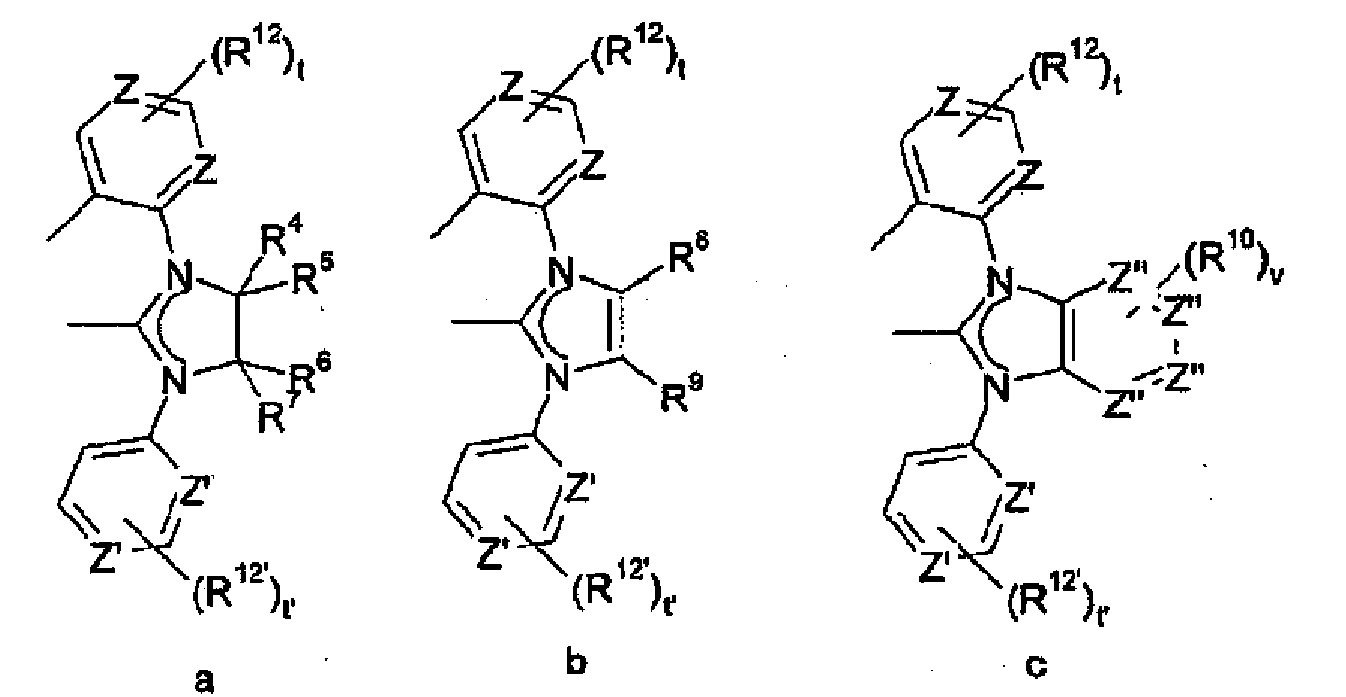

 Z, Z', Z'' identiques ou différents, CH ou NR12, R12' identiques ou différents, radical alkyle, aryle, hétéroaryle, alcynyle ou alcényle ou à chaque fois 2 radicaux R12 ou, selon le cas, R12' forment ensemble un cycle condensé, qui peut le cas échéant contenir au moins un hétéroatome, ou R12 ou, selon le cas, R12' signifie un radical doté d'un effet donneur ou accepteur ;t et t' identiques ou différents, 0 à 4, où, lorsque t ou, selon le cas, t' > 1, les radicaux R12 ou, selon le cas, R12' peuvent être identiques ou différents ;R4, R5, R6, R7, R8, R9 et R11 hydrogène, alkyle, aryle, hétéroaryle, alcynyle ou alcényle ou un radical doté d'un effet donneur ou accepteur ;R10 alkyle, aryle, hétéroaryle, alcynyle ou alcényle ou à chaque fois 2 radicaux R10 forment ensemble un cycle condensé, qui peut le cas échéant contenir au moins un hétéroatome, ou R10 signifie un radical doté d'un effet donneur ou accepteur ;en outre, le groupe de structure
alkylène, arylène, hétéroarylène, alcynylène, alcénylène, NR18, PR19, BR20, O, S, SO, SO2, SiR30R31, CO, CO-O, O-CO et (CR21R22)x, un ou plusieurs groupes (CR21R22) non adjacents pouvant être remplacés par NR18, PR19, BR20, O, S, SO, SO2, SiR30R31, CO, CO-O, O-CO, où
x vaut 2 à 10 ; et
R18, R19, R20, R21, R22, R30, R31 signifient H, alkyle, aryle, hétéroaryle, alcényle, alcynyle
où, dans les cas dans lesquels le groupe de structure v 0 à 4, où, lorsque v vaut 0, les quatre atomes de carbone du radical aryle dans la formule c et h, qui sont le cas échéant substitués par R10, portent des atomes d'hydrogène ;Y3 hydrogène, un radical alkyle, aryle, hétéroaryle, alcynyle ou alcénylecomprenant la transformation d'un précurseur de ligand, choisi dans le groupe constitué par :
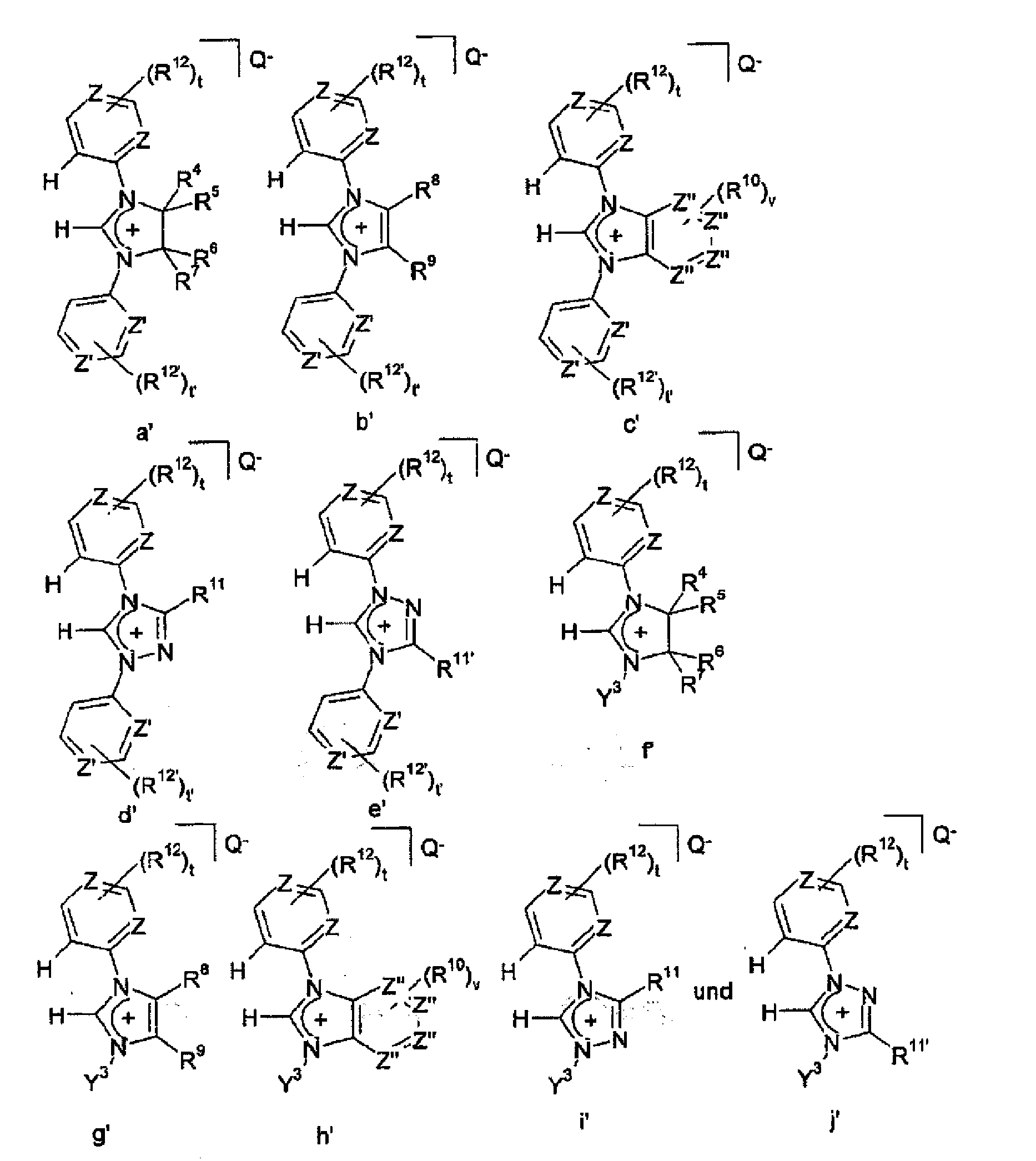 Q- signifie un contre-ion monoanionique, de préférence halogénure, pseudohalogénure, BF4 -, BPh4 -, PF6 -, ASF6 - ou SbF6 - ; etles autres symboles dans les précurseurs de ligands des formules a' à j' présentent les significations mentionnées en ce qui concerne les ligands des formules a à j,
la transformation comprenant l'utilisation d'un réactif auxiliaire basique contenant Ag (voie B), le précurseur de ligand, dans l'étape(iB) étant transformé avec le réactif auxiliaire basique contenant Ag, un carbène protégé étant obtenu, et(iiB) le carbène protégé étant ensuite transformé sans autre traitement et/ou purification avec un complexe métallique contenant au moins un métal M1 ;un complexe de carbène cyclométallisé de formule générale I étant obtenu,
la transformation dans l'étape (iB) ayant lieu à température ambiante dans un solvant ou un mélange de solvants aprotiques et la transformation dans l'étape (iiB) ayant lieu à des températures de 70 à 150°C. - Procédé selon la revendication 1, caractérisé en ce que(B) le rapport du complexe métallique contenant au moins un métal M1, du précurseur de ligand et du réactif auxiliaire basique valant 1:1-10:0,5-5 par atome métallique M1 et le nombre de ligands carbène n, de préférence 1:1-5:0,5-2,5, de manière particulièrement préférée 1:1-3:0,5-1,5 (voie B).
- Procédé selon la revendication 1 ou 2, caractérisé en ce que le solvant aprotique est choisi parmi au moins un solvant choisi dans le groupe constitué par le dioxane, la butanone, le THF, le toluène, le xylène, le DMF, l'acétonitrile, le DMSO, la NMP et la pyridine.
- Procédé selon l'une quelconque des revendications 1 à 3, caractérisé en ce qu'on utilise, comme métal M1, Ir, de préférence Ir(I) ou Ir(III), de manière particulièrement préférée Ir(I).
- Procédé selon l'une quelconque des revendications 1 à 4, caractérisé en ce qu'on utilise, dans la voie B, comme réactif auxiliaire basique, Ag2O, Ag2CO3, AgOAc et/ou Ag2S, de préférence Ag2O.
Priority Applications (2)
| Application Number | Priority Date | Filing Date | Title |
|---|---|---|---|
| EP11158560.0A EP2338593B1 (fr) | 2006-01-31 | 2007-01-09 | Procédé pour la préparation des complexes de carbenes des métals de transitions |
| EP07703742A EP1993728B1 (fr) | 2006-01-31 | 2007-01-09 | Procede de fabrication de complexes carbene-metal de transition |
Applications Claiming Priority (3)
| Application Number | Priority Date | Filing Date | Title |
|---|---|---|---|
| EP06101109 | 2006-01-31 | ||
| EP07703742A EP1993728B1 (fr) | 2006-01-31 | 2007-01-09 | Procede de fabrication de complexes carbene-metal de transition |
| PCT/EP2007/050193 WO2007088093A1 (fr) | 2006-01-31 | 2007-01-09 | Procede de fabrication de complexes carbene-metal de transition |
Related Child Applications (1)
| Application Number | Title | Priority Date | Filing Date |
|---|---|---|---|
| EP11158560.0 Division-Into | 2011-03-16 |
Publications (2)
| Publication Number | Publication Date |
|---|---|
| EP1993728A1 EP1993728A1 (fr) | 2008-11-26 |
| EP1993728B1 true EP1993728B1 (fr) | 2012-06-06 |
Family
ID=37808157
Family Applications (2)
| Application Number | Title | Priority Date | Filing Date |
|---|---|---|---|
| EP11158560.0A Active EP2338593B1 (fr) | 2006-01-31 | 2007-01-09 | Procédé pour la préparation des complexes de carbenes des métals de transitions |
| EP07703742A Active EP1993728B1 (fr) | 2006-01-31 | 2007-01-09 | Procede de fabrication de complexes carbene-metal de transition |
Family Applications Before (1)
| Application Number | Title | Priority Date | Filing Date |
|---|---|---|---|
| EP11158560.0A Active EP2338593B1 (fr) | 2006-01-31 | 2007-01-09 | Procédé pour la préparation des complexes de carbenes des métals de transitions |
Country Status (4)
| Country | Link |
|---|---|
| US (3) | US8410280B2 (fr) |
| EP (2) | EP2338593B1 (fr) |
| JP (1) | JP5199887B2 (fr) |
| WO (1) | WO2007088093A1 (fr) |
Families Citing this family (24)
| Publication number | Priority date | Publication date | Assignee | Title |
|---|---|---|---|---|
| JPS6180011A (ja) * | 1984-09-28 | 1986-04-23 | Toshiba Corp | 寸法測定装置 |
| US8373159B2 (en) * | 2007-07-05 | 2013-02-12 | Basf Se | Organic light-emitting diodes comprising carbene-transition metal complex emitter, and at least one compound selected from disilylcarbazoles, disilyldibenzofurans, disilyldibenzothiophenes, disilyldibenzophospholes, disilyldibenzothiophene s-oxides and disilyldibe |
| KR101741778B1 (ko) * | 2007-10-17 | 2017-05-31 | 유디씨 아일랜드 리미티드 | 가교된 카르벤 리간드를 포함하는 전이 금속 착물 및 이의 용도 |
| JP5615178B2 (ja) | 2007-10-17 | 2014-10-29 | ビーエーエスエフ ソシエタス・ヨーロピアBasf Se | 架橋カルベンリガンドを有する遷移金属錯体およびoledにおけるその使用 |
| US9108998B2 (en) | 2009-10-14 | 2015-08-18 | Basf Se | Dinuclear platinum-carbene complexes and the use thereof in OLEDs |
| US9487548B2 (en) * | 2009-12-14 | 2016-11-08 | Udc Ireland Limited | Metal complexes comprising diazabenzimidazolocarbene ligands and the use thereof in OLEDs |
| KR102231266B1 (ko) * | 2009-12-14 | 2021-03-24 | 유디씨 아일랜드 리미티드 | 디아자벤즈이미다졸로카르벤 리간드를 포함하는 금속 착물 및 oled에서의 그의 용도 |
| GB201003483D0 (en) | 2010-03-02 | 2010-04-14 | Univ St Andrews | Gold complexes |
| GB201009656D0 (en) * | 2010-06-09 | 2010-07-21 | Univ St Andrews | Carboxylation catalysts |
| CN102947416B (zh) * | 2010-06-18 | 2016-04-13 | 巴斯夫欧洲公司 | 包含二苯并呋喃化合物和8-羟基喹啉根合碱土金属或碱金属配合物的层的有机电子器件 |
| KR101877581B1 (ko) * | 2010-06-18 | 2018-07-11 | 유디씨 아일랜드 리미티드 | 피리딘 화합물 및 8-히드록시퀴놀리노레이토 알칼리 토금속 또는 알칼리 금속 착물의 층을 포함하는 유기 전자 소자 |
| US8883322B2 (en) | 2011-03-08 | 2014-11-11 | Universal Display Corporation | Pyridyl carbene phosphorescent emitters |
| EP3473634B1 (fr) | 2011-06-08 | 2020-07-22 | Universal Display Corporation | Complexes hétéroleptiques de carbène d'iridium et diode électroluminescente les utilisant |
| US9502672B2 (en) * | 2012-06-21 | 2016-11-22 | Universal Display Corporation | Organic electroluminescent materials and devices |
| WO2014012972A1 (fr) * | 2012-07-19 | 2014-01-23 | Basf Se | Complexes métalliques binucléaires comprenant des ligands carbènes et leur utilisation dans des diodes électroluminescentes organiques (oled) |
| CN110003280A (zh) * | 2012-08-09 | 2019-07-12 | Udc 爱尔兰有限责任公司 | 具有碳烯配体的过渡金属配合物及其在oled中的用途 |
| KR102226202B1 (ko) | 2013-07-31 | 2021-03-12 | 유디씨 아일랜드 리미티드 | 발광 디아자벤즈이미다졸 카르벤 금속 착물 |
| US9385033B2 (en) * | 2013-09-27 | 2016-07-05 | Intel Corporation | Method of forming a metal from a cobalt metal precursor |
| MX2016004936A (es) | 2013-10-17 | 2016-12-20 | Abbvie Deutschland | Derivados de aminocromano, aminotiocromano y amino-1,2,3,4-tetrahi droquinilina, composiciones farmaceuticas que los contienen, y su uso en terapia. |
| CN104788355A (zh) * | 2015-04-02 | 2015-07-22 | 聊城大学 | 一种含氮杂环苯腈或邻苯二腈化合物的合成方法 |
| KR20190011866A (ko) * | 2017-07-25 | 2019-02-08 | 삼성디스플레이 주식회사 | 유기금속 화합물 및 이를 포함한 유기 발광 소자 |
| US20190088888A1 (en) * | 2017-09-20 | 2019-03-21 | Universal Display Corporation | Organic electroluminescent materials and devices |
| KR20210126201A (ko) * | 2020-04-09 | 2021-10-20 | 삼성디스플레이 주식회사 | 유기금속 화합물 및 이를 포함한 유기 발광 소자 |
| KR102733298B1 (ko) * | 2021-07-29 | 2024-11-21 | 엘지디스플레이 주식회사 | 유기금속 화합물 및 이를 포함하는 유기발광소자 |
Family Cites Families (5)
| Publication number | Priority date | Publication date | Assignee | Title |
|---|---|---|---|---|
| CN101924190B (zh) | 2000-08-11 | 2012-07-04 | 普林斯顿大学理事会 | 有机金属化合物和发射转换有机电致磷光 |
| DE10338550A1 (de) | 2003-08-19 | 2005-03-31 | Basf Ag | Übergangsmetallkomplexe mit Carbenliganden als Emitter für organische Licht-emittierende Dioden (OLEDs) |
| WO2005113704A2 (fr) | 2004-05-18 | 2005-12-01 | The University Of Southern California | Composes luminescents a ligands carbene |
| US7598388B2 (en) * | 2004-05-18 | 2009-10-06 | The University Of Southern California | Carbene containing metal complexes as OLEDs |
| JP2007045742A (ja) * | 2005-08-10 | 2007-02-22 | Mitsubishi Chemicals Corp | 遷移金属錯体の製造方法及び遷移金属錯体 |
-
2007
- 2007-01-09 WO PCT/EP2007/050193 patent/WO2007088093A1/fr not_active Ceased
- 2007-01-09 EP EP11158560.0A patent/EP2338593B1/fr active Active
- 2007-01-09 JP JP2008552765A patent/JP5199887B2/ja active Active
- 2007-01-09 EP EP07703742A patent/EP1993728B1/fr active Active
- 2007-01-09 US US12/162,863 patent/US8410280B2/en active Active
-
2013
- 2013-02-27 US US13/778,262 patent/US8877937B2/en active Active
-
2014
- 2014-09-09 US US14/480,973 patent/US20150018544A1/en not_active Abandoned
Also Published As
| Publication number | Publication date |
|---|---|
| EP2338593B1 (fr) | 2013-06-19 |
| US8410280B2 (en) | 2013-04-02 |
| EP2338593A1 (fr) | 2011-06-29 |
| US20130178621A1 (en) | 2013-07-11 |
| JP2009525299A (ja) | 2009-07-09 |
| US20150018544A1 (en) | 2015-01-15 |
| US20090018330A1 (en) | 2009-01-15 |
| EP1993728A1 (fr) | 2008-11-26 |
| JP5199887B2 (ja) | 2013-05-15 |
| US8877937B2 (en) | 2014-11-04 |
| WO2007088093A1 (fr) | 2007-08-09 |
Similar Documents
| Publication | Publication Date | Title |
|---|---|---|
| EP2338593B1 (fr) | Procédé pour la préparation des complexes de carbenes des métals de transitions | |
| EP2134807B1 (fr) | Triphénylène complexes d'iridium et leur utilisation dans des oleds | |
| EP1819717B1 (fr) | Utilisation de complexes metal de transition- carbene dans des diodes electroluminescentes organiques (del organiques) | |
| JP2777880B2 (ja) | 複素環式カルベンとの金属錯体 | |
| EP1558619B1 (fr) | Complexes de rhodium et d'iridium | |
| WO2008000726A1 (fr) | Utilisation de complexes pt- et pd-bis- et tétracarbène avec des ligands carbène pontés dans des diodes électroluminescentes organiques | |
| EP2151446B1 (fr) | Procédé pour la préparation de catalyseurs de réthénium à base de Schiff de ligand contenant un ligand de type salicyldimine | |
| EP1682560A1 (fr) | Procede pour produire des composes organometalliques heteroleptiques ayant subi une orthometallation | |
| Serroni et al. | New procedures for the synthesis of mixed-metal and/or mixed-ligand ruthenium (II) and osmium (II) polypyridine supramolecules and the use of these procedures in the preparation of hexanuclear species | |
| Landman et al. | Fac and mer dppe-substituted Fischer carbene complexes of chromium: X-ray, DFT and electrochemical study | |
| US20030032808A1 (en) | Tri-and bidentate amido ligands prepared by palladium0 coupling and metallation threreof to form metal-amido catalysts | |
| Meguro et al. | Synthesis, structure, and quaternization and complexation reactions of κ3SCS pincer palladium complexes having 3, 5-pyridinediyl unit | |
| Yamamoto et al. | Luminescent rhenium (I)–gold (I) hetero organometallics linked by ethynylphenanthrolines | |
| EP1448577B1 (fr) | Complexes rhodium et iridium | |
| KR101311122B1 (ko) | 디포스핀 리간드 및 이를 이용한 전이 금속 착물 | |
| Tanase et al. | Preparation of NHC-substituted phosphitepalladacycles | |
| CN101220058B (zh) | 手性和非手性pcn钳形钯化合物及合成方法和用途 | |
| Ferreira et al. | Redox behaviour of imino-β-diketonato ligands and their rhodium (I) complexes | |
| EP3717495B1 (fr) | Complexes de platine (ii) phosphorescents à base de anhc | |
| DE102013016487B4 (de) | Verfahren zur Herstellung von Metall-N-heterocyclischen Carben-Komplexen | |
| US20060041159A1 (en) | Transition metal complexes with proton sponges as ligands | |
| CN116332964B (zh) | 一种双齿吡唑基氮杂环钯卡宾化合物的合成方法 | |
| Sung et al. | The reactivity of TMSN3 with ruthenium cyclopropenyl complexes containing different ligands and different substituent at Cγ | |
| Vives | Treball Final de Grau | |
| CN118420485A (zh) | 一种偕二氟烯烃衍生物的制备方法 |
Legal Events
| Date | Code | Title | Description |
|---|---|---|---|
| PUAI | Public reference made under article 153(3) epc to a published international application that has entered the european phase |
Free format text: ORIGINAL CODE: 0009012 |
|
| 17P | Request for examination filed |
Effective date: 20080901 |
|
| AK | Designated contracting states |
Kind code of ref document: A1 Designated state(s): AT BE BG CH CY CZ DE DK EE ES FI FR GB GR HU IE IS IT LI LT LU LV MC NL PL PT RO SE SI SK TR |
|
| 17Q | First examination report despatched |
Effective date: 20090306 |
|
| GRAP | Despatch of communication of intention to grant a patent |
Free format text: ORIGINAL CODE: EPIDOSNIGR1 |
|
| DAX | Request for extension of the european patent (deleted) | ||
| GRAS | Grant fee paid |
Free format text: ORIGINAL CODE: EPIDOSNIGR3 |
|
| GRAA | (expected) grant |
Free format text: ORIGINAL CODE: 0009210 |
|
| AK | Designated contracting states |
Kind code of ref document: B1 Designated state(s): AT BE BG CH CY CZ DE DK EE ES FI FR GB GR HU IE IS IT LI LT LU LV MC NL PL PT RO SE SI SK TR |
|
| REG | Reference to a national code |
Ref country code: GB Ref legal event code: FG4D Free format text: NOT ENGLISH |
|
| REG | Reference to a national code |
Ref country code: AT Ref legal event code: REF Ref document number: 560732 Country of ref document: AT Kind code of ref document: T Effective date: 20120615 Ref country code: CH Ref legal event code: EP |
|
| REG | Reference to a national code |
Ref country code: IE Ref legal event code: FG4D Free format text: LANGUAGE OF EP DOCUMENT: GERMAN |
|
| REG | Reference to a national code |
Ref country code: DE Ref legal event code: R096 Ref document number: 502007009998 Country of ref document: DE Effective date: 20120802 |
|
| REG | Reference to a national code |
Ref country code: NL Ref legal event code: VDEP Effective date: 20120606 |
|
| PG25 | Lapsed in a contracting state [announced via postgrant information from national office to epo] |
Ref country code: CY Free format text: LAPSE BECAUSE OF FAILURE TO SUBMIT A TRANSLATION OF THE DESCRIPTION OR TO PAY THE FEE WITHIN THE PRESCRIBED TIME-LIMIT Effective date: 20120606 Ref country code: SE Free format text: LAPSE BECAUSE OF FAILURE TO SUBMIT A TRANSLATION OF THE DESCRIPTION OR TO PAY THE FEE WITHIN THE PRESCRIBED TIME-LIMIT Effective date: 20120606 Ref country code: FI Free format text: LAPSE BECAUSE OF FAILURE TO SUBMIT A TRANSLATION OF THE DESCRIPTION OR TO PAY THE FEE WITHIN THE PRESCRIBED TIME-LIMIT Effective date: 20120606 Ref country code: LT Free format text: LAPSE BECAUSE OF FAILURE TO SUBMIT A TRANSLATION OF THE DESCRIPTION OR TO PAY THE FEE WITHIN THE PRESCRIBED TIME-LIMIT Effective date: 20120606 |
|
| REG | Reference to a national code |
Ref country code: LT Ref legal event code: MG4D Effective date: 20120627 |
|
| PG25 | Lapsed in a contracting state [announced via postgrant information from national office to epo] |
Ref country code: GR Free format text: LAPSE BECAUSE OF FAILURE TO SUBMIT A TRANSLATION OF THE DESCRIPTION OR TO PAY THE FEE WITHIN THE PRESCRIBED TIME-LIMIT Effective date: 20120907 Ref country code: SI Free format text: LAPSE BECAUSE OF FAILURE TO SUBMIT A TRANSLATION OF THE DESCRIPTION OR TO PAY THE FEE WITHIN THE PRESCRIBED TIME-LIMIT Effective date: 20120606 Ref country code: LV Free format text: LAPSE BECAUSE OF FAILURE TO SUBMIT A TRANSLATION OF THE DESCRIPTION OR TO PAY THE FEE WITHIN THE PRESCRIBED TIME-LIMIT Effective date: 20120606 |
|
| PG25 | Lapsed in a contracting state [announced via postgrant information from national office to epo] |
Ref country code: EE Free format text: LAPSE BECAUSE OF FAILURE TO SUBMIT A TRANSLATION OF THE DESCRIPTION OR TO PAY THE FEE WITHIN THE PRESCRIBED TIME-LIMIT Effective date: 20120606 Ref country code: IS Free format text: LAPSE BECAUSE OF FAILURE TO SUBMIT A TRANSLATION OF THE DESCRIPTION OR TO PAY THE FEE WITHIN THE PRESCRIBED TIME-LIMIT Effective date: 20121006 Ref country code: RO Free format text: LAPSE BECAUSE OF FAILURE TO SUBMIT A TRANSLATION OF THE DESCRIPTION OR TO PAY THE FEE WITHIN THE PRESCRIBED TIME-LIMIT Effective date: 20120606 Ref country code: CZ Free format text: LAPSE BECAUSE OF FAILURE TO SUBMIT A TRANSLATION OF THE DESCRIPTION OR TO PAY THE FEE WITHIN THE PRESCRIBED TIME-LIMIT Effective date: 20120606 Ref country code: SK Free format text: LAPSE BECAUSE OF FAILURE TO SUBMIT A TRANSLATION OF THE DESCRIPTION OR TO PAY THE FEE WITHIN THE PRESCRIBED TIME-LIMIT Effective date: 20120606 Ref country code: NL Free format text: LAPSE BECAUSE OF FAILURE TO SUBMIT A TRANSLATION OF THE DESCRIPTION OR TO PAY THE FEE WITHIN THE PRESCRIBED TIME-LIMIT Effective date: 20120606 |
|
| PG25 | Lapsed in a contracting state [announced via postgrant information from national office to epo] |
Ref country code: PL Free format text: LAPSE BECAUSE OF FAILURE TO SUBMIT A TRANSLATION OF THE DESCRIPTION OR TO PAY THE FEE WITHIN THE PRESCRIBED TIME-LIMIT Effective date: 20120606 Ref country code: PT Free format text: LAPSE BECAUSE OF FAILURE TO SUBMIT A TRANSLATION OF THE DESCRIPTION OR TO PAY THE FEE WITHIN THE PRESCRIBED TIME-LIMIT Effective date: 20121008 |
|
| PLBE | No opposition filed within time limit |
Free format text: ORIGINAL CODE: 0009261 |
|
| STAA | Information on the status of an ep patent application or granted ep patent |
Free format text: STATUS: NO OPPOSITION FILED WITHIN TIME LIMIT |
|
| PG25 | Lapsed in a contracting state [announced via postgrant information from national office to epo] |
Ref country code: ES Free format text: LAPSE BECAUSE OF FAILURE TO SUBMIT A TRANSLATION OF THE DESCRIPTION OR TO PAY THE FEE WITHIN THE PRESCRIBED TIME-LIMIT Effective date: 20120917 Ref country code: DK Free format text: LAPSE BECAUSE OF FAILURE TO SUBMIT A TRANSLATION OF THE DESCRIPTION OR TO PAY THE FEE WITHIN THE PRESCRIBED TIME-LIMIT Effective date: 20120606 |
|
| 26N | No opposition filed |
Effective date: 20130307 |
|
| REG | Reference to a national code |
Ref country code: DE Ref legal event code: R097 Ref document number: 502007009998 Country of ref document: DE Effective date: 20130307 |
|
| BERE | Be: lapsed |
Owner name: BASF SE Effective date: 20130131 |
|
| PG25 | Lapsed in a contracting state [announced via postgrant information from national office to epo] |
Ref country code: BG Free format text: LAPSE BECAUSE OF FAILURE TO SUBMIT A TRANSLATION OF THE DESCRIPTION OR TO PAY THE FEE WITHIN THE PRESCRIBED TIME-LIMIT Effective date: 20120906 |
|
| PG25 | Lapsed in a contracting state [announced via postgrant information from national office to epo] |
Ref country code: MC Free format text: LAPSE BECAUSE OF NON-PAYMENT OF DUE FEES Effective date: 20130131 |
|
| REG | Reference to a national code |
Ref country code: CH Ref legal event code: PL |
|
| REG | Reference to a national code |
Ref country code: IE Ref legal event code: MM4A |
|
| PG25 | Lapsed in a contracting state [announced via postgrant information from national office to epo] |
Ref country code: LI Free format text: LAPSE BECAUSE OF NON-PAYMENT OF DUE FEES Effective date: 20130131 Ref country code: CH Free format text: LAPSE BECAUSE OF NON-PAYMENT OF DUE FEES Effective date: 20130131 Ref country code: BE Free format text: LAPSE BECAUSE OF NON-PAYMENT OF DUE FEES Effective date: 20130131 |
|
| PG25 | Lapsed in a contracting state [announced via postgrant information from national office to epo] |
Ref country code: IE Free format text: LAPSE BECAUSE OF NON-PAYMENT OF DUE FEES Effective date: 20130109 |
|
| REG | Reference to a national code |
Ref country code: AT Ref legal event code: MM01 Ref document number: 560732 Country of ref document: AT Kind code of ref document: T Effective date: 20130109 |
|
| PG25 | Lapsed in a contracting state [announced via postgrant information from national office to epo] |
Ref country code: AT Free format text: LAPSE BECAUSE OF NON-PAYMENT OF DUE FEES Effective date: 20130109 |
|
| PG25 | Lapsed in a contracting state [announced via postgrant information from national office to epo] |
Ref country code: TR Free format text: LAPSE BECAUSE OF FAILURE TO SUBMIT A TRANSLATION OF THE DESCRIPTION OR TO PAY THE FEE WITHIN THE PRESCRIBED TIME-LIMIT Effective date: 20120606 |
|
| PG25 | Lapsed in a contracting state [announced via postgrant information from national office to epo] |
Ref country code: LU Free format text: LAPSE BECAUSE OF NON-PAYMENT OF DUE FEES Effective date: 20130109 Ref country code: HU Free format text: LAPSE BECAUSE OF FAILURE TO SUBMIT A TRANSLATION OF THE DESCRIPTION OR TO PAY THE FEE WITHIN THE PRESCRIBED TIME-LIMIT; INVALID AB INITIO Effective date: 20070109 |
|
| REG | Reference to a national code |
Ref country code: FR Ref legal event code: PLFP Year of fee payment: 10 |
|
| REG | Reference to a national code |
Ref country code: DE Ref legal event code: R081 Ref document number: 502007009998 Country of ref document: DE Owner name: UDC IRELAND LIMITED, IE Free format text: FORMER OWNER: BASF SE, 67063 LUDWIGSHAFEN, DE Ref country code: DE Ref legal event code: R081 Ref document number: 502007009998 Country of ref document: DE Owner name: UDC IRELAND LIMITED, BALLYCOOLIN, IE Free format text: FORMER OWNER: BASF SE, 67063 LUDWIGSHAFEN, DE |
|
| REG | Reference to a national code |
Ref country code: GB Ref legal event code: 732E Free format text: REGISTERED BETWEEN 20161020 AND 20161026 |
|
| REG | Reference to a national code |
Ref country code: FR Ref legal event code: PLFP Year of fee payment: 11 |
|
| REG | Reference to a national code |
Ref country code: FR Ref legal event code: TP Owner name: UDC IRELAND LIMITED, IE Effective date: 20170303 |
|
| REG | Reference to a national code |
Ref country code: FR Ref legal event code: PLFP Year of fee payment: 12 |
|
| P01 | Opt-out of the competence of the unified patent court (upc) registered |
Effective date: 20230505 |
|
| PGFP | Annual fee paid to national office [announced via postgrant information from national office to epo] |
Ref country code: DE Payment date: 20250129 Year of fee payment: 19 |
|
| PGFP | Annual fee paid to national office [announced via postgrant information from national office to epo] |
Ref country code: FR Payment date: 20250127 Year of fee payment: 19 |
|
| PGFP | Annual fee paid to national office [announced via postgrant information from national office to epo] |
Ref country code: GB Payment date: 20250127 Year of fee payment: 19 |
|
| PGFP | Annual fee paid to national office [announced via postgrant information from national office to epo] |
Ref country code: IT Payment date: 20260121 Year of fee payment: 20 |