EP1994462B1 - Elektronische geräte mit einer bewegung verwendenen datentransferfunktion und verfahren - Google Patents
Elektronische geräte mit einer bewegung verwendenen datentransferfunktion und verfahren Download PDFInfo
- Publication number
- EP1994462B1 EP1994462B1 EP06821059A EP06821059A EP1994462B1 EP 1994462 B1 EP1994462 B1 EP 1994462B1 EP 06821059 A EP06821059 A EP 06821059A EP 06821059 A EP06821059 A EP 06821059A EP 1994462 B1 EP1994462 B1 EP 1994462B1
- Authority
- EP
- European Patent Office
- Prior art keywords
- electronic equipment
- motion
- mobile phone
- information
- transducer
- Prior art date
- Legal status (The legal status is an assumption and is not a legal conclusion. Google has not performed a legal analysis and makes no representation as to the accuracy of the status listed.)
- Not-in-force
Links
Images


Classifications
-
- H—ELECTRICITY
- H04—ELECTRIC COMMUNICATION TECHNIQUE
- H04L—TRANSMISSION OF DIGITAL INFORMATION, e.g. TELEGRAPHIC COMMUNICATION
- H04L63/00—Network architectures or network communication protocols for network security
- H04L63/20—Network architectures or network communication protocols for network security for managing network security; network security policies in general
-
- G—PHYSICS
- G06—COMPUTING OR CALCULATING; COUNTING
- G06F—ELECTRIC DIGITAL DATA PROCESSING
- G06F1/00—Details not covered by groups G06F3/00 - G06F13/00 and G06F21/00
- G06F1/16—Constructional details or arrangements
- G06F1/1613—Constructional details or arrangements for portable computers
-
- G—PHYSICS
- G06—COMPUTING OR CALCULATING; COUNTING
- G06F—ELECTRIC DIGITAL DATA PROCESSING
- G06F1/00—Details not covered by groups G06F3/00 - G06F13/00 and G06F21/00
- G06F1/16—Constructional details or arrangements
- G06F1/1613—Constructional details or arrangements for portable computers
- G06F1/1633—Constructional details or arrangements of portable computers not specific to the type of enclosures covered by groups G06F1/1615 - G06F1/1626
- G06F1/1684—Constructional details or arrangements related to integrated I/O peripherals not covered by groups G06F1/1635 - G06F1/1675
- G06F1/1694—Constructional details or arrangements related to integrated I/O peripherals not covered by groups G06F1/1635 - G06F1/1675 the I/O peripheral being a single or a set of motion sensors for pointer control or gesture input obtained by sensing movements of the portable computer
-
- G—PHYSICS
- G06—COMPUTING OR CALCULATING; COUNTING
- G06F—ELECTRIC DIGITAL DATA PROCESSING
- G06F1/00—Details not covered by groups G06F3/00 - G06F13/00 and G06F21/00
- G06F1/16—Constructional details or arrangements
- G06F1/1613—Constructional details or arrangements for portable computers
- G06F1/1633—Constructional details or arrangements of portable computers not specific to the type of enclosures covered by groups G06F1/1615 - G06F1/1626
- G06F1/1684—Constructional details or arrangements related to integrated I/O peripherals not covered by groups G06F1/1635 - G06F1/1675
- G06F1/1698—Constructional details or arrangements related to integrated I/O peripherals not covered by groups G06F1/1635 - G06F1/1675 the I/O peripheral being a sending/receiving arrangement to establish a cordless communication link, e.g. radio or infrared link, integrated cellular phone
-
- G—PHYSICS
- G06—COMPUTING OR CALCULATING; COUNTING
- G06F—ELECTRIC DIGITAL DATA PROCESSING
- G06F3/00—Input arrangements for transferring data to be processed into a form capable of being handled by the computer; Output arrangements for transferring data from processing unit to output unit, e.g. interface arrangements
- G06F3/01—Input arrangements or combined input and output arrangements for interaction between user and computer
- G06F3/017—Gesture based interaction, e.g. based on a set of recognized hand gestures
-
- H—ELECTRICITY
- H04—ELECTRIC COMMUNICATION TECHNIQUE
- H04L—TRANSMISSION OF DIGITAL INFORMATION, e.g. TELEGRAPHIC COMMUNICATION
- H04L67/00—Network arrangements or protocols for supporting network services or applications
- H04L67/01—Protocols
- H04L67/04—Protocols specially adapted for terminals or networks with limited capabilities; specially adapted for terminal portability
-
- H—ELECTRICITY
- H04—ELECTRIC COMMUNICATION TECHNIQUE
- H04W—WIRELESS COMMUNICATION NETWORKS
- H04W12/00—Security arrangements; Authentication; Protecting privacy or anonymity
- H04W12/50—Secure pairing of devices
-
- H—ELECTRICITY
- H04—ELECTRIC COMMUNICATION TECHNIQUE
- H04L—TRANSMISSION OF DIGITAL INFORMATION, e.g. TELEGRAPHIC COMMUNICATION
- H04L67/00—Network arrangements or protocols for supporting network services or applications
- H04L67/50—Network services
- H04L67/75—Indicating network or usage conditions on the user display
-
- H—ELECTRICITY
- H04—ELECTRIC COMMUNICATION TECHNIQUE
- H04W—WIRELESS COMMUNICATION NETWORKS
- H04W12/00—Security arrangements; Authentication; Protecting privacy or anonymity
- H04W12/60—Context-dependent security
- H04W12/68—Gesture-dependent or behaviour-dependent
-
- H—ELECTRICITY
- H04—ELECTRIC COMMUNICATION TECHNIQUE
- H04W—WIRELESS COMMUNICATION NETWORKS
- H04W24/00—Supervisory, monitoring or testing arrangements
-
- H—ELECTRICITY
- H04—ELECTRIC COMMUNICATION TECHNIQUE
- H04W—WIRELESS COMMUNICATION NETWORKS
- H04W88/00—Devices specially adapted for wireless communication networks, e.g. terminals, base stations or access point devices
- H04W88/02—Terminal devices
Definitions
- the present invention relates generally to electronic equipment, and, more particularly, to electronic equipment with data transfer function using motion and method of transfer using motion, e.g., shaking or other intended motion, for identification.
- motion e.g., shaking or other intended motion
- phone books sometimes referred to as address books, contacts, etc. (collectively referred to as "phone book” for convenience)
- phone book may include the name of one or more persons, companies, or other entities and the relevant telephone number(s), e.g., home, work, mobile, etc., postal address(es), email address(es), and/or other information pertaining to the respective person, company, etc.
- Such a person, company, etc. may be referred to as a contact and the term contact information sometimes is used to refer to the pertinent information for that contact.
- a contact sometimes the collection of the name and the relevant contact information for a given person, company, etc. is referred to collectively as a contact.
- a contact For example, on a display menu or special key of a mobile phone is the label "contacts," and executing the "contacts" function would bring up a phone book listing names, etc., as is well known.
- a mobile phone includes a personal contact, for example, the name of the owner of the mobile phone and other pertinent information, such as, for example, the owner's telephone number(s), address(es), email address(es), etc.
- the personal contact information may be analogous to a typical business card or may include more or less information than a business card.
- Mobile phones, PDAs and other electronic equipment have the ability to transfer contact information from one to another, e.g., using Bluetooth, infrared (IR), or another mechanism. It is somewhat inconvenient to transfer contact information between mobile phones, PDAs and/or other electronic equipment, whether that transfer is of one or more contacts or of personal contact information. For example, using a Bluetooth approach to transfer contacts between two mobile phones, it usually would be necessary to turn on the Bluetooth functions of both mobile phones, to wait a period of time for one mobile phone to detect the nearby mobile phones with Bluetooth activated, select the desired mobile phone for connection, and then transmit the contact information to that mobile phone. If the incorrect mobile phone mistakenly were selected, the contact information may be sent to an incorrect mobile phone, which is a possible security problem.
- Bluetooth infrared
- contacts As used herein, the terms contacts, contact information, information, phone books, address books, calendars, settings (e.g., phone settings, preferences, display screen settings, soft key settings, ring tone settings, etc.), business cards, cards, data, content images, videos, movies, music, documents, programs and the like may be interchangeable in the sense that these may be transferred, copied or the like from an electronic equipment to another electronic equipment.
- the terms "contact,” “contact information” and “information” may be used herein to represent each of the foregoing that is able to be transferred, copied or the like from an electronic equipment to another electronic equipment.
- An aspect of the present invention relates to an electronic equipment including a transducer; wherein the transducer is operable to detect motion of the electronic equipment, and a transmitter responsive to detected motion to transmit information (data or program) from the electronic equipment.
- a detector is responsive to a signal representative of motion of another electronic equipment, and wherein the transmitter is responsive to a prescribed relationship between motion detected by the transducer and a signal representative of motion of another electronic equipment to transmit information.
- the transmitter in response to such prescribed relationship transmits information via a secure communication link to such another electronic equipment.
- the electronic equipment is a mobile phone and said another electronic equipment is a mobile phone.
- the electronic equipment is at least one of a mobile phone and a PDA and the another electronic equipment is at least one of a mobile phone and a PDA.
- the transducer is operable to detect shaking.
- the transducer comprises an accelerometer.
- the transducer comprises a signal conditioning circuit to filter out signals representing motion not representative of intended motion of the electronic equipment.
- the signal conditioning circuit comprises a low pass filter.
- the transmitter comprises a short distance transmitting device.
- transmitter comprises a Bluetooth communication device.
- US 20041139217 A1 discloses electronic devices that have orientation sensors that detect tilting of the devices; the devices are tilted relative to each other to control the rate at which data is transferred from one device to the other.
- WO 2004/075169 discloses using infrared communication between two electronic devices to set up a key; after a button is pressed to initiate identification and key exchange between devices, shaking is used to transfer data from one device to the other.
- EP 1 132933 discloses a pairing process between two devices in which a PIN code is selected for secure communication between the device.
- the European patent application based on WO 2006/127270A1 is a prior right document which is not relevant for assessment of inventive step.
- This prior right document shows an information exchange system. Information is exchanged with devices having matching movements, wherein the matching movements can include being struck together, being moved in gestures that simulate any number of activities such as throwing and catching and being tapped some number of times.
- the transmitter comprises an infrared communication device
- the transmitter comprises a WLAN communication device.
- a transducer function is carried out based on signal variation detection.
- a further electronic equipment is included, and both the electronic equipment including detector circuitry operable to detect the occurrence of at least substantially the same motion of the electronic equipment to initiate a pairing of the electronic equipment.
- transferring information between or among electronic equipment comprises transferring at least one of settings, contacts, address book, or contacts.
- Another aspect of the invention relates to electronic equipment, including a transducer, wherein the transducer detects motion of the electronic equipment, a detector responsive to a signal representative of motion of another electronic equipment, and a transmitter responsive to a prescribed relationship between motion detected by the transducer and a signal representative of motion of another electronic equipment to transmit information (data or program) for receipt by such another electronic equipment.
- Another aspect of the invention relates to a method of transmitting information, including moving an electronic equipment, detecting such moving, and in response to the moving of a prescribed character transmitting information.
- Another aspect of the invention relates to a method of transferring information between electronic equipment, including moving at least two electronic equipment simultaneously to establish communication between such electronic equipment, and transferring information from at least one of such electronic equipment to another of such electronic equipment.
- Another aspect relates to detecting the character of movement of one of such electronic equipment, comparing such movement with a signal representing the character of movement of such another electronic equipment, and in response to such movements being at least substantially the same the transferring information comprising transmitting information from one electronic equipment to the other.
- Another aspect relates to the moving comprising manually moving.
- Another aspect relates to the moving comprising manually shaking.
- Another aspect of the invention relates to a computer program operable in electronic equipment, including code to operate the electronic equipment to detect the character of motion of such electronic equipment; code to cause comparing of the character of motion of such electronic equipment with a motion signal representing motion of another device, code for causing information to be transferred from one electronic equipment to another electronic equipment when the character of motion of such electronic equipment and such motion signal represent substantially the same motion.
- Another aspect relates to the pairing of two or more electronic equipment based on motion of the electronic equipment to enable or to facilitate transferring information between or among the electronic equipment.
- Another aspect relates to Bluetooth pairing of two or more electronic equipment based on motion.
- the term “electronic equipment” includes portable radio communication equipment.
- portable radio communication equipment which hereinafter is referred to as a “mobile radio terminal,” “mobile phone,” “mobile device,” or “mobile terminal” and the like, includes all equipment such as mobile telephones, pagers, communicators, i.e., electronic organizers, personal digital assistants (PDAs), smartphones, portable communication apparatus or the like:
- PDAs personal digital assistants
- the term “electronic equipment” also may include portable digital music devices, e.g., iPod devices, mp3 players, etc.
- a portable radio communication device may also be a portable digital music device.
- the invention is described primarily in the context of a mobile telephone. However, it will be appreciated that the invention is not intended to be limited to a mobile telephone and can be any type of electronic equipment.
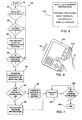
- Fig. 1 electronic equipment 10 and electronic equipment 12 are illustrated being held in a hand 14 of a person.
- a double-ended arrow 16 represents motion of the electronic equipment 10, 12 as they are moved together by the hand 14.
- the electronic equipment 10, 12 are mobile phones (also referred to as mobile telephones and sometimes referred to as cell phones, satellite phones, and by other terminology, as will be appreciated by those having ordinary skill in the art).
- short distance (or other) communication capability between mobile phones may be used to transfer data information between mobile phones.
- a communication connection or link and an appropriate communication protocol can be established between mobile phones, and the fact that a given mobile phone is connected to a correct other mobile phone, e.g., the security of the connection between the mobile phones, can be assured.
- the short distance communication mechanism mentioned above e.g., Bluetooth, IR, wireless local-area network (WLAN) or some other, may be used to transfer information from one mobile phone to the other mobile phone(s).
- the communication link and/or protocol are so established between the mobile phones that undergo the same, at least substantially the same, or similar motion to the exclusion of other mobile phones that are not undergoing such motion.
- the mobile phones 10, 12 are shown as having a "brick" or “block” design type housing 18, but it will be appreciated that other type housings, such as, for example, clamshell or slide-type housings, may be utilized without departing from the scope of the invention.
- the mobile phone 10 includes housing 18 (sometimes referred to as a case), speaker 20, display 22, navigation switch and selection/function keys or switches 24, key pad 26, microphone 28, and volume control slide switch 30; these are illustrative and exemplary of parts of atypical mobile phone, but it will be appreciated that other parts that are sim ilar or different in form and/or function may be included in the mobile phone 10.
- the mobile phone 12 may be the same as, similar to or even different from the mobile phone 10, although for convenience of illustration the two mobile phones are shown having a similar shape.
- the mobile phones to which the invention pertains also may be of the types that have more or fewer functions, keys, etc. compared to those illustrated and described in detail herein.
- the mobile phones 10, 12 may function as conventional mobile phones.
- the mobile phones 10, 12 may have additional functions and capabilities that may be developed in the future.
- the display 22 displays information to a user, such as operating state, time, phone numbers, contact information, various navigational menus, etc. which facilitate and/or enable the user to utilize the various features of the mobile phone.
- Part or all of the display 22 may be a touch screen type device 22a ( Fig. 3 ).
- the navigation and function keys 24 and the keypad 26 may be conventional in that they provide for a variety of user operations.
- one or more of the function keys and navigation device 24 may be used to navigate through a menu displayed on the display 22 to select different phone functions, profiles, settings, etc., as is conventional.
- the keypad 26 typically includes one or more special function keys, such as, a "call send" key for initiating or answering a call, a "call end” key for ending or hanging up a call, and dialing keys for dialing a telephone number.
- Other keys included in the navigation and function keys 24 and/or keypad 26 may include an on/off power key, a web browser launch key, a camera key, a voice mail key, a calendar key, etc.
- the volume control switch 30 may be operated to increase or to decrease the volume of the sound output from the speaker 20. If desired, a sensitivity control also may be provided to change the sensitivity of the microphone 28 as it picks up sounds for transmission by the mobile phone 10.
- the mobile phone 10 may have more of fewer keys, navigation devices, etc. compared to those illustrated.
- a method of using and carrying out the invention is illustrated schematically in a blocked diagram 32.
- step 34 (sometimes referred to as block e.g., as a block in a flow chart, function diagram or logic diagram, etc.) the mobile phones 10, 12 are coupled using detection of motion, as will be described further below.
- a user whose hand 14 is holding the mobile phones 10, 12 together, may move the phones together in a common path, common motion, common frequency, common amplitude or duration, etc., and the common motion or movement pattern of the mobile phones may be detected or recognized by the respective phones and indicated by each of the mobile phones to the other, and with that indication of the intended motion being provided, a communications protocol or link may be established between the two mobile phones.
- Such detection and recognition may be effected by respective accelerometers or other transducers and appropriate circuitry and/or programming or logic in the respective mobile phones.
- appropriate action may be initiated to effect sharing, transferring, or exchanging information locally from one mobile phone to the other (or among more than two mobile phones).
- Such transferring of information may provide information from one mobile phone to another and also may synchronize information of the phones so they have the same information, settings, etc., and so on.
- information is transferred between mobile phones 10, 12.
- the information may be data, e.g., contact information pertaining to one or more contacts, and any other information, as may be desired, e.g., non-limiting examples of which are mentioned above.
- Other information that may be transferred, also referred to as exchanged, between respective mobile phones may be, for example, calendars, phone settings, e.g., ring tones, sound amplitude, display screen brightness, various preferences, and the like.
- phone settings e.g., ring tones, sound amplitude, display screen brightness, various preferences, and the like.
- motion may be used to establish that the two mobile phones are to be connected in the sense of providing a communications link with appropriate communications protocol between the phones to transfer data from one to the other or from each to the other.
- the motion may be a shaking motion, an acceleration, moving the phones toward each other, or some other type of intended motion.
- Intended motion means that motion intended so as to carry out the functions of the invention as compared to casual motion occurring due to walking, jogging or even riding in a vehicle or as compared to random motion, such as raising a mobile phone to the ear of a user or some other type of motion that may be considered noise or the like.
- Holding the two mobile phones 10, 12 in one hand 14 of a user facilitates obtaining the intended motion in common and simultaneously for both mobile phones.
- the invention is illustrated with two mobile phones held in the hand 14, but it will be appreciated that the two mobile phones may be held in some other device that provides for common intended motion to facilitate establishing a communication between the two mobile phones. Furthermore, although the invention is illustrated with two mobile phones 10, 12, it will be appreciated that the invention may be used with more than two mobile phones.
- the mobile phones 10, 12 include motion sensing capability and the ability to transmit it signals representing the motion so that communication between the two mobile phones for information transfer purposes can be achieved efficiently and securely knowing that the correct mobile phones are and will be communicating with each other for information transfer function.
- Fig. 3 represents a functional block diagram of an exemplary mobile phone, for example, the mobile phone 10.
- the representation also may be for the mobile phone 12 and for other mobile - phones, too.
- the representation also is similar to those of PDAs and/or other electronic equipment, as will be appreciated by those having ordinary skill in the art.
- the construction of the mobile phone 10, which is presented by way of example here, is generally conventional with the exception of the capability provided by a motion transducer 40 and use of information provided by the motion transducer, as are described in greater detail below.
- the various functions carried out by the parts represented in the functional block diagram of Fig. 3 may be carried out by application software within the mobile phone 10. However, it will be apparent to those having ordinary skill in the art that such operation can be carried out via primarily software, hardware, firmware, or a combination thereof, without departing from the scope of the invention.
- the mobile phone 10 includes a primary control circuit 42 that is configured to carry out overall control of the functions and operations of the mobile phone 10, e.g., as is represented at block 43.
- the control circuit 42 may include a CPU 44 (central processor unit), microcontroller, microprocessor, etc., collectively referred to herein simply as CPU 44.
- the CPU 44 executes code stored in memory within the control circuit 42 (not shown) and/or in a separate memory 46 in order to carry out conventional operation of the mobile phone functions within the mobile phone 10.
- the CPU 44 executes code stored in the memory 46, for example, or in some other memory (not shown) in accordance with the present invention in order to perform the various functions of detecting motion based on signals provided by the motion transducer 40, detecting characteristics of signals representing motion of another mobile phone, carrying out comparisons of the motion signals or information, e.g., as a comparator, and controlling transfer of information between the mobile phones when appropriate motion information has been received.
- the mobile phone 10 includes a conventional antenna 50, radio circuit 52, and sound processing signal circuit 54, all of which are cooperative to send and to receive radio frequency (or other) signals in conventional manner.
- the sound processing signal circuit 54 may include an amplifier to amplify the signal and to provide it to the speaker 20 so a user may hear the sound, and the sound processing signal circuit 54 also may use the same amplifier or another amplifier to amplify signals from the microphone 28 for transmitting thereof via the radio circuit 52 and antenna 50 to another mobile telephone, to a cellular phone tower, to a satellite, etc. Operation of the radio circuit 52, sound processing signal circuit 54, speaker and microphone, are under control of the control circuit 42, as is conventional.
- the mobile phone 10 includes the display device 22, keypad 24, 26 (including the navigation device mentioned above), and the capability of a touch screen 22a, which may be part or all of the display device 22, as is conventional; and these are coupled to the control circuit 42 for operation in conventional manner.
- the mobile phone 10 includes a memory 46.
- the memory 46 may include a phone book for the mobile phone, and in the phone book, for example, are contacts or information pertaining to contacts. Sometimes such information is in the form of a VCARD.
- a user may use the keys and navigation device 34, 26 and/or touch screen 22a to provide inputs to the control circuit 42 to access contacts in the memory 46 and/or to add or to delete contacts, to add , delete or change information pertaining to a contact, and/or to select a contact to cause the mobile phone to dial the telephone number of the contact, to send an email to the contact, to display an image of the contact, or for some other purpose.
- One of the contacts may be a personal contact, which includes information pertaining to the owner of the mobile phone, e.g., the owner's name, address(es), telephone number, email address(es), etc:
- the mobile phone 10 includes an input/output interface 56, a power supply 57, and a short distance communications mechanism 58, for example a Bluetooth communications device, infrared (IR) communications device, or some other device.
- a short distance communications mechanism is wireless local area network (WLAN), and the invention also may use still other short distance communications mechanisms or devices that currently exist or may be developed in the future.
- the short distance communications mechanism 58 may transmit and receive signals using SMS (short message service), MMS (multimedia messaging service) or some other communications mechanism and protocol.
- SMS short message service
- MMS multimedia messaging service
- the motion transducer 40 shown in Fig. 4 includes a motion sensor 60, for example, an accelerometer or an acceleration transducer.
- the motion transducer 40 also may include signal processing circuitry, for example, motion signal processing circuit 62, which is described below.
- An accelerometer may provide a signal output, e.g., an electrical signal, representing acceleration of the transducer.
- the accelerometer may be in the case or housing 18 of the mobile phone 10.
- An accelerometer is useful to produce signals representing motion occurring as a user shakes the mobile phone back and forth while holding the mobile phone in the hand 14.
- the transducer may be a position sensor type transducer or a rotation sensing transducer, either of which may provide a signal output, e.g., an electrical signal, that represents the motion of or changes in location or orientation of the mobile phone.
- a transducer may be a proximity sensor, whereby the sensor provides a signal output representing the proximity of the mobile phone to another object or even to another mobile phone.
- the respective proximity sensors also would provide the same or substantially the same outputs, which would change as the mobile phones are moved toward or away from each other, to indicate that these are the two mobile phones that are to be coupled by appropriate communication protocol for information transmission between them.
- a motion transducer may be any device, circuit or other mechanism or combination thereof that provides an indication that motion has been sensed and/or provides an indication of the character of the motion, such as, for example, acceleration, velocity, direction, path length, arc size, centripetal force, directional change or any other characterization of the motion.
- arc size may not be exactly the same for two mobile phones that are held in a user's hand and moved together because it is likely that one mobile phone will move through a shorter radius arc than the other; according to the invention, though, such motion would be sufficiently similar as to allow for mutual detection and pairing of the mobile phones.
- An example, as is mentioned above, is an accelerometer that provides an electrical output (or some other output) in response to acceleration.
- a velocimeter that provides an output representative of velocity.
- a signal detector that responds to changes in electrical signals, radio frequency signals, or some other signals, such as amplitude or frequency or changes therein, Doppler shift, or some other discernible change that occurs due to motion.
- a motion transducer is a small generator, e.g., an electric generator.
- An example of such a generator is the type currently used in Seiko Kinetic wrist watches and chronometers.
- Such a generator may generate an electrical output in response to motion.
- the character of the electrical output from a small generator e.g., duration, amplitude, frequency, or some other character, may be used to represent motion of the mobile phone.
- Still another motion detection embodiment may use a Bluetooth system (or some other system) to detect signal variations or relationships.
- the radios and associated circuitry e.g., motion signal processing circuitry 62
- the radios and associated circuitry may be used to detect variations (or lack thereof) in the signals of one mobile phone and received from the other mobile phone.
- Examples of signal variations may be Doppler shift, amplitude changes, frequency changes, etc., or lack thereof. For example, if the mobile phones 10, 12 are held in one hand as they are moved together, it is likely that there would be no change in the relationship of the two signals, and this would indicate correct phone with which to establish information transfer.
- the motion transducer 40 also includes a motion signal processing circuit, which is designated generically 62 in Fig. 3 and is designated individually 62a, 62b, 62c, respectively, in Figs. 4, 5 and 6 .
- the motion sensor 60 produces an output indicative of motion of the mobile phone 10. This output is provided to the motion signal processing circuit 62 that processes and conditions the signal prior to being input to the control circuit 42.
- the motion signal processing circuit 62 provides a motion signal to the control circuit 42 to indicate at least one of that motion has been detected, characteristics of that motion, e.g., duration of the motion, amplitude of the motion, frequency (e.g., changes of direction) of the motion, etc.
- the motion signal processing circuit 62 may filter the output of the motion sensor 60 or otherwise may condition the output using known techniques such that the indication of motion or an appropriate signal to represent motion to the control circuit 42 only is provided in instances where the user decidedly moves the mobile phone 10 in a prescribed manner, e.g., in a back and forth shaking motion or in some other prescribed manner, such as was described above or some other manner. Such motion is referred to as intended motion.
- the motion signal processing circuit 62 may block from the control circuit 42 signals representing brief or casual movement of the mobile phone 10, e.g., as a result of being dropped, carried by a user while walking or jogging, bouncing in a moving vehicle, etc.
- the motion signal processing circuit 62 preferably requires that the output from the motion sensor 60 be maintained for at least a predetermined time, amplitude and/or frequency prior to issuing a motion indication, e.g., that intended motion has been detected, to the control circuit 42.
- the motion signal processing circuit 62 may provide inputs to the control circuit 42 and the control circuit 42 may include appropriate circuitry and/or program code to effect the desired filtering, e.g., as was just described, to avoid false indications of motion detection of a type that would allow for connecting of the cell phones 10, 12, for example.
- each of the motion signal processing circuits 62a, 62b, 62c shown in Figs. 4, 5 and 6 includes a low pass filter 64 and either a threshold detector 66, amplitude detector 68 or frequency detector 70.
- the motion signal processing circuit may include a combination of two or more of the detectors 66, 68, 70.
- the low pass filter 64 removes or blocks signals representing casual motion or noise or spurious signals representing brief, unintended movement of the mobile phone 10 or casual movement of the mobile phone, such as may occur during walking, jogging or bouncing in a moving vehicle.
- the threshold detector 66 is designed to output an appropriate motion signal on line 72, which is coupled as an input to the control circuit 42, when motion of a relatively long duration occurs, e.g., probably not due to casual motion, noise or the like. In response to such motion signal the control circuit 42 effects operation of the mobile phone 10 to transmit data to another mobile phone, e.g., mobile phone 12, and/or to receive data from such other mobile phone.
- the threshold detected by the threshold detector 66 may be represented by pulse width of signals input thereto, and the output therefrom may be representative of such pulse width, as is represented by the relatively short and long pulse width signals 66a, 66b.
- the signal provided on line 72 to the control circuit 42 may be of a shape, form, duration, etc., similar to the signals 66a, 66b, may be respective high or low signals, depending on the duration of the signals 66a, 66b, may be a digital signal value of a prescribed number of data bits in length, or may be of some other character that is suitable to effect a desired operation of the control circuit 42 depending on whether or not intended motion that is to cause communication between mobile phones has been detected.
- the cutoff or distinguishing duration of pulse widths representing the motion detected to distinguish between intended motion and casual motion or noise may be from about a fraction of a second to up to three or four seconds; these are just exemplary and the duration or pulse width of occurrence of such motion may be more or less.
- a low pass filter 64 and an amplitude detector 68 provides an output on line 72, e.g., of a type suitable for the control circuit 42 to understand and to operate based on whether intended or prescribed motion has been detected or has not been detected.
- a relatively low amplitude signal 68a as input or output from the amplitude detector
- intended or prescribed motion may produce a relatively larger amplitude signal 68b as input or output to/from the am plitude detector 68.
- motion signal processing circuit 62c is illustrated in Fig. 6 as a low pass filter 64 and a frequency detector 70.
- the frequency detector 70 provides an output on line 72, e.g., of a type suitable for the control circuit 42 to understand and to operate based on whether intended or prescribed motion has been detected or has not been detected. For example, casual motion or noise may produce a relatively low frequency signal 70a or respond to a relatively low frequency signal 70a, respectively, as output from or input to the amplitude detector.
- a relatively higher frequency signal 70b input to and/or output from the frequency detector 70 representing detection of intended motion may be provided to the control circuit 42.
- a mobile phone may operate to check for intended motion; and in response to detecting intended motion the mobile phone transmits information.
- a mobile phone is but one non-limiting example of an electronic equipment; which is more broadly defined above.
- the mobile phone transmits information.
- such information is transmitted to another mobile phone.
- information in response to a mobile phone receiving information that its motion and the motion of another mobile phone are the same, or are at least substantially the same within predetermined parameters or limits of deviation, information may be transferred from one mobile phone to the other mobile phone and/or from each mobile phone to the other. Parameters may be predetermined, e.g., as a default condition as is set by a user, to determine what information is transmitted and whether information transmitted from one mobile phone to the other or from both mobile phones to the other mobile phone.
- Fig. 7 illustrates a representative flow chart 80 showing an example of steps, functions and methods that may be carried out using the invention.
- the steps shown in the flow chart may be carried out using a mobile phone (or mobile phones), for example, of the type described herein or other type.
- Appropriate programming code may be written in an appropriate computer language or the like to carry out the steps, functions and methods as now are described with respect to Fig. 7 .
- the steps shown in the flow chart are referred to below as blocks.
- the method starts. Starting may include turning on the cell phone (or both cell phones 10, 12, for example), and pressing an appropriate key to indicate that the motion responsive information transfer function(s) is(are) to be carried out.
- an inquiry is made whether an initiate signal has been input, e.g., whether a key has been pressed, the mobile phone has been turned on, etc. If not, then the flow chart loops back to the input to block 84 until such initiate input is received.
- an inquiry is made to determine whether motion, e:g., shaking or other prescribed type of motion, for example, of the types described above, is occurring. If not, then a loop is followed back to block 24. It is noted here that the looping back as described here and with respect to other loops mentioned below, may be back to a beginning portion of the flow chart 80, e.g., to the input to block 84, or the loop may be back upstream in the flow chart to some other location. For example, the negative loop followed from block 86 may be back to the input of block 86 rather than to the input to block 84.
- the threshold detector 66, amplitude detector 68 and/or frequency detector 70 determines whether such motion is intended motion. If it is not, then a loop is followed back to block 74; but if intended motion is detected, then at block 88 the output from the threshold, amplitude and/or frequency detector is provided to the control circuit 42 to set up a communication protocol and communication link at block to communicate with another mobile phone to transfer information as was described above.
- a compatible protocol may be, for example, a signal representing the motion of another mobile phone for comparison with the detected motion of the current mobile phone to determine whether the motions are the same or are at least substantially the same within some parameters as may be predetermined by the mobile phone manufacturer, or may be determined by the user of the mobile phones.
- the compatible protocol may be a characteristic of information transmission passwords, handshaking, etc., that would be set up automatically by the respective control circuits 42 of the mobile phones 10, 12, for example, in response to intended motion being detected by both mobile phones.
- the compatible protocol may be a signal provided by a mobile phone in response to motion, e.
- a suitable transmission mechanism for such purpose would be a short distance transmission mechanism such as, for example, Bluetooth, infrared or WLAN; and the communication may use SMS, MMS or some other suitable transmission protocol.
- a comparison may be made to determine whether the character of the motion of one mobile phone, e.g., mobile phone 10, and the character of a signal representative of motion of another mobile phone, e.g., mobile phone 12, are the same or are substantially the same within acceptable parameters or variations to confirm that the two mobile phones are the ones that are to communicate with each other for information transfer. If the two mobile phones 10, 12 are held in a person's hand and are shaken simultaneously, the detected motion by each mobile phone will be the same or at least substantially the same. Therefore, the signal received by one of the mobile phones as a representation of motion thereof is likely to be the same as a representation of motion, e.g., by a separate signal, of motion of the other mobile phone.
- an inquiry is made whether data transfer instructions have been set. If not, then at block 96 information (data, etc.) is transferred between the mobile phones 10,12, for example, according to a default setting, e.g., as may have been set by the mobile phone manufacturer or by some other entity. If the data transfer instructions have been set, e.g., see the description of Fig. 8 below, then at block 98 those data transfer instructions are followed. At block 100 information (data, etc.) is transferred, for example, from one mobile phone to the other or from both mobile phones to the other.
- an inquiry is made whether information (data, etc.) transfer has been completed. If not, then a loop is followed back to block 100 and the information transfer function continues until all information intended to be transferred has been transferred; and then the flow chart ends at block 104.
- an exemplary menu 108 is illustrated. Such menu may be displayed on the display 22 of the mobile phone 10 or 12.
- Four functions are shown in the menu pertaining to data transfer instructions. Those functions may be selected using a stylus or finger pressing on a touch screen area where respective functions are shown or by navigating to and selecting a function using navigation device 24 and associated keys and/or keys 26 of the mobile phone keypad.
- the data transfer instructions are to transfer only the mobile phone user's personal contact information, e.g., name, address(es), telephone number(s), etc. from one mobile phone to the other. This is analogous to transferring an electronic business card from one mobile phone to the other.
- select contacts menu function If the select contacts menu function is selected, then only those contacts that have been selected by the user, e.g., by highlighting them, setting some type of flag pertaining to them, categories of contacts, etc., would be transferred from one mobile phone to the other at block 100. If the all contacts menu function is selected, then all contacts stored in the phone book or memory 46, for example, of the mobile phone would be transferred at block 100 to the other mobile phone; this function may be particularly useful when providing contact information to a new mobile phone, when providing contact information to another mobile phone that is unlikely to have any or relatively few contacts in common with those being transferred to it.
- the contacts in both mobile phones 10, 12, for example would be synchronized to update the information in both phone books; this function may be analogous to the synchronizing of a mobile phone or a PDA with a database that is contained in a computer, such as, for example, the Microsoft Outlook contacts database or the Palm Desktop Software database.
- Fig. 9 is illustrated a pair of PDAs 110,112 with which the invention may be used according to the description herein.
- the invention also may be used with a mobile phone and a PDA.
- some people prefer to use a Blackberry communication device to exchange emails with respective contacts, but they prefer to use a mobile phone other than the Blackberry communications device for voice communication. Therefore, using the present invention information can be transferred, easily between such a Blackberry communication device and a mobile phone.
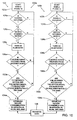
- FIG. 10 Another flow chart 120 is illustrated in Fig. 10 to depict another exemplary embodiment of operation of the invention apparatus and method according to the invention.
- the flow chart 120 has two parallel tracks 120a, 120b, respectively representing the operation of the mobile phones 10, 12, for example, as they are held in a user's hand 14 and moved, as by shaking them.
- the two tracks of the flow chart 120 commence, e.g., upon turning on the mobile phones 10, 12.
- an inquiry is made whether shaking (or some other motion) is occurring. If not, then a loop is followed back to the input to block 124a, 124b, respectively.
- an inquiry is made whether the motion is intended motion, e.g., according to detection by the threshold, amplitude and/or frequency detectors 66, 68, 70 described above in the motion signal processing circuit 62 ( Fig. 3 ). If the motion is not intended motion for a respective mobile phone 10, 12, then a respective loop is followed back to the input of block 124a or 124b. If the motion is intended motion, then at block 128 Bluetooth communication function is turned on (or some other short distance communication mechanism is turned on) so that a signal from the other mobile phone can be received for subsequent comparison.
- an inquiry is made whether the motion signal from another device, e.g., the other mobile phone, has been received via the turned on Bluetooth or other short distance communication, e.g., IR or WLAN. If not, then Bluetooth may be turned off (or not, as desired), and a loop is followed back to a respective block 124a, 124b.
- the Bluetooth function may be turned off when no signal has been received or it may be turned off based on a timer that is part of the control circuit 42 or a separate timer; or the Bluetooth function may be turned off manually by the user.
- a motion signal is received from the other mobile phone
- at blocks 132a, 132b inquiries are made, e.g., a comparison is made, of the received signal representing motion of the other mobile phone and the motion of the instant mobile phone; and if they are substantially the same, then at blocks 134a, 134b secure communication is established between the two mobile phones 10, 12.
- data is transferred (block 136) between the respective mobile phones using SMS, MMS or some other transfer process, e.g., as was described above with respect to the steps at blocks 92-104 ( Fig. 7 ).
- the transfer may be according the default data transfer instructions or selected data transfer instructions, e.g., as was described above with respect to Fig. 8 .
- the communication between the mobile phones 10, 12 may be terminated.
- computer program elements and/or circuitry elements of the invention may be embodied in hardware and/or in software (including firmware, resident software, micro-code, etc.).
- the invention may take the form of a computer program ' product, which can be embodied by a computer-usable or computer-readable storage medium having computer-usable or computer-readable program instructions, "code” or a "computer program” embodied in the medium for use by or in connection with the instruction execution system.
- a computer-usable or computer-readable medium may be any medium that can contain, store, communicate, propagate, or transport the program for use by or in connection with the instruction execution system, apparatus, or device.
- the computer-usable or computer-readable medium may be, for example but not limited to, an electronic, magnetic, optical, electromagnetic, infrared, or semiconductor system, apparatus, device, or propagation medium such as the Internet.
- the computer-usable or computer-readable medium could even be paper or another suitable medium upon which the program is printed; as the program can be electronically captured, via, for instance, optical scanning of the paper or other medium, then compiled, interpreted, or otherwise processed in a suitable manner.
- the computer program product and any software and hardware described herein form the various means for carrying out the functions of the invention in the example embodiments.
Landscapes
- Engineering & Computer Science (AREA)
- Theoretical Computer Science (AREA)
- Computer Hardware Design (AREA)
- General Engineering & Computer Science (AREA)
- Physics & Mathematics (AREA)
- General Physics & Mathematics (AREA)
- Human Computer Interaction (AREA)
- Computer Security & Cryptography (AREA)
- Computer Networks & Wireless Communication (AREA)
- Signal Processing (AREA)
- Computing Systems (AREA)
- Telephone Function (AREA)
- Mobile Radio Communication Systems (AREA)
- Near-Field Transmission Systems (AREA)
Claims (9)
- Elektronische Ausrüstung (10, 110), umfassend
einen Wandler (60, 62), wobei der Wandler betreibbar ist, Bewegung der elektronischen Ausrüstung zu detektieren;
einen Sender (42, 52), der auf detektierte Bewegung reagibel ist, um Informationen aus der elektronischen Ausrüstung zu senden,
einen Detektor (42, 52), der auf ein für Bewegung einer anderen elektronischen Ausrüstung repräsentatives Signal reagibel ist, und
dadurch gekennzeichnet, dass der Sender reagibel auf eine vorbestimmte Beziehung zwischen der durch den Wandler detektierten Bewegung und einen für eine Bewegung einer anderen elektronischen Ausrüstung repräsentativen Signal reagibel ist, um eine andere elektronische Ausrüstung zu identifizieren, so dass ein Kommunikationskanal zwischen den korrekten elektronischen Ausrüstungen hergestellt wird, und Informationen in Bezug auf solch eine andere elektronische Ausrüstung über die hergestellte Kommunikationsverbindung zu senden, und
wobei die vorgegebene Beziehung ein übliches Bewegungsmuster der elektronischen Ausrüstung und solcher anderer elektronischer Ausrüstung ist und der Wandler eine Signalkonditionierungsschaltung umfasst, um Signale herauszufiltern, welche Bewegung repräsentieren, die nicht für die beabsichtigte Bewegung der elektronischen Ausrüstung repräsentativ ist, und die Signalkonditionierungsschaltung einen Tiefpassfilter (64) umfasst. - Elektronische Ausrüstung nach Anspruch 1, wobei die elektronische Ausrüstung ein Mobiltelefon (10) und/oder ein PDA (110) ist und die andere elektronische Ausrüstung ein Mobiltelefon (12) und/oder ein PDA (112) ist.
- Elektronische Ausrüstung nach Ansprüchen 1 bis 2, wobei die elektronische Ausrüstung ein Mobiltelefon ist und die andere elektronische Ausrüstung ein Mobiltelefon ist.
- Elektronische Ausrüstung nach Ansprüchen 1 bis 3, wobei der Wandler betreibbar ist, ein Schütteln zu detektieren.
- Elektronische Ausrüstung nach Ansprüchen 1 bis 4, wobei der Wandler einen Beschleunigungsmesser umfasst.
- Elektronische Ausrüstung nach Ansprüchen 1 bis 5, wobei der Sender zumindest eines umfasst von einer Kurzdistanz-Sendevorrichtung, einer Bluetooth-Kommunikationsvorrichtung, einer Infrarot-Kommunikationsvorrichtung, einer WLAN-Kommunikationsvorrichtung oder einem Signalvariationsdetektor.
- Elektronische Ausrüstung nach Ansprüchen 1 bis 6, weiter umfassend eine weitere elektronische Ausrüstung, wobei beide elektronische Ausrüstungen Detektorschaltungskreise beinhalten, die betreibbar sind, das Auftreten zumindest der im Wesentlichen gleichen Bewegung der elektronischen Ausrüstung zu detektieren, um eine Paarung der elektronischen Ausrüstung zu initiieren, und wobei in Reaktion auf eine solche Paarung die Detektorschaltkreise Informationen zwischen der elektronischen Ausrüstung übertragen.
- Elektronische Ausrüstung nach Anspruch 7, wobei das Übertragen von Information das Übertragen von Einstellungen, Kontakten, Adressbuch und/oder Kontakten umfasst.
- Elektronische Ausrüstung nach Ansprüchen 1 bis 8, wobei der Wandler einen Beschleunigungsmesser umfasst und die Bewegung Schütteln, Dauer der Bewegung, Amplitude der Bewegung, Beschleunigung und/oder Frequenz der Bewegung umfasst.
Applications Claiming Priority (3)
| Application Number | Priority Date | Filing Date | Title |
|---|---|---|---|
| US11/373,655 US20070211573A1 (en) | 2006-03-10 | 2006-03-10 | Electronic equipment with data transfer function using motion and method |
| US11/555,844 US20070213045A1 (en) | 2006-03-10 | 2006-11-02 | Electronic equipment with data transfer function using motion and method |
| PCT/IB2006/003595 WO2007105032A2 (en) | 2006-03-10 | 2006-12-13 | Electronic equipment with data transfer function using motion and method |
Publications (2)
| Publication Number | Publication Date |
|---|---|
| EP1994462A2 EP1994462A2 (de) | 2008-11-26 |
| EP1994462B1 true EP1994462B1 (de) | 2011-05-18 |
Family
ID=37904282
Family Applications (1)
| Application Number | Title | Priority Date | Filing Date |
|---|---|---|---|
| EP06821059A Not-in-force EP1994462B1 (de) | 2006-03-10 | 2006-12-13 | Elektronische geräte mit einer bewegung verwendenen datentransferfunktion und verfahren |
Country Status (4)
| Country | Link |
|---|---|
| US (1) | US20070213045A1 (de) |
| EP (1) | EP1994462B1 (de) |
| AT (1) | ATE510251T1 (de) |
| WO (1) | WO2007105032A2 (de) |
Families Citing this family (50)
| Publication number | Priority date | Publication date | Assignee | Title |
|---|---|---|---|---|
| US20080266080A1 (en) * | 2007-04-30 | 2008-10-30 | Wing Fai Leung | Wireless communication system |
| US7769927B2 (en) * | 2007-07-19 | 2010-08-03 | Lenovo (Singapore) Pte. Ltd. | Apparatus, system, and method for acceleration initiated association |
| US7907901B1 (en) | 2007-09-13 | 2011-03-15 | Dp Technologies, Inc. | Method and apparatus to enable pairing of devices |
| US8707327B2 (en) * | 2007-09-30 | 2014-04-22 | Lenovo (Singapore) Pte. Ltd. | Methods and arrangements for effecting supplementary mail transfer or management |
| US8392591B2 (en) | 2007-12-28 | 2013-03-05 | Cellspinsoft Inc. | Automatic multimedia upload for publishing data and multimedia content |
| US9467850B2 (en) * | 2007-12-31 | 2016-10-11 | Intel Corporation | Handheld device association via shared vibration |
| US20090192912A1 (en) * | 2008-01-30 | 2009-07-30 | Kent Griffin | Charge-for-service near field communication transactions |
| FR2934069B1 (fr) * | 2008-07-16 | 2010-09-10 | Leyio | Dispositif personnel de partage |
| FR2934068A1 (fr) * | 2008-07-16 | 2010-01-22 | Bruno Maurel | Dispositif personnel de partage |
| US7796190B2 (en) | 2008-08-15 | 2010-09-14 | At&T Labs, Inc. | System and method for adaptive content rendition |
| CN101383870B (zh) * | 2008-10-13 | 2013-08-07 | 深圳市同洲电子股份有限公司 | 一种移动终端及其数据发送方法、系统及网络系统 |
| US20100167646A1 (en) * | 2008-12-30 | 2010-07-01 | Motorola, Inc. | Method and apparatus for device pairing |
| US20100167711A1 (en) * | 2008-12-30 | 2010-07-01 | Motorola, Inc. | Method and system for creating communication groups |
| GB2469325B (en) * | 2009-04-09 | 2015-11-18 | Money Controls Ltd | Apparatus and method for enabling a transfer of data |
| KR101094506B1 (ko) * | 2009-04-21 | 2011-12-19 | 삼성에스디에스 주식회사 | 디바이스 충격을 이용한 무선 네트워크 연결 제어 방법 및 응용 프로그램 제어 방법과 그 디바이스 |
| KR101706978B1 (ko) * | 2009-08-26 | 2017-02-17 | 삼성전자주식회사 | 블루투스 통신방법 및 이를 적용한 단말기 |
| US20110076941A1 (en) * | 2009-09-30 | 2011-03-31 | Ebay Inc. | Near field communication and network data/product transfer |
| US10095276B2 (en) * | 2009-11-25 | 2018-10-09 | Visa International Service Association | Information access device and data transfer |
| JP5683872B2 (ja) * | 2010-08-24 | 2015-03-11 | オリンパスイメージング株式会社 | 情報機器の通信方法、情報機器、及び情報機器の通信プログラム |
| TWI499902B (zh) * | 2010-09-16 | 2015-09-11 | Piime View Internat Co Ltd | 電子書及其電源控制器及其電源控制方法 |
| KR101145528B1 (ko) * | 2010-10-18 | 2012-05-15 | 주식회사 엘지유플러스 | 모바일 dlna 디바이스 |
| US11004056B2 (en) | 2010-12-30 | 2021-05-11 | Visa International Service Association | Mixed mode transaction protocol |
| US9052876B2 (en) * | 2011-05-13 | 2015-06-09 | Symbol Technologies, Llc | Peer-to-peer event-time secured link establishment |
| CN102904618B (zh) | 2011-07-26 | 2016-04-27 | 联想(北京)有限公司 | 一种设备间通信处理方法及装置 |
| TWM426825U (en) * | 2011-09-02 | 2012-04-11 | Spectec Comp Co Ltd | Wireless communication card for insertion with memory card |
| US10423248B2 (en) * | 2011-10-28 | 2019-09-24 | Wacom Co., Ltd. | Touch-sensitive system with motion filtering |
| FR2984654A1 (fr) * | 2011-12-16 | 2013-06-21 | St Microelectronics Crolles 2 | Appairage de dispositifs sans fil |
| US20130234925A1 (en) * | 2012-03-09 | 2013-09-12 | Nokia Corporation | Method and apparatus for performing an operation at least partially based upon the relative positions of at least two devices |
| US9959567B2 (en) * | 2012-07-12 | 2018-05-01 | Sears Brands, Llc | Systems and methods of targeted interactions for integrated retail applications |
| KR20140031468A (ko) * | 2012-08-31 | 2014-03-13 | 주식회사 팬택 | 휴대 단말 및 이의 컨텐츠 공유 방법 |
| US9152971B2 (en) | 2012-09-26 | 2015-10-06 | Paypal, Inc. | Dynamic mobile seller routing |
| WO2014190534A1 (zh) * | 2013-05-31 | 2014-12-04 | 东莞宇龙通信科技有限公司 | 移动终端、可穿戴设备和设备配对方法 |
| US9389691B2 (en) * | 2013-06-21 | 2016-07-12 | Blackberry Limited | Devices and methods for establishing a communicative coupling in response to a gesture |
| TW201525716A (zh) * | 2013-12-23 | 2015-07-01 | Qisda Corp | 行動裝置配對方法 |
| US10057354B2 (en) | 2014-05-30 | 2018-08-21 | Genesys Telecommunications Laboratories, Inc. | System and method for single logout of applications |
| US9632824B2 (en) * | 2014-05-30 | 2017-04-25 | Genesys Telecommunications Laboratories, Inc. | System and method for application inactivity control |
| JP2016021728A (ja) * | 2014-06-17 | 2016-02-04 | 船井電機株式会社 | ロック制御システム、携帯端末、電気機器 |
| US9986086B2 (en) | 2014-07-31 | 2018-05-29 | Samsung Electronics Co., Ltd. | Mobile terminal and method of operating the same |
| KR20160016490A (ko) * | 2014-07-31 | 2016-02-15 | 삼성전자주식회사 | 이동 단말기 및 그 동작방법 |
| US9514296B2 (en) * | 2014-09-08 | 2016-12-06 | Qualcomm Incorporated | Automatic authorization for access to electronic device |
| US11170616B2 (en) | 2016-03-16 | 2021-11-09 | Triax Technologies, Inc. | System and interfaces for managing workplace events |
| US11810032B2 (en) | 2016-03-16 | 2023-11-07 | Triax Technologies, Inc. | Systems and methods for low-energy wireless applications using networked wearable sensors |
| US10769562B2 (en) | 2016-03-16 | 2020-09-08 | Triax Technologies, Inc. | Sensor based system and method for authorizing operation of worksite equipment using a locally stored access control list |
| US10692024B2 (en) | 2016-03-16 | 2020-06-23 | Triax Technologies, Inc. | Wireless mesh network system for monitoring worksite events including detecting false events |
| FR3042939A1 (fr) * | 2016-03-23 | 2017-04-28 | Orange | Procede d'appariement d'un peripherique avec une passerelle |
| TWI611321B (zh) * | 2016-04-29 | 2018-01-11 | 和碩聯合科技股份有限公司 | 可攜式電子裝置及其控制方法 |
| US20180224927A1 (en) * | 2017-01-18 | 2018-08-09 | Htc Corporation | Positioning apparatus and method |
| US9949124B1 (en) * | 2017-04-24 | 2018-04-17 | Zihan Chen | Method and device for authenticating wireless pairing and/or data transfer between two or more electronic devices |
| DE102017212538B4 (de) * | 2017-07-21 | 2026-02-26 | Bayerische Motoren Werke Aktiengesellschaft | Verfahren und Steuereinheit zur Kopplung eines mobilen Endgeräts mit einem Fahrzeug |
| EP3447611A1 (de) * | 2017-08-25 | 2019-02-27 | Bundesdruckerei GmbH | Verfahren zum übertragen digitaler informationen zwischen wenigstens zwei elektronischen geräten |
Family Cites Families (17)
| Publication number | Priority date | Publication date | Assignee | Title |
|---|---|---|---|---|
| FI20000529L (fi) * | 2000-03-08 | 2001-09-09 | Nokia Mobile Phones Ltd | Menetelmä avainkoodin syöttämiseksi elektroniikkalaitteeseen ja elektroniikkalaite |
| US7068294B2 (en) * | 2001-03-30 | 2006-06-27 | Koninklijke Philips Electronics N.V. | One-to-one direct communication |
| US7159194B2 (en) * | 2001-11-30 | 2007-01-02 | Palm, Inc. | Orientation dependent functionality of an electronic device |
| US7369868B2 (en) * | 2002-10-30 | 2008-05-06 | Sony Ericsson Mobile Communications Ab | Method and apparatus for sharing content with a remote device using a wireless network |
| US20040203381A1 (en) * | 2002-12-31 | 2004-10-14 | Cahn Janet E. | Method and apparatus for data transfer |
| US20060146765A1 (en) * | 2003-02-19 | 2006-07-06 | Koninklijke Philips Electronics, N.V. | System for ad hoc sharing of content items between portable devices and interaction methods therefor |
| US20050101314A1 (en) * | 2003-11-10 | 2005-05-12 | Uri Levi | Method and system for wireless group communications |
| US8639819B2 (en) * | 2004-02-05 | 2014-01-28 | Nokia Corporation | Ad-hoc connection between electronic devices |
| US7299009B2 (en) * | 2004-02-25 | 2007-11-20 | Nokia Corporation | Blue-tooth assisted wireless local area network (WLAN) home network systems |
| US7280096B2 (en) * | 2004-03-23 | 2007-10-09 | Fujitsu Limited | Motion sensor engagement for a handheld device |
| US7176886B2 (en) * | 2004-03-23 | 2007-02-13 | Fujitsu Limited | Spatial signatures |
| US20050222801A1 (en) * | 2004-04-06 | 2005-10-06 | Thomas Wulff | System and method for monitoring a mobile computing product/arrangement |
| US7877082B2 (en) * | 2004-05-06 | 2011-01-25 | Massachusetts Institute Of Technology | Combined short range radio network and cellular telephone network for interpersonal communications |
| JP4498417B2 (ja) * | 2004-07-01 | 2010-07-07 | ノキア コーポレイション | 移動通信装置用アプリケーションのパーソナライズにおいてコンテキスト・オントロジを利用する方法,装置及びコンピュータプログラム |
| KR100668311B1 (ko) * | 2004-11-02 | 2007-01-12 | 삼성전자주식회사 | 이동 통신 단말기를 이용한 정보 처리 장치 및 방법 |
| US8339363B2 (en) * | 2005-05-13 | 2012-12-25 | Robert Bosch Gmbh | Sensor-initiated exchange of information between devices |
| US7427926B2 (en) * | 2006-01-26 | 2008-09-23 | Microsoft Corporation | Establishing communication between computing-based devices through motion detection |
-
2006
- 2006-11-02 US US11/555,844 patent/US20070213045A1/en not_active Abandoned
- 2006-12-13 AT AT06821059T patent/ATE510251T1/de not_active IP Right Cessation
- 2006-12-13 WO PCT/IB2006/003595 patent/WO2007105032A2/en not_active Ceased
- 2006-12-13 EP EP06821059A patent/EP1994462B1/de not_active Not-in-force
Also Published As
| Publication number | Publication date |
|---|---|
| ATE510251T1 (de) | 2011-06-15 |
| WO2007105032A3 (en) | 2008-05-02 |
| US20070213045A1 (en) | 2007-09-13 |
| EP1994462A2 (de) | 2008-11-26 |
| WO2007105032A2 (en) | 2007-09-20 |
Similar Documents
| Publication | Publication Date | Title |
|---|---|---|
| EP1994462B1 (de) | Elektronische geräte mit einer bewegung verwendenen datentransferfunktion und verfahren | |
| US20070211573A1 (en) | Electronic equipment with data transfer function using motion and method | |
| US20070259685A1 (en) | Electronic equipment with keylock function using motion and method | |
| US11785465B2 (en) | Facilitating a secure session between paired devices | |
| EP2220855B1 (de) | Wechselwirken mit einrichtungen auf der basis eines physischen kontakts von einrichtung zu einrichtung | |
| KR101309944B1 (ko) | 휴대용 장치로부터 데이터 전송을 위한 방법 및 시스템 | |
| US8498631B2 (en) | Activation of applications based on vibration of portable electronic device | |
| KR101572847B1 (ko) | 휴대용 단말기의 동작 감지 장치 및 방법 | |
| JP6789668B2 (ja) | 情報処理装置、情報処理システム、情報処理方法 | |
| CN101627396B (zh) | 基于受限设备的地理存在来保护数据的系统和方法 | |
| JP2006074477A (ja) | 通信用端末装置、通信用端末装置の機能設定変更方法及びそのプログラム | |
| JP5407522B2 (ja) | 通信機器 | |
| CN104918253B (zh) | 假基站的识别方法、装置和终端设备 | |
| CN107402628A (zh) | 信息处理装置,信息处理系统和信息处理方法 | |
| JP2003101640A (ja) | 携帯端末 | |
| JP2002135369A (ja) | 携帯電話端末およびそのキー制御方法 | |
| JPWO2004107789A1 (ja) | 携帯無線端末および携帯無線端末制御方法 | |
| JP2006345016A (ja) | 非接触icカード機能を有する携帯電話機及びその制御方法 | |
| JP2016092476A (ja) | 電子機器、制御方法、及び制御プログラム | |
| JP2005094442A (ja) | 無線通信装置及び音情報伝達装置 | |
| JP4467526B2 (ja) | 携帯通信端末 | |
| KR101497181B1 (ko) | 통화모드를 제어하는 방법, 모바일 단말기 및 기록매체 | |
| KR100651529B1 (ko) | 휴대단말기에서 보안기능 설정 및 해제 방법 | |
| KR20050051791A (ko) | 신체 접촉에 따른 벨소리 출력 방법 및 이를 구현하는이동통신단말기 | |
| JP2005198135A (ja) | 電子機器、その制御方法、制御プログラム及び記録媒体 |
Legal Events
| Date | Code | Title | Description |
|---|---|---|---|
| PUAI | Public reference made under article 153(3) epc to a published international application that has entered the european phase |
Free format text: ORIGINAL CODE: 0009012 |
|
| 17P | Request for examination filed |
Effective date: 20080910 |
|
| AK | Designated contracting states |
Kind code of ref document: A2 Designated state(s): AT BE BG CH CY CZ DE DK EE ES FI FR GB GR HU IE IS IT LI LT LU LV MC NL PL PT RO SE SI SK TR |
|
| AX | Request for extension of the european patent |
Extension state: AL BA HR MK RS |
|
| 17Q | First examination report despatched |
Effective date: 20090115 |
|
| GRAP | Despatch of communication of intention to grant a patent |
Free format text: ORIGINAL CODE: EPIDOSNIGR1 |
|
| DAX | Request for extension of the european patent (deleted) | ||
| GRAS | Grant fee paid |
Free format text: ORIGINAL CODE: EPIDOSNIGR3 |
|
| GRAA | (expected) grant |
Free format text: ORIGINAL CODE: 0009210 |
|
| REG | Reference to a national code |
Ref country code: GB Ref legal event code: FG4D |
|
| REG | Reference to a national code |
Ref country code: CH Ref legal event code: EP |
|
| REG | Reference to a national code |
Ref country code: IE Ref legal event code: FG4D |
|
| REG | Reference to a national code |
Ref country code: DE Ref legal event code: R096 Ref document number: 602006022115 Country of ref document: DE Effective date: 20110630 |
|
| REG | Reference to a national code |
Ref country code: NL Ref legal event code: VDEP Effective date: 20110518 |
|
| PG25 | Lapsed in a contracting state [announced via postgrant information from national office to epo] |
Ref country code: LT Free format text: LAPSE BECAUSE OF FAILURE TO SUBMIT A TRANSLATION OF THE DESCRIPTION OR TO PAY THE FEE WITHIN THE PRESCRIBED TIME-LIMIT Effective date: 20110518 Ref country code: PT Free format text: LAPSE BECAUSE OF FAILURE TO SUBMIT A TRANSLATION OF THE DESCRIPTION OR TO PAY THE FEE WITHIN THE PRESCRIBED TIME-LIMIT Effective date: 20110919 Ref country code: SE Free format text: LAPSE BECAUSE OF FAILURE TO SUBMIT A TRANSLATION OF THE DESCRIPTION OR TO PAY THE FEE WITHIN THE PRESCRIBED TIME-LIMIT Effective date: 20110518 |
|
| PG25 | Lapsed in a contracting state [announced via postgrant information from national office to epo] |
Ref country code: ES Free format text: LAPSE BECAUSE OF FAILURE TO SUBMIT A TRANSLATION OF THE DESCRIPTION OR TO PAY THE FEE WITHIN THE PRESCRIBED TIME-LIMIT Effective date: 20110829 Ref country code: IS Free format text: LAPSE BECAUSE OF FAILURE TO SUBMIT A TRANSLATION OF THE DESCRIPTION OR TO PAY THE FEE WITHIN THE PRESCRIBED TIME-LIMIT Effective date: 20110918 Ref country code: AT Free format text: LAPSE BECAUSE OF FAILURE TO SUBMIT A TRANSLATION OF THE DESCRIPTION OR TO PAY THE FEE WITHIN THE PRESCRIBED TIME-LIMIT Effective date: 20110518 Ref country code: SI Free format text: LAPSE BECAUSE OF FAILURE TO SUBMIT A TRANSLATION OF THE DESCRIPTION OR TO PAY THE FEE WITHIN THE PRESCRIBED TIME-LIMIT Effective date: 20110518 Ref country code: BE Free format text: LAPSE BECAUSE OF FAILURE TO SUBMIT A TRANSLATION OF THE DESCRIPTION OR TO PAY THE FEE WITHIN THE PRESCRIBED TIME-LIMIT Effective date: 20110518 Ref country code: GR Free format text: LAPSE BECAUSE OF FAILURE TO SUBMIT A TRANSLATION OF THE DESCRIPTION OR TO PAY THE FEE WITHIN THE PRESCRIBED TIME-LIMIT Effective date: 20110819 Ref country code: FI Free format text: LAPSE BECAUSE OF FAILURE TO SUBMIT A TRANSLATION OF THE DESCRIPTION OR TO PAY THE FEE WITHIN THE PRESCRIBED TIME-LIMIT Effective date: 20110518 Ref country code: LV Free format text: LAPSE BECAUSE OF FAILURE TO SUBMIT A TRANSLATION OF THE DESCRIPTION OR TO PAY THE FEE WITHIN THE PRESCRIBED TIME-LIMIT Effective date: 20110518 Ref country code: CY Free format text: LAPSE BECAUSE OF FAILURE TO SUBMIT A TRANSLATION OF THE DESCRIPTION OR TO PAY THE FEE WITHIN THE PRESCRIBED TIME-LIMIT Effective date: 20110518 |
|
| PG25 | Lapsed in a contracting state [announced via postgrant information from national office to epo] |
Ref country code: NL Free format text: LAPSE BECAUSE OF FAILURE TO SUBMIT A TRANSLATION OF THE DESCRIPTION OR TO PAY THE FEE WITHIN THE PRESCRIBED TIME-LIMIT Effective date: 20110518 |
|
| PG25 | Lapsed in a contracting state [announced via postgrant information from national office to epo] |
Ref country code: EE Free format text: LAPSE BECAUSE OF FAILURE TO SUBMIT A TRANSLATION OF THE DESCRIPTION OR TO PAY THE FEE WITHIN THE PRESCRIBED TIME-LIMIT Effective date: 20110518 Ref country code: CZ Free format text: LAPSE BECAUSE OF FAILURE TO SUBMIT A TRANSLATION OF THE DESCRIPTION OR TO PAY THE FEE WITHIN THE PRESCRIBED TIME-LIMIT Effective date: 20110518 |
|
| PG25 | Lapsed in a contracting state [announced via postgrant information from national office to epo] |
Ref country code: DK Free format text: LAPSE BECAUSE OF FAILURE TO SUBMIT A TRANSLATION OF THE DESCRIPTION OR TO PAY THE FEE WITHIN THE PRESCRIBED TIME-LIMIT Effective date: 20110518 Ref country code: RO Free format text: LAPSE BECAUSE OF FAILURE TO SUBMIT A TRANSLATION OF THE DESCRIPTION OR TO PAY THE FEE WITHIN THE PRESCRIBED TIME-LIMIT Effective date: 20110518 Ref country code: SK Free format text: LAPSE BECAUSE OF FAILURE TO SUBMIT A TRANSLATION OF THE DESCRIPTION OR TO PAY THE FEE WITHIN THE PRESCRIBED TIME-LIMIT Effective date: 20110518 Ref country code: PL Free format text: LAPSE BECAUSE OF FAILURE TO SUBMIT A TRANSLATION OF THE DESCRIPTION OR TO PAY THE FEE WITHIN THE PRESCRIBED TIME-LIMIT Effective date: 20110518 |
|
| PLBE | No opposition filed within time limit |
Free format text: ORIGINAL CODE: 0009261 |
|
| STAA | Information on the status of an ep patent application or granted ep patent |
Free format text: STATUS: NO OPPOSITION FILED WITHIN TIME LIMIT |
|
| 26N | No opposition filed |
Effective date: 20120221 |
|
| PG25 | Lapsed in a contracting state [announced via postgrant information from national office to epo] |
Ref country code: IT Free format text: LAPSE BECAUSE OF FAILURE TO SUBMIT A TRANSLATION OF THE DESCRIPTION OR TO PAY THE FEE WITHIN THE PRESCRIBED TIME-LIMIT Effective date: 20110518 |
|
| REG | Reference to a national code |
Ref country code: DE Ref legal event code: R097 Ref document number: 602006022115 Country of ref document: DE Effective date: 20120221 |
|
| PG25 | Lapsed in a contracting state [announced via postgrant information from national office to epo] |
Ref country code: MC Free format text: LAPSE BECAUSE OF NON-PAYMENT OF DUE FEES Effective date: 20111231 |
|
| REG | Reference to a national code |
Ref country code: CH Ref legal event code: PL |
|
| REG | Reference to a national code |
Ref country code: IE Ref legal event code: MM4A |
|
| PG25 | Lapsed in a contracting state [announced via postgrant information from national office to epo] |
Ref country code: IE Free format text: LAPSE BECAUSE OF NON-PAYMENT OF DUE FEES Effective date: 20111213 Ref country code: CH Free format text: LAPSE BECAUSE OF NON-PAYMENT OF DUE FEES Effective date: 20111231 Ref country code: LI Free format text: LAPSE BECAUSE OF NON-PAYMENT OF DUE FEES Effective date: 20111231 |
|
| PG25 | Lapsed in a contracting state [announced via postgrant information from national office to epo] |
Ref country code: LU Free format text: LAPSE BECAUSE OF NON-PAYMENT OF DUE FEES Effective date: 20111213 |
|
| PG25 | Lapsed in a contracting state [announced via postgrant information from national office to epo] |
Ref country code: BG Free format text: LAPSE BECAUSE OF FAILURE TO SUBMIT A TRANSLATION OF THE DESCRIPTION OR TO PAY THE FEE WITHIN THE PRESCRIBED TIME-LIMIT Effective date: 20110818 |
|
| PG25 | Lapsed in a contracting state [announced via postgrant information from national office to epo] |
Ref country code: TR Free format text: LAPSE BECAUSE OF FAILURE TO SUBMIT A TRANSLATION OF THE DESCRIPTION OR TO PAY THE FEE WITHIN THE PRESCRIBED TIME-LIMIT Effective date: 20110518 |
|
| PG25 | Lapsed in a contracting state [announced via postgrant information from national office to epo] |
Ref country code: HU Free format text: LAPSE BECAUSE OF FAILURE TO SUBMIT A TRANSLATION OF THE DESCRIPTION OR TO PAY THE FEE WITHIN THE PRESCRIBED TIME-LIMIT Effective date: 20110518 |
|
| PGFP | Annual fee paid to national office [announced via postgrant information from national office to epo] |
Ref country code: DE Payment date: 20141209 Year of fee payment: 9 Ref country code: GB Payment date: 20141210 Year of fee payment: 9 |
|
| PGFP | Annual fee paid to national office [announced via postgrant information from national office to epo] |
Ref country code: FR Payment date: 20141208 Year of fee payment: 9 |
|
| REG | Reference to a national code |
Ref country code: DE Ref legal event code: R119 Ref document number: 602006022115 Country of ref document: DE |
|
| GBPC | Gb: european patent ceased through non-payment of renewal fee |
Effective date: 20151213 |
|
| REG | Reference to a national code |
Ref country code: FR Ref legal event code: ST Effective date: 20160831 |
|
| PG25 | Lapsed in a contracting state [announced via postgrant information from national office to epo] |
Ref country code: GB Free format text: LAPSE BECAUSE OF NON-PAYMENT OF DUE FEES Effective date: 20151213 Ref country code: DE Free format text: LAPSE BECAUSE OF NON-PAYMENT OF DUE FEES Effective date: 20160701 |
|
| PG25 | Lapsed in a contracting state [announced via postgrant information from national office to epo] |
Ref country code: FR Free format text: LAPSE BECAUSE OF NON-PAYMENT OF DUE FEES Effective date: 20151231 |