EP1995174A2 - Procédé pour le décollage vertical et l'atterrissage sur des surfaces inclinées - Google Patents
Procédé pour le décollage vertical et l'atterrissage sur des surfaces inclinées Download PDFInfo
- Publication number
- EP1995174A2 EP1995174A2 EP08101858A EP08101858A EP1995174A2 EP 1995174 A2 EP1995174 A2 EP 1995174A2 EP 08101858 A EP08101858 A EP 08101858A EP 08101858 A EP08101858 A EP 08101858A EP 1995174 A2 EP1995174 A2 EP 1995174A2
- Authority
- EP
- European Patent Office
- Prior art keywords
- air vehicle
- unmanned air
- inclined surface
- landing
- uav
- Prior art date
- Legal status (The legal status is an assumption and is not a legal conclusion. Google has not performed a legal analysis and makes no representation as to the accuracy of the status listed.)
- Withdrawn
Links
- 238000000034 method Methods 0.000 title claims description 23
- RZVHIXYEVGDQDX-UHFFFAOYSA-N 9,10-anthraquinone Chemical compound C1=CC=C2C(=O)C3=CC=CC=C3C(=O)C2=C1 RZVHIXYEVGDQDX-UHFFFAOYSA-N 0.000 claims abstract description 35
- 230000001174 ascending effect Effects 0.000 claims description 6
- 230000005484 gravity Effects 0.000 claims description 5
- 230000007246 mechanism Effects 0.000 abstract description 6
- 238000010586 diagram Methods 0.000 description 10
- 238000013500 data storage Methods 0.000 description 3
- 241000269799 Perca fluviatilis Species 0.000 description 2
- 230000008901 benefit Effects 0.000 description 2
- 230000007704 transition Effects 0.000 description 2
- 241000408659 Darpa Species 0.000 description 1
- 230000009286 beneficial effect Effects 0.000 description 1
- 230000008859 change Effects 0.000 description 1
- 230000000694 effects Effects 0.000 description 1
- 239000000446 fuel Substances 0.000 description 1
- 238000005259 measurement Methods 0.000 description 1
- 230000009467 reduction Effects 0.000 description 1
Images



Classifications
-
- B—PERFORMING OPERATIONS; TRANSPORTING
- B64—AIRCRAFT; AVIATION; COSMONAUTICS
- B64D—EQUIPMENT FOR FITTING IN OR TO AIRCRAFT; FLIGHT SUITS; PARACHUTES; ARRANGEMENT OR MOUNTING OF POWER PLANTS OR PROPULSION TRANSMISSIONS IN AIRCRAFT
- B64D45/00—Aircraft indicators or protectors not otherwise provided for
- B64D45/04—Landing aids; Safety measures to prevent collision with earth's surface
-
- G—PHYSICS
- G05—CONTROLLING; REGULATING
- G05D—SYSTEMS FOR CONTROLLING OR REGULATING NON-ELECTRIC VARIABLES
- G05D1/00—Control of position, course, altitude or attitude of land, water, air or space vehicles, e.g. using automatic pilots
- G05D1/04—Control of altitude or depth
- G05D1/06—Rate of change of altitude or depth
- G05D1/0607—Rate of change of altitude or depth specially adapted for aircraft
- G05D1/0653—Rate of change of altitude or depth specially adapted for aircraft during a phase of take-off or landing
-
- G—PHYSICS
- G05—CONTROLLING; REGULATING
- G05D—SYSTEMS FOR CONTROLLING OR REGULATING NON-ELECTRIC VARIABLES
- G05D1/00—Control of position, course, altitude or attitude of land, water, air or space vehicles, e.g. using automatic pilots
- G05D1/08—Control of attitude, i.e. control of roll, pitch, or yaw
- G05D1/0808—Control of attitude, i.e. control of roll, pitch, or yaw specially adapted for aircraft
- G05D1/0858—Control of attitude, i.e. control of roll, pitch, or yaw specially adapted for aircraft specially adapted for vertical take-off of aircraft
-
- B—PERFORMING OPERATIONS; TRANSPORTING
- B64—AIRCRAFT; AVIATION; COSMONAUTICS
- B64U—UNMANNED AERIAL VEHICLES [UAV]; EQUIPMENT THEREFOR
- B64U10/00—Type of UAV
- B64U10/20—Vertical take-off and landing [VTOL] aircraft
-
- B—PERFORMING OPERATIONS; TRANSPORTING
- B64—AIRCRAFT; AVIATION; COSMONAUTICS
- B64U—UNMANNED AERIAL VEHICLES [UAV]; EQUIPMENT THEREFOR
- B64U10/00—Type of UAV
- B64U10/80—UAVs characterised by their small size, e.g. micro air vehicles [MAV]
-
- B—PERFORMING OPERATIONS; TRANSPORTING
- B64—AIRCRAFT; AVIATION; COSMONAUTICS
- B64U—UNMANNED AERIAL VEHICLES [UAV]; EQUIPMENT THEREFOR
- B64U2201/00—UAVs characterised by their flight controls
- B64U2201/20—Remote controls
-
- B—PERFORMING OPERATIONS; TRANSPORTING
- B64—AIRCRAFT; AVIATION; COSMONAUTICS
- B64U—UNMANNED AERIAL VEHICLES [UAV]; EQUIPMENT THEREFOR
- B64U30/00—Means for producing lift; Empennages; Arrangements thereof
- B64U30/20—Rotors; Rotor supports
- B64U30/26—Ducted or shrouded rotors
-
- B—PERFORMING OPERATIONS; TRANSPORTING
- B64—AIRCRAFT; AVIATION; COSMONAUTICS
- B64U—UNMANNED AERIAL VEHICLES [UAV]; EQUIPMENT THEREFOR
- B64U50/00—Propulsion; Power supply
- B64U50/10—Propulsion
- B64U50/13—Propulsion using external fans or propellers
- B64U50/14—Propulsion using external fans or propellers ducted or shrouded
Definitions
- the present invention relates generally to vertical takeoff and landing, and more particularly, relates to vertical takeoff from and landing on inclined surfaces.
- UAVs Unmanned Air Vehicles
- VTOL vertical take-off and landing
- the VTOL UAV may be capable of operating in a variety of areas, such as constrained urban areas and non-urban areas commonly described as having "complex" terrain.
- the VTOL UAV is designed to perform autonomous missions that generally require the UAV to launch vertically, fly along a pre-planned flight plan, and land vertically. For example, at some point while flying a mission, the UAV may be expected to perform "perch and stare" observations. Perch and stare observations require the UAV to land vertically, perform observations (possibly for an extended period of time with engine shutdown), and takeoff vertically.
- a mission may require the VTOL UAV to takeoff from and land on unprepared ground or vehicle decks.
- the takeoff and landing surfaces may not be level and, for example, may be inclined up to as much as 30 degrees or more.
- mechanical landing gear mechanisms have been designed to level the UAV so that the UAV can vertically takeoff from and land on inclined surfaces.
- these mechanical landing gear mechanisms are complex and heavy, which may compromise both the durability and flight performance of the UAV.
- some of these mechanical landing gear mechanisms are limited to inclines of 10 degrees or less, which may limit the UAV from performing missions in certain terrain conditions.
- VTOL UAV VTOL UAV to be able to vertically takeoff from and land on an inclined surface without using a mechanical landing gear mechanism to compensate for the incline.
- a method for landing an unmanned air vehicle on an inclined surface includes descending vertically above the inclined surface, detecting a pressure differential caused by the inclined surface, counteracting motion caused by the pressure differential, detecting when the unmanned air vehicle contacts the inclined surface, and when the unmanned air vehicle contacts the inclined surface, rotating the unmanned air vehicle until the unmanned vehicle has landed on the inclined surface.
- vanes of the unmanned air vehicle may be adjusted. Additionally, the throttle of the unmanned air vehicle may be adjusted to counteract the motion caused by the pressure differential.
- a flight control system of the unmanned air vehicle may detect a landing touch condition.
- the vanes of the unmanned air vehicle may be adjusted. Adjusting the vanes may include moving the vanes to counteract motion induced when the unmanned air vehicle contacts the inclined surface. Additionally, the throttle of the unmanned air vehicle may be adjusted to control the rate of descent of the vehicle. Adjusting the throttle may include increasing the throttle to counteract gravitational forces.
- a method for vertical takeoff of an unmanned air vehicle from an inclined surface includes receiving a command to launch, determining attitude orientation, orienting vanes of the unmanned air vehicle to counteract gravity, increasing thrust to release landing gear of the unmanned air vehicle from the inclined surface, and ascending substantially perpendicular from the inclined surface.
- Determining attitude orientation may identify whether the unmanned air vehicle is located on the inclined surface.
- Orienting vanes may include adjusting the vanes to a positive angle based on the attitude orientation determination.
- the method may also include ascending substantially vertically at a distance above the inclined surface.
- a method for vertical takeoff from and landing on inclined surfaces includes providing a takeoff mode in a flight control system of an unmanned air vehicle.
- the takeoff mode adjusts at least one vane and a thrust of the unmanned air vehicle so as to initially ascend substantially perpendicular to the inclined surface.
- the method also includes providing a landing mode in the flight control system of the unmanned air vehicle. The landing mode adjusts the at least one vane and the thrust of the unmanned air vehicle upon detecting that the unmanned air vehicle has contacted the inclined surface at a contact point so as to rotate the unmanned air vehicle about the contact point until the unmanned air vehicle has landed.
- the takeoff mode may adjust the vanes based on an attitude orientation determination.
- the landing mode may rotate the unmanned air vehicle in an uphill direction. Additionally, the landing mode counteracts motion induced by the contact point.
- Fig. 1 is a block diagram of a Vertical Take-Off and Landing (VTOL) Unmanned Air Vehicle (UAV) 100.
- the UAV 100 includes a fuselage 102, a duct 104, control vanes 106, and landing gear 108.
- the UAV 100's center of gravity 114 is typically above the control vanes 106.
- the UAV 100 includes other components as well and is not limited to any particular VTOL UAV design.
- the UAV 100 may be an Organic Air Vehicle (OAV) or a Miniature Air Vehicle (MAV).
- OAV Organic Air Vehicle
- MAV Miniature Air Vehicle
- the fuselage 102 may be a housing that contains other components of the UAV 100.
- the fuselage 102 may contain an engine for powering the UAV 100 and storage of fuel, such as gasoline, for the engine.
- the fuselage 102 may also contain components for vehicle operation, such as a flight control system 110 and a navigation system 112.
- the flight control system 110 may include a processor, a data storage device, and mode control software to control the UAV 100 in flight.
- the flight control system 110 receives inputs from the navigation system 112 and/or an operator of the UAV 100.
- the flight control system 110 may adjust the vanes and throttle to control the movement of the UAV 110.
- the navigation system 112 may include inertial measurement sensors, a global positioning satellite (GPS) sensor, an above ground level sensor, barometric pressure sensors, magnetometers, rate sensors, and accelerometers. Additionally, the navigation system 112 may include a processor and a data storage device. A navigation algorithm may be stored in the data storage device. The navigation system 112 may receive data from the sensors and the processor may execute the navigation algorithm to provide as an output a navigation solution. The navigation solution may be an estimate of the UAV 100's position, altitude, height above ground, attitudes (e.g., pitch, roll, yaw), attitude rates, velocity, and/or time.
- GPS global positioning satellite
- the duct 104 includes a fan that draws in air through the duct 104 to provide lift.
- the fan draws air in through the top of the duct 104 and expels it out the bottom to provide thrust.
- the thrust produced by the duct 104 and fan combination is powerful enough to enable the UAV 100 to hover, as well as fly.
- the control vanes 106 may be located under the fan located within the duct 104. The control vanes 106 provide thrust vectoring for the UAV 100.
- the landing gear 108 is the structure that supports the UAV 100 when not flying and allows the UAV 100 to land on the ground after a flight.
- the landing gear 108 may be a fixed or active mechanical landing gear mechanism.
- the landing gear 108 may include three-point posts or a landing ring. As depicted in Fig. 1 , the landing gear 108 has three-point posts; however, the invention is not limited to this type of landing gear.
- Fig. 2 is a flow chart of a method 200 for vertical landing on an incline.
- the UAV 100 begins descending vertically under the control of a pre-existing flight control mode.
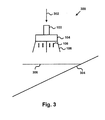
- Fig. 3 is a pictorial diagram 300 of the VTOL UAV 100 vertically descending 302 above an inclined surface 304.
- the landing flight control mode is engaged either manually by the operator or automatically when the UAV's above ground level (AGL) sensor determines that the UAV 100 is at a predetermined height above the inclined surface 304.
- the landing flight control mode is preferably a software program that is executed by the flight control system 110.
- the landing flight control mode monitors the attitude orientation of the UAV 100 from data derived from the navigation system 112. In a normal descent, the UAV 100 is above an attitude 306 where the surface pressure affects the UAV 100 and the pressure differential across the lower duct 104 is uniform.
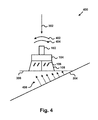
- the UAV 100 detects a pressure differential 406 as seen in Fig. 4 .
- the pressure differential 406 may be inferred from the attitude data without the use of pressure sensors. Alternatively, the pressure differential 406 may be detected with the use of pressure sensors.
- Fig. 4 is a pictorial diagram 400 of the VTOL UAV 100 as it further descends above the inclined surface 304.
- the flight control system 110 is operable to detect and compensate for the pressure differential 406 encountered by the UAV 100.
- the flight control system 110 detects and compensates for the pressure differential 406 by modulating the vanes 106 and controlling the throttle.
- the flight control system 110 counteracts the motion 404 induced by the surface pressure with a counteracting vane motion 402.
- the vane deflection may vary based on surface inclination, while the throttle setting is based on trusting to maintain vehicle descent rate.
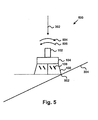
- Fig. 5 is a pictorial diagram 500 of the UAV 100 after the UAV 100 contacts the inclined surface 304 at a contact point 502.
- the landing touch condition is satisfied. This condition may be detected by existing onboard sensors included in the navigation system 112.
- the vanes 106 are adjusted to provide thrust to impart a rotation to the UAV 100 in an uphill direction as illustrated in Fig. 5 .
- the counteracting vane motion 504 is designed to counteract the motion 506 induced by the touch point 502.
- the throttle is also modulated as depicted in Fig. 8 to provide sufficient thrust to counteract gravitational forces on the UAV 100 while the vanes 106 are in transition, but not so much as to detach the landing gear 108 from the incline 304.
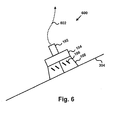
- Fig. 6 is a pictorial diagram 600 of the UAV 100 after the UAV 100 has landed on the inclined surface 304.
- the landing flight control adjusts the vanes 106 to pivot the UAV 100 about the touch point 502 at a controlled rate to gently lower the UAV 100 until all of the landing gear 108 contact the inclined surface 304. At this point, the landing condition is satisfied.
- the landing condition may be detected by existing onboard sensors as a decrease to zero of the vehicle attitude angular rate in spite of continued reductions in throttle.
- a secondary condition for the landing condition is that the onboard sensors detect that the UAV 100 has met the vehicle-specific tip-over angle.
- the throttle is reduced to zero or idle to fully seat the UAV 100.
- the expected throttle settings and vane deflections during the landing flight control mode sequence are shown in Fig. 8 .
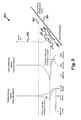
- Fig. 7 is a flow chart of a method 700 for vertical takeoff 602 (as shown in Fig. 6 ) from the inclined surface 304.
- the UAV 100 receives a command to launch from an operator.
- a take-off flight control mode is engaged.
- the take-off flight control mode is preferably a software program that is executed by the flight control system 110.
- the take-off flight control mode determines the attitude orientation of the UAV 100 from data sourced by, for example, the navigation system 112.
- the attitude as measured by the navigation system 112 may indicate that the UAV 100 is positioned on the inclined surface 304.
- the take-off flight control mode orients the vanes 106 to a positive angle as depicted in Fig. 6 based on onboard sensor determination of the vehicle attitude relative to the gravity vector.
- the vanes 106 are oriented to counteract gravity relative to the vehicle center-of-gravity 114 such that the UAV 100 is predisposed to release the landing gear 108 from the inclined surface 304 substantially simultaneously.
- the expected throttle settings and vane deflections during the take-off flight control mode sequence are shown in Fig. 9 .
- the UAV 100 starts ascending, initially substantially perpendicular to the take-off surface. Once the UAV 100 is a distance 902 above the inclined surface 304, pre-existing flight controls are engaged to bring the UAV 100 to a full upright attitude for hover or transition to normal flight. For example, the UAV 100 may begin ascending vertically within several duct diameters above the takeoff surface.
- the landing gear may no longer be required to level the UAV 100 on the inclined surface 304.
- the UAV 100 can implement more missions in a wider variety of terrains. Both military and commercial (e.g., police, firefighters, border patrol, forest service, and security) users of the UAV 100 may benefit from the improved versatility of the UAV 100.
Landscapes
- Engineering & Computer Science (AREA)
- Aviation & Aerospace Engineering (AREA)
- Radar, Positioning & Navigation (AREA)
- Remote Sensing (AREA)
- Physics & Mathematics (AREA)
- General Physics & Mathematics (AREA)
- Automation & Control Theory (AREA)
- Chemical & Material Sciences (AREA)
- Combustion & Propulsion (AREA)
- Mechanical Engineering (AREA)
- Control Of Position, Course, Altitude, Or Attitude Of Moving Bodies (AREA)
Applications Claiming Priority (1)
| Application Number | Priority Date | Filing Date | Title |
|---|---|---|---|
| US11/752,497 US7871044B2 (en) | 2007-05-23 | 2007-05-23 | Method for vertical takeoff from and landing on inclined surfaces |
Publications (2)
| Publication Number | Publication Date |
|---|---|
| EP1995174A2 true EP1995174A2 (fr) | 2008-11-26 |
| EP1995174A3 EP1995174A3 (fr) | 2013-04-24 |
Family
ID=39561797
Family Applications (1)
| Application Number | Title | Priority Date | Filing Date |
|---|---|---|---|
| EP08101858.2A Withdrawn EP1995174A3 (fr) | 2007-05-23 | 2008-02-21 | Procédé pour le décollage vertical et l'atterrissage sur des surfaces inclinées |
Country Status (3)
| Country | Link |
|---|---|
| US (2) | US7871044B2 (fr) |
| EP (1) | EP1995174A3 (fr) |
| JP (1) | JP2008290704A (fr) |
Cited By (10)
| Publication number | Priority date | Publication date | Assignee | Title |
|---|---|---|---|---|
| EP2236417A1 (fr) | 2009-04-02 | 2010-10-06 | Honeywell International Inc. | Procédé et dispositif pour le contrôle de l'attitude d'un véhicule aérien sans pilote utilisant seulement un axe d'un magnétomètre triaxial |
| EP2386925A1 (fr) * | 2010-04-27 | 2011-11-16 | Honeywell International, Inc. | Capteur de détection de proximité du sol pour drone |
| CN105388901A (zh) * | 2014-08-26 | 2016-03-09 | 鹦鹉股份有限公司 | 在抛投开始时对旋翼无人机进行动态控制的方法 |
| CN108873930A (zh) * | 2018-05-31 | 2018-11-23 | 苏州市启献智能科技有限公司 | 基于移动平台的无人机起降方法及系统 |
| CN109634296A (zh) * | 2018-12-18 | 2019-04-16 | 南京航空航天大学 | 基于鲁棒伺服控制理论的小型无人机弹射起飞控制系统及方法 |
| CN110816861A (zh) * | 2018-08-08 | 2020-02-21 | 极光飞行科学公司 | 监控飞行器的垂直着陆的飞行器着陆系统和方法 |
| CN114365058A (zh) * | 2019-09-17 | 2022-04-15 | 索尼集团公司 | 飞行体、控制方法和程序 |
| WO2022113087A1 (fr) * | 2020-11-30 | 2022-06-02 | Efix Aviation Ltd | Giravion |
| WO2022226932A1 (fr) * | 2021-04-29 | 2022-11-03 | 深圳市大疆创新科技有限公司 | Engin volant sans pilote embarqué |
| US12428141B2 (en) | 2023-06-01 | 2025-09-30 | Efix Aviation Ltd | Fixed wing rotorcraft |
Families Citing this family (35)
| Publication number | Priority date | Publication date | Assignee | Title |
|---|---|---|---|---|
| US8200375B2 (en) | 2008-02-12 | 2012-06-12 | Stuckman Katherine C | Radio controlled aircraft, remote controller and methods for use therewith |
| US8878111B2 (en) | 2009-02-24 | 2014-11-04 | Blue Origin, Llc | Bidirectional control surfaces for use with high speed vehicles, and associated systems and methods |
| US20100302359A1 (en) | 2009-06-01 | 2010-12-02 | Honeywell International Inc. | Unmanned Aerial Vehicle Communication |
| FR2973335B1 (fr) * | 2011-03-29 | 2013-04-19 | Inst Superieur De L Aeronautique Et De L Espace | Micro/nano vehicule aerien commande a distance comportant un systeme de roulage au sol, de decollage vertical et d'atterrissage |
| CN104755373B (zh) * | 2012-10-31 | 2017-03-08 | 国立大学法人德岛大学 | 搬送装置以及飞行器的控制方法 |
| KR101447809B1 (ko) | 2013-03-22 | 2014-10-08 | 김명호 | 그립형 이착륙 장치가 구비된 무인항공기 시스템 |
| US9547991B2 (en) | 2013-05-23 | 2017-01-17 | Honeywell International Inc. | Aircraft precision approach and shipboard landing control system and method |
| CN103543744B (zh) * | 2013-09-10 | 2016-04-27 | 江苏省地质勘查技术院 | 一种无人驾驶飞艇航空磁测飞行航线布置的方法 |
| EP2902319B1 (fr) | 2014-01-30 | 2019-06-26 | The Boeing Company | Véhicule aérien sans pilote |
| CN103869817A (zh) * | 2014-03-03 | 2014-06-18 | 东南大学 | 一种倾转四旋翼无人机垂直起降控制方法 |
| WO2015143684A1 (fr) * | 2014-03-27 | 2015-10-01 | SZ DJI Technology Co., Ltd. | Décollage assisté |
| US9767701B2 (en) | 2014-06-26 | 2017-09-19 | Amazon Technologies, Inc. | Ground effect based surface sensing in automated aerial vehicles |
| CN104330071B (zh) * | 2014-10-14 | 2016-09-14 | 南昌航空大学 | 一种控制小型无人直升机平稳起飞的预检测方法 |
| US9033276B1 (en) * | 2015-01-07 | 2015-05-19 | TLL Associates | Telescoping landing leg system |
| KR101872295B1 (ko) * | 2015-04-21 | 2018-06-29 | 순천대학교 산학협력단 | 소형 무인비행체의 비행 자세 안정화 시스템 |
| TW201643579A (zh) * | 2015-06-15 | 2016-12-16 | 鴻海精密工業股份有限公司 | 無人飛行載具自動啟動系統及方法 |
| CN105059558B (zh) * | 2015-07-16 | 2018-02-02 | 珠海云洲智能科技有限公司 | 无人船载无人机起降系统 |
| US9448562B1 (en) * | 2015-08-18 | 2016-09-20 | Skycatch, Inc. | Utilizing acceleration information for precision landing of unmanned aerial vehicles |
| US9513635B1 (en) * | 2015-12-30 | 2016-12-06 | Unmanned Innovation, Inc. | Unmanned aerial vehicle inspection system |
| US9740200B2 (en) | 2015-12-30 | 2017-08-22 | Unmanned Innovation, Inc. | Unmanned aerial vehicle inspection system |
| US9618940B1 (en) | 2015-12-31 | 2017-04-11 | Unmanned Innovation, Inc. | Unmanned aerial vehicle rooftop inspection system |
| CN105480413B (zh) * | 2016-02-03 | 2019-01-22 | 英华达(上海)科技有限公司 | 无人旋翼机及控制无人旋翼机的飞行方法 |
| US9994307B2 (en) * | 2016-03-25 | 2018-06-12 | The United States Of America As Represented By Secretary Of The Navy | Vertical take-off-and-landing unmanned aerial vehicle system capable of landing on uneven or sloped terrain |
| US11029352B2 (en) | 2016-05-18 | 2021-06-08 | Skydio, Inc. | Unmanned aerial vehicle electromagnetic avoidance and utilization system |
| WO2018057068A2 (fr) * | 2016-06-01 | 2018-03-29 | Blue Origin, Llc | Propulseurs d'agilité pour conditions météorologiques difficiles, et systèmes et procédés associés |
| CN105974931B (zh) * | 2016-06-30 | 2019-04-09 | 西安电子科技大学 | 一种用于无人机着陆显示仪表的显示系统 |
| CN114476105B (zh) * | 2016-08-06 | 2025-01-03 | 深圳市大疆创新科技有限公司 | 自动着陆表面地形评估以及相关的系统和方法 |
| JP6776752B2 (ja) * | 2016-09-13 | 2020-10-28 | 富士通株式会社 | 飛行装置、飛行装置制御プログラム及び飛行装置制御方法 |
| CN106647785B (zh) * | 2016-11-16 | 2020-07-14 | 深圳市元征科技股份有限公司 | 无人机停机坪控制方法及装置 |
| KR101867737B1 (ko) * | 2016-12-23 | 2018-06-15 | 주식회사 포스코 | 구조물 부식 진단 및 예방용 드론 |
| US10822122B2 (en) | 2016-12-28 | 2020-11-03 | Blue Origin, Llc | Vertical landing systems for space vehicles and associated methods |
| US10099802B2 (en) | 2017-02-14 | 2018-10-16 | Honeywell International Inc. | Methods and systems to detect and alert a dynamic rollover condition for an aircraft |
| US12066839B2 (en) * | 2018-02-28 | 2024-08-20 | Nileworks Inc. | Agricultural drone having improved safety |
| CN112566842B (zh) * | 2019-02-01 | 2024-07-05 | 松下知识产权经营株式会社 | 无人飞行体、信息处理方法以及记录介质 |
| JP7196668B2 (ja) * | 2019-02-14 | 2022-12-27 | 株式会社Ihi | 飛行体 |
Citations (2)
| Publication number | Priority date | Publication date | Assignee | Title |
|---|---|---|---|---|
| EP0752634A1 (fr) | 1995-07-07 | 1997-01-08 | Sacom Co., Ltd | Dispositif pour le contrÔle de l'attitude d'un hélicopter télécommandé |
| EP1193168A2 (fr) | 2000-09-26 | 2002-04-03 | Rafael Armament Development Authority Ltd. | Dispositif mobile sans conducteur |
Family Cites Families (9)
| Publication number | Priority date | Publication date | Assignee | Title |
|---|---|---|---|---|
| FR1389617A (fr) * | 1964-01-09 | 1965-02-19 | Nord Aviation | Machine volante non habitée |
| US3857533A (en) * | 1974-01-28 | 1974-12-31 | S Mason | Helicopter self-leveling landing gear |
| US4062507A (en) * | 1977-02-03 | 1977-12-13 | Felder Donald W | Slope landing compensator system |
| FR2758790B1 (fr) * | 1997-01-27 | 1999-05-07 | Sci Chaneac Et Fils | Amelioration d'un aeronef a decollage vertical |
| JPH11115896A (ja) * | 1997-10-17 | 1999-04-27 | Komatsu Ltd | 操作自在な無人低速飛翔体 |
| IL141628A0 (en) * | 1998-08-27 | 2002-03-10 | Bostan Nicolae | Gyrostabilized self-propelled aircraft |
| US7032861B2 (en) * | 2002-01-07 | 2006-04-25 | Sanders Jr John K | Quiet vertical takeoff and landing aircraft using ducted, magnetic induction air-impeller rotors |
| US7857254B2 (en) * | 2004-12-22 | 2010-12-28 | Aurora Flight Sciences Corporation | System and method for utilizing stored electrical energy for VTOL aircraft thrust enhancement and attitude control |
| US7946528B2 (en) * | 2005-04-15 | 2011-05-24 | Urban Aeronautics, Ltd. | Flight control system especially suited for VTOL vehicles |
-
2007
- 2007-05-23 US US11/752,497 patent/US7871044B2/en not_active Expired - Fee Related
-
2008
- 2008-02-21 EP EP08101858.2A patent/EP1995174A3/fr not_active Withdrawn
- 2008-02-22 JP JP2008042051A patent/JP2008290704A/ja active Pending
-
2010
- 2010-11-18 US US12/949,410 patent/US8141823B2/en not_active Expired - Fee Related
Patent Citations (2)
| Publication number | Priority date | Publication date | Assignee | Title |
|---|---|---|---|---|
| EP0752634A1 (fr) | 1995-07-07 | 1997-01-08 | Sacom Co., Ltd | Dispositif pour le contrÔle de l'attitude d'un hélicopter télécommandé |
| EP1193168A2 (fr) | 2000-09-26 | 2002-04-03 | Rafael Armament Development Authority Ltd. | Dispositif mobile sans conducteur |
Cited By (17)
| Publication number | Priority date | Publication date | Assignee | Title |
|---|---|---|---|---|
| EP2236417A1 (fr) | 2009-04-02 | 2010-10-06 | Honeywell International Inc. | Procédé et dispositif pour le contrôle de l'attitude d'un véhicule aérien sans pilote utilisant seulement un axe d'un magnétomètre triaxial |
| US8386095B2 (en) | 2009-04-02 | 2013-02-26 | Honeywell International Inc. | Performing corrective action on unmanned aerial vehicle using one axis of three-axis magnetometer |
| EP2386925A1 (fr) * | 2010-04-27 | 2011-11-16 | Honeywell International, Inc. | Capteur de détection de proximité du sol pour drone |
| US8135503B2 (en) | 2010-04-27 | 2012-03-13 | Honeywell International Inc. | Ground proximity sensor |
| CN105388901A (zh) * | 2014-08-26 | 2016-03-09 | 鹦鹉股份有限公司 | 在抛投开始时对旋翼无人机进行动态控制的方法 |
| CN108873930B (zh) * | 2018-05-31 | 2021-09-10 | 苏州市启献智能科技有限公司 | 基于移动平台的无人机起降方法及系统 |
| CN108873930A (zh) * | 2018-05-31 | 2018-11-23 | 苏州市启献智能科技有限公司 | 基于移动平台的无人机起降方法及系统 |
| CN110816861A (zh) * | 2018-08-08 | 2020-02-21 | 极光飞行科学公司 | 监控飞行器的垂直着陆的飞行器着陆系统和方法 |
| CN110816861B (zh) * | 2018-08-08 | 2023-10-03 | 极光飞行科学公司 | 监控飞行器的垂直着陆的飞行器着陆系统和方法 |
| CN109634296A (zh) * | 2018-12-18 | 2019-04-16 | 南京航空航天大学 | 基于鲁棒伺服控制理论的小型无人机弹射起飞控制系统及方法 |
| CN114365058A (zh) * | 2019-09-17 | 2022-04-15 | 索尼集团公司 | 飞行体、控制方法和程序 |
| US12280900B2 (en) | 2019-09-17 | 2025-04-22 | Sony Group Corporation | Flying body, control method, and program |
| WO2022113087A1 (fr) * | 2020-11-30 | 2022-06-02 | Efix Aviation Ltd | Giravion |
| US12208929B2 (en) | 2020-11-30 | 2025-01-28 | Efix Aviation Ltd | Rotorcraft |
| US12509253B2 (en) | 2020-11-30 | 2025-12-30 | Efix Aviation Ltd | Rotor system |
| WO2022226932A1 (fr) * | 2021-04-29 | 2022-11-03 | 深圳市大疆创新科技有限公司 | Engin volant sans pilote embarqué |
| US12428141B2 (en) | 2023-06-01 | 2025-09-30 | Efix Aviation Ltd | Fixed wing rotorcraft |
Also Published As
| Publication number | Publication date |
|---|---|
| US8141823B2 (en) | 2012-03-27 |
| EP1995174A3 (fr) | 2013-04-24 |
| JP2008290704A (ja) | 2008-12-04 |
| US7871044B2 (en) | 2011-01-18 |
| US20100012776A1 (en) | 2010-01-21 |
| US20110057075A1 (en) | 2011-03-10 |
Similar Documents
| Publication | Publication Date | Title |
|---|---|---|
| US7871044B2 (en) | Method for vertical takeoff from and landing on inclined surfaces | |
| US10474167B2 (en) | System, a method and a computer program product for maneuvering of an air vehicle with tiltable propulsion unit | |
| US9540100B2 (en) | System, a method and a computer program product for maneuvering of an air vehicle | |
| US8386095B2 (en) | Performing corrective action on unmanned aerial vehicle using one axis of three-axis magnetometer | |
| Stone et al. | Flight testing of the T-wing tail-sitter unmanned air vehicle | |
| CN106114854B (zh) | 一种无人驾驶航空器 | |
| NL2018003B1 (en) | Unmanned aerial vehicle | |
| US11858626B2 (en) | Autonomous air vehicle delivery system incorporating deployment | |
| US20210362857A1 (en) | Distributed Elevon Systems for Tailsitting Biplane Aircraft | |
| US20210362851A1 (en) | Tailsitting Biplane Aircraft having a Coaxial Rotor System | |
| US20220291697A1 (en) | Yaw Control Systems for Tailsitting Biplane Aircraft | |
| JP2010168034A (ja) | ダクト付きファンuav制御の代替方法 | |
| CN106043695B (zh) | 一种油动多旋翼无人机定桨距变转速系统及控制技术 | |
| JP7466217B2 (ja) | 離着陸システム | |
| CN115016514A (zh) | 仿生扑翼飞行器的起飞、巡航及降落全自主飞行控制方法 | |
| CN105292472A (zh) | 多用途软翼无人机 | |
| EP4038464B1 (fr) | Usage conditionnel de vitesse commandée au lieu de la vitesse de l'air détectée pour informer des décisions de contrôle de vol | |
| JP2020090237A (ja) | 回転翼航空機 | |
| JP2008201183A (ja) | 姿勢制御装置 | |
| CN112198891B (zh) | 多旋翼机自主回收方法 | |
| Pelletier et al. | Autonomous navigation and control functions of the CL-327 VTOL UAV | |
| NL1040979B1 (en) | Air vehicle. | |
| WO2023049497A1 (fr) | Élément d'aile polygonale fermée et ses utilisations | |
| Smouter | Autonomous vertical recovery of fixed wing unmanned aerial vehicles | |
| Singh | Development of Ground Station and Onboard Sensors for an Autonomous Mini Helicopter |
Legal Events
| Date | Code | Title | Description |
|---|---|---|---|
| PUAI | Public reference made under article 153(3) epc to a published international application that has entered the european phase |
Free format text: ORIGINAL CODE: 0009012 |
|
| 17P | Request for examination filed |
Effective date: 20080221 |
|
| AK | Designated contracting states |
Kind code of ref document: A2 Designated state(s): AT BE BG CH CY CZ DE DK EE ES FI FR GB GR HR HU IE IS IT LI LT LU LV MC MT NL NO PL PT RO SE SI SK TR |
|
| AX | Request for extension of the european patent |
Extension state: AL BA MK RS |
|
| PUAL | Search report despatched |
Free format text: ORIGINAL CODE: 0009013 |
|
| AK | Designated contracting states |
Kind code of ref document: A3 Designated state(s): AT BE BG CH CY CZ DE DK EE ES FI FR GB GR HR HU IE IS IT LI LT LU LV MC MT NL NO PL PT RO SE SI SK TR |
|
| AX | Request for extension of the european patent |
Extension state: AL BA MK RS |
|
| RIC1 | Information provided on ipc code assigned before grant |
Ipc: B64D 45/04 20060101ALI20130321BHEP Ipc: G05D 1/08 20060101ALI20130321BHEP Ipc: B64C 27/20 20060101AFI20130321BHEP Ipc: B64C 39/02 20060101ALI20130321BHEP |
|
| 17Q | First examination report despatched |
Effective date: 20130411 |
|
| AKX | Designation fees paid |
Designated state(s): DE FR GB |
|
| GRAP | Despatch of communication of intention to grant a patent |
Free format text: ORIGINAL CODE: EPIDOSNIGR1 |
|
| INTG | Intention to grant announced |
Effective date: 20141023 |
|
| STAA | Information on the status of an ep patent application or granted ep patent |
Free format text: STATUS: THE APPLICATION IS DEEMED TO BE WITHDRAWN |
|
| 18D | Application deemed to be withdrawn |
Effective date: 20150303 |