EP1995627A1 - Diffuseur optique avec des vides et des particules sphériques en surface - Google Patents
Diffuseur optique avec des vides et des particules sphériques en surface Download PDFInfo
- Publication number
- EP1995627A1 EP1995627A1 EP08156653A EP08156653A EP1995627A1 EP 1995627 A1 EP1995627 A1 EP 1995627A1 EP 08156653 A EP08156653 A EP 08156653A EP 08156653 A EP08156653 A EP 08156653A EP 1995627 A1 EP1995627 A1 EP 1995627A1
- Authority
- EP
- European Patent Office
- Prior art keywords
- film
- light
- voided
- beads
- diffuser
- Prior art date
- Legal status (The legal status is an assumption and is not a legal conclusion. Google has not performed a legal analysis and makes no representation as to the accuracy of the status listed.)
- Withdrawn
Links
- 230000003287 optical effect Effects 0.000 title claims abstract description 85
- 239000011324 bead Substances 0.000 title claims abstract description 63
- -1 polyethylene terephthalate Polymers 0.000 claims description 58
- 239000002245 particle Substances 0.000 claims description 48
- 229920000642 polymer Polymers 0.000 claims description 48
- 229920000139 polyethylene terephthalate Polymers 0.000 claims description 19
- 239000005020 polyethylene terephthalate Substances 0.000 claims description 19
- 229920001577 copolymer Polymers 0.000 claims description 17
- 239000011800 void material Substances 0.000 claims description 15
- 230000005540 biological transmission Effects 0.000 claims description 13
- 239000004743 Polypropylene Substances 0.000 claims description 9
- 229920000728 polyester Polymers 0.000 claims description 9
- 229920001155 polypropylene Polymers 0.000 claims description 7
- 229920003207 poly(ethylene-2,6-naphthalate) Polymers 0.000 claims description 5
- 229920000098 polyolefin Polymers 0.000 claims description 4
- 239000003999 initiator Substances 0.000 claims description 3
- 229920000747 poly(lactic acid) Polymers 0.000 claims 1
- 239000011112 polyethylene naphthalate Substances 0.000 claims 1
- 239000004626 polylactic acid Substances 0.000 claims 1
- 239000010408 film Substances 0.000 description 128
- 239000010410 layer Substances 0.000 description 68
- 239000000758 substrate Substances 0.000 description 37
- 238000000034 method Methods 0.000 description 27
- 239000011159 matrix material Substances 0.000 description 22
- 239000000203 mixture Substances 0.000 description 19
- 238000000576 coating method Methods 0.000 description 17
- VYPSYNLAJGMNEJ-UHFFFAOYSA-N Silicium dioxide Chemical compound O=[Si]=O VYPSYNLAJGMNEJ-UHFFFAOYSA-N 0.000 description 15
- 239000006185 dispersion Substances 0.000 description 15
- 239000000463 material Substances 0.000 description 15
- 230000008569 process Effects 0.000 description 15
- 239000011248 coating agent Substances 0.000 description 14
- 239000011521 glass Substances 0.000 description 14
- 238000009792 diffusion process Methods 0.000 description 13
- 229920003229 poly(methyl methacrylate) Polymers 0.000 description 13
- 239000004926 polymethyl methacrylate Substances 0.000 description 13
- GWEVSGVZZGPLCZ-UHFFFAOYSA-N Titan oxide Chemical compound O=[Ti]=O GWEVSGVZZGPLCZ-UHFFFAOYSA-N 0.000 description 12
- 239000008119 colloidal silica Substances 0.000 description 12
- 238000001125 extrusion Methods 0.000 description 11
- XLYOFNOQVPJJNP-UHFFFAOYSA-N water Substances O XLYOFNOQVPJJNP-UHFFFAOYSA-N 0.000 description 11
- 230000000977 initiatory effect Effects 0.000 description 10
- 239000004973 liquid crystal related substance Substances 0.000 description 10
- 239000000523 sample Substances 0.000 description 10
- HRPVXLWXLXDGHG-UHFFFAOYSA-N Acrylamide Chemical compound NC(=O)C=C HRPVXLWXLXDGHG-UHFFFAOYSA-N 0.000 description 9
- 229920005989 resin Polymers 0.000 description 9
- 239000011347 resin Substances 0.000 description 9
- NIXOWILDQLNWCW-UHFFFAOYSA-N acrylic acid group Chemical group C(C=C)(=O)O NIXOWILDQLNWCW-UHFFFAOYSA-N 0.000 description 8
- 238000002156 mixing Methods 0.000 description 8
- 239000000178 monomer Substances 0.000 description 8
- 238000012360 testing method Methods 0.000 description 8
- 239000012790 adhesive layer Substances 0.000 description 7
- 125000000217 alkyl group Chemical group 0.000 description 7
- 125000004432 carbon atom Chemical group C* 0.000 description 7
- 239000010954 inorganic particle Substances 0.000 description 7
- 238000005259 measurement Methods 0.000 description 7
- 229920002223 polystyrene Polymers 0.000 description 7
- VTYYLEPIZMXCLO-UHFFFAOYSA-L Calcium carbonate Chemical compound [Ca+2].[O-]C([O-])=O VTYYLEPIZMXCLO-UHFFFAOYSA-L 0.000 description 6
- 239000000654 additive Substances 0.000 description 6
- 230000000996 additive effect Effects 0.000 description 6
- 239000011230 binding agent Substances 0.000 description 6
- 239000002270 dispersing agent Substances 0.000 description 6
- 239000012788 optical film Substances 0.000 description 6
- 239000008188 pellet Substances 0.000 description 6
- 239000012071 phase Substances 0.000 description 6
- 238000004519 manufacturing process Methods 0.000 description 5
- 230000010287 polarization Effects 0.000 description 5
- 239000000126 substance Substances 0.000 description 5
- 239000004594 Masterbatch (MB) Substances 0.000 description 4
- PPBRXRYQALVLMV-UHFFFAOYSA-N Styrene Chemical compound C=CC1=CC=CC=C1 PPBRXRYQALVLMV-UHFFFAOYSA-N 0.000 description 4
- TZCXTZWJZNENPQ-UHFFFAOYSA-L barium sulfate Chemical compound [Ba+2].[O-]S([O-])(=O)=O TZCXTZWJZNENPQ-UHFFFAOYSA-L 0.000 description 4
- 239000011162 core material Substances 0.000 description 4
- 239000005329 float glass Substances 0.000 description 4
- 238000005286 illumination Methods 0.000 description 4
- 229910010272 inorganic material Inorganic materials 0.000 description 4
- 229920000435 poly(dimethylsiloxane) Polymers 0.000 description 4
- 229920002285 poly(styrene-co-acrylonitrile) Polymers 0.000 description 4
- 239000002861 polymer material Substances 0.000 description 4
- 229920000036 polyvinylpyrrolidone Polymers 0.000 description 4
- 239000001267 polyvinylpyrrolidone Substances 0.000 description 4
- 235000013855 polyvinylpyrrolidone Nutrition 0.000 description 4
- 238000012545 processing Methods 0.000 description 4
- SMZOUWXMTYCWNB-UHFFFAOYSA-N 2-(2-methoxy-5-methylphenyl)ethanamine Chemical compound COC1=CC=C(C)C=C1CCN SMZOUWXMTYCWNB-UHFFFAOYSA-N 0.000 description 3
- UFHFLCQGNIYNRP-UHFFFAOYSA-N Hydrogen Chemical compound [H][H] UFHFLCQGNIYNRP-UHFFFAOYSA-N 0.000 description 3
- 239000004952 Polyamide Substances 0.000 description 3
- 239000004698 Polyethylene Substances 0.000 description 3
- 239000004793 Polystyrene Substances 0.000 description 3
- XTXRWKRVRITETP-UHFFFAOYSA-N Vinyl acetate Chemical compound CC(=O)OC=C XTXRWKRVRITETP-UHFFFAOYSA-N 0.000 description 3
- 229920006243 acrylic copolymer Polymers 0.000 description 3
- 229910000019 calcium carbonate Inorganic materials 0.000 description 3
- 229920002301 cellulose acetate Polymers 0.000 description 3
- 229920006217 cellulose acetate butyrate Polymers 0.000 description 3
- 230000008859 change Effects 0.000 description 3
- 238000004581 coalescence Methods 0.000 description 3
- 230000000694 effects Effects 0.000 description 3
- 239000007789 gas Substances 0.000 description 3
- 238000009998 heat setting Methods 0.000 description 3
- 229920001519 homopolymer Polymers 0.000 description 3
- 239000001257 hydrogen Substances 0.000 description 3
- 229910052739 hydrogen Inorganic materials 0.000 description 3
- 239000011147 inorganic material Substances 0.000 description 3
- 238000009413 insulation Methods 0.000 description 3
- 238000011068 loading method Methods 0.000 description 3
- 125000002496 methyl group Chemical group [H]C([H])([H])* 0.000 description 3
- 238000012986 modification Methods 0.000 description 3
- 230000004048 modification Effects 0.000 description 3
- 239000012074 organic phase Substances 0.000 description 3
- 229920002647 polyamide Polymers 0.000 description 3
- 239000004417 polycarbonate Substances 0.000 description 3
- 229920000515 polycarbonate Polymers 0.000 description 3
- 229920000573 polyethylene Polymers 0.000 description 3
- 229920005596 polymer binder Polymers 0.000 description 3
- 239000002491 polymer binding agent Substances 0.000 description 3
- 238000006116 polymerization reaction Methods 0.000 description 3
- 229920002635 polyurethane Polymers 0.000 description 3
- 239000004814 polyurethane Substances 0.000 description 3
- 229920000915 polyvinyl chloride Polymers 0.000 description 3
- 230000001902 propagating effect Effects 0.000 description 3
- 238000010791 quenching Methods 0.000 description 3
- 230000000171 quenching effect Effects 0.000 description 3
- 229920006126 semicrystalline polymer Polymers 0.000 description 3
- 239000004094 surface-active agent Substances 0.000 description 3
- 239000000725 suspension Substances 0.000 description 3
- 239000004408 titanium dioxide Substances 0.000 description 3
- 238000009736 wetting Methods 0.000 description 3
- DXPPIEDUBFUSEZ-UHFFFAOYSA-N 6-methylheptyl prop-2-enoate Chemical compound CC(C)CCCCCOC(=O)C=C DXPPIEDUBFUSEZ-UHFFFAOYSA-N 0.000 description 2
- XKRFYHLGVUSROY-UHFFFAOYSA-N Argon Chemical compound [Ar] XKRFYHLGVUSROY-UHFFFAOYSA-N 0.000 description 2
- IJGRMHOSHXDMSA-UHFFFAOYSA-N Atomic nitrogen Chemical compound N#N IJGRMHOSHXDMSA-UHFFFAOYSA-N 0.000 description 2
- SOGAXMICEFXMKE-UHFFFAOYSA-N Butylmethacrylate Chemical compound CCCCOC(=O)C(C)=C SOGAXMICEFXMKE-UHFFFAOYSA-N 0.000 description 2
- 239000004593 Epoxy Substances 0.000 description 2
- 101000618467 Hypocrea jecorina (strain ATCC 56765 / BCRC 32924 / NRRL 11460 / Rut C-30) Endo-1,4-beta-xylanase 2 Proteins 0.000 description 2
- BAPJBEWLBFYGME-UHFFFAOYSA-N Methyl acrylate Chemical compound COC(=O)C=C BAPJBEWLBFYGME-UHFFFAOYSA-N 0.000 description 2
- 239000004642 Polyimide Substances 0.000 description 2
- XLOMVQKBTHCTTD-UHFFFAOYSA-N Zinc monoxide Chemical compound [Zn]=O XLOMVQKBTHCTTD-UHFFFAOYSA-N 0.000 description 2
- 150000001252 acrylic acid derivatives Chemical class 0.000 description 2
- 239000004676 acrylonitrile butadiene styrene Substances 0.000 description 2
- 238000013459 approach Methods 0.000 description 2
- QVGXLLKOCUKJST-UHFFFAOYSA-N atomic oxygen Chemical compound [O] QVGXLLKOCUKJST-UHFFFAOYSA-N 0.000 description 2
- 238000013329 compounding Methods 0.000 description 2
- 239000013068 control sample Substances 0.000 description 2
- 150000001925 cycloalkenes Chemical class 0.000 description 2
- 125000003700 epoxy group Chemical group 0.000 description 2
- 125000001495 ethyl group Chemical group [H]C([H])([H])C([H])([H])* 0.000 description 2
- 150000002484 inorganic compounds Chemical class 0.000 description 2
- 229920000554 ionomer Polymers 0.000 description 2
- 125000001449 isopropyl group Chemical group [H]C([H])([H])C([H])(*)C([H])([H])[H] 0.000 description 2
- 230000031700 light absorption Effects 0.000 description 2
- 239000011368 organic material Substances 0.000 description 2
- 229920000620 organic polymer Polymers 0.000 description 2
- 239000001301 oxygen Substances 0.000 description 2
- 229910052760 oxygen Inorganic materials 0.000 description 2
- 229920000647 polyepoxide Polymers 0.000 description 2
- 229920001721 polyimide Polymers 0.000 description 2
- 230000000379 polymerizing effect Effects 0.000 description 2
- 239000004800 polyvinyl chloride Substances 0.000 description 2
- 229920002620 polyvinyl fluoride Polymers 0.000 description 2
- 238000010008 shearing Methods 0.000 description 2
- 239000000377 silicon dioxide Substances 0.000 description 2
- 239000000243 solution Substances 0.000 description 2
- 239000002904 solvent Substances 0.000 description 2
- 239000003381 stabilizer Substances 0.000 description 2
- 230000000087 stabilizing effect Effects 0.000 description 2
- 229920006132 styrene block copolymer Polymers 0.000 description 2
- 238000010557 suspension polymerization reaction Methods 0.000 description 2
- 239000010409 thin film Substances 0.000 description 2
- 229920002554 vinyl polymer Polymers 0.000 description 2
- YAXWOADCWUUUNX-UHFFFAOYSA-N 1,2,2,3-tetramethylpiperidine Chemical compound CC1CCCN(C)C1(C)C YAXWOADCWUUUNX-UHFFFAOYSA-N 0.000 description 1
- RKMGAJGJIURJSJ-UHFFFAOYSA-N 2,2,6,6-Tetramethylpiperidine Substances CC1(C)CCCC(C)(C)N1 RKMGAJGJIURJSJ-UHFFFAOYSA-N 0.000 description 1
- JLZIIHMTTRXXIN-UHFFFAOYSA-N 2-(2-hydroxy-4-methoxybenzoyl)benzoic acid Chemical compound OC1=CC(OC)=CC=C1C(=O)C1=CC=CC=C1C(O)=O JLZIIHMTTRXXIN-UHFFFAOYSA-N 0.000 description 1
- ORACIQIJMCYPHQ-MDZDMXLPSA-N 2-[4-[(e)-2-[4-(1,3-benzoxazol-2-yl)phenyl]ethenyl]phenyl]-1,3-benzoxazole Chemical compound C1=CC=C2OC(C3=CC=C(C=C3)/C=C/C=3C=CC(=CC=3)C=3OC4=CC=CC=C4N=3)=NC2=C1 ORACIQIJMCYPHQ-MDZDMXLPSA-N 0.000 description 1
- WDQMWEYDKDCEHT-UHFFFAOYSA-N 2-ethylhexyl 2-methylprop-2-enoate Chemical compound CCCCC(CC)COC(=O)C(C)=C WDQMWEYDKDCEHT-UHFFFAOYSA-N 0.000 description 1
- OMIGHNLMNHATMP-UHFFFAOYSA-N 2-hydroxyethyl prop-2-enoate Chemical compound OCCOC(=O)C=C OMIGHNLMNHATMP-UHFFFAOYSA-N 0.000 description 1
- VHSHLMUCYSAUQU-UHFFFAOYSA-N 2-hydroxypropyl methacrylate Chemical compound CC(O)COC(=O)C(C)=C VHSHLMUCYSAUQU-UHFFFAOYSA-N 0.000 description 1
- FKOZPUORKCHONH-UHFFFAOYSA-N 2-methylpropane-1-sulfonic acid Chemical compound CC(C)CS(O)(=O)=O FKOZPUORKCHONH-UHFFFAOYSA-N 0.000 description 1
- ONWRSBMOCIQLRK-UHFFFAOYSA-N 2-phenylethenesulfonyl chloride Chemical compound ClS(=O)(=O)C=CC1=CC=CC=C1 ONWRSBMOCIQLRK-UHFFFAOYSA-N 0.000 description 1
- DXIJHCSGLOHNES-UHFFFAOYSA-N 3,3-dimethylbut-1-enylbenzene Chemical compound CC(C)(C)C=CC1=CC=CC=C1 DXIJHCSGLOHNES-UHFFFAOYSA-N 0.000 description 1
- IWTYTFSSTWXZFU-UHFFFAOYSA-N 3-chloroprop-1-enylbenzene Chemical compound ClCC=CC1=CC=CC=C1 IWTYTFSSTWXZFU-UHFFFAOYSA-N 0.000 description 1
- 125000006201 3-phenylpropyl group Chemical group [H]C1=C([H])C([H])=C(C([H])=C1[H])C([H])([H])C([H])([H])C([H])([H])* 0.000 description 1
- SWZOQAGVRGQLDV-UHFFFAOYSA-N 4-[2-(4-hydroxy-2,2,6,6-tetramethylpiperidin-1-yl)ethoxy]-4-oxobutanoic acid Chemical compound CC1(C)CC(O)CC(C)(C)N1CCOC(=O)CCC(O)=O SWZOQAGVRGQLDV-UHFFFAOYSA-N 0.000 description 1
- 239000004925 Acrylic resin Substances 0.000 description 1
- 229920000178 Acrylic resin Polymers 0.000 description 1
- 229920006353 Acrylite® Polymers 0.000 description 1
- QGZKDVFQNNGYKY-UHFFFAOYSA-O Ammonium Chemical compound [NH4+] QGZKDVFQNNGYKY-UHFFFAOYSA-O 0.000 description 1
- BVKZGUZCCUSVTD-UHFFFAOYSA-L Carbonate Chemical compound [O-]C([O-])=O BVKZGUZCCUSVTD-UHFFFAOYSA-L 0.000 description 1
- 229920008347 Cellulose acetate propionate Polymers 0.000 description 1
- DQEFEBPAPFSJLV-UHFFFAOYSA-N Cellulose propionate Chemical compound CCC(=O)OCC1OC(OC(=O)CC)C(OC(=O)CC)C(OC(=O)CC)C1OC1C(OC(=O)CC)C(OC(=O)CC)C(OC(=O)CC)C(COC(=O)CC)O1 DQEFEBPAPFSJLV-UHFFFAOYSA-N 0.000 description 1
- 229910000968 Chilled casting Inorganic materials 0.000 description 1
- SNRUBQQJIBEYMU-UHFFFAOYSA-N Dodecane Natural products CCCCCCCCCCCC SNRUBQQJIBEYMU-UHFFFAOYSA-N 0.000 description 1
- JIGUQPWFLRLWPJ-UHFFFAOYSA-N Ethyl acrylate Chemical compound CCOC(=O)C=C JIGUQPWFLRLWPJ-UHFFFAOYSA-N 0.000 description 1
- ZZSNKZQZMQGXPY-UHFFFAOYSA-N Ethyl cellulose Chemical compound CCOCC1OC(OC)C(OCC)C(OCC)C1OC1C(O)C(O)C(OC)C(CO)O1 ZZSNKZQZMQGXPY-UHFFFAOYSA-N 0.000 description 1
- 239000001856 Ethyl cellulose Substances 0.000 description 1
- 229920000219 Ethylene vinyl alcohol Polymers 0.000 description 1
- WOBHKFSMXKNTIM-UHFFFAOYSA-N Hydroxyethyl methacrylate Chemical compound CC(=C)C(=O)OCCO WOBHKFSMXKNTIM-UHFFFAOYSA-N 0.000 description 1
- DGAQECJNVWCQMB-PUAWFVPOSA-M Ilexoside XXIX Chemical compound C[C@@H]1CC[C@@]2(CC[C@@]3(C(=CC[C@H]4[C@]3(CC[C@@H]5[C@@]4(CC[C@@H](C5(C)C)OS(=O)(=O)[O-])C)C)[C@@H]2[C@]1(C)O)C)C(=O)O[C@H]6[C@@H]([C@H]([C@@H]([C@H](O6)CO)O)O)O.[Na+] DGAQECJNVWCQMB-PUAWFVPOSA-M 0.000 description 1
- 229910001374 Invar Inorganic materials 0.000 description 1
- CERQOIWHTDAKMF-UHFFFAOYSA-N Methacrylic acid Chemical compound CC(=C)C(O)=O CERQOIWHTDAKMF-UHFFFAOYSA-N 0.000 description 1
- VVQNEPGJFQJSBK-UHFFFAOYSA-N Methyl methacrylate Chemical compound COC(=O)C(C)=C VVQNEPGJFQJSBK-UHFFFAOYSA-N 0.000 description 1
- 229920002292 Nylon 6 Polymers 0.000 description 1
- 229920000305 Nylon 6,10 Polymers 0.000 description 1
- 229920002302 Nylon 6,6 Polymers 0.000 description 1
- 239000002033 PVDF binder Substances 0.000 description 1
- 229930040373 Paraformaldehyde Natural products 0.000 description 1
- 238000006124 Pilkington process Methods 0.000 description 1
- 229920002319 Poly(methyl acrylate) Polymers 0.000 description 1
- 229920002367 Polyisobutene Polymers 0.000 description 1
- 239000004372 Polyvinyl alcohol Substances 0.000 description 1
- 229920007962 Styrene Methyl Methacrylate Polymers 0.000 description 1
- BZHJMEDXRYGGRV-UHFFFAOYSA-N Vinyl chloride Chemical compound ClC=C BZHJMEDXRYGGRV-UHFFFAOYSA-N 0.000 description 1
- QYKIQEUNHZKYBP-UHFFFAOYSA-N Vinyl ether Chemical compound C=COC=C QYKIQEUNHZKYBP-UHFFFAOYSA-N 0.000 description 1
- 238000005299 abrasion Methods 0.000 description 1
- 239000011358 absorbing material Substances 0.000 description 1
- DHKHKXVYLBGOIT-UHFFFAOYSA-N acetaldehyde Diethyl Acetal Natural products CCOC(C)OCC DHKHKXVYLBGOIT-UHFFFAOYSA-N 0.000 description 1
- 150000001241 acetals Chemical class 0.000 description 1
- 239000002253 acid Substances 0.000 description 1
- 150000007513 acids Chemical class 0.000 description 1
- 150000003926 acrylamides Chemical class 0.000 description 1
- 230000004913 activation Effects 0.000 description 1
- 239000000853 adhesive Substances 0.000 description 1
- 230000001070 adhesive effect Effects 0.000 description 1
- 230000002411 adverse Effects 0.000 description 1
- 238000013019 agitation Methods 0.000 description 1
- 125000001931 aliphatic group Chemical group 0.000 description 1
- 229910052783 alkali metal Inorganic materials 0.000 description 1
- 150000001340 alkali metals Chemical class 0.000 description 1
- 150000001336 alkenes Chemical class 0.000 description 1
- 125000003342 alkenyl group Chemical group 0.000 description 1
- 125000005907 alkyl ester group Chemical group 0.000 description 1
- 229910045601 alloy Inorganic materials 0.000 description 1
- 239000000956 alloy Substances 0.000 description 1
- PNEYBMLMFCGWSK-UHFFFAOYSA-N aluminium oxide Inorganic materials [O-2].[O-2].[O-2].[Al+3].[Al+3] PNEYBMLMFCGWSK-UHFFFAOYSA-N 0.000 description 1
- 150000001412 amines Chemical class 0.000 description 1
- 150000003863 ammonium salts Chemical class 0.000 description 1
- 229920006125 amorphous polymer Polymers 0.000 description 1
- 239000012736 aqueous medium Substances 0.000 description 1
- 239000008346 aqueous phase Substances 0.000 description 1
- 239000007900 aqueous suspension Substances 0.000 description 1
- 229910052786 argon Inorganic materials 0.000 description 1
- 125000003710 aryl alkyl group Chemical group 0.000 description 1
- 125000004429 atom Chemical group 0.000 description 1
- 239000002585 base Substances 0.000 description 1
- 238000005452 bending Methods 0.000 description 1
- AOJOEFVRHOZDFN-UHFFFAOYSA-N benzyl 2-methylprop-2-enoate Chemical compound CC(=C)C(=O)OCC1=CC=CC=C1 AOJOEFVRHOZDFN-UHFFFAOYSA-N 0.000 description 1
- 230000015572 biosynthetic process Effects 0.000 description 1
- MPMBRWOOISTHJV-UHFFFAOYSA-N but-1-enylbenzene Chemical compound CCC=CC1=CC=CC=C1 MPMBRWOOISTHJV-UHFFFAOYSA-N 0.000 description 1
- CQEYYJKEWSMYFG-UHFFFAOYSA-N butyl acrylate Chemical compound CCCCOC(=O)C=C CQEYYJKEWSMYFG-UHFFFAOYSA-N 0.000 description 1
- 238000004364 calculation method Methods 0.000 description 1
- 229920002678 cellulose Polymers 0.000 description 1
- 239000001913 cellulose Substances 0.000 description 1
- 229920006218 cellulose propionate Polymers 0.000 description 1
- 239000007795 chemical reaction product Substances 0.000 description 1
- 230000003098 cholesteric effect Effects 0.000 description 1
- 150000001875 compounds Chemical class 0.000 description 1
- 239000012141 concentrate Substances 0.000 description 1
- 125000002704 decyl group Chemical group [H]C([H])([H])C([H])([H])C([H])([H])C([H])([H])C([H])([H])C([H])([H])C([H])([H])C([H])([H])C([H])([H])C([H])([H])* 0.000 description 1
- 230000007547 defect Effects 0.000 description 1
- 238000012674 dispersion polymerization Methods 0.000 description 1
- GMSCBRSQMRDRCD-UHFFFAOYSA-N dodecyl 2-methylprop-2-enoate Chemical compound CCCCCCCCCCCCOC(=O)C(C)=C GMSCBRSQMRDRCD-UHFFFAOYSA-N 0.000 description 1
- 125000003438 dodecyl group Chemical group [H]C([H])([H])C([H])([H])C([H])([H])C([H])([H])C([H])([H])C([H])([H])C([H])([H])C([H])([H])C([H])([H])C([H])([H])C([H])([H])C([H])([H])* 0.000 description 1
- 229920001971 elastomer Polymers 0.000 description 1
- 238000005516 engineering process Methods 0.000 description 1
- 230000007613 environmental effect Effects 0.000 description 1
- SUPCQIBBMFXVTL-UHFFFAOYSA-N ethyl 2-methylprop-2-enoate Chemical compound CCOC(=O)C(C)=C SUPCQIBBMFXVTL-UHFFFAOYSA-N 0.000 description 1
- 229920001249 ethyl cellulose Polymers 0.000 description 1
- 235000019325 ethyl cellulose Nutrition 0.000 description 1
- 229920006244 ethylene-ethyl acrylate Polymers 0.000 description 1
- 229920006225 ethylene-methyl acrylate Polymers 0.000 description 1
- 229920002313 fluoropolymer Polymers 0.000 description 1
- 239000004811 fluoropolymer Substances 0.000 description 1
- 230000004927 fusion Effects 0.000 description 1
- 238000007756 gravure coating Methods 0.000 description 1
- 238000009499 grossing Methods 0.000 description 1
- 238000010438 heat treatment Methods 0.000 description 1
- LNMQRPPRQDGUDR-UHFFFAOYSA-N hexyl prop-2-enoate Chemical compound CCCCCCOC(=O)C=C LNMQRPPRQDGUDR-UHFFFAOYSA-N 0.000 description 1
- 238000000265 homogenisation Methods 0.000 description 1
- 150000002430 hydrocarbons Chemical group 0.000 description 1
- 125000002768 hydroxyalkyl group Chemical group 0.000 description 1
- 230000006872 improvement Effects 0.000 description 1
- 150000002500 ions Chemical class 0.000 description 1
- 238000010030 laminating Methods 0.000 description 1
- 239000004816 latex Substances 0.000 description 1
- 229920000126 latex Polymers 0.000 description 1
- 125000005647 linker group Chemical group 0.000 description 1
- 239000007788 liquid Substances 0.000 description 1
- ADFPJHOAARPYLP-UHFFFAOYSA-N methyl 2-methylprop-2-enoate;styrene Chemical compound COC(=O)C(C)=C.C=CC1=CC=CC=C1 ADFPJHOAARPYLP-UHFFFAOYSA-N 0.000 description 1
- 239000011325 microbead Substances 0.000 description 1
- 229910052757 nitrogen Inorganic materials 0.000 description 1
- MDYPDLBFDATSCF-UHFFFAOYSA-N nonyl prop-2-enoate Chemical compound CCCCCCCCCOC(=O)C=C MDYPDLBFDATSCF-UHFFFAOYSA-N 0.000 description 1
- 125000005064 octadecenyl group Chemical group C(=CCCCCCCCCCCCCCCCC)* 0.000 description 1
- 125000002347 octyl group Chemical group [H]C([*])([H])C([H])([H])C([H])([H])C([H])([H])C([H])([H])C([H])([H])C([H])([H])C([H])([H])[H] 0.000 description 1
- ANISOHQJBAQUQP-UHFFFAOYSA-N octyl prop-2-enoate Chemical compound CCCCCCCCOC(=O)C=C ANISOHQJBAQUQP-UHFFFAOYSA-N 0.000 description 1
- JRZJOMJEPLMPRA-UHFFFAOYSA-N olefin Natural products CCCCCCCC=C JRZJOMJEPLMPRA-UHFFFAOYSA-N 0.000 description 1
- 239000011146 organic particle Substances 0.000 description 1
- 239000011242 organic-inorganic particle Substances 0.000 description 1
- PNJWIWWMYCMZRO-UHFFFAOYSA-N pent‐4‐en‐2‐one Natural products CC(=O)CC=C PNJWIWWMYCMZRO-UHFFFAOYSA-N 0.000 description 1
- 229920001483 poly(ethyl methacrylate) polymer Polymers 0.000 description 1
- 229920001200 poly(ethylene-vinyl acetate) Polymers 0.000 description 1
- 229920002492 poly(sulfone) Polymers 0.000 description 1
- 229920002037 poly(vinyl butyral) polymer Polymers 0.000 description 1
- 229920002239 polyacrylonitrile Polymers 0.000 description 1
- 229920001707 polybutylene terephthalate Polymers 0.000 description 1
- 238000006068 polycondensation reaction Methods 0.000 description 1
- 229920006380 polyphenylene oxide Polymers 0.000 description 1
- 229920001343 polytetrafluoroethylene Polymers 0.000 description 1
- 239000004810 polytetrafluoroethylene Substances 0.000 description 1
- 229920002451 polyvinyl alcohol Polymers 0.000 description 1
- 229920002102 polyvinyl toluene Polymers 0.000 description 1
- 229920002981 polyvinylidene fluoride Polymers 0.000 description 1
- 238000001556 precipitation Methods 0.000 description 1
- 238000002360 preparation method Methods 0.000 description 1
- HJWLCRVIBGQPNF-UHFFFAOYSA-N prop-2-enylbenzene Chemical compound C=CCC1=CC=CC=C1 HJWLCRVIBGQPNF-UHFFFAOYSA-N 0.000 description 1
- 238000007342 radical addition reaction Methods 0.000 description 1
- 150000003254 radicals Chemical class 0.000 description 1
- 238000004064 recycling Methods 0.000 description 1
- 230000000452 restraining effect Effects 0.000 description 1
- 229920006395 saturated elastomer Polymers 0.000 description 1
- 238000007573 shrinkage measurement Methods 0.000 description 1
- 229910052708 sodium Inorganic materials 0.000 description 1
- 239000011734 sodium Substances 0.000 description 1
- 238000000935 solvent evaporation Methods 0.000 description 1
- 239000007921 spray Substances 0.000 description 1
- 125000004079 stearyl group Chemical group [H]C([*])([H])C([H])([H])C([H])([H])C([H])([H])C([H])([H])C([H])([H])C([H])([H])C([H])([H])C([H])([H])C([H])([H])C([H])([H])C([H])([H])C([H])([H])C([H])([H])C([H])([H])C([H])([H])C([H])([H])C([H])([H])[H] 0.000 description 1
- 238000003756 stirring Methods 0.000 description 1
- 125000001273 sulfonato group Chemical group [O-]S(*)(=O)=O 0.000 description 1
- 230000003746 surface roughness Effects 0.000 description 1
- 150000003512 tertiary amines Chemical class 0.000 description 1
- XOLBLPGZBRYERU-UHFFFAOYSA-N tin dioxide Chemical compound O=[Sn]=O XOLBLPGZBRYERU-UHFFFAOYSA-N 0.000 description 1
- 229910001887 tin oxide Inorganic materials 0.000 description 1
- 238000012546 transfer Methods 0.000 description 1
- 230000007704 transition Effects 0.000 description 1
- 239000012780 transparent material Substances 0.000 description 1
- 238000009966 trimming Methods 0.000 description 1
- 229920001567 vinyl ester resin Polymers 0.000 description 1
- 239000011787 zinc oxide Substances 0.000 description 1
Images



Classifications
-
- G—PHYSICS
- G02—OPTICS
- G02B—OPTICAL ELEMENTS, SYSTEMS OR APPARATUS
- G02B5/00—Optical elements other than lenses
- G02B5/02—Diffusing elements; Afocal elements
- G02B5/0273—Diffusing elements; Afocal elements characterized by the use
- G02B5/0278—Diffusing elements; Afocal elements characterized by the use used in transmission
-
- G—PHYSICS
- G02—OPTICS
- G02B—OPTICAL ELEMENTS, SYSTEMS OR APPARATUS
- G02B5/00—Optical elements other than lenses
- G02B5/02—Diffusing elements; Afocal elements
-
- G—PHYSICS
- G02—OPTICS
- G02B—OPTICAL ELEMENTS, SYSTEMS OR APPARATUS
- G02B5/00—Optical elements other than lenses
- G02B5/02—Diffusing elements; Afocal elements
- G02B5/0205—Diffusing elements; Afocal elements characterised by the diffusing properties
- G02B5/021—Diffusing elements; Afocal elements characterised by the diffusing properties the diffusion taking place at the element's surface, e.g. by means of surface roughening or microprismatic structures
- G02B5/0226—Diffusing elements; Afocal elements characterised by the diffusing properties the diffusion taking place at the element's surface, e.g. by means of surface roughening or microprismatic structures having particles on the surface
-
- G—PHYSICS
- G02—OPTICS
- G02B—OPTICAL ELEMENTS, SYSTEMS OR APPARATUS
- G02B5/00—Optical elements other than lenses
- G02B5/02—Diffusing elements; Afocal elements
- G02B5/0205—Diffusing elements; Afocal elements characterised by the diffusing properties
- G02B5/0236—Diffusing elements; Afocal elements characterised by the diffusing properties the diffusion taking place within the volume of the element
- G02B5/0247—Diffusing elements; Afocal elements characterised by the diffusing properties the diffusion taking place within the volume of the element by means of voids or pores
-
- G—PHYSICS
- G02—OPTICS
- G02F—OPTICAL DEVICES OR ARRANGEMENTS FOR THE CONTROL OF LIGHT BY MODIFICATION OF THE OPTICAL PROPERTIES OF THE MEDIA OF THE ELEMENTS INVOLVED THEREIN; NON-LINEAR OPTICS; FREQUENCY-CHANGING OF LIGHT; OPTICAL LOGIC ELEMENTS; OPTICAL ANALOGUE/DIGITAL CONVERTERS
- G02F1/00—Devices or arrangements for the control of the intensity, colour, phase, polarisation or direction of light arriving from an independent light source, e.g. switching, gating or modulating; Non-linear optics
- G02F1/01—Devices or arrangements for the control of the intensity, colour, phase, polarisation or direction of light arriving from an independent light source, e.g. switching, gating or modulating; Non-linear optics for the control of the intensity, phase, polarisation or colour
- G02F1/13—Devices or arrangements for the control of the intensity, colour, phase, polarisation or direction of light arriving from an independent light source, e.g. switching, gating or modulating; Non-linear optics for the control of the intensity, phase, polarisation or colour based on liquid crystals, e.g. single liquid crystal display cells
- G02F1/133—Constructional arrangements; Operation of liquid crystal cells; Circuit arrangements
- G02F1/1333—Constructional arrangements; Manufacturing methods
- G02F1/1335—Structural association of cells with optical devices, e.g. polarisers or reflectors
-
- G—PHYSICS
- G02—OPTICS
- G02F—OPTICAL DEVICES OR ARRANGEMENTS FOR THE CONTROL OF LIGHT BY MODIFICATION OF THE OPTICAL PROPERTIES OF THE MEDIA OF THE ELEMENTS INVOLVED THEREIN; NON-LINEAR OPTICS; FREQUENCY-CHANGING OF LIGHT; OPTICAL LOGIC ELEMENTS; OPTICAL ANALOGUE/DIGITAL CONVERTERS
- G02F1/00—Devices or arrangements for the control of the intensity, colour, phase, polarisation or direction of light arriving from an independent light source, e.g. switching, gating or modulating; Non-linear optics
- G02F1/01—Devices or arrangements for the control of the intensity, colour, phase, polarisation or direction of light arriving from an independent light source, e.g. switching, gating or modulating; Non-linear optics for the control of the intensity, phase, polarisation or colour
- G02F1/13—Devices or arrangements for the control of the intensity, colour, phase, polarisation or direction of light arriving from an independent light source, e.g. switching, gating or modulating; Non-linear optics for the control of the intensity, phase, polarisation or colour based on liquid crystals, e.g. single liquid crystal display cells
- G02F1/133—Constructional arrangements; Operation of liquid crystal cells; Circuit arrangements
- G02F1/1333—Constructional arrangements; Manufacturing methods
- G02F1/1335—Structural association of cells with optical devices, e.g. polarisers or reflectors
- G02F1/1336—Illuminating devices
- G02F1/133602—Direct backlight
- G02F1/133606—Direct backlight including a specially adapted diffusing, scattering or light controlling members
-
- G—PHYSICS
- G02—OPTICS
- G02B—OPTICAL ELEMENTS, SYSTEMS OR APPARATUS
- G02B2207/00—Coding scheme for general features or characteristics of optical elements and systems of subclass G02B, but not including elements and systems which would be classified in G02B6/00 and subgroups
- G02B2207/107—Porous materials, e.g. for reducing the refractive index
-
- G—PHYSICS
- G02—OPTICS
- G02F—OPTICAL DEVICES OR ARRANGEMENTS FOR THE CONTROL OF LIGHT BY MODIFICATION OF THE OPTICAL PROPERTIES OF THE MEDIA OF THE ELEMENTS INVOLVED THEREIN; NON-LINEAR OPTICS; FREQUENCY-CHANGING OF LIGHT; OPTICAL LOGIC ELEMENTS; OPTICAL ANALOGUE/DIGITAL CONVERTERS
- G02F1/00—Devices or arrangements for the control of the intensity, colour, phase, polarisation or direction of light arriving from an independent light source, e.g. switching, gating or modulating; Non-linear optics
- G02F1/01—Devices or arrangements for the control of the intensity, colour, phase, polarisation or direction of light arriving from an independent light source, e.g. switching, gating or modulating; Non-linear optics for the control of the intensity, phase, polarisation or colour
- G02F1/13—Devices or arrangements for the control of the intensity, colour, phase, polarisation or direction of light arriving from an independent light source, e.g. switching, gating or modulating; Non-linear optics for the control of the intensity, phase, polarisation or colour based on liquid crystals, e.g. single liquid crystal display cells
- G02F1/133—Constructional arrangements; Operation of liquid crystal cells; Circuit arrangements
- G02F1/1333—Constructional arrangements; Manufacturing methods
- G02F1/1335—Structural association of cells with optical devices, e.g. polarisers or reflectors
- G02F1/133504—Diffusing, scattering, diffracting elements
-
- G—PHYSICS
- G02—OPTICS
- G02F—OPTICAL DEVICES OR ARRANGEMENTS FOR THE CONTROL OF LIGHT BY MODIFICATION OF THE OPTICAL PROPERTIES OF THE MEDIA OF THE ELEMENTS INVOLVED THEREIN; NON-LINEAR OPTICS; FREQUENCY-CHANGING OF LIGHT; OPTICAL LOGIC ELEMENTS; OPTICAL ANALOGUE/DIGITAL CONVERTERS
- G02F1/00—Devices or arrangements for the control of the intensity, colour, phase, polarisation or direction of light arriving from an independent light source, e.g. switching, gating or modulating; Non-linear optics
- G02F1/01—Devices or arrangements for the control of the intensity, colour, phase, polarisation or direction of light arriving from an independent light source, e.g. switching, gating or modulating; Non-linear optics for the control of the intensity, phase, polarisation or colour
- G02F1/13—Devices or arrangements for the control of the intensity, colour, phase, polarisation or direction of light arriving from an independent light source, e.g. switching, gating or modulating; Non-linear optics for the control of the intensity, phase, polarisation or colour based on liquid crystals, e.g. single liquid crystal display cells
- G02F1/133—Constructional arrangements; Operation of liquid crystal cells; Circuit arrangements
- G02F1/1333—Constructional arrangements; Manufacturing methods
- G02F1/1335—Structural association of cells with optical devices, e.g. polarisers or reflectors
- G02F1/133504—Diffusing, scattering, diffracting elements
- G02F1/133507—Films for enhancing the luminance
Definitions
- the invention relates to optical displays, and more particularly to liquid crystal displays (LCDs) that may be used in LCD monitors and LCD televisions.
- LCDs liquid crystal displays
- LCDs are optical displays used in devices such as laptop computers, hand-held calculators, digital watches and televisions.
- Some LCDs include a light source that is located to the side of the display, with a light guide positioned to guide the light from the light source to the back of the LCD panel.
- Other LCDs for example some LCD monitors and LCD televisions (LCD-TVs), are directly illuminated using a number of light sources positioned behind the LCD panel.
- This arrangement is increasingly common with larger displays, because the light power requirements, to achieve a certain level of display brightness, increase with the square of the display size, whereas the available real estate for locating light sources along the side of the display only increases linearly with display size.
- some LCD applications such as LCD-TVs, require that the display be bright enough to be viewed from a greater distance than other applications, and the viewing angle requirements for LCD-TVs are generally different from those for LCD monitors and hand-held devices.
- Some LCD monitors and most LCD-TVs are commonly illuminated from behind by a number of cold cathode fluorescent lamps (CCFLs). These light sources are linear and stretch across the full width of the display, with the result that the back of the display is illuminated by a series of bright stripes separated by darker regions. Such an illumination profile is not desirable, and so a diffuser plate is used to smooth the illumination profile at the back of the LCD device.
- CCFLs cold cathode fluorescent lamps
- LCD-TV diffuser plates employ a polymeric matrix of polymethyl methacrylate (PMMA) with a variety of dispersed phases that include glass, polystyrene beads, and CaCO 3 particles. These plates often deform or warp after exposure to the elevated humidity and high temperature caused by the lamps.
- PMMA polymethyl methacrylate
- the diffusion plates require customized extrusion compounding to distribute the diffusing particles uniformly throughout the polymer matrix, which further increases costs.
- U.S. Pat. Application No. 2006/0082699 describes one approach to reducing the cost of diffusion plates by laminating separate layers of a self-supporting substrate and an optically diffuse film.
- this solution is novel the need to use adhesives to laminate these layers together results in reduced efficiency of the system by adding light absorption materials. Also the additional processing cost to laminate the layers together is self-defeating.
- this previous disclosure does not teach the materials and structure for an unattached diffuser film. It is desirable to have an unattached diffuser film, which must have dimensional stability as well as high optical transmission while maintaining a high level of light uniformization.
- a diffuser it is desirable for such a diffuser to have additional heat insulation value to reduce the heat gain from the light sources to the LC layer above the diffuser. Voiding is a well-known means to achieve both the optical requirements and the insulation requirements of the diffuser.
- a thin diffuser is also desirable as manufacturers are constantly looking for means to thin the profile of LCD screens. Producing a thin voided film that meets these requirements is very challenging as thin voided films are highly prone to shrinkage under elevated temperatures.
- the object of the present invention to provide a voided polymeric optical diffuser film with multi-functionality that includes surface collimating and or directional diffusion which can be placed adjacent to an optically transmissive self-supporting substrate, unattached to said substrate, to provide the optical smoothing function of previous plate diffusers at a very low cost.
- the optical diffuser film is unique in that it provides a high level of optical function and meets dimensional stability requirements under specified thermal testing even at low thicknesses.
- One embodiment of this invention is a voided semi-crystalline polymeric integrated optical diffuser film provided with surface beads.
- the film is useful when incorporated into a display device such as an LC display.
- this film has a shrinkage of less than 1% as a result of thermal changes from 0-90C.
- This film is useful in replacing the optical function of diffuser plates and top diffuser typically used today in backlit LCD displays.
- the present invention is applicable to liquid crystal displays (LCDs, or LC displays), and is particularly applicable to LCDs that are directly illuminated from behind, for example as are used in LCD monitors and LCD televisions (LCD-TVs).
- LCDs liquid crystal displays
- LCD-TVs LCD televisions
- An embodiment of the invention is directed to a liquid crystal display (LCD) unit that has a light source and an LCD panel that includes an upper plate, a lower plate and a liquid crystal layer disposed between the upper and lower plates.
- the lower plate faces the light source, and includes an absorbing polarizer.
- An arrangement of light management layers is disposed between the light source and the LCD panel so that the light source illuminates the LCD panel through the arrangement of light management layers.
- the arrangement of light management layers includes an arrangement of light management films and an optically transmissive self-supporting substrate.
- the arrangement of light management films comprises at least a first voided polymeric optical diffuser film with surface diffusion and or collimation properties.
- the arrangement of light management films optionally comprises other optical layers.
- Other optical layers may include a bead coated collimation film, a light directing film and a reflective polarizer.
- Another embodiment of the invention is directed to a liquid crystal display (LCD) unit that has a light source and an LCD panel that includes an upper plate, a lower plate, and a liquid crystal layer disposed between the upper and lower plates.
- the lower plate faces the light source, and includes an absorbing polarizer.
- An arrangement of light management layers is disposed between the light source and the LCD panel so that the light source illuminates the LCD panel through the arrangement of light management layers.
- the arrangement of light management layers includes an arrangement of light management films and an optically transmissive self-supporting substrate.
- the arrangement of light management films comprises at least a first voided polymeric optical diffuser film with surface diffusion and or collimation properties and comprising a structured surface to control the direction of light rays transmitted through the film.
- the arrangement of light management films optionally comprises other optical layers.
- Other optical layers may include a light directing film and a reflective polarizer
- the diffuser plates currently used in LCD-TVs are based on a polymeric matrix, for example polymethyl methacrylate (PMMA), polycarbonate (PC), or cyclo-olefins, formed as a rigid sheet.
- the sheet contains diffusing particles, for example, organic particles, inorganic particles or voids (bubbles). These plates often deform or warp after exposure to the elevated temperatures of the light sources used to illuminate the display. These plates also are more expensive to manufacture and to assemble in the final display device.
- the invention is directed to a directly illuminated LCD device that has an arrangement of light management layers positioned between the LCD panel itself and the light source.
- the arrangement of light management layers includes an optically transmissive self-supporting organic or inorganic substrate and a voided polymeric optical diffuser film with surface diffusion and or collimation properties possessing a specific transmission and haze level placed directly adjacent to one side of the substrate, but unattached to said substrate.
- the transmission and haze levels of each component are designed to provide a direct-lit LC display whose brightness is relatively uniform across the display.
- the optically transmissive self-supporting organic or inorganic substrate of the present invention are simple to manufacture and are commercially available as a commodity item. Voided polymeric optical diffuser films with surface diffusion and or collimation properties of the present invention are simple to manufacture and provide a high degree of flexibility in the materials and processes used in manufacturing.
- the structural and optical requirements are separated: the substrate provides the structural performance and the unattached diffusing layer, provides the optical performance. By separating these functions, the cost advantages of using common transparent materials and common diffuser sheets can be exploited, to reduce overall costs. By not attaching the substrate and the diffuser film a high level of optical performance and a low manufacturing cost is realized. This also permits the introduction of warp resistant plates, for example glass plates, at low cost.
- the voided polymeric optical diffuser films with surface diffusion and or collimation properties may comprise a voided film as described herein with a surface coating of beads and a polymer binder (matrix).
- the beads are on at least one major surface of the voided diffuser film.
- the preferred embodiment provides the beads on the surface furthest away from the light source.
- the beads useful in this invention are substantially transparent (light transmission greater than 70%).
- the beads may be glass, organic polymer or polymeric beads with an inorganic coating.
- the organic polymer beads useful in this invention may further comprise inorganic material(s) either within the bead or on the surface of the bead.
- the beads that populate the surface of the voided may have a size of range of between 1000-50,000 nm in their thickest dimension. In an embodiment the size range of the beads may be 8000 and 30,000 nm. and in yet another embodiment the size range may be between 1500 and 30,000 nm.
- the bead populated voided film may have one embodiment wherein the beads are substantially mono dispersed in their size and or shape and in another embodiments there is a variety of sizes and or shapes that that are randomly distributed on the film.
- the embodiment with a variety of sizes provides a surface with minimal contact for the next film (towards the viewer) in the light management film stack.
- a top diffuser that has a beaded surface and a light directing film with a surface structure.
- the light directing film needs an air gap on the light entry side to help redirect back into the film any reflected light that is going opposite from the optimal or intended direction.
- the resulting film stack will provided excellent optics as required by the LCD display. Additionally having a variety of bead sizes allow the polymer binder that is used to hold the beads to the film surface to have good adhesion to prevent the loss of beads during times of surface abrasion or rubbing. By controlling the amount of bead embedment into the polymer binder the surface area of the bead that is surrounded by gas (air) is maximized and the optics of the film stack is further optimized.
- Other useful embodiments useful in this invention is to provide a voided film with a surface roughness or texture that creates an uneven surface so when a surface of another film is placed on top of the roughen or texture surface, spaces that contain air are formed between the two films.
- Such roughness or texture may be embossed or extrusion roll molded into the surface. Such a process may be done prior to stretching of said voided film or after it has been stretched.
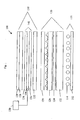
- FIG. 1 A schematic exploded view of an exemplary embodiment of a direct-lit LC display device 100 is presented in FIG. 1 .
- a display device 100 may be used, for example, in an LCD monitor or LCD-TV.
- the display device 100 is based on the use of a front panel assembly 130, comprising a LC panel 140, which typically comprises a layer of LC 136 disposed between panel plates 134.
- the plates 134 are often formed of glass, and may include electrode structures and alignment layers on their inner surfaces for controlling the orientation of the liquid crystals in the LC layer 136.
- the electrode structures are commonly arranged so as to define LC panel pixels, areas of the LC layer where the orientation of the liquid crystals can be controlled independently of adjacent areas.
- a color filter may also be included with one or more of the plates 134 for imposing color on the image displayed.
- An upper absorbing polarizer 138 is positioned above the LC layer 136 and a lower absorbing polarizer 132 is positioned below the LC layer 136.
- the absorbing polarizers 138, 132 and the LC panel 140 in combination control the transmission of light from the backlight 110 through the display 100 to the viewer.
- the absorbing polarizers 138, 132 may be arranged with their transmission axes perpendicular. When a pixel of the LC layer 136 is not activated, it may not change the polarization of light passing there through.
- the polarization of the light passing there through is rotated, so that at least some of the light that is transmitted through the lower absorbing polarizer 132 is also transmitted through the upper absorbing polarizer 138.
- Selective activation of the different pixels of the LC layer 136 results in the light passing out of the display at certain desired locations, thus forming an image seen by the viewer.
- the controller may include, for example, a computer or a television controller that receives and displays television images.
- One or more optional layers 139 may be provided over the upper absorbing polarizer 138, for example to provide mechanical and/or environmental protection to the display surface.
- the layer 139 may include a hardcoat over the absorbing polarizer 138.
- LC displays may operate in a manner different from that described above.
- the absorbing polarizers may be aligned parallel and the LC panel may rotate the polarization of the light when in an unactivated state.
- the basic structure of such displays remains similar to that described above.
- the backlight 110 includes a number of light sources 114 that generate the light that illuminates the LC panel 120.
- the light sources 114 used in a LCD-TV or LCD monitor are often linear, cold cathode, fluorescent tubes that extend across the display device 100.
- Other types of light sources may be used, however, such as filament or arc lamps, light emitting diodes (LEDs), flat fluorescent panels or external fluorescent lamps. This list of light sources is not intended to be limiting or exhaustive, but only exemplary.
- the backlight 110 may also include a reflector 112 for reflecting light propagating downwards from the light sources 114, in a direction away from the LC panel 140.
- the reflector 112 may also be useful for recycling light within the display device 100, as is explained below.
- the reflector 112 may be a specular reflector or may be a diffuse reflector.
- a specular reflector that may be used as the reflector 112 is Vikuiti® Enhanced Specular Reflection (ESR) film available from 3M Company, St. Paul, Minn.
- suitable diffuse reflectors include polymers, such as polyethylene terephthalate (PET), polycarbonate (PC), polypropylene, polystyrene and the like, loaded with diffusely reflective particles, such as titanium dioxide, barium sulphate, calcium carbonate and the like.
- PET polyethylene terephthalate
- PC polycarbonate
- diffusely reflective particles such as titanium dioxide, barium sulphate, calcium carbonate and the like.
- An arrangement 120 of light management layers is positioned between the backlight 110 and the front panel assembly 130.
- the light management layers affect the light propagating from backlight 110 so as to improve the operation of the display device 100 .
- the arrangement 120 of light management layers may include a diffuser plate 122.
- the diffuser plate 122 is used to diffuse the light received from the light sources, which results in an increase in the uniformity of the illumination light incident on the LC panel 140. Consequently, this results in an image perceived by the viewer that is more uniformly bright.
- the arrangement 120 of light management layers may also include a reflective polarizer 128.
- the light sources 114 typically produce unpolarized light but the lower absorbing polarizer 132 only transmits a single polarization state, and so about half of the light generated by the light sources 114 is not transmitted through to the LC layer 136.
- the reflecting polarizer 128, however, may be used to reflect the light that would otherwise be absorbed in the lower absorbing polarizer, and so this light may be recycled by reflection between the reflecting polarizer 128 and the reflector 112.
- At least some of the light reflected by the reflecting polarizer 128 may be depolarized, and subsequently returned to the reflecting polarizer 128 in a polarization state that is transmitted through the reflecting polarizer 128 and the lower absorbing polarizer 132 to the LC layer 136.
- the reflecting polarizer 128 may be used to increase the fraction of light emitted by the light sources 114 that reaches the LC layer 136, and so the image produced by the display device 100 is brighter.
- reflective polarizer any suitable type may be used, for example, multilayer optical film (MOF) reflective polarizers; diffusely reflective polarizing film (DRPF), such as continuous/disperse phase polarizers, wire grid reflective polarizers or cholesteric reflective polarizers.
- MOF multilayer optical film
- DRPF diffusely reflective polarizing film
- the arrangement 120 of light management layers may also include a light directing film 126.
- a light directing film is one that includes a surface structure that redirects off-axis light in a direction closer to the axis of the display. This increases the amount of light propagating on-axis through the LC layer 136, thus increasing the brightness of the image seen by the viewer.
- a prismatic light directing film which has a number of prismatic ridges that redirect the illumination light, through refraction and reflection.
- the present invention uses an arrangement of light management layers that have separate structural and diffusing members.
- An optically transmissive self-supporting substrate and an unattached voided polymeric optical diffuser film perform these functions, respectively.
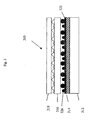
- FIG. 2 One exemplary embodiment of the present invention is schematically illustrated in FIG. 2 .
- the arrangement of light management layers 200 includes an optically transmissive self-supporting substrate 212 and a voided polymeric optical diffuser film 214 adjacent to but un-attached to the substrate.
- Other optical films can be added to the arrangement of light management layers above the voided polymeric optical diffuser film 214. These other optical films may include a bead coated light collimation film 215, a prismatic light directing film 216, and a reflective polarizer 218.
- the substrate 212 is a sheet of material that, like that of the plate diffuser in conventional back lights, is self-supporting, and is used to provide support to the layers above in the light management arrangement. Self-supporting is thus defined as bending insignificantly(less than 1/180 of its longest dimension) under its own weight even with the additional weight of other layers in the arrangement.
- the substrate 212 may be, for example, up to a few mm thick, depending on the size of the display. For example, in one exemplary embodiment, a 30" LCD-TV has a 2 mm thick bulk diffuser plate. In another exemplary embodiment, a 40" LCD-TV has a 3 mm thick bulk diffuser plate.
- the substrate 212 may be made of any material that is substantially transparent to visible light, for example, organic or inorganic materials, including glasses and polymers.
- Suitable glasses include float glasses, i.e. glasses made using a float process, or LCD quality glasses, referred as LCD glass, whose characteristic properties, such as thickness and purity, are better controlled than float glass.
- One approach to forming LCD glass is to form the glass between rollers.
- the substrate 212, the diffuser film 214, and one or more other light management layers may be included in a light management arrangement disposed between the backlight and the LCD panel.
- the substrate 212 provides a stable structure for supporting the light management arrangement.
- the substrate 212 is less prone to warping than conventional diffuser plate systems, particularly if the supporting substrate 212 is formed of a warp-resistant material such as glass.
- Suitable polymer materials used to make the substrate 212 may be amorphous or semi-crystalline, and may include homopolymer, copolymer or blends thereof.
- Example polymer materials include, but are not limited to, amorphous polymers such as poly(carbonate) (PC); poly(styrene) (PS); acrylates, for example acrylic sheets as supplied under the ACRYLITE® brand by Cyro Industries, Rockaway, N.J.; acrylic copolymers such as isooctyl acrylate/acrylic acid; poly(methylmethacrylate) (PMMA); PMMA copolymers; cycloolefins; cylcoolefin copolymers; acrylonitrile butadiene styrene (ABS); styrene acrylonitrile copolymers (SAN); epoxies; poly(vinylcyclohexane); PMMA/poly(vinylfluoride) blends; atactic poly(propy
- a semi-crystalline polymer matrix is preferred as it may be substantially transparent to visible light, can be readily stretch voided, and can possess dimensional stability having a shrinkage of less than 1.0% after being tested at elevated temperatures up to 85C(this is the condition typically required by films in direct backlit LCD's).
- Preferable polymers to meet all these criteria are polyesters and their copolymers.
- PET poly(ethylene terephthalate)
- PEN poly(ethylene naphthalate)polyesters
- PET is most suitable as it is much lower in cost than PEN.
- FIG. 5 shows the light transmission of several commercially available PET resins. Transmission is measured per method ASTM D-1003. Some grades have a transmission below 90.5%. It is preferred that PET grades with optical transmissions above 90.5% are used to limit the amount of light absorption by the diffuser film.
- Exemplary embodiments of the voided polymeric optical diffuser film with surface diffusion and or collimation properties may included but are not limited to inorganic, organic and hybrid (containing both inorganic and organic materials) polymeric beads that are adhered to the surface using a polymeric binder.
- US 6906157 provides a water dispersible polymer particle stabilized by a hydrophobically capped oligomeric acrylamide dispersant or a heterogeneous method for forming polymer particles comprising providing a water immiscible organic phase comprising at least one monomer dispersed in a continuous water phase and a hydrophobically capped oligomeric acrylamide, and polymerizing the organic phase to yield polymer particles stabilized with hydrophobically capped oligomeric acrylamide.
- a heterogeneous method for forming polymer particles comprising providing a water immiscible organic dispersed in a continuous water phase, polymerizing the organic phase, and adding hydrophobically capped oligomeric acrylamide to yield polymer particles stabilized with hydrophobically capped oligomeric acrylamide.
- Particles (beads) made by this process provide several advantages over the prior art. First, polymer particles stabilized by hydrophobically capped oligomeric acrylamides show excellent colloidal stability as compared to similar polymer particles stabilized by other common surfactants.
- the water dispersible polymer beads may be made from a heterogeneous polymerization or by a solvent evaporation or precipitation process performed in the presence of a hydrophobically capped oligomeric acrylamide dispersant. Any hydrophobically capped oligomeric acrylamide dispersant may be used in the invention provided it produces the desired results.
- the hydrophobically capped oligomeric acrylamide dispersant has the formula (I): or the formula (II): or the formula (III): wherein: each R 1 and R 2 independently represents a linear or branched alkyl, alkenyl or arylalkyl group having from 1 to about 30 carbon atoms, such as octyl, 2-ethylhexyl, decyl, dodecyl, octadecyl, octadecenyl, 3-phenylpropyl, 3-phenyl-2,2-dimethylpropyl etc., with the sum of R 1 and R 2 comprising from about 8 to about 50 carbon atoms,each R 3 independently represents hydrogen or a methyl group, each X independently represents hydrogen or an alkyl group containing up to about 4 carbon atoms, such as methyl, ethyl or isopropyl etc., each Y independently represents hydrogen or an al
- the total number of carbons comprising X and Y will be 0-3 or X or Y will comprise a sulfonate group.
- Y' represents an alkyl group containing up to about 4 carbon atoms or a hydroxylated or sulfonated alkyl group containing up to about 4 carbon atoms,each Z independently represents oxygen, NH, NR 1 or S, m is an integer of from about 2 to about 80,n is an integer of from 0 to about 80, andp is an integer of from about 1 to about 6, preferably from about 1 to 2.
- the dispersants of the present invention may be represented by the two structures, Structure 1 and Structure 2, below wherein z, the number of repeating units, is between 5 and 90 and R 4 , R 5 , and R 6 are saturated or unsaturated, branched or unbranched hydrocarbon chains containing 4 to 30 carbons atoms and q can be 0 or 1.
- L is an optional linking group which can be-O 2 CCH 2 --or--NHCOCH2-.
- the water dispersible polymer particle stabilized by a hydrophobically capped oligomeric acrylamide dispersant may be made from any polymer via any number of heterogeneous preparative techniques to yield particles of from 0.01 to 100 ⁇ m in median diameter.
- polymers useful in this invention include, but are not necessarily limited to polyesters and addition polymers of monomers containing ⁇ , ⁇ -ethylenic unsaturation. In preferred embodiments, they may be styrenic, acrylic, or a polyester-addition polymer hybrid.
- styrenic it is meant synthesized from vinyl aromatic monomers and their mixtures such as styrene, t-butyl styrene, ethylvinylbenzene, chloromethylstyrene, vinyl toluene, styrene sulfonylchloride and the like.
- acrylic is meant synthesized from acrylic monomers and their mixtures such as acrylic acid, or methacrylic acid, and their alkyl esters such as methyl methacrylate, ethyl methacrylate, butyl methacrylate, methyl acrylate, ethyl acrylate, butyl acrylate, hexyl acrylate, n-octyl acrylate, lauryl methacrylate, 2-ethylhexyl methacrylate, nonyl acrylate, benzyl methacrylate, the hydroxyalkyl esters of the same acids, such as, 2-hydroxyethyl acrylate, 2-hydroxyethyl methacrylate, and 2-hydroxypropyl methacrylate and the like.
- alkyl esters such as methyl methacrylate, ethyl methacrylate, butyl methacrylate, methyl acrylate, ethyl acrylate, butyl acrylate, hexyl
- polyester-addition polymer hybrid it is meant the free radical addition reaction product of a monomer containing ⁇ , ⁇ -ethylenic unsaturation (such as a styrenic, acrylic, vinyl ester or vinyl ether) with a polyester macromonomer containing unsaturated units either pendant or along its backbone.
- a monomer containing ⁇ , ⁇ -ethylenic unsaturation such as a styrenic, acrylic, vinyl ester or vinyl ether
- the matte beads (particle) in accordance with this invention include a polymeric core material surrounded by a layer of colloidal inorganic particles.
- Any suitable colloidal inorganic particles can be used to form the particulate layer on the polymeric core, such as, for example, silica, alumina, alumina-silica, tin oxide, titanium dioxide, zinc oxide mixture thereof and the like.
- Colloidal silica is preferred for several reasons including ease of preparation of the coated polymeric particles and improved adhesion of the matte particles to the photographic element during processing.
- colloidal silica will be used as the "colloidal inorganic particles" surrounding the polymeric core material, however, it should be understood that any of the colloidal inorganic particles may be employed.
- any suitable polymeric material or mixture of polymeric materials capable of being formed into particles having the desired size may be employed in the practice of this invention to prepare matte particles for use in photographic elements, such as, for example, olefin homopolymers and copolymers, such as polyethylene, polypropylene, polyisobutylene, polyisopentylene and the like; polyfluoroolefins such as polytetrafluoroethylene, polyvinylidene fluoride and the like, polyamides, such as, polyhexamethylene adipamide, polyhexamethylene sebacamide and polycaprolactam and the like; acrylic resins, such as polymethylmethacrylate, polyacrylonitrile, polymethylacrylate, polyethylmethacrylate and styrenemethylmethacrylate or ethylene-methyl acrylate copolymers, ethylene-ethyl acrylate copolymers, ethylene-ethyl methacrylate copolymers, polystyrene and copo
- a polymer or copolymer that has an index of refraction that substantially matches the index of refraction of the material of the layer in which it is coated.
- Any suitable method of preparing polymeric particles surrounded by a layer of colloidal silica may be used to prepare the matte bead particles for use in accordance with this invention.
- suitably sized polymeric particles may be passed through a fluidized bed or heated moving or rotating fluidized bed of colloidal silica particles, the temperature of the bed being such to soften the surface of the polymeric particles thereby causing the colloidal silica particles to adhere to the polymer particle surface.
- Another technique suitable for preparing polymer particles surrounded by a layer of colloidal silica is to spray dry the particles from a solution of the polymeric material in a suitable solvent and then before the polymer particles solidify completely, passing the particles through a zone of colloidal silica wherein the coating of the particles with a layer of the colloidal silica takes place.
- Another method to coat the polymer particles with a layer of colloidal silica is by Mechano Fusion.
- a still further method of preparing the matte particles in accordance with this invention is by limited coalescence. This method includes the "suspension polymerization" technique and the "polymer suspension” technique.
- a polyaddition polymerizable monomer or monomers are added to an aqueous medium containing a particulate suspension of colloidal silica to form a discontinuous (oil droplets) phase in a continuous (water) phase.
- the mixture is subjected to shearing forces by agitation, homogenization and the like to reduce the size of the droplets.
- shearing is stopped an equilibrium is reached with respect to the size of the droplets as a result of the stabilizing action of the colloidal silica stabilizer in coating the surface of the droplets and then polymerization is completed to form an aqueous suspension of polymer particles in an aqueous phase having a uniform layer thereon of colloidal silica.
- Suitable polymer materials used as a binders for the coating dispersion may include homopolymer, copolymer or blends thereof.
- Example polymer materials include, but are not limited to poly(carbonate )(PC); poly(styrene) (PS); acrylates, acrylic copolymers such as isooctyl acrylate/acrylic acid; poly(methylmethacrylate) (PMMA); PMMA copolymers; acrylonitrile butadiene styrene (ABS); styrene acrylonitrile copolymers (SAN); epoxies; poly(vinylcyclohexane); PMMA/poly(vinylfluoride) blends; styrenic block copolymers; polyimide;; poly(dimethyl siloxane) (PDMS); polyurethanes; polyamide; ionomers; vinyl acetate/polyethylene copolymers; cellulose acetate; cellulose acetate
- the beads and their coating binder may be applied to the surface of the voided film in a variety of means known in the art. This includes but is not limited to coating a dispersion of the beads by the use of a slot hopper, air-knife, roller, gravure coating, direct or offset roll transfer.
- the surface of the voided film may be treated prior the application of the beads to improve the wetting of the surface as well as to improve the adhesion of the dried coated dispersion.
- Such treatment may include but is not limited to atmospheric plasma such as CDT or corona.
- the plasma may be done in air or other gas such as nitrogen, argon, oxygen and others or a mixture of gases to enhance chemically bonding site that are better suited to the binder of the bead containing coating dispersion.
- primers typically are very thin layer and some may be applied to the voided web prior to the formation of the voids that occur during stretching or orientation of the film.
- the coating dispersion may also contain addenda such as surfactants for improved wetting between the film and the liquid coating. Such materials are also useful in preventing coating repellencies and other dynamic defects that occur during a coating process.
- the void initiating particles may be any type of particle that is incompatible with the matrix polymer. These particles can be inorganic or organic. Inorganic particles can include any of calcium carbonate, barium sulfate, titanium dioxide, or any other inorganic compound that can be melt blended into a polymer. Typical organic void initiating particles are polymers that are immiscible with the matrix polymer. These are preferred as resin pellets of these immiscible polymers can be simply dry blended with the resin pellets of the matrix polymer and extruded together to form a cast film. Inorganic particles require a pre-mixing or melt compounding, which adds processing cost. Preferred organic void initiating particles are polyolefins. Most preferred is polypropylene.
- the void initiating particles should be added so as to produce enough diffusivity to function as a diffuser yet not be so opaque that the optical luminance of the LCD display is significantly reduced.
- Preferred loadings of the void initiating particles are 3 to 25 wt % of the entire film. The most preferred loadings are 10 to 20 wt%.
- the voided polymeric optical diffuser 214 is preferably produced by a process of dry blending the matrix polymer and an immiscible polymer additive. Blending may be accomplished by mixing finely divided, e.g. powdered or granular, matrix polymer and polymeric additive and, thoroughly mixing them together, e.g. by tumbling them. The resulting mixture is then fed to the film forming extruder. Blended matrix polymer and immiscible polymeric additive which has been extruded and, e.g. reduced to a granulated form, can be successfully re-extruded into a voided polymeric optical diffuser. It is thus possible to re-feed scrap film, e.g. as edge trimmings, through the process.
- scrap film e.g. as edge trimmings
- blending may be effected by combining melt streams of matrix polymer and the immiscible polymer additive just prior to extrusion. If the polymeric additive is added to the polymerization vessel in which the matrix polymer is produced, it has been found that voiding and hence diffusivity is not developed during stretching. This is thought to be on account of some form of chemical or physical bonding which may arise between the additive and matrix polymer during thermal processing.
- the extrusion, quenching and stretching of the voided polymeric optical diffuser film may be effected by any process which is known in the art for producing oriented film, e.g. by a flat film process or a bubble or tubular process.
- the flat film process is preferred for making voided polymeric optical diffuser according to this invention and involves extruding the blend through a slit die and rapidly quenching the extruded web upon a chilled casting drum so that the matrix polymer component of the film is quenched into the amorphous state.
- the film base is then biaxially oriented by stretching in mutually perpendicular directions at a temperature above the glass-rubber transition temperature of the matrix polymer.
- the film is stretched in one direction first and then in the second direction although stretching may be effected in both directions simultaneously if desired.
- the film is stretched firstly in the direction of extrusion over a set of rotating rollers or between two pairs of nip rollers and is then stretched in the direction transverse thereto by means of a tenter apparatus.
- the film may be stretched in each direction to 2.5 to 5.0 times its original dimension in each direction of stretching.
- voids initiate around the void initiating particles.
- the higher the concentration of void initiating particle the higher the degree of void volume that is produced.
- the final stretched thickness of the film is preferably in the 1.0 to 10.0 mil thickness range.
- the most preferred thickness range is between 2.0 and 6.0 mils. This is significantly thinner than the optically transmissive self-supporting substrate and together their total thickness can be maintained in the range of that of the currently used plate diffusers.
- the film After the film has been stretched and a voided polymeric optical diffuser film formed, it is heat set by heating to a temperature sufficient to crystallize the matrix polymer whilst restraining the voided polymeric optical diffuser against retraction in both directions of stretching.
- This process enables the film to meet shrinkage requirements of less than 1.0% when tested at temperatures up to 80C.
- the voiding tends to collapse as the heat setting temperature is increased and the degree of collapse increases as the temperature increases.
- specular light transmission increases with an increase in heat setting temperatures.
- heat setting temperatures up to about 230 C can be used without destroying the voids, temperatures between 150 C and 200 C generally result in a greater degree of voiding and more efficient duffusivity, as well as result in low shrinkage after thermal testing.
- the voided polymeric optical diffuser film 214 may also include a whitener.
- whiteners are added at levels much lower than void initiators and thus do not contribute to voiding but do improve whiteness and to some extent diffusivity of the film.
- Whiteners are typically inorganic compounds, TiO2 being most preferred.
- These optical brighteners can be added to the film during the resin blending process and can be added via master batch pellets at the appropriate ratio. The appropriate ratio is that that would let down the concentration of the master batch pellet with the rest of the matrix resin and void initiating resin to a concentration preferably between 0.25 and 5.0 wt%.
- the voided polymeric optical diffuser film 214 may also include optical brighteners that convert UV light into visible light. Such optical brighteners must be chosen from those which are thermally stable and can survive the extrusion temperatures used to fabricate the voided polymeric optical diffuser film.
- Preferred optical brighteners comprise benzoxazolyll-stilbene compounds.
- the most preferred optical brightener comprises 2,2'-(1,2-ethenediyldi-4,1-phenylene)bisbenzoxazole.
- the appropriate ratio is that that would let down the concentration of the master batch pellet with the rest of the matrix resin and void initiating resin to a concentration preferably between 0.01 and 0.1 wt%.
- the optical brightener will be added to attain a concentration between 0.02 and 0.05%wt.
- the voided polymeric optical diffuser film 214 may also include an antistatic coating to prevent dirt attraction.
- An antistatic coating to prevent dirt attraction.
- anyone of the known antistatic coatings could be employed.
- the voided polymeric optical diffuser film 214 may also be fabricated as a multilayered or coextruded film. Advantages of doing so would be to enable the use of a very thin film yet still meet both optical and thermal stability or shrinkage requirements. Thin films require high loadings of void initiator and thus high voiding to achieve the optical diffusion performance of a plate diffuser. At these high levels of voiding the film is much less dimensionally stable at elevated temperatures. By creating a film with a non-voided layer adjacent to one or both sides of a voided layer the dimensional stability at elevated temperatures can be improved. Such multilayered films are produced the same as previously discussed except a second extruder is used to melt and pump neat matrix polymer.
- This neat polymer extrusion flow is delivered along with the voided layer extrusion flow, previously described, into a co-extrusion die assembly.
- a multilayered cast film is then produced with a layer of neat polymer on one or both sides of the voided layer. This cast film is then quenched and stretched as previously discussed.
- the optically transmissive self-supporting substrate 212 or the optical diffuser film 214 may be provided with protection from ultraviolet (UV) light, for example by including UV absorbing material or material in one of the layers that is resistant to the effects of UV light.
- UV absorbing compounds are available commercially, including, e.g., Cyasorb® UV-1164, available from Cytec Technology Corporation of Wilmington, Del., and Tinuvin® 1577, available from Ciba Specialty Chemicals of Tarrytown, N.Y.
- HALS hindered amine light stabilizing composition
- Suitable HALS compositions are available commercially, for example, under the "Tinuvin” tradename from Ciba Specialty Chemicals Corporation of Tarrytown, N.Y.
- Tinuvin 622 is Tinuvin 622.
- the arrangement of light management layers 300 includes an optically transmissive self-supporting substrate 312 and a voided polymeric optical diffuser film 314 adjacent to but un-attached to the substrate.
- Other optical films can be added to the arrangement of light management layers above the voided polymeric optical diffuser film 314. These other optical films may include a, a prismatic light directing film 316, and a reflective polarizer 318.
- the voided polymeric optical diffuser film 314 of this arrangement has been fully described previously as that of the voided polymeric optical diffuser film 214 of FIG. 2 in the prior arrangement.
- the voided polymeric optical diffuser film 314, however, further comprises an adhesive layer 320 and transparent microbeds 326 that are partly embedded into adhesive layer 326.
- the function of the partly embedded microbeads on this surface of the voided polymeric optical diffuser film 314 is to direct light rays which transmit through the film into a more normal direction to the film surface. Such layers can further control the direction of light transmitting through the voided polymeric optical diffuser film.
- Fig. 4 provides an optically transmissive self-supporting substrate 412 with a voided polymeric diffuser 414.
- Transparent support 424 on which there is a thin adhesive layer 420 with beads 426 that are partly embedded into adhesive layer is laminated with adhesive layer 422.
- adhesive layer 422 By having beads that are only partly embedded in the adhesive layer, light is pre-collimated as it exits layer the beads. Light that encounters the air interface is scattered and will recycle back through the layer below in to the voided diffuser and it will then be redirected back up towards the beads thus having an additional opportunity to be collimated by the beads.
- Samples of voided polymeric optical diffuser films were prepared and coated with a dispersion of polymeric binder and beads and their performance in combination with an optically transmissive self-supporting substrate was compared to A sample of voided polymeric optical diffuser film.
- PET(#7352 from Eastman Chemicals) was dry blended with Polypropylene("PP", Huntsman P4G2Z-159) at 5% by weight and with a 1 part PET to 1 part TiO2 concentrate (PET 9663 E0002 from Eastman Chemicals) at 0.5% by weight. This blend was then dried in a desicant dryer at 65 C for 12 hours.
- Cast sheets were extruded using a 2-1/2" extruder to extrude the PET/PP/TiO2 blend.
- the 275C meltstream was fed into a 7 inch film extrusion die also heated at 275 C.
- the PP in the PET matrix dispersed into globules between 10 and 30 um in size during extrusion.
- the final dimensions of the continuous cast sheet were 18 cm wide and 1140 um thick.
- the cast sheet was then stretched at 110 C first 3.2 times in the X-direction and then 3.4 times in the Y-direction. The stretched sheet was then Heat Set at 150 C.
- a sheet of voided polyester has described in example one was coated with an aqueous dispersion with polymeric beads and its optical and mechanical performance was compared against the control
- a one kilogram dispersion was prepared as follows: 933.5 grams of water, 40.1 grams of Polyvinylpyrrolidone and 26.3 of the dispersion containing Polyvinylpyrrolidone and matte beads ( approximately 10% by weight) is added together, along with a small amount of surfactant to aid in the coating process.
- the dispersion was mixed to assure good dispersion quality of the mixture.
- the beads in this example are polymeric matte particles comprising a polymeric core surrounded by a layer of colloidal inorganic particles.
- the Polyvinylpyrrolidone is 10,000 MW and it was obtained from Sigma-Aldrich. This total dispersion is kept at room temperature and allowed to stir for approximately one hour prior to coating.
- the Polyvinylpyrrolidone, water, and matte bead dispersion is slot die coated onto the microvoided support at a wet coverage of 38.1 cm 3 /m 2 and then dried.
- the measurements of brightness comprised an on-axis luminance measurement and an on-axis luminance gain calculation. These measurements along with optical uniformity, for examples EX1-EX5 and control samples C1-C5 were performed on a specially designed LCD-TV experimental test bed.
- the test bed apparatus 500 illustrated schematically in FIG. 5 used a commercial backlight unit 510 to mount and illuminate the samples. Either a diffuser plate 502, or a combination of an optically transmissive self-supporting substrate and a voided polymeric optical diffuser film 502 was placed in the backlight. The samples were then measured optically using either of two measuring devices 520 and 530. A description of the back light unit and the measuring equipment follows:
- the ELDIM 160R EZ Contrast conscope was used to determine the on-axis luminance emitting from the diffuser plate or from the optically transmissive self-supporting substrate in combination with an unattached diffuser film.
- On-axis luminance is the intensity of light emitting normal to the diffuser plate or diffuser film surface. Data was reported as the luminance in candela per square meter(cd/m 2 ). The on-axis luminance value for all samples was divided by the on-axis luminance value for the 2mm thick native diffuser plate for the backlight to determine an on-axis luminance gain value.
- the TopCon BM7 colorimeter was used to measure optical uniformity for all samples.
- the 5 mm spot size of the instrument was centered over the # 5 of ten CCFL's(spaced nominally 30 mm apart) in the backlight unit to measure luminance. This same measurement was made at 5 mm intervals in 4 different locations either side of the location directly above CCFL # 5, resulting in 9 different measurements nominally centered on CCFL #5.
- FIG. 6 shows results of these measurements over the CCFL's with no diffuser plate or diffuser film.
- the peak luminance directly over CCFL #5 is obviously a maximum whereas luminance minimums occur at the approximate locations halfway between CCFL #5 and CCFL #4 on one side and CCFL #6 on the other side. These minimums are approximately at locations 3 and 8 in FIG. 6 , respectively.
- Optical Uniformity is determined by calculating the ratio of the smallest minimum value of luminance in this measurement by the maximum value of luminance made directly over CCFL #5.
- Shrinkage testing was done to all diffuser film samples that were configured in an unattached mode to the float glass self-supporting substrate. Thermal shrinkage measurements were performed using samples with dimensions of approximately 35 mm wide by minimum of approximately 6 inches long. Each strip is placed in a punch to obtain a preset 6-inch gauge length. The actual gauge length is measured using a device calibrated with a 6-inch invar bar preset to measure 6-inch samples. This length is recorded to 0.0001 inches using a digital micrometer. Once the initial length is determined, samples are placed in an oven at the prescribed temperature for the necessary time interval (in this case test condition 85 degrees C for 24 hours).
- the data in Table 1 shows that the diffuser films of the present invention EX-2 (microvoided diffuser with beads) has better luminance properties than the control sample (no beads on a microvoided diffuser).
- the data show that the inventive sample has about a 7% improvement in the on-axis luminance over the control sample.
- the data also shows that the foamed or voided films with and without beads had similar shrinkage properties.
Landscapes
- Physics & Mathematics (AREA)
- General Physics & Mathematics (AREA)
- Optics & Photonics (AREA)
- Nonlinear Science (AREA)
- Mathematical Physics (AREA)
- Chemical & Material Sciences (AREA)
- Crystallography & Structural Chemistry (AREA)
- Optical Elements Other Than Lenses (AREA)
- Planar Illumination Modules (AREA)
- Liquid Crystal (AREA)
- Devices For Indicating Variable Information By Combining Individual Elements (AREA)
Applications Claiming Priority (1)
| Application Number | Priority Date | Filing Date | Title |
|---|---|---|---|
| US93113207P | 2007-05-21 | 2007-05-21 |
Publications (1)
| Publication Number | Publication Date |
|---|---|
| EP1995627A1 true EP1995627A1 (fr) | 2008-11-26 |
Family
ID=39722645
Family Applications (1)
| Application Number | Title | Priority Date | Filing Date |
|---|---|---|---|
| EP08156653A Withdrawn EP1995627A1 (fr) | 2007-05-21 | 2008-05-21 | Diffuseur optique avec des vides et des particules sphériques en surface |
Country Status (6)
| Country | Link |
|---|---|
| US (1) | US20090009873A1 (fr) |
| EP (1) | EP1995627A1 (fr) |
| JP (1) | JP2009109972A (fr) |
| KR (1) | KR20080103015A (fr) |
| CN (1) | CN101329417A (fr) |
| TW (1) | TW200909943A (fr) |
Cited By (2)
| Publication number | Priority date | Publication date | Assignee | Title |
|---|---|---|---|---|
| CN103823264A (zh) * | 2014-03-10 | 2014-05-28 | 宁波东旭成新材料科技有限公司 | 高聚光抗刮型增亮膜 |
| CN112236618A (zh) * | 2018-11-01 | 2021-01-15 | 株式会社Lg化学 | 车灯及其制造方法 |
Families Citing this family (9)
| Publication number | Priority date | Publication date | Assignee | Title |
|---|---|---|---|---|
| CN102576101B (zh) * | 2009-10-24 | 2015-01-14 | 3M创新有限公司 | 空隙化扩散体 |
| JP6001545B2 (ja) * | 2010-10-20 | 2016-10-05 | スリーエム イノベイティブ プロパティズ カンパニー | ナノ空隙ポリマー層を組み込んだ広帯域半鏡面ミラーフィルム |
| CN102425760A (zh) * | 2011-09-30 | 2012-04-25 | 深圳市华星光电技术有限公司 | 一种复合型光学膜片、背光模组及液晶显示装置 |
| RU2494423C1 (ru) * | 2012-05-17 | 2013-09-27 | Открытое акционерное общество "Институт пластмасс имени Г.С. Петрова" | Способ изготовления диффузного отражателя |
| KR101660712B1 (ko) * | 2013-11-29 | 2016-09-29 | 한국기초과학지원연구원 | 플라즈마 수중 방전 기법을 이용한 난분해성 유기물 처리 장치 및 방법 |
| CN107077249A (zh) * | 2014-11-07 | 2017-08-18 | 3M创新有限公司 | 触敏投影屏 |
| CN106163162A (zh) * | 2015-03-30 | 2016-11-23 | 富泰华精密电子(郑州)有限公司 | 电子设备的壳体 |
| US12287502B2 (en) * | 2019-06-12 | 2025-04-29 | 3M Innovative Properties Company | Coated substrate comprising electrically conductive particles and dried aqueous dispersion of organic polymer |
| KR102778475B1 (ko) * | 2019-12-13 | 2025-03-12 | 삼성디스플레이 주식회사 | 디스플레이 장치 |
Citations (13)
| Publication number | Priority date | Publication date | Assignee | Title |
|---|---|---|---|---|
| US2932629A (en) | 1955-03-28 | 1960-04-12 | Dow Chemical Co | Quiescent suspension polymerization |
| US4248741A (en) | 1979-05-29 | 1981-02-03 | The Dow Chemical Company | Method of making catalysts for the production of ethylene oxide |
| US5279934A (en) | 1993-06-09 | 1994-01-18 | Eastman Kodak Company | Photographic light-sensitive elements |
| US5378577A (en) | 1992-10-30 | 1995-01-03 | Eastman Kodak Company | Photographic light-sensitive elements |
| EP0994385A1 (fr) * | 1998-09-17 | 2000-04-19 | Eastman Kodak Company | Matériau photographique de visualisation d'image jour/nuit contenant une feuille de polyoléfine biaxialement orientée |
| JP2002098810A (ja) * | 2000-09-21 | 2002-04-05 | Keiwa Inc | 異方性拡散シート、この異方性拡散シートの製造方法及びこの異方性拡散シートを用いたバックライトユニット |
| EP1431055A2 (fr) * | 2002-12-20 | 2004-06-23 | Eastman Kodak Company | Feuille polyester contenant des cavités pour des matériaux d'enregistrement thermosensible |
| US6906157B2 (en) | 2002-04-09 | 2005-06-14 | Eastman Kodak Company | Polymer particle stabilized by dispersant and method of preparation |
| US20060082699A1 (en) | 2004-10-15 | 2006-04-20 | 3M Innovative Properties Company | Liquid crystal displays with laminated diffuser plates |
| US20060209404A1 (en) * | 2005-03-16 | 2006-09-21 | Kim Sang P | Light-diffusing sheet having voids for TFT-LCD |
| WO2007002341A1 (fr) * | 2005-06-24 | 2007-01-04 | 3M Innovative Properties Company | Element optique pour l'etalement de lumiere lateral dans des ecrans retroeclaires et systeme utilisant un tel element |
| US20070019131A1 (en) * | 2005-07-25 | 2007-01-25 | Jin-Sung Choi | Optical unit, a method of manufacturing the same, a backlight assembly having the same and a display device having the same |
| EP1956403A2 (fr) * | 2007-02-12 | 2008-08-13 | Rohm and Haas Denmark Finance A/S | Dispositif optique avec ensemble de film autoportant |
Family Cites Families (6)
| Publication number | Priority date | Publication date | Assignee | Title |
|---|---|---|---|---|
| US2706262A (en) * | 1950-07-15 | 1955-04-12 | American Optical Corp | Diffusion coated articles |
| KR100367845B1 (ko) * | 2000-06-07 | 2003-01-10 | 삼성전자 주식회사 | 액정표시장치의 조명 방법, 이를 구현시키기 위한액정표시장치의 백라이트 어셈블리 및 이를 채용한액정표시장치 |
| EP1293532B1 (fr) * | 2000-06-15 | 2007-05-09 | Teijin Limited | Film polyester oriente bi-axialement pour plaque de diffuseur de lumiere et plaque de diffuseur de lumiere |
| US6900941B2 (en) * | 2002-05-16 | 2005-05-31 | Eastman Kodak Company | Light diffuser with colored variable diffusion |
| US6958860B2 (en) * | 2002-10-07 | 2005-10-25 | Eastman Kodak Company | Voided polymer film containing layered particulates |
| US6846089B2 (en) * | 2003-05-16 | 2005-01-25 | 3M Innovative Properties Company | Method for stacking surface structured optical films |
-
2008
- 2008-05-21 TW TW097118630A patent/TW200909943A/zh unknown
- 2008-05-21 US US12/154,232 patent/US20090009873A1/en not_active Abandoned
- 2008-05-21 JP JP2008133264A patent/JP2009109972A/ja active Pending
- 2008-05-21 KR KR1020080047245A patent/KR20080103015A/ko not_active Withdrawn
- 2008-05-21 EP EP08156653A patent/EP1995627A1/fr not_active Withdrawn
- 2008-05-21 CN CNA2008102147166A patent/CN101329417A/zh active Pending
Patent Citations (13)
| Publication number | Priority date | Publication date | Assignee | Title |
|---|---|---|---|---|
| US2932629A (en) | 1955-03-28 | 1960-04-12 | Dow Chemical Co | Quiescent suspension polymerization |
| US4248741A (en) | 1979-05-29 | 1981-02-03 | The Dow Chemical Company | Method of making catalysts for the production of ethylene oxide |
| US5378577A (en) | 1992-10-30 | 1995-01-03 | Eastman Kodak Company | Photographic light-sensitive elements |
| US5279934A (en) | 1993-06-09 | 1994-01-18 | Eastman Kodak Company | Photographic light-sensitive elements |
| EP0994385A1 (fr) * | 1998-09-17 | 2000-04-19 | Eastman Kodak Company | Matériau photographique de visualisation d'image jour/nuit contenant une feuille de polyoléfine biaxialement orientée |
| JP2002098810A (ja) * | 2000-09-21 | 2002-04-05 | Keiwa Inc | 異方性拡散シート、この異方性拡散シートの製造方法及びこの異方性拡散シートを用いたバックライトユニット |
| US6906157B2 (en) | 2002-04-09 | 2005-06-14 | Eastman Kodak Company | Polymer particle stabilized by dispersant and method of preparation |
| EP1431055A2 (fr) * | 2002-12-20 | 2004-06-23 | Eastman Kodak Company | Feuille polyester contenant des cavités pour des matériaux d'enregistrement thermosensible |
| US20060082699A1 (en) | 2004-10-15 | 2006-04-20 | 3M Innovative Properties Company | Liquid crystal displays with laminated diffuser plates |
| US20060209404A1 (en) * | 2005-03-16 | 2006-09-21 | Kim Sang P | Light-diffusing sheet having voids for TFT-LCD |
| WO2007002341A1 (fr) * | 2005-06-24 | 2007-01-04 | 3M Innovative Properties Company | Element optique pour l'etalement de lumiere lateral dans des ecrans retroeclaires et systeme utilisant un tel element |
| US20070019131A1 (en) * | 2005-07-25 | 2007-01-25 | Jin-Sung Choi | Optical unit, a method of manufacturing the same, a backlight assembly having the same and a display device having the same |
| EP1956403A2 (fr) * | 2007-02-12 | 2008-08-13 | Rohm and Haas Denmark Finance A/S | Dispositif optique avec ensemble de film autoportant |
Cited By (4)
| Publication number | Priority date | Publication date | Assignee | Title |
|---|---|---|---|---|
| CN103823264A (zh) * | 2014-03-10 | 2014-05-28 | 宁波东旭成新材料科技有限公司 | 高聚光抗刮型增亮膜 |
| CN103823264B (zh) * | 2014-03-10 | 2017-01-04 | 宁波东旭成新材料科技有限公司 | 高聚光抗刮型增亮膜 |
| CN112236618A (zh) * | 2018-11-01 | 2021-01-15 | 株式会社Lg化学 | 车灯及其制造方法 |
| CN112236618B (zh) * | 2018-11-01 | 2022-07-05 | 株式会社Lg化学 | 车灯及其制造方法 |
Also Published As
| Publication number | Publication date |
|---|---|
| TW200909943A (en) | 2009-03-01 |
| KR20080103015A (ko) | 2008-11-26 |
| CN101329417A (zh) | 2008-12-24 |
| JP2009109972A (ja) | 2009-05-21 |
| US20090009873A1 (en) | 2009-01-08 |
Similar Documents
| Publication | Publication Date | Title |
|---|---|---|
| EP1995627A1 (fr) | Diffuseur optique avec des vides et des particules sphériques en surface | |
| EP1965231A2 (fr) | Film diffuseur optique et ensemble de lumière pour affichages à cristaux liquides | |
| US7583881B2 (en) | Optical element and display with transparent tensioned supporting films | |
| EP2116873A2 (fr) | Film diffuseur optique ayant des domaines linéaires de diffusion variable | |
| US7132136B2 (en) | Stacked microvoided light diffuser | |
| US7327415B2 (en) | Microvoided light diffuser | |
| EP2023166B1 (fr) | Élément optique comprenant diffuseur asymétrique limité | |
| EP1956403A2 (fr) | Dispositif optique avec ensemble de film autoportant | |
| JP2009230118A (ja) | クリンピングフレームおよびバネを有する張力をかけられた光学要素 | |
| WO2007100742A1 (fr) | Afficheur optique à plaque optique cannelée | |
| KR100665781B1 (ko) | 광학특성 및 내열성과 내흡습성이 우수한 광확산판 | |
| KR20100104614A (ko) | 확산 및 차폐기능을 갖는 확산필름 및 이의 제조방법 | |
| KR20080050745A (ko) | 직하형 백라이트 유닛, 이의 제조방법 및 이를 포함하는액정 디스플레이 장치 |
Legal Events
| Date | Code | Title | Description |
|---|---|---|---|
| PUAI | Public reference made under article 153(3) epc to a published international application that has entered the european phase |
Free format text: ORIGINAL CODE: 0009012 |
|
| 17P | Request for examination filed |
Effective date: 20080521 |
|
| AK | Designated contracting states |
Kind code of ref document: A1 Designated state(s): AT BE BG CH CY CZ DE DK EE ES FI FR GB GR HR HU IE IS IT LI LT LU LV MC MT NL NO PL PT RO SE SI SK TR |
|
| AX | Request for extension of the european patent |
Extension state: AL BA MK RS |
|
| 17Q | First examination report despatched |
Effective date: 20090119 |
|
| AKX | Designation fees paid |
Designated state(s): DE FR GB |
|
| STAA | Information on the status of an ep patent application or granted ep patent |
Free format text: STATUS: THE APPLICATION IS DEEMED TO BE WITHDRAWN |
|
| 18D | Application deemed to be withdrawn |
Effective date: 20090530 |