EP1995904A1 - Procédé et appareil pour la transmission et la réception d'accès multiples par répartition en fréquences - Google Patents
Procédé et appareil pour la transmission et la réception d'accès multiples par répartition en fréquences Download PDFInfo
- Publication number
- EP1995904A1 EP1995904A1 EP07010071A EP07010071A EP1995904A1 EP 1995904 A1 EP1995904 A1 EP 1995904A1 EP 07010071 A EP07010071 A EP 07010071A EP 07010071 A EP07010071 A EP 07010071A EP 1995904 A1 EP1995904 A1 EP 1995904A1
- Authority
- EP
- European Patent Office
- Prior art keywords
- channels
- sub
- symbols
- symbol sequences
- sequence
- Prior art date
- Legal status (The legal status is an assumption and is not a legal conclusion. Google has not performed a legal analysis and makes no representation as to the accuracy of the status listed.)
- Withdrawn
Links
Images


Classifications
-
- H—ELECTRICITY
- H04—ELECTRIC COMMUNICATION TECHNIQUE
- H04L—TRANSMISSION OF DIGITAL INFORMATION, e.g. TELEGRAPHIC COMMUNICATION
- H04L5/00—Arrangements affording multiple use of the transmission path
- H04L5/02—Channels characterised by the type of signal
- H04L5/023—Multiplexing of multicarrier modulation signals, e.g. multi-user orthogonal frequency division multiple access [OFDMA]
-
- H—ELECTRICITY
- H04—ELECTRIC COMMUNICATION TECHNIQUE
- H04L—TRANSMISSION OF DIGITAL INFORMATION, e.g. TELEGRAPHIC COMMUNICATION
- H04L27/00—Modulated-carrier systems
- H04L27/26—Systems using multi-frequency codes
- H04L27/2601—Multicarrier modulation systems
- H04L27/2614—Peak power aspects
Definitions
- the invention relates to a method and an apparatus of frequency division multiple access reception and transmission. Particularly, it relates to single channel frequency division multiplex access (SC-FDMA).
- SC-FDMA single channel frequency division multiplex access
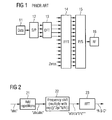
- Figure 1 shows the structure of a known sender in this technical field.
- 11 symbolizes an incoming data stream which may be coded into symbols, such as PSK or QAM symbols.
- a serial parallel converter 12 converts an appropriate number of symbols into a parallel available symbol group.
- DFT digital Fourier transformation
- FFT fast Fourier transformation
- the purpose of this transformation is avoiding problems as regards the peek to average power ratio (PAPR) in the subsequent processing steps, particularly in the analogue output.
- PAPR peek to average power ratio
- the output of the Fourier transformation is mapped into the frequency domain either in a localized manner (as shown in Fig.
- the inverse Fourier transformed outputs of IFFT 14 are fed to parallel serial converter 15 and then fed to the analogue radio frequency module 16.
- the incoming data sequences may be grouped according to users and may have for a given time different length corresponding to the different numbers of sub-channels allocated to different users.
- a DFT of appropriate size is needed. This would require the use of a variable DFT size or of plural DFT converters of respectively different width for accommodating the various widths required.
- a variable DFT size can easily be rendered by a software implementation. But mobile communication requires fast components (processing speed) for matching the throughput/capacity needs. Thus, the DFTs 13 are preferred to be hardware implementations. There, it is difficult or inefficient to make them flexible, and it is expensive to provide plural hardware components of different width in parallel. Thus, supporting sending to, or receipt from, multiple users in wireless communication systems in a fast and cheap manner is difficult.
- the present scheme uses only one fixed size DFT or IDFT depending on whether one is on the sending side or the receiving side.
- a feature of the invention is that to a data stream repetitions thereof are added, a term providing a frequency shift is applied to the elements of the data stream including the repetitions, and the result is processed by a fixed size FFT/iFFT.
- the repetition of the initial data stream is made such that the resulting number of symbols matches the input width of the FFT.
- a frequency division multiple access receiving method is rendered by which one or more individual data sequences coded into one or more respective individual symbol sequences sent from one or more senders can be received in a receiver via plural wireless sub-channels.
- the method comprises in the receiver the steps of pre-processing the received signals of the respective sub-channels for forming digital symbols and obtaining symbol sequences, a repetition step of repeating in said symbol sequences the individual symbols therein by a repetition number r for obtaining modified symbol sequences, wherein the repetition numbers for different symbol sequences may be different, a multiplying step of applying multiplicatively to the symbols of one or more of the modified symbol sequences a term exp(-j*2*n*mk*n/N), wherein mk is a shift offset of a respective sequence (corresponding to a user), n is a running index indicating the symbol position in the modified sequence, N is the number of simultaneously processed sub-channels, and j ⁇ 2 is -1, an adding step of adding correspondingly positioned symbols across the modified symbol
- a frequency division multiple access sending method may be configured in substantially the same way as the receiving method, with the difference, however, that the sums of the sum sequence are applied to a Fourier transformation (DFT, FFT), and the post-processing is different.
- DFT Fourier transformation
- FFT Fourier transformation
- symbol streams requiring a DFT (on the sending side) or an iDFT (on the receiving side) are repeated to obtain a stream length corresponding to the input width of the DFT/iDFT, and in multi-user environments a multiplicative term is applied to the repeated sequences in order to appropriately position the respective results on the output side of the DFT/iDFT.
- This method makes use of the following properties of the DFT/iDFT:
- the outputs of appropriately prepared and added symbol sequences can be added, transformed and thereafter separated again so that a fixed size (inverse) Fourier transformation can be used for plural user symbol sequences, also of various widths.
- Fig. 4 the following numbers are, by way of example, assumed: In an FDMA environment, 1200 sub-carriers (sub-channels) are available. These channels may be allocated to data transfer of users according to earlier agreements (band-width, costs). In Fig. 4 , the white boxes 40 show the available (not assigned) sub-channels, whereas the grey boxes show the sub-channels assigned as a group. The structure of Fig. 4 may best be understood from top to bottom as an iterative sub-channel assignment. At the beginning, all 1200 sub-channels are not assigned. It is then assumed that two users obtain each 400 sub-channels (left and right box), so that 400 of the initially 1200 remain unassigned.
- the width of the DFT/iDFT may correspond to the total number of sub-channels or may be an integer fraction thereof.
- the width of the DFT/iDFT should be an integer multiple to all possible symbol stream length, i.e. also an integer multiple to all possible numbers of sub-channels allocated to one user.
- the above-mentioned value of 1200 is 2*2*2*2*3*5*5 and supports thus sub-channel numbers 1, 2, 3, 4, 5, 6, 8, 10, 12, 15, 16, 20, 24, 25, 30, 40, 48, 50, 60, 75, 80, 100, 120, 150, 200, 240, 300, 400, 600 and 1200. If the DFT/iDFT width and thus also the number of simultaneously processable sub-channels is for example 1152, this exhibits the prime factors 2 ⁇ 7 and 3 ⁇ 2. With these prime factors, other numbers of sub-channels allocated to one user (“resource blocks”) can be supported.
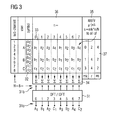
- Figure 2 shows as a very fundamental block diagram important features of the invention.
- 21 is a component for, or a step of, adding repetitions to one or more symbol sequences. The repetition is preferably made such that the sequence as a whole is repeated, so that for example "abc" would under a double repetition become “abcabc”.
- 22 is a means for, or a step of, frequency shifting, particularly by multiplicatively applying a term exp(-j*2* ⁇ *s), the factor s to be described later. Such a factor is applied to every individual symbol of the various repeated sequences, and the result is, as indicated, "a'b'c'a"b"c"".
- step/means 23 is a Fourier transformation (FFT/DFT).
- step/means 23 is an inverse Fourier transformation (iFFT/iDFT).
- the results are spaced Fourier transforms "A B C " of the original input sequence, the spacing corresponding to the repetition rate.
- Figure 2 shows the processing of one symbol sequence only.
- the output of FFT 23 shows that there are blanks between the Fourier transform outputs. These could be used for other symbol sequences, if properly prepared, particularly such that the results thereof fall into the blanks and not onto the outputs occupied by the already processed symbol sequence.
- the components 21 to 23 in Fig. 2 together with possibly some post-processing, could replace component 13 in Fig. 1 in order to change the prior art device of claim 1 into a device according to the invention.
- Figure 3 shows the case that plural symbol sequences are processed.
- a DFT/iDFT width of 8 corresponding to 8 simultaneously processable sub-channels is assumed.
- a user A has 4 sub-channels assigned, whereas users B and C, respectively, have two sub-channels assigned. This is shown on the left hand side of Fig. 3 .
- Box 33 shows the repeated sequences. Repetition is made such that the sequence including repetitions has a number of symbols corresponding to the number of simultaneously processable sub-channels, i.e. 8 in the shown example. This uses the prerequisite that the number of sub-channels allocated to a user (4 or 2 in the shown example) divide the number of simultaneously processable sub-channels (8 in the example) without remainder.
- the repetition rate r for user A is 2 because the number of symbols ns of "his" symbol sequences is 4.
- the repetition rate r is 4 because their respective numbers of symbols is 2. These numbers are shown in box 37 on the right hand side of Fig. 3 .
- N is the number of simultaneously processable sub-channels, i.e. 8 in the given example.
- n is an index designating the position of a particular symbol to which the particular factor is to be applied in the sequence including the repetitions. This value n is shown in box 36. As can be seen, it runs from 0 to 7, or generally, from 0 to N-1. Likewise, it could run from 1 to N.
- the value mk defines the offset of the transformation results on the parallel output terminals of the DFT/iDFT. These values mk must be selected such that the results appear in an appropriately separated manner, to be described.
- DFT/iDFT 31 has a number of output 31o corresponding to the number of inputs 31i, i.e. 8 outputs (or generally speaking: N outputs corresponding to N inputs). These outputs show at the respective output terminals.
- the selection of the user offsets mk must be made in view of the respective length of symbol sequence of the respective user and in view of earlier assignments and selections such that the transformation of the respective sequence receiving the offset falls on yet free output terminals.
- the value mk appears as a factor in the exp(%) term. Through this, it determines after the DFT/iDFT 31 the starting point of the respective outputs. This makes use of the above-mentioned property (b) that a cyclic shift of the signal corresponds to a frequency shift of the spectrum.
- the respective data can be nested such that transformation output corresponding to different users appear on different outputs. These outputs are spaced according to the repetition rate of the respective symbol sequence, and have an offset corresponding to the value mk defined for them.
- the sign of the exp-argument (j*2*n*n*mk/N) may be "+” or "-”. It must be constant within one DFT/iDFT 31, and the subsequent post-processing depends on it as regards the positions of the various outputs.
- Figure 4 shows for each sub-channel group assignment (resource block assignment) possible offsets mk and repetition rates r at the respective top right corner.
- 400 divides 1200 without remainder, and the 400 symbols appearing on the 400 sub-channels may be repeated 3 times in order to generate a cyclic pattern covering the input side of the DFT/iDFT.
- an offset mk of 0 is defined so that on the output side, the outputs for this user 41 occupy outputs 0, 3, 6, 9, 12, 15, ....
- user 42 also obtains 400 sub-channels capable of transmitting 400 symbols, to be repeated three times for obtaining a cyclic pattern.
- an offset of 2 is defined so that its outputs occupy DFT/iDFT outputs 2, 5, 8, 11, 14, 17, ... which is interleaved with those of user 41.
- each user receives 100 symbols at a time, to be repeated twelve times in order to generate on the input side a cyclic pattern corresponding to the width N of the DFT/iDFT. Since the repetition factor for users 43, 44, and 45 is 12, their outputs appear on the output side of DFT/iDFT at every twelve output.
- the user offsets mk is defined 1, 7, and 10 for user 43, 44, and 45, respectively.
- the output corresponding to user 43 occupies outputs 1, 13, 25, 37, ...
- the output of user 44 is on outputs 7, 19, 31, 43, ...
- the output of user 45 is on outputs 10, 22, 34, 46, ....
- the remaining 100 sub-channels are allocated to users 46 to 49.
- Their outputs must be placed on the remaining free outputs 4, 16, 28, 40, 52, 64 ....
- Their respective step width is 48 corresponding to the repetition rate of the 25 input signals to be repeated 48 times in order to arrive at a cyclic pattern of 1200 symbols corresponding to the 1200 inputs of the DFT/iDFT.
- Their respective offsets are 4, 16, 28, and 40, and from the respective offset on they occupy every 48 th output.
- the 1200 outputs of DFT/iDFT are occupied by separable data sorted according to user data streams. They appear in a cyclic manner on the outputs of the fixed size DFT/iDFT.
- a fixed size DFT/iDFT may be used for processing plural user input data streams with one large fixed size DFT/iDFT without requiring plural such transformation devices of different sizes.
- the outputs of the DFT/iDFT 31 may be brought to appropriate post-processing, which may in a sender be an inverse Fourier transformation (iDFT/iFFT) corresponding to component 14 in Fig. 1 .
- the outputs of the individual users may be mapped onto the iFFT 14 inputs in a desired way.
- the outputs can be converted to serial and fed to the analogue transmission circuit.
- the outputs of DFT/iDFT 31 are deinterleaved to obtain data sequences according to users. These sequences may be further transmitted.
- the offsets assigned to the various users have to be selected such that the spectra after the DFT/iDFT 31 are disjunct.
- a realizable combination of DFT length combinations can be visualized as a tree structure as shown in Fig. 4 , similar to a CDMA code tree.
- To every node in the tree of Fig. 4 corresponds the line spectrum on the output side of the DFT/iDFT 31 which can be described by using the mentioned repetition factor r (distance of neighbouring lines) and offset mk (index of the first line). Therefore, each node can be described by a repetition factor r and an offset mk.
- the root node, the 1200 box in Fig. 4 has repetition factor 1 (i.e. would cover all outputs) and offset 0 (i.e. starting from the first one).
- Figure 5 shows schematically hardware structures of receivers.
- 51 and 52 are pre-processings such as demodulations, channel estimations, and the like.
- 53 is a separator for user spectra which presents at the output the respective user data corresponding to the respectively assigned sub-channels of the respective user. On its output, the separator 53 shows a number of symbols corresponding to the number of simultaneously processable sub-channels. Its output would correspond to column 32 in Fig. 3 .
- 54 are repeaters for making for each user symbol sequence a repetition such that a periodic sequence of a length corresponding to the input width of the IDFT appears. To all those users not having a user offset of 0, the shift corresponding to box 35 in Fig. 3 or corresponding to box 22 in Fig.
- Fig. 3 This is shown at reference numeral 58.
- 55 is the summation corresponding to box 34 in Fig. 3 .
- 56 is the IDFT corresponding to 31 in Fig. 3 .
- 57 is post-processing of the result. It may comprise de-interleaving of the user outputs from the IDFT outputs so that on its output the data of the various users are available.
- the structure of Fig. 5b differs from that from Fig. 5a only in that due to a different channel allocation to users, the way of compiling user data is different.
- the Fig. 5a structure is suitable for localized SC-FDMA channel assignment.
- the structure of Fig. 5b with interleaving means 53' is suitable for a distributed SC-FDMA where user channels are regularly distributed across the available sub-channels.
- Figure 6 is a block diagram showing the invention in a sending context. It may be for example the base station of a wireless system serving plural mobile equipments belonging to plural users.
- the base station receives data for the various users and knows in advance how many sub-channels are available for each user. A corresponding number of symbols can be transmitted at a time to each user. Such a number of symbols is formed into a sequence such that for each user a sequence of symbols of a length corresponding to the respectively assigned sub-channels is available and provided. This is symbolized with 61 in Fig. 6 .
- Repeaters 54 are provided in the same way as in Fig. 5 .
- Each symbol sequence is repeated such that the sequence including the repetitions has a length corresponding to the number of simultaneously processable sub-channels and corresponding to the input width of the DFT 62.
- a multiplicative term is applied to various symbol sequences in the same way as described with reference to Fig. 5 and as shown in Fig. 3 .
- Summation 55 corresponds to that of Fig. 5 .
- Box 62 is a Fourier transformer. It may be a DFT or an FFT. Its input width is N, and it has the same output width. It is noted in this respect that the number of lines amongst the components in Figs. 5 and 6 do not indicate the numbers of respective inputs and outputs. The lines there only show qualitatively signal flow.
- the N outputs of DFT 62 may go into a mapping unit 63 for mapping these outputs such that they appear on desired sub-channels.
- 64 is an inverse Fourier transformation preparing the signals for sending. 65 symbolizes the analogue part towards airing the signals.
- the invention may be applied both on the receiving side ( Fig. 5 ) and on the sending side ( Fig. 6 ). It may be applied both in cellular base stations for sending and/or receiving, and in mobile user equipment for sending/receiving, such as in cell phones, PDAs, wLAN components, laptops with radio access and the like.
- the assignment of sub-channels and offsets to user data and symbol streams may be made by a scheduling component.
- This scheduling component may make the assignment for every submitted frame (number of symbols corresponding to the fixed input width N of the DFT/iDFT). Changing assignments of sub-channels and internal offsets may be necessary between frames because, needless to say, one user may be served and thus disappear from services, or a user may come new and require services not requested so far.
- the scheduler has access to respective organization information and information on the number of sub-channels for each user, and can determine in accordance thereto the particular channel assignment, repetition rates r for the respective symbol sequences, offsets mk for the individual sequences, and adjust these quantities so that in the respective computations they can be used as required.
- the symbols in the respective user symbol sequences may be PSK Symbols (Phase Shift Keen Symbols) of an appropriate bit size or may be QAM Symbols (Quadrature Amplitude Modulation Symbols) of an appropriate bit size. They may be represented as complex numbers to which the exp((7) term is applied multiplicatively as required.
- the Fourier transformer 31, 56, 62 may be a hardware device. It has fixed input width N and a corresponding output width N of signals. As said earlier, two or more of such transformers may be provided with different input widths N1, N2. The input widths are selected such that within the totally available number of sub-channels different user resource block sizes can be supported (number of sub-channels allocated to a user). As already said, this requires a suitable combination of prime factors of the input width number. Preferably, low prime factors such as 2, 3, and 5 are accommodated at least with power 2. Prime factor 2 may be accommodated with power 4, 3 may be accommodated with power 2 or 3, 5 may be accommodated with power 2 or 3. One transformer may be provided having width 1200 (2 ⁇ 4*3*5 ⁇ 2). Another transformer may be provided of width 1152 (2 ⁇ 7*3 ⁇ 2). With such an arrangement, plural possible resource block sizes can be supported according to the possible prime factor products with respectively at least one of the provided transformers.
- the method according to the invention can also support B-IFDMA (block interleaved frequency division multiple access) and B-EFDMA (block equidistant frequency division multiple access).
- B-IFDMA block interleaved frequency division multiple access
- B-EFDMA block equidistant frequency division multiple access
- Fig. 7 shows 32 sub-channels in which four 2-channel-blocks with respective 6 channels inbetween are assigned.
- the distance of the small user blocks equals the repetition factor which is the same for all streams/subcarriers.
- the frequency shift for neighboring sub-carriers increases by exp(-j*2*n/N).
- the method supports multiplexing of different data streams for IFDMA, B-IFDMA, B-EFDMA.
- One fixed size (inverse) Fourier transformation is provided and can accommodate plural data streams.
- inverse Fourier transformation is provided and can accommodate plural data streams.
- the input symbol sequences (see e.g. fig. 3 ) were described to be established according to users and sub-channels allocated to them, which makes sense from a factual point of view because then the output is also user- or receiver-specific.
- other constraints may make other symbol sequence arrangements more advantageous so that other symbol sequence compilation criteria than "same user” or “same source/destination address” or “same sender/receiver” may be more advantageous.
- the invention may, but needs not necessarily require that symbols within one symbol sequence (such as a1, a2, a3, a4 in fig. 3 ) come from the same sender and/or go to the same receiver.
- Other compilation criteria may be "same application" (e. g.
- the invention may also be used in user equipments which require accommodation of only one user data stream (presented probably through plural sub-channels).
- the other sub-channels may be disregarded or may be set to 0 in processing.
Landscapes
- Engineering & Computer Science (AREA)
- Signal Processing (AREA)
- Computer Networks & Wireless Communication (AREA)
- Mobile Radio Communication Systems (AREA)
Priority Applications (1)
| Application Number | Priority Date | Filing Date | Title |
|---|---|---|---|
| EP07010071A EP1995904A1 (fr) | 2007-05-21 | 2007-05-21 | Procédé et appareil pour la transmission et la réception d'accès multiples par répartition en fréquences |
Applications Claiming Priority (1)
| Application Number | Priority Date | Filing Date | Title |
|---|---|---|---|
| EP07010071A EP1995904A1 (fr) | 2007-05-21 | 2007-05-21 | Procédé et appareil pour la transmission et la réception d'accès multiples par répartition en fréquences |
Publications (1)
| Publication Number | Publication Date |
|---|---|
| EP1995904A1 true EP1995904A1 (fr) | 2008-11-26 |
Family
ID=38871575
Family Applications (1)
| Application Number | Title | Priority Date | Filing Date |
|---|---|---|---|
| EP07010071A Withdrawn EP1995904A1 (fr) | 2007-05-21 | 2007-05-21 | Procédé et appareil pour la transmission et la réception d'accès multiples par répartition en fréquences |
Country Status (1)
| Country | Link |
|---|---|
| EP (1) | EP1995904A1 (fr) |
Cited By (2)
| Publication number | Priority date | Publication date | Assignee | Title |
|---|---|---|---|---|
| WO2015130043A1 (fr) * | 2014-02-27 | 2015-09-03 | 삼성전자 주식회사 | Procédé et appareil de modulation permettant une émission et une réception de signaux dans un système de communication mobile |
| WO2020136895A1 (fr) * | 2018-12-28 | 2020-07-02 | 三菱電機株式会社 | Dispositif de transmission sans fil, dispositif de réception sans fil, système de surveillance de communication à distance, système de communication sans fil et procédé de communication sans fil |
Citations (2)
| Publication number | Priority date | Publication date | Assignee | Title |
|---|---|---|---|---|
| WO2002078232A1 (fr) * | 2001-03-26 | 2002-10-03 | Samsung Electronics Co., Ltd. | Appareil et procede de communication de donnees bases sur l'acces multiple par repartition orthogonale de frequence (ofdma) |
| WO2006118411A2 (fr) * | 2005-05-02 | 2006-11-09 | Lg Electronics Inc. | Dispositif de limitation de bande dans des systemes de communication sc-fdma et procede associe |
-
2007
- 2007-05-21 EP EP07010071A patent/EP1995904A1/fr not_active Withdrawn
Patent Citations (2)
| Publication number | Priority date | Publication date | Assignee | Title |
|---|---|---|---|---|
| WO2002078232A1 (fr) * | 2001-03-26 | 2002-10-03 | Samsung Electronics Co., Ltd. | Appareil et procede de communication de donnees bases sur l'acces multiple par repartition orthogonale de frequence (ofdma) |
| WO2006118411A2 (fr) * | 2005-05-02 | 2006-11-09 | Lg Electronics Inc. | Dispositif de limitation de bande dans des systemes de communication sc-fdma et procede associe |
Non-Patent Citations (1)
| Title |
|---|
| SORGER U ET AL: "Interleaved FDMA-a new spread-spectrum multiple-access scheme", COMMUNICATIONS, 1998. ICC 98. CONFERENCE RECORD. 1998 IEEE INTERNATIONAL CONFERENCE ON ATLANTA, GA, USA 7-11 JUNE 1998, NEW YORK, NY, USA,IEEE, US, vol. 2, 7 June 1998 (1998-06-07), pages 1013 - 1017, XP010284733, ISBN: 0-7803-4788-9 * |
Cited By (3)
| Publication number | Priority date | Publication date | Assignee | Title |
|---|---|---|---|---|
| WO2015130043A1 (fr) * | 2014-02-27 | 2015-09-03 | 삼성전자 주식회사 | Procédé et appareil de modulation permettant une émission et une réception de signaux dans un système de communication mobile |
| US9917722B2 (en) | 2014-02-27 | 2018-03-13 | Samsung Electronics Co., Ltd. | Modulation method and apparatus for signal transmission and reception in mobile communication system |
| WO2020136895A1 (fr) * | 2018-12-28 | 2020-07-02 | 三菱電機株式会社 | Dispositif de transmission sans fil, dispositif de réception sans fil, système de surveillance de communication à distance, système de communication sans fil et procédé de communication sans fil |
Similar Documents
| Publication | Publication Date | Title |
|---|---|---|
| RU2365041C1 (ru) | Способ и устройство передачи для выделения ресурсов для передачи пакетных данных восходящей линии связи в системе мультиплексирования с ортогональным частотным разделением каналов | |
| DK2299626T3 (en) | Signaling method and apparatus in an OFDM multiple access system | |
| RU2325773C1 (ru) | Способ для выделения подканала в сотовой системе связи множественного доступа с ортогональным частотным разделением каналов | |
| JP4703135B2 (ja) | 送信機および送信制御方法 | |
| CN101421948B (zh) | 在正交频分复用系统中使用线性内插方案的信道估计方法和装置 | |
| CN101019457B (zh) | 用于发送和接收与不同多路接入技术相关联的数据块的方法、装置和通信接口 | |
| JP4358271B2 (ja) | 多重搬送波を用いる広帯域無線通信システムにおける副搬送波割り当て方法及び装置 | |
| EP1657872A2 (fr) | Appareil et méthode pour transmettre un préambule et rechercher une cellulle dans un système OFDM | |
| EP1955462A2 (fr) | Appareil et procede de transmission de donnees au moyen d'une pluralite de porteuses | |
| JP2006504324A (ja) | combパターンシンボルの周波数跳躍直交周波数分割多重接続方法 | |
| KR20080106832A (ko) | 직교 주파수 분할 다중 시스템의 평균전력 대 최대전력비감소 장치 및 방법 | |
| AU2121701A (en) | Multi-carrier CDMA radio transmitting method and apparatus, and channel estimation method and apparatus for multi-carrier CDMA radio transmitting system | |
| EP1665594A2 (fr) | Combinaison d'une transformation de fourier rapide inverse et du traitement des intervalles de protection pour la mise en oeuvre efficace de systemes a multiplexage par repartition orthogonale de la frequence | |
| CN101267672B (zh) | 抑制ofdma系统天线间干扰的子信道分配方法和设备 | |
| US9596117B2 (en) | OFDM modulator, OFDM transmission device, and OFDM modulation method | |
| WO2007022831A1 (fr) | Emetteur/recepteur multiporteuse a ondelettes / mrof combine | |
| US7852955B2 (en) | Orthogonal frequency division multiplexing transmitting and receiving method and device thereof | |
| KR101295378B1 (ko) | 다수의 반송파를 이용하여 데이터를 전송하는 장치 및 방법 | |
| CN101069398B (zh) | 用于进行mimo-ofdm系统的多流fft的方法和装置 | |
| EP1995904A1 (fr) | Procédé et appareil pour la transmission et la réception d'accès multiples par répartition en fréquences | |
| KR20090059315A (ko) | 통신시스템에서 역 고속 퓨리에 변환 방법 및 장치 | |
| US8046398B2 (en) | Method and apparatus for modulating symbols in an orthogonal frequency division multiplexing system and transmission apparatus using the same | |
| KR100836624B1 (ko) | 가변 고속 푸리에 변환 장치 및 그 방법 | |
| KR20100136610A (ko) | 단일 반송파-주파수 분할 다중 통신 시스템에서 신호 송수신 장치 및 방법 | |
| US20090067518A1 (en) | Interpolation Method and a Related Device for Channel Estimation in Communication Systems |
Legal Events
| Date | Code | Title | Description |
|---|---|---|---|
| PUAI | Public reference made under article 153(3) epc to a published international application that has entered the european phase |
Free format text: ORIGINAL CODE: 0009012 |
|
| AK | Designated contracting states |
Kind code of ref document: A1 Designated state(s): AT BE BG CH CY CZ DE DK EE ES FI FR GB GR HU IE IS IT LI LT LU LV MC MT NL PL PT RO SE SI SK TR |
|
| AX | Request for extension of the european patent |
Extension state: AL BA HR MK RS |
|
| AKX | Designation fees paid | ||
| STAA | Information on the status of an ep patent application or granted ep patent |
Free format text: STATUS: THE APPLICATION IS DEEMED TO BE WITHDRAWN |
|
| 18D | Application deemed to be withdrawn |
Effective date: 20090527 |
|
| REG | Reference to a national code |
Ref country code: DE Ref legal event code: 8566 |